Key 2. Perithecial, pseudothecial, cleistothecial and gymnothecial fungi
Reading edition
1 (key 1,2) Perithecia occurring singly or in groups, but directly on the dung or buried in it (figs 16, 28, 19, 22, 27, 30, 32, 34-36). 2
- Perithecia occurring in or on a mass of fungal tissue (stroma) growing in or on the dung (figs 32, 37). 135
2(1) Spores black, brown or dark olive-greenish. 3
- Spores hyaline or pale coloured, at least under the microscope (may be coppery red en masse). 117
3(2) Spores smooth, without an ornamentation of hyaline pits. 4
- Spores 1-celled, ornamented with hyaline pits.
(Gelasinospora) 114
4(3) Perithecia dark, olive, brown or black. 5
- Perithecia reddish brown, orange or golden, globose, with a neck. Spores black, limoniform. 116
5(4) Perithecia globose, surmounted by a dense tuft of greyish green hairs, which may be branched or simple, straight or curly. Spores olivaceous, limoniform. Asci clavate, soon disappearing. (A large genus not characteristic of dung, but occurring occasionally).
Chaetomium (fig. 16)
- Perithecia more pyriform, or if globose then with a distinct neck, may be setose but not densely hairy, with clavate or cylindrical asci. 6
6(5) Each spore composed of 4 or more cells in a row (figs 17, 21). Asci bitunicate (figs 20, 23). 7
- Spores 1- or 2-celled. Asci bitunicate or unitunicate. 29
7(6) Spores 16-32-celled, united firmly together in a bundle both in the ascus and after discharge. Germ slits usually absent.
(Sporormia) 8
- Spores each with 4 or more cells, each spore free and surrounded by its own gelatinous sheath. Germ slits usually present.
(Sporormiella) 11
8(7) Spores 16-20-celled. 9
- Spores 29-32-celled, 130-160 × 4-6µm. Sporormia mirabilis
9(8) Spores 16-celled, 85-116 × 5-6.5µm. Sporormia fimicola
- Spores smaller. 10
10(9) Spores 16-celled, 37-45 × 3µm. Asci 50-60 × 10-12µm.
Sporormia sp. (fig. 17)
[recorded as S. fimetaria by Richardson (1972); see also Bell (1983) and Dissing (1992)]
- Spores 16-20-celled, 50-57 × 3.5-4.5µm. Asci 70-80 × 12-16µm.
Sporormia fimetaria
(These two taxa may represent the extremes of S. fimetaria).
11(7) Spores 4-celled. 12
- Spores more than 4-celled. 22
12(11) Spores more than 65-70µm long. 13
- Spores less than 65-70µm long. 15
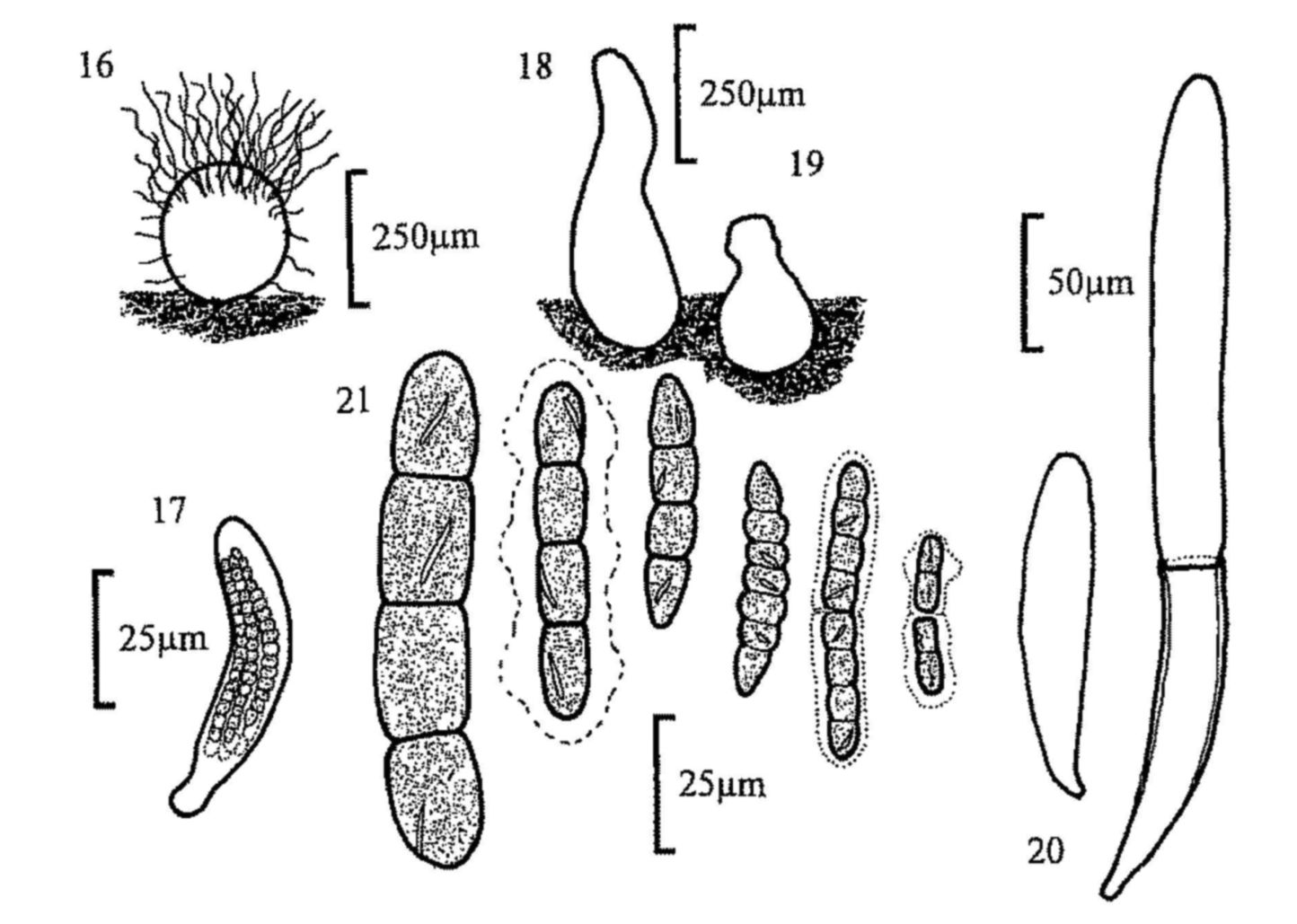
Fig. 16. Chaetomium sp., perithecium and spore. Fig. 17. Sporormia sp., ascus and spores. Fig. 18. Sporormiella ovina, pseudothecium. Fig. 19. S. intermedia, pseudothecium. Fig. 20. S. intermedia, immature bitunicate ascus and mature ascus with outer layer ruptured. Fig. 21. Ascospores of, from left, S. ovina, S. intermedia (with gelatinous sheath characteristic of the genus), S. lageniformis, S. vexans, S. bipartis and S. minima.
13(12) Spores 65-95 × 15-18µm. Sporormiella megalospora
- Spores longer than 90µm. 14
14(13) Spores 90-118 × 15-20µm. Asci tapering gradually from the broadest part near the apex to a 'stipe'.
Sporormiella ovina (figs 18, 21)
- Spores 91-114 × (14)18-21µm. Asci cylindrical, abruptly contracted below to a short 'stipe'.
Sporormiella borealis
15(12) Spores mostly less than 35µm long. 16
- Spores mostly between 35-60µm long. 19
16(15) Spores less than 25µm long. 17
- Spores 25-35(38)µm long. 18
17(16) Spores (15)17-24(26) × 5-7µm, end cells broadly conical. Ascospores uniseriate. Asci 120-135µm long. Pseudothecia 250-300µm diam.
Sporormiella pulchella
- Spores 16-22 × 4.5-5.5µm, end cells subovate. Ascospores biseriate. Asci 95-125µm long. Pseudothecia 300-350µm diam.
Sporormiella nigropurpurea
18(16) Spores 30-38.5 × 5.5-6.5µm. Asci clavate, tapering gradually below to a 'stipe'.
Sporormiella leporina
- Spores 27-36(38) × 4-6(8)µm, tending to break in two at the middle septum. Asci cylindrical, abruptly contracted below.
Sporormiella minima (fig. 21)
19(15) Spores with end cells rounded. Asci cylindrical, abruptly contracted below. 20
- Spores with end cells tapered and slightly conical. Asci clavate, tapering gradually to a long stalk. 21
20(19) Spores 45-65 × 8-11.5µm.
Sporormiella intermedia (figs 19-21)
- Spores 38-46 × 6.5-8µm. Sporormiella australis
21(19) Spores 45-60 × 11.5-14µm, germ slits parallel with long axis.
Sporormiella grandispora
- Spores 35-45(48) × 7-9(10)µm.
Sporormiella lageniformis (fig. 21)
22(11) Spores 5-celled, 70-80 × 17-19µm. Sporormiella pentamera
- Spores more than 5-celled. 23
23(22) Spores 7- or 8-celled. 24
- Spores 13-celled, 46-60 × 9-10µm. Sporormiella antarctica
24(23) Spores 7-celled. 25
- Spores 8-celled. 26
25(24) Spores 40-55 × 7-9µm, readily disarticulating, the end cells longer than wide, the rest shorter than wide.
Sporormiella vexans (fig. 21)
- Spores 70-80 × 16-18µm, end cells rounded.
Sporormiella heptamera
26(24) Spores mostly longer than 45µm. 27
- Spores less than 50µm long, not disarticulating at the central septum. 28
27(26) Spores 45-60 × 5-7.5µm, disarticulating at the central septum, all cells the same width.
Sporormiella bipartis (fig. 21)
- Spores 50-59 × 10-12µm, not disarticulating, 3rd cell down wider than the others.
Sporormiella corynespora
28(26) Spores (33)37-40(49) × 7-9µm, cylindrical. Asci abruptly contracted below.
Sporormiella pascua
- Spores 40-48 × 7-8µm, fusiform cylindrical. Asci gradually tapered below.
Sporormiella octomera
29(6) Spores obviously 2-celled at maturity. 30
- Spores 1-celled, or appearing 1-celled at maturity. (Those of Podospora, Schizothecium etc. are 2-celled in early stages of their development, but only one cell matures to become pigmented; the other remains hyaline, often collapses, and may be difficult to see). 47
30(29) Spores 23-28 × 13-17µm, upper cell dark, 15-19µm, with close, blunt spines giving the impression of a pitted spore surface, with apical germ pore, the lower cell hyaline, 6-8.5µm, smoky-brown. Asci unitunicate, 4-spored. Perithecia 400µm diam.
Apiosordaria verruculosa (fig. 24)
- Both cells of spore similar in shape, size and colour. 31
31(30) Asci unitunicate. Spores with a 'gelatinous' appendage at each end. Perithecial neck with setae. 32
- Asci bitunicate. Spores without gelatinous appendages, although a sheath may be present. 33
32(31) Spores 38-48 × 11-14µm, appendages longitudinally fibrillate.
Zygospermella striata
- Spores 46-68 × 11-17µm, appendages hollow, not fibrillate.
Zygospermella insignis (fig. 25)
33(31) Spores with each end truncated by a germ pore. Pseudothecia with dark bristles at neck.
(Trichodelitschia) 34
- Spores with rounded ends and germ slits along the sides. Pseudothecial neck smooth or hairy, but without setae.
(Delitschia, fig. 26) 36
34(33) Spores 28-34 × 9-12µm. Trichodelitschia aedelphica
- Spores smaller. 35
35(34) Spores 20-27.5 × 8-11µm.
Trichodelitschia bisporula (figs 22, 23)
- Spores 18-21 × 6-7µm. Trichodelitschia munkii
36(33) Asci ca 256-spored. Spores 14-15 × 6-8µm.
Delitschia myriaspora
- Asci 8-spored. 37
37(36) Spores less than 20µm long. 38
- Spores more than 20µm long. 41
38(37) Spores 8-11 × 3-5µm. Delitschia perpusilla
- Spores 10-20µm long. 39
39(38) Spores 10-14 × 5-6µm. Delitschia marchalii
- Spores longer. 40
40(39) Spores 14-18 × 6-10µm, uniseriate. Asci 70-90 × 7-16µm.
Delitschia niesslii
- Spores (16)18-20(22.5) × 6-7.5µm, biseriate. Asci 80-145 × 20-25µm.
Delitschia consociata (fig. 26)
41(37) Spores mostly wider than 20µm. 42
- Spores mostly less than 20µm wide. 43
42(41) Spores 50-64 × 19-23µm. Delitschia furfuracea
- Spores 50-70 × 25-33µm.
Delitschia winteri (fig. 26)
43(41) Spores 20-25 × 4.5-6µm, the cells slightly tapered and almost completely separated. Pseudothecia hairless, globose, ca 200µm diam.
Delitschia leptospora (fig. 26)
- Spores longer and wider. 44
44(43) Spores transversely septate. 45
- Spores obliquely septate, deeply constricted at the septum, 35-50 × 15-18µm.
Delitschia didyma
45(44) Pseudothecia hairy. Spores 37-50 × 17-20µm, not deeply constricted at the septum.
Delitschia chaetomioides
- Pseudothecia smooth. 46
46(45) Spores biseriate, 45-55 × 13-16µm, one cell usually larger than the other, deeply constricted at the septum and readily separating.
Delitschia canina
- Spores uniseriate, 40-55 × 16-21µm, both cells equal.
Delitschia patagonica
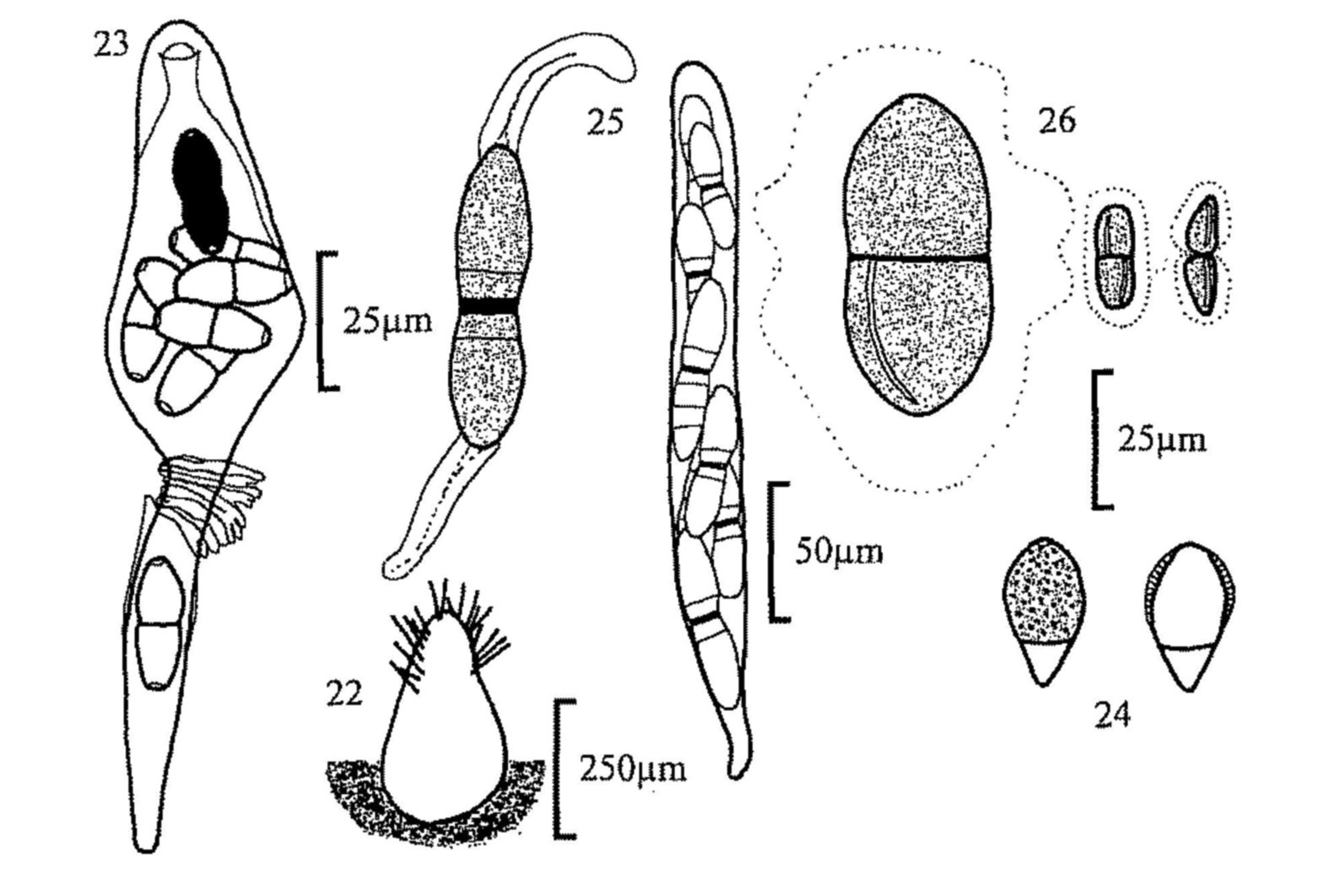
Fig. 22. Trichodelitschia bisporula, pseudothecium. Fig. 23. T. bisporula, expanded ascus broken through the outer wall, with spores. Fig. 24. Apiosordaria verruculosa, ascospores. Fig. 25. Zygospermella insignis, ascus and ascospore. Fig. 26. Ascospores of, from left, Delitschia winteri, D. consociata and D. leptospora.
47(29) Spores with colourless 'gelatinous' secondary appendages (caudae, fig. 28) at one or both ends (not always easy to see; mounting in Indian ink is useful, and essential for some). A hyaline (empty) cell, the primary appendage (fig. 28), may also be present. 48
- Spores without caudae, although a colourless gelatinous sheath may be present. Primary appendages present or absent. 88
48(47) Perithecia often hairy or tomentose when young. Immature spores long, wavy cylindrical, with a row of globules, and more likely to be seen than mature spores (fig. 29). Secondary appendages thin, simple, up to 60 × 3µm. Mature spores with a dark cell 14-25 × 7-13µm and pedicel (primary appendage) 25-50 × 3-6µm.
(Cercophora) 49
- Perithecia often with scales or setae at the neck or tomentose. Caudae, simple or compound. Immature spores clavate or ellipsoid, not long, wavy cylindrical. Mature spores readily observed. 51
49(48) Immature spores 45-70 × 4-6µm. 50
- Immature spores smaller, 38-52 × 3-3.5µm. Mature spores with upper (dark) cell 14-18 × 7-9µm; hyaline pedicel 27-36 × 3-3.5µm.
Cercophora silvatica
50(49) Perithecia with white or grey tomentum. Young spores 45-65 × 4.5-6µm. Mature spores with upper cell 17-25 × 8.5-13µm and pedicel 30-50µm long.
Cercophora coprophila (fig. 29)
- Perithecia with flexuose brown hairs and, at the neck, tufts of agglutinated, swollen, obtuse hairs. Young Spores 52-68 × 4-5µm. Mature spores with upper cell 15-25 × 9-11µm and pedicel 35-45µm long.
Cercophora mirabilis
51(48) Primary appendage absent.
(Arnium, fig. 28) 52
- Primary appendage present. 60
52(51) Asci (64-)128-spored. Spores 18-26 × (10)12-15µm. Perithecial neck sometimes with rigid, brown, septate hairs up to 330µm.
Arnium leporinum
- Asci 4- or 8-spored. 53
53(52) Asci 4-spored. 54
- Asci 8-spored. 55
54(53) Spores ellipsoid, sometimes inequilaterally flattened, 44-54 × 22-30µm, with 1 apical germ pore, caudae not swelling in water. Perithecium usually with lateral tufts of agglutinated hairs up to 550µm long.
Arnium arizonense
- Spores evenly ellipsoid-fusiform, 31-55 × 18-25µm, with germ pore at each end, caudae covering germ pores, 35-60 × 7-11µm, but rupturing and swelling to up to 130 × 50µm, and becoming diffuse and irregular. Perithecial neck covered with rigid hairs up to 190 × 2.5µm.
Arnium hirtum
55(53) Perithecial neck distinctly setose with rigid hairs. 56
- Perithecial neck without setae. 57
56(55) Spores evenly ellipsoid-fusiform, 31-55 × 18-25µm, with germ pore at each end, caudae covering germ pores, 35-60 × 7-11µm, but rupturing and swelling up to 130 × 50µm, and becoming diffuse and irregular. Perithecial neck covered with rigid hairs up to 190 × 2.5µm.
Arnium hirtum
- Spores slightly inequilateral, 35-43 × 17-23µm, caudae 50-75 × 5-8µm, not covering germ pores. Perithecial neck with brown hairs up to 250µm long.
Arnium cervinum
57(55) Perithecia covered with a dense tomentum of septate flexuous hairs. Spores mostly longer than 45µm. Only occasionally fimicolous. 58
- Perithecia without a tomentum. Spores up to 45µm. 59
58(57) Spores (40)45-54 × 25-35µm, uniseriate. Tomentum pale or grayish.
Arnium olerum
- Spores 47-70 x 20-30µm, biseriate above. Tomentum olivaceous brown.
Arnium tomentosum
59(57) Spores somewhat inequilateral, rounded below, pointed above, 31-40 × 18-24µm, caudae 50-120 × 6-10µm, with 1 apical germ pore not covered by cauda.
Arnium caballinum
- Spores equilateral, 36-44 × 20-23µm, caudae 50-80 × 6-8µm, covering germ pores.
Arnium mendax
60(51) Perithecia with scales at the neck, composed of inflated and agglutinated cells (fig. 27, S. conicum).
(Schizothecium) 61
- Perithecia setose or hairy at the neck, but not with inflated cells, or neck black but almost hairless.
(Podospora) 70
61(60) Asci 4-spored. 62
- Asci 8-spored. 63
62(61) Spores 11-14.5 × 6.5-9µm.
Schizothecium nanum (fig. 28)
- Spores 19-24 × 12-14.5µm. Schizothecium tetrasporum
63(61) Spores more than 30µm long. 64
- Spores less than 30µm long. 65
64(63) Perithecia crowned with a fascicle of long agglutinated hairs at the neck, up to 335µm long. Spores 31-40 × 15-25µm, biseriate.
Schizothecium aloides
- Perithecia with shorter, less remarkable tufts. Spores 30-45 × 19-24µm, ± uniseriate.
Schizothecium glutinans
65(63) Perithecial neck with rigid setae, as well as agglutinated hairs (which may be greatly reduced). Asci 140-210 × 19-25µm, broadest at the markedly rounded apex. Spores 18-23 × 11-14µm.
Schizothecium pilosum
- Perithecial neck without rigid setae. Asci broadest in the middle. 66
66(65) Spores mostly over 23µm long. 67
- Spores up to 23µm long. 69
67(66) Spores 22-25(27) × 11-13µm. Scales at neck distinct.
Schizothecium hispidulum
- Spores wider, 12-19µm 68
68(67) Perithecia 0.5-1mm high, scales at neck usually well developed. Spores (23)26-30 × 12-17µm.
Schizothecium conicum (fig. 27)
- Perithecia 1-2mm diam., subpyriform, neck velvety with indistinct scales. Spores 24-28 × 15-19µm.
Schizothecium squamulosum
69(66) Spores 17-23 × 8.5-13.5µm, primary appendage slender cylindrical, 6-8 × 2µm. Perithecia 0.25-0.7mm high, sometimes with poorly developed scales.
Schizothecium vesticola (fig. 28)
- Spores 11-14 × 6-8µm, primary appendage short, 2µm long, almost triangular. Perithecia 0.3-0.45mm high, with short agglutinated hairs.
Schizothecium cervinum
70(60) Asci 4-spored. Spores 35-40 × 18-19µm. Podospora pauciseta
- Asci with more than 4 spores. 71
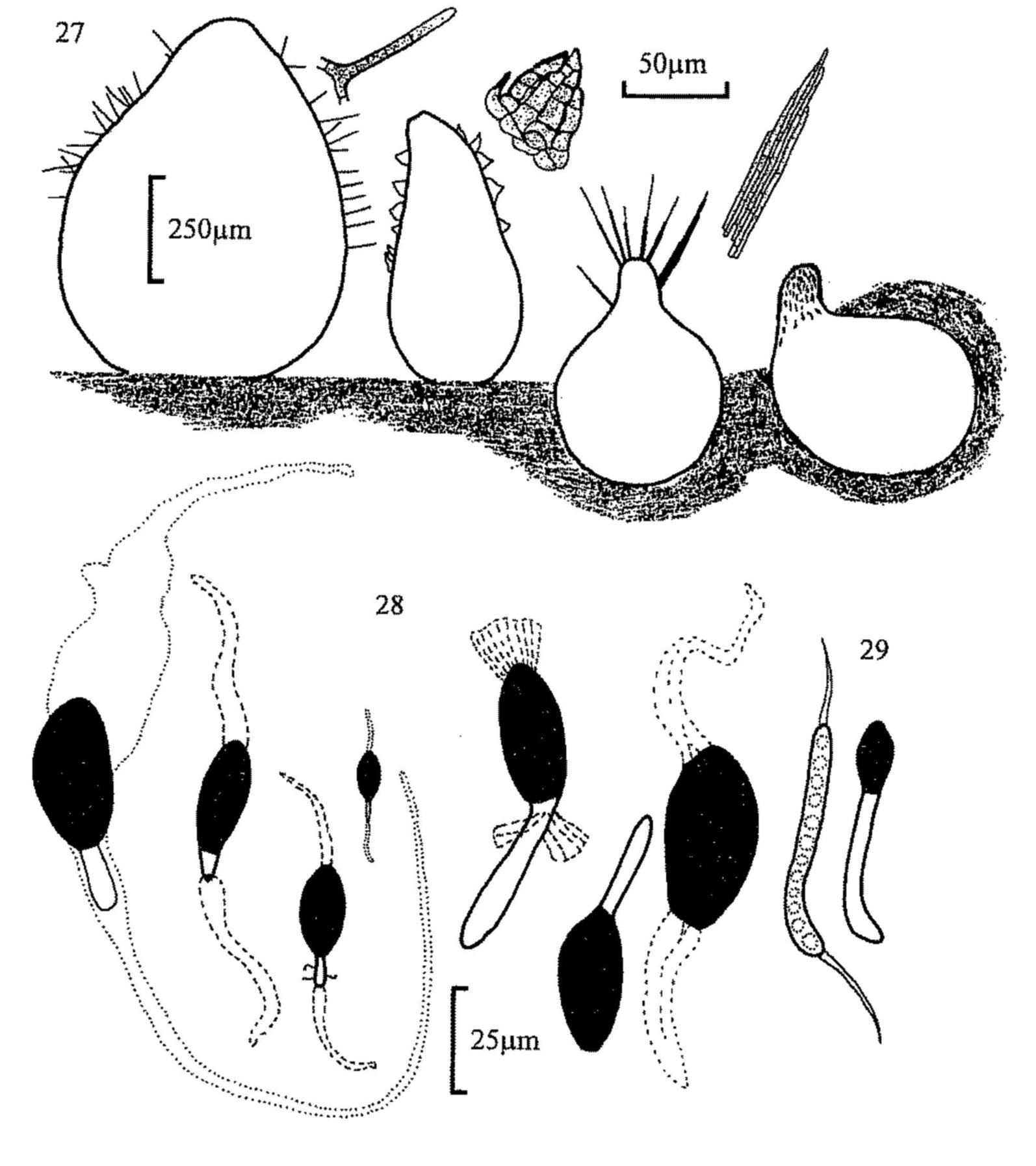
Fig. 27. Perithecia, from left, of Podospora appendiculata, Schizothecium conicum, P. excentrica and P. decipiens, with detail of hairs. Fig. 28. Ascospores of, from left, Podospora excentrica, P. appendiculata, S. vesticola, S. nanum, P. decipiens, 'P. dagobertii' and Arnium sp. Fig. 29. Cercophora coprophila, immature (l) and mature (r) ascospores.
71(70) Asci 8-spored. 72
- Asci with more than 8 spores. 82
72(71) Spores more than 45µm long. 73
- Spores less than 45µm long. 74
73(72) Spores 48-60 × 27-31µm, caudae apparently striate. Perithecia superficial, covered with rigid, nonagglutinated hairs up to 120µm.
Podospora fimiseda
- Spores 50-68 × 22-32µm, caudae apparently segmented, with an intestine-like appearance. Perithecia immersed to superficial, with a long neck, tomentose with long flexuous hairs when young, more or less glabrous when mature.
Podospora intestinacea
74(72) Perithecia superficial, ovoid to globose, covered with short (up to 100µm), sparse, radiating, hyaline tipped, hairs. Spores 24-31 × 11-15µm, with simple caudae.
Podospora appendiculata (figs 27, 28)
- Perithecia with base immersed in substrate, pyriform, without such hairs. 75
75(74) Perithecial neck with short tubercular hairs, up to 20µm long. Spores 32-42 × 17-22µm, with a long but withering primary appendage. Caudae in two rings, one inserted near the base of the primary appendage, the other at the spore apex. The individual filaments may be free, but often clump together to form an apparently broad appendage.
Podospora decipiens (figs 27, 28)
- Perithecial hairs longer. Caudae single or 4 at each end. 76
76(75) Spores with 4 caudae at each end. 77
- Spores with a single cauda at each end. 78
77(76) Spores 40-45 × 22-25µm. Podospora gwynne-vaughaniae
- Spores 29-40 × 16-25µm. Podospora communis
78(76) Spores less than 30 × 15µm. 79
- Spores larger than 30 × 15µm. 80
79(78) Spores 21-28 × 11-14µm, primary appendage 12-14 × 4µm. Perithecia 0.3-0.5mm diam., neck setose with rigid cylindrical hairs. Asci 200-250 × 22-26µm, broadest in the middle.
Podospora ellisiana
- Spores 18-23 × 11-14µm, primary appendage 4-8 × 3µm. Perithecia 0.2-0.3mm diam., neck setose with rigid hairs. Asci 140-210 × 19-25µm, broadest at the markedly rounded apex.
Schizothecium pilosum
80(78) Perithecia ca O.9-1.4mm high × 0.6-0.7(0.85)mm diam., neck not hairy. Spores (29)36-45 × (17.5)22-27µm, caudae ephemeral and difficult to see, even in Indian ink.
Podospora pyriformis
- Perithecial neck with tufts of rigid hairs. 81
81(80) Perithecia 0.38-0.53mm high × 0.21-0.38mm diam., ± immersed, with hairs at the neck up to 335µm long, grouped in rigid fascicles. Spores slightly flattened on one side, 30-37 × 18-24µm, caudae invisible in water.
Podospora excentrica (figs 27, 28)
- Perithecia ca 0.8-1.4mm high × 0.4-0.7mm diam., semi-immersed, hairy all over, flexuous below, rigid and pointed at the neck up to 170µm. Spores 33-45 × 22-27µm.
Podospora perplexens
82(71) Asci 16-32-spored. Perithecial neck with short tubercular hairs. Spores 25-36 × 15-24µm. Caudae in two rings, one inserted at the base of the primary appendage, the other at the spore apex; individual filaments may be separate or clumped to appear as a broad single appendage (cf. P. decipiens).
Podospora pleiospora
- Asci with more than 32 spores. 83
83(82) Perithecia with tufts of rigid hairs at neck. Asci with more than 64 spores. 84
- Perithecia without tufts of rigid hairs. Asci 64-spored. 87
84(83) Spores 14-17 × 9-11µm. Asci 256-spored. Perithecia ca 500µm diam., immersed, except for the neck, which has tapered tufts of hairs up to 300µm.
Podospora curvicolla
- Spores larger. Perithecia semi-immersed. 85
85(84) Spores (18)20-26 × 12-16µm, caudae of 2-several filaments covered with granules. Asci 512-spored. Perithecia up to 1mm high × 0.95mm diam., neck with rigid but non-agglutinated hairs up to 130µm long.
Podospora granulostriata
- Caudae simple, without granular appearance. Asci 128-spored. Perithecia not larger than 750µm high × 500µm diam., with rigid, non-agglutinated hairs up to 190µm long at neck. 86
86(85) Spores 17-19 × 10-12µm. Podospora setosa
- Spores 19-24 × 11-16µm. Podospora tarvisina
(See discussion in Lundqvist (1972) on these last three names)
87(83) Spores 24-34 × 14-19µm, caudae in two rings, one inserted at the base of the primary appendage, the other at the spore apex; individual filaments may be separate or clumped to appear as a broad single appendage (cf. P. decipiens/P. pleiospora). Perithecia ca 0.6-1.1mm high × 0.4-0.5mm diam., covered with flexuous hairs or rarely smooth.
Podospora myriaspora
- Spores 15-20 × 10-15µm, caudae small, simple and evanescent. Perithecia 0.4-0.5mm high, covered with long flexuous hairs.
Podospora collapsa
88(47) Spores with primary appendage. 89
- Spores without primary appendage. 93
89(88) Spores with primary appendage directed towards base of ascus. 90
- Spores with primary appendage directed towards apex of ascus.
(Anopodium) 91
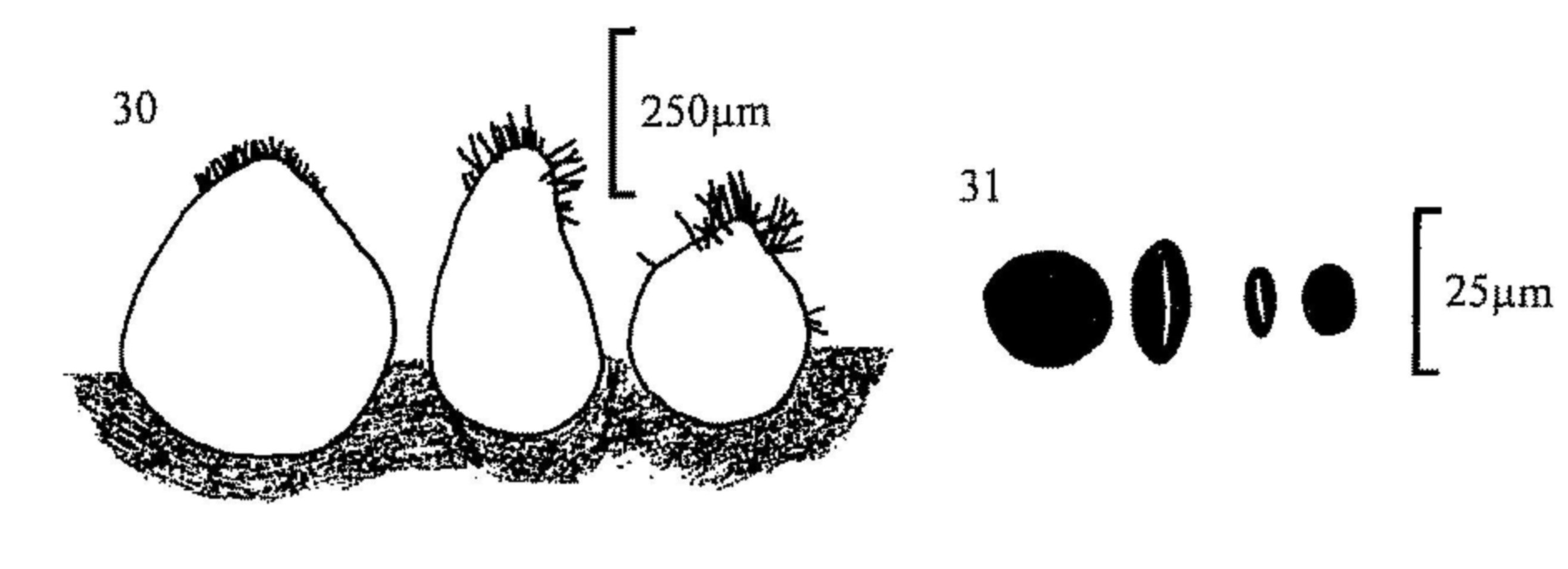
Fig. 30.. Perithecia of, from left, Coniochaeta ligniaria, C. scatigena and C. hansenii. Fig. 31.. Ascospores of C. scatigena (l) and C. ligniaria (r).
90(89) Spores 34-45 × 19-25µm, without caudae but surrounded by a thin (ca 5µm) gelatinous sheath. Perithecia ca 0.5-0.7mm diam., ± smooth.
Podospora globosa
- Spores 17-20 × 8-9.5µm, flattened on one side, convex on the other. Perithecia 0.3-0.45µm diam., with distal cells of agglutinated hairs fimbriate.
Podospora fimbriata
91(89) Perithecia hairy. Spores 27-32 × 16-19µm, appendage 15-18 × 2.5-3µm.
Anopodium ampullaceum
- Perithecia glabrous. 92
92(91) Spores 28-32 × 16-21µm, appendage 12-15 × 3-3.8µm.
Anopodium epile
- Spores 30-37 × 16-20µm, appendage 24-27 × 5µm.
'Podospora' dagobertii (fig. 28)
(The combination in Anopodium has not been made; see Lundqvist, 1964, 1972)
93(88) Spores flattened, disc shaped, with a germ slit around the edge. Perithecial neck with short (up to 120µm) setae.
(Coniochaeta, figs 30, 31) 94
- Spores ellipsoid. Perithecial neck without setae or with very prominent (up to 950µm) tufts of agglutinated hairs. 99
94(93) Asci with numerous (64-128) spores. 95
- Asci 8-spored. 96
95(94) Spores 6-10 × 5-9 × 4-7µm. Perithecial setae up to 120µm long.
Coniochaeta hansenii (fig. 30)
- Spores 13-16 × 9.5-13.5 × 5.5-8µm. Perithecial setae up to 35µm long.
Coniochaeta sp.
96(94) Spores 7-9 × 6-8 × 5-6µm, slightly flattened.
Coniochaeta leucoplaca
- Spores larger. 97
97(96) Spores narrowly elliptical in face view (length more than 2 × width), ca 13-18 × 6-9 × 4-6µm.
Coniochaeta saccardoi
- Spores broadly elliptical to nearly circular in face view (length less than 2 × width). 98
98(97) Spores (9)10-16(20) × 7.5-10(15) × (4)5-8µm. Neck setae 20-50µm long.
Coniochaeta ligniaria (figs 30, 31)
- Spores (16)17-23 × (10)13-19 × 7.5-10(15)µm. Neck setae 40-80µm long.
Coniochaeta scatigena (figs 30, 31)
99(93) Perithecial neck with prominent agglutinated tufts of rigid setae up to 950µm long. Spores 43-54 × 20-29µm, with apical germ pore. A gelatinous sheath which surrounds the whole spore swells in water, and appears fringed at the margin and radially striate.
Arnium macrothecium
- Perithecial neck without setae. Gelatinous sheaths may be clearly visible around spores, but are not complex in structure. 100
100(99) Spores with germ slit along the side. Ascus with a large and complex plug at the tip staining blue or red in KI (other genera have asci with blue staining ascus tips, but the feature is very pronounced in this genus and is unlikely to be mistaken). Perithecia form singly or severally in a stroma which is usually of limited extent, often without a definite margin. [N.B. if orange and with a stroma see Selinia, 119].
(Hypocopra, fig. 32) 101
- Spores without germ slits, but often asymmetrical, and with a small papilla at the basal end. Asci without complex apical plug.
(Sordaria, fig. 33) 107
101(100) Spores mostly less than 25µm long. 102
- Spores more than 25µm long. 104
102(101) Spores 9-14 × 6-7µm. Hypocopra parvula
- Spores larger. 103
103(102) Stroma with a brown hyphal mat between perithecial necks. Spores 19-27 × 10-14µm.
Hypocopra equorum (fig. 32)
- Stroma with white hyphae between black perithecial necks, becoming smooth. Spores 23-25 × 12-14µm.
Hypocopra brefeldii
104(101) Ascospores up to 15µm wide. 105
- Ascospores 15µm or wider. 106
105(104) Ascospores 25-31 × 10-15µm, distinctly flattened on one side. Ascus plug blue in KI, but becoming reddish.
Hypocopra planispora
- Ascospores 26-32 × 13-14µm, ellipsoid and narrowed towards their ends.
Hypocopra stephanophora
106(104) Ascospores 27-43 × 16-20µm. Hypocopra merdaria
- Ascospores 38-50 × 19-24µm. Hypocopra stercoraria
107(100) Spores up to 10µm long. 108
- Spores 10µm or longer. 109
108(107) Asci 8-spored. Spores 8 × 4µm. Sordaria minima
- Asci ca 128-spored. Spores 5-8 × 4-5µm.
Sordaria polyspora
109(107) Spores relatively narrow, at least twice as long as wide, 22-26 × 9-12µm. Gelatinous sheath broad, distinct.
Sordaria alcina
- Spores relatively broad, less than twice as long as wide. 110
110(109) Spores mostly 25µm or longer. 111
- Spores up to 25µm long. 112
111(110) Spores (21)23-29(30) × 14.5-17(18)µm, with apiculate base. Gelatinous sheath broad, distinct. Asci 240-300 × 20-24µm.
Sordaria superba
- Spores (26)28-35 × (17)18-22µm, with slightly apiculate base. Gelatinous sheath broad, distinct. Asci 280-350 × 30-35µm.
Sordaria macrospora
112(110) |Spores with gelatinous sheath absent or very thin, 19.5-25 × 15.5-19µm.
Sordaria humana (fig. 33)
- Spores with gelatinous sheath, up to 15µm diam. 113
113(112) Spores obovoid to broadly ellipsoid, 18-23 × 12-15µm.
Sordaria lappae
- Spores ellipsoid, 17-25 × 10-14µm.
Sordaria fimicola (fig. 33)
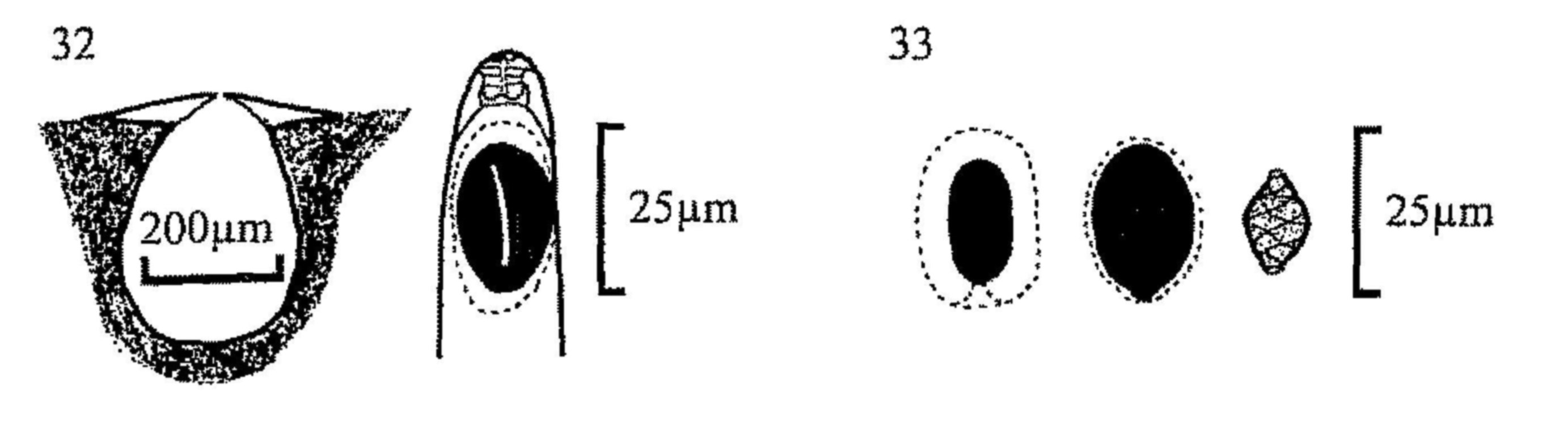
Fig. 32. Hypocopra equorum, perithecium with limited stroma, and detail of ascus tip with blue staining plug and spore. Fig. 33. Ascospores, from left, of Sordaria fimicola, S. humana and Sphaerodes fimicola.
114(3) Spores 20-28 × 12-16µm, with subacute ends, each with a germ pore.
Gelasinospora adjuncta
- Spores larger. 115
115(114) Asci 4-spored. Spores 24-29 × 15-18µm, with rounded ends and one germ pore.
Gelasinospora tetrasperma
- Asci 8-spored. Spores 26-35 × 22-27µm Gelasinospora cerealis
116(4) Perithecia orange to golden, often gregarious, almost spherical, necks ca 50µm diam., 15µm high, setae at ostiole hyaline, up to 35 × 3µm. Spores limoniform, with a germ pore at each end, 15-25 × 9-16µm.
Sphaerodes fimicola (fig. 33)
- Perithecia yellow or reddish brown (darker when filled with mature spores), neck 50µm long, with setae at the ostiole 40-70µm long. Spores dark brown to black, limoniform, 20-34 × 11-17µm, with apical germ pore.
Melanospora brevirostris
117(2) Asci more than 8-spored. see Key 1 at 86
- Asci with 8 or fewer spores, or asci evanescent, not readily observed. 118
118(117) Perithecia orange/yellow, 500-1000µm diam. Spores long (over 45µm) or 2-celled if shorter. 119
- Perithecia smaller, or black or with a neck. Spores shorter (less than 20µm) or septate if longer. 120
119(118) Perithecia orange, 500-1000µm diam., in small groups on a limited stroma. Spores thick walled, 48-60 × 22-26µm, with a gelatinous sheath.
Selinia pulchra
- Perithecia orange yellow, superficial, ca 500µm diam., with ostiole in a disc surrounded by silvery triangular tufts of hyphae ca 100µm long. Spores ellipsoid, 1-septate, 12-14 × 4-5µm.
Nectria suffulta
120(118) Perithecia reddish brown or pale, hyaline, with a distinct neck. 121
- Perithecia black. 131
121(120) Perithecia globose, up to 250µm diam., immersed, reddish brown, with a neck 1-3 mm long. Asci broad ellipsoid, 5-8.5µm, rapidly breaking down and difficult to see. Spores ellipsoid-allantoid. 5.5-7 × 1.5-2µm, collecting in a pearly droplet at the fringed tip of the perithecial beak.
Viennotidia fimicola (fig. 34)
- Perithecia pyriform, very pale in colour, 60-200µm diam., with a neck 60-700µm long. Asci rarely visible. Spores pointed-fusiform, 1-3 septate, often with a sheath and clumped together in fascicles.
(Pyxidiophora, fig. 36) 122
122(121) Neck 95-145µm long, brown, rugose, with cells arranged in 5-6 longitudinal rows visible in one view. Spores 38-52µm long.
Pyxidiophora badiorostris
- Neck not brown or rugose, composed of hyaline, irregularly arranged cylindrical cells. 123
123(122) Spores less than 45µm long. 124
- Spores more than 45µm long. 125
124(123) Spores 35-45µm long, with brown apical or subapical patches of pigment.
Pyxidiophora brunneocapitatus
- Spores 35-43µm long, without brown apical or subapical patches of pigment.
Pyxidiophora microsporus
125(123) Spores mostly 45-60µm long. 126
- Spores mostly longer than 60µm. 129
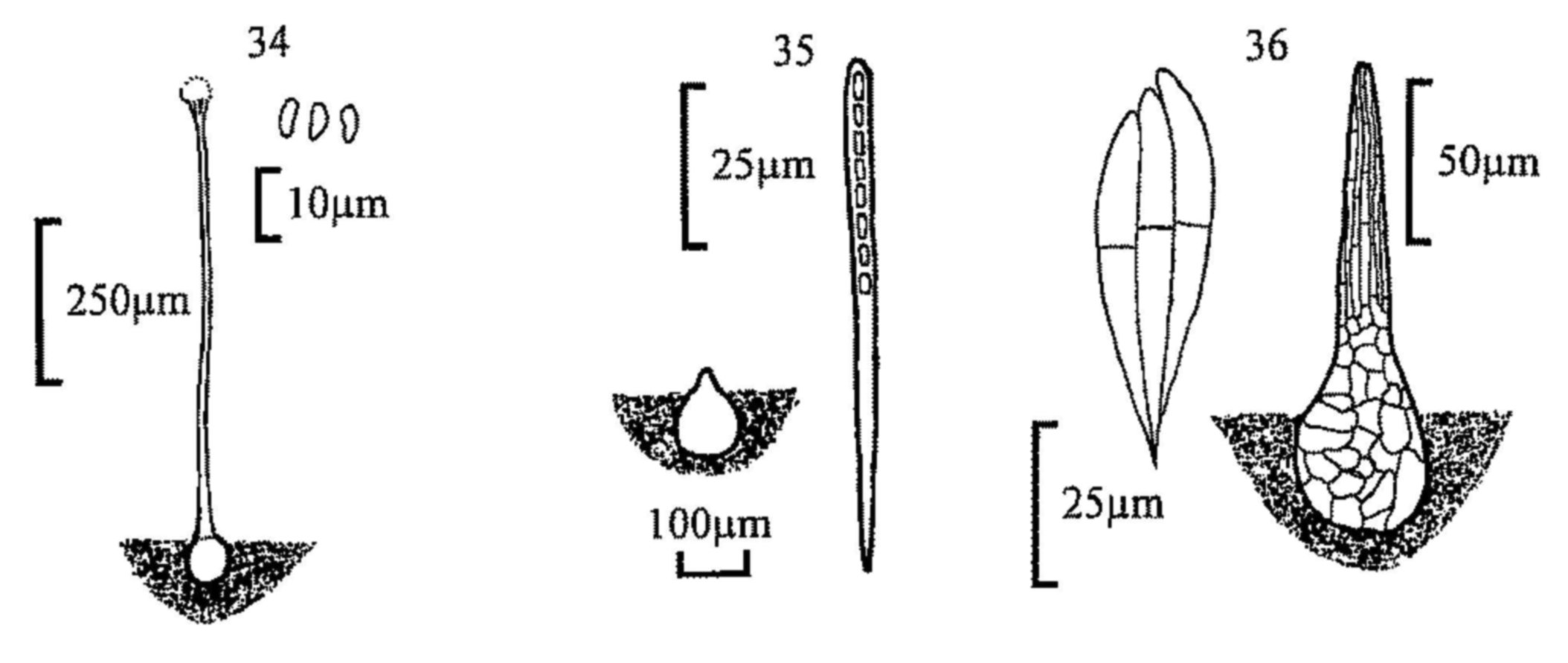
Fig. 34. Viennotidia fimicola, perithecium and spores. Fig. 35. Phomatospora coprophila, perithecium, and ascus with spores. Fig. 36. Pyxidiophora petchii, perithecium and spores.
126(125) Perithecia 70-100µm diam., neck 100-190µm long. Spores (43)48-58(65)µm long.
Pyxidiophora grovei
- Perithecia usually less than 80µm diam. 127
127(126) Perithecial necks mostly less than 100µm long. Spores (45)48-57(60)µm long.
Pyxidiophora arvernensis
- Perithecial necks up to 200µm long. 128
128(127) Spores 45-53µm long.
Pyxidiophora petchii (fig. 36)
- Spores 53-65µm long. Pyxidiophora schotterianus
129(125) Spores 60-70µm long. 130
- Spores (75)80-90(100)µm. Perithecia 120-160µm diam., neck 220-370µm long.
Pyxidiophora bainemensis
130(129) Perithecial necks 300-700µm long. Spores 60-70µm. Perithecia 100-120µm diam.
Pyxidiophora spinuliformis
- Perithecial necks 225-265µm long. Spores 65-70µm. Perithecia 110-125µm diam.
Pyxidiophora marchalii
131(120) Perithecia small, up to 400µm diam., with hairy necks. Spores hyaline or pale, coppery-red en masse, extruded in tendrils. 132
- Perithecia larger, without hairy necks. If smaller than 200µm, with spores smaller than 5 × 3µm. 134
132(131) Spores reniform, with gelatinous sheath, 3.5 × 2-3µm, yellow, reddish brown en masse in extruded tendrils. Asci spherical, evanescent. Perithecia black, spherical, 200-400µm diam., with cylindrical neck up to 300µm long, with sparse pointed hairs.
Microascus longirostris
- Spores larger, not reniform. Perithecia up to 300µm diam. 133
133(132) Perithecial necks long, up to 750µm, with terminal hairs up to 1500µm, curved or circinate at tips. Spores limoniform, 7-10.5 × 5.5-7µm.
Lophotrichus ampullus
- Perithecial necks short, ca 50µm, with long straight tapering hairs. Spore shape limoniform/variable, 6-7.5 × 5-5.5µm, with prominent germ pores.
Lophotrichus bartletti
134(131) Perithecia up to 150µm diam., immersed but for a conical neck 50-75µm high. Asci 50 × 2-2.5µm. Spores minute, cylindrical, 3.5-4.5 × 1.75-2.5µm.
Phomatospora coprophila (fig. 35)
- Perithecia more obvious, often hairy, or tomentose when young. Immature spores up to 70µm long, wavy cylindrical, with a row of globules inside and a short thin appendage at each end.
(see Cercophora, 49)
135(1) Perithecia immersed, surrounded at the neck by a very limited flange-like stroma which is easily overlooked.
see Hypocopra, 101 or if orange see Selinia, 119
- Stroma very conspicuous. 136
136(135) Perithecia in a subglobose group at the tip of the stromatic stalk. Spores with germ slit and gelatinous sheath.
(Podosordaria) 137
- Perithecia not in a terminal head. 139
137(136) Stalk short, 3-5mm. Spores (12)14-19 × 6-9µm, slightly flattened on one side.
Podosordaria leporina
- Stalk long, 1-6cm. Spores larger. 138
138(137) Spores 21-24 × 11-12µm. Stromatic stalk hairy.
Podosordaria tulasnei
- Spores 40-60 × 20-30µm. Stromatic stalk not hairy.
Podosordaria pedunculata
139(136) Stroma externally black, rooted or partially immersed in the dung, expanding at the surface to form a white disc up to 15mm diam., punctate with black perithecial ostioles.
(Poronia) 140
- Stroma not as above. 141
140(139) Spores 18-26 × 7-12µm, bean shaped, with gelatinous sheath. Stroma deeply rooted. Especially on horse dung.
Poronia punctata
- Spores (22)25-32(35) × (12)14-18µm, oblong ellipsoid to slightly fusiform. Stroma not deeply rooted. Especially on rabbit dung near the sea.
Poronia erici
141(139) Stroma spreading over surface of dung or filamentous. Spores ellipsoid to slightly flattened on one side, with germ slit. (Xerophilic fungi developing after long periods of relatively dry incubation).
(Wawelia) 142
- Stroma clavate, black, partly immersed to superficial, usually aggregated in small groups, ca 1-1.5mm high × 0.6-0.7mm diam., each containing a single perithecium. Spores ellipsoid with germ pore and gelatinous sheath.
(Bombardioidea) 146
142(141) Stroma spreading on substrate, black brown, firm but not brittle. Ascomata globose, 0.5-1mm, with white hyphae at neck. Spores broad limoniform, 15-19 × 9-10µm.
Wawelia effusa
- Perithecia globose to pyriform, black, brown or dark grey, produced laterally along the length of fine stromatal strands growing from the dung. 143
143(142) Asci 4-spored. 144
- Asci 8-spored. 145
144(143) Spores 15-18 × 9-12µm. Perithecia up to 400µm diam., dark grey at maturity, single or clustered, the ostiole with a crown of silvery white hyphae. Stromata up to 30 × 0.1-0.5mm.
Wawelia sp.
- Spores 6-8 × 4-6µm. Stromata conical, white, 5-12 × 1-2mm.
Wawelia regia
145(143) Perithecia hairy, globose, 350-500µm diam., stromatal strands up to 25mm long. Spores ellipsoid, flattened on one side, 9-12 × 6-8µm.
Wawelia octospora
- Perithecia villose with conidiophores, globose, 230-420µm diam., produced laterally on stromatic filaments 20-30 × 0.1-0.3mm. Filaments pink at first, with a white pointed tip, becoming brown, velvety with conidiophores. Spores ellipsoid to flattened on one side, 7.5-9.5 × 3-4.5µm.
Wawelia sp. (fig. 37)
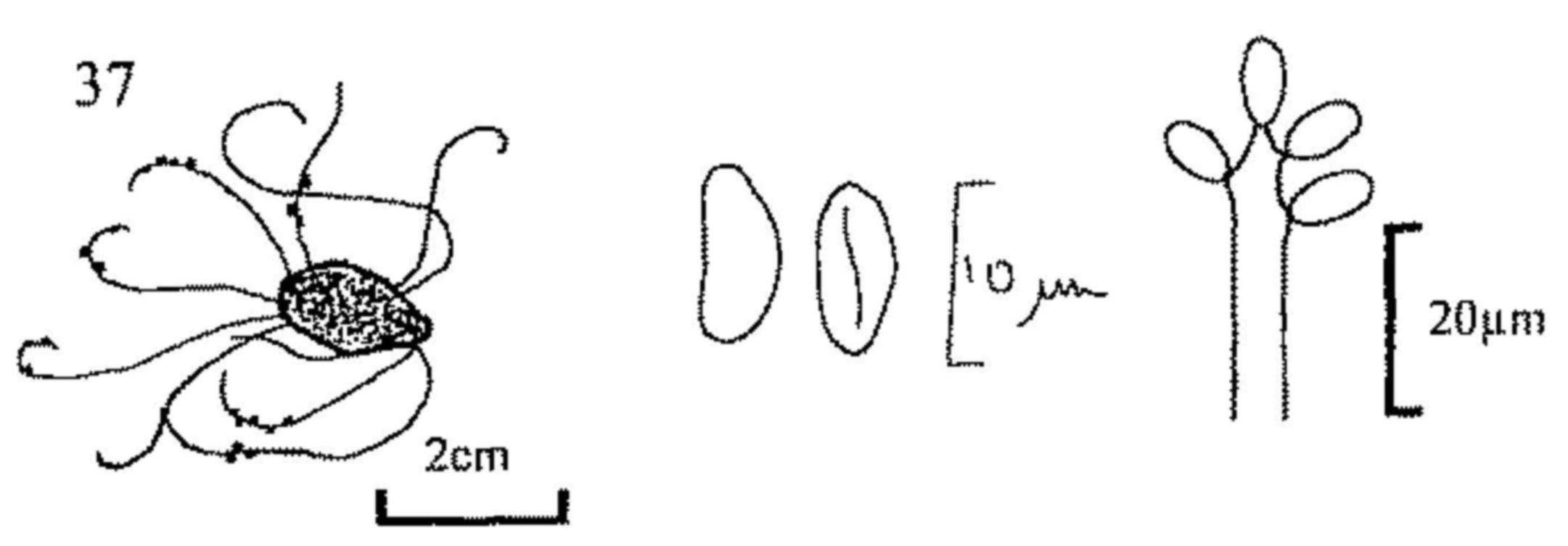
Fig. 37. Wawelia sp., stromatic filaments with perithecia growing from a rabbit pellet, ascospores, and conidiophore and conidia.
146(141) Asci 8-spored. Spores 20-31 × 9.5-15µm.
Bombardioidea bombardioides
- Asci 4-spored. 147
147(146) Spores 24-34 × 15-19(20)µm. Basal germ pore less distinct than the apical one.
Bombardioidea serignanensis
- Spores 34-43 × 16-22µm. Distinct germ pore at each end of spore.
Bombardioidea stercoris
148 (key 1,1) Fruit bodies solitary or in small groups, each a subglobose, fertile, light brown head on a slender sterile stalk. Head soon bursting to expose the yellow ochraceous spore mass. On mixtures of bird droppings, cast pellets and decaying animal material. 149
- Fruit bodies superficial, lacking a distinct stalk. 150
149(148) Spores 5-8 × 2-3µm. Head 1-2mm diam.
Onygena corvina (fig. 38)
- Spores 7-9 × 4-6µm, 4-5µm. Head 2-4mm diam. Onygena equina
150(148) Fruit bodies with an external wall of loosely anastomosing and interwoven hyphae, and with ± specialised terminal cells (gymnothecia, fig. 39). 151
- Fruit bodies with a well defined parenchymatic wall (cleistothecia, fig. 46). 161
151(150) Gymnothecia with simple thin-walled, ± uniform and poorly developed hyphae constituting the outer hyphal sheath. 152
- Gymnothecia with thick-walled hyphae modified at their ends into appendages, or if thin-walled then always accompanied by appendages (i.e. curled, toothed or pointed hyphae). 155
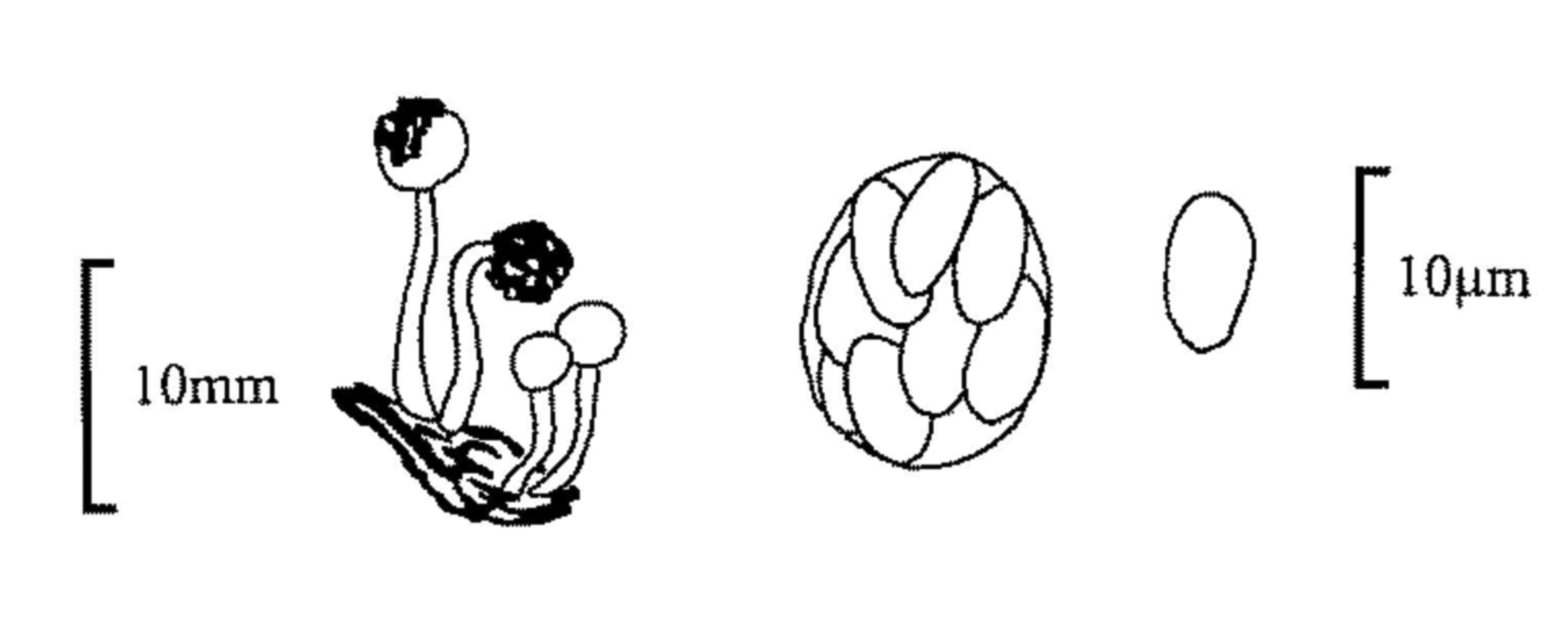
Fig. 38. Onygena corvina, habit sketch, ascus and ascospore.
152(151) Gymnothecia red-orange to brick-red. Ascospores orange, subglobose to ellipsoid, with an equatorial furrow, smooth, 4.5-5.5 × 3.5-4.5µm.
Arachniotus ruber (fig. 40)
- Gymnothecia white or yellow, never orange or brick-red. Ascospores without an equatorial furrow. 153
153(152) Gymnothecia white. Ascospores hyaline, ellipsoid, smooth, 3-4 × 2-2.5µm.
Arachniotus candidus
- Gymnothecia distinctly pigmented, yellow or brown. Ascospores larger than 4µm. 154
154(153) Gymnothecia yellow brown. Ascospores orange to brownish, slightly lenticular, smooth or slightly roughened, 5-6.5 × 3.3-4.6µm.
Arachniotus confluens
- Gymnothecia lemon yellow. Ascospores lemon yellow, lenticular, smooth, 5-6 × 3-4.5µm.
Arachniotus citrinus
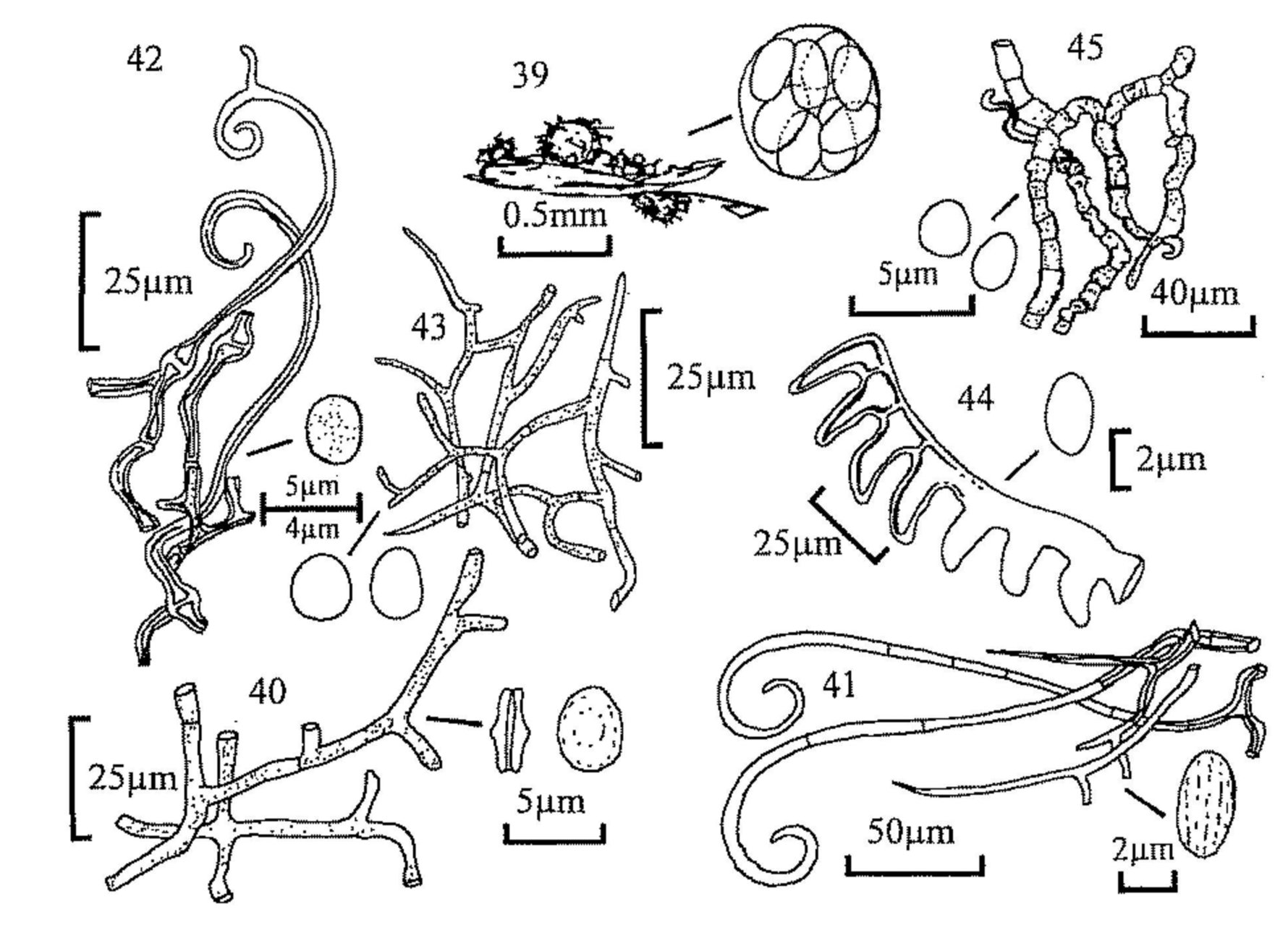
Fig. 39. Habit sketch of a gymnothecium and ascus. Figs 40-45. Spores and peridial hyphae. Fig. 40. Arachniotus ruber. Fig. 41. Myxotrichum chartarum. Fig. 42. Gymnoascus californiensis. Fig. 43. Gymnoascus reesii. Fig. 44. Ctenomyces serratus. Fig. 45. Arthroderma curreyi.
155(151) Gymnothecia possessing only thick pigmented hyphae. 156
- Gymnothecia possessing ± thin, hyaline hyphae with only a few, although often distinctive, appendages (i.e. comb-shaped end cells or dumb-bell shaped asperulate cells accompanying twisted and bent hyphae). 160
156(155) Gymnothecia brown-black or dark greenish-grey, with external hyphae with spine-like branches and septate, hooked appendages. Ascospores orange brownish, ovate, delicately striate, 4-5.2 × 2.4-3.3µm.
Myxotrichum chartarum (fig. 41)
- Gymnothecia never black, and, if possessing thick-walled hyphae, then appendages never septate. Ascospores smooth, or if ornamented then asperulate or echinulate. 157
157(156) Gymnothecia rose to orange-brown or yellowish. Appendages curved or irregularly branched and pointed, never verticillately branched. Ascospores smooth, or at most asperulate. 158
- Gymnothecia red-brown with appendages verticillately branched. Ascospores 3-4.5 × 2-2.8µm, yellowish brown, lenticular.
Actinodendron verticillatum
158(157) Gymnothecia rosy pink when young, becoming browner, with spines and curved, non-septate hairs. Ascospores hyaline, globose to subglobose, asperulate, 3-5 × 2.5-4µm.
Gymnoascus californiensis (fig. 42)
- Gymnothecia yellow. Ascospores smooth. 159
159(158) Gymnothecia yellow to yellow-brown, without elongated appendages but with thick-walled branches, few of which are pointed. Ascospores globose-ellipsoid, yellow to brownish, 3-4.5 × 3.5µm.
Gymnoascus reesii (fig. 43)
- Gymnothecia golden yellow to reddish-brown, with acute-ended appendages. Ascospores lenticular, smooth, hyaline, 2.5-3.5 × 2-2.5µm.
Pseudogymnoascus roseus
160(155) Gymnothecia orange brown, with comb-like appendages. Ascospores slightly lenticular, pale orange, 3.3-3.6 × 2-2.6µm.
Ctenomyces serratus (fig. 44)
- Gymnothecia whitish to pale ochraceous, particularly when dry, with few appendages but those present twisted and bent, and their branches constricted with regular or irregular dumb-bell shaped cells. Hyphal walls asperulate or with protuberances. Ascospores smooth, lenticular, hyaline, 2.4-3.3 × 2µm.
Arthroderma curreyi (fig. 45)
161(150) Asci relatively large, 100-200-spored, 1-3/fruit body. 'Cleistothecia' minute, <100 (rarely <250)µm diam., immersed.
see Thelebolus etc. (Key 1, 86)
- Asci with 8 or fewer spores. 162
162(161) Ascospores purple at maturity, large, 50-70 × 25-35µm, epispore with a few longitudinal cracks.
see Ascobolus immersus (Key 1, 48)
- Ascospores smaller, hyaline, yellow, olivaceous, brown or black. 163
163(162) Ascospores olivaceous, brown or black, at least in part. 164
- Ascospores aseptate, hyaline, yellow or other pale colours. 174
164(163) Ascospores 4-celled (cf. Sporormiella), with germ slits, readily fragmenting. Asci clavate, bitunicate. Cleistothecia black, shiny, up to 500µm diam. 165
- Ascospores 1- or 2-celled. 166
165(164) Ascus stalk up to 20µm long. Ascospores 25-32 × 5µm.
Preussia vulgaris
- Ascus stalk 30-60µm long. Ascospores 26-38 × 5-7µm.
Preussia funiculata (fig. 47)
166(164) Ascospores 2-celled. 167
- Ascospores 1-celled 170
167(166) Spores unequally 2-celled, one brown ellipsoid, with an apical germ pore, 10-12 × 6.5-7.5µm, the other a basal hyaline, cylindrical pedicel, 6-8 × 3µm. Cleistothecia black, globose, up to 250µm diam., covered with flexuous brown hairs up to 1mm long. Asci evanescent.
Zopfiella erostrata
- Spores equally 2-celled. 168
168(167) Spores not constricted at the septum, ellipsoid, golden-brown, 25-30 × 10-15µm with 1-3 guttules in each cell. Cleistothecia gregarious on a mycelial mat, whitish to pale orange, up to 500µm diam.
Heleococcum aurantiacum (fig. 48)
- Spores hyaline, divided into two almost globose cells by the constricting septum. Ascomata superficial, globose, dark coloured.
(Mycoarachis) 169
169(168) Asci 8-spored, 5.5-11µm diam. Spores 5-5.5 × 3-3.5µm.
Mycoarachis inversa
- Asci 4-spored, 6-6.5µm diam. Spores 4.5-5 × 2-2.5µm.
Mycoarachis tetraspora
170(166) Asci broad-clavate, (1)-2-(3)-spored, 30-50 × 13-18µm. Spores brown-black with short ridges and warts, subglobose, 12-15.5 × 11-12.5µm, with a single germ pore.
Copromyces bisporus (fig. 49)
- Asci 8-spored. 171
171(170) Spores globose, sooty brown, 3µm diam. Cleistothecia gregarious, with basal spirally coiled appendages, black, 100-200µm diam., partially immersed in a white to red felty hyphal mat.
Pleuroascus nicholsonii
- Spores larger, ellipsoid or limoniform. 172
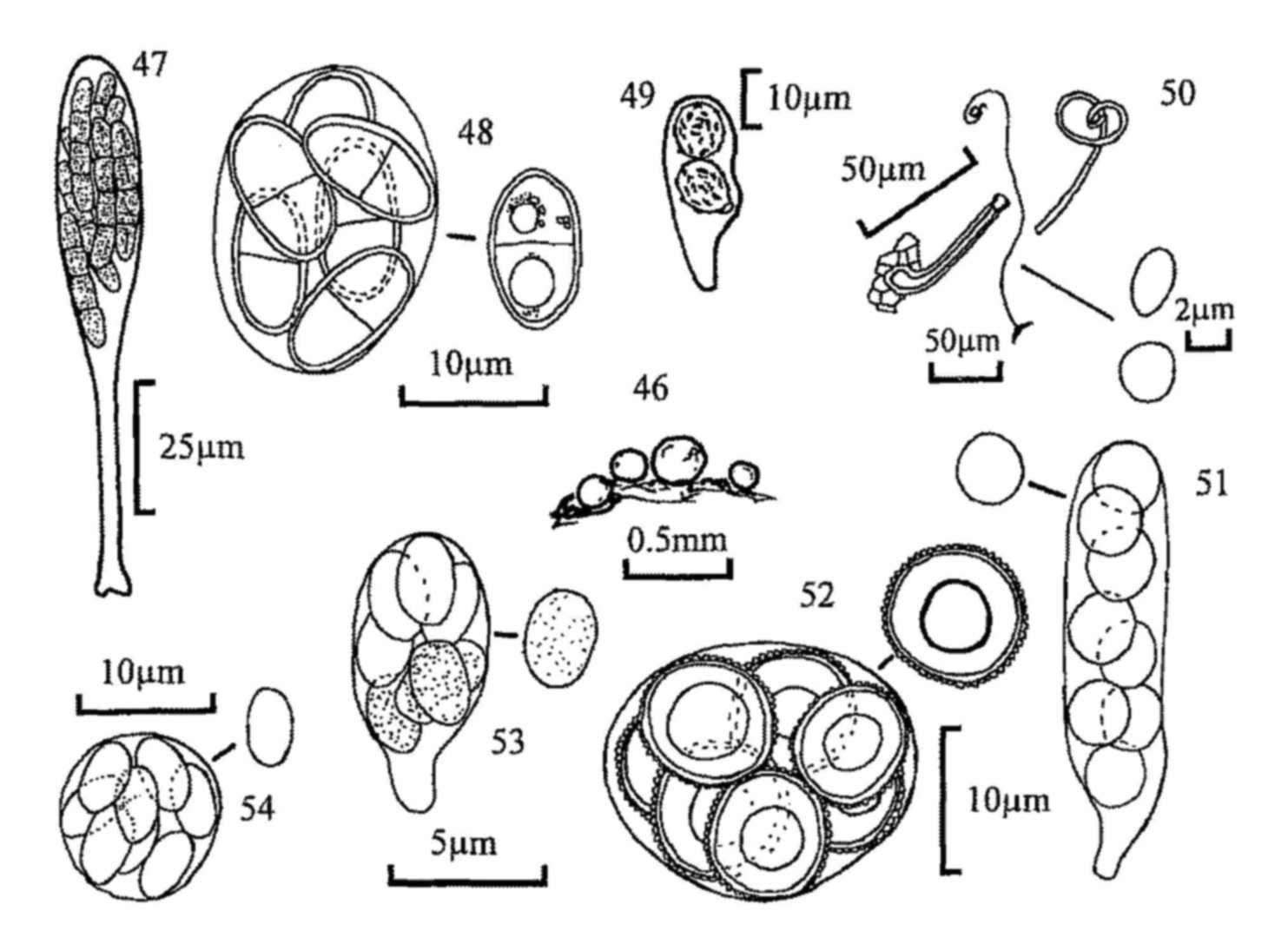
Fig. 46. Habit sketch of cleistothecia. Figs 47-54. Asci and spores. Fig. 47. Preussia funiculata. Fig. 48. Heleococcum aurantiacum. Fig. 49. Copromyces bisporus. Fig. 50. Arachnomyces nitidus. Fig. 51. Orbicula parietina. Fig. 52. Roumegueriella rufula. Fig. 53. Aphanoascus stercoraria. Fig. 54. Pseudeurotium ovale.
172(171) Spores olivaceous, limoniform, usually with an apical germ pore. Perithecia greyish or greenish, abundantly hairy, branched or simple, straight or curly. Asci pedicellate, soon disappearing.
see Chaetomium at 5
- Spores darker, with 1 or more minute germ pores. Cleistothecia distinctly but not abundantly hairy. 173
173(172) Spores smoky brown, broadly ovoid, 9-14 × 6-9µm. Cleistothecial hairs short, up to 30µm.
Thielavia wareingii
- Spores dark brown, flattened limoniform, 13-16 × 10-13 × 8-9µm. Cleistothecial hairs of two types, some smooth, dark brown, arising from the base up to 3mm long, others greyish green, rough, up to ca 120µm.
Thielavia fimeti
174(163) Cleistothecia produced within a common arachnoid mycelial mass. Spores smooth or minutely asperulate, yellow to yellow-brown, broadly ellipsoid, 4-5 × 3-5µm.
Aphanoascus fulvescens
- Cleistothecia single or gregarious, but not on or in a mycelial mass. 175
175(174) Cleistothecia 170-750µm diam., covered with long (several mm when extended), thick-walled, aseptate, helical appendages. Asci clavate cylindrical, evanescent, 35-62 × 12-21µm. Spores ellipsoid, hyaline, 12-17 × 9-12µm.
Lasiobolidium spirale
- Cleistothecia without coiled appendages. 176
176(175) Cleistothecia with hairs or appendages. 177
- Cleistothecia smooth. 178
177(176) Cleistothecia black, shining, 100-200µm diam., with dark brown-black thick-walled hairs with hooked tips. Asci 8-15µm diam. Spores straw or copper coloured, ellipsoid, 4-7 × 3.5-4.5µm with de Bary bubble and a germ pore at each end.
Kernia nitida
- Cleistothecia reddish brown, less than 1mm diam., with long simple appendages curled at the tips. Spores hyaline, oblate, 3.55 × 2-3µm.
Arachnomyces nitidus (fig. 50)
178(176) Ascospores globose, larger than 9µm. 179
- Ascospores ellipsoid, up to 9µm. Asci always subglobose. 180
179(178) Ascospores, smooth, 9-13µm.
Orbicula parietina (fig. 51)
- Ascospores ornamented, 13-24µm Asci subglobose. Cleistothecia ochraceous, becoming yellowish brown or flushed cinnamon.
Roumegueriella rufula (fig. 52)
180(178) Ascospores hyaline, then faintly yellowish, minutely spiny, 2.5-3 × 2-2.5µm. Cleistothecia pale, then dark brown.
Aphanoascus stercoraria (fig. 53)
- Ascospores hyaline, then brown, smooth, 5.5-6 × 3.5-4µm. Cleistothecia dark brown from the beginning.
Pseudeurotium ovale (fig. 54)