Key 1. Ascomycota
Reading edition
1 Ascoma either globose to flask shaped, usually with an easily observable pore or neck (perithecium or pseudothecium, figs 16, 18, 19, 22, 27, 30, 32, 34-37), or discoid (apothecium, figs 1, 3, 4, 7, 11-14). Spores usually 8 in each ascus (less frequently 4, 16, 32, 64, 128 etc.). Asci ellipsoid to cylindrical, borne in a distinct hymenium, thus appearing in fascicles or distinct groups when the fruit body is squashed. 2
- Ascoma globose to subglobose, lacking a definite pore or neck (cleistothecium or gymnothecium, figs 38, 39, 46). Asci globose to subglobose, 8-spored, not in a distinct hymenium, appearing quite free when the fruit body is squashed.
Key 2, 148 (p. 45)
2(1) Ascoma a perithecium or pseudothecium, usually dark in some part, not opening to a disc but remaining globose or flask shaped. Asci unitunicate, not operculate but often with an apical pore, which may stain blue in iodine, or bitunicate.
Key 2, 1 (p. 24)
- Ascoma an apothecium, white or lightly coloured, soft fleshed, opening out to a disc or cushion shape when mature. Asci unitunicate. 3
3(2) Asci opening by an operculum (fig. 8), a bilabiate vertical split down to a subapical ring of thickening (fig. 15), or apparently just bursting. 4
- Asci inoperculate, with an apical pore. 96
4(3) Spores 8 (occasionally 4) in an ascus, colourless, purple or brown. 5
- Spores more than 8 in an ascus, colourless. 77
5(4) Spores remaining colourless. 6
- Spores purple or brown at maturity. 39
6(5) Apothecia with obvious hairs. 7
- Apothecia without obvious hairs (microscopic hairs up to 50µm long may be present). 14
7(6) Hairs brown. Apothecia orange, red orange or yellow orange
(Cheilymenia, fig. 1) 8
- Hairs colourless. Apothecia colourless or pinkish.
(Lasiobolus, fig. 3) 12
8(7) Apothecia with stellate hairs. Spores 14-20 × 8-11µm.
Cheilymenia stercorea (figs 1, 2)
- Apothecia without stellate hairs. 9
9(8) Spores 14.5-18 × 8-9.5µm. Asci 10-13µm diam. Apothecia 2mm diam. or more.
Cheilymenia coprinaria
- Spores larger, 17 × 10µm or more. 10
10(9) Apothecia reddish orange, up to 1mm diam., marginal hairs rooting, wall 2-4µm thick. Spores 21-26 × 10-13.8µm.
Cheilymenia fimicola
- Apothecia pale orange yellow, marginal hairs superficial, wall up to 2µm thick. 11
11(10) Asci up to 22µm diam. Spores 17-27 × 10-14.5µm.
Cheilymenia pulcherrima
- Asci wider, 25µm diam. or more. Spores 23-26.5 × 13-16.5µm.
Cheilymenia raripila
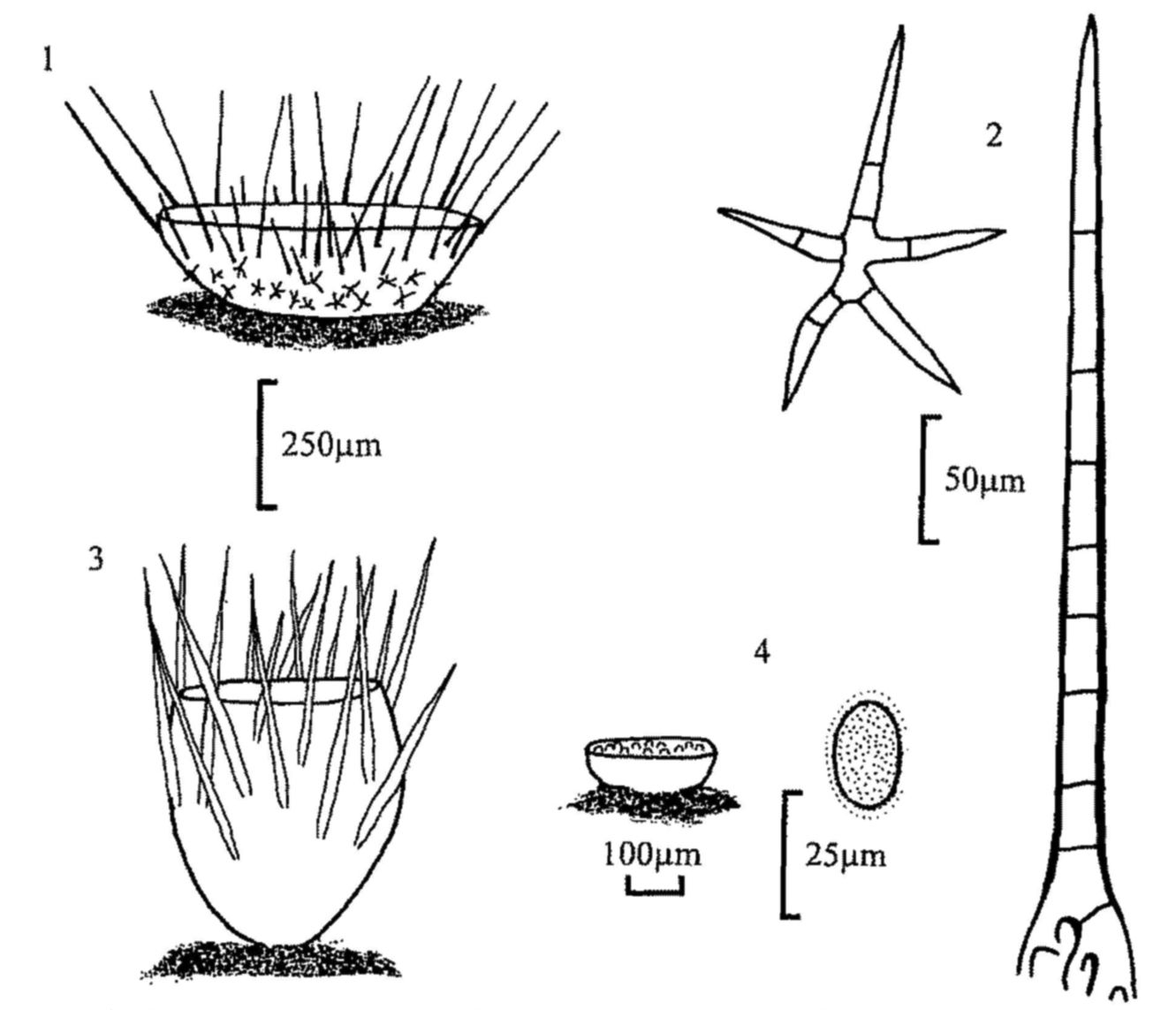
Fig. 1. Cheilymenia stercorea, apothecium. Fig. 2. C. stercorea, stellate and rooted hairs. Fig. 3. Lasiobolus ciliatus, apothecium. Fig. 4. Iodophanus carneus, apothecium and spore.
12(7) Hairs 600µm or longer. Spores 19-23 × 7-10µm.
Lasiobolus macrotrichus
- Hairs shorter, up to 600µm. 13
13(12) Asci clavate, 20µm diam. or wider. Spores 19-22 × 10.5-13.5µm.
Lasiobolus cuniculi
- Asci cylindrical, up to 20µm diam. Spores 18-22.5 × 9.5-11.5µm.
Lasiobolus ciliatus (fig. 3)
14(6) Asci blue in iodine solution. 15
- Asci not blue in iodine. 24
15(14) Spores large, 30-42 × 15-18µm, warted, ellipsoid with acute apices.
Thecotheus cinereus
- Spores smaller, smooth or only finely ornamented 16
16(15) Apothecia brownish, large, 1cm diam. or more. (Peziza) 21
- Apothecia pale, up to 4mm diam. Asci protruding from hymenium when ripe. 17
17(16) Apothecia white to pink, up to 2mm diam. Spores finely verruculose, 18-25 × 8-14µm.
Iodophanus carneus (fig. 4)
- Apothecia pale, variously coloured when fresh, but drying darker. Spores smooth.
(Thecotheus) 18
18(17) Spores apiculate at each end, smooth. 19
- Spores not apiculate, 20-22 × 8-10µm. Thecotheus agranulosus
19(18) Spores with a collar at the base of the apiculus. 20
- Spores without a collar at the base of the apiculus, 16-21 × 8-12µm.
Thecotheus apiculatus
20(19) Apothecia white. Spores 20-22 × 10-12µm, apiculus 4-6µm diam.
Thecotheus perplexans
- Apothecia yellowish. Spores 12-15 × 7.5-9µm, apiculus 2.5-3.5µm diam.
Thecotheus africanus
21(16) Spores smooth, without guttules. 22
- Spores verruculose or spinulose, 15-18 × 8-9µm, with 1 guttule. Paraphyses with clavate apices, with brown contents. Apothecia asymmetrical, extended on one side.
Peziza pleurota
22(21) Spores 19-24 × 10.5-14µm. Apothecia yellowish brown, up to 10cm diam.
Peziza vesiculosa
- Spores up to 10µm wide. 23
23(22) Apothecia ca 1cm diam., umber with a paler margin. Spores 15-22 × 9-10µm.
Peziza bovina
- Apothecia up to 2cm diam., pale brown. Spores 13-16 × 7-9µm.
Peziza fimeti
24(14) Apothecia robust, up to 4mm diam., orange or with brownish or purple tints. 25
- Apothecia smaller, rarely more than 1mm, pale, yellowish green, orange, grey or chestnut. 32
25(24) Apothecia orange or red. 26
- Apothecia discrete, brownish or purple. (Fimaria) 27
26(25) Apothecia crowded, 1-3mm diam., orange, with a granular surface. Asci up to 190 × 15µm. Spores 15-18.5 × 7-9.5µm. Paraphyses strongly clavate to apex up to 14µm diam, filled with orange granules.
Coprobia granulata
- Apothecia discrete, 1-2mm diam., orange or red. Asci 240 × 10-12µm. Spores 12-15 × 7-8µm. Paraphyses yellow, only slightly swollen from 2µm to 3-4µm at apex.
Ascophanus bresadolae
27(25) Spores 8-9.5 × 4-4.5µm. Fimaria equina
- Spores larger. 28
28(27) Spores 20-38 × 10-13µm. Fimaria hepatica
- Spores shorter. 29
29(28) Spores 10-13 × 7-9µm. Fimaria porcina
- Spores 13-17 × 7-11µm. 30
30(29) Disc punctate with asci. Paraphysis tips swollen up to 3-5µm. Spores 14.5-16 × 9.5-11µm.
Fimaria leporum
- Disc not punctate with asci. Paraphysis tips not or only slightly swollen. 31
31(30) Apothecia pale yellowish. Spores 13-15.5 × 7.5-8.5µm.
Fimaria theioleuca
- Apothecia chestnut/purplish brown. Spores 14-17 × 7-8.5µm.
Fimaria cervaria
32(24) Spores less than 10µm long. 33
- Spores mostly longer than 10µm. 36
33(32) Paraphyses markedly capitate to 5-6µm, with yellowish green contents. Apothecia dull at first, yellowish at maturity. Spores 7-10 × 2-4.5µm.
Thelebolus microsporus (fig. 5)
- Paraphyses only slightly inflated above, without coloured contents. Apothecia whitish or grey. 34
34(33) Spores 5-7 × 3-4µm. Asci 38-42 × 6-7µm. Apothecia smoky grey, 0.3-0.4mm diam.
Ascophanus cinerellus
- Spores larger. Apothecia pale, white or yellowish. 35
35(34) Apothecia up to 1.2mm diam. Asci short stalked, 40-55 × 8-12µm. Spores 7.5-9 × 4.5-5.5µm.
Coprotus glaucellus
- Apothecia 0.2-0.5mm diam. Asci attenuate below, 65-85 × 10-15µm. Spores 8-10 × 5-6.5µm.
Coprotus lacteus
36(32) Apothecia chestnut brown up to 1mm diam. Asci 160 × 13µm. Spores 13-16 x 8-11µm. Paraphyses forked, with swollen tips.
Ascophanus misturae
- Apothecia lighter coloured. Asci less than 150µm long. 37
37(36) Spores 14-18 × 9-11µm. Apothecia pale yellow/orange, up to 1.5mm diam. Asci cylindrical, 110-150 × 12-15µm. Paraphyses yellowish, slightly inflated to 4-5µm at apices.
Coprotus ochraceus
- Spores less than 15µm long. Apothecia up to 0.6mm diam. Asci less than 100µm long. 38
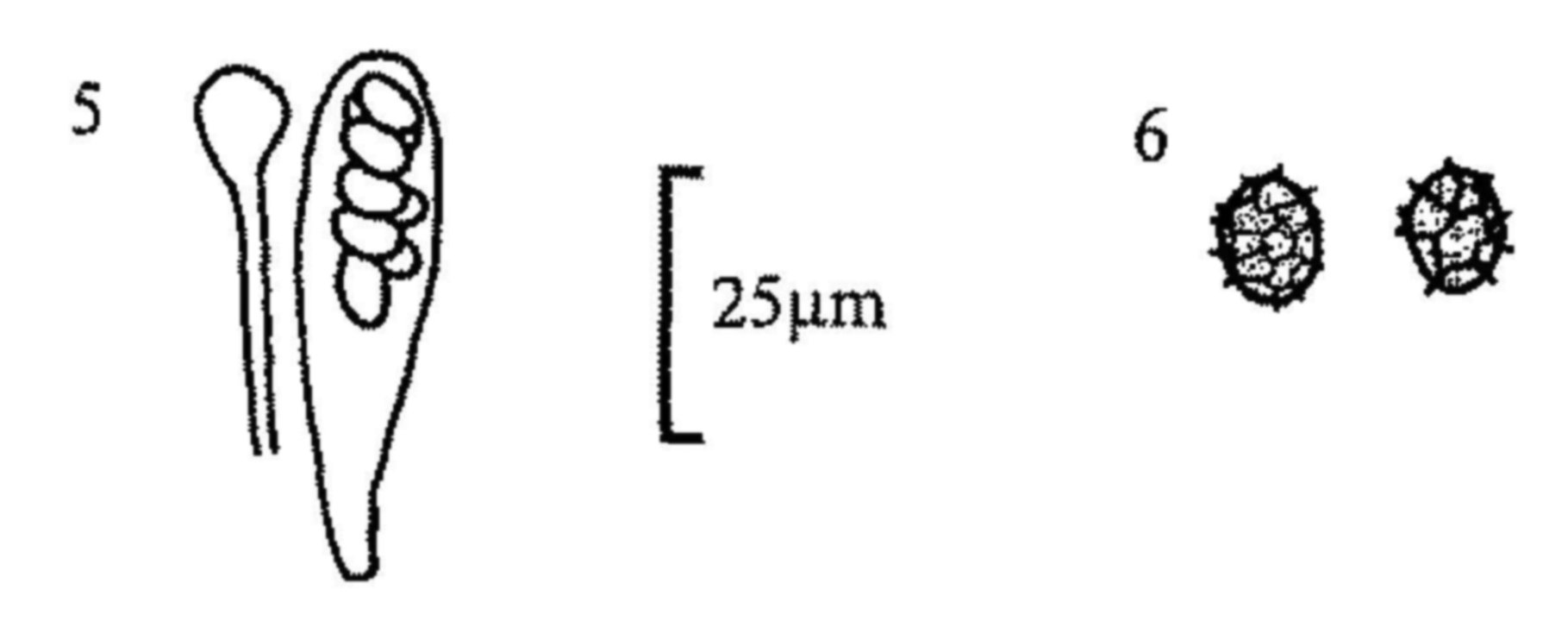
Fig. 5. Thelebolus microsporus, ascus and paraphysis. Fig. 6. Ascodesmis microscopica, ascospores.
38(37) Apothecia bright yellow. Asci cylindrical clavate, attenuate below, 65-90 × 10-15µm. Spores 12-14 × 6-8.5µm. Paraphyses branched, apices inflated to 4-5µm, with yellow contents.
Coprotus aurorus
- Apothecia white/pale yellow, with darker margin. Asci broadly clavate, stalked below 40-55 × 15-30µm. Spores 9-15 × 6.5-9.5µm. Paraphyses inflated above to 5-8µm, hyaline.
Coprotus granuliformis
39(5) Spores spherical or broadly ellipsoid, brown, ornamented with warts, anastomosing ridges or a reticulum. Asci clavate. Apothecium without excipulum.
(Ascodesmis, fig. 6) 40
- Spores ellipsoid or spherical, hyaline at first, then purple, becoming brown at maturity; epispore smooth, finely verruculose, warted or cracked. Asci cylindrical. Excipulum present. 45
40(39) Spores 18-21.5 × 13.5-17.5µm. Ascodesmis macrospora
- Spores up to 16µm. 41
41(40) Spores ± spherical, L/B ratio mostly up to 1.2. 42
- Spores ± broadly ellipsoidal, L/B ratio mostly 1.2 or more. 43
42(41) Spores ornamented with round warts, 8.5-11 × 8.3-10µm.
Ascodesmis nana
- Spores ornamented with a network of ridges, 10.5-14 × 9-12µm.
Ascodesmis sphaerospora
43(41) Spores with a prominent reticulum of ridges (fig. 6), 11-15.5 × 8-13.5µm. Apothecia 150-300µm diam.
Ascodesmis microscopica (fig. 6)
- Spore ornament not a reticulum. 44
44(43) Spores with 1 simple or branched ridge and isolated or occasionally connected warts, 11-14.5 × 7-11.5µm. Apothecia up to 500µm diam.
Ascodesmis porcina
- Spores with isolated warts, some joined to form short ridges, but not a reticulum, often capitate, 9.5-12.5 × 7.5-10µm. Apothecia 50-150µm diam.
Ascodesmis nigricans
45(39) Spores separate in the ascus. (Ascobolus) 46
- Spores firmly joined together, both in the ascus and after ejection (fig. 10).
(Saccabolus) 66
46(45) Spores spherical. 47
- Spores ellipsoid. 48
47(46) Spores 10.5-13.5µm, epispore with numerous but isolated warts.
Ascobolus brassicae (figs 8, 9)
- Spores 11.5-13.5(15)µm, epispore with subparallel occasionally anastomosing lines.
Ascobolus crosslandii
48(46) Spores very large, mostly 50-70 × 25-35µm, almost oblong with rounded ends, typically with few cracks in the epispore.
Ascobolus immersus (figs 7, 9)
- Spores smaller, with epispore smooth, warted or with cracks. 49
49(48) Epispore strongly and irregularly wrinkled with a vesiculose layer of pigment, 11.6-16 × 6.5-9.3µm. Paraphyses capitate up to 18µm. Apothecia up to 0.6mm diam.
Ascobolus rhytidiosporus
- Epispore not strongly wrinkled/vesiculose. 50
50(49) Epispore basically smooth or warted, perhaps with a few irregular cracks. 51
- Epispore with a clear pattern of cracks or lines. 56
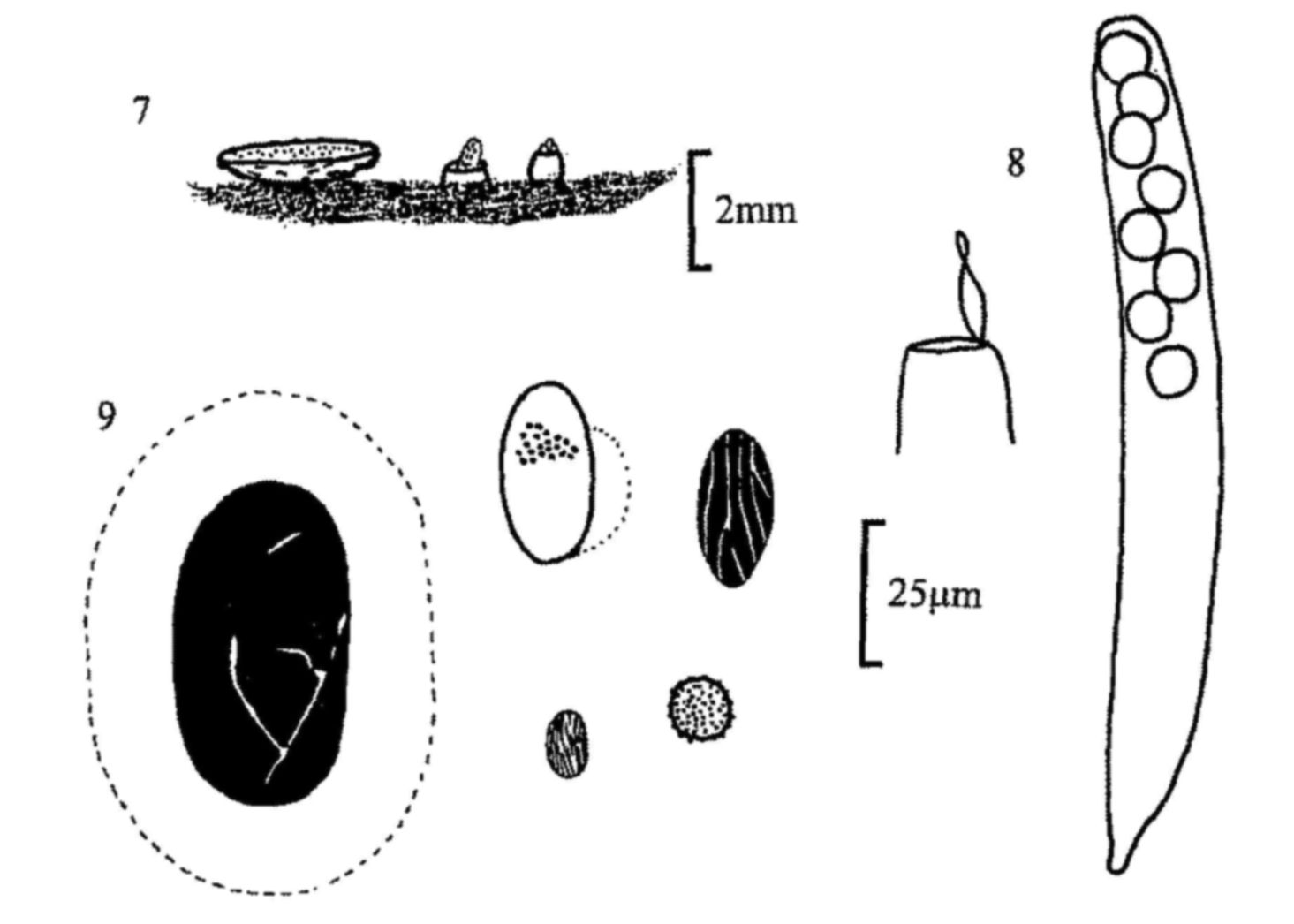
Fig. 7. Apothecia of, from left, Ascobolus furfuraceus, A. immersus and A. albidus. Fig. 8. A. brassicae, ascus with spores and detail of operculum. Fig. 9. Ascospores of, clockwise from left, A. immersus, A. stictoideus, A. albidus, A. brassicae and A. crenulatus.
51(50) Spores up to 25µm long. 52
- Spores longer, 25µm or more. 54
52(51) Epispore smooth, finely granular or punctate. Gelatinous material unilateral, not surrounding spore. 53
- Epispore warted, spores 18.5-21(22.5) × (9)10-11.5µm, surrounded by gelatinous sheath.
Ascobolus hawaiiensis
53(52) Spores 18-24 × 10-13µm. Hymenial mucus greenish yellow. Excipulum not brown.
Ascobolus mancus
- Spores 20-25 × 11-13µm. Hymenial mucus sulphur yellow. Excipulum with rich brown intercellular pigment.
Ascobolus boudieri
54(51) Epispore smooth or finely granular, spores 23-29(32) × 12-17µm.
Ascobolus elegans
- Epispore warted. 55
55(54) Spores with a regular pattern of warts and intact epispore, 26-32 × 15-17.5µm.
Ascobolus stictoideus (fig. 9)
- Spores with irregular patches of thicker pigment, especially at the poles, 28-35 × 16-18µm.
Ascobolus degluptus
56(50) Spores mostly 18 × 10µm or larger. 57
- Spores mostly smaller than 20 × 10µm. 61
57(56) Apothecia small, mostly up to 1mm diam., colourless. Spores 20-35 × 11-14µm, epispore cracks distant, irregular, often anastomosing.
Ascobolus albidus (figs 7, 9)
- Apothecia larger, usually 1mm diam. or more, disc yellowish, greenish, purplish or brownish. 58
58(57) Apothecia crowded, purplish or purplish brown with intercellular pigment. Spores 18-28 × 10-12µm, with longitudinal anastomosing cracks.
Ascobolus roseopurpurascens
- Apothecia yellowish or greenish. 59
59(58) Spores 17-22 × 9.5-12µm with a few widely spaced and irregularly oriented cracks.
Ascobolus michaudii
- Spores with closely spaced, ± longitudinal, cracks, with varying degrees of anastomosis. 60
60(59) Apothecia furfuraceous, sessile. Ascus wall blue in iodine. Spores 19-28 × 10-14µm.
Ascobolus furfuraceus (fig. 7)
- Apothecia smooth, substipitate. Ascus wall only faintly blue in iodine. Spores 19-22 × 9.5-13µm.
Ascobolus perplexans
61(56) Apothecia large, stipitate, 5-10mm diam. Spores 16-19.5 × 8.5-10µm, with subparallel, longitudinal, only rarely anastomosing lines.
Ascobolus lignatilis
- Apothecia up to 2mm diam. 62
62(61) Apothecia white. 63
- Apothecia yellow, green or brownish. 64
63(62) Spores 13-17 × 7.5-8.5µm, with a coarse reticulum of fine cracks when mature. Only recorded on grouse, capercaillie etc. (Tetraonidae) dung.
Ascobolus carletonii
- Spores 16-20 × 8-10µm, with a pattern of longitudinal anastomosing cracks. Only recorded on deer dung.
Ascobolus sacchariferus
64(62) Spores 14.5-16 × 8-9µm, epispore lines not densely crowded.
Ascobolus cervinus
- Spores smaller, epispore with densely crowded, rarely anastomosing cracks. 65
65(64) Apothecia greenish yellow, furfuraceous, with crenulate margin. Spores 9.5-15 × 6-8µm.
Ascobolus crenulatus (fig. 9)
- Apothecia brownish yellow to brown, smooth, with undifferentiated margin. Spores 12.5-14.5 × 7-8.5µm.
Ascobolus minutus
66(45) Asci 4-spored. Spore clusters 42-58 × 14-20µm. Spores 16.5-23 × 9.5-12µm, smooth to finely punctate, but with a thick cap or girdle of reticulated or warted pigment.
Saccobolus quadrisporus
- Asci 8-spored. 67
67(66) Spore clusters ± globular, 17-26(39) × 15-20µm. 68
- Spore clusters elongated, 2-3 times as long as wide. 69
68(67) Spore clusters compact, subglobose, with only the exposed surface of spores pigmented, ornamented with small and coarse warts.
Saccobolus dilutellus
- Spores loosely united in cluster, ornamented with small isolated warts covering most of their surface.
Saccobolus globuliferellus
69(67) Apothecia yellow. Spores in 4 rows of 2 longitudinally arranged spores (fig. 10). 70
- Apothecia hyaline or violaceous (some mature darker). Spores in 2 rows of 3 and 1 row of 2 (fig. 10). 73
70(69) Spore clusters 40µm or longer. 71
- Spore clusters up to 40µm long. 72
71(70) Spore clusters 50-71 × 16-25µm. Spores 22-29 × 8.5-14.5µm, smooth or rarely finely punctate, with distant irregular cracks.
Saccobolus glaber (fig. 10)
- Spore clusters 43-51 × 14-17µm. Spores 16-22 × 7.5-9µm, with fine isolated warts.
Saccobolus citrinus
72(70) Spores 14-17.5(19.5) × 7.5-8.5(10)µm, easily separated at maturity. Spore clusters becoming shorter and more rounded with maturity. Apothecia up to 300µm diam., inconspicuous due to their solitary nature and the predominantly brownish colour due to the mature spores.
Saccobolus truncatus (fig. 10)
- Spores 11.5-13.5 × 5.5-6.5µm. Saccobolus minimus
73(69) Apothecia white, covered with tapering squamules composed of septate hyphae. Spore clusters 38-43 × 15-17µm. Spores 16-17.5 × 7-8.5µm, smooth or finely punctate.
Saccobolus caesariatus
- Apothecia not white, without tapering scales. 74
74(73) Spore clusters mostly over 40µm long. 75
- Spore clusters mostly under 40µm long. 76
75(74) Spore clusters 38-62 × 14-19µm. Spores 13-21.5 × 6.5-9.5µm, smooth, finely warted or with reticulate cracks. Apothecia 0.2-2mm diam.
Saccobolus versicolor (fig. 10)
- Spore clusters 42-60 × 18-24µm. Spores very coarsely warted, 17.5-23 × 8.5-10µm (inc. warts).
Saccobolus beckii
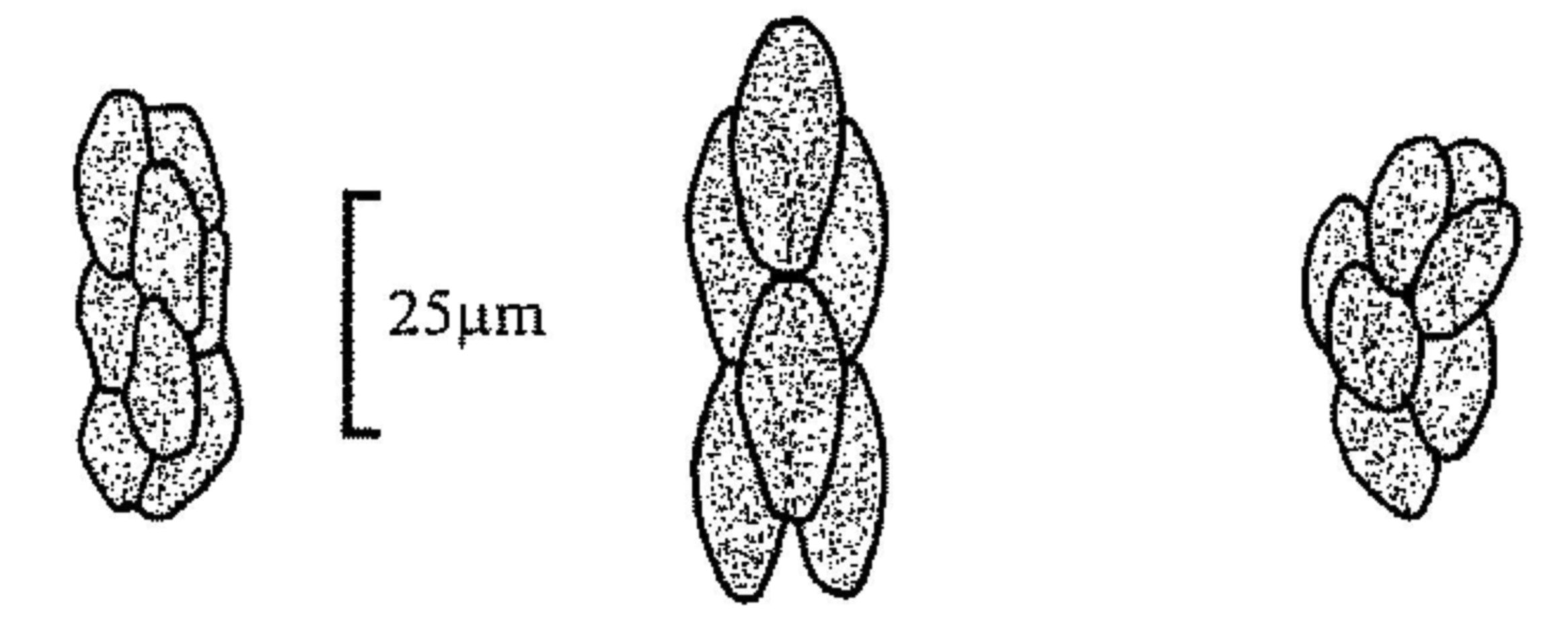
Fig. 10. Spore clusters of, from left, Saccobolus versicolor, S. glaber and S. truncatus
76(74) Spore clusters compact, 26-43 × 13-19µm. Spores 13.5-18 × 7.5-9.5µm, epispore with fine or coarse warts. Apothecia 0.3-0.8mm diam.
Saccobolus obscurus
- Spore clusters elongated, 28-37 × 10-13µm. Spores 10-14.5 × 5-7.5µm, epispore smooth or very finely granular. Apothecia 0.1-0.3mm diam.
Saccobolus depauperatus
77(4) Asci operculate or bursting, without a subapical ring. Spores ellipsoid. 78
- Apothecia white, often minutely hairy at the margin. Ascus dehiscing by a vertical slit; the slit is prevented from running right down the ascus by a subapical ring of thickening. Spores ellipsoid-fusiform.
(Ascozonus, figs 14, 15) 90
78(77) Asci 16-spored. Spores ellipsoid, 11-16 × 7-10µm.
Coprotus sexdecemsporus
- Asci more than 16-spored. 79
79(78) Asci 32-spored. 80
- Asci more than 32-spored. 84
80(79) Asci very large, nearly 0.5mm long, spores 30-35 × 13-17µm (32-40 × 20-24µm in Kimbrough, 1969). Apothecia pale coloured.
Thecotheus pelletieri
- Asci and spores smaller. 81
81(80) Spores 10µm or longer. 83
- Spores up to 10µm long. 82
82(81) Spores ellipsoid, with minute scattered warts visible under oil-immersion, 7-9 × 4-4.5µm. Apothecia densely crowded, 90-120µm diam., with 8-13 asci. Asci 32-55 × 16-18µm with (24-)32 spores. Paraphyses 1.5-2µm, clavate to 4-4.5µm.
Thelebolus caninus
- Spores subacute at apices, ca 6 × 4µm (described as 'minute'; this value is suggested by Boudier's comparison with R. dubius, for which measurements are given). Apothecia densely crowded, tawny yellowish-brown.
Ryparobius brunneus
83(81) Spores 10-12.5 × 5-7.5µm. Asci clavate, 75-100 × 20-30µm. Paraphyses enlarged to 6µm at apex.
Coprotus albidus
- Spores 13.5-17.5 × 7-8µm. Asci 10-15 per apothecium, 120-175 × 50-75µm. Paraphyses filiform.
Coprotus rhyparobioides
84(79) Asci with up to 64 spores. 85
- Asci with many more than 64 spores—impractical to count. 86
85(84) Asci 64-spored, broad clavate with short stalk, 80-130 × 30-60µm. Spores 8-12 × 4-7µm.
Coprotus niveus
- Asci broadly clavate with up to 64 spores, 60-100 × 20-30µm. Spores 7-10 × 4.5-5.5µm. Apothecia superficial, on the surface of the substrate, yellowish brown, gregarious, united into a crust.
Thelebolus crustaceus
86(84) Apothecia superficial, 400-600µm diam., with prominent, acuminate, superficial, 1-2-septate hairs, 80-190µm long, often roughened towards their apex, with one 1000+-spored ascus, 110-240 × 15-27µm. Spores very variable, 6.5-16 × 3.7-8.8µm (mostly 7.5-13 × 4.5-7µm).
Lasiobolus monascus
- Apothecia minute, rarely above 350µm diam., globose and immersed in substrate when young. Asci broad globose, with 100-200 spores. Usually only 1-3 asci in each apothecium, which dehisce by bursting at the apex. 87
(Other Ryparobius spp. will key out here [e.g. R. dubius, R. myriosporus, R. pachyascus and R. polysporus]. They all have scattered to gregarious, immersed to semi-immersed apothecia 100-200µm diam., with relatively few asci, each with 100-250 ellipsoid to subacuminate ca 5-7 × 3-4µm spores. There are insufficient modern observations to allow their identification and separation with confidence).
87(86) Apothecia with a few, but obvious, setae. Spores 9 × 7µm or larger. 88
- Apothecia without setae. Spores ellipsoid, 6-9 × 3.5-4µm. 89
88(87) Spores ellipsoid, 9-11 × 7-9µm. Setae up to 600µm long.
Trichobolus zukalii
- Spores subglobose, 11-12 × 10-11µm. Setae up to 300µm long.
Trichobolus sphaerosporus (fig. 11)
89(87) Apothecia and asci large, 170-250µm diam.
Thelebolus stercoreus (fig. 12)
- Apothecia and asci small, rarely above 80-90µm diam.
Thelebolus nanus (fig. 13)
90(77) Asci 16(-24)-spored. Spores not closely aggregated into an imbricated mass, 13-14 × 6µm (8-9 × 4µm)[1]. Apothecial hairs rough, subulate.
Ascozonus parvisporus
- Asci with 32 or more spores. 91
91(90) Asci 32-spored. Spores 16.5-18 × 4.5-5µm (11-12 × 3-3.5µm)[1]. Apothecia with a single row of sharp, pointed, roughened hairs.
Ascozonus crouanii
- Asci more than 32-spored. 92
92(91) Asci 48-spored. Spores spindle-shaped, 12-14.5 × 2.5-4µm.
Ascozonus leveillei
- Asci more than 48-spored. 93
93(92) Asci 64-spored. 94
- Asci more than 64-spored. 95
94(93) Apothecia with a short base of globose cells, with minutely roughened marginal hairs up to 30 × 8µm. Spores elliptic-fusoid, 12-14 × 3-5µm.
Ascozonus woolhopensis (figs 14, 15)
- Apothecia sessile, with aseptate smooth hairs. Spores 21 × 7.5µm (13-14 × 4.5-5µm)[1].
Ascozonus cunicularis
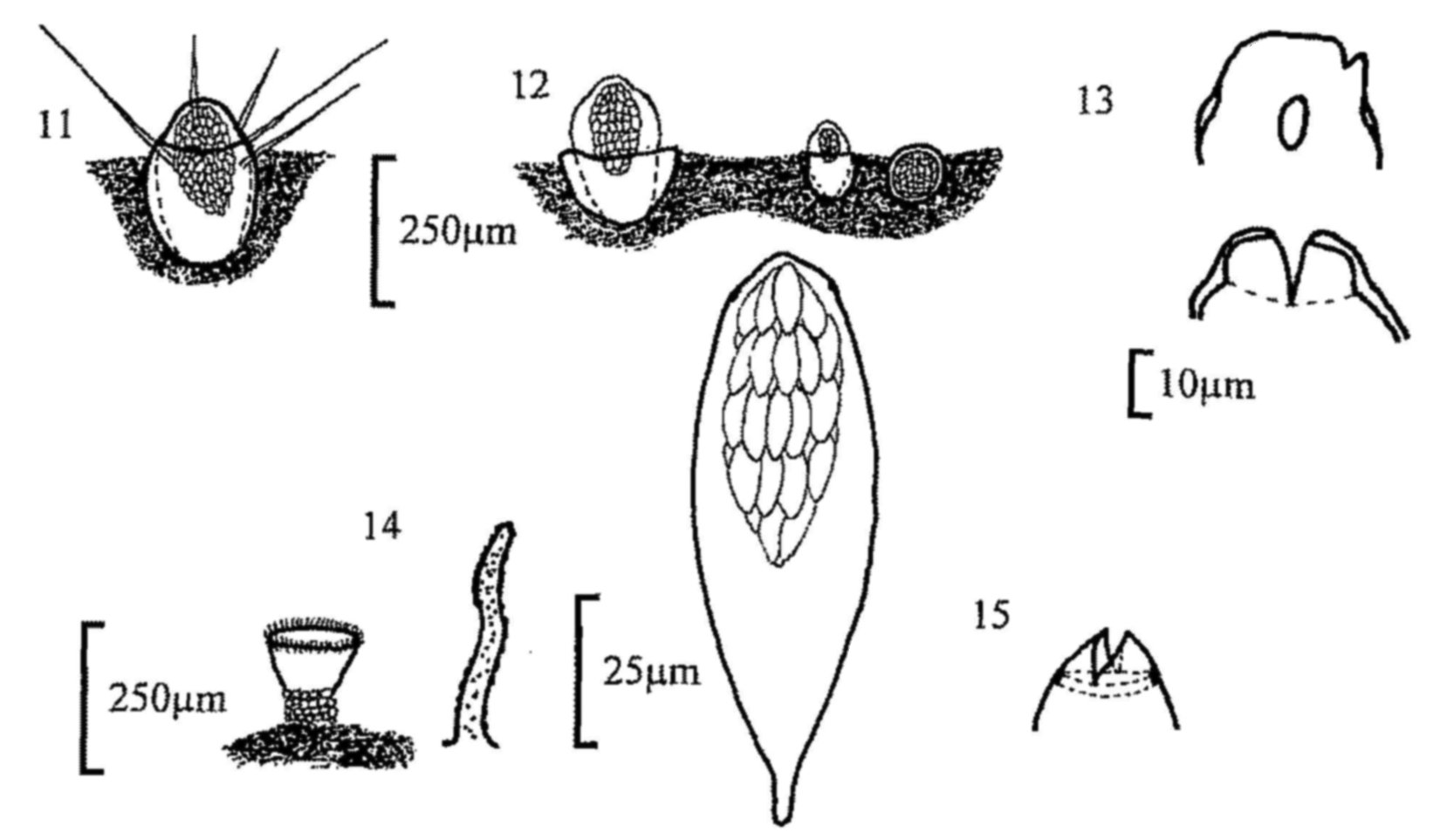
Fig. 11. Trichobolus sphaerosporus, apothecium. Fig. 12. Thelebolus stercoreus, apothecium. Fig. 13. T. nanus, mature and immature apothecia, and detail of ascus dehiscence. Fig. 14. Ascozonus woolhopensis, apothecium and apothecial hair. Fig. 15. A. woolhopensis, ascus with spores and detail of dehiscence.
95(93) Apothecia with a short base of globose cells, with short, irregular hairs. Asci 64-96-spored Spores elliptic-fusoid, 14-14.5 × 5-5.5µm (10-15 × 3.5-4µm)[1].
Ascozonus leveillanus
- Apothecia sessile, dotted with hairs in connate groups of 2-3. Asci with 128 or more spores. Spores 10 × 5µm (7 × 3.5µm)[1].
Ascozonus subhirtus
96(3) Apothecia stalked. 97
- Apothecia not stalked. 98
97(96) Apothecia up to 2mm diam., with a short cylindrical stalk, light brown. Asci 150 × 10µm. Spores hyaline, with 2 oil drops, occasionally 1-septate, 13-15 × 4.5µm.
Lanzia cuniculi
- Apothecia up to 3mm diam., pale olivaceous to grey, with a long, slender, reddish-brown stalk arising from a sclerotium in the dung. Asci 30-40 × 4-5µm. Spores ellipsoid, grey-brown, 4-4.5 × 2µm.
Martininia panamaensis
98(96) Spores 7-11(14) × 1.75-2.75µm. ellipsoid, ellipsoid-fusiform or slightly clavate. Apothecia yellowish brown when fresh, drying darker, up to 1mm diam. Asci 42-60 × 7.5-9µm, pore weakly blue in iodine.
Pezizella albula
- Spores and asci smaller. 99
99(98) Spores linear, 3-5 × 1µm. Asci 30 × 5µm, cylindrical with a short stipe. Paraphyses not clavate but fused to form an epithecium. Apothecia pale pellucid, 0.5-1mm diam.
Orbilia leporina
- Spores longer, subulate, curved. 100
100(99) Spores 7-8.5 × 1.2-1.8µm. Asci 36-40 × 3-5µm, gradually tapering to a short base. Paraphyses enlarged to 3µm at apex, covered with brown granules. Apothecia light brown, 0.4-1.mm diam.
Orbilia fimicola
- Spores 8-10.55 × 0.9-1µm. Asci 30-45 × 3µm, cylindrical-clavate with narrow tapering base and truncate apex. Paraphyses 2µm diam., the tips with a crust-like secretion fusing together to form a shiny epithecium. Apothecia white to yellowish, 180-700µm diam.
Orbilia fimicoloides