Front matter
Reading edition

Illustrated.
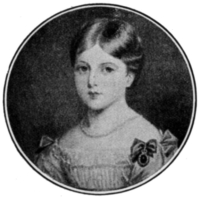
THIS MINIATURE REPRESENTS THE QUEEN AT THE AGE OF EIGHT

1819 MAY 24TH 1899
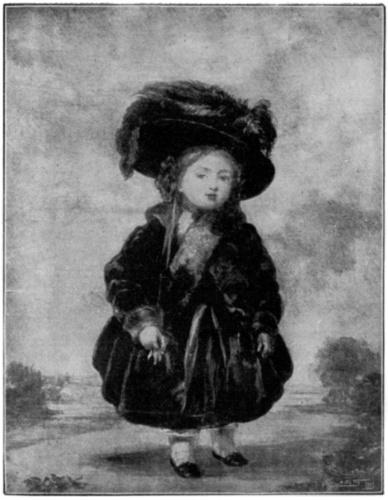
H.R.H. THE PRINCESS VICTORIA AT THE AGE OF FOUR. (From a Painting by Denning.)

THE BIRTHPLACE OF THE QUEEN ILLUSTRATED BEING AN H I S T O R I C A L G U I D E TO THE STATE ROOMS, PICTURES, AND GARDENS BY Ernest Law, B.A. Barrister-at-Law Author of “The History of Hampton Court Palace;” “The Royal Gallery of Hampton Court;” “Vandyck’s Pictures at Windsor Castle,” etc. Notice.—This Catalogue and Guide are copyright, and immediate proceedings in Chancery will be taken against any infringers thereof. LONDON GEORGE BELL AND SONS 1899


HE State Rooms of Kensington Palace, and likewise Queen Anne’s Orangery, will be open to the public every day in the week throughout the year, except Wednesdays, unless notice be, at any time, given to the contrary.

The hours of opening will be 10 o’clock in the morning on week days, and 2 o’clock in the afternoon on Sundays.
The hours of closing will be 6 o’clock in the evening from the 1st of April to the 30th of September, both days inclusive, and 4 o’clock during the winter months.
They will be closed on Christmas Day and Good Friday.

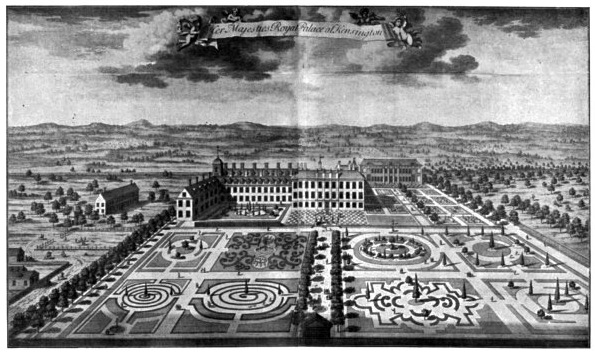
KENSINGTON PALACE AND GARDENS IN THE REIGN OF QUEEN ANNE.

PAGE
RONTISPIECE. H.R.H. the Princess Victoria at the age of Four4

Notice to Visitors6
Plate—Kensington Palace and Gardens in the Reign of Queen Anne8
Preface14
Historical Sketch.
Early History of Kensington17
Building of the Palace18
Deaths of Queen Mary and King William19
Queen Anne at Kensington Palace20
Death of Prince George of Denmark22
Death of Queen Anne22
George I. at Kensington Palace23
George II. at Kensington Palace24
Kensington in George III.’s Reign25
Birth of Queen Victoria26
Plate—The Duchess of Kent with Princess Victoria (aged Two Years)27
Queen Victoria’s Early Years at Kensington29
The Queen’s Childhood at Kensington Palace30
Plate—The Princess Victoria in 182531
Princess Victoria becomes Heiress to the Throne34
Queen Victoria’s Accession36
Queen Victoria’s First Council37
Kensington Palace in Recent Years40
Restoration of the State Rooms41
Methods of Restoration42
Arrangement of the Pictures44
Associations with Queen Victoria45
Descriptive and Historical Guide.
Old Kensington Palace Gardens47
Queen Anne’s Gardens49
Queen Anne’s Orangery51
Terrace of Queen Anne’s Orangery53
Exterior of Queen Anne’s Orangery54
Interior of Queen Anne’s Orangery55
The Alcoves of Queen Anne’s Orangery56
Restoration of Queen Anne’s Orangery56
Kensington Gardens58
Queen Caroline’s Improvements in Kensington Gardens58
Kensington Gardens in the Nineteenth Century59
Plate—South Front of Kensington Palace in 1819—after Westall61
South Front of the Palace63
Wren’s Domestic Style63
East Front of the Palace64
Plate—Plan of the State Rooms66
Public Entrance to the Palace67
Queen’s Staircase68
Old Oak Wainscoting of the Staircase69
Window Sashes of the Staircase69
Queen Mary’s Gallery70
Wainscoting and Carvings of Queen Mary’s Gallery71
Pictures in Queen Mary’s Gallery. Portraits of the Time of William and Mary to George II73
Queen’s Closet77
Pictures of “Old London”77
Queen Anne’s Private Dining Room80
Pictures in Queen Anne’s Private Dining Room81
Queen Mary’s Privy Chamber83
Pictures in Queen Mary’s Privy Chamber83
Queen Caroline’s Drawing Room87
Painted Ceiling of the Queen’s Drawing Room88
Contemporary French and German Portraits88
The Cupola or Cube Room93
The Painted Ceiling of the Cube Room94
Plate—The Cupola or Cube Room as it was when the Queen was Baptized in it95
Painted Walls of the Cube Room96
General Appearance of the Cupola Room98
King’s Drawing Room99
Painted Ceiling of the King’s Drawing Room99
William Kent, the Royal and Fashionable Decorator100
Plate—King’s Drawing Room101
Kent the Father of Modern Gardening103
West’s Pictures in the King’s Drawing Room104
King’s Privy Chamber108
Portraits of George III.’s Time108
The Nursery113
Pictures and Prints illustrative of the Queen’s Life and Reign113
Ante-Room114
Prints illustrative of the Life and Reign of the Queen114
Queen Victoria’s Bedroom115
Prints of the Life and Reign of the Queen116
Mementoes and Relics of the Queen’s Childhood collected in “Queen Victoria’s Bedroom”116
King’s Gallery117
Decorative Carvings in the “King’s Gallery”117
Chimney-Piece, Map and Dial118
Plate—The King’s Gallery119
Painting of the Ceiling and Wainscot of the King’s Gallery121
Naval Pictures in the King’s Gallery122
King’s Grand Staircase129
Kent’s Alterations in the King’s Grand Staircase130
Plate—The King’s Grand Staircase131
Painted Walls of the King’s Grand Staircase133
Painted Ceiling of the King’s Grand Staircase135
Presence Chamber137
Painted Ceiling of the Presence Chamber138
Ceremonial Pictures of Queen Victoria’s Reign139


HE following pages, compiled under the sanction of the Lord Chamberlain of Her Majesty’s Household and the First Commissioner of Her Majesty’s Works and Buildings, are intended to meet the requirements of visitors to the State Rooms of Kensington Palace, now open by command of the Queen to the inspection of the public during Her Majesty’s pleasure. This little book, therefore, is to be understood as aiming only at a descriptive and historical account of the particular parts of the building on view—not, in any sense, as attempting a general history of the Palace. Nevertheless, the author may, perhaps, be permitted to say that, as far as his object extends, he has endeavoured to render the information here given as accurate and complete as possible, by devoting the same amount of time and labour to research and verification, as though he had been writing a book of a critical nature for a restricted circle of readers, instead of a mere handbook for ordinary sightseers.

In this way, the writer conceives, can he best promote the object which, it may be assumed, the Queen and Her Majesty’s Government have had in view in restoring and opening these State Rooms to the public—namely, that they should serve as an object-lesson in history and art, and a refining influence of popular culture and education.
In pursuance of this design the author has had recourse not only to such well-known standard authorities on his subject as Pyne’s “History of Royal Residences,” 1819; Faulkner’s “History of Kensington,” 1820; Leigh Hunt’s “Old Court Suburb,” 1853; and Mr. Loftie’s “Kensington—Picturesque and Historical,” 1887; but also to a large number of earlier and less known historical and topographical works, which have served to illustrate many things connected with the history of this interesting old building.
His main sources of information, however, have been the old manuscripts, parchment rolls, and state papers, preserved in the British Museum and Record Office—especially the “Declared Accounts” and “Treasury Papers,” containing the original estimates, accounts and reports of Sir Christopher Wren and his successors, relating to the works and buildings at Kensington. None of these have ever before been examined or published; and they throw much light on the art and decoration of this palace, while also, for the first time, setting at rest many hitherto debatable points.
The author must here once again—as in works of a similar nature elsewhere—express his obligations for the kind assistance he has received from all those who have charge of the Queen’s palaces—the Hon. Sir Spencer Ponsonby Fane, G.C.B., Comptroller of Her Majesty’s Household; the Hon. Reginald Brett, C.B., Secretary of Her Majesty’s Board of Works and Buildings; Sir John Taylor, K.C.B., Consulting Architect and Surveyor to the Board; and Mr. Philip, Clerk of the Works at Kensington Palace.
At the same time he wishes to make it clear that for the information contained herein, and for the opinions and views expressed, he himself is alone responsible.
Here also the author must make his acknowledgments to the editor of “The Gentlewoman,” who has kindly lent him the blocks for the portraits of the Queen.
It may be as well to take this opportunity of emphasizing what is more fully insisted on in subsequent pages, that Kensington Palace, as a public resort, is not to be considered in the light of an Art Gallery, but as a Palace with historical pictures in it. The clear understanding of this may prevent misapprehension as to the scheme followed in restoring the state rooms to their original state, where the pictures—and their frames—are arranged on the walls as a part only of their furniture and decoration.
Finally, it may be observed that though the outline of the history of the Palace, prefixed to the description of the State Rooms, has necessarily been brief, the Queen’s early life, and the interesting events that took place here in June 1837, seemed to require a fuller treatment. These, therefore, have been described in detail, mainly in the words of eye-witnesses, which, though they have often been printed before, may, being repeated here, acquire—the compiler has thought—a new vividness and interest, when read on the very spot where they were enacted; and thus insure for these famous scenes an even wider popularity than before.