D E S C R I P T I V E A N D H I S T O R I C A L G U I D E. (continued 2)
Reading edition
General appearance of the Cupola Room.
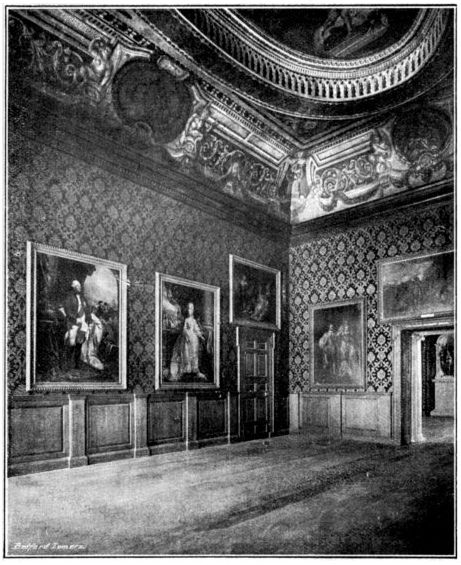
SUCH was the decoration of this famous Cupola or Cube Room when finished by Kent, such it appeared in 1818, when Pyne’s drawing, from which our illustration is taken, was made, and such it appears to this day, save for the large musical clock which then stood in its centre, for the console tables against the walls, and the four large chandeliers that hung from the ceiling. These last were most essential features in this saloon, for its windows, abutting northwards on the private gardens, admit but very insufficient light; and only when illuminated by a blaze of candlelight can full justice have been done to the extravagant glories of its walls and ceilings.
It was, in fact, intended essentially as a room for grand evening entertainments, and Kent evidently bore this in mind when he constructed it; for he contrived a very ingenious method, whereby the double doors in the doorways between it and the two drawing-rooms, with which it communicates, fold back, when opened, into the door jambs, in which they lie flush, offering no projecting hindrance to the movement of guests passing either way. This is a point never thought of by modern architects, who might do worse, when designing great reception rooms, than take a hint in this matter from the much contemned Kent, and so obviate the usual “crush” at the too narrow doorways.
It seems to have been in this Cupola Room that took place, on the 24th of June, 1819, the baptism of the infant Princess Victoria. Faulkner records that “the Royal Gold Font was brought from the Tower and fitted up in the Grand Saloon, with crimson velvet covering from the Chapel Royal, St. James’s. The ceremony was performed by the Archbishop of Canterbury, assisted by the Bishop of London.... The Prince Regent and nearly all the Royal Family were present at the ceremony, or at the dinner in the evening.”
Exactly underneath this room is the famous pillared “Council Chamber” in which, as we have already stated, the Queen held her first council.

Built at the same time as the two preceding rooms by command of King George I., William Kent here again reigns supreme in the design and decoration. “It was on the walls of this drawing-room,” we are told by Pyne, writing in 1818, “that the then new art of paper-hangings, in imitation of the old velvet flock, was displayed, with an effect that soon led to the adoption of so cheap and elegant a manufacture, in preference to the original rich material from which it was copied.”
The paper that now covers the walls is a copy of an old pattern, and has been supplied by Messrs. Bertram, the decorators.
We may again notice here the five lofty doorways, surmounted by flat architraves, and the oak pilasters in the dado as characteristic of Kent. There was originally one of his great massive marble chimney-pieces in this room, long since replaced by the present plain insignificant one.
The dimensions of this room are 39 feet 6 inches long (from east to west), 28 feet wide, and 22 feet 8 inches high to the top of the cornice.
Painted Ceiling of the King’s Drawing Room.
THIS is another of Kent’s artistic efforts. There is in the Record Office a letter from Lord Grafton dated June 26th, 1725, conveying his majesty’s commands that “their Lordships of the Treasury would give orders to Mr. William Kent to paint the ceilings, etc. in the new apartments at Kensington”—including this one.
The cove of the ceiling, or portion nearest the cornice, is elaborately decorated with scroll-work and architectural ornaments, richly gilt and painted, and with medallions in the middle of each side supported by female figures. In the centre is a large projecting heavy oval frame of plaster, with the panel within it recessed about three feet. This is painted with the story of Jupiter and Semele, the God appearing in a thunder-cloud, and Semele, in a ridiculous attitude, on a couch. No painting could be worse. The signature of the artist, “William Kent pinxit, 1725,” has been found a little to the left of the right foot of Semele.
When the restoration of this room was taken in hand last winter, the ceiling was so begrimed with the dirt, dust, smoke, and smuts of upwards of a hundred and fifty years of London atmosphere, as to be nearly black. The cleaning was carried out with the most scrupulous care, and practically no re-painting or re-gilding has been necessary.
William Kent, the Royal and Fashionable Decorator.
THE whole effect of this ceiling if you do not look at it is rich and striking, and with the fine paper and the pictures on the walls will pass muster as a suitable decorative treatment of a grand state reception room. George I. and George II. at any rate had no hesitation in extending an unqualified approval to Kent’s work. After having finished this suite he grew into greater favour than ever. He was soon after appointed “Master Carpenter, Architect, Keeper of the Pictures, and Principal Painter to the Crown, the whole, including a pension of £100 a year, which was given him for his works at Kensington, producing—according to Walpole—£600 a year.” From the Court his vogue extended to a large circle of patrons and votaries. “He was not only consulted for furniture, as frames of pictures, glasses, tables, chairs, etc., but for plate, for a barge, for a cradle; and so impetuous was fashion, that two great ladies prevailed on him to make designs for their birthday gowns. The one he dressed in a petticoat decorated with columns of the five orders; the other like a bronze, in a copper-coloured satin, with ornaments of gold!”
KING’S DRAWING ROOM.

Kent, the “Father of Modern Gardening.”
KENT also had a great reputation as a horticulturist, and was generally designated, at the end of last century, as the “Father of Modern Gardening”—his ghastly progeny consisting of the destructive and desolating “landscape-gardening” enterprises of “Capability Brown,” Repton, and their followers. His hand doubtless fell heavy on the old Queen Anne formal gardens about Kensington Palace. We can see the influence of his taste, which was followed with enthusiasm by Queen Caroline and her gardener Bridgman, in the barrenness and commonplace appearance of the grounds that lie immediately below in front of us, as we look out of the windows of this room, and in the entire absence of planting or gardening in the large expanse surrounding the “Round Pond.”
This Round Pond, or “the Basin” as it used to be called, is, by the bye, not round at all, but of a geometrical figure, more of an oval form than circular, and with the four sides flattened and the intermediate portions of the circumference bent into “ogees.” In thus shaping this basin the designer, whether Kent or Bridgman, has overstepped artistic discretion; for from no point of view, neither in Kensington Gardens, from the ground beside it, nor even from this window is its real shape to be made out—only from Rocque’s plan or bird’s-eye view, of 1736, can it be seen to be so eccentric.
The distant view, however, beyond the private gardens, across the Round Pond and Kensington Gardens, over grassy slopes and ancient trees to Hyde Park, a mile away, is one of the pleasantest in the metropolis. Not a street, not a road, not a house, not a roof is to be seen. In the spring and early summer, when the foliage is fresh and green, one might imagine oneself in the depths of the country, in some old house overlooking midland pastures and woods.
West’s Pictures in the King’s Drawing Room.
IN this room are hung the paintings of West, all of which were executed for George III., who greatly admired them, and extended to him a most liberal patronage. He was equally in favour with the public, who lauded his performances to the skies, and with his fellow-artists, who made him President of the Royal Academy. We now hardly know which to wonder at most—an obscure lad in the wilds of Pennsylvania, who took his earliest lessons in painting from a tribe of Cherokees, accomplishing what he did; or the English fetish, Public Opinion, having been so deluded as to regard his efforts as masterpieces of Art. The depreciation which has overtaken him may be judged when we hear that an “Annunciation,” for which £800 was originally paid, was knocked down in 1840 for £10! His portraits, nevertheless, are interesting.
80 The Death of General Wolfe (497). . . . . West.
Wolfe lies in the centre, to the right, supported by three officers. In front of him is a wounded officer, standing, supported by others, to hear his dying injunctions. At his feet is an Indian warrior in his war-paint, gazing at him to see how an English chief will die. On the extreme left is a messenger running, and on the left ships with soldiers disembarking. On canvas, 5 ft. high, by 8 ft. wide.
Wolfe was killed on the 13th September, 1759, in the moment of victory before Quebec. “The fall of Wolfe was noble indeed. He received a wound in the head, but covered it from his soldiers with his handkerchief. A second ball struck him in the belly, but that too he dissembled. A third hitting him in the breast, he sank under the anguish, and was carried behind the ranks. Yet, fast as life ebbed out, his whole anxiety centred on the fortune of the day. He begged to be borne nearer to the action, but his sight being dimmed by the approach of death, he entreated to be told what they who supported him saw: he was answered, that the enemy gave ground. He eagerly repeated the question, heard the enemy was totally routed, cried ‘I am satisfied,’ and expired.” (Walpole’s Memoirs.)
“In this picture, which was painted in 1771, West introduced the sensible innovation of dressing the characters in their proper costume; previous to that time it was the common practice with painters to dress their figures in historical compositions of any kind, in the Greek or Roman costume. Sir Joshua Reynolds was one of those who were averse to the innovation, but when the picture was finished, he changed his opinion. After a careful examination of the picture, he observed to the Archbishop of York, who was with him at the time, ‘West has conquered; he has treated his subject as it ought to be treated; I retract my objections. I foresee that this picture will not only become one of the most popular, but will occasion a revolution in the art.’ When West related this to the King, he said, ‘I wish I had known all this before, for the objection has been the means of Lord Grosvenor getting the picture, but you shall make a copy for me.’”
This is the copy ordered by George III., for which the painter received £315. The original is at Grosvenor House, and has been finely engraved by Woollett. There are several other repetitions of it.
81 Prince of Wales (George IV.), and Duke of York (500). . . . . . West.
The Prince is on the left, in yellow satin, his right hand on his hip, his left on his brother’s shoulder, who leans against a table. They are both in the robes of the Garter and St. Andrew. On canvas, 9 ft. high, by 7 ft. wide.
The Prince of Wales was born on August 12th, 1762; Frederick, Duke of York, on August 16th, 1763. This picture represents them when they were about fifteen and fourteen years old, therefore, about 1777.
Soon afterwards the Duke of York proceeded to Prussia for the purpose of being educated as a soldier.
82 Dukes of Cumberland, Sussex, and Cambridge, and the Princesses Augusta-Sophia, Elizabeth, and Mary (488).
The Duke of Cumberland is on the left, standing; the Duke of Sussex is lying down near his sister Elizabeth, who holds on her lap the infant Princess Mary (?). Kneeling by them is the Duke of Cambridge, and behind is the Princess Augusta-Sophia. Signed and dated 1776. On canvas, 6 ft. 7 in. high, by 7 ft. 10 in. wide.
Prince Ernest Augustus, afterwards Duke of Cumberland and King of Hanover, and grandfather of her Royal Highness Princess Frederica, was born June 5th, 1771; Prince Augustus Frederick, Duke of Sussex, on January 27th, 1773; and Prince Adolphus Frederick, Duke of Cambridge, on February 24th, 1774. Princess Augusta-Sophia was born on November 8th, 1768; Princess Elizabeth, on May 22nd, 1770; and Princess Mary, on April 25th, 1776.
The Princesses have long been wrongly called, Charlotte, Augusta, and Sophia; the correct names, as given above, are derived from the contemporary mezzotint by V. Green; besides, when this picture was painted the Princess Sophia was not born.
83 Queen Charlotte, aged 36, with her thirteen children in the background (498) . . . . . West.
Standing; dressed in white, her hair powdered and piled up high. The thirteen children are seen in the distance to the left, in a picture which is now at Windsor Castle. On canvas, 9 ft. 6 in. high, by 7 ft. wide.
84 George III.; Lords Amherst and Lothian behind (494). . . . . . West.
He is standing, facing to the right, in full regimentals. He holds a scroll of paper in his hands in front of him. Behind him is his crown and sceptre; and in the background the two peers, and a view of Coxheath Camp. On canvas, 9 ft. 6 in. high, by 7 ft. wide.
It appears from West’s own memoranda that this picture was painted before 1779, consequently the King cannot have been more than forty.
85 Duke of Cambridge, and Princesses Charlotte and Augusta (487). . . . . West.
The Duke, in a maroon-coloured suit, is standing on the right. Princess Charlotte is sitting on a stool, with her sister on her lap. In the background are a curtain, a column, and Kew Gardens with the Pagoda. Signed on the top in the left hand corner; and dated 1778. On canvas, 9 ft. high, by 6 ft. wide.
Princess Charlotte, George III.’s eldest daughter, afterwards Queen of Wirtemburg, was born on September 29th, 1766; and Princess Augusta, on November 8th, 1768. It is doubtful whether the names are correct.
86 Apotheosis of the Infant Princes Octavius and Alfred (503).
Alfred, the younger of the two, is seated on clouds, with his hands out-stretched to his brother, who is being conducted up to him by an angel.
Prince Octavius was born on February 23rd, 1779, and Prince Alfred on September 22nd, 1780. Alfred died on August 20th, 1782. “I am very sorry for Alfred,” said the King, “but had it been Octavius I should have died too.”
Octavius followed his brother to the grave on May 2nd, 1783. For this picture West received £315. Engraved by Sir Robert Strange.
87 Queen Charlotte and the Princess Royal (492). . . . . West.
The Queen is sitting on a sofa, with embroidery on her lap. The Princess stands on the right, by her side, and holds the embroidery. Dated 1776. On canvas, 5 ft. 5 in. high, by 6 ft. 8 in. wide.
88 Duke of Clarence (William IV.), and Duke of Kent (502). . . . . . West.
The Duke of Clarence is on the left, dressed in a blue coat with a white vest; he has his right hand on a globe, his left on his hip. The Duke of Kent is in red turned full to the front, but looking at his brother; his right hand is on his brother’s left hand, his left is pointing upwards. On canvas, 9 ft. 6 in. high, by 7 ft. wide.
Prince William Henry, Duke of Clarence, afterwards William IV., was born August 21st, 1765. Prince Edward, Duke of Kent, father of her present Most Gracious Majesty, was born November 2nd, 1767. This picture was painted when they were about thirteen and eleven years. In 1780, the Duke of Clarence went to sea as a midshipman. West received 250 guineas for the picture.
89 George III. Reviewing the Tenth Dragoons in Hyde Park in 1797 (168). . . . . Beechey.
The King is in front on a white horse, whose head is turned to the left. He is in full regimentals, with a cocked hat. Just behind him is the Prince of Wales, in the uniform of the 10th, holding up his sword and giving the word of command. To the left of the King is the Duke of York, with Generals Goldsworthy and Sir David Dundas; Sir William Fawcett is standing in front of them. The King is turning round to speak to them, and points with his right hand to the cavalry charge in the left distance. On canvas, 13 ft. 8 in. high, by 16½ ft. wide.
The 10th Light Dragoons (now the 10th Hussars) were frequently reviewed by George III. in company with the Prince of Wales, who entered the army as brevet-colonel, November 19th, 1782, and after whom the regiment was called “The Prince of Wales’s Own,” on Michaelmas Day, 1783. In 1793 he was appointed colonel-commandant of the corps, and succeeded as colonel on July 18th, 1796. The review commemorated here took place not long after that date, for the picture is mentioned in a biographical sketch of Sir William Beechey in The London Monthly Mirror for July, 1798, where we are told that the King rewarded him for it with the honour of knighthood. The names of the officers were derived from an account of a review, which took place in 1799, and which this picture was formerly supposed to represent; it is therefore doubtful whether they are quite correct. (See Notes and Queries.)
This picture is regarded as Beechey’s masterpiece, and was very much admired at the time. But “although a clever and showy group of portraits, it has little of real nature, and is full of the painter’s artifices. Thus the King’s white horse forms the principal light, and comes off the Prince of Wales’s dark horse, and so on; the light and shadow of all the heads being the light and shadow of the studio, and not of the field.”—(Redgrave’s Century of Painters.) The King had several copies taken of it; in one, which he gave to Lord Sidmouth, the figure of the Prince was omitted by the King’s own desire, a curious proof of his dislike of his son. When the Prince became King he hinted that it should be restored, but this was evaded. Benjamin Smith engraved the portrait of George III. from this picture.

Although this room formed part of the state apartments built by Kent, it was much transformed in the reign of George III., so that it bears little trace of its original decoration. Indeed, it is so commonplace in appearance, that, except for the pictures which now hang on its walls, it looks more like an ordinary bedroom in an old-fashioned country inn than a king’s chamber in a palace. The plain deal dado, the common chimney-piece of black veined marble, the wood and plaster cornice, the shutters and windows, are all of the most ordinary and inartistic pattern.
The dimensions of this room are 31 feet long, 24 feet wide, and 17 feet high.
Portraits of the Time of George III.
90 Portrait of Francis, 5th Duke of Bedford (961). . . . . . J. Hoppner.
Full-length, turned to the left, looking to the front. He is dressed in a peer’s full robes. His left hand is on his hip, his right holds a scroll of paper. He is bareheaded, face close-shaven, and his hair short. Behind him is a red curtain, and in the distance on the left a statue of Hercules. On canvas, 8 ft. 3 in. high, by 5 ft. 2 in. wide.
Behind is written:—“Received, 7th April, 1810, from Mrs. Hoppner.” The duke, who was born in 1765, died on March 2nd, 1802.
“More dignified and well painted than the similar one at Woburn.”—Sir George Scharf.
91 Francis Hastings, Earl of Moira (950). . . . . Hoppner.
Full-length, figure slightly to the right, but the face turned round to the left. Dressed in uniform, with the Ribbon and Star of the Garter. His right hand holds a scroll of paper by his side; his left rests on a document on a table. Background, a green curtain, and sky on the right. On canvas, 7 ft. 10 in. high, by 4 ft. 10 in. wide.
Behind is painted “R.A. 1794,” the year of Hoppner’s election, and “The Star and Garter added 1812,” in June of which year Lord Moira, after failing to form a ministry, accepted the Garter, “but,” says Lord Spencer in a letter to Lord Buckingham, “whether as a calm to his honour or his understanding, it is not for me to say.” This picture was received from Hoppner’s widow, in June, 1810, a few months after his death.
92 Portrait of John Hely, Lord Hutchinson (872) . . . . . Phillips, R.A.
Three-quarters length, seated, turned to the left, and looking downwards. His left leg is crossed over his right, and in his left hand he holds a map of Egypt; his right holds an eyeglass on his breast. He is in his uniform. In front of him on a table are writing materials. On canvas, 4 ft. high, by 3½ ft. wide.
John Hely was born in 1757, and in 1774 went into the army. In the expedition to Egypt in 1801 he was appointed second in command to Sir Ralph Abercrombie; on whose death the chief command devolved on Hely, then a major-general. For his admirable conduct of the campaign, in which he drove the French from Egypt, he received the thanks of both Houses, and was raised to the peerage in 1813. In 1823 he succeeded his brother to the earldom of Donoughmore. He died in 1832.
93 Christian VII. of Denmark (976). . . . . Dance.
A head, in an oval, turned to the right; dressed in a red uniform trimmed with gold; on his breast a blue ribbon. His hair is powdered and brushed back.
This was formerly unnamed, but the mezzotint engraving after it by Fisher shows it to have been painted by Dance; doubtless when the King was over here in 1767 for his marriage to Princess Matilda. He was then eighteen years old.
Their domestic life was not happy. In politics he distinguished himself by granting liberty of the press to his subjects; in reward for which Voltaire addressed the famous lines to him, in which he tells him: “Je me jette à tes pieds au nom du genre humain.”
He afterwards went out of his mind, and died in 1808.
He was the son of Princess Louisa, the daughter of George II., and succeeded to the throne in 1766. The engraving after this picture by G. Fisher is dated 1769.
94 Portrait of Richard Brinsley Sheridan (891). . . . . . K. A. Hickel?
Bust; face turned slightly to the right. He has a blue coat and a yellow waistcoat. His face is close-shaven. On canvas, 2 ft. high, by 1 ft. 8 in wide.
“Whatever Sheridan has done, or chosen to do, has been par excellence always the best of its kind. He has written the best comedy, the best farce, and the best address (‘Monologue on Garrick’), and, to crown all, delivered the very best oration (the famous Begum speech) ever conceived or heard in this country.”—Byron.
This appears to be the study for, or a replica of, the head of Sheridan in the picture of the Interior of the old House of Commons in 1793, painted by Karl Anton Hickel, and now in the National Portrait Gallery.
95 Portrait of Spencer Perceval (890). . . . . Joseph.
Half-length, turned to the left. In his left hand he holds a paper. He wears a blue coat and a white waistcoat. His face is shaven, his hair grey, and his head bald in front. On canvas, 2½ ft. high, by 2 ft. wide.
Behind is written:—“Received from Mrs. Joseph, 18th June, 1814.”
This is a posthumous likeness, taken from a mask after death, but considered by all who knew him to be a faithful resemblance. When Queen Charlotte went to see it, and the curtain which covered it was withdrawn, she was so struck with its truth, that she burst into tears. Many copies with slight variations were executed; one of them is now in the National Portrait Gallery. It is engraved in mezzotint by Turner. It is a fair specimen of George Francis Joseph, an indifferent artist, who was elected an associate of the Royal Academy after painting this portrait. He died in 1846.
Perceval, who became Prime Minister in October, 1809, was assassinated in the lobby of the House of Commons by Bellingham, on May 11th, 1812. The official documents he holds in his hand remind us that his state papers were not at all to the taste of the Prince Regent, who remarked, “that it was a great misfortune to Mr. Perceval to write in a style which would disgrace a respectable washerwoman.”
96 Mary Granville, Mrs. Delany (944). . . . . Opie.
Bust, turned to the left. She is dressed in a black silk dress, trimmed with lace, and having a hood over her white widow’s cap. Round her neck is a locket. On canvas, 2 ft. 6 in. high.
This portrait represents her as a very old woman, and was probably painted not many years before her death, in 1788, at the age of eighty-eight. She was the eldest daughter of Bernard Granville, grandson of Sir Bevil Granville, the Royalist leader, and was born in 1700. She was educated under the care of her uncle, Lord Lansdowne, and married in 1717 Alexander Pendarves. She was intimate with Swift, through whom she became acquainted with her second husband, Dr. Delany. After his death she spent most of her time with her friend, the Duchess of Portland, and when she died, George III., who, with the Queen, became very intimate with the old lady, gave her a pension and a house at Windsor. She occupied her declining years in copying flowers in paper, and executed as many as 980. She died in 1788. Her autobiography was published in 1861; it contains a great many reminiscences of the court and family of George III.
This picture first brought Opie into notice. A replica painted for the Countess of Bute is in the National Portrait Gallery.
97 Brownlow North, Bishop of Winchester (888). . . . . . after Dance.
Bust, nearly a full face, slightly inclined to the right. He is seated in a purple-covered chair, in the robes of a Chancellor of the Garter, with the chain of the order on his breast. On canvas, 2 ft. 8 in. high, by 2 ft. 2 in. wide.
He was a half-brother of Lord North, the Prime Minister; was born in 1741; and was successively appointed Bishop of Lichfield and Coventry, Worcester and Winchester, and died in 1820.
98 Portrait of Hurd, Bishop of Worcester (889). . . . . Gainsborough.
Bust, turned to the left, facing and looking in front. Dressed in a bishop’s canonicals, with a small, but full, curly wig. Painted in an oval. On canvas, 2 ft. 6 in. high, by 2 ft. 1 in. wide. Compare No. 371.
99 Richard Hurd, Bishop of Worcester (887). . . . . Gainsborough.
Bust, to the right, looking to the front His left hand is on his breast, holding his gown. Dressed in canonicals, with a bushy wig. On canvas, 2 ft. 6 in. high, by 2 ft. 1 in. wide.
He was the son of a farmer at Congreve, Staffordshire, and was born in 1720. He was appointed preceptor to the Prince of Wales and the Duke of York, and was nominated Bishop of Worcester in 1781; but declined the primacy offered by George III., with whom he was a great favourite. He wrote many moral and religious works, long since relegated to the limbo of insipid mediocrities. Engraved by Holl in 1774? Perhaps the picture exhibited in 1781.
100 A Rabbi (266). . . . . after Rembrandt, by Gainsborough.
Bust, to the right. He wears a dark dress, and cap with flaps; his beard is long. On canvas, 2 ft. 6 in. high, by 2 ft. 1 in. wide.
This was in Gainsborough’s possession at his death, and was exhibited at Schomberg House, 1789.
101 Portrait of C. F. Abel, the Musician (938). . . . . Robineau.
Half-length; seated at a piano or spinet, turned towards the right, but his face looking behind him, over his shoulder to the left. He is dressed in a red coat and has a small wig. On canvas, 2 ft. 1 in. high, by 1 ft. 8 in. wide. Signed on the left-hand side:—“C. Robineau 1780.”
Charles Frederick Abel was a pupil of Bach’s, and at one time belonged to the royal band at Dresden. He came to England about 1765, and was appointed master of Queen Charlotte’s band. Although he wrote music, he was more celebrated for his playing than his compositions. Abel was a very passionate man, and much addicted to the bottle,—peculiarities which the visitor would suspect him of, from his flushed face and red nose. He died in 1787, after being three days in a sort of drunken torpor.
Robineau was a portrait-painter who practised in Paris and London.
102 Duchess of Brunswick, Sister of George III. . . . . . A. Kauffman.
Full-length, turned to the right. She holds a child in her arms on an altar in front of her. She is dressed in white with an orange-coloured mantle, lined with light blue; she wears sandals. On canvas, 8 ft. 11 in. high, by 5 ft. 11 in. wide.
On the left at the foot of the column is the signature:—“Angelica Pinx Aº. 1767.” To the left, on a vase, the inscription:—
Carol. ILLE de Bruns. & Priñ. Hered. A. MDCCLX M. Jul. apud Enisdorff VICTORIA. et A. MDCCLXIV M. Jan. apud Lond. AMORE. Coron.
Augusta, the eldest daughter of Frederick, Prince of Wales, was born on the 31st of July, 1737, and was married to the Duke of Brunswick on the 17th of January, 1764. By him she became the mother, among other children, of Caroline, Princess of Wales, and of Duke William Frederick, “Brunswick’s fated chieftain,” who fell at Quatre-Bras. In 1767, when this portrait was painted, she was in England on a visit.
The child in her arms must be her eldest son Charles George Augustus, who was born 8th February, 1766, and died in 1806.
103. Frederick, Prince of Wales (893) . . . . . Vanloo?
Bust, turned to the left, facing in front. He wears a blue sash over his coat. See ante, No. 4.
104. George III., when Prince of Wales, aged 12, and Prince Edward Augustus, Duke of York and Albany, aged 11 . . . . . . Richard Wilson, R.A.
Seated figures, on a couch by a table, the Prince of Wales on the left. On canvas, 3 feet 3½ inches high, by 4 feet 1½ inches wide. Lent by the trustees of the National Portrait Gallery.
The Duke of York was born in 1739, became an admiral in 1759, and died at Monaco in 1767.

The designation of “The Nursery” has been for many years applied to this room, having, it appears, been so used at one time by Queen Victoria, whose doll-house is now placed here. It was afterwards occupied by the late Duchess of Teck, and it was here that Princess May, now Duchess of York, was born, on May 26th, 1867.
Its associations are, therefore, exclusively Victorian, with which its decoration—so far as it can be said to have any—accords. The “shell” of the room, however, is part of Kent’s addition to the State Rooms.
The dimensions of this room are 30 feet 7 inches long by 23 feet 5 inches wide, and 17 feet high to the highest point of the ceiling, 15 feet 2 inches to the top of the cornice.
Pictures and Prints illustrative of the Queen’s Life and Reign.
A COLLECTION is here being formed by Mr. Holmes, the Queen’s Librarian, of various prints, illustrative of Her Majesty’s Life and Reign. Among them are old prints of the Queen as a child, and as the young Princess Victoria, Heiress to the Throne; also of the marriage of the Prince of Wales in St. George’s Chapel, the Baptism of the Princess Royal, etc.; and also the Jubilee Celebration of 1887 in Westminster Abbey, from the painting by W. E. Lockhart, R.S.A.
110 The Queen’s First Council in the pillared Council Chamber at Kensington Palace on 20th of June, 1837 . . . . . After Wilkie.
For an account of this famous scene, see page 37.

S we go through the door of “The Nursery” into this ante-room, we pass from the portion of the Palace built by Kent, to the original block erected by Wren, this ante-room being a part of what was formerly one of William III.’s state rooms.

Through this lobby it was that the Queen passed to the adjoining staircase when she went downstairs to receive the news of her accession.
The dimensions of this room are: 19 feet 3 inches long, 10 feet 2 inches wide, and 16 feet high.
Prints illustrative of the Life and Reign of the Queen.
THE wall space here will be devoted to further prints illustrative of the Queen’s Life and Reign.


To future ages, if not indeed already to the present one, this plain, modestly-decorated chamber must have an interest far transcending that of the more gorgeous Georgian saloons, which we have just traversed. For, it was for many years the bedroom of our own Queen, when as a little girl of tender age she lived in quiet simplicity at Kensington Palace with her mother, the Duchess of Kent.
From the windows of this room we can imagine the little princess, when she rose in the morning, gazing out over the gardens and the Park beyond, as the beams of the eastern sun struggled through the mists and smoke of distant London, musing on the mighty destiny awaiting her; or in the evening hour, when the flower-scented air of the garden beneath floated in at the casement, looking out where the far-off lights of the great town twinkled among the trees, her mind filled with solemn thoughts of the awful responsibility that was to be hers.
Even now, when the building octopus, with its stucco tentacles, has clutched and sucked in so many a fair surrounding green field, from these windows not a roof, not a chimney meets the eye; not an echo, even, of the ceaseless roar of the traffic strikes the ear.
It was in this room that the Queen was sleeping on the memorable morning of the 20th of June, 1837, when she was awakened by her mother, the Duchess of Kent, to go to the Drawing Room downstairs, where Lord Conyngham and the Archbishop of Canterbury were awaiting to inform her of her accession to the throne.
The dimensions of this room are: 23 feet 3 inches long, 19 feet 3 inches wide, and 16 feet high.
Prints of the Life and Reign of the Queen.
PRINTS in continuation of the series commenced in “The Nursery,” are in process of being arranged in this room.
Mementoes and Relics of the Queen’s Childhood, collected in “Queen Victoria’s Bedroom.”
HERE also will be arranged some of the Queen’s toys, with which she played as a little girl in these rooms; and perhaps other similar objects of interest. Labels will, doubtless, be affixed to explain, what these are.
ing’s allery.


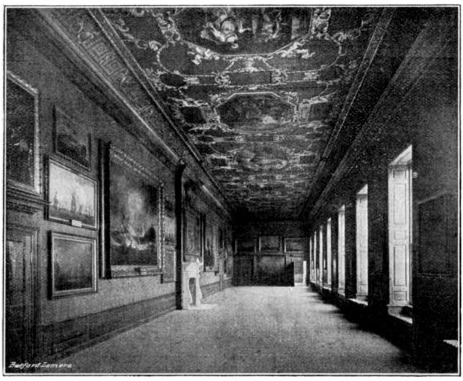
HIS magnificent gallery, the finest of all the state rooms at Kensington Palace, was designed and built by Sir Christopher Wren for William III. about the year 1693. It owes much of its architectural effect to the great architect’s wonderful knowledge and appreciation of proportion—an element too often disregarded in buildings of modern times. Its length is 96 feet, its breadth 21 feet 6 inches, and its height 18 feet to the top of the cornice, and 19 feet 8 inches to the highest point of the ceiling. It is, therefore, 12 feet longer than the already-described Queen Mary’s Gallery, 2 feet higher, but of the same width. Compared with it, the “King’s or Cartoon Gallery” at Hampton Court, built by Wren almost exactly at the same time, it is 21 feet less long, 3 feet less wide, and 10 feet less high.

In relation to it the following items from the old accounts, dating from about the year 1693, are interesting:
“Item to Richard Hawkesmore, Clerk of the Workes, for making up an account [an estimate?] of the King’s New Gallery at Kensington—£5.”
“More to him for Pasteboard and other Materialls for making a modell of the said Gallery for the King—£5 2s.”
“Cha: Houghton for rating, casting up, and engrossing the Books of the said Building for the Auditor—£5.”
Decorative Carvings in “the King’s Gallery.”
THE oak cornice and the oak doors of this gallery, especially the beautiful architraves of the doors, are among the finest specimens anywhere existing of Wren’s decorative art, designed by him and carried out under the superintendence of Gibbons. Relating to this work we find the following item in the accounts for the years 1691 to 1696:
“To Grinling Gibbons, carver, for worke done in the new Gallery building, in the King’s great and Little Closet, in three Roomes under the King’s apartment, in the King’s Gallery, and other places about the said Pallace—£839 0s. 4d.”
In other respects the appearance of this room has been much altered; for the oak panelling, which appears originally to have entirely covered its walls was removed, it would seem, in the reign of George I. or of George II.; when also the ceiling, which was originally plain, was painted as we see it now.
Chimney-Piece, Map and Dial.
AT the same time a new chimney-piece was inserted. Part of the original over-mantel, however, of the time of William III., still remains, especially a very curious map of the north-west of Europe, showing the names of various towns, especially in the north of France, the Netherlands, and the British Isles. Relating to it we have discovered, in the course of our researches among the old parchment rolls in the Record Office, the following entry, dating from about, the year 1694:
“To Robt Norden for his paines in drawing a map for the chimney-piece and for attending the painters—£5.”
Round the circumference of the map are the points of the compass; and an old dial-hand or pointer, still remains, which was actuated by an iron rod connected with a vane, still existing above the roof. This enabled King William to know from which quarter the wind was blowing; whether, therefore, it was safe for him, with his asthma, to venture out of doors, or whether the wind was favourable for wafting him away from this hated climate to his own dearly-loved country of Holland.
It was this dial which so greatly interested Peter the Great, when he privately visited William III. in this palace in 1698, being admitted by a back door. “It was afterwards known,” says Macaulay, but unfortunately without giving his authority, “that he took no notice of the fine pictures, with which the palace was adorned. But over the chimney in the royal sitting-room was a plate which, by an ingenious machinery, indicated the direction of the wind; and with this plate he was in raptures.”
THE KING’S GALLERY.
This old dial is fixed in a square carved and gilt frame, probably the one referred to in the following item in the old accounts of the years 1691-96:
“To Rene Cousins gilder for a large frame carved and gilt with burnished gold—£10.”
The outer frame of deal wood surrounding this gilt one is, on the other hand, of a later date, evidently designed by Kent, as was also the decorated panel above it, itself surmounted by a pediment, richly carved, doubtless by men trained in the school of Wren and Gibbons.
In the centre of this fine “Kentian” panel is a medallion picture of the “Virgin and Child,” painted in fresco, of the school of Raphael, and inscribed behind with the date, 1583.
All this over-mantel was, in the time of George I., painted over white with enrichments of gold. It so remained until last winter, when the thick coats of filthy paint were cleaned off. It has been thought best to leave the deal wood in its natural state, unpainted, only applying a little stain to tone it into harmony with the colour of the surrounding oak carvings.
Although this carved over-mantel is an addition, and as far as the pediment is concerned, very out of place so close to the cornice, yet it is very beautiful and of much interest as being one of the finest examples of decorative design executed in England during the reigns of the first two Georges. In it we trace the influence of the lighter French taste of Louis XV., which Kent had no doubt become acquainted with when travelling abroad. The marble chimney-piece below, on the other hand, is in that architect’s regular massive, heavy style.
Almost at once, after this gallery was finished by Wren, it became the receptacle of some of the finest works of art in the Royal collection. Among the manuscripts in the British Museum is the original list of William III.’s pictures, placed “in Kensington House, 1697”—some seventy pieces being mentioned as then hanging on its walls.
It was in the year following that Peter the Great was in England; when, besides his private interview with the King, mentioned above, he was a spectator at a ball given in this same gallery on the birthday of Princess Anne, not publicly, however, but peeping through one of the doors, in a closet prepared for him on purpose.
In this room, King William, in the month of March, 1702, after his accident, and a few days before his death, “took several turns” to exercise himself; but soon becoming fatigued, he reclined upon a couch and fell asleep, “but soon to awake in a shivering fit, which was the beginning of a fever, attended with serious symptoms, from which he never recovered.”
Painting of the Ceiling and Wainscot of the King’s Gallery.
THIS gallery was also a favourite sitting-room of Queen Anne and her husband, and of George I. It was by command of the latter monarch that Kent, about the year 1724, undertook the painting of the ceiling, his charge for which, with similar work in “the little closets,” amounted to £850. Although the richness of the colouring and gilding give it a gorgeous appearance, neither the design nor the ornaments, least of all the panels, painted with mythological subjects, are interesting. It is divided into seven compartments, surrounded by elaborate classic scroll and arabesque work, and allegorical figures. The centre medallion is oval, the other six oblong or lozenge shaped. The officers of Works in their Report, dated 30th of September, 1725, to the “Lords Commissioners of His Majesty’s Treasury,” on this work, added:
“We have caused an estimate to be made of the charge of painting the wainscot of the sd. Gallery and little closets in the same manner as the Bedchamber and closets are already painted, amounting to £32: 16:
Gilding the same—£154: 4:
Providing Scaffolds for the Painters and covering the floors with Boards to prevent their being damaged, etc., £233: 3:”
They further added:
“We crave leave to lay before your Lordships a letter that we have received from Sir James Thornhill, Serjt Painter to his Majesty, in which he complains that the gilding of the cornishes, which hath hitherto been done by himself, and his predecessors, is by my Lord Chamberlain’s Letter directed to be done by another person, which letter we have hereunto annexed.”
On October 5th, accordingly, an order was made to the Board of Works to commission Sir J. Thornhill to do the gilding of the cornices.
On the barbarity of painting the beautiful oak work in this gallery, and especially the exquisitely carved oak architraves and cornices, we need not dwell. They remained painted until last autumn, when with infinite trouble and pains, the paint was cleaned off, and all the delicate chiselling of Gibbons and his assistants revealed to the eye, after being obscured for a hundred and seventy-four years. The visitor can judge for himself with what success this has been accomplished. No stain has been used in this restoration; and only after repeated experiments was the method adopted of treating it simply with wax polish.
The old panelling of Wren’s time was probably removed in the time of George II., in order to afford more wall-space for hanging pictures on—which was Queen Caroline’s great hobby.
An even worse barbarism was perpetrated in this superb gallery at the beginning of the century—when it was divided by partitions into three distinct rooms—in which state it remained until the restorations were begun last year. One of these subdivisions was used by Queen Victoria, when a little girl, for her toys.
Naval Pictures in the King’s Gallery.
IN this gallery have now been collected a large number of sea-pieces, sea-fights, dockyards, and admirals, mainly of the time of the Georges, to illustrate the history of the British Navy. Though but very few—for instance, those by Monamy and Scott—can be considered fine works of art, yet all of them will be found interesting and curious; and no one, who has known them only when hanging in bad lights on dark screens in the overcrowded rooms at Hampton Court, would have suspected how much there is to be studied in them, now that they are at length properly displayed.
201 The Dockyard at Sheerness (1055). . . . . R. Paton.
The dock is on the left, terminated by a fort in the centre of the picture. On the left are a large man-of-war and a disabled ship towed by a barque.
This and Nos. 204, 232, 233, and 236 are pieces of dockyards, painted by Paton more than a hundred years ago. They are each on canvas, 3 ft. 4 in. high, by 4 ft. 10 in. wide.
202 Close of the Action, November 4th, 1805, Sir R. Strachan’s Victory (1037). [See Companion Piece, No. 234.] . . . . . N. Pocock.
On the left are three French vessels,? The Formidable, Scipion, Mont Blanc, or Duguay Trouin, two of them utterly dismantled; to the right is the English fleet.
The engagement took place off Ferrol, about a fortnight after Trafalgar, the French ships being under the command of Rear-Admiral Dumanoir, who had escaped from that battle.
203 George III. Reviewing the Fleet at Portsmouth (1011). [See No. 235.] . . . . . D. Serres.
In the centre is a large man-of-war, the “Barfleur”: near it the “Worcester” firing a salute, and beyond a line of men-of-war, the “Royal Oak” and “Lennox” being distinguishable on the right. On canvas, 4 ft. 10 in. high, by 7 ft. wide. Signed “D. Serres, 1776.”
204 The Dockyard at Deptford (1000). [See No. 201]. . . . . . R. Paton.
Greenwich is seen in the background; the dock buildings on the right; and on the left various ships, one firing a salute.
205 Ships in a Dockyard (999). . . . . unnamed.
206 A Sea-piece (1046). . . . . D. Serres.
A large vessel is seen broadside, and in front an officer’s gig; other vessels are behind. Signed in lower right-hand corner, “D. Serres, 1789.”
207 Action between the “Arethusa” and “Belle Poule” (673). . . . . unnamed.
The “Arethusa,” with its stern to the spectator, is to the left; “La Belle Poule” is on the right. They are discharging heavy broadsides at each other. The moon is seen in the distance between them.
The action took place on the 17th of July, 1778, off the Lizard, and lasted two hours at close quarters without intermission. The “Belle Poule” got away, though the English had got the best of the fight.
208 Sea Piece (1078). . . . . Brooking.
On the right is an English frigate bearing away; on the left one coming in. A fair specimen of this good marine painter.
209 George III. Reviewing the Fleet at Portsmouth (1012). [See No. 235.] . . . . . D. Serres.
A large man-of-war in the centre; smaller craft on each side.
210 The Royal Yacht which brought Queen Charlotte to England in 1761, to be married to George III., in a storm (1001) . . . . . Wright.
The Royal Yacht is in the centre of the picture, attended by a convoy of twelve vessels. It had been re-named “The Royal Charlotte,” and was newly ornamented with a profusion of carving and gilding for the occasion. They embarked at Stade on the 24th of August, and landed at Harwich on September 6th.
Richard Wright was a painter of marine subjects.
211 A Small Sea-Piece (1080). . . . . P. Monamy.
In the centre, towards the left, is an English man-of-war firing a salute; other smaller craft are to the right and left. 1 ft. 8 in. high, by 2 ft. 11 in. wide.
This is an excellent specimen of Peter Monamy, an imitator, and probably pupil, of the Vandeveldes. Though much cracked, it is beautifully painted, “showing a fine quality of texture, with great precision of touch; the calm plane of the ocean level receding into the extreme distance, without that set scenic effect of passing cloud-shadows, which even the best masters have used to obtain the appearance of recession and distance; this work well deserves notice, and might puzzle the best painters of such subjects to rival.”—(Redgrave’s Century of Painters.)
212 His Majesty’s Yacht in Portsmouth Harbour (1035) . . . . . J. T. Serres.
She has twenty-six guns, and lies across the picture; other craft are to the right and left. Behind is seen Portsmouth. Signed “J. T. Serres, 1820.”
213 Shipping . . . . . unnamed.
214 On the Thames—The Tower of London (1024). . . . . unnamed.
215 A Man-of-War engaged with two Vessels (1015)....Monamy.
A man-of-war is on the left engaged with two of the enemy’s vessels; behind are others shown in action. (See No. 219.)
216 Rear-Admiral Sir Charles Knowles’s Squadron attacking Port Louis in St. Domingo (? Hispaniola) March 8th, 1748 (998)....R. Paton?
To the left is an English vessel, the “Cornwall,” firing at a fort in the centre of the picture. More to the left is a small ship burning; on the right are other vessels attacking the fort.
The fire-ship of the enemy was towed clear of the squadron by the boats, and left to burn and blow up at a distance from the fleet. The fort surrendered in the evening, and was blown up. The English lost seventy men.
217 Battle of Trafalgar—Close of the Action (1058). [See Companion Piece, No. 224.] . . . . . Huggins.
In the centre is a large vessel (? the “Victory”) with rigging much shot away and torn. Others are seen behind in action.
These are two of three pictures, painted for William IV.; the third is now at St. James’s Palace.
218 Rear-Admiral Sir Charles Knowles’s Action with a Spanish Squadron off the Havannah, October 1st, 1748 (1002) . . . . . R. Paton?
In the background is the battle-line of the enemy, under Vice-Admiral Reggio, against which the British fleet is bearing. The action began at two o’clock. Although defeated, nearly all the Spaniards got into port; they lost eighty-six men. Knowles, when he came home, was tried by court-martial for not pursuing the enemy with more vigour, and was reprimanded.
219 Sea Fight—A Man-of-War attacked by Boats (226). . . . . Monamy.
The vessel is surrounded by boats, and is responding to their musketry by a fierce cannonade. 3 ft. 4 in. high, by 4 ft. 2 in. wide.
220 Admiral Viscount Keith . . . . . T. Phillips, R.A.
Half length, in robes, turned to the left. His right hand holds up his cloak, his left is seen underneath. His hair is gray.
He commanded the fleet which, in 1795, captured the Cape of Good Hope, and performed other brilliant services. He died in 1823.
221 Shipping on the Thames—Temple Gardens (1026) . . . . . unnamed.
222 Sea-Piece—The British Fleet (1017). . . . . Elliot.
In front are some eight large vessels, some with the yards manned, others with their sails partly set; other ships are seen behind.
On the frame in front is written:—“To the Rt. Honble. Wm. Pitt this view of the British Fleet, which secured to England the uninterrupted navigation of the Southern Ocean is dedicated.” William Elliot was a bad marine painter in the style of Serres.
223 Battle of Camperdown—Close of the Action (1064). [See Companion Piece, No. 225.] . . . . . J. T. Serres.
In the centre is a British flag-ship, shown at the end of a long line of vessels. On the right is one of the enemy on fire, to which boats are hastening. On the left is a ship with the name “WASSANAER.”
224 The Day after the Battle of Trafalgar (1057). [See Companion Piece, No. 217.] . . . . . Huggins.
It represents the storm which separated the squadron the day after the battle. On the right is a dismantled vessel rolling over; on the left is the “Victory.” On canvas, 8 ft. high, by 10 ft. wide.
225 Battle of Camperdown—Lord Duncan’s Victory (1053). [See Companion Piece, No. 223.] . . . . . J. T. Serres.
The English fleet is ranged in three lines about to begin the action by breaking the line of the enemy ranged beyond them. The enemy have already opened fire. On canvas, 3 ft. high, by 4 ft. wide. Signed, “J. T. Serres, 1793.”
John Thomas Serres was the son of Dominic Serres, who brought him up as a marine painter. In the year in which this picture was painted he succeeded, on his father’s death, to the office of marine painter to the King, and one of his duties in this post was to make sketches of the harbours on the enemy’s coast. He married the soi-disant Princess Olive of Cumberland, who lost him his appointment, and brought him to misery, destitution, imprisonment, and madness. (Redgrave’s Dict. of Artists.)
226 Equipment of the English Fleet in 1790 (1033). . . . . Elliott.
Three full-rigged men-of-war and others partially rigged are in front; beyond is a port. In front is a label:—“To the Earl of Chatham this view of the expeditious equipment of the British Fleet in 1790 is dedicated.”
227 A Man-of-War going out to Sea (1034). . . . . unnamed.
Crossing the picture to the left, following another going into the picture.
228 Admiral Lord Anson (19). . . . . After Hudson by Bockman.
This appears to be a copy of a picture in Lord Lichfield’s possession at Shugborough in Staffordshire, by Thomas Hudson, a portrait painter, who flourished from 1701 to 1779, and who is chiefly remembered now as the master of Reynolds.
Anson was a victorious admiral in the reign of George II., well known for his famous voyage round the world in the years 1740-44, and for his great exploit of capturing, in 1743, the Spanish galleon “Manilla,” which had a cargo on board valued at £313,000. He was created a peer in 1747 for his victory over the French fleet, and was First Lord of the Admiralty during the Seven Years’ War.
He is here represented in peer’s robes, which approximately fixes the date of the picture.
Bockman, by profession a mezzotint engraver, was in England about 1745-50, when he executed copies of various portraits of admirals, which had been painted by Kneller for James II., and G. Dahl, a Swedish painter, for William III. The originals were presented by William IV. in 1835 to Greenwich Hospital.
229. Shipping (1025) . . . . . unnamed.
230. A Ship (381) . . . . . unnamed.
231 George III. Reviewing the Fleet at Portsmouth (1013). [See No. 235.] . . . . . D. Serres.
In the centre is a large three-masted vessel, with the Union Jack flying, and the royal party on board. Many others are behind.
232 The Dockyard at Portsmouth (1051). [See No. 201.] . . . . . R. Paton.
On the left is a large vessel about to be launched; the dock buildings are behind.
233 The Dockyard at Chatham (1062). [See No. 201.] . . . . . R. Paton.
The dock is on rising ground to the right; on the left is seen the Medway. Various ships are on the river.
234 Commencement of Sir Robert Calder’s Action, July 22nd, 1805 (1038). [See Companion Piece, No. 202.] . . . . . N. Pocock.
A small English ship is engaging two French vessels on the left.
On the 19th of July, Calder had received despatches from Nelson stating that the combined Franco-Spanish fleet was on its return from the West Indies, and he cruised about off Cape Finisterre in the hope of intercepting it. Though both sides lost heavily, the action had no very decided result. The small English ship is probably the “Hero,” the van-ship of the British, which began the attack.
Nicholas Pocock, like D. Serres, acquired his knowledge of the sea in the navy, which he gave up to adopt marine painting as a profession.
235 George III. Reviewing the Fleet at Portsmouth (1014). . . . . . D. Serres.
To the right is a large line-of-battle ship firing a salute. Several yachts with officers and spectators on board are seen.
This, and Nos. 203, 209, and 231 pieces were painted by Dominic Serres, a native of Gascony, who, after running away from home, becoming a sailor, and then master of a trading vessel, and being captured by an English frigate, settled in England and took to painting marine pieces to earn a living. He was one of the original members of the Royal Academy, and frequently exhibited. He is to be distinguished from his son, J. T. Serres (see No. 225).
236 The Dockyard at Woolwich (1066). . . . . [See No. 201.] R. Paton.
Woolwich church is seen in the centre background; the dock buildings are on the right.
237 Admiral Sir John Jennings (11) . . . . . After Kneller by Bockman.
Knighted by Queen Anne in 1704, died in 1743, and is buried in Westminster Abbey.
238 Admiral John Benbow . . . . . After Kneller by Bockman.
He was given the command of a ship by James, Duke of York, for his bravery. In 1702, when in command of the West India squadron, he sustained, almost alone, the fire of the whole French fleet under Du Casse; his cowardly officers, two of whom were afterwards tried by court-martial and shot, having basely deserted him. He died at Jamaica very soon afterwards from a wound received in the action.
239 Admiral George Churchill (10). . . . . After Kneller by Bockman.
A brother of the Duke of Marlborough’s. He died in 1708.
240 Admiral Sir G. Bing, Viscount Torrington (7) . . . . . After Kneller by Bockman.
The celebrated admiral of the reigns of Queen Anne and George I. He was especially distinguished for his services against the Pretender, and for his great victory over the Spanish off Sicily in 1718. His son was the famous Admiral Byng, who was shot, as Voltaire said, “pour encourager les autres.”
241 Admiral Edward Russell, Earl of Orford (27) . . . . . Sir G. Kneller.
Half length, to the right; in blue. His left hand is on his hip, his right has a bâton.
This is the famous admiral in the reign of William and Mary, who gained the victory of La Hogue against the French fleet under Tourville.
This portrait is one of the series of admirals painted for William III.
242 Portrait of General Spalken (910). . . . . unnamed.
Three-quarters in length. Bareheaded, with grey hair. His right arm rests on a table, on which is his cocked hat; his left is in his belt. He wears a general’s uniform, a red coat with blue facings, a long white waistcoat with brass buttons, and white breeches.
I can find nothing about Spalken.
243 Admiral Sir Thomas Dilks (9). . . . . After Kneller by Bockman.
This is the hero of a brilliant action in Cancalli Bay in 1703, when a small English squadron attacked a fleet of forty-three French merchantmen with three men-of-war, and captured them all.
244 Admiral Sir Stafford Fairbourne (18) . . . . . After Kneller by Bockman.
Lived in the reigns of William III. and Anne.
245 Admiral Sir John Gradin (8). . . . . After Kneller by Bockman.
Served in the reign of Queen Anne, and was dismissed for over-caution.
246 Admiral Beaumont (1). . . . . After Dahl by Bockman.
He perished on the Goodwin Sands in the great storm “such as of late o’er pale Britannia passed,” in 1703.

IR Christopher Wren was the original builder of this staircase, although Kent’s name has usually alone been associated with it. To the great architect, however, we certainly owe the “shell” of the building, its proportions, the black marble steps, the black and white chequered marble on the landings, and the fine balustrade of wrought iron. This ironwork was doubtless designed by Jean Tijou, whose name we have found in the contemporary accounts relating to this palace, and in whose style the design certainly is. As to the stair-treads, it is worthy of note that in an estimate of Wren’s for the completion of the King’s Great Staircase at Hampton Court, in 1699, he proposed that they should be made “of Irish stone such as are at Kensington, but longer and easier,” which, in fact, they are.

In King William’s time the windows must have been of a different type to those now here, which are in the style of Kent. As to the walls, they were then probably painted with simple ornaments. Among the Kensington accounts for the year 1692, we have found the following record of a payment relating to such work:
“To Robt. Streeter, Sergt Painter, for japanning, gilding and painting several Roomes and Lodgings in the said Pallace, painting severall staircase, and the Guard Chamber, and other places in and about the said Pallace—£3,599.”
Kent’s Alterations in the King’s Grand Staircase.
KENT’S improvements, which must have been carried out about 1725, included—besides the painting of the walls and ceiling—the alteration of the approach to the staircase on the ground floor, where he inserted, in the area or “well,” an arcade of two plain arches, which support, or rather appear to support, the landing above. Under the first arch begins the wide flight of black marble steps, with two landings in the ascent, paved with alternate squares of black and white marble, as is also the long top landing or balcony. The balusters are now painted blue, their original colour, found under successive coats of more recent paint. The hand-rail of oak has had its dirty paint cleaned off.
THE KING’S GRAND STAIRCASE.
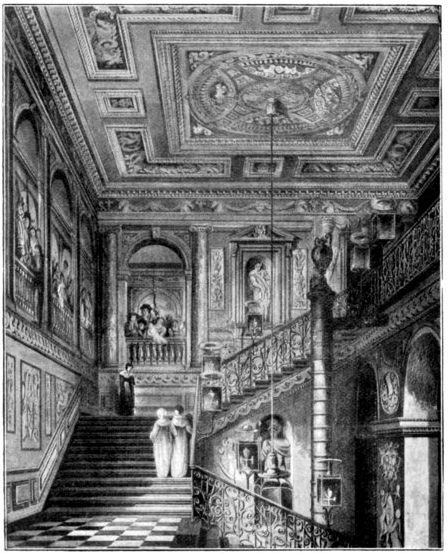
No one who did not see this staircase before the restorations were begun can conceive the woeful state of dust, filth, decay and rot which it then presented. With the fine iron balusters broken, damp oozing from the walls, the paintings indistinguishable from incrustations of smoke, and strips of the painted canvas hanging from the walls in shreds—it seemed impossible that it could ever be restored to its pristine splendour. The visitor must judge for himself whether this result has not been triumphantly accomplished.
The Painted Walls of the King’s Grand Staircase.
OPPOSITE the balustrade, on the right side as one goes down the stairs, is a low wainscot of plain moulded panelling; and above this, level with the top of the second landing, is painted a large Vitruvian scroll. The square space thus formed beside the first landing, and the spandril space beside the rise of the stairs, are filled with representations, in chiaro-oscuro, of sea-horses, armorial trophies and other devices, and scroll-work, heightened by gilding. These, as well as similar paintings on the arcade, opposite and under the stairs, show that Kent’s taste and skill as a decorative artist were by no means contemptible, whereas as a painter of subjects or figures he was no artist at all.
The two walls of the staircase above the Vitruvian scroll are painted to represent a gallery, behind a colonnade of the Scamozzian Ionic order, supporting a corresponding entablature, with a frieze embellished with unicorns’ heads, masks of lions, and festoons of foliage, divided by fleurs-de-lys, richly heightened with gold. Between these columns is painted a balustrade; with numerous figures of personages of George I.’s court, looking over it.
In the first and second compartments on the left are yeomen of the guard and various ladies and gentlemen; and a young man in a Polish dress representing a certain Mr. Ulric, a page of the King’s, “and admired by the court,” says Pyne, “for the elegance and beauty of his person;” while the youth standing on the plinth outside the balcony is a page of Lady Suffolk’s. In the third or right-hand compartment on the same wall are seen, among many other unidentified persons, a Quaker and an old man in spectacles.
Two other servants of the court appear in this group, Mahomet and Mustapha, who were taken prisoners by the Imperialists in Hungary. At the raising of the siege of Vienna in 1685, George I., then elector of Hanover, was wounded, and was attended by these two Turks, who had been retained in his service, and who were said to have saved his life. Mahomet apostatized from the faith of his fathers and became a Christian; married a Hanoverian woman and had several children. King George, on his accession to the British throne, brought these two faithful servants with him to England in his suite. They were constantly about his person, and were credited with obtaining large sums of money from persons who purchased their influence to obtain places about the court. Mahomet, however, in whatever way he may have obtained his wealth, made a noble and benevolent use of it; for among many other recorded acts of benevolence, he released from prison about three hundred poor debtors by paying their harsh creditors.
Pope, at any rate, believed in Mahomet’s integrity, for he mentions him in his Epistle to Martha Blount in these lines:
“From peer or bishop ’tis no easy thing To draw the man who loves his God or King. Alas! I copy (or, my draught would fail,) From honest Mahomet or plain Parson Hale.”
Mahomet died of dropsy in 1726, just after these walls were painted. Mustapha, after the death of George I., continued in the service of his successor, and is supposed to have died in Hanover.
In the same group are also a Highlander, and a youth known as “Peter the Wild Boy.” He was found in the woods of Hamelin, near Hanover, in 1725, and when first discovered was walking on his hands and feet, climbing trees with the agility of a squirrel, and feeding upon grass and moss of trees. He was supposed to be about thirteen years of age. He was presented to George I., then in Hanover, when at dinner, and the King made him taste of the different dishes at table. We get this information from Pyne, who adds:
“He was sent over to England in April, 1726, and once more brought before his Majesty and many of the nobility. He could not speak, and scarcely appeared to have any idea of things, but was pleased with the ticking of a watch, the splendid dresses of the King and princess, and endeavoured to put on his own hand a glove that was given to him by her royal highness. He was dressed in gaudy habiliments, but at first disliked this confinement, and much difficulty was found in making him lie on a bed: he, however, soon walked upright, and often sat for his picture. He was at first entrusted to the care of the philosophical Dr. Arbuthnot, who had him baptized Peter; but notwithstanding all the doctor’s pains, he was unable to bring him to the use of speech, or to the pronunciation of words.... He resisted all instruction, and existed on a pension allowed in succession by the three sovereigns in whose reigns he lived. He resided latterly at a farmer’s near Berkhampstead in Hertfordshire, till February, 1785, where he died, at the supposed age of nearly ninety.”
The east wall of the staircase is painted as far as the width of the second landing with a continuation of the arcade, showing a fourth compartment, in which are again figures of yeomen of the guard and ladies—one holding an infant in her arms over the balustrade. Further up, on the same wall, is painted a pedimented niche, with a figure of a Roman emperor; and higher up still, on the top landing or balcony, are figures of Hercules, Diana, Apollo, and Minerva.
All these paintings are on canvas, stretched on battens fixed to the wall.
Painted Ceiling of the King’s Grand Staircase.
THE ceiling of the staircase being square and flat, it did not afford much scope for the exercise of imaginative design, and Kent was obliged to content himself with a very commonplace pattern—sufficiently apparent in the accompanying plate. In the four corners are a sort of double oblong panels, with similar square ones intervening between them. The ground colour is gray. The oblongs are painted with ornamental scroll-work and horses’ heads, the squares with human heads. These panels are bordered with very heavy projecting frames of plaster work, white and gilt, as is also the great square compartment in the middle. The panel of this last is painted with a representation of a circle, within which are four semicircular spaces or apertures, apparently intended to portray a pierced dome with galleries—but they are all in quite impossible perspective. In three of these spaces are seen musicians playing on various instruments, and spectators looking down upon the company below. In the fourth “the painter,” says Pyne, “has introduced his own portrait, holding a palette and pencils, with two of his pupils, who assisted him in the decoration of the walls, and a female of a very pleasing countenance, which is supposed to be a resemblance of an actress with whom he lived in the habits of peculiar friendship, and to whom he left a part of his fortune.”
All these decorations—including “the female of a very pleasing countenance”—the visitor can make out, if he thinks it worth while to incur a stiff neck in doing so; but, in truth, the figures, as well as the perspective, are all so badly drawn and painted, that the less they are examined the better. They prove to us once more that Kent, as a pictorial artist, was beneath contempt. If, however, we are content to look on his paintings on this staircase as mere formless colour decoration, the general effect is rich and sumptuous enough.
The paintings of the staircase were finished, as we have said, about 1726. Three years after we find among the records the following warrant:
“For the delivery of the following for the King’s service at Kensington, viz. for the Great Staircase 6 lanthorns, 12 inches square and 17 high, with a shade over each, an iron scroll and 2 flat sockets for candles, 1 lanthorn for a pattern 11 inches square and 19½ inches high, with scrolls, etc.”
Our illustration, taken from Pyne’s drawing dated 1818, shows these lanthorns still in it. Except for these, which disappeared a long time ago, and the tall German stove, which was only removed a few months ago, the staircase appears exactly the same to-day.

In this room we have a blending of the style of Wren, who originally built and designed it, and of Kent, who redecorated it for George I. The chimney-piece and over-mantel, with its fine Gibbons carving of foliage, fruit, and flowers, the beautifully designed and richly carved oak cornice and the panelled dado are Wren’s; whereas the painted ceiling and the doors are Kent’s. It was, doubtless, he also who altered the spacing of the window sashes, and substituted the present ugly large panes for the originally picturesque small ones. There is record of this being done in 1723, among the old accounts.
The walls appear originally to have been entirely lined, like most of Wren’s rooms, with oak wainscot, but this had entirely disappeared long before the beginning of this century, when they were covered with tapestry, over which were nailed a great quantity of pictures—among them several which have now been brought back here from Hampton Court. At the same period, in 1818, there was still hanging between the windows “a looking-glass of large dimensions, tastefully decorated with festoons of flowers, painted with great truth and spirit by Jean Baptiste Monnoyer.... Queen Mary sat by the painter during the greatest part of the time he was employed in painting it.”
This looking-glass has disappeared. Gibbons’ fine carving, however, over the chimney-piece, of foliage, fruit, and flowers in lime wood fortunately remains. When recently cleaned and repaired, it was found to be so fragile and friable as to necessitate its being all painted over in order to hold the fragments together. An oaken colour, “flatted,” in accord with the prevailing tone of the panelling in the room was thought most suitable.
The two windows of this room, the sashes of which were altered by Kent, look into a small courtyard.
The dimensions of the room are 27 feet 4 inches long, 26 feet 10 inches wide, by 16 feet 4 inches high to the top of the cornice, 18 feet to the highest part of the ceiling.
We presume it to have been in this room that William III. in May, 1698, received the Count de Bonde, Ambassador Extraordinary from the Court of Sweden, when he returned to the King the insignia of the Order of the Garter, which had belonged to Charles XI., King of Sweden. “The Sovereign assembled the Knights Companions upon this occasion in the Presence Chamber, and all appeared in their mantles, caps, and feathers, attended by the officers of the order in their mantles, and the heralds in their coats.”
Painted Ceiling of the Presence Chamber.
THE ceiling of this room, like most of those in the state apartments built by Wren, is “coved” or “saucer-domed,” and was no doubt originally quite plainly-coloured, with a light cream-tinted wash. As we see it now, it gives the idea of an attempt by Kent to imitate Raphael’s Loggie in the Vatican. The paintings have been stated to be in imitation of those “then recently discovered on the ruined walls of Herculaneum and Pompeii,” but these were not unearthed until twenty-five years after. Kent has, however, carefully followed what indications he could get of the decorative treatment of Roman classic art. The colours are bright-reds and blues, enriched with gilding on a white ground. The ceiling, or rather the plaster behind the cornice, bears the date, 1724. Faulkner, in his “History of Kensington,” considers that “a proof of his liberal zeal for the interest of his profession is clearly evinced by his adopting this antique ornament rather than his own historical compositions.” Why this should be the case, however, he does not deign to explain.
Ceremonial Pictures of the Queen’s Reign.
IN this room are arranged the ceremonial pictures of the reign of the Queen, copied from well-known pictures by British artists. They afford most accurate representations of the events depicted, and no doubt will live to remotest history, as interesting and curious specimens of early Victorian art. The scenes, and the participants in them are all too well known to require explanation. Perhaps later on the numbered “key-plans” will be put up to assist in the identification of each personage.
271 Coronation of the Queen in Westminster Abbey, June 28th, 1838. Her Majesty taking the Sacrament . . . . . After C. R. Leslie, R.A.
When the Queen had been formally invested with the insignia of her sovereignty, and had received the homage of the peers, she laid aside the crown and sceptre, and following the Archbishop, advanced to the altar to receive the sacrament.
272 Marriage of the Queen and Prince Albert at the Chapel Royal, St. James’s, 10th February, 1840 . . . . . After Hayter.
273 Christening of the Princess Royal at Buckingham Palace, 10th February, 1841 . . . . . After C. R. Leslie, R.A.
274 Marriage of the Princess Royal to Prince Frederick William of Prussia in the Chapel Royal, St. James’s, 25th January, 1858 . . . . . After J. Phillip, R.A.
275 Christening of the Prince of Wales in St. George’s Chapel, Windsor Castle, 28th of January, 1842 . . . . . After Hayter.
276 Marriage of the Prince of Wales and the Princess Alexandra of Denmark in St. George’s Chapel, Windsor Castle, 10th March, 1863 . . . . . After W. P. Frith, R.A.
277 A Sketch of the Queen leaving Westminster Abbey after her Coronation . . . . . . By Camille Roqueplan.
Camille Roqueplan was a French artist sent over by Louis Philippe to make sketches at the Queen’s Coronation.
278 The Marriage of H.R.H. the Duke of Connaught and Strathearn and H.R.H. Princess Louise Margaret of Prussia in St. George’s Chapel, Windsor, 13th March, 1879 . . . . . After Sidney P. Hall.

CHISWICK PRESS:—CHARLES WHITTINGHAM AND CO. TOOKS COURT, CHANCERY LANE, LONDON.
Typographical errors corrected by the etext transcriber:
William Talman, Comptroler=> William Talman, Comptroller {pg 18}
his exernal architectural effect=> his external architectural effect {pg 63}
being situate=> being situated {pg 68}
his face his shaven=> his face is shaven {pg 91}
Prince Octavious was born on February 23rd, 1779=> Prince Octavius was born on February 23rd, 1779 {pg 106}