PREFACE
Reading edition
It is difficult to tell the story of Irish folk intimately and convincingly, the bare truths concerning their splendid recklessness, their unproductive ardor, their loyalty and creative memories, sounding to another race like a pack of lies.
When, therefore, I recall "The Singing Woman," Katrine; her beauty, her fearlessness, her loyalty, her voice of gold—it seems as if only one lost to caution and heedless of consequence would undertake her history expecting it to be believed. But there is this advantage: the newspapers, recording much of her early life, are still extant, her Paris work discussed by Josef's pupils to this day, and her divine forgetfulness the night she was to sing at the Metropolitan a known thing to people of two continents; but unrecorded of her, till now, is that, for love, like brave, mad Antony, she threw a world away.
It is impossible to tell the tale of Katrine without narrating side by side the story of Dermott McDermott; and here trouble begins, for Ireland would never allow anything written concerning him that was not flattering, and the Irish people, especially in the regions of Kildare and Athlone, have combined to make a saint of him. A saint of Dermott McDermott! Heaven save the mark!
But of Frank Ravenel's life I can speak with truth and authority. I had the story from his own lips under the pines and the stars of North Carolina, fishing the Way-Home River, or sitting together on the Chestnut Ridge, where Katrine and he first met. This was before he became—before Katrine made him—the great man he is to-day.
And two things linger with me—the first a conversation between Dermott and Katrine at the Countess de Nemours'.
"Tell me," said Katrine: "do you think any woman ever married the man who was kindest to her?"
"It's unrecorded if it ever occurred," Dermott answered.
And a second, the truth of which is less open to dispute.
"Nora," Katrine asked, "could you ever have loved any but Dennis-your first love?"
"No," answered Nora. "To an Irishwoman the drame comes but the wance."
E.M.L.
I
UNDER THE SOUTHERN PINES
Ravenel Plantation occupies a singular rise of wooded land in North Carolina, between Way-Home River, Loon Mountain, and the Silver Fork. The road which leads from Charlotte toward the south branches by the Haunted Hollow, the right fork going to Carlisle and the left following the rushing waters of the Way-Home River to the very gate-posts of Ravenel Plantation, through which the noisy water runs.
Ravenel Mansion, which stands a good three miles from the north gate of the plantation, is approached by a driveway of stately pines. The main part is built of gray stone, like a fort, with mullioned windows, the yellow glass of early colonial times still in the upper panes. But the show-places of the plantation are the south
Long ago, when Charles II. was on his way to be crowned, a certain English Ravenel—Foulke by name—had the good-luck to fall in with that impulsive monarch, and for no further service than the making of a rhyme, vile in meter and villainous as to truth-telling, to receive from him an earldom and a grant of "certain lands beyond the seas."
Here, in these North Carolina lands, for nearly two hundred years, Ravenel child had grown to Ravenel man, educated abroad, taught to believe little in American ways, and marrying frequently with a far-off cousin in England or in France.
They were gay lads these Ravenels, hard riders, hard drinkers, reckless in living and love-making, and held to have their way where women were concerned. Indeed, this tradition had ancient authority, for on the stone mount of the sundial in the lilac-walk there had been chiselled, in the year 1771, by some disgruntled rival perhaps:
"The Ravenels ryde forth, Hyde alle ye ladyes gay; They take a heart, They break a heart, Then ryde away!"
He was handsome, as the Ravenel men had always been, with a bearing which caused men and women, especially women, to follow him with their eyes. Certain family characteristics were markedly his: the brown hair and the wide gray eyes, which seemed to brood over a woman as though she were the only one to be desired—these had belonged to the Ravenel men for generations; but the shape of the head, with its broad brow, the short upper lip and appealing smile, he had from his lady mother, who had been a D'Hauteville, of New Orleans.
From the time of his majority, some five years before, the South had been rife with tales of his wit, his love-making, and his lawlessness. Whatever the cause, women were forever falling in love with him, and the mention of his name from Newport News to New Orleans would but call forth the history of another love-affair, in which, according to the old inscription, he had taken a heart, had broken a heart, and then had ridden away.
Mrs. Ravenel, adoring and tender, in lavender and old lace, the merriest, gayest, most illogical little mother in all that mother-land of the South, regarded Frank as he re-entered with a blush of pleasure on her bright, fond face.
"Who has the Mainwaring place, mother?" he asked.
"A heavenly person," Mrs. Ravenel answered.
"Man, I suppose," Francis laughed.
Mrs. Ravenel nodded assent and repeated: "Heavenly! An Irishman; with black hair, very black brows, pale like a Spaniard, about thirty—"
"
—"who rides like a trooper, drinks half a glass of whiskey at a gulp, and is the greatest liar I can imagine."
"It's enlightening to discover an adored parent's idea of a heavenly person," Francis said, with an amused smile.
"He sends me flowers and writes me poetry. We exchange," she explained, and there came to her eyes a delightfully critical appreciation of her own doings.
"The heavenly person has—I suppose—a name?" Frank suggested.
"Dermott McDermott."
"Has the heavenly person also a profession?"
"He is"—Mrs. Ravenel hesitated a minute—"he is an international lawyer and a Wall Street man."
"It sounds imposing," Frank returned. "What does it mean?"
"I don't know," his mother answered. "I have enough of the artist in me to be satisfied with the mere sound. His English—"
"His Irish," Frank interrupted.
—"is that of Dublin University, the most beautiful speech in the world. He is here in the inCan talk in rhyme," she repeated, with emphasis, "and carries a Tom Moore in his waistcoat-pocket."
There came a sound of singing outside—a man's voice, musical, with an indescribably jaunty clip to the words:
"I was never addicted to work, 'Twas never the way o' the Gradys; But I'd make a most excellent Turk, For I'm fond of tobacco and ladies."
And with the song still in the air, the singer came through the shadow of the porch and stood in the doorway—a man tall and well set-up, in black riding-clothes, cap in hand, who saluted the two with his crop, and as he did so a jewel gleamed in the handle, showing him to be something of a dandy.
Standing in the doorway, the lights from the candelabra on his face and the sunset at his back, one noticed on the instant his great freedom of movement as of one good with the foils. His hair was dark, and his eyes, deep-set and luminous as a child's, looked straight at the world through
"I thought the evening was beautiful till I saw you, madam," he said, with a sweeping salute. "I kiss your hand—with emotion." There was a slight pause here as he regarded Mrs. Ravenel with open admiration. "And thank you for the beautiful verses, asking that at some soon date you send more of the flowers of your imagination to bind around the gloomy brow of Dermott McDermott."
It was the McDermott way, this. A kiss on the hand and a compliment to Madam Ravenel; a compliment and a kiss on the lips to Peggy of the Poplars; but in his heart it was to the deil with all women—save one—for he regarded them as emotional liars to be sported with and forgotten.
The contrast between them, as they stood with clasped hands, did not pass unnoted by Mrs. Ravenel. The black hair, olive skin, the bluer than blue eyes of Dermott, as he stood in the light of the doorway; his alert, theatric, dominating personality; his superb self-consciousness; the decision of manner which comes only to those who have achieved, seemed to her prejudiced gaze admirable in themselves, but more admirable as a foil to the warm brown of Frank's hair, to the poetic gray of his eyes, his apparent self-depreciation, his easy acceptances, and his elegant reluctance to obtrude on others either his views or his personality.
Perhaps it was the prescience of coming trouble between them which caused a noticeable pause after the introduction—a pause which Dermott courteously broke.
"So this is the son," he said. "Sure," he went on, comparing them, "ye've a right to be proud of each other! Ye make a fine couple, the two of you. And now"—putting his cap,
Frank rose from his chair and stood by the chimney, regarding the Irishman as one might have viewed a performer in a play, realizing to the full what his mother had meant by the "charm of McDermott," for it was a thing none could deny, for the subtle Celt complimented the ones to whom he spoke by an approving and admiring attention, and conveyed the impression that the roads of his life had but led him to their feet.
"To tell the truth," McDermott continued, noting and by no means displeased by Frank's scrutiny, "I had heard ye were home, Mr. Ravenel, and came early to see you with a purpose—two purposes, I might say. First, I wanted to talk to you concerning Patrick Dulany, the overseer whom I got for your mother last year. Ye've not see him yet?"
"I arrived only last night, Mr. McDermott," Francis answered.
"True, I'd forgotten. It's a strange life Patrick's had, and a sad one. He's of my own
Mr. McDermott looked from the window with the fixed gaze of one struggling with unshed tears.
"The next month he was ordered home, and soon after fell the bitter business of the marriage in Italy. I stood up with him. She was the most beautiful creature I have ever seen—save one; and a voice—God! I heard her sing in Milan once. The king was there; the opera 'La Favorita.' She was sent for to the royal box. We had the horses out of her carriage and dragged it home ourselves. What a night it was! What a night it was!"
McDermott paused as in an ecstasy of remembrance.
"What was her name?" Francis asked.
"Ah, that"—he threw out his hand with a
"And she left him?" Mrs. Ravenel's voice was full of sympathy as she spoke.
"For another!" Dermott made a dramatic pause, relishing his climaxes. "And then she died."
"So, for his daughter's sake"—there was a curious hesitancy in his speech just here, but he carried it off jauntily—"his daughter, a primrose girl and the love of my life, I've come to ask that you be a bit lenient with him, Mr. Ravenel, at the times he has taken a drop too much, as your lady mother has been in the year past. I think you'll find him able to manage, for, in spite of his infirmity, black and white fall under his spell alike."
"If Frank has a fault, Mr. McDermott, which I do not think he has, it's over-generosity. You need have no fear for your friend," Mrs. Ravenel said, proudly, putting her hand on Frank's shoulder.
As her son turned to kiss the slender fingers, Dermott McDermott regarded the two curiously.
"You're fortunate in having a son of twenty—" He hesitated.
"
"—so devoted to you, madam. Ye're twenty-five—coming or going?" he inquired, with a laugh.
"On my last birthday—April."
An odd light shone in McDermott's eyes for a second before he said, with a bow:
"Neither of ye look it; I can assure you of that. Well," he continued, reaching for his cap and whip, "I must be going. Ye've found already, haven't ye, Ravenel, that the sound of my own voice is the music of heaven to my ears?" And then, as though trying to recollect: "I think I said it was at Ramazan Dulany and I fought together?"
Francis nodded.
"God," McDermott cried, his face illumined, his eyes glowing, "I wish it had been Waterloo! I've always carried a bruised spirit that I didn't fight at Waterloo."
"Your loss is our gain, Mr. McDermott," Francis answered, with a smile. "You'd scarce be here to tell it if you had."
"And that's maybe true," Dermott said, pausing by the doorway to put on his gloves. "But I'd rather have fought at Waterloo, even if I were dead now, so that I could tell you exactly
"Oh! Mr. Ravenel," he called back suddenly, as though the thought had just come to him, "I've been waiting your coming to have a talk with you—a business talk—but not to-night." He waved the matter aside with a gay, outward movement of the hands. "Sometime at your pleasure." Again the eyes of the two met, and this time each measured the other more openly than before.
"I shall be glad to see you at any time, Mr. McDermott," Frank answered, his words courteous enough, but his eyes lacking warmth; and the intuitive Celt realized that in Frank he had met one whom he had failed either to bewilder or to charm.
"Madam!" he cried, saluting. "Mr. Francis Ravenel, delightful son of a delightful mother! The top of the evening to both of ye." And with a considered manner he made a stage exit, and Frank and Madam Ravenel heard the gay voice—
"... most excellent Turk, For I'm fond of tobacco and ladies—"
"Well," said Mrs. Ravenel, her eyes dancing with merry light, "isn't he delightful?"
"Delightful!" Frank repeated. "Is he? I wonder. Shrewd, cool-headed, cruel, I think—subtle as well."
"Nonsense," Mrs. Ravenel interrupted, with a smile which might not have been so mirthful had she seen at that moment the man of whom she spoke.
Near the north gate McDermott had brought his horse suddenly to a walk. There was no longer gayety in his manner or his face. The merry light had left his eyes, and in its place shone a gleam, steady and cold, as only the eye of the intellectual Irish can be.
"And so that is the son! An unco man for the lassies, like his father before him." His eyelids drew together as he spoke. "Handsome, too—with a knowledge of life. It's a pity!" he said. "It's a pity! But he may not interfere. If he does, well—even if he does, the gods are with the Irish!"
II
THE MEETING IN THE WOODS
Instead of entering the drawing-room after Dermott's departure, Frank turned with some abruptness toward Mrs. Ravenel.
"I am going for a walk, mother," he said, with no suggestion that she accompany him; and her intimate acquaintance with Francis, sixth of the name, made her understand with some accuracy the moods of his son, Francis seventh.
"You are handsomer than ever, Frank!" she exclaimed, as if in answer to the suggestion.
"You spoil me, mother," he returned, with a smile.
"Women have always done that—" she began.
"And you more than any other," Frank broke in, kissing her, with a deference of manner singularly his own.
"There may be truth in that," Mrs. Ravenel admitted, a fine sense of humor marked by the grudging tone in which she spoke. "I remember that
"Nature is unappreciative," he returned; and the gray eyes with the level lids looked into the blue ones with the level lids, and both laughed.
For a space Mrs. Ravenel contemplated him, the ecstasy of motherhood illuminating the glance.
"You are quite the handsomest human being I ever saw, Frank—though I think I said something like that before."
"You are, of course, unprejudiced, lady mother," he laughed back from the lowest step.
"It's natural I should be—being only a mother," she explained, gayly.
"Ah," she went on, "I am so happy to have you at home with me! Not happy at having asked those people down. They come on the twenty-seventh."
"Whom have you asked?"
"The Prescotts."
"Good."
"The Porters and Sallie Maddox."
"Better."
"And Anne Lennox."
There was a silence.
"Did I hear you say 'best'?" Mrs. Ravenel inquired.
"
"I am always subtle in my methods," his mother continued. "Note the adroitness now. Why don't you marry her, Frank?"
"Do you think she would marry me?"
"Don't be foolish. Anne is devoted to you, and you must marry someone. You are an only son. There is the family name to be thought of, and there must be a Francis eighth to inherit the good looks of Francis seventh, must there not? And how I shall hate it!" she added, truthfully.
Again a silence fell between them before Frank turned the talk with intention in word and tone.
"About this new overseer?" he asked. "Satisfactory?"
"When not drunk—very."
"Does it"—he smiled—"I mean the drunkenness, not the satisfaction—occur frequently?"
"I am afraid it does."
"What did McDermott say his name is?"
"Patrick Dulany."
"French, I suppose?" he suggested.
"By all the laws of inference," his mother returned, with an answering gleam in her eye.
"There seems to have been a Celtic invasion
"Only a daughter." And as Frank turned to leave her Mrs. Ravenel asked, lightly: "How long do you intend to stay here, Frank?"
"I have made no plans," he answered; but going down the carriageway he said to himself, with a smile: "Mother shows her hand too plainly. The girl is evidently young and pretty."
The plantation had never seemed so beautiful to him. The wild roses were in bloom; the fringe-trees and dogwood hung white along the riverbanks; the golden azaleas, nodding wake-robins, and muskadine flowers looked up at them from below, while the cotton spread its green tufts miles and miles away to a sunlit horizon.
Swinging along the road outside the park, the half-formed plan to visit the overseer left him, and purposeless he climbed the hill to Chestnut Ridge. Something in the occasion of his home-coming after a two years' absence—his mother's reference to his marriage, his remembrances of Anne Lennox—had brought back to his face its habitual expression of sadness. And more than he would have acknowledged was a disquietude caused by his instant resentment of the existence of Dermott McDermott. Never in his
Passionate, proud, intolerant, full of prejudice, conscious by twenty-six years' experience of a most magnetic power with women, he came to the edge of the far wood as lawless a man, in as lawless a mood, as the Carolinas had ever seen—a locality where lawless men have not been wanting.
Suddenly, through the twilight, he heard a voice—a woman's voice—singing, and by instinct he knew that the singer was alone and conscious of nothing save the song.
At the top of the rise, under a group of beeches, with both arms stretched along a bar fence, a girl stood, the black of her hair in silhouette against the gold of the sky. He noted the slender grace of her body as she leaned backward, and listened to her voice, Heaven-given, vibrant, caressing—juste, as the French have it—singing an old song.
He had heard it hundreds of times cheapened by lack of temperament, lack of voice, lack of taste; but as he listened, though little versed in music, he knew that it was a great voice that sang it and a great personality which interpreted it. With the song still trembling through the
A flower of a girl—"of fire and dew," delicate features, nose tip-tilted, a chin firmly modelled under the rounded flesh, and eyes bright with the wonder and pride of life. She wore a short-waisted black frock, scant of skirt and cut away at the neck. It was in this same frock that the Sargent picture of her was painted—but that was years afterward; and although she was motionless, one knew from her slender figure and arched feet that she moved with fire and spirit. Her hair was very dark, though red showed through it in a strong light, and her cheeks had the dusky pink of an October peach. But it was the eyes that held and allowed no forgetting; Ravenel always held they were violet, and Josef, who saw her every day for years, spoke them gray; but Dermott McDermott was firm as to their being blue until the day she visited him about the railroad business, when he afterward described them "as black as chaos," adding a word or two about her deil's temper as well. The truth was that the color of them changed with her emotions, but the wistfulness of them remained ever the same. Dermott, in some lines
Suddenly the languor seemed to leave her, and she stood alert, chin drawn in, hands clasped before her, and began the recitative to the "Ah! Fors e lui." Twice she stopped abruptly, taking a tone a second time, listening as she did so, her head, birdlike, on one side with a concentrated attention. After the last low note, which was round and low like an organ tone, she resumed her old position with arms outstretched upon the fence.
As Frank came up the path their eyes met, and he removed his hat, holding it at his side, as one who did not intend to resume it. Standing thus, he bore himself, if one might use the word of a man, with a certain sweetness, an entire seeming self-forgetfulness, as though the one to whom he spoke occupied his entire thought.
"It is Miss Dulany?" he inquired, with a smile which seemed to ask pardon for his temerity.
"I am Katrine Dulany," the girl answered, gravely, for the readjustment from the music and the silence was not easily made.
"I was fortunate enough to hear you sing. It
"I know," Katrine answered. "The plantation has expected your coming."
A silence followed, during which, with no embarrassment, she retained her position, waiting for him to pass. The indifference of it pleased him.
"I was going to see your father at the lodge. The roads are unfamiliar, and the path, after two years' absence, a bit lonely." The sadness which accompanied the words was honest, but it seemed for some more personal sorrow than it was.
"My father is not well," Katrine said, hastily. "I am afraid you cannot see him, Mr. Ravenel. May I ask him to go to you to-morrow instead?" There was entreaty in her voice, and Frank knew the truth on an instant.
"I cannot have you carrying messages for me."
"Seeing that I offered myself"—she suggested, with a smile.
"—is no reason that I should trespass on your kindness, so I shall carry my message myself." This quite firmly.
"I will sing again if you stay." She looked at him through her long lashes without turning
"It's a premium on discourtesy," he answered, "but I yield."
Near the place where she stood there was a fallen log, and he seated himself upon it, placing his hat on the ground as though for a continued stay, regarding her curiously.
She was the daughter of his drunken overseer, a child in years, yet she showed neither embarrassment nor eagerness; indeed, she conveyed to him the impression that it was profoundly equal to her whether he went or stayed.
"Tell me," he said, "before you sing, where have you studied?"
"I?" she laughed, but the laugh was not all mirthful. "In Paris, in London, in Rome, in New York." There was bitterness in her tone. "I am a gamin of the world, monsieur."
"Tell me," he repeated, insistently.
She made no response, but stood, with her profile toward him, looking into the sunset.
"Won't you tell me?" he asked again, his tone more intimate than before.
"Ah, why should I?" And then, with a sudden veering: "After all, there is little to tell. I was born in Paris of poor—but Irish—parents." She
She turned from him as she ended the telling. "What shall I sing?" she asked.
"'The Serenade.'"
"Schubert's?"
"There is but one."
"It is difficult without the accompaniments but I will try:
"'All the stars keep watch in heaven While I sing to thee, And the night for love was given— Darling, come to me— Darling, come to me!'"
She ended, her hands clasped before her, her lithe figure, by God-given instinct for song, leaned forward, and Francis Ravenel was cona great gift sets its owner as a thing apart.
"Sometime," he said, "when you have become famous, and all the world is singing your praises, I shall say, 'Once she sang for me alone, at twilight, under the beeches, in a far land,' and the people will take off their hats to me, as to one who has had much honor."
He smiled as he spoke. It was the smile or the praise of the song, or a cause too subtle to name, that changed her. She had already seemed an indifferent woman, a great artist, a careless Bohémienne in her speech; but for the next change he was unprepared: it was a pleading child with wistful eyes who seated herself beside him, not remotely through any self-consciousness, but near to him, where speech could be conveniently exchanged.
"Mr. Ravenel," she began, "I had thought to keep it from you, but you are different—the most different person I ever saw." A dimple came in her cheek as she smiled. "And so I am going to tell you everything." She made a little outward gesture of the hands, as though casting discre
"You shall not go away."
The words were spoken quietly, but for the first time in her life Katrine Dulany felt there was some one of great power to whom she could turn for help, and her woman heart thrilled at the words.
"You mustn't feel about it as you do, either," Frank continued. "The time has gone by for thinking of your father's trouble as anything except a disease—a disease which very frequently can be cured."
"Ah!" she cried, "do you think it would be possible?"
"I have known many cases. Is your father good to you?" he asked, abruptly.
"Sick or well, with money or without, he is the kindest father in the world. Save in one way, it is always for me he thinks."
"Katrine," he said, "I am not a particularly good man, but the gods have willed that we meet—meet in strange moods and a strange way. I am a better man to-night than I have ever been in my life. It's the music, maybe, or the fringed gentian, or the whippoorwills." There was love-making in every tone of his voice. "Whatever it is, it makes me want to help you. May I? Will you trust me?"
She turned her hand upward, as a child might have done, to clasp his, looking him full in the eyes as she did so.
"Utterly," she said.
"I have not always been considered trustworthy," he explained, lightly.
"People may not have understood you." There was a sweet explaining in her voice.
"Which may have been, on the whole, fortunate for me," he answered, with a curious smile.
"Don't," she said—"don't talk of yourself like that. I know you are good, good, good!"
"Thank you," and again there came to him
A noise startled him. Some one was approaching with uncertain footsteps and a shuffling gait, and at the sound the girl's face turned crimson.
"Katrine, little Katrine, where are you?" a voice cried, thickly and uncertainly, as a man came from under the gloom of the trees. There was not a moment's hesitation. The child rose and put her arms around the figure with a divine, womanly gesture, as though to shield him and his infirmities from the whole world. It was the action of one ashamed to be ashamed.
"Daddy," she said, laying her head against his shoulder, "this is Mr. Ravenel!"
III
A KINDNESS WITH MIXED MOTIVES
In the walk home through the gloom of the night Frank Ravenel thought of many things not hitherto considered in his philosophy. The women whom he had known had presented few complexities to him. That he should be giving a second thought to Katrine Dulany seemed humorous; but the more he resolved to put her from his thoughts the more vivid the memory of her became. He recalled his emotion when their eyes first met, and the remembrance brought again the tightening of the throat which he had on the hilltop. He could feel the clinging pressure of the slender hand, could hear again the voice like a caress, and her words, "You are good—good—good!" kept repeating themselves somewhere in the recesses of his brain to the tune of an old song.
"Good!" he ejaculated. "God, if she only knew!"
He had stated to his mother at the outset of
The girl on the hill had had a more disturbing effect than any one that ever came into his life before. Looking down the vista of probable events, he saw nothing but trouble for her if he remained at Ravenel—saw it as reasonably and as logically as though he were contemplating the temptation of another. An affair with the daughter of his overseer, a very young person, was a manifest impossibility for him, Francis Ravenel; his pride and such honor as he had where women were concerned forbade it. But even as he reached this decision the voice of gold came back to him:
"And the night for love was given— Darling, come to me!"
How she could love a man! He recalled her gesture when she said: "I will tell you everything"!
By the lake he paused, and, looking into the moonlit water, came to his conclusions sanely enough. He would see her no more. There would be many people for the next fortnight to occupy his time; the coming folks were interesting. Anne Lennox would be there; the time would pass; he would leave Ravenel; but as he dropped asleep a voice seemed to call to him through the pines, and he knew he would not go.
The next morning before coffee he wrote to Dr. Johnston, the great specialist in alcoholic diseases, urging him to come to Ravenel at his earliest convenience. "There is a man to be helped," he wrote, "and neither money nor brains are to be spared in the helping."
Through the breakfast the memory of Katrine was vividly with him. He recalled, with the approval of an aristocrat in taste, the daintiness of her movements, the delicacy of her hands as they lay open on the fence, even her indifference to him, to him, who was in no wise accustomed to indifference in women.
During this time he saw neither Dermott McDermott nor the new overseer, whom he learned was at Marlton on affairs concerning a sawmill.
The fourth day after his meeting with Katrine a message from the great doctor gave him the dignity of a mission, and he rode to the old lodge to show her the letter, which said that Dr. Johnston would be at Ravenel soon.
There was eagerness in his gait and eyes as he mounted his horse, and as he rode down the carriageway standing in his stirrups, waving his cap to his mother with a "Tallyho to the hounds," he had never looked handsomer nor had more of an air of carrying all before him, as was right, she thought, for a Ravenel.
The old gate-lodge on the Ravenel place stands on the north branch of the road which leads to Three Poplar Inn. It is built of pale-
Frank remembered it as a drear-looking, lonesome place during the occupancy of the former incumbent. Instead, he found a reclaimed garden; hedges of laurel, trim and straight; old-fashioned flowers, snowballs, gillybells, great pink-and-white peonies; and over the front on trellises, by the gate and doorway, scrambles of scarlet roses against the green and the ivied walls.
In the doorway Nora O'Grady, a short, wide woman of fifty or thereabout, was singing at a spinning-wheel. She had a kind, yellow face with high cheek-bones, and dark eyes which seemed darker by reason of the snowy hair showing under a mob cap. Her chin was square and pointed upward like old Mother Hubbard's, and she could talk of batter-cakes or home rule with humorous volubility, and smoke a pipe with the manner of a condescending duchess.
She had, as Frank found afterward, an excellent gift at anecdote, but a clipping pronunciation of English by reason of having spoken nothing but the Erse until she was grown. Added to
For fifteen years this strange old creature and her boy Barney had followed the seesawing fortunes of the Dulanys, accompanying their gypsy-like sojournings with great loyalty and joyousness.
She rose from her spinning as Ravenel approached.
"Is Miss Katrine at home?" he inquired.
Nora dropped a courtesy, and with the tail of her eye observed, labelled, and docketed Francis Ravenel.
"Will your lordship be seated," she said. "Miss Katrine will be back in a minute. She's gone to ask after Miranda's baby. Nothin' seems able to stop her from regardin' the naygurs as human beings. If 'twere not that I know she'd be here immejit I'd go afther her mysel', and not keep your lordship waitin'."
She motioned him to a wide settle on the porch with an alert hospitality. In her heart she preferred Dermott McDermott to all possible suitors for Katrine, but if this was another jo, as the Scotch say, so much the better, for one might
"Would ye have a drop of Scotch?" she asked, and upon Francis declining she reseated herself at her wheel, "with his permission," as she put it, delighted, Celtlike, at the chance for conversation. "Ye're perhaps," she says, with some humor, "like the man in the old, old tale when a friend asked him to take a drink. He said he couldn't for three reasons. First, he'd promised his mother he never would drink; second, his doctor had tould him he mustn't drink; and, third, he'd just had a drink."
Frank laughed back at the merry old woman as she sat at the whirring wheel, her accustomed eyes scarcely glancing at the work in her scrutiny of him.
"Dulany's not at home this day. I'm sorry," she went on. "He's off about the sawmill of that triflin' Shehan man. Did ye hear that about his telegraph, Mr. Ravenel? No? It's a funny tale. Ye know that old mill of yours ain't worth more than a few hunder dollars. But Dulany saw an advertisement for a new kind of machinery, and he wrote the firm to ask them what it would cost to have it put in. They sint back the word: tin thousand dollars, and would he
"'If a man had ten thousand dollars, what in hell would he want with a sawmill?'"
Frank laughed aloud again, uncomprehending the fact that the shrewd little woman was deliberately holding him with her tales till Katrine returned.
Inside the house he heard a note, struck suddenly, and repeated over and over in a voice little above a whisper.
"She's come in the other way. I'll tell her your lordship's wantin' her," said Nora O'Grady, disappearing.
He looked about him in great content. Things seemed so much as he desired them to be—the roses, the old furniture, the spinning-wheel, the coiffed peasant woman—that he waited for Katrine's coming, fearing that she should be less beautiful than he remembered her.
With some surprise he heard a laugh (he had not thought of her as a girl who laughed) so merry, so infectious that he found himself wondering what caused it as the girl herself came through the doorway to greet him, her rose face radiant, her eyes shining, her hand outstretched.
She wore white, so simply made as to have something statuesque about the lines of the gown, and cut from the throat to show the poise of the head and the curls at the back of the neck.
"I could scarcely believe Nora when she said it was you. Father is at Marlton. I was so lonely. It is good of you to come, even if only on business. You are riding?" she asked, regarding his clothes.
"Yes," he answered. "I am going to the world's end."
"You will be sorry," she returned, quickly. "I have been there. Carolina is better. Stay here!"
She seated herself beside him on the settle as she spoke, and the odor of the red rose she wore at her breast came to him with the words.
He had taken off his hat and leaned his bare brown head against the high back of the bench.
"You see," he began, his eyelids drawn together in his own way, his eyes fastened upon some remote distance, "I, too, have been lonely.
"Do you mean me?" Katrine asked, smiling, and looking at him with eyes full of surprise.
"It is perhaps Nora to whom I refer," he suggested, whimsically.
"She is not always companionable—Nora," Katrine returned; "and to-day she is not pleased with me, so I like her less than usual. She purposed to cook nettles in the potatoes, and I remonstrated, and—I have not absented myself from your society," she said, abruptly breaking her talk after a woman's way.
"Then why didn't you watch the sunset from the Chestnut Ridge last night and the night before and the night before that?" he asked.
"Why didn't I watch the sunset from the Chestnut Ridge?" she repeated after him, as though not understanding; and then, with a slow, steady smile, looking straight in his eyes, "The thought never occurred to me," she said.
No studied coquetry could have piqued him as this simple statement, which he felt to be the plain truth. He had taken three long walks on the off-chance of meeting a girl who apparently had forgotten his existence, and although the
"But, if I had known," she explained, and the selflessness and sweetness of her as she spoke touched him strangely—"if I had thought you wanted to talk to me, I should have been glad to come."
Fortunately there remained to him a dignified explanation of his suggestion.
"I thought you might come, not so much to see the sunsets as in the hope of seeing me. I promised to help you when I could. I thought you might be interested to know that I had kept my promise. If any one can help your father it is Dr. Johnston." He gave the letter to her as he spoke. "He is coming to Ravenel to-morrow."
In an instant her face softened; her eyes became suffused by a soft, warm light, and she looked up at him through a sudden mist of tears.
"The interview must be arranged," he went on. But Katrine interrupted him:
"Ah! It will be easy enough. Father is as anxious as I am to be himself again. You do not know daddy, Mr. Ravenel," she explained, a proud loyalty in her tone. "He has not been everything, and then, when he has seen father, you can tell me what to do. You see, I haven't thanked you yet," she said, abruptly.
"To know that you are pleased is enough. Besides, I have, on some few occasions, drifted into doing a kind act for the act's sake," he said; adding: "Not often, it's true, but occasionally."
"You have made me, oh, so happy, and hopeful—as I have never been before in all my life. It seems like one of the fairy stories in which one's wishes all come true."
"And if it were given you to have whatever you wished, what would you ask for, Katrine?"
"To have father well. And then," her face became illuminated, "to study with Josef."
"Josef?" He repeated the great name interrogatively.
"You have not heard of him?" she asked, incredulously.
He made a sign in the negative.
"
"Which is perhaps the reason I have never heard of him," he answered, with a smile. "From your enthusiasm I am led to judge it is music which he teaches."
"Yes," she answered; "but he teaches more than that. I knew a girl in Paris who studied with him. She was quite intricate and self-seeking when she began. And in six months he had changed her whole nature. She became elemental and direct, and," she put her hands together and threw them apart with the gesture which he knew so well, "and splendid! Like Shakespeare's women!" she finished.
"Gracious Heaven, hear!" said Frank. "And does this miracle-worker live uncrowned?"
"Ah, don't!" she said, her sincerity and enthusiasm reproving his scoffing tone. "You see"—there was sweetness and an apologetic note in her voice as she continued—"I believe in him so much it hurts to have you speak so. Josef says that when woman developed to the point of needing more education, there was nothing ready to give her except the same thing they gave men; that because certain studies had been proven all right for them they were given ready-
"I shall not permit you to go to him," Frank interrupted, gravely.
She regarded him, a question in her glance. "Why?" she asked.
"Because if your soul was any larger, Katrine, there would be no room for it here below. It crowds the earth a little as it is. No," he finished, with conviction, "you shall never go to study with Josef. Music is all right. But that soul-stretching"—he smiled at this phrase—"that would be all wrong for you. I want you exactly as you are."
IV
THE PROMISE IN THE ROSE GARDEN
A silence fell between them, broken only by the whirring of Nora's wheel and the robin's chatter before Katrine inquired:
"Are you still bent on that expedition to that world's end?"
"I could," he returned, "be persuaded from it, or at least to postpone it. If by any chance I were invited to luncheon in a certain garden—an old-fashioned garden, with box and peonies, and," he raised his head to look down over the flowers—"and some queer purple things like bells whose name I have forgotten, under a trellis of roses, with—"
"Me," she interrupted, with a laugh. "We'll make a party, as the children say. Nora will give us broiled chicken and yellow wine in the long-necked glasses, and cake with nuts in it, and you," she stopped for a second, the dimple in the left cheek showing itself, "will give all of your
Having ordered the luncheon, they went together down the gravelled pathway to the grape arbor, which was grown over with sweet, old-fashioned climbing roses, through which the sunlight filtered in wavy lights on the quaint low rocker, the long rattan couch, the pillows of gay hue, the table covered with books and sewing. Frank paused at the archway and looked in.
"I have found it," he said.
"What?" she asked.
"The world's end," he answered.
"You must," she explained, "really to appreciate this place, lie on the couch so that you may see the wistaria on the gray wall. You should then light a cigarette and have the table brought near, that you may ring for what you want." She moved the table toward him as she spoke. "And I will take this chair beside you. If you want me to talk to you I shall do so; if you want me to sing, I will do that; or if the king desires silence"—she made an obeisance before him as of great humility—"I can even accomplish that, though it is difficult for a woman," she added, with a laugh.
"You have a good friend in McDermott," Francis said, abruptly.
"Yes; he has been kind to us, most kind," Katrine answered.
"For old sake's sake?" Frank suggested.
"Scarcely for that. We never knew him until father met him quite by accident in New York two years ago."
"Didn't they fight together in India?" Frank inquired.
"In India!" Katrine repeated. "Father was never in India. Will some one have been telling you that McDermott and he fought together in India, Mr. Ravenel?" she asked, in astonishment.
Frank sat upright, regarding her with amazement.
"Didn't your father save his life at Ramazan?"
It was Katrine's turn to be bewildered.
"I never heard of Ramazan," she said. "Where is it?"
"And he was not present at your father's marriage in Italy?"
"I understand," she explained, "my father saved him from a horrible attack of the measles in New York. They thought for weeks that he would die."
"But why," Frank demanded, "didn't he say just that?"
"He couldn't!" Katrine stated, as simply and uncritically as a child. "You see, he has the soul of an artist, and there's something about a man of thirty dying of measles impossible for the artistic temperament to contemplate. Ah!" she said, with gentle pleading in her voice for an absent friend, "he's the greatest liar as well as the most truthful person alive; but you've got to be Irish to understand how that thing can be. He couldn't say my father saved him from the measles. The story of India sounds better—and no one is hurt. Can't ye understand? The gratitude for service rendered is the great thing; to remember a kindness has been done; and whether he gives as reason for his gratitude Ramazan or the measles, what is the difference? Do you know"—there came an apologetic look and she was a boy, and it comforted her for quite a year. You see, it made her happy."
"Oh," Francis laughed, "you incomprehensible Celts!"
"Incomprehensible, indeed!" she said. "Incomprehensible!"
A singing voice broke the talk, rolling strongly, vibrantly through the leaves, a lawless, insistent voice, and Dermott McDermott, with the reins loosened on his horse's neck, and his ardent eyes looking upward to heaven's blue, rode by the other side of the privet hedge:
"'War-battered dogs are we, Fighters in every clime, Fillers of trench and grave, Mockers be-mocked by time. War dogs hungry and gray, Gnawing a naked bone, Fighting in every clime Every cause but our own.'"
"
"I am not sure," she answered. "I cannot be certain, but I think it has something to do with Ravenel. I think it has to do with you."
"With me?" Frank sat erect. "Do you know," he said, after some thought, "absurd as it may seem, Katrine, I think so, too."
The sun was far behind the pines when he rose to leave, flattered, softened, with the remembrance of caressing gray eyes, of a voice full of strange cadence, and speech with quaint humor and dramatic turns to the sentences.
"Good-bye," he said, standing by the boxwood arch. "I am your debtor, Miss Dulany, for one perfectly happy day."
"My debtor!" she repeated, looking at him through sudden tears. "I've known rich men before now, men richer than you, Mr. Ravenel; and great men, though none greater than yourself; and handsome men as well, though here"—and the mutinous humor of her showed in the speech—"I can't truthfully say I've ever
V
FRANK FALLS FURTHER UNDER KATRINE'S INFLUENCE
When Frank came out on the porch the next morning at Ravenel, he found Patrick Dulany waiting on horse by the main steps. It was the first time the two men had met in daylight, and with the keenest interest Mr. Ravenel inspected his strange overseer; for in the week since his return he had heard much of his wit and his ability.
He found him to be a large man with a broad face tanned to the hue of a mulatto. His eyes were light blue with the fulness under them of people who have gift in speech. His silver hair, of which he had a great quantity, set strangely around his dark face, falling low over a brow markedly intellectual. But it was the mouth and chin at which Ravenel most wondered, for their lines were strong, the lips full and finely chiselled, showing, one could have sworn, high birth and great resolution.
"Twas the sawmill business that kept me from seeing you sooner, Mr. Ravenel," he began. "But Katrine's been telling me of you, with some worry, I think, in her gentle soul for fear that you may not understand our friend McDermott."
Francis replied with a comprehending smile.
"Now that I've seen ye," said Dulany, "I know you'll understand. He has a peculiarity of nature. He likes to arrange certain unimportant details of life that they may sound better in the telling. But one has a small knowledge of human nature if he discount McDermott because of this. In Ireland his name is a household word. He's here to-day, gone to-morrow. He works like a galley-slave; his word is as good as his bond when given in honor. And 'tis for others he works always. Generous, he gives all, all, all! his work, his brain, the money it earns, everything! His is a great soul, a very great soul. There's not a man in America, barring the President, who has his personal
His sadness of tone introduced the next statement better than words could have done.
"Mr. Ravenel," he said, "I have a confession to make to you. I drink." He looked Frank squarely in the face as he spoke, with no flinching. "Ye may have heard it from one or another since ye've been back. It's been a habit of mine for some time. I was not myself the other evening when I met you on the hill. The worst of it is," and he spoke the words brightly and bravely, "I've no excuse for it, if there can be found an excusing for such a habit. The thing is growing upon me in this solitude. I try, God alone knows how I try, for Katrine's sake, to resist; but only those who have fought the thing can realize what its temptations are. However, I've been thinking that if I drink too much, or fail to suit you, it might make it easier for you to tell me to go, if you knew it would be better for me that I went."
"
"And I'm glad to hear you say that, sir," was the answer. "Well"—hopefully—"things may change for the better in me, and so, good-day," and spurring his horse he was off at a gallop down the broad road, and Ravenel stood listening to the horse's hoofs clatter over the bridge, strike the soft road under the pines, and die away in silence before he turned into the bridle-path which led to the stables.
And a strange thing occurred but a few minutes after this interview, when Frank made his daily visit to the stables. One of the head grooms explained a horse's lameness to him as due to a bad place in the road near the north gate which, he finished, would probably not be mended until Mr. Dulany was over "his coming attack."
"Is he drinking again?" Ravenel asked.
"For three days past," the groom answered.
Francis made no comment whatever, but the next day he discovered the man's suspicions justified, and the third, as he rode to Marlton, he saw Katrine, a pale-faced, desolate little figure, sitting on the garden bench, her head in her hands, the picture of despair. About five o'clock Jerry
"Mr. Dulany is drinking?" Frank said, interrogatively, to the youth.
"Something fierce," was the laconic answer.
"Is he better this evening?"
"Worse. Heart's actin' up," the boy responded.
At the end of the week, after three days spent with the Dulanys, at the old lodge, Dr. Johnston and Francis sat together at the dinner-table at Ravenel. Mrs. Ravenel had left them, and the great doctor, in the admirably restrained and cautious language of the scientific mind, gave his findings in the case, as it were.
"Mr. Dulany's habits," the great doctor began, "I should say, after such superficial investigation as I have been able to make, may be cured. One thing I have noted with pleasure. He has lost none of his mental integrity. He is capable of the truth concerning himself. Generally those given to the alcoholic habit deny everything or secrete everything concerning it when sober. Sometimes they are sentimental over it, given to self-pity, with even a certain desire for
"It is the ancestry of genius," Francis answered.
"It is the ancestry of Katrine Dulany," Dr. Johnston returned, looking at Frank with an untranslatable smile.
A silence fell between them, broken at length by the doctor. "I have decided to take Mr. Dulany to New York with me. I shall keep him near me as long as is necessary. If there is no organic trouble, of which I have some fear, the case will be simple enough, if there is the desire in him to help me. He was keen to have his daughter go with him, but I told him frankly it was better that she should not go. He leans too much on her. He must strengthen his own will; he must learn to rely on himself."
As the doctor spoke it was not of Patrick Dulany that Francis thought, but of Katrine. The people were coming on the twenty-seventh;
And the ten days were his; days on the river fishing by the Indian Rocks, or drifting with the current under the dogwoods' white, open faces down to the falls; days with lunches in the rose-garden, and Abt and Schubert songs under the pines at twilight, when their hands touched in the exchange of a flower or a book and lingered in the touching; when their eyes had learned the answering of each other with no spoken word. And the question and answer were the same in the Garden of Eden, before man and woman made their first great mistake and did the thing that was intended for them to do.
For Frank this companionship was unutterably sweet. He enjoyed the small and unimportant events of their intercourse; the way Katrine would save flowers for him to wear, pinning them in his coat with a flushed cheek, or read, with an ecstasy of appreciation, a line from some great writer, marking a meaning he had never found, or laugh man of the world like myself, these ideas seem trivial."
On one of these ten precious days the lawyers at Marlton telephoned him to obtain an interview. The business was important, and he started immediately for a conference with them. By the fence opening into the main road from the lodge he found Katrine, in her high-waisted black frock, looking out between the bars of the great swinging gate, with a radiance about her, an inconsequential joy such as he had never seen before in any human being. She had a letter tucked in her breast, and at sight of him she touched it.
"He is getting better, better, better, and the doctor writes he may be quite himself again," she said, with no salutation whatever, her face a wonder to behold.
"I am rejoiced more than I can say, Katrine," he answered.
"You have been so good," she replied, gratefully.
"Thank you," he said, gravely, and though the words were trivial the manner gave them significance.
"Were you coming to call on me?" Katrine inquired.
"Stay with me," she said, opening her hand and showing some nuts, as though they might be an inducement to remain. "It's lonesome. I've finished practising. Stay with me!"
"Duty calls," he answered, looking down at her.
"Put your fingers in your ears! If you once listen to her, you can never hear any other thing in life." She folded her arms on one of the bars of the gate, resting her chin upon them, as she looked up at him. "If you will stay with me," she hesitated, searching her mind for further inducements, "I'll tell you tales of Killybegs and the Black Bradley Brothers, who hid their sister in the 'pocheen' barrel"—she waited a minute—"and of the wedding of Peggy Menalis on the old sea-wall."
He shook his head.
"And I'll sing you a funny little song that ends like this":

[You can play this music (MIDI file) by clicking here. You can view the Lilypond data file for this music by clicking here.]
She sang the tones out sweet and true as a bird. "Is she calling still?" she asked.
"
"Duty," she answered; and as she spoke she shut her eyes tight and drew the lids together.
"Somehow, I don't hear her so plainly as I did," he returned, with a laugh.
There was another pause, filled by a glance which made his heart throb.
"And if you stayed," she went on, at length, "I could tell you how nice you are."
Frank smiled. "I don't hear her at all now—that Duty person," he said, gayly.
"You are," she hesitated, "a very nice man."
He kept his eyes averted.
"One of the nicest I have ever known."
He fastened his eyes on the Chestnut Ridge.
"The nicest of all," she said, almost in a whisper, her eyes brimming over with laughter.
At the words he sprang to the ground and stood beside her.
"And Duty?" she asked.
"I don't know whether it's Duty or not, but something tells me that there's nothing in all the world of any importance except to stay with you," he answered.
But with his acquiescence there came the veering in her moods for which he had already learned to watch.
"
"The lawyers telephoned for me from Marlton."
"They are waiting for you?"
"Yes."
"And you are going to keep them waiting because I asked you to stay?"
"Them or the whole world," he answered.
"King Francis," she said, with a courtesy, "must do no wrong. Here is a flower—a horrible one, it is true, but the only one I have. Wear it, and go to the lawyer men and think of me. Perhaps—this evening—" she hesitated.
"May I come," he said, "early?"
On the evening of the twenty-sixth they sat on the mahogany settle together, in a moonless night, the lilacs and honeysuckle a-bloom around them.
"All those people are coming to-morrow. I wish they were in some other place," he ended, inadequately considering the vehemence of his tone. "Do you, Katrine?" he asked.
She did not answer him.
"Do you, Katrine?" he repeated, insistently.
There was no response.
"Do you wish that we had these ten happy
She turned toward him with a wistful look, letting her eyes rest in his as she spoke. "I am sorry it is over. I shall miss you more than I can say."
"Thank you." And then, with a mixture of whimsicality and earnestness he continued: "Do you remember the talk we had the other day of Josef?"
"Yes."
"When you told me he believed women to have some undeveloped psychic power which, with study, could be developed to revolutionize the world?"
"I didn't say it so clearly as that, but that is what he means."
"Do you believe it, Katrine?"
"I don't know, Mr. Ravenel."
"Do you believe that if you tried to help me, even if I were far away, you could?"
"Again I don't know, Mr. Ravenel."
"I do," he said, in the tone of one thoroughly convinced. "I have been thinking it over, and have come to the conclusion that Josef is right. You could make me do anything, Katrine. Will you try? In these days to come, when I
She hesitated for a minute, not knowing whether he was jesting or not.
"Believe me," she said, at length, "I will try."
VI
DERMOTT GIVES A DINNER AT THE OLD LODGE
The following morning, as she stood clipping the roses, Dermott McDermott leaned over the hedge.
"Will you marry me, Katrine?" he said, with no salutation whatever.
"Will you wait," she inquired, "till I've finished cutting the roses?"
"But I'm in earnest," he announced.
She held the clippers in her gloved hand to shade the sun from her eyes, regarding him in her friendly, companionable way.
"Dermott," she said, "what makes you such a liar?" The word as she spoke it of him seemed almost a compliment.
"You've been associating, I fear, with some narrow and confined spirit, who repeats things exactly as they occurred. I've more imagination!" he explained, with a laugh. "Why should I not change things a bit?" he continued. "Every
"There was St. Patrick," Katrine suggested, a laugh held under her eyelids.
"He's so remote you can prove nothing against him. Take another that I have later news of."
"Wellington."
"He was never an Irishman."
"And Burke."
"And I'm thinkin', begging your pardon, Mistress Katrine, there was a lady to be explained away in his case. No," he said, waving her suggestion far from him, "all the Irish are alike. They've, as I say, one of three vices. I lie, that's why I'm so interestin', especially to the ladies. Suppose I say: 'Old Mrs. O'Hooligan was tripped by a dog in the lane yesterday!' Who cares? Not one soul in a thousand! But instead, with a gesture: 'Did ye hear of the startling adventure of Mrs. O'Hooligan? She was coming home at midnight from a sick friend's' (it's well to throw in a few sympathetic touches if ye can). 'Suddenly an animal, a strange animal, came by, something like a mad bull' (of course you can enlarge or diminish the animal as required; in the mist of night I have found a
He wore a broad smile as he spoke, looking down at her with great love and devotion.
"Ye see, Mistress Katrine, the ladies like a little exaggeration. There's Mrs. Ravenel likes me fine, and says it's my temperament; and Peggy of the Poplars is crazy about me; and hundreds in the two continents who'd marry me at a second's notice. I'm a great lover," he laughed somewhat uneasily, keeping his eyes averted, and adding, "when I don't care! Ye see, a woman doesn't mind a bit of exaggeration in a man's love-making," he went on. "Now there was Antony, who threw a world away. What's that! One world! I'd tell her I'd throw away a universe of worlds. Why not be extravagant! It's all," he laughed again softly, "it's all 'hot air,' anyway."
"And yet you're a truthful person, Dermott McDermott. There's none can tell the truth more bravely or with greater nicety than you," Katrine broke in.
"
"I don't think Mr. Ravenel can come. There are visitors at Ravenel House," Katrine explained.
"He can-and I think he will-leave them for one evening," Dermott answered.
"I'm the only human being alive that ye've not hypnotized, Frank Ravenel!" Dermott cried, with a laugh, as the three of them sat at dinner at the Old Lodge the evening following this talk. "The only person ye've ever known, probably, who did not fall under the charm of the ways and the eyes of you." There was flattery in this of such a subtle kind that Katrine looked quickly
"Ye see," Dermott went on, "I underrated the South when I came here. You Southerners understand people as I think no other folk on earth understand them. That's your great strength," he said, addressing himself entirely to Frank. "Now, in a business matter I might, though I'm by no means sure of it, get the better of you." His eyes were bland and frank as he spoke. "But where you would always have the advantage is in knowing the people you may trust. It's a great gift that. The greatest knowledge of all is to know people, and it seems to be an instinct with you, Mr. Ravenel!"
Again Katrine looked from one to the other, mystified, as Francis sat smiling under this flattery.
"Shouldn't there be accompanying laurel wreaths with this unsolicited testimonial, Mr. McDermott?" he inquired, with a laugh.
In a second Dermott took warning, left the subject, and was galloping over conversational fields furthest from compliments to Frank.
"About the trouble over your Senator here from North Carolina. I'd a talk with the Presi
And later—
"The pork bill! Heavens! I saw McClenahan in the Senate about it, and I said to him: 'If ye stand for the pork bill, ye'll not be returned to the Senate next year. I'll see to it myself. I know your district. God! How I know it! You can buy every vote in that part of the land of the free and home of the brave for ten dollars, or less—and I've the money to do it.' He didn't vote for it." McDermott finished with a jolly laugh.
Again and again during the dinner he discussed his private affairs in this manner, deferring to Ravenel, flattering him by asking opinions on weighty subjects, listening to the answers with gloomy attentiveness, bewildering, fascinating, dominating, by a perfectly conscious use of every power he possessed.
At the mention of a coaching party which had passed Katrine's house the day before, with Frank driving four-in-hand, he added a note of gayety to the dinner, returning at the same time to the game he was playing with Frank.
"I never see ye drive, Ravenel," he cried, "but I think of the olden days. Ye've a style all your
"When Ravenel drives four-in-hand, There's something in his style and way That takes us to a by-gone day Of statelier times and manners grand: When ladies gay, In bright array, And patch and powder held their sway."
"I rather fancy that last!" he cried, repeating it:
"When ladies gay, In bright array, And patch and powder held their sway. "When Ravenel drives four-in-hand, The days of chivalry return, Hearts with an old-time passion burn, And lords and ladies fill the Strand, Our thoughts in that old time abide When Raleigh lived And Rizzio died, And fair Queen Mary sinned and sighed— That olden land, That golden land, When Ravenel drives four-in-hand.
"To you, Mr. Ravenel!" he cried, draining his glass.
"Thank you, McDermott," Francis answered, with a pleased smile, "you have, indeed, the gift of rhyme." And Katrine knew as Frank spoke that his distrust of Dermott had been laid aside for the present, and that he was in a state of mind to grant anything which Dermott might demand of him.
The thought troubled her after she had left them together for the coffee and cigars. She had believed for a long time, as she had told Frank in the rose-garden, that Dermott was in Carolina on some business connected with Ravenel, and she had an instinct that the affair was to be brought to a head to-night.
From her place in the hall she could see that Dermott had brought his chair around to Frank's side at the table, and she heard him say:
"You know—or probably, with your celestial
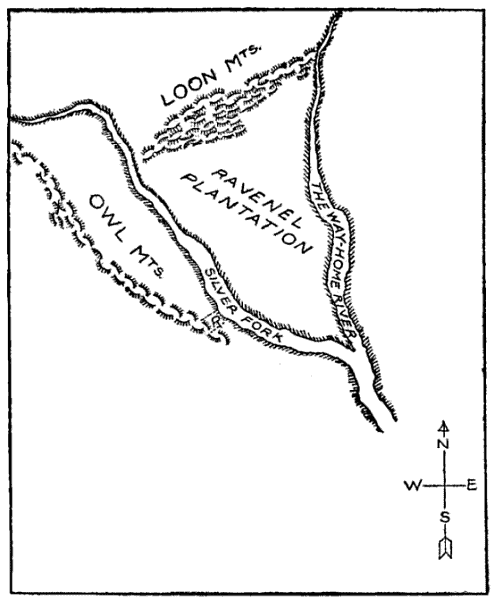
At the words, Katrine, who had been retuning an old guitar, took alarm and was alert on the instant. Striking it quickly, insistently, she came to the door of the dining-room, which framed her beauty like a picture.
"I'm going to sing you an Irish song, a real Irish song!" she cried, gayly, touching the strings. The men turned, and Francis, with the land on the other side of the Silver Fork clear out of his mind at sight of her, came near the doorway where she stood.
"Come all ye men and fair maids And listen to my song, I'll sing of Bloomin' Caroline, Who never did a wrong. SHE Beats the fragrant roses, She's admired by all aroun'. They call her Bloomin' Caroline, Of Edinboro Town."
"Young Henry, being a Highland lad, A-courting her he came, And when her parents heard of it They did not like the same. so She bundled up her costly robes, The stairs came tripping down, And away went Bloomin' Caroline From Edinboro Town."
Dermott had risen and stood by the far window, looking into the night. Unseen by him, she touched Frank on the sleeve.
"Do not do anything he asks you to do to-night," she whispered, with great intensity, and in a minute more was back at the singing.
"They had not been in London For scarcely half a year—"
and before the song ended the two men were joining the refrain, taken out of themselves by her beauty and charm.
For nearly a week after this she saw neither of them again, but her honest soul was fretted
"Dermott McDermott," she cried, "come here!"
He rode through the ferns and undergrowth toward her, as she stood looking up at him with fearless eyes.
"I've done something I want to tell you, something you won't like, for it was going against you; and it makes me feel that I've not been quite loyal to you, you that's always been so good to me, too." The quick tears filled her eyes as she spoke.
He dismounted to be nearer her, and, putting out his hand, said:
"There's nothing you could do that's not forgiven. You hold my heart in the hollow of your hand. What did ye do, child?"
"The other night when I saw you turning Mr. Ravenel the way you wanted by your flattery and your hypnotic presence, I knew ye wished him to do something for you. I knew when you told him how clever he was—cleverer than you were yourself—that it must be something very great to make you admit a thing like that. And when
Dermott stood looking at her with pity and admiration as he put his hand gently on her shoulder.
"Ye did just what was right, little lady; just the thing that any sweet, grateful woman should have done. You understood what I was doing, thought a friend might be cajoled wrongly, and warned him against it. I'm proud of ye for it!" he cried, with enthusiasm. "Proud of you!" he repeated. "And besides," he added, with a laugh, "it didn't make the slightest difference. He did it anyhow! We signed the papers to-day!"
"The papers for what?" she demanded.
"For that useless bit of land on the other side of the fork," he responded.
"Dermott," she said, "you play fair, don't you? You wouldn't take advantage of any one?"
"Wouldn't I?" he said. "If it were to help you, I'd outwit the deil himself, Lady Katrine."
VII
KATRINE'S OWN COUNTRY
In the following fortnight Francis and Katrine met but three times.
One day, having grown restless, she went to walk, taking the road from the plantation back into the mountains. Returning by the ford, she heard laughter and the ring of horses' hoofs, and by a sudden turn of the road came directly upon Frank, who, separated from a party, was riding beside Anne Lennox. At first sight of her whom she knew instinctively to be a rival, Katrine was reminded of a golden peony, for the pale-yellow hair, bright hazel eyes shot with yellow light, and thick, creamy skin had given Anne Lennox from early childhood a noticeable and flower-like beauty. A long-limbed, slender, full-breasted, laughing woman, with square shoulders and the carriage of one much accustomed to the saddle, she looked with curiosity at Katrine, who was standing aside beneath the elderberry-bushes to permit them to pass.
"
"Upon my honor, Anne—" Frank began, with a laugh, when he met the clear eyes of Katrine looking at him from below.
If there had been some coldness, some resentment at his lack of attention to her, or implied jealousy at his devotion to another, he could have understood it. But there was nothing of the kind. In those eyes, which he believed the most beautiful in the world, there was nothing but a glad light at seeing him, a bright smile of recognition in which he could detect neither remembrance nor regret.
Anne Lennox turned her keen brown eyes backward to look at Katrine as she crossed the bridge. "Frank Ravenel," she exclaimed, "if a girl who looks like that lives near you, you have been making love to her! I wonder if by any chance she could be the woman!"
"She is the daughter of the new overseer," Frank answered; and his tone implied, though
The next time of meeting between Francis and Katrine was one morning on the river road. Her cheeks flushed at sight of him, and there was an odd reserve in her manner; but she never seemed more beautiful.
He stood, hat in hand, wondering at her silence, a bit amused.
"It is a pleasant day," he suggested, at length, remotely.
"It is pleasant," she answered, with averted eyes.
"Unusual weather for this season, don't you think?" he went on, a bit of teasing in his tone.
"I haven't thought of it," she said, concisely.
"Suppose you think about it now," he suggested, jesting still, but not quite at ease concerning her mood.
Suddenly she turned toward him, her face suffused, her eyes troubled.
"Katrine," he cried, "what is the matter? Tell me! Let me help you!"
"I'm jealous," she said, simply.
"Jealous!" he repeated. "Of whom?"
"
She had clasped her hands in front of her, and stood with her chin drawn in, looking at him from under a tangle of dusky hair.
"You poor child," he said, moving toward her.
"Don't!" she cried, backing away, "don't try to comfort me! I've always, always been like this. I cannot help it. Whenever I care for anybody—oh, it never made any difference whether I had any right to care or to be jealous! I just was; and it hurts!" She put her hands suddenly over her heart and began to speak rapidly, as a child does when accumulated trouble makes silence no longer possible. "I hated her when I saw she was with you; far up the road, when I only knew she was a woman; and when I saw her nearer I hated her more. She is so pretty," she explained. "Are you going to marry her?" she demanded.
"Not exactly," he answered, grimly.
"Good-bye!" she cried, dropping down the river-bank to the skiff.
"Katrine!" he called.
"I'm not coming back!" she cried through the bushes. "I'm never coming back! Good-bye!"
Two days later there came from Ravenel House a polite note, cordial by the book, asking
Katrine read it with a curious smile around her lips, answering while the messenger waited. She "regretted extremely that a cold"; she paused a minute in the writing to reflect on the way the cold had come; sitting one damp afternoon in the rose-garden with the son of the writer of this extremely polite invitation; "regretted extremely that this cold, which seemed more persistent than such things generally were, prevented her accepting Mrs. Ravenel's most kind invitation."
The third meeting was an intentional one on Frank's part. The people at Ravenel had become unbearable, and with no thought save for Katrine's society, he took a short cut through the laurel trees, crossed the river in his canoe, and entered the lodge garden to find her sitting on the broad steps of the house, her chin resting in her hands. There was an exaltation in her little being, an alluring remoteness, an entire concentration upon her own thoughts, which one sees in a child; and when one saw her thus,
At sight of him she bowed gravely, moving that he might have nearly all the rug upon which she had been sitting, not minding the stones for herself in the least. Her careless generosity spoke even in this trifling act.
"You are bored?" she asked, after a silence which he seemed disinclined to break.
"To extinction, little lady," he answered, puffing a cloud of smoke into the hollyhocks. "You see, you have spoiled me for those others." There was another pause. "And you?" he asked.
"I? Well, I practised, and planted some flowers, and made some things for Miranda's baby, and then"—she hesitated, with an adorably shy look full of that pathos, which made so many of her simplest statements seem claims for protection, "and then I went over into 'My Own Land.'"
He regarded her for a minute, his approval of her showing in every line of his handsome face. It was in these untouchable moods of her, when she eluded him utterly, when she took him out of himself entirely, that he found the most zest in intercourse with her.
"Is it a long journey to that land of yours?"
"Not long," she answered, "but sometimes difficult. I go down to a queer gate; I never knew where I got that gate," she threw in, in an explaining way; "and let down the bars and walk up a long driveway of blue pines, and there I am!"
"Go on," he said, "though I think it shabby that you've never told me of your property before now."
"I found this country; oh, years ago! Of course, I have changed it a great deal. There was only one house at first, like Kenilworth Castle, only much larger, with those heavenly, deep windows. And I have taken all the people I liked to live there—"
"Jolly," he said; adding, hastily: "But not in the least a house-party sort of thing, is it? where they play bridge and drink whiskey-sours?"
Katrine shook her head. "These people live in My Country. I've stolen some, but others come of their own accord. They are very great people. Colonel Newcome is the host. You know him?"
"Adsum," Frank answered, softly, and Katrine flashed a smile of appreciation back at him.
"
"'Henry Esmond,' I said (you know he's a little man, so I looked straight in his eyes as I spoke), 'I will not have her here with her red stockings and their silver clocks.'
"'Ye've listened to gossip of her,' says he.
"''Twas you yourself that rode after her and the King, when ye crossed swords with his Majesty for her honor,' said I.
"'An event which never took place, believe me,' said he, with a bow, and he bows like a king.
"'Ye lie like a gentleman,' said I, 'and I've pride in ye for it; but Beatrice Esmond never comes in here.' And then I just told the truth to him. 'I've had jealousy of her for many years, despite her morals,' I explained."
Ravenel threw back his head and laughed.
"Oh, you women!" he cried. "Are there many ladies resident in that land of yours?"
"Some; not many. Di Vernon, of course,
"One awful day," she went on, "when everything seemed wrong," the quick tears came to her eyes as she spoke, "and I was sick and disgraced before people and wanted to die, I went into My Own Land, and there was Jean Valjean at the bars waiting for me. He smiled as I came."
"'Cheer up, Little Irish Lady!' he cried, at sight of me, 'cheer up! There is reason for everything in that Great Beyond that we'll understand some day.' And that night, because of his strength, I went to sleep comforted, and the next morning sang the 'Ah! Patria mia' quite nobly. It was payment for the suffering, perhaps. Who can tell?"
"And whom," it was curious how Frank's jealousy showed in the question, "whom do you like best of all these tenant folk of yours, Katrine?"
"Ye'll never tell?" She turned to look him full in the eyes. "Promise me ye'll never tell; I'm a kind of henchman to Davie,' she quoted Alan's words with a deep-voiced enthusiasm, 'and whatever he cares for I've got to care for, too. I'm not so very bonny, but I'm leal to them I love.' In My Land, that is all they care for. They are of all religions and times and climes, but they are loyal, every one." And, turning to him suddenly, she brought her wee bit of a fist down on the hard stone, her cheeks flushed, her eyes glorious to see. "It's all there is, in My Land or yours, that makes life worth while—Loyalty! The 'enduring to the end.' Even if one's none so bonny, he can be leal to them he loves!"
Frank threw his cigar away and moved nearer to her, holding out his hand with an odd com
"Katrine, dear," he said, "take me to live in that land of yours. I want to let down the bars of the gate you don't know where you found, and go up the pine driveway to meet Colonel Newcome. I want all that it means to have those people for intimate friends."
"One must make one's own 'Land,'" Katrine answered. "And besides," with a curious, lovable puckering of her eyelids, "men mustn't dream things. Men must do."
There was a silence.
"Must they?" he asked, at length. "Why?"
"Did it ever occur to you," she asked, abruptly, "that you might work—ever, I mean—when you were a boy?"
"Never for a second."
"You never felt that you would like to take a part in great affairs, as other men do?"
"Why should I, Katrine? I have all the money I can possibly want. Life is short. I come of a family who tire of living quickly. Say, for instance, I live until I'm sixty. I probably sha'n't, you know, but we'll say so for argument. One-third of the time I sleep, which reduces the real living to forty years. Until the with you!"
She had clasped her knees, making of herself a magnetic bunch of color and lovableness, and she let her eyes rest in his a moment before she spoke. "Don't talk that way, will you? I like to think of you always as a great man—a man of action, a man who helps."
They regarded each other steadily for a full minute before he said:
"It has begun."
"What?" she asked, mystified.
"That mental treatment you spoke of some time ago. You are having a terrible effect on me, Katrine, and I find it extremely uncomfortable," he added, laughing.
VIII
FRANK YIELDS TO TEMPTATION
During the time of the house-party at Ravenel, Katrine gave vent to the natural rebellion against her position but once. Dermott was away on some business in New York; the daily letter from Dr. Johnston concerning her father's condition had not arrived; and she had seen the gay people from Ravenel coach past her as she sat alone on the Chestnut Ridge.
For nearly a week she had been sleeping badly, awakening every hour or two through the night with something—something that could not be put aside—pressing upon her soul.
Huddled in a sad little heap, in her white gown by the side of the bed, one unbearable night she stretched her arms along the coverlet, sobbing out to the everlasting silence the questionings as to what she had done to be so neglected and set apart.
"What has been in my life but shame—shame which was not mine?" she cried, as the horror
Out in the wooded silence a bird began to sing a mournful melody. Of the greatness of night he sang, and dead morns, and dropping stars; of dear forgotten things and loves that might have been, that may not be; of passion and unfulfilled desires, and through the pines the song entered her heart like a response. She listened, not as a girl listening to a bird, but as one artist listens to another with a rapture of appreciation. And the music comforted her. And later, in the midst of great sorrow, she saw intended significance in the occurrence.
"It was an answer," she said, "to remind me that there will always be that solace. Give me, oh God," she prayed, "power to make of all my sorrow music for the world!"
The day following her midnight protest she heard from Nora and old Cæsar that the guests at Ravenel had gone; heard as well that "old Miss and Marse Frank were goin' shortly"; heard it with a stirring at her heart of physical pain to which she had grown used.
On the evening of this day, a warm June even
He wore a light overcoat over his evening dress, and stood hatless by the boxwood arch looking across at her.
"Katrine," he said, "little Katrine, I have come back to you."
His face was illumined as he spoke her name. The peculiar ability to express more than he felt was always his, but at the instant he felt more than he was able to express.
"I am glad," she answered, not moving toward him nor offering to shake hands. It seemed enough that he was there.
"They have gone at last," he said; adding, piously: "Thank God!"
"You did not have a good time?" she asked.
"I did not."
"I am sorry," she said, baffling him by the serenity of her tone.
"There were two or three occasions which
Katrine laughed.
"And there was an evening when we had charades, for which nobody had the least gift or training. It was the evening you were to come to us. Why didn't you, Katrine?"
"I was not well," she answered. "But I shouldn't have come if I'd been well, Mr. Ravenel."
She seemed to him so perfect, such an utterly desirable being, as she sat with roses in her hand and the moonlight shining on her flower-like face.
Neither noted the silence which fell between them, a silence which spoke more than language could have done, for language had become, between them, an unnecessary thing.
There was still no spoken word as they walked side by side along the path which led to the house. At the turn into the wider way there was a tall pine-tree, the boughs beginning high from the ground, the turf beneath them covered with brown pine-needles. There was a bench here, upon which they had often sat together. In the moonlight this place under the tree was in a soft,
It seemed as though they were alone together in the world. In the moonlit gloom under the pine they stood, near, nearer, and at length he put his arm around her gently, not drawing her toward him, only letting it lie around her waist, as though they had a right to be there, heart to heart, in the stillness of the night. Standing thus, he felt her tremble, noted her quickened breath, and the rise and fall of her breast and shoulders because of his caress.
Although they could not see each other in the gloom, she knew his lips sought hers. By an indefinable instinct she turned from him twice before their lips met in a long kiss of passion and content. They kissed each other again before he drew her down beside him on the garden bench in the flower-scented dusk.
"You care?" she asked, in a whisper, her breath on his cheek.
"More than I thought I could care for anything in life," he answered.
It was after ten when Nora's shrill voice recalled them to themselves.
For answer he clasped her slim white hands behind his throat and drew her toward him.
"What do you think?" he said, his lips kissing hers in the speaking of the words.
"I hope you will not go."
"I shall not." And then: "Oh, for a few days, perhaps, to take mother to Bar Harbor; but I shall come back. And we'll have the whole long summer together, you and I; you and I," he repeated. "Good-night. Kiss me, Katrine!"
"Good-night," she said, raising her lips to his; and then, almost as though it were a benediction, she added: "God keep you always just as you are, beloved." And as he had done many times before, Francis Ravenel felt powerless before this girl who gave all, asking nothing in return.
IX
THE TRUTH
Frank did not leave Ravenel even for the few days which he had mentioned to Katrine as a possibility. Accompanied only by her maid, Mrs. Ravenel started to Bar Harbor without him. June drifted into July, and still he lingered at the plantation.
And all the summer days were spent with Katrine Dulany. At first he believed that he would probably tire of the whole affair quickly. He was surprised to find that he did not. He found her always new. There was an elusive quality to her, days when she would barely permit him to touch her hand, when she dazzled him by the audacity of her thinking; her indifference to him, to him who was in no way accustomed to indifference in women. And a few hours later, perchance, he would return to find a girl with wistful eyes and speech of tenderness, with no thought "that is not for the king," she told him once.
"I have kept you waiting for me, I am afraid," he said one day, when he had kept an engagement he had made for ten o'clock at a quarter of twelve.
That morning she had been studying; not tones, but German Church music, and already she had realized, unformulatedly, the solace in the exercise of a great gift; had found that she could forget trouble in the world of inspired work; not for long, perhaps, but long enough to have peace of mind restored to her and strength to go on for another day.
"It didn't matter," she said. "I practised. One forgets one is waiting then."
Finally there arose in him an absurd jealousy of this gift of hers, of the thing which seemed to console her even for his absence.
"I shall learn to hate your music," he said one night, when she had drawn herself away from
"Don't do that!" she said. "Ah, don't do that! Don't you see that it is all I have for my own in life; all I shall ever have!"
And with some hidden, mental connection between his words and the act, she began to sing in her great, lovely voice:
"Ask nothing more of me, sweet, All I can give you I give. Heart of my heart, were it more, More shall be laid at your feet. Love that should help thee to live, Song that should bid thee to soar. All I can give you I give; Ask nothing more, nothing more."
She asked, neither by word nor look, for any expression concerning the song; but as the last note died away seated herself beside him, chin in hand, looking far past him into the night.
At two of the next morning he awakened with a start. He was alone in his own rooms at Ravenel. Looking around in the half-light of the window, he put his head back on the pillow with the air of one awakened from a feverish
Where was he going, and where was he taking Katrine Dulany? Marriage was out of the question. A person of his importance did not make a mesalliance. He owed a duty to all the Ravenels who had preceded him, to those who would follow. To marry suitably was the first duty in life; perhaps it was the only one which he acknowledged. Where was he going? He lay with open eyes, staring at the ceiling in the faint light of the coming dawn, with a sense of physical sickness at the thought of giving Katrine up, of letting her go out of his life forever. He had told her he cared more for her than he had ever thought it possible for him to care for any one. That was long since, back in the times before he had known the sweetness of her. Now, with all the heart he had to give, he had learned to love her, to long for her presence; she had touched a new chord in his nature, one which he had never known before her coming.
He would not give her up; he could not. Why should he? She would be happier with him, even though wrongfully his, than with a drunken Francis the King! It was so she spoke of him, and it was this complete trust that appealed to all the best within him, as a tenderness born of her sweetness, her complete loyalty, raised him beyond his own selfishness, and he resolved to save her, save her even from himself.
With this fixed thought he rose early and, breakfastless, went out into the dawn. He would go away and leave her. He would see her once more and tell her the truth about himself. He would make it clear to her, "damnably clear," he said to himself, with a set chin. She would be left with no illusions concerning him. It would help her to forget to know him as he really was. He felt it part of his expiation to tell her the truth.
As he rode up the pathway to the lodge he was white to the lips. His eyes were sunken. All the passion of which he was capable longed for this woman whom he was about to surrender, perhaps to some other. He winced at the thought of it.
She was sitting in the old arbor and turned
"What is the matter?" she asked, anxiously, at sight of his white face. "Are you ill?"
"Katrine!" he cried, "it is shame—shame at what I have been doing; shame at the way I have been treating you!"
She grew suddenly pale, and her lips parted as she stood with eyes fastened upon him, waiting for him to go on.
"I wanted you to love me," he went on. "I wanted it from the first. As time passed I learned to care so much that I thought of nothing else, wanted nothing else, but to be near you. But never, never for one instant, and, Katrine, it is of this you must think always, never for one instant did I intend to marry you!"
She placed one hand against the bench for support, her face exquisitely pale, her eyes darkened, her mouth drawn; but she regarded him steadily and bravely as he continued.
"I might make excuses for my conduct; might even lie about there being some obstacles, my mother's objections, the rest of the family, but I don't want to do that. I want you to know the truth just as it stands, to know me exactly as I am. My mother would object to my marry
Still she spoke no word, but sat looking away from him into the ocean of roses.
"For God's sake, say something to me, Katrine!" he cried, at length. "Tell me even that I am the contemptible cad you think me to be; only say something. I cannot endure this. With every fibre of me I am longing to take you in my arms, to kiss your eyes that have the ache in them. God knows how I want you and how I am suffering!"
Her lips quivered for an instant before she controlled herself to speak.
"There seems nothing to say except 'Good-bye.'"
Her voice was infinitely sad and tender. There was neither anger nor resentment in it, and she rose as though to leave him, but he held her back. The great womanliness of her, the ability to suffer in silence, and the dignity of such a silence touched him strangely. There was a sob in his throat as he spoke.
"
"Dear," she answered—and as she spoke she put her hand on his brown hair, as a mother might have done, "I don't want you to suffer like this. I might have known, had I thought about it at all, that you would never marry me. But it seemed so perfect as it was, I never thought at all, I just," it seemed as though she were saying her worst to him, "I just trusted you."