PREFACE (continued 2)
Reading edition
He flung out one arm as though to protect himself from a physical blow, and a moan escaped him.
"Let me tell you about myself," she continued; "it will be best, for we may never meet again. Oh, please God," she cried, suddenly, "we may never meet again in this world!"
The tears were rolling down her cheeks, and she sobbed aloud as she spoke. He reached his arms toward her, but she moved away, sitting silent until she regained such composure as would permit her to go on.
"The first thing I remember in my life, I must have been about three, was my father's beating his head against the wall of the room in which I was sleeping because my mother had left him. After that I became used to anything—to
"As father grew worse and less able to care for himself, it was necessary to have money. Mr. Ravenel, I have been a beggar in the streets! I have sung in the streets, I! in the court-yards of the hotels, for money to keep from starving! So you will see sorrow is no new thing to me. I do not question it. I have had in my life three perfectly happy months, perfectly happy. It is
He shook his head. "If I touch you I shall not go. Oh, Katrine, Katrine, Katrine! Do you know what I am doing? I am going when I could stay, stay, or take you with me! Will you remember it in the years to come, when you are older and will understand what it means? Will you, oh, for God's sake, Katrine, remember that there was still some little good in me, that although I did not do the best I could have done for you, at least I kept myself from doing the worst?"
A scarlet flush suffused her face at his words.
"Ah, don't!" she cried, putting out her hand, as though to ward off a blow. "Don't! Don't say it! Don't even think it! Believe me, it could never have been like that! I should have died first!"
X
TO TRY TO UNDERSTAND
She turned and left him, walking quietly along the narrow path through the harrowed field under the silent pines. The feeling of death was upon her. She wanted to cover her eyes, to blot out the sun, to run to some friendly darkness to make her moan. She knew he was watching her, however, and carried her head well up. She hoped that he could not see that her hands were clinched. As she went on, her cheeks scarlet, her carriage splendidly undejected, the wish came to her that she could sing. It would prove to him that she had the will not to let this thing crush her, not to be as other women might have been. But her sincere soul put the thought aside because of its untruth. She had given him a great honesty always, she would give it to him until the end. He knew she suffered, but she desired him to know as well that she was brave, that her spirit was unconquered, that she would
On the crest of the hill she turned to look at him. He was standing with his eyes fastened on her, the strained whiteness of his face marked out against the black of his horse's mane.
Across the distance she had covered their eyes met. The slim little figure in the black frock outlined against the blue of the sky, the wind blowing the pines over her head, her dusky hair holding the sun, her skirts, pushed backward by the wind, revealing her childish body full of exquisite vitality. The tears stood big in her eyes, but hers was a soldier's courage, the courage to face defeat, a thing goodly to see in man or woman. Hastily she untied the scarlet kerchief she wore around her throat and waved it to him, high, at arm's-length, like a flag of victory.
"Ah, don't worry! It's all right!" she called. "Don't think about me! Good-bye!"
At the back of the lodge, down by the brook, there was a place shut in by bushes and roofed over by boughs, where she had often before hidden her grief. Reaching this leafy room, she threw herself on the pine-needles, moving her head from side to side as if in physical pain. There was shame mixed with the grief. Remembered
If there had been another reason for his conduct, she thought, any reason save the one he gave! If a father had forbidden marriage between them, or if he had feared the anger of his mother, her pride, at least, would not have suffered. But he had made it clear, "damnably clear," as he has stated it, that the only obstacle to his marrying her was his own will.
But he had suffered, too. She had seen him white and haggard with longing for her, and she knew pretence too well to doubt that thus far she was the supreme attraction in his life. The thing that hung black over all was the unchangeableness of the cause of her trouble. She could never be anything but Katrine Dulany; he had decided that she was not worthy to become Katrine Ravenel. Wherein, then, did these Ravenels excel? Her rebellious Irish heart put questions for her clear head to answer. Were they a generous, high-minded, clear-souled people? Folk-tales, passed by word of mouth, of the ill doings of Francis sixth, as well as Francis
But through the turmoil of heated thought one idea became fixed, however. She must leave Carolina and work; determinedly, doggedly; work to save her reason. Unformulated plans were taking shape in her mind even while she sobbed forth her grief. If she could but study, she thought!
"There must"—and here she spoke aloud, her hands clinched in the pine-needles—"must, must be found some way to do it!"
And by some curious mental twist, as she made the resolution, there came back to her the words of some old reading:
"No great artistic success ever came to any woman, that had not its root in a dead love."
As she lay face downward, her body con
"If ye've hurt her, Frank Ravenel, if I find when I come back ye've hurt her, you'll answer to me for it! God! how you will answer to me!" he cried.
There is this about life: that frequently when we think the worst has happened it is but the forerunner of worse to come.
As Katrine lay tossed by misery and shame, Nora O'Grady, with her kilted linsey-woolsey skirt turned up, her white kerchief loosened over her bosom, and her brogans twinkling in her haste, came running along the road, her face twitching with sorrow. Ever and anon in her speed she dried her eyes on her apron and a moan escaped her.
"Poor heart!" she repeated. "Poor heart, she's enough to bear without this coming to her the now!"
Looking down at the prostrate figure, she began, in a shrill voice:
"Honestly to God, Miss Katrine, ye'll hear another word of this! Crying like a child in the middle of a lot of damp stickers because ye can't have music as ye like! Just throw yourself round on this wet ground a bit more an' mayhap He'll take away the voice He's given ye already! Perhaps it's because ye cry for nothing that there's been something sent ye to cry for!" And here her thought of suitable conduct was lost in real grief.
"Ah, Miss Katrine! Miss Katrine! Your fa
Katrine, who had arisen, stood with tear-stained face regarding her. "He is—?" She could not go on with the question, but Nora answered it without its being finished.
"He has not been drinking. Oh, Miss Katrine, he's past that! Can't ye understand? The hand of God's upon him! He's called away, Miss Katrine. Ye should have seen him as he crawled to the doorway and fell on it. I got him to his own seat by the window, and he's wanting you, Miss Katrine, he's wanting you sore! So I come, in part to tell you, but more to have ye prepare yerself for the change in him, for his end's in sight!"
Although she was trembling from head to foot and had grown ashen pale, Katrine spoke calmly.
"He came alone?"
Nora shook her head in the affirmative.
"It seems, Miss Katrine, that there was some organic trouble; that the great specialist, whose name is gone from me, warned him not to try the cure. He said the other disease was too far along. But your father wanted to be himself again. It was for you he wanted it. It was the disgrace he was to you that was on his mind always."
"
When Katrine entered the room where her father sat, she found him, as Nora had said, by the window, his head thrown back, his eyes closed; nor did he open them at her coming, though by a poor movement of the hands he made her understand his knowledge of her presence.
"Little Katrine," he said, while two great tears welled from under the closed lids. "Little Bother-the-House! I have come back to you. There is no one can help me except you."
Katrine made a swift movement to be near him. Kneeling, she drew his poor, sorrowing head to her breast, and in the twilight these two, the one so old and weak and loving, the other so young and desolate and brave, clung to each other, blinded by the vision of the separation so soon to be.
In nearly every crisis of life there comes some twist in affairs which seems to turn the screws harder or sets them to making one flinch in a new and unexpected place. In Katrine's case it was a turn which made life so unbearable that there were times when she would be forced to bite
"There was never a day, Katrine, while I was at the hospital, that I had not a letter from him. Money was spent for me like water. The doctor told me he had orders to spare nothing. Ay, there's not another man in the world who would do for a stranger what Mr. Ravenel tried to do for me. And sometimes he'd write drolly, you know his way, that he'd seen ye somewhere, riding, mayhap, or in the garden, or had heard a note of your music as he rode by; and the home feeling would come back to me, and I'd take heart again."
XI
KATRINE IS LEFT ALONE
In the ten days before her father's death nothing seemed spared Katrine. The hopeless life of the man was recounted to her hour by hour, interspersed with the rereadings of Frank's letters, and, most of all, with remorse at the desolate place he had prepared for her when he had gone.
"But ye'll have a friend in Mr. Ravenel," he told her, earnestly. "One who will help you, Katrine, and ye need have no fear to take his help. He is one who has a high thought for women and would never betray a trust. It's a great comfort to me to know ye've him, Katrine."
On the day before the end his grief was bitter to hear.
"My little wee lassie," he sobbed, "I'm leaving ye alone with nothing; none to shield you, none to care, but just one friend. I'm going out, and it's good I'm going. I would always have held you back, always have been a drag to your name—for
"Ah," he whispered, at length, wiping his brow, "the music's gone from me. In the whole matter with your mother, Katrine, I was at fault. I was jealous of her gift, of the love she had for it, and made her life miserable by my demandings." He placed his hand tenderly on her head as he spoke. "Katrine," he said, solemnly, "with those we love it's never enough to forgive and forget. One must forgive and try to understand. To forget and forgive. Ah, Katrine, time helps us there! It does almost all of the work, so it's little credit we need take either for the forgiving or forgetting. But to try to understand! When those we love have hurt us or injured us, to study why it was done: what inherited weakness in them, what fault of their environment brought it about, to study to understand, that's the real Christianity."
In the starry watches of the night, wide-eyed and grief-shaken, Katrine took the lesson to
But, she demanded of herself, was she large-souled enough to acquire such tolerance toward Francis Ravenel? Leaning on the window-ledge, looking into the clouded darkness of the night, awaiting the hour to give her father the potion that for a time relieved his pain, she went over tenderly, bit by bit, the summer that had passed, that flower-scented, love-illumined summer for which she felt she was to pay with the happiness of a lifetime.
She lived again her first meeting with Frank under the beeches; the recklessness of her own mood because of her father's drinking; Frank's lonesomeness at his home-coming; the touching of hands on the old log; the sympathy between them from the first, and at the end asked herself, honestly, who was most to blame. She had done wrong to permit him to kiss her the night under the pine-tree, but she would not have foregone the memory of it for all the world had to offer.
On the last day about noon the pain left her father, and toward evening he asked to be helped to his old place by the window, that he might see
After assisting him to find the desired letter, she sat at his feet with a white face and fixed eyes as he read:
"I met Katrine to-day on the river-bank. She was well and beautiful and happy. It makes me want to be a better man every time I see her. I want to help to make her life happy—" The hand which held the letter suddenly dropped lifeless.
"Father!" she cried. And again: "Oh, father, can you leave me like this?" And as the truth came to her that she was alone, Nature was merciful, and she fell unconscious by her father's body, with Frank's letters lying scattered around her on the floor.
After her father's burial there followed the collapse which comes so frequently to those women who have the power to bear great trials in silence.
In the small, white bed, with vines reddening around the window and shining into the room, Katrine lay, day after day, with the pallor of death on her face and a horrible nausea of life,
But with the return of strength the problem of daily living was to be solved. The little stock of money which she and Nora had between them was used for the last sad needs of her father, and with Dermott McDermott away she knew no one to whom she could turn.
"Don't you be minding troubles like these, though, Miss Katrine," Nora sympathized. "Niver ye mind a bit! Ye're wanting to go away, and we'll find the money to go. We've some bits of trinkets, an old watch or two, and I'm a good hand at a bargain. And we'll not want to carry the furniture on our backs like turtles, either. I know a woman in Marlton whose heart's been set on the old sideboard for months back. We'll go slow, Miss Katrine, but with your voice we've no great cause for worry, my lamb. Look at the thing with sense, and trust to Nora; she'll manage it all. And in a few weeks we'll be off to New York, that wicked old place that I'm far from denyin' I like fine."
On the day before this departure there fell an event, small in itself, yet so momentous in its out
Sad and wide-eyed, she was sitting in her black frock, huddled close to the big pine-tree at the foot of the garden, when Barney O'Grady, the son of Nora, came out of the beech woods. He had been crying, and at sight of Katrine he threw himself on the grass, breaking into a passion of tears, and clutching at her skirt as a child might have done.
"Barney!" Katrine cried. "Barney, dear, what's your trouble?" and she put a soft hand on the boy's tousled red hair.
"Mother's going to leave me here," he said, "and I want to go. I hate it, hate it, hate it, here all alone! I want to go! I want to go!" he moaned.
"Is it the money?" Katrine asked.
"Yes," the boy answered, "there's not enough for us all. And I'm to stay with Mr. McDermott till I earn enough to come. And I want to go now."
"But if you should get in New York, what would you do?" Katrine demanded.
"Newspaper work," was the answer. "I've the gift for it," he explained, with an assured vanity, between his sobs.
But the boy continued to sob appealingly, and Katrine, who had that real intelligence which no sooner sees a desired end than it finds a way to accomplish it, put her sorrow aside for practical thinking.
She reviewed her possessions rapidly, remembering, with a throb of pain, some carved gold beads she had worn when "she found herself," at the age of three. They had always seemed part of her, and, though no one had told her, she knew they had belonged to her dead mother, "who went away." But she felt little hesitation in giving them, if some one were to be helped by the sacrifice.
"Wait, Barney," she cried, "here, where Nora can't see you! I'll be back in a moment! They're just some old beads," she said, apologetically, with a splendid dissimulation, as she gave them to the boy. "But old Mrs. Quinby, at Marlton, tried to buy them of Nora once when
"Ye needn't worry, Miss Katrine," he answered, drying his eyes on his sleeve. "It's been betwixt and between the truth with her all my life. But if the time ever comes when I can serve ye—" He choked. "Ah!" he cried, "words are poor things! But ye'll see!" And with this he was gone at a breakneck run down the Swamp Hollow toward the Marlton road.
And the strangeness is that Katrine's hidden gift of old beads to a half-grown Irish boy, in the woods of North Carolina, should wreck a Metropolitan "first night," shake the money-market of two continents, and change the destinies of many lives.
XII
THE REAL FRANCIS RAVENEL
On the afternoon of the day upon which Frank said good-bye to Katrine he took the evening train North. It was his intention to see Ravenel no more for a long time, certainly not while the Dulanys remained. He was afraid of himself, for there came to him at every thought of the affair a glow of admiration at the words Katrine had thrown back at him:
"It could never have been like that. I should have died first."
He had given her up, but the fight was not finished, and the struggle went on constantly. In the silences of the night it was upon him again, gripping him with a pain around the heart. The most unexpected happenings would bring remembrances of her. The appealing gaze of an Irish newsboy, or a hand-organ grinding out the "Ah! che la morte," which brought back the half-lighted piano and Katrine's singing in
For three days he endured Bar Harbor before he fled to the Canadian woods with no companion save a guide. He gave his address to none save his mother, and for six weeks tramped until his body ached for rest; rowed the sombre lakes for exhaustion and peace of mind, cursing the fact that he was a Ravenel, and knowing full well that his conduct was both foolish and illogical.
At the first stop for letters he found one from his mother, which disturbed him more than any letter of hers had ever done before. She wrote:
DEAREST LADDY,—I am writing in much haste and some perturbation of mind for your advice. Last night, at the Desmonds', Nick van Rensselaer came to me after dinner for a chat. I knew he had something upon his mind when he wasted his time talking to a woman.
And what do you think it was? The most astounding, impossible, quixotic, unlanguageable thing in the world! He wants to send Katrine Dulany abroad to study. He wants it to be done in my name, however, so that it will in nowise compromise her, and wishes to have all the credit of the kindness given to me. He
You see the part I shall be forced to take in the affair. I have asked him for a few days to consider the proposition, and am writing you for advice.
When are you coming? Every one is asking about you.
Lovingly always, MOTHER.
Lying on his back watching the crooked blue spots of the sky through the tree-tops of a Canadian forest, Francis read this letter over and over, and as he did so it seemed strange to him that he had not thought to help Katrine in this way himself. If she ever found out that he had done so she would probably never forgive him, but there were ways, he reasoned, to arrange it so that she could never find out.
His decision being made, he acted upon it immediately, and that night two letters, one addressed:
MONSIEUR PAUL ROGALLE, de Rogalle, Dupont et Cie, Paris, France,
and another:
M. JOSEF, Faubourg Saint Honoré,
The morning after the writing of these letters Frank started farther north, and heard nothing of the outside world for more than a month. At North Point he found a bundle of letters, two from his mother, and another from Doctor Johnston, enclosing the note which Katrine had written him after her father's death.
He opened the doctor's first, and at sight of the enclosure his heart, in the homely old phrase, came to his throat.
It was a sad letter, thanking the doctor for all he had tried to do, speaking of her father's suffering at some length, parsimonious of detail concerning her own life or future plans.
It was ten o'clock in the hunting-hutch. The night outside was starless, the lamps flickered irregularly, the guides lay heavily asleep in their blankets on beds of pine boughs in the corner. It was a strange place for the birth of a man's soul, but as Frank Ravenel read the letter a tenderness, a selfless tenderness, for the sad little writer of it came to him. He had already protected her from himself—"somewhat late," he confessed, with bitterness, and there had been some effort "not to do the worst." But the feelDon't think of me! Good-bye!" It seemed in some way to have been a cry of victory.
He went to the door of the tent straining his eyes into the blackness. Alone in the great woods with the night noises, under the silent stars, things took on a different value. What was he compared to her?
Stripped of family and wealth, how would each measure before a judging world. "She was so"—he hesitated in his mind for a word—"she was so square," he said to himself. Wave after wave of pity swept over him as memory brought back to him her vividness, the fervid speech, the humor, the touch of her. He closed his eyes for a moment, she was in his arms, there came the odor of her dusky hair, and for the first time in his life he was a man.
"
"Oui, monsieur."
"The distance to the nearest railroad?"
"By land—it is sixty miles, m'sieu."
"By the lakes?"
"It is much shorter, but of an extreme dangerousness."
"We will go by the lakes."
"When, m'sieur?"
"To-night, Grègoire!"
XIII
DERMOTT'S INTERVIEW WITH FRANK AT THE TREVOY
In three days Frank reached New York, where he found mail at the club: from the South; from the Western mines; from women inviting him; as well as five or six messages by wire or mail from one Philip de Peyster, soliciting an immediate interview. Even in his perturbed and planless state these repeated demands made an impression on Frank, and in the morning he telephoned that he was at the Trevoy for the day, and would be pleased to see Mr. de Peyster at his convenience, suggesting the luncheon-hour as a time when both might be free.
Having received no response to his message, at two o'clock he entered the dining-room of the Trevoy alone. After ordering, he sat looking indifferently from one group to another, and noted, with surprise, that Dermott McDermott, with his back toward him, was at the next table
There was nothing in the Irishman's appearance to suggest the man of fashion whom Frank had known in Carolina. His clothes were of rough tweed, he wore an unpicturesque derby hat, and he had the unconsciousness of self which comes from intense occupation with great affairs.
Francis listened to the jolly laugh, the quick evasion, the masterful voice, leading, cajoling; he knew the men were wanting something from McDermott, and realized, as they did not, that it was something the Irishman had determined not to give.
It was of Frank's own home they were speaking, disconnectedly, and in a strange jargon: of Loon Mountain, Way-Home River, road-beds, cost of production, capitalization, bridges.
As he sat wondering at them, their concentration, their unity of thought, their enthusiasm, by one of those throws of fate, which go far toward the making of our lives, Dermott's voice came to him clear and scornful.
"I have heard much, I might say overmuch, recently, of family and ancestors, and have sometimes wondered what those boasted an
If the words had been spoken directly to him, they could not have stung Frank more than they did. What had he done? It was Katrine's question, and he recalled the lovable, vibrant little figure on the lodge steps demanding of him if he had no desire to work, no wish to take part in the great constructive affairs of men.
The group at the next table rose with an approval of Dermott's final words, and, cigars lighted, were going their several ways, when the Irishman turned and, apparently seeing Frank for the first time, came toward him with a smile, hand outstretched.
"
"Only a few days ago. I have been fishing in the Canadian woods. I can scarcely say how sorry I am."
"Ah, well! Ah, well! Ye did all ye could for him," said McDermott, genially, "and it's probably for the best. Everything is, you know," he added. "But I thought you might be interested to hear something of the little girl. She has just sailed for France. I saw her off. Transatlantique—yesterday. She has gone to Paris to study with Josef."
Both men scrutinized each other steadily for a short time, but at the game they were now playing Francis was by far the keener.
"Mother wrote me nearly six weeks ago about somebody's suggesting such a plan for Miss Dulany. Wait a minute," he continued, feeling in his pockets, "here's her letter now."
He gave his mother's screed to McDermott, determined that the Irishman should not suspect the part which he had taken in Katrine's affairs,
"Nick van Rensselaer! So that's the way of it," he remarked. "Josef simply wrote her to come, that everything had been arranged by some great lady. There were no conditions save that she should write to her unknown benefactor once a month. The money is to be repaid when Katrine becomes a great singer.
"It's just as well—just as well!" Dermott said, after a silence, peering into the cloud of smoke he had blown ceilingward, as though to foretell the future. "Ye see, Mr. Ravenel, if she will so far honor me, I'm intending some day to marry Katrine Dulany."
There was again the challenge of the eyes, but Frank's training stood him well as he raised his brows with genuine surprise. "So?" he said. "I think no one suspected in Carolina." "I hope not," McDermott returned. "You see, she's but a child; eighteen years! And a man protects that age from mistakes, as you, of course, know."
The lids came down over his inscrutable gray-blue eyes as McDermott spoke.
"And, besides, I have had so little to offer her." There was real humility in the tone now. "When
"In the hall at Ravenel?" Francis repeated, in genuine surprise.
Dermott nodded. "Under the sconces on the left of the mantel-shelf."
"Ah!" Frank cried. "I remember, a beautiful girl in green. It was found among my father's papers only last year. It was a relic of his life abroad."
"Yes," Dermott answered, with a curious smile, "that's just what it was. A relic of his life abroad. Well, good-bye and good luck to
"Three seventeen! Three seventeen! Mr. Ravenel! Three seventeen!" Dreaming over McDermott's story, Frank realized that a call-boy was charging around the dining-room screaming his name and room number. "Mr. Philip de Peyster."
"Hello, old man!" Frank cried, with genuine pleasure, as Mr. de Peyster came forward. "I found so many messages from you, I fear the worst. You're wanting me to stand up with you, I take it."
De Peyster shook his head. "Nothing so bad as that. I have rather overwhelmed you with messages and things, haven't I? It's only business, however, not matrimony. I'm sorry, Frank," he added, laughing, "to let you in for a
"Know him!" Frank answered. "The Almighty alone does that, I fancy. I am acquainted with him."
"Whether he got word of the scheme, or whether by pure accident he went South about the time the plans were maturing, no one knows; but he bought a mica-mine, started a tannery, and secured, on the south side of the Silver Fork, a tract of land which lies almost in the centre of our proposed line. It's but ten or fifteen acres, but it goes from the river's edge to Owl Mountain, and we are forced to buy from him, at his own price, tunnel the mountain or go around it, a distance of twenty-two miles, with two streams to bridge. A cheerful prospect! He is holding
"It was," Francis answered, with a queer smile, "it was; but, with unusual business foresight, I sold it to Mr. McDermott myself for eleven hundred dollars. He said he was going to raise eagles on it," he explained, with a laugh.
The flowers, the lights, and the music of the night he had dined at the lodge came back to him. He recalled a touch on his arm, an upturned face with wistful gray eyes, and remembered Katrine's warning. As he did so a great anger came to him at the way he had been used, and his newly awakened manhood called to him for action. There should be another side to the matter, he determined. McDermott's overheard misprisement of the South! His statement of his intentions toward Katrine! The cut of the words, "She is but eighteen, and one protects that age," came back to him. There had never come a time in his life before when he would have been in the mood to do the thing he now offered.
"Phil," he said, "there is another bank to the Silver Fork River."
"
"It would be at least nine miles from Ravenel House," Frank answered, determinedly. "I find I have changed a great deal in my views of things lately," and here he leaned forward on the table toward his friend. "De Peyster," he said, "let us build the railroad together!"
XIV
DERMOTT DISCOVERS A NEW SIDE TO FRANK'S CHARACTER
The next morning news came to McDermott that his land on the Silver Fork was no longer desired by the newly formed company. It was nearly a fortnight, however, before he learned the railroad was to be built on the Ravenel side of the river.
The information came with abruptness from John Marix, a gaminlike broker, who encountered McDermott in the elevator to their mutual offices.
"Say, McDermott," he cried, with a cheerful laugh, "Ravenel didn't do a thing to you, did he? He didn't do a thing to you!" he repeated, with a lively chuckle.
McDermott's eyes were bland on the instant. He did not understand the little man's meaning. What he did understand, always understood, however, was that he must never be taken off guard in the game of life.
"
"Yes they do!" the other responded, derisively. "It's because you've done everybody that we're glad somebody's got even for a minute! But"—dropping the bantering tone—"this Ravenel is something of a wonder. I was at the meeting of the new company to-day. He's full of the scheme, knows every foot of the land, and is willing to put a whole bunch of money into it. We've elected him president of the concern."
By the same afternoon the facts of the case were in McDermott's possession, and the following morning, upon seeing Frank about to enter the De Peyster offices, he advanced toward him, hand outstretched. He was entirely unprepared for the manner in which he was received. Frank nodded to him slightingly, with the scant courtesy he might have accorded a domestic whom he disliked, and said, with directness, looking him squarely in the eyes, "I don't care to shake hands with you, McDermott."
Dermott regarded him steadily in return, the gray gleam in his eyes a bit brighter, the lines of his mouth harder. Whatever the grave faults of these two men may have been, there was not
"So!" said Dermott. "So!" And yet a third time he repeated "so!"—his tone one of grave consideration. "Had another done what ye have just done, Mr. Ravenel," he said, at length, "this little episode might not have ended so gayly. But for you I have so slight a respect that there's nothing you could do to me that would make me call ye to account for it." And, raising his hat high and jauntily, he said, with a laugh: "Good-morning, Ravenel!"
Frank turned white at the words, but the Irishman had disappeared in an elevator, and any immediate action seemed impossible and theatric. In the short time he had spent in New York he had learned many things, and the narrow, tiled halls of an office building twenty-three stories high, in Wall Street, did not seem the fitting background for a personal encounter to which the hills of North Carolina might have lent themselves with picturesqueness.
He sat thinking the matter over in the club that night with two things fixed in his mind. First, that he would go to see Katrine in Paris immediately; of the outcome of such a meeting he took no thought whatever. Second, that he
The affair with McDermott rankled, however, and it was with drawn brows and tightened lips that he answered a telephone call—a call which changed both of the plans which he had so carefully arranged.
His mother's doctor at Bar Harbor had rung him up to say Mrs. Ravenel was seriously ill and wanted him to come to her at once. He started at midnight, to find his mother in a high fever, unconscious of his arrival, and facing an operation, as the only chance to save her life.
He had been to her always, as she herself put it, "a perfect son," and for the next three months, which made the time well into December, he proved the words true, living by her bedside, and allowing himself scant sleep from the watching and service. It was when she was far toward the recovery of her health and her old-time beauty that he spoke to her of his newly formed intentions with characteristic unwordiness.
"I am going into business, mother," he said, "with Philip de Peyster."
She was knitting at the time, counting stitches
"I am beginning to think a man should have some fixed duties in life," Frank explained.
"Yes, certainly," Mrs. Ravenel answered. "The Bible says something like that, I believe. What are you thinking of doing?"
"Buying and selling things, like railroads and mines," he answered, smiling at her indifference.
"I'm glad it's Phil de Peyster you are going to buy and sell things with," Mrs. Ravenel said. "His mother was maid of honor at my wedding, and a charming girl, Patty Beauregarde, of Charleston. And I am delighted at anything you do to make you happy, Frank. I have thought you have not been very gay of late. There is, perhaps, a trouble—"
"What an idea!" he answered.
"Will you have offices and things?" Mrs. Ravenel inquired, vaguely. "I have always had ideas for office furnishings, you know."
"If you could see Phil's office, mother, I think
"Well, dearest," Mrs. Ravenel said, "if it amuses you, I'm glad you thought of doing it," and she folded up her work and put it into her bag. "Life's a rather dreary affair at best," she concluded, "and anything that interests one is a positive boon."
XV
JOSEF
There is in the Faubourg St. Honoré, not far from the Hotel of the Silver Scissors, an old house set far back in a court-yard of its own. A gray stone wall, the height of the first two stories, protects both garden and house from the eyes of the passer-by; and, save for the sound of singing, the place seems uninhabited most of the time.
On a misty morning in late November Katrine clapped the knocker of this old house with fear in her heart, for her future hung on the word of the great teacher who lived here, Josef, whose genius, generosity, and brutal frankness were the talk of the musical world. A Brittany peasant woman opened the door with no salutation whatever, for the huge Brigitte, in her white coiffe and blue flannel frock, spoke in awed whispers only, when the master was at home.
"Mademoiselle Dulany?" she asked.
"The master is expecting you," Brigitte said, leading the way up a wide oak staircase to the second floor, which had been made into one great room. It was a bare place, with no draperies and little furniture. Two grand pianos stood at one end near a small platform, like a model-stand. There were photographs of some great singers on the walls, and a few chairs huddled together.
In the corner at a desk a woman was writing from the dictation of a man who stood gazing out of the window. He turned at Katrine's entrance. She has seen his picture frequently, and knew on the instant that it was Josef, the greatest teacher in Europe—in the world.
"You may go, Zelie," he said to the woman. "I shall not need you till to-morrow." And the dismissal over, he came forward toward Katrine as she stood by the entrance, uncertain what to do.
He was a man about fifty years of age, below the medium height, heavily built, and dressed in black, with a waistcoat buttoned to the collar like a priest's. His hair was iron-gray, his eyes brown, and the pupils of them widened and contracted when he spoke. He had a clean-shaven
Being alone with her, he motioned her to a seat by the window, near which he remained standing.
"I have been hearing that you have a voice. I have heard great things concerning it. I hope they are true." His tone implied that he had small belief that they were. "You have a serious drawback. You are too rich." She started at this. "The management of your income, however, is given to me, as I suppose you know. Will you be so good as to remove your jacket and hat, and walk up and down the room several times?"
Katrine obeyed.
"Good!" he said, at the first turn; and at the last, "Very good! Sing," he said, as abruptly as he had issued his former order.
In the after years she was given to making light of her choice, but the command was scarcely spoken before she began, in her lovely, sonorous voice, the song which it was her heritage to sing well:
"'Tis the most distressful country that ever I have seen, They're hanging men and women there for wearing of the green."
As she sang the three great stanzas, Josef stood motionless, his lips drawn, his eyes half shut, his face like a wooden man's; but his hands trembled, and as she ended her singing he opened the piano and seated himself in front of it. "Take the notes I strike," he said, "little—very little—so—so—so!" he sang.
Up and down, over and over, listening with his head turned to one side like a dog, he had her sing the tones, saying only, "Once more!" and "yet again!" and "over—over—over!" At last, with a sigh, he closed the instrument. "I am not one given to extravagance in language," he said, "but you have the greatest natural voice I have ever heard. It is almost placed. Sit down a minute, I want to talk to you. Two kinds of pupils I have had in my life: those with voice and no temperament, and those with temperament and no voice. God seldom gives both; if He does, it is the great artist that may be made. To be great one must have both. But even with both given, one must have the ability to mental part of which I speak. I do not mean that you are to wear your voice or your body out practising. It's something far harder. You must learn to surrender yourself, to lose your life to have it!" He looked at her keenly. She was drinking his words in, as it were, and the expression on her face assured even him. "Do you want me," he said, suddenly coming nearer, "to tell you about yourself; what I see in you?"
She bent her head, quivering from head to foot, before the power of this man, who seemed uncanny in his knowledge.
"You have had some great sorrow. It is an unhappy love-affair. I understand." Here he smiled his critical, unfathomable, remote smile. "You are not yet eighteen, and have been capable of a great sorrow! Child," he said, "thank God for it! You have a voice of gold. We will make of that sorrow diamonds and rubies and
"Master," she said, with something of his own abruptness, "may I talk to you a little, a very little, about myself?"
Already Josef realized the charm of her companionship as well as the adoring humility with which her eyes shone into his and the unquestioning way she placed herself under his direction. He nodded his permission with a smile.
"I want to be taught in everything. I know so little. It is not book studies I mean. I want to learn to be bigger, to think great thoughts. I want, most of all, to develop the power to be happy, to make the people around me happy. Most, I want"—she drew up her chest and made an outward gesture with her arms, a gesture significant of her whole nature in its indication of courage and generosity—"I want," she repeated, "to grow soul!"
Josef laughed aloud. "Ah," he cried, "you funny, little, unusual thing! I'm glad you've come to me. We will study, study, and grow soul together, you and I. We will not accumulate
"I have thought sometimes," Katrine went on, "that men have many fine traits, which, without becoming masculine, women might study to acquire. I remember once I went to spend the day with a boy and a girl whose mother punished them both for some slight misdemeanor. Afterward the girl cried all the rest of the morning, but the boy went out and made a swing, and in a little while was quite happy. I was only five, but I saw then, and later, that women bear their sorrows differently from men. I don't want to cry; I want to make swings."
"Very well. It is very well," said the great man, and there was a mist in his eyes as he looked Don't cry! Make swings!"
She had resumed her hat and jacket, and, with the lesson-day slip in her hand, was at the farther door, when she turned with sweetest pleading in her eyes. "Illustrious One!" she said, "I've not told you all. I've not asked you what I really want to know."
Already there was between them that quick comprehension of each other which exists for those people who have special gift.
"Well?" he said, waiting with a smile.
"You remember a pupil of yours named Charlotte Hopkins?"
"Very well, indeed."
"You changed her greatly."
"It is to be hoped so," he answered, with a laugh.
"She told me much of you: of your power, of your ability to make people over. And she said you had studied in the East, and had learned how to make people do your will, even when they were far away from you. Is it true?"
"Some say so," he answered.
"It is not hypnotism?" she questioned.
"I'm no Svengali, if that's what you mean,"
More moved by her personality than he had been by any other in the twenty-five years of his teaching, he stood by the window and watched her cross the court-yard below and disappear through the great iron gates.
"Poor little girl!" he thought. "Beauty and gift and a divine despair. Everything ready to make the great artist. And then the heart of a woman, which is like quicksilver, to reckon with. I spoke bravely about her forgetting, but I have doubts. Sometimes I wonder if it be possible for a person with a fine and generous nature to become a really great artist. Perhaps it is necessary to have great egotism and selfishness for the arts' development. I wonder," he said, aloud; repeating, after a minute's silence, "I wonder—"
XVI
MRS. RAVENEL UNWITTINGLY BECOMES AN ALLY OF KATRINE
After his mother's recovery Frank went back to New York immediately, keen to arrange the railroad matters and get the actual work started. In the first interview with De Peyster, however, he found that Dermott McDermott was far from being out of the reckoning.
"It is rumored," said De Peyster, "that he is trying to elect himself president of N.C. & T. road. If he succeeds he can control the traffic in Carolina to such an extent that our line would be a failure, even if built."
"Then," returned Frank, and any one who loved him would have gloried at the set of his mouth and chin as he spoke, "he mustn't be allowed to be president of the N.C. & T. We must buy up the proxies."
Before the end of the week, however, they were surprised again by the news that McDermott
"But," De Peyster ended, as he repeated the news to Frank, "if you think he's whipped you don't know him! I'm more anxious over this last move than if he stayed right here and fought us openly. There is more to it than we know."
In silence Frank held the same belief, though he reasoned that McDermott's European trip could be well explained by his affection for Katrine; and so the thought of Dermott away from New York disturbed him far more than it did Philip de Peyster, but for very different reasons.
It was at Bar Harbor that he received the first letter from Katrine, in accordance with the compact that she should write her benefactor once a month. The letter had been forwarded from his Paris bankers, enclosed with business letters in a great envelope.
With a throbbing heart he opened it. She had touched it; it had been near her; one of those small, soft hands, with the dimples at the base of the fingers, had penned the strange, small writing:
DEAR UNKNOWN ONE,—There is little to tell. I go every day to Josef. He thinks it possible I may become a great singer.
I wonder about you, and feel something like Pip in "Great Expectations," only I know how good and great you must be. Isn't it fine to be like a fairy princess, who can do anything for people she chooses? And to have the heart to help—ah, that is the best of all!
In my mind, for we Irish imagine always, I have made you a stately lady, perhaps not very strong, who is much alone and has had a great sorrow, who helps the world because it is good to help. So every month I will send you letters of what I do and dream to do. If you are alone much, it may amuse you to read of my queer life here in Paris. If my letters bore you, you will not have to read them. I want only to show that I appreciate your help and your interest in me. To know Josef is the greatest thing, save one, that has come to my life. He gives me little slips of writing to pin up in my room to learn by heart. The last one read:
"What is it that enables one to live through the dead calm which succeeds a passionate desolation? Good work and hard work. The way to live well is to work well."
Ever gratefully yours, KATRINE DULANY.
Another letter came in the same mail, which Frank read with a distaste for the writer of it,
For two months he had carried a letter which he had written to Katrine during the first week of his mother's illness. He took it from his pocket and read it over now, wondering if it were wise to send it:
"I heard of your great sorrow sixty miles from a railroad in the Canadian woods. I started that night to see if I could help you. To speak truth, Katrine, I don't know why I started to come to you, except that I could not stay away.
"In New York I met McDermott, who told me you had sailed to study with Josef. This did not change my plans in the least. But there came the question of that land on the other side of the river which detained me for several days, and then my mother's dangerous illness.
"I have been with her constantly since—the crisis is past, but she is still too ill for me to leave her. I am coming to you just as soon as I can. And I am going to ask you to forgive me, to take me and make whatever you can out of my worthless self. Whatever of
"Don't remember me as I was; don't do that, Little One; only as I hope to be; as I hope you will help me to be. I am coming for your answer the first minute I can get away.
"FRANCIS RAVENEL."
There had been many reasons for not sending this letter: his mother's illness; his sudden plunge into business; but underneath all was the fear, which grew larger day by day, that he might receive from Katrine the rebuff which his conduct toward her so richly merited.
Uncertainly he held the letter, reviewing one of the curious turns that life had taken in giving Katrine an ally in his mother.
On one of his week-end visits to Bar Harbor, where Mrs. Ravenel was still staying, her old gayety had led her one evening to the teasing subject of his marrying. He was standing by the open casement, looking into the twilight over the sea, when he answered her, and he could not hide the break in his voice as he spoke. "I have the misfortune to love the wrong woman, mother!"
"Frank!" The cry of alarm and tenderness and protest touched him strangely.
"
She came near, putting her hand tenderly on his cheek. "Ah," she said, "my boy, my boy!"
He drew her to him, and for the minute he seemed, indeed, a boy again, coming to this sure haven of comfort, to the place where he had never been criticised or told that he was wrong. "Yes, lady mother, I'm hard hit. I fell in love with one whom I didn't think it square to the family to marry. We have never made mis-alliances, in this country or the other. I believed, and I believe still, that a man owes it to his descendants, to the furthest generation, to marry for them. I believed, and I believe still, that marriage is far less a matter of personal inclination than most people consider it to be. I believe that when a man marries a woman he does not marry her alone, but all of her ancestors, and that he may expect to see the maternal grandfathers appearing again in his own grandchildren."
"Certainly, dear," Mrs. Ravenel acquiesced, in a tone which indicated there could be but one opinion on such a subject.
"You know how firmly I have believed this always, mother!"
She pressed his hand for reply.
"
Far into the night, lying sleepless, with his hands folded under his head, there came a light tap at his door, and he knew his mother had come to him. She wore a rose-colored dressing-gown, and at sight of it he remembered, with tenderness, how she had always longed "to be beautiful to him."
Kneeling by the bed, she put her gentle arms around his neck, laying her soft cheek against his own. And the way everything in life falls down before mother-love could surely never be shown better than in her talk with him, in which she renounced almost every inherited belief to try to make life happier for him.
"Onliest One!" she said. It was her baby name for him.
"Yes, Miss Cora," he answered. They were the first words, learned from the negroes, that his childhood lips had ever formed.
"I couldn't sleep. You remember how I
"Perhaps it's true, mother mine, but the knowledge comes too late."
"No, it hasn't, boy!" she answered. "It hasn't. If I were a man and wanted a woman, I wouldn't let her wishes interfere in the matter. I would carry her off, if necessary. It was a good, old-time way—that!" she cried, earnestly.
"Mother! Mother! Mother!" Frank remonstrated, with a laugh, though with tears in his eyes.
"And you will have her if you want her; for you are so beautiful and dear and sweet, no woman could help loving you."
And with this biased assurance he fell asleep, as she sat by his bedside with her hand on his cheek.
XVII
MCDERMOTT VISITS HIS FRENCH COUSIN
It was true that Dermott's sudden departure for Europe had troubled Frank. But it would have disturbed him more had he known the truth, for McDermott was not only bent upon seeing Katrine, but was stirring another trouble for Frank, a trouble which McDermott felt had already slept too long.
The week before the Irishman sailed (it was the very day upon which he decided, with a laugh to himself, to give up the railroad fight and allow the new company to build the road on the Ravenel land) he wrote his French cousin, the Countess de Nemours, thus:
BEAUTIFUL LADY WITHOUT MERCY,—I am writing in a perturbed state of mind, for I think I shall get for you a great fortune. You do not answer my letters, though I have written at the lowest estimate ten thousand times. I want the date of your first marriage securely stated in written evidence; also the dates of the
There is a little girl over there studying music in whom I want you to interest yourself. Her name is Katrine Dulany. She is with Josef.
Yours of the Shamrock, DERMOTT MCDERMOTT.
The Countess de Nemours' house in Paris stood in the centre of the street of the Two Repentant Magdalens. An iron door in a griffoned arch opened into a sunny court-yard, where peacocks strutted by an old fountain, and a black poodle, who was both a thief and a miser, snarled at the passers-by.
On the right of the entrance, in a kind of sentry-box, Quantrelle the Red acted as concierge. He was a man above the peasant class, ridiculously long and spare, with an unbroken record for thirty years of drunkenness and quarrelling. His narrow head was covered with irregular tufts of scarlet hair, and in his forehead were heavy furrows which curved down over the nose and waved upward and back to the temple. His eyebrows were red tufts standing fiercely out over his little red-brown eyes, and his nose, long, overpaid retention, in the De Nemours' household. He had a wit of his own, had Quantrelle. Frequently his pleasing fancy led him to admit visitors when he knew Madame de Nemours to be absent, and, after conducting them by some circuitous route to unexpected rooms, he would leave them waiting until discovered by any chance domestic who happened by. And when they were ushered forth to the street he would follow them with a torrent of shrill apology, retiring, in a paroxysm of silent laughter, behind the shutters of his little box. Why Madame de Nemours endured his vagaries was indeed strange, for she was one who demanded of every other domestic something of an over-obsequiousness in service. It was a well-known fact, however, that he held an assured position in the household, and that the Countess only smiled at his grimaces and
On the morning of Dermott's coming, Quantrelle the Red sat in his little house peering out, monkeylike, expectantly, at the passers-by, and craning his long neck to keep a constant eye on the corner around which the Irishman was to arrive. As the brougham drew up to the curb the Red One sprang to his feet, threw the iron doors wide apart, and stood bowing double as McDermott entered.
"Ah, my Quantrelle!" he cried, gayly, at sight of the thin grotesqueness. "Still in your old place; still taking care of madame!"
"Till the end," was the answer, with a serious note in the voice.
"You have not changed much in the three years since I saw you last," Dermott said, inspecting him closely.
"Nor you, monsieur," Quantrelle answered. "In fact, you have changed little since twelve years ago, when I hid you and young Monsieur de Chevanne on top of my box here, after some escapade, to keep you both from the police." He scrutinized McDermott closely as he spoke. "And it's not the money (which I know well you will give me anyhow) which makes me say you
McDermott laughed. "You are sober, Quantrelle!"
"Distressingly so, monsieur!"
"And if I give you money you would use it for—" McDermott paused.
"Charity, monsieur," the Red One answered, his eyes drooped religiously. He took the gold coin which Dermott gave him, tossed it into the sunshine, and slipped it into his pocket with a bow. "You will notice, I honor your integrity by not biting it to see if it be counterfeit."
"Knowing your character, it is indeed a compliment," McDermott said. "Au revoir, my Quantrelle!"
"Au revoir, Monsieur l'Irlandais!"
And Dermott passed.
Inside he found the Countess waiting in the
"And this," she said, in a beautiful, quiet, warm voice, "is the Irish cousin who has not been to see me for so very long!"
Although past fifty, she was tall and slight, with the grace of a girl. Her hair, white and soft and wavy, was worn high in a style quite her own; her skin was pink and white as a child's; her blue eyes shone with tenderness, and they had a merry, dancing light in them continually. Her face was of a delicate oval, with a nose slender, beautifully modelled, and exceptionally high between the eyes. She wore a green-white dress of cloth individual in its cut and very plain, with an old silver belt and brooch to match. Her hands, fragile and beautiful as shells, were ringless.
"It seems so perfectly flat to say that I am glad to see you, doesn't it?" she asked, as Dermott smiled down at her.
"I like it just the same," he answered.
"When did you get in?" she inquired.
"I came over from Havre yesterday. I was
"And you will stay—" She paused.
"Ten days at most."
"Ah!" she said. "That's horrid! You will miss so many pleasant things! A Bernhardt first night for one."
"I'm a horny-handed son of toil, beautiful cousin," he answered, "and I have come on business only."
There was a pause, which Dermott felt the Countess was waiting for him to break.
"Patricia," he said, a beautiful consideration for her in his voice, "I want to spare you in every way I can in reviewing the bitter business of your early marriage. I have written you only what was absolutely necessary for you to know. I discovered by accident that your first husband left quite an estate. If you were his wife and had a living child at the time of his death, and if these facts can be established, this property belongs to you. You have not as much money as you should have. I shall get his estate for you—if I can."
"About the records?" she inquired.
"If you have them ready I shall go over to
"Dermott, dear," the Countess said, putting her hand on his shoulder affectionately, "you are not going to make trouble for any one, are you?"
"Am I not?" he answered, with a short laugh. "Am I not?"
She took a bundle of papers, which she had evidently prepared for him, from a desk which stood between the windows, but made no motion to give them to him.
"It's all so far in the past," she said, "no one can ever know what I suffered. But I want no one else to suffer in order that I may have what you term my rights."
"Patricia," Dermott answered, gravely, "the thing is all a bit in the air as yet. Your first marriage will be difficult to establish. The French law requires such absolute proof that I may not be able to obtain it. Now, don't let us discuss the matter further, nor worry that kind heart of yours." He patted her head affectionately as he spoke.
In the years past she had known him well enough to remember his moods, and she gave him the papers in silence.
"
"I'm going to ask a great favor of you for her, Patricia," he answered. "You live in this great house alone. It would be better to have more people about you. I want you to see much of her, for I am hoping that some day she may be my wife."
He spoke the last word tenderly, a bit wistfully.
"Ah, Dermott," she cried, "I had no idea! I shall be so glad to do anything I can! Why couldn't she come and stay with me?"
"That is like you," he answered, gratefully; "but such things can never be arranged happily. They must grow. Wait until you meet her. I am to see her to-night. I will bring her to you to-morrow, if I may."
"It is arranged, this marriage?" she asked, delighted at a bit of romance.
"Not in the least," he answered, concisely.
"But she loves you?"
"On the contrary," he said, quietly, "she loves another."
"And you are hoping—" The Countess hesitated.
"
"How old is she?"
"Nearly nineteen, and Irish."
"Irish girls are hard to change."
"But you loved your second husband, did you not?" Dermott inquired.
"I hope I was a good wife," the Countess answered, evasively, adding, "But you remember our own Tom Moore!"
"'The wild freshness of morning—'?"
Dermott stood looking into the fire, his eyes drooped, his face saddened.
"But there is something else to remember as well," Madame de Nemours said, touching him on the shoulder and looking up at him admiringly. "The half-gods go when the gods arrive. And you have everything in your favor. You are so great a man and such a charming fellow, Dermott!"
On the following day Katrine came alone to see Madame de Nemours, Dermott having concluded wisely that his presence would be but a drawback to any quick acquaintance between the two.
"I am Katrine," the girl answered, in response
"It came about in this way," the Countess explained, drawing Katrine to a couch and still keeping her hand. "There was a time when I knew Dermott, my cousin, very well. That was in Ireland, before he became the great man he now is. Since that time we have written to each other always, for he has been kind enough to give me his friendship. He came yesterday. I was sad, and told him of my lonesomeness. It is best, is it not, to be quite frank when two people are meeting as you and I are doing? In spite of all this," and here she made a slight gesture to include her luxurious surroundings, "I am quite a poor woman. And so when I told Dermott that I was lonesome in this great house, with none but servants, no companions, he spoke to me of you. He was quite practical. He said that you spent much money as you were living. He told me of your great beauty and your greater voice. I became very much interested in you, and we arranged for this talk. Now that I have seen you, I want you to come and live with me very much, very much." She was so charming in her kindness, this great lady! "But you may not desire it. The situation is awkward for me." She
Impulsively, Katrine clasped both the Countess' hands in hers.
"I want to come very much," she said. "There was never any one with whom I would rather be. I know now that you are the lady of whom Monsieur Josef spoke to me once. 'Ach!' he said, you know his way, 'she is the greatest lady in the world! It is not what she does, but what she is so beautifully.'"
As Katrine spoke with the earnestness of voice and manner always her own, the Countess leaned forward suddenly with a startled look.
"Who is it that you remind me of?" she cried, drawing her, black brows together. "If I could only think! Who is it that you remind me of?"
XVIII
KATRINE MEETS ANNE LENNOX
During McDermott's ten days' stay in Paris, Katrine saw him constantly. The evening after her first visit to the Countess he received with a gay air of irresponsibility the news that she was to take up her residence with Madame de Nemours, and though he personally assisted in the establishing of herself and Nora in the queer old house, it was with the manner of one in no way responsible for what was going forward.
Some sunny rooms on the third floor were given her, a great piano was enthroned in a bright corner, gay flowers bloomed against the faded tapestry, and the Countess urged her to choose from many pictures the ones she desired for intimate friends.
She knew that McDermott visited Josef to speak of her, and that he returned delighted with the visit; but in all of his attentions there seemed
But the Countess was too much occupied with her new protégé to be downcast over any mythical inheritance in America, and as she stood under the lamps in the doorway bidding him farewell, she said, with girlish enthusiasm: "Don't you think about it any more. I have enough to live on nicely. And as for that glorious Katrine, I'll deave her ears with your name! No praises. Ah, I'm too old and wise for that! It will be this way. 'It's a pity,' I'll say, 'that Dermott is not better-looking,' and she'll answer, 'Sure he's one of the handsomest men in the world.' And the next day, 'How unfortunate he is so niggardly?' 'Niggardly!' she'll cry. 'He gives away everything he has. He's the soul of generosity!' Ah, trust me!" the Countess ended. "She shall persuade herself there's none other like you. And there's not!" she cried, kissing her hand to him as he went down the steps.
Within the week after McDermott's leaving
The first of these was the alarming illness of Quantrelle the Red. After a day of peculiarly unbearable conduct on his part, the other domestics in the house had revolted, and late in the evening turned him out to pass the night in his fireless sentry-box. For ten days after this occurrence he hovered between life and death with an inflammation of the lungs, during which period the De Nemours' household learned his real power, for the Countess flew into a paroxysm of rage at his treatment, discharged the cook and one of the upper maids, harangued the others, sent for the best doctors in Paris, and herself assisted in the nursing, taking little sleep or nourishment until the old fellow was well on his way to recovery.
During all of this turmoil Katrine went quietly back and forth to her lessons, in no way questioning the conduct of the Countess, for she understood to the full that human hearts form attachments by no rule.
One evening during Quantrelle's convalescence, when the Countess was her sunny self again, she offered, unasked, an explanation of her seemingly singular conduct.
"
It was an amazing statement, and Katrine's face showed her astonishment.
"When I was sixteen," Madame de Nemours continued, "I was sent to a convent school at Tours. Quantrelle's father was gate-keeper there, and let me pass out the night I went to be married. I was only a child." The Countess covered her face with both hands, as though to shut out some horrid sight. "He was an American, a Protestant, and my father cursed me. Two years after the marriage my husband deserted me. Perhaps," she paused in her story, "perhaps Dermott has told you this?"
"He has never spoken of it to me," said Katrine.
"After my baby came," Madame de Nemours continued, "I was alone with poverty and ill health, and for two years, two years," she repeated, impressively, "Quantrelle, a long, thin-legged, red-haired boy, kept me alive with the money he could earn and the scant assistance his mother could lend him. It was eleven years
"It was long ago?" Katrine asked.
"Thirty years. Dermott has recently been demanding papers of me. It seems there may be some property in America belonging to my first husband which he can claim for me."
A premonition of the truth came to Katrine at the sound of Dermott's name.
"And your first husband's name?" she inquired. "Will it pain you to tell it?"
"Not at all," the Countess answered, with a sad smile. "It was Francis Ravenel."
The sound of the name itself brought no shock to Katrine. She seemed to have heard it before it was spoken, but she made no sign.
She knew it was Frank's father of whom Madame de Nemours spoke, and the tales of him in North Carolina had more than prepared her for wild doings in his student days. It seemed strange, however, that Frank had never spoken of an early marriage of his father. But the more
It was not until the gray of the following morning that she comprehended to the full the weighty significance of Madame de Nemours' early marriage, and saw clearly the significance of Dermott's stay in Carolina, with the direful resulting that might come to Frank from the Irishman's investigations there.
"If Frank's father married in America, with a wife and child living in France—" But here Katrine stopped in her thinking, putting the idea from her mind as one too horrid to entertain.
The second apparently disconnected event which led by a circuitous route to the death of Madame de Nemours, as well as to the discovery of that missing witness for whom McDermott long had searched, was announced quietly by the Countess herself one morning of the following May.
Looking up from the Paris Herald, she said to Katrine, "I see that Anne Lennox has leased the old Latour Place in the Boulevard Haussmann for an indefinite period."
The three months following the coming of Mrs. Lennox made no change in their lives whatever. Katrine was aware that Madame de Nemours and
And the divine days with Josef by the sea! His wisdom, his temper, his splendid intolerance, his prophetic imaginings, as he stormed at the imbecility of his kind!
"It's this damned idea of realism that's killing art!" he shrieked one day, on the rocks at Concarneau. "Who wants things natural? If Jones and Smith could be taught by reiterating life as it is, the race of fools would soon become extinct. My neighbor loves his neighbor's wife, and they go off together and there is murder done. Does the reading of this in book or paper stop my going off with the woman I love if I have the chance? Not a whit! Art must raise one's ideals. It's the only thing that helps you, me, any one!"
Or, again, and this was at twilight, waiting under the old crucifix for the herring-boats to come in: "Anybody with eyesight can imitate the actual. The real! What has the creative mind to do with that? It is not one great and innocent-minded girl you are to represent in Marguerite, all girlhood in its innocence and surrender."
And another time, on the way home from Pont-Aven:
"Women of detail, women who indulge themselves in soul-wearying repetition of the little affairs of life, have driven more men to perdition than all the Delilahs ever created."
And Katrine and he laughed together at his anathema, and went forward into a dusky French twilight, singing as they went.
Around her room she pinned the written slips which he gave at every lesson, Scripture which seemed perverted to uses other than its own:
"He that endureth to the end, the same shall be saved.
"Live with Goethe's Faust—learn it. You will understand Gounod's better.
"All art comes from the same kind of nature. If you didn't sing yours, you would paint it, carve it, write it, play it out; for, if it is in you to create something artistic, nothing human can stop your doing it.
"There are no mute, inglorious Miltons. Every one who has the qualifications for success succeeds."
As time passed the letters to her unknown
Upon the second anniversary of her farewell to Francis Ravenel, which was soon after her return from Brittany to Paris, she took from the depths of an old trunk the mementos of that time which seemed to her so far away. Such trifling things: a pine cross tied with blue ribbon; a grass ring which he had made for her once in the barley-field; a note or two; a book of collected poems, marked. Trifling things, indeed! but her heart throbbed with the sense of his presence as she held them in her hands.
In the next room Nora was clattering some tea things, making the plain, homely bustle that frequently keeps one sane. Out-of-doors it was one of Paris' divine gray days, with pinks and lavenders showing in the shadows; but neither the in-door noise nor the outside beauty held her. She was back in the Carolinas with her first love; there was the odor of pine and honeysuckle in the Paris air, a harvest moon in the sky.
"
On the impulse of the moment she decided to write her story to the unknown with no names, telling the pain which haunted her always; the pain which she felt would be hers until the end. Having finished the narrative, she concluded:
"I am trying to make it very clear to you. You have been, you are, so kind. But I want you to know about me exactly as I am. The world would say that this man did not treat me well. He had faults; he had ignorances; we are none of us perfect; he was not a great man. But he was just as I would have him."
And, womanlike, she added a postscript:
"You send me too much money. Lessons in fencing, dancing, languages, music, cost a great deal. I have not been spending it all, although I have been helping an art student, who has almost starved himself to death in a room built on a roof, painting by candle-light.
"P.P.S.—Also a girl who tried to drown herself because she cannot sing, but she writes beautifully. I will send you one of her poems, to show you she is worth helping.
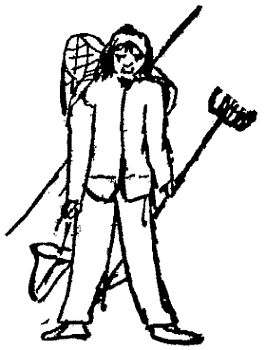
"P.P.P.S.—Also a very poor rag-picker with, I think, twelve children. He looks even worse than this."
The routine of her life having been thoroughly established the preceding winter, she fell easily again into the old lines. Every day she lunched with Madame de Nemours. Sometimes, when engagements left them both free, they dined together in quite a stately manner in the high, old tapestry room, and once in a fortnight she was bidden to dinner with friends of this great lady—Bartand, the dramatist; President Arnot; or Prince Cassini, with his terrible vitality and schemes for universal betterment.
One morning she was disturbed at her studies by a card from the Countess, saying that Mrs.
"And this," the stranger cried, in a high, strong, musical voice, coming forward, "is the Miss Dulany of whom I have been hearing such wonderful things?" She waited for no response. "I have just been telling the Countess that I almost met you at Ravenel House, in Carolina, over two years ago. There was a house-party, and you refused to come."
Katrine flushed and turned pale again suddenly, as she realized that this was the Mrs. Lennox whom, by current gossip, Frank was to marry, and she lived over again in an instant, it seemed, the morning when she had met them riding together by the ford at Ravenel.
"I was ill, I remember," Katrine explained, recovering herself; "unfortunately ill, since I was prevented from meeting you." There was both consideration and compliment in her tone.
"Everything has changed a great deal since
"I do not know Mr. van Rensselaer," said Katrine.
"What!" Mrs. Lennox cried, with amazement. "I thought you met him at Ravenel! I understood he heard you sing there, and it was because of it that he wanted to send you abroad to study."
"If it be Mr. van Rensselaer who has been so kind to me, I do not know it," Katrine answered, in no small degree annoyed by this enforced intimacy. "I have never seen him nor heard his name before in my life."
If Mrs. Lennox noted Katrine's manner she
"Mrs. Ravenel told me," she continued, with excitement in her voice, "that Nick van Rensselaer came to her at Bar Harbor, and asked the use of her name if he furnished the means to send you abroad to study. He said that he was especially anxious to remain unknown in the matter. Mrs. Ravenel told me afterward that you had declined the offer because of having inherited a fortune yourself. But, of course, I thought you must have met him; in fact, I remember that Frank said he thought so, too. By-the-way," she went on, rising to go, "he is coming over soon; Mr. Ravenel, I mean." She looked conscious for a second, as though preferring to keep something back, and then finished: "He will, of course, call while he is here?"
"He may be so kind," Katrine answered, suavely.
"Good-bye," Mrs. Lennox said, holding out a slim, black-gloved hand first to the Countess and then to Katrine. "I hope your studies will let you come to me soon. I hear you are to make your début in the spring."
Katrine laughed. "That will be as Josef says."
"
After Mrs. Lennox had left the room, Katrine and the Countess looked at each other with questioning in the eyes of each.
"You lived at a place called Ravenel," Madame de Nemours asked, "and never told me?"
"I did not think the name one you would care to hear," Katrine answered.
"Ah, you so sweet thing!" the Countess cried, impulsively, putting her hand on the girl's cheek. "You were right. There are probably thousands of Ravenels in America unconnected with my unfortunate life."
But Katrine, who had had her own surprises in the interview, inquired, "Why did Mrs. Lennox, who is very beautiful, very wealthy, and of the monde, take so much trouble to come here to tell me of a Mr. van Rensselaer?"
"I didn't think she came for that alone," answered the Countess. "I thought she wanted you to know that Monsieur Ravenel was coming over to visit her."
Naturally, a marked change in Katrine's attitude toward her unknown benefactor followed this talk with Anne Lennox. She had become accustomed to think of "The Dear Unknown" as a lady, old and beneficent. The new idea was
The obviously honest thing to do was to write to Mr. van Rensselaer immediately, to let him know that without effort or curiosity on her part his identity had been revealed to her.
Her letter to him was short to abruptness. She stated briefly the manner in which the information had come to her as well as her regret that his wish to remain unknown had been thwarted. She hoped that her voice would fulfill all the promise he thought it gave two years back; referred to the personal nature of her last letter; spoke of her desire to repay in full the money part of her obligation to him, realizing that the kind thought could never be repaid in
In a fortnight the answer came:
MY DEAR MISS DULANY,—Your letter reached me but a few minutes ago, and I am feeling, since its arrival, like the ass that wore the lion's skin. Mrs. Lennox was entirely wrong in her statements. It is true that I proposed the arrangement, which she told you of, to Mrs. Ravenel, but that dear lady wrote me within the week that I was too late in my offer, and that another believer in your gift had anticipated the pleasure I had promised myself in helping to give to the world a great voice.
I am extremely sorry that you are under no obligations to me. The confidences which you mention I assure you are entirely safe so far as I am concerned, for I never received a letter from you save the one which lies before me as I write.
I have heard that you will sing at the Josef recital in May. May I count upon you to write me a line as to the exact time, so that I may have the pleasure of hearing you?
If, meanwhile, there is any way that I can serve you, believe me that I shall be glad to do so, for I heard you sing "Ah! Fors e lui" one night, standing under the pines outside of your window, and my debt is great.
Sincerely, NICHOLAS VAN RENSSELAER.
One evening, shortly after the receipt of this letter, Madame de Nemours told Katrine a piece of news for which she was not unprepared.
"By-the-way," she said, "Mrs. Lennox was here to-day. Mr. Ravenel is expected in Paris to-morrow. I have asked a party to dine with them on Friday."
Katrine had just said good-night to the Countess, and was standing in the doorway, candle in hand, with the light shining full on her face, as Madame de Nemours spoke; but she received the news with no change of face, no tremor of an eyelid. She felt it a loyalty to old love that the Countess should be forever unable to recognize in Frank the man whom they had discussed so often, namelessly; and of whom Madame de Nemours had such a slighting opinion. The strangest thing of all was that she had for this man's coming; this man for whose presence she had longed day and night for two years; the re
"I want to be sent away, Illustrious Master," she said, the following afternoon, to Josef, when the lesson was over, and they stood together looking at the sun going down over the gray mist of the Paris roofs. "I am not well, and there is some one coming to Madame de Nemours' on Friday whom I do not wish to meet."
Josef looked at her quickly.
"Mademoiselle Silence," he said, "I, who read voices as others read a printed page, understand. You had better see him."
Katrine flushed crimson, but changed suddenly to such a whiteness that Josef thought she would have fallen.
"Forgive me," he said, tenderly, putting his hand on her shoulder. "I am the surgeon with the knife, but my work is almost done. Let me tell you something. You have worked as I have never seen any one work before. I have not praised much, but I have seen. Ah, I know! Tones, little, big, staccato, breath, breath, breath! Over, and yet again over. And the thinking a
Katrine took the hand of the great teacher and kissed it lovingly.
"Something?" she said. "You have done all."
"Not all; a part, a very little part," he returned. "But meet the man, my child, and you will see how much has been done by both of us. On Saturday morning you will come to me. You will say, 'Prophetic man, I am ashamed through all my being to have loved so slight a thing.' You will find you have outgrown him, and he will have only the weight of the Santa Claus, which children painlessly outgrow. And ever after you will have toward him a kindly mother-feeling, for that is woman's way toward their first loves."
"No," said Josef, "you never have wanted to forget, and that has made it hard for me. You have a strange creed of your own. But sometimes, when I know beyond words that I have received a 'wireless' message from you over the roof-tops, I begin to believe you dangerous, Katrine Dulany. But your belief of 'mind-curing' people into being better has the seed of truth in it which makes so many new creeds dangerous. You can make yourself so great by fine thinking that the people who come in contact with you understand and are uplifted."
"It is a thing more subtle, Greatness!" Katrine answered.
"It is not a thing more subtle, Obstinacy!" he returned, with a laugh. "However, have your way! You are ordered, to Fontainebleau to-morrow. Your voice is in rags, shall I say? You will stay for two weeks at the house of Madame Lomard. You will lie in the open and breathe much. And so, good-bye to you!"
XIX
A VISION OF THE PAST
Anne Lennox's residence in Paris was more closely connected with Frank Ravenel than the world knew. In a letter which she had received from Mrs. Ravenel, after her illness at Bar Harbor, that comfort-loving old lady had written that she would like to go abroad for the winter if there could be found some homelike place to stay.
Mrs. Lennox had grown tired of New York, and she quickly devised a plan to take some of her servants with her, find a suitable establishment in Paris, and ask Mrs. Ravenel to make her a prolonged visit. That Francis would probably accompany his mother to Europe and visit her as frequently as business made it possible was not overlooked in Anne Lennox's calculations.
But Mrs. Ravenel, who was too fearful of her comfort to trust written descriptions, asked her son to step over to Paris, as she jauntily put
"She writes me," said Mrs. Ravenel, eyeing the invitation suspiciously, "that she has taken a house like a palace. I lived in a palace once in Venice. The walls were of marble, with moisture on them constantly, and there was but four feet of rug on a tiled floor forty feet square. When I asked for fire they brought me a china basket with three or four semi-hot coals in it, and placed it in the exact centre of the room where one was liable to trip over it. The experience cured me of 'dreaming to dwell in marble halls.' I want heat, electricity, and a large bath of my own."
According to his mother's wishes, Frank had written to Anne that business was bringing him to Paris, and that he would give himself the pleasure of calling upon her some time within the following fortnight. In the stately old house, which she had taken on the Boulevard Haussmann, Anne awaited Frank's coming with more emotion than she acknowledged to herself. She knew that he had arrived in Paris two days before, had seen that he was at the Grand Club, and the day previous had received from him a note asking permission
Long before her ill-assorted marriage had been dissolved by the death of her husband, Anne Lennox's name had been connected with that of Francis Ravenel. But it was one of the few affairs of his life which had caused no scandal, one which other women had slurred over with a laugh.
"Anne's all right, you know," they explained, "and really Frank and she would have been very well suited to each other if they could have married. At worst nothing but a flirtation; and who, knowing her husband, can blame her?" These were the excuses framed for Mrs. Lennox by her many friends. The death of her husband had brought the general belief that a wedding between Frank and herself would naturally follow. Nearly four years had elapsed, however, and marriage between them seemed no nearer than it had ever done.
With all the love of which her worldly heart was capable, she had loved this man for years, for his wealth, his family, even for his reputed successes with women, which would give added distinction to the charms of the woman whom he finally selected for a wife.
After he had been announced she rose to greet him, and stood watching him as he came slowly through the great hall, noticing the hangings as he came. It was a slight thing, but a woman in love knows the value of such signs.
"When did you come?" she asked.
"Three days ago." He offered no excuse for his tardy attention, adding only, "You've a beautiful old place, Anne."
"You like it?" she asked. "I'm delighted. You are not easily pleased. But you should see the De Nemours' place. Whenever I come back after seeing it this place seems detestably new,
She watched him with attentiveness.
"Yes!" he answered, in a tone which might either be asking or answering a question, adding: "The New York papers are heralding many complimentary things concerning her voice. Have you heard her sing?"
Anne shook her head. "She is hedged about like royalty. That dreadful Josef prescribes every minute of her day. It must be a great bore to live in the way she has done. I met her once, however. Do you know, Frank, she had never heard of Nick van Rensselaer, and when I told her he had wanted to send her abroad before her fortune came she seemed amazed. Of course, your mother denied the fact that it was Mr. van Rensselaer who enabled her to come; but I always believed it was he, didn't you?"
"You are complimenting mother's veracity," Frank answered, laughing. "If she said it was not Mr. van Rensselaer, as a dutiful son I am bound to believe it, am I not?"
"Doubtless," Anne answered, smiling. "By-the-way, Madame de Nemours has left with me an invitation for you to dine with her on Friday."
"
"I don't know. She has never dined with us when I have been there. I believe she is allowed frivolities but once a fortnight. Perhaps—" But before she finished a maid entered with Madame de Nemours' card. "You can ask for yourself," Anne explained, glancing at the card. "Here is the Countess in person."
It had grown dark in the room, and Frank stood in the shadow as he was presented to the Countess, who had come with the hope of meeting him, for Katrine's sudden resolve to go to Fontainebleau had not deceived her at all. By that process of seemingly illogical reasoning by which women arrive accurately at facts, she had come to the conclusion that Katrine had gone away to avoid meeting either Anne Lennox or this Mr. Ravenel, and a far less brilliant woman than Madame de Nemours would have suspected Frank of being the man who had caused Katrine such pain in the past. That she had lived on his plantation, and that there must have been many opportunities for them to have been constantly together, unnoted in a place twenty miles from any dwelling, made the thing doubly sure. And so Madame de Nemours, by reason of her intuitions,
"I am in despair," the Countess said, after the greetings had been exchanged. "Here am I giving a dinner to distinguished Americans," this with a little complimentary gesture toward both of them, "on Friday, and Katrine Dulany ordered off to Fontainebleau by that terrible Josef. 'You are not well!' said he. 'Go on such a day, on such a train, to such a place! Say this! Think this! Imagine this!' And the poor child went off yesterday for a month to Fontainebleau, afraid to disobey. Do you know, I am thinking," she went on, "of adopting this strange child, Katrine, legally, just to circumvent Josef? For that, and other reasons," she explained, laughing, "I am so sorry you are not to meet her, Mr. Ravenel."
"I have met Miss Dulany frequently," Frank answered. "In Carolina, three years ago. Every one there was interested in her voice."
"Yes," the Countess answered, "it will be like that always with her. If I tell you something," she said, the light dancing in her eyes as she spoke, "will you be very discreet about it? I am thinking of marrying Katrine to my nephew, the Duc de Launay. He doesn't know it, being
She rose, and as she did so Frank came forward to assist her with her wraps. At sight of him, in the full light of the doorway, she drew back for an instant, clutched at a curtain, gave another quick look, and fell, with a white face, unconscious into Anne's supporting arms.
It was not long, however, before she recovered enough to be helped to her carriage; but this fainting was followed by a protracted illness, the Friday dinner was postponed indefinitely, and Katrine summoned hurriedly home from Fontainebleau.
Naturally, Anne Lennox called and brought Frank with her to make inquiries and to leave regrets. It was in this visit, as Frank stood well in the sunshine admiring the old house, that
Josef protested impatiently that it was a badly chosen time for the Countess to be ill, speaking as though Madame de Nemours had personally selected it with criminal thoughtlessness of Katrine, whose début was close at hand; for despite his protests, the girl took the position of nurse, sitting up till all hours of the night, and neglecting her lessons if the Countess needed or desired her services.
The great lady herself, after the danger seemed passed, lay in silence day by day, neither questioning nor explaining. To Katrine, however, explanations were unnecessary, for she understood that to Madame de Nemours the sight of Frank had brought back, with terrible distinctness that other Ravenel who had been summoned to his accounting years before. Just how much Madame de Nemours knew of Frank's attitude to Katrine at this time was never made clear, but