JUDITH LEE (continued 3)
Reading edition
“You must be able to do a great deal of good in the world with such a gift as yours. I love doing good—don’t you? It must be so nice to detect an improper person directly you see one. Your friendship for me was almost a certificate of character. If only it had not been so brief—but the night was fine, and the boat was handy, and we did not tie you very tight.—Your affectionate friend, Marianne Tracy.
“Pray remember me to the gentleman whose name you once mentioned to me—Mr. Everard Brookes. Is he married?”
The audacity of the woman in writing to me at all! And such a letter, with such innuendoes! I could hardly contain myself till I got to the end. For quite two days after I had received that effusion I could hardly bring myself to speak civilly to a single person I came across. And even now sometimes I tingle all over when I think of it—and that was ages ago, and I have never heard of nor seen the woman since.
V. THE MIRACLE
People sometimes say that they envy me because, with my power of reading thoughts—that, they say, is what it comes to—I must have so many opportunities of doing people good. It must be so sweet, they add, with what I occasionally feel to be an irritating smirk, to be able, with very little trouble to oneself, to benefit one’s fellow-creatures. That sort of remark is very easy to make, but it is not easy to benefit one’s fellow-creatures. And as for doing people good, it is surprising how many people would rather not be done good to. Take that case of what happened at Dieppe.
I was spending my summer holidays at Dieppe. I had been there about a fortnight. One evening I was sitting, all alone by myself, on the terrace outside the Casino. I had been dancing; my partner had gone to fulfil another engagement, and, as I was not engaged for that dance, I had asked him to leave me where I was. I was taking my ease in a long chair close to the sea-wall. In front of me, in the glow of the electric light, people were seated at little tables having refreshments. At one of these was a gentleman whose name I knew, talking to one who was to me a complete stranger.
The first gentleman’s name was Armitage—Cecil Armitage. He was an amazingly handsome young man, perhaps in the late twenties. He was staying in my hotel, and was the cause of no little amusement to some of the other visitors. He, a young man of seven or eight-and-twenty, evidently of birth and breeding, was paying the most marked attention to a woman who was one of the greatest jokes in Dieppe—Miss Drawbridge.
Miss Drawbridge, commonly known as “Gertrude” to people who had never spoken to her in their lives, was a sort of standing dish at Dieppe. She was supposed to have been there longer than the oldest inhabitant; she had certainly been a frequenter for quite a number of years. What I had seen of her I rather liked. She was staying at my hotel, and there was a time when she had asked me to share her table; and, although that time had passed and she never asked me to share it now, we were still on quite good terms. She was certainly a curious person—people who haunt the same foreign watering-place year after year generally are; and what an extremely presentable young man like Cecil Armitage could see in her was a mystery—unless it was her money.
Imagine the sensation which stirred the air when it became known that this perfect Adonis was engaged to “Gertrude.” Had not Miss Drawbridge announced the fact herself, I fancy few people would have believed it. And the things which were said of Miss Drawbridge, especially by some of the women! The men just sneered.
There was I on the terrace, in my long chair (I could say things about men, but I think I had better get on with my story), and there was Mr. Armitage, drinking what looked to me very like absinthe—fancy drinking absinthe at that time of night, or, so far as that goes, at any time!—and talking to a perfect stranger. Of course, the man was quite entitled to be a stranger; but I have seldom seen a man whose looks I liked less. The contrast between him and Mr. Armitage was amazing. He was a sallow, hatchet-faced man, with an upturned moustache—which I hate!—and something the matter with one of his eyes which made him seem to be looking in two directions at once. Nor did I like his manner towards Mr. Armitage; he seemed to me to be positively bullying him. That was one reason why I watched what they said, and some very surprising observations—I cannot say I heard—I saw. And, as always is the case on such occasions, I could not have gained a more intimate acquaintance with them had they bawled them in my ear.
The first thing I saw was the stranger’s thin lips contorting themselves as, in what I imagined to be an angry undertone, they formed these words, which I have no doubt, judging from the expression of his face, he snapped out at Mr. Armitage as if he were an angry terrier:
“Don’t you make any mistake about it, my boy. I’ve not come over to Dieppe to be fooled with. I’m either going to have you or the money in four-and-twenty hours. If I have to have you, it will be penal servitude, and then the smile will come off that pretty face of yours.”
Mr. Armitage was not smiling at that particular moment, as anyone could see; on the contrary, he looked very much disturbed. The way in which he leaned across the table helped me to realize the earnestness which I felt sure was in his voice as he replied to the other’s threat, in words which, as I saw each fresh one shaped on his lips, surprised me more and more.
“Don’t be absurd, Clarke. I can’t perform the impossible. I can’t get it in four-and-twenty hours; but you shall have your money, with a thumping interest, if you will only give me reasonable time.”
“And pray, what do you call reasonable time, my beautiful—forger?”
“It won’t take very much to make me break this glass against your face, Clarke. You may have the whip-hand of me, but I’ll break your neck before you get a chance of laying the lash across my back.”
I held my breath, expecting every moment to see something dreadful happen. The way Mr. Clarke snarled back at him!
“That’s the tone you take, is it? You talk to me like that again, and I’ll have you jailed to-night. Do you think you can both rob and murder me? I say you’re a forger—forger—forger! Now you touch me with a glass, or anything else, if you dare. This will be the last time you ever show yourself in a decent place if you do.”
There was a pause. Mr. Armitage leaned so far forward that I quite expected that he would take the other by the throat and strike him with his glass. I was just on the point of jumping up and doing something which would divert his attention, when he seemed all at once to change his purpose, and, leaning right back, positively laughed.
“What nonsense it is, Clarke, our talking like this. You’ll do no more good by calling me names than I should do by knocking you down. I tell you again, you shall have your money, with thumping interest, if you’ll wait.”
“I know a good deal about you, my lad—about all there is to learn—but I don’t know where you’re going to get anything like that amount of money from, unless you’ve found some one else to rob.”
I thought Mr. Armitage would resent this remark as he had done the others, and I believe that for a moment it was his intention to do so, but again he changed his purpose, and I saw these remarkable words come from his lips instead:
“I have—I’ve found a woman.”
It was not strange that Mr. Clarke looked at him as if he wondered if he was in earnest; then he asked, with a smile which made him an even more unpleasant-looking person than before:
“What woman have you found this time?”
“If you are suggesting, as you appear to be, that I ever have robbed a woman up to now, I can only inform you, Clarke, with all possible courtesy, that you are a liar. I have not always treated women well—few men have; but no woman has ever suffered in pocket because of me up to the present time of speaking.”
“That’s between you and your conscience. Who is the woman you purpose, according to your own statement, to rob, at the eleventh hour?”
“It’s the woman I intend to make my wife.”
“Oh, so there is a woman you’re going to make your wife—at last. What about——” I do not know what he was going to say; Mr. Armitage stopped him so suddenly, and positively shook his fist in his face.
“Stop that, Clarke; don’t you mention any names. You keep your tongue between your teeth. I’m going to marry the woman I’m going to marry because I’m a thief, and because I’m such a cur that I shrink from paying the penalty. She’s a wretched old fool who comes all to pieces; Heaven knows what’s left of her when the various aids to beauty are put away for the night; but she’s got money, and she’s willing to give me money, enough to be rid of you and save myself from the treadmill. That’s why I’m going to enter the bonds of holy matrimony, and that’s a perfectly frank confession; franker, I dare say, than most men make in similar circumstances.”
“This sounds as if it were going to be a marriage of real affection; a genuine love-match.” The sneer which was on Mr. Clarke’s face as he said this; the indescribable look which was on Mr. Armitage’s as he replied:
“If you only knew how I hate the woman; how every pulse throbs with loathing when she comes near me.” He gave what seemed to me to be a great sigh. “As I live, it’s a comfort to say that to some one. It makes me ill to be in the same room with her—got to that stage already. Heaven knows how far it will go by the time we’re married. I shouldn’t wonder if I were to murder her on our wedding night.”
“Is that so really? What a honeymoon you’ll have if you do. Is the lady young?”
“Young! I shouldn’t care to ask her age for fear of the depth of the lie she’d tell me; she’s at least old enough to be my mother—my grandmother, for all the woman that’s left in her.”
“What a very charming couple you will make—full of vivacity! Has the lady physical charm?”
“She never had, I tell you she takes all to pieces nowadays. She is one of those women the ladies’ papers always suggest to the masculine mind; she gets her hair from one of the persons advertised on the back pages; her complexion from some wretched harridan whose advertisement is to be found a page or two in front; her figure from a person the editor specially recommends—at so much a time; and her teeth from the Lord knows who. Oh, she’s a regular specimen of love’s young dream.”
“Is she really? She must be a walking nightmare. What is the fortunate lady’s name? I take it she has tons of money.”
“Her name is Drawbridge, and she has, at any rate, enough money to pay you, Clarke.”
“I hope there will be a little left for you when I am paid, I do really, my dear boy.”
“Well, there may be or there mayn’t; but I’m marrying her to get the money to pay you, and that’s the whole, plain truth.”
Mr. Armitage was about to rise from his chair when the other leaned right over the table and stopped him.
“One moment, Armitage, one moment. When are you going to touch that money, eh?”
“I can’t tell you the exact day now, can I? I only proposed to her yesterday. It was your telegram that brought me to the sticking-point.”
“I’m afraid I shall have to push you a little beyond the sticking-point. I’m in a hole myself. I’m pressed for money. I’ve got to find at least five hundred pounds in four-and-twenty hours.”
“Is that true?”
“Perfectly true. I shall be in a very inconvenient position if I don’t find it; and it’s got to come from you. You’ll be in a more inconvenient position than I shall if it doesn’t; so that’s plain. I’ve come all the way to Dieppe to make it clear to you that it is plain. Can you get five hundred pounds out of your fair lady between this and to-morrow night? If you can I’ll wait a few days for the rest, but five hundred I’ve got to have before I go to bed to-morrow night; or—you know the alternative if I don’t. That engagement will be off; I don’t suppose even she will want to marry you after you’ve done a term of penal servitude. There’s something else—I should like a hundred to-night.”
“I haven’t ten pounds left in the world. I’m practically broke; I’ve been losing steadily ever since I’ve been at this place.”
“Then it looks as if you’ll have to get a hundred for me and a bit over for yourself. I’ve got to have my hundred, and the other four to-morrow.”
Mr. Armitage, looking steadily at the other, seemed to see something in his face which made it clear that he meant what he said. A grim look came on his own face as I saw him say: “I’ll see what I can do.”
“You’d better. Where is the lady?”
“Punting, in the club; playing baccarat.”
“Then you’d better cut off to the club as fast as ever you can, and take her by the scruff of the neck and squeeze that hundred out of her while she’s got it to squeeze. After you’re married you’re not going to let her play baccarat with your money, are you? She’ll make a pauper of you if you don’t take care.”
“You mind your own business, and leave me to manage my matrimonial affairs after my own fashion.” Mr. Armitage got up from his chair. “Where shall I find you, at the hotel or here?”
“You’ll find me all over the place, my lad, don’t you make any mistake. I’m not going to lose sight of you till I’ve got my money, or got you in jail. You can go, but just you understand I shall be close behind you—and I’m not the only one who’ll be close behind you either. If you keep looking over your shoulder you’ll see two or three—friends of mine.”
Mr. Armitage took himself off, with an air of indifference which was very well done; he could not have had a very careless feeling in his heart. Almost immediately Mr. Clarke followed with the evident intention of dogging his steps. And I was left alone, nearly overcome by feelings which were altogether indescribable.
What on earth was I to do? It was no business of mine, this affair of the old maid and the young bachelor. She must have known what a risk she was running when she agreed to his preposterous proposal. If, by what I will call an accident, I had become acquainted with facts which made the gentleman’s position in the matter abundantly clear—still, it was no concern of mine.
But it was no use my talking to myself like that. I could not allow a person of my own sex to enter into what I knew would be such a hideous marriage without making some attempt to lay before her the facts upon which my knowledge was based. In other words, here was one of those opportunities for doing good of which people were so fond of talking; and, if the thing was in my power, good should be done.
I got up from my seat and went in search of Miss Drawbridge; finding her, as I had expected, in that part of the building which is found in every French casino, and which—I presume ironically—is called “Cercle privé,” as if it ever is, in any sense of the word, a “club,” or has anything “private” about it. She was seated at one of the baccarat tables, and I could see at a glance that she was winning; she had quite a quantity of bank-notes in front of her, and kept adding to the store. Presently the bank was closed and the players rose. Miss Drawbridge rose too, with her spoils in a white satin handbag. As she moved towards the door Mr. Armitage came into the room, with Mr. Clarke not very far behind him. When he accosted her, I thought, as I suppose every one else did in the room, what an extraordinary couple they were—to think that they were ever going to be married. I saw him ask her, with an attempt at a smile:
“Well, what luck? How many banks have you broken?”
Her back was towards me, so that I could not see her answer, but I guessed what it was from his rejoinder.
“That’s great news.” I fancy he hesitated. Would he have the assurance to ask for that hundred pounds for Mr. Clarke without a moment’s warning? He approached the subject by what I suppose he meant to be a delicate way. “I’m awfully glad you’ve had a bit of luck, because the fact is it’s all the other way with me; I can’t do anything right, and, between ourselves——” I saw him hesitate again; I imagine that the decent man which was in him made it difficult for him to ask a woman for money when it came to the pinch.
What she said I could not see, but I conceive of her as saying, struck by his hesitation: “Well, and what is it, between ourselves?”
He made a stumbling effort to explain what it was he wanted.
“You know, it’s like this: I’m awfully pushed for coin. If you could manage to lend me, say, a hundred out of those winnings of yours——”
She cut him short. I could not tell with what words, but her hand dived into her white satin bag just as they passed through the swing-door out of sight.
Two or three minutes afterwards, when I returned to the Casino, I saw in the crowd round the “little horses” Mr. Clarke sidle up to Mr. Armitage. Both their faces were in plain sight. I could see Mr. Clarke ask:
“Well, have you got it? Has the sweet young thing been kind?”
Mr. Armitage turned away, as if the other’s gibe had roused him to sudden anger; but I saw him hand his companion something as he moved away, and I knew what it was. A few minutes later I saw Mr. Armitage again, going towards the club. He was addressed by a fat, florid-looking man, with an exaggerated moustache. A moustache sometimes screens a man’s mouth almost completely; but his was so formed that, despite the absurd dimensions of that hirsute adornment, I could see his lips distinctly. He said to the man he had stopped, with what I fancied was an evil gleam in his bold, blood-shot eyes:
“I’m sure Mr. Armitage has a five-pound note which he can spare for an old friend who’s a little on his uppers.”
Mr. Armitage recognized him with what was evidently not a start of satisfaction.
“So it’s you, Morgan, is it? What on earth are you doing here? I thought you were——”
Mr. Morgan raised his finger to his lips, to prevent the other bringing his sentence to a close.
“Quite so—we won’t say where. How about a five-pound note, Mr. Armitage, for a very old friend?”
Mr. Armitage looked at him angrily for a few seconds, then grabbed something out of the pocket of his dinner-jacket which might have been a hundred-franc note. He thrust it into the other’s hand and, without waiting for a word of thanks, went quickly on. Mr. Morgan looked at what he had been given, then he looked after the donor—the expression on his face was not that of a grateful man.
I found Miss Drawbridge sitting at the very table on the terrace which had been lately occupied by Mr. Armitage and his friend. As I took the chair in front of her she said to me:
“That’s right, come and talk to me—and have something.” She herself was having some curious concoction in a big glass; for me she ordered a lemon-squash. “I’ve had a good night, my dear. It seems as if I can’t lose at baccarat lately—as if my luck had turned; I’m sure it’s about time it should. You look a little moped. What’s been troubling you?”
I considered for a second or so; then I decided, by degrees, to make the plunge. I approached the subject by what I meant to be a roundabout fashion of my own.
“I’ve just learnt something rather disagreeable.”
“Have you? That’s easy; the difficulty is to learn anything else. Is it private, or for publication?”
“I’ve just learnt that a man who I thought was rather a decent sort is a thief and a rogue, and two or three other things which are rather worse.”
“When you’ve had my experience of life, my dear—which Heaven forbid you ever will—you’ll know that that sort of thing is quite common with a man—you must take a man at his own valuation, my dear. We should never get one at all if we took them at ours.”
“This man is not only going to marry a woman for her money, but because he doesn’t know where he will get money from if he can’t from her, and if he doesn’t get her money at the earliest possible moment he’ll be sent to jail. He’s a thoroughly all-round bad lot, the man is, though he doesn’t look it.”
Miss Drawbridge had her fish-like eyes—they always looked as if they had been boiled—fixed on me with a watery stare.
“What’s the gentleman’s name?” I knew from her manner that, as the children have it in their game, she was “getting warm.” “Does it begin with the first letter of the alphabet?”
“I’m afraid it does.”
“What have you found out about Mr. Armitage? Stay—before you speak I ought to tell you that what you say will in all probability be repeated to him; and while I’m about it I ought, perhaps, to tell you something else—and that is not a very easy something to say.”
She sipped at her glass; then she took a cigarette out of a gold case and began to smoke. I thought what an extremely unprepossessing person she seemed. I wondered by what process of evolution a sweet, simple, fresh, clean young girl had become transformed into such a being. Rather to my surprise, and a good deal to my confusion, she showed an unexpected capacity to read my thoughts.
“You don’t think I’m very much to look at, do you? I’m not; I never was. Time has not improved me, either outside or in. When I was young I was very poor. For seven years I was governess at sometimes twenty, sometimes thirty pounds a year, and lived upon my earnings—if you know what that means. I couldn’t expect to get married on that, could I? And no one wanted me anyhow, though I wanted to marry very badly. I never remember the time when the one thing of which I dreamed was not to become some decent man’s wife. It sounds funny, doesn’t it? Isn’t it a shocking confession to make? I wonder how many women would make it if they told the truth?”
She flicked the ash from her cigarette. I was beginning to wish that I had left her alone, that I had not embraced an opportunity of doing her good.
“When I was about thirty-eight I came into a lot of money from an uncle, whom I don’t remember to have ever seen. It turned my head; I thought that money could do anything. I decided that now I would marry, and that I would marry just the sort of man I had always hoped I would do. You see, I had practically no knowledge of the world at all—how can a woman have who has lived a life like mine? It took seven or eight years to make it clear to me that, in thinking because I had got money I could marry the sort of man I wanted to, I was a fool.”
She smiled, and the whole of her face seemed to be dislocated to enable her to do so, and she beckoned the waiter to fill her glass.
“Men wanted to marry me—oh yes; but they were the kind of men whom I would not, as the saying is, have touched with the end of a barge-pole. I sent them about their business. Whenever I saw a masculine creature to whose appearance I particularly objected, I knew that, sooner or later, he would ask me to be his wife—which was nice. No one else ever did, so I made a fool of myself by way of seeking consolation. I know they call me ‘Gertrude’ here, and some equally silly name at other places which I favour regularly with my society. As a matter of fact, my name is Elizabeth. Since my mother died, when I was a girl, no one has ever called me by my Christian name—think of that!”
The waiter brought her a fresh edition of that curious concoction; she put the glass to her lips.
“Don’t suppose that my desire to marry grew less as my years grew more; that’s a silly notion which some young girls seem to have. If I have to advertise for a husband, I’m going to have one before I die; so you can imagine what it means to me that Cecil Armitage has asked me to be his wife. I don’t know that I’m particularly fond of him; I’m quite aware that he isn’t at all fond of me. But he’s so young—you don’t know what a young man means to a woman like me—and so handsome, so beautiful, so healthy, so strong, so well shaped! In my most sanguine moments I never dreamed that I should have such a perfect specimen of a man for my very own. Of course, I shall have to pay for him—you needn’t tell me that; my experience is that one always has to pay for anything that’s worth having—and generally through the nose. I expect to have to pay through the nose for him. I’ve got more money than some people think, or, I believe, even than he suspects. I believe he thinks that I’ve got two or three thousand a year; I’m a rich woman, my dear. My money has gone on increasing and increasing, and now I don’t spend a tenth of my income. I don’t mean to let him know how much money I really have; he’d want too much if I did. I don’t suppose for a moment that he isn’t what I’ve seen described as ‘shop soiled’; he wouldn’t want to get money out of me at the price of making me his wife if he wasn’t in a nasty hole. And, bless you, I don’t mind that; I’ve grown out of all my illusions. You can tell me all you know against him if you like, though I don’t know how you found out; it will give me a pull over him when it comes to talking matters over a little later on. Nothing you can tell me to his discredit will surprise or hurt me in the least. I’m prepared to pay a good lump sum to get him clear of all his messes, then I’m going to have one of the finest weddings ever seen in town; I’ve had a special sum set apart for it for years. Won’t he make a picture of a bridegroom? I never dreamed that I should marry a man like him.”
Her cigarette being nearly consumed, she lit another, while I looked at her with, I have no doubt, amazement in my eyes and something like terror in my heart. I had never supposed that there were such women as she existing in the world, who looked at what, to me, were sacred things from such a point of view. It seemed to me that I was listening to some one in a nightmare when she went on.
“There will be crowds of people at my wedding; you can always get crowds of people if you don’t care what it costs to get them. And the papers will be full of it; the ladies’ papers send their own lady reporters to weddings, and give pages and pages, and lots of illustrations, if you make it worth their while. It’s all a question of making it worth their while. I tell you that with such a bridegroom I’m going to have the wedding of the season; and I do believe you thought you were going to choke me off him by telling me that he is what you call a thief. You funny little thing! How many really honest men do you suppose there are, if the truth were known?”
I had nightmares because of Miss Drawbridge that night—real nightmares. I had a broken and disturbed night absolutely on her account, and I got out of bed with the feeling strong upon me that, if I could possibly help it, that, to my mind, impossible marriage should not take place—I would do that unfortunate woman good in spite of herself.
When I got down almost the first person I saw was Mr. Cecil Armitage, looking so glum, so unhappy, so desperate, and, I could not but think, so ashamed of himself, that my resolution was strengthened—particularly when, as I was having my coffee and roll, the man Morgan, with the huge moustache, came and planted himself at my table, and actually began to talk to me.
“I rather fancy, Miss Lee, that you are interested—shall I say?—in our mutual friend Armitage?”
He seemed to have got my name off pat, though where he had got it from I could not think; how he dared to address me I could not think either. I had never seen the man except the night before in the Casino for about thirty seconds—and then at a distance. I did not answer him, I just looked at him; he went on:
“I may mention I am Captain Morgan, of the Fusiliers.” I think it was the Fusiliers, I know it was some regiment—as if I cared. “I’m an old friend of Mr. Armitage, and if you like I can place you in possession of certain facts concerning that gentleman——”
I did not wait for him to finish. I got up and walked off, leaving my coffee and roll unfinished. I dare say if I had stopped to finish them he would have offered to sell me secrets about Mr. Armitage for five pounds apiece. I had an instinctive feeling that he was that kind of man.
It is quite the thing at Dieppe to go down to the quay to see the boat come in from Newhaven. After déjeuner, as there was a pretty stormy sea, I thought I would go and see what the passengers looked like. As I was going I fell in with Mrs. Curtis, one of the dearest old ladies I have ever met. She was an American, and, so far as I could make out, had been doing Europe very much on her own, although she had a husband who everybody said was a millionaire. It seemed that he was coming to Dieppe by that very boat.
“I haven’t seen him,” she told me, “for more than six months. He’s so occupied with business that he hasn’t time to spare for such a trifle as a wife, except between whiles. I understand that he’s been making another million dollars. I wish he wouldn’t; every fresh million he makes only seems to fill him with the desire to make more; and as we’ve neither kith nor kin, and are just a lonely old couple, what we’re going to do with all the money I can’t think.”
It was a funny thing to say, but then people do say funny things, and there are such funny people, and so much of the world does seem queer. A few people have too much money and so many have nothing like enough—it’s all a jumble.
When the boat drew up at the quay she began to wave her handkerchief with all her might to an elderly gentleman who stood on the deck, and he began to wave his to her; so I drew off in order that they might meet without being worried by a stranger. As I was strolling off the quay after most of the people had gone, a girl who had a small brown bag in her hand looked at me as if she wondered if I were very dreadful, and then as if thinking that perhaps I was not, summoned up courage to speak to me.
“Can you tell me,” she asked, “the name of a cheap and respectable hotel where—where I can go alone?”
I told her of one which I thought answered that description—I offered to show her where it was. She was quite the prettiest girl I had seen for ages, with a face, I thought, which had character and strength, as well as being good to look at. I fell in love with her at sight. She did not accept my offer to show her to the hotel, but she thanked me for giving her the name; and then, after favouring me with a further inspection, she made a remark which took me aback.
“I believe that in these foreign places, if they have been there any time, English people begin to know each other by name as well as by sight. Will you pardon my asking how long you’ve been here?” I told her. Then came a staggering question: “Can you tell me if there is now staying in Dieppe a gentleman named Cecil Armitage?”
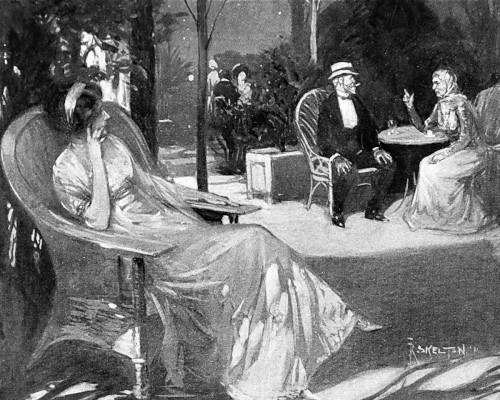
“SO YOU’VE BEEN MAKING MORE MONEY,” SHE SAID
I informed her that to the best of my knowledge and belief there certainly was. I do not know what there was in my tone which she resented, but there seemed to be something; because, barely thanking me, she gave me a cold little nod and walked on.
That evening, after dinner, I was sitting in the Casino gardens when I saw a fragment of conversation between Mrs. Curtis and her newly returned husband which both amazed and tickled me. I may say at once that, unless I blindfold myself, whether I want to or not I cannot help seeing what people are saying whenever I look out of my eyes. I was rather in the shadow, and they were in the full glare of the electric light, so that I could not help seeing them. The old lady was speaking when I saw them first.
“So you’ve been making more money?” she said; and as she said it she looked at her husband rather severely.
“I’ve been making a pile, Elinor; a regular pile. I wish money wasn’t so easy to make, or that I hadn’t the knack of making it.”
As he said it he looked to me as if he groaned. In spite of the severe expression on the old lady’s face I dare say there was a twinkle in her eye.
“And what are you going to do with it now you’ve made it?”
“I’m hanged if I know—I’ll be bothered if I do. It’s of no use to me; and I suppose it’s of no use to you, is it?”
“None whatever. I’ve all the money I’m ever likely to need and rather more; it’s piling up at the bank as it is, so that I’m ashamed to look my bank-book in the face, there’s such a lot of it. I wonder you can’t find some better occupation for your time than making money when you’ve got more than you want already.”
The old gentleman, bending towards her, took her hand in his. I could see how his face softened as he touched her, and how hers softened too.
“I tell you what I should like to do with some of that last money I’ve been making—I’d like to do some one a good turn. Do you think it would be easy? I don’t mean just give it away to the first Tom, Dick, or Harry who thinks he wants it—there are plenty of them. You don’t happen to know of a man, woman, or child to whom a certain amount of money would mean the difference between heaven and hell? There must be such people in the world somewhere. Wouldn’t you like to set some fellow, who wasn’t quite a bad one, on his legs, or give some woman, who was very much in need of it, happiness—if money could do it?”
She did not answer, but I fancy she pressed the hand which was holding hers, and I stole off. I did not dare to stay longer for fear I really should be intruding.
I walked as far away from them as I could get, to the other end of the terrace, where I was a witness of quite a different scene. There was Mr. Armitage, standing close up against the sea-wall, looking out across the night-black sea; and somehow his attitude told me that it could not be blacker than his mood. I paused a little distance from him and sat on the wall itself. I wondered how long he would stay. I did not wish to intrude—I had nearly been intruding at the other end—but I did not wish to go; I had a right to be somewhere. After a while he turned, and I thought he was going; then out of the darkness there came—I knew no more than he did from where—the figure of a woman. When she saw him she stopped, and he stopped also. There was a lamp close to the sea-wall which let me see their faces, and how, at the sight of each other, they changed. Then I saw each pair of lips form at the same moment a Christian name—“Cecil!” “Margery!” and in an instant they were in each other’s arms. I had to stop and look at them, because this was the girl I had met on the quay, to whom I had lost my heart. They were silent for quite a perceptible period, as if each was content to know that the other was there. Then, as he held her at arm’s length, I saw him ask her:
“Margery, how do you come to be here?”
And I saw her answer, with the light of love all over her:
“I came for you.”
“For me? Good God!” The hands which had held her fell to his sides; he seemed to stagger as if he had been dealt a blow. “Margery, you shouldn’t have come.”
“I had to come; I couldn’t help coming; I couldn’t stay away. I thought you might want me.”
“Want you? As if there’s ever likely to be a time when I don’t want you! I was half beside myself for want of you then.” She moved forward; he put up his hands as if to stop her. “You mustn’t, you mustn’t.” He drew himself a little more erect. “Margery, I’m going to be married.”
There was a look on her face as if she were bracing herself to bear.
“Is that true? Is it quite, quite certain that you’re going to be married?”
“It’s either that or jail.”
“You are sure—perfectly sure?”
“Absolutely. Clarke is here; he wants his money; he’ll take a warrant out if he doesn’t get it soon. I can only get it from—her.”
There was such an accent on the pronoun—I knew it from the look which was on his face. I could see she winced.
“I know; I’ve heard all about her. I don’t know what to advise you to do. You know you will be committing a great sin—if you marry her.” I noticed that both parties seemed to avoid mentioning her name. “I know you, Cecil, your weakness and your strength. I do not think you will ever cease to love me.”
“I am as sure of that as that you and I are standing here; it’s the only thing of which I am sure. You are part and parcel of my life, of my very being.”
“That being so, do you think you ought to marry—her, even to save yourself?”
“It’s not only to save myself—it’s to save you. If I don’t marry her I shall be sent to jail—there’s no alternative. Then, when I come out, as likely as not I shall marry you.”
“Well—what then?” The smile which lighted up her face was one which, my instinct told me, only comes to the woman who holds the world well lost for love. Her question made him flame into anger.
“What then? Everything then! Margery, you shan’t marry a jail-bird—you shall not. If I’m to be branded as a felon I’ll never carry on the brand to you, and to our children—never, never. As God is my witness, you shall not be a felon’s wife. So the thing resolves itself into this: If I don’t marry this woman I shall become a jail-bird—Clarke will make me one; then—you’ll be such a temptation to me, Margery. I’ve been tempted once and I’ve fallen, but what was that temptation compared to you? I’ll not dare to risk it. So it’s good-bye, Margery. I’ve no right to kiss you; the mere thought of your lips against mine drives me mad. I’m going—I’m going to marry that woman—and I’m going to her now.”
And apparently he went—he positively ran. And the girl never turned even to follow him with her eyes, but remained stock still where he had left her; then did as he had done—looked out across the night-black sea.
I sat still and watched her till I could bear it no longer; then I went to her and said:
“Will you come with me, please, while I speak to some friends?” She glanced at me as she might have done at a ghost; I do not think she quite realized that I was a creature of flesh and blood. So I reached out and took her by the hand and said to her again: “I—I think I can help you if you’ll come with me while I speak to some friends.”
She did not utter a sound, or try to. I think her heart was broken. She just let me take her by the hand and lead her where I would; she moved as if she were a docile child. I saw, in the distance, that Mr. and Mrs. Curtis were still where I had left them; so I placed her on a chair within sight, and I said, as if I had been speaking to a child:
“Sit there, please, and don’t move; in a few minutes I hope I’ll be able to come to you again with some good news.”
She sat down with meek and heart-rending obedience—she was such a picture of misery I could have cried; but I bore up till I got to Mr. and Mrs. Curtis, even though I believe there was something moist in the corners of my eyes. I got to the heart of my subject without any sort of preamble.
“You know, Mrs. Curtis, I told you that I was a teacher of the deaf and dumb, and that I could tell what people are saying by watching their lips?”
“Of course you did, my dear. This is my husband, who has just come to me from New York City. Fred, this is Miss Judith Lee, of whom I was speaking to you. She’s a very wonderful young woman, and I hope she’s going to be my very dear friend.”
I did not wait for Mr. Curtis to speak; I just went on. I could see he was beginning to look at me with a sort of wonder.
“I just saw you and Mr. Curtis talking, and I saw him say to you that with some of the money he had just been making he would like to set some fellow, who wasn’t quite a bad one, on his legs, and give some woman, who was very much in need of it, happiness. Well, I know just such a pair, and if he meant it I can give him a chance of doing, right now, exactly what he said he wanted to do.”
They looked at me, and they looked at each other, which I did not wonder at—I was so hot and eager, so very much in earnest. With that girl sitting there, right in my line of vision, I felt that I had got to take these people’s hearts by storm; and I was not going to stick at a trifle in doing it. Mr. Curtis asked, with something in his voice which made me wonder if he was quizzing me, but I did not care if he was:
“Who are your deserving couple, Miss Lee?”
Then I told them all about it, in just as few words as I could, and as close to the point as I could get them. It did me good to see how quick he was at getting at my meaning. I had heard a deal about American quickness; I saw an example of it then. I believe that before I had finished he understood it all—just got at what I wanted him to get. The quizzical note was still in his voice when he made what, from an Englishman, would have seemed a simply amazing speech, but which seemed to come quite naturally from him.
“If fifty thousand dollars—that is, ten thousand pounds sterling—would do for this lady and gentleman what you want to do, you can have the cash to-night, on one condition, Miss Lee—that you don’t say from whom it comes. You’re to regard that as your secret and mine.”
In about three minutes I went tearing off after Mr. Armitage. I found him sitting at a table in a corner of the restaurant, a suspicious-looking glass in front of him and a most dismal expression on his face. Just as I reached him I saw Mr. Clarke coming in at the other end, but I paid no attention to him.
“Mr. Armitage, I want you to come with me at once on business which is to you almost a matter of life and death.”
He looked at me as if amazed, which was not odd. I fancy I seemed pretty excited, and my acquaintance with him was of the slightest. But I gave him no chance to talk. Almost before he knew it, I was sailing down the room with him at my side. We encountered Mr. Clarke, who tried to stop us.
“Armitage, there’s something which I’ve got to say to you.”
I gave him no chance either.
“Then you’ll have to have something. Mr. Armitage has business which won’t permit of an instant’s delay.”
And I bore that young man right past him. I dare say they both of them thought I was mad. I was conscious that Mr. Clarke was looking after us as if he would like to bite me, but did not dare; he did not even dare to try to speak to Mr. Armitage again. I believe Mr. Armitage did ask some questions, but he got no answers; I took him at such a pace to my hotel that he had not time to ask many. I had arranged with Mrs. Curtis that she should carry off the girl to her private sitting-room. As I opened the door, with the young gentleman in tow, she came out, and she slipped into my hand what I knew to be a wad of notes. Then I showed Mr. Armitage into the room, and when he saw the girl and the girl saw him their faces were a study.
Off I went, without any preamble, as hard as I could to the point.
“I have no time to waste in explanations—at least, not now; I merely want you to understand that owing to circumstances over which I have practically no control I know all about you—and that’s all. I believe, Mr. Armitage, that you have some regard for this young lady, whose name I don’t happen to know, except that it’s Margery. Is it correct that you have a regard for her?”
The bewildered look with which that young man regarded me, as if he wondered if something had happened to the foundations of the world!
“I have only the pleasure of knowing you very slightly, Miss Lee; I’m afraid I don’t understand——”
I stopped the flow of his eloquence with a wave of my hand.
“We shall be able to talk about all that later. In the meanwhile, may I ask you to inform me if you have a regard for this young lady? You’ll find it worth your while to say just ‘Yes’ or ‘No.’ I know you are supposed to be engaged to Miss Drawbridge, but that doesn’t matter. Will you please answer my question?”
“I don’t know what use you intend to make of the information, but I have no objection, since you appear to know already, to telling you that Miss Stainer is dearer to me than anything else in the world.”
“I knew it, but I preferred to get the fact from you. Without thrusting myself too much upon your confidence, may I ask, Miss Stainer—I should prefer to call you Margery, but as it seems your name is Stainer——”
“Please call me Margery,” she murmured—just murmured; I could see the words better than I could hear them.
“May I ask, Margery, if you have in the least degree any feeling of the same kind for Mr. Armitage?”
She did not answer—she looked at me. I don’t know what she saw on my face, but she seemed to see something which induced her to draw close and take my right hand in both of hers, and—that was all; but I understood; as I immediately made clear.
“That being the case, it is evidently desirable that you should be married at the earliest possible moment”—you should have seen their faces—“and a friend has placed funds at my disposal which will enable you to do so. Please don’t speak, not yet. Mr. Armitage, you’ve been doing something disgraceful; I’m ashamed of you. How much do you owe that man Clarke?”
That bewildered look on his face was increasing; he seemed all eyes.
“How do you know I owe him anything? Has he been telling you?”
“He has not; and I’m the only one who is to ask questions. You can ask all you like later on, but at present please content yourself with answering mine. How much money do you owe that objectionable Clarke person?”
“It was eight hundred, but now he makes it out to be a thousand.”
I did not ask what hold the man had over him, not out loud; but I dare say the question was formulated in my brain. I cannot explain how it was, but I seemed to see the answer in his eyes, or somewhere: “He’s got a forged acceptance.” And it gave me such cold shivers down my back that I went hurrying on.
“Mr. Clarke will be paid his thousand pounds; and you will sit down at that table and write on that sheet of paper a list of the moneys you owe; they will all be paid—out of the fund which I have at my disposal. Now, do not ask questions, but do as you’re told. Yes, it is a miracle if you like to think it so, it’s the miracle which is going to be the making of you. Now, sit down and write.”
He sat down and wrote; it took him some minutes. A young gentleman cannot be expected to set down all he owes in an instant; I dare say there were omissions in that list of his when it was finished, though it came to a nice little total as it was.
“That’s a very great deal of money,” I told him when I glanced at it. “Nearly three thousand pounds. It’s dreadful that a young man who is practically penniless should owe all that. If, by a miraculous interposition, it is paid, is this sort of thing going to recur? Wait before you answer. You will leave Dieppe to-night, by the boat which starts at half-past one. Miss Stainer will leave also, in charge of a lady who is a very dear friend of mine. You will go to London, there you will obtain a marriage licence, and the day after to-morrow, which will be Thursday, you will be married.”
“Oh!” Margery gasped. I had to put an arm round her waist to hold her steady.
“You will book two berths by the boat which starts for New York on Saturday. On your arrival there employment will be found for you, and you will be provided with funds which will enable you to live until your salary falls due. The future will be in your own hands. Live decently, keep out of debt, work like an honest man should do who has given hostages to fortune, and there’s no reason I know of why you shouldn’t be the happiest couple in the world—because you are starting with a very valuable capital, your love for each other. Now, Margery, you’re not to do that.”
The girl, having come close up to me, had laid her head against my breast and was crying. I had to comfort her.
“Now, my dear, you must keep your head; you mustn’t give way; there are heaps of things you must do. To-morrow you must buy your trousseau, and all sorts of things you will have to have; and—now, Margery, if you will keep on crying you’ll make me cry too, you will—and I won’t.”
And I did not cry; I never do. I look upon crying as an absurd feminine weakness; and if I did, it was nothing to speak of.
Everything happened as I intended. They left by the early morning boat—Mr. Armitage was so shamefaced. He was still bewildered; even as the boat was starting I believe he had a sort of feeling that his brains were addled. Mrs. Curtis shared a cabin with the girl. And Mr. Curtis stayed behind with me.
The next morning I interviewed Mr. Clarke. I sent for him to Mr. Curtis’s sitting-room, and he came. Mr. Curtis was present to see that everything was fair. I began at the visitor before his nose was well inside the door—I did have such an objection to the man.
“Mr. Clarke, I presume you’re aware that you have placed yourself in a very serious position?”
He glared at me as if he wondered who I was; then he looked at Mr. Curtis, and perhaps that kept him from saying some of the things he would have liked to say.
“You have in your pocket a forged bill of acceptance which you received, well knowing it to be forged, and which you have used for the purpose of extorting blackmail. I need not tell a person of your experience that by so doing you have placed yourself within the reach of the criminal law.”
He began to bluster.
“Who the deuce are you, and what do you mean by talking to me like this?”
“Mr. Armitage has instructed me to act on his behalf.” I laid some notes on the table. “There is the money he owes you. You’ll give me the bill you hold and a quittance in full of all the claims you have against him.”
The man made quite a pretty little scene—or, rather, he tried to; because a few remarks from Mr. Curtis brought him to before he had really got under weigh. When he left that room he had got his money, and I had the bill and the quittance and everything I wanted. Then I interviewed Miss Drawbridge.
I found her in the courtyard of the hotel having what she called her “aperitive.” As always, I came to the point with her at once.
“Miss Drawbridge, Mr. Armitage wishes me to tell you that the engagement which he entered into with you is at an end. As you made it clear to me that there was no sentiment about the matter, I am sure you will excuse my treating it as a business proposition—which is off.”
She did not seem to mind my talking to her like that in the very least. She was a most extraordinary woman. Instead of my taking her aback, she took me.
“That’s all right. I’ve been turning matters over in my mind, and I think myself that it would be better to cut the loss. Between ourselves, I’ve almost decided to marry Captain Morgan. He’s a gentleman I’ve known for some considerable period. Every time I meet him he asks me to marry him, and I think, on the whole, he will suit me better than Cecil Armitage; he’s more my sort.”
I believe my breath failed me. The rapidity with which she adjusted herself to fresh matrimonial prospects was a trifle startling. I saw that the person whom she called Captain Morgan was coming out of the hotel.
“You were so kind as to lend Mr. Armitage a hundred and fifty pounds, which he returns, and for which he thanks you. I think you’ll find that correct.”
I laid a hundred and fifty pounds in bank-notes on the table and tore off. Captain Morgan was within a yard or two.
I left with Mr. Curtis by the afternoon boat for London. The next day that affectionate pair were married. Mr. Curtis gave the bride away, and I was her bridesmaid. Afterwards we had quite a festive time with Mr. and Mrs. Curtis. On the Saturday Cecil and Margery sailed. I doubt if they had realized the situation even then. I believe they still thought it was a miracle—and it was.
It was a miracle which materialized and, if I may mix my metaphors—and I shall if I choose—bore fruit and flourished. Mr. Curtis, that miracle-worker, gave Cecil a post in his own business—a small one at first, but which rapidly grew in importance. Cecil Armitage proved himself to be an excellent man of affairs; hard-headed, shrewd Mr. Curtis both trusts and likes him. Margery wrote to me only the other day that she and Cecil were the happiest pair in the United States of America. That seems a tall order; I hope there are lots of couples who are as happy as they are—but they are happy.
The same mail brought me a letter from Mrs. Curtis. She said she hoped to see me before very long with a husband of my own. She never, never will. Never, never, never!
VI. “AULD LANG SYNE”
One of the few cases in which I had any association with the police was in connection with the affair of the shooting in Great Glenn Street.
There was, about that time, an epidemic of shooting in that part of London in which the inhabitants, for the most part, are certainly not natives of the great city. The police had made a raid upon a club which they had reason to believe was in reality nothing but a gambling house. On their gaining entrance the lights had been extinguished and firearms had been used by persons who, in the darkness, had been invisible. Three of the constables had been shot—one of them had been killed on the spot, the two others seriously wounded. In the confusion the assassins had escaped. My connection with the matter began on a Tuesday morning, some three weeks after the tragedy had taken place. On the preceding afternoon an arrest had been made in a house in Park Street. The man had made a desperate resistance; there had been shooting on both sides. He had actually killed two officers before he himself was rendered helpless. On the Tuesday morning of which I speak I had business in the City. I learnt, casually, that Park Street was quite close to the spot to which my business took me. I thought I would go and see what sort of place it was; but only persons who could prove that they had business there were allowed to pass into it.
When I saw the crowds which thronged the approaches I wished to go no farther. I never saw such faces. Seldom has that gift of mine for reading what people are saying merely by watching their lips had on me a more curious effect.
On the fringe of the crowd on my right was a thin, undersized, yet intellectual-looking man, on whose sallow cheeks the blue beginnings of a beard lent him an appearance which was almost ghastly. There could be no doubt that he was a foreigner, and one who was ill at ease. He kept giving furtive glances round him, as if he feared that something unpleasant might come at any moment from either side. Presently something did come. A ginger-haired man, with a greasy cloth cap on the back of his head, came shambling past me. He paused as if to look about him. A more unpleasant-looking person one could hardly imagine. Suddenly he caught sight of the individual I had been observing. As he did so his whole being changed. It reminded me of what one reads of the wild beast which bristles and quivers at the sight of its prey. Moving stealthily towards the man with the sallow cheeks, he gripped him by the shoulder. The man, springing from the ground, leaped forward as if to tear himself free, but he of the ginger hair had him in too fast a hold. They eyed one another. Words came from the sallow man’s lips, a torrent of them; I could see them, but what they meant I had no notion. They were in a language of which I had no knowledge.
One thing was evident from the words I saw him utter—he spoke with a strong accent. I had a vague general idea, but his exact words I could not have reproduced. The ginger-haired man turned round so that I could see the whole of his face. There was no mistaking what he said. The words he uttered were sufficiently startling:
“I’ve only got to say a word to these blokes here, and they would tear you to pieces. You mind what you’re saying.”
Whatever the other might have been saying, the ginger-haired man’s words affected him in a manner which it was not pleasant to see. There was an odd movement in his throat, as if there were something the matter with the muscles. Then he spoke again, just two or three words. That time I could see what he said.
“You go away—you let me go.”
“If I let you go, where shall I see you to-night? Don’t you make any mistake about it, I’ve got to see you.”
The other replied:
“Why have you got to see me? What for?”
“Some one will be on the road to the gallows by this time to-morrow if I don’t see you to-night—and you know who.” It was obvious from the sallow man’s bearing that he did. I was conscious of an uncomfortable sensation as I realized the fact. The ginger-haired man went on: “That is, if they don’t out him before the hangman does. I’ve only got to say half a dozen words and the hangman will never have his chance—these here coves would do him out of his job.”
The look in the sallow man’s eyes became accentuated, but for the moment the faculty of speech had gone. The ginger-haired man continued instead.
“All right, you needn’t speak if it hurts you to try. I shall be at Sam’s to-night at ten sharp. I shan’t stop if I don’t find you there; I shall go straight off and make a few remarks to some gentleman who will pay me handsomely for every one of them—and don’t you make any mistake about it.”
The instant he disappeared the sallow-faced man slipped into a street which was in front on the right.
I also departed—in a singularly disturbed state of mind. In the first place, I wished that I had never come; and in the second, I had a most uncomfortable feeling that by my coming I had placed myself in possession of information for which, figuratively, all London was groping. This feeling of discomfort was strengthened by an incident which immediately followed.
A few paces ahead two men were strolling side by side. They were apparently foreigners of the decent mechanic class. At the end of the street they stopped. One of them turned towards the other. I saw him say:
“Come into Sam’s; I’ll introduce you.”
At the corner where they were standing was a shop-front which reminded me of a type of café one finds abroad. There was a good-sized window; the lower half was painted a deep chocolate colour; across the upper half a muslin curtain was drawn which badly needed washing. It was to the building to which this window belonged that the speaker had referred with a motion of his hand. Sam’s? The ginger-haired man had advised the sallow-faced alien to meet him at Sam’s at ten o’clock. Could this be the Sam’s to which he had referred? The pair in front passed through a swing-door. I hesitated. There was nothing to show what the place might be—no name, no sign, no anything. I saw two constables advancing towards me. I addressed them.
“Can you tell me what that place is?”
I motioned towards the window at the corner of the street. They eyed me with what seemed inquiring glances.
“That’s Sam’s,” said one; as he said it he smiled, as if something in my question had amused him.
“Are ladies admitted?”
“Ladies? Well, I don’t know about ladies—it depends upon what you call ladies. Chaps take their wives and sweethearts, and plenty of women—respectable women—go in there by themselves; but as for ladies—well, begging your pardon, I don’t suppose many of Sam’s lady customers pay quite so much for their frocks as I dare say you do.”
“Is the proprietor’s name Sam?”
“I don’t suppose he pays rates and taxes under that name, if that is what you mean. I fancy he is a Pole or a Russian, though he speaks English as well as you or I do; but everybody about here knows him as Sam.”
That night I paid a visit to Sam’s. I had to go, drawn there by a magnet which was stronger than I. The compelling cause was the little scene which I had witnessed between those two men. If they would be there I felt that I must be; that I had to be there, if only to see if they were. I could not make up my mind whether I should, or should not, communicate with the police. I had an intuition that if that meeting did take place, confidences might be exchanged which the police might consider it extremely desirable that they should share. And yet—I could not decide. Not improbably a telephone was available at Sam’s; in a moment a message might be sent to the nearest station; I could give them notice, at the last minute, that assistance might be required, in time for it to reach me.
It was about twenty minutes to ten when I arrived at Sam’s. I need hardly say that I was not wearing the frock to whose cost the policemen had rather pointedly alluded, for I had no wish to have the attention of Sam’s customers attracted to the splendours of my costume. I passed the place four or five times before I actually entered.
When I was in I wondered why I had hesitated as to entering. It seemed quite respectable and fairly clean; and some of the customers, both male and female, were of a better class than I had expected from what the policeman said.
The apartment into which one came after passing the doors was a good large one. I dare say there were between twenty and thirty marble-topped tables, some of them quite large ones. At nearly all of them people were seated; trade was brisk, and there was a babel of voices. I took my seat at a table at which there were already a couple seated. In the hasty glance which I had given round the place I had been unable to discover either of the actors in the scene of the morning. Most of the people seemed to be drinking coffee. I ordered a cup. As it was being brought I looked carefully round; the whole place was visible from where I sat; it was certain that neither of the men was there. I glanced at the clock. It wanted four or five minutes to ten. I sipped my coffee when it came, and found it surprisingly good.
What the people around were talking about I had not a notion; watching their lips told me nothing. I had a feeling that more than one language was being spoken. If there were a dozen, they were all equally unknown to me.
The minutes passed. It was just on ten o’clock when the swing-door opened and the man with the ginger hair looked in. He was probably the only Englishman there. I thought of what I had heard of the unpleasant type of countenance found among low-class aliens. He was to my mind by far the most unpleasant-looking creature there. He glanced round. Not seeing the person he sought, he came farther in and searched more minutely. He glanced at the clock, hesitated, then took a seat at a table near the door. He ordered a cup of coffee from the waiter. When it came he began to swallow it in little gulps, glancing every moment at the clock. The minute-hand marked ten minutes past. He emptied his cup and rose to his feet, muttering something to himself. He might as well have shouted at the top of his voice; it could not have been more audible to me. His face seemed to be distorted by a sudden frenzy of rage.
“I’ll pay him!” Those were the three words he muttered; they were followed by a string of oaths. Then he moved as if to go, and as he did so the sallow-faced man came in.
In the white glare of the electric light he seemed sallower than ever. He was a curious figure as he stood there with one hand still on the swing-door; so short, so slight, such a bundle of nerves; yet, as it were, all instinct with electricity. When he saw the ginger-haired man he held himself straighter, as if he had stiffened; as in the morning, a look came into his eyes which was half rage, half terror. No greetings were exchanged. The new-comer placed himself on a vacant chair. The ginger-haired man sat down on the opposite side of the table. From where I was I could see them perfectly. Then the ginger-haired man said:
“Another half-minute and you’d have been too late.”
The sallow man, resting his arms on the table, seemed to consider the other’s face. Then he spoke in what was no doubt a whisper, which only reached the ears of the man whom he addressed. His accent must have been less marked than it had been in the morning, because I saw so clearly what he said.
“What do you think to gain by going to the police?”
“They offer a reward, don’t they?”
“I see—it is like that—it is the money you are after; so!”
“You take care what you’re saying; you keep a gag on that tongue of yours, or you’ll be sorry.”
“You continually threaten. If it was me you threatened I would not mind—not that.” He made a little movement with his hand. “But my friends—my brother—that is another thing.” The speaker leaned farther forward; probably he dropped his voice still more. “You are a brave man to threaten, to my face, to sell my brother to the police for money.”
The only effect which his words had on the ginger-haired man was to make him angry.
“Do you think I’m afraid of you, or of your friends either? I’ll learn you, if you talk to me like that. I’ll call Sam over here and tell him right out what will settle you and your brother too!”
“My brother did not mean to shoot them.”
“What do I care? You tell that to the police; it don’t interest me.”
“He was a fool. He meant to frighten them; but he had the wrong pistol, and in the dark he did not know it. He thought the pistol was loaded with blank cartridge.”
“I say again, you tell that to the police, it don’t interest me. I don’t care what he meant to do or what he did; that’s his affair, not mine. It’s business I’m after.”
“What do you mean by ‘it’s business you’re after’? What do you want from me?”
The ginger man had been sitting back in his chair. Now he also leaned over the table, so that their faces almost met. He uttered one word: “Money!”
“So! It is money you want from me? You know very well I have no money.”
“I know that I want a hundred pounds from you—and I know I’m going to get it.”
“You’re a fool! I have no hundred pounds, nor have I the moon.”
“You’re going to pay me by instalments, so much a week, until the whole is paid. You’re going to start by giving me this week five golden goblins.”
“I tell you I have not the money; I do not know where to find it.”
“How much have you got on you?”
“Three or four shillings—and that is all the money I possess.”
“Hand it over.”
The sallow-faced man stared as if he did not comprehend.
“But if I give you all that I have got I shall have nothing left. I do not know where the next money is to come from; I shall have none with which to buy food for to-morrow.”
“You hand over what you’ve got, and you turn your pockets inside out to prove that it’s all you’ve got.”
“Do you think I am the sort that will let himself be robbed by such as you? And if I say ‘No,’ what then?”
“Your brother will be in quod to-night—that’s what then. I’ll begin by telling Sam and the blokes here that you’re the brother of the chap that’s wanted for the shooting in Great Glenn Street; they’ll look after you. Then there’ll be some one who’ll get him—don’t you make any mistake about it.”
The sallow man’s big eyes seemed to have grown on a sudden still larger, as if they had been distended by the stress of his emotion. His lips twitched.
“You don’t know where he is!”
The ginger-haired man did not respond upon the instant. Possibly, realizing how the other hung upon his expected answer, he chose to play upon his feelings. When he did speak it was with that hideous grin which made his evil face seem positively diabolical.
“Oh yes, I do know; I know as well as you do—perhaps better.”
“Then where is he?”
“Your precious brother is at No. 3 James Buildings, in the third-floor front—that’s where he is. The room don’t belong to him; it belongs to a lady, and the rent’s a week behind. Perhaps that’s news to you. The lady is trying to find the money to-night to pay the rent in the morning.”
“How do you know?”
“That’s tellings, how I know. I’ve a way of finding out things when I want to. Look here, I’ve had enough of talking. Are you going to hand over?”
“I will give you a shilling to-night, and I will see if I can find some more for you in the morning.”
“A shilling! My crikey, there’s generosity! A shilling for your brother’s life! Chuck that! You’ll not only hand over all the coin you’ve got, you’ll give me your watch and chain and every blessed thing you’ve got about you. And if you can’t find me some more by the morning, I’ll have the clothes off your back. That’s what you’re going to give me as a start for your brother’s life, my lad. Quick, too! Hand over, now, or I’ll call Sam. Which is it to be?”
The ginger-haired man stretched out a huge, filthy hand, palm uppermost, across the table. The other met his eyes, saw what was in them, then proceeded to empty the contents of his pockets into the upturned palm—a pocket-knife, a wooden pencil, a packet of cigarettes, all sorts of oddments, even to his pocket-handkerchief. Still the ginger-haired man was not satisfied.
“Sure that’s all? There’s not much here, you know. You haven’t got a revolver? It’s not a nice thing to carry about with you if it’s loaded.”
“I have nothing of the kind, I swear to you. I never had such a thing; I am not that sort of man.”
“I thought you might have your brother’s. If you haven’t, perhaps you will be able to get it for me. I shall be at the corner of Market Street at half-past eleven to-morrow morning. I am going to have five pounds out of you somehow this week, or—you know what. And don’t you dare to be ten minutes late.”
The ginger-haired man rose from his chair, thrusting the other’s miserable belongings into the side-pocket of his jacket as he did so. Then, pushing the swing-door back, he passed into the night.
I was endeavouring to make up my mind what course I ought to pursue. As I watched the sallow man I kept repeating to myself, “3 James Buildings.” There could be no doubt who was the occupant of that third-floor front; or, at least, it seemed to be clearly my duty to give the police the earliest possible opportunity of resolving what little doubt there was. I asked the waiter, who was a dwarf-like person with scarcely a hair on his parchment-coloured scalp, if there was a telephone in the house. He informed me that there was not, but that there was a public telephone within a couple of minutes’ walk. While I was speaking to the waiter the sallow man, getting quickly off his chair, went swiftly through the swing-doors. Following him in less than half a minute, I found him on the pavement without, talking to a young woman who had a check shawl drawn over her head. They were carrying on what seemed to be an animated conversation, in what was probably a foreign tongue. Cutting it suddenly short, he went hurrying down the street at what was very nearly a run. The girl stood looking after him. Then, I presume, hearing my footsteps, she glanced round towards me. She had quite a pleasant face; was scarcely more than a child—possibly seventeen or eighteen; but in her eyes was that uncomfortable look of something more than terror which had lent such grisly character to the face of the man I could still see hurrying through the street.
I left her there and went to seek the telephone. It was in a small tobacconist’s shop. The people at the exchange put me on at once.
“Is that Scotland Yard?” I asked. “Who is that speaking? Put me on to Inspector Ellis. I am Judith Lee. I have an idea that I can put you on the track of the man you want for the shooting in Great Glenn Street.”
There came along the wire a sound which was very like an ejaculation of surprise, even of incredulity.
“Are you serious, Miss Lee? Where are you speaking?”
“I want you to send half a dozen men in plain clothes, made up to look as little like policemen as they can manage, to the corner of Perrivale Street as soon as possible. Let them go singly and appear not to know each other when they get there. I fancy it’s a ticklish job they’ll have to handle. The great thing is not to arouse suspicion till the thing is done. You had better come with them. How long will it be before you are there?”
“I’ll be there as soon as a taxicab can bring me.”
“Will you be there, say, in fifteen minutes?”
“Before that—probably in less than ten.”
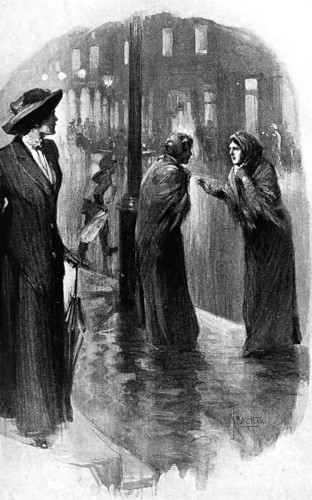
When I came out of the telephone-box there were two women standing under a lamp-post on the edge of the pavement. I recognized one as the girl with a shawl over her head who had been outside Sam’s talking to the sallow man. The other was bare-headed, so that I could see her scanty grey hair and how her face was seamed with wrinkles. They were so absorbed in what they were saying that they did not notice me standing at the door of the telephone-box. They seemed to be in a state of almost hysterical agitation; unless I erred, tears were in the voices as well as in the eyes of both. I looked at their lips, expecting to find that they were still speaking in that unknown tongue, and that, therefore, what they were saying was sealed from me. After watching them a moment, however, it struck me that, while they were not speaking in English, some of the words they uttered were not unfamiliar.
A few months before the occurrences of which I am writing I had received an invitation from certain persons who were starting an institution for the education of deaf-mutes in the town of Posen, in the province of that name, in that part of Eastern Germany which is adjacent to Poland. I was invited for a month, but I stayed four. I had a fair knowledge of German before I went, but the variety of the language which was spoken in that part was new to me. Before, however, I came away it had become more familiar. I had only to watch the two women standing under the lamp-post closely for a few seconds to perceive that that was the tongue they were speaking.
At first I merely caught a word here and there. Only by degrees did I obtain anything like a clear insight into what they were saying. When I did understand I lost words here and there, so that I had to guess at them, but I learnt sufficient to render me thankful that I had been able to learn so much.
One of the first words I caught was “bomb”—which in German is “Bombe.” My interest in their conversation grew when I realized that the word was being formed on the younger woman’s lips again and again, and the sense in which it was being used. She repeated the same statement two or three times.
“I tell you he has got a bomb on a little table by his bed.”
“But why a bomb?” the elder asked.
“Because he will not be taken. I have a particular
“I TELL YOU HE HAS GOT A BOMB ON A LITTLE TABLE BY HIS BED”
way of entering the room; he would know in a second if it was anyone else who wished to enter. He says that if anyone tries to enter the room, some one who is not me, he will push the bomb over on to the floor—and that will be the end of everything.”
“He must be mad to have a thing like that at his bedside. Suppose the table were to tumble over?”
“That would be the end! I tell you I am afraid to go near it, to look at it. I would not touch it for all the money in the world. It is made of some sort of glass; he says that if you hold it in your hand and squeeze, closing your fingers on it sharply, like that”—she demonstrated her meaning with her outstretched hand—“that would be enough. What I have suffered because of that thing!”
The girl covered her face with the edge of her shawl, as if to hide from herself the dreadful picture her imagination had conjured up. The tears were streaming down the old woman’s wrinkled cheeks.
“He must be mad,” she wailed, “to have a thing like that beside his bed.”
“That is not the worst,” continued the girl. “How can I tell you what I suffer when I return? When I am going up the stairs my knees tremble so that I can scarcely mount them; I tremble so that I can hardly think of the signal which tells him it is I. Consider what would happen if I made one little slip; he would not wait to give me a chance to put it right—he has sworn it. That same moment the bomb would fall.”
The two women were reducing themselves almost to a state of nervous collapse by their own words. They both of them trembled and cried.
“What is the signal which you give?” asked the elder.
“It begins when I enter the house. I give one whistle—like that.” She gave utterance to a clear, bird-like note. “As I ascend the stairs I sing, something different nearly every day. He is so afraid that some one will hear me and imitate that he makes me continually change. To-night it is to be a verse of an English song—like this.”
As I stood on the step of the telephone-box she sang, just above her breath, so that the air reached me, the chorus of “Auld Lang Syne,” with the strangest accent.
“It is an English song; I do not know what it means. He sang it to me—you know how well he sings.”
“He can still sing?” There was an anxious note in the elder woman’s voice.
“Yes, a little; enough to make me understand. I do not ask him to explain; I copy him as nearly as I can; for him that is sufficient. I sing this song as I am ascending, my knees shaking, my tongue dry in my mouth. When I reach the top, I pronounce what he calls the password loud enough for him to hear it on the other side; to-night it is ‘Gruss.’ Then I knock on the door, three times; first one tap, then two taps, then three taps; then I go in, and I sigh with thankfulness because I am still alive. Then I see the bomb upon the table, and I am worse than ever, because the sight of it terrifies me more than I can tell you.”
“But there are other people in the house; they cannot go through all this performance each time they go in or out?”
“That is where you are wrong; there is no one else in the house; except that one, all the rooms are empty—that has been arranged. See, I have here the street-door key; with that I let myself in; and——”
The elder woman interrupted her, without glancing in my direction; so that if I had not been observing her lips I should not have guessed that it was to me she referred.
“Why does that woman stay so long upon the step? You see how she is watching us?”
The younger answered not a word. Without a look in my direction she glided away, up the street on my left; while, without so much—so far as I could perceive—as a peep towards me, the elder went trudging past me on the right.
Within a very few minutes I was at the corner of Perrivale Street. As I neared it a man came and accosted me.
“Miss Lee? I thought that you were not coming, that some hoax had been played. I am Mr. Ellis—you telephoned to me just now.”
“Where are the men I asked you to send?”
“They are about the street, separately. They will gather at a word from me. They are in charge of Inspector Davis, who is standing in front of that shop-window smoking a pipe.”
I noted the burly figure to which he referred. So far as I could judge, there was nothing to point to the presence of his six policemen. He went on:
“Where is this man of whom you spoke? Are you sure that you are on his track, or is it merely surmise?”
“This is going to be a much more delicate business, Mr. Ellis, even than I supposed. The man who tries to arrest him will do so not only at the peril of his own life, but of the lives of others.”
“Do you mean that there will be more shooting? We are prepared for that.”
“I do not mean that there will be more shooting.”
I told him of the conversation with which I had just been made acquainted. He heard me with growing amazement.
“Do you mean to say that the fellow has a bomb with him in his room, which he will explode if anyone tries to take him? He will do for himself if he does. Where’s the gain?”
“That I cannot tell you. These people seem to have their own ideas. He will not only do for himself and his would-be captor, or captors, but he’ll work wholesale havoc in the neighbourhood. That is a consummation not to be desired.”
Mr. Ellis’s manner suggested that he was excited.
“But, even if you are right, even if the fellow is such a hideous monster—because he is a hideous monster, is he to defy us, to escape us? Are we not to take him? What are we to do?”
“I’ll tell you what we will do. I will take him.”
“You! You will take him! What do you mean by you will take him? Do you imagine that we will allow you to do our work, to do what we dare not do, to run a risk which we should be afraid to take? You are dreaming.”
“I am not dreaming. It is because I am very wide-awake that I make the proposition. There will be not only risk in your case, there will be certainty. It would be absolutely certain that you would bring destruction upon innocent heads; while, in my case, there will be practically no risk at all. Let me explain.”
He condescended to listen as I went scampering on.
“This girl, from whom I learnt about the bomb, is the only person who is allowed to approach his room. You must remember that the house is empty. She is the only person he permits to enter. I propose to pretend to be her.”
“Do you mean that you’re going to make up to imitate her? He would probably detect you in an instant.”
“Not at all. I’m not going to try to imitate her in appearance. Haven’t I been telling you about the elaborate series of signals by which she announces to him her coming, and how she described them in detail to the other woman? They’re what I’m going to imitate. I know them off by heart. Before he’s begun even to suspect that there’s anything wrong I shall be in his room.”
“There is, I am free to admit, a certain amount of sense in your suggestion. The idea of imitating the girl’s signals is not bad; but if you try that we shall have to enter the house with you—some of us, at any rate; and, keeping close at your heels, go into the room with you, and trust to luck to down him before he’s reached his bomb. There are women in the force. I’ll get one here. You can tell her about the signals, she can work them instead of you. It’s her business—as I said, each to his job.”
“And don’t you realize that by this time that girl has probably gone back to him, or may go back at any moment, and that then your chance is lost? If anything is to be done, it must be done at once—now, and I will do it.”
“Where’s the fellow to be found?”
“He’s at 3 James Buildings, in a room on the third-floor front.”
“That’s just round the corner, less than a minute from here. If you and I go on in front, my men will follow.”
He turned into a narrow side-street. There was not a soul in sight. A woman came out of a doorway on the left perhaps a dozen yards in front of us. I whispered to my companion:
“That’s the girl—the one I saw talking about the bomb. She is probably going to him now; if she gets to him first we are done.”
Mr. Ellis made a curious sound—I think he did it with his tongue between his teeth. The girl hurrying along in front stopped and looked round, as if to see from whom it came. Two men, appearing from what I take it was an alley on the right, were on her before she could move. Each had her by an arm.
She never uttered a sound or attempted to struggle. When we got to her she seemed paralysed with terror—trembling as if, without the support of her captors, she would have fallen.
Mr. Ellis spoke.
“You two had better look after her—take her to the station; detain her till I come.” He addressed the girl. “Do you speak English?”
“I have no English.” It was with difficulty that she spoke. Then she saw me. “You!” she exclaimed in German. “You were on the step.”
I said to Mr. Ellis:
“Can’t I have her shawl? It might enable me to carry the deception a little further if I have it. He’ll spot the trick at once if I enter the room with a hat and jacket on. Apparently she wears neither.”
They took her shawl. Removing my hat and jacket, entrusting them to the men who had her in charge, I donned the shawl in their place. A notion seemed to dawn on her of what the proceeding meant. She began all at once to struggle violently, breaking into voluble speech.
“Off with her,” directed Mr. Ellis. “We don’t want any fuss here.”
I sped on in front. After a second or two he joined me.