Front matter (continued 8)
Reading edition
Inidora—As a recognition of Andûmana̤'s gift of this golden fruit to his children the annual feast of the oonda̤ is observed by all Entoans. Oonda̤ in your language would mean divine, and as it is the favorite fruit of the dwellers in Astranola̤, it is thought to be appropriately named.
Those who have this moment entered are the governor of Wya̤mo, Darraon Olēva̤s and his wife, the Lady Noûnia̤. Now the governor rises, and bearing aloft his chaplet, he approaches his wife and places it on her head, fervently praying: "Andûmana̤, Creator and Giver of all good gifts even as I crown Thy child with oonda̤ blooms, so crown Thou her with the priceless blessing of a long and happy life;" and the guests respond, "Ra̤û, ra̤û, ra̤û." Now he kneels by the side of his wife, and as she places her chaplet on his head, with trembling lips she implores Andûmana̤ to prolong the days of her beloved, and that they may be as full of the fragrance of noble deeds as are oonda̤ blooms full of the perfume of Andûmana̤'s breath, and again the guests respond, "Ra̤û, ra̤û, ra̤û."
De L'Ester—We regret that we cannot devote further time to observation of this attractive festival, but affairs relating to our mission grow more pressing than you are aware of, and we must hasten our movements. We now will ascend to the upper floors. Yes, the decorations and furnishings of these spacious apartments are of the best art productions of Ento, and certainly they are beyond unfavorable criticism. You have learned that Ento's textile fabrics are surpassingly excellent; so you are not surprised at the beauty of designs, coloring and quality of these draperies, rugs, upholstery and other appurtenances of this elegantly appointed residence. Yes, in most Ento residences, large or small, somewhat sumptuous furnishings are the rule, rather than exception. In arts and manufactures the Entoans have progressed beyond the tawdry and mean, and all who so desire, may, at small cost, gratify cultivated tastes.
We now will go out on the balcony, George. Yes, the dome balcony. Do not you think that Vil Tylû (White City) would be as appropriate a name for this city as it was for your World's Fair City? And now that we have fulfilled our promise, may we hope that you are not disappointed?
Gentola—Dear friends, the fulfillment of your promise exceeds my anticipations, and as I gaze in all directions I am filled with wonder and admiration for this extensive, this grandly beautiful White and Gold City. The absence of all indications of poverty is in itself a charm, and it appears so immaculately clean and so new, that one might imagine it the creation of a very recent time.
Genessano—On the contrary, previous to the inception of the Irrigating and Waterways System, it was a city of importance, and as now, the capital of Wya̤mo. At the time that the proposed irrigating system was under consideration the then governor of Wya̤mo was one of its most enthusiastic supporters and later an indefatigable worker who lived to see the System assume unlooked for proportions and incalculable beneficence. His successors followed his fine example, and a time arrived when the Irrigated Belt touched Kûltymo's limit on the north, and you perceive that now it penetrates quite into the System. During later centuries the population has so increased as to necessitate encroachment upon the agricultural lands northward, and now in that direction the city's suburb is parallel with the northern shore of Ta̤imon.
Kûltymo Tylû is favored beyond any city of our planet, for though it is within the equatorial zone, it is far enough northward to possess a moderately temperate and most salubrious climate. Then northward, Lake Ta̤imon and the great Waterway affords an outlet for shipping, passing not only in that, but in all directions, and Cēhylû Ooltēma̤h, rising in the far north, runs southward, pouring its immense volumes into the System, thus affording highways for vessels of the largest size. In the distance, and toward the northeast, is Lake Komû-tēlesa̤ (lake of Springs) another considerable body of fresh water, and if you will look in that direction you will perceive that, through a continuation of the Waterway, it communicates with Ta̤imon, and that on its placid bosom vessels great and small are passing to and fro. Later, through observation, you will learn that the Waterways with their attendant feeders, directly or indirectly connect with nearly all the freshwater lakes and rivers of our Planet, and that all within certain degrees of latitude are embraced by the system. Thus, Kûltymo Tylû has at its doors extensive water transportation, added to which Tûza̤mos and air Transports bring it into ready communication with all portions of the planet, from whence it receives all manner of products. In turn Kûltymo Tylû exports immense quantities of manufactured goods and art wares, but its principal distinction is its great art school and library, to which come students from all over Ento. I, like yourselves, am enchanted with the beauty of this white and gold city, which to me suggests a great white bird, its body resting on the broad plateau, the tip of one snowy wing touching Ta̤imon, the other spreading toward the lovely valley Insa̤lû, and the neck and head gracefully curving downward over the northern slope of the plateau, to drink of the shining, vivifying waters of the beneficent System. Bernard, have you naught to say of this great city?
Bernard—Yes, aside from cities of our Spirit World, I have seen none to compare with it. As my dear mother has said, the beauty of its architecture, its exceeding cleanliness and absence of poverty are its most attractive features, and I quite agree with her. But, Genessano, you did not complete your simile; you forgot to give your bird a tail.
Genessano—You are very right; I did forget. Well, for my tailless bird I shall from among yonder gleaming, golden domes and snowy towers, whose symmetrical beauty is heightened by a southern background of fleecy clouds and azure sky, gather plumage as fine as that of alzoyta̤s, the sacred bird of Astranola̤, whose wide-spreading wings over-shadow death's darkened realm.
Gentola—I beg that you will not take offense at my boy's inconsiderate speech. During his Earth life always he saw the droll side of things, and in that direction I do not find him changed.
Bernard—Mother, dear, I meant no offense; so Genessano could take none.
Genessano—That is as true as truth. Bernard and I are as two opposing mirrors, each reflecting images upon the other's face; thus one never misunderstands the other's motives, and Bernard's ever are kind. Let this fraternal embrace assure you of our mutual good will.
De L'Ester—We will rise to the upper balcony, from which we will command a still more extensive view of the city and its suburbs, and you, Gentola̤, will give expression to whatever may impress you.
Gentola—To me the extent of this city is surprising. Eastward its limit is beyond my power of vision. Southward domes, turrets and lofty columns lose themselves amid the mists of the horizon. Northward, for mile after mile, on the level; thence down the sloping plateau and across the far reaching plain, the white and gold wonder spreads itself. In that direction, in the middle of some of the wide streets, are canals, on which small boats, carrying passengers or freight, are passing to and fro. At intervals the canals are spanned by handsome bridges, over which a variety of vehicles are passing. Toward the southwest Ta̤imon, which you say is nearly twenty miles away, mirrors in its waters the great warehouses and manufactories which line its shores. It occurs to me to ask why chimneys are not features of Ento architecture. Even those great structures have none.
Inidora—Many centuries previous to my existence on Ento electrical appliances had come into such general use that in all cities, towns, villages and pretentious country places, they almost were the sole agencies for heating, lighting, culinary and other purposes, and yet some families of the Soûvannallos and of another race far southward, still adhere to ancient domestic usages. Certainly they are the only Entoans who persist in using fireplaces and chimneys, which no longer are features of Ento architecture.
De L'Ester—Northward and southward, along the level of the plateau, and eastward and westward, toward Insa̤lû-Valley and Lake Ta̤imon, there are many stupendously tall and massive towers, whose average height is about one thousand feet, and whose bases seem substantial enough to support Ento's satellites. The skill and daring involved in their construction is both admirable and surprising. In their interiors are elevators which carry to the height of their summits persons and things connected with their service. They are used for a system of electric lighting, and also as watch towers during the annual floods and on their summits are as fine observation telescopes as we have seen. Yes, when those great towers are lighted, night is well nigh turned into day. How little the peoples of our planet yet comprehend what may be, and ere long will be, accomplished through the agency of electricity, whose civilizing power is illimitable. I should like to inform you as to one of its achievements, and at another time will do so.
You are exhausted, and we must hold you no longer. We will not come for you to-morrow morning, but at two o'clock in the afternoon. Earlier we will be at Da̤o to meet friends who are interested in our mission. Yes, friends from Ento's and other planetary Spirit Worlds. Be patient; the time is near when you will see them as you see us. For yet a little while Spirit forces will hold Valloa̤ in her physical form, for it would not be well should she pass to the Spirit side before all things are in readiness for the culmination of our mission.
Friends, George, Bernard and I will bear Gentola̤ safely to her home; then I must go elsewhere, but to-morrow we all will meet at Da̤o.
Gentola̤, rest your right hand on George's shoulder. Bernard, place your right arm about your mother and your left hand on my shoulder, and now for the Sorrowful star, toward which this mighty magnetic current bears us with the velocity of thought, and here in your quiet room, where twilight shadows have fallen, we leave you until the morrow. Bernard, make your adieu, for before she may be disturbed, I desire to see your mother recover herself. Ah, that is well. Yes, we still are here, and pleased that you so readily have regained your usual condition. As we have held you overlong to-day, I pray you, rest, rest, rest. Now au revoir.
CHAPTER XIV.
DANO AND VALLOA.
De L'Ester—Exactly two o'clock, and you are awaiting us, so at once we will be off. Only George and I have come for you. Bernard and our friends will meet us at Kûltymo Tylû. Now, be at rest. Ready, George. No, mortals can have no realization of the rapidity with which wholly freed spirits are able to move. You, who to a degree are freed, do not realize it.
Gentola—No, I do not. Always, to me, we appear to be stationary, while all else is falling away from us. Now, as we near Ento, it seems to be rushing toward us, and now I perceive its divisions of land and water, and yonder is Kûltymo Tylû, and on yonder great tower our friends and my dear boy are watching and waiting for us. A greeting for you all, dear friends, and for you, too, my dear lad. Yes, from afar off I saw you waving your hand to me, you dear, dear boy.
George—While De L'Ester shall relate to you something that certainly will interest you, Inez and I will make a hurried visit to Da̤o, but ere he shall have concluded his narration we again will be with you.
De L'Ester—We find that, until our mission shall have culminated, we must defer visiting certain localities of peculiar interest, and as some untoward event might, during your mortal existence, prevent your gaining through personal observation, information concerning them, we have decided that I shall endeavor to acquaint you with some of their features.
Far within Ento's Arctic and Antarctic regions there are lands which, during a large part of the year, are covered with ice and snow. Still farther northward and southward and at the poles such intense cold perpetually prevails that the land surfaces are uninhabitable. In these regions are vast deposits of precious and other ores, and to gain access to them many difficulties had to be surmounted. I say had to be surmounted; for, during many centuries, mining within the Arctic and Antarctic Circles has been a settled industry. In remote times, as at present, throughout Ento's Torrid and Temperate Zones, the mining industry has progressed northward, and to a lesser degree southward, and so gradual have been its movements that, almost imperceptibly, it has penetrated polar lands, and mainly through the agency of electrical appliances has the achievement been made possible. You have been informed that more than fifty Ento centuries ago, the Entoans understood electrical engineering and many electrical appliances, and that then, as now, Tûza̤mos and air Transports were used as common carriers, but, of course, they were less perfect than those of to-day. Still, they served the requirements of their time, which were less exacting than the requirements of to-day. But you have not known that, quite within Ento's Arctic and Antarctic Circles, there are large underground communities of men, women and children, whose occupations, almost solely, are connected with the mining industry. Naturally, one might infer that the disadvantages of their environments would be both discouraging and depressing. Not so. Through the agency of electricity their underworlds are brilliantly lighted and where necessary comfortably warmed, and it enables them to keep in constant touch with the outer world which, at any time, they may visit, and from whence they may command such luxuries and comforts as they may desire.
Lines of Tûza̤mos penetrate far northward and southward, and where they cannot go air Transports can and do go. Thus these communities are not at all isolated, and they go and come where and when they will. Some time, if you may so desire, you shall visit some of them, and I may assure you that you will find them very interesting. Yes, all mines are owned by the general government, and the remuneration of those engaged in them is so liberal, so equitable, as to assure to them prosperity and contentment. At the entrances of the various great mines are enormously lofty light towers, whose several floors are devoted to educational and other purposes. In the schools some of Ento's foremost scientists of the past and of the present day have been taught electric and hydraulic engineering, geology, mineralogy and other specialties. Other floors are for living rooms, nurseries, hospitals and the inevitable Istoira̤. The several departments are attractively finished and furnished, and are quite as desirable as are well appointed dwellings of milder climes. On the summits of these lofty towers are immense electric lights which are to navigators of space what beacon lights are to mariners of seas. To air voyagers they afford cheering assurance of their whereabouts and of hospitable entertainment; for, at all mining centres, are air Transport Stations for the accommodation of travellers and for shipping purposes.
Frequently, in Arctic and Antarctic regions, terrific snow storms occur, and were it not for the far reaching tower lights, air pilots would not be able to find Transport landings, which ever are kept in readiness for their arrival. Yes, the mines are located in mountainous regions, for as the poles are approached the planet's surface is very rugged and mountainous, and as on all stable planets the more nearly the poles are approached the vaster are the mineral deposits. Yes, the same law applies to Earth, and were I not somewhat opposed to prophesying, I might say that within ten years the insatiable gold worshippers of our planet will set up their altars in localities nearly as frigid as are Ento's northern and southern mining regions. Much more in this direction I might relate, but we anticipate that later on we may afford you views of what I have given you a mere idea. Ah, here are George and Inez.
George—I fear that we may have abused our leave of absence; if so I can only say that we have been so engrossed as to not note the passing moments. Since our visit of the early morning her Spirit attendants have succeeded in temporarily stimulating her vital energy, but ere long they will have to yield to the inevitable, and Valloa̤, the golden haired, will be borne to Ento's Spirit World. Evidently she realizes that death, the dread terror, is drawing near and it is touching to see her young, lovely face wearing a smile while her faintly throbbing heart is full of anguish at thought of leaving her adored father and Dano, her betrothed. Inez, my dear one, will you tell our sister about the dying girl?
Inez—Words cannot describe the pathos of the scene. Since witnessing it my heart is burthened with measureless sympathy for mortal sorrow. By one side of Valloa̤'s couch sat her father, his woful face betraying his consuming grief and anxiety. By the other side knelt Dano, his rapt gaze wearing the expression of one who sees with clear eyes. So emaciated, so wan is Valloa̤'s lovely face that it is as snow amid the wealth of her golden, flowing hair. As we looked and listened she turned to her father with encouraging words, then she smiled into his and her lover's eyes, and said, "Dearest ones, pray do not regard me so wistfully. I am growing stronger; soon I shall be well;" and they, to hide from her their despair, smiled back at her, assuring her of their confidence in her speedy recovery. About her were Ministering Spirits who, to their utmost were sustaining her physical energy, and for a moment I stood near her and Dano, who with a startled look, turned toward me, and quickly I moved away. He grows very sensitive, and Valloa̤'s Spirit vision is so clear that as she recedes from the mortal condition, in exceeding bewilderment she gazes into the thinly veiled Spirit World, whose glory fills her soul with ecstasy. I now am satisfied that our Band have acted wisely in not taking you into the presence of the dying girl, for assuredly your easily aroused sympathy would endanger your safety.
De L'Ester—Which we dare not trifle with, as in it is involved the success or failure of our Mission. This, you perceive, is the loftiest tower of the city. It is a signal tower, and through this telescope, which is one of its scientific features, it commands a view of the immense distances of this levelled portion of the planet. Gaze now over the city and express your impression of the view.
Gentola—Beautiful, wondrously beautiful! Toward the east the city gently inclines downward, and across Insa̤lû Valley, merging itself into the country, which is so closely dotted with white dwellings and Istoira̤s, gleaming amid the green of lawns, orchards and lofty bûda̤s and other forest trees, that one cannot say where the city ends and the country begins. Southward the plateau rises gradually in broad terraces, on which are white and gold structures like stately palaces, amid blooming gardens and the feathery foliage of bûda̤s trees. Some are less spacious, but scarcely less attractive in the beauty of their architecture and surroundings. There are open squares lined with palatial white and gold residences and other structures whose great domes and towers look down upon fountains so lovely as to defy my descriptive ability. Upward and upward the terraces rise until against the background of the deep blue sky the southern portion of the city appears as a dim, mist-veiled, never-to-be-forgotten, magnificently lovely picture. I cannot imagine a scene more beautiful; no, not even in Celestial Worlds. Seeing this wonderful city and learning to what heights humanity may attain arouses within me a hope for the future of our own sorrowful planet.
De L'Ester—Alas and alas, that many, many centuries must elapse ere your hope shall bear fruition. Development of the peoples of a planet, as a whole, is not a matter of centuries, but of ages. Centuries come and go, and only Infinite Intelligence can discern that all along the line one step has been taken. Like the rising and falling of ocean's unquiet waves, now amid mad tempests, dashing their white crests toward the sky, anon with gentle undulations laving the sand strewn shore, so amid storm and calm, the peoples of planets slowly, but surely, evolve toward higher planes of being.
Wars, with their lamentable features, are the upheavals of the animal impulses of crude civilizations, and Earth's peoples are far from being civilized. All over our planet civil corruption and social, selfish greed and ambition for place and power are eating into the very vitals of society, hence of governments, and if Spirit agencies cannot sway the minds of some who may serve as Saviors, the poverty and agony of the masses in time will produce a state of delirium, in which the sense of accountability will be lost; then woe be to those who, through standing on the shoulders of their defrauded and oppressed brethren, have climbed to high places.
Man is in one, angel and animal, and ever as the angel strives for ascendency, the animal snarls and shows its teeth, and you may believe me that, were it not that Spirits of highest Realms control illumined minds of Earth, who serve as restraining influences in the consciousness of the masses, a chaotic state of society quickly would ensue. Apparently, it is a provision of Divine Law that the wise and strong shall aid the unwise and weak; that the higher shall reach down to uplift the lowly, and those who fail to fulfill this righteous law thereby so lessen their Spiritual estate that, in the world of equitable adjustments, they find themselves in a state of poverty undreamed of by mortal man.
Yes, even as the peoples of Earth agonize in the throes of evolution, so in past ages have the Entoans agonized; so, to a degree, do they yet agonize, for though they are more highly evolved than are the peoples of our planet, they, as I have once said, are yet in their swaddling clothes.
Yes, ages elapsed ere they evolved from savagery to a civilization which made it possible for their ideals to assume form and expression in the construction of this wonderful and beautiful city. Wonderful not only in its architecture, but in its many fine expressions of science, of art, of social amenities and usages, and other admirable features of an advanced evolution, which has carried from the past into the living present such lessons of wisdom as have been learned in the school of experience. The school whose pupils never play truant and who ever are learning their lessons well or ill, and who, perforce of natural law, must advance onward toward clearer, higher views of the meaning of life, of love, of God in humanity.
Now again look southward. Is not it a vision to enrapture the soul of an artist or a lover of the beautiful? See how temples, domes and light towers lose themselves in the cloudlike, luminous haze which the slanting sun rays glorify into an indescribable loveliness. Toward the lovely valley Insa̤lû the shadows of declining day are falling over the whiteness of the city and over domed temples and light towers. Afar, gray and empurpled mist wreaths are rising and veiling the pallid beauty of fountain groups, whose silvery treasures, thrown high into the quiet air, are tinted by the glory of the setting sun, which gleams athwart Ta̤imon, over which, like dream phantoms, vessels great and small are noiselessly gliding. Lower, lower sinks the red disk of the solar king, and fleecy clouds, catching the reflection of his last beams, put on their robes of crimson and gold, and like angels in flight, drift across the deepening azure of the sky.
George, we now will ascend, but not to a great height, for soon the light towers will be ablaze, and you, Gentola̤ and Bernard, will witness a spectacle you will not soon forget.
Look downward now. Shadows are brooding over the great city, and save for the musical tones of the temple bells every sound is hushed, but wait a little and the scene will change.
Ah, you are startled, as well you may be. Is not the transformation marvellous? Is not the scene grandly, weirdly beautiful? Below us is the wide-spreading city, whose lofty electric light towers suddenly have turned night into day, and southward, where the terraced plateau attains its greatest elevation, is the great light tower on whose summit is an immense golden and crimson crystal Symbol of Andûmana̤'s abode, and as the afterglow of its radiance fades from the sky, suddenly the Sacred Symbol will blaze into the splendor of its amazing beauty. Now, from every temple, the music of chiming bells floats upward and the atmosphere is vibrant with their rhythmic notes. With expectant gaze, all eyes are turned toward the Symbol of their Religion, and now flashing upon the bosom of night behold the glowing, scintillating, radiant wonder. Simultaneously from every lip bursts forth a prayer, which I will translate into your language.
Andûmana̤, Creator and Preserver, even as the shadows of night wrap us about, so may Thy Love infold us while we sleep, and may Thy Messengers, who read our inmost thoughts, bear to Thee the fervent adoration of Thy loving but ever sorrowful children. Oirah, oirah, oirah. (So be it.)
In low, plaintive tones the chiming bells accompany the intoned prayer, and every face is uplifted toward the great glowing Sun, whose dazzling radiance penetrates the dense fog enveloping the city as with a snowy mantle.
Gentola—Ever since you promised me that some time I should at night behold some portion of Ento, I have tried to imagine how it might appear, but never have I imagined a scene so grand, so beautiful, so marvellously strange as this.
Oh, that the peoples of our planet might, if but for a moment, behold this illustration of the possibilities inherent in humanity, for surely it would stimulate them to higher endeavor, to emulate the attainments of the Entoans, whose peace, prosperity, learning, culture, refinement and kindliness is in strong contrast with the turmoil, poverty, selfishness and lack of real friendliness prevalent among the masses of our rightly named Sorrowful Star. Yes, I know that the Entoans are sorrowful, but it is not of a nature that debases them, and I hope and pray that soon it may give way to measureless joy.
De L'Ester—So hope, so pray all who are engaged in this Mission.
Gentola—As I listen to the chiming of the temple bells I do not distinguish one discordant note, and all ring in perfect unison. I should like to know how this is accomplished?
Inidora—All Ento temples possess chimes of bells, and all the chimes of each city are tuned to the same key note. They are electrically connected, and by means of electrical mechanism all are simultaneously rung. Our people have stated times of worship, which are at sunrise, at midday and at sunset, and when in a few moments yonder radiant Symbol of Ento's faith shall be extinguished, again the waiting people will implore Divine protection through the night, and the chiming bells again will ring their plaintive Oirah, oirah, oirah. (Amen or be it so.)
Yes, in cities and towns and country places the same religious ceremonies are observed. At sunrise the blessing of Andûmana̤ and the protection of the Divine Ones who dwell in Astranola̤ are invoked. At midday all Sacrifices and Offerings of value are laid upon the altar. At sunset in temples flowers alone are laid upon the altar, and the High Priest invokes for his people the protection of Andûmana̤'s Messengers. No, it is only in Kûltymo, Da̤o, Camarissa̤ and two other cities of Ento that there are such Symbols as we now are gazing upon. But see, the glory of its beauty is paling and—now it has disappeared. Again the chiming bells fill the air with melody. Again from every lip ascends a prayer for protection through the darkness of night. Gradually the melody dies into silence, and through the deepening twilight and the soft radiance of its many light towers, Kûltymo Tylû gleams in pallid whiteness, in phantom-like loveliness. Quietly, tranquilly, the people are returning to their homes. No sounds of traffic or of labor break the stillness of the great white and gold city, but from soiva̤s (parks) and ilofēn mûna̤a̤ (amusement gardens) strains of sweet music float upward and thither, presently, men, women and children will wend their ways.
And thus, Kûltymo Tylû, queen city of my beloved Ento, we leave thee, and as our faces turn away from thee, our backward, lingering glances stray over thy peerless loveliness, and we regretfully murmur Info oovistû.
Gentola—Dear friends, so strange, so enchanting are some of the experiences that you are affording me that I am at a loss to express either my emotions or my boundless gratitude. Oh, if only I might remember all that I see, all that occurs. Why is it that, after I have regained full consciousness, I can no more recall these experiences than I can recall a dimly remembered dream?
De L'Ester—Cannot you comprehend that it is you, the Ego or Spirit Self which alone takes cognizance of these experiences? That the magnetic chord connecting you, the Spirit Self, with your conscious mind, which is the animal soul consciousness, is, so to say, the telegraphic wire through which, under our control, your physical organism is made to automatically record the words transmitted by whichever member of our Band may be acting as operator? While you are with us your Soul consciousness is in abeyance; hence, is not an active factor in these experiences, and can record nothing concerning them. Take comfort from this statement. When under my control you shall rewrite, and as far as feasible correct the imperfect record of our journeys to and experiences on Ento; imperfect because you are not yet fully developed in your peculiar phase of mediumship; your memories relating to our Mission will experience a sort of resurrection, and you will recall much, if not all, that has and yet will transpire while engaged in our endeavor to serve as we would be served. Not until you shall be wholly freed, will you fully comprehend this statement, but when you shall be enabled to recall these experiences, also to a degree, you will realize that they are more than dreams. Yes, doubtless, there are those who will regard you as a visionary. That will be their mistake, not yours.
Now we are over the intersection of the Central Waterway, with one running toward the northwest, which also intersects with one traversing a portion of the North Temperate Zone. Since Genessano Allis Immo demonstrated the practicability of great Waterways, several have been completed and others are in course of construction. Through them and their feeders the retention of the annual floods and control of irrigation has been greatly simplified and their measureless value demonstrated.
To-morrow we all will meet at this point. We held you too long yesterday and you are yet somewhat devitalized. We will see to it that you shall sleep restfully to-night, and in the morning at nine o'clock we will be en evidence.
George, Inez and your wistful-eyed lad will see you safely home, and we will repair to Da̤o.
Au revoir.
CHAPTER XV.
RE-EMBODIMENT.
De L'Ester—We find you difficult of control this morning. Like the legendary Martha you are anxious about many things. Our journey of to-day is less in your thoughts than are the exasperatingly high prices of household supplies or the letter you have been reading. How do I know? Have not I said that I can read your thoughts as you might read an open book? No, I cannot at all times do so; it is only when, as now, I am en rapport with your soul consciousness.
You are not resting easily. Ah, that is better. Now you are tranquil, and now—you are free, and we are off for Ento. Yes, glorious indeed is this sense of freedom from physical conditions, which only to a limited degree can you either perceive or realize. It may surprise and disappoint you to be told that in your present state you cannot perceive Spirit Worlds. That you may perceive us, we and these Ento Spirit friends are obliged to, in a sense, etherealize. No, not as Cabinet Spirits etherealize, but in a more sublimated sense. At the culmination of our Mission conditions may be such as to enable you to behold Spirits as they really are. No, I do not promise it, but it may occur.
No, mortal ears are not attuned to sense ethereal vibrations. Hearken to the grandly sublime, sonorous under-tone coming from Eternity's shoreless sea and rolling in rhythmic measure onward, onward forevermore. Beethoven, Handel, Mozart and others of Earth's illumined ones, in moments of inspiration caught faint notes of music celestial, and with ardent longing strove to give them expression. Believe me that a so termed musical genius is a musical medium, whose subconscious mind, like an aeolian harp, vibrates in unison with the unwritten music of the Soul of the Universe.
We are nearing the intersection of the Waterways, and our friends perceive our approach. Lohaû, ēmenos. We greet you all and apologize if we have kept you waiting.
Gentola̤, you will please give me your attention. At no great distance the branch running in a southwestward direction forms a junction with another Waterway which is not yet completed, and which later on we may observe. For the present we will continue our course toward the northwest. The large town at this intersection is an important shipping point, and yonder is quite an imposing temple, two smaller ones and some pretty suburban Istoira̤s. There are some imposing public buildings, many handsome private residences, a pretty park, and the streets are wide and beautifully kept, and along the margins of the street canals are borders of blooming plants. Really, it is an attractive town, but at present we cannot give it further attention. It is named Fûna̤voh Ritza̤, which in your language would mean Town of the Intersection. Passing in either direction are vessels of various sizes, some of them equaling in dimension and tonnage the huge steamships traversing the seas and oceans of our planet, and it is not too much to say that in point of scientific construction and beauty of finish and furnishing Earth does not possess their equal. They are so scientifically constructed as to be practically indestructible, and electricity is the propelling energy; also it lights them, and when desired heats them. For a brief period we will take passage on the vessel about to leave port. Gentola̤, come to the bow and observe how swiftly and almost noiselessly it cleaves the water. At this rate of speed it will soon cross the second intersection, and before to-morrow will be traversing the broad expanse of Villostû Nykon (Sea of Many Islands). We now will glance through the interior. These great saloons and luxuriously appointed sleeping apartments are finished in rare carved woods and inlaid designs of Ento's fruits and flowers through which peer lovely child faces of marvellously delicate and artistic execution.
You perceive that this vessel carries many passengers, and all in equal comfort. Unlike the vessels of our planet it carries no steerage passengers, for on Ento such an atrocity is as unknown as are class distinctions, which the Sacred Writings distinctly forbid. This is the Sacred statement: "I, Andûmana̤, the Creator of all that is declare that of one blood, one bone, one flesh, I have made all the children of My Love, so let no man dare say, I am better than my brother," and I can assure you that the Sacred commandment is obeyed.
On this deck are the offices, saloons, sleeping, culinary and dining apartments. On the deck below, to which we will now descend, are the engineer's and his assistants' apartments and departments, and also storage for freight. For the motive energy, the mechanism is partly here, and partly in what may be termed the hold. These vessels are so like and so unlike the seagoing vessels of our planet that should I attempt to describe existing differences I would consume too much time and space, but we desire that you shall bear to the peoples of Earth a knowledge of the fact that it is possible for vessels of the largest size to be propelled by electric energy, and also that now on Earth there are men inspired by Spirit Electricians who are working to that end, and that ere long there will come into the Earth sphere men, who, on the Spirit side, have learned the higher applications of electric energy, and who will know how to use them. The time is not far distant when, on our planet, steam as a motive power will have become as obsolete as it is on Ento.
Your continued surprise, at seeing on Ento much that corresponds with, or at least bears a resemblance to Earth forms, is so natural that we do not marvel at it; still, if you will bear in mind a fact we already have stated, that form is the expression of a universal principle, and that in conformity with the degree of his evolvement, man expresses it, you will cease to wonder that our next door neighbors, the Entoans, shape the keels of their vessels on the same lines as Earth's shipbuilders shape the keels of their vessels. Adaptation of means to ends is an expression of form. Thus the savage who shapes the primitive dugout, or his more advanced brother who constructs the more shapely bark canoe, intuitively applies the principle of form as a means to an end. As the Entoans of the present are the result of the Entoans of the past, you may rest assured that their progenitors also used dugouts and bark canoes, and only through their larger accumulated experiences do they, in some directions, take precedence of their less mature Earth brethren, who, in time, will outgrow their youthfulness. We now will ascend to the upper deck, for we are approaching one of the circular basins which are features of all Waterways. They occur at intervals of about twenty English miles, and through the system of atmospheric telegraphy the movements of all vessels are so perfectly controlled that their passage in opposite directions is accomplished through the medium of the basins, and thus collisions never occur.
Observe how swiftly, how gracefully, yonder huge vessel sweeps around the further curve of the basin, cleaving the water like a thing of life, and leaving in its wake great undulating billows of snowy foam. Across the basin friendly salutations come to our fellow voyagers, and they cry back, "Lohaû, lohaû. Fa̤endos a̤yon mûya." Ah me, it is hail and good-bye to most things, and now it is good-bye to this fine vessel which for a time has given us hospitality and you an object lesson.
George, we now will ascend. Sweeping northward and southward, yet tending eastward, we will afford you a comprehensive view of the equatorial lands and portions of the North and South Temperate Zones. Observe how diversified is this Equatorial region. Cities, towns and villages dot the wide expanses which largely are devoted to agricultural pursuits, and so productive are the lands that they not only afford sustenance for local populations but admit of great quantities of grains, fruits and vegetables being shipped to other less favored localities. Truly, Ento's Irrigated Belt is the garden of the Planet. George, we now will quickly pass northward to the headwater of Cēhylû Ooltoma̤h (Rushing River).
Gentola̤, in this chain of spring-fed lakes the great river rises, and during a considerable portion of the year its volume is greatly enlarged through melting snows and frequent rains of this rather cold but humid region. We will follow its course southward so that you may observe the cities, towns and villages lining its banks, and the various kinds of craft traversing its navigable length. You perceive that Pfylonna, the city beneath us, is at the head of navigation, and we with profit and pleasure might pass an hour in viewing its points of interest, but not now, for time is flying and at any moment we may be called to Da̤o.
Yes, this northern region is more picturesque than are the lands of the Temperate and Equatorial countries, which, as we proceed southward, stretch into great level plains which sustain a dense population, largely of agriculturists. Yonder, on the eastern bank of the river, is a pretty, wooded height, the remnant of a mountain chain of the long ago. Now its slight elevation is little more than a sufficient barrier against the tumultuous floods, which during the spring pour down between it and the stone embankments of Cēhylû Ooltoma̤h's western shore. Yes, Ento's Waterways, Irrigating System, Embankments and other stupendous works excite wonder and admiration for the skill, industry and enterprise involved, but generally, when self-preservation is at stake, humanity rises superior to emergencies. Inidora̤, while we hastily survey the surrounding country, will you learn if the Istoira̤ may be interesting enough to engage our attention? Some rural Istoira̤s possess very attractive features.
Inidora—I feel strongly impelled to gratify your curiosity and my own. I shall be gone but a moment, and if worth while will summon you.
De L'Ester—Again we are near the northern limit of the Irrigating and Waterways System, and to what a state of perfection it has been brought. Those great Structures are pumping Stations, and so excellent is the mechanism employed that the water distribution is under perfect control. The government of Ento indulges in no half-way measures. Whatever is done is done as well as can be accomplished.
What can so delay Inidora̤? He must have found the Istoira̤ unusually interesting. We will seek him there. Ah—see how like one enchanted he stands gazing upon a woman kneeling before the flower laden altar. Over her white robes falls a wealth of dark, waving hair, which, like a silken mantle, partly conceals her large, dark, luminous eyes and marvellously lovely face, in which yet lingers the timidity and guilelessness of childhood. So entrancing is the young creature that Inidora̤ is unconscious of our presence. Now she prays to Azēon, God of Love, to send her a lover who shall be handsome, tender and true, and she will be faithful and loving until death shall call them into the Silence. Prayer from a heart so pure, uttered by lips so tremulous, so beautiful, might move either mortal or Spirit. Genessano, speak to your brother, for truly he is lost to all save this lovely girl.
Genessano—Inidora̤, my brother, have you found in this beautiful suppliant your other Self? Nay, start not; it is I, Genessano. You were so absorbed that you did not observe our coming in search of you.
Inidora—Yes, yes, I indeed have found my other Self, and cannot claim my own. Oh, thou beauteous Spirit Amilla, for whom I have searched the worlds of space, clothed thou art in flesh, which holds thee as the shell holds the pearl. Blind and deaf thou art to the presence of thy lover, thy other Self, whom thou prayest Azēon to send thee. Drawn to thee through the law which attracts each to its own, I again have found thee, and henceforth I shall guard and guide thee until thou art free; then again wilt thou find thy lover tender and true, and I shall claim thee for my very own. Amilla, dearest, loveliest one, reverently I kiss thy perfumed hair, thy upturned brow, beneath which thy luminous eyes shine like twin stars. I touch with mine thy parted lips, and the fragrance of thy breath is as the fragrance of rodels, but thou knowest not that I am near thee. Amilla, Amilla, oh, couldst thou know, that as of old thy lover so tender, so true, stands beside thee, how quickly wouldst thou turn toward me thy face, which is as beautiful as is the face of an angel. But thou dost not know, thou dost not know. Alas, thou hast so forgotten the past that I am as naught to thee. Oh, it is pitiful, pitiful, that I cannot make thee understand. Fain would I this moment free thee, but I must not, I dare not. Friends, bear with me, for until I shall have brought her Soul into harmony with my own I shall remain with my regained Amilla, whose repeated embodiments, like my own, have held us far apart. This accomplished, I at intervals will be with you, and when my love shall be freed, oh, joy of joys! we together with you dear friends will for love's sake labor for the upliftment of humanity.
De L'Ester—Even as thine own shall one day come to thee, so ere long shall mine own come to me. Inscrutable are the Laws of the Infinite Duality through whose seemingly devious ways apparently we are impelled toward destined ends. As to-day I walk alone, so one brief hour ago, walked our Inidora̤. A seeming chance, a sudden impulse, and lo! for our friend the face of the universe is changed. Gentola̤, you comprehend that, during past embodiments, Inidora̤ and Amilla have known of their indissoluble relationship. That you may come to further understand the law of re-embodiment, I briefly will relate a portion of my life story, involving comparatively recent experiences of my own, and of one who is my other Self, for, as you have been told, the male and the female are the two halves of a whole, and it is a law of nature, or if it pleases you, of God, that, somewhere or somehow, the halves shall become as one, not as one entity or individual, but as one in perfect Spiritual harmony.
More than a century ago, after a prolonged separation, suddenly my Soul Mate and I came face to face, and I knew my own. I a freed spirit, she a creature born of lust and fallen in the mire of a dissolute existence. Vainly her Spirit Self warred against and strove to escape from the bondage of inherited animal passions which held her fast as with chains of steel; so, patiently, lovingly I did for her what I could, until one drunken with wine and frenzied with jealousy, struck her body dead at his feet. I, who waited and watched for her release, drew her away from the scenes of her degraded mortal existence to her own place, aiding her as other loving ones also did, to undo the tangled threads of her sorrowful Earth life. She, who well understood the Law of Being, quickly realized that if she would progress out of the conditions of her previous embodiments, she again must enter the Mortal Sphere of our or of some other planet, and with slight hesitation, this she resolved to do.
It is well that you shall learn that all mortal experiences are necessary for the perfecting of character, which is but another term for Spiritual growth. The tendency of the real Self, the Spirit, is ever onward, ever upward. The tendency of the animal Soul or conscious Self, ever is toward the material plane of Being; thus, in the Spiritualized human, there is a constant warfare between the Positive or Spiritual man and the Negative or Animal consciousness and no one comes out of the battle unscathed.
You question the justice of a law which demands from humanity that which from an elevated mortal standpoint is objectionable; but, my friend, have not you learned that the crust of bread earned by sweat of the brow is sweeter far than the whitest loaf to the palate of the idler? Be assured that when again you shall find yourself on our side of life, you will prize the crusts you have, through sad experiences, earned, far more than the white loaves you might have eaten to your hurt, and I do not question but that in time you not only will acquiesce in the justice but in the beneficence of a law which admits of the undoing of mistakes, and of the acquisition of much that only can be learned through repeated mortal experiences, and of what is of greatest moment, the Rebirth of exalted Spirits, who may be Saviors of humanity.
You, who in your mortal state, but partly realize that Love, the Divine Principle, impels all things into harmonious relations, into a fulfillment of the Law of Love, may experience a sense of surprise, that after a period equalling no more than forty of Earth's fleeting years, my Romēne, grown strong and learned in many things, announced her desire to at once take on mortal form, that as a Teacher she might serve women undergoing such experiences as to her were most sorrowful memories.
Yes, Romēne is the name of my other Self, and at her desire one of the Spirit Bands, known as Angels of the Visitation, sought out suitable environments for her next step on the ever ascending ladder of progress. Why did she so quickly become re-embodied? She did so that thus she might fulfill the Law of Love, for remember that it is only through loving service that Spirits in or out of the mortal body grow strong, wise and purified. Although Romēne and I understood the fact that for all losses there are adequate compensations, it but slightly mitigated the sorrow of our separation. We simply submitted, as all must, who desire to progress toward the unattainable perfection of the Infinite Spirit, Who alone is Perfection. Desiring that I should not interfere with, or even be cognizant of her mortal experiences, Romēne exacted from me a promise that I should not seek for her or endeavor to learn on what planet she might be re-embodied, and I have kept my promise. When the moment of our parting arrived, there was one close embrace, one lingering look into each other's eyes, then a loosening of clinging hands, and then—and then I stood alone, for the Angels of the Visitation had borne my Spirit Romēne away to, I know not where. At times word comes to me of one who lives a life of self-abnegation, of an Angel of pity, who ministers to fallen ones, inspiring them with clearer views of their duties to others, to themselves, thus to God. That ceaselessly she walks amid the squalid homes of the ignorant, the wretched children of men, instilling into their dulled minds a desire for knowledge, which is the bread and water of life. Thus she is earning her crust of bread. Thus she is earning the reward for duties fulfilled.
It is a provision of the Law of Re-embodiment that those who return to the Mortal Plane retain little or no recollection of past experiences, but to some peculiarly constituted persons, in moments of Spiritual exaltation, come gleams of memories of a wondrous past existence, which, like the lightning's flash, come and are gone. I know not if to my Romēne these gleams of memories ever come, but I know that with me her Spiritualized Image ever abides, and that with measureless longing I wait and watch for her return. Never have I purposely sought for my vanished one, but ever as I journey from world to world, with vague expectation I scan the faces of women, hoping that in some one of them I may find at least a resemblance to her who on some planet is fulfilling the Law of Love, and the years go swiftly by and soon, ah, yes, at any moment she may return to me.
This recital I purposely have given as a lesson for you who so revolt against the Law of Re-embodiment.
Gentola—Certainly I do not desire to avoid learning any truth, however unpalatable it may be, but to one whose latest religious education has been thoroughly orthodox, the facts and statements of the Spiritual Philosophy are somewhat startling. I have outgrown some of my former beliefs, but I confess that I have not grown far enough to receive with equanimity a belief in Re-embodiment. Yes, I am aware that the belief did not originate in Modern Spiritualism, indeed it is only of late years that I have heard any Spiritualist advocate it. If it is a truth, why is it that most returning, perhaps I should say communicating Spirits are so reticent concerning it? During the twelve years of my Mediumship, to me it has not been more than hinted at. From your own story I infer that Re-embodiment is a matter of choice, yet clearly in order to progress of necessity one must yield to this law. When it may suit your inclination I should like you to more fully explain this very mystifying matter.
De L'Ester—To your quite reasonable remarks I cannot now reply, but at a more opportune time I shall do so. This much I may say, that although a willing consent to an unavoidable necessity is somewhat paradoxical, when there is a choice between a lesser and an infinitely greater good, even at cost of ease or inclination, one is apt to choose the greater good. As with most persons some of the experiences of your present Embodiment have not been so agreeable as to induce in you a desire for their possible repetition, yet I venture to predict that a time will arrive when, through your own desire, you again will take on mortal conditions.
Gentola—It may be as you say, but now I recoil from the thought of again passing through the sorrowful experiences that of necessity are a part of mortal existence. But come what may, in all sincerity I can say, "Thy will be done."
While we have been conversing I have been watching Inidora̤ and the kneeling girl and it seems strange that she does not perceive his presence, he who appears so real, so substantial. As he gently touches her hair, she thinks the breeze is toying with it, and with her shapely hand she smooths its rippling waves. He kisses her forehead over which flossy curls are straying; again she fancies that the breeze is playing with her tresses, and somewhat impatiently she tucks them under her jewelled fillet. Now she rises to her feet, raises her hands toward the golden Sun crowning the altar and silently, but with an expression of intense devotion on her lovely face, bows low, murmuring, "Oirah, oirah, oirah," and now with Inidora̤ by her side, quietly, serenely she passes from the Istoira̤. What a strange scene, but in keeping with all these strange experiences.
De L'Ester, all my preconceived ideas relating to spirits are vanishing. What were my preconceived ideas? I scarcely can say, but certainly I have not conceived it possible that such a scene as the one we have witnessed could occur. Like other mortals, in a sense, I have regarded Spirits as superhuman, and I confess that it is something of a shock to realize that you are as human as myself. Then again, as I believe that you would not mislead me, I am constrained to accept your declaration that Re-embodiment is a fact, and in my mind the question arises, why does not the Infinite Potentiality create humans so perfect as to preclude the necessity of their experiencing the many trials and sorrows incident to repeated Embodiments?
De L'Ester—Why the Infinite Duality does this, or does not do that, only the Infinite can reveal, but this we do know, that as Spirits in or out of the mortal body through high endeavor and loving service for others unfold their infolded attributes they grow into a clearer realization that whatever really is is right, and that in the Universe there is but one Principle which is wholly good, hence, logically, there can be no evil, and that so termed evil is a manifestation of unevolvement, which inevitably must yield to the divinity inherent in all that is real.
As to Spirits, the only difference between those in and those out of mortal bodies is the change in their environments. So termed death is the casting off of a coarse garment for one of finer texture, and a subsequent removal from one to another condition of existence, which in no way changes the higher emotions.
Why does not the Infinite Potentiality create humans so perfect as to not require added virtues? As well may we ask when, where, how, did the first humans of the universe appear, for neither we, or most exalted Spirits, or Angels of the highest Heavens know. The utmost that is known is that in the evolution of the human animal germs, of any planet, a period arrives when the evolved human animal becomes a conscious Soul, and in him the Ego, the Spirit entity, finds an instrument through whom it may express its God likeness or attributes. How do we know this? Because that on various planets we see it exemplified. Upon what basis do we declare Re-embodiment to be a fact? Because we constantly see its demonstration. Why do not all communicating Spirits declare this truth? May I ask why do not you speak Greek, Hebrew or Sanscrit? You may reply, because I have not learned those languages; besides, should I speak them but few persons would understand them. Precisely so, and it is quite as true, that only Spirits advanced to certain planes of Spiritual Being are learned in the Law of Re-embodiment, and equally as true that until of late comparatively few Occidentals have been prepared to accept a truth so repellent not only to orthodox Christianity but to the many whose minds reject all beyond the material plane of Being. Communicating Spirits may be ignorant concerning Re-embodiment, or too wise to offer that which might excite distrust or aversion. At times silence is indeed golden.
Among the older civilizations of our planet a knowledge of this truth and of the significance of the Karma are so incorporated with all that concerns their existence that their every thought and act are shaped thereby, and it is but a question of time when the western peoples will receive and retain the impress of their forcefulness.
Yes, I am aware that by most of your thinkers the law of heredity is thought to be accountable for the great diversity of forms, features and mental characteristics of families, and to a degree they are correct, but only to a degree. For instance, you are one of ten children (not including Inez and Emma, whose growth has been on the Spirit Side) of the same parents, subjected to nearly the same antenatal influences and after environments, yet in physical likeness, temperament and mentality, you were so unlike your brothers and sisters as to be regarded as somewhat uncanny. We know that heredity only partly covers your case.
As another illustration, we will select a not exceptional instance of a low type of parents, whose ancestors may or may not have been below their own level, but certainly not above it. To these parents are born a number of children who may more or less closely resemble them, but among the brood is one so entirely unlike any of the others as to perhaps arouse suspicion as to his or her paternity. Though the other children possess very ordinary mentality, and physically are uncouth, the exceptional child is unusually intelligent, straight of limb, erect of head, open eyed, handsome featured, and with a certain grace of bearing which sets him or her quite apart, not only from the other children, but from the parents to whom he or she ever is as much a stranger as though of another family. Does the law of heredity satisfactorily account for an instance of this kind? And it is not an isolated one.
Your scientists assert that not only through successive, but intermittent generations, mental and physical traits are transmitted, and I admit the fact; on the other hand I assert that it is not possible through heredity or fortuitous circumstances to, through a low type of parentage, produce a type possessing the very best characteristics of the human. One does not gather figs off thistles or roses from noxious weeds. Believe me, Gentola̤, entertaining Angels unawares is of common occurrence, and Angels are Spirits who, through repeated embodiments, have attained to more or less exalted states of Being.
Yes, very exalted Spirits, desiring to compass certain ends, on our or other planets, are, so to say, reborn, and generally into lowly conditions. If you will acquaint yourself with the mortal origin of the Saviors of our Planet, the men and women who, during the crises of humanity's upheavals, have come to the front as leaders or teachers, you will learn that as a rule it has been, not the nobly born, but the lowly born, who have been the champions, the deliverers of the people, whom "in the fullness of time" they came to serve, perchance to save.
To return to your own case. You are aware that your parents were very upright, very pious and intelligent persons; these and other characteristics fitted them for parentage of more than average merit. Your father was strong physically and mentally, and of a most generous nature, which impelled him to assist all who came his way. At the same time he exhibited a certain ruggedness of character, amounting to brusqueness. Your mother, frail physically, but with high Spiritual development which afforded her fine intuition, formed with your father a combination through whom Spirits well advanced might return to further fulfill the Law of their Being. Physically, you are somewhat like your father, and also your mentality possesses a coloring of his positive, unswerving honesty of purpose, but largely it is through your mother's Spirituality that you possess a free entrance into the Realm of Intuition. So much and more I yield to the law of heredity. Then again arises the question, all having been born of the same parents and under like conditions and environments, why are not you and your brothers and sisters more alike? When you return to our side of life you will be better able to reply to this question.
You desire that I shall tell you something of your embodiment preceding your present one. You were an Oriental, your parents being Egyptians, dwelling in Alexandria. Your father was a dealer in rich stuffs and jewels. A man of stern character, yet withal of a rare tenderness of nature. Your mother, a woman of great beauty and fine intelligence, gave you birth, and almost immediately passed to the World of Spirits. Toward the close of eleven years of Earth life you joined your mother who had guarded and guided you until you were released. Yes, previous to your present Embodiment you clearly understood that you were to be the Special Instrument for the accomplishment of this Mission, and gladly you re-entered the mortal plane that thus you might further fulfill the Law of Love. Throughout your present Embodiment you have shown decidedly Oriental tendencies. Your love of light, of high temperature, of rich colors, of flowers and fruits, and your equally strong dislike of darkness, of cold and of animal food, indicates a sort of overlapping of the tendencies of your previous Earthly existence.
For some time I have had it in my thoughts to answer some of the unasked questions agitating your mind, but until now no opportunity has presented itself. I am quite aware of the inadequacy of my replies, and of my inability to verify such statements as I have made, nevertheless they are as true as Truth.
Gentola—I thank you for your patient endeavor to instruct me, and I earnestly desire that I may grow into a knowledge of all that is true.
De L'Ester—We better than yourself comprehend why you so revolt against the idea of Re-embodiment. Your nature is very pitiful, very sympathetic, and it is not so much your personal sorrows as your consciousness of the fact that on our Planet ignorance, injustice, cruelty and poverty so prevail as to render life undesirable, that occasions you to shrink away from further mortal experiences.
Yes, it is true that the struggle for power and luxury among those best equipped for the battle is indeed a sad spectacle, only a little less sad than is the struggle for mere existence among the toiling millions of Earth's children. On the surface the strife between prosperity and poverty appears very unequal, but to those who see beyond mortal existence, and who know that it is the sum of mortal deeds that determines the condition of all on the Spirit Side, how pitifully small and mean are all the ephemeral dignities and luxuries for which men and women barter their best, their immortal interests!
We are not surprised that you now shrink from the thought of again returning into this seething maelstrom of human passions and misery, but remember that under all this strife and agony is the ever uplifting lever of evolution which unfailingly brings to the surface and perpetuates that which is worthiest. Cannot you yet conceive of the lofty devotion of discarnated ones, who, seeing their opportunity and their duty, hasten to the rescue of struggling humanity, sustaining the weak, restraining the wayward and consoling the sorrowful, thus fulfilling the Law of Love? Thus presenting to humanity higher views of Truth.
Ever the onward marching army of humanity is calling for leaders who shall direct their ways toward a better land, and ever the supply is equal to the demand; for ever the Angels of the Visitation are preparing the ways and making them straight for the advent of Saviors who are to be the Leaders and Teachers of humanity. At present the affairs of Earth's peoples are tending toward a most destructive culmination. It would seem that only the Infinite One can stay the mad strife for place, for power, for gratification of selfish greed, which, from day to day, grows fiercer and more aggressive. Almost certainly they are sowing a wind that will develop into a whirlwind whose destructive fury will efface so many landmarks that survivors will find themselves at a loss to discover their whereabouts. Those who are at the head of Humanity's Signal Service should heed the outlook. Will they? We think not. They and the accumulators and hoarders of the wealth that should serve humanity's needs are so besotted with selfishness that they are blind and deaf to the cries of suffering millions who know not where to turn for bread, and who now dumbly endure, but who, when the day of reckoning shall come as come it will, will hold their oppressors to an account of their Stewardship. At no time during the history of our Planet have the Rulers of the Nations been less humane, less selfish, less merciful, less just than at present. True, the Sovereigns of some of the more enlightened Nations do not, as in times past, indulge in wholesale or ruthless butcheries of their subjects, who have evolved too far to tamely submit to such cruelties, but it is a Truth as true as God that a sovereign or nation who idly, perhaps exultingly, looks on while another nation is being butchered for the crime of self-defense, are aiders and abettors of murderous crime. At this moment fear of consequences alone stays the hands of the leading Sovereigns of Europe from flying at each other's throats and sacrificing on the altars of their unrighteous ambition hecatombs of innocent, unwilling victims. Understand, Gentola̤, I am not finding fault with a condition, which, in the present state of evolution of the peoples of our Planet, cannot well be otherwise. I simply state facts and deplore their unwelcome existence.
Not only I, but all Spirits of right mind, long unutterably for an opportunity to say to mortals, if but this much: Learn to love one another. Learn that the good of one is the good of all. Learn that a cup of cold water from the hand of a friend is better far than a cup of choicest wine from a grudging hand. Learn that loving charity and pitiful mercy are as two radiant Angels whose brightness will lighten your pathway to the brink of the river beyond whose further shore you will reap the harvest whose seed you have sowed while on the mortal side of life. Learn that gentle words spoken and kindly deeds done are treasures laid up in the heaven of your own consciousness, and that throughout eternity they will be as precious jewels in your crown of endless existence. And learn, oh, learn that, above and beyond all else, Love is the fulfilling of the Law of the Infinite.
Yes, everywhere the processes of the progress of humanity appear to be much the same, and so advanced and harmonious are some of the peoples of some Planets of our and other Solar Systems, that compared with the unevolved, inharmonious peoples of our Planet they are as Gods. Yet so surely as on this height the Sun is shining, so surely will a period arrive when Earth's peoples will be as brethren living in perfect unity.
Courage then, my friend, courage. With such ointment as you may possess, anoint the worn and weary feet of your fellow travellers, and though on Earth's plane they may neither understand or value your service, be assured that on the Spirit Side their risen Selves will turn and bless you.
I have consumed so much time that only in the briefest manner can I reply to further questions. You desire to know if all mortals of our Planet have been Re-embodied? Yes, repeatedly. You think it strange that Spirits of a low plane of evolvement willingly become reborn under such conditions as inevitably must occasion them much wretchedness. I reply that Spirits seeking Rebirth are aware that they cannot re-enter mortal existence on a plane higher than the one for which their progress on the Spirit Side has fitted them, and gladly they take up their cross that thus they may earn their crown of Spiritual progress. At another time I will inform you as to how Spirits recognize their Spirit mates. Too long we have tarried on this pleasant height. Now we must hasten elsewhere. George, your sister awaits your assistance.
George—I have been taking a survey of this locality, and have learned that the proprietor of the surrounding estate, with his family and domestic assistants, occupies the nearby fine residence, to which is attached this attractive Istoira̤. On its eastern side the height gently slopes toward an extensive area of irrigated lands. When we rise you will observe the pretty village occupied by those who, with the proprietor, are engaged in their cultivation, which apparently is very successful. De L'Ester has informed you that on Ento seldom are laborers mere wage earners; all enterprises, of whatever nature or magnitude, being conducted on a co-operative plan.
I also have glanced into the residence and found it a finely appointed and luxurious rural home. I left Inidora̤ enraptured with Amilla, who sang a love song accompanying her voice with the soft, sweet notes of the harplike Loita̤. She is the only surviving child of parents quite past middle age, and she resembles her rather dark skinned father, though indeed she also resembles her mother, who is fair enough to be of the Quend race. In the Istoira̤, back of the altar, are tablets setting forth the family history of births and deaths. Ra̤imon Kenoida̤s is the father's name. Amilla bears the name of her mother.
De L'Ester—As usual, George, you make us your debtors. Now we will rise, and while following the course of the river we will obtain a view of areas of the Irrigated Belt. We are journeying nearly due south, though further on the river curves slightly toward the east, then gradually toward the west, but the general direction is southward until it empties into Hûyda̤fon Loisa̤ (Bottomless Lake), a fresh water lake, partly within the South Temperate Zone, and which is a part of the system. Now the river widens and the elevation grows so pronounced as to suggest a period when its rocky peaks pierced the clouds. Yes, ages have passed since that remote time.
Those great embankments along the western shore are for the purpose of confining the prodigious volume of water which in the spring pours down from the north, threatening to inundate the broad, level stretches toward the west. You have yet to witness, and shall, if all goes well, the spring floods of melted snow, to which are added such downpours of rain as will astonish you. To one unused to the spectacle it might appear as though Ento were about to have an experience similar to the legendary Noachian deluge. As already stated engineering skill has risen equal to all emergencies arising from the spring floods, which no longer are regarded as disastrous, but as a special blessing.
What vast expanses of growing grains, of vegetables and fruits. Yes, Ento's labor saving machines are of such a high degree of excellence that they serve all the purposes of a fine system of cultivation.
Below us now the mountainous height abruptly slopes to the level of the plain, rendering necessary the great embankment which, as you perceive, is carried to the further side of the gap, where it terminates at the foot of the broken mountain, which extends the length of the river. Gama̤lûfan (Town of the Gap), the large town below us, whose wharf is lined with vessels great and small, and in whose Basin a number of large vessels await opportunity for discharging or for taking aboard lading and passengers, is a manufacturing centre of some importance, and its wide, beautifully paved, flower bordered and shaded streets and numerous fine residences indicate a considerable population of highly cultivated people. As is usual, the Temple is the most attractive feature of the town. Its white, sculptured walls and lofty golden dome, on which glows the many rayed emblem of Ento's religion, stands out in bold relief against the background of the verdure covered slope at whose foot it is built. In the large building to the right of the temple is a fine library, and to the right of it is the town school, to which at this moment a large number of children are hastening; not with the noisy hilarity of youths of our Planet, but with the gravity of their elders. It is a pathetic feature of Ento child life which we will hope may ere long disappear.
Why do not we in this region see any Tuzamos For the same reason that on our Planet a time will arrive when, as on Ento, railways, in certain localities, will be impracticable. You have been informed that, in certain regions of this planet, to a considerable depth, the soil is friable and as porous as a sponge, rendering it too unstable for a Tûza̤mo roadbed, which the spring floods undermine and render unsafe for transportation. It is only where the soil is coherent that Tûza̤mo lines are practicable. Of course, as Air Transports can go anywhere over the Planet, for many purposes they are preferable to land or water transportation.
Yonder is a fruit laden vessel drawing to its mooring at the wharf. We will descend so that you and our lad may examine the crates and baskets piled high with the luscious fruits of the various countries. Observe how each variety of fruit is surrounded by its own peculiar aura, which mortals term aroma. It is the vital principle or Spirit essence of the fruit, and is the portion of which Spirits partake, and I can assure you that an indulgence in this direction is never followed by a fit of indigestion. You may believe my assertion that the aura of animal foods attracts Spirits of gross appetites, and the feasters at meat laden boards ever have guests they little dream of entertaining, and the drinker of intoxicants hobnobs with boon companions for whom he unwittingly pays the score.
While on this subject I shall tell you another fact. In all households there is a certain fluidic condition originating in the emanations of the persons composing the family, and also from the emanations of the foods partaken of by the family, and of visitors who in a slight measure contribute to the condition. So sublimated is this fluid that, as a rule, only discarnated Spirits fully perceive it, yet there are instances where it is so decided, so perceptible, that, to a degree, visitors unconsciously are influenced by it, and according as this fluid is Spiritualized or sensualized, will be the class of persons attracted by it. Hereafter, upon entering different homes, observe your sensations, and soon you will recognize the meaning of this statement.
No, animal food does not necessarily debase Spirituality; yet I would not advise you or any one to partake of it. Comparatively few persons are positive enough to repel unseen, uninvited guests, but only decided positives have any assurance that they are not entertaining to their hurt, guests whose mere proximity is a menace. But enough of this, for I do not feel quite certain that this information is not somewhat premature, but let it pass.
Now we will resume our journey. Yes, the generally levelled surface of these Equatorial lands precludes much variety or picturesqueness of scenery. We now have reached the southern confine of the Province of Vohûaka̤, and the river curves a little toward the southwest, rushing through this rift in the mountain, which is known as Yoida̤s hûa̤ (bow shaped). Below us, in the angle formed by the mountain and the river, is the capital city of Vohûaka̤, which is known as Endoina̤a̤ Tylû (City of Bridges), and aptly it might be termed the Venice of Ento. To my mind it is a very beautiful and unique city. Gentola̤, what do you think of it?
Gentola—It also impresses me as being a very beautiful city. Through nearly all of the streets are canals spanned at intervals by handsome bridges, so ornamental, so apparently unsubstantial, that it seems surprising that they sustain the weight of the numerous vehicles and multitudes of people passing over them. The margins of the canals are lined with great palmlike trees, whose leaves are in incessant motion, and as the pretty, passenger laden and other boats glide along under their rustling branches they seem to be whispering to each other. And, dear me, see those lovely, lovely flowers, growing all along the margins of the Waterways, their rich, glossy green leaves and great snowy blooms trailing down the walls and onto the water, where they rest like enthroned Queens of the flower world. Yes, I perceive their aura, and how wonderful it is. Please take me nearer, so that I may see them more clearly. Genessano, you are a flower lover, will not you tell us something concerning these beauties?
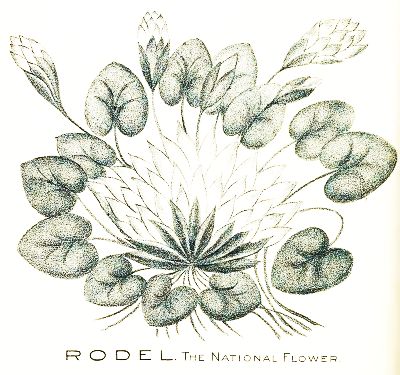
RODEL. The National Flower.
Genessano—This is the rodel, the beauteous flower whose delicate perfume is considered far more exquisite than that of any other of the many fragrant blooms of Ento. With fervent prayers to Andûmana̤'s Messengers that, through loving deeds and duties fulfilled, its life may be made as beautiful as is the heart of the rodel, its unfolding buds are placed in the hands of the newly created infant. Bridal and other special ceremonies are graced by its peerless loveliness, and its snowy blooms cover from tear dimmed eyes the pallid faces of the beloved dead. Also it symbolizes Life and Death. In early morning its opening chalices turn their hearts toward Andûmana̤'s rising abode, their sweet fragrance ascending as an Offering to Him Who is the Source of all life. At close of day its white petals fold themselves over its golden heart and it sleeps the sleep of death, for it blooms but a day, ere its sweet life ends. Look into its heart and you will see a golden representation of the shining rays surrounding Andûmana̤'s glorious abode, hence it is regarded as a Divine Symbol, and in a sense it is idolized, or perhaps I should say reverenced as being possessed of Sacred qualities. Where nature has not provided suitable conditions for its growth it is artificially cultivated; besides, the matured buds are shipped all over the Planet, so that no occasion need lack the office of the Sacred flower.
Gentola—Many thanks for your interesting information. To me all flowers are more or less beautiful; these are especially so. What immense leaves and how oddly pretty their frilled edges are, and they stand up in a rim all around the—— Oh, my, Bernard, look at that droll little creature blinking at us from that large leaf. What is it, De L'Ester?
De L'Ester—If you should come across one of its kind on Earth probably you would call it a frog. Genessano may have another name for it. Brillo? That is rather a nice name for the comical looking creature. Ah, there it goes headforemost into the water, and now may be relating to its comrades its narrow escape from the clutches of some strange looking beings. Observe how substantially these canals are walled. The masonry is about six feet thick and impenetrable by water, and at intervals spaces are arranged for the growing of rodels and other plants of an aquatic nature. The Entoans, universally, are flower lovers; so, in your next Re-embodiment, you will find other inducements than grapes to tempt you to become an Entoan. We will ascend a little so that we may command a better view of the city. Yes, the scene is very attractive. The canals are alive with passing boats, and overhead are Transports coming or going.
You have observed the immense basin wherein a number of large river vessels await their turn to load or unload their freight. Those numerous small, heavily laden boats are the carriers to or distributors for the large vessels which, of course, could not navigate the canals. An admirable feature of Entoan cities is the absence of avoidable noises, haste and confusion. Always the people work in harmony, each respecting the rights of their neighbors, and all intent upon doing their duty, thus honoring their calling and themselves. Back of their harmonious relations with each other is the intelligent force of a Spiritually evolved people, expressing itself in elevated thoughts and aims, and in the beautiful in art, architecture, industry and thrift, which ever are the concomitants of properly adjusted social relations and of an intelligent sense of duty. The Entoans consider idleness so utterly at variance with right conduct as to be disgraceful and not at all permissible, save in cases of disability. Although they never have heard that Satan finds mischief for idle hands to do, they have learned that idleness is the begetter of all manner of social corruption, so, sternly it is frowned out of Ento's code of ethics. What is known on our planet as the social evil, which, indeed, is a condition of undevelopment on a level with mere animalism, long, long ago, through their ever increasing Spirituality and consequent refinement, was, by the Entoans, outgrown. Even by persons least observant of social niceties, strictest chastity is practiced. Yes, Ento's religion demands chaste conduct; but, aside from that, the Entoans have evolved beyond mere animalism. Idleness is a vestige of barbarism, and inevitably it begets vicious tendencies and vicious abuses of natural functions; hence it is all important that the law-makers of a people shall not only recognize the importance of this fact, but that also they shall in themselves furnish fine examples of honesty, industry, chastity and temperate living, which, alas, generally they do not. Our acquaintance with the peoples of various Planets affords us wide opportunities for observation of their modes of thought and habits, and wherever we have found degradation of the sacred function of procreation, we have found a corresponding lack of Spirituality, and of all ideals constituting the basis of true civilization, which invariably is the reflection of the degree of Spirituality of peoples who never are truly civilized until they recognize that the human body is a temple for the indwelling of the holy Spirit, the God-man.
Now we must turn our attention elsewhere. It will not, I think, be amiss to devote a short time to an investigation of yonder mercantile establishment, so that you may compare it with those of—well, of your city of St. Louis. You perceive that the structure is seven stories in height, and its frontage is quite two hundred feet, its depth about the same. Enter without hesitation. You are not yet quite accustomed to the fact of your invisibility. Including the interiors the entire structure is of stone and various metals, rendering it fireproof. Those elevators, swiftly carrying patrons to the various floors, also are entirely of metal. Yes, the lightweight metal metszû.
These plant spaces surrounding the fountains are quite attractive, and the fountains themselves are exquisite in design and execution. I imagine that they are intended to serve the double purposes of ornamentation and of cooling the heated atmosphere. Observe this one. In the centre of the basin, on an ornate pedestal, is poised the graceful form of a lovely, smiling girl, holding in her arms and outreaching hands a mass of blown rodels and buds, whose long, slender stems and frilled leaves seem to float on the water. From the hearts of the full blown flowers jets of crystal water are thrown nearly to the lofty ceiling, thence falling in silvery spray over the upturned face of the girl and her armful of rodel blooms. The rim of the marble basin is a composition of rodel blooms and foliage, as perfect of execution as is the marble form of the girl or the lifelike blooms she holds in her arms. Here is another basin in which is a great white marble vase filled with growing aquatic plants and grasses. Around its rim, at intervals, are sculptured water fowls from whose bills fine jets of water are thrown upward, falling downward into the vase and basin like a gentle shower of rain.
There are four fountains, and the basin of the next one is shaped like a shallow fluted shell, in which is a group of semi-human, semi-fishlike creatures of a mythical character. Oh, yes, the Entoans, like all other peoples, have their myths. Genessano may enlighten us as to the meaning of these nondescript creatures, whose present occupation is throwing a bewildering number of tiny streams of water in such a fashion as to partly conceal their lovely faces and fishlike forms.
Genessano—It is a very ancient story, and reckoned something more than a myth, that once in a remote time a mother and her three children fled from one who sought to destroy her and them. Being closely pursued, she cried to the Gods for succor, and with her children sprang into Indoloisa̤. The Deific Ones, compassionating her and her children, metamorphosed her and them in such a manner that easily they eluded their pursuer, who, in his fury, still sought for them, but the avenging Gods raised such a tempestuous storm that quickly he and his followers were destroyed. I recall that during my childhood, when storms swept over Indoloisa̤'s bosom and the moaning winds sounded like wails of distress, it was a common saying, "Ah, Rinahdo, the cruel one, pursues Noyna̤ a Vonna̤ and her children," and our mother would shelter in her loving arms her two timorous boys. This group commemorating the legend is, of course, purely fanciful, and the smiling mother and her laughing children are very unlike what my childish fancy used to conjure into something terrifying. This fourth fountain also illustrates a mythical legend, but it is not so regarded by my people.
In the centre of this beautiful flower rimmed basin is a mass of large leaves of a heart shaped growth. Up-springing from them is a long and strong stem, bearing two great, many petalled flowers, from whose hearts are rising with outspread wings, two softly plumaged birds, each one carrying in its beak a bud just bursting into bloom. Our Sacred Writings declare that out of Himself Andûmana̤ created and caused to come forth from the buds the infant progenitors of Ento's children. That at His command the Gods so assiduously cared for the infants, that with miraculous quickness they grew to maturity, and in time their offspring peopled Ento. Since most ancient times this myth has been perpetuated in sculpture, painting and in religious ceremonies.
De L'Ester—This story of the origin of the Ento human is no more absurd or illogical than are legends of the same nature of peoples of other planets, who cling to senseless superstitions because they are yet too immature to perceive the truth.
Now, Gentola̤, you will speak of whatever may interest you.
Gentola—Where everything is interesting it is difficult to choose, but certainly this great structure is worthy of notice. The roof is composed of four great domes, filled in with plates of glass, so transparent as to not obstruct the light, which falls through shades so adjusted as to permit the sunlight to fall only on the groups of plants and fountains. To me the whole interior, including the displays of the various wares, appears very admirable. As we pass from one department to another I scarcely can realize that we are not in some similar establishment on Earth. Here are textile goods whose coloring, weave, designs and quality equal, if they do not surpass, any fabrics I ever have seen. After all you have said to me relating to the universality of substance, the homogeneity of the mind of man and of the natural and inevitable results of certain universal laws, perhaps I should not express surprise to find here silks, satins, velvets and other fabrics very like those of our own Planet. Here, too, are woolens of a great variety of weaves and colorings, but I do not see any black goods of any kind.
Genessano—To the Entoans black suggests darkness, for which they entertain a positive aversion, and darkness suggests death, the ever present terror of their lives. Black, the symbol of death, is never worn or used in any avoidable manner. You may not have observed that in the homes of the people lights ever are shining. Light being the symbol of life, on every home altar a light burns perpetually.
Gentola—As I have been on Ento but twice during the night I had not noticed the custom. A dread of darkness may to some appear rather childish, but I can sympathize with the Entoans, for I have an intense dislike for darkness. In the absence of light, I cannot locate myself. I feel as though I were drifting through illimitable space, and the sensation is excessively disagreeable. De L'Ester, can you explain this mental condition?
De L'Ester—Not now. I merely will say that you lack what phrenologists term locality, which will account for the fact that always you are getting lost.
Gentola—That is true. At present I am lost in admiration of the very attractive garments worn by Ento men and women. I know that I never again will desire to wear the close fitting, ungraceful clothing I always have worn. See that stately woman whose inner-robe outlines her superb form, yet is modesty itself, and the over garment, loose, but extremely graceful of cut, has such an air of distinction that it seems to me any change would detract from its beauty. Oh, yes, indeed, I greatly admire the manner in which the Ento women wear their abundant waved or curled hair. The fillet is far prettier than any millinery creation.
Dear me, what exquisite laces. As delicate as gossamer and of such lovely designs. I profoundly admire fine laces, and am a fair judge of their qualities, especially handmade laces, and these in texture, designs and workmanship are as fine and beautiful as any I ever have seen. Here, too, is a display of embroidery, which is surpassingly lovely. I perceive that in their production gold, silver and silk threads in a great variety of colors are combined harmoniously and most artistically, and here are bands in which the flowers are simulated by minute stones closely imitating the natural blooms. Yes, frequently I have observed robes of both men and women bordered and trimmed with such embroidery, and—no, it does not make the men appear effeminate, quite the contrary. I cannot attempt a detailed description of this adjoining department, devoted to an endless array of articles for the toilet. Should I do so, certainly my Earth friends would laugh at such an exhibition of my vivid imagination. Quite as certainly I would not find fault with their incredulity. I, however, will say that I find here combs, brushes, manicure implements, perfumes, soaps and an endless array of articles whose uses I only can guess at. Could some of our Earth folk walk into this establishment, which they would term a department store, they, like myself, would find themselves amazed, not so much by the strangeness, as by the familiar appearance of a thousand and more articles.
De L'Ester—Do not forget that in the universe there is but One Mind which must everywhere express itself harmoniously, and you will cease to marvel at many things.
Ah, George is experimenting and Genessano looks on with curious interest. Mon ami, what are you attempting?
George—I am trying to find out if any of these salespeople are Sensitives. Ah, my gentle sir, as you look about you seeking to learn who has spoken to you, your dreamy eyes are opening wide with surprise. Genessano, through Gentola̤, address him. I fancy that he does not understand English.
Gentola—Emano, ra̤ûdossa̤ illûma̤ voi hûa̤. Voiha istan finostû tsoina̤.
George—He grows alarmed, but stands in an attitude of intense attention.
Gentola—Oûna ûfan yoidas ēmano. Info oovistû.
George—Now he is thoroughly alarmed and rushes away, exclaiming, "Zēmos, Zēmos, dēlûsa ilmo evantos." His comrades and the people stare and question as to the cause of his alarm, and two young men have gone after him, evidently thinking him attacked with sudden illness. Very certainly Ento possesses many Sensitives, and when the Spirit Worlds shall have succeeded in changing the positive conditions surrounding them they will become amenable to Spirit Control. What did Genessano prompt you to say to the youth? In effect you remarked, "Friend, the weather is fine." Then you asked, "Do you hear what I say?" Then you added, "Be not alarmed. Info oovistû." Evidently he did not heed your advice, and certainly he does not desire further acquaintance with you, for his cried to Zēmos, a god, to protect him. The experiment being concluded, I shall not further interrupt you.