Front matter (continued 2)
Reading edition
Observe, now, this central marble shaft, which rises nearly to the domed roof. Both base and capital are sculptured masses of grains, fruits and flowers. The surface of the shaft is divided into sections on which are engraved names and brief records of departed Entoans. Above each legend is a head in bas-relief, and so well executed are these images of the dead that one can easily determine as to age and characteristics of the originals. Through such knowledge of their written language as I possess I shall attempt to gain some information relating to these people of a bygone day.
Muyolos Kalaf and Feniston Inisella were ancestor and ancestress to Inisellēna. Their sculptured faces indicate that they were handsome and intellectual persons and that all lived to a good old age.
Here it is stated that the original of this admirable bust was one Hûyten Dēmos, who was sire to Endoifan Inivos, who became the mother of Rosilla, who in time gave birth to Stivon Izamma, which also was the name of his sire, who was greatgrandsire to Silvano Izam, the present proprietor of the residence we have been viewing. Engraved on this shaft is quite a family history, but we shall find matters of greater interest to enlist our attention.
This edifice in itself is both Istoira̤ and Fa̤va̤ a croidas, where the ashes of the departed are deposited, and in those sealed, ornamental receptacles are the incinerated remains of past generations. Observe the many sculptured forms on this and on the opposite wall. Here is a face, hoary with age, but with a fine, majestic expression, and here are others of the midday of life, representing splendid types of the human.
Here are faces of youths and maidens as entrancing as dreams of love. Of children, too, angelic in their beauty and innocence of expression. Ah, me! Were mortal life the end of all, better to not have been born into it. Think of all that these sculptured faces stand for. Smiling infants, youths and maidens and mature men and women, who loved with intensest devotion and who passed to their spirit world without either hope or expectation of reunion.
All, all lived and loved, joyed and sorrowed and when death came hopeless despair came also. How could it have been otherwise? To live, to love, to die, and then—nothing. This was their belief and is yet the belief of the entire peoples of Ento, whom it holds in a state of hopeless despair, of measureless anguish.
Medium—Have the Entoans never believed in a continuity of existence?
De L'Ester—We have learned that previous to the establishment of the national religion, which largely was based upon their legendary Holy Writings, there were those who entertained vague theories relating to it, so vague indeed that they do not appear to have influenced those who formulated the Ento religion.
You have been informed that planetary influences are controlling factors, accelerating or retarding the spiritual unfoldment of humans of whatever Planet. The influences dominating the Entoans ever have tended toward a positive mental materialism, but their spirituality has conserved and exalted them, thus enabling them to submissively yield to the will of their Creator.
Then, too, there is that in the human which impels him to submit to the inevitable. In agony unspeakable he may for a time rebel, but in the end he submits. Thus it has been with the peoples of this Planet. They have hopelessly, despairingly submitted to what they have considered inevitable. But for them a brighter day is dawning, and is near at hand; the darkness of a hopeless belief ere long will pass away, for bright rays from their spirit realms are irradiating their inner consciousness and death, the dread messenger who ever stands between them and happiness, soon will be known as the angel who will open for them the gateway into a continuous, glorious existence. To their soul consciousness there is yet no visible sign of the coming religious revolution, yet events are so shaping themselves that you shall see this prediction verified; not only see it, but you will aid in bringing it to pass. Ere long you will better understand my meaning; at present it would not be well to say more in this direction.
We might with pleasure and advantage remain here for another hour, but you are somewhat exhausted, and we must act prudently, else we may find occasion for regret.
George alone will attend you on your Earthward journey. Special duties elsewhere demand our immediate attention. To-morrow at the appointed time we will come for you. No, madame, we will not again return to this locality. Adieu.
CHAPTER IV.
DESCRIPTIVE FEATURES.
De L'Ester—With pleasure we salute you, and we are gratified to find you awaiting us. But before starting on our journey I must again insist that you shall protect yourself against interruption. Yes, I see how you are situated, but the fact remains that it is harmful to you to be disturbed. Yesterday, while you were with us, some one attempted to enter your apartments. The locked doors prevented the intrusion but you were so disturbed that it was all we could do to keep control of you. It is not well that you shall be suddenly called back to your physical body. It injures you, and is a great disappointment to your comrades. Cannot you take further precaution against intrusion?
Medium—I do not see that I can. I fully realize that it harms me to be disturbed, but at times I cannot prevent it.
De L'Ester—Well, what cannot be cured must be endured, but we shall hope that you may be left in peace to-day. Your sister Inez accompanies us, and desires to speak to you.
Inez—Dear sister Sara, I bear greetings to you from many loved and loving ones, who, with delight and boundless interest, watch the progress of our mission of loving endeavor to which you and many other devoted ones are for its accomplishment applying such talents and energy as are at your and their command. But our Counsellor and guide grows restive, and we must not delay our journey.
De L'Ester—Now, madame, we are ready for our flight to Ento. Compose your too active soul forces and trust yourself unreservedly to our care. George, we are a little late, so will make a hasty passage. Upward now and outward. More swiftly than the lightning's flash cleaves the sky we are borne on this wondrous magnetic ocean which knows no shore but is as boundless as the universe and changeless as God.
In grandest, sweetest cadences ever its magical undulations are murmuring, "Glory to the Highest! Glory to the Highest!" and angel choirs innumerable join the glad pæan, "Glory to the Highest! Glory to the Highest!" Ah, madame, little do or can mortals know of the wonderful existence on our side of life, and in some not very far away time you again will enter the marvellous spirit realms, which language is too poor to describe, and we, with our dear ones who watch and wait for you will meet and greet you on the threshold of two worlds, the spiritual and the physical.
Yes, madame, we are nearing Ento. Lower, lower, George. That is well. We will move slowly, so that we may closely observe such scenes as may come into view. We now are about 1,400 miles north of the equator, and below us is a mountain range of no great altitude. The height of its loftiest peak is not over 3,000 feet. Those rugged heights are but the vestiges of snow-capped, cloud-piercing giants of bygone ages. Yes, in that shaded cleft is some snow, and to mortal sense the air here would appear quite cool. Lower still, George. Madame, look downward now, for beneath us is the deepest canyon on Ento, but in either area or depth it is not to be compared with many such formations on our Planet.
George, we will alight near the margin of the stream.
Medium—What a quiet, solitary spot.
De L'Ester—It is indeed a quiet, solitary spot. Here is a scant growth of grass amid which are some tufts of flowering plants and on yonder rocky elevation are some low-growing shrubs and stunted trees. From its base upward the mountain's side is worn into deep fissures, partly screened from view by shrubs and several species of conifera. There is no sight or sound of bird or bee or of any living thing. From the rocky ledges tiny rivulets of sparkling water trickle downward, finding their ways to the level and into this limpid stream. From yonder cleft in the mountain side a volume of water gushes with such energy that as it strikes the ledge lower down it is dashed into silvery spray whose myriad drops fall into the deep, dark pool whose over-flow is tributary to this stream, which flows southward, then eastward, finding entrance into an underground channel at the base of the mountain, where it too curves outward, thence debouching on the further side, where it is joined by other streams, all flowing into a small but pretty lake, which later on you shall see.
Madame, you are silent. Does the quiet of this solitary spot oppress you?
Medium—Friends, I feel absolutely dazed. I had thought to find everything on Ento altogether unlike anything on Earth, yet here is water and there are tufts of star-shaped white and pink flowers very like some I have seen on Earth. Then see those pretty purple flowers, so closely resembling violets, and on that elevation and up the mountain's side are shrubs, trees and vegetation so very similar to growth on our own Planet that you will pardon me for saying that not only am I surprised, but in a sense am disappointed. No, George, I did not imagine that I should find either people or trees growing upside down, but I did imagine that surely there must exist more striking dissimilarities between the life expressions of this Planet and our own. Such speculations relating to it as I have become aware of have led me to expect something very different from what thus far I have observed on Ento.
Von Humboldt—Madame, with your and our Counsellor and guide's permission, I shall say that since I have been not of Earth, I have journeyed far and have looked closely into nature as expressed on many habitable Planets, and I have learned that everywhere Infinite, Intelligent Energy is manifested in strikingly similar ways. You have been told that the homogeneity of matter is universal. That the qualities of metals of all Planets are exactly the same and that the constituents of water never anywhere vary, neither do the crystallized forms of either ever vary. So it should not surprise you to find here water quite as palatable as the sparkling beverage of our Earth-world.
Of course their relative positions to, and their distances from central Suns, occasion differences in the bodies of Planets, particularly as to their density; then, too, in accordance with conditions, atmospheres vary as to being rarefied or dense, humid or dry and so on, but life germs of fauna and flora ever are the same, and given like or similar Planetary conditions their expressions will present more or less close resemblances. Yes, environments occasion differences, but environments are the results of Planetary conditions. But that is too comprehensive a question for present consideration. At another time we may recur to it.
The physical and atmospheric conditions of Ento and Earth being so much alike, naturally their Fauna and Flora must present mutual likenesses. As for chemical affinities and their unvarying expressions, they are universal.
As has been said to you the universe is indeed a unit. Everywhere Infinite, Intelligent Energy seeks to express itself not only in harmony and beauty, but along the same lines, and ever toward a state of perfection, beyond the highest conception of Spirit or mortal, for who can conceive an idea of that which is known by many names, but whom you name God? From my own observation and through association with spirits of advanced spheres whose mission, like my own, is Planetary research, I can say with assurance that among the life expressions of all sufficiently evolved Planets there is what may be termed a universal homogeneity, for while there are dissimilarities there are equally close resemblances which may be expressed as unity in variety.
As to man on Ento, Earth and other Planets, we find our brethren so like ourselves that, logically, we all must claim the same origin. Yes, madame, I do assure you that in limitless space there are myriads of worlds, varying as to bulk, density, and atmospheric conditions, but in other respects so like Ento and Earth as to present fauna and flora very similar to those of either Planet. They are peopled by humans like ourselves, in various stages of evolvement, and all, like the peoples of Ento and Earth, are engaged in the endeavor to solve the problem of eternal progress. Between those on the lowest and those on the loftiest heights of progress on different Planets, the intermediate stages represent man in all degrees of evolvement. On some Planets I have visited, man,—the human animal, slowly, through ages,—has pursued his certain way, toward the period in which he is destined to become a Spiritualized being, and now the hairy, unshapely limbed creature who scarcely walks erect, with face full enough of the mystery of existence to startle one, approaches nearly the line of demarcation between the human animal and the Spirit man.
On other Planets, compared with man on either Ento, or Earth, the spiritualized human is as a god.
If what I have said may suffice as replies to your questions and remarks, or may in some measure reconcile you to the close resemblances between features of Ento and Earth, I shall account myself more than fortunate.
De L'Ester—Thanks, Von Humboldt, for your timely remarks, which we hope may lessen madame's regret at finding Ento so like our own beloved Planet, and its human denizens so like ourselves,—with but one head, two arms, and as many legs. Madame, I but jest that I may bring a smile to your perplexed face. Since I have accomplished that I feel that I may hope for pardon.
Aside from affording you a general idea of the varied formations and scenery of Ento, we have a special purpose in bringing you to this spot. We desire that you now shall closely observe these rose-colored, lily-shaped blooms, whose long slender stems springing from tufts of dark green, glossy foliage are crowned with a profusion of the pretty, dainty flowers. As they will be used for one of our illustrations, I will give their Ento name—which is Loisa̤ yanû, in your language water gems or jewel. These compact masses of prettily leafed plants with their numerous white, star-like blooms are named Oina̤ mista̤. Oina̤ signifying lamp and mista̤, snow. You will remember that to the Entoans the shining points in space are the lamps of Astranola̤, hence Oina̤ mista̤, or snow lamp.
Yes, these purplish blue flowers, almost hidden by abundant foliage, in form, color and fragrance are very like Earth's wild violets. Entoans know it as Loisa̤ infûen, but you may name it, Water drinker, for that is as near the significance of its Ento name as I can arrive at. Loisa̤ yanû, oina̤ mista̤, and loisa̤ infûen, always are found growing in marshy places, or by the margin of flowing streams.
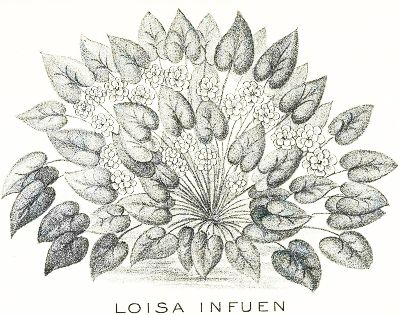
LOISA INFUEN
Now we will learn what yonder elevation may offer. No, it is not an isolated mass. Do not you perceive that on the further side it connects with the mountain of which, doubtless, it is a small spur? I have said that in bringing you here we have had a special purpose in view. In this pretty, flowering plant our purpose stands revealed. Yes, this is The Hinifro enora̤. The yellow wonder which requires so little soil or moisture as to be practically independent of either. When, nearly two years ago, through your automatism, Poole created a copy of it, promising to sometime on another Planet show it to you growing and in bloom, you smiled rather incredulously. As we have fulfilled that promise, so shall all else that we have promised you come to pass.
These densely foliaged trees are known as Oona̤mosa̤ tûla̤. In your language this would signify burr-berry. They seldom grow to a greater height than thirty feet. Yes, they do resemble chestnut trees, but the burrs contain berries, not nuts, and they now are fully ripened. Certainly it could not harm you to taste the fruit, but through its extreme acidity and astringency it is very unpalatable.
We now will examine these pretty shrubs whose dark green, glossy foliage renders them quite attractive. The fruit has a luscious appearance but is unfit for human food. Its Ento name is Gûfon litza̤, which I shall translate into Bitter sweet. Once Inez was curious enough to taste this fruit and very much to her discomfiture. As you are aware, your sister was a still born child, consequently her mortal education has been acquired under such difficulties as you, in your present state, little comprehend. Being of an inquiring turn of mind she investigates for herself, at times gaining information at some cost, which makes it all the more valuable.
Inez—De L'Ester, I owe you thanks for regarding my overweening curiosity so leniently. I confess that I am of a very inquiring turn of mind, but since largely through this means I acquire necessary mortal experiences which, through my premature return to the spirit side, were denied me, I feel assured that your forbearance will condone what may amount to a fault.
De L'Ester—Inez, dear friend, I did not mean that my brusquerie should occasion you even a passing thought. Pardon me if I may have caused you a suggestion of pain.
Inez—Pardon is not a word that should pass between two such close friends as are we. There, I offer you my hand with my heart in it and thus the fancied wound is healed.
Medium—De L'Ester, George, what a strange looking animal is emerging from that cleft in the mountain. What an ungainly, ugly creature and what vicious looking eyes it has.
De L'Ester—Really, the creature is as much a surprise to us as to you. As none of us have seen its like on Ento, we must conclude that it belongs to a nearly extinct species. That it is of the marsupial family is apparent. Its structural formation, hair and other characteristics are those of your American opossum, but its size is much greater than that of those creatures. I should say that it is quite two feet in height, four in length, and its weight not under one hundred pounds.
As it comes this way sniffing, grunting and rooting under the leaves for the fallen fruit of the Oonamosa tûla̤, it impresses one with the idea that it is an ill-tempered, pugnacious animal. When our Ento spirit friends join us we may learn its name, habits and so on.
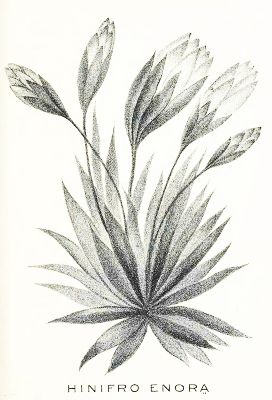
HINIFRO ENORA̤
Although we twice have visited this canyon we have not, until now, seen in it an animal or bird of any kind, but we have been informed that during the mid-summer season of this latitude a species of water-fowl comes here for breeding purposes, but that as soon as their young are able to fly they migrate to other regions. We know that very recently they were here in considerable numbers, now not one remains. Earlier in the summer the canyon produces a harvest of wild grains, and those low growing shrubs bear an abundance of fruit which affords them subsistence.
Madame, you perceive that the mountain curves toward the east; now look quite to our left and you will observe a rift in it extending southward. Once when George with these and other friends were examining this region they discovered an opening in the rift, leading into a cavernous formation which they consider worthy of observation. As neither Inez nor I have yet seen it, we will share with you whatever of interest it may offer. George, you and Inez will lead the way, and I shall have the pleasure of assisting madame.
Yes, the entrance is somewhat forbidding. We will remain here while George lights up the interior. How? Through the ignition of elemental substances. Sooner or later all Spirits learn the laws of chemical affinities. It is a simple matter, the production of molecular combustion. We now will proceed.
This rather low and narrow passage widens as we descend, and now terminates in this vast chamber, which truly is wondrously beautiful. Stalactites depending from the lofty ceiling meet upspringing stalagmites, forming seemingly endless rows of columns, united by snowy arches so singularly perfect in their outlines as to present a spectacle strangely, weirdly, marvellously lovely. In this soft radiance columns, arches, and walls appear as though incrusted with countless, many colored jewels, whose splendor might bedim the rarest, costliest gems worn by Ento's or Earth's rulers.
We now will approach more nearly yonder grotesque formations, which certainly are very remarkable. Sufficiently so to suggest a sermon on what some learned persons might term unintelligent energy in unintelligent matter. Be not alarmed, friends, though in these peculiar formations there are many sermons of a nature to arouse earnest inquiry; at present I am not in a mood for sermonizing but I must say that they positively are startlingly strange. One readily can imagine them animal forms of some far away age whom suddenly death stilled into immobility, leaving to pitiful nature the kindly office of enveloping them in snowy winding sheets.
In this spacious niche is another group, apparently composed of the forms of a man, two females and the torso of a child, all so admirable in outline, pose and drapery as to suggest the skill of an able sculptor. It, indeed, would require uncommon artistic ability to surpass, or even equal the grace of this snowy group.
Here is another formation still more wonderful than those we have been observing. George, you have done well to hold in reserve this masterpiece of nature. It really is marvellous. It is as though some weary mortal of a past age laid down to rest, Death coming this way blew upon him his icy breath and froze him into perpetual silence, then gently enshrouding him in purest whiteness passed on, leaving him to the peacefulness of endless sleep.
How many years have elapsed since nature began these strangely beautiful formations? Who can say? Not I, madame. Such a lapse of time is inconceivable. But we know that here, during an unrealizable length of time, from dripping water charged with lime, atom has been added to atom and thus the stupendous wonder has grown, grown in darkness, and silence, and never have any but Spirit eyes gazed with admiring awe upon the splendor and loveliness of this scene which naught but Infinite, Intelligent activity could create.
On no other Planet have we found formations of this nature excelling these, seldom have we seen them equaled. Those arched openings invite us into other divisions of this underground fairyland. We will enter this chamber on our right. These formations differ somewhat from those we have seen, but are quite as beautiful. See how those great stalagmites, singly and in groups, unite themselves with the white loveliness of descending stalactites, all apparently forming a gateway to a veritable garden of snow trees and vegetation, the drooping branches laden with blossoms and fruit, forbidden fruit, we may conclude, as between it and ourselves there is a swiftly flowing stream. What do I think of the Biblical legend concerning Adam and Eve? Madame, my opinion is, that had the mythical garden been as beautiful as this the commendably inquisitive Eve would have been content with the prescribed diet and the amiable Adam would, to this day, be promenading under the Edenic trees. One is tempted to linger in this strangely beautiful spot, but we must pass on.
We pointed out to you that the stream traversing the canyon entered an opening, at the northern base of the mountain; it is the same stream now rushing by us toward an exit at the southern side of the mountain, thence into the lake of which we have spoken. We now will cross it to glance through other portions of the cavern, some of which, George says, are not greatly unlike those we already have explored.
Medium—Although I have not seen them, I know that on our Planet there are formations similar to these; may I ask are such formations features of all Planets you have visited?
De L'Ester—Yes, of all Planets sufficiently aged. Do not you remember that on our moon we once showed you a cavern similar to, but not nearly so extensive as this that contained stalactites and stalagmites too, but of rather diminutive proportions? You also may remember that we demonstrated to your satisfaction that there was a time when Luna was capable of and did sustain many life expressions of both fauna and flora, but that now the internal heat of the little Planet is so nearly exhausted that but a limited number of peculiar life expressions survive the rigor of its extremely low temperature? The history of a planet may be likened to that of a human. In the case of the Planet, birth, growth, maturity, with a gradual but unceasing withdrawal of vitalizing heat and energy, which finally must culminate in the extinction of all its life forms, aye, of even the cohesive energy which has so long held it in form, followed by inevitable disintegration of its atoms which are the building material of new worlds.
The parallel history of the human includes birth, growth, maturity, then gradual withdrawal of vital energy, during which the heart beats respond less vigorously to the crimson current which flows more and more sluggishly and the history draws near its conclusion. The extremities grow colder, colder, animation dies out of the expressive features, the eyes grow dim and sightless, pulseless, breathless, lies the mortal body, but it is not dead. No, no, there is no death. Life is in every atom of the universe and the disintegrated particles of the physical body afford material for new life expressions, while the freed Ego, the ever conscious, cohesive, vitalizing spirit force which held the mortal body in form assumes other and higher relations and thus revolves the wheel of evolution whose circumference is the universe, whose centre is God.
Madame, you are so given to asking questions and I to loquacity that we too much delay our progress. Your pardon, friends, for having kept you waiting. Now we will move on. Yes, it would be rather difficult for even a diminutive mortal to penetrate this passage which now widens and grows loftier, and now we have reached the last of the series of caverns. Gradually we have been descending and now are far below the level of the entrance and on the brink of a deep and narrow chasm. No occasion for alarm, madame, but to reassure you we will join hands. Inez, you will take your sister's right hand, giving your right hand to Humboldt. I will hold your left hand, madame, and Agassiz, with George, will precede us. George, you will be good enough to light us down the abyss. Yes, it is a tremendous chasm, but here we stand, safe and sound, and you perceive that there was no danger. It is too much to expect that, while you yet are on the physical plane you will wholly free yourself from apprehension. Indeed, we have experienced some misgiving as to the amount of courage you might exhibit on occasions to which, during your mortal existence, you must be unaccustomed.
George, as you are acquainted with this uncanny locality, I desire that I now may stand aside while you shall act as guide and I suggest that you shall say to madame something relating to our mission. Your discretion will limit your statements.
George—You, madame, have been informed that certain Spirits being aware that you possessed such qualities as gave promise of a peculiar phase of mediumship, suited to a special purpose, have since your birth, been endeavoring to prepare you for it. With measureless patience and loving care they have guarded and guided you, sometimes by straight, ofttimes through devious ways, but ever toward a definite end. Finally it became possible to control you for our purpose and I, with Von Humboldt, Darwin, Agassiz, Bulwer Lytton, Giordano Bruno and others of our band traversed Ento, with the purpose of arranging a programme against the time when we should have you with us. As unfavoring events may oblige us to accommodate our movements to such circumstances as may occur, we do not anticipate that our programme will, in its entirety, be carried to its conclusion, but to that end we all will do our utmost, and we feel assured that Divine influences will aid us in our mission which, as yet, you but slightly comprehend, but which in time will unfold itself.
One purpose we have in view is to show you much that will be of interest to you, through whom we hope to bring to the peoples of our Planet the positive knowledge that the neighboring world, about which they are so curious, has much in common with Earth.
Yes, it is matter for regret, that much concerning our journeys and mission must be left unsaid and that necessarily the written account of our experiences must be somewhat sketchy, otherwise it would be too voluminous for the average reader's patient perusal.
Through some Ento spirits we learned of the existence of these great caverns and of a very unique spectacle which, presently, we will observe. This one is much larger than any of those we have examined and, as you perceive, it contains no formation to break its immensity. We are about eleven miles distant from the outer entrance and quite one thousand feet below its level. A half mile further on will reveal the cause of this continuous vibration and the tumultuous detonations which resemble the discharge of artillery. Thanks to our spirit condition, we are invulnerable to the condition existing here, else we would not dare to approach the fiery horror we are nearing.
The roaring of ocean's storm-tossed waves is as nothing to the sounds breaking upon the stillness of these cavernous depths; but fear not, madame, for with safety you may, with us, approach a scene so grand, so appalling that you are not likely to ever forget it.
We now are in another great cavern whose floor slopes abruptly to this precipitous elevation and, standing on its edge, we look down upon a very hell of tumultuous flames. Yes, lacking a stirring feature or two, it easily might hold its own against Dante's "Inferno."
Look, now, away toward the left where is bursting forth a huge column of flame. Up, up, toward the vaulted roof it climbs, twisting, curving, writhing like a gigantic serpent; now it slowly sinks downward and is engulfed. Now in the distance a storm is raging. See how the fiery billows are rising; higher, higher, leaping and curving their angry crests they madly rush toward us as though they would overwhelm us and as they burst against this precipice, involuntarily one shrinks back from their hot, mephitic breath.
Observe that pyramidal fountain near the centre. Is not it grandly, wonderfully beautiful? See how it forms itself into a rose shape, while from its heart numerous jets shoot upward. A moment and it is gone and all over the surface of the fiery lake myriad fantastic shapes of many hued flames are glowing, scintillating and projecting themselves toward the lofty roof, forming a magnificent pyrotechnic display.
The noise is indeed deafening and the ever changing spectacle so awe inspiring that words cannot adequately describe its terrible, but wondrous beauty. Truly, silence is at times golden.
Medium—Still, I should like some one to break the silence by an explanation of this, to me, strange phenomenon. Is it volcanic?
Von Humboldt—One does not desire to long remain in proximity to this underground conflagration, for, madame, that is what it is. Not for one moment could a mortal live in this mephitic atmosphere. As you perceive even Spirits are, to a degree, sensitive to it. As we return toward the upper world I shall briefly explain to you the origin of the truly wonderful spectacle. We have reached the cavern at the bottom of the chasm and if it may please you, friends, we will pause here while I shall attempt to satisfy Madame's laudable curiosity.
All over Ento in certain localities, are deposits of the various coals of sulphur, of naphtha, of natural gas, and of such mineral formations as are found on other Planets, and since remote times coal, naphtha, natural and manufactured gases as fuel and for lighting were universally used. Then came a knowledge of applied electricity, and with this knowledge a disinclination for the old, cumbrous methods of heating and lighting, and ere long, save in rural localities, electricity became almost the sole illuminant and heating energy, and coal as fuel fell into disuse; but for certain uses, to a limited extent, it yet is mined.
The region in which, for a period equaling nearly twenty years of your time this conflagration has been raging, contained vast stores of bituminous coal, sulphur and naphtha. Through some mischance a colliery became ignited, and ere the danger became apparent, the fire was inextinguishable. A large area has been burned out, extending to the southern base of the mountain where the fire burst into the immense cavern which holds, as in a basin, the terrific, raging, incandescent volume of heterogeneous matter. As the coal deposit extends no further than the base of the mountain and other inflammable materials involved finally must become exhausted, we may conclude that at no very distant time the conflagration will die out. Soon an opportunity will be afforded you for observing the devastation it has wrought elsewhere.
Madame, you owe me no thanks. It is both my duty and my pleasure to contribute what I may to the interest of our undertaking.
Medium—May I ask if you still are interested in such researches as engaged your attention while in earth life?
Von Humboldt—Madame, the bent of mind which, during earth life, has impelled mortals in certain directions or toward special pursuits, is an inherent part of each individual. Entering upon an advanced plane of existence I found myself possessed of the same inclinations and traits as formerly characterized me. The same may be said of our friends, Agassiz, Darwin, Bulwer Lytton, Bruno and others of this Band. The chemist, the mathematician, the geologist, the naturalist, the astronomer, the mystic each is true to his inherent traits or tendencies. When freed from the ills and cares incident to mortal existence, with quickened senses and desires, with enlarged abilities and the universe an open book in which all who strive for attainment may learn to read the wondrous story written by Infinite Intelligent Energy, strange, indeed, would it be did not these and all aspiring Spirits in time acquire a larger knowledge of such arts, sciences or pursuits as dominated their lives on the physical plane.
In contradistinction one must use such terms as Spirit, mortal, spiritual, physical and others. Yet, substantially, they all are states of being. Spirit, per se, as we understand it, is the vitalizing, unchanging principle which expresses the infinite, intelligent, indestructible, unvarying, all pervading energy and in every atom of the universe this indivisible spirit is manifested. As without substantiality there can be no existence or state of being, conclusively, spirit is substantial and all entities or individualized expressions of substance hold within them the spiritualized potentiality of evolution or growth. And, as in each individualized expression of substance there is a quality which may be termed plasticity, it follows that through inheritance and environment entities evolve in various directions, thus manifesting the scientific, the artistic and other tendencies.
Yes, the spirit body is as substantial as is the physical body, but of a finer expression of substance. You now are apart from your physical body, yet you are conscious that your spirit body is substantial, and where there is consciousness there is being, which is but another name for spirit. I may add that there is not an atom of the universe that is not, in a certain sense, conscious, hence, in a certain sense, individualized and intelligent.
I am aware, madame, that I have answered your questions in a superficial manner; at present I cannot do otherwise.
Our chemist is ready to light our way to the outer world and you will allow me to assist you. As we proceed, I shall, with your permission, relate a past personal experience.
Age and infirmity came to me as it comes to many, and the hour of my departure from earth life drew near. For a time I had lain apparently unconscious, though really I was fully alive to all that was transpiring about me, and gradually, yet with a certain suddenness, I experienced a most peculiar sensation. I felt as though I were ascending what seemed to be a rift between walls of adamant. Darkness so profound I never before had experienced and, in some perplexity, I reached out my hands and groped blindly, hoping to touch something that might indicate my whereabouts; but in vain. The sensation of being between two walls continued and I felt myself ascending, ever ascending. I do not recall that I experienced a sense of alarm, but in an indolent fashion I queried as to what the peculiar sensation might mean. Certainly, I did not associate it with the change called death. Suddenly, as we now come into the sunlight, I emerged into a soft radiance, indescribably, gloriously beautiful, and in great surprise I looked about me, seeing nothing but the soft radiance which wrapped me about as with a garment. Great as was my surprise, I at once began to wonder where I was and as to what had occurred to me. Was I dreaming? Was I delirious? No, I was fully awake and in possession of all my senses. Yet something unusual had occurred. Surely I had not died. No, that could not be, for here, I said, is my body, and I am as alive as a man can be. Perceiving that I could move about through the bewildering, unaccountable radiance, I began to investigate my surroundings which, imperceptibly, had assumed an air of strangeness. Imagine, if you can, my amazement when, after a little, I found myself standing near my old, worn body over which friends were tenderly bending, closing its wide open, dim eyes, smoothing its scant locks, and otherwise preparing it for its last resting place.
As spellbound I gazed upon the pitiful scene, I felt, rather than saw, some one near me. Turning, I, in great surprise beheld a company of radiant beings, who called to me in joyous tones: Alexander! Alexander! We have come to meet and greet you; come with us, come away from this Sorrowful Star[1] to our glorious spirit realms.
In a moment I recognized dear, long-lost friends of my youth. In a moment I was in the embraces of my parents, no longer aged, but glowing with life, with love, with the beauty of immortals. There were my nearest and dearest ones, each vieing with the others in joyous congratulations upon my having been freed from Earth life. All, all with loving embraces and tenderest speech, drew me away from my mortal home to the realms of immortals, the realms which know neither death or hopeless partings.
Has this reminiscence wearied you? No? Then I shall not regret having related it. You, and all mortals, must pass through the change called death. When this change shall come to you the memory of this recital may aid you in your ascent from the physical to the spiritual plane of being.
De L'Ester—Dear friend, you are silent. Nay, you need not tell me why. I read your thoughts, as you might read an open book. True, the change called death must come to you, as it must come to all mortals, yet dread it not, for so frail is the tie between your real self and your physical body that almost ere your physical eyes shall be closed as in sleep, your spirit eyes will open to undreamed of glories.
Now make your adieux, for we must not hold you with us longer. George, I shall accompany you and this somewhat wearied comrade to her home, where approaching night is already enfolding her physical body with darkening shadows.
Across space with the speed of thought we have journeyed. And now commending you to the care of angelic guardians, whose watchful love ever protects you. Au revoir.
FOOTNOTES:
CHAPTER V.
GIORDANO BRUNO.
De L'Ester—Good morning, madame. It gladdens us to find you quite recovered from the exhaustion of yesterday and in such a cheerful mood, and ready for our journey to Ento, which only for a few moments will we delay.
Yes, we propose returning to the locality of our visit of yesterday, from whence we shall prosecute our quest for further experiences. How long shall we hold you with us to-day? For at least three, possibly four hours. All will depend upon your endurance, and may loving angels strengthen and sustain you, for only through your instrumentality can we hope to attain the fulfillment of the emprise so ardently desired by countless hosts of many spirit worlds.
Now, away for Ento. Our swift movement no longer disturbs you? No? We knew that soon you would adjust yourself to it. George, we will descend to the rift in the mountain. You recognize the spot, madame? Yes, that is the entrance to the cavern, and our way lies through this rugged, fern-clad rift to the further side of the mountain. The convulsion which rent it asunder must have been a terrific one. How long ago did it occur? It is our opinion, madame, that it may have occurred at about the period during which our planet was assuming recognizable form, which was so long ago as to be not a matter of years, but of ages.
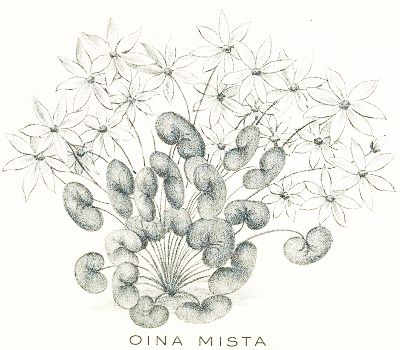
OINA MISTA
As we proceed, the rift narrows into this gloomy defile, overhung by insecure-looking crags, from which, we emerge into the sunlight. What a beautiful spot is this niche in the southern slope of the mountain! It is a veritable flower garden. Indeed, madame, I wish you might bear to your Earth home some of these lovely, fragrant, white star flowers. Yes, they are a variety of Oina̤ mista̤. The tiny stream trickling from the mountain's side provides necessary moisture, and the sun so warms the sheltered nook that the growth of the plants is very luxuriant.
These star-like blooms are fitting emblems of the spirit group of which you and Inez are members. What do I mean? Why, have not you been told that in our spirit realms, as in the spirit realms of all worlds, the law of affinity, holds Spirits in different groups, which are designated by different names? Both you and Inez belong to the group known as Star Angels. Onerous as is your present mission, on your return to the spirit side it will be no less so, for the Star Angels are the teachers of the Spirits who wander in darkness in the Earth spirit sphere, multitudes of whom scarcely, if at all, realize that they have left the physical body, and ever are hovering about the places where formerly they existed. Not alone to those whose mortal lives were passed amid vice and squalor and wretchedness; not alone to those who were the very undertow of the murky tide of human degradation and misery; not alone to these do the Star Angels minister. There are myriads of men and women who have passed, and continually are passing, to the spirit side of life, who have dwelt in luxurious homes, surrounded by all the splendors and delights their selfish, perverted natures craved; having, during their Earthly existence, chosen spiritual darkness rather than light, they reap as they have sowed, and in sorrow and bitter anguish gather up their sheaves of tares. To such unhappy ones the Star Angels also minister.
In the Earth spirit sphere licentiousness, selfishness, uncharitableness, envy, cruelty and all the baser animal passions are the chains which hold the Spirit in bondage. Separation from the physical body makes no change in the status of the physically disembodied Spirit. It goes to its own place, and cannot go elsewhere, until it has earned advancement to a higher plane.
Madame, I should like to make my replies as endless as your questions, but this mutual pleasure must be deferred.
We will now move toward what has aptly been named Moûentos hoa̤ falados, for, truly, it is a desolate valley, made so through the conflagration to which Humboldt has alluded. We will pause on this elevation, underneath which is the remarkable spectacle we recently observed. The roaring, rumbling, hissing sounds and constant vibration of this spot are rather disquieting, but as they can work us no injury we need not hasten our departure. In this region during the winter season there is a heavy snowfall as spring advances, the snow rapidly melts, rains add to the volume of water which pour down the mountain side and into those fissures from which gases and smoke are issuing. The water coming in contact with the fire raging deep down beneath the surface, tremendous explosions occur, casting out such quantities of ashes that, as you perceive, the entire valley is covered as with a parti-colored mantle. Vegetation there is none, and living creatures shun the pestilent locality. Previous to the conflagration the valley afforded sustenance for a large number of agriculturists and others engaged in various occupations. At the further end of the valley we yet perceive vestiges of the wrecked homes and industries of a busy community.
On our right the mountain spur separates this valley from another of about the same conformation and area. We will now pass on to it. George, you will allow me to assist your sister. As you see, madame, the summit of this mountain spur is nearly level. Its eastern side, which forms the western boundary of the Valley of Desolation, is somewhat abrupt, while on the west it gently slopes toward the picturesque and lovely valley at its foot. As this spot affords a fine view of what we desire that you shall observe we will for a little remain here.
Nearly two centuries of Earth time have elapsed since this valley became a solitude. The climate is temperate and salubrious, the soil prolific, and water abundant, yet no Entoan could be induced to attempt to dwell in this ill-fated locality. From Ento spirits we have learned the story of the horror which led to its abandonment. As briefly as possible I shall relate it.
While in the canyon you were told that its converging streams, through an underground channel, flowed into a lake, which later on you should see. Behold the sparkling waters of the canyon, the swiftly flowing stream of the cavern gushing forth nearly at our feet. Observe that several mountain rivulets add to its volume, which empties itself into yonder tranquil, oval sheet of water, which, like a great mirror framed in emeralds reflects in its depths the sapphire sky, and white, ever-changing forms of fleecy clouds.
Previous to its abandonment the valley, which is about seventeen English miles in length, and half as many in width, was for the most part devoted to the cultivation of grains and fruits. For the convenience of those dwelling on either side it became necessary to bridge the little river. Those substantial piers of stone and iron, attest to the dimension and stability of the structure of nearly two centuries ago. Where the river empties into the lake was another and more imposing bridge, and there we perceive a number of great white piers, like ghostly sentinels, keeping watch over the ruins of a once populous city, extending from the bridge to far along the eastern and western shores of the lake. The name of the city was Pētûsa̤a̤ Tylû. In your language Pētûsa̤a̤ signifies pearl. Hence, Pētûsa̤a̤ Tylû signifies City of Pearls, so named because of certain pearl-bearing mollusks inhabiting the lake and river. In Pētûsa̤a̤ Tylû were magnificent temples and institutions of learning, and its private residences, were surpassingly beautiful. Its various industries flourished and prosperity smiled upon a cultivated and opulent community. Suddenly an ominous oppressiveness weighted the atmosphere, and, nature aghast, was as silent as death. Then from toward the south came a seismic wave, the ground trembled, heaved and burst asunder into yawning fissures, towering temples crashed to the ground in fragments, and public buildings and private dwellings were shaken from their foundations in ruinous masses. Fire added to the horror of the catastrophe and no one attempted to stay the conflagration. Terror-stricken, all who survived the sudden disaster strove to escape from the deadly peril to a place of safety. At intervals, during two days and nights, the appalling shocks continued, and it was estimated that fully one-third of the population of Pētûsa̤a̤ Tylû, and the valley perished outright, or died from injuries, terror and exposure.
After the subsidence of the seismic disturbances the survivors returned to look after their dead, and, peradventure, to find some remnants of their belongings; but so effectually had fire and destructive elements done their work, that but few of their dead were recovered, and only the ruins of their beautiful city remained. Ever since that dread visitation, at intervals in this locality slight seismic shocks have occurred, and no one has been found adventurous enough to attempt to dwell in it.
Previous to this destructive event, this valley was one of the most desirable spots on this portion of the planet. Sheltered as it is by the mountain, its mean temperature is considerably higher than that of other regions of the same latitude, and being thoroughly cultivated it produced certain grains, fruits and vegetables in unusual abundance. Nature, left to her own devices, has perpetuated some grains, fruits and vegetables, but the harvests are gathered by wild creatures, who, being undisturbed, have increased prodigiously. The air is vocal with the notes of many birds, some of gay, others of modest plumage, and trees and undergrowth are alive with small animals, whose chatterings are to you unfamiliar.
Underlying the valley and the outlying region are coal fields, reservoirs of naphtha, and deposits of various kinds, exactly corresponding with those of our Planet, and in this mountain range are immense stores of gold, silver and other minerals. Elsewhere these minerals are mined or otherwise procured, but this locality will remain undisturbed for as long as occasional slight seismic disturbances occur or those ruins serve as reminders of the terrible catastrophe which destroyed Pētûsa̤a̤ Tylû.
To the Entoans life is the chiefest consideration, and no inducement is strong enough to tempt them to risk losing it. Could our daring Earth men voyage between our Planet and Ento, how quickly would this solitude be overrun with a gold mad multitude. Come here, they some time may, but, heigh-ho, they will then care not at all for all the gold in the universe.
Medium—Do the peoples of Ento and of other Planets consider gold and silver more precious than other metals?
De L'Ester—We have visited many Planets peopled by humans, and wherever we have found them sufficiently evolved to be able to distinguish the qualities of things, we also have found gold and silver taking precedence of all other metals. The Ento name of gold is Vybo, which in your language might mean either glittering, shining or brilliant. On this Planet gold is almost the only currency, and you will have an opportunity for observing that it is coined in flat, oblong pieces of varying weights. On the largest coin is what may be termed the national emblem, a hand holding a full blown Rodel. On other pieces are characters or symbols denoting their values. The Ento name for silver is Rytza̤, and as currency, it relatively holds about the same value as copper holds in the estimation of your nation. Indeed, with the Entoans, copper is little less valuable than silver, but for ornamentation and the finer uses they prefer gold and silver to any other metals.
Repeatedly you have been told that the components of all Planets are the same. From unquestionable sources the truth has come to us that the formulas of the Divine Chemist never vary. Thus Ento, Earth and other planets, in proportion with their bulk and density, contain a due amount of each universal component. On this Planet during past ages, attrition and disintegration have been releasing the precious metals so that they are easily procurable, and this has led to their application to common uses.
You say that you find it difficult to adjust yourself to a belief in or, rather, to a realization of the homogeneity of matter. That is not to be wondered at. Old beliefs which, as a rule, are old superstitions, cling to one with great tenacity. Nevertheless, it is a fact, and a comprehension of it will enable you to adjust yourself to other facts, one of which is that the Infinite Intelligent Energy compels each and every atom to assume its orderly relation to all other atoms. Further, that indeed, atoms are embryotic universes, each atom containing within itself all the properties which anywhere exist, and any one atom may form the nucleus about which other atoms may congregate, until a world is in process of formation. But such was not the formative process which brought this Planet and our distant World into recognition as members of our Solar System.
To reply intelligibly to your questions is one thing, to do so satisfactorily is another affair. At least I may hope that I have not shocked you. No! Then on some other occasion I may feel emboldened to recur to this subject. Now, one more look at the tranquil lake still mirroring in its limpid water fleecy clouds and sapphire sky. One more look at this lovely valley so luxuriantly clothed with grasses, flowering plants, shrubs, trees and blossoming vines, and we will flit to yonder distant mountain peak. Allow me the pleasure of aiding you. Ah, what a pleasing view! Madame, you will kindly attempt a description of it.
Medium—To the best of my poor descriptive ability I shall try to meet your wishes. Extending westward are plains reaching further than my sense of vision. From the base of the mountain, southward, the surface of the land is broken into shallow, valley-like depressions, covered with luxuriant vegetation. To the left is a forest of gigantic trees, and in the distance and toward the south I see houses and cultivated lands and some animals grazing. Thanks, George, I do not care to approach them more nearly, I see them quite distinctly, and they closely resemble one of the animals already described. I mean the one so like a horse, but they are smaller, and they are altogether white, excepting their black, short, erect manes and long black tails.
De L'Ester—They are a smaller variety of the same animal, and they and their larger relatives, are at times used for such purposes as the peoples of our planet use the horse. They are designated as Lûma̤ Zēon, and their services as draught animals are but seldom required, the Entoans regarding them more as a luxury than as a necessity.
The animal near yonder clump of shrubbery is a cross between the Lûma̤ Zēon and another animal known as the Algoû. Yes, it is a graceful and handsome creature, its marked peculiarities are its coat of long, silken brown hair and its very erect appearance, the result of its shoulders being a trifle higher than its haunches. Otherwise it closely resembles the Lûma̤ Zēon. George will now assist you downward to the level.
George—Ever at your service, my sister.
Gently gliding toward the plain, In my arms I safely hold you; Downward, downward, once again, Here we are on terra firma.
I take it for granted that you all admire my poetry.
De L'Ester—Your doggerel, rather.
George—Unadulterated envy prompted that ungracious remark. Alas! how often genius excites jealousy or goes unrecognized save by superior minds. But I am magnanimous and I forgive you. A poet can afford to be generous to one less gifted than himself. It really appears as though you all are more interested in this browsing Algoû than in my inspired utterances. I shall console myself with the reflection that as time is endless I can afford to wait for appreciation. In the meantime, shall we follow the course of this sparkling rivulet, which further on loses itself in a marshy tract? De L'Ester, as you are more familiar with the flora of Ento than am I, I shall now be silent. A poet should not be expected to know everything.
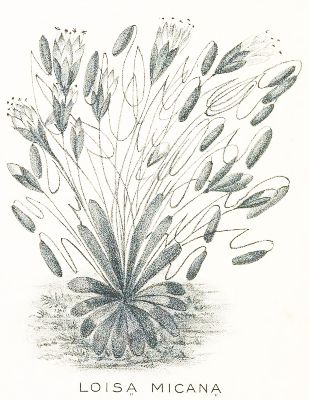
LOISA̤ MICANA̤
De L'Ester—Your modesty, George, is only a little less admirable than your poetry. What more can I say? You perceive, madame, that Spirits, as well as mortals, at times indulge in a bit of nonsense. Ah! you recognize these tufts of pretty flowers. Yes, it is the vining water lily, which our artist friend, Poole, drew for you two years ago. See how bees are extracting sweets from its pink chalices, which are quite as fragrant as the flower you name tuberose.
You have been informed that the Ento word Loisa̤ stands for our words water, lake, pond, reservoir, stream and so on, and that the Rodel is the representative of the Ento lily family. Loisa̤ mīcana̤ is a diminutive relative of the true Rodel, and, with the Entoans, who are flower lovers, it is a universal favorite. In your language, mīcana̤ would mean angular, crooked, curved and twisted, and you will pronounce it Mēcana̤h.
This variety of the Rodel always is found by the margins of streams or in marshy localities. Its long, slender, crooked leaf and flower stalks convey the impression of a vining tendency, hence its name. See how the rivulet is bordered with this and other blooming plants whose white, red, blue and yellow tints present an endless array of floral beauties. Yes, several of them have been drawn for you by Poole and Jared James. I believe you and Jared had a slight unpleasantness over one of his drawings. He is a very right minded person, but does not take kindly to interference with his plans.
As we move along you may observe that the rivulet is widening and losing itself in yonder great marshy tract, and if you will look toward our left you will see something that may surprise you. Certainly, we may go nearer. Yes, this is the same gorgeous, carmine hued, many petaled, golden centred Water Queen, so faithfully reproduced for you by Aaron Poole. You may recall that at the time it was drawn we promised to some time show you the growing plant. Poised on their long, slender flower stalks and stirred by the breeze, the stately beauties bow this way and that, as though in gracious acknowledgment of the homage of the myriad blooms growing luxuriantly all over the marsh and filling the air with their sweet perfume.
The queen, though holding her head so loftily, has only her beauty to commend her. Such odor as she exhales is very objectionable, and her train of many slender stemmed leaves falling about her feet and onto the limpid pool which serves her majesty for a looking glass, are covered with a viscid exudation, and woe to such insects as may alight on their treacherous surface. Her royal highness is known as Loisa̤ Gentolissima. In these nearby, showy masses of bloom you will recognize the Water Princess. Considering the difficulties in the way, Poole certainly very fairly reproduced those two plants. You may observe that the Princess differs from the Queen in having shorter, thicker flower stalks, smaller leaves, fewer petals of a paler carmine, and her pistils and stamens are of a brownish tint. This near relative of the queen is Loisa̤ Gentolana̤.
Your English words, lady, friend, gentle, loving, kind, beloved and the like, in the Ento language is represented by the word Gentola̤. The affixes ana̤, ana̤a̤, issima, issima̤a̤, ena̤, ēna̤a̤ and others add to the word gender, number, dignity, distinction, tenderness and so on. Frequently one or more of these or other affixes are used as diminutives. You will remember this, as the word is a common one and used in varying senses.
Medium—You speak of this or that as being known to the Entoans by such or such a name. Am I to understand that all Entoans speak the same language?

LOISA̤ GENTOLISSIMA̤
De L'Ester—Strictly speaking, the Entoans have but one language, which is spoken by all educated persons, but among what you might term the common people of different Provinces there are dialects and provincialisms, but not of a very marked character. Yes, all the peoples of Ento are, to a greater or lesser degree, educated. Nowhere on the planet does a condition approaching barbarism exist. In every community there are industrial and other schools, which the youthful Entoans are obliged to attend; thus all become fitted for such occupations as they may choose.
Ere long two friends from Ento's spirit spheres, who at times serve with our Band, will join us. They are more competent to afford you special information relating to Ento educational matters than are we.
Medium—Allow me to remark that, having all my life heard of but one Heaven, it seems strange to hear you speak of other heavens or spheres, as belonging to other Planets.
De L'Ester—Doubtless it may appear strange to you. For myself, upon entering our spirit world, one of my great surprises was to meet Spirits from other Planetary spirit spheres who had come into our realms on voyages of discovery or to make acquaintance with us and our ways. No, only very advanced spirits can journey unaided beyond their own spirit spheres. Those less advanced, by which I mean less spiritualized, may, when assisted, visit other planets and their spirit spheres.
Yes, all Planets inhabited by the spiritualized human are surrounded by their own spirit spheres.
Your beloved and loving son implores us to allow him to accompany his dear mother on these journeys, and, through earnest endeavor he progresses so rapidly that we purpose attempting soon to bring him with us. Nearly five of earth's fleeting years have greatly added to Bernard's spiritual growth and strength. Earth life with its temptations, its defeats and victories, now appear to him as a troubled, vanishing dream, dreamer and dream alike sorrowful.
Heredity, overlapping tendencies of previous embodiments and environments, largely, are the influences which act as character builders. Bernard's really fine, generous nature on one hand served him as armor against foes without and within, on the other hand it rendered him vulnerable to assaults to which impetuous youth ever is subjected.
But he builded as well as he could. So do all. Every one rough hews his own character and, through the Divinity who shapes all ends, eventually all learn to build according to the perfect law of love.
Yes, we are aware that Bernard has made you acquainted with his experiences and progress, and be assured that all that loving service can offer is aiding him in his highest aspirations.
We have not yet informed you that a dear friend, a member of our Band, is to meet us here, and at any moment he may arrive. No, you have not yet met him, but—Ah, here he comes! Hail! hail! and a welcome from all.
Madame, this is Giordano Bruno, of whom I doubt not you have some knowledge. We are delighted that you are to have the pleasure of a mutual acquaintance.
Bruno—Madame, I kiss your hand and shall be honored if I may place you among my closest friends.
Medium—I assure you that I appreciate the kindness which prompts you to meet me in such a friendly fashion.
De L'Ester—According to prearrangements, our friend and comrade, Bruno, has come to take an active part in our plans. He and George, having made a study of certain features of our programme will, from time to time, lead our movements. I now shall give way to one whom we all delight to honor.
Bruno—I am charmed, madame, that henceforth I shall have a place in the Band of which you are the valued instrument. Since my entrance into our spirit world, I have experienced much pleasure in visiting this and other Planets, but seldom have I desired to return to our own sorrowful Star. Memories of the terrible, woeful torture that freed me from my physical body have disinclined me to look upon the land of my birth. Ah, how often recollections of that sorrowful time force themselves upon my consciousness. Never have I been able to forget the hour when, rather than renounce what I knew to be a truth, I yielded up my mortal existence. But Giordino Bruno lives. Aye, despite the ignorance and cruelty of men who, in the name of the gentle, loving Nazarene condemned him to an ignominious death; he lives and knows as many of earth's learned ones now know, that worlds do revolve. Aye, that systems of worlds as infinite in number, as the universe is infinite in extension, pursue their appointed ways through space, proclaiming as they fly: God is Infinite, God is Law, God is Truth, God is All.
Despite Papal excommunication and condemnation to eternal torment, Giordino Bruno lives in a realm so surpassingly fair that even tongue of archangel cannot declare the glory thereof.
Madame, will you bear from me a message to the peoples of your native land? Yes? Then I thank you.
Children of earth's most favored land—children of America, I, Giordino Bruno, once a citizen of sun-kissed Italy, greet you.
Rejoice unceasingly that freedom of thought and speech are yours. Guard jealously this priceless blessing which through centuries of bloodshed, torturing flames and agony unspeakable has become your heritage. Glorious indeed are your United States of America, blest beyond expression in being as a "City of refuge" to the oppressed of other nations. Not yet, Heaven born one, have you outgrown your years of infancy and, though yet with uncertain steps you totter and waver, ever your generous hands are extended toward the helpless, ever your loving heart is pitiful for those who drink of the overflowing cup of human misery. Ever your eyes are brimful of compassionate tears for the unfortunates beyond ocean's watery wastes to whom your voice is as the voice of an angel crying: "Come to us! come to us! and share with us our bounteous store. Come to us and be free as we are free." I greet you, child Republic. Thou, indeed, art the brightest jewel in earth's diadem of nations. Freedom is thy most precious possession; lest selfish greed and love of power may seek to wrest it from thee, wear it next thy heart. Swear by all that to you is sacred, that neither political nor religious intolerance shall find foothold upon your soil. Let your unalterable declaration be: Liberty of conscience, liberty of speech for all; license for no one.
Cherish in your heart of hearts a love of justice, of forbearance, of toleration, of that charity which neither thinketh nor doeth evil, but permit no faction or Religion to interfere with your liberty of righteous action.
Insidiously, aristocratic ideas are striving to cross the threshold of your Temple of Equality. Guard well its doorways. Sacrilegious hands are seeking to smirch the records of your courts of justice; let your vengeance fall swiftly upon the offenders.
On the fair face of your Goddess of Liberty there is a troubled frown; beware lest she turn from you in anger. Spotless is her snowy robe, children of earth's greatest Republic. See to it. See to it that in the coming years you shall not stain it with your heart's best blood.
May the angels who watch over the destinies of nations be strong enough to guide through the perilous future your "Ship of State," which, through calm and storm steers toward an unknown shore. Amen! Amen!
Madame, our spirit realms are deeply interested, not only in the progress of the United States of North America, but of the entire continent. It is a matter for regret that your people do not more fully realize that they are an object lesson for all the other nations of Earth. The heart-beats of your Republic send a vitalizing current through all the peoples of our planet. How all-important then, that this life current shall flow unpolluted to the hearts and brains of all nations.
Madame, through your kindly attention to my words you have made me your debtor, but I feel assured that if these friends can bear with me, I may ask as much of your courtesy.
Now, with your permission, we propose conferring on you a new name. In madame there is no comradeship. Medium you do not fancy. Sara is somewhat familiar. Gentola̤, an Ento name, we consider very appropriate. Will you allow us to know you by this name, whose significance you understand? Yes? Then with Love and Truth as sponsors, you shall be to us Gentola̤.
George—Congratulations are in order. With tenderest, truest affection, I offer mine.
De L'Ester—As all are children of The One, I offer a brother's love and devotion.
Agassiz—De L'Ester's sentiment is also mine.
Humboldt—And mine, too, our friend, our sister.
Inez—And mine, for my sister by birth and "for love's sake."
Gentola—Friends, this is a strange christening, and for a time, I fancy that my new name will to me seem equally strange. I promise you that I shall strive to be all that it signifies.
Bruno—We chose the name because we know that it indicates your nature, which is in tune with all that is best in the human.
Now, Gentola̤, what I have to say is in line with the pursuits of our friends, Agassiz and Von Humboldt, consequently, quite aside from the science which engages me. But, having, with George, and other friends, explored this portion of Ento it is thought that I am qualified to offer you such information as may be pertinent to the present stage of our mission. On Ento during a remote age, there existed certain amphibious creatures so enormously large and unwieldy that only through their prodigious strength could they have coped with other fierce, active, gigantic forms of that early time. Scarcely can one realize their size, their uncouth forms or their extreme ferocity, which impelled them to a continuous warfare against not only their own kind, but against other species equally huge and aggressive. As has been said, Spirits, on our side of life, sufficiently progressed, can and do visit Planets, not only of our Solar System, but of other systems of worlds, and now, as at all times, there are Planets of our and other systems evolved to a degree analogous to that of Ento, during the age in which these and similar creatures existed. Through observation of conditions obtaining on such Planets, we arrive at a conception of the appalling conditions that must have existed on Ento during the Reptilian Age, when the steaming waters teemed with countless life forms and on unstable shores huge creatures fought to the death, filling the hot, moisture-laden atmosphere with their savage cries, roarings and hissings.
Cunning, sagacity, instinct, call it what we may, is an accumulated unfoldment of innate ability expressed as the sum of inherited experiences; hence, on Ento, in that age, the cunningest, the strongest, the most active and tenacious of certain species survived the many calamitous occurrences which swept out of existence myriad reptilian creatures. Yes, modified through environments, even yet pigmy representatives of ancient, huge ancestors inhabit the watery divisions of Ento.
Previous to the spiritualized man epoch there was an enormous production and destruction of life forms, and in time Ento became a vast repository of fossilized remains. Time, climatic changes and other causes so contributed to their destruction that only petrified specimens of the larger and later reptiles are occasionally discovered. How long ago did the earliest Ento humans appear? Gentola̤, the germinal man of Ento appeared when the first life cells swarmed in the warm waters of the young Planet. But the evolved human, the Spiritualized Man, became conscious of himself long after the great creatures of the Reptilian Age had of necessity yielded place to no less huge quadrupeds, who were more highly evolved expressions of life.
When one speaks of an event as having occurred some hundreds of thousands of years gone, in the mind of an uninformed auditor it is likely to occasion a sense of incredulity. But I safely may say that the lapse of time which merged the Reptilian into the Mammalian Age, during which came to the evolved human animal his crowning glory, a spiritualized, conscious existence, if measured by years, might be compared with the countless sands upon the seashore.
Now we must recur to the matter under consideration. As you perceive, this division of the plain extends from the base of the mountain to the verge of this extensive morass, which rests in a basin-shaped formation of limestone. The plain itself is the result of ages of attrition and disintegration of the foothills of the mountain chain, and the morass is the result of many centuries of accumulated remains of vegetable growths and débris washed from mountain and plain into the basin of what once was one of a chain of fresh water lakes. Its southern rim is a rather narrow ledge of limestone, once of considerable elevation, but now a mere barrier between the morass and a much lower level. Prior to the filling up of the lake it extended westward quite thirty English miles, where it connected with a series of smaller lakes leading into a great fresh water lake known to the Entoans as Loisa̤ Bascama̤, of which later on you will learn more. For the double purpose of draining the morass, thus rendering it tillable, and also that the mountain streams flowing into it may be used for irrigation of the lands southward at the foot of the ledge, a great basin is being excavated, into which they will be led. Already the ledge has been pierced to afford them egress.
At a depth of about eighty feet the excavators unearthed some petrifications of remote life forms. One of a prodigious size, has, among the learned ones, occasioned excited interest. Savants from all over the Planet are hastening to examine the fossils, especially the larger one, and to no doubt talk learnedly of those relics of bygone ages. When, very recently, George and I visited the spot we learned that the large petrifaction is the well preserved skeleton of an amphibian quite sixty feet in length. How came it there? One can only conjecture as to that. Certainly there was a time when the temperature of this latitude was much higher than at present, and the waters of the entire chain of lakes teemed with forms of life now extinct. It is quite as certain that the enormous spring floods so increased the volume of the lakes that their waters then poured over the ledge, which was loftier than it now is. It is not so certain as to how the amphibian came to find lodgment at the base of the ledge. Perhaps, in fleeing from a foe it rushed over the ledge, or having through some mischance lost its life, its body may have been swept over it, thus adding its skeleton to an already large accumulation of similar structures. George and I observed a number of learned men and women eagerly examining and discussing the probabilities and possibilities relating to the great fossil, which is but slightly mutilated and is to be removed to some museum.
As we looked and listened we were somewhat amused by the remarks of some of the assemblage who evidently were quite sincere in their statements.
One studious looking man mildly declared that the Holy writings clearly intimated that in the beginning Andûmana̤ created from within Himself all things. Another man warmly disputed this declaration on the basis that Andûmana̤ being perfect, could not out of his own Personality have created creatures so monstrous, so hideous as was this and many others. No, clearly it was through a misunderstanding of the Holy writings that such an illogical conclusion could be arrived at. Then a person of great dignity of mien gave his opinion, which, evidently, he considered final, that in the beginning, after Andûmana̤ created Astranola̤ and His messengers, He created Ento. Having prepared homes suited to their needs He created all living creatures. Some He found unsuited to His pleasure; such He destroyed, as is evidenced in these fossilized structures, which, for the most part, find no correspondence in creatures now existing. Having perfected His designs, He, out of Himself, created His children who perpetually should dwell on Ento. Then, with conviction, he exclaimed: Andûmana̤, through His Messengers, who dwell in the best realms of Astranola̤, revealed to His children the origin of all things, all of which is contained in the Holy writings, and I call His Messengers to witness that I, Kēlofa̤ Irdomyn, am not so impious as to question His divine words.
No one seemed inclined to dispute with this expounder of mysteries and with a self-satisfied air he resumed his critical examination of the ancient fossil.
To be told that in nearly all directions the Entoans are further advanced than are the peoples of Earth, and in a breath to bring you face to face with their extremely circumscribed and absurd religious ideas and beliefs, out of which have grown equally circumscribed and absurd notions relating to certain scientific matters, naturally, may occasion you to hesitate as to your acceptance of other statements we have made and others yet to follow. Realizing this, we consider it advisable to offer an explanation of a seeming paradox.
Through the process of unfoldment, spiritualized humans grow into clearer, higher conceptions of personality. Through ages of ignorance and savagery intuitively they grope their ways toward truth, which, like a beacon light, beckons them onward and upward, and slowly, but surely, their consciousness grows and unfolds as lotus blooms grow and unfold from ooze and darkness into sunlight. Thus, through ages the Entoans evolved into a recognition of self as personality, but not as spirit, for Andûmana̤, being to them a Material Personality, naturally, they could not conceive of aught more sublimated than their Creator. Still their unrecognized spiritual forces inevitably urged them forward, and in their history a period arrived when to a degree, society became organized, and about certain centres congregated those most learned in such sciences and arts as had resulted from ages of evolution. As yet the masses were almost wholly uneducated, consequently their ideas relating to social obligations and other niceties of civilization were extremely crude. Wars between different nations were continually waged, and of necessity, the weaker succumbed to the stronger. Selfish, ambitious, cruel and successful leaders grew arrogant, and the people were impoverished and enslaved and such civilization as existed seemed threatened with extinction.
It is a fact that under adverse conditions, humanity degenerates more rapidly than under favoring conditions it is capable of progression. Were this truth generally recognized, it might act as a deterrent against the reckless, criminally foolish conduct of nations who rush into wars as though they were a pleasurable pastime, rather than a damning process for the breeding of generations of preordained murderers, suicides, thieves and prostitutes—the inevitable results of inherited tendencies.
The Entoans, being no exception to a universal rule, were in a deplorable condition, when a memorable epoch arrived which ushered into mortal existence a man fitted for his arduous mission. A man wise and humane beyond any one of his time. A man of high courage, firm will, a fine sense of justice and a wonderful ability for controlling other men. About him he gathered not only an immense army of soldiery, but all who cared for their own safety and the welfare of the people, hastened to join him in his efforts to bring about a better state of affairs. In an incredibly brief time he subdued the vicious oppressors of the people. Forced warring elements into peaceful subjection. Established in the fullest sense, a centralized government, based upon equitable principles. Autocratic, certainly it was, but with the peculiar feature that rulers and people should he amenable to the same laws. When through peace and prosperity the peoples of the Planet were brought into harmonious relations with each other and with their newly found freedom from oppression and dissension, Zoifan Ouidas, their deliverer and Supreme Ruler announced that through a shining messenger, Andûmana̤ had communicated to him certain instructions relating to His now obedient children. A congress of Ento's learned and pious ones having been convened, Zoifan Ouidas made known the revelation he had received which constituted a basis for what was to be accepted as the Holy writings. To this revelation was added such beliefs and legends as appeared reasonable and desirable, and from these writings a creed was formulated and a ritual established.
To this day the creed remains unchanged, but from time to time the ritual has been added to or modified to suit the views or aims of an all-powerful priesthood.
Since the establishment of their national religion, centuries have been added to centuries. Steadily the generations of Entoans have been evolving, and were it not that an unyielding ecclesiasticism has held them in spiritual bondage, this closing of their fiftieth century of peace and equal rights for all would find them not only with knowledge of all the arts, but of all the sciences known to the people of our planet, and their faces on which pathos, sorrow and despair are written in every line would be beaming with the priceless consciousness of a continuity of existence which ere now should have been a possession of the plane of their unfoldment.
To a degree you now may comprehend the paradoxical situation, and I trust that what I have related, may serve to explain other incongruities which from time to time may attract your attention.
De L'Ester—George, with an excited air, is returning from the excavation. What so perturbs you, mon ami?
George—Hasten, friends, hasten. A professor is about to hold an autopsy over the remains of the ancient amphibian, and I fancy it will be an edifying occasion.
De L'Ester—We immediately will accompany you. You with Inez and our friends will lead the way. Gentola̤, allow me to aid you. Direct your gaze southward, and toward the right. Yes, quite a large assemblage which will afford you an opportunity of seeing some of the eminent personages of Ento, scientists, writers and others.
We need not approach nearer. Gentola̤, attend closely to what the very modest and intellectual appearing Professor may say. I shall translate it word for word.
Professor—I have been requested to express an opinion as to what order of life this fossilized structure may represent. Also as to the probable date of its existence. Speaking with exactitude, this creature was, like its diminutive descendants of the present, at home on the land, or in the waters of Ento's lakes and rivers of temperate and warmer climes. I need only allude to a fact that is well understood that all this order of life, of which in ancient times there was a greater variety than now exists, belongs to the Acrocustēno ingo-lavion (amphibious flesh-eaters). Of the probable date of the creature's existence I hesitate to speak. In these days many men and women of learning and research find themselves in a state of unrest and indecision. On one hand science demonstrates what appears to be facts. On the other hand these apparent facts are opposed by the declarations of our Holy writings. To state the matter briefly through ancient records we learn that nearly two hundred centuries have elapsed since the Creation of our beloved Ento. Our Holy writings declare the same, and also make mention of and describe huge forms of life similar to, if not exactly like this as having been of the first created creatures who long previous to the establishment of our Holy religion had become extinct.
How shall I proceed? Step by step scientific research has led us backward, and now we face the indisputable fact that in this fossilized structure, and the formations about it is positive evidence that the creation of Ento dates incalculably further back than two hundred centuries.
Friends, how shall we reconcile the positive statements of our Holy writings, with this equally positive statement in stone? May the gods be merciful, for, alas, I see no way out of the dilemma, and I refuse to further incur the wrath of Andûmana̤'s messengers.
Bruno—This person is in a fair way to get himself into trouble. As we read the thoughts of the assemblage we learn that were some of them as outspoken as this professor he would not find himself alone in his skepticism. As it is a craven fear of their gods and the priesthood seals their lips, and as the professor with a troubled face turns away, they regard him with an air of disapproval.
In the reports these scribes are writing many learned terms will be used, many learned opinions expressed, and doubtless many learned lies will be told, all for the glory of Andûmana̤, to whom it is believed His messengers will bear an account of these proceedings.
De L'Ester—Gentola̤, you will attempt a description of this scene. You need not hesitate. Where you may fail we will prompt you.
Gentola̤—Extending eastward and westward I see a not very broad ledge of limestone rock. On its southern side it is so perpendicular and its surface is so smooth that it presents the effect of well executed masonry. I cannot estimate the distance from where the petrifactions lie on a broad shelf-like projection to the top of the ledge, or from the projection to the bottom of the excavation.
De L'Ester—From the projection to the top of the ledge is quite one hundred feet, but at the time of the creature's misadventure the altitude of the ledge must have been considerably greater. From the projection to the bottom of the excavation the distance is, I should say, about eighty feet.
Gentola—On the south side of the ledge an immense excavation is being made. On the north side the morass is on a level with the top of the ledge, but on the south side the ground slopes rather abruptly to a plain which appears to greatly need irrigation.
Aside from the large and very perfect petrifaction there are numerous smaller ones which do not appear to interest the investigators. Indeed they are in a very fragmentary state, and I suspect that my description is of the same character.
I see a large number of men at work in the excavation. Some are engaged in lining the sides with huge cut stones, which are mechanically lifted and laid with much precision, some kind of cement being used to fill the interstices. Other men attend the working of scoops, which take up great quantities of soil, which is hoisted to the top of the excavation and dumped into receptacles which run swiftly on a tramway to the plain where it is thrown out, the empty receptacles returning on another track. Nearly all of the labor is done by machinery, but I cannot say what the motive power may be.
De L'Ester—Electricity furnishes the motive power, not only for those machines, but as you will have occasion to observe for nearly all mechanical purposes of the Entoans.
Gentola—One noticeable feature of this scene is the behavior of those laborers who move about so quietly and speak in such a polite and gentle fashion. The work proceeds very expeditiously, yet no one seems in haste, or exhibits the least excitement or impatience.
How very tall those dark skinned men are, and they are so erect and finely proportioned. Yes, notwithstanding their lustrous bronze complexions they certainly are handsome men. Their long, black, wavy hair, large dark eyes, regular features and very intelligent expression is in strong contrast with the fair complexioned, brown or blond haired, gray or blue eyed, and smaller men who are working on the tramways.
All, both dark or fair, wear their hair to their shoulders, parted in the middle or on one side, pushed well back from the forehead and held in place by what appears to be fillets of silver. All wear shapely, half loose garments, reaching to the knees, and the lower limbs are clothed in loose fitting—well, as I do not know the Ento name, I shall say trowsers.
De L'Ester—The Ento name for the upper garment is lenivo. For the trowsers, as nearly as I can pronounce it, the Ento name is birrsch. And for the foot covering, which you perceive is a very nicely formed shoe, not of leather, but of a manufactured material, the name is—no, not fettos, but pfettos.
We now will move to the tented space, and in a general way, but briefly, you will further describe the appearance of those men and women who are engaged in quiet discussion over fragments of the smaller fossils.
Gentola—Both men and women of the dark skinned race are exceedingly tall. The men are very handsome, very distinguished looking, with a dignity of bearing quite devoid of ostentation.
The women are very beautiful, very graceful, very gentle, and quiet, and with such fine, intelligent expression, that I cannot find words to express my sense of their superiority to any women I ever have seen.
I do not quite so much admire the fair skinned men and women who are more slightly built, but who are taller and stouter than any earth race that I know of, and certainly they are in appearance very admirable.
Bruno, were you sufficiently tall, you might claim kindred with some of those handsome, olive skinned men and women, who are but slightly darker than yourself. They appear to represent one race, the bronze complexioned ones another, the fair skinned men and women an entirely different race.
It seems odd that the men, as well as the women, wear their hair long and flowing. The hair of the men to their shoulders, that of the women quite below their waists, and all wear fillets of various kinds. I must say that I think the effect very pretty. As for the garments of both sexes, they seem to me simply perfection, not at all voluminous, but loose, graceful and of textures so admirable as to weave and coloring that seldom have I seen fabrics so beautiful.
De L'Ester—You have mentioned the fillets worn by both sexes. The metals, the width, form and settings of the fillets indicate the official positions and occupations of the wearers. Not alone are they worn for convenience or as ornaments, but also as badges of certain distinctions, for which all are urged to strive. Class distinctions in the sense of caste do not exist, and all are incited to a spirit of emulation in the direction of meritorious achievements, which are considered the only real distinctions. From the laborer yonder to the Supreme Ruler, all men and women strive to attain to the utmost of their capabilities. The cut, color, ornamentation and other features of apparel also indicate the position and occupation of the wearer. As our mission progresses you will have opportunities of further observing such matters.
No, for decorative purposes the Entoans do not wear head coverings. They too much prize their beautiful, abundant hair to risk such abominations as hats and bonnets. Then, too, their taste is too finely cultivated to admit of personal disfigurement.
Gentola—I commend both their judgment and taste, and I wish I might understand what those learned persons are saying. The scene itself I shall not soon forget. It is worth the experiences of an ordinary lifetime.
De L'Ester—These friends and I possess a general knowledge of the language, but of scientific technicalities we know next to nothing. If we did both time and space are too limited to devote ourselves to their consideration.
Not another word. We have held you long enough. One momentary, comprehensive glance at the scene and then Earthward. George and Inez will bear you swiftly to your quiet home. Au revoir.
George—Safe you are in your own room, and some one desires to enter. It is your friend, Mrs. S——le, who always brings you flowers.
May divine and loving influences abide with you until we again come for you. Adieu.
CHAPTER VI.
INIDORA AND GENESSANO.
De L'Ester—Like musical chords touched by unskilled fingers are your thoughts, Gentola̤. For some minutes we have watched your hurried preparations for our journey and it is evident that, though your spiritual aspirations reach out toward highest ideals, material duties equally claim your attention. Yours is a harmonious combination of the Mary and Martha natures. Martha, now, will please close her eyes, fold her active, capable hands and rest while Mary shall accompany us starward.
We too, wish that it might be possible for you in your fully conscious moments to recall the memory of events, scenes and other matters pertaining to our journeys. As you cannot, that which your soul self will be made to write must serve as a record of your experiences while absent from your body. And when under my supervision you will, for publication rewrite the record, you will vividly realize all that has or will occur during our mission. You now are in a tranquil state and we will be off. George, we are ready.
Ah, how grand, how exhilarating is the movement of this inconceivably swift magnetic current, bearing us on its glowing, undulating bosom toward our destination, which we are nearing. Lower, lower, George. Look downward now, Gentola̤, for we are over the morass.
We perceive that the learned visitors have departed and that the great fossil is being carefully prepared for removal. The ledge is being further pierced to afford a passage for the waters of the morass, and the excavation is nearly completed. Some time we again will pass this way to observe the result of the skill and labor expended in accomplishing so considerable an undertaking. This being an agricultural region, the irrigating reservoir will greatly add to its fertility.
We now will move southward for about fifty miles, and you will observe how thickly populated is the region over which we shall pass and that the inhabitants enjoy a degree of the comforts and luxuries of life found only among a highly civilized, consequently prosperous, people. Observe too, the fine architectural effects, the well tilled fields and roadways as smooth and level as floors. And let me tell you, fine roadways always indicate an advanced civilization.