Volume 11 — The Biology of the North American Crane-Flies
Reading edition
(Tipulidæ, Diptera) V. The Genus Dicranoptycha Osten Sacken BY CHARLES P. ALEXANDER, Ph.D. (Cornell)
GENERIC DIAGNOSIS
Larva. Form very elongate, terete; integument smooth, glassy, transparent; abdominal segments two to eight with a basal transverse band or area of microscopic chitinized points on the ventral surface; segment eight with a similar band on the dorsum. Spiracular disk surrounded by four lobes, the lateral pair more slender than the blunt ventral pair; dorsal lobe very low or lacking; spiracles small, widely separated; a triangular brown mark on the disk between the spiracles; anal gills a fleshy protuberant ring surrounding the anus. Head-capsule compact, massive, the præfrons large with a few marginal punctures; externo-lateral plates very broad. Labrum large, flattened, pale; antennæ two-segmented, the apical segment almost as long as the basal segment, narrowed to the blunt tip; mandibles with a blunt dorsal and two blunt ventral teeth; maxillæ generalized in structure; hypopharynx a rounded cushion; mentum deeply split behind but not completely divided, with three principle teeth and a small lateral tooth on either side.
Pupa. Cephalic crest low, depressed, setiferous; labrum tumid; labial lobes oval, contiguous; antennal sheaths ending opposite the base of the wing. Pronotal breathing-horns microscopic, represented only by tiny triangular tubercles; mesonotum unarmed; wing-sheaths ending opposite the middle of the third abdominal segment; leg-sheaths ending opposite the base of the fifth abdominal segment, the tarsi terminating on a level, or nearly so. Abdominal tergites and sternites each with four transverse rows of microscopic setæ; lateral spiracles on segments two to seven.
DISCUSSION OF THE GENUS
The genus Dicranoptycha was erected by Osten Sacken in 1860 (Proc. Acad. Nat. Sci. Phila. for 1859, p. 217). The genus includes a small group of crane-flies with a Holarctic distribution, there being about six species in North America and two, or possibly three, in Europe. As I have indicated elsewhere, D. signaticollis v.d.W. of Java is undoubtedly a species of Libnotes. Of the American species, D. germana O.S. is characteristic of the Canadian life-zone of northeastern America. D. sobrina O.S. is widely distributed in the United States and southern Canada, usually occurring in the Transitional and Upper Austral life-zones. So far as known at present it is the only species of the genus occurring on the Pacific slope. The remaining American species (nigripes O.S., winnemana Alex., tigrina Alex. and minima Alex.) are Austral in distribution, occurring in the southeastern and south central United States. A more detailed account of the distribution of the species is given in another paper by the writer which may be consulted (Proc. Acad. Nat. Sci. Phila. for 1916, pp. 496, 497). All of the known species are generally similar to one another in appearance and are separated by relatively slight differences of size, color and structure.
Nothing has ever been written concerning the immature stages of this peculiar group of crane-flies. The species described hereinafter were reared at Lawrence, Kansas, and the general conditions under which they occur may be briefly discussed:
North Hollow, on the Campus of the University of Kansas, is a typical dry Austral woodland traversed by a small stream that is entirely dry during the months of midsummer drought. The soil consists of a rich black humus that is soft and mellow except during the period of greatest dryness, being overlain by a varying depth of vegetable debris and leaf-mold. It is in this relatively dry soil that the larvæ of Dicranoptycha occur. The forest cover consists of Carolina poplar, Populus deltoides Marsh; black walnut, Juglans nigra L., white elm, Ulmus americana L.; Kentucky coffee-tree, Gymnocladus dioica (L.) Koch; honey locust, Gleditsia triacanthos L.; red bud, Cercis canadensis L.; yellow wood, Cladrastis lutea (Mx.f.) Koch; tree-of-heaven, Ailanthus glandulosa Desf., etc. The principle shrubs are the goose-berry, Ribes gracile Mx.; poison ivy, Rhus Toxicodendron L.; wahoo, Evonymus atropurpureus Jacq.; bladder-nut, Staphylea trifolia L.; coral-berry, Symphoricarpos orbiculatus Moench.; blackberried elder, Sambucus canadensis L., etc. The herbage is made up of tall grasses, composites and, in the spring, the all-dominant cleavers, Galium. In addition to the above, great tangles of lianas (Smilax, Vitis, Ampelopsis, etc.) are found.
In situations such as the above these Austral species of Dicranoptycha spend their entire lives. The first larvæ of D. winnemana were found here on March 20, 1918, by the writer and his wife. At this time they were well grown (length 16 mm.; diameter 0.9 mm.). They occurred just beneath the cover of fallen leaves and other debris in the upper layers of soil. Here they were associated with pupæ of Tipula angustipennis Lw., larvæ of Sciara (Mycetophilidæ); Psilocephala hæmorrhoidalis Macq. (Therevidæ), numerous beetle larvæ, centipedes, etc. By their elongate form and glabrous shiny skin they are very characteristic and easily recognized. The glassy appearance of the body suggests the shiny shells of a small coiled molluscan whose dead fragments occurred in some numbers in the same situations. These larvæ were placed in rearing and the first adults appeared in the breeding-cages on May 6, and from that time on continued to appear in large numbers. It was over a month later that the first individuals were taken in the field. The pupal duration could not be determined closer than ten days, and this may be the usual length of time required for this stage. The first larvæ of D. minima were found on July 2, 1918, in similar situations in North Hollow. At this time they were only about one-half grown. On July 11 much larger larvæ of this species were secured and placed in rearing, emerging as adults on July 21. The larvæ, like these of D. winnemana, live just beneath the layer of leaf-mold in the upper zone of black soil. They are usually quite sluggish in their motions but at other times are quite active. The larvæ are herbivores and feed on the rich organic earth in their haunts. When ready to pupate, they encase themselves in earthen cells (10 mm. × 3.5 mm.), firm in texture, rather thick-walled but without silk. There is a small opening at either end. The length of the cavity is but little greater than the pupa itself. In this cavity the pupa rests and matures. As in other insects, the teneral pupæ are very pale yellow but gradually darken in color until, at emergence, they are of a dark brownish-black. When newly transformed the teneral flies rest on the ground and on the leaves of low plants nearby.
The adult flies of D. germana usually occur in the immediate neighborhood of running or stagnant water and may be swept from the rank vegetation in such places. The flies rest on the upper surface of the leaves of tall herbs and low shrubs. In eastern Kansas, the flies of D. winnemana, D. tigrina and D. minima often occur together. In June, D. winnemana appears on the wing and is found associated with Tipula morrisoni Alex., T. mingwe Alex., etc.; in July, D. minima appears, together with Tipula flavibasis Alex., T. unimaculata Lw., etc.; still later in July D. tigrina emerges and all three species fly together during August and into September when they fly with Tipula ultima Alex., T. unifasciata Lw., etc. It is curious that no other species of Limnobiinæ occur in the thamnophytic association frequented by Dicranoptycha. All three species of this genus as discussed above have habits that are generally similar to one another. They are usually found resting quietly on the upper surface of the leaves but fly readily and on slight disturbance. Pairs in copulation are often found resting, the bodies directed away from one another and the wings folded over the abdomen. While thus united they fly readily, sometimes the female taking the initiative, sometimes the rather smaller male. The eggs are deposited in the soft earth in these situations.
NATURAL AFFINITIES
In the Monographs (1869) Osten Sacken included the genus Dicranoptycha in his tribe (section) Limnobina anomala, or, as it subsequently became known, the Rhamphidini, and still later the Antochini. A recent survey of the immature stages of several Antochine genera has shown that the tribe is merely an artificial grouping based on superficial resemblance of the adult flies. This heterogeneous assemblage includes representatives of at least three other tribes, Dicranoptycha, together with Antocha, Elliptera, Rhamphidia, etc., showing an undeniable affinity with the Limnobiini, whereas Teucholabis, Elephantomyia, etc., show an equally clear relationship with the Eriopterini. Moreover a close phylogenetic relationship with the lowermost subtribes of the Hexatomini (Ularia, Epiphragmaria, etc.), is easily apparent.
Dicranoptycha shows the closest affinities with Antocha and Rhamphidia. The larvæ of these three genera, each of which typifies a division, show the following common characters:
Abdominal segments with basal transverse creeping welts or areas of microscopic points. The massive compact head-capsule with the præfrontal sclerite large, distinct, the externo-lateral plates large, mussel-shaped and very thin. The mentum is not completely divided medially. The maxillæ are large and of primitive structure, the cardines and stipites distinct, the two distal lobes large, subequal in size, covered with hairs and bearing sensory organs. Mandibles with one or more dorsal and two or more ventral teeth in addition to the apical point.
The differences between these allied divisions are best indicated by a key.
LARVAE
1. Spiracular disk with only the two long ventral lobes remaining; spiracles lacking or vestigial; abdominal segments with both dorsal and ventral welts; strictly aquatic.Antocharia.
Spiracular disk surrounded by four or five short lobes; spiracles large and functional; abdominal segments with ventral welts only (except the dorsum of segment eight); terrestrial or semiaquatic.
2. Body moderately elongated and covered with a long dark pubescence; spiracular disk squarely truncated, surrounded by five subequal stout lobes; mentum with five subequal teeth, the lateral one of either side not conspicuously reduced.Rhamphidaria.
Body very long and slender, glabrous; spiracular disk obliquely truncated, surrounded by four slender naked lobes; mentum with three subequal primary teeth and a much reduced lateral tooth on either side.Dicranoptycharia.
PUPAE
1. Pronotal breathing-horns branched; aquatic.Antocharia.
Pronotal breathing-horns not branched; semiaquatic or terrestrial.
2. Pronotal breathing-horns distinct, elongate-cylindrical.Rhamphidaria.
Pronotal breathing-horns apparently lacking, microscopic.Dicranoptycharia.
THE SUBTRIBE DICRANOPTYCHA
A Key to the Species of Dicranoptycha
LARVAE
1. Spiracular disk with the dark markings less extensive; the mark of the lateral lobes not contiguous with the spiracle or the triangular area on the disk; dorsal marking indistinct or lacking.D. winnemana Alex.
Spiracular disk with the dark markings more extensive; the mark of the lateral lobes suffusing the ventral inner margin of the spiracle and usually closely approximated or nearly contiguous with the triangular area on the disk; dorsal marking black, transversely rectangular.D. minima Alex.
Description of the Species.
DESCRIPTION OF THE SPECIES
1916 Dicranoptycha winnemana Alexander; Proc. Acad. Nat. Sci. Phila., pp. 500, 501; Pl. 25, fig. 12.
Larva.—Length, 20-22 mm. Diameter, 0.9-1.1 mm.
Coloration varying from white to almost black depending on the nature and amount of the food eaten which shows clearly through the transparent integument. The fat-bodies likewise show through and give a white color to the larva especially after death.
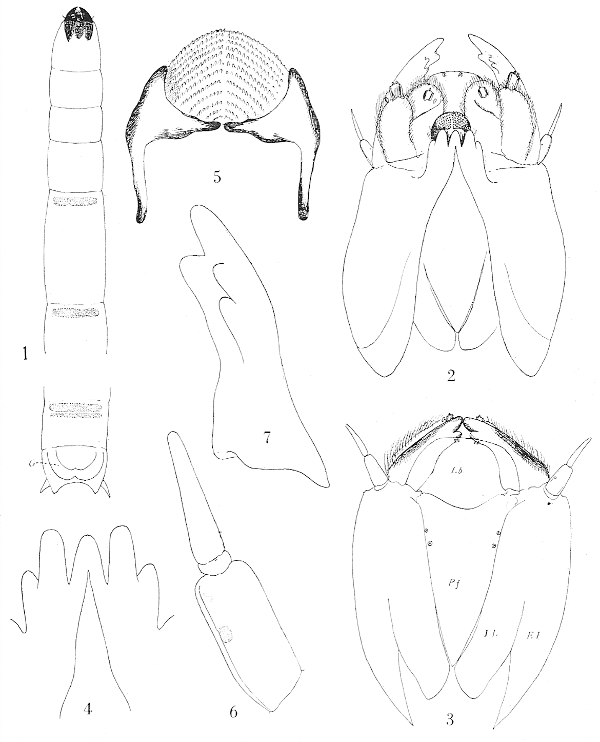
Form very elongate (fig. 1), body terete; integument very glabrous, transparent and glassy. Prothoracic segment a little longer than the mesothorax which, in turn, slightly exceeds the metathorax. The intermediate abdominal segments are elongated. The basal ring of sternites two to eight bears a transverse band or area of microscopic chitinized spicules, the one on the eighth segment split lengthwise by a capillary line. A similar band occurs in the same position on the dorsum of the eighth segment but the pleural region is devoid of such a band.
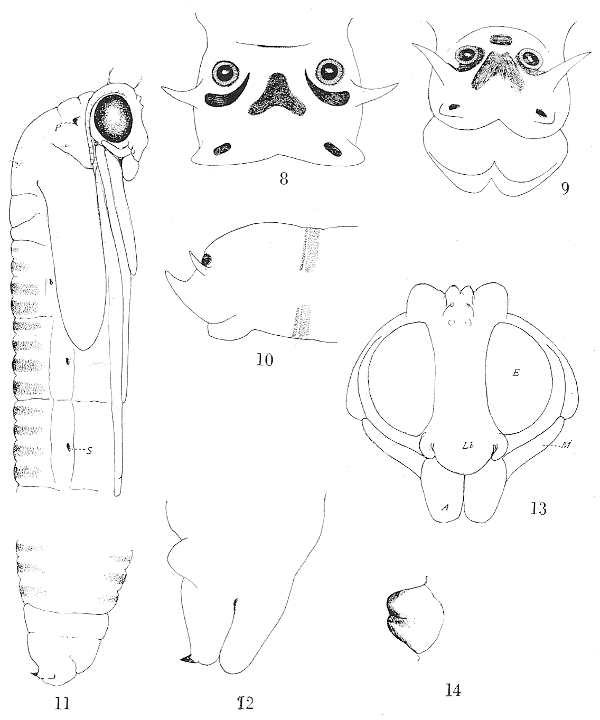
Spiracular disk (fig. 8) moderate in size, obliquely truncated, surrounded by four lobes, a pair of small, slender, lateral lobes and short, broader ventral lobes. The usual dorso-median lobe is lacking but its position is indicated by a gently rounded convexity. The inner face of the lateral lobe bears a narrow semi-lunate black mark with the concavity toward the spiracle, the proximal end acutely pointed. The ventral lobes bear a similar but smaller subrectangular black mark. A pale and usually indistinct dusky mark occupies the inner face of the dorsal lobe. On the disk between, and slightly below the level of, the spiracles is a large brown triangular or V-shaped mark. The spiracles are small, separated from one another by a distance equal to about 2.5 to 3 times the diameter of one; the center-piece of the spiracle is black, the ring yellow surrounded by an outer dusky margin. Anal gills fleshy and protuberant as a blunt ring surrounding the anus (fig. 10).
Head-capsule (fig. 2) of the compact, massive type of the Limnobiini; præfrontal sclerite (fig. 3) large and distinct; the sclerite broad with the sides subparallel to about midlength, thence tapering gradually to the tip which is entire; there are two or three punctures at the margin before midlength. Interno-lateral plates narrow, a little longer than the præfrons; externo-lateral plates very broad, thin and flattened with the posterior margin very obtuse and the inner ventral portions continuous with the mental plate. Labrum (fig. 3) very broad and extensive, flattened, pale in color, the anterior margin with about two sense-organs. Mentum (fig. 4) deeply split behind but not completely divided, the anterior margin with three primary teeth that are subequal in size or the middle one a little smaller; a much reduced lateral tooth on either side. Præmentum smaller than the hypopharynx, in outline roughly oval or semicircular with the two labial palpi surrounded by hairs at the base. Hypopharynx (fig. 5) consisting of two chitinized arms that are contiguous but not fused medially, the concavity between them filled with a rounded cushion that is covered with tubercles arranged in more or less distinct oblique parallel rows. Antennæ (fig. 6) two-segmented, the basal segment cylindrical with an auditory plate on the face at beyond midlength; apical segment long and slender, in length but slightly less than the basal segment, tapering gradually to the bluntly rounded apex. Mandibles (fig. 7) simple with the teeth blunt; apical point longer than the lateral teeth; dorsal tooth single, broad, very flattened and obtusely pointed; ventral teeth two, a little smaller than the dorsal tooth. Maxillæ (fig. 2) of a generalized structure, the cardines distinct and feebly chitinized; distal lobes of the organ consisting of a subequal inner and outer lobe; the outer lobe with an abundance of long, delicate hairs and bearing a few sensory papillæ including one larger palpiform organ.
Pupa.—Length, 9.1-12.8 mm. Width, d.-s., 1.6-1.8 mm. Depth, d.-v., 1.6-1.9 mm.
Thoracic dorsum shiny light brown; in very old pupæ the color is much darker, but still retains a much brighter color than the leg and wing-sheaths; abdomen pale becoming darker in age, especially on the pleura.
Cephalic crest (fig. 13) low and depressed, inconspicuous, lying between the antennal bases which extend beyond it; there are four small setigerous lobes, the larger pair of which are posterior in position. Front between the eyes broad, subparallel. Two blunt tubercles on either side of the forehead. Eyes large, with coarse ommatidia. Labrum semicircular in outline, tumid. Labial lobes large, oval, contiguous with one another, at the tip of the labrum. Maxillary palpi moderately long and slender, nearly straight, gradually narrowed to the tip which ends opposite the knee-joint of the fore legs. Antennæ with the basal segments separated only by the cephalic crest, the sheaths ending about opposite or a little before the lateral angle of the thorax.
Pronotal breathing-horns (fig. 14) very small, almost microscopic; when viewed from the dorsal aspect appearing as tiny triangular tubercles. Mesonotum moderately convex, unarmed, the V-shaped suture distinct; a few setæ on the mesonotum, including one near the end of each scutal lobe. Wing-sheaths rather short, but narrow, ending about opposite midlength of the third abdominal segment. Leg-sheaths ending opposite the base of the fifth abdominal segment, the tips of the tarsi ending about on a common level or those of the fore legs a trifle longer.
Abdominal segments (fig. 11) subdivided into four annuli that bear transverse bands of microscopic setæ; these bands increase in width from the basal to the apical. Spiracles on the pleural region of segments two to seven, lying opposite the third annulus and close to the ventral margin of the pleura. No spiracles are discernible on the dorsum of the eighth segment. Male cauda (fig. 11) with the ventral lobes very blunt, rounded; the dorsal lobes very small, terminating in a sharp spine that is directed dorsad and bears a weak seta near its base. Female cauda (fig. 12) with the ventral lobes a little longer than the dorsal lobes; the latter at the outer angle of the apex with a short stout spine that is directed dorsad as in the male.
Nepionotype (type larva), Lawrence, Kansas, April 2, 1918.
Neanotype (type pupa), with the type larva, May 6, 1918.
Paratypes, larvæ and pupæ, about fifty from the type locality, March 20 to May 20, 1918.
Dicranoptycha minima Alexander.
1919 Dicranoptycha minima Alexander; Ent. News, Vol. 30.
The larva is very similar to that of D. winnemana as described above, but is slightly smaller. The spiracular disk (fig. 9) has the dark markings much more extensive. The mark of the lateral lobes is contiguous with the spiracles and is also closely approximated to the large triangular brown mark on the disk. There is a large transverse rectangular mark occupying the inner face of the dorsal lobe. The marking of the ventral lobe is about as in D. winnemana.
Nepionotype, Lawrence, Kansas, July 11, 1918.
Neanotype, Lawrence, Kansas, July 21, 1918.
Paratypes, a few larvæ from the type-locality.
Explanation of the Figures
A—Labial Lobes; E—Eye; EL—Externo-lateral Plate; G—Anal Gills; IL—Interno-lateral Plate; Lb—Labrum; M—Maxillary Palpus; P—Pronotal Breathing-horn; Pf—Præfrons; S—Spiracle.
Fig. 1. Larva of Dicranoptycha winnemana, ventral aspect of body.
Fig. 2. The same, head-capsule, ventral aspect.
Fig. 3. The same, head-capsule, dorsal aspect.
Fig. 4. The same, mentum, ventral aspect.
Fig. 5. The same, hypopharynx, ventral aspect.
Fig. 6. The same, antenna.
Fig. 7. The same, mandible.
Fig. 8. Larva of Dicranoptycha winnemana, spiracular disk, dorso-caudal aspect.
Fig. 9. Larva of D. minima, spiracular disk, caudal aspect, the anal gills protruded.
Fig. 10. Larva of D. winnemana, spiracular disk, lateral aspect.
Fig. 11. Pupa of D. winnemana, lateral aspect of male.
Fig. 12. The same, lateral aspect of female cauda.
Fig. 13. The same, head and mouth-parts, ventral aspect.
Fig. 14. The same, pronotal breathing-horn, enlarged.