JOURNAL (continued 3)
Reading edition
"But he could not be more delighted with my poor efforts to entertain him, than I was by his affability, condescension, and engaging demeanour. He promised to renew the visit; but, the aspect of public affairs has ever since been too stormy and menacing, to allow the anxious Mahmoud any opportunity of relaxation. Should days of peace return, and the father of his people still remember his promise, he may again delight us by his presence."
Whilst thus expatiating with an air of enthusiasm on the virtues of Sultan Mahmoud, all the cruelty, indignity, and outrage committed on her countrymen and relations, by his orders, seemed to vanish from the old lady's recollection, as though she had tasted of the fabled Lethe.
Happy the tyrant, who, by a single act of condescension, can thus obliterate the sanguinary records of his earlier days; and wash out the remembrance of blood in libations to Bacchus, and draughts of the too seductive and all-powerful Champagne!
NEAPOLITAN STEAM-BOAT. On returning to the house, I found an express from Pera awaited me, announcing the arrival of the Neapolitan steam-boat Francesco, with the Prince of Bavaria.
Sunday, 9th.—I went down to Pera at an early hour this morning, and found the Francesco Primo floating proudly in the centre of the Horn. She was surrounded by hundreds of caiques, full of Turks and Greeks, admiring this fine vessel, the largest steamer that had ever visited Constantinople.
At Tongo's, I roused up some of its passengers, whom I had expected, and who were in our old quarters. They had been delighted with their trip, but were highly dissatisfied with the treatment on board, where they had to quarrel with bad provender, bad wine, and disobliging servants. In the course of the voyage, they had visited Corfu, Napoli, Egina, Corinth, Athens, and Smyrna. At the consul's I found Taylor, and near the house, Lord Wiltshire, Ruddel, and Hatfield: every lodging-house, every thing which went by the name of an albergo, was occupied; and such an immigration of visitors with purses full of money, and pockets crammed with note books, had probably never happened in Stamboul before. The Prince of Bavaria and his suite occupied the Palace of Austria.
JEWISH MUSICIAN. After dinner, we sallied forth for the Sweet Waters of Europe, where I believe the whole crew of the boat had gathered together. The crowd of natives was also considerable to-day; and I saw many very beautiful Greeks among them. We stopped to observe a party of Turkish ladies, to whom a Jew was singing, and accompanying himself on a guitar. After listening to various songs, they asked him for a French or English ditty, as he professed to have visited all countries; but he attempted to evade the request, afraid, no doubt, of being detected by the Europeans standing round, for, probably, he had never been five miles from Constantinople in his life. As the ladies insisted, he at last commenced the following ditty;
Alendo falendo Malendo Calendo Li fuli Culendo Buon Giornò.
which he repeated five or six times, much to the satisfaction of his Turkish auditors, but more to our amusement, for most of us laughed heartily, notwithstanding the sour looks of the old Turks, who, I presume, were scandalized at seeing us expose ourselves in the presence of the fair. The poor singer was heartily glad when we moved away, when he, no doubt, treated his attentive listeners to another series of English or Italian airs.
Boat loads of laughing, joyous Greeks now began to crowd the landing-place; and every caique had either a guitar, flute, or violin on board. After landing, the parties strolled about, while their servants spread the carpets and viands upon the velvet turf. This done, each jovial company squatted down on their cushions, and commenced feasting and merry-making, which generally lasted until the night was far advanced.
BEAUTIFUL GREEK. Many of the Greeks present were from the Fanal, and three ladies from that quarter, who stepped out of the same caique, attracted universal admiration wherever they moved; for, if not princesses by birth, they were, at all events, entitled to claim that distinction in the court of beauty; and the eldest was the most lovely creature I ever beheld. She possessed one of those fine intellectual faces, which, once seen, can never be obliterated from the gazer's remembrance; and there was a languor and a softness in her countenance, and in the expression of her large, dark, sleepy eyes, inexpressibly fascinating, though more allied to Oriental than Grecian loveliness. They were,
"Black as death, their lashes the same hue, Of downcast length—in whose silk shadow lies Deepest attraction."
Her hair was of a deep glossy brown, nearly approaching to black, and fell in luxuriant ringlets on a neck of ivory; while her tall, commanding figure seemed to have been moulded by the Graces; and though somewhat inclining to the embonpoint, she moved with an elegance and dignity befitting Juno herself.
I have already observed, that the ankle of the true Grecian race is remarkable for its exquisite symmetry; and hers was a model of perfection, which plainly indicated her descent from a people, among whom beauty is the most decided national characteristic. Her delicate small foot was chaussée'd in a very neat black shoe, with a stocking of snowy whiteness: in a word, she seemed the personification of Dudú,
"Somewhat large, languishing, and lazy, But of a beauty that would drive you crazy."
ELEGANT COSTUME. The ferridgè or cloak, worn by this "Queen of the Sweet Waters," was thrown loosely on her shoulders, disclosing a dress remarkable for its elegant simplicity. Her veil of white gauze, worked at the ends with silk and gold, floated at random over her head and shoulders; a rich shawl was bound round her waist, and served to confine the tunic close to her bust: the remainder of her dress was of muslin, plain, neat, and of the purest white. She appeared perfectly unconscious of her superior beauty, and though this costume was calculated to display her attractions to the greatest advantage, her whole demeanour was characterised by the most perfect modesty.
The other ladies, if seen elsewhere, might have been considered handsome; but on this occasion their charms were completely eclipsed. In attempting to describe the person of so singular and lovely a female, I feel conscious how inadequate my language has been to convey any idea of the reality; which, like a Peri descended from the celestial paradise, flits before my eyes, "rich in all woman's loveliness."
"Who hath not proved how feebly words essay To fix one spark of Beauty's heavenly ray? Who doth not feel, until his failing sight Faints into dimness with its own delight— His changing cheek—his sinking heart confess The might—the majesty of loveliness?"
I could not discover who the enchantress was, further than that her party came from the Fanal. After remaining but a very short time, they reentered their light bark, and sped swiftly down the stream.
TURKISH LADIES. Some Turkish ladies present were exceedingly affable, lowering their gashmaks, and conversing for some time with us, through Tongo's brother, who performed the office of interpreter. They made various inquiries respecting our nation—why we had come to Stamboul?—how long we intended to remain? And then came that question, at once so natural and delightful to a pretty woman, "Did we think them handsome?" To this home-thrust at our gallantry, we of course made a suitable reply; which, unlike such answers in general, was strictly consistent with truth, for they were really beautiful, though the artificial junction of their painted eyebrows, and their stained nails, by no means heightened the effects of their natural charms. Our compliments appeared to amuse them exceedingly, for they laughed and chattered to each other with a vivacity not surpassed by the most accomplished gossips of any country, and which formed a perfect contrast to their affected sober demeanour. Just as they were beginning to be delightfully familiar, and had presented us with some delicious ices, two or three old Turks hove in sight. In an instant, every dimpling smile vanished; their countenances were again enshrouded in the odious linen masks; their ample veils dropt around them, and making a hasty sign for us to depart, our talkative and merry friends were again as demure and discreet, as any "magnificent three-tailed bashaw" in the empire could possibly have desired.
This was my farewell excursion to the Keathane, for I had no opportunity of visiting it afterwards; but the happy moments I passed there, will ever be among the most delightful recollections of my visit to the East.
THE SERASKIER. Monday, 10th.—To day I took upon myself the duties of a cicerone, and volunteered to pioneer the uninitiated, and show them the wonders of Stamboul. The first place we visited was the arm bazaar, with the others in succession; and when they closed, we went to the Seraskier's tower. As we were coming away, the pilot of the Actæon joined us, and we climbed up the circular stair a second time. In descending, the cavash who had conducted us, observed, that he thought he had hit upon the means of getting admitted into St. Sophia. As he addressed himself to me, I promised to give him 100 piastres if I could accomplish it; and after consulting his brother cavashes, he returned, saying, it would only be necessary to ask permission of the Seraskier. Ask the Seraskier! beard the lion in his den! Who would undertake to present himself before him on such an errand? George, however, the fearless pilot of the Actæon, would have belled the Sultan himself in his divan; so he was unanimously chosen to represent the company of English nobles, and pushed into the presence forthwith.
He found the Seraskier seated smoking upon his divan, and he politely inquired the purport of his visit. George, who was in his plain sailor's clothes, addressed his Excellency by all his titles, and replied, that he was a British officer, one of several others, who were waiting outside, because they felt unwilling to intrude on his Seraskiership; that the party could remain in Stamboul but a few days, and having heard much talk of the magnificent mosque of St. Sophia, they were most anxious to be admitted within its sacred precincts; for which favour they should be ever grateful, and devoutly pray, &c.
To this the Seraskier replied, that he highly applauded the laudable curiosity of the spokesmen and his friends: that truly, the mosque was an object worthy of their inspection, and did the order for admission depend on him, he would grant it instanter. It was, however, entirely foreign to his department, and he could only refer them to the Scheik Islam, or to the Reis Effendi, either of whom, on his recommendation,—and he desired George to convey to them his humble respects,—would grant the object of their petition. He prayed to God they might succeed, for God was great.
So saying, he bowed George out of the audience chamber into the court, where we stood, bursting with laughter at the ridiculousness of the scene, and well aware, that the permission was never granted, except as an especial favour, and always by a firman regularly signed and sealed by the Sultan, and delivered through the various officers about the court, on the payment of heavy fees.
FOREIGN VISITERS. To console ourselves for this disappointment we bowled away to a cabob shop, and having made a good luncheon, repaired to Mustapha's, to assist our digestion with a pipe, and make ready for the consul's dinner, to which we were invited. The shop was full of English, French, Germans, and Russians, all passengers in the Francesco; indeed, there was hardly a bazaar where some one of them was not to be found. The Jew interpreters were making a rare harvest, and the price of every article had nearly been doubled. Mustapha pawned off Attar Gul, as well as every other scent, manufactured for the occasion: having promised, if I would not peach, he would serve my friends honestly, he probably did so; but I am certain he made a good thing of the contraband.
ORIENTAL BEAUTY. Tuesday, 11th.—I enjoyed the pleasure, this morning, of being introduced to a very handsome Turkish lady, whom Madame Giuseppino purposely invited to her house, in order to give me an opportunity of witnessing a perfect specimen of Oriental beauty. After a good deal of persuasion, she allowed me to copy her profile.
Her eyes and eyelashes were intensely black; though I suspect the latter were stained of a dye deeper than the natural one. Her complexion was beautifully fair, with the slightest tint of carnation suffused over the cheek. Her lips! sweet lips! "that make us sigh even to have seen such." Her glossy hair, which was bound with a kalemkeir or painted handkerchief, representing a whole parterre of flowers, fell in loose curls upon her shoulders, and down her back: she wore a short black velvet jacket, embroidered with gold lace; trowsers of sky blue silk; an under-jacket of pink crape, and one of those beautiful transparent shirts which ravish the beholder, and "half reveal the charms they fain would hide." A magnificent Persian shawl encircled her waist, which had nature's own form, never having been compressed by the cruel bondage of stays.
Her feet were in slippers, and two or three ugly rings deformed her white and slender fingers, the nails of which were dyed with henna. Around her neck she wore a double row of pearls, from which hung an amulet. Her skin was very white and beautiful; the constant use of the dry vapour bath having reduced it to a fineness, which I can only compare to highly polished marble; and it looked as glossy and as cold. She was well pleased with the drawing I made of her; and, on rising to go away, she put on her yellow boots over the beautiful white foot and ankle, which it was a sin to conceal: then donning her gashmak and cloak, she bade us adieu, with a grace and elegance which few English ladies could equal.
No wonder the Turks sigh for paradise, when they believe heaven to be peopled with houris such as these! Egad! it requires the exertion of all one's philosophy and self-denial to resist the temptation of turning Turk too.
It was really delightful to watch the elegant manner in which this young and lovely creature moved, and with how graceful, yet unstudied attitude she accepted the sweetmeats I presented to her. Who would wish for spoons, forks, or knives, when such fair hands are plunged with yours into the dish, and draw forth the contents with an air that fills one with admiration? So soft, so gentle is the touch with which every thing is handled,—the contact being effected with the extreme tip of the finger alone,—that it reminds you of the half hesitating, half fearful, yet graceful, motion with which a well-bred cat dips her paw into water.
I repeatedly thanked our hostess for the pleasure she had afforded me, by an introduction to this very beautiful representative of the much talked-of, and far-famed, Turkish ladies.
Considering the rigid seclusion of eastern women at home, and the ingenuity with which their apparel is contrived for concealing their persons when abroad, I have reason to congratulate myself on my good fortune in having seen so many.
OTTOMAN EMPIRE. Wednesday, 12th.—I took a long ramble to-day over hill and valley with Lord Ponsonby; during which we had a very interesting conversation on the present position of this country. The Sultan's future prospects were canvassed; but the opinions being confidential, I cannot report them here. Thus far, however, I am at liberty to observe, that to me they appeared sound, judicious, and suited to the exigency. His plan for the maintenance of the Turkish empire may not suit Lord Grey's views; but it is the best, and must inevitably be adopted, now, or at some future period. I, however, believe, that, when it comes to the "ultima ratio regum" with Russia, which will be sooner or later, Austria will forsake her quondam ally; that is, if France and England go hand in hand: Persia will rise in arms; her southern provinces will probably rebel; Poland will again revive; and the great empire fall to pieces. But I will say no more; for my own ideas appear so identified with those confided to me, that, in giving them utterance, I might unconsciously betray a trust, and make known that which, for the present, ought to be a secret.
Thursday, 13th.—To-day the Sultan crossed in the state caique to his new palace near Beglerbeg. The frigates, &c. manned yards, were dressed in all their colours, and fired a royal salute. Unfortunately, this transferring of his sacred person from Europe to Asia was not previously made known, so that I did not witness the procession; but the thundering of the cannon announced that some great event was going forward.
MORNING PRAYER. Friday, 14th.—The sound of the muezzin, calling the faithful to prayer, again arrested my attention this morning. Though it was late ere I got to my couch, I could not resist the pure and freshening air, which entered my chamber to summon me forth, and I reached the garden ere the sun rose upon Terapia. Just then, a loud voice came borne on the wings of the breeze, breaking the stillness which reigned below and around me. The village was yet in repose; Philomel had ceased her song, and the other choristers of the grove were silently awaiting the coming of the god of day. The night breeze, in dying away, had left the trees calm and motionless; and it was in that moment of breathless nature, that the usual solemn invocation to prayer spread itself in sonorous undulations through the silent valley, chanted forth in clear distinct tones from the tapering minaret of the little mosque on the opposite side of the bay.
In such a scene as this, it sounded like the voice of the Divinity calling on every frail mortal to confess and own the power of the omnipresent Being, the Great Spirit who made the temple of the universe for his worship. The humbled sinner acknowledges the awful summons, and offers the outpourings of a heart full of gratitude to the Eternal, who made him, and this beautiful world for his enjoyment; and responds to the voice of God, speaking through nature, with an intensity of feeling which is the sure pledge of its sincerity.
SUNRISE. As these sounds died away upon the breeze, the sun arose; the morning gun of the camp responded to the echoes of that from the fleet; the rattling of the marine sentries' muskets, discharged immediately after; the roll of drums, and the blast of trumpets, proclaimed that man had started from his couch, to toil or idle through another day. The smoke soon curled in thin white masses from the cottage chimneys of the numerous villages around, and the complicated machinery of life's business was set in motion by the Great Engineer in full-orbed majesty arrayed.
RUSSIAN CAMP. I have already mentioned the slight offered to the captain of the Actæon, when he went to visit the Russian camp; and that the commander-in-chief had gone on board to make an apology, and had sent tickets for the officers to enable them to enter without future difficulty and trouble. To-day we espied the ambassador's boat coming over, and, on nearing the head-quarters, it deposited Lady Ponsonby and a party, who also went and made an inspection of this formidable army. On going to the palace to dinner, I learnt that they had been much gratified: the officers were attentive; the tents comparatively clean, much cleaner and more comfortable than they expected to have found them; but the men were rather badly clothed, and looked shabby.
RUSSIAN INSOLENCE. The ambassador informed me that, in order to ascertain whether the American consul of Beiroot, had not made some unintentional mistake in his story respecting the contemptuous treatment offered by the Russians to a party whom they supposed to be English, he had recently sent the pilot of the Actæon, in plain clothes, on board the admiral's ship. The experiment, however, only served to elicit a still more flagrant and unequivocal manifestation of their rancorous insolence; for when George approached within hail, he received orders to "sheer off instantly, as he was very well known." He replied that he was not an Englishman; but that availed nothing: "Be off!" was the order of the day. I need not add, that Lord Ponsonby was now quite satisfied of the truth of the story; yet, though he felt highly indignant, and has manifested on all occasions the most earnest desire to shield us from the injurious treatment experienced from these northern barbarians, what could he do? The Russians would, of course, disclaim any intentional insult; say it was all a mistake, and then repeat the outrage.
NAMIK PASHA—TAHIR PASHA. Namik Pasha15 was at the palace to-day; he professes to be highly gratified with his reception in England, and is quite enthusiastic in his encomiums on Lord Grey, the English ministry, and the ladies. He appears to be a clever, sensible man; and much benefit must arise to this country, from the enlarged views he has no doubt acquired during his sojourn among the more civilised nations of Europe; especially as he is known to have considerable influence with the Sultan. I do not mean politically, for every one here believes he is bribed by Russia; but he will take an active part in improving the manners, customs, and feelings, and in bettering the condition, of his countrymen. Tahir Pasha divides the friendship of the Sultan with him, and will much assist any plans for the amelioration of the country. He commanded the Turkish fleet at Navarino, and is the best instructed and most intelligent man in the Sultan's service. He converses fluently in several of the European and Oriental languages; and, as I am informed, understands those of antiquity. The Sultan has appointed him general of cannoneers, and governor of Galata and Pera; while Namik holds the important post of commander of all the fortresses and batteries on the Bosphorus, on which he sails to and fro in a very beautiful caique, manned by three rowers, who pull up and down the current at an astonishing rate. His boat, and that of Dr.—— (I forget his name), are the most elegant on this stream.
EXCURSION TO THE BLACK SEA. Saturday, 15th.—It being arranged that the steam-boat should make an excursion into the Black Sea, some of the officers and myself went down to Stamboul this morning, with the intention of joining the party; and we expected that a great many Perotes would have accompanied us; but not above six were on board: as it was, the deck proved to be sufficiently crowded. The boat was detained one hour after all the passengers had arrived, in waiting for his Highness the Prince; who being at length on board, off we started. As her paddles revolved, the caiques of the Turks began to dance on the waves, much to the terror of their owners. On approaching the new kiosk, the Francesco stopped to salute the Sultan, who was sitting in one of the bow-windows with several of his suite about him, watching us through an English spy-glass; and we could discern that the apartment was fitted up in the Parisian style. A battery near the palace answered our salute; and the Sultan having retired, we started again. In that portion of the building appropriated to the harem, some females were observed peeping at us through the blinds; but none of the lineaments, not even the eyes, could be distinguished, the mere contour of the figure being all that was discernible; so those who were prepared to boast of having exchanged glances with the Sultan's dark-eyed beauties, were entirely disappointed.
On nearing the Actæon, the Captain came on board, and we lay to for some time, while a boat was despatched to that vessel for a Russian flag, and when it arrived we steamed on again. Another salute was fired as we passed the Russian admiral, which he was so long in returning, that it was supposed they did not think our boat worth replying to. However, it came at last, with a bad grace, though better late than never.
THE SYMPLEGADES. After sailing past the old ruined Genoese castles, which have been restored by some French engineer, we entered the Sea of Storms. Near the coast, which is low and sandy, in the direction of Rivaz, arise the "blue Symplegades," those fatal rocks, about which so many fables had been narrated by the ancient poets; and I expected to behold vast masses of rugged cliffs: but certainly these geese have been magnified into swans; for there was nothing to inspire terror on the present occasion, though it is possible the waves may break violently on them during a storm, and perhaps a Turkish vessel might be reminded of Davy Jones. COLOUR OF THE BLACK SEA.We returned after having gone about three miles out, and satisfied some of our learned associates that, although the element on which we were sailing was called the Black Sea, the water was not in reality of that colour: some of the more hardened unbelievers, however, aware that experiment is the test of truth, actually insisted on having a bucket of it hauled up, and examined in a tumbler, before they would renounce their preconceived opinions.
A long discussion now arose, whether the boat should remain until the next evening at Buyukdere, or proceed onwards to Galata, after landing those who wished to disembark at the former place. After a stormy debate, the first-named proposition was carried by a large majority, a majority decided by the democratic principle of vote by ballot. Notwithstanding this apparent settlement of the question, the captain changed his mind, and, landing those who were Buyukderotes, he left them to find their way to Stamboul, and obtain lodgings for themselves as they could: rather a difficult thing, by the by; for to-morrow evening the Austrian ambassador gives a grand fête, dinner, ball, and supper to the Prince of Bavaria, who is to review the Russian troops in the morning, and leave Stamboul on Monday. All attempts have failed to procure him an audience of the Sultan, who will not receive him, because, he says, naturally enough, "What has he to do with me, or I with him? He is brother of the King of Greece: granted: but why come to intrude himself here? I will not see him; it can do no good." These were the Sultan's words, in answer to the application.
CHARACTER OF THE RUSSIANS. Having landed at Buyukdere, with many of the Inglesi, we went to the hotel, a clean, comfortable well-fitted house, with a good cook and good wines. It was very laughable to hear the landlord execrating the Russians. "They never," said he, "spend a penny; stingy close fellows, who would eat a tallow candle down to the very end, and leave not a drop for the waiter!" He wished to God they were at the bottom of the Black Sea, with the English fleet anchored above them. "Then," said he, "we should see the porter corks fly, the tables swim with grog, cigar boxes burst their cedar sides, the cook roast all day, and I be happy in the general scramble: but, alas! there's no such luck nowadays."
After partaking of a few bottles of London porter, we embarked in my caique which had been waiting for me, and away we rowed to Terapia. We dined at the palace, and went to bed early, to be up betimes, and over the water, in order to accompany the Prince at the review. By the by, the splendid lobsters we had for supper must not be forgotten. I never saw such immense shell-fish; any one of them would have satisfied the cravings of an alderman.
GRAND REVIEW. Sunday, 16th.—Our party arrived in time to see the Prince received by a guard of honour. Count Orloff, the general, and a staff of officers, were present, superbly dressed in Polish, Russian, and Turkish uniforms. The guard consisted of one man in full dress, from each regiment, and a brass trumpet band; and, from what I afterwards observed, it was very evident that the uniform worn on this occasion by each soldier was the only one of the kind belonging to his respective regiment. After inspecting this body, the Prince got on horseback, and we also found horses provided for us all and many to spare, though most of us preferred going on foot.
We first visited the Turkish camp, and then proceeded to that of the Cossacks. A guard of the latter, wild fierce-looking marauders, led the way; then followed the Prince and his staff; and the procession was closed by a troop of Turkish lancers, very odd-looking soldiers, and our party of pedestrians, who managed, by making short cuts, to get before the main body of reviewers. The tents were all whitened, and put in the best possible order for the occasion; and it must be allowed they looked very pretty and comfortable, being surrounded by tall green branches, which were stuck into the ground; so that, in walking between them, we seemed to be moving through a grove of shady trees. Each regiment was drawn out, with its arms piled, and the soldiers were dressed in grey great-coats, though it was the hottest day I ever remember to have experienced during my stay at Constantinople.
As the royal cortège passed along the line, the soldiers doffed their caps, and when it arrived at the centre of each regiment, the fugle-man gave a signal, and they raised a loud shout, followed by a short expressive ejaculation, in their native language, which means, "God save the Emperor!" But the most striking and novel portion of the whole was, when the regiments, after being reviewed, successively poured forth one of those beautiful solemn chants, which I heard once before, from the quarter-deck of the Actæon. GIANT'S MOUNTAINIn the present instance, the whole army did not commence singing together, but each regiment caught up the strain as the preceding one dropped it, so that the music lasted for a considerable period; and never did the elaborate productions of the most celebrated composers, sound to me half so beautiful as these sacred simple melodies, when chanted by a thousand united voices, and spreading heavenly music over the whole mountain. I shall not readily forget the effect produced on my feelings by this harmonious "concord of sweet sounds;" and at that moment how highly poetical did the rich descriptive imagery of Shakspeare appear, where he makes one of his characters exclaim:—
"That strain again;—it had a dying fall: O, it came o'er my ear like the sweet south, That breathes upon a bank of violets, Stealing, and giving odour!"
After following the Prince to the top of the Giant's Mountain, we allowed him to descend without our train, and remained to enjoy the wide extended prospect.
Behind the mosque situated on this eminence, is an oblong narrow garden, full of rose trees and jasmine, which vulgar tradition points out as the grave of the giant who gives name to the mountain, and who figures in the Pagan annals as a hero of extraordinary size and valour. Among the Christians, he is said to have been a vast and ferocious giant; while the Mussulmans will have him to be a holy dervish. In each tradition he was a monster, that sat on the top of the mountain, and dangled his feet in the waters of Buyukdere to cool himself. According to the poets, every one who passed the Bosphorus was compelled to engage him in single combat, until he fell, at last, by the hand of Pollux. The Christian version of the story, that describes him as the stirrer up of whirlpools, and the devourer of the sailors who attempted to pass the channel without paying tribute, is equally wild and fabulous. The Mussulman account, which makes him a dervish that lived to a vast age, and whose favour it was the object of every one of the Faithful to gain, is the least improbable of the whole.
DISTANT PROSPECT. Near the mosque stands a pretty little kiosk, belonging to the Sultan, shaded by some amazingly fine plane trees. Constantinople is not seen from this spot, but the view extends along the whole channel, and the isles in the Sea of Marmora are just visible; while beyond them, towering into the skies, and of the most dazzling whiteness, appears Mount Olympus, the habitation of the gods. The prospect on the European side is tame and unpicturesque, consisting almost entirely of a succession of flat uncultivated downs, with nothing to break the dull monotony of the scene, except here and there, where the tall slender minaret of a mosque, or a single tree, rises against the horizon, and resembles the mast of some solitary vessel ploughing its course through the boundless waste of waters.
We descended by a different route, through part of the ground marked out for a new camp, the necessity for which it is difficult to comprehend, unless more troops are expected. We got into the Sultan's Valley, and lounged under the trees till dinner-time, when we passed over to Terapia.
GRAND FÊTE. Most of the Turkish ministers were present at the grand fête and dinner given by the Austrian embassy, at which the Seraskier got "plenissimus Bacchi," and, I believe, proved rather uproarious; at least he became terribly amorous, and attentive to the ladies. Had he been able, and dared, he would have waltzed and danced with them all. I did not go, for a good reason,—I was not asked. One had, after all, the satisfaction of the "fox and the grapes." It was a poor affair! There could, in reality, be no great pleasure in seeing an assembly of old grey-bearded Turks getting drunk on porter and Champagne, and making fools of themselves, however much gratification it might afford the sapient heir to the throne of Bavaria, and his attendant crowd of Germans and Neapolitans.
THE PRINCE AND THE SULTAN. Monday, 17th.—This morning the Russians began to embark their tumbrils and heavy baggage, so that they seem to be absolutely going in earnest. I went down to Pera to learn the result of the negotiations for delaying the steam-boat,boat, and found most of the passengers in a state of fury. Some among them had resigned their passage, and resolved to travel home by land; others were storming, because it was now proposed to put off the boat's starting till Saturday, Prince Butera having been offered an audience on Friday. It seems that when the Sultan refused the Austrian application, Orloff went and COMMANDED him to receive his Royal Highness, "UNDER PAIN OF INCURRING THE DISPLEASURE OF HIS IMPERIAL MASTER THE Emperor OF ALL THE Russias, THE Emperor OF THE East!" And how did Mahmoud act? Why, he consented; ay, consented, not only to receive with open arms this man, who is the brother of a king set over a portion of his empire, which has been wrested by force and treachery from his sublime grasp, and once the brightest jewel of his diadem, but also to present him with a snuff-box set in diamonds, with his own portrait on the lid! This is the first instance in which the great imperial monkey has made use of the sublime cat's paw!
PRINCE BUTERA. Though the delay in the starting of the boat was openly resisted by all the English, as well as by the supercargoes, the Prince's governors continued running from one passenger to the other, canvassing for votes. The almost universal reply to this unreasonable application was, "that it appeared extraordinary a prince royal, who, together with his suite, had treated the passengers during the whole voyage with supercilious contempt, and thwarted them whenever they wished the slightest change in the route, should now condescend to solicit those same individuals to delay the boat a week, and inconvenience themselves, to further an object in which the Prince alone was at all interested."
The conduct of the royal party, on the very morning when this selfish request was made, was not at all calculated to remove the prejudices to which their previous behaviour had given rise. The Prince had obtained a firman to see the mosques, which would have admitted four hundred as readily as four; yet he had not the good feeling or politeness to announce to any single passenger that he was going to visit these exclusive curiosities, but went with his suite and his particular friends alone; and though he had appointed a certain hour for assembling before St. Sophia, he actually went thither an hour earlier, so that those who intended to spunge upon the royal firman came too late, and were disappointed. PREPARATIONS TO DEPART.After such treatment, could they assent to postpone the departure of the boat for a single day? Though I am proud to say none of my countrymen gave in, yet the Neapolitans, Germans, and Spaniards, and one or two Frenchmen on board, uniting with the Prince's friends and suite, obtained a majority for the measure. As we dined at the palace, I determined to sound Lord Ponsonby, in the evening, as to the probability of the Actæon's departure; for hitherto he had repeatedly told me it would take place in a few days, or, at the latest, by the end of the month. This state of uncertainty was very unpleasant; for I was prevented from leaving Terapia on any excursion, even for two or three days; because it was possible she might sail any day at six hours' notice. Now, as it seemed very probable that the steam-boat would remain in the harbour till the end of the week, I might arrange to go in her, especially as my friend and fellow-lodger Barrow was very anxious to be off, and a house divided cannot go on smoothly. By taking a passage in the Francesco, I should also have an opportunity of visiting Smyrna and most of the Greek islands. Unfortunately, however, the French ambassador and several of his legation came in, and sat until a late hour; so the opportunity did not occur. In fact, the reply of Captain Grey, in answer to an observation made by the commander of the French frigate, in the course of the evening, sufficiently explained that his departure was altogether uncertain.
Tuesday, 18th.—I was informed to-day, by Hodgson, that on Thursday, the American chargé d'affaires intends visiting the mosques, having received a firman for that purpose; and he very kindly invited me to go, observing, at the same time, that if my two friends chose to be at the gate of the seraglio, opposite St. Sophia, at a certain hour, they might enter in the train.
ROYAL COUNTRY SEAT. On returning to Terapia, I joined a party who were going to see the Sultan's palace on the lower side of the bay. It is a very comfortable pleasant country seat, without containing any furniture of a costly description; the usual display of Oriental taste and magnificence being lavished on the baths, which are situated at a short distance from the main building, in a delightfully secluded spot; and are as splendid and luxurious as art can render them. The little valley in which the kiosk stands has been entirely enclosed by stone walls, in order to form gardens and pleasure-grounds; and it is possible to ride for five or six hours through the broad and stately alleys cut through the groves and shrubberies of this lovely domain, without passing twice over the same route. RAPACITY OF THE SULTAN.This truly royal dwelling once belonged to an imân, whom the Sultan thought proper to bowstring16, and forfeit his lands. Of the precise nature of his crime I am ignorant; but in a country like Turkey, where the caprice of the Sultan is the law, a very slight pretext is sufficient to ensure the destruction of such as have excited his rapacity by an imprudent display of wealth, or his jealousy by attempts to acquire popularity: in the present case, it was probably the great beauty of this estate that caused its owner's destruction. However this be, I certainly envied his sublime highness the possession of so charming a retreat: it is a place to live and die in; and I felt a momentary desire to pass the remainder of my existence within its ever-blooming orange, rose, and jasmine bowers. I believe it might belong to the British government for a trifle, having been offered by the Sultan to Mr. Stratford Canning, who refused it, from very honourable motives, as he considered it possible he might be suspected of pressing the government to purchase it, with a view to his own private enjoyment.
The Sultan is now not sorry we declined his offer, for he spends a great portion of his leisure in this, the most pleasant, romantic, and delightful of all his summer residences. We left it highly gratified, after partaking of some delicious strawberries, cherries, and melons, which the gardeners brought us from the hot-houses.
DEPARTURE OF THE ACTÆON. After dining at the palace, I found an opportunity of mentioning to his Lordship that I was invited to return home in the Actæon, she being supposed to be on the point of sailing; but, if this was uncertain, I should endeavour to find another mode of conveyance. Lord Ponsonby, thus appealed to, acknowledged that there was no chance of the ship sailing till her time was up, for he had written to the admiral of the station, and the government at home, to have the Actæon fixed at Terapia, at his disposal. As he did not know what might happen between him and the Russians, he thought it right to have a frigate to go away in, if necessary; and he preferred that vessel for the purpose, as he felt a strong personal friendship and regard towards both captain and officers. This communication, which was highly complimentary to my friends, as well as particularly satisfactory to myself, decided me at once, and, on returning home, I announced to my gay warm-hearted companions on board the Actæon that the painful moment of separation was at hand. The blow was not unexpected, yet some of us would rather it had been deferred. The next morning I started for Pera, and bargained with the directors of the steam-boat for my own and my friend's passage to Malta.
VISIT TO THE MOSQUES. Thursday, 20th.—This being the day fixed for the American chargé d'affaires' visit to the mosques, at nine o'clock our party sallied forth, and, on arriving opposite the Seraglio Gate, we bought slippers, took our pipes, and squatted in the shade, under the wide-spreading roof of the beautiful fountain in the centre of the square.
St. Sophia was built by Justinian on the ruins of a church of the same name, already twice destroyed; and part of the dome was a third time overthrown by an earthquake. Splendid and various were the treasures it once contained; but these have been long since removed by the desecration and sacrilege of the Latin and the Moslem; and nothing of that description is now left to astonish the pilgrim of either creed, who approaches this sacred temple. Justinian gloried that he had erected a place of worship which far surpassed the work of Solomon; and on dedicating it the second time, after the restoration of the dome, he was nearly maddened by joy. What would have been his feelings, could he have foreseen the day when the conquering Latin should defile its altar, and the infidel Turk convert it into a temple for the worshippers of his prophet, after being consecrated to the pure religion of Christianity for a period of nine hundred years! St. Sophia is thus equally an object of veneration to the Christian and the Musulman.
On the arrival of our American friends, we mustered in a large party before the bronze gates of the church, where we were all for a few moments busily engaged in taking off our boots and putting on the slippers we had purchased. This done, we proceeded into the interior of the edifice, with which I confess myself greatly disappointed; as the tout ensemble displays no magnificence, and the impressions on the gazer's mind, partake of none of that involuntary admiration and religious awe, which the sight of an old English cathedral, or the splendid churches of Italy, never fails to produce. One of its greatest defects arises from want of loftiness in the dome, the diameter of which is one hundred and fifteen, while its height does not exceed twenty feet. There is an immense number of columns, the spoils of various heathen temples. Of these, eight, of porphyry, are from that dedicated to the Sun by the Emperor Aurelian; and the same number, of green marble, verd antique, or serpentine, from the temple of Ephesus. Very little of the ancient mosaic now remains, as the devotees, both Turk and Christian, have for ages been in the habit of pillaging it, to make ornaments, beads, and talismans; so that the work of destruction is nearly complete, and a manufacture of these relics, which are composed of gilded glass, will soon be required. I bought a whole handful for a few paras; and having seen them dug out of their cement by the mufti who sold them, I can vouch for their being genuine.
We now ascended into the upper and lower galleries; in the former of which the Greek women performed their devotions, and the men in the latter. Two doors, one on either side of the passage in which we now were, opened into a third gallery, where I was told stood the "gates of heaven and hell." They are of marble, but the origin of this superstition I could not learn. The floor of the mosque was covered with beautiful carpets, and the ornaments resembled those I saw in that of Soliman the Magnificent, which is considered a much finer building. St. Sophia is also surpassed in beauty by the mosque of Sultan Mehemet, which may be considered as the St. Peter's of the East. The next in size and grandeur are those of Achmet and Osman; but as these buildings very much resemble each other, both in external and internal form and decorations, to see one is quite sufficient: "ab uno disce omnes." A greater or less number of elegant, tall, slender minarets or towers, are attached to each mosque in proportion to its size. They are dazzlingly white, like the edifices to which they belong, and are surmounted by golden crescents that flash and sparkle in the brilliant sunbeams of this sultry clime; and, as the number of public religious foundations is immense, independently of thousands of private mosques; the united splendour of so many glittering objects, added to the beauty of the deep blue cloudless sky, contribute to render the view of Constantinople, from a distance, one of the most singular and attractive prospects on the earth.
On quitting St. Sophia, we proceeded to the mosque of the Sultan Achmet, situated in the Atmeidan17; but I did not observe any thing particularly worthy of notice, except the court, which is very beautiful and shaded by fine trees. The Osmalie, or "light of Osman," is built of pure white marble; and may be pronounced to hold the same rank among giomi, or mosques, as the Cathedral of Milan among Christian churches. Its clean and white appearance, the untarnished splendour of the gilded railings which surround that sacred spot, pointing eastward towards Mecca, the burial-place of the Prophet; together with the rich and brilliant patterns of the soft carpets that overspread the floor, called forth unqualified admiration from the whole party. We were equally pleased with the assiduity and politeness of the mufti, or priest, who acted as our conductor, in explaining every thing worthy of notice; as well as the purposes to which the different portions of the edifice were applied.
By this time, our fair American friends had pretty well satisfied their curiosity; and they judiciously resolved not to weaken these favourable impressions, by visiting any less respectable mosque. For my own part, I had been congratulating myself on the pleasure I should enjoy, in making a sort of pilgrimage to that of the lovely, gentle, and virtuous Rose, better known by the name of the Sultana Validè: but the ladies out-voted me; and, after expending a vast deal of eloquence in vain endeavours to inspire them with a portion of my sentimental enthusiasm, I was reluctantly compelled to submit to the disappointment; it being impracticable to get admitted any where without the firman. I therefore made my bow, and returned to Terapia, to complete the necessary arrangements for our intended departure.
Friday, 21st.—I again visited many of the beautiful spots in the vicinity of my residence, to-day; and crossed over to the Sultan's Valley to bid it a final adieu. In recalling to mind, hereafter, the scenes and occurrences of which I was there a partaker, I anticipate even more pleasure than was produced by their actual enjoyment. "Hæc olim meminisse juvabit."
FATE OF CONSTANTINOPLE. Saturday, 22d.—To-day is, probably, the last of my present sojourn in a neighbourhood where I have passed so many happy hours; and I cannot help reflecting on the important changes which may take place in the destiny of this empire before I visit its capital again, in case it should ever be my good fortune to return. Who can at present decide whether the white-haired Russian or the cunning Egyptian, the subtle Greek or the ambitious Gaul, shall be the future monarch of the Queen of cities, and occupy the throne of the Cæsars and the Prophet? Yet, come what may, her glory can suffer but a temporary eclipse; for, independently of the vast political advantages of her position, the beauty of her capacious harbour, which, from the earliest period, has been crowded with the rich navies of the East and West, and which acquired from that circumstance the appellation of the Golden Horn, points out Constantinople as the mistress of a great empire. "The genius of the place will ever triumph over the accidents of time and fortune."
ARMENIAN PAINTER.Having bidden farewell to the officers of the Actæon (the best and worthiest set of fellows whom I ever had the happiness of knowing), and taken leave at the embassy18, I glided away on the rapid current; and soon Terapia19, "the abode of health," was entirely lost to the view. After seeing my baggage safely deposited on board the Francesco, I hastened into Stamboul to take leave of Mustapha; and having given the worthy old Turk a hearty shake of the hand, I returned to Pera. The old Armenian, who paints the costumes of the Turks in water-colours, was there in waiting for me; and after disburthening him of all his collection, I copied the portrait of a Georgian slave, which he had in his possession. She was another rare specimen of Eastern loveliness. The evening was finished at Cartwright's, where we took a "doch'an doras," and bade farewell to that honest warm-hearted jovial fellow.
POETICAL DESCRIPTION. Sunday, 23d.—At 8 o'clock all were on board; and the Prince having done us the honour to be punctual, in one hour afterwards the anchor was up, the steam on, and away we went round the Seraglio Point; leaving the
"Queen of the morn! Sultana of the East! City of wonders, on whose sparkling breast Fair, slight and tall, a thousand palaces Fling their gay shadows over golden seas! Where towers and domes bestud the gorgeous land, And countless masts a mimic forest stand; Where cypress shades; the minarets snowy hue, And gleams of gold dissolve on skies of blue; Daughter of Eastern art! the most divine, Lovely, yet faithless bride of Constantine: Fair Istamboul, whose tranquil mirror flings, Back with delight thy thousand colourings; And who no equal in the world dost know Save thy own image, pictured thus below! Dazzled—amazed—our eyes, half-blinded, fail, While sweeps the phantasm past our gliding sail. Like as in festive scene, some sudden light Rises in clouds of stars upon the sight. Struck with a splendour never seen before, Drunk with the perfumes wafted from the shore; Approaching near these peopled groves we deem That from enchantment rose the gorgeous dream. Day without voice;—and motion without sound; Silently beautiful! this haunted ground Is paved with roofs beyond the bounds of sight, Countless and colour'd; wrapp'd in golden light! 'Mid groves of cypress, measureless and vast, In thousand forms of crescents, circles, cast, Gold glitters; spangling all the wide extent, And flashes back to Heaven the rays it sent. Gardens and domes—bazars, begem the woods— Seraglio, harems, peopled solitudes, Where the veil'd idol kneels; and vistas through Barr'd lattices, that give th' enamoured view; Flowers, orange-trees—and waters sparkling near. And black and lovely eyes, alas! that fear To scare even fancy from her promised land."20 I long'd to see the isles that gem Old Ocean's purple diadem. I sought by turns—and saw them.
The Seraglio and its dark groves; the gilded domes and their snowy, arrow-like minarets; the Seven Towers, with their fancy-pictured terrors, fade gradually from my sight, as the steam-boat rapidly ploughs the glassy wave. The eye, straining itself for a last glimpse of the beautiful city, beholds it resting, like a phantom, on the indistinct verge where heaven and the waters meet, until it sinks into the bosom of the unruffled ocean.
MY FELLOW PASSENGERS. What a motley crew! A royal prince; Spanish nobles; Italian counts; French marquises; Dutch chevaliers; and, I may proudly add, English gentlemen. We had also a quack doctor from Paris; a gaming-house-keeper from Milan; a clergyman, poor as an Apostle, from Iceland; a grim-looking student from the University of Göttingen; a Danish baron, music-mad; a singing count from Sienna; a crazy architect from Paris; and two Russian noblemen. There were only two ladies;—a Russian countess, who read nothing but Homer, and made classical mistakes; and a Bavarian lady, whose great merit was her inclination to render herself agreeable. Then there were the chief captain, the second captain, and the sub-captain; the manager, second manager, and sub-manager. However, two things most necessary to the establishment were still wanting; namely, a good cook, and an honest steward.
MARBLE QUARRIES. The vessel carried a Neapolitan pennant, and was armed with six brass cannon, a very sufficient stand of small-arms, and a forest of boarding-pikes; in case we should be attacked by any of the pirates infesting the Greek Archipelago. An awning was spread over its spacious deck, under which we lived like a swarm of flies, fifty in number, feeding on detestable provender, and sleeping in beds remarkable for uncleanness and their innumerable parasitical tenants. The place marked on our route to be first visited was that part of the Island of Marmora containing the quarries which have supplied Constantinople with building materials from time immemorial; but in reference to the precise spot where they were to be found, there were as many opinions as voices. The truth was plain, no one knew; neither captains, managers, pilots (of whom there were two), nor tourists; and in the midst of our Babylonish discussion, the boat arrived off the town of Marmora; and, of course, on the wrong side of the island for our purpose. Some insisted on returning; others were for crossing the isle on mules, or, if these could not be procured, on foot: but the majority, of which I was one, seemed satisfied with staying where fortune and steam had brought them. When the quarryites landed, they found it would take fourteen hours to visit their lion, and, as luck would have it, twelve hours only were marked on the itinerary as the period allowed for the passengers to remain at the island. Backed by this powerful argument, we the anti-quarryites demanded a ballot, and an overwhelming majority decided that the boat should start at midnight.
GREEK DEPUTATION. Soon after the return of the passengers who had landed, a deputation of the inhabitants, consisting of the papa, or chief priest, with some of his brethren, as well as the civil authorities, all Greeks, came on board to compliment the brother of their King. As the Prince did not understand one word of their language, he begged Madame Manochini (the owner of a lodging-house at Smyrna, who had been treated to a passage to Stamboul and back) to be his interpretress. After thanking them in his name, she enquired if they had any daughters?
"Certainly."
"Are they pretty?"
Each father expatiated on the superior beauty of his own child; and the papa added that his was angelic,—"Καλὴ καλὴ." "Then," continued Madame, "I am desired to say, the Prince is very much obliged to you for your visit, and requests that you will immediately send the prettiest maiden of the whole to bear him company on board." Perfectly thunderstruck at this extraordinary address, the papa and his brethren looked first at each other, then at Madame and the Prince; and, making a hurried bow to the German Pasha, they jostled one another down the ladder, and into their boat, with a rapidity that amused as well as surprised us all; for, at the time, we were unacquainted with the nature of this audacious reply. They probably took him for a vardoulacha, or vampire, and thought to themselves, "If this Prince is such a curiosity, what must little Otho be!"
Well, of course his Royal Highness demanded the meaning of their abrupt and sudden flight, and wished to know what Madame had said to scare the holy fathers thus? "Was the reply complimentary? if so, it had produced a most extraordinary effect: they could not be pleased, that was evident."
"Oh yes," answered she, with a satirical smile; "I said you were delighted to see them, and that, knowing they had plenty of handsome daughters, you desired them to send the prettiest on board to bear your Highness company."
His Highness looked somewhat foolish: he did not know what to say; and appeared little less chagrined himself, than the Greek papas of the Isle of Marmora. We afterwards understood that the Prince had made some reductions in her bill while he occupied her house at Smyrna; and, by way of retaliation, she thus insolently attempted to injure his character among her countrymen; and, I have no doubt, completely succeeded, as far as the Greeks of this island are concerned.
PLEASANT DORMITORY. Monday, 24th.—Myself and four companions in misery have passed a horrible night in a cabin worse than the Black Hole of Calcutta. The offensive odour from the chicken-coop, which stands just at the side of the only aperture where fresh air can find an entrance; the heat of the confined chamber; the myriads of insects, that devoured my body with ravenous appetite, after having endured a fortnight's starvation; kept me in such a fever, that I vowed never to enter the cabin again. EXTRAORDINARY TRANSFORMATION.When I looked out, my fellow-passengers burst into a laugh; and Barrow, taking an observation, as my phiz came to the meridian above them, exclaimed, "Who has been painting your face? it is as yellow as a canary-bird!" "Nonsense!" I exclaimed; and, jumping upon deck, I seized my glass, and saw myself indeed as yellow as our good King's face on a sovereign. Not my face only, but, by all that's startling! hands, arms, legs, body, were in the same condition, as though I had been plunged into a curry-pot. I beheld myself with jaundiced eyes! It was wholly inexplicable; for I had not suffered a moment's illness, since I arrived in Stamboul; neither have I felt any symptoms of approaching disease; yet, in one night, my skin has been gilded over like a counterfeit sovereign,—
"Suffering a yellow change Into something rich and strange."
Nevertheless, I am afraid, unlike the false coinage, the gilt will not very easily rub off. On my first appearance, I observed the French doctor, who seemed to possess a hawk's eye for business, vanish from the quarter deck, and descend hastily below; in a few minutes he reappeared, bearing in his hand an ample supply of his rob; but I declined his services, as a medical officer from Corfu undertook to give me the necessary advice. We had also an English physician, and the Prince's body-surgeon.
BRITISH FLEET. At the Dardanelles we learned the very interesting news that the English fleet had arrived in Basiké Bay; and in swinging round "old Sigæum," we beheld the Admiral's ship at anchor, and several other large vessels sailing towards the harbour. At mid-day we were alongside the Britannia; and a boat came off from her, to ask intelligence from Constantinople. As I was anxious to renew my acquaintance with Sir Pulteney Malcolm, and as many of the passengers wished to see the ship, the boat took as many as could get into her, and in a few minutes we stood on the deck of the largest of those majestic floating castles which, I trust, are destined, ere long, to teach the Russian that all "Old England's wooden walls" have not got the dry rot in them. It is some years since I had the pleasure of seeing the Admiral before; and though the march of time has imprinted on his noble figure a few slight traces of its progress, yet he appears to be as active, enterprising, and determined as ever. He accompanied us over the ship; and was very anxious that we should inspect his improved kitchen, cattle-pen, and newly invented gun-screws for elevating the breech of the cannon. After a hearty luncheon, during which I forgot all my jaundice, we took leave, and on entering the Captain's gig the Francesco hoisted the British colours, and saluted. The compliment was immediately returned, and the thunder of the cannon re-echoed from Tenedos, and spread itself over the Plain of Troy, with a report loud enough to rouse Achilles, Ajax, and Hector, from their graves,—
"That with the hurly, death itself might wake."
It was a beautiful, no less than a proud and gratifying sight to behold the Malabar, the St. Vincent, and the Alfred, all sailing in with every stitch of canvass set; telegraphing the Britannia, and with the utmost precision taking up their positions as the Admiral announced them. At that moment there could not have been a soul on board the Francesco who did not acknowledge the superiority of Britain on the seas.
GULF OF SMYRNA. Passing Mitylene and the opposite ruins of Assos, we entered the Gulf of Smyrna as it was growing dark. As I was by no means comfortable from a slight fever which enervated me, I determined to sleep below no longer, and therefore brought my mattress on deck. I laid it out near the cabin skylight, and there courted sleep, rolled in my Greco. Thank Heaven and a clear sky for most delicious repose!
Towards morning, I was awakened by a sensation of damp and cold; and found myself and mattress soaking wet, and exhaling the odour of rose-water. I found that a stream of this rich perfume had inundated me; it was flowing from a large jar belonging to one of the passengers, which, standing too near the tiller of the helm, had been broken by it during the night.
FRENCH SQUADRON. Tuesday, 25th.—This morning we saw the French fleet lying at Vourla. The four combatants on these seas have thus passed in review before us; and I cannot suppose England and France have sent their fleets here on a pleasure trip; but that they actually mean to do something effective. Of these four, the Russian is the weakest, and the Turk the next in inferiority: report says, also, that the French fleet is not in the most perfect order; but, at all events, it is equal, if not superior, to the two former united. As soon as we came in sight of the Madagascar, which was lying in the harbour or roadstead of Smyrna, a boat put off from it towards the steam-vessel, and in a few moments the King of Greece was in the arms of his brother. The usual bustle incident to the transfer of luggage from one vessel to another, at sea, followed; and the Prince, with all his suite, left us, to accompany the King in his cruise on board the Madagascar.
SMYRNA. We established our quarters at a wretched little inn, close to the water-side, kept by a negro, who had been cook on board some English man-of-war. Unpromising as was its external appearance, the house was clean notwithstanding; and, having all to ourselves, except the billiard-room, we got on famously; particularly as the dinners were wholesome, and of good, plain, English cookery. We had plenty of soda-water, porter, and ale, which were kept constantly flowing; for the heat was excessive. In the evening, I strolled about this celebrated sea-port for a short time, and was much struck with the beautiful appearance of the houses of the merchants, which, however, are situated in narrow dirty streets. The bazars are much inferior to those of Constantinople; and I did not see a single Smyrniote woman who had any pretensions to beauty. In the course of the day the King landed incog., and went through the town; and towards night, the Madagascar sailed away for Syra.
DEPARTURE FOR SYRA. Thursday, 27th.—Hotter by several degrees than yesterday: I wish to heaven we could get away from this broiling place. Not a breath of air stirs to relieve me, or mitigate the weakness and fainting with which I am oppressed. I am incapable of exertion, and, indeed, there is no inducement to walk out: it is too much labour to play at billiards; and smoking sickens and disgusts me: I have but one pleasure, if such it can be called; namely, that of lying on the sofa, in a state of stupor. This afternoon the American corvette John Adams sailed away in fine style.
Friday, 28th.—Another oppressive day: a storm of thunder and rain, during the night, has had no effect in cooling the air. I walked out on the Marina in the evening; and having ascertained that they produce ices in great perfection at Smyrna, I have fully availed myself of the discovery, and the day was spent in cooling one's interior, as no means could be found to do the same for the outward man.
Saturday, 29th.—This morning the Rover, a very pretty and wicked-looking sloop, came in from the West, and sailed again soon after. I was occupied this entire day in making blue and white lights to burn in the grotto of Antiparos. By midnight all the passengers and crew were in their places on board the steamer; and the ladders were hauled up, the cook's assistant being the only individual missing. Our object was, to get a day off the quarantine, by having every one on board before midnight, and making that day count as one, as we might be said to have nominally left Smyrna on it. The Spaniards returned to the vessel, accompanied by a band, and three boat-loads of ladies, who continued sailing round and round the vessel until a very early hour, so unwilling were they to say farewell.
FORTUNATE ESCAPE. One of the young gallants, in leaning over the bows of the boat, overbalanced himself, and dropped into the water, from whence he was quickly rescued by these fair damsels, who thus became the guardian Naiads of the place; for without their assistance he most probably would have been drowned.
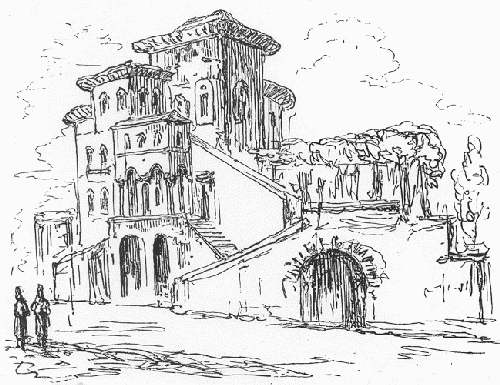
Drawn by Sir W. Gell
HOUSES IN SCIO.
Sunday, 30th.—At five this morning we bade adieu to Smyrna; and never did I send aloft a more sincere prayer than when petitioning to see it no more. By the forenoon, we were off the Island of Scio, the coast of which presented much beautiful and picturesque scenery. The wind now gradually increased to a stiff breeze, and the weather became threatening; so that the first symptoms of turning in made their appearance among the passengers. The night following was black and stormy, and we had reason to anticipate an Archipelago gale: fortunately, however, it cleared up, much to the satisfaction of the captain and myself; for never did a boat traverse these seas with less of the seaman in the composition of its crew, from the said captain down to the slop-boy.
QUARANTINE. Monday, July 1st.—The Island of Tinos was in sight at daylight this morning; and, passing through the channel between it and Andros, we approached Syra, the quarantine station of the new Greek kingdom for all vessels coming from Smyrna or the plague countries. The situation of Syra is very beautiful; the houses rising gradually in a succession of terraces, built upon the slope of a steep mountain, situated at the bottom of an extensive bay, in which we found the Madagascar lying at anchor.
KING OF GREECE. Shortly after our arrival, the officers of health came alongside, and informed us we were destined to seven days' quarantine. Of these, the day we left Smyrna counted as one, that passed at sea as another, and the one on which we got pratique as a third; so we had, in reality, only four days to remain in durance vile. To console us for the unwelcome detention, the inhabitants brought off quantities of delicious fruit, honey, and meat to regale our appetites; while, in the evening, our eyes were gratified with the brilliant spectacle afforded by the illumination of the Madagascar and the town. The presence of the King seemed to have transported the good people of the island beyond themselves: such firing of guns and blazing of bonfires, such screaming and hallooing, probably never before disturbed the quiet precincts of Syra. His Majesty gets pratique to-morrow, and there is to be a dinner and ball ashore. We could plainly discern them making preparations, and decorating the governor's house, but had no prospect of partaking of these festivities.
It was very late before I could get asleep, owing to the gambling going forward on deck until two o'clock in the morning. There was a rouge et noir table, and a whist party, by both of which very high stakes were played, much to the annoyance of the better disposed passengers, who wished for rest and quietness.
SHIP LAUNCH. Tuesday, 2d.—At nine o'clock, after dressing the ship in her colours, and receiving a salute from the shore, the King left the Madagascar in the captain's gig. A deputation of the principal inhabitants awaited his arrival, and the keys of the town, according to "ancient and approved usage," were delivered to him under a triumphal arch. The governor then addressed him in a Greek speech, to which his Majesty replied; but in what language the court newsman has not thought fit to inform us. After parading through the town, the procession arrived at the governor's, where the King held a levee. In the afternoon, he returned to the vessel, on board of which a dinner was given to the principal inhabitants; and again the poor Greeks illumined their houses and burnt bonfires.
The English in the steamer set up a singing-party this evening, in opposition to the hazard-players; and we kept it up until there was a dissolution of the card table; it being impossible either to gain or lose money with any satisfaction while the jovial chorus disturbed their calculations.
INHABITANTS OF SYRA. Wednesday, 3d.—Great preparations were made for a ship-launch; and again the King went in state to the governor's residence, and proceeded thence to the dockyard, where he performed the ceremony of naming a small vessel; which glided beautifully into the ocean amid salvos of artillery, volleys of small-arms, and the cheers of the surrounding spectators. The grand festival and ball took place on shore in the evening; when they kept it up till past midnight; and the moment the King and his party returned on board, the Madagascar set sail, and "left us alone in our glory." It seems rather extraordinary that the Prince of Bavaria had not the inclination, as he certainly had the power, to put off these fêtes until the passengers of the Francesco, with whom he had sailed for two months, and to whom he was now under some obligation, could have participated in them. There was no reason for hurry; there existed no necessity for the King's immediate return to Nauplia; in short, no excuse can be found to palliate such paltry, ungenerous, unfeeling conduct: certainly unfeeling, when it is considered that his fellow-travellers were witnesses of these festivities, without the possibility of joining in them.
Friday, 5th.—By the first boat which came alongside to-day, many of the more restless part of our crew hurried ashore. I remained on board till the evening; and amused myself, during the interval, in watching the numerous boats, crowded with the inhabitants, which came off to visit the steamer. I did not notice a single Greek woman who maintained the reputation of her countrywomen for any thing but ugliness; and none of the men were of that fine race of beings whom I expected to see. There was nothing national in their costume; the women being mostly dressed in imitation of the Parisian mode; and, apparently, many of the men took their cut from Bond Street. Over a cabinet in the billiard-room, I afterwards observed several plates from the "Courrier des Dames;" and as Syra is destined to be the principal port of the Greek islands, I presume its inhabitants wish also to show themselves leaders in the march of improvement. Of course, the ladies will prefer stiff stays, gigot sleeves, and spacious bustle, to the loose jacket, short petticoat, and coloured stockings of their grandmothers.
GRAND FESTA. There is to be a grand festa this evening, to-day being the eve of the γενεθλιον του προδρομου, or birth of St. John the Baptist. There was an incessant firing of muskets and petards; which proved that the gunpowder had not been all expended upon King Otho. Towards night, every one lighted a large bonfire before his house, and the favourite amusement seemed to be, who would run the oftenest through it when the blaze was at the fiercest. Shouts of laughter burst from the crowd, as each unlucky wight issued, scorched and singed, from the fiery trial; while the applause was proportionate towards those who ventured bravely, and escaped uninjured.
Many of us joined in the sport, leaping through the mass of newly kindled flame, and, among others, I had the satisfaction of presenting myself on the other side, minus a good portion of whiskers, and with eyelashes singed into little tufts, close to the lid.
SYRA. Syra, like many of the Greek towns, is best seen at a distance; for it is, in reality, but an insignificant place, and there is not a respectable street in it. The houses, too, are low and dirty; and a disagreeable smell of dried fish and bad olives salutes one in every quarter. However, the inhabitants appear to be wealthy and enterprising; and at some future period it may become a large, populous, flourishing city.
Saturday, 6th.—We started at midnight, and in the morning were off St. Nicolo, in the island of Tinos. The town is very pretty; and the house of the bishop, near the church, is a very favourable specimen of Greek domestic architecture.
LADIES OF MYCONE. After remaining here a short time, we proceeded on our course to Mycone. Several boat-loads of the natives put off to see the vessel; and on being received on board, they expressed the greatest surprise and admiration at the size and beauty of the steamer's cabin and deck. On our part, we were no less gratified with the graceful, varied costume, worn by our island visiters; one of whom, a female, was dressed in a most superb style; and being also exceedingly pretty, she set off her decorations to great advantage. Dark eyelashes overshadowed a pair of eyes, blue, soft, and beautiful as the heaven of her native clime. A shawl of parti-coloured silk was so disposed upon her head as to cover its upper part, and form a bow on the right side; while the ends hung over each ear, allowing the rich tresses of her glossy auburn hair to flow from under them unconfined. A plain loose jacket of light blue cloth covered a deep-red bodice laced close to the form; and a petticoat of the same colour, descending in ample folds to the knee, was fastened round the waist by a narrow black silk shawl. Her stockings were black, and the garters vermilion. Another lady of the party, a dark beauty, also wore a dress of rich and elegant fashion. Her hair, black as jet, was closely bound round her head, and fastened in a knot upon the crown, as one sees it arranged on the Greek statues. A thin gauze veil, ornamented at the two extremities with flowers and gold embroidery, was thrown carelessly over this elegant coiffure, heightening and adding new graces to a beauty it was intended to conceal. Her jacket was of green velvet braided with gold, and lined with white silk. The remainder of her dress consisted of rose-coloured silk; and a magnificent shawl, of that brilliant red and yellow pattern so common among the Greeks, encircled her waist. I believe she was the wife of the Neapolitan consul, who also fulfilled the duties of that office for half a dozen countries besides.
VULGAR TOURISTS. Proceeding next to Delos, we anchored opposite Mount Cynthus, and went on shore immediately, to visit the ruins of the theatre, and of some vast temple, built upon the ascent of that hill. Thence we passed to the Thermæ, and to the ruins of the great Temple of Apollo, which cover an immense extent of ground, where capitals, columns, architraves, friezes, and cornices, lie mingled in undistinguished confusion; and from their size and number they had more the appearance of the fragments of some fallen mountain, than the remains of man's handiwork. While engaged in contemplating these stupendous ruins, the rest of the party wandered about, and saw many things which necessarily escaped my observation. But four hours only were granted us to examine one of the most interesting of the places marked down in the itinerary; and it was necessary to hurry over the scene. It really seemed, that the feelings of the generality of our tourists must be of a very low and vulgar description, thus to visit any spot consecrated by history or fable, as it were for an instant, merely to gratify the empty vanity of being able to say "Oh! I have been there;" and then to hurry on towards the next object with the same heartless indifference. How different is their conduct on arriving at the busy haunts of men, which promise balls, dinners, or festás! Then, hours and days are not sufficient for the gratification of their favourite enjoyments, and every stratagem is put in practice to create delay.
Hardly one third of the passengers landed at Delos, yet five days were absolutely lost in Smyrna. The same parties who grumbled, and grudged four short hours at this isle, would have detained us as many days over the number specified in the city of figs, had they been permitted. Nor was the cool morning, or evening, freshened by the never-failing breeze, selected for going ashore; but the very hottest time of day, when on this treeless, barren, granite island, the reflection of light and heat is almost insupportable: when Apollo darts his fiercest rays on those who wander to seek his fane, and Diana was unable to offer them any cool, shady retreat which, at such an hour, she would herself have loved so well. Yonder, under the soot-imbued awning of the Francesco, sits many a listless cold-hearted being gazing without emotion,—
——"on the sacred place, Where once stood shrines and gods;"
and with no enviable feelings putting the question to him, who, with his imagination rapt on the thoughts of other days, hastens to the classic shore:—"What is the use of running out in the sun; cannot you see those piles of stones from the deck?"—Senseless, unfeeling, sordid, and degraded! what can have induced you to approach this consecrated land?
A MODERN ANTIQUE.There was one of our party who thought he had made a grand discovery and capture. With great labour and exertion, we carried for him to the water's edge a large block of marble, resembling a portion of a basin or font. He at once decided, that it had been some receptacle for water belonging to the temple, and resolved on carrying it to Palermo. Unfortunately, however, it was shortly afterwards recognised to be nothing more than a Turkish mortar for pounding the sulphur, nitre, and charcoal used in the manufacture of gunpowder; and on examination, there was no doubt of its being perfectly modern. "Never mind," said its proprietor; "it shall go to my palace; and there being no reason to explain what it really is only whence it came, the Sicilians will admire and venerate it as a relic from Delos!"
BEAUTIFUL ANCHORAGE. Sunday, 7th.—In the middle of the night we started for Naxos, bidding adieu to Delos over a cup "mantling with rosy wine," and with the song of sociality; thus worshipping the glorious gods of the table, as, leaving the temple of the one, we approached the spot hallowed by the worship of the other. Where, indeed, should the chorus sound more joyously than in the waters of Delos, or the sparkling wine flow faster than in the sight of Naxos?
It was a beautiful night; the moon shone with resplendent lustre, and the sea, calm and unruffled as a mountain lake, reflected all its beams, until each rippling wave became like molten silver.
Crossing from Naxos to Paros, and coasting along the latter mountainous isle, we stopped opposite the town of the same name, to discover the most convenient anchorage, for visiting the celebrated grotto. While waiting for the necessary information, several of the passengers went in search of the quarries which supplied the ancients with marble; but as, without interpreters, they could not make themselves understood, they returned unsuccessful. We, however, were fortunate in meeting with a rich proprietor, who lived opposite the grotto and village of Antiparos, and who promised to have men and torches ready for us by daylight. We then started again, and at length dropt anchor in a beautiful strait between the two islands. The greatest caution is requisite in getting to this position; the passage being extremely narrow, and the water shallow: the latter was so beautifully transparent, that each pebble on the yellow sand appeared distinctly visible, and myriads of sportive fish were seen darting in every direction from the clamorous hissing monster that invaded their quiet abode.
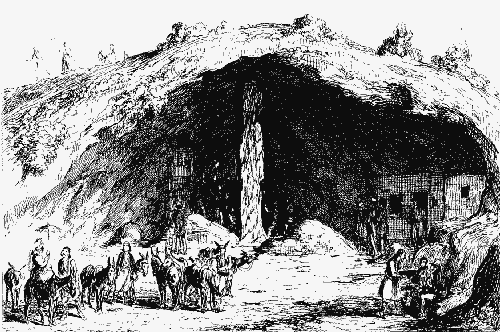
Drawn & Etched by George Cruikshank, from a Sketch by the Author.
Grotto Antiparos.
Published by Longman & Cº. April, 1835.
VISIT TO ANTIPAROS. Monday, 8th.—The expedition to Antiparos seemed to suit the general taste, and all were ready by the appointed hour. At four o'clock we embarked in two large country boats, and proceeding through the strait, we landed in a little bay, and found an assemblage of donkeys and guides awaiting our arrival. The distance, as we were informed, was two hours, and all being mounted, away we started on this grotto chase at a double quick step; so that in a short time many began to show symptoms of fatigue. For the first half hour the country appeared almost destitute of trees, but arriving at length MARINE PROSPECT. on the brow of a hill, after a long and gradual ascent, a richly cultivated and finely wooded hollow, surrounded by mountains, opened upon our view. As the abrupt faces of these eminences form an insurmountable barrier on three sides of the basin just alluded to, we fancied that the grotto must be there. But no! we had to descend, cross it, and mount again towards the south, by a steep path that wound up the least precipitous side of this punchbowl. Hitherto the rock had been primitive limestone lying on gneiss, but we now came upon a thick stratum of pure limestone.
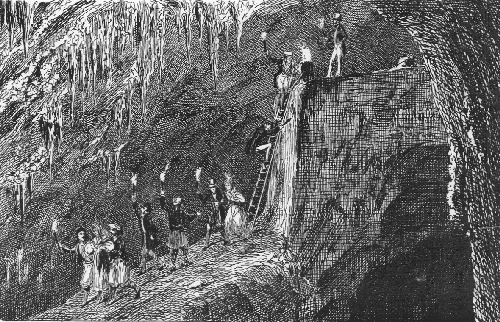
Drawn & Etched by George Cruikshank, from a Sketch by the Author.
Interior of the Grotto of Antiparas.
ENTRANCE TO THE CAVERN. Passing over the brow of a tolerably high mountain, we found that it declined towards the south into the plain; and thence to the sea by a gentle slope. The ground was covered with myrtle and arbutus, and presented a wild but beautiful aspect. We had now nearly reached the further end of the island, where a narrow promontory extends far into the calm blue waters. Far off in the distance appeared the islands of Sikyno and Raclia, floating like huge birds upon the bosom of the waves. Close under the western shore, where the island of Paros terminates in bold perpendicular cliffs, lay the little island of Spotico; while all around, the sea bristled with rocks as far as the eye could reach. On one side of a steep path, which we were now slowly ascending, the guides pointed out a huge fissure or break in the rock, which they said was the platform in front of the grotto. At the further end of this cavern, behind a vast stalactite, reaching from the roof to the ground, and suggesting to the imagination the idea of some gigantic sentinel before the pit of Acheron, yawned a low narrow opening, the interior of which presented to the view a more than Egyptian darkness. Around this spot were assembled a band of kirtled Greeks, provided with ropes, ladders, and flambeaux. Our appearance was the signal for a general uproar: each commenced talking, screaming, and fighting for possession of the ladies, and every now and then edging in a word of French or English, by way of additional recommendation. Much time was lost in squabbling for the torches, the number of which proved to be less than that of the adventurers; and it was only fair that "first come should be first served." Those who had loitered behind complained bitterly of the deficiency in this respect; especially the chevalier d'industrie from Milan, who, being less expert with his feet than with his hands, had been one of the last to arrive. Of his adroitness with the latter, he quickly gave us a specimen; for, while one of my friends was peering into the entrance of this Acherontic cave, he very cunningly appropriated his torch; and it was not until the matter became serious, that he could be induced to restore it.
PERILOUS DESCENT. It was with feelings wrought up to a high degree of excitement, in which I believe all my companions participated, that I heard the order given to advance, when the whole party trod closely on the footsteps of the guides, who preceded us with torches. Our speed, however, soon received a check; for by the time we had advanced fifteen or twenty paces, the light of day entirely failed us. All now became enveloped in utter darkness, except a small space in front, where the tapers of our conductors, nearly extinguished by the damp and unwholesome atmosphere, emitted a pale and livid blaze, which, failing to reveal the extent and termination of this frightful cavern, produced a "darkness visible," and magnified every danger. It was a long, narrow, winding chasm, gradually increasing in the abruptness of the descent as we advanced; and the floor, that consisted of carbonate of lime, was rendered slippery as ice by the damp and the friction of the feet of those who, for the last three thousand years, have visited this extraordinary place from motives similar to our own. A single cable of no very satisfactory appearance was all we had to depend upon for support, and it chafed against the sharp, rugged, angular projections of the rocks in a fearful manner, when violently dragged from side to side by the united action of the forty individuals who clung to it. The feelings of insecurity to which this naturally gave rise were not at all diminished by the shrieks and exclamations of terror proceeding from such as lost their footing upon the polished floor, and lay struggling in ineffectual efforts to get up, without letting go the rope. My own personal safety did not so wholly occupy my attention as to prevent me from being affected with wonder and admiration at the exceeding beauty of some portions of this subterranean corridor, which glittered in the torch-light with a splendour no language can describe; for the innumerable minute crystals scattered over its surface, glowed at one moment with a deep blood-red, and at another exhibited all the different hues of the most brilliant rainbow.
MELODRAMATIC SCENE. It is hardly possible to conceive a more extraordinary spectacle than that in which I was now an actor: it was perfectly melodramatic, and would make the fortune of any minor theatre in London, though the pen of a Dante is alone equal to its description. First and foremost, were seen the Greek guides exciting us to persevere, and the STRIFE OF TONGUES. beckoning us onwards by waving the flaming torches high above their heads; and when the light flashed upon their savage countenances, wild streaming locks, and picturesque garments, as well as over the pale, stumbling, struggling crowd which followed, it required no great stretch of fancy to imagine that I saw the attendant demons of some mighty sorcerer, the inhabitant of this rocky den, deluding us onwards to destruction. The laughter, screams, and hallooing, which accompanied our efforts to maintain a hold upon the cable, our only hope of safety, united to the smoke and stench of the flambeaux, rendered the whole scene no unapt representation of Pandemonium. The Greeks shouted forth oaths, warnings, entreaties, and directions, in their native tongue: with these were intermingled, in indescribable confusion, the English "d—n," the French "sacre," the German "mein Got," the Italian "corpo di Bacco," and the gentler exclamations of certain of the fair sex who, strange to say, accompanied us in this hazardous expedition.
SYMPTOMS OF ALARM. On reaching the brink of a most frightful precipice, we were instructed to crawl down by means of some rude steps cut in the surface of a sloping buttress or inclined plane of rock, which appeared to extend to the bottom. The sight of this horrible den acted as a "pretty considerable" sedative to our enthusiasm. Each exclaimed to himself, (at least I did for one) "Can I venture?"—as he contemplated the dismal, and, to all appearance, bottomless gulf, where nothing was visible but the strange figures of our guides at a prodigious distance beneath us, clinging to the wall with one hand, while they brandished their torches with the other. However, there was little space for reflection; and though, by this time, I shrewdly suspect most of the party had pretty well "satisfied the sentiment," as Sterne says, none were heard to say so; and after a short delay we pushed on again, apparently regardless of danger. Our progress, however, became every moment more and more difficult and discouraging; for this rude and imperfect staircase, also slippery as ice, was covered with loose stones, that came rattling down on our devoted heads at every false step of those above; and many who had eagerly contested at the outset for the distinction of leading the party, would now have gladly made an inglorious retreat rearward, to escape the contusions, or something worse, with which they were momentarily threatened; convinced, with Falstaff, that "honour hath no skill in surgery."
PETRIFIED GARDEN. After remaining for a few minutes suspended from the cord, like a cluster of bees in the act of swarming, we again found ourselves on terra firma; and a passage behind some masses of projecting rock brought me to a platform, in front of which rose a stalagmite, admirably adapted by its position for the display of my fireworks. Accordingly I let off a blue-light, which illuminated the grotto beneath, the arches of which were of immense size; and their vast ribs, protruding from the rock, and extending to a great height, formed a magnificent dome, from which hung innumerable concretions of pointed form. Masses of crystallised limestone grew from the floor in every shape that fancy could picture. There were trees, teeth, flowers, houses, men, &c.: in short, imagination never could exhaust itself in pointing out resemblances between these phenomena, and the ordinary productions of nature and art.
The predominance of the figures of trees, plants, and flowers among these fantastical creations, gives to the whole grotto the appearance of a petrified garden; but it was no slight drawback on our gratification to find these objects covered with slime and mud, obscuring the brilliant ever-changing hues of the myriads of crystals with which they are studded, and which former travellers have alluded to in terms of admiration. It was only when the blue flame shed its beautiful light upon the scene, that it at all realised my preconceived ideas of this "Palace of the genii, the most beautiful of fairy land," as it has been frequently styled.
By a ladder fastened to the stalagmite, we descended into another frightful cavern, where on one side several dismal-looking pits, like the entrances to coal mines, and black pools of dirty, stagnant water, menaced us with death under a twofold aspect, until we reached the uneven and shelving floor of the grotto. There were several chambers, more or less resembling each other, being separated from the grand nave of this magnificent temple by the accumulation of the crystallising mass for ages.
DESCRIPTION BY A NAVAL OFFICER. It is a scene that ought to be visited by a few congenial spirits, quietly and leisurely. On the present occasion the effect and the illusion were dissipated by the glare of the torch lights, the hallooing and screaming of those present, and the thumping of hammers and blocks of stone to get fragments of the crystal. This part of the grotto is certainly the heaven, the paradise; though, of a truth, the descent into it is through purgatory; an opinion in which I am by no means singular; and in confirmation I shall beg leave to introduce a portion of the narrative of a gallant officer belonging to one of our vessels cruising in the Levant, who saw the grotto under more favourable auspices than we did; though, like the poor Frenchman, whom I shall have occasion to mention hereafter, he acknowledges that he purchased the gratification at the cost of some mortal terror.
MAGNIFICENT PASSAGE. Speaking of the deepest and most gloomy of the caverns into which we had penetrated, he says:—"I was quite disheartened at this horrible prospect, and declared I would go back, but our guides assured us there was no danger, and the rest of the company resolving to see the bottom after having come so far, I would not leave them: so we went to a corner where was placed an old slippery rotten ladder, which hung down close to the wall, and down this, one after another, we at length descended. When we reached the bottom we found ourselves at the entrance of another passage, which was indeed horrible enough; but in this there was not wanting something of beauty. It was a wide and gradual descent, at the entrance of which one of our guides seated himself, and began to slide down, telling us we must do the same. We could discover by the light of his torch that this passage was one of the noblest in the world. It was about nine feet high, seven wide, and had for its bottom a fine green glossy marble. The walls and arch of the roof, being in many places as smooth as if wrought with art, and made of a fine glittering red and white granite, supported here and there with columns of a deep blood red shining porphyry, made with the reflection of the lights an appearance not to be conceived. Our guides could here keep on each side of us; and what with the prodigious beauty and grandeur of the place, our easy travelling through it, and the diversion of now and then running over one another whether we would or not, made this the pleasantest part of the journey.