JOURNAL (continued 2)
Reading edition
Wednesday, 15th.—This morning we took Mustapha, once the consul's janissary, and now his servant, as a guide to the curiosities on the other side of the water. He is by birth a Swiss, who, after having experienced various vicissitudes and adventures, was taken by pirates, sold as a slave, turned Mussulman, and is now happy and contented in the service of so good a master. Few English visitors who have remained any time in Constantinople during the last fifteen years, have quitted it without making the acquaintance of our friend Mustapha.
MOSQUE OF SOLIMANIE. The first object to which he conducted us was the mosque of Solimanie, the largest and most elegant in Stamboul; though it does not possess the same interest or renown as St. Sophia, nor the beauty and lightness of that of Sultan Achmet. The outer court is surrounded by fine old plane trees, and we looked into the inner one, which is surrounded on three sides by cloisters, and several antique pillars, with a fine ornamented fountain in the centre. On entering by the principal door, we took off our shoes, which was no hardship, the whole floor being covered with soft carpeting. The dome is supported by four enormous pillars of grey granite, polished by age. I was desirous to have measured them, but the priest or servitor, who accompanied us, refused permission. From the ceiling of the aisles, and around the dome, hung innumerable lamps of different sizes; an octangular frame of iron, suspended under the dome, also supported an immense quantity about ten feet from the floor. The aisles were filled with many little recesses, in which were placed books on stands; and one of them was occupied by a Turkish priest, who chanted some verses from one of these open volumes. Neither ornaments nor pictures decorate the interior, all being plain and simple, except that portion nearest Mecca, where an enormous wax candle is placed on each side of a little niche in the wall. There is something extremely impressive in the unadorned simplicity, vast extent, and sombre aspect of this mosque, which is the only religious edifice in Constantinople, that can be seen by a Christian without a firman; a donation to the priest of thirty-five piastres being sufficient to admit a large party.SERASKIER'S TOWER. We now proceeded to the Seraskier's tower, situated in a large court by the side of the palace of the Seraskier Pasha. In the upper chamber a party of men are constantly stationed to watch for fires, and, I believe also, to give notice of any unusual assembling of the people. On the appearance of a fire, they sound the alarm by beating gongs, and by despatching messengers to various parts of the city. From the windows of this apartment, is a most perfect bird's eye view of the whole capital and its vicinity. In the whole course of my travels, I can recall but one prospect, whose exquisite loveliness affords a similar combination of all the ingredients necessary to a perfect landscape, and which I, in some degree, prefer, as presenting even a still greater variety of beautiful objects,—I mean the view of Naples from the hermitage on Vesuvius.
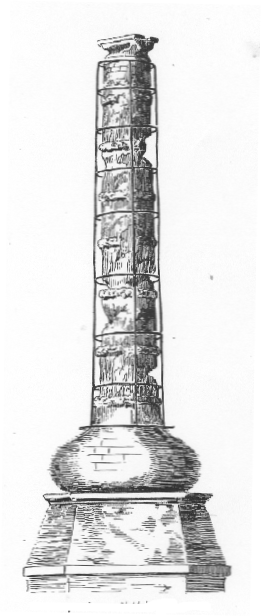
Etched by G. C. from a Sketch by the Author.
The Burnt Pillar.
Published by Longman & Co. April, 1835.
BURNT PILLAR. A short walk brought us to the Tchernberlé Tasch, or burnt pillar, built of red porphyry, which has been cracked and splintered by the numerous fires that have taken place around it; and, to prevent its falling to pieces, it has been enclosed within a sort of iron cage. It is ninety feet in height, and thirty in circumference at the base. Of the inscription, only a few letters can at present be made out. It originally ran thus:—
Το θειον εργον ηενθαδε φθΑρεν χρονω Καινει μανουῃΛ ευσεβης ΑυτοκρΑτωρ.
Passing onwards, we came to a dark dismal place, called the Cistern of the Thousand and One Pillars, a large reservoir for water, but now dry and occupied by the winders of silk thread. Its extent is very great, and the number of pillars far exceeds that above-mentioned. There is also another cistern, but as the entrance is through a Turk's dwelling, it cannot be visited except as a special favour, not always granted. HIPPODROME. From this, we were led to the Atmeidan, or place of horses, the ancient hippodrome; a large oblong area, on one side of which is the beautiful mosque of Sultan Achmet, separated from the open square by a handsome screen of masonry; over which a number of plane trees hang their luxuriant foliage, and through its windows we were gratified with a view of the court of the mosque. The Atmeidan is famous as being the scene of countless insurrections and tumults; it was the rendezvous of the turbulent janissaries; here they made their last noble stand, and were hewn to pieces and swept down by the Sultan's cannon and cavalry. Here too were held games and reviews, and here stands the obelisk of Theodosius, the brazen serpents from Delphi, and the lofty monument of Constantine, built of rough masonry, and supposed to have been once covered with brass. It is ninety feet in height. The obelisk was brought from Egypt and placed there by Theodosius, as appears from the following inscription on the pedestal, which is now covered up with earth, and the Turks will not allow of its being cleared away.
Difficilis quondam Dominis parere serenis Jussus, et extinctis palmam portare tyrannis: Omnia Theodosio cedunt sobolique perenni; Terenis sic victus ego, duobusque diebus, Judice sub Proclo, superas elatus ad auras.
It measures sixty feet in height, and each of its faces is covered with hieroglyphics. On the pedestal is a badly executed alto relievo, intended to represent the victories of Theodosius. Between these two monuments is the celebrated tripod from the island of Delphos; the heads of the serpents of which it is composed are lost: one of them was cut off by Sultan Mechmed with a single blow of his sword. From the number of people that gathered about me, I had some difficulty in making a drawing of these objects; and the soldiers from a neighbouring guard-house really appeared to consider I was forming a plan to pocket the columns and run away with them. Had not Mustapha been with me, it is probable I should have been arrested, as a friend of mine was yesterday, when he attempted to sketch Constantinople from Tophana. A superior officer, however, soon ordered him to be released, and gave him two soldiers as a protection whilst he finished his drawing. ST. SOPHIA.Thence our course lay to St. Sophia, which is a confused heap of unsightly buildings; the centre having enormous buttresses built against it, and the dome is much too low in proportion to the great size of this edifice. The principal entrance to the seraglio is also situated in the square, of which St. Sophia occupies one side, the walls of the palace another, and a row of small houses and coffee shops a third. In the centre is a very beautiful fountain; which, though inferior in size to that of Tophana, is much more richly ornamented.
SERAGLIO. The guard having allowed us to pass the gate, we entered the first court of the seraglio—a large oblong enclosure, formed by the Sultan's gardens, the inner gate, the grounds of the serai, barracks, stables, and a portion of the outer wall. Within a niche on the left-hand side of this entrance, the heads of rebellious Pashas and other traitors are exhibited to the gazing multitude, and among the more recent of those placed there, may be mentioned that of Ali Pasha. The second gate, which is flanked by double towers, resembles that of an ancient Gothic abbey; the interior is highly ornamented with gilding and inscriptions in letters of gold; and a large gilt cipher of the Sultan decorates the front. Our attempt to pass into the second court was less successful: Mustapha being a great coward, he was afraid to offer the sentinels a bribe; yet I have no doubt that the sight of a gold dollar never fails to gain admission for the unbeliever, whether Jew or Christian. Turning away from this forbidden paradise, we proceeded to examine a fine old plane tree, in the trunk of which three people live and keep a coffee-shop. A grove of plane, oak, chestnut, and cypress trees, conducted us out by the lower gate, and we walked to the sultanas' mosque, where the bodies of the late Sultan, and of the wives of his two predecessors, lie in state. The present Grand Signior's favourite sultana, and her son, also repose upon the same bier. TURKISH FUNEREAL POMP.On looking through the window, we distinguished the Sultan's coffin, deposited on a kind of throne, with four large wax tapers burning around it, and covered with the most splendid Cashmere shawls. All the other coffins were decorated in a similar manner: those of the women being distinguished by having no turban at the head; and the Fez, or Greek cap, with a feather and diamond aigrette, lay on that of the Sultan's son. The court of the Sultana Valide's mosque conducted us to the water-side; and, embarking at the steps of the Balook bazar, we glided swiftly across to Galata, highly delighted with the novelty of the objects witnessed during our day's excursion.
COSTUME. Thursday, 16th.—The clothes' bazar attracted our curiosity to-day, where, in a few minutes, a person may be rigged out, either à la Turque, or as an Armenian, the whole dress costing about 270 piastres. A cloth cloak, a silk gown, a silk jacket, camlet trowsers, yellow or red morocco boots, a shawl for the waist, with a waistcoat, shirt, and a calpac or turban, form the dress of a gentleman or merchant. The Jews wear a low black hat, round which is twisted a white handkerchief, inscribed with some Hebrew sentences from their law. The calpac of the Greek differs from that of the Armenian, by having a hole at the top, out of which peeps a bit of red cloth. The Turks wear yellow, Greeks and Armenians red, and Jews black, boots. The day was finished at Mustapha's, the scent dealer; or, to describe him by his real appellation, "Kortz Sultanée Amel Mehemet Said," as his card duly setteth forth. There we generally took a luncheon of beed caimac, a species of curd; or of mahalabé, a mixture of rice boiled to a jelly, and eaten with ice and cream; at other times we discussed a large dish of cabobs and a few glasses of lemonade. Occasionally our party adjourned to the coffee-house built in his garden, where, under the shelter of a delicious rose and jasmine bower, we spent the interval between dinner in all the luxury of idleness, smoking and drinking sherbet.
ANECDOTE. Friday, 17th.—I visited a printing-office in Galata, and saw the types of a work on the Greek church, some specimens of music, and a few Turkish books. The types were cast in Paris, and brought here at a great expense. The proprietors are now preparing a Hebrew work for the press, which will take them two years to execute. Went again in the afternoon to the Valley of Sweet Waters, where a greater crowd had assembled than even on the former occasion. I walked to the village, where there is a coffee-shop in a very agreeable situation, overshadowed by plane trees, one of which is nearly as large as that of the seraglio, and also quite hollow. In one part of the canal, near the palace, where the water is very deep, the favourite sultana of Selim drowned herself. She was young and exceedingly beautiful, but grew so jealous of the attentions paid by her lord and master to a Greek slave whom he had recently purchased, that she determined on committing suicide. Accordingly, having succeeded in eluding the vigilance of the guards and eunuchs, she one night escaped from the palace; and having procured a large stone, she carried it to the edge of the canal, and there fastened it to her person by means of the Cashmere shawl which she wore round her waist. On her absence being discovered next morning, the utmost consternation prevailed throughout the harem; and her slaves and attendants trembled at the fate which awaited them when the Sultan was informed of his favourite's escape. The harem, the palace, the gardens, the whole neighbourhood, were instantly searched, but in vain; no one had seen the sultana, and her absence remained a mystery. The eunuchs were threatened with death, if she were not found; and the horror of all was aroused by the suggestion that she might possibly have eloped with some giaour10, and several of the slaves were sent to atone for their neglect with the forfeit of their lives. In the mean time, the poor Sultan remained inconsolable: all his former love returned, and the Greek slave was sent as a present to one of the Pashas. At the expiration of a few days, as the disconsolate Selim was seated smoking on the borders of the canal, the body became detached from the stone, and rose to the surface of the water. Overwhelmed by the heart-rending spectacle, which too well explained the mystery of his beautiful queen's disappearance, he was with difficulty prevented by his attendant slaves from throwing himself upon the corpse. When he retired, it was taken out, and sent into Constantinople to be buried. Thus ends this little episode in the life of the mighty Selim.
IBRAHIM PASHA. Saturday, 18th.—I went up to Terapia in the evening, and dined at the palace. Ibrahim's army is passing the Taurus, and will soon be followed by its chief, who is taking the baths near Kutahieh. It is perfectly true, that Greek pilots are on board the Russian men-of-war, and that the Count Orloff has proposed to the Sultan to man the Turkish fleet with Russian artillery-men; so little dependence can be placed on their own sailors, should they come to blows with France or England.
Sunday, 19th.—This morning I went over to the Sultan's Valley, which is kept by outposts of Turks and Russians, one of each nation mounting sentinel together. The Russian has orders to instruct his Turkish comrade in the manual exercise, and in marching, during the time they are on duty. The poor Turks do not like it; for, when left to themselves, they make but lazy guards.
The Captain of the Actæon considers that he has received a marked affront from the Russian Commander-in-Chief. In consequence of his invitation, he went to head-quarters, and sent in his name; but after being kept standing for twenty minutes in the hall, among orderlies and common soldiers, he came away in disgust. Next day the General, who was probably a little alarmed, came on board to make an apology, saying the whole matter originated in a mistake, and that the attendants were ignorant of the rank of his English visiter. What! not recognise a captain in his Britannic Majesty's navy, commanding a frigate which lies moored within sight of the Russian army, when he visits its General in full uniform, in his boat, and with his pennant displayed? I think it is full time that these northern barbarians should be instructed, with the point of the bayonet, in the respect due to a British officer. However, it is to be hoped that such insolence will not long remain unpunished.
RUSSIAN MILITARY PUNISHMENT. In this beautiful valley there is a kiosk of the Sultan, at present used as a paper-mill; and near the landing-place stands a large house once occupied by an Englishman, sent hither by the Sultan to establish a leather manufactory. It is now the Russian head-quarters, the valley being their exercising ground. This morning a Russian soldier was flogged at parade. I was not in time to witness the punishment, but it was explained to me by one of the midshipmen. The whole regiment was drawn up in two lines facing each other, each man having in his hand a small twig or stick. The offender, stripped of his jacket and shirt, was made to run the gauntlet through the ranks, every man giving him a sharp cut as he passed, while the officers and sergeants stood by to see that the blows were sufficiently severe; and in case of any neglect, the delinquents are punished themselves. The man roared like a bull, and seemed to suffer immensely.
SULTAN'S VALLEY. Under the pleasant shade of some remarkably fine plane trees growing near to each other, close to the borders of a stream, thousands of Turkish and Armenian, as well as Greek parties, formerly came to spend the day during the summer months. This is all over now: the presence of the Russians prevents a single pic-nic, and the lovely valley is deserted. Crossing over to the European side, I walked along the shore towards Buyukdere, and at the point of Kerridge Bournu enjoyed a fine view of the entrance to the Black Sea, and the old Venetian castles which rise so romantically on the opposite coast, a little beyond the Giant's Mountain. The view in the Sultan's Valley is very grand, and the undulating hills approach each other in a picturesque manner, forming a wooded vista, terminated in the distance by the arched aqueduct which carries the water across several deep valleys from the bents near Belgrade to Constantinople. These bents are large reservoirs, resembling artificial lakes, bordered by thick woods, groves, and pasture land, and converting their immediate vicinity into a beautiful and luxuriant landscape, while all around is barren and exhausted.
RUSSIANS AND TURKS. Monday, 20th.—I strolled about in the Sultan's Valley till dinner-time; and on returning again in the evening to play at cricket with the officers of the Actæon, I found all the Russian cavalry horses had been turned out to graze. They are sorry steeds, supplied for the Cossacks by the Sultan; they seemed, however, to enjoy this liberty very much. Just before dusk, some Russian soldiers came down to catch them, and we amused ourselves with observing their motions. In vain they drove them from one side to the other, and into all the corners of this extensive pasture-ground; it was of no use, they would not be caught either by stratagem, or the temptation of corn. An old white stallion seemed to be the prime devil of the lot; for the moment the men got near, away he gallopped, kicking and flinging, with all the others at his heels. The Turkish commmandant of the army encamped near the Russians now came and sat down, and took a pipe. He laughed heartily at the discomfiture of his Frankish allies; and when we asked him how he liked them, (for he understood Italian, though he could not speak it,) making every sign of contempt, he spat upon the ground, pronouncing the word Rusky; as much as to say, he spat in their faces, and called them some very unpolite names in Turkish. But the Inglez—oh! and then he shook our hands—they were good fellows, he liked them exceedingly. When our midshipmen visited the Russians, they did not offer them any refreshment; but on their arrival at the Turkish encampment they were immediately taken to the officers' tent, and regaled with ices, coffee, pipes, lemonade, &c.; and it was with difficulty that they got away from their hospitable entertainers. When it became dark, there came down a reinforcement of Cossacks, and after a short chase the horses were caught. RUSSIAN HORN BANDS.The Russian and Turkish bands play every evening for a couple of hours. The latter also chant hymns at meal-time and at sunset; and the sound of so many voices, pealing forth these solemn and beautiful airs, and swelling and modulating as the breeze wafts them over the waves, diffuses over the mind a sensation of tranquillity which it is difficult for language to describe.
Thursday, 23d.—Went to the other side of Pera, to visit a garden established by a Frenchman for vegetables and the cultivation of the vine. He makes a delicious wine from the Chious grape, called Altintash, resembling the white lachryma of Vesuvius, but neither so strong nor so highly flavoured. He also manufactures an effervescing liquor, in imitation of champagne, but very inferior to that sparkling elixir, of which many of the Turks are, in secret, decided worshippers.
ANECDOTE. This evening, while sitting under the cypresses near the walls of Galata, upon the grass-covered tomb of an old Turk, our guide, Guiseppino, amused us with some Venetian tales, of which the following is a specimen:—"Many years since, there arrived in Venice a traveller of commanding exterior, and very magnificently dressed. He appeared exceedingly inquisitive respecting the curiosities of the city, and spent all his time in visiting the palaces, the museums, cathedrals, &c. One day, he called a gondolier, desiring that he might be carried to the church of a certain saint. The boat accordingly plied through several canals, and pulled up, at length, near the stairs of a church. The gentleman entered the building, but quickly returned, saying,—'That it was not the church he sought.'—'Well, then,' replied the gondolier, 'we will try another.' In this way they visited half a dozen churches; but the traveller was still unsatisfied. The gondolier was in despair: he had been rowing to and fro, from one end of Venice to the other, for the last four hours. At length he suddenly pulled up before a very ancient and venerable building; the gentleman entered, but as quickly came out again, with the same complaint. 'Not right this time?' said the gondolier: 'Why this is the church of Tutti Santi11; and if your patron saint is not here, by San Giacomo, he is in no other church of Venice!'".
COLLEGE OF PAGES. Friday, 24th.—To-day I passed by the ruins of the College of Pages, situated at the north end of Pera. Here were educated, in various languages and accomplishments, the pages of the Sultan,—selected from the sons of persons of the greatest distinction among the Turks. Their education began about the age of nine years, and continued till they were thought sufficiently instructed to attend to the duties of their appointments about the Sultan's palace. This noble structure was destroyed in the great fire; and will, probably, never be rebuilt, unless some rich merchant purchases the ground and materials, or some foreign ambassador receives it as a present. Passed through the Christian burying-ground, which is adorned with beautiful walks, overshadowed by cypresses; it is the favourite winter promenade. Thence a steep descent leads to the Sultan's new barracks; which are handsome square buildings, with regular windows, and a turret at each angle. SULTAN'S VISIT TO THE MOSQUE.The Sultan himself is now staying at his new palace in the neighbourhood of Dolma Batché; and the streets of the village were gravelled for him to go to prayers, which we were informed he would do at twelve o'clock. From a dread of tumult or assassination, he never visits any mosque in the city, contrary to the custom of his predecessors; and, for similar reasons, he never announces to which he will go until the same morning, and that as late as possible: in fact, time is only allowed for the guards to assemble, and the ordinary preparations to be made for receiving him.
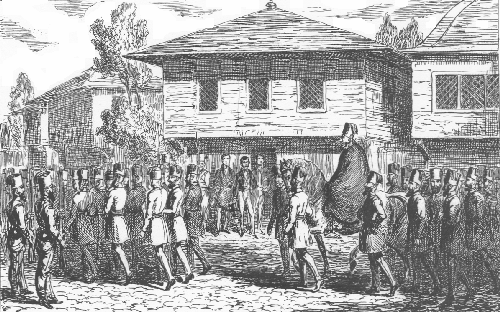
Drawn & Etched by George. Cruikshank, from a Sketch by the Author.
The Sultan going to Mosque.
At half past eleven we were enlivened by the distant sounds of "Zitti, Zitti," played by a military band; and in a short time afterwards a regiment marched by the coffee-house in which we were smoking, and drew up on either side of the street, which extends from the new palace to the mosque. The band was stationed about midway, and no one was allowed to pass or remain standing. On taking our position in front of the crowd at the appointed hour, a Turkish officer came up, and politely addressed us in French, with an invitation to come within the file. He led us some distance nearer the palace, and placed us under a doorway; where we were joined by a German baron, who resides near the village, and who appeared to be on very friendly terms with all the officers, three of whom speak French. The one to whom we were indebted for our present advantageous situation remained some time conversing with us. He was a very handsome man, the son of a Georgian; and is esteemed a good officer, being second in command, although only nineteen years of age. He quitted us, to join a party of American ladies, who came within the lines, and as soon as the Sultan had passed by, he ordered ices and lemonade for them; and although he has never been out of Constantinople, he behaved just as any well-bred European officer would have done under similar circumstances. ANECDOTE.As we stood chatting together, our German friend related a curious adventure which happened to him last year:—He was out shooting behind the village, when his Highness rode up, accompanied by two or three officers; and as it is unlawful to appear in the Sultan's presence with fire-arms, the German felt himself in a very embarrassed situation. However, he stood still, taking off his hat. The Sultan, on passing, looked hard at him; and just at that moment, a swallow, happening to fly towards the party, he pointed to it, and said "Tirez!" The German, though in a great fright, understood him perfectly: he fired, and, as luck would have it, killed the bird, which fell at the head of the Sultan's horse. His Highness was quite delighted, exclaiming, "Eh, eh," (good, good,) and desired one of the attendants to enquire who the sportsman was, and where he lived; after which he rode away. Next morning, a person attached to the court came to the baron's house, with a present of china, flowers, and a purse containing 5000 piastres, which his sublime Highness had condescended to present to the successful shot. The baron requested the bearer to take his compliments and thanks to his master, and say, that he was ready to kill a swallow every day for the same reward.
SULTAN'S VISIT TO THE MOSQUE. Namik Pasha, who had arrived from England, France, and Prussia only a few days before, now came to tell us, that as it was past the usual time of the Sultan's going to the mosque, he was afraid he would not come at all to-day; that he had left him with Count Orloff, with whom he was in a towering passion, many angry speeches having passed between the cunning diplomatist and the enraged sovereign. However, soon after, the order to fix bayonets and shoulder arms, both of which were very well executed, announced his approach, and in a few minutes afterwards the band struck up his favourite march. At the head of the procession were three led horses, richly caparisoned, having saddle-cloths embroidered with gold and precious stones, and bridles ornamented in a similar gorgeous style. They were noble-looking animals, and seemed as if conscious of the magnificence with which they were decorated. Next to these followed about thirty officers, consisting of generals, colonels, and captains of the fleet, walking two and two: they wore a sort of frock coat, with that description of cap called a fez. HIS PERSONAL APPEARANCE.After the ministers of state, came his Sublime Highness himself on horseback, closely wrapped up in a greyish brown cloak, with a collar of diamonds, emeralds, and rubies, arranged in the form of flowers—the richest and most brilliant ornament I ever beheld. Like his officers, he also wore a plain fez, to the silk tassel of which the paper was still left attached, as is customary with the lower orders of the people; this fashion, in fact, seems almost universal; and when the paper is destroyed, a new tassel is put to the cap. It was drawn close over his ears, and down to his large black eyebrows, and his beard hung over the diamond clasp of the cloak. His face is long; his nose, slightly arched, indicates talent and resolution; and his eye is remarkably large, bright, and penetrating. We took off our hats as he passed: he looked earnestly at us, without turning his head, and after acknowledging the salute by a slight inclination of his body, again addressed himself to Namik Pasha, with whom he had been conversing before he came up to us. Another party of officers closed the procession. The Sultan has the appearance of being about fifty-five years of age; and his blotched face, and red nose, sufficiently indicate a penchant for the bottle: indeed, on the present occasion, he displayed strong symptoms of being in what is called "a state of liquor," as well as in a most particular bad humour. It is reported that he and his sword-bearer get drunk together every day, and that he once forced the Grand Mufti to drink half a bottle of Champagne, which he refused at first, declaring that to do so was contrary to the religion and ordinances of the Prophet. But the Sultan told him that he was himself the Head of the Church, and that he would make a new ordinance, bidding the Mufti swallow what was offered him, or take the consequences of disobedience. Upon this the Chief Priest drank off the potion, perhaps, after all, by no means new or unacceptable; and the Sultan, turning to a certain officer of state, who had also refused the wine on account of similar scruples, said, "Now then you may drink, seeing that the Head of the Church and the Chief Priest have set you the example."
NEW REGULATION SOLDIER. In about a quarter of an hour the Sultan returned in the same manner, and entering his palace, the regiment marched off in good order. It was almost entirely composed of boys; and though the whole body looked rather imposing when together, yet individually they have by no means a military air or appearance. Their uniform is extremely mean and unbecoming: it consists of a fez cap, worn slouching over the eyes and ears; an ill-made jacket of coarse blue cloth, faced and turned up with red; coarse white Russia duck trousers, always exceedingly dirty; Wellington boots in the same condition, into one of which the right leg of the pantaloon is generally stuffed, while the left hangs in the ordinary fashion, or is turned up over the ankle; the bayonet and cartouch box are both suspended at least half a foot lower than they should be; and their linen and persons are also disgustingly filthy. The whole of this description is by no means an exaggerated sketch of the new regulation soldier—the hope of the Sultan, and the terror—of whom? of himself. It is but justice, however, to add, that the officers of this regiment presented a striking contrast to their men, being all good looking, well dressed, and of a soldier-like appearance; the band also was respectable, and executed their different marches in a masterly style.
PALACE OF THE BRITISH EMBASSY. I returned by Tophana, where there is a great mart for tobacco pipes in the vicinity of the fountain before described. In the evening I went into the garden of the English palace, which is very beautiful, with shrubberies, shady walks, and bowers; but the building itself is in ruins, having been destroyed during the late fire. Being quite isolated from any other dwelling, and surrounded by a large garden enclosed with lofty walls, it was positive negligence that caused its destruction. The ambassador, Sir Robert Gordon, was up the Bosphorus, and his principal servant obstinately refused to allow any one to enter the room where the fire had originated, until it was too late. The damages are estimated at 20,000l., and perhaps the best thing that could now be done would be to sell the materials, and either let the ground on building leases, or dispose of it altogether. By either of these methods, a large sum would certainly be realised, and with the produce a suitable house might be purchased in Pera, when it is decisively ascertained that the Russians are not to be the future masters of Constantinople; until then, it would be useless to think of spending the money. In fact, there can be no question that the ambassador ought to reside in Pera, in the winter season, when the roads are often blocked up with snow, and the wind on the Bosphorus so violent, that all communication by water, with the villages far up the channel, is cut off; so that serious evils might arise, not only from the distance, but occasionally from the impossibility of claiming the ambassador's protection on any sudden emergency. The Russians are building a splendid palace in Pera; that of the Austrian mission was not injured; and the representatives of the new Allies, England and France, are the only two who do not make Pera their residence, much to the inconvenience of merchants, and all persons connected with the embassy, particularly the members of the diplomatic corps.
ARM BAZAR. Saturday, 25th.—Went to the arm bazar, or curiosity shop, which I found stored with a motley show of weapons, dresses, ornaments, horse trappings, and armour, such as would make George Robins's fortune, could he send his myrmidons of porters to lay hands on all they could carry away. Helmets, spears, bucklers, bows, battle-axes, swords, daggers, rifles, long guns; in a word, every species of offensive and defensive weapon, from the common musket of the English soldier to the stiff bow of the Persian, were here gathered together from every kingdom of the East and West. DAMASCUS SWORD BLADES.A fat Turk, squatting on his counter, tempts you, on one hand, with a blade of the rarest Damascus steel, inscribed from hilt to point with some verse from the Koran in Arabic letters of gold; such as an invocation to the one God,—"Strength to the arm who wields the blade in a righteous cause, and death to him it reaches," &c. Drawing the sword from the gold-embroidered velvet scabbard, he rings it with his nail, to convince you of its soundness and temper. SCENE IN THE BAZAR.Cast your eyes in the opposite direction, and you may observe the Armenian, in the next stall, winking and slily beckoning you towards him. He smiles, should you condescend to notice him, but frowns and shows impatience when you appear to disregard his attempts to seduce you from his portly rival. The latter, finding you will not buy the sword, displays his pistols, silks, mouth-pieces of tempting amber, and appears determined that you shall purchase something; till at length, his patience being fairly exhausted, he packs up his wares, and surrenders you to the wiles of his now triumphant opponent, who feels satisfied that he can make you take something off his hands, though the Turk was unsuccessful. As most Englishmen appear to value swords, he takes from his cupboard a black-looking, dust-covered, white-handled weapon; and pushing aside his long robe with an air of the utmost importance, he draws forth the blade, which proves to be a black Khorassan, entirely destitute of ornament: he rings it, it returns a silver sound; he points out the beautiful watering, the gradual deepening of the colour from the edge to the back, and finishes by swearing to you, whilst he looks towards the Armenians and Jew brokers gathered around for their attesting nods, that it is the most exquisite blade in Stamboul; that it will cut a lawn kerchief, thrown into the air, into two parts, as clean as a pair of scissors. He then closes his panegyric with the demand of, "How much will you give?" Scarcely waiting for a reply, he throws it aside, as if of no value; and, in imitation of his neighbour the Turk, endeavours to keep your curiosity awake, by placing all his wares before you. JEW BROKERS.The instant you turn from the disappointed merchant, you are assailed by twenty Jew brokers at once, who, having espied their quarry from afar, have assembled from all quarters of the bazar, and, like a flock of vultures, are waiting near to devour you, congratulating themselves on your unwillingness to buy of the cunning Armenian. One attacks you in bad Italian, another in modern Greek, interlarded with a few words of unintelligible English or French. Each is master of a stall; where, according to his own account, you can purchase whatever you want at the greatest advantage, though, as yet, they know not what that is, even if you do yourself. Thus, like Actæon, the unfortunate stranger is exposed to the chance of being torn to pieces by the dogs who profess to call him master, and to do his utmost bidding.
The bazar is always crowded with buyers, sellers, and idlers, so that it costs some little squeezing and pushing to get through its various passages. When a large purchase is contemplated, or if the seller be an Armenian or Greek, he will adjourn with you to the neighbouring coffee-house, and there, over a pipe and a cup of coffee, the bargain is concluded on much better terms than in public, where, possibly, the merchant's pride would not relish the exposure of abating some hundred piastres, and where the sharks of brokers might lay claim to a good recompense, for bringing the Ingles capu dou to be plucked.
INTERIOR OF THE BAZARS. In the bazar the noise is deafening from the screams of the disputing parties, and the vociferating of prices by those who have articles for sale. It is a sort of Babel in miniature, where Jews and brokers push by you every instant, hastily shuffling along, and loaded with some piece of second-hand finery to be put up at auction; such as, for instance, an incense salver, a piece of Persian silk, an Albanian rifle, an old silk or velvet robe, embroidered with gold, the property of some gay Turkish lady, who having exhausted her purse the day before in a party of pleasure to the Keathane or "Sweet Waters," wishes to replenish it by the sale of a portion of her wardrobe. To these may be added, amber mouth-pieces, bundles of long pipe-sticks, a lot of worn-out clothes, a Persian battle-axe, China ornaments for scents, coffee cups with their silver filigree stands, a Cashmere shawl, &c. Each seller bawls out the last bidding for his separate commodity in the highest note of which his voice is capable; and as all are pitched in different keys, the stranger is soon driven forth to seek a purer and more quiet retreat, either within the gold and silver embroidery bazar, or in that of the Broussa silks, close by.
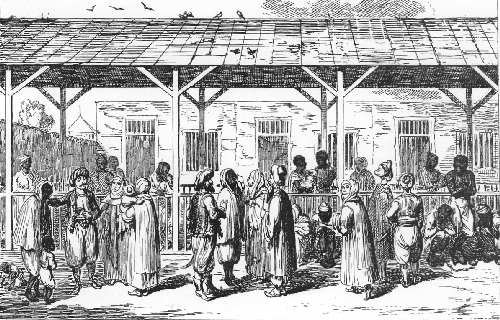
Drawn G. C. from a Sketch by the Author.
Slave Market, Constantinople.
SLAVE MARKET. Quitting this scene of tumult, I visited a place of a very different character,—the slave market, situated in a square yard, three sides of which are occupied by low stone buildings, with wooden sheds projecting in front. They were divided into rows of cells, each having a window and door opening into the wooden enclosure just mentioned. Within these dens,—and they exactly resemble the cells usually occupied by wild beasts,—a "crowd of shivering slaves" were seen either penned up within the inner apartment, or lying about, like cattle, in the open space in front. They appeared to be all Nubians,—black, dirty, and clothed in ragged blankets. Born to no other inheritance but slavery, they seemed wholly unconscious of their degraded state; and continued chattering unconcernedly, and, to all appearance, very happy. As I stood gazing on the novel scene, the ruffian keeper (and never did a vile, debasing occupation stamp its character more indelibly on the physiognomy of man) led one of the black victims forth, to meet the speculating caprices of a haggard old Turkish woman. He proceeded to point out her good qualities, and to descant on the firmness of her muscles, the robustness of her limbs, and her mature age; at the same time pinching her tender flesh, by way of proving the truth of his assertions, till the poor creature shrieked out with agony. He then tore down her eye-lids, to exhibit the healthiness of her eye-balls; and wrenched open her mouth, to prove, by ocular demonstration, that he practised no deception in speaking of her age. The old woman herself examined her all the time, and haggled, as to the price, like a butcher when purchasing an ox in the cattle market. As I witnessed all this, my heart sickened, and I turned with loathing from the disgusting spectacle. Yet the poor negress was wanted only for a domestic slave, and would, probably, be kindly treated, when once the property of the old hag, who, I believe, purchased her at last for 1000 piastres, or fifty dollars. Indeed the girl appeared to be conscious that the change would be advantageous to her, from the meekness with which she bore the treatment of her persecutors. Proceeding a little further on, we observed, sitting at the window of one of the cells, a solitary female, whose head was covered with a linen veil. On hearing our approach, she looked at us through its folds; in an instant after, the covering was removed, and a pair of brilliant, dark eyes shed their lustre upon us. Nowadays a white slave is seldom found in the market, the Russians protecting the Circassian and the Georgian, and the French and English the Greek. When they do appear, they are generally disposed of at a high price. GEORGIAN SLAVE.This beautiful captive, who proved to be a Georgian, was neither bashful nor timid. She saluted us with smiles, severing her raven locks, and trying to captivate the spectators, by making her beauty appear to the greatest advantage. However, it did not seem to possess any power over the Turks; and as to the Christians, they are not allowed to purchase slaves publicly, though sometimes it is done indirectly, and by the assistance of some friendly Osmanli. I saw but three or four men-slaves, with a few boys, all Nubians, and, like their female companions, in a dirty, miserable condition. They were chained together, two and two, by the ankles. Having now satisfied my curiosity in regard to this much talked-of but loathsome spot, I was most glad to hear the proposition that we should adjourn to Mustapha's. From him we learned that the Georgian beauty had been exposed to sale for several days; but that no one had offered to purchase her, the sum demanded being exorbitant. Her proprietor was a rich man, and could afford to wait until some one consented to put down the 2500 piastres at which he valued her.
TURKISH CONFECTIONERY. Passing through the old-clothes' bazar, the Monmouth Street of Stamboul, we came to a range of stalls occupied by the engravers and cutters of precious stones. Many talismans were offered to us, set very neatly in blood-stone, carnelian, and lapis lazuli. The day was wound up with the important business of tasting the different varieties of confectionery to be found in a large, handsome shop near the Balouk bazar. All were luscious, and many, particularly the preserved rose leaves, were even delicate. We partook of some thirty or forty different sorts; in which flowers, scents, fruits, and gums were mixed with sugar, until of the consistence of damson cheese. The Turks eat a vast quantity of these cloying sweetmeats, after which they drink abundance of sherbet. A glass of good brandy, however, would, in my opinion, be a much better corrective.
ARMENIAN VISITERS. Sunday, 26th.—Went up to Terapia this morning, and spent the day in wandering through the Sultan's Valley, under the superb plane trees, and returned to dine on board the Actæon. After dinner, a party of young Armenians came on board, accompanied by their tutor. They were sons of a man of distinguished rank among his countrymen, residing on the Bosphorus; and one of them, the eldest, about eighteen years of age, was so fat, round, and sleek, that we all decided him to be what Baba threatened to make poor Juan. The other two brothers were very fine intelligent lads, and there was also a cousin with them, a heavy, shy, youngster. The tutor, who was a young man of about twenty-two, spoke French, Italian, English, and Latin, fluently. His pupils, likewise, understood a little English, and French uncommonly well. They were delighted with their reception, and remained a long time at table in the gun-room, drinking their wine with much relish, and seeming to prefer it to coffee, especially the younger boy, who, had he been permitted, would have willingly finished a whole bottle to his own share. On taking leave, they invited us all to their father's residence; but we never availed ourselves of the invitation, possibly because we discovered that they had no sisters; and the inside of the black house, below Jené Keni, was in itself an insufficient attraction, without the chance of getting a glimpse of a fair Armenian girl, divested of her odious gashmak, and the form-concealing cloak.
The evening was lovely, and my sail down to Pera delightful: no sound broke upon the ear, save the rippling of the current against the caique as it glided lightly along, like the bird, which skims closely over the surface of the ocean, and appears to bathe its plumage in the waves, though in reality without wetting its crescent wings.
ORIENTAL COSTUME. Monday, 27th.—Strolled again in the bazar: this word means barter, or the act of bargaining for the sale or purchase of any commodity; and it is in them that all the retail trade of Constantinople is carried on. As these cloistered passages exclude the rays of the sun, they are cool and pleasant places to lounge in, except that the pavement is usually in a very dilapidated state. The merchants themselves present an interesting spectacle, each wearing the proper costume of his respective country, which, with the motley garb of the crowd incessantly passing to and fro, amuses the stranger's eye with a curious and almost infinite variety of dress and appearance. For the convenience of those who arrive periodically at Stamboul from the most distant portions of the empire, in caravans, there are large khans provided; which, being built entirely of stone, are fire-proof, and afford ample accommodation for the merchants with their attendants and property. TURKS.—ARMENIANS.—GREEKS.Yonder sits the Turk, grave and taciturn: his goods are spread before him on his counter, and samples hang around in neat array; but satisfied with this, and trusting to their intrinsic value to recommend them, he smokes with a haughty air, and disdains to utter a single word to arrest the stranger's passing steps. Should you question him about the price, and attempt to cheapen his merchandise, the answer will be comprised in two words; and if the abatement be again proposed, he replies with an economical "No," and a whiff of smoke, after which he again relapses into his former apathy.
That bearded elder, seated on a low stool with the dark clouds of thought and mental calculation visible on his countenance, is an Armenian. Though he will submit to a diminution of his price, he is honest; and though a man of few words also, yet is he civil without affectation, and persuasive from the apparent sincerity of his professions.
JEW INTERPRETERS. Their neighbour, however, makes ample amends for the taciturnity of both. He is a Greek, and you may hear him at the other extremity of the bazar. The most laboured efforts of the rhetorician bear no comparison with the honied, artful speeches, and the gay and cheerful air by which he detains, wheedles, and finally succeeds in obliging the passer by to purchase, or at least examine the contents of his stall. Observe yon poor devil, dragged first this way, then thrust back again, trying in vain to still the tempest which rages around him, by speaking half a dozen languages in a breath. He is an interpreter, or go-between in a purchase, and seems torn to pieces in the whirlwind of voices which assail him from the disputing parties, in each of whose languages he tries to explain; but, poor patient Jew! you never could speak any of them intelligibly, and your nasal twang, and drawling accent, so disguises what you do say, that nothing but a miracle could make you understood. The screams, the grimaces, the gestures which these people exhibit, during their unavailing efforts to render themselves understood, appear inexpressibly ludicrous to the indifferent spectator, and their perseverance is still more extraordinary, since it rarely happens that their best endeavours are repaid by any thing better than reproaches, kicks, and imprecations.
TURKISH CIVILITY. Our old friend Mustapha reposes so much confidence in the honour of an Englishman, that this morning he offered to lend me any sum I wished, with no other security than my simple word. In order to convince me of his ability to make good this promise, after removing a stone from the floor, he unlocked an iron trap-door, and showed me a mine of gold pieces concealed below. He was delighted with a rough sketch I made of him; indeed, many circumstances go to prove that the fanatical aversion of the Turks to portraits and pictures is much on the decline, notwithstanding all representations of the human figure are strictly prohibited by the Mahomedan law. The Sultan has had his likeness taken twice already, and he is going to sit a third time to an English artist of the name of Atkins.
Tuesday, 28th.—A ship arrived from Malta to-day, bringing intelligence that the formidable English fleet destined to join the French squadron might soon be expected in the Dardanelles. All Pera is in raptures at this news, and there is now some hope that the Russian Bear will be forced to draw in his claws.
DECREASE OF FANATICISM. I walked about Stamboul to-day, and experienced much civility from the Turks, who took infinite trouble to answer all my enquiries. When I made them understand by signs that I wished to cross the Horn, many left their little stools and walked some distance to put me in the right course. How changed is their conduct in this respect from what it was at no very remote period, when a Christian hardly dared be seen in the streets, and when the Turk, for mere sport, thought nothing of drawing a pistol and shooting at any Frank whom he happened to observe looking out of his window; and not only the foreign merchant, but even the consul, was obliged to have a guard of janissaries to attend him from his house to his office. At that time, too, the wealthy Christian, in passing through the streets of Stamboul, was often stopped and compelled to sweep the muddy crossing; and even the dogs were allowed to worry him, without his daring to beat them off. Happily those days of fanatical intolerance are for ever passed; and the irresistible march of civilisation, by gradually weakening his prejudices, has humanised even the intolerant and ferocious Mussulman.12
CASHMERE SHAWLS. Thursday, 30th.—To-day a man brought for sale a quantity of Persian silk, which was very soft and beautiful, and the colours were bright and well arranged; he had also some black Cashmere shawls with variegated borders: though the patterns looked handsome, they were of inferior qualities, and not to be compared with the French and Scotch imitations. Not being inclined to purchase any, I posted off to the khan, where the Angora shalée is sold, and saw some beautiful specimens of this soft and warm manufacture, whose fine silky texture renders it a great object of commerce for ladies' dresses: the price is about 300 piastres for eight pics, which is the requisite quantity.
TURKISH BATH. I returned to Pera to take the hummum or bath, the one there being very clean, quiet, and well managed. A narrow platform, raised about three feet from the ground, and covered with cushions, runs round the whole of the first chamber, which is lighted from above by a glazed cupola; and a fountain of clear water playing continually in the centre, spreads a delicious coolness throughout. As soon as we had mounted the stage, one of the bath-men offered carpets and cushions, but my companion refused them, for the plague is often communicated by using these pro bono publico comforts; and a Perote lives in constant dread of this terrible malady. After undressing, we hung our clothes on pegs, and covered ourselves with a linen towel, devoted to that laudable purpose, and which, if neglected in the slightest degree, calls forth the most energetic remonstrances from the old Turk, who sits smoking near the fountain.
The wooden pattens or slippers used by the bathers were arranged on the steps by which we mounted the stage, and I had several narrow escapes from being prostrated on the marble pavement ere I reached the small door leading into the hummum; so difficult do the uninitiated find the use of these wooden bridges, which are clumsy, heavy, and slippery as skates. I shuffled along very awkwardly, much to the amusement of three sedate old gentlemen, who were puffing and melting from the effects of a long sojourn in the heated atmosphere of the inner chamber. The first hot room was rather pleasant; and after remaining there a few moments, to break ourselves in for the furious attack on the pores to be expected in the next, we entered the second chamber, and again pushed on into the third, where the sensation, though at first unpleasant, gradually became delightful. Coffee and pipes were now brought in; and sitting down on a low marble bench, we consigned ourselves to the influence of the melting atmosphere, thinking of the unhappy condition of the mutton-chop, when it exclaimed in a piteous voice to the gridiron, "I am all of a perspiration." There were several other bathers undergoing this process of fermentation; and when the coffee was finished, and the pipe laid aside, two fellows placed me gently on my back, and commenced rubbing, squeezing, and twisting my arms, ribs, and legs till I thought every joint would be dislocated. I soon felt satisfied with this sort of discipline, though, upon the whole, the sensations were rather disagreeable than painful. The room where we underwent the operation is an octagon, with an arched roof, into which light is admitted through a number of bulls' eyes, or knots of glass; and a marble basin is fixed against the wall on each of its eight sides, into which two pipes, with stop-cocks, admit both hot and cold water. With this you deluge yourself by means of a large metal ladle chained to the wall; or it is done by the bath-man, should you prefer the assistance of another. Within this chamber was a smaller one, containing similar basins, and to one of these I moved, followed by one of the men, who, after lathering me from head to foot with a sort of slimy caustic soap, scrubbed me down with a brush made of aloe shreds. Having overwhelmed me once more with cold and hot water, and given a finishing pull or two at my limbs, he left me to duck myself, if I thought fit; but I had had quite enough, and hurried back into the second chamber. Here I was enveloped in hot towels, one being wound round my head, another round each leg, &c., and in this way I returned to the first court, where I mounted the stage, and sat down to dry, smoking a good half hour before I resumed my clothes. Instead of being exhausted, as might have been expected, I felt highly refreshed, and grew delightfully cool in a short time, though I fancied I had lost some pounds of flesh.
As regards the natives of the East, bathing can scarcely be styled a luxury; to them, it is really indispensable; for as they do not change their clothes even at night for months together, in fact, not until worn out, they would be otherwise insufferable beasts; but by frequenting the bath every day, or every other day, and performing the ablutions imposed on them in the Koran, with their quiet sedate mode of life, they are actually rendered very cleanly animals. The women have the use of the baths in the afternoon, when they assemble in crowds, and all the scandal and news of the town is circulated, marriages concluded, and the secret intrigues of the parties are reciprocally detailed; in short, every thing which may be supposed to be brought on the tapis in an exclusive meeting of the fair sex. Nature is every where the same; and I presume, whether in a bath at Stamboul, a Parisian saloon, or a drawing-room in London, a similar love of gossip is their distinguishing characteristic. Almost every quarter of Stamboul is furnished with its baths or hummums; and the houses of all rich Turks possess this desirable luxury, which is used by the male part of the family in the morning, and by the females afterwards. The plan on which they are constructed is the same throughout the East: in them shaving is universally performed; the hair is dyed, the beard is made to assume a beautiful glossy black; and the depilatory pincers and ointments of the ladies are applied to the purposes for which they are designed. The bath I used was opposite the sherbet vender, on the hill of Pera, who is so well described in "The Armenians" of Macfarlane; and whose little fountain of water, flowing through machinery, and setting wheels, circles, and bells all in motion together, is no slight decoy to the thirsty passenger. I have read "The Armenians" with great pleasure. The description of the locale, as well as of the manners, customs, and general appearance of the native and foreign inhabitants of Constantinople, is given with admirable fidelity; in short, no modern work with which I am acquainted presents a more lively and faithful picture of this queen of cities.
EASTERN STORY-TELLER. Friday, 31st.—Instead of making an excursion to the Sweet Waters, I went with my friend the American secretary to visit the coffee-houses in the Armenian quarter, where an improvisatore exhibits his talents every holyday. Immense crowds of respectable Turks assemble there to listen to the narrations of this accomplished story-teller; and it is even said that the Grand Signior himself is often present as an auditor in disguise. In all the coffee-houses there were concerts of vocal and instrumental music; the former consisting of songs or chants performed by a number of voices together, or else one man sang a single verse, to which all the others responded by way of chorus. Occasionally they varied their performances by singing alternate verses of the same song. We sat in the open air, on a long pier of wood built out into the sea, where there were hundreds besides, perched upon low stools, smoking, or eating delicious ices and mahalabé, and laughing and talking with more vivacity than I could have expected in beings generally so taciturn, and so absorbed in the contemplation of their own importance. At last, a man came to the door of the largest coffee-room and clapped his hands, when the Turks immediately moved into this apartment, in which seats were arranged in a semicircular form one above the other, as in a theatre. A portion of the floor, in front of the benches, was occupied by low stools, probably reserved for visiters of distinction; and close to the wall was a rostrum and a large easy arm-chair, on one side of which stood a little desk.
MATTHEWS AT CONSTANTINOPLE. Our Oriental friends behaved with much politeness: for, perceiving from our European costume that we were strangers, they offered us places in front of the stage; and after a few minutes' delay a man entered, and was handed up to the platform and chair amidst a buzz of universal applause. In his hand he carried a small stick, and in gait, physiognomy, and manner bore a singular resemblance to our English Matthews. He was dressed in a frock coat, now so generally worn in Constantinople, and wore, on one of his fingers, a most superb brilliant ring, which, it is said, was presented to him by the Sultan, as a mark of his especial approbation. A profound silence prevailed among the company the moment he made his appearance; every one seeming desirous to be amused, and most anxious to catch every word that fell from his lips. ORIENTAL JOHN TROT.No story-teller of Stamboul had ever enjoyed so much fame and popularity as this Turkish Matthews, who, rising from his seat and making three very profound obeisances to the company, commenced his "At Home" with a series of imitations, in which he personated a Turk from Aleppo, the Yorkshire or Calabria of the East. This Oriental John Trot, is represented as setting out on his journey to see the world and make his fortune; and with this intent visits various places. On one occasion, being mistaken for a Pasha in disguise, he is every where feasted, and treated with the most respectful attention, until the real truth being discovered, he is bastinadoed, spit upon, plucked by the beard, and, in short, maltreated in a thousand different ways. At last he finds his way to Stamboul, and manages to obtain an interview with his Sublime Highness; after which he visits England, France, &c., and on his way back is taken by a pirate, who carries him to the coast of Africa. During this compulsatory voyage, he describes himself as affected with the most horrible sea sickness; and here his representation of a person labouring under that detestable malady was so accurate, that I almost fancied myself again in the cockpit of the Actæon, and all the terrors of the voyage across the Adriatic arose fresh to my imagination. After many other adventures, he returns safe to INGENIOUS MIMICRY.Aleppo, his native city, no richer than he set out; but, like the monkey who had seen the world, "full of wise saws," and strange assertions. His hairbreadth escapes, the unlucky scrapes he gets into, the blunders he is incessantly committing from his imperfect knowledge of the languages of the various nations among whom he is thrown, the continual equivoque and play upon words, his absurd misconceptions of the orders he receives, his buffetings, bastinadoes, feasts, imprisonments, and escapes, the odd satirical remarks elicited by the different objects, places, and strange fashions he encounters,—all afforded opportunities to the ingenious mimic for displaying the versatility of his powers. The changes, too, of voice, manner, look, gesture, suitable to the various characters he assumed, were infinitely ludicrous and entertaining. In this respect he was little, if at all, inferior, to his mirth-inspiring brother of the Adelphi; in proof of which, I need only state, that, though utterly unacquainted with his language, and enabled to follow the thread of the story only by the hurried explanations of Hodgson, I sat listening and laughing with the greatest satisfaction for more than two hours, without feeling my attention at all beginning to flag. A DELIGHTED AUDIENCE.As to the Turks, they were literally convulsed with laughter; shouting, screaming, and uttering a thousand exclamations of delight; and more than once it was evident, from their uproarious mirth, that he had succeeded in satirising the peculiarities of some well-known individual. At every pause in the story—very necessary for the actor, who was often exhausted by the violence of his gesticulations—wooden trays were handed about, and every one was expected to contribute a few paras. Of course the liberality of the audience was proportioned to the gratification they received; and on the present occasion he, no doubt, experienced substantial proofs of their approbation in a pretty considerable harvest of silver pieces. I could have remained with pleasure to hear another tale, but the heat was overpowering, and my friend also seemed anxious to get away; so we quitted the room with our risible muscles somewhat sore from long-continued exertion.
The refreshing coolness of the sea breeze induced us to hire a caique, and we coasted along towards the Seraglio Point. The walls on this side of the triangle, which encloses Constantinople, are, perhaps, the most ancient of all, and remains of former splendour are every where seen intermingled with the ordinary materials of which they are composed. Capitals of superb workmanship, friezes, and columns, are not only embedded in the masonry, but thousands of pillars piled one above the other form the foundations, in many parts, which may be plainly distinguished beneath the transparent waves.
BOOK MARKET. Saturday, June 1st.—Notwithstanding it rained heavily this morning, I went over to Stamboul to see what I could pick up in the Sahof Charshousi, or book-market. This bazar is very quiet, as befits a temple devoted to literature, and most of the merchants are old fellows with spectacle on nose, who sit in a corner of their shop-board, and pass the time in poring over the Koran, or some of the thousand and one commentaries written upon it. Their books and manuscripts are piled up without order, and they seem never to know where to put their hands upon any work which may be demanded. There was an infinite number of manuscripts of Persian poetry, and I bought several beautifully illuminated almanacks; but if, while examining these, I approached a volume of the Koran, or, indeed, any religious book, they either snatched it away, or interposed themselves in such a manner, that I could not touch the object of this extraordinary precaution.
CURIOUS MANUSCRIPTS. I bought one book, which the owner said was a treatise on mathematics; it however appeared to me to be more like a genealogical tree, and so it turned out. My friend Hodgson, who is well versed in the Oriental languages, pronounced it to be a Silsileh-nameh, or genealogy of the Ottoman emperors from Adam to the present Sultan; a work of extreme rarity, and the most complete he had ever seen. Through his assistance I procured a very good copy of the Koran, and also a firman, signed by Sultan Selim, granting permission to a rich Turk to bequeath his fortune as an endowment for four priests, on condition that they employed themselves in sweeping the mosque at Mecca. This document, which is very long, is beautifully written on gold, and is altogether a very splendid specimen of Oriental penmanship. I also bought some Turkish spelling-books, very tastefully painted and ornamented, such as are used in the schools.
Monday, 3d.—As the heat of the weather begins to be oppressive, my companion and myself have determined to remove to Terapia, where we have, after some difficulty, engaged a house close to the back gate of the English palace, and commanding a fine view of the Bosphorus. This morning we took possession of our abode, which is furnished by its proprietor, Mauvromati, with all we required; and we have hired one Demetrio, a most obliging, clever fellow, who speaks Persian, Turkish, Greek, French, and English; besides these accomplishments, he is an excellent cook.
The mids of the Actæon found a name for the establishment immediately: pipes, porter, bread and cheese, and whisky toddy, became the order of the day, and night, too; and these jovial youths have transferred their berth to the "Jolly Landsmen."
NAVAL BANQUET. But there was another inducement to move to Terapia; for the midshipmen of the Actæon gave their brother officers of the French frigate Galatea a dinner, in return for one to which they had been invited. The starboard side of the main deck was partitioned off by sails, and converted into a very handsome cabin, which was hung with a drapery of the flags of all nations, except the Rusky, whom we unanimously voted unworthy to hold companionship with the Jack and the Tricolor, which, with the Turkish blood-red flag, formed a handsome canopy at the head of the table. The ambassador and the captain lent their plate, and the ship's cooks were put under the orders of the palace chef. The pièces montées, sweetmeats, &c. were under the direction of the ambassador's Italian confectioner; the wines were partly from the embassy cellar, and partly from the captain, and the renowned Stampa of Galata. Plenty of volunteers from the marines and sailors joined the ship's boys as attendants; so that altogether, the affair was splendidly got up, and did honour to the British mids. Our dinner was a capital one; for the cook, fired with national emulation, surpassed all his previous efforts, and, in consequence, the table was covered with the rarest delicacies that art and nature could supply; the dessert consisted of all the rich and exquisite fruits which this sunny clime and fertile soil produce in an almost endless variety; and of ices and Champagne there was no lack. Twenty-six sat down to the sumptuous repast; and when the cloth was removed, the wine circulated briskly, while the bond of amity between the French and English sailor, was strengthened by the interchange of many a loyal toast and happy well-timed allusion to the brave and martial character of the two nations; nor was music wanting to complete our joyous revelry: the whole budget of lower deck songs was completely exhausted; the guests contributing their quota of chansons à boire, &c. to the general hilarity; and "God save the King" and "Rule Britannia" were succeeded by the "Parisienne" and the "Marseilloise." Thus was the party bravely kept up till about midnight, when twenty out of the number, though sailors, were "half-seas over;" and though the sea was, in reality, as smooth as a lake, they imagined themselves tossing in some heavy swell, bidding their companions remark how dreadfully the ship pitched and rolled, and declaring unanimously that a retreat into the hammocks was next to an impossibility. Three of our ancient and hereditary foes were borne (not steadily, I trow) to the ship's side, and gently lowered from the gangway, 'mid tears of joy; dead,—but not from piercing of cruel shot, nor from "ghastly wound of glittering steel:" no, they were laid prostrate by rapid discharges from the circling bottle, and the overpowering draughts of glorious red hot "bishop." Being at length all safely stowed in the Actæon's jolly-boat,—for in what other could so noble a band of topers have been appropriately embarked?—
"They were row'd to their ship, By the mess they had dined with."
In returning to the Actæon, after a game of cricket in the Sultan's Valley, we approached as close as possible to head-quarters, where the Russian and Turkish bands were playing. The Russians often sang between the airs; and some two or three hundred voices joining in chorus, during the stillness of evening, produced a very impressive effect. Parties of the soldiers were engaged in dancing; and, in fact, it seemed to be a gala day, for there was a display of fireworks, and an illumination throughout the camp in the evening.
SEVEN TOWERS. This spectacle, which had all the air of enchantment, was seen to great advantage from the quay at Terapia. It continued to a late hour; and the inhabitants of that quarter assert it to have been merely a ruse, to occupy the attention of the idle and inquisitive, who might otherwise be spying about and discover the other and more serious game going on behind the Point, where soldiery are daily landed from the fleet, and the small craft which come in from the Black Sea. The stratagem is a good one, and I dare say some hundreds of men will be added to the encamped army, while certain unconscious diplomatists are sipping their coffee, and complacently gazing at these fiery devices.
Thursday, 6th.—Jeddi Calé, or the Seven Towers, may be considered as the Bastile of the East. They were erected by the immediate successors of Constantine the Great, to strengthen the fortifications at one of the angles of the wall which surrounds the city, but in succeeding ages were converted into a formidable state prison. This cluster of forts was originally five in number, until Theodosius, in order to commemorate his victory over Maximus, erected a triumphal arch, which being flanked by towers, the structure thenceforward received the appellation which it now bears. In 1768, one of the most ancient of these castles fell down, and its majestic ruins afford ample proof of the vast solidity of the masonry. Each tower is about 200 feet high, and the walls which enclose them are double, and enormously thick, being constructed of immense blocks of stone; but since the invention of gunpowder they are no longer considered impregnable. This edifice, after being first used as a barrack for the janissaries, was converted into a prison, in which, contrary to the law of nations and every principle of justice, the minister of any power against whom the Sultan happened to declare war, was immured, until the termination of the quarrel.
This shameful and barbarous violation of the usages which prevail in every other European government, has at all times been regretted by the respectable Turks, who acknowledge it to be a base and disgraceful stigma upon their national character.
From the time when the Seven Towers thus became the prison of ambassadors, they acquired an interest and celebrity which otherwise they never could have attained. Mystery and romance took them under their especial protection; and Eastern imaginations joined themselves to those of the West, in inventing tales of horror, dark, deep, and tragical, connected with the dungeons and caverns beneath these dreaded walls. That gloomy aperture which yawns beneath your footsteps is called the Well of Blood; even the Turkish guide acknowledges that it has often overflowed with human gore! Within this low arched vault, from which the cheerful sun is for ever excluded, the victim lay extended upon the rack, until death itself became a welcome relief; and upon its walls were arranged, in dreadful order, all the infernal instruments of torture, by which the cruelty of man endeavoured to extort from the wretched prisoners a confession of crimes, perhaps never committed, and of conspiracies, existing only in the guilty imaginations of their oppressors. A little court within the precincts of the building was pointed out to me as having frequently contained a pyramid of human heads, reaching so high, that, standing upon its summit, you might have looked over the walls, and beheld the pure and peaceful Sea of Marmora. The guide also made me remark a number of narrow passages, scarcely high enough to admit a dog, through which it is reported that the miserable captive was formerly compelled to crawl upon his belly, and then left to perish from starvation, while he licked the dust in the extremity of his agony.
Thanks, however, to civilisation, these horrors are now no longer perpetrated; and, indeed, for the honour of human nature, one is desirous of believing that the greater portion of them are mere fables, invented by the guides, for the purpose of gratifying a morbid taste for the horrible, and to enhance the interest of the place. A few old soldiers are at present the only occupants of this redoubtable fortress, which is rapidly falling to ruin, though a remnant of the jealousy of former ages still requires a firman to be obtained, before you are allowed to visit its once formidable interior.
TOMB OF ALI PASHA. Leaving the towers, and proceeding on towards the village of Ejub, we came to the range of tombs, which formed one of the principal objects of the day's excursion. It is situated near the gate Selyori, through which passes the road leading in the direction of Santo Stefano.
It is a low square piece of rough masonry, erected of oblong stones, in the centre of a small verdant grove, and canopied by the luxuriant foliage of a magnificent plane tree.
Intermingled with this mass of smiling verdure and blossom-loaded boughs, appeared the dark funereal cypress, the emblem of death, intruding itself in melancholy contrast with the smiling and cheerful tints by which it is encircled.
The tombs consist of five tall sculptured stones, of unequal height, surmounted by turbans, and inscribed with the following legend in gilded characters, explanatory of the fate of the individuals whose names it commemorates:—"Here is deposited the head of the once celebrated Ali of Tepeleni, governor of the Sanjak of Janina, who for upwards of fifty years aspired to independence in Albania. Also, the heads of his three sons, Mouktar Pasha, Veli Pasha, Saelik Pasha; and that of his grandson, Mehemet Pasha."
RUSSIAN INSOLENCE. Being unable to proceed farther along the walls, we returned, through the city, to the Golden Horn, and arrived rather late in Pera, where Hodgson and a friend of his from Beiroot, were waiting dinner. The latter gentleman is the American Vice-consul in Syria, and has visited Constantinople in the hope of recovering some money to which he is entitled for the salvage of a valuable English ship, lost on the coast near Beiroot. He amused us until a late hour with many interesting descriptions of Beiroot, Lady Stanhope, and the monks and cedars of Lebanon. Among other anecdotes, he related a curious incident that happened to him yesterday. He accompanied a party of Americans to Buyukdere, where they took a caique, and rowed alongside the Russian flag-ship. The sentinel at the gangway immediately ordered them to sheer off, and, on demanding the reason, they were told that they must not attempt to approach without the admiral's permission. Nothing daunted, they desired the man to ask the officer of the watch to allow them to inspect the interior of the vessel; but he flatly refused, because "they were Englishmen."
No sooner, however, was it explained that they were Americans, than they were desired to wait, while the officer reported this communication to his superior; the result of which was, that the admiral himself came on deck and took them down to his cabin, where he treated them to a luncheon of bread and cheese, fruit, and porter. When he had shown them over the ship, he ordered his boat to be manned, and conducted them himself to the head-quarters of the camp, sent an officer as their guide, and patiently waited until they had fully gratified their curiosity. But his attentions did not end there; for he took them on board again, gave them another luncheon, and afterwards sent them ashore at Buyukdere in his own boat.
My friend Marriot, who left us some time ago to visit Ibrahim at Kutahieh, has returned with Mr. Costingen, who went to meet him at Broussa, a charming city, surrounded by mulberry groves, situated at the foot of Mount Olympus. It was the first residence of the Ottoman Emirs, commencing with Orchan, whose mausoleum, strange to say, is a beautiful octagonal church, belonging to a Greek monastery of that period. The tombs of sultans, Ilderim, Bayazid, and of Amurath I., are also at Broussa.
IBRAHIM PASHA. Marriot remained a day with Ibrahim, taking the bath and dining with him. He is a fine fellow by his account; he said he would have been in Stamboul, in spite of the Russians, if the French and English had not interposed, and prevented him by their threats; adding, that they would, ere long, back him, and wish they had not interfered. If the allies would furnish him with 50,000 muskets, he declared himself ready to begin the war again, with certain hopes of success, provided they took no part in the contest; for he could raise 150,000 Syrians, besides the assistance of 45,000 Persians, who were offered to him. He says, the day must arrive, when he shall be in Stamboul, with the full approbation of both English and French, who will find their truest policy is, to establish him on the throne of Constantinople; and thus erect an effectual barrier against the encroaching ambition of the Northern powers.
Marriot and his friend went up to Olympus, and remained encamped there two days, for the purpose of bear-hunting; but meeting with no success, they returned, and, taking boat, arrived at Constantinople by night.
RUSSIAN INSOLENCE. As they were quietly ascending the hill towards Pera, the guard seized upon them, and, notwithstanding their remonstrances, took them to the common prison, where they were thrust in among a crowd of wretches who had been pining there for several days. Indignant at this outrage, they sent a messenger for the consul, and for Giuseppino, at break of day; and in the course of the morning, after a tremendous row with the colonel of the guard-house, they were set at liberty. The consul is exasperated, but they will get no redress, so long as the present system of English diplomacy exists. Be it in Pera or in Madrid, Petersburg or Naples, poor John Bull must always be kicked and cuffed, ill used, and treated contrary to the law of the land in which he happens to be sojourning. Is it to be supposed that any minister would give himself the trouble to mix himself up in such affairs? He might address a note to the authorities, when the facts would in all probability be denied, or some paltry excuse made: the minister declares himself satisfied, and the Perotes have the laugh against us and our boasted powerful and energetic government. Now, had it been a Frenchman, a Russian, or even a Prussian, who had been served in this scandalous manner, how different would have been the result! The colonel would have been dismissed, if not imprisoned; an apology from the government, with the corporal punishment of the insolent soldiers, and every satisfaction that could have washed away such foul treatment, would have assuredly followed. For, though the law allows the arrest of persons going through the streets at night without a light; yet, the officer, seeing they were gentlemen, and just arrived by sea, had full discretionary power to send them home with a guard; or, if it was thought requisite to detain them, he had a good chamber in which they might have been placed. But, insolent and obstinate, he turned a deaf ear to every remonstrance, and ended by placing them in the same room with filthy beggars and malefactors.
ANECDOTE. As an illustration of what has been just stated, I will present the reader with a similar and somewhat more ludicrous anecdote. A few weeks since, Costingen had gone on horseback to Buyukdere, where, in passing the Sultan's kiosk at Dolma Batché, it is always necessary to dismount. Woe betide the unlucky wight who, failing to comply with this custom, happens to ride through the precincts of the palace. Our Turk, however, forgot all this, and was instantly arrested and insulted by the officer of the guard and the soldiers, who dragged him into the guard-house, preparatory to his being sent off to prison. Having discovered that he was mistaken for an Englishman, and finding matters were assuming a rather serious aspect, he luckily bethought of saying he was a Russian, "Rusky effendi ben! Rusky, Rusky!" roared he. Consternation immediately spread itself over the sleepy countenances of the Turks at this announcement. The captain, in the utmost alarm, begged his pardon, and pipes, coffee, ices, &c. were offered him by the soldiers, who declared themselves ready to fulfil his slightest commands. The captain of the guard, as well as he could explain himself, enquired why did he not say at once that he was a Russian? "Mashallah! it was an unlucky mistake. Am I not blind, not to see that you were no Englishman?" Further to propitiate the newly created Muscovite colonel's wrath, a guard of five men, a guard of honour,—hear it, ye Englishmen!—was sent to conduct him safe home, and to protect him from further insult; and with this guard of honour, Costingen the Turk actually marched through the streets of Pera, and came to Tongo's house!
RUSSIANS AND TURKS. Such is the respect paid to the subjects of an energetic government. Yet it must not be supposed that the Russian finds any real sympathy in the breasts of the people: no! the Turks hate them as they do Satan, and declare in private that they would "spit upon their beards, and burn their fathers;" an oriental expression, indicative of extreme hatred and contempt.
It was very late when I started from Tophana13 to return to Terapia. The evening was calm and beautiful, and as the caique glided slowly up the stream, following all the sinuosities of the shore, the jasmine and orange flower, and the sweet roses which are now blooming in myriads, filled the air with their perfumed odours.
TURKISH PUNCHINELLO. As we passed the house of the Moslem, all was gloomy silence; but on nearing a Greek village, the enlivening sound of the song, the guitar, and followed by bursts of merriment, broke upon the ear; and the frequent clapping of hands, and the strain of the romaika, or the Italian waltz, which came floating over the water, told of the merry joyous inmates, who are ever seen to prefer the dance and song, to the pipe and coffee-cup; the twinkling feet, and sparkling smile, to the grave nod and solemn demeanour of their former tyrants. A little below Jené Keni, near one of the Turkish batteries, the Turkish Punchinello was exhibiting his grotesque antics. It is long since this merry devil has been allowed to stroll about, and amuse the lower orders; but he does sometimes make his appearance. A transparent skreen, illuminated from behind, concealed him from the spectators, so that his shadow was the sole actor of all his tricks and adventures, which appeared to resemble very closely those of his English and Neapolitan namesake. His conversation must have been exceedingly humorous, from the bursts of laughter which it extorted from the soldiers and boatmen; for I lay to some time, in order to give them a view of master Punch, who appeared to have his hands fully occupied with the contests of his white and black slaves. On one occasion, his four wives, jealous of his favourite black sultana, attacked him together; but he eventually got the upper hand, by thrashing them all. Of course he breaks the head of a pasha; sets the bowstring at defiance; decapitates the eunuch sent to perform that merciful office on himself; and at last provokes the attack of the Shaitanculy, or devil's assistant. Just, however, as the prince of darkness had made his appearance, an alarm was given, away scampered the crowd, out went the lights, Punch disappeared, and before my men had the caique well on her way again, all was quiet and solitary, as if nothing forbidden had been there.
BEAUTIFUL NIGHT SCENE. How lovely Terapia appears as I approach it; not a breath of wind ruffles the surface of the water, while the blaze of innumerable lights, which flash and glitter through the leafy skreen of the casement-covered hill, reminds me of the fabled splendours of Aladdin's cave. An almost perfect silence prevails, interrupted only at intervals by the faint splash of some distant oar, or the notes of thousands of nightingales, which swarm in every rose-garden and orange grove, pouring forth "their amorous descant through the livelong night."
The only persons I met, were the soldiers composing the Turkish guard, which perambulates the streets every hour. Their leader carries a staff armed with a large iron ferrule, which he strikes against the pavement, to give notice that he is on duty.
THE MUEZZIN. Friday, 7th.—This was the first morning that I heard the Ezan, or cry of the muezzin from the minaret, calling the faithful to prayer. I believe the invocation he makes, is something like the following:—"Come to prayer; come to the temple of salvation. Great God! there is no God but God.
"La Allah ila Allah, Muhammed14 Resoul Allah:" No God but God! Mahomet, prophet of God.
This exhortation is uttered in a loud and piercing tone of voice, which steals through the calm morning, producing a powerful effect: it is like the shrill call of a spirit to devotion, and has an unearthly sound. Though the bell tolling to prayer, possesses over the soul a power whose influence is very generally acknowledged, yet the awful voice of the priest crying from the minaret is infinitely more solemn, and seems as if it proceeded from the Divinity itself. There are few Mohammedans in Terapia who obey the summons, except those in authority.
I walked out this afternoon with the ambassador, and took him to a garden belonging to my landlord, an entrance into which I had stipulated for on taking the house. It commands a view of Terapia and the Bosphorus, and the prospect is so beautiful and picturesque, that it has even been visited by the Sultan.
MADAME MAUVROMATI. On entering, we found Madame Mauvromati and her pretty daughters sitting under the wide-spreading plane trees; and they presented us with some delicious strawberries. Madame Mauvromati is a very old woman, and has been a witness of most of the atrocities inflicted on the Greeks during their recent struggles: she is herself of Genoese parents, but was married to a Greek, who perished in the great massacre. Of course she speaks Italian fluently; and her children, like their mother, are well educated, as, in addition to their native language, they understand Italian, French, and one of the sons, English: I suspect also, that the dark-eyed beauty, who so modestly proffered the strawberry basket, understood me better than she chose to acknowledge. We sat listening to tales of the cruelties perpetrated on the Greeks and Armenians; the exploits of the Sultan, and the destruction of the janissaries; interspersed with various little anecdotes of individuals well known in Stamboul, till it grew late, and, in consequence, dinner was not served at the palace till much beyond the usual hour. The French ambassador having sent word he should come in at ten o'clock, our meal was despatched at double quick time. Admiral Roussin was accompanied by two of his suite: politics, the most interesting of topics at the present crisis, were not the order of the evening; and, by one o'clock, I believe we were all glad to hear the pipe to hammocks. I then strolled up to my lodgings, where, however, I found that the piping had not reached.
THE PLAGUE. Saturday, 8th.—A short time since, as two of the midshipmen were strolling about the country, they discovered a retired valley, and on proceeding towards the only dwelling in it, they were suddenly stopped by a sentinel. On inquiry, they learned that it contained part of a family resident in Terapia, three of whom had died of the plague in April last. They are now shut up in this solitary building, doing their eighty days penance or purification; and, of course, no one is allowed to approach them. The guard places water, bread, and, perhaps, some other coarse provisions in a certain spot, and the half-starved wretches are allowed to remove it, some time after they have seen their keepers retire.
GREEK MASSACRE. In the evening I visited my landlord's garden, in the hope of meeting with Madame Mauvromati, and learning the concluding portion of her history of the massacre of her countrymen, and the destruction of the janissaries. The dark-eyed houri, with her basket of strawberries, was there as usual; and the old lady led us to a seat under the plane trees, commanding a view of Terapia and the Sultan's kiosk.
"Observe," said she, "that range of dark houses which lines for some distance the shore beneath us: they were once the happy homes of my dearest friends and connexions. The evening which preceded the fatal day to which you allude, had been passed in their society, and when I quitted them, to return to my own residence, it was with feelings of security as great as could be reasonably indulged in a city, where, at that time, the life of a Greek was exposed to a thousand perils. Alas! it was the last time I ever saw them alive. On the following morning, when I looked from my window, I beheld the body of each of my friends suspended from his own threshold, where they remained for the greater part of the day. In vain we petitioned to have them delivered up, that we might perform towards them the last sad duties of humanity. No! the request was denied, and they were delivered to the Jews, who, with a brutal feeling unequalled, except among the most ferocious savages, mutilated and defiled the remains of these descendants of the Grecian princes;—yesterday men of rank and fortune,—to-day treated as dogs, and refused even Christian burial.
ANECDOTE OF THE SULTAN. "Though this occurrence took place in 1822, ten years ago, yet the horrid spectacle is still as fresh in my memory as if it had happened but yesterday. My husband, being a great favourite with the Sultan, was allowed to purchase his life by the sacrifice of nearly all he possessed; but he was long obliged to remain in concealment. Those were, indeed, times of misery and distress: there was not a single family belonging to my nation but had to deplore the loss of some one of its members; and every Greek village presented a scene of pillage and wanton massacre.
"But enough of this; let us now converse on more agreeable subjects. Two years ago, our noble Sultan,—may his beard be white!—having heard of the beauty of this garden, and the extensive prospects it commands, sent a message to signify it was his pleasure to pay me a visit; and, a day being appointed, he came with his sword-bearer, and two other officers of the court. Let me first inform you, however, that some hours previous, every dish and sweetmeat intended to be placed before his Highness, was commanded to be sent over to the kiosk, in order that they might be tasted before he partook of them, to prevent the possibility of poison being administered through their means. After each dish had undergone the necessary scrutiny, it was returned to me, enclosed in a gauze net, carefully sealed by the proper officer.
"Well, the Sultan came, as I said before, and eat, drank, and was merry. He is passionately fond of music, and the piano-forte was placed out under the trees, where Anna and Zuleika sat singing and playing Greek and Italian music to him, until he was quite enraptured.
"In the course of the evening, several of the young people of Terapia were sent for by his Highness's special desire; and we waltzed, and danced quadrilles, until long after the morn had shed its golden beams on the smooth waters of the Bosphorus.
"Our sovereign remained during the whole time, so perfectly did he relish and enter into the entertainments we had provided for him. Next day, I received a magnificent present of flowers, sufficient to deck some half dozen churches, and sweetmeats enough to last for a whole year; accompanied by a message from the Sultan, expressive of the pleasure he had experienced the evening before.