JOURNAL, &c. &c.
Reading edition
On my arrival in London (26th March, 1827) I found Sir Humphry better than I had expected, but evidently very weak. He appeared to have altered much during the four years which had elapsed since I last saw him, and it was evident that although his mind was still vigorous and full of energy, his bodily infirmities pressed heavily upon him, and I could not but perceive that he was keenly alive to his altered state. I had hoped to have remained some little time in London, but finding that everything was ready for our departure, I contented myself with calling upon a few old friends, and taking my seat by Sir Humphry's side, his servant George being on the dicky with his master's favourite pointers, we drove from Park Street on the morning of the 29th of March. We slept that night at Dover, which we left the next morning at half-past nine o'clock, and arrived at Calais about twelve, after a beautiful and calm passage. Sir Humphry wishing to be left to repose quietly on his bed in the cabin, I took my favourite seat on the prow, and sat musing on times past and to come, looking upon the curling waves which were glittering with a thousand golden colours in the bright beams of the morning sun. The weather formed a strong contrast with that of the day before, when the only change had been from sleet and snow to hail and rain. The difference between the English and French coasts is very striking; and the contrast between the lofty white chalk cliffs of the one, and the gay and verdant hills of the opposite shore, seems almost emblematical of the national peculiarities of the two countries.
Sir Humphry was provided with a letter from Prince Polignac, the French Ambassador at London, to the Director of the Douane, which greatly facilitated our passing the Custom house, where otherwise we should have had much difficulty from the variety of the luggage; among which, to say nothing of scientific instruments, and upwards of eighty volumes of books, were numerous implements for fishing and shooting, and the two pointers. We went to the Hôtel Rignolle, a large and excellent inn, where Sir Humphry's travelling carriage awaited us, and we found it in every respect easy and commodious. After dinner I prepared and arranged every thing for our departure on the morrow, for the servant could on such occasions render me but little assistance, he not speaking a word of any language but English; and then took a walk through the town and bought a pack of cards, which Sir Humphry had begged me to bring that he might teach me the game of ecarté. During my walk I was amused by seeing both old and young dressed in their holiday clothes, playing at battledore and shuttlecock in the open streets. I soon returned; and after we had played a game together, I read aloud some of the "Tales of the Genii," and we then retired to rest.
31st. This morning I arose with thoughts of Heidelberg, it being dear F***'s birthday, which I knew would therefore be one of pleasure in the happy home I had left. After breakfast we set off for Dunkirk. The country through which we passed is exceedingly flat and uninteresting. On arriving at Gravelines, a strongly fortified little town, we found that the carriage had sunk, the leathers being new, so that we were obliged to send for a smith and a saddler, who detained us nearly two hours. We then proceeded through the same uninteresting flat to Dunkirk. After dinner we walked out to see the town, which is very clean, and has good broad streets. Near the market place is the episcopal church of Cambrai, the diocese of the celebrated Fenelon. The portico is chaste and beautiful, consisting of ten lofty corinthian pillars supporting a frieze. The interior of the church is simple and elegant. The harbour of Dunkirk is large, but nearly choked up with mud; on one side of it is a large basin newly made, which is kept full at low water by means of flood gates.
April 1st. We started after breakfast for Ghent, and passed first through Bergues, a little town with very strong fortifications. At Rousbrugge, three postes and a half from Dunkirk, we entered the territory of the King of the Netherlands. We passed the custom house without having any part of our baggage examined, Sir Humphry's passport being signed by the Dutch Ambassador at London, who had added to his signature a request to the officers on the boundary to treat ce celebre sçavant with all possible attention and respect.
The country beyond Rousbrugge becomes rather more diversified; the hedges, which are formed of small trees, are often very prettily interwoven, forming a fence at once useful and elegant; and we passed the first hill, a very low one, which we had seen since we left Calais. We drove on through Ypres and Menin, and spent the night at Courtrai. All these towns are strongly fortified, chiefly I believe under the direction of the celebrated Vauban, and are called the iron boundary of Holland. They are kept very clean and neat. Ypres has a fine large gothic town-house, with an immense number of windows in it. I read in the evening to Sir Humphry part of the "Bravo of Venice," and he dictated a few pages on the existence of a greater quantity of carbon in the primary world, and on some of the phenomena of the Lago di Solfatara, near Rome. His clear reasoning, and the proofs and facts which he adduces in support of his theories, still show the quick and powerful mind of his former days, when his bodily faculties were in the fulness of their vigour, and not, as now, a weight and oppression upon his mental powers.
2nd. The first poste after leaving Courtrai was Vive St. Eloi, an assemblage of a few shabby houses, hardly worthy the name of a village; thence to Peteghen and to Ghent. The country is flat, and anything but picturesque, and almost every field has a windmill in it. We only stopped to dine at Ghent, and then immediately started for Antwerp, where we arrived at about seven in the evening, passing through Lakesen and St. Nicholas. We were ferried over the Scheldt, and afterwards transported to the inn in a very novel manner. On arriving at the ferry opposite the town, the post-horses were taken out of the carriage, which was pushed into the ferry-boat by four men, who with some difficulty dragged it out when on the other side of the river, and then drew it with us in it through the town to the inn, more than half a mile distant from the landing place. After tea I continued the "Bravo of Venice," and read Voltaire's "Bababec et les Faquirs" to Sir Humphry.
3rd. We did not breakfast till late, and afterwards drove out to see the town in spite of hail and snow. Our first visit was to the cathedral, which much disappointed us both as to its internal and external appearance. It strongly reminded me of that of Strasbourg, which it resembles in its minuteness of architecture, and even in the circumstance of its having its left tower in an unfinished state. The right tower, which is complete, is neither so light, or airy, nor by any means so beautifully sculptured as that of Strasbourg; nor does the building, as a whole, bear any comparison with the latter in beauty and effect. The interior is beautiful from its simplicity; and its having been newly white-washed gave it a light and cheerful appearance. It contains some fine pictures; the chief of which are the "Crucifixion," and the "Descent from the Cross," by Reubens. The pulpit, the largest and most beautiful specimen of carved wood I ever saw, represents Adam and Eve in the garden of Eden. We afterwards went into many of the various churches, some of which are adorned with very fine paintings. In that of St. Barbara are some very curious and beautifully carved wooden confessionals, in a style similar to that of the pulpit in the cathedral. Near this church is a celebrated Calvary,[A] which also includes a representation of Purgatory and of Heaven, being an assemblage of demons and saints in the most wretched taste. On one side, through a grating, the mortal remains of our Saviour in the tomb are presented to view; on the opposite side the Virgin Mary appears decked out with flowers and gold lace, surrounded by a choir of angels and saints; and on looking through a third grating one gets a peep at purgatory, where the wicked are seen swimming about among waves of flame in the strangest confusion imaginable. The whole of this representation appeared to us most ridiculous; yet not so to many good Catholics, whom we saw silently kneeling before the gratings, and apparently devoutly praying for those souls who had been dear to them whilst upon earth. The devotion of many, however, was not so abstract as to render them indifferent to the presence of Sir Humphry, whose appearance, it is true, was likely to abstract attention, even though unknown, wrapped up as he was in a large mantle lined with white fur.
In all the churches which we visited, the priests and attendants were busied in preparing them for the next day, (Good Friday.) Though the subject represented, the Tomb of Christ, with its surrounding scenery, attendants, and guards, was the same in every church, it was much more beautifully executed in some than in others. A part of the church was in general nearly encircled and darkened by hangings of black cloth, and a recess was thus formed, in which, in some of the churches, a stage of considerable depth was erected, on which was painted the scene of the tomb, with its figures, side scenes, and distant views, very skilfully managed. The perspective was well kept; and the whole being very well illuminated by unseen lamps, the effect was quite theatrical.
Leaving these scenes of papal devotion, we drove to the harbour, a work of Napoleon's, which, like most of his other works, is remarkable for its strength and durability. Its size is not very striking; but it was tolerably well filled with shipping of all nations, amongst which I observed many English, and some North-American vessels. From thence we drove through the town; and Sir Humphry could not omit paying a visit to the fish-market, which, luckily for his white mantle, was not Billingsgate. The market did not appear to be very well stocked, and he could find nothing remarkable or new to satisfy his ever active curiosity. The town appears clean, and has some large open streets, the principal of which is called the Mere, in which our hotel, Le Grand Laboureur, is situated; it possesses no very remarkable buildings; and the town house and the celebrated exchange, make, at least externally, a very poor show. The picture gallery, which is said to be very excellent, was unfortunately closed, it being a fête day. Our visits to the churches and the different parts of the town had fully occupied our morning, and in the evening after dinner I read to Sir Humphry Voltaire's "Histoire de la Voyage de la Raison," and finished the "Bravo," which he much admired.
4th. Left Antwerp in the morning, and passing through Coutegle, Malines, or Mechlin, we arrived at Brussels about one o'clock. The road runs nearly the whole of the way on the bank of a large canal, and is often bordered by a row of fine beech trees. The appearance of this capital from a distance is rather imposing; the handsomer and more modern part of it being situated upon a hill, at the bottom of which lies the old town, on the banks of the river Senne. The gate through which we entered is remarkably handsome, and the style of architecture light and elegant. We drove to the Hôtel de Flandres, on the Place Royale, where we were very well accommodated. Before dinner I took a hasty run through the town, just to see the fine old gothic town-house, with its light and lofty spire, surmounted by a colossal statue of St. Michael and the dragon, which acts as a vane; and the parks, palaces, and fine public walks, which latter were crowded with English. English equipages and servants are also continually passing in the streets; and so many of the shops are completely English, that it is difficult to believe that one is in the capital of a foreign nation. The number of English generally in Brussels is said to exceed twenty thousand. At one of the English circulating libraries I procured the "Legend of Montrose," which amused Sir Humphry for the evening.
5th. At nine in the evening we left Brussels by the Porte de Louvaine, and drove on to Tervueren, through a fine forest of beech trees; at the extremity of which is situated the summer chateau of the Prince of Orange, which, in external appearance, hardly equals the country residence of an English gentleman. From thence we proceeded to Louvaine, or Löwen; where we only stopped to change horses. The Hôtel de Ville is one of the finest specimens of gothic architecture in the Netherlands; but we could only catch a hasty view of it as we drove by and went on to Thirlemont, where we dined, and after dinner proceeded to St. Troud, which we made our resting-place for the night.
6th. We quitted St. Troud after breakfast, in the midst of rain and snow, for Liege, or Lüttich, where we made no stay, but passed on to Battices. Between this last place and Aix-la-Chapelle, we crossed the boundary of the Netherlands, and entered upon the Prussian territory. The custom-house officers were very civil; and Count Bülow's besonders empfohlen, (particularly recommended), written in his own hand on Sir Humphry's passport, was of great utility. We entered Aix-la-Chapelle in the evening; and passing by the new theatre and the bath rooms, which are pretty, but small buildings, we drove to the grand hotel, which was neither grand nor comfortable. Our book for this evening was Swift's "Tale of a Tub."
7th. Left Aachen, (the German name for Aix), and passed on to Jülich, the first Prussian fortress. From thence we proceeded to Bergheim: after which we passed over a wide sandy flat, rendered in many parts almost impassable, by the previous heavy rains. A league or two before we reached Cologne, the many and gloomy steeples of the once holy city rose to view; amongst which, the colossal mass of its splendid but unfinished cathedral stood prominent. The fortifications before the town are thickly planted with shrubs, so that from a distance they have more the appearance of sloping green hills, than walls of defence. Passing over numerous drawbridges, and under one of the ancient gateways, we drove through many dark and narrow streets to the Cour Imperiale.
8th. In the morning we left Cologne to the protection of its eleven thousand virgins, and started for Coblentz. At Bonn, we merely changed horses, and drove on to the little post-town of Remagen, leaving the summits of the celebrated seven mountains, the castled crag of Drachenfels, Rolandseck, and the towers of the convent of Nonnenwerth, as yet surrounded only by bare and leafless trees, behind us. Here we dined; and then continued our route along the banks of the Rhine, which was very turbid and swollen, to Andernach, and from thence to Coblentz. The scenery, which I had formerly beheld in all its summer glory, as well as in its rich autumnal tints, was now not only shorn of its beauty, but enveloped in mist and cloud.
9th. We quitted Coblentz at about eight o'clock in the morning, in the midst of a thick fog, which in a short time cleared away, and afforded us a most magnificent spectacle; for it came rolling down the hills on each bank of the river like immense waves, through which the sunbeams broke in from every side, till it was at last quite dispersed, and unveiled to our view the numberless little towns and villages on the banks, leaving the Rhine glittering in the rays of the sun, like a stream of burnished gold, rushing along between its dark and rocky mountains. We changed horses at Boppart, and from thence drove on to St. Goar, where Sir Humphry has determined to stop till to-morrow. After dinner he took a ride along the banks of the river, followed by his servant. In the mean while I strolled up the hills, and amused myself by sketching the old ruins of the castle of Rheinfels, and the river below me in the distance. On our return, Sir Humphry told me that he had decided to include Heidelberg in his route, which he had not at first intended to do, passing through Mayence and Mannheim, so that I shall in a day or two again see my home. After having read the "Old English Baron" to Sir Humphry, we retired for the night; he to rest, and I to my chamber, where I could not but admire the scene around me. It was a beautiful starry night, and the lofty rocks opposite my window rose as it were from the rolling river beneath, awful and gigantic amid the shades of night, till their dark outlines, mingling with the more distant mountains, were lost in the clear sky. Every sound in the village was hushed, and it seemed as if even the air itself was lulled to rest by the stillness of night.
"All Heaven and Earth are still—though not in sleep, But breathless, as we grow when feeling most; And silent, as we stand in thoughts too deep:— All Heaven and Earth are still: from the high host Of stars, to the lull'd lake and mountain-coast, All is concenter'd in a life intense, Where not a beam, nor air, nor leaf is lost, But hath a part of being, and a sense Of that which is of all Creator and defence."
10th. Our drive this morning from St. Goar to Bingen was cold and rainy, and the Lurley rocks, and the wild and rugged banks of the Rhine between St. Goar and Oberwesel, looked more than usually dreary, the few vines and the little vegetation that appear upon them in summer not having yet begun to shoot. We quitted the banks of the Rhine at Bingen, and struck across the country through a fine rich plain stretching almost as far as the eye can reach, and every here and there diversified by low hills, to Mayence. Ingelheim, one of the numerous residences of Charlemagne, and where that monarch once had a magnificent palace, is now a little insignificant borough, and the palace with its hundred columns from Rome or Ravenna, has vanished, or nearly so, for the slight remains that are still standing, shew but little of former grandeur.
At Mayence our passports were demanded at the first of the numerous draw-bridges, and quickly visé'd. Sir Humphry determined upon spending the night here, as I knew that the accommodations at the Roman Emperor were much better than any he would find at Oppenheim or Worms, which latter town we could not have reached till the night had set in, and Sir Humphry does not like to travel after sunset. The streets of this ancient town are for the most part narrow, dark, and dirty, with the exception of the chief street running from the upper part of the town towards the Rhine, called die grosse bleiche, the great bleaching place, and which is a broad and handsome street. The whole appearance of the town, the old dom or cathedral, with its heavy towers and light pinnacles of red stone; its brazen gates, still bearing the marks of the balls of the celebrated siege in 1792; the many magnificent houses, often uninhabited or turned into shops and cafés; the vast but ruinous palace of red sand-stone on the Rhine; the few inhabitants one meets with in the streets,—the officers and soldiers of the different regiments in garrison of course excepted,—plainly tell the stranger that Mayence has no longer any pretension to the splendour it owned under the rule of the Ecclesiastical Princes, it being then the second ecclesiastical town in Germany; or even during its occupation by the French, who, wherever they went, were sure to carry with them life and spirit. As it has changed for the worse, so may it again change for the better, and who can say that it may not in a few lustres more again flourish as a frontier fortress of France.
11th. Quitting Mayence, we drove on along the flat and sandy banks of the Rhine, through Oppenheim to Worms, from the time of Charlemagne and the Frankish kings, till the days of Luther, the scene of brilliant fêtes, princely tourneys, and solemn diets of the empire,—now a dismal mass of ruin and desolation. The lofty nave and the four steeples of its ponderous gothic cathedral, when seen from a distance, rise with an imposing grandeur in the level plain of the Rhine; but, on a nearer survey, the church itself offers nothing of interest. We dined at Frankenthal, a neat and clean little town in Rhenish Bavaria, and then drove on through Oggersheim to Mannheim, where we crossed the Rhine over a fine bridge of boats. The streets of this town are remarkably broad and clean; the houses are lofty, and being built in small compact squares, all the streets meet at right angles, and generally afford at their openings a very pretty peep at the distant country, so that one imagines the surrounding scenery to be finer than it really is. The Planken, or chief street, traverses the town in a straight line from gate to gate, and forms a fine wide walk between two rows of acacias, which is chained in from the carriage road on each side.
The four leagues from Mannheim to Heidelberg are through a country, not one spot of which is uncultivated; this is backed by the finely wooded mountains of the Odenwald, on which are still visible the remains of some of the many castles which formerly crowned the different heights. We reached Heidelberg towards evening, and as soon as I had seen Sir Humphry comfortably lodged in the hotel of the Prince Carl, immediately under the imposing ruins of its far-famed castle, he begged me to go and see my mother, he being too fatigued to accompany me; and on my doing so, I found that my letter, which should have informed her of my approach, had not yet reached her.
12th. Sir Humphry finding himself too indisposed either to visit the university, or to receive any of its eminent professors, some of whom are very desirous to visit him, has determined to remain here only till tomorrow; for it is painful to him to know that he is surrounded by scientific men anxious to see and communicate with him, and to feel that he is no longer able to enjoy their society, or that scientific discussion, which, as it was formerly a source of the highest gratification to him, "now," he says, "only serves to make me feel that I am but the shadow of what I was." It is in vain to combat with such feelings, but it is impossible not to regret their existence; for could Sir Humphry be persuaded occasionally to mix more frequently in such society, it would certainly rather be of service to him than not, for his fine mind is still full of intellectual power and elasticity, and he deceives himself in thinking otherwise. In the afternoon, as he did not feel strong enough to mount the hill to the castle, he took a short walk over the bridge along the northern banks of the Neckar, and appeared much to enjoy the beautiful scenery that encircles this spot, and is indeed every where to be found around Heidelberg. From this side one sees the ancient ruin with its mouldering towers, backed by a lofty amphitheatre of finely wooded mountains, with the town standing immediately under it, and the broad river rushing through its light and airy bridge, often foaming over many a rugged rock. The scene at all times is beautiful and imposing, but when lighted up by the rays of the setting sun, which fall with a resplendent glow upon the red-stone walls and towers of the castle, the effect produced is very striking, and at that hour it is impossible for the most indifferent observer to pass the spot without admiration. The castle itself is now in a very dilapidated state, for with the exception of the chapel, which is merely a bare and lofty hall, there remains scarcely one entire room; but the exterior walls of the quadrangle are nearly perfect, and much of the sculpture that every where adorns the ruin is still in high preservation, and some of the ruined towers, as such, are very beautiful. The gardens too, which, from their situation, sweeping as they do around the hill on which the castle stands, and abounding in fine large trees, are at once commanding and beautiful, afford many a delightful walk and striking view of the country beneath; and wandering amid their risings and descents, one feels that here art has been considered as she really is, the handmaid, not the mistress of nature's works. From some of the terraces one looks directly down upon the town, having a fine view beyond of the fertile plain between it and Mannheim, through which the Neckar is seen winding till it joins the Rhine, which, with the distant Vogesian mountains, bounds the view in the west.
Heidelberg contains about 12,000 inhabitants, and has of late years become a favourite resort of strangers. The university library is considered to be one of the richest in Europe in ancient manuscripts, and were the sovereign of the state a more liberal patron than he is of learning and science, doubtless the museums and public institutions would be more liberally endowed than they are; there is, however, an excellent anatomical museum in the school for medicine, and so long as such names as those of Thibaut, Tiedemann, Gmelin, Schlosser, and various others whose works evince their talent, shall be found amongst the list of its professors, so long must Heidelberg hold a deservedly high rank in the learned and scientific world, and open a wide field of advantage and instruction to all young men anxious to avail themselves of such opportunities; nor will any impartial judge deny, that amongst its students many highly honourable examples of talent and application are found.
13th. We this morning bade adieu to Heidelberg, and set off for Neckargemünd. Sir Humphry very much admired the winding river and its picturesque banks, though the woods were yet leafless, and the rocks rather bare; whilst I could see no spot that did not, in one way or another, recall to my mind the many social and happy days I had spent in roving through the green woods, and among the mouldering castles of the Neckar. From Neckargemünd we struck across the country to Wiesenbach and Sinsheim, and from thence through very pretty but not striking scenery to Fürfeld, where we entered the kingdom of Würtemberg, and on to Heilbronn. This old town offers nothing interesting save the old square tower in the walls on the Neckar, formerly the prison of the celebrated Götz of the Iron Hand, who, it is said, died within its walls. The doughty champion will probably live in the remembrance of the good people of Heilbronn, only so long as the old tower which bears the name of the Götzen Thurm continues to stand; but the fame of Götz von Berlichingen will never die but with the extinction of German literature, handed down as it is to posterity by the master-hand of Göthe. The drive from Heilbronn to Oehringen is very beautiful, over hill and dale, and from valley to valley through the mountains. The first little village which we passed was Weinsberg, and above it, on a hill covered with vineyards, are the remains of the castle of Weibertreue (Woman's faith.) This spot was the scene of the action celebrated in Bürger's admired ballad, Die Weiber von Weinsberg—The Women of Weinsberg.
"Wer sagt mir an wo Weinsberg liegt Soll seyn ein wack'res Städtchen," &c. &c.
the story of which is founded on the following fact:—During the time of the deadly feuds between the houses of Hohenstaufen and Guelph, about the year 1140, Weinsberg was besieged and taken by the Emperor Conrad. The town and castle had excited his high displeasure for having afforded an asylum to his enemy Guelph, and he determined to destroy them with fire and sword, and said he would only allow the women to depart, and take any treasure with them.
At dawn of day the gates of the town were opened, and every woman appeared carrying her husband upon her back. Many of his officers, indignant at thus seeing the enemy's garrison escape, endeavoured to persuade the Emperor to evade his promise, but Conrad replied, "an Emperor's faith once pledged was not to be broken;" and he granted them a free pardon, and from that time the castle of Weinsberg has borne the name of Weibertreue.
We did not reach Oehringen till eight o'clock; and then found the only decent inn in the town in great confusion, owing to the exhibition of a cabinet of wax-work, which had attracted all the waiters and chambermaids, so that it was with great difficulty I could obtain even hot water to make our tea.
14th. We left Oehringen at eight in the morning, and arrived at Halle, or Schöneshalle, about twelve, passing through some very pretty mountainous country. In this part of Würtemberg there are some coal mines, but the coal seems to be of a very inferior quality, a brown coal.
The female peasantry dress their hair in a very singular manner, drawing it back from the forehead, and tying it up in a bunch behind, which gives the head a remarkably naked appearance, and increases their altogether awkward and uncouth air. The town is small and very old, and has some considerable remains of ancient fortifications. From Halle we had a very long drive up-hill and down-hill for five hours, through a fertile country well wooded and watered, to Ellwangen, another small town, prettily situated in a valley: the hills on the one side are surmounted by a modern chateau, belonging to the King of Würtemberg; and on the top of those opposite stands a fine large church, to which, at certain seasons of the year, pilgrims flock in numbers from great distances. Before tea I strolled round the town, and afterwards read one of the "Arabian Nights Entertainments" to Sir Humphry, after which we played our usual game at ecarté.
15th. Leaving Ellwangen, we passed through hilly but barren country, and over the most abominable roads possible, to Nördlingen, the first Bavarian post-town. We were every now and then obliged to get out of the carriage from fear of being overturned; and the postilion frequently preferred driving over a newly ploughed field to passing along the road. We however arrived safely at the post-house; thus accomplishing six short leagues in about as many hours. On driving into the town we were, as usual, asked for our passport, which was an English one: the officer took it for French, and I suppose he had never seen such an one before, for he copied the printed title into a paper which he gave me, as a permission to enter Bavaria, as follows:—"Permit to pass, &c. &c., Lord Dudley, particulier," and I could hardly make the man believe that the printed name was not that of the person travelling, but that of the minister. From Nördlingen we drove to Donauwörth, on the Donau, or Danube; passing through Haarburg, a small village, but one of the prettiest spots we had seen since we left the banks of the Neckar. The church and many of the houses are situated on the top of a lofty rock, high above the rest of the buildings, and the whole scene is strikingly picturesque. The Danube at Donauwörth is a small and unimposing stream. Opposite our inn were two boats ready to start for Vienna; they were of considerable size, but wholly built of rough deal planks. Such boats are chiefly filled with merchandize, and rarely take passengers, as their accommodation is very inferior. When they arrive at Vienna, they are broken up and sold as old wood, the current of the Danube being too rapid to admit of boats ascending. We had good accommodation at the only hotel, the Crab, which is out of the town, on the banks of the river; and Sir Humphry determined to remain till tomorrow, to see the fishermen cast their nets in the morning.
16th. Sir Humphry did not feel well enough to-day to accompany the fishermen, but desired them to bring him any fish they might catch; they accordingly brought him a schill, the large perch of the Danube, (Perca lucioperca, Block,) of which Sir Humphry begged me to take a drawing. We then dissected it, and afterwards had it dressed for dinner, and both of us thought it very good, and much resembling cod in taste. Sir Humphry now generally prefers dining alone, and at a late hour for this part of the world, (four o'clock); and I, therefore, where I find a table d'hôte, usually dine at it; for though the business of eating in this country is not one of hasty dispatch, or of such trivial importance as to leave all the powers awake to conversation, yet foreigners who wish to become acquainted with the people and manners, as well as to see them, will, at all events, understand them much better by mixing with them, than by keeping, as is so often the case with English travellers, to their own rooms. While Sir Humphry dined, I took a walk up the Schellenberg, to look at the spot from which Marlborough drove the French at the celebrated battle of Blenheim; and sitting under an old oak, on the top of the hill, I enjoyed the extensive view beneath me. Hardly visible in the distance appeared the towers of Blenheim; nearer stood many a small village, embosomed as it were in the forests; and the Danube, winding through the woods and verdant meadows, now hidden by an interposing hill, then again appearing in many a bending curve, with here and there a small green island, flowed tranquilly on till it reaches the town of Donauwörth, where it receives the tributary waters of the Wernitz, a small river which runs through the town. I hastily took a sketch of the view, the scene of actions which can never be forgotten by the friend of English glory, and then returned to Sir Humphry, and in the evening read to him some of the "Arabian Nights," and Dryden's beautiful poem "The Flower and the Leaf."
17th. Crossing over to the right bank of the Danube by a small wooden bridge, our road passed through many pleasant meadows covered with beautiful anemones, interspersed here and there with the dark blue gentian, and enlivened by numerous herds of cattle. The first poste was Bergheim, and from thence to Neuburg and Ingolstadt. The church steeples of all the villages by which we passed were covered with tiles glazed with different colours, which in the sunshine have a very brilliant and Chinese appearance. Ingolstadt is a small old town, with dilapidated fortifications and walls. The only inn seemed in a similar condition, and the kitchen and some of the rooms being in a state of repair, we were obliged to continue our route. On leaving the town, we crossed over the Danube again and drove on to Vohburg. In the distance we thought we saw the Salzburg Alps, but we were unable to determine with certainty, the clouds having the greatest possible resemblance to distant snowy mountains. The Danube at Vohburg is by no means so wide as the Rhine at Mannheim, but is much more rapid. We again recrossed it, and drove through some marshy land, and a small forest of firs, beautifully green, to Neustadt, where we remained for the night at a most wretched inn.
The whole country through which we have passed appears very populous, but the peasantry look wretchedly squalid and poor, and an English eye is much struck by seeing the women constantly at hard work in the fields, and apparently performing a much greater share of the laborious part of their employment than the men.
18th. We left Neustadt in the morning, and drove on through pretty and hilly country, chiefly covered with fir wood, to Postsari, where we came down close upon the Danube, and beheld some most beautiful rocky scenery, far superior in grandeur to that of the Rhine. Immense perpendicular masses of grey rock, with dark fir-trees here and there forcing themselves through the fissures and crevices, form the right bank of the Danube at Abach, a small village at the foot of a hill, on the top of which stands an enormous round tower, the only remaining vestige of a large castle which formerly crowned the summit. Before entering the village the road is hewn through the solid rock, and high above the head of the traveller is a gigantic Latin inscription, cut in the rock, purporting that this work was undertaken and completed by Charles Theodor, Elector of Bavaria; two colossal lions on pedestals mark the spot which was once solid rock. From this little village we passed over the hill to Regensburg, or Ratisbon, which lies in the valley beneath. The appearance of this old city from a distance is not more imposing than when in it, for it has no high towers nor fine prominent buildings. We entered it at about one o'clock, through an alley of young poplars, on the right of which stands a small modern temple, dedicated to the memory of the celebrated astronomer, Keppler. A light pretty gateway leads into dark and narrow streets, at the end of one of which was our inn, the Golden Cross, and the good accommodation we here found, was not rendered the less agreeable from its contrast with that of the wretched inn at Neustadt. In the afternoon I walked out with Sir Humphry to see the town. The greatest, or rather only curiosity it possesses, is the large room in which the celebrated Diet of the Empire used to be held: the exterior has a miserable appearance, and Sir Humphry, instead of going in, went to see some fish in a tank, and wished me to accompany him as interpreter. I went in the evening again to see the hall of the Diet, but it was shut, and the man who shows it was not to be found. From the fish-tank we went to the bridge over the Danube, which is well built of stone, and is entirely paved with large flag stones. The river, already of considerable breadth, rushes through it with astonishing rapidity, and turns a number of mills below it. We then returned and took our tea, and our evening's book was "Palamon and Arcite."
19th. We quitted Ratisbon at nine in the morning, leaving the banks of the Danube to our left, and drove on to Eglofsheim, and from thence generally through or on the borders of a thick and sombre pine forest, through Birkheim to Ergolshausen. The cottages in this part of Bavaria are usually built of trunks of trees, laid horizontally one upon another, like the log-houses of America; and the roofs are covered with shingles, on which are placed large flat stones, to prevent their being blown off. The better ones have generally some picture, the subject of which is taken from the Holy Writings, painted on the front; and at Ratisbon I saw a "David and Goliath," which covered the entire front of a large house three or four stories high. At Ergolshausen we were detained whilst the carriage was mended; this reparation cost eighteen kreuzers, (about sixpence,) and in France, for a similar one, we paid five francs.
When all was put to rights we set off for Landshuth, and soon caught a transient glimpse of the snowy Alps, rising out of the distant horizon like clouds into the clouds. The Isar, on which Landshuth is situated, exceeds even the Danube in rapidity, and well may Campbell call it
"Isar rolling rapidly."
We had hardly entered the inn when we were visited by a heavy thunderstorm, accompanied by tremendous hail.
20th. Wishing to see something of the town, I took a hasty stroll, early in the morning before we started, through the streets, but found little worth seeing. The cathedral is, externally, a fine old Gothic building, and the principal street is respectable. I was much struck with the head-dress of the women, which seems to vary according to their rank. The peasant girls wear large fur caps, whilst the women of a rather higher class have upon their heads most extraordinary gauze or muslin appendages, in all sorts of shapes, some like helmets, some pointed, and others falling in peaks, but all more or less richly embroidered with gold or silver thread.
On leaving Landshuth we ascended a very long and steep hill, and on arriving at the top we saw the Austrian Alps, at a distance of seventy or eighty miles, bounding the whole horizon with a line of shining white, and here and there broken by a dark shade of grey; whilst some single perfectly white and shining peaks shone high above the floating clouds, whose white colour appeared tarnished when compared with that of the eternal snow. We drove the greater part of the day through pine forests, up hill and down hill; now perfectly losing sight of the Alps, then again from the summit of the next hill catching sight of them, apparently not more than ten miles off, so distinctly could we trace the vallies between the different mountains. We stopped to dine at the post-house at Neumarkt, a small village, where I could get nothing but a pigeon dressed in garlic, and some sausage. Leaving this village, we descended from the mountains, amid which we had been travelling, into the plain which separates them from the Alps, and found ourselves, as it were, in front of this colossal chain, now brightly illuminated by the glowing sun. Towards evening I had hoped to have seen the rosy tinge upon the Alps, caused by the reflection of the sunbeams upon the snow of the summits, but I was disappointed, for they faded away into the grey clouds of evening as we drove up a very steep but short hill into Neu-Ötting, a neat little town, in the streets of which we saw many pretty women and girls knitting before their doors; on the whole, the people are much handsomer here than in the country we have hitherto passed through. About two miles further on we reached Alt-Ötting, where we were very well lodged at the post-house. Our hostess, a young lass of only seventeen or eighteen, spoke very good French, and seemed intelligent and active in the direction of her household.
21st. In the morning, before Sir Humphry was up, I went to see a little church on the Platz or square before our inn. The arcades surrounding it are completely covered with votive pictures, or pictures returning thanks to some favourite saint for having been delivered from great danger; some, for example, for having broken their legs or arms instead of their necks, others that their friends had been killed and not they, and such like. Many of these pictures bear dates of two or three hundred years ago, but they are almost all mere daubs. The interior of the church is also quite covered with paintings, and gold and silver offerings, some of the latter apparently of great value. On my return to the inn, I asked our hostess about this church, and she told me that it had been a celebrated place of pilgrimage for ages past; that the image of the virgin in it bears the date of the twelfth century, and that there also are kept embalmed the hearts of the sovereigns of Bavaria, Charles Theodore, Maximilian Joseph, and others. She also informed me that there was a convent of nuns, and a Capuchin monastery in the town; some of the former I had seen in the church.
On leaving Alt-Ötting, we for the first time this year saw cherry-trees in blossom, and on the sides of the road there was abundance of the pretty blue gentian. The next station, and the last in Bavaria, was Marktl. From thence we drove on to Braunau, already a wide and very rapid river. The black and yellow striped posts on the wooden bridge announced to us the dominion of Austria; and on entering the town, we drove to the custom-house, where, however, the officers gave us no trouble, for a letter from Prince Esterhazy, with which Sir Humphry was furnished, seemed to act as a talisman, producing instantaneous civility, with bows and titles innumerable. The next poste was Altheim, where we found that every thing was to be paid for in Austrian money, which at first promised to be no slight trouble, though we soon found it was an easy matter to reduce it, six Bavarian kreuzers, or six florins, being equal to five Austrian ones. It was our intention to have reached Haag this evening, but having a very long and steep hill to cross, the night overtook us at Ried, a little village, where we were obliged to put up with the accommodations of a miserable inn, with bad coffee and wretched beds, much to the discomfiture of Sir Humphry.
22nd. We left Ried at about nine, and drove through a fine forest of lofty pines to Haag, and from thence to Lambach. Wood seems so abundant in this country, that not only the inferior houses are wholly built of it, but even the fences between the fields are formed of rough deal planks. Lambach is a small insignificant town on the Traun, which river we here saw for the first time: its water is beautifully clear, and of a bluish-green colour. From Lambach we turned off to Vöcklabrück, along the banks of the Agger, another clear mountain stream, winding very prettily through a flat valley of the same name. On our approach to this little place we beheld the lofty Alps, which form the shores of the Traun Lake, at a short distance off; and Sir Humphry rejoiced that he had at length arrived where he might enjoy his favourite amusement of fishing, which, but for a thunderstorm, he would this very evening have indulged in, at the expence of the poor fish in the little river Vöckla.
23rd. Early this morning, Sir Humphry begged me in his name to visit Count E——, who lives at a short distance from Vöcklabrück, and is proprietor of the fishing right in the Agger and Vöckla, and request his permission for him to fish in these streams; this the Count very graciously granted, and Sir Humphry accordingly mounted a pony, and rode down to the Vöckla, where, however, during the morning, he caught but little fish. The afternoon was spent in the same pursuit, and we closed the evening as usual with reading some of Dryden's poems and the "Arabian Nights."
24th. In the morning Sir Humphry begged me to procure a one-horse chaise for him, in which, with his servant, he was driven to the Kammer Lake, about ten miles off. I, in the meanwhile, strolled about the environs, not finding anything interesting in the town; but my walk did not prove very agreeable, the weather being so misty that I could gain no view of the neighbouring Alps, and I was very glad to see Sir Humphry return in the afternoon, bringing with him a few fish, which were dressed for his dinner. In the evening we read Prior's "Alma," but not being pleased with it we soon changed it for Pope's "Essay on Man."
25th. We quitted Vöcklabrück at about ten in the morning, not at all to my sorrow; and after a beautiful drive through fine fir woods and lanes, where the hedges were already quite green, we arrived at Gmünden, and beheld a scene which surpasses in magnificence any thing I have ever yet seen. On one side of the hill down which we drove was a wood of tall beeches, the leaves just bursting from the bud; on the lower side, meadows of the most beautiful green sloped down to the town of Gmünden, which seemed to rise out of the bosom of the lake of the same name, or, as it is more generally called, the Traun Lake. Alps, whose summits were hidden in the clouds, and on whose rocky heights nothing was seen but the dark black pine, form the banks of this large reservoir of water, in some places descending with precipitous and almost perpendicular steepness into the clear lake, whilst in others they are lost in fine meadows and orchards, with neat wooden cottages peeping through the trees; and on an island in the lake we saw a large chateau and church, which are joined to the main land by a long wooden bridge. The best inn at Gmünden, the Ship, is close upon the edge of the water, and commands a magnificent view over the whole extent of the lake, and every window being provided with a little cushion, one may enjoy the scene leaning on the window-sill for hours, without any detriment to one's elbows. Gmünden itself is a pretty clean little town at the north end of the lake, exactly on the spot where it empties itself into the river Traun with an impetuous rush, thus dividing the town into two distinct parts, connected by a strong wooden bridge built on piles. On the shores of the lake are many beautiful small villages, now and then seen through the half green trees, and at about six miles from Gmünden, apparently at the end of the lake, is the town of Traunkirchen, almost lost in distance and haziness. The water of the lake is beautifully clear, and of a deep blue-green colour. After reading to Sir Humphry in the evening, I spent an hour gazing out upon the lake and its alpine shores, partially illuminated by the moon; the more distant snowy summits seemed like detached clouds, resting as it were upon the dark and gloomy masses beneath, which threw their long broad shadows over the silvery bosom of the lake; while every here and there on the surrounding shores, a few twinkling lights, seen between the trees, marked the situation of a village or country house.
26th. On awaking this morning, I fancied myself on the sea shore, for the first sound I heard was the surge of the waters of the lake, which had been agitated into light waves by a fresh morning breeze. On going to my window the scene formed a striking contrast to that of yesterday evening; the darkness and deep silence of night had disappeared; not a cloud was to be seen, and the brilliant beams of the young sun shone upon numberless boats, flitting with their white sails over the glittering waves; whilst in the street beneath stood motley groups of peasants lounging about, or awaiting the arrival of some boat from the other shore of the lake. Sir Humphry rose early, and immediately after breakfast we went out to the bridge over the Traun, he to fish, whilst I sketched; and staid the whole morning beneath the bridge, on one of the piers close to the rushing stream. The view from this spot is far more extensive than that from the inn windows, as from hence you see quite to the opposite end of the lake, and can discover beyond the promontory, on which stands the town of Traunkirchen, the houses and spires of Ebensee, as white specks against the distant grey mountain; and from hence also are seen to great advantage, far beyond the mountains of the lake, the distant snow-clad summits of the Schneeberg and other of the Styrian Alps. On my return home I found Sir Humphry already there, and that he had caught some fine trout, which proved excellent. In the evening we had a violent storm, and I read Green's poem on the Spleen, which Sir Humphry does not admire.
27th. This morning proved rainy, and Sir Humphry was in despair, as he had ordered a small carriage, intending to go and see the Falls of the Traun, about ten miles down the river; it cleared up, however, about eleven o'clock, and turning out very fine, we set off, Sir Humphry armed with all his fishing-tackle, and I with my sketch-book. After a fine drive along the top of the precipitous and highly picturesque banks of the Traun, passing by many smaller falls and rapids, we reached the inn near the great fall, the roar of which is heard at a considerable distance. A little below the cataract a lofty wooden bridge is thrown over the Traun, and from beneath it one beholds a truly sublime scene. The greater part of the river here precipitates itself from a height of nearly fifty feet, in one immense mass of foam over the impeding rocks, which are of considerable breadth. Thick clouds of mist are continually rising from the boiling pool, and the spectator standing within a few feet of the descending river is completely wetted in an instant. In the centre of the river stands a large rock, from which three smaller falls throw themselves into the greater pool; and again, higher up on the right is another large cascade, where the water falls in a perpendicular sheet between two rocks, which serve as a support to a small wooden house that has been erected over the fall. Below the bridge the whole river is one white stream of foam, with dark black rocks here and there jutting out of it. The banks are formed of lofty rocks (chiefly pudding-stone,) and are topped with woods of dark black pine. Boats descending the river avoid the danger of this cataract by means of a small canal, which has been cut through the right bank of the river in a sloping direction from the fall, and again joins the river at some distance below it. This canal is immediately filled with water by raising a sluice gate close to the fall, and the boat keeping near the shore is very easily guided into it, and descends quickly and safely. Sir Humphry finding the fish would not bite, we returned home, after spending a short hour in this sublime and romantic spot. The drive back to Gmünden is finer than the drive to the Falls, the river presenting more beautiful openings and turnings, and the lake gradually rising into view.
In the evening Sir Humphry determined not to remain at the baths of Ischl, about twenty miles distant, as he had intended doing, but to proceed to Laybach, three hundred miles off, as he thought the snipe-shooting, which he much wished to enjoy, would not yet be over there.
28th. We left Gmünden at eight, crossing over the lake in a large boat. The view of Gmünden from the lake is beautiful, and with its gently sloping green hills and woods in the back ground, and its neat white houses, rising as it were out of the water, forms a strong contrast with the rugged mountains which surround the lake on every other side. Whilst crossing over, the scene continually changes, the Alps presenting themselves from different sides; and on turning the promontory on which Traunkirchen is situated, we entered as it were upon another small lake, and discovered the town of Ebensee, about three miles off, quite at the end of it. The Traun here flows into the lake, and often brings with it a considerable quantity of wood, which is collected by a long cordon, formed of the trunks of fir-trees joined together, and drawn across the end of the lake. Ebensee has very large salt-works, which afford employment to the greater number of its inhabitants. Post-horses were here again put to the carriage, and we drove on along the banks of the Traun through most enchanting scenery to Ischl, and from hence to Aussee, over a very steep mountain, on the sides of which I found, whilst walking up it, many of our prettiest garden flowers, cyclamens, anemones, &c. &c. After ascending for an hour and a half, we entered Styria, passing the boundary of Upper Austria, and came to the snow, through which we pursued our way for half an hour more, when we found ourselves on the top of the pass, between 4000 and 5000 feet above the level of the sea, environed by Alps clad in deep and for the most part eternal snow. Our road down was cut through the snow, which was much deeper on this side than on the other. Aussee is a little town, beautifully situated at the bottom of a valley, surrounded on all sides by gigantic rocks; it also has, like Ebensee, extensive saltworks, the salt for which is furnished from the salt-mines in the adjacent mountains.
29th. We quitted Aussee this morning, and drove on through Mitterndorf, Steinach, and Liezen, our road lying through beautiful Alpine country, sometimes hilly, and always at a great elevation. Between Liezen and Rothenmann we passed the first old feudal castle that we have seen in this part of Austria; it is called Wolkenstein, and is finely situated upon a hill, between rocks and woods. Most of these people have large gôitres, the cause of which it is perhaps difficult to ascertain with certainty. Sir Humphry seemed inclined to attribute their presence to the calcareous earths which the waters of these vallies may hold in solution. This opinion has been also supported by many scientific medical men; still Sir Humphry seemed to think there was reason in my observation, that it might rather be the effect of climate and damp; for in a mountainous country that is also full of streams, the inhabitants are always exposed to strong currents of damp and chilly air at one season, and to the extreme of heat in the summer months, when the rays of the sun are reflected from the rocky mountains, and, as it were, concentrated upon the lower vallies; for were it from the water, would it not, in an equal degree, affect the upper classes, which, I have observed in the neighbourhood where I have resided, is not the fact; for though they are subject to this disease, they are by no means so much so as the poorer inhabitants of the villages in the Odenwald, for instance; and the water of many of these parts has been proved to be more than usually free from earths and salts.
Between Rothenmann and Gaishorn, at which latter village we passed the night, we saw a peat moor, a very rare thing in this country. I think I shall never forget the evening we spent here, in one of the most miserable dirty little village inns in Europe. When we drove up to the door we heard within the sound of loud and merry music, and the noise of a number of people dancing and clapping their hands; this all of a sudden ceased, and out rushed a whole troop of peasants of both sexes to see the strangers. The master of the inn, a young man, led us up a tumble-down staircase to the first and only story, where we found three rooms in no very inviting state: the walls were dirty, bare, and ragged; the beds almost as bad; the furniture looked as if it had been standing there for a hundred years, and every thing smelt of tobacco-smoke. Sir Humphry could scarcely make up his mind to remain in such a place, yet it was too late to attempt to proceed, as he did not like to travel after dark; so I was obliged to do my best, and arrange our accommodation for the night, I being the only one who could make myself understood, and this with no small difficulty, the people here speaking the most wretched Austrian dialect. When I had at last got dinner served, or rather supper, which we had luckily brought with us, and had ordered chickens to be killed to take with us to-morrow, got out sheets to be aired, &c. &c., none of which orders I could get attended to with any regularity, as every body was running off to the dance, which in the meanwhile had recommenced with as much noise as before, I attempted to read the "Arabian Nights" to Sir Humphry, but he found it impossible to hear, and was obliged soon to retire to his bed. Before I followed his example I went to take a peep at the dance, and asked the host what all this rout was about? He told me it was the conclusion of a wedding fête which had been celebrated the day before, and his house having been engaged for the purpose, he could not put an end to their merriment. The dance which these peasants were enjoying, the national dance of Styria, was a slow waltz, not devoid of grace, with various tours performed by four couple, and which were always preceded by a loud clapping of hands and stamping with the feet. Had we arrived yesterday we should have seen the fête in its glory, and all the guests in their gay and motley apparel, which would have been an entertaining sight, but the bride and bridegroom not being present this day, their friends were footing it merrily in their every-day dress. Having partaken of some of the remains of the wedding cakes, I retired to bed, but not to sleep, the party continuing their revels and noise till a very late hour.
30th. We could not set off this morning till after nine, one of the bolts of the carriage wanting repair, which I was obliged to superintend, the workmen understanding nothing of the build of an English carriage. We then set out and drove on to Krapath, where our chickens proved very acceptable, the post-house offering nothing but stale brown, or rather black bread and sour wine. We passed to-day another old castle on the mountains, which latter, though still in some parts covered with snow, already begin to lose their rocky and alpine appearance, and have a more rounded form. The day was warm and very dusty. From Krapath we drove on to Judenburg, a considerable town on the top of a hill, but which we did not enter till long after sunset.
May 1st. From Judenburg we went on through Unzmarkt, to Neumarkt, in Carinthia; and from thence through some beautiful vallies to Friesach, a small town, where we passed the night at a very good inn. Upon the hill above the town, stand the remains of an extensive old castle, but we arrived too late to admit of my visiting it.
2nd. We left Friesach early, and went on to St. Veit, and from thence to Klagenfurth, the capital of Carinthia. Before us in the distance appeared another range of lofty snowy Alps, which form the boundary between this country and Carniola. Between St. Veit and Klagenfurth we met a post carriage, and the postilions insisted in spite of all remonstrance upon changing horses, alleging as a reason that we should find none at Klagenfurth. On driving to the post, which is a very fine hotel, we found upon enquiry that the postilions were in the right, and that they are permitted to change horses when they know that there are none at the next station. Klagenfurth appears to be a very respectable town, with broad and clean streets, and one or two fine open squares. We stopped here to dinner, and then went on to Kirschentheur, a small village lying at the foot of the Löbel, one of the chain of Alps which we had seen in the morning, and over which the high road from Carinthia to Carniola passes. We had not long left Klagenfurth when we again met with another carriage, and were stopped and deprived of our horses, which not a little irritated Sir Humphry, for we this time got instead of our three only two, and neither of these having a saddle, and our carriage being without a front dicky, the postilion was obliged to walk to the next station. Sir Humphry had hoped to have crossed the Löbel to-night, but on arriving at Kirschentheur, we found it was too late to think of it; and we therefore remained at the post-house, where we found ourselves tolerably comfortable.
3rd. Our preparations for departure this morning seemed to indicate a very laborious route, for the carriage was provided with six horses, two postilions, and two drags. We started at seven, and after a drive of half an hour arrived at the foot of the Löbel Alp, or, to speak more correctly, at the foot of a lesser mountain, which lies before the Alps, to the summit of which we ascended by an excellent road, in many places cut through the limestone rock. From the top, already at a considerable elevation, we looked down upon the road before us, which appeared like beautiful terraces built one above the other, and which lay so perpendicularly under our feet, that it seemed almost impossible to reach the lowest without imminent danger. The drags, however, were put on, and we all arrived safely upon the last terrace, which is formed of a noble and lofty stone arch, thrown across a very deep ravine. We then proceeded through a beautiful valley formed of magnificent rocks, crowned with woods of different descriptions, above which appeared the white fields of snow. We at last reached the base of the Löbel itself, and began the ascent of it, which occupied nearly four hours. The road, which is everywhere excellent, and is kept in very good order, winds upwards in a continual zig-zag till it reaches the summit, where an opening is hewn through the solid rock, from whence a most extensive and magnificent view presents itself to the eye of the traveller just arrived from below; one seems to look out upon a vast plain, but this plain is formed of the summits of lesser mountains, all beautifully wooded, whilst nearer on each side is a long chain of rocky Alps, whose crests are covered with snow, and the road in front is seen winding through a deep valley till it is lost in the woods.
Upon these Alps the varied progress of vegetation is distinctly marked; first appears the beech now just burst into leaf, reaching to a height of about 4000 feet; then follow the dark pine and fir, whose sombre tints contrast finely with the beautiful green of the lower woods; and again above these the lowly heath appears, bordering upon bare and rugged rocks, or upon fields of eternal snow.
On the road we met with very little snow, and this only near the summit of the pass; on arriving here our three extra horses were taken off, and locking both the hinder wheels, we began the descent; this is much steeper than the ascent from the other side, and from the top one sees terrace lying below terrace, till they reach the valley. We arrived safely at the bottom, having, however, with some difficulty avoided running over a drunken man, who was lying fast asleep in the middle of the road. We then drove on through the valley, always down hill, to Neumarkt, in Carniola, into which province we had entered on the summit of the Löbel; it is a small bourg, beautifully situated in a dell, and completely surrounded by mountains; it is the first station after leaving Kirschentheur, and we reached it at about two o'clock, so that we had occupied seven hours in the passage of the Löbel. After dining here we went on to Krainfurth, a pretty town, and of considerable size, on the river Save or Sau. The evening being fine, Sir Humphry went out to fish, but caught nothing.
4th. We left Krainfurth at eight, and arrived, after a pleasant but, as usual, silent drive, at Laybach about twelve, and have taken up our quarters at Detella's inn, which however is not the first, as the Savage, and the City of Trieste, are each of them better hotels, and are more pleasantly situated. Sir Humphry, however, chooses Detella's, in consequence, he says, of its being the house in which he was ten years ago, as well as in the year 1827, when he was seriously ill there, and received great attention from some of the innkeeper's family.
5th.-17th. Sir Humphry generally goes out shooting the whole day, and often brings home quails and landrails; but the snipes are rare. I seldom accompany him on these excursions, as he is not fond of a second gun, and I can be of no use, as he always takes a game-keeper with him besides his servant. After dinner he usually goes out fishing for an hour or two, and in the evening, after I have read to him, we generally play a game at ecarté.
We are here in the heart of Carniola, and it seems as if we were already at the end of Germany, for the greater part of the people are Servians, and appear to be as different in their manners and habits as in their language from the northern Germans; the peasants are servile to their superiors, boorish and uncivil towards strangers, and ignorant to an extreme. The only language which they understand is the Slowenian or Krainerisch, which is said to bear great affinity to the Russian; and I am told that when the Russian troops were in this part of Europe, they and the peasants were on very good terms, as they mutually understood each other. The sound of this language is not hard or unpleasant, with the exception of one or two letters, which are not met with in most European languages; those who understand German and Krainerisch, inform me that the latter language possesses equal compass and power with the former. The higher and middling classes mostly speak German, and often Italian, and are polite and friendly in their manners.
The town of Laybach, though of a considerable size, and with a population of about 15,000 inhabitants, offers nothing interesting. It is divided into two parts by the river Laybach, a slow and usually turbid stream of no great breadth. Four or five wooden bridges unite the two parts of the town; they are broad and appear like the continuation of the streets, being shut in on both sides by rows of shops, so that the passenger is not aware that he is crossing the river. The streets are generally narrow and dark, and of the churches, which are numerous, the episcopal church is the first. On a hill above the town are the remains of the ancient citadel, now only used as a prison. The view from hence is fine and extensive, overlooking a vast plain, bounded on one side by the lofty chain of the Carinthian Alps, and on the other by lesser mountains, covered with one continuous and immense wood, the ancient Hyrcinian forest, which stretches on almost to the frontiers of Turkey; nearer to the town are a great number of marshes, the theatre of Sir Humphry's daily sport. The garrison is considerable, and both the officers and soldiers are fine men, and look very well in their white and light blue uniforms.
18th. We quitted Laybach this morning, and Sir Humphry intends returning to Ischl, but by a different route to the one we formerly followed. He would certainly have prolonged his stay in Laybach, and have continued his shooting and fishing for some time longer, in spite of the weather, which begins to be already very warm, had he not received intimation from the police that he could not at present continue to shoot, this being the breeding season. A pretty little pony, which Sir Humphry bought a few days ago for the trifling sum of five pounds, is tied behind the carriage, and runs after it. We followed our old road to Krainburg, where we turned off into the Sau-thal or Valley of the Save; along the banks of which river we drove on to Saphnitz, a small village of only a few houses, where they seem very rarely to see strangers, for the post-house was not even provided with either butter or cheese. The valley between this place and Assling becomes more and more beautiful and sublime as we advance. On one side are barren and bleak rocks, rearing their snow-clad summits into the clouds; and here and there the eye catches a glimpse of one of the ancient passes over the mountains, formed by the Romans, and which have probably been often trodden by Trajan and his legions during the wars of that emperor in this part of Germany; on the other, or left side of the valley, the mountains are lower, and seem to glory in the beauty and luxuriance of their beech woods, through whose foliage rocks of grey limestone are often seen jutting out. The clear blue waters of the Save run through the middle of the valley, receiving in their course many small tributary streams on both sides. Near Assling the contrast becomes less striking; the valley seems to close, the rocks and woods are more intermixed, and beyond them, in the distance, are discovered the snowy peaks of the Terglon and Skerbina, two lofty mountains in the district of Wochain. Assling is a pretty little village on the Save, almost embosomed in wood. To the left, on entering, is a large iron foundery, and also the remains of an unfortunate chain bridge, which had given way upon the first trial. The post-house, where we stopped for the night, is a very good inn, and the host remarkably civil.
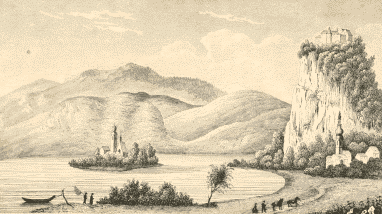
From nature by J. J. Tobin - VELDES LAKE
19th. Sir Humphry wishing to see the lake of Veldes, the lake of Wochain, and the source of the Save, which all lie out of the high road in the district of Wochain, he determined to make a tour for a day or two into this wild and remote country, a part of Austria rarely visited by strangers. We were told at Assling, that the roads were in many places too bad and too narrow to admit of our passing in the travelling carriage, and Sir Humphry, therefore, hired a small calêche, in which we set out. We crossed the Save by a very precarious bridge, built of wood, exceedingly narrow, without any railings, and with a floor formed of the trunks of fir-trees, cut into logs and laid parallel to each other. We then went over a steep mountain, and drove on for about two hours in a valley, on the sides of which the trees and rocks were so picturesquely blended, that it would be difficult to say which of the two contributed most to the beauty of the landscape. At the end of the road, on driving down a hill, the lake of Veldes opened upon us. This lake is on a much smaller scale, and totally different from the Traun-See, and to many would perhaps appear more beautiful. At the bottom of the hill, near the lake, lies the village of Veldes, with its church steeple and a few of the houses peeping out from between the trees; above the church an enormous lofty rock rises perpendicularly out of the waters of the lake, bearing on its top an old imperial castle, to which on the land side a pathway is seen winding up through the wood. In the centre of the lake is a small island, completely covered with trees of the most brilliant green, in the midst of which and high above them is seen the steeple of a church, with the roofs of a few houses. The length of this lake is between three and four miles, but its breadth is considerably less; the nearer shores are formed by noble mountains covered with fields, meadows, and fine beech woods, behind which to the right appear the snowy peaks of the Wochain Alps. Driving through the village and around the lake, we entered into the beautiful valley of the Wochain-Save, a small but beautifully clear stream, of an emerald green colour. After stopping for some time for Sir Humphry to fish, we drove on to Wochain-Villach, a wretched little village, where we dined upon the produce of Sir Humphry's sport. Not a soul in the place spoke a word of German or any other language except their Slowenian, so I was e'en obliged to make use of our Assling coachman as interpreter. After dinner we went on through the same magnificent valley along the banks of the Wochain-Save to Feistritz, a large village, chiefly belonging to Baron Z——, of Laybach, who also possesses very large iron and steel-hammers near the village. We were received very politely at his Schloss or country house, by his steward, to whom the innkeeper of Assling had given us a letter, the Baron himself, with whom Sir Humphry was personally acquainted, and on whom I had called in his name whilst at Laybach, being absent. The Schloss is old and in bad repair, but we were very comfortably lodged, and contrived to sleep in spite of the noise of the hammers which were at work the whole night, and caused the surrounding ground and houses to tremble as if shaken by an earthquake.
20th. We set out early this morning for the Wochain lake, and as we drove along the banks of the Save, the country became at every mile more and more romantic; and upon arriving at the spot where the river issues from the lake, it seems to have reached the highest pitch of wild grandeur. Barren rocks, from four to six thousand feet high, rise up to the clouds, in which they hide their lofty snow-clad peaks. The highest of all, visible from this side of the lake, is the Skerbina.[B] The south side of the lake, round which the road runs, is finely wooded, and here and there noble masses of light grey rock rise abruptly out of the blue water, contrasting finely with the dark pines which crown their summits. The shores of the north side are formed of sloping meadows and hills, beyond which rise those enormous walls of rock seen on approaching the lake. Sir Humphry crossed over the lake in a boat, in order to visit the Savitza, or the source of the Wochain-Save, a lofty cascade, just seen at the western end of the lake like a glittering silver thread among the grey rocks. I drove round the banks as far as was practicable in the carriage, and then walked on and met Sir Humphry at the end of the lake, George following with the pony for him to mount on leaving the boat. We then proceeded for about three miles through fields, over rocks and stones, and the dry beds of mountain torrents, till the road became too bad for the pony. Sir Humphry then dismounted, and taking my arm, proceeded, with the boatman as a guide, for about a mile further, when we reached a frail wooden bridge cast over the foaming Save. Here Sir Humphry said he would go no further, but wait with George, who led the pony, till I returned from the source. I and the guide, therefore, went on up the mountain, climbing over rocks and fallen trees, where no vestige of a path was to be traced, till we came to the foot of a high and mouldering scaffold, which the guide told me, in as good German as he could, had been erected some years ago to enable the Archduke John to gain a fine view of the fall. Having mounted it by a tottering ladder, I found myself in full front of the cascade, which gushed some hundred feet above, out of the side of one of those enormous mountains of rock which we had seen from the other end of the lake, and rushed with a deafening roar into an abyss below, invisible from the spot on which I stood; I made signs to the guide that I wished to get down to the foot of the fall, but he shook his head, and appeared never to have been there, nor to like to go. The noise was so tremendous, that it was impossible to hear any thing he said; but wishing, if possible, to reach the bottom, I determined to trust to my own hand and foot, and after a dangerous descent over the wet and slippery rocks, I found myself close to the pool, into which the descending, but often-broken column of water precipitates itself. The height of the fall must be nearly four hundred feet, and from the transparency and icy coldness of the water, and its gushing out of the middle of a perpendicular wall of rock, which exhibits no trace of vegetation, except here and there a stunted fir-tree thrusting itself through a crevice, it is probably the exit of a subterraneous lake, confined in the interior of the mountain, and supplied from the snows of the still loftier summits. In spite of the clouds of spray and foam, which fell like a continual rain, I took a rapid sketch of the scene before me, and then returned to the guide, whom I had left upon the scaffolding, and who told me that he had descended a part of the way, shouting after me, till he was afraid to go any farther, nor had he ever been at the foot of the fall. In the rock above the scaffolding is engraved a short Latin inscription, by Baron Z——, in honour of Prince John. The view from this spot, looking towards the lake, is exceedingly beautiful and picturesque, presenting to the eye a scene very different from the one we beheld at the opposite end of the lake. The immense mountains of rock, from which the Save takes its rise, extend on each side in a wide and lofty amphitheatre, till they gradually lose their wildly sublime character, giving place to mountains of lesser height, and of a softer and more undulating form, beautifully covered with fine green beech woods, now and then relieved by a dark forest of pines, or by the lighter shades of the bare limestone rocks. Far below the spectator lies the tranquil lake, with its varied shores, partly wooded, partly fields and meadows, through which the Save, after having pursued its foaming course through the woods below the Savitza, is seen to wind, till it mixes its clear waters with those of the deeper coloured lake. The only traces of human habitations are two deserted huts, at some little distance from the lake, for the village of Althammer, the only one in the vicinity of this lake, is situated quite at the extremity of it, and is not visible from this point. Upon returning to the little bridge, I found that Sir Humphry had left it, and on reaching the lake, the boatman who had conducted him across it told me he had gone round the lake to Althammer in the carriage. I accordingly was rowed over to the village, and met him just arrived, after having fished for half an hour in the lake. He seemed pleased by the account I gave him of the Savitza, and though he regretted he had not seen it, he was well satisfied in having given up the attempt; and he said he was convinced he could not have borne the fatigue. Althammer is merely a collection of iron and steelworks, with the requisite habitations of the workmen, and is also the property of Baron Z——. We dined with the directors, who treated us very civilly, and afterwards drove back to Feistritz, where we did not arrive till almost night, Sir Humphry often stopping on the road to fish.
21st. We quitted Feistritz early this morning, and returned by the same beautiful valley through which we had before passed. Sir Humphry caught fish enough upon our way to furnish us with another dinner at Wochain-Villach, and between this village and the lake of Veldes we witnessed a most beautiful atmospheric phenomenon. It commenced with a fine rainbow, which in a few minutes concentrated itself upon one of the finely wooded mountains in the valley, and here displayed the most beautiful prismatic colours possible; at the base blue, then red, then green, never extending beyond the outline of the mountain, and through these colours we could still plainly descry the dark green of the trees. It was on the whole the most splendid kind of rainbow I had ever beheld, and Sir Humphry said he had never seen such an one before. It lasted for about five minutes, then gradually disappeared, and proved the forerunner of a very heavy rain, which began to fall just as we entered Assling.
22nd. The morning was exceedingly cloudy, and upon leaving Assling we did not expect to see much of the country before us, but about ten o'clock it cleared up, and afforded us a view of the same kind of beautiful scenery as that below Assling, though growing wilder and more romantic as we ascended the valley. Kronau is a small bourg between Assling and Wurzen, and the glen, at the entrance of which it is situated, seems to be the finest in the whole valley, although the tops of the higher mountains were obscured by huge masses of cloud. We here met many hundreds of pilgrims, of both sexes, travelling in companies; some returning, some going to Mount Lushari, a lofty mountain about six leagues beyond Wurzen, where there is a famous shrine of the Virgin. Those who were returning were all singing hymns of joy at having been absolved from their sins; whilst those who were going walked in silence, many bearing serious and often mournful countenances.
Wurzen is a wretched little village, a collection of a few dozen of wooden huts, situated about two thousand feet above the level of the sea, at the foot of a pass which leads from Carniola into Carinthia, similar to that of the Löbel, but by no means so elevated. The post-house is tolerable, and the view from the windows magnificent, so much so, that Sir Humphry requested me to take a sketch of it for Lady Davy. The master of this inn is so remarkably civil that Sir Humphry has determined to stay for a day or two, and to make an excursion to the source of the Isonzo, which we are told is about twenty miles from Wurzen. In the afternoon Sir Humphry went out to fish, and I to examine the source of the Wurzen-Save, which rises about two miles above the village, and is of a character very different from the Savitza, or source of the Wochain-Save. The river here flows from a large pond, which appears perfectly insulated, lying in the midst of fields, at the end of a dry water-channel coming from one of the lateral vallies. The water in the pond is exceedingly clear, and at the bottom towards the centre, one discovers a number of very large holes, through which the water rises mixed with a great quantity of air, producing a constant ebullition on the surface of the middle of the pond, the water of which is perfectly cold.[C] After leaving the pond, the Wurzen-Save winds through the valley as a beautiful clear mountain stream, passing by Kronau, Assling, and Radmansdorf, where it receives the Wochain-Save, flowing from the lake of Wochain. These united branches are then called the Save, and the river flows on through the valley of the same name to Krainburg; it afterwards passes near Laybach, where it receives the river of that name with many other smaller streams, and rolls on, already a considerable river, through Carniola, passes by Agram, traverses Croatia, and then forms the boundary between Austria and Turkey till it reaches Belgrade, where it mixes its mighty and rapid waters, swollen to a great size by a hundred tributary streams, with those of the Danube, and rolls with it into the Black Sea.
23rd. Sir Humphry going out to-day to shoot in the marshes near the river, I went to see the lake of Weisenfels, about six miles off, and had a famous mountain ramble. This lake is not large, but beautifully clear and highly picturesque; it lies at the foot of the Mannhardt, a stupendous mountain covered with eternal snow. I took a slight sketch of the lake, and after spending an hour or two upon its beautiful and sunny banks, I returned to Wurzen. After recounting what I had seen in my ramble to Sir Humphry, we spent our evening as usual with cards and reading.
24th. We left Wurzen this morning in a little carriage, and drove over very bad roads up the valley to Tarvis, a small and old town, through which the high road from Italy to Carinthia and Vienna passes. The only manufactures of the town appear to be of iron and steel. We here took another road to the left, up the valley of Raibl, along the banks of a foaming mountain torrent, till we reached the little village of the same name, where we arrived about twelve o'clock. Raibl lies at the foot of the Königsberg, a lofty mountain containing very productive lead mines, and is only inhabited by miners. There is a small but very decent inn in the village; immediately in the front of it rises a lofty Alp of very singular form, its rocky and barren summit being split into five rounded peaks or cones. Whilst Sir Humphry took a luncheon, I drew a sketch of the place, and we then set out for the source of the Isonzo, which the postmaster of Wurzen, who accompanied us as a guide, assured us was at a short distance up the mountain, and that the road to it was very good. Sir Humphry proceeded in this carriage whilst I walked up the mountain with the postmaster, and a friend of his from Raibl, neither of whom seemed to know much about the Isonzo or its source, for after a long walk they conducted us to a valley in the middle of which ran a small stream, which the postmaster declared was the Isonzo. This, however, both to Sir Humphry and me, appeared impossible on comparing its situation and direction with that of the Isonzo, as traced on our maps, and after a long discussion with the postmaster and his friend, the latter admitted they were wrong, and that it was the Pless, or Fletzbach, a little mountain river, a tributary stream of the Isonzo, whose source, from all the information we could gain, lies in a very different direction, at least ten miles off, and in a very wild and barren country.
Sir Humphry was sadly disappointed and very angry with the postmaster, who had assured us at Wurzen that he was well acquainted with the source. We had however enjoyed some very fine wild scenery, and had seen many beautiful small cascades leaping from the mountains. On our road we passed a knoll of ground where the grass grew more luxuriantly than any where else, and we learnt that this spot had been the grave of some hundred Austrians, who had bravely defended a small fort which stood here, against the French; of the whole garrison three or four only escaped the slaughter. At that time the French had possession of the whole surrounding country, and had thrice sent to the Austrians a flag of truce, assuring them that resistance was vain. The inhabitants of Raibl still speak with horror of this action, in which the Austrians fought with desperate enthusiasm, led on by their commander, Major Hermann, who, it is said, wished for death, and if so he could scarcely have found a more wildly romantic spot in which to have parted with life.
On our return we made a slight detour to see the Raibl-See, a small, wild and highly romantic lake, from out of which flows the Raibl-bach, the stream which runs through the valley of Raibl. Sir Humphry began to fish in the lake whilst I attempted to sketch, but the clouds of evening, which had already begun to overspread the summits of the Alps, gathered so fast around us, as soon to compel us to return to our inn at Raibl.
25th. Quitting Raibl we returned to Wurzen, and on the following morning left it for Villach, a considerable town on the other side of the mountains. The road winds up hill for some hours, but the ascent is by no means so steep as that of the Löbel. From the top one has a very fine view of the mountains and vallies of Carinthia. Villach is seen at the foot of the mountain, and a league or two beyond it lies the Ossiacher lake, a considerable expanse of water, whose banks on one side are formed by low hills, prettily wooded, while on the other side fine corn fields slope down to the water's edge. To the left is seen the mountain of Bleiberg, which contains the most extensive and productive lead mines in Austria. It being Whit-Monday, we found the town very gay and full of peasants from the surrounding villages, who were come to a fair which is held there; we only stopped to change horses, and then drove on up the valley of the Drave to Paternian, a wretched little village, where scarcely any thing was to be had at the post-house. We have now left the limestone Alps and come to mountains of a different character, formed chiefly of micaceous schist. Their outlines are less wild and rugged than those of the limestone mountains, to which, however, they are not at all inferior in height, and the beautiful forests of beech and fir which skirt their bases, appear, if possible, of a more brilliant verdure than the woods which clothe the Alpine chains that we have left behind us. From Paternian we continued our road to Spital, a small and dirty town, with which the post-house fitly corresponded, but where we were obliged to sleep, it being the only inn in the place.
27th. Sir Humphry to-day determined to try the fishing in the Millstädter-See, a small lake about a league distant from the town; he accordingly rode there on the pony, and I walked by his side. This lake is of a very different character from those which we have as yet visited. Its banks are quite pastoral; the mountains, covered with woods or green fields, rise with a gradual slope from the lake, and although of considerable elevation, for their summits were still covered with snow, present no where the rocky and wild appearance of those of the Wochain, or of the Valley of the Save. The lake itself is between two or three miles in length, and on its shores, embosomed in wood, lie the town of Millstadt and some pretty villages. After Sir Humphry had caught a few trout, we returned to Spital, which we soon after left for Gemünd. We had a beautiful drive of some hours through the valley of the Drave, and arrived about five, but found the hotel occupied by peasants, who were giving a grand ball. We were, however, accommodated with very good rooms, and Sir Humphry passed the night very comfortably, in spite of the music and bustle.