JOURNAL, &c. &c. (continued 2)
Reading edition
28th. We could not leave Gemünd till ten o'clock, there being no horses left at the poste. It is a neat little town with an immense square modern Schloss, the country residence of Count L——, of Vienna, and which is almost as extensive as the whole town. As soon as horses arrived, we proceeded to the village of Reinweg, and came to more lofty Alps of mica schist than those we have seen the two last days, and which form the extensive chain of the Tauern. The Katzberg, one of this chain, lies immediately above Reinweg, and we were here obliged to take a Vorspann, consisting of an additional horse and two oxen, who with no small difficulty dragged the carriage up to the top of the Katzberg, though the road is excellent; the view from the summit is very extensive and grand. The descent into the valley of the Murr is very precipitous, and this valley is by no means so beautiful as that of the Drave, though the Alps are higher and their summits more thickly clothed in snow; the fine woods around their bases are wanting, so that the valley seems cold and barren. We passed the night at St. Michael, a large village at the foot of the Katzberg, and on the banks of the Murr.
29th. Leaving St. Michael this morning, we turned out of the valley of the Murr into another lateral one, which, though narrower, is more beautiful; and here some of the Alps present a variety of very remarkable forms. The first poste is Tweng, a few houses collected together at the foot of the Radstädter Tauern, so called from the town of Radstadt, which lies on the other side of this Alp, to distinguish it from one or two other chains, which also bear the name of the Tauern Alps. We were here again furnished with six horses in order to reach the summit of the pass, which is six thousand feet above the level of the sea. We were a long while crawling up this steep ascent, but were fully recompensed by the magnificent views which we every now and then caught a glimpse of. As we ascended higher and higher, these views grew more and more wild, and every ten minutes we passed by beautiful cascades formed by the melting of the snows of the cold regions into which we were penetrating. Upon reaching the highest point of the pass, perhaps four thousand feet above the valley below, we entered as it were upon a frozen world, where we could see nothing around us but immense fields of white and dazzling snow, beyond which rose still more elevated mountains, whose summits were crested with a long and jagged wall of semi-transparent crested snow, whilst here and there a dark and rocky peak, seemingly indignant of its load of snows, had shaken them off, and elevated its head far above the surrounding whiteness, forming the most magnificent image of wild sublimity that can well be conceived. Having sent back our three extra horses, we began the descent, which, in spite of our two drags, was not without danger, the road being very slippery and steep; but we soon arrived at a little village, aptly called auf dem Tauern (on the Tauern). The few huts which form this hamlet were still surrounded with snow, which, however, was beginning to melt quickly, and here and there a little brownish green plot of grass appeared, which a few days before was covered with snow. The road both ascending and descending is excellent, but it is not built with so much art as that of the Löbel. The views descending on the Radstadt side are, if possible, more beautiful than those which we saw during our ascent from Tweng.
The mountains are more thickly wooded, and the springs of the various turnings of the road present a view of the distant Styrian Alps, one of which, called the Bischoff's Mütze, or the Mitre, is of a very singular form, consisting of two peaks exactly resembling gigantic termites, (anthills,) rising out of vast fields of snow. Along the side of the road runs a mountain torrent, clear as crystal, forming at every hundred yards fine cascades, some of which, increased considerably by lateral streams, are beautiful and picturesque to a high degree. The road then winds through a narrow valley, closed in on all sides by stupendous masses of dark blue-limestone, (for we are again travelling over a calcareous chain,) till upon turning suddenly round a corner, we looked down with surprise upon an open, wide, extended, and fertile valley, with hamlets and villages peeping through the trees, and bounded at a great distance by another chain of snowy Alps. Before arriving at Unter-Tauern, (below the Tauern,) the first village in this valley, situated at the foot of the Alps, we passed on our left a noble cascade, bounding in many a broken column from an amazing height; the last of these columns falls more than five hundred feet, and is dispersed into a light white foam before it reaches the pool which receives it below. From Unter-Tauern to Radstadt is a short poste. This latter is a small town, still surrounded by its old wall and towers, and appears to possess nothing remarkable. The poste where we passed the night is a very indifferent inn.
30th. We left Radstadt this morning in the rain, the first wet weather we have had for some time, and drove on through the fertile and beautiful valley of the Enns to Schladming. The country in many parts resembles a flower garden, for the narcissus, the cyclamen, and many other of our garden flowers flourish here as the common weeds of the fields and mountains. From Schladming we proceeded to Gröbming, the next poste; it is a small village, picturesquely situated at the foot of high rocky mountains. About noon the weather cleared up, and on arriving here Sir Humphry determined to spend the afternoon in this place, and to see if he could find any thing to shoot in the fields. We accordingly went out after dinner, but could not see a bird, and returned in the evening to our inn, where I continued to read Shakspeare, which has been our book for the last six or seven evenings.
31st. We quitted Gröbming early this morning, where Sir Humphry had to pay dear for very bad accommodations, the only instance of exorbitant charges which we have as yet met with. To remonstrate with the landlord, however, was in vain; nor did it appear to us extraordinary that a being who had been rendered by illness unable to move, but by the help of a broad wooden bowl, in which he sat and shoved himself about, his legs being shrivelled up and quite useless to him, should be churlish and discontented. From Gröbming we went to Sternach, where we entered upon our former road, and from thence through Mitterndorf to Aussee, where we arrived in the afternoon, just as it began to rain hard.
June 1st.-7th. We have spent the whole of this week at Aussee, at a very good country hotel near the poste, which is not, in this little town, an inn, as is generally the case in this part of the country. Sir Humphry has been fishing every day from eight in the morning till three or four, about which time he usually dines, and our evenings have been spent as usual. I generally accompany him in all his excursions, being needed as an interpreter, and whilst he is fishing I take a sketch, or ramble about the lakes and through the woods, thus fully enjoying the beautiful alpine scenery with which we are surrounded. Our first trip was to the Gründtl-See, an exceedingly beautiful lake, about four miles from Aussee. The drive to it is chiefly along the banks of the Traun, and though over a very bad road, which is only passable for a one-horse cabriolet, is very picturesque, and the lake is seen peeping out at intervals through dark green firs. The Traun, which is here only a small mountain stream, but beautifully clear, rushes foaming out of the lake at its southern end; a small covered bridge is thrown across it at this spot, beneath which are sluice gates, by means of which the exit of the waters can be partially hindered. Close to the bridge is a cottage inhabited by the fisherman, who alone has the right of fishing in the lake, which privilege he rents from the crown. A few zwanzigers (an eightpenny coin) easily procured for Sir Humphry every possible facility in his favourite pursuit from this man. He rowed us over to the other end of the lake, where the Traun enters, which he told us was the best spot for fishing. The view of the lake from the southern end is finer than that from the northern extremity. In the centre of the scene at the latter end, some beautiful white cliffs rise to a great height, topped with bright green beech woods. On the right hand appear rugged mountains, covered with dark forests of pine, whilst those to the left are covered with woods of a lighter and more vivid green. Beyond the lake, mountain rises over mountain, the nearer ones finely wooded, whilst those in the distance are rocky and barren, and surmounted by a white crest of snow.
Leaving Sir Humphry occupied with fishing, I followed the course of the Traun for about a mile and a half up a fine narrow valley to the Töplitz Lake, from which issues no longer a broad and deep river, such as it flows from the Traun-See, but a little brawling brook eight to ten yards wide. The Töplitz-See is a small lake, of a wild and gloomy character; its banks are so precipitous that it is impossible to go round it, as I was told by the fishermen of the Gründtl-See, and above these banks nothing is to be seen but vast and sombre pine forests. There was a small canoe, hollowed out of the trunk of a fir-tree, lying at the water's edge, but there being no oar or paddle in it I could make no use of it, and accordingly returned to Sir Humphry. On a second visit to the Gründtl-See, I again went on to the Töplitz Lake, having been told by the fisherman that beyond it, and only a few hundred yards distant from it, lay another lake, the Kammer-See, from which the Traun took its rise, but that to reach this lake it was necessary to row across the Töplitz-See; I therefore took an oar with me, but upon arriving at the lake, I was sadly disappointed at finding the canoe no longer there, nor could I imagine who could have taken it away, for there was not in the surrounding scene the slightest vestige of a human being. I however climbed up the rocks, and attempted to pass round the lake, but was soon obliged to desist, having twice nearly slipped over the edge of the rock, a precipice of many hundred feet above the lake, into the water, upwards of a thousand feet in depth. When I returned with my unused oar to the fisherman, he told me that the canoe had probably been taken by some peasants, who lived in a summer hut at the other end of the Töplitz-See. This fisherman appeared to be a man of considerable information; he was well acquainted with the various fish which inhabit the alpine waters, and amongst other things he told us that the Ombre Chevalier, a fish of rare occurrence, was to be met in the Lambach-See and in the Upper Oden-See, two small lakes in the middle of the snowy Alps, at a very great elevation above the Gründtl-See. Sir Humphry much wished to visit these lakes, but was immediately deterred by the account which the fisherman gave us of the roads to them. The Gründtl Lake is famous for its trout and fine char, immense quantities of which are yearly sent to Vienna, potted.
Another of our trips was to the Lower Oden-See, about four miles on the other side of Aussee. This is a small lake, very different in character from the Gründtl-See and Töplitz-See: the shores, though not exactly flat, are formed of slightly varied hills covered with wood. Sir Humphry had excellent sport, and caught a great many small trout in the little stream which flows from this lake.
8th. Having paid another visit to the Gründtl-See this morning, we left Aussee and crossed over the mountain which we had passed on our former route to Ischl, and found the road now perfectly clear from snow. Sir Humphry intends to spend some time here, and to make use of the salt baths, which attract much company to this little place during the season.
9th.-21st. Sir Humphry has now given the baths a fair trial, and has found great benefit from them, although upon our arrival here, after taking his first bath, he was for giving them up in despair, and determined immediately to quit Ischl. This determination, however, was caused by the imprudent haste in which he had taken that bath, for no sooner were we arrived than he ordered a bath to go into instantly after his dinner. I could not help urging him not to do so, but in vain; he went into it, and was in consequence afterwards very unwell, and passed a most restless night.
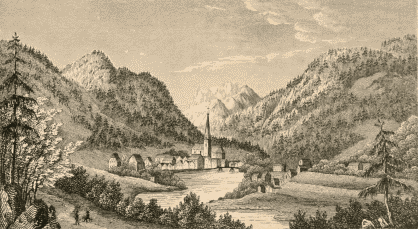
From nature by J. J. Tobin - ISCHL
In the morning he begged me to order horses to leave Ischl, but consented to my looking at some of the lodgings before we set off. I found one which, from its convenience and pleasant situation, I thought would suit him, and on his going with me to see it he was so pleased with it, that he relinquished his intention of leaving Ischl, and took it for a week, and we entered into it the same afternoon, causing a great bustle to its inmates, who were not accustomed to prepare so quickly for their lodgers. It is a very good large house, standing quite alone on the top of a grassy mound, with a large garden in front and fields behind, at a short distance from the baths, and within a few steps of the little town. The only persons who inhabit it are the owner, an elderly man, formerly bailiff of the district, with his housekeeper and a servant, so that Sir Humphry is certain of enjoying the quiet and tranquillity which are so necessary to him.
Ischl is a small clean town,—if it may be so denominated, for I should think it scarcely contains two thousand inhabitants,—delightfully situated in a valley watered by the river Traun, which flows through it, and is crossed by a wooden bridge. On every side are beautiful walks, some into the woods, some along the river, others again up into the mountains; and even these the invalid may enjoy, as he is sure at every short distance of finding a comfortable seat on which to repose. These benches generally bear the name of some prince or princess, whose favorite spot it marks, and they are always so placed as to command a fine view of the town, the valley and river, or the mountains. On the right bank of the town there is a sort of public garden, which is called the Prater, and is said to be a very humble imitation of the celebrated park of the same name at Vienna. Here are various amusements for the people, the principal ones shooting at the target with the rifle and the cross-bow; behind these gardens rises a little wooded hill, on the top of which is a seat called the Umbrella-seat, from the awning over it, which is spread in the shape of an umbrella. From this spot one enjoys a most beautiful panoramic view of the surrounding scenery. To the west lies the delightful valley that leads to Salzburg, on each side of which, mountain rises over mountain, all richly covered with wood. On the east one sees Ischl, with its steaming saltworks, and beyond it the valley of the Traun, seemingly closed in by the wild and rocky Alps which form the shores of the Traun-See. On the northern side a mighty wall of rocks, many thousand feet high, rises out of dark pine forests, and beyond these appears, in hoary whiteness and surrounded by glaciers and eternal snows, the summit of the Dachstein or Schneeberg, the loftiest of the Styrian Alps, which we often beheld in the evening from our windows, glowing with the ruddy beams of the setting sun long after all light had departed from the nearer and less elevated mountains. A fine range of wooded hills, at whose feet runs the Ischl, a small mountain stream that falls into the Traun, forms the southern boundary of this scene. The chief street in Ischl runs parallel with the river, and at its end is situated the Pfannhaus or boiling house, with its adjacent works. This is a large circular building, containing an enormous iron boiler or pan, between thirty and forty feet in diameter and a foot and a half in depth, in which the solution of salt, conveyed there in pipes from the mines, is evaporated.
Ischl has but one church, which is Catholic. A small theatre is being erected, and is to be finished by the middle of the season, which will be in July. The houses are all arranged for lodgers, and rooms may be had on any scale, from those adapted to the habits of the most simple and retired individual, to those of the prince and his suite. The lodgings are dear, but living, on the contrary, is very cheap. An excellent dinner at the table d'hôte, where I usually dine, costs from one to two paper, or schein florins (ninepence-halfpenny to twenty-pence English;) but a person may dine at what expence he pleases, as the dinner is always served à la carte, and a good plate of soup costs not more than one penny. A few days after our arrival, I met at the table d'hôte Mr. B——, a most agreeable and well-informed man, with whom I enjoyed many a walk in the neighbourhood during his stay, which was unfortunately of short duration.
Sir Humphry is now engaged in composing a new work, which he intends to call A Vision; this usually occupies our mornings, he dictates to me for an hour or two, then reads over what has been written, which I afterwards copy off fair, and at 12 o'clock he takes a bath. These baths are made with the mother-water, or residue which remains after the greater part of the salt has been crystallized out of the salt water by evaporation, and is an intensely strong solution of chloride of sodium and some other salts. This is diluted according to prescription for the various patients, so many gallons to so much common water. The same solution of salt is also employed for douche and shower baths, which are much used, and said to be very efficacious. The situation and arrangement of the vapour baths are rather extraordinary. Above the large boiler in the panhouse, on the scaffolding which supports the roof, and from which the boiler is suspended, a number of small closets are erected, in which the person taking the bath is seated, so that he is not only completely surrounded by the vapour of the boiling salt water, but breathes an air impregnated with many volatile particles. These baths are used twice a day, and the patient usually remains in his cabinet, or walks along the gallery suspended over the pan from one to two hours at a time, which proves in a variety of cases of the greatest utility. Sir Humphry generally dines at three, and afterwards goes out fishing, with his servant, and often does not return till nine o'clock, when I read to him. There are a great number of visitors here, who come during the summer months to use the baths and to enjoy themselves, but Sir Humphry sees no one, and appears to wish to avoid all society, and of course I see none but those I chance to meet at the table d'hôte, or in a walk.
21st. Having agreed yesterday with the apothecary of the place (to whose shop I go almost daily with some prescription or other from Sir Humphry, who often varies his medicines) to ascend one of the nearer Alps, we started for the summit of the Zimitz early this morning: we crossed over hills and dales, through woods and fields, till we came to the foot of the mountain, on the top of which we proposed eating our dinner, which we carried in our pockets. My companion had told me before that he had already ascended this Alp, and was well acquainted with the road; but when we began the ascent he confessed that he was at a loss, and our only alternative was to turn back, or find our way as we could. We chose the latter, and confiding in our own eyes and limbs, we followed the course of a mountain torrent, which came rushing down the rocks. Stepping from rock to rock, we in a short time came to the entrance of a snow-cave, through which this little stream flowed. Close to the snow we found many rare plants, and amongst others the yellow violet of the Alps. Before entering into this cave, which had been formed in a fallen avalanche, I slipped on the rock, and was obliged to jump into the icy cold water, which was fortunately not deep. The cave, however, repaid me for my cold bath. Entering through an opening in its roof of snow, the rays of the sun illuminated its dark and rocky sides, and were reflected upon the water that flowed through the middle. On looking towards the opposite end of the cave, through a lofty arch of snow, we beheld a distant waterfall, whilst the rocks and bushes, finely lighted by the rays of the sun, contrasted strongly with the darkness of the cave, whose fretted roof seemed as if hewn out of the finest white marble into large descending points, from which the melting snow was continually dropping. Having made a slight sketch of this fairy scene, we left the cave, and, following the rivulet, soon reached the waterfall which we had seen in the distance through the arch of snow. An immense barrier of rock here put an end to our progress in this direction, and we were obliged to turn to the right, where the ascent appeared more possible. My companion made a considerable detour whilst I attempted to climb up the rocks; but I had not ascended more than twenty feet, when, on catching hold of a small fir-tree, it snapped off, and I rolled down the rocks into the rivulet below. In spite of my fall I reascended, and with some difficulty reached the uppermost rock, and found myself in a situation whence I could no longer ascend nor descend. At last my companion appeared above, and reaching down to me his long alpine pole, I clung to it, and with his assistance thus extricated myself from my most unpleasant and perilous situation; I was, however, so exhausted, that we were obliged to wait a full half hour before we could proceed on our ascent. Our road then lay for a long time through a forest of pine and beech, till we came to a brook, whose course we followed to its rise, which was in a large snow. We passed quickly over this, and then saw that we only had about a fourth part of the ascent to accomplish. We journeyed on merrily, although we were obliged, for upwards of an hour, to climb with the help of hands and feet over the rocks, till we came to the last, though not easiest part of the journey. This was a wood of dwarf firs, which an avalanche of the last winter in its descent had laid flat upon the ground, though their roots generally remained fixed. We scrambled over and through these, and, after all difficulties, I found myself, about two o'clock, on the snow-clad ridge of the mountain. My companion was still battling with the prostrate firs, but arrived about a quarter of an hour afterwards, and we then went on to the highest of the five peaks which form the summit of the Zimitz, between seven and eight thousand feet above the sea. The view from this spot amply repaid us for the toil and danger we had encountered in reaching it. Many thousand feet below us we beheld four large lakes surrounded by green mountains and vallies glowing in the sun; beyond these lay the wide extended plains of Bavaria, clothed with glittering towns and villages, over which the eye wandered to a far distant horizon, bounded only by the clear blue sky.
Looking back we saw down into many a dark valley, out of which rose numberless snow peaks, and high above the rest the majestic Schneeberg, with its eternal glaciers, and at a yet greater distance the still more lofty peaks of the Salzburg chain; but the reflection of the sun from the vast and glaring fields of snow was so strong that the eye could scarcely bear to look at them, and turned with delight to the green woods and lakes below. Having spent an hour in the pure air of these upper regions, we began to descend by a very different road to the one we had chosen in ascending, which, though better and not so rocky, was in many parts so steep, that we were in continual danger of pitching forwards, and were therefore obliged to seat ourselves each upon a stout branch of a fir-tree, and thus ride down. Having traversed two snow fields, we came to some as yet uninhabited huts, about half-way down the mountain, from whence a good sheep path conducted us into a valley. Here we got some milk in one of the dairy huts, and then made the best of our way towards Ischl, as a thunderstorm, which we had for some time seen approaching, was now fast gathering round us, and the peasants advised us to hasten as quickly as possible, but long before we could reach home it burst over us with tremendous violence. The rain came down in such torrents, that in five minutes the road was more than ankle deep in water, but it soon changed into hail, like a shower of nuts, accompanied by the loudest thunder and most vivid lightning. Thus, soaked but much refreshed, we reached Ischl about eight o'clock in the evening.
July 13th. Sir Humphry is already tired of Ischl, and has left off the use of the baths, by which, however, he has been much strengthened, and his health in general improved, but I suppose we shall soon quit this place, though he seldom fixes on his departure till a day or two before. New guests arrive daily, and this little place is filled with company. Parties of pleasure and jaunts are arranged every day to some of the neighbouring lakes or vallies, or other points worthy of being visited. I have only joined a few of these, for Sir Humphry not knowing well what to do with his morning if I am out of the way, I can of course only be one in those parties which occupy the afternoon. The first of the two most interesting trips was to the Chorinsky Klause.
A Klause, in these alpine countries, generally signifies a dam or embankment, built over some mountain stream, in the centre of which are flood-gates, which can be closed so as to shut in the stream, which by degrees collects behind the wall or dam, till it forms a small lake. The use of this arrangement is to float down the wood which is cut in the mountains into the larger rivers, the mountain streams not having in summer a sufficient body of water to effect this without this contrivance. The fir-trees, cut into pieces from five to ten feet long, are rolled down from the mountain into these artificial lakes. When a sufficient quantity is collected on the surface, or the water rises too high, the Klause wird gesprengt, that is, the flood-gates are opened, and the pent up lake rushing out with tremendous velocity, carries the wood along with it into the river of the neighbouring valley. It was to see the water let out that we went to the Klause. We started from Ischl after dinner, at one o'clock, a large party in six or seven carriages, and drove up the valley of the Traun, for about a league and a half, to Weissenbach, a village at the foot of the mountain on which the Klause is situated. Here we left our carriages and walked up the mountain, the road being very steep. I joined a party consisting of Madame de B—— and her daughter, a Greek gentleman and his wife, and two or three others, and we seemed much to have shortened a hot walk of an hour and a half up hill by chatting on various subjects.
We found the Chorinsky Klause to consist of a very strong and thick wall, from thirty to forty feet high, built across a narrow valley. In the centre of the wall was a large flood-gate, and on each side of it a much smaller one. These were situated at a considerable height above a clear shallow pool which lay at the foot of the wall, and was formed by the superfluous water which had drained from the lake, already over full. The whole party having taken a good position in front of the Klause, the signal was given. The workmen struck the spring of the flood-gates in the centre, which instantly burst open with a noise resembling a sudden but hollow clap of thunder; at the same moment an immense spout of water rushed forth, filling the space before occupied by the invisible air. It was the work of a second, and it was a magnificent sight to see the tranquil pool in an instant transformed into a basin of curling foam, pouring with irresistible violence over the rocks of the foreground, and whirling up the sand from the bottom of the stream, which was for the first five minutes nothing but foam of a muddy brown colour, till it changed by degrees to a pure white. The lesser flood-gates were afterwards opened, and then three streams poured forth at once from the lake. This scene lasted for nearly half an hour, the cascades becoming less and less as the quantity of water in the lake diminished, until the latter was perfectly drained; and where but a short time before we beheld a beautifully clear lake, we now saw only cleanly washed pebbles and sand, through which a little insignificant rill was running. Our walk back was very pleasant and shady. Among the party Madame A—— and Madame L——, two celebrated actresses, the one in comedy, the other in tragedy, from Vienna, were pointed out to me; the former of whom was a handsome woman, though of small stature, and lively and animated in her conversation. After this excursion I very often met a great many of the party in a small public garden called the Volksgarten, to distinguish it from the Prater, and where it is the fashion to spend an hour before dinner. The conversation one day turned upon the following lines, which were found written upon a table in the garden:
Espérance d'un meilleur sort Toujours renaissante et trahie, Voila l'histoire de ma vie; Il n'est rien de vrai que la mort!
Various were the discussions upon them, and the ladies took great pains to discover the author. Who could he be? Who was there in Ischl whose character at all answered to this description? No one could be hit upon with any certainty; but at last the lively Mademoiselle Marie, the daughter of Madame de B——, with whom I had walked to the Chorinsky Klause, declared it must be the solitary young Englishman, who so rarely joined in their parties of pleasure, and who visited nobody. It was in vain that I denied having written them, for they determined with one accord that I should be considered as the author, unless I should by the next morning produce four lines which might convince them of their error. I accepted the challenge, and accordingly after dinner, for the first time in my life, attempted to compose a couplet, and after ransacking my brains, I could produce nothing better than the following;—
Est elle donc vraie cette mort tant souhaitée? N'est ce pas naître à une plus mauvaise vie? Ne dirais tu pas dans l'éternité, La mort que j'ai desiré m'a trahie?—
which I the next morning wrote under those of the anonymous author. In the evening I met the greater part of the company at the little theatre, which had been finished the week before, and in which a small company of players from some neighbouring town were doing their best to amuse the gay visitants of the baths. The ladies, and especially Mademoiselle Marie, said they had read the verses, and were more than ever persuaded of their being in the right, nor could all my rhetoric, aided by a pocket full of bonbons, convince them of the truth.
18th. This evening at a late hour Sir Humphry returned from his fishing, without either fish or rod, and, not a little vexed, begged I would go directly to the Commissary of the Police, and endeavour to regain his rod, which he told me had been taken from him in the following manner. He had driven along the banks of the Traun for about five miles, in a little chaise which he sometimes uses in his longer excursions, had been fishing for some hours, and was just preparing to return, when two men came up, one of whom began to talk to him and George in German, but as neither of them understood him, Sir Humphry proceeded to get into the carriage, whilst George took up the fish which had been caught. Upon this the man became more violent in his words and actions, and at last forcibly seized the rod and basket, and walked off with them. Although it was just ten o'clock, I went to the inn where I knew the Commissary generally supped, and luckily found him. I related to him what had happened, and he was very polite, but said nothing could be done that night, but begged me to come to him the next morning, and to bring the servant with me.
19th. I took George this morning to the Commissary, who, from his description, immediately recognized the offender, but found that he did not belong to his district, but to that of Ebensee, to the Commissary of which place he gave me a very civil letter. I returned to Sir Humphry, who said that I should take a carriage and drive over at once to Ebensee with George, and he gave me letters of introduction, which he had with him, to the Governor of the province, and some other great men, to show the Commissary. Arrived at Ebensee, I found the Commissary all civility, and the fisherman, who lived at some distance, was immediately summoned. In the mean time the Commissary told me that the rivers and lakes were let out in different portions to various fishermen, who alone have the right to fish, or allow any other person to do so, in that part which they rent, and he supposed that Sir Humphry had exceeded the limit of the portion belonging to the fisherman at Ischl, from whom he had obtained permission to fish.
Whilst waiting for the fisherman, I asked the Commissary if I could not see the salt works; he said certainly, and that he should be happy to show them to me, and I accordingly accompanied him thither, and found them to be on a very large scale. There are several evaporating pans, much larger than the one at Ischl, and immense reservoirs for the salt water are kept constantly by three pipes, through which it is conducted from Hallstadt, more than twenty-seven miles distant. These pipes, the master of the works told me, are always running, and should any accident happen to either of them, it can be easily repaired, in spite of the great distance they traverse, there being, at very short intervals, places where the pipes may be uncovered and examined. From the reservoirs the water is conducted into the pans, and the salt produced by the evaporation is taken out twice every day, and put into large conical baskets to drain, after which it is pressed into conical six-sided forms, of various sizes, from twenty to a hundred pounds each. These pyramids are then placed, some thousands at a time, in the baking rooms, where they are exposed to a very high temperature, which renders them quite firm and hard, after which they are carried into the store-houses, from whence the salt is sent to all parts of Austria. The quantity produced in this part of the country, in these salt-works, in those of Ischl, Aussee, Hallstadt, &c., must be immense, for I understand that from the warehouses of Ebensee alone, upwards of 25,000 tons of salt are sent annually across the lake of the Traun.
Upon the arrival of the fisherman we found the case to be as the Commissary had supposed, and the man pleaded in his defence that it was allowed to take away both rod and fish from any one so offending. The Commissary, however, told him he ought to have warned Sir Humphry of this. The poor man said he had done so, but they would not understand him, and in spite of his defence, the Commissary compelled him to deliver up the rod and basket, with which I returned to Ischl.
21st. Sir Humphry set out this morning in his little cabriolet on a fishing excursion up the valley of the Traun, to the lake of Hallstadt, and took me with him. This lake, about eight miles to the north east of Ischl, is of a very grand and imposing character, but still does not equal the Traun-See in the diversity and beauty of its banks. We drove over a wooden bridge at the end of the lake, where the Traun flows out of it, and then round its shores for a short distance to Obertraun, where the road terminated. We here took a boat and rowed for some miles up the lake, opposite to the small town of Hallstadt. The view from hence was superb; the nearer houses seemed built in the water, behind these the salt works are seen, extensive and noble buildings, more like the palace or seignoral chateau of the lord of the surrounding territory, than a manufactory; and beyond them rose the mountain which contains the salt-mine, a stupendous mass of rock capped with eternal snow, and to the left appeared the glaciers of the Schneeberg. Rather to the right of the saltworks, embosomed in wood, lay the rest of the town of Hallstadt, and one large house was situated some thousand feet above the lake, standing alone in the wood. Along the side of the mountain we saw what appeared to be a pathway, but the boatman told us this was the canal cut for the pipes which convey the salt-water from the mines of Hallstadt to the works of Ischl and Ebensee. This is a stupendous undertaking, for the pipes are conveyed a great distance over rivers and vallies and along mountains, where the passage for the pipes has been cut for many miles through the solid rock. Sir Humphry fished for some time but without success, when, not wishing to visit the town, we rowed back to the village of Obertraun, and on our way thither passed by the Gosauzwang, the most celebrated part of the saliduct or salt canal between Hallstadt and Ebensee. The three pipes are here carried across a very wild and romantic glen, the defile of the Gosau, a mountain stream which runs down through it. Four lofty columns of brick work, about two hundred feet in height, are built up from the bottom of the valley and from out of the waters of the Gosau, to a level with the pipes, which are thus carried over the valley, being laid from pier to pier; and they serve at the same time as a bridge to any foot passenger who may wish to pass, being railed in on each side. These pipes, after traversing one or two smaller streams, give part of their water to the salt works at Ischl, and are then carried on to Ebensee, where they fill the reservoirs which I saw when I visited the Commissary to procure the return of Sir Humphry's fishing rod.
23rd. Yesterday I went with a very large party, consisting of almost all the strangers in Ischl, to visit the Salzberg, the salt mountain or rather mine, which was to be illuminated for the visitors. We set out at about one o'clock, a long string of carriages, and after an hour's drive through a very pleasant valley, we arrived at the foot of the mountain which contains the mine. Here a number of miners were waiting with sedan chairs for the ladies, many of whom however preferred walking up the mountain, and in about three quarters of an hour we arrived at the Haupt Eingang, or chief entrance of the mine. We were now to be attired, as is usual on entering the mines, in a long white mantle or frock, and a large wide broad brim, the latter to hinder us from knocking our brains out, and the former to keep our clothes clean. Here was confusion dire; this frock was too small, this too long; this lady had no brimmer, this gentleman could find no stick. I laid hold of the first frock and hat I met with, but up came a lady and begged I would exchange with her, as her frock was so long she could not walk in it, and mine so short that it did not reach to my knees. La grande toilette at length finished, the ladies were placed in their carriages, that is two in each wheelbarrow, face to face, with a miner before to pull, who carried a lamp in his hand, and another to push behind, and between every two barrows went another miner bearing a paper lanthorn. The gentlemen were of course on foot, with the exception of one or two gouty invalids.
In this guise, with half-a-dozen miners going before carrying lamps, the whole train entered the passage, and in a few seconds lost sight of daylight. After a long, wet, and (in spite of our many lamps) dark journey through this narrow and low passage, where my head was continually coming in contact with the roof, we came to the Rutsch, or slide, which leads down into the salt-chamber. This Rutsch is formed of the trunks of two large fir-trees laid close together, rounded and polished, and placed in an oblique direction, in an angle of about forty degrees. A miner, with a lamp in one hand, places himself astride these trees, and holds with his other hand a cord which is fixed to the rock on the sides. The person who wishes to descend seats himself behind the miner, and holds him by the shoulders. The miner then lets the cord slip through his hands, and down they go like lightning into what seems an abyss of darkness: safe at the bottom, he gives a shout that the next couple may follow. When the Rutsch is very long, as in the mines at Hallein, near Salzburg, the miner always sits upon a thick leather apron, and when alone makes no use of the cord, but rushes down with a fearful impetus into the salt-cave below. When we arrived at the Rutsch, and the ladies had all got out of their barrows, after much discussion and many fears and doubts, they consented thus to descend, as the miners assured them it was more dangerous to do so by the steps cut in the rock at the side, which were exceedingly precipitous and very wet. Having reached the bottom of the Rutsch, which ends in a slight curve to break the impetus of the descent, we found ourselves in an immense cavern, or room, excavated in the rock, about twelve feet high, and from ten to twelve thousand in circumference, supported in the middle by a massive pillar of rock, and lighted up by some hundred lamps, which, however, only served to give the scene a more awful and gloomy appearance. The visitors, whose number was considerable, in their long white mantles and hats, looked like spectres wandering in the shades of a nether world. The roof and walls of this cavern were covered with minute crystals of salt, not, however, sufficiently large to give to it the glittering appearance which I had expected. The mountain contains a great many of these Salzkammern or salt-chambers, which at different periods are filled with fresh water, conducted into them by wooden pipes. When this has dissolved a sufficient quantity of salt, which operation occupies some months, it is drained off through a deep perpendicular shaft, near the middle of the cave, and is then conducted through wooden pipes, often for a very great distance, to the boiling-houses, where it undergoes the progress of evaporation.
Having wandered through these gloomy abodes of silence and night for some time, we ascended the stairs, the ladies resumed their seats in the barrows, and the procession returned as it had entered. To save my head from additional thumps to the many it had received on entering, I took the place of one of the pushers, and after a merry drive of about twenty minutes we again saw daylight, like a distant star, increasing in size till we reached the entrance of the mine. We here unspectred ourselves, and returned home in our usual terrestrial appearance, and a merry party we were.
24th. We left Ischl this morning in a little cabriolet for Aussee, leaving the travelling carriage packed and ready for starting at Ischl, for Sir Humphry wished, before he quitted this part of the country, to have a day or two's more fishing in the Gründtl-See; but the weather proving very warm, and a thunderstorm coming on in the evening, he determined not to remain at Aussee beyond to-morrow.
26th. We returned this morning to Ischl, and after an early dinner bade adieu to it, and set off for Ebensee. We here again crossed the magnificent Traun-See, and after a row of two hours and a half, and seeing Gmünden, as it were, rise out of the lake, we found ourselves in our old quarters at the Ship.
27th, 28th. These were wet days, and Sir Humphry chiefly occupied himself in dictating "The Vision," and reading. In the afternoon of the latter, his coachman arrived from Vienna, and brought with him "Salmonia," which had just been published, and was forwarded to him through the Embassy at Vienna. Sir Humphry had engaged this man, who is an Englishman, at Ischl, whilst in the service of the Polish Princess L——, which he left, not wishing to go to Poland. Sir Humphry now intends buying three additional horses, and thus rendering himself independent of the poste.
29th. Sir Humphry this morning finished his "Vision," which, he tells me, is really founded on a dream that he had some years ago, in which he found himself borne through the firmament from planet to planet. Of this dream, which he introduces as the consequence of a highly interesting and animated conversation that he holds with two friends in the Colosæum at Rome, on the grandeur and decay of nations, and the mutability of religions, the general outline, he says, has alone remained in his mind; but it has been his pleasure and delight during his mornings at Ischl, and when he was not engaged in his favourite pursuit of fishing, to work upon this foundation, and to build up a tale, alike redundant with highly beautiful imagery, fine thoughts, and philosophical ideas; and the hours thus passed with Sir Humphry have afforded me high mental gratification and advantage, for I have then marked his mind wandering, as it were, with the associates of his early days; those days, in which he was evidently, by the exercise of his extraordinary powers and quick perception, exciting not only his own mind to dive into, and to unfold to clearer view, the mysteries of creation, but that too of other congenial spirits; thus most naturally collecting around him a constellation of shining lights, the remembrance of whom often awakens vivid thoughts of the past, and rouses his whole soul to action.
In the afternoon I read to him "Salmonia," in which he immediately began to make corrections and additions in preparation for a second edition.
31st. Sir Humphry this morning went to look at a pair of horses which he thought of buying. The price demanded was 800 florins, (paper money,) about 32l.; but Sir Humphry thought them too dear, and did not buy them. In the afternoon we paid another and a last visit to the Falls of the Traun. This grand and striking scene appeared now even more beautiful than when I saw it for the first time. The body of water in the river was considerably less, thus rendering the different cascades more diversified and picturesque. Sir Humphry amused himself for an hour or two with fishing, and we afterwards returned to Gmünden, which we quitted on the 3rd of August, and drove over to Vocklabrück, where we remained the rest of the day, for Sir Humphry to fish in the Vöckla, and went on the next morning across the country for some leagues to Schörfling, a little village on the Atter, or Kammer-See. This lake, the largest of those in Upper Austria, is about fifteen miles in length; the shores on this side are low, but at the opposite end they are formed by the Zimitz Alp, the Schaafberg, and the chain of mountains which separate this lake on the one side from the Wolfgang-See, and on the other from Ischl and the valley of the Traun. Its depth is not very considerable, but the colour of the water is a beautiful green. On a promontory which stretches far out into the lake, stands the castle of Kammer, a fine large building, belonging to a noble family of the same name. The most striking view of the lake is from the little village of See-Walchen, about a mile from Schörfling. We remained at Schörfling in a miserable inn, without having one single fine day till the 9th. Sir Humphry did so, finding there were some quails in the neighbouring fields, and he went out shooting and fishing every day, in spite of the weather, with considerable success.
9th. We quitted Schörfling at nine o'clock and went to Frankenmarkt, a long drive chiefly over bad and cross roads. Before arriving at this little town, we beheld on our left a fine and magnificent view of the Schneeberg, and the Alps of Hallstadt and Aussee, and on quitting it we caught the first glimpse of the Salzburg chain, which we continued to behold increasing in grandeur and beauty the nearer we approached it. The next poste from Frankenmarkt is Neumarkt, and from hence we drove through many villages and hamlets, the road being now and then rather hilly, till, at about half-past one, we saw Salzburg lying before us in the broad valley of the Salza, backed by a gigantic rampart of Alps. On the right side of the road we passed by a small lake of no great beauty or extent. The situation of Salzburg is strikingly grand and beautiful, and probably no town in Europe can boast of a finer. Lying as it were close at the foot of the lofty pyramid of the Watzmann, a mountain more than ten thousand feet in height, the town extends along the right and left bank of the Salza or Salzache, which separates it into two parts, the old and new town, which are united by a strong wooden bridge. On a hill on the right bank of the river, considerably elevated above the town, stands the fortress or mountain castle, a very strong and imposing fortification. Both parts of the town are strongly fortified, and that on the right bank of the river is provided by nature with a lofty wall of rock, superior to any means of defence that could be formed by art.
10th. The first thing I did this morning was to call upon Count W—— for Sir Humphry, in order to obtain permission for him to shoot in the neighbourhood. The Count was not in Salzburg, but I easily obtained leave from the person who acted for him during his absence. Sir Humphry accordingly immediately started for the neighbouring marshes, and I occupied the morning in seeing the town. The most remarkable object is the Neu Thor, the New Gate, a stupendous undertaking, which may stand comparison with any of the works of the ancient Romans. It is formed of one long arch, or rather tunnel, some hundred feet in length, between twenty to thirty in breadth, and thirty to forty feet in height, cut through the wall of rock, which surrounds the town on the Bavarian side. On the outside the rock is handsomely sculptured, and forms a very elegant entrance into this long passage. This work was commenced at the beginning of the last century, and forty years elapsed ere it was completed. Another work of a similar kind is the summer riding school, a large amphitheatre, the galleries of which are cut out of the solid rock. From hence I crossed over the Salzache into the new town, to visit the church of St. Sebastian, which contains the monument of the celebrated Theophrastus Paracelsus. It is very simple, and formed of the red brown marble of the country. It bears his head in relief, and the following inscription, which is a proof of the great esteem in which the memory of this famous quack was held even till the middle of the eighteenth century.
"Philippi Theophrasti Paracelsi qui tantam orbis famam ex auro chymico adeptus est effigia et ossa donec rursus circumdabuntur pelle sua sub reparatione ecclesiæ MDCCLII. ex sepulchrali tabe eruta heic locata sunt.
"Conditur hic Philippus Theophrastus insignis medicinæ doctor, qui dira illa vulnera, lepram, podagram, hydropsin, aliaque insanabilia corporis contagia mirifica arte sustulit, ac bona sua in pauperes distribuenda collocandaque honoravit.
"Anno MDXXI. die XXIII Septembris vitam cum morte mutavit."
On my return I passed by the house in which he died, and on the outside of it there is still a painting of him, and a nearly obliterated inscription. From hence I went to the church of St. Peter, in the old town, to see the tomb of Haydn; but unfortunately found the church closed, and could not see the monument.
The cathedral church of St. Rupert is a fine building in the Italian style of architecture. It is built partly of free-stone and partly of marble. The streets of Salzburg, with the exception of the chief street, are narrow and generally ill paved, but the houses are clean and neat, and of a great height. The palace of the former archbishop is a spacious and magnificent building, and before it is a beautiful fountain. Besides its public buildings, Salzburg has many large and elegant private houses.
On my return to the inn I found Sir Humphry already there, and that he had dined; and he asked me to accompany him to Aigen, a beautiful villa, about two miles from Salzburg, the seat of Prince Schwarzenberg. From the gardens of this villa the view of Salzburg and the whole chain of Alps is most magnificent, but we could not enjoy it completely, as the summits of the mountains were mostly veiled in cloud, thus mingling as it were with the heavens, and only here and there a dark brown peak was seen piercing through the white shroud, which every now and then passed over it like the foaming wave over a rock, leaving it for some moments invisible. We strolled for some time through the gardens, Sir Humphry on his pony, and then returned to the city.
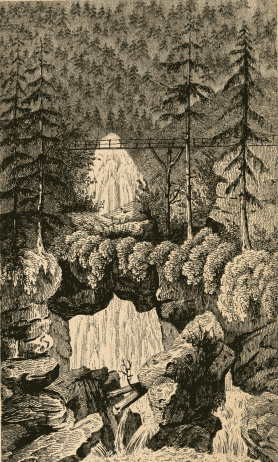
From nature by J. J. Tobin - FALLS of the SCHWARTZBACH
11th, 12th. Were cloudy and rainy days, but in spite of the weather Sir Humphry has been out shooting the greater part of them, with, however, very little good fortune; and on the 13th, we left Salzburg in the morning, and drove through a long avenue of fine beech-trees to Hallein, passing by the Untersberg, where there are large quarries of white marble, belonging to Bavaria. To the right, the view of the snowy Watzmann, and the nearer and finely wooded mountains was exceedingly striking. Above Hallein two enormous brown rocks rise out of the woods, bearing a very striking resemblance to artificial walls. Hallein is a dirty town, celebrated only for its extensive salt mines. The scenery between it and Golling is fine, but cannot be compared with that beyond Golling. At this latter place we stopped for two or three hours, and whilst Sir Humphry took his dinner, I went to see the Falls of the Schwartzbach, about two miles distant. After crossing the Salza, I came in about half an hour to the first or lower fall, where, in the very midst of dark pines, some of which seemed even to grow out of the falling water, the Schwartzbach, or dark stream, dashes over the rocks, and divides itself into two branches, one of which makes but one single leap to the pool below, whilst the other descends in innumerable small cascatelles, and the black rocks, peeping here and there through the white and curling foam, give a very beautiful effect to this part of the scene. I then ascended with my young guide, a little boy whom I had taken with me from Golling, to the upper fall, of which nothing is visible from below but the rising spray, and the beautiful iris playing upon it. The pathway leads immediately to the front of this fall, which, in point of singularity of situation, is perhaps unrivalled.
At this spot the rocks form a wide and massive arch, on which the tall pines and other trees stand firmly rooted. Beneath this arch, rude blocks are tumbled one upon another in wild confusion, through which the water of the upper fall forces its way to the lower one. Above the arch which nature has thus formed, a slight wooden bridge is built, so that two openings are thus formed, the one above the other, through which the water is seen descending in a broad sheet of foam. Standing at the foot of this cascade, it is first seen gushing forth from the rock amongst the trees immediately above the wooden bridge; between this and the natural arch it again appears, and is for the third time seen below the arch, closing the opening between it and the rocks beneath like a white curtain. The rainbow was seen beautifully shadowing the spray wafted from the fall, which was itself in a dark recess of the mountain, and the sun tipped the tops of the surrounding trees with a brilliant light, whilst now and then a single ray shot through the leaves and fell upon the white fall. It was a scene before which a painter might have sat for hours.
We afterwards went upon the bridge, from whence we had a view of the whole fall, looking down into the basin which receives it. A little footpath leads from the bridge to the spot where the water issues as clear as crystal from the rock, in the same manner as that of the Savitza in Wochain. After taking one or two rapid sketches, I returned with my little guide to Golling, which Sir Humphry soon after left for Werfen, and we turned into the mountains, passing through a magnificent defile where the Salza is quite hemmed in by rocks, through which this foaming river forces its way with irresistible violence.
The Salza in its whole course is a muddy river, which considerably detracts from the beauty of the scene. Towards evening we arrived at Werfen, a small insignificant town with an ancient fort on the hill above it, and passed the night at a tolerable inn.
14th. Rising early this morning and looking from my window before sunrise, I beheld one of the finest scenes imaginable. The distant snowy Watzmann appeared quite near, and was encircled by beautiful rose-coloured clouds, though not so dense as to hide the mountain which glimmered through them, tinged with the same beautiful hue. These clouds, which kept ascending and descending, and now and then breaking and leaving the mountain quite clear, became gradually fainter and fainter, till the sun rose, bringing with him the mists of morning, when the whole scene vanished from my eyes, and this so quickly, that I was almost tempted to fancy it a dream.
At nine o'clock we left Werfen, and crossing the Salza drove on through some very pretty villages to Itan, a little hamlet, where we had to wait a considerable time for horses, the Archduke John having passed through but a few hours before, on his road from the baths of Gastein to Grätz. From Itan we proceeded to Radstadt, and from thence along our former road to Unter-Tauern.
15th. This morning was rainy, but in spite of this I preferred walking up the mountain, to the slow pace at which the carriage ascended with four horses and two oxen. The rain ceased in about an hour, but the distant views, on our former descent so beautiful, were now all veiled in mist and cloud. We passed two very fine falls, one of them a little out of the road, which Sir Humphry got out to see. It is called Prince John's Fall, and is a cascade of from three to four hundred feet high, and is well worth seeing.
On arriving at Auf-dem-Tauern, the little village near the summit of the pass, we found the fields and the greater part of the surrounding Alps, which when we passed the first time were hidden as far as the eye could reach in snow, now richly clad with fine grass and alpine flowers. The road descending to Tweng is formed of white primary marble, mixed with mica-schist. At Tweng we struck into a cross road to Tamsweg, a large village lying in a fine broad valley, in the middle of which runs a branch of the Murr, which we have followed from the very peak of the Tauern. The inn here was very bad. In the evening I went to the village doctor for some medicine for Sir Humphry, who told me that this valley was one of the highest in Austria, the village itself lying three thousand and twenty-two Paris feet above the level of the sea, and that the pass of the Tauern was rather more than two thousand feet higher.
16th. We left Tamsweg this morning, and drove on, over abominable roads, to Murrau, a dirty little town on the Murr. Sir Humphry said he should stay a day here to see if he could shoot some quails, or catch any huchos[D] in the river, and he went out immediately after we arrived, about two o'clock, but found no quails. The Murr forms a very pretty cascade about a mile below the town.
17th. Sir Humphry went this morning to the river and fished for some hours, but in vain. This, added to an exorbitant bill brought in by the host, determined him to proceed, and we left Murrau at four in the afternoon. The scenery of the valley of the Murr is always of the same kind; mountains clad with fine woods diversified with fields and villages, and the river winding through the valley. We passed on our road two old feudal castles, rearing their grey walls out of the wood. At the next station, Neumarkt, we found ourselves on the same road which we had traversed on our way to Carniola. There being no tolerable inn here, we proceeded a post further, to Friesach, and had a very pleasant moonlight drive along the banks of a foaming brook, and through some dark and shady glens.
18th. Sir Humphry spent the whole of this day in the fields round Friesach, in the hope of finding a good many quails, but returned late in the afternoon with only one or two, and complaining terribly of the heat.
19th. We left Friesach early this morning, and drove on, over our old road, to St. Veit and Klagenfurth, where we turned off to the right, and proceeded along the banks of the Lake of Klagenfurth to Velden. The length of this lake is about fifteen miles, its greatest breadth three or four. The scenery of its banks near Klagenfurth is rather flat and uninteresting, but towards Velden it becomes more diversified and beautiful. Sir Humphry intended passing the night at Velden, but the old ruined chateau, which now serves as the post-house, was better adapted for the habitation of bats and owls than the accommodation of a sickly and susceptible traveller; and accordingly he ordered horses for Villach, in spite of the approaching night. Whilst they were being put to, we enjoyed a fine view of the lake through the arched windows of the earth-floored hall of the chateau. Some time before we arrived at Villach it was quite dark, but the road being very good and perfectly safe, Sir Humphry, notwithstanding his reluctance to travel after nightfall, said that he was glad that he had gone on to Villach, where he would stay to try the shooting.
20th. This morning he changed his mind, and we went on to Wurzen, crossing over the same mountain which we had passed on our road to Ischl. The ascent on this side is much longer than that from Wurzen. At the foot of the mountain are some hot baths, much used by the inhabitants of Villach. We tried their temperature and found it to be 85° Fahrenheit. The proprietor said that the water contained principally sulphur and magnesia.
21st-25th. These days were chiefly wet and rainy, but when it did not pour Sir Humphry was out shooting in the marshes. Two mornings, when the rain kept him at home, he occupied himself with the additions to "Salmonia," and in dictating an ancient Irish Tale; a fairy fiction, or a tale of enchantment, founded on the supposed adventures of a Norwegian hero in Ireland.
26th. A fine day at last, and we see the Alps unveiled for the first time since we have been here. I thought I should have seen them quite free from snow, and was not a little surprised, on the clearing away of the clouds, to find them covered with a newly fallen crest, which was brilliantly white, for I believed that the temperature of the air would be too high to allow the snow, which falls on the heights when it rains in the valleys, to remain unmelted even for the shortest time. In the afternoon I took a ramble with the postmaster, as a guide, to see a waterfall in the neighbourhood, which I suspected from what he told me was the feeder of the pond from which the Wurzen-Save rises. After a long walk through the woods in one of the smaller side valleys, at the opening of which the pond or source of the Save is situated, we arrived at the end of the valley, where all progress was put an end to by the lofty and rocky mountains which shut it in on all sides; mountains, through which there is hardly a path for the most adventurous chamois hunter. In the centre of this vale is a hut, or, as it is called by the peasants, an Alpe, (a hut on the mountains,) built with the trunks of trees, in which a few cowherds were employed in making cheese. Opposite this hut, high up in the rocks, is a considerable cascade, which without doubt is the source of the Save. The water issues in a considerable stream from an opening in the side of the mountain, and rushes down into the valley foaming and dashing over the rocks; it then flows on for a short time in a bed of limestone pebbles, where it suddenly disappears, sinking into the ground, and in all probability continues its subterraneous course through the whole length of the valley, till it rises in the pond near Wurzen. We ascended with considerable difficulty to the top of the fall, and in order to examine the hole, I was obliged to take off my shoes to prevent my slipping over the rocks. The water flowed perfectly clear and intensely cold from a reservoir in the interior of the mountain, but the opening in the rocks was not sufficiently large to enable me to look in. Having descended safely, and drank some curds and whey in the Alpe, we returned home; and I determined, if the weather should be fine to-morrow, to cross over the Alps to Trenta, and see the source of the Isonzo, to seek which we made such a long trip in vain the last time we were here.
27th. I started from Wurzen at eight o'clock with a guide, who said that he was well acquainted with the pass across the Alps, and as he told me we should find nothing to eat at Trenta, we took some cold meat and eggs with us. At Kronau we turned into the beautiful defile which lies behind this village, and which is called the Valley of Pisching, from a little stream which flows through it, along whose banks we walked briskly for about an hour and a half, surrounded on all sides by rocky and magnificent mountains. At the end of the valley we turned off to the right, and began to ascend one of the mountains by a very rugged and steep path, passing sometimes through fir woods, and at other times over white limestone rocks. After a very fatiguing ascent of more than two hours, we found ourselves on the top of a pass between two mountains. To our left was a still more lofty mountain, through which, near the summit, there was a large hole like a window, so that the blue sky was distinctly seen through it. My guide told me that it was possible to ascend to this hole from the other side, but that he had never been there. The descent to Trenta on the other side was much worse than our ascent had been, the path or rather track that we followed being every now and then impeded by great blocks of limestone and shattered fir-trees. The points of view were very fine and wild, though the whole seemed desolate and dreary. In less than an hour we reached the valley and the few huts which form the hamlet of Trenta. In the middle of the valley runs the Isonzo, which is seen gushing forth from the rocks, and forming a magnificent cascade in a gulley or crevice of the mountain, a few hundred yards distant from Trenta. I immediately went to it, and found that the fall consisted of three distinct cascades, one above the other, all three highly picturesque, but chiefly so the upper one, which is by far the loftiest. My guide said the quantity of water was not now so considerable as in general, and that if I liked to go to the top of the uppermost fall I could see the place from whence it issued out of the mountain. We accordingly climbed up the rocks till we came to a heap of loose and detached fragments of limestone, from under which the water appeared to issue, but on climbing up still further, I came to a large opening in the rock, through which a sunbeam fell, and upon looking into it, I saw that within there was a large cavern filled with water perfectly clear, and apparently of great depth, for when I threw in a large white stone on the spot where the sunbeam played upon the water, I saw it descend through it for a long time. Of the extent of this subterraneous lake and cavern it was impossible to form any idea, for all beyond a few feet from the opening was darkness. The peasants at Trenta call this source the Sorga, and they told me that after great melting of the snows the water rushes also out from the opening, and then forms a very noble cascade. The water is intensely cold, yet an old peasant assured me, that on looking through the hole he had sometimes seen fish in the lake. This, however, seemed very doubtful, for many others said they had repeatedly been there and had never seen a trace of any living animal in the water within the mountain. Having taken a sketch or two and eaten our frugal dinner, we began to think of returning home, and reascended the rugged path which had brought us to Trenta, but before we reached the summit of the pass I experienced great pain in the thighs and legs, so that I was obliged to rest every now and then. At last, however, we gained the top, and having staid there for a good quarter of an hour to recruit my strength, we descended briskly, passed again through the romantic glen of Kronau, and I found myself at home by seven o'clock. Fifty kreutzers (1s. 8d. English) made my guide a happy man, and the evening was passed in recounting to Sir Humphry the adventures of the day.
29th. We left Wurzen this morning, and passed over our old road to Assling. The scenery of the valley is now more beautiful than when we last saw it, for trees of every kind appear in full verdure on the sides of the mountains; beech, oak, ash, walnut, birch, and, last and highest, the pine, above which are the bare brown rocks, just tipped with snow. Three leagues beyond Assling we turned out of the post road, and drove to Radmannsdorf, passing through what much resembled an English park; fine large trees rising from a verdant turf, rendering the drive at once shady and agreeable. Radmannsdorf is a small insignificant town; the only inn it has to boast of was being repaired and not habitable, so that we were obliged to go somewhere else, and Sir Humphry determined to proceed to Veldes and to spend a day or two in that beautiful neighbourhood. After an hour's drive we arrived there, and with considerable difficulty, and some danger to the carriage, we got up a narrow and hilly lane, at the top of which the best inn in the village is situated, which we however found bad enough. Sir Humphry begged me immediately to go to the fisherman's at the other side of the lake, and see what he had. I found in his tank only very large carp and some small specimens of Silurus glanis. This latter fish is found in this and one or two more of the Austrian lakes. The fisherman told me that it here sometimes grows to a great size, and that the last year he and his fellow-fisherman had caught one that weighed upwards of two hundred pounds. I chose the smallest carp, one of five pounds, and a little Silurus, and was then rowed back to Veldes by the fisherman. The lake was beautifully tranquil and clear, and in the shade of the mountains, for the evening was already set in, resembled an extensive surface of black polished marble, only ruffled by the paddle of the canoe which bore us across it. We had part of the fish dressed for supper, and we found the carp far preferable to the Silurus, for the flesh of the latter is flabby and insipid.
30th. At one o'clock in the morning George called me to Sir Humphry, who told me that he felt very ill. At four he begged I would order horses to quit Veldes as soon as possible, but none could be procured till seven, and then only a pair of cart horses. Sir Humphry in the meanwhile applied leeches, and found himself considerably relieved. At seven o'clock we left Veldes, but, as if fated to be unfortunate in this village, our peasant-postilion drove us against the projecting roof of a small house, which however did no further damage than that of dashing the lamps to pieces. We at last got clear of Veldes, and without further accident soon reached Safnitz, where we found post horses which took us to Krainburg by one o'clock, and from thence to Laibach by four, where we took up our old quarters at Detella's inn.
31st August-7th October. Sir Humphry continued very unwell for two days, but on the third went out shooting as he used to do formerly. The ennui of Laibach is terrible, for Sir Humphry sees nobody, and is daily occupied in shooting or fishing, and it is only when the rain keeps him at home that he dictates to me the additions and corrections for "Salmonia," or continues his Irish Tale, "The last of the O'Donohoes," which he finished on the 13th of September. The second edition of "Salmonia" was not finished till the 25th, and I added six little views to it, which Sir Humphry begged I would draw for him; the first three are from his description, and the remainder from sketches I have taken on our journey. After "Salmonia" had been safely despatched to the English Embassy at Vienna, Sir Humphry determined upon making a little tour to Trieste, and there to examine the electrical phœnomena presented by the Torpedo, or Electrical Ray, and we accordingly left Laibach on the 6th of October, in the afternoon, in a little carriage drawn by Sir Humphry's two ponies, for he bought another shortly after our arrival at Laibach. We only went on to Oberlaibach, where we spent the night. Not far from this small village the river Laibach issues, for the last time, from its subterraneous passage.
7th. Early this morning I went with two students from Munich, whom I met on their road to Adelsberg, to see the source of the river. At the end of a romantic glen, surrounded by fine rocks and wood, the river oozes out of the hill, forming a large pond, which falls over a natural dam in front, and is then joined, a few hundred yards below, by another subterraneous stream, and they together form a tolerably large river. Parting here from my Munich companions, I returned to Oberlaibach, when I found Sir Humphry was already gone out shooting, but he shortly returned, and having shot nothing, we set out for Planina. Immediately upon leaving Oberlaibach we ascended a very long and steep hill, the surface of which was everywhere perforated with large conical pits, much resembling funnels, affording a striking example of that species of country called by geologists funnel land. Arrived at the top of the hill we found ourselves in a wide fertile valley, through which we saw the Laibach winding slowly, till on reaching the end of the valley it disappears in the fields, and after pursuing its subterraneous course through the mountain, again rises to the surface near Ober-Laibach. We stopped to bait the horses at Loitsch, and then drove on through the valley to Planina, a dirty village, where we passed the night in a miserable inn.
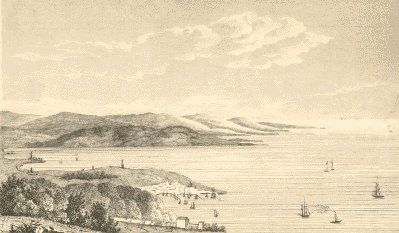
From nature by J. J. Tobin - TRIESTE
8th. Leaving Planina early this morning, we ascended a very steep hill, at the foot of which the Laibach again rises out of the mountains as it does at Ober-Laibach. The country between Planina and Adelsberg is bleak and barren, and presents nothing interesting. The mountain near the latter small town contains the famous grottos of Adelsberg, formerly thought to be the only spot where that singular animal the Proteus Anguinus was found. Sir Humphry said there was no time for me to visit these grottos now, but he thought that he should pass through Adelsberg again upon his return, and we accordingly drove into Trewalchen, where we passed over another long and steep hill. At Sesana we saw the first olive trees; they much resemble the common willow, but are darker; these and the flat-roofed houses, and a lighter and more airy style of architecture, told us that we were approaching Italy. The country between Sesana and Trieste is wild and bleak, completely covered with broken and waterworn rocks, over which, ages ago, some great current of the ocean must have passed, and thus occasioned their present singular and often fantastic shapes. At the foot of the last hill, which is not steep, we entered the territory of Trieste, and from its summit one of the most magnificent sea views I ever beheld burst upon our sight. Nearly two thousand feet below us lay the wide expanse of the blue Adriatic, its light waves glittering in the sun-beams, occasionally shaded by the intercepting clouds. At the foot of the mountain, and partly concealed by it, appeared Trieste, with its harbour full of vessels, lying on a small promontory. Looking over the town and across the bay the eye embraces the whole hilly coast of Istria, with the towns of Capo d'Istria, Pirano, and others; and promontory is seen beyond promontory till the more distant ones can no longer be distinguished from the waves. The right or opposite coast, stretching down to Venice, is flat, and the last visible point on it is the ancient town of Aquilea; but behind this low and marshy tract the distant Alps of the Friul are seen, covered with eternal snow. After stopping the carriage for some time to admire this magnificent view, we descended the hill by a very winding and steep road. Every thing bespoke the approach to a large and commercial city, and the road was filled with carts and waggons coming and going, loaded with merchandize. In some of them we counted twenty horses, in another twenty-four oxen, with twelve drivers, who made a terrible noise with their mouths as well as their whips to animate their strong and fine beasts during their ascent. A new road is now building which, when finished, will render the great number of cattle now obliged to be used unnecessary. We reached the gate of Trieste about four o'clock, and after driving through some fine wide streets wholly paved with flagstones, and across the Ponterosso, a miserable little bridge, we took up our quarters at the Locanda Grande, in the market-place; but our rooms looked towards the harbour and sea, and immediately beneath them we heard the joyous noise and bustle of the sailors. What a difference between this town and the inland cities of Germany! There all seems dead or asleep, and hardly a living soul is to be seen in the streets; here, on the contrary, all is activity and animation. The representatives of all nations seem assembled here,—Italians, Germans, English, and Americans, with Greeks and Turks in their national dresses, are seen walking through the streets or sitting before the doors of the cafés: this latter applies especially to the Turks, who, in their graceful costume with their long pipes, attract the notice of every stranger unaccustomed to see individuals of this nation.
Leaving Sir Humphry to repose in his room, I took a walk about the town and harbour. The streets are generally broad, well paved, and clean, and the houses are lofty and well built. The harbour is full of small craft, but I saw but one large merchantman, lately arrived from the Brazils. Near the Molo san Carlo, a small pier, lay a steam-boat which was to start the next morning for Venice. To the left of the town, looking towards the sea, and at a considerable distance from the houses, is the Lazaretto, a large and spacious building, close to a basin or dock, in which the vessels lie whilst performing quarantine. After dinner I went with Sir Humphry to the theatre, which is an elegant and lofty building, with five tiers of boxes very tastefully ornamented. The piece performed was an opera, The Arabs in Gaul, but spite of the magnificent decorations and really fine music, Sir Humphry soon became tired, and we returned to our Shakspeare and ecarté. I sleep to-night, for the first time in my life, in the bed-room of an Emperor; a little chamber with only one window in it, and with which, I think, few Emperors of the present day would be content. Above the bed is painted a gorgeous crown and encircling canopy, beneath which, on a small marble tablet, are the following words:—
Locus iste Imperatoris Josephi Secundi Habitatio fuit XV Maji.
The year was either never mentioned, or has been rubbed out.
9th. The noise of the sailors and the hum of business—sounds long foreign to my ear—greeted me upon waking this morning, and on looking out of my window I saw a number of people upon the quay below, buying fish from the sailors of some fishing-boats that had just come into the harbour. After breakfast I accompanied Sir Humphry on a visit to the British Consul, Colonel D——, who politely promised to send Sir Humphry a fisherman who could supply him with some living torpedos for his experiments. Sir Humphry afterwards rode out on his pony, George attending him, whilst I took a walk on the hill above the town. I had intended to visit the stalactite grotto at Corneale to-day, as Sir Humphry, who had seen it ten years ago, said it was well worth notice; but on coming away from Colonel D——'s I found that it was too late.
10th. I left Trieste early this morning, with a guide, to visit the grotto. After a three hours' walk over two very long and steep hills, from which however the view over the Adriatic, with numberless white sails flitting across its waves, the two coasts, the harbour with its shipping, the town and the gardens surrounding it planted with cypresses and olives, was magnificent, we reached Corneale, a small and dirty village, and having here provided ourselves with a man carrying a large lamp, and some boys with candles, proceeded over some very rough and stony fields to the grotto. The entrance was not, as I had expected, in the side of a hill, but in the open fields, and surrounded by a wall. Having lighted our lamp and candles, I took off my coat, and we began the descent down some very slight wooden stairs, the steps and railing of which were, as I afterwards found to my cost, not only slippery, but quite rotten from the continual dripping. The entrance, or hall, is a fine lofty dark vault, supported in the middle by one enormous stalactite column. Beyond this the cave becomes narrower, and the numberless stalactites of all sizes present a greater variety of forms than it is possible to describe: immense cauliflowers, trunks of trees, fruits; rounds and ovals of all sizes, from that of a marble to globes of many feet in diameter; pyramids rising up from below, and whose bases are lost in profound darkness; myriads of peaks hanging from the roof, often invisible to the eye, are seen at every step.
These different forms, the deathlike stillness of the cave, the total darkness, except in those points where the guides placed themselves so as to illuminate the most striking objects; deep precipices before and around me, from out of which here and there a single snow white column rose, formed, and still forming, by the water which falls in measured time from the unseen roof; the flickering lights of our candles,—all this, and the thought of where I should roll to were I to slip from the frail steps into one of those dark abysses, produced an indescribable feeling of awe and fear. Descending further into the cavern, we passed by the Lion's head, the Melon, the Death's head, and two magnificent single pillars, the one plain, the other beautifully fluted, both of which upon being struck by the hand emit a loud sonorous sound, that thrills mournfully through the surrounding silence. Beyond these we came to the Waterfall, one of the finest specimens of stalactites in the cavern; other pillars and pyramids, and last of all to the Baldachin, or canopy formed of beautifully fluted hanging stalactites. Beyond this point the cave had not been explored, as the precipices are very dangerous. Even the descent to this spot is not very safe, being often along very narrow slippery paths and rotten stairs, or rather ladders. On my return I sketched different subjects in the cave, and whilst drawing the entrance-hall, incautiously sat upon the wooden hand-rail, when I heard a sudden crack, and felt that I was falling backwards. Not being able to recover myself, I slipped from rock to rock, turning twice head over heels, but without injury, and with perfect presence of mind, although I expected every instant to be dashed over the edge of a precipice. As soon as I felt my fall become slower, I stopped myself with my hands, with my head downwards, and my heels in the air. In this position I remained some minutes, not daring to move a finger, till the guide came down through the rocks with his lamp to my assistance; with his help I regained my feet, and found that I had been lying on the very verge of a smooth rock, beneath which was a dark and impenetrable abyss. My next fall would probably have been into eternity.
After the whirl of my brain had passed away, I found, with the exception of some light bruises, that I had not injured myself, as the rocks were very smooth and round. Having reascended, we left the cave, and I sat for a long time in the fresh air as I felt very sick. The guide and the boy had been exceedingly terrified, and still looked as pale as I think I must have done myself; nor shall I soon forget the shriek they uttered when they saw me falling. After a draught of water that was very refreshing, though from a dirty pool in the field, and paying the man and boys who had been in the grotto with me for upwards of two hours, I returned to Trieste, where the tailor and a good dinner set every thing to rights again.
Sir Humphry had just received two living torpedos, and made some experiments with them upon the power and effect of their electricity, which he seemed inclined to think of a peculiar kind. These finished, he determined to quit Trieste to-morrow, and to return to Laibach.
11th. We started from Trieste this morning early, and having ascended the hill above the town, from whence we had such a beautiful view upon our arrival, we turned out of the road and drove across the country over very bad roads to Wippach, where we did not arrive till evening. We had stopped to bait at mid-day in a miserable little village, and after leaving it we lost our way, Robert (the coachman) being a perfect stranger in this part of the country, and spent some hours in vain before we again got into the right road. Wippach lies in a fine fertile valley at the foot of a lofty range of mountains. The river of the same name rises close behind the town, out of the rock, in the same manner as the river Laibach. The trout in this river were the object of Sir Humphry's trip hither, and as soon as he arrived, though the evening was too far advanced to allow of his fishing, he went to look at the river, and found it very foul from rain. When he returned to the inn, he dictated to me his observations on the experiments with the torpedos which he had made at Trieste.
12th. In the morning Sir Humphry went out to try the fishing in the river, and returned about twelve o'clock not having caught anything. We then quitted Wippach, which has nothing at all attractive or interesting in it. At the end of the town is a large and handsome chateau, belonging to the Counts of Wippach, and on the other side an extensive cotton manufactory. The drive from hence to Trewalchen is steep and hilly, the road passing over a lofty ridge of the mountain. From Trewalchen we went on to Adelsberg, where we did not arrive till night, and as Sir Humphry said that he should the next morning go on to Zirknitz, I determined to visit the principal grotto in the night. There are two here, the grotto of the Magdalen, long known and celebrated as being the only spot in which the Proteus Anguinus[E] had been found; and the great grotto, only lately discovered, and more remarkable for the variety and grandeur of the stalactite formations which it contains.
After having read to Sir Humphry till nearly ten, I set out, accompanied by three guides furnished with lamps and some pounds of candles. We walked across the fields for about a mile in darkness, the moon not having yet risen, till we came to a slight ascent which brought us to a door in the mountain. The guides here lighted their lamps, and cut the candles into bits, and unlocking the door, we entered and found ourselves in a low and dark passage. Two of the guides went on before with the candles, and I followed a few minutes after with the other, the only one of the three who spoke German. The passage brought us to the top of a rock, where we found ourselves in an immense vault, the roof and sides of which could not be distinguished by the eye. Below us, at the foot of the rock, we heard the rushing of a river, whose waters were invisible to us owing to the extreme darkness. We saw the other two guides upon a frail wooden bridge, which is thrown across this subterraneous stream, they having already lighted some of the candles, which they were engaged in fixing upon the side rail, and in a few minutes, more than thirty candles in some degree dispelled the darkness which surrounded us. The river became visible for about one hundred yards on each side of the bridge, flowing as it were out of total darkness above, and passing again into gloom and shade below it. The light however was by no means sufficient to enable me to discover the roof of this vast dome. It is a striking scene, but very different from any presented by the grotto of Corneale, and a poet might have thought the vault a banquetting room for the giants of old, or the council-chamber of Lucifer and his host; the dark and rushing water the gloomy river Styx, dividing him from the kingdom of Pluto, and have expected to see the grim ferryman appear with his boat. There was however no Charon to ferry us over, and we accordingly descended the steps in the rock, and crossed the river by the tottering and slippery bridge. A steep path cut in the rocks on the other side conducted us to the Little Temple, a small vault, whose roof and sides were covered with stalactites of the most varied and grotesque forms, hanging down from the roof, shooting out from the sides, or rising as stalagmites[F] from the floor, some pointed, some round, and others flat, thin, and transparent. In one part of this temple are inscribed the names of the strangers who have visited the grotto. From hence we went to the Hall, or Place of the Tournament, passing in another vault by the Butcher's stall, perhaps one of the most apt denominations of the many which the guides have given to the numerous larger masses of stalactite met with in these caverns. It stands alone, projecting from the walls of the vault, and somewhat resembles a pulpit in form. One of the guides enters this stall with a lamp, and illuminates the different joints of limestone meat, sausages, hams, &c., which hang around. The Tournier-platz or Place of the Tournament, is a lofty and extensive cavern, the floor of which is formed of very fine sand, and is exceedingly level and firm. The shape of the vault is oval, and the sides have some slight resemblance to an amphitheatre. On Whit-Monday the whole of the grotto is illuminated, and hundreds flock to behold this curious scene, the Tournier-platz being arranged as a ball-room, and in which the visitors dance till a very late hour. From thence we went through long passages and caverns, each of which presents something remarkable. In one, a large pillar rises from the ground, which, on being struck with a stone or stick, gives out a sound resembling the deep and sonorous tone of a tolling bell; and in another, stands a large fluted pillar, to which the guides give the strange name of the Kanonen-Säule zu Moskau, or the Pillar of Canons at Moscau. In another part of the cavern we see a vase, on the top of a small pillar, constantly full of water, which falls into it, drop by drop, from the roof; it is perfectly clear, and icy cold. Beyond this font, we came to the great curtain, the most striking single stalactite in the whole cavern. The limestone here descends in many a waving and beautiful fold from the roof, from a height of upwards of twenty feet, and projecting about six feet out from the rock. The whole mass is exceedingly thin, and is bordered by a stripe of red. Seen from a distance, when the guides hold their lamps behind it, the effect is highly striking, and the spectator can hardly believe that the transparent curtain before him is formed of hard stone. The red colour in the edge of this mass of limestone, is the only instance of the kind I met with in the grotto, the general colour of the stalactites being either pure white or whitish brown: and they are often covered with a crust of very fine crystals. At some distance beyond the curtain, the cave divides into two branches, one of which ends with a large block of limestone, that bears the name of the high altar; the other has been rarely trodden by the foot of a stranger, for my guide said that this was only the second time that he had been there, since the discovery of that part of the cave, by him and another of the men who were with me, six or seven years ago. It extends for a considerable way, till all further progress is stopped by a large pool of water, over which the guides said no one had ever crossed. This pool did not appear to me to be of any very great extent, and I felt persuaded, that with the help of a few long poles, it would have been possible to have passed over the slippery rocks on its sides; we had, however, nothing of the kind with us, and I was obliged to abandon the idea, nor did the guides appear at all inclined to continue our peregrinations, having already penetrated to a greater distance than usual. I carefully examined the water, but in vain, to see if I could discover anything like a proteus, and I asked the guide if on his former visit he had seen any animal in the pool, but he said he had not. The paths through the cavern are generally very good, and broad enough for two or three persons to walk abreast, and have in many places been widened and levelled by art, but the road from the curtain to the end of the grotto, passes over a chaos of rocks and large broken stalactites; these, though now united by the all-binding lime-water into shapeless masses of rock, formerly composed the roof, but have now given place to newer formations, so that even in these subterraneous caverns, as in all other of nature's works, man beholds destruction only as making way for regeneration. The process is one of the slowest, but sure in its effects; an accident, the shock of an earthquake for example, may strew the floor of the cavern with the stalactites which hang from the roof, yet the impregnated water flows from above, deposits the limestone, and in a few centuries, the roof is again ornamented with its curious and beautiful fretwork. Retracing our steps through the different halls, temples, and passages, we again found ourselves on the banks of the subterraneous river. This is the Laibach, which rising in the plain above Adelsberg, enters the mountain, and after flowing through the cavern and underground for a considerable distance, again appears at the foot of the hill near Planina. We crossed the little bridge, ascended the rocks, and taking a last look around the vast and dark cupola by which we had first entered, I bade adieu to the caverns of Adelsberg. On coming out of the mountain, the air felt very cold, for the temperature within had been very agreeable, almost warm. It was past one o'clock, so that we had been three hours under ground. The moon was up, and guided by her clear light, we soon reached the inn, where I dreamt till morning of grottos, and caverns and their spirit inhabitants.