Front matter
Reading edition
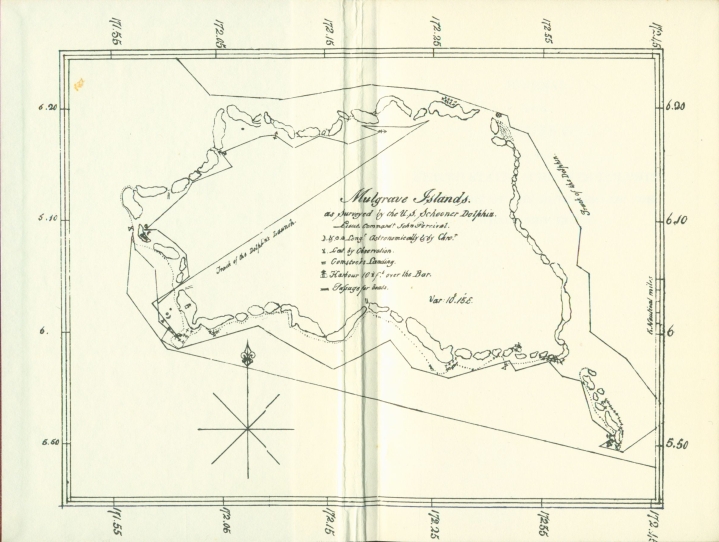
Map of Mulgrave Islands
JOURNAL
OF A
CRUISE
OF THE
UNITED STATES SCHOONER DOLPHIN,
AMONG THE ISLANDS OF THE PACIFIC OCEAN;
AND A VISIT TO THE MULGRAVE ISLANDS,
IN PURSUIT OF THE MUTINEERS OF THE
WHALE SHIP GLOBE.
WITH A MAP.
By Lieut. HIRAM PAULDING, of the U. S. Navy.
NEW-YORK: G. & C. & H. CARVILL. M,DCCC,XXXI.
Entered according to the Act of Congress, in the year one thousand eight hundred and thirty-one, by G. & C. & H. CARGILL, in the Clerk's Office of the Southern District of New-York.
NEW-YORK: LUDWIG & TOLEFREE, PRINTERS, No. 73, Vesey-street.
PREFACE.
The principal inducement of the author, in preparing the following Journal for publication, originated in an idea that a plain narrative of a a cruise through an unfrequented part of the ocean, comprising a particular description of a groupe of Islands, never before explored, and forming, perhaps, the latest inhabited portion of the globe, might not be without interest. It is believed, that, in habits, opinions, and modes of living, the people of the Mulgrave Islands, approach more nearly to a state of nature than those of any other known region. The object of the CRUISE, of which a concise account is now offered to the Public, necessarily led to a more full examination of these Islands than has yet been made, or than it will ever probably be thought worth while to make again, except for a similar purpose.
The delay in publishing this little work originated partly in the hesitation of the author in offering, and partly in that of the booksellers, in accepting it; and the public must decide whether they were not both right in the first instance. It only remains for him to state, that all he aimed at or desired, was to give a plain, unpretending narrative, of what he saw, which, without presuming to merit applause, might at least escape censure.
New-York, May, 1831.
JOURNAL
OF A
CRUISE OF THE U. S. SCHOONER DOLPHIN.
—————
In the year 1824, the crew of a whale ship, called the Globe, belonging to the island of Nantucket, mutinied while in the Pacific Ocean, murdered the officers in latitude about eight degrees south, longitude one hundred and sixty degrees west, and carried the ship to the Mulgrave Islands, where it was proposed by the chief mutineers to burn her, and form a settlement. Here they landed a great part of the stores, sails, rigging, &c.; but some of the crew, who had no part in the mutiny, taking advantage of the others' being on shore, cut the cables, just at the dusk of evening, and, making sail, stood out to sea with a fine breeze.
The mutineers pursued the ship, as soon as they discovered she was underway, but, finding that she outsailed them, they soon gave up the chase, and returned to the shore. The nautical instruments of every description had been taken on shore by order of the mutineers, so that the people on board of the Globe were left to traverse a vast ocean, studded with islands, and rocks, and reefs, where currents are frequent, strong, and variable, without any other guide by which to direct their course than the stars and prevailing winds. The Mulgrave Islands are situated in north latitude six degrees, east longitude one hundred and seventy. three degrees; and although the passage of the Globe was very long, she arrived safely at Valparaiso, where the crew informed the American Consul of the events that had transpired. It was unfortunately at a period when our commerce, on the coast of the Pacific, required for its protection all the naval force we had at the time on that station, and no measures were taken to bring the offenders to answer for their crimes, until some months after the Globe had returned to the United States. Information of the occurrence having been communicated to the secretary of the navy, he, in 1825, directed Commodore Hull, then commanding our squadron in the Pacific Ocean, to despatch the United States schooner Dolphin, in search of such of the mutineers as had been left at the Mulgraves. Besides the importance of bringing the guilty to punishment, for the sake of example,—humanity for the suffering condition of the innocent, that had been left by those who escaped, dictated that something should be done for their relief. Accordingly on the 18th of August, 1825, the Dolphin sailed from Chorillos, on the coast of Peru, under the command of Lieutenant Percival, who was directed, preparatory to his departure from the coast, to stop at some convenient place for such refreshments as might be necessary for the cruise. On the day following, we stood into the harbour of Casma, and anchored, when we fired several guns, as signals, to acquaint the people in the interior of the arrival of a stranger that wanted their aid. It was not long before we had the satisfaction of seeing a number of people, who had made their appearance in obedience to the signal. A few moments' conversation with them, satisfied us that our wants could not be supplied here. Wood might have been obtained, but the water was neither good, nor convenient to be got at, and all other things that we were in want of, could only be procured at the most extravagant prices.
After laying at anchor a few hours, we got underway, and stood along the coast for a small place called Santa, which was situated a few leagues to the north of us, Casma is but a poor harbour, as it lies so much exposed to the prevailing southerly winds, that frequently a high and dangerous surf breaks upon that part of the shore where alone (at any time) it is practicable to land. A valley, covered with thickets of reeds and bushes, extends back from the sea for several miles. In it there is neither habitations nor inhabitants, and a sandy waste of hill and dale separates it from the little Indian village of Casma, which is several miles in the interior. It is situated in a valley, about a league in circumference, which is watered by a small stream. The soil is rich, but poorly cultivated. The inhabitants (of whom there is about a thousand) are all Indians. They live in wretched habitations, and their intercourse with the Spaniards for centuries, it seems, has not much improved their condition in any respect. Their principal dependance is upon the sale of their poultry to such ships as visit their harbour for the trade of the interior country, and to people thus engaged, their proximity may sometimes be a very great convenience.
The harbour of Santa is formed by several small islands, lying a little to the south of it, and about a mile from the main. We passed between the islands and the main, although it was night, and very dark. On the following morning, we made the customary signal, by firing a gun, which, in a very short time, brought the captain of the port down to the beach. He had not much the appearance of official dignity, having a long black beard, and was in no respect prepossessing. Rude, however, as was his exterior, he was profuse in offers of hospitality. He assured us that we should be abundantly supplied with every thing we wanted, and requested that an officer might be sent with him to Santa, to negociate for our supplies. The purser and myself were ordered upon this service, and not having time to send to Santa for horses, it being six miles from our anchorage, we were reduced to the necessity of a most painful ride, behind the captain of the port and a companion whom he had brought with him. The road was over an uninterrupted plain, which was almost everywhere covered with impenetrable thickets of reeds, and the Algaroba[1], and in some places a foot or two deep with water that had escaped from the streams of the cultivated valley. When we arrived at the door of the commandant's house, he shewed us in with an air of some formality, and welcomed us with every Spanish expression of hospitality. The appearance of the house corresponded well with that of its occupant. It was disgusting in the extreme. There were but two rooms in it, one of which was occupied as a granary and bed-room, and the other as a pulparia,[2] and the ordinary conveniences of the family. In the middle of the latter, hung a hog, weighing three or four hundred pounds, which had been butchered that morning. The captain pretended he could himself supply whatever we asked for, assuring us that he would sell more cheaply than any one else, and evinced an extreme jealousy at our conversing with any other than himself upon the subject of our visit to Santa. As a matter of courtesy, we soon made our way to the house of the governor, and paid our respects to him. He seemed to feel highly complimented with our attention, and, like the captain of the port, proffered his assistance to obtain for us whatever we stood in need of. He bore the name of the cruel conqueror of Peru, it being nothing less than the great Pizarro; but it was evident, from his complexion and curling locks, that his ancestors came from Africa. Notwithstanding this disadvantage, however, he could not be compared to the captain of the port without disparagement, and, considering the wretched society in which he lived, I thought he discharged his official duties rather creditably. Both the governor and captain of the port invited us to dine with them; and each, fearing we would make our purchase of the other, solicited our company very earnestly. We finally accepted the invitation of the latter, and he escorted us back to his house, where the table was already smoking with savoury dishes, served up in a variety of ways from the huge animal we had seen there in the morning, under circumstances by no means calculated to improve our appetites. A rabble, formed of half naked Indians, and long bearded white men, assembled in the room, while we were at dinner, some of whom sat down at table unceremoniously, and partook with us. Our host indulged himself freely with the use of aquadiente,[3] and, ere we finished our repast, his house exhibited a constant scene of riot, from which we were exceedingly glad to escape. After making a few purchases we returned on board. The next day, a party, consisting of about thirty or forty, came down to make us a visit. All degrees of the society of Santa, without any distinction,—whites, mulattoes, and Indians, having, it would seem, mingled together for the occasion. They remained with us all day, eating and drinking, and appeared to be very happy; but begged for every thing that came in their way. At sunset, to our great satisfaction, they left us, and on the following morning, we got underway, and continued along the coast to the north.
The small town of Santa contains about two thousand inhabitants, nearly all of whom are Indians. It is situated in latitude nine degrees south, in the valley of Santa, which is twenty or thirty miles in circumference, beautiful and rich in soil, and watered by a deep and rapid stream, which takes its rise in the Andes, at the distance of a hundred miles from the sea coast. Previous to the revolution, it was a flourishing valley, with a numerous population, producing rice, wheat, and other grain, in considerable quantities, for exportation; and frequently large herds of cattle were driven from it to Lima. It abounds also in fruits, such as oranges, lemons, grapes, and a variety of other delicious kinds. Large farming establishments are every where to be seen, each comprehending thousands of acres, and previous to the revolution possessed by gentlemen of ample fortune. All of these are, now in ruins, and most of them unoccupied. The climate of Santa is mild, and almost unvarying. Here, as in nearly all the rest of Peru, bordering on the Pacific Ocean, it never rains, and wherever the land is cultivated it is watered from the rivers.
Around the cultivated valley of Santa, are spread extensive plains of barren sand; and at a short distance back from the sea rises the first range of gloomy and sterile mountains which, increasing in altitude as you advance into the interior, terminates in the eternal snow-covered Andes, at the distance of from fifty to a hundred miles. At Santa we obtained wood with ease, and from two or three old wells, near the shore, filled our casks with brackish water. Where the river empties into the harbour it is so much exposed to the sea as to render watering difficult, and almost always dangerous. Santa was a place of some trade before the revolution, it being connected by direct communication with some mines of the precious metals in the interior.
On the 24th of August, we anchored in the roads of Huanchaco, and communicated with several vessels that were lying there. Huanchaco is an Indian village, and the seaport of the city of Bolivia, the ancient name of which was Truxillo. It is exposed to the sea, and at times the surf breaks so violently on the shore, as to prevent all intercourse with the vessels at anchor. The Indians are provided with a float they call Balsa, and on which they pass through this surf, in cases of great emergency, when no boat could live in it. It is composed merely of two bundles of long reeds, bound compactly together, tapering a little at one end, and the two bundles secured to each other, the small ends coming to a point, somewhat resembling in appearance the bow of a boat. In the middle it is hollowed sufficiently for a man to seat himself securely. It is usually about fifteen feet long, and from two to three feet wide. It is calculated for one man only, who directs it with his paddle. I one day witnessed their wonderful skill in the management of the balsa. The surf was breaking so furiously, that the men, accustomed to work in it, advised me not to go on board of my ship. Whilst I was standing on the shore, with several of them around me, a boat appeared just without the heavy rollers that were setting in, filled with people, who it was evident were strangers to the danger they were about to encounter, as they were dashing on fearlessly into the surf. The Indians near me made motions, and called to them not to advance further, but they neither saw nor heard the warning. Observing this, six or eight of them launched their balsas, and in a few minutes were in the midst of the breakers. They were just in time, for the boat in a moment afterwards darted forward with great velocity, and suddenly disappeared. The wave had broken, and was foaming over her, and another must have terminated the existence of every person on board; but, before the next swell, that came rolling on in quick succession had reached them, each man was upon a balsa, and the skilful and intrepid Indians bore them safely to the shore. We remained but a few hours at Huanchaco, when we continued on to the north, and on the 25th of August, came up with the Lobos Islands, in latitude six degrees south, and distant about a hundred miles from the coast. They are barren rocks, rising in some places several hundred feet, and no where have any appearance of vegetation. With the aid of our glasses, we saw at a distance a number of people upon these inhospitable rocks, and supposing they might be some unfortunate seamen, whose vessel had been cast away, we hove to, with a view of affording them relief. Upon examination, however, they proved to be Indians from the coast, who had come here on a catamaran, upon a fishing enterprise, it being the season when great quantities of fish, resembling mackerel, are taken on the shores of these Islands.
Previous to ascertaining who these fishermen were, we landed on a small island nearer to us, where, on the side of a hill, forty or fifty yards distant, we saw several hundreds of seals basking in the sun. The rock rose perhaps a hundred feet, and many of the seals were near the top of it. The noise of our landing gave them the alarm, and, as we had cut them off from the water, they made the best of their way for the other side of the hill, joining in a terrific growl like so many furious mastiffs. They had reached the top of the hill, and were descending on the opposite side, when we overtook them, and very wantonly killed several. They were so large that many of them would have weighed at least five or six hundred pounds, but their motions were extremely clumsy. Whenever we came near them they would growl, and snapped at us like a ferocious dog, and their long teeth warned us not to approach them within striking distance. Considering their immense size, it is astonishing bow slight a blow will kill them when given on the nose. If, however, this fatal part is missed, and they receive a severe blow upon any other part of the head, they suffer but little injury, and become extremely tenacious of life, particularly if it has time to swell. The nose is then no longer a mortal part, and it is almost impossible to subdue them. We witnessed several instances of this kind, being but poorly provided with weapons proper for the purpose, and withal unskilled in the use of them. In descending from the top of the hill, there was but one narrow defile by which they could escape, and there they floundered for nearly half an hour, tumbling over each other three or four deep, until at last they got into their native element.
The north side of the Lobos Islands affords a fine harbour, where we saw a small vessel at anchor waiting for the proceeds of her cargo, which had been landed on the coast at a place called Lambayaca.
On the 26th of August, we anchored at Peyta, in latitude five degrees south. This was the last place at which it would be convenient for us to stop, and here, to our gratification, we were enabled to obtain the necessary refreshments for our cruise. We filled the deck with pigs, poultry, and vegetables, and at considerable expense succeeded, after much trouble, in obtaining a supply of good water. Peyta is situated in a deep bay, and is a good harbour, formed by two projecting points of land, and is for many leagues surrounded by barren sand. It is the seaport of an interior city, called Pieura, and receives from distant valleys all that is necessary for the consumption of the inhabitants or strangers, who visit it for the purposes of trade. It is supplied with water from a river that empties itself into the sea, near a small Indian town called Golan, whence we found it necessary to resort for a supply. When we had proceeded there, and anchored our vessel within a mile or two of the town, the only method by which we could obtain water, was to have it brought in calabashes on mules. It was their saint's day, and in the village all was frolic and mirth. Groups of men and women were everywhere seen, dressed fantastically, singing and dancing along the streets. I called upon the governor, who was a white man, very early in the morning, to report the arrival of our vessel, and the object of our visit. He had just risen from his hammock, and received me with many expressions of civility, and proffers of assistance. His house was but little better than that of the captain of the port of Santa, and his appearance not more prepossessing. The room into which I was ushered had no other floor than the ground beaten hard, on which were several large piles of pumpkins, bags of beans, and Indian corn, which he proposed to sell me before our official interview had ended. Immediately after breakfast he came on board to visit the captain, bringing with him several emales. They remained on board nearly all day, to the annoyance of every body, and in the evening were removed to the shore with great difficulty, so freely had they partaken of our hospitality. Soon after our arrival at Peyta, we were invited to dine with the governor, who treated us with great kindness and hospitality. Some months previous to our arrival, his son had shipped himself at Talcahuana, on board of the Dolphin, as a common sailor, and was discharged on our arrival here, and permitted to remain with his friends. He was spoken of amongst us as a person who had been compelled to fly from his home for improper conduct of some kind, and now the whole mystery was explained. His father was one of the most respectable and patriotic men in the place where he resided; but this son was a youth of a bad disposition, and had given him a great deal of trouble. When the revolution first commenced in that section of the country, he provided himself with the uniform of a patriot officer, and went about the country, where he was a stranger, or but slightly known, and under the authority of his pretended commission, took, by violence, the cattle and horses of the farmers, or whatever else he could possess himself of, which he converted into money for his own purposes. Sometimes he even pressed the Indians as soldiers, and compelled them to assist him in carrying off his plunder.
At length, his exactions became so heavy, and were levied so tyrannically, that a gentleman resisted him, and questioned the legality of his authority. Numbers were fired with indignation against him, and the propriety of his conduct was no sooner questioned, than the investigation was followed up with such activity, that, finding there was no safety but in flight, he preferred a voluntary exile to meeting the just resentment of the people he had injured. He had suffered many hardships during his absence, and appeared on his return to be truly penitent. I was at his father's house when he entered. His mother and sisters were deeply affected, and received him with all the tenderness of female sympathy, their eyes overflowing with tears. They each embraced him, as one most dear to them; but when he approached his father (a man about sixty) who was standing on the opposite side of the room, he caught the old man's eye bent indignantly upon him, and turned away with a look humbled to the dust.
Whilst lying here we had an opportunity of witnessing a solitary instance of an enterprising disposition in a Peruvian Indian,—a characteristic, it is believed, they but rarely possess, or, at most, but in a slight degree. We had on board an Indian youth, who belonged to this part of Peru, and for several days had held frequent conversations with his countrymen, who were attracted on board by curiosity. One of these people had concerted with the youth a plan for his deserting. In compliance with this arrangement, he put off, during the mid-watch, with his canoe, and taking his station just ahead of the Dolphin, gave a shrill whistle as the signal of his approach. The lad, fearing that he might be detected, did not venture to answer the signal, which was repeated several times, when the officer of the watch suspecting the object, gave the long expected response, and the credulous Indian came cautiously paddling close under the bow of the vessel, where, to his amazement, he was made prisoner, and compelled to go on board. When the captain came on deck the next morning, he punished the poor Indian, by impressing upon him the belief that he intended to detain, and make a soldier of him. Not having sagacity enough to know the difference between our vessel and a patriot man-of-war, and conceiving that there was no chance for his escape, he made the most pathetic appeals to the captain's humanity, and appeared to suffer all the agony of despair. The captain ordered a cartridge-box to be put over his shoulders, and a musket placed in his hands.
He seemed frantic with the reality of his servitude, using his utmost violence to disengage himself from the cartridge-box and musket, declaring again and again that he was no soldier, and in the most affecting manner begging the captain for God's sake to permit him to go on shore. When his tormentors discontinued their persecutions, he jumped over the stern into his canoe, with great activity, and soon joined his anxious friends on the beach, who had assembled there, apprehensive of his captivity, and awaiting the result.
On the 2d of September, we sailed from Peyta, and shaped our course for the Gallapagos Islands. The trade wind was moderate, accompanied with fine weather. On the morning of the 6th, we made Hood's Island, and in a few hours afterwards, anchored on the west side, in a small harbour, called Gardner's Bay, the only one it affords. After dinner, the captain took with him twenty or thirty of the crew, and went in pursuit of turtle. The island is high and mountainous, covered everywhere with volcanic cinders, many of which are in huge masses. The men were at first very eager in their search for turtle, and the whole crew, if they had been permitted, would gladly have engaged in it.
They expected to have found the turtle near the shore; instead of which they had to scramble over rocks and climb mountains, half the time making their way through brambles, at the expense of scratches and torn clothes. Men were never more disappointed than our crew in the amusement of catching turtle. Sometimes they would wander about for hours before they found one, and then it would probably be a mile or two from the beach, and as much as a man could well lift. By sundown we had collected about thirty, of large size. Black grouper were very abundant close to our anchorage, but the sharks were so numerous that for every fish taken we lost one or two hooks. We got a plentiful supply for the crew, however, in the course of an hour. On the following morning, we joined Captain Meek, of the brig Tamahamah, which vessel had accompanied us hither, and making a large party—went round the island about ten or twelve miles from our anchorage, where we expected to find turtle more abundant. The captain was an old cruiser here, and well calculated to make one of an agreeable party. He stood cook for us, and as the day was very warm, our first essay on landing, was to make a large bower, under which to prepare our dinner. The people then dispersed, to look for turtle, the first of which were served up for our dinner, in a style that might have been relished by less keen appetites than ours, which were sharpened by laborious exercise. At night, we had collected upwards of a hundred, besides ten large green turtle, we were so fortunate as to find on the beach near the place of our landing. When we came to assemble our men to return on board, two of them were missing, and upon inquiry were ascertained to have been absent nearly all day. We dispersed and looked for them in every direction until dark, when every body being much fatigued, a party was left to search for them again in the morning, and the rest repaired on board. In the morning, we renewed our labours without success, and with great reason began to feel seriously alarmed for the safety of our shipmates. There was no water on the island, and the preceding day had been so extremely warm, that we feared the poor fellows would soon perish, if they had not already. Our search, too, was attended with considerable danger. Wandering about in distant parts of the island, we sometimes, in clambering over rocks and mountains, changed our course without being sensible of it, and would find ourselves pursuing our way in a different direction from what we supposed. In the afternoon, when our strength and patience were quite exhausted, and our parties returning for the night, the lost men suddenly appeared on the beach, close to the vessel. They were pale and emaciated, with scarcely strength to move one foot before the other. Their clothes were in tatters, and their shoes worn off their feet, which were very much crippled with their long journey over the sharp cinders. It appeared from the story of these men, that they had several times been on the side of the island where we were anchored, but upon an eminence that overlooked the vessel, and thinking themselves on the other side, recrossed; when, to their astonishment, seeing nothing of her, they would retrace their steps; and in this manner, were wandering about for many hours, almost despairing at last of finding relief. While they were in this wretched situation, they several times quenched their thirst by killing turtle that came in their way, and drinking from the reservoir with which nature has supplied this singular animal. I have since been told by a seaman, that he deserted from a whale ship at these islands, accompanied by a number of others, and that for weeks, they had no other water than what they obtained by breaking open the turtles and drinking of the water they found in them. It is contained in a pouch that resembles a bladder, and is immediately connected with the stomach. It is large in proportion to the size of the animal, and some of them will hold two or three gallons. It surprised us to see the tameness of the birds. They would scarcely fly from us when we approached them within a few feet, and in many instances we could pick them up with our hands. The gannet, generally of a clear white, and as large as a goose, we could catch with great ease; and the albatrosses, some grey and some yellow, which were much larger than any bird we have in the United States, would but rarely rise upon the wing to escape us. They ran very fast, and would sometimes give us a chase of one or two hundred yards. A bird, the plumage and form of which differed in no respect from our mocking-bird, would feed within a few feet of us, and the turtle-doves were killed in great numbers by our people, with short poles. Hood's Island is evidently of volcanic origin. It is, indeed, nothing but a mass of cinders. It is covered with a slight growth of scrubby bushes of various kinds, and occasionally a tree of four or five inches in diameter, is met with. Of all its vegetation, the cactus seems best adapted to it. There is a variety of the species; one of which attains to a larger size than any other production of the island, and spreads out into a tree of considerable height. This kind of the cactus is chosen by the turtle for food. When the whalers, or other visiters, go to the Gallapagos Islands for these animals, they cut down a number of the trees in the evening, and on the following morning they are sure to find turtle feeding there, although none could be seen in its vicinity on the preceding day. The guanas are not the least remarkable of the inhabitants of the Gallapagos. They are from two to three feet long and shaped like a lizard. Their colour varies from grey to jet black. They are easily caught and quite harmless; are often eaten and said to be excellent. On the top of the head they have a beautiful shining crest of black and yellow, which, in the sun, has a most brilliant appearance.
Except where we anchored, a heavy surf breaks all round Hood's Island. In a high and central part of it, is a place which resembles the dry bed of a small lake. It is surrounded by ridges and peaks of cinders rising in some places from one to three hundred feet, and in all probability has been the crater of a volcano. In places difficult of access we saw a few seals, but so shy that with the exception of one or two instances, we could not approach them. The few that we killed were hair seal, and consequently of but little value. Between Hood's Island and the small one that forms the harbour, there is a passage for ships, but it is very narrow, and with a strong current that runs through it, which would always render it dangerous for a ship to attempt to pass, particularly so if the wind were not perfectly fair.
At one, P.M., on the 10th of September, we got underway, and stood over for Charles Island, where we anchored at six, in Essex Bay. Rock Dismal, so called by Commodore Porter, is an excellent land mark, and seems to have been appropriately named. It rises to the eastward of Essex Bay, in sharp crags of fifty to a hundred feet high. A few solitary bushes constitute all its vegetation. In approaching Essex Bay, and at its entrance, we were alarmed several times by a strong ripple, but in casting the lead found no bottom with ten fathoms of line. At Essex Bay, is the celebrated post-office of the whalers, to which Commodore Porter resorted several times during his cruise for information. We found a letter there left by a whaler who had visited Charles Island for a supply of turtle. He was last from the river Tumbez, where one of his crew had caught a fever, of which he died. Two others lost their way in the mountains of Charles Island, where, after wandering about for a considerable time, one of them complained to his companion of a head-ache, and soon after sat down and died. The other found his way to the ship after a great deal of suffering.
Charles Island is high and mountainous, and like Hood's, is covered with a thin growth of bushes. At the distance of a mile from the beach there is a small spring of water, to which there is a footpath over the crags and hills, worn by visiters in search of turtle, a scanty supply of which can only be obtained with great labour. The residence of Pat, the Irishman, in this lone and dreary place, for a number of years, has made it an object of curiosity to all who visit the island. Here he planted his potatoes and pumpkins, and raised his chickens; administering the government of his island with despotic sway, for Pat was a monarch although he pillowed his head upon a rock, and reposed his rude limbs on a bed made of bushes. The story is known to all who have read Commodore Porter's journal, in which he gives an account of Pat's residence on this island, and of his possessing himself of the person and services of a black man belonging to a whale ship, who had strayed too far from his companions, and whom Pat held in durance for a long time.
At ten, A.M., we parted company with the Tamahamah, and sailed for the Marqueses Islands. The turtle with which our deck was covered, were very troublesome and offensive for about a week, when they became quite domesticated and gave us not the slightest inconvenience. For two or three weeks we served them to the crew constantly, in lieu of the usual allowance of salt provisions. It was a most valuable substitute, and important to us, as we were bound upon a long cruise, as well for the health of the crew as for the preservation of our sea stock. When the number became comparatively small, we discontinued the general use of them, and served them only once or twice a week. We never fed them, and for aught I could see, they were equally as fat and healthy a month after they were taken on board, as on the first day. As a sea stock nothing can be more convenient or better calculated for a long cruise. They may be put any where and kept in almost any way, and if it should be thought advisable to feed them, there is scarcely any vegetable substance that they will not eat after they are a little domesticated. The liver of this turtle is particularly delicious. When fried, it is not unlike a fine oyster, and although partaken very freely of, no ill effect is ever experienced from it. Sixteen days after leaving Charles Island, we made the island Rooahooga, one of the southernmost of the Marqueses group. The wind was fresh and blew steadily from the southward and eastward, accompanied by a heavy swell. As we approached the islands, we had some rainy and cloudy weather, but with this exception, our whole passage was attended with clear days and fine moonlight nights. In latitude three degrees south, and longitude ninety-five degrees west, we observed a remarkable appearance in the water, which, had we been navigating an unfrequented ocean, would have very much alarmed us. At several different times during the day, on September 12th, we passed through violent rips, and at times nearly the whole ocean assumed the appearance and agitation of boiling water.
Throughout our passage, we remarked, that whenever the wind hauled to the southward of southeast, it increased in force. It occurred so frequently as to be a subject of general remark.
On the 20th of September, in latitude seven degrees fifty minutes south, and longitude one hundred and twenty degrees thirty minutes west, we saw a comet for the first time, thirty or forty degrees above the horizon, and bearing from us east by north. At day-light, on the morning of September 26th, several of the southernmost of the Marqueses were in sight. They were all mountainous, but covered with vegetation, and as we drew near presented a pleasing contrast to the sterile and gloomy Gallapagos. We stood along the shore of La Dominica, admiring the beautiful little valleys that were presented to our view in quick succession, where villages of palm-thatched huts, surrounded by clumps of tall cocoa-nut and wide-spreading bread fruit trees, formed scenes of rural quiet calculated to fill the imagination with the most agreeable conceptions of the happy condition of their inhabitants. At length we came to a small bay where the valley was more populous than any we had seen before, and the captain, to our great satisfaction, hauled up for it and stood close in towards the island. We lowered a boat, and providing ourselves with a few trifles for presents, pulled into the bay within a few yards of the shore. The beach was already thronged with people of all ages, male and female, who invited us to land by the most significant gestures, whilst many of them were singing and dancing to express their joy. The surrounding rocks and hills were covered with groups of females, gaily decked off with their neat head-dresses of the white Tapa cloth and many-coloured robes, which were floating in the wind, half concealing and half exposing their fantastically painted limbs. When they saw that we would not land, the men and boys dashed into the water with whatever they had to offer us, and swam off to the boat. A chief, who had a dry wreath of cocoa-nut around his brows, came off with them; and, upon being invited, got into the boat, where he remained until our departure, apparently giving orders from time to time to those who were passing and repassing from the shore to the boat. In a few minutes, they had presented us with a considerable quantity of cocoa-nuts, bananas, and papayas, for which we gave them in return a few trifling articles, the most valuable of which were glass beads. The chief had his eyes constantly fixed upon our fire-arms, and finally gave us to understand, by motions, that a pistol would be acceptable to him. With this intimation we could not comply; but he bore the refusal with great good nature, and for some time after our store of little presents was exhausted, his people continued to bring us off fruit without the expectation of any return. When they found that we were serious in our refusal to land, the women came from the hills and assembled on the rocks close to us, where, in a nearer view, they could display their persons to more advantage, and charm us with the melody of their voices. There they all joined in songs, keeping time by clapping their hands, stopping occasionally to receive the applause of the men and to invite us on shore. Several of them, male and female, swam off to the boat; and when we were about to depart, insisted so strongly upon going on board with us that we had to use some violence to get clear of them.
We continued on in the afternoon, soon passing La Dominica, and at sundown made Rooahooga ahead. The weather being squally and the island only fifteen miles from us, we lay by for the night. At daylight, we found ourselves a few miles distant from the middle of the south side of the island, where a bay presented itself, which, at a distance, promised to afford anchorage. On a nearer approach, however, its appearance changed, and as there were but few signs of inhabitants, we ran along toward the west end of the island. This part of it had not much appearance of fertility, although we saw a few large trees. It is high, broken, and indented with a number of small bays, none of which are large enough to form a harbour. In rounding the southwest point of the island we had sudden and violent gusts of wind. Invisible Bay is situated a little to the westward of this point, and although it has somewhat the appearance of a harbour, and presents to view a beautiful sand beach, we saw no indications of inhabitants. About ten miles to the north, we anchored in twenty fathoms water, having rocky bottom, and an inaccessible rocky shore where the surf breaks violently. The captain and several officers went back to Invisible Bay in one of the boats, and in a cave close to the shore they found five or six natives, who at their approach, fled to the hills, making signs for our people to depart. In the cave, they found a few fishing-nets. They tried to prevail upon the natives to come near, but their demonstrations of friendship were answered only by motions expressive of hostility. The landing was difficult, as the shore was rocky, and a considerable surf broke upon it, although the bay was tolerably protected by a projecting point. Soon after meridian, we got under way and shaped our course for Nooaheeva, which was plainly in sight from Rooahooga. We stood along, with a fine breeze and clear weather, and at three, P.M., rounded the north-eastern extremity of Nooaheeva, when a spacious harbour, called Comptroller's Bay, opened to our view. It is about three miles deep, and at its inner extremity are two projecting points that extend out for more than a mile, and form three small harbours. We were no sooner observed by the natives on shore, than they put off in a number of large canoes and pulled with great rapidity towards us. The wind was light and baffling, and we advanced slowly into the harbour. In a few minutes, we were surrounded by canoes, containing from six to eight men each. They belonged to different tribes, which they attempted to explain to us with great earnestness of speech and gesture, but as we had no one on board who knew much of the language, we were greatly at a loss to comprehend their meaning. They had not followed us long when two of the canoes came along side, one on each quarter, and the men crawled up the side and perched themselves upon the hammocks, like so many monkeys, where they called out in a loud voice, addressing themselves alternately to us and to the natives on the side of the vessel opposite to them,—one party exclaiming "Mattee, mattee, Typee!" and the other "Mattee, mattee,[4] Happah!" and occasionally using angry gestures with the exclamation. This was too expressive for us not to understand. They belonged to different tribes, the Typee, and Happah; and were mutually trying to prejudice us against the tribe to which they did not belong, in order to induce us to anchor in their own bay. Both the bays were beautiful, but as the Happahs' was the most populous and nearest to us, we gave it the preference; and a little before sunset anchored in twenty fathoms water within a cable's length of the shore. The Typees no sooner saw that we were standing in for the Happah Bay, than they hurried into their canoe and paddled off for their village as fast as they could. The Happah valley was a romantic spot. A plain, a league or two in circumference, stretched back to the mountains in a semicircular form, presenting in front a clear white sand beach about a mile long. The plain was covered with cocoa-nuts, with bread-fruit interspersed, and near enough to form a continued shade without presenting the appearance of a dense forest. Scattered about every where through these trees were the palm-thatched habitations of the natives. In the rear of the plain, the mountains rose precipitously, forming an insuperable barrier against the incursions of other tribes. The land rose gently to the left, but it was almost barren and added nothing to the beauty of the landscape. On the extreme right, a considerable mountain and a point projecting far out into the bay, separated the Happahs from the tribes that lived beyond them in that direction. Nothing could equal the apparent joy of the natives when they saw us anchored in front of their village. The whole tribe, which probably did not exceed five hundred, flocked down to the beach, expressing their satisfaction by dancing and singing. Hundreds of them dashed into the water and swam off to us, so that we had not time to furl sails and clear the deck before the vessel was crowded with people. To show them that we had the means of making successful resistance against any hostile intention they might adopt, we paraded our musketeers upon the deck and practised them, a ceremony that appeared to afford the natives very great amusement. We allowed them to remain on board until the dusk of evening, when the number being so great as to make the vessel uncomfortable, and apprehending that in the course of the night they might appropriate to themselves many things that they would find about the deck, and which could not conveniently be spared, we sent most of them on shore. The chiefs and a few others who expressed a great desire to remain, were permitted to pass the night with us.
On the following day, I took a few presents with me and went over to the Typee valley, to visit that tribe, celebrated as the most warlike of Nooaheeva. As soon as the boat was perceived, the people came running towards the beach in every direction, and before she reached the shore we were surrounded by great numbers, who plunged into the water and swam off to us. As many as we could conveniently accommodate were permitted to get into the boat, where they treated me so unceremoniously that I did not think it prudent to land. Amongst those who paid me a visit was a chief of the tribe. He was a man about thirty years of age, well-featured and of fine proportions. His deportment was grave and dignified, but like the rest of our new acquaintances, who swam off to us, he was quite naked except a slight covering about his loins. The common people treated him with great deference, and never intruded upon that part of the boat where he was seated. He made us understand that he wished to obtain muskets and powder, for the purchase of which he had caused five or six large hogs to be brought down, that were tied and laying on the shore. I offered him whatever else I had that I thought would induce him to part with them; but he obstinately refused any other consideration than muskets and powder. Large quantities of cocoa-nuts, bananas, and papayas were thrown into the boat by the people who were swimming around us, and when we had been lying there an hour, we had as many in the boat as we could conveniently carry. I had a variety of presents, such as beads, buttons, &c., all of which the common people were very anxious to obtain; but the chief would take nothing from me of less consequence than fire-arms or gunpowder. I offered him flints and musket balls, which, although of great value amongst the natives, he would not receive. He invited me frequently, with great earnestness of manner, to land, until he found, by my repeated refusals, that I was determined to remain in my boat.
The bay of the Typees was rather smaller than that of the Happah tribe. They live principally upon the side of a mountain that rises gently from the shore. The number of the tribe appeared to be about the same as that of the Happahs. Their houses are situated in circular chains of villages, rising one above the other, from the base to near the top of the mountain, where it terminates in rude and uninhabitable cliffs. Groves and clumps of cocoa-nut, and bread-fruit trees are every where interspersed with the dwellings, and the mind of the observer being impressed with the idea of their usefulness to the natives, gives a double effect to the beautiful landscape adorned by their waving tops and broad green leaves. We had several occasions to remark the inveterate dislike that the Typees and Happahs entertained towards each other.
On the morning after our arrival, the sailing-master went on shore in the Happah valley to obtain an altitude of the sun by the artificial horizon He was shy of the natives, as we all were at first, and apprehending that some of them might approach him with a hostile intention, while his back was turned towards them, and having heard that they held in great reverence a place said to be Tabooed, or consecrated, he made a circle round his place observation, and told the natives, who had followed him in great numbers, that the space within the circle was Tabooed. They stared at him in silence and stood back from it; but by and by, when he was intently engaged in getting his altitude, one of the natives, supposing that he was employed in some plan (to him incomprehensible) to destroy the Typees, as he turned the face of his sextant in that direction, crawled up gently behind the sailing-master, without being perceived by him, and suddenly tapping him two or three times on the shoulder, exclaimed with great energy, "Mattee, mattee, Typee!" It may readily be supposed that his imagination, which was very much excited before, was not soothed by this salutation. He turned upon the native, expressing in look and manner his consternation and displeasure, which was only met by the delighted Indian with a repetition of "Mattee, mattee, Typee!"
On the morning of the 25th, I went on shore, in company with several of the officers, to indulge our curiosity and ramble about the valley. We were soon surrounded by a group of natives, who followed us wherever we went. Our first object was to visit the chief of the valley, whose residence we found at the distance of two or three hundred yards from the shore. It was a plain, oblong hut, thirty by twenty feet. Its simple structure was such as is first suggested to the untutored mind—a few poles laid over crotches, upon which was framed a triangular roof, and the whole thatched with palm or cocoa-nut leaves. When we entered this regal hut we found the chief seated near one end of it, who barely condescended to notice us as we approached to make our salutations. We were not prepared for so rude a reception and felt somewhat mortified to find a chief of his distinguished rank so totally destitute of courtesy. We thought at least that he would have risen from his sitting posture, and expected more from him than our after experience taught us we had a right to look for from people in a state of nature. The only furniture in the hut was a few coarse mats. At one side of it five muskets, highly polished, were arranged one above the other, over which hung two kegs of powder sewed up in canvass, and near them a few long spears and a war conch, ornamented with human hair. We made ourselves as much at home as if we had received a more cordial welcome, and indulged our curiosity in examining whatever we saw, when suddenly the chief rose and his silence and gravity were at once explained. We had remarked that he had an uncommonly large black robe thrown over him, but without the least suspicion that it covered any one else than himself. He suddenly threw it aside as we came near him and there stood his wife, a girl about eighteen years of age, who had just finished making her toilet. He pointed to her with a look of satisfaction, and uttered "Motake," a word we afterwards learned, signified very good, or very well. Although she was naturally a pretty girl, she had made herself a hideous looking object. She had smeared her face all over with a coarse yellow paint, upon which was drawn streaks of black and green, than which nothing could have appeared more disgusting. She assumed a manner and look of affectation, such as may often have been observed in some self-approving beauty, who, conscious of her charms, feels that she is an object of admiration to all around her. When I expressed my disapprobation of her style of ornament, she stared at me with a look of surprise, which seemed to ask what I was saying. I soon gave both her and the chief to understand, by signs; after which they seemed not so well pleased with themselves or each other; and when I saw her again in the evening she was without any ornament, and looked all the better for it. While here, two grotesque figures came in and walked up to me with an austere look. They had a profusion of cock's feathers bound circularly round their brows, broad gorgets of wood ornamented with red berries round their necks, shell bracelets and ornaments of polished shell or bone tied above their ancles. Each held in his hand a fan of palmetto. After standing a few moments, keeping their eyes fixed upon me, they began jumping up and down and fanning themselves, applying both hands to the fan. My first feeling was surprise, mingled with curiosity, to know the cause of their strange appearance; but when they had several times repeated their exercise, the scene was altogether so ridiculous that I could not refrain from laughing. They soon afterwards, without even noticing the chief, turned and walked off. After leaving the hut of the chief, I visited a number of others, all of which were nearly alike. In one of them I saw two drums, the only instruments of music that I met with. The largest of them was a hollow log, from three to four feet long, and about a foot and a half in diameter, covered at both ends with shark skin. I asked the owner to play upon it, to which he readily consented, seeming highly flattered with the invitation. He accompanied his voice by thumping his hands and elbows on the drum-head; but the music that he made was intolerable. He beat, however, in very good time, and had evidently a high opinion of his performance.
In the course of our ramble, one of the officers told an Indian, who had joined us, by signs, that he wanted some cocoa-nuts. The good-natured fellow acquiesced without the least hesitation, and to our great astonishment, ran up a tree standing near us, with the activity of a squirrel. The tree was forty or fifty feet high, having but a slight inclination, yet the climbing seemed to occasion him scarcely any exertion. They do not press their bodies against the tree and hitch themselves up as is customary with us, which, in their naked condition, they could not do without injury. They press the bottoms of their feet against the tree, and clinging to it with their hands one above the other, ascend upon all-fours. It did not strike us with less surprise when he had thrown the cocoa-nuts down, to see with what facility he stripped off the hard husks without the aid of any thing but his teeth. For such a thing to have been accomplished by one of us would be found impossible. We afterwards remarked the same practise in other places, and at other islands. It was general except with the old men, who, unless they were very robust, used a sharp-pointed stick of hard wood to remove the husk.
They could not understand our practice of shaking hands. When we extended a hand to one of them as a mark of friendly salutation, they looked as though they would question what was meant by it; and from their manner seemed to think that our object was to feel their skin, which they would always reciprocate by raising up our sleeves and examining very minutely.
On the morning of the 29th of September, which was the last of our remaining in Comptroller's Bay, I made another excursion to the Typee Bay, taking with me the chief of the Happahs, who was very anxious to go. I wondered at this, as the tribes evinced so much dislike to each other; but afterwards saw, in my intercourse with the natives of the South Sea Islands, that uncivilized men are capable of as much duplicity towards each other as the educated and refined. When we had arrived within a hundred yards of the shore we were met by the chief with whom I had formed an acquaintance on the preceding day. He saluted the chief of the Happahs in a way that indicated a former acquaintance, but with a look and manner somewhat formal. The Typee chief immediately spoke to some one near him, who ran off and in a few minutes returned with a calabash filled with a preparation of the bread-fruit, upon which was poured a quantity of milk expressed from a cocoa-nut. This was offered by the Typee to the Happah chief, and I was also invited to partake of it. I tasted and found it very palatable. The two chiefs seated themselves in the stern of the boat, and made a hearty breakfast, using their fingers instead of spoons. Neither of them seemed very communicative, as only a few words passed between them at this interview. There was also in the boat a young woman belonging to the chief's family, for whom breakfast was brought in the shell of a cocoa-nut, and which was a preparation of the cocoa-nut and bread-fruit, sour and disagreeable to the taste. This, I was informed, is the food upon which the women almost entirely subsist, they being Tabooed from eating whatever is held in high estimation by the men. When the chiefs had finished their repast, the Typee pointed to his hogs, which he had again caused to be brought down upon the beach, saying that he wanted powder or guns for them, but unfortunately I had neither of these valuable articles with which to make an exchange with him, and he would consider nothing else as an equivalent. He sent for several old muskets that were very much out of order, and proposed to go on board with me and have them repaired, making me understand by signs, that he would in return present me with hogs. His anxiety was so great upon this subject, that I found it difficult to put a stop to his solicitations. In the mean time, however, I saw the schooner underway, and dismissing my Typee friends, pulled away for the Happah Bay. When I had approached within half a mile of the Happah village, the schooner was almost out of the harbour, and the chief observing that I was anxious to get on board, proposed jumping into the water and swimming home, to which I readily consented. He then stripped himself of his neck and ear ornaments, which consisted of two white pieces of polished shell and a carved image of bone, and presenting them to me as a token of his regard, plunged into the water, leaving me free to pursue my way to the vessel without the trouble of landing him. Most of the ornaments worn by these people, are of bone or shells, finely polished or rudely carved. They attach a number of them to a piece of cocoa-nut twine, and wear them around their necks, or wrists, or ancles, as may be most agreeable to the taste and fancy of the individuals. A more expensive and difficult ornament to obtain is a gorget. It is a piece of wood, semi-circular, about three inches wide, carved to fit the neck, covered with a beautiful red and black berry, and stuck on with a gum that oozes from the tree of the bread-fruit. On the hill that rises to the left of the valley, we planted a variety of seeds of fruit, vegetables and grain, but the natives of the valley are so totally ignorant of every thing that relates to agriculture, that it is not probable they will ever derive any advantage from them. Whilst we were in Happah Bay, the weather was clear and delightful. The temperature so regular that no change was felt in the transition from day to night.
On the 30th of September, we stood out of Comptroller's Bay, and ran down for Massachusetts' Bay, a place made familiar to our countrymen by Commodore Porter's long and interesting visit. The two points that form the harbours of Comptroller's and Massachusetts' Bays, are about seven miles distant from each other. At one, P.M., we were clear of the projecting southern point of Comptroller's Bay, and at three, P.M., anchored in eight fathoms water, within half a mile of the hill at the bottom of the bay, called Porter's Monument. Before we came to anchor, the water was covered with canoes, and people of both sexes and all ages swimming towards us, and as soon as the vessel lost her head way, they were crawling up on all sides like so many rats. They were not less delighted with our arrival than were the Happahs. Hundreds were collected on the shore, and all expressing their satisfaction by songs and dances. Amongst our first visitors, were two English sailors who had deserted from whale ships, and been long enough resident on the island to converse in the language of the natives. With them came also a native of Nooaheeva, and a native of Otaheite, both of whom had served a considerable time in whale ships, and could converse in broken English. We were therefore in no want of interpreters, and it seemed at once to introduce us to the confidence and friendship of our new acquaintances.
The harbour of Massachusetts' Bay is spacious and affords good anchorage for ships of the largest class. The only part of it, however, where landing is not attended with difficulty and some danger, is the east side, where there is a fine sand beach from a quarter to half a mile long, at one extremity of which empties a small rivulet of pure and excellent water into the bay. Landing may be effected at the watering-place beyond Porter's Monument, where there is a more considerable stream of fresh water, but it is always difficult, and when the surf is high, cannot fail to be dangerous. At this place we watered the Dolphin; but had to swim the casks to and from the shore, and altogether, it was a laborious undertaking. Along the east and north part of the bay there is a long reef that makes at a short distance from the shore, upon which a heavy surf is always breaking. In entering the bay, the whole habitable part of this section of the island is presented at one view, and forms a most grand and beautiful landscape. It is nearly semi-circular, and rises like an amphitheatre, in fruitful and populous circular ranges of hills, until at the distance of several miles, it terminates in a circumference of high and gloomy mountains, the tops of which resemble a massive wall. This rude and barren circle of mountain contrasts finely with the fertile ranges below, covered with their forests of cocoa-nut and bread-fruit trees, and huts and villages every where scattered about through hill and dale. Nor is the extreme elevation without its interest and beauty. A number of little cataracts reflecting the rays of the sun and looking like sheets of liquid silver, break in upon the gloom of the sterile rock, adding brilliancy as they descend to the lively prospect below. After a shower, not less than fifty of these splendid falls of water may be seen, some of which are but just perceptible through the intervening space between hills and trees, producing an effect peculiarly agreeable. What is called Porter's Monument, is a round hill from fifty to an hundred feet high, situated at the east extremity of the bay. It was here that Commodore Porter had his Fort, not a vestige of which is now remaining. It is overrun with a wild luxuriant growth of vines and grass, and no trace of a footstep can be found. On one side of the hill, near its base, was stretched a bark line, which was attended by a man who calls himself Opotee, and who declares the hill beyond it to be tabooed. Upon one occasion, as I was approaching it, some natives called out "Taboo, Taboo!" but Opotee immediately expressed his willingness that I should pass, as I was a countryman of his namesake, Opotee. To the north of Porter's Monument, and back from the sand beach, where was the navy-yard, all is now overgrown with bushes and trees, some of which have attained to a considerable size. Like the monument, there is no indication of its ever having been occupied for any human purpose,
On the first of October, the day after our arrival, I went on shore, taking with me a great variety of seeds, for the purpose of planting them where it was most probable they would be taken care of and come to maturity. The natives flocked round me in great numbers. There was not less than a hundred boys with the crowd of men and women that followed me. They were highly delighted when they discovered my object, which was explained to them by John Luxon, the native of Nooaheeva, who spoke English. Whenever we came to a rough or muddy place, which was frequently the case, the boys and men, notwithstanding my remonstrances, would mount me on their shoulders and carry me over, with loud shouting. I could easily perceive that this was a frolic with those who engaged in it, and done out of levity and the caprice of the moment; but I could not but feel that they had been first stimulated to it by the favourable impression they had conceived of my design. I planted some things in unfrequented places where I found a clear spot, but most of the seeds and fruit-pits, in the enclosures of the natives. John Luxon was a man of some rank as a chief, and possessed considerable property. To one of his enclosures that was large and seemed to have been attended with unusual care, I devoted most of my attention. There, aided by several of the natives, who laboured with great assiduity, I prepared the ground and made quite an extensive plantation of orange, lemon, cheromaya, peach, apricot, water-melons, pumpkins, potatoes, onions, beans, corn, and a variety of other fruits and grain, from Peru. He expressed himself in terms of the warmest gratitude, and I have no doubt that the natives have already experienced the most important benefits from the memento I left them of the Dolphin's visit to their Island.
In the course of my days' occupation, I was several times driven into Luxon's house by the frequent showers that came over. I no sooner entered, than the natives flocked after me, and in a few minutes the hut would be crowded. The little boys and girls here shewed me the same officious attention that I received in making my way to the village, but expressed in a different manner. As many as could approach would surround me with their fans, keeping them going until the rain ceased, and I was again enabled to resume my work. This was a kind of civility, peculiarly agreeable, as the weather was oppressively warm; but I could not fail to discover that my little attendants were all candidates for my friendly notice and bestowed their civility with the expectation of some reward. I had a few trifles about me, but not enough to give to all, and felt at a loss in what way I should make my presents, fearing that the least favoured would be mortified and displeased. It seemed however to make no difference. It was all "motake"[5] with them. All seemed satisfied. On my return to the beach, I found it thronged with men, women, and children. All the beauty and fashion of Massachusetts' Bay had assembled in honour of our arrival, decked out in their finest tappas, and gayest colours. The females were dressed in the best style of their island, with neat turbans of tappa-cloth, white, or ornamented with colours, a white robe of the same material thrown loosely over them, tastefully knotted on one shoulder, concealing half the bosom, and a wrapper round the waist that reached below the knee. They were arranged in groups of a dozen each, singing merrily and clapping their hands in time to the music of their voices. A little way from them the men were seated in the same manner and similarly occupied. The ladies, to improve their charms, had used an abundant quantity of cocoa-nut oil, which filled the air with its nauseous perfumes for an hundred yards round. Many of them had more highly anointed themselves with yellow paint, which, with the cocoa-nut oil, was running from them in streams. Some had decorated themselves with necklaces of a golden yellow fruit which bears a strong resemblance to a pine-apple, and emits a powerful offensive smell. At a distance, with their variegated robes flying in the wind, their appearance was altogether agreeable, and upon a near approach the scene was animated beyond description. The dusk of evening was the signal for their dispersion, when some went one way and some another. On the second of October, I wandered back upon the hills, and had all the boys with me that followed me on the preceding day.
They renewed their frolic of carrying me, and whenever I seated myself, came round me as many as could approach, each with a green leaf for a fan. I entered unceremoniously a number of the huts, where I almost always found one or more men, in nearly every instance, extended on their backs, their heads resting on a log laid along on one side of the hut, and their heels on another, about four feet from the first. They would never rise to receive me, but utter "motake," when I was perceived by them, and make motions for me to do as they did, offering me at the same time a fan, one of which they were using almost constantly. In the course of my ramble, I met with a little girl, twelve or fourteen years old, who was very pretty, attended by a servant, the only instance in which I remarked such a thing on the island. She was evidently walking out to make a visit, and had just arrived at the house of her destination when I met her. I put some beads round her neck, which seemed to delight her very much; but an old man present, whose hut she was about to visit, assumed an angry look, and seemed to threaten by his manner. He changed his conduct, however, when I made him a trifling present, and the little girl, taking my hand, led me to her father's hut. He was a chief of some consequence, as was indicated by the possession of two or three casks of powder, and six muskets. These he took down, and displayed very ostentatiously, and wanted to know if I had not others to dispose of. His conduct was altogether kind and hospitable, in acknowledgment for which I made him a present at my departure. Whenever I wanted cocoa-nuts to quench my thirst, I had only to signify it to one of the men that was following me about, and he would supply me from the nearest tree. With one fellow I was very much amused. He carried his arms full of cocoa-nuts following me about nearly all day, and when I returned to the vessel I presented him with a musket ball, with which he was perfectly satisfied, said it was "motake," and went away. When I returned to the beach in the evening, I found the natives, male and female, assembled in as great numbers as on the day previous, and amusing themselves in the same way. The females were again in their finest attire, and at a distance might any where else have been mistaken for an assemblage of fashionable belles. We were apprehensive that our men, a number of whom were at work on shore, would have been very much annoyed by the intrusion of the natives. This, however, was not the case. When they commenced their work in the morning a circle was made, comprehending the whole space we wished them to occupy, which we told the natives was tabooed, and there was not an instance of their passing it. The next day they held quite a fair on the beach. Amongst other things, they had for trade large quantities of cocoa-nuts and bread-fruit. The former they exchanged for small pieces of tobacco; but a piece of iron hoop, fashioned into a tool or instrument of husbandry, was demanded for the latter. They were all day on the beach, cooking and eating their bread-fruit and cocoa-nuts. In the evening, the boys and men amused us with playing soldiers, by ranging themselves in a line with sticks for muskets. One of our officers took a particular pleasure in making grimaces, and talking a gibberish to the natives in imitation of their manner of speaking. It was very offensive to them; but they respected us too much to betray their displeasure. Upon one occasion, however, he amused himself in this way with the boys, about a hundred of whom were assembled, when I encouraged them to retaliate on him, by clucking like a hen. They soon discovered that it was disagreeable to him, and assembled round him like so many little furies, clucking with all their might. It seemed to delight them to have an opportunity of revenging themselves upon him, which they did most amply, for they did not let him rest a moment until he went on board, which was soon afterwards, highly displeased with me for conspiring with the Indians against him. We were often amused with the strange and ridiculous taste of the natives in the article of dress.
They were all desirous of obtaining clothes, and a number of old garments were given them, or exchanged for curiosities by the officers and crew. When obtained, whether they fitted or not, the Indians immediately put them on, and scarcely ever more than one garment at a time. Thus, half naked and half attired, a native would walk about with exceeding gravity, admiring himself, and believing that every one else was equally pleased with his genteel appearance.
Whenever they seated themselves to sing, a person was selected to occupy a conspicuous station, and perform a dance round the circle, slowly, and in the most graceful native style, striking at the same time the hollow of his left arm with his right hand, in time with the music of their voices. This distinction was always conferred upon some one who had obtained an old jacket or tattered shirt. If he had on a jacket, it was sure to be buttoned closely round him, with the two or three remaining buttons, and the sleeves, if not torn off, would probably not reach more than half the length of his arms. Thus attired, he would perform his evolutions round the circle slowly, and with a most serious air, stopping occasionally to receive the applause of the singers, who bestowed it upon him with great enthusiasm. Soon after daylight, one morning I was on the beach, and my curiosity led me to a place, where a number of females were busily employed in collecting something from the rocks. When I approached them they discontinued their occupation, and would have fled, but I called them back, and prevailed upon them to renew their occupation. Each of them was provided with a green leaf, in which she was gathering from the rocks a species of fine green sea moss and small snails. What they preserved in the leaf was intended for their families at home. They ate freely of them, and said it was "motake." The moss was tender, but to me had no other taste than that of salt water, with which it was covered at high tide. The snails were not larger than a pea, covered with a hard shell, and when broken, heated the tongue like pepper. The moss, when gathered, had a most disgusting appearance. I was told by the Englishmen, residing here, that the natives esteem it a very great delicacy. One of the females had an infant with her a few months old, which she was teaching to swim by holding it in a pool of water, and occasionally letting it go. The infant would make a slight effort, when let go by the mother, and, no doubt, was taught to swim almost as soon as it could walk. On the third of October, in walking through the habitable part of the valley, I was every where met by females, who addressed me with a smile, and finely modulated tone of voice, "Coare ta whyhene?"[6] The father of one of these, good naturedly conducted me to the hut of a chief, highest in blood of any in the valley. He was a man upwards of fifty, and apparently more civilized than any of the natives I had seen before. He told the interpreter to say, that he felt pleasure in seeing me at his hut. It was about forty by twenty feet, and constructed in the same way as that occupied by the Happah chief, differing in no respect from those of the common people, except in dimensions. His rank and importance was displayed in the possession of six muskets, and two casks of powder that hung directly fronting the door, and which the chief took occasion to point out to me soon after I entered. To him they were a treasure, and, in fact, the wealth and consequence of every individual seemed to be estimated by this standard alone. The powder was covered over with canvass, and the muskets highly polished. On one side of the hut were two logs, about three feet apart, and between them a coarse mat, for the convenience of laying down on, one log being intended for the head, and the other for the feet. Whilst I was here, a number of visitors came in, and, walking directly to the logs, without noticing any one, threw themselves down between them, their heads on one, and feet on the other, where they lay, fanning themselves, and looking at us, without saying a word, except once or twice, when they saw me looking at them, I was saluted with "motake." In the middle of the hut was the coffin of the chief's father, who had died about six months previous. It was the trunk of a large bread-fruit tree, six or eight feet long, highly polished, and the lid so ingeniously fitted, that the place of contact could not be seen but by the closest examination. He told me that his father had been a great warrior, and the friend of Opotee.[7] Before his door was a swivel, and a number of shot, that he said he had obtained from Opotee. He prized them very highly, although they could not be of the least use to him, except as they served to gratify his vanity. When I expressed a desire to know the manner in which they prepared the paint, used by the females, he directed his son to get some of the root, and grind it between two stones, mixing a little water with it, the only process required. I gave the chief's wife (who was an old woman) some beads, and a cotton handkerchief, with which she was so delighted, that she threw both her arms around my neck, and embraced me most affectionately. She was painted all over, quite yellow, and so thoroughly smeared my clothes, that I paid dearly for this expression of her regard. At parting, the chief presented me with a hog (the only one we obtained at the Marquesas), some sticks of the tappa tree, and offered whatever was acceptable to me, about his house. We also exchanged names, and I promised again to visit him, but had no opportunity afterwards. His son accompanied me on board, carrying the presents his father had made me, and all the way calling me "Kappe," the name of his father, and himself, by my name.
In the evening, when I returned to the vessel, she was crowded with natives, the work of the day being completed. The men and women were in different circles, singing their songs. That of the women, resembled the croaking of a great many frogs. The quick and lively motion of their hands, accompanying the various modulations of the voice, exhibited a great activity, and command of muscle, and was far more pleasing than their music. There was one amongst the females, who possessed great powers of voice, in the utterance of strange sounds, in which none of the rest could accompany her. The performance seemed to distress her very much, and was certainly very disagreeable; yet the natives would all stop occasionally, to listen to her, and, when she was done, exclaimed, with seeming surprise, "motake!"
On the 4th of October, I took a boat, prepared with arms, and providing myself with a few presents, ran down for Lewis' Bay, to ascertain the depth of water at the entrance of the harbour, what difficulties might probably attend our running in with the schooner, and whether it afforded any better prospect than the other places we had visited, of obtaining a supply of hogs. The distance was only six miles, and, with a fine breeze, we were at the entrance of the harbour in little more than an hour. It was very narrow, formed by two high points of land, and the depth of water abundantly sufficient for ships of the largest class. A heavy and broken swell made the entrance appear difficult: and, without a fair wind, it is so confined, that it would be hazardous to attempt it; but the gorge being once passed, you enter a large smooth basin, where there is scarcely a ripple, the land rising high all around it, and the points locking with each other. In the basin we found good anchorage, in from four to nine fathoms water, and a clay bottom. Lewis' Bay is divided into two parts by a projecting point of rocks. I first landed in that which fronts the entrance, or rather went into the edge of the surf. A great many people, of all ages, came swimming off through the surf, and in a few moments the boat was full of them, and of fruit of various kinds. They were anxious for me to land, but I saw there would be great difficulty in my getting off again, in the event of any misunderstanding with them, which was not altogether impossible. I did not remain long, but, dismissing the natives who had crawled into the boat, or were hanging on the gunwale, pulled round the point of rocks to the other landing. When first I went into this part of the harbour, I could perceive only two or three persons, who were afraid to come near us. They gradually relaxed in their timidity, however, and kept nearing us a little, until we at last prevailed upon them to get into the boat. As soon as they saw our muskets, which they thought were intended for trade; but which were only for our protection, they ran away, saying, they would bring us hogs directly. In the mean time the news of our arrival spread, far and wide, over the valley, and the people came running from every direction, with whatever they could most readily possess themselves of, for trade. Every body wanted muskets, and a chief had seven or eight hogs brought to the beach, all of which he offered for one gun. After spending an hour or two here, on the most friendly terms with the natives, I prepared to depart, and missed one of my shoes, that I had thrown off wet. Search was made in the boat, without finding it, when it was remarked, that a native had been seen crawling in the water for a considerable distance to a rock near the shore, where he deposited something, and returned. Upon examination, we found the shoe wrapped up in a piece of tappa cloth, the Indian having stolen it, without reflecting that the possession of one shoe, without the other, was of no value to him, or perhaps not caring whether it was or not, so that he gratified his propensity to steal. When I returned a short distance, and held the shoe up to show the natives that I had recovered it, they set up a loud laugh, which I interpreted into applause, of the ingenious exploit of their countryman. The valley of Lewis' Bay is not to be compared to either of the other places we visited on the island, for beauty or fertility. It is, however, quite populous, and the scenery is grand and picturesque. The land gradually rises from a small plain below, like the valley occupied by the Typees, in a succession of hills, and terminates in a perpendicular high ledge of rocks. In returning from Lewis' to Massachusetts' Bay, the wind was ahead, and we pulled close in with the shore, which, for nearly the whole distance, rises abruptly, from the ocean, to the height of six or seven hundred feet. Numerous falls, which were only perceptible in heavy mist, before they reached the water, were leaping from the top, whilst the sea beat the sides with unceasing fury, throwing its spray to the height of more than a hundred feet. Whilst we were tugging at our oars, contemplating this magnificent scene, the sea suddenly became unusually agitated, and threatened, at every instant, to swallow up the boat. We pulled directly from the shore, and for half an hour our situation was very critical, after which the sea became regular. A phenomenon, so remarkable, baffled all our speculation, and we were entirely at a loss to determine respecting its cause. On our arrival on board, we learned that the vessel had narrowly escaped being driven on shore in a squall It was not the fault of the anchorage, but in consequence of the baffling winds which had several times driven the vessel over her anchor, whereby it was fouled by the cable, and tripped with the violence of the squall.
The natives, as usual, were assembled on the shore near us, amusing themselves in their customary way, by singing and dancing. The females, having learned from some of the Dolphin's crew, that it was not in good taste to use cocoa-nut oil, and paint, in such profusion, left it off, as well as the golden yellow fruit, which had also been highly disapproved of. It improved their appearance, and they seemed to be sensible of the superior estimation in which they were held. These wild ladies, in truth, who, on our first arrival, came swimming round, like so many mermaids, grew very fastidious in the short time we remained at their island. After the first day or two, they requested to be allowed to go on board, in our boats, and then, seeing some of the officers carried through the surf by the seamen, nothing less would please them, when they did us the honour of a visit, but to be gallanted on board with the same ceremony. Our sailors gallantly condescended to gratify two or three of them; but, instead of taking them to the boat, they most uncourteously let them fall into the first heavy roller they encountered, leaving them to the choice of swimming to the boat, or back to the shore again, after which none ever asked to be carried. With regard to their superstitions or worship, we could learn but little. John Luxon told me, that he was tabooed by his father, who was a chief, and that no common man dared to pass over his head. He was usually dressed in a sailor's shirt and trowsers, and an old hat. He came off regularly every morning, and ate with us three time a day, taking his seat at the table, without the least ceremony, and never waiting to be asked.
One day, some one had, designedly or accidentally, thrown some bread in John's hat, which he did not perceive when he took it up, and put it on. When he felt the bread upon his head, he threw his hat off instantly, and, with a look of the utmost horror, exclaimed, "who put dat dare? Me Taboo here!" (putting his hand on his head) "To-morrow me sick, me die!" This, he repeated over a number of times, and with great earnestness of manner tried to find out who had put the bread in his hat, insisting upon it, that, on the morrow, he should sicken and die. The morrow, however, came, and John was alive and well, and was heartily laughed at for his foolish superstition, when he came on board as usual to spend the day with us. I do not believe that John had the same implicit faith in taboo afterwards. I tried to find out from him what was meant by his being tabooed, but he spoke English so badly, and seemed to understand so little of the matter himself, that I was not much the wiser for his explanation. We were told here, that, a few years since, the missionaries at the Society Islands, moved by the benevolent purpose of converting the Marquesas islanders to Christianity, sent one of their number to reside at Massachusetts' Bay. The missionary landed amongst his charge, by whom he was received with characteristic kindness and hospitality. No other notice was taken of him, however, than would have been bestowed upon the most poor and ignorant mariner, seeking an asylum amongst them. He was permitted to fix upon his place of residence, and live in such way as pleased him best. He soon commenced preaching the doctrines of his faith. The natives listened to him, wondering at all he said, but not less at his singular manner of life,—to them unexampled, in all their acquaintance with the whites,—and, certainly, unparalleled amongst themselves. They had always seen the white men, who visited their islands, take liberties with their females, and mingle with them in all their pleasures, whilst this man, who called himself a messenger from the Great Spirit, lived a life of celibacy, retired from all that, to them, was amusing or agreeable. When a free interchange of opinion had taken place amongst them, respecting him, they came to the conclusion, that he was differently made and constituted from all other men they had ever seen, and curiosity being raised to the highest pitch, they, with a levity peculiar to savages, determined to subject him to a scrutiny. The missionary, alarmed at a disposition that evinced so little respect for his character and personal rights, took his departure by the first opportunity, since which no attempt has been made to convert the natives of the Marquesas to Christianity.
The men of the Marquesas, were, in general, quite naked. But few ornaments were worn by either sex. The women frequently had no other ornament than a small flower, stuck through a slit in their ears. Some of the men wore polished whale's teeth round their necks, and some shell bracelets, but they were not in common use. A few were tattooed all over, and others but slightly. The mode of their tattooing seemed to be altogether a matter of fancy. Some had indulged the most whimsical taste, in having indelibly pricked into their flesh, fish, birds, and beasts, of all kinds known to them. Others were tattooed black, even to the inner part of their lips. It is an art in high estimation amongst them. There are men, who pursue it as a regular business, and are in great favour with their countrymen, for their skilful performance. The women tattoo more tastefully than the men. Their feet and legs, half-way to the knee, are usually covered with figures, wrought with great neatness, and the right hand and arm, half-way to the elbow, is often similarly ornamented. Both men and women commonly wear their hair short, and when instances to the contrary are met with, the persons invariably have a disgusting appearance, their hair hanging in long and disagreeable looking matted locks.
The men are finely formed, large, and active; and both men and women would, in many instances, be considered handsome, were it not for our fastidious objection to their copper colour. Their teeth are very beautiful, and formed a subject of remark to us all, while we were amongst them. I do not think that, of all the people that came under my observation at Nooaheeva, there was a single one with bad teeth. This is the more remarkable in the men, as they are accustomed all their lives to strip the husk of the cocoa-nut in the manner I have described.