Front matter (continued 2)
Reading edition
Now the Sikhs under Runjeet Singh had defeated the Affghans under Ajean Khan, the elder brother of Dost Mahomed Khan, at Noushera (half way between Attock and Peshawur), in 1823. They imagined themselves superior, as soldiers, to the Affghans, and knew that the latter had defeated the British. They did not, however, bear in mind that our troops were destroyed in the retreat by the frost and snow. Lady Sale says, the first snow fell on the 26th of November. They, therefore, argued thus:—They had beaten the Affghans, and the Affghans had beaten the British; therefore the British were not invincible, and might be overcome by Sikh troops.
The disturbed state of the Lahore government during the latter part of the reign of Runjeet Singh, up to the present moment, had compelled the British government to introduce various precautionary measures for the protection of the British frontier, on a scale which was opposed to the terms of the treaty of 1809. It is true that the British government had recognised their boy-king, Dhuleep Singh, who had been proclaimed by the army, but being of a naturally suspicious character, the Sikhs considered themselves in danger of invasion, and resolved to anticipate the British, and wage war, by crossing the Sutlej. They appointed Lall Singh, prime minister, or vizier, and Tej Singh, an officer of considerable talent and experience, commander-in-chief of the Sikh forces.
The British government demanded an explanation of this movement, but none being given, the Governor-General issued a proclamation,[13] declaring all the possessions and territories of the Maharajah Dhuleep Singh on the left bank of the Sutlej to be confiscated and annexed to the British dominions; calling upon the inhabitants and their rulers to second the British government, he assured all who were peaceably disposed, of the protection of that government.
Thus the war was begun. The Sikhs, as we have seen, crossed the Sutlej with their heavy artillery on the 13th, on the 14th, marched to Ferozeshah, and, on the 18th, met the British forces, under the command of Sir Hugh Gough.
The battle of Moodkee, on the 18th of December, was their first battle with the English. This engagement they themselves allowed to be a defeat; but in that of Ferozeshah, three or four days later, they claimed the victory. Indeed many British officers have told me that it was a very desperate affair, and that it was fortunate the Sikhs were ignorant of their own power and resources. If this fact be held in recollection, when the reader comes to the battle of Sobraon, seven weeks later, he will see the necessity for a grand effort on their part; for another defeat or retreat would have been ruin to the Sikh cause.
Colonel Campbell's force was, as we have stated, nearly 3,000 strong, but the loss of the English in the battles of Moodkee and Ferozeshah, amounted to 3,291 men killed and wounded, and 804 horses; so that the arrival of this force would not replace the numbers lost. It was, therefore, necessary to draw troops from other quarters also, and concentrate them at the place of action.
FOOTNOTES:
CHAPTER III.
Nidampore—Christmas-day—Munsorepore—Kotla Mullair—Phurawallee—Bussean—Surrender of Wudnee—Cession of Ferozepore—Bhaga Poorana—False Alarms—Roree Bukkur—Sir John Littler—Sir H.M. Wheeler—Ferozeshah—Aliwal—Sikh Forces—British Forces—Sikh Entrenchment—Returns of Killed and Wounded—Sir H. Hardinge—Battle of Ferozeshah—Sudden Attack by Tej Singh—His Blunder—Appearance of a field of Battle—Fate of the Wounded.
To resume our route. On December the 24th, Colonel Campbell's force marched to Nidampore, a small village; a distance of nine miles. Here we halted, with the prospect of spending a quiet Christmas Day. On this day, however, we received intelligence, in camp, of the battle of Ferozeshah, which had taken place on the 22nd of December; and that the Sikhs, driven from the field, had retired across the Sutlej. This day, therefore, instead of breathing peace and love, was employed in preparations for war with our determined foes: unlike the Romans at the siege of Jerusalem, when no operations were undertaken against the Jews on their Sabbaths and Holy days. In Europe, however, and indeed all over the world in the present age, all days are alike in regard to war. The heathen Sikhs, who keep sacred no day in the week, might attack us on any day, and at any hour; so that it was necessary in self-defence that we should be prepared for the enemy. Accordingly the services of the armourer-sergeant and his men were put in requisition to sharpen swords and lances, and all was ready for starting the next morning.
On the 26th, our troops began their march to the village of Munsorepore, a distance of ten miles, through a country abounding in jungle, which rendered it necessary to observe great caution on the march; and flanking parties were sent out to prevent a surprise. Our route lay through two villages, which appeared to be thinly peopled: the walls of the houses were in a state of decay, and altogether they presented a desolate and deserted appearance. This, however, was not extraordinary; for as the Sikhs had been located on the south side of the Sutlej for fourteen days, it was to be expected that the people would abandon their homes and fly to the desert.
On the 27th of December, our troops marched to Kotla Mullair, a distance of sixteen miles. This town is very long and densely built; the main street being peculiarly narrow.
On the 28th we marched to Phurawallee, the country of the Nabah Rajah, twelve miles over a flat country, and by an unmade road, but by no means bad. This was Sunday; and still no public service. Last night, a private of the Lancers shot himself dead; such an event is happily of rare occurrence, and it produced a deep impression upon both men and officers.
There was a report abroad in the bazaar to-day, that another battle had taken place; but there was no foundation for the rumour. The Sikhs, it will be seen, did not meditate fighting again so soon.
On the 29th, we proceeded to Bussean, a long twelve miles' march through a flat and open country. The detachment had under its charge 4,300,000 rounds of ball (musketry) cartridges. This would give for 20,000 infantry, 215 rounds per man; and, as it is said that one shot in 100 kills, there were rounds sufficient to destroy 43,000 of the enemy. Independently of this, we had round-shot, shrapnell, canister and grape.
Our next march was to Wudnee or Budnee, fifteen miles and a half, by a very sandy route, which was consequently quite unfit for hackeries.
On the road, the commanding officer received an Express from the Governor-General, ordering us to take the fort of Wudnee, should we find it occupied by Sikh troops. Captain Rose, of the Lancers, was accordingly sent in advance of our force, to surround the Avails with his troop. To his great regret, the garrison offered no resistance, and about 5,000 rupees, and a few half-starved horses were given up to us. Two companies of the 59th Regt. of Native Infantry were left in charge of the fort.
Only a few days before, the whole of this district had been under the sway of the Maharajah of Lahore; but by the proclamation of the Governor-General it was now incorporated with the British dominions.
About ten years previous to these events, the demise of the female chief of Ferozepore without issue, gave us possession of that place; the rule in such cases being, that the estates of those chiefs who die without heirs become escheats. Thus this city fell to the East India Company. Runjeet Singh had previously objected to cede to us any of the ferries; but we had now for some time past been permitted to make use of them, both here and along the course of the river. On the cession of Ferozepore, however, his jealousy was aroused anew, and studiously fostered by his officers, at our occupation of a territory so near his own capital; and his chiefs constantly urged upon him the necessity of excluding us. Thus, with the possession of Ferozepore, we had gained the ferry at that place, and subsequently also secured one opposite to Loodianna.
This was an important point, for by it we obtained the right to cross whenever we chose. The Sikhs, however, as we have seen, were not prevented from crossing over to us. It was a very anomalous position for the British rule to be placed in, for, while we were protectors of the estates of four Sikh Rajahs, the estates of other chiefs were under the government of the Lahore Durbar. It is obvious that the circumstance of the Sikhs having a right to visit the estates of those chiefs who owed allegiance to the Durbar, and none to the British government, must have been a source of considerable inconvenience and annoyance, to say the least of it. Hence there is no doubt, that they sent over guns and ammunition to the left or south bank of the Sutlej, long before they crossed themselves, and when they did venture over, we confiscated the said estates.
To return to our narrative. On the 31st of December, the detachment under Colonel Campbell marched twelve miles to Bhaga Poorana, a small native village in the possession of the Alloo-walla Rajah, who held lands on both sides of the Sutlej. Here the Colonel received an order from the Commander-in-Chief to proceed to Loodianna, instead of to Ferozepore, the object of which change we could not in the least understand. In the evening, while we were at mess, we were suddenly disturbed by the report that some thousands of Sikhs were approaching our camp, and indeed had actually entered it. Our dessert was left untouched upon the table; the whole regiment was soon mounted, and drawn up at the head of their lines. After waiting about half an hour, and seeing no enemy, all retired to bed. In less than half an hour after, we had a second false alarm, from the firing of some sentries, belonging to the picquets of the Native Infantry corps. Such mistakes, with all their concomitant annoyances, are by no means unfrequent. An alarm has been occasioned by a few bullocks crossing a nullah near a camp during a dark night. In such a case, a Sepoy sentry receiving no answer to his challenge, "Who come dare?" (who goes there?), fires his piece, and the whole camp taking this as a signal of danger, is instantly in motion.
A false alarm of this kind occurred at Roree Bukkur, in Scinde, when the Bengal column under Major-general Sir Willoughby Cotton, was en route to Candahar, in February, 1839. The musket of one of the sentries went off by accident; the others immediately fired, whereupon the whole of the troops turned out.
Looking at the map, it would seem as if the recent "Express" to move on Loodianna had in view to command the road from Delhi, though just then no convoy was, it is believed, on the road from that city. Again, troops had been marched from Loodianna, and Runjoor Singh had not then crossed. The sudden appearance of the Sikhs in the neighbourhood of our frontier, threatened the two advanced posts at Ferozepore and Loodianna, both on the south bank of the Sutlej, and distant from each other about seventy miles. Major-General, now Sir John Littler, commanded at the former place; and, when summoned on the 23rd of December, 1845, to join the Commander-in-Chief, had about 10,000 troops. He left a small force at that post, and joined head-quarters at about 1 o'clock, P.M. At Loodianna, Colonel, now Sir Hugh Massy Wheeler, K.C.B., commanded. At Subathoo, fourteen miles up the hills, the Honourable Company's 1st European regiment was stationed. Loodianna is about equi-distant from Subathoo and Moodkee.
The battle of Ferozeshah, on the 21st and 22nd of December, 1845, has been the subject of discussion both as to the time and form of making; the attack. In regard to time, it is the opinion of the French marshal, Marmont, in his "L'Esprit des Instructions Militaires," p. 151, that "it is best to begin a battle early in the morning if certain of success; but if uncertain, in the middle of the day." Some assert that it was not necessary to commence the attack on the 21st, and that it would have been far better to have deferred it till early the next morning. Then again it is maintained, that had the attack been deferred till the morning of the 22nd, Tej Singh would have joined the main body of the Sikhs. However, early next morning the attack was renewed, and the rest of the entrenchments soon taken. It also appears that Tej Singh did actually come up before Ferozeshah at nine o'clock in the morning—at an hour when the British had possession of the place—and Major-General Littler was ordered to hold it at all risks.
I have before said that the cavalry were taken off in the direction of Ferozepore, with the exception of the 3rd Dragoons. Here, again, I may remark on the absence of the 9th Lancers, which was a general subject of regret among the officers present in the battle; a regret which I have heard repeatedly expressed both at the time and since. It is not possible to calculate the value of the services which this strong corps might have rendered in the hour of need; instead of which they were marching backwards and forwards between Ferozepore and Loodianna. Yet it is very probable that Tej Singh may have been aware that the 9th and 16th Lancers, and other corps, were on their march to join the main army, and hence have hastened his retreat.
Another objection to delay was the great scarcity of water; there being, it is said, no water at Ferozeshah, except in the village held by the enemy, and but little in the villages near it. Others, again, assert, that had the troops fallen back a little they would have found a supply of water, and that the Sikhs, moreover, would then most probably have come out of their entrenchments, and attacked the English on even ground.
At the battle of Aliwal, which took place subsequently, namely, on the 28th of January, 1846, the Sikhs did leave the little entrenchment which they had thrown up, and took up a position, their right resting on a village of the same name; their left on a circular entrenchment; and their centre on some heights. Again, it is whispered that the Governor-General and the Commander-in-Chief were desirous of making an immediate attack, in order to prevent the Sikhs from marching upon Ferozepore or Loodianna. Of Loodianna, however, there was no danger, because they would naturally attack that place by crossing at Philoor; there was far more reason to have expected an attack upon Ferozepore, for three good reasons.
1st. Because the Sikhs had fallen back to Ferozeshah, only a few miles from Ferozepore.
2ndly. Because, as has been before stated, Runjeet Singh's Chiefs were very averse to the English having possession of Ferozepore, from which there is a direct road to Lahore, their capital; and
3rdly. Because, by their retrograde movements from Moodkee, the Sikhs joined the other infantry.
The object in not attacking till the next morning, would have been to gain information respecting the nature and strength of the enemy's entrenched position at Ferozeshah. The late Captain P. Nicolson, the assistant political agent, is said strongly to have recommended an attack on the rear of the enemy's entrenchment. Major Broadfoot, when he reached the spot, where Major-General Littler joined about noon, exclaimed, "We will now drive them out of that entrenchment."
It is said that there was a great deal of jungle about Ferozeshah, but that the ground immediately around was open. By a brief delay, it might have been ascertained that the rear was undefended by guns. It is not to be supposed that the Sikhs would have thought of an advance beyond their then position, until they had gained a victory.
Again, it is broadly asserted that the Sikhs would never have left their entrenchments, and might have strengthened them, had any delay taken place.
The Sikh force is said to have been as follows:
Battalions. Corps. Guns.
French Brigade Infantry, 4 Regular Cavalry, 2 26
Buhadoor Singh's do. 4 do. 1 16
Mertab Singh's do. 4 do. 1 18
— — —
12 4 60
The Infantry were 7,200 men.
Irregular Cavalry.
Charaganee Horse 4,500
Orderly do. 3,500
Lall Singh's do. 1,800 Heera Singh's do. 3,500
Moolraj's do. 550
Bala Singh's do. 200
Nehing's do. 1,000
Utter Singh's do. 700
Pindeewalas 900
Dogras[14] 200
————
16,850
————
4 Corps of Regular Cavalry, about 2,000
Irregular Horse, 16,850
———
18,850
Infantry 7,200
———
Total 26,050
———
Artillery Field Guns 60
Heavy Guns 28
—
88
—
Zumbooruks (Camel Guns) 250
—
The above force, with 3,000 detached Infantry, and the greater part of the Irregular Horse, marched to Ferozeshah, for the purpose of holding Moodkee; reaching this place in the evening, they fought the battle of the 18th of December, with a force of 17,000 or 18,000 men.
The British force at Moodkee was about 13,000 men, and 48 guns, 36 of which were horse artillery: the action was sudden, and there was no regularity; the corps moved off in echelon, but owing to the dust, confusion, and lateness of the day, some infantry corps fired into each other. I have heard that a native infantry corps fired by mistake into H.M. 50th foot. Many of the officers, and all those of the staff who were killed, were shot by Sikh soldiers from the branches of trees, where they had stationed themselves. The Horse Artillery and Cavalry opened the encounter; but the dust which these troops raised, caused the Infantry, which came up last, to grope as it were in the dark, and to make serious mistakes.
The Sikhs having been defeated at Moodkee, called upon the troops before Ferozepore, and the Nuggur Ghât to join them, which made their force as under:
Battalions. Infantry. Cavalry. Guns.
10 Additional, 6,000 Additional, 500 Additional, 55
12 Before 7,200 Before 2,000 Before 60
—— —— Heavy Guns 28
13,200 2,500 ——
—— —— 143
——
This, including the 16,850 Irregular Cavalry, gives 32,550 men, of whom the Regular troops were 15,700 men; and, deducting the seventeen guns taken at Moodkee, the enemy ought to have had 126 guns at Ferozeshah, besides the 250 Zumbooruks. These were not very great odds against the British as to numbers.
The number of British killed and wounded was 2,419; namely, 2,269 non-commissioned officers and privates, and 150 officers, which gives one officer to every fifteen men; and as the usual proportion is one to twenty, or twenty-five, this was the greatest proportional loss in the four battles.
At Ferozeshah, including the Sikh force detached to Moodkee, there were 13,200 infantry; deducting, say 1,200 killed and wounded at Moodkee, there remained, say 12,000 men; to these add an additional reinforcement of 6,000 men and we have 18,000 infantry, which appears to have been the amount of the Sikh forces in the entrenchments at Ferozeshah on the 21st of December 1845; also 126 guns, of which twenty-eight were heavy guns, which likewise agrees with the returns; the enemy's cavalry could scarcely have exceeded 8,000 or 10,000 men. The entrenchment was about a mile in length, and half a mile in breadth, but as there was a village within those limits, the space for the troops was of course greatly diminished by it.
It will be for the military reader to form his own judgment, as my experience does not warrant me in giving an opinion of the motives and actions of my superiors. I have trusted a great deal throughout my accounts, to officers who were actually present in this remarkable campaign. It is curious to note the opinions of others. One thing however seems tolerably clear, that the only mode by which a really true account of any battle can be given, is to obtain a statement from some competent officer of each corps, troop, or company of artillery, etc., actually present in the field.
The practice, in this respect in the Indian army is this: each brigadier reports to the major-general commanding his division, upon the efficiency and prominent services of each regiment in his brigade, noting also the disposition of each corps; the major-general in a similar manner makes a report to the Adjutant-General for the information of the Commander-in-Chief, of the state of each of his brigades, and the particular services rendered. It is from these divisional reports that the Commander-in-Chief draws up his despatches.
It is obvious, that after a great battle, particularly if there be a pursuit of the enemy, no correct return of the killed and wounded can be given for two, three, or four days; for those who are killed lie on the field, and those who are wounded will get into a village, if near, and remain concealed there.
The Sikhs having thus, as we have stated, drawn their various forces from Moodkee, Ferozepore, and Nuggur Ghât, concentrated them at Ferozeshah, and formed their entrenchments, which in several places they threw up breast high.
Lieutenant-General Sir Henry Hardinge, the Governor-General, who was second in command, shared all the fatigues and dangers of the army with the Commander-in-Chief. Orders had been despatched to Sir John Littler to join head-quarters immediately. He accordingly left only a small garrison at Ferozepore, and, with a body of about 5,000 men and twenty-one guns, effected the junction, about noon on the 21st of December. Measures for a general attack were at once planned; but a considerable delay occurred, and much time was lost, as we have stated, in consequence of the conflicting views of competent officers, as to whether it was desirable to make an immediate attack, or to defer it till the following morning. The former was ultimately resolved upon.
The British marched in even ranks, and commenced the action with a brisk fire of artillery at a distance of about a mile from the enemy. The Sikhs made a gallant defence. The British artillery advanced steadily till they were within a few hundred yards of the entrenchment; but the Sikhs kept up an incessant fire from their heavy guns; in consequence of which our infantry were ordered to advance, and, in the face of a murderous fire, to take the batteries. Night put a stop to the carnage, but not to the awful state of confusion which prevailed in the British camp, which arose partly from the severe losses and the scattering of the different regiments, with the uncertainty as to whether any advantage had been gained, and partly from the incessant firing kept up during the whole night by the Sikhs upon the wretched soldiers who were lying wounded upon the field of battle, or who were cowering around their scanty fires, worn out with cold, fatigue and excruciating thirst.
Sir Henry Hardinge, finding that a large Sikh gun occasioned much annoyance to our troops, brought up the 80th Foot, who soon took it. He then passed among the different European corps, which greatly cheered and reanimated them under their intense sufferings. It was a night of terrific suspense and anxiety to the two British Chiefs, both of whom nobly resolved to fight and conquer, or perish in the attempt. The British lion was roused, and his vast strength was all centred in one final attempt. The die was cast. The Governor-General gave the word, and Britons struck home the death-blow.
The village of Ferozeshah appears to have been held during the night of the 21st of December, partly by the British and partly by the Sikhs. One of our divisions under the gallant Major-General, Sir Harry Smith, kept up a fire during the greater part of the night. The other divisions bivouacked at some distance, no one knows where. Had a concerted movement been necessary, it would have been quite out of the question; for, by some mistake or oversight, no place of rendezvous had been fixed on. I am told that the men belonging to two or three of the European corps got clubbed together, and were so found the next morning; nay, even the whereabouts of the Commander-in-Chief himself could not be found. A certain Major-General was anxious to communicate with him, and an engineer officer, who had just been with Sir Hugh Gough, offered to shew him the road; but, to his surprise, he could not find it: either His Excellency had moved his position, or the night was too dark to enable the officer to trace his way back.
The morning light revealed the fact that the Sikhs were still masters of a large portion of their entrenchments; the British retaining only that part where they had bivouacked during the night.
The Commander-in-Chief now drew up his forces; the Infantry forming into a line supported on either side by the horse artillery. His Excellency took the command of the left wing, the Governor-General of the right. The engagement opened with a brisk cannonade from the centre. The Sikhs renewed the deadly fire from their heavy guns, screened by their masked batteries, scattering death and destruction among the British troops. Both the left and right wings of infantry advancing under their able commanders, charged the Sikhs at the point of the bayonet, and took possession of the village of Ferozeshah.
At this juncture, when victory seemed to be decided for the British, Tej Singh, the commander-in-chief of the Sikh army, suddenly appeared on the field with his army of reserve, consisting of 30,000 men, and a large park of light guns. He charged into the midst of the British troops, and attempted to recover the entrenchment, but without success. He then opened a fire upon us from his guns, but, unhappily, all our shot were expended. It was one of those unexpected cases which demand the greatest promptitude and judgment; and our artillery are said to have fired blank ammunition.[15]
The British cavalry had been ordered by a certain staff officer, in the Adjutant-General's department, to move off to Ferozepore. This, I suppose, must have been before Tej Singh came up. It is also reported that Tej Singh conceived that this move was made in connection with some deeply concerted plan, with the intention of getting into his rear. Whatever may have been his opinion, he contented himself with firing a few shots from his light guns—none other had he—by which a few of the British were killed and wounded. Had the cavalry not been ordered off, the whole of which, I understand, moved away, with the exception of that noble regiment the 3rd Light Dragoons, who had previously, in this same action, performed prodigies of valour in charging batteries and entrenchments,—acts unparalleled in cavalry tactics,—Tej Singh might have been attacked to advantage. Thus much is certain; that the officer above alluded to was allowed to retire from the service. The whole affair of the morning of the 22nd cannot be either unravelled or explained; and I have discussed the matter with many officers who were present on that occasion, but have never met with one who could solve its mysteries. It savours more of romance than of reality. "Truth is strange—stranger than fiction." Goolab Singh, now Maharajah of Cashmere, speaking to a European officer, of Tej Singh's advance, as above described, observed that: "Tej Singh committed a great blunder; he should never have gone near you, but should have marched at once upon Delhi!"
Many, however, are of opinion, that the sudden attack of Tej Singh, with his 30,000 troops, was a mere feint. It was well known that he was in correspondence with Captain Nicolson; and it is even affirmed, that he had privately furnished an officer with a plan of the intended operations of the Sikh army. It was his object to ingratiate himself with both parties. His position as leader of the army demanded that he should make the attack; while at the same time he foresaw that the British would ultimately triumph in the Punjaub, and that it would be for his interest to make friends of them. Therefore, after firing a few shots, the Commander-in-Chief of the Sikhs fled from the field of battle, at the very moment when the failure of the enemy's ammunition, and the departure of their cavalry to Ferozepore, gave him an advantage which might have turned the tide of victory in his favour. After the desertion of their general, the Sikhs made several ineffectual attempts, to recover the entrenchment, but before night-fall, were compelled to retreat across the Sutlej.
The view of a field of battle awakens the noblest sympathies of our nature. Even the stern Napoleon has had his cold heart touched by such a scene. The first survey is overwhelming; and the heart of even the stoutest soldier shrinks within him, and sickens at the sight. On a nearer inspection, we find the dead and the dying, friend and foe, lying side by side; their furious contest suddenly cut short by the cold hand of death—while the cries and moans of the wounded till our ears with sounds of lamentation and woe, and our hearts with pity and commiseration.
We lament the fate of the slain, and grieve that his career is ended; yet it is the death of the brave soldier who has gloriously discharged his duty to his country, and whose fame remains imperishable, that calls forth our deepest grief, admiration and gratitude. "Dulce et decorum est pro patria mori." Well did Lord Hutchinson, in reporting the death of the brave and lamented Abercrombie, express the feelings of a soldier, when he said: "His name shall be embalmed in the memory of a grateful country."
Thoughts of a future state are powerfully impressed upon the mind, as the eye wanders over the battle-field of the slain. As we gaze upon those who have distinguished themselves, not only as the liege soldiers of their king, but as the faithful soldiers of the King of kings, our heart insensibly finds relief. While the spark of life yet flickers in the mortal tenement, we watch by the side of our wounded comrade, and, like king David, we fast and weep, and say: "Who can tell whether God will be gracious to me that he may live;" but when the dread fiat has gone forth, and the spirit no longer dwells within its house of clay, like David we restrain our grief, and looking beyond the grave, exclaim in faith: "Wherefore should I weep? Can I bring him back again? I shall go to him, but he shall not return to me."
Before quitting the field of slaughter, I would make a few remarks respecting the wounded. The fate of the private soldier is often very hard: by the loss of limbs he is rendered useless for life as a soldier, his means of subsistence are curtailed, and what is yet dearer to him, his military career is blighted for ever. The officer may do duty again if he lose an arm, or what is almost the same thing, if he be wounded and unable to have the ball extracted. This was the case with my father, who, having been hit in both shoulders at the battle of Waterloo, did duty in his most gallant regiment the old 95th, now the Rifle Brigade, for nearly three years after, although, as the ball remained in the shoulder, the left arm was rendered useless.[16] Some officers even continue in the service after they have lost a leg, and receive a good pension. This is the case with Field-Marshal the Marquis of Anglesey.
The disabled rank and file are what is styled "invalided," that is to say, they are sent to England and elsewhere, where they obtain a pension, fixed and determined by a board of officers.
The late Queen's Inspector-General of Hospitals in Bengal, states a fact which ought to be generally known, "The number of those who are wounded and die in consequence, cannot be ascertained fully under the lapse of a year, because there are cases in which a gun-shot through the lungs has superinduced affections of the brain, fevers, etc." It is likewise worthy of remark that gun-shot wounds are more dangerous than sabre cuts.
FOOTNOTES:
CHAPTER IV.
Return to Bussean—Sir John Grey's Detachment—Battle of Assaye—Sindiah's Troops—Generals Allard and Ventura—General Lloyd's Observations on the Art of War—Tactics of the Sikhs—Runjeet Singh's Discipline—Sikh Artillery—Goojerat—Moodkee—Sir Joseph Thackwell—Bootawalla—Pontoons—Their Value to an Army—Great Rise in the Price of Food.
On the 2nd of January, 1846, Colonel Campbell's force marched to Bussean, a retrograde movement; but in times of war, such counter movements are occasionally unavoidable, and their utility can be known only to the superintending eye of the Commander-in-chief.
In the course of the day, soon after we had finished our long and fatiguing march, we were surprised to find that we were to return in the direction of Ferozepore, in company with Major General Sir John Grey's detachment, which, at this time, was a march or two in our rear. This detachment consisted of three troops of horse artillery, H.M. 16th Lancers, 3rd Light Cavalry, H.M. 10th Foot, three regiments of Native Infantry, a company of Sappers and Miners, and the 4th Irregular Horse. This formed a force of about 7,500 men. There were besides, twelve twelve-pounders and eighteen horse artillery guns; in all thirty guns, or four to every thousand men, a force as large as that with which the Duke of Wellington fought the battle of Assaye, on the 23rd of September, 1803; for, excluding the 3,000 Mysore, etc., cavalry, he had only 4,500 men. The enemy was defeated with the loss of 120 guns taken, destroyed, or lost; the captured guns amounted to above 100.
It may be asked, why, when the Duke of Wellington, with a mere handful of soldiers, attacked some 35,000 men and gained such an action, we could not utterly eradicate even the very name of Sikh? The reasons are threefold. The battles of Moodkee and Aliwal were field actions; those of Ferozeshah and Sobraon were storming entrenchments. The strength of the entrenchments at Ferozeshah was not equal to those at Sobraon. The number of killed and wounded at Ferozeshah amounted to 2,419, and at Sobraon 2,383. At the former battle, the enemy had more than one hundred, at the latter sixty-seven guns, and two hundred camel-swivels; besides, at Sobraon, the Sikhs had two strong batteries in the rear of the right and left flanks of the entrenchment; for there were entrenchments and works within one another. We made three good attacks. The attack in front by Major-General Gilbert's division was not originally designed. There was a bank or mound of earth between this division and the entrenchment. The brigade, of which the 29th Foot composed a part, got jammed up, and formed into a wedge, something like the Roman form. It was at first intended that this division should wait as a reserve, and act if required, There was a failure in the right attack on the enemy's left.
Secondly, the troops of Sindiah and of the Berar Rajah, at the battle of Assaye had indeed been drilled, but they had not then had the advantage of having French officers; besides which, they, the Sirdars, were unable to act by themselves; nor had their men, like the Khalsa troops, been disciplined by such distinguished officers as were in the service of Runjeet Singh. The older French officers had died off, and the others were mere adventurers, very different from Ventura and Allard, who had served in the wars of the great Napoleon; the former having been in the retreat from Moscow. Sindiah's European officers were simply drill-sergeants; the merely being able to advance in line, or to execute some common evolutions will not gain a battle. A practised military eye for planning a battle, and marking out the details, is the indispensable requisite for such an achievement. As General Lloyd truly observes, in his able work on the Art of War: "No art or science is more difficult than that of war. It may be divided into two parts: the one mechanical, which may be taught by precepts; the other has no name, nor can it be either defined or taught. It consists in a just application of the principles and precepts of war in all the numberless circumstances and situations which occur; no rule, no study or application however assiduous, no experience however long, can teach this part; it is the effect of genius alone. As to the first, it may be reduced to mathematical principles; its object is to prepare the materials which form an army, for all the different operations which may occur: genius must apply them, according to the ground, number, species, and quality of the troops, which admit of infinite combinations. In this art, as in poetry and eloquence, there are many who can trace the rules by which a poem or an oration should be composed, and even compose according to the exactest rules, but, for want of that enthusiastic and divine fire, their productions are languid and insipid: so in our profession, many are to be found who know every precept of it by heart; but alas! when called upon to apply them, are immediately at a stand. They then recall their rules, and want to make everything, the rivers, woods, ravines, mountains, etc., subservient to them; whereas, their precept should, on the contrary, be subject to these, which are the only rules, the only guide we ought to follow. Whatever manoeuvre is not formed on these is absurd and ridiculous. These form the Great Book of War, and he who cannot read it, must for ever be content with the title of a brave soldier, and never aspire to that of a great general."
The discipline and training of the Sikh army had, as I have observed before, undergone a complete transformation and improvement under Runjeet Singh, so that the troops under Sindiah, in 1803, could not bear comparison with those of 1845, who had been disciplined by Ventura and Allard. Runjeet Singh himself was a great warrior; and from the time that he visited Lord Lake's camp, in 1805, he became convinced of the superiority of the discipline of the British army, and at once resolved on re-forming his own. He had a good material to work upon in the native hardihood, bravery and energy of the Sikh character. His primary attention was given to the formation of a regular infantry; and in this he was greatly aided by some deserters from the British service, to whom he confided the drilling of his troops. After that, he enlisted the Goorkhas, whose able resistance to the English had given him great confidence in their mode of discipline.
The opposition of his officers and troops, especially in the adoption of a new dress, would have daunted a less resolute character; but Runjeet Singh, conscious of the power of example, took part in all the military exercises and drill, and even wore the unaccustomed dress of a British foot-soldier; thus making himself master de facto, and not merely de verbo, of the new principles of war. After this, Ventura, Allard, and other European officers, carried out and perfected that discipline, which made the Sikh army what it was, when led under Tej Singh against the British forces, in 1845.
Let the reader bear in mind how fatal the trap, laid by the Sikhs for our troops at Ramnuggur, had proved to those gallant cavalry officers, Colonel Cureton,[17] Lieutenant-Colonel Havelock, and Captain Fitzgerald; the two latter were my brother officers in the 4th Queen's Own Light Dragoons, at Bombay. At the battle of Goojerat, on the 21st of February, 1849, the Sikhs moved more than once to try and turn our flank. Was such an attempt ever made in 1803? No! It was at Assaye that the Duke of Wellington fought his hardest and best battle (I am speaking of India), for he had five to one as odds against him. In guns, the enemy had seven times the number, besides several 16-pounders and heavy guns. The Duke had none but 17 pop-guns; for 6-pounders, when brought into action against 16 and 12-pounders, deserve no better name.
Thirdly, The Sikhs fired their guns in the ratio of thrice to our twice, which multiplies most fearfully the battering power of artillery, and raises the calibre of a six into a nine-pounder. At the battle of Ferozeshah, the Sikh guns were served with extraordinary rapidity and precision. The infantry stood between and behind the batteries, and lay on the ground behind their artillery, priming their muskets, and actively discharging their pieces in the face of the British force, thus forming an almost unprecedented shower of balls, carrying destruction and death with irresistible force. Recollecting that in 1845 and 1846, the enemy's artillery was double that of the British, we might rather ask how it came that so many escaped its deadly effects, than wonder how it was that so many were destroyed.
At Goojerat, where we had the greatest number of guns, the victory was complete; for after three hours' constant firing, our troops advanced, the enemy's guns were taken, and they fled.
Referring to the history of the battles in India in earlier times, from 1780 to 1792, we find that Hyder Ali Khan and Tippoo Sultan, used 18-pounder guns as field-guns. Sir Eyre Coote was obliged to use the same, which taught the British the necessity of having large guns; but, till very recently, we had departed from the practice of using guns equal in calibre to those of our enemies. It is a curious fact, that the British had 2,419 killed and wounded at Ferozeshah, and 2,383, or 36 less, at Sobraon: also, at the former battle, 694 killed, and at the latter, only 460, being a difference of 50 per cent. less. How can we account for this, but from the circumstance of our having had more guns at Sobraon? At Goojerat, the British loss was 807, out of which number 96 were killed, or not one-eighth. At Moodkee, the English lost 872 killed and wounded, of which number 215 were killed, or nearly one-fourth. At Goojerat, nearly 90 guns had been playing for three hours upon the Sikhs, before they gave way and the British advanced to take their guns. At Moodkee, the 36 Horse Artillery guns were the only ones brought into play. Except at the battle of Aliwal, where the loss was 589, the British suffered less at Goojerat than in any other battle with the Sikhs.
Lord Gough, in his Despatch,[18] says that the enemy had 60,000 men (perhaps overrated), and 59 guns. His lordship had 84 guns, according to the return, and these were of heavier metal than those of the enemy.
Surely, after these proofs, and when we have lost 10,788 men, killed and wounded, and 1,899 horses, in seven battles and one siege, viz., Moodkee, Ferozeshah, Aliwal, Sobraon, Ramnuggur, Chillianwallah, Goojerat, and the fort of Mooltan, we ought to be prepared on every point on our North-West frontier.
When I left India, in 1846, after the decisive battle of Sobraon, it was the general opinion that not another shot would be fired again in India for many years to come, whereas, in little more than two years after, we had, instead of a campaign of two months' duration, that is from the 18th of December, 1845, to the 10th of February, 1846, an uninterrupted warfare of ten months' continuance.
To resume our narrative. On the 3rd of January, Colonel Campbell's force marched for the third time to Wudnee, a distance of seventeen miles. The fatigue and tedium of marching to and fro, began to be sensibly felt, and many of our camp followers deserted. Among them was my Bihishti, or water-carrier, who had accompanied me on the march from Cawnpore. Then, too, there was so much heavy baggage, that instead of the indispensable refreshment of an ablution at the end of a dusty march, our officers could not get their towels and soap till a late hour in the afternoon.
On Sunday, the 4th of January, we marched back to Bhaga Poorana. Here we experienced a scarcity of water; and what little there was, was very bad. On the 5th, we marched at a quarter to five, A.M., on Moodkee, fifteen miles distant.
Here we encamped on the battle-field, which was still covered with the fragments of soldiers' clothing and appointments, carcases of camels and horses, and the bodies of friends and enemies, who had been slaughtered here on the 18th of December. The atmosphere all round was greatly tainted, which, combined with the horrible sight before us, made our hearts sick, and our heads faint.
About a month ago, this large village, containing about 4,000 inhabitants, belonged to the Lahore Rajah. It was now in the possession of the English: the scene before us proclaimed the price at which it had been bought. But even amid the ruins, the soldier as well as the Christian, looks forward with hope to the future: the one to the promotion of his country's glory, the other to the spread of the Gospel among the heathen.
In the evening, we received an unexpected order to join the "army of the Sutlej"; our Horse Artillery and Cavalry to proceed together; the Infantry and Elephant Battery to halt. On the 6th, we made a forced march of about twenty miles, to Aurufkee. On the road, we saw several corpses of British and Sikh soldiers, in a state bordering on decomposition, and plundered of their clothing.
Colonel Campbell[19] having been appointed to a brigade of Cavalry, as also Colonel Scott, Major and Brevet Lieutenant-Colonel Fullerton[20] assumed the command this day, of the Queen's Royal Lancers.
Our camp was pitched at a distance of four miles from the river Sutlej.
On the 8th, I called on Major-General Sir Harry G.W. Smith, K.C.B., commanding the first division of the army of the Sutlej, an old brother rifleman, and friend of my father's.
The cavalry was commanded by Major-General Sir Joseph Thackwell, K.C.B. (now Colonel of the 16th Lancers), who is very much liked by all who have the honour of knowing him. He is considered one of the ablest officers in the British service; and his experience of military operations in India has always rendered his advice and assistance indispensable in all the late campaigns. Sir Joseph, I am happy to find, has been invested with the highest class of the Bath, and never did a braver or kinder man receive this distinction. His services during the campaign of which I am now treating, were most invaluable, none more so; and yet his reward was slow. Colonel Campbell, having, as I said before, been made a Brigadier of Cavalry, was appointed to the 2nd Brigade, consisting of the 9th Lancers, 11th Light Cavalry, and 2nd and 8th Irregular Cavalry.
On the 9th of January, about 10 a.m., we distinctly heard the roar of the Sikh guns. During the greater part of the previous day, the Sikhs, who were encamped in great apparent regularity, on the right, or opposite side of the river Sutlej, were practising their guns. They were evidently preparing for another encounter. In the course of the day, I called on Major-General Sir Joseph Thackwell, Major-General Sir Robert H. Dick, K.C.B., Lieutenant-Colonel Gough, Acting Quarter-Master-General to H.M. forces, since then Colonel and Aide-de-Camp to the Queen, and Lieut.-Colonel Havelock, Persian Interpreter to the Commander-in-Chief.
On the 10th, the cold was intense, when we were out at a general watering parade, at eight o'clock in the morning. Encamped on an arid plain, we found the dust extremely troublesome, the west wind, which usually prevails at this season, blowing very hard.
Sunday, January 11th. This morning at two o'clock there was an alarm. Every man of the 9th immediately turned out, and, having saddled and bridled, stood by his horse until the reveillé. I sent off all my superfluous baggage to the house of Lieutenant Fullerton, 14th Regiment Bengal Native Infantry, at Ferozepore, distant fourteen miles. He is a cousin of Lieut.-Colonel Fullerton, my commanding officer, and he had kindly offered to give it shelter. The Lieutenant, who had acted as aide-de-camp to Major-General Littler, at the battle of Ferozeshah, was at this period in charge of the Sudder (chief) Bazaar, at Ferozepore. The weather about this time was still intensely cold.
On the 12th of January, we changed ground to Bootawalla, less than two miles distant from the Sutlej: our position was on the left of the army. It is usual to change ground every now and then, because an encampment becomes dirty in a few days, and likewise because it is desirable to be nearer to the forage. When an enemy is close, however, these changes are made with much caution, since it is highly expedient not to give up a good position in exchange for a bad one. Such niceties are reserved for marches in times of peace, or where no enemy is at hand.
January 13th. We marched at two p.m. about three miles out from camp, in the direction of the bridge of boats, erected by the Sikhs; when, after a little cannonading on both sides, we returned by six o'clock p.m. The object of such a movement was this, to try our rockets in the enemy's camp, and to ascertain the range of his guns. But, suppose we had found our enemy off his guard, that there were but few sentries, and no battery to defend the bridge on our side, our plan would then have been to destroy the bridge, and station a guard to prevent its reconstruction.
The advantage of a pontoon bridge consists in your being able to place it at any part of the river. When Major-General Littler heard that the Sikhs were likely to cross, he sunk our pontoon bridge.
And here I may be permitted to digress a little, to give some account of this pontoon bridge, which was made at Bombay. The Duke of Wellington, in 1803, ordered forty boats, each twenty-one feet in length, to be made at Bombay, and transported on a carriage with four wheels. This step was taken with a view to the operations of our army on the river Toombuddra against the Maharatta territory, and to enable him to cross and re-cross the river whenever he chose.[21] The Ferozepore pontoon bridge was sent thither in 1844. My object in mentioning this bridge is, that it forms an argument why the Sikhs expected us to attack them, for they said that the bridge of boats was a clear proof of our design. It is not a little singular, that in all the wars from 1803 to 1844, or for above forty years, the British had never used a pontoon bridge; none have ever been seen in the Delhi magazine. When opposite to Ramnuggur, in 1848, on the Chenāb, the Commander-in-Chief detached a large force to operate against the right flank of the Sikh army, it was found necessary to proceed twenty-five miles up the river, before this force could cross. Thus making a march of fifty miles before it came up with the enemy, and when ranged on the opposite bank, nearly in face of the British camp, that single division stood completely isolated, without the possibility of being supported in case of need. Whereas, had the army of the Punjaub possessed a pontoon train, this force might have crossed above the Sikh entrenchment, and been in a position to receive support from the main army. The Commander-in-Chief could easily have received prompt intelligence of their advance and progress, and instantly on hearing that they had engaged the enemy, transported his army across the ford, or, by means of a second pontoon train, he might have defeated Shere Singh's army at once, and deprived him of all his guns. The moral effect of an attack carried on under such circumstances is incalculable; the chances are that it would have decided the campaign.
Besides, had the British possessed a pontoon train they might have destroyed all the enemy's boats, and prevented him from crossing, except at fords, which are few and often imperfectly known.
But it is not every one who is gifted with the genius of a Wellington; at the battle of Assaye his Grace sent some staff-officers to find a ford at a place where there was a village on each side of the river; and when a ford was found, he remarked: "I thought it probable that the people would not have built villages there unless a ford existed."
The want of a pontoon train caused a complete stand-still of the whole army at Ramnuggur. The artillery, cavalry, and infantry might be said to have been immovable, and therefore, useless, because they could not cross an ordinary river.
Let us consider how they act on the continent of Europe. Windischgrätz crossed the Danube to Vienna, with 150,000 men, by means of a pontoon train. The French army have a special corps of pontoniers. The Russian guards have a movable force of 50,000 men, complete in every branch, with a magnificent pontoon train, exclusive of the other pontoon trains, attached to the other divisions of the mighty army of that vast empire.
Every military man knows that the transport of an army, with its immense quantity of artillery and baggage, across the rivers which intersect its line of march, is one of the most difficult as well as the most important operations in military tactics, especially in India, where the camp followers are so numerous.
History, both modern and ancient, teaches us that the success of a campaign often depends on the rapid conveyance of troops across the rivers that intersect their march. As far back as the days of Darius a floating bridge was thrown across the Bosphorus, and afterwards across the Danube, while Xerxes threw one over the Hellespont at the time of his ill-starred expedition to Europe. The most celebrated pontoon of modern times, was that constructed by the engineers of the British army across the Adour, in the south of France, in 1814, the river being 110 feet across.
During the retreat of Napoleon from Moscow, the whole of his immense army must have been captured or destroyed on the banks of the Beresina, had it not been for the extraordinary care and vigilant forethought of the principal French engineer, in preserving the materials required in the formation of a pontoon.
A pontoon train, such as the Duke of Wellington employed in India, in 1803, composed of forty boats, would require forty carts and 160 to 170 bullocks. The Duke, in his Despatches,[22] states that for some streams he had basket boats ten feet in diameter and three feet deep, and covered with double leather.
When the Duke of Wellington's bridge of boats was brought to Ferozepore in the autumn of 1845, Major Broadfoot, who was charged with its transport, aroused the suspicion of the Sikhs, and in their opinion, virtually acknowledged that hostilities existed between them and the British, by manifesting extraordinary vigilance for its safe keeping, placing it under the escort of a strong guard of soldiers, and by employing the pontoniers to construct it, on the arrival of the boats at Ferozepore.
To return to my journal. On the 14th of January, 1846, the cavalry received orders to hold themselves in readiness to march at a moment's notice. We remained in this state of suspense from eight in the morning till one o'clock in the afternoon, when we again marched towards the Sikh bridge, and did the like execution with our guns as yesterday. The Sikhs having crossed over to our side of the bridge, were busily employed in making an entrenched camp.
On the 15th gram sold at sixteen seers or thirty-two lbs. for the rupee, a rather dismal prospect for a large army. The 9th Lancers had 600 fighting men, and the camp followers amounted to 3,600 men which gives six to every fighting man. After deducting 1,600, the number of followers required for 800 horses, including officers' chargers, and 480 dooly bearers, there would still remain 1,520 followers to be accounted for, and if we again allow the officers about forty in number, say 500 servants,—a very fair portion,—there would then be left 1,020 whom we must conclude to have been elephant and camel drivers, tent lascars, cooks, bazaar people, etc.
On the 18th the Lancers again held themselves in readiness to turn out at a moment's notice, owing to the enemy's crossing the river in large numbers. On the 19th we changed our ground, five miles to the right, and on our arrival the troop of the 9th, to which I belonged, was sent on picquet to a distance of nearly two miles to our right front, and pretty close to the Sutlej; indeed a picquet of the enemy was clearly seen on the other side. Had the enemy crossed, or rather, attempted to cross, the officer in command would have sent information to the camp, and in the meanwhile made arrangements to retard the force in the best manner he could, so as to allow the army time to come up to his support. To gain time is an officer's chief object, under such circumstances; nor must he in any case retire, unless driven in.
FOOTNOTES:
CHAPTER V.
Hurrekee Ghât—Chain Bridles—Sir Thomas Dallas—Victory of Sir Harry Smith at Aliwal—Umballa—Preparations of the Sikhs—Capture of Dhurmkote—Loodianna—Runjoor Singh—Buddiwal—Sirdar Ajeet Singh—Invalids at Loodianna—The Pattiala Rajah—Alarm at Loodianna—Siege-train in Danger—Convoy inadequately protected—Sikh Artillery at Aliwal—Major Lawrenson—Singular Formation of the Sikh Infantry at Aliwal—16th Lancers—Desperation of the Sikhs—Colonel Cureton—Charge of Lancers—Marshal Marmont's Opinion—Sikhs evacuate Buddiwal—Rapid Movements of the Sikhs—Brigadiers Godby and Hicks.
The Governor-General and the Commander-in-Chief inspected the 9th Lancers on the morning of the 21st of January. An incessant report of guns of a heavy calibre was heard all day, from the other side of the river. This afternoon I rode in company with my commanding officer to the Hurrekee Ghât, near which was our picquet, to enquire about two boats, said to have been captured by the enemy. We, however, saw only a couple of old boats and a great many unarmed people near them.
On the 23rd a false alarm caused the Commander-in-Chief to order us out, and we all stood to our horses at the head of our lines, from twelve till four o'clock, P.M.
On the 25th several of our officers had chain reins made for their regimental bridles, because in the last action the enemy had cut some of the bridles of the 3rd Light Dragoons, with their swords, by which their riders became powerless, having lost all command over their horses.
This brings to my recollection an anecdote told me of the late Lieutenant-General Sir Thomas Dallas, of the Madras Cavalry, well known in the wars with Hyder Ali Khan and Tippoo Sultan, as the best horseman and most experienced swordsman, in the Madras army, having often proved himself the victor in single combat, and killed his man. One of the enemy was noted for possessing a scimitar of the first quality; Sir Thomas, then a Captain, and this man made an agreement to this effect, that they were to fight together, and that the native was not to cut the Captain's reins, nor he to use his pistols. After a long encounter the man violated the engagement and cut the Captain's reins, which were not of steel, upon which the latter drew his pistol and shot his opponent dead on the spot.
In a country like India every officer should go on service, furnished with a chain rein, for without it many a man has lost his life; besides, it is neither heavy nor inconvenient. The dragoons and troopers should also be supplied with them. The natives use them as well as coats of chain armour, and many of the Sikhs, as I myself witnessed, wore even breast plates and back pieces of steel. I picked up a steel helmet in the Sikh camp at the battle of Sobraon, which now serves to decorate my father's dining-room.
On the 28th of January, the Royal Lancers were in readiness the whole day to turn out at a moment's notice, as the Sikhs shewed themselves in great force, and appeared as if bent upon mischief.
January 29th. Intelligence was received in Camp of the splendid victory gained by Major-General Sir Harry Smith over the Sikhs under the command of Runjoor Singh, at Aliwal, on the 28th. The force under Sir Harry having captured the whole of the enemy's guns, forty-eight in number, and put to rout their army of 24,000 men, our whole line turned out at sunrise, when a royal salute was fired in honour of the day. After the salute, the Governor-General and Commander-in-Chief passed up the line, and the former addressed each regiment separately. These addresses are not unusual in India.
The battle of Ferozeshah, it will be remembered, was fought on the 21st and 22nd of December, 1845, so that about five weeks had elapsed since the last feat of arms. More troops were now advancing to the frontier, and several hundred hackeries, laden with shot, shells, powder, and stores of all kinds, were coming up. Engineer officers, too, were in great request; for it now became known that our assiduous enemy was fortifying Sobraon, on the left bank of the Sutlej, between Loodianna and Ferozepore. In fact the Sikhs were working hard at their entrenchments day and night.
We had not as yet received our military stores and supplies from Delhi. A well-stocked magazine, was apparently much needed. Many considered that Umballa was the most advantageous spot for establishing such a depôt, being 150 miles from Ferozepore, and seventy-one from Loodianna. Ferozepore was thought too isolated; delay, therefore, was imperative, and it was of no use to anticipate events.
The reader may easily conclude that the Sikhs, seeing our additional troops, guns and stores moving up to the army, did not remain idle, for they had a great game at stake, being no less than the future fate of a kingdom. They were buoyed up by their success at Buddiwal; the whole army under Tej Singh had re-crossed the Sutlej. The bridge-head, which secured so important an advantage, was enlarged; and, in the very face of the British army, they unremittingly carried on their warlike preparations. They seemed confident of victory, and ready to carry war and destruction into the very heart of their enemy's country, when our unlooked-for and glorious victory at Aliwal, proved to them that they were not invincible.
The announcement in our camp, on the 29th, of Sir Harry Smith's victory at Aliwal, caused considerable sensation. As for myself, I must confess that it was a great disappointment to me not to have taken a part in this engagement. I had written just before to Sir Harry Smith, who, as I have already observed, had been in the Rifle Brigade with my father, during the Peninsular war, expecting that he would have some fighting, and asking to be employed as his aide-de-camp. It was now too late. The news of the brilliant victory came, and put an end to all chance of my witnessing a battle in that quarter.
The object of Sir Harry in moving from our camp was doubtless to prevent the Sikhs from marching towards Delhi and intercepting our supplies. He succeeded in taking the little town and fort of Dhurmkote, which was filled with grain, and thus secured the regular supplies of the army. Having accomplished the reduction of the place, he received intelligence from head-quarters, that Runjoor Singh had crossed the Sutlej with 40,000 Sikhs, and had taken up a position on the road to Loodianna, for the purpose of intercepting our supplies from that town, which he threatened with an attack. This was accompanied by an order to Sir Harry Smith to proceed immediately to Loodianna.
Four regiments of infantry, three of cavalry, and eighteen guns composed the whole of the detachment under the command of this brave general, when on the 21st of January he proceeded to Buddiwal, a small garrison close to Loodianna, which was occupied by Runjoor Singh, and 10,000 of his men. Sir Harry Smith endeavoured by a détour to reach Loodianna, and effect a junction with the Brigade stationed there, before undertaking any engagement with the Sikhs. The latter, however, relying upon their superior numbers, provoked an attack by a brisk fire from their formidable artillery. A severe contest followed, and the British General after sustaining heavy losses, deemed it prudent to fall back upon Loodianna. This he effected by a very skilful evolution, and succeeded in holding the place.
Dr. M'Gregor, in his history of the Sikhs,[23] states that Runjoor Singh, younger brother of Lena Singh Mujetheea,[24] commanded the division of the Sikh army destined to act against Loodianna, as well as to seize the siege-train in progress to join our army, which were the two objects to be held in view by Sir Harry Smith. Dr. M'Gregor says: "Had he (Sir Harry) stopped to return the fire of the Sikhs at Buddiwal, all fear for Loodianna might have been removed; but then there was the risk, that if discomfited, Runjoor Singh might have crossed the country, and captured the siege train, which was escorted by only a Native Infantry regiment, and the 11th Light Cavalry, with a few Artillerymen. The condition of Sir Harry Smith was such, that he could not hope effectually to drive Runjoor Singh across the Sutlej that day, and he probably considered—like a good general, brought up in the school of Wellington, and disciplined in a corps like the immortal old 95th—that half measures were worse than useless. Besides, though making a great sacrifice of baggage, and even of lives, there was the hope that his forbearance would be construed into fear by the Sikhs, who might, in consequence, be induced to meet him in a fair field, where he would have an opportunity of accomplishing the two objects which he had in view; namely, the defence of Loodianna, and the safety of the train, closing all, perhaps, with the entire discomfiture of the Sikhs, when his troops should be a little refreshed." The whole of the Sikh force was not, it was believed, at Buddiwal, therefore the apprehension of Sir Harry Smith, doubtless, was that the other division might get to Loodianna. Buddiwal was at the time in the possession of Sirdar Ajeet Singh, a chief under our protection, who, after the operations at Moodkee and Ferozeshah, burnt a portion of the barracks of H.M. 50th Foot, at Loodianna, and then took possession of Buddiwal, where he made prisoner Assistant-Surgeon R.G.D. Banon, 62nd Foot (now Surgeon of the 96th Foot), and kept him in confinement for twenty-five days,—twelve of which in irons. The Sikhs in vain tried to induce him and the other Europeans who were in the fort, to join their army. They were released after the battle of Sobraon.
It is said, that though Sir Harry Smith was ordered not to fight before he had made a junction with Colonel Wheeler's detachment, yet that as the Sikhs had been moving to the south of Buddiwal, an action must inevitably have ensued, to prevent their advance towards our convoy. There were said to be three roads from Buddiwal to Loodianna. Buddiwal lies to the south-east of Aliwal and between it and Sirhind. Runjoor Singh's force was double that of Sir Harry Smith, besides which he had a large number of guns.
The fort at Loodianna contained all the sick of H.M. and the H.C. troops, which had marched from thence to join the army, as well as the ladies, women, and children belonging to those regiments. The only troops left there were the two Goorkha corps, the Nusseeree and Sirmoor Battalions,[25] but they were afterwards increased by the arrival of the 30th Native Infantry, the 1st Light Cavalry, and about 1,500 of the Pattiala Horse. The Pattiala Rajah was under our protection, and was one of those chiefs who early rendered assistance to our army, both in men, money, and supplies. He died very suddenly, soon after the battle of Ferozeshah, not without suspicion of having been poisoned, which is by no means an unusual method of securing the succession to a Rajahship. It is not impossible that he may have been killed by some of the true Sikhs, for his strenuous support of the British. A mystery hangs over this affair; and if we were to discard mystery from the records of Indian narratives, we should have little left to relate. The deceased Rajah's successor more than fulfilled the expectations of the Governor-General, and was, at the close of the campaign, confirmed in the possession of his estates, and invested by Lord Hardinge with the style and title of Maharajah, in consideration of his important services.
The alarm at Loodianna was natural, for a Sikh force having burnt down part of the cantonments, the appearance of a second, and more powerful force would be conclusive in the minds of most persons as to the fate of the station. It fama per urbes Subathoo et Simla. At Umballa the alarm was still greater. Dr. M'Gregor, in his History of the Sikhs, p. 136, writes: "We may smile at the fears which prompted this fugacious movement,[26] but had Sir Harry Smith not advanced to Loodianna, there is every reason to believe that the siege-train might have been lost, Loodianna pillaged and burnt, the hill stations destroyed, and Umballa, and even other places in the Provinces, sacked and occupied; so that the movement of the 1st division was one of the utmost importance, and not only prevented such sad disasters, but was followed by one of the best managed actions on record." That the train was in some danger is evident, from the fact that the Commander-in-Chief despatched for its security the 3rd Infantry Brigade, under the command of Brigadier Taylor, towards Dhurmkote, which lies to the west of Aliwal, and about half way between Loodianna and Ferozepore. On the 30th of January, this Brigade returned to camp.
Now, if we look at the map we shall see, that on the 28th, the day of the battle of Aliwal, the convoy would have been but a short distance south-west from Dhurmkote, perhaps twenty miles. And, again, if we suppose a line to be drawn from Dhurmkote, in a direction twenty miles to the south-east, which extreme point is called Bussean, we shall find that the Sikh troops at Buddiwal were very near to the convoy, on the night of the 27th of January. The escort for the convoy was extremely weak; for a corps of Native Infantry, and another of Native Cavalry, would not (after the late actions), have been above 1,200 men strong. This convoy was very inadequately protected, and such as our brave Commander-in-Chief would not have sent. Until joined by Taylor's brigade, from the neighbourhood of Kurnaul, it was in imminent danger. Had the Sikhs seized the convoy, the battle of Sobraon could not have taken place when it did; moreover, from delay, the season would have been sickly; and great loss must have ensued from this cause alone.
There are some circumstances which occurred at the battle of Aliwal, deserving of prominent notice. The enemy had a great many guns, which were playing with considerable effect upon the British troops. Major, now Lieutenant-Colonel G. S. Lawrenson, C.B., who commanded the Brigade of Horse Artillery, finding his men and horses falling, to save the delay of waiting for orders, instantly galloped up his brigade of guns to within a short distance of the Sikhs, wheeled round, unlimbered, and, by a brisk cannonade soon forced their gunners to quit their guns for a time. Had the cavalry charged at the same moment, I am assured they would have taken the guns. It was one of those exhibitions of decision and promptitude in war, which well merits, and did receive its reward. It was probably the suddenness of the movement which prevented the immediate support by troops.
The Sikhs made a singular disposition of their infantry in this battle for receiving the charges of the British cavalry. Instead of forming in squares they were arranged into triangles, the apex being in front and opposed to the British, the men also in the rear, or base line, knelt down, so that when the 16th Lancers broke through the front face they were received by fixed bayonets. The French system was followed in these dispositions; and a few French officers were alone wanting to animate the enemy with hopes of success, however futile such hopes must have proved. For, opposed to a force commanded by one of our ablest and most experienced generals, nothing but ruin and utter destruction could, under any circumstances have fallen to the lot of our rash, though brave foe.
The 16th Lancers suffered greatly, for the Sikhs fought with the most obstinate bravery. Preferring a voluntary death, even when all hope of resistance was at an end, they determined that their lives should be purchased at a high cost. Captain Bere of that gallant regiment was most successful in his efforts, having been seen to charge through the wedge of Sikhs, and back again more than once. And cordially do I congratulate a brother officer, Lieutenant T.J. Francis, on having had the good fortune to be present in this glorious action. He had but lately returned from England, and, at the commencement of the campaign, was on his way to the upper provinces with a detachment of recruits. Being anxious not to lose the opportunity of seeing service with Sir Harry Smith's division, Lieutenant Francis hastened up, and arriving opportunely for the battle, obtained permission to accompany the 16th Lancers to the field. After the action, Brigadier Cureton, who commanded the cavalry, thanked Lieutenant Francis for his valuable services, which commendation I had the pleasure of reading from a copy of an extract from the brigade orders a day or two after.
The late Colonel Cureton of the 16th Lancers, who was unfortunately killed at Ramnuggur, had been known to say that Lancers should never be employed in charges with the enemy in less than a squadron, and from the results of this battle many cavalry officers have questioned whether the lance is the best weapon for cavalry in India. In the charges at Aliwal the Sikhs have been known to receive the point into their bodies and then to kill their adversary by cutting him down. The Sikh could not extract the lance, nor had the Lancer time to draw his sword.
There is no doubt that Lancers should never charge in small parties. Nothing less than a wing should attempt to break squares of infantry.
The charge in line, of a broken enemy is another thing. Marshal Marmont, in his "Esprit des Instructions Militaires," p. 45-50, says: "Cavalry should have one pistol; heavy cavalry, with lances and sabres and some few carbines, should be employed to fight infantry, the light cavalry to finish. The hussar or light cavalry soldier will, single-handed, beat the lancer. Cuirassiers should be armed with the lance and straight sword. The first rank should charge with the lance couched, and the second rank with the sabre in hand. As soon as the shock is effected, and the ranks are mingled, the sabres must do their duty. Lancers are equally successful against cavalry in line, especially if the enemy have only sabres. The cavalry in line should have lances chiefly, the sabre as an auxiliary."
Though Marmont was educated as an artillery officer, his great military experience entitles his opinion to be received with due respect, no matter to which branch of the profession he may refer. The Lancers were not employed in the Peninsular war, nor yet at Waterloo, consequently the 16th is the first Lancer regiment which has had the honour of testing the lance in open conflict, and against bodies of hostile infantry.
After the engagement at Buddiwal on the 22nd of January 1846, the Sikh troops under Runjoor Singh suddenly evacuated that place, and proceeded in the direction of Loodianna, keeping close to the river, where they secured a number of boats with the apparent intention of re-crossing to the right bank to join the main army. Whether this was a feint, or whether Runjoor Singh, having received intimation of the advance of reinforcements with whom his forces might not be equal to cope, desired to secure the means of a hasty retreat; or, whether he was following the example of Tej Singh, and acting a double part, remains uncertain. However this may be, Sir Harry Smith lost no time in taking possession of the place which had been evacuated by the Sikhs, who were soon after joined by a large reinforcement of their own body. The troops under Runjoor Singh, amounting to between 15,000 and 16,000 men, were immediately on the move, and preparing for fresh aggressions.
Sir Harry Smith saw that a collision was inevitable, and his own strength having been reinforced from head-quarters, he proceeded, on the morning of the 28th to reconnoitre the enemy's troops, and, if compelled, to give him battle. Sir Harry encountered them near the village of Aliwal, on their way to Jugraon, with the intention of occupying that town. The Sikhs, finding that Sir Harry was about to out-flank them, suddenly changed their position, and drew up along a ridge with their right flanking the village of Aliwal, and their left resting on their own entrenched camp. With the extraordinary agility and rapidity of action which characterized the Sikhs throughout their engagements with the army of the Sutlej, the centre division of the Khalsa troops instantly threw up entrenchments, behind which they hastily placed their strong artillery, and opened a murderous fire upon the British.
Sir Harry's force amounted to only 11,000 men, being a fourth less than that of the enemy, but like an able tactician, knowing that by the superior activity and disposition of his troops he could bring more men into action against the different salient points of attack, than the enemy who opposed him, he overcame the odds of numbers.
Notwithstanding the sharp fire of the Sikhs, he ordered a halt while he took a rapid survey of the nature of the country, and the position of the troops. His quick eye instantly recognised and decided on the mode of attack. He saw that by carrying the village of Aliwal, he should be able to throw himself upon the enemy's left and centre. This was effected with great promptitude and valour, by Brigadiers Godby and Hicks, who captured two guns. The general then made a skilful and effective charge upon the right wing, where the enemy was worsted; but the contest with the left was for some time doubtful, and the onslaught deadly. Three times did our British Lancers charge into the midst of the closely serried ranks of their brave opponents, whom they literally cut to pieces. To the very last their indomitable spirit did not forsake the Sikhs, they fell back in a body to a distance of a few paces, discharged a full volley into the faces of their conquerors, and then retreated towards the ford on the Sutlej. Although beaten, they were not dismayed; and although their leader, Runjoor Singh, was the first to fly and basely quit the field, leaving his brave followers to conquer or die, their courage never quailed. Again they rallied and made one last and vigorous effort. Though defeat had made them desperate, and they fought like men who jeoparded all, it was a defeat, and they were compelled to give way.
It was a magnificent and hard-fought battle: as ably conducted as it was skilfully planned.
FOOTNOTES:
CHAPTER VI.
Richard Bond, the Messman—Sikh Grass-cutters—Choice of Camps—General Lloyd's Opinions—Lieut.-Colonel Irvine and Sir H. Maddock—Position at Sobraon—Brigadier E. Smith's Plan—Colonel Irvine's Plan—Goolab Singh's Policy—Sir Robert Dick's Division—Major-General Gilbert's Division—Sir Harry Smith's Division—Brigadier A. Campbell—Sir Joseph Thackwell—Brigadier Scott—British Batteries—Rockets—Sikh Batteries—Assault on the Sikh Entrenchments—Brigadier Stacey—Captain Cunningham's Account—The 10th Foot—Lieut.-Colonel Franks—Sikh Entrenchments stormed—Sirdar Sham Singh destroys the Pontoon—Sikh Retreat cut off—Great Loss of the Sikhs—Peace Principles inapplicable to India—Sikhs driven across the Sutlej—Tej Singh.
On the 30th of January, 1846, about noon, we moved out and proceeded a distance of two miles, expecting to meet the Sikh cavalry, who were encamped by the bridge of boats, but after having waited for two or three hours we were doomed to be again disappointed.
On the 1st of February, our mess-waiter, Richard Bond, died, he had been for some weeks past in bad health, yet, being anxious not to be separated from his regiment, in which he had served for many years, the poor man accompanied us from Cawnpore, and though apparently of an Herculean frame, an insidious malady gained upon him; and on the 1st of February poor Bond was numbered among those who have been. Mors sola fatetur quantula sint hominum corpuscula. He was an old and meritorious servant: and as a member of the Mess Committee at this period, I feel happy in paying this passing tribute to his memory.
Whilst on an out-line picquet on the 2nd, I heard most distinctly the Sikh drums from the camp in our right front, about six o'clock in the afternoon. During the day also my patrols brought in five grass-cutters in the employ of the enemy. After having questioned them I released them with a warning not to appear near our camp again. This was by no means an uncommon ruse de guerre, while pretending to cut grass they were in fact spying out the land.
On the 7th of February, our regiment again changed ground, from the right to the extreme left. The whole army was encamped in a line nearly parallel to the river Sutlej, from which it was distant not more than a mile and a quarter, and in some parts even less. It is a rule in forming a camp, not to make it within reach of the fire of the enemy's guns; and at the same time to shew as extended a front as possible, both for the purpose of overawing the adversary, and of watching his movements. The same rule applies on having crossed a river, to avoid exposure to the fire of the enemy who occupies the bank which you have quitted.
In reference to the choice of camps, I may perhaps be excused if I again refer to the able and very scarce work on the Art of war by the well known author of the "Seven Years' War in Germany."
"The choice of camps," he says, "depends on two principles: the one geometrical and the other the effect of genius. The first consists in calculating the distance relative to the number and species of troops which compose the army; the other in seeing all the combinations that may be formed on a given piece of ground, with a given army, and in the choice of that precise combination which is most advantageous. This unacquirable and sublime talent is much superior to the other, and independent of it. Great geniuses have a sort of intuitive knowledge; they see at once the cause and its effect, with the different combinations which unite them—they do not proceed by common rules successively from one idea to another, by slow and languid steps. No, the whole with all its circumstances and various combinations is like a picture, all together present to their mind: these want no geometry, but an age produces few of this kind of men; and, in the common run of Generals, geometry and experience will help them to avoid gross errors.
"The perfection of our art would be, no doubt, to find a construction or an order of battle equally proper for all kinds of ground. But this being impossible, the only thing remaining for them to do is to find such a construction and such a formation of the troops as may, with the greatest simplicity, and, consequently velocity, be adapted to those numberless circumstances which occur. This should be the constant subject of their studies, but can never be obtained without geometry."
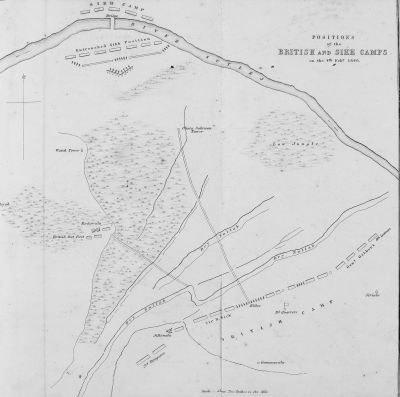
POSITIONS of the BRITISH and SIKH CAMPS on the 4th Feb. 1846
February the 8th. Sunday. Dined at half-past six, with my brother officers, at the mess of the 3rd Light Dragoons. They are encamped on our right, at the distance of about a quarter of a mile. As in the field, so at the mess-table, the Lieutenant-Colonel of this fine corps, Colonel White, C.B. (now aide-de-camp to the Queen), appeared to be beloved by his officers; indeed they have no small reason to be proud of one, so universally esteemed and respected by the cavalry division of the army of the Sutlej.
The battle was at hand: already were preparations making to meet those gallant men, the Sikhs, in mortal combat. On the evening of the 9th, Lieutenant-Colonel Irvine, of the engineers, came into the camp, having been sent to the frontier at the recommendation of Sir Herbert Maddock, Deputy-Governor of Bengal. Troops had been detached from the army to meet the large convoy coming from Delhi, with ammunition and stores; for the operations against the enemy at Moodkee, Ferozeshah, and Aliwal, had exhausted the greater part of our gun ammunition. Indeed, as I have already observed, that on the 22nd of December, 1845, when Tej Singh came before Ferozeshah, the British had no shot left. The force under Brigadier Campbell, however, brought up 4,300,000 rounds of musket ball cartridges, and twelve 12-pounders, with shot and other missiles, otherwise my gallant friend, Sir Harry Smith, would not have had the means of fighting the splendid battle of Aliwal.
And now we come to the 10th of February, the day on which the memorable battle of Sobraon, the crowning battle of the Sikh campaign of 1845-46 was fought, and which most persons expected would be the last.
The fate of the Punjaub seemed to hang by a thread; from the 22nd of December, 1845, to the 28th of January, 1846, no military operations had occurred till Sir Harry Smith gained the battle of Aliwal. The Sikhs' strongly entrenched position at Sobraon still remained to be taken; defended as it was by 30,000 regular troops, besides being equally strong by nature and art. By nature, as situated on the banks of the river, in the form of a half moon, having many and great impediments in its front; by art, the triple form of the entrenchments, bristled with a triple row of guns, which must be silenced before an entrance could be effected; a bridge of boats in its rear, by which the besieged might retire if they chose; and, moreover, batteries commanding the rear of the flanks of the entrenchment, which enabled them to fire upon any troops attempting to storm the works: added to which, the men could come over the pontoon bridge to assist in serving the guns in the works; and this they actually did.
Major-General, Sir Harry Smith, after the battle of the 28th of January, in which he had lost 589 killed and wounded, joined His Excellency, the Commander-in-Chief, on the 8th of February. It was judged expedient to wait for his arrival before the attack on Sobraon could be safely made. Part of the siege train, too, had arrived, to ensure the safety of which, it may be recollected, was the principal object in detaching Sir Harry Smith.
A plan had been proposed by the late Brigadier E. Smith, C.B., Chief Engineer, but when the nature of the proposed attack was explained to Lieutenant-Colonel Irvine, a senior officer, who had been sent by Sir T. Herbert Maddock, to join the army, which he had only reached on the 9th, the day before the battle, he is said to have taken a different view.
It is recorded, that in the year 1776, Sir W. Howe, in a despatch on the American entrenchments, wrote: "If I could have made approaches I could easily have taken the enemy's entrenchments."[27]
Whether Colonel Irvine proposed to make approaches I cannot say; certain it is, that it was agreed to follow the plan laid down by Brigadier Smith, Colonel Irvine being of opinion that it would be better to leave the conduct of the affair in the hands of the officer who had formed a digested plan. Had Brigadier Smith been superseded, a delay of two or three days at least must have ensued. Now, without knowing the exact cause for the delay, it is stated in the "Blue Book" that certain proposals had been made by the Lahore Durbar, or by some of the principal chiefs. Some say, that the celebrated Goolab Singh of Cashmere had made certain offers, to which an answer was required in three days. An officer of artillery remarked to the Commander-in-Chief, that the remainder of the supplies, stores, etc., from Delhi, would reach camp in two days. Lord Gough, in his Despatch of the 13th of February, says:—"Part of my siege train having come up with me, I resolved, on the morning of the 10th, to dispose our mortars and battering guns," etc.[28] This waiting of two days or more would have consumed more time than it was thought politically right to expend. We must remember that an answer was required in three days. Now, if Goolab Singh was the real proposer of these terms, it would seem that it could not answer to grant them. Perhaps he undertook to pay us the expenses of the war, to reduce the Sikh army, and to accept a British Resident at Lahore; these conditions, or something like them, must have been proposed.
Such offers could not have satisfied the government of India, because, when after the treaty of 1846, we took a slice of the Punjaub (Jullundur), and allowed the Sikh Durbar to keep up an army of 32,000 men, they raised more, either openly or covertly; hence, if they acted thus under our own eye, while holding the reins of government at Lahore, it is not unreasonable to conclude that they would follow up the plan in extenso in our absence, for a Resident would have been no adequate check.
Goolab Singh was evidently playing a game for himself: if he could be the means of saving the country, then Cashmere ought to be his reward; but, when affairs went in a contrary direction, he was forced to be no longer an actor on the scene. But, distrusting Goolab Singh, and supposing him to have been a traitor to his country, yet might he not be meditating the destruction of the English? He had his own troops with which he could turn the scale against us. Thus, whatever were the terms, or the nature of the terms, they were clearly less than we could accede to.
Colonel Irvine, as I have remarked, instead of acting as Chief Engineer, became an aide-de-camp, and partly a spectator.
The reader will doubtless imagine, and justly so, that we had more shot and shell on the road to join us; but time—that important element in our lives, which when once lost cannot be recalled—time, in military matters is everything. This was a well-known saying of Napoleon's, and the truth of it is evident to less able soldiers. The old plan, therefore, and not the new mode of attack, was the order of the day.
Owing to the peculiar form of the enemy's entrenchment, it was decided that the battering-train and disposable field-artillery should be put in position in an extended semi-circle, embracing within its fire the works of the Sikhs. On the morning of the 10th, a heavy mist prevented the intended cannonade from beginning at daybreak as was proposed. It must be borne in mind, that, strictly speaking, the attack on a strong entrenched position is usually made in the same way as upon a fort or outwork: for forts are, sometimes, surrounded by entrenchments, thus making the fort a kind of citadel, as it were, though it may not be so called technically.
This mist, though unfavourable for artillery is often favourable for troops, for enabling them to form under cover near such works and entrenchments.
Major-General Sir Robert Dick's division was placed on the margin of the river Sutlej, ready to commence the assault. The 7th Brigade belonging to this division, and led by Brigadier Stacey, was to head the attack, supported by the 6th Brigade of the same division, at a distance of two hundred yards. A reserve which was entrenched at the village of Rodawalla, was in readiness to move forward if required.
In the centre, Major-General Gilbert's division was deployed for support or attack, with its right resting on Little Sobraon. With regard to this division, it has been stated by an officer of an infantry corps, that it was not intended that it should attack in the first instance, but it so happened that Major-General Gilbert[29] with that decided conduct which marked all his actions, finding that the left attack on the enemy's right had not succeeded, determined at once to make his attack in front.
As I have before observed, there were impediments in the front, of which we were ignorant; they were in the nature of an embankment, and when our troops came up, this embankment, lying between them and the entrenchment, prevented the British from easily mounting it and entering the enclosure; the only means, therefore, by which they could effect this, was by moving to the right and left of this impediment. It will not be a matter of surprise therefore, that a little confusion occurred, and that our troops were in some slight degree jammed together. But we must defer the result to its proper place, and proceed with the order for the movements of the other troops.
Major-General Sir Harry Smith's Division was formed near the village of Guttah, with its right thrown up towards the Sutlej. It was determined to threaten by feigned attacks, the enemy's horse, under Rajah Lall Singh Misr, which was stationed on the other side of the river. There was a ford at Hurrekee Ghât at which were drawn up the 16th Lancers, who would thus have been enabled to cross over and attack the Sikh cavalry, if circumstances had called for aid. Besides, as there was a ford there, the enemy might have thought of crossing himself, for the purpose of attempting to turn our left flank.
Brigadier A. Campbell took up an intermediate position, between the divisions of Major-General Gilbert's right, and Major-General Sir Harry Smith's left. Campbell's brigade was to the rear of Sir Harry's division, the better to effect this object, for it is desirable, on occasions like these, not to place the cavalry within reach of cannon shot.
Major-General Sir Joseph Thackwell, K.C.B. commanding the cavalry division, had under him Brigadier Scott, C.B.,[30] who held a reserve in the first brigade on our left, ready to act as circumstances might render necessary. Brigadier Scott, as well as the Major-General, had commanded cavalry in the Affghan campaign, when Ghuznee was taken, in July 1839, and proceeded to Cabool; so that, should the presence of Sir Joseph Thackwell have been required in any other part of the field of action, he had as his second in command, an officer whom he well knew, and in whom he could place the most implicit confidence, for it must always be recollected that it is of great advantage to have an officer in the field, who has had experience in Indian warfare. It cannot be supposed that an officer just come from Europe can all at once, be prepared to command a brigade composed of Lancers, Dragoons, and native Cavalry. Surely a little experience is requisite. Besides in India, from the nature of the service, a Lieutenant-Colonel often commands a Brigade; while in Europe that command would generally devolve upon a Major-General.