Front matter (continued 3)
Reading edition
“‘Why, of course—are we not, dear Mr. Candytuft? What would be thought of us if we did not pay our homage to——’
“The sentence was broken by the sudden appearance of Monica and Agatha, each bearing a jewel-case, and looking radiant with the possession.
“‘Thank you, dear papa,’ said Monica, curtseying and smiling her best to Jericho.
“‘They’re beautiful. Thank you—dear, dearest papa,’ cried the more impulsive Agatha.
“‘Look!’ said Monica, and she exhibited her treasure.
“‘Look!’ cried Agatha, and she half dropped upon one knee, on the other side, to show her jewels.
“‘Beautiful!’ cried Candytuft. ‘Pray, ladies, don’t stir.’
“The girls, with pretty wonder on their faces, kept their positions on either side of Jericho.
“‘My dear madam’—and Candytuft appealed to Mrs. Jericho—‘is not this a delightful group—an exquisite family picture? It ought to be painted.’”
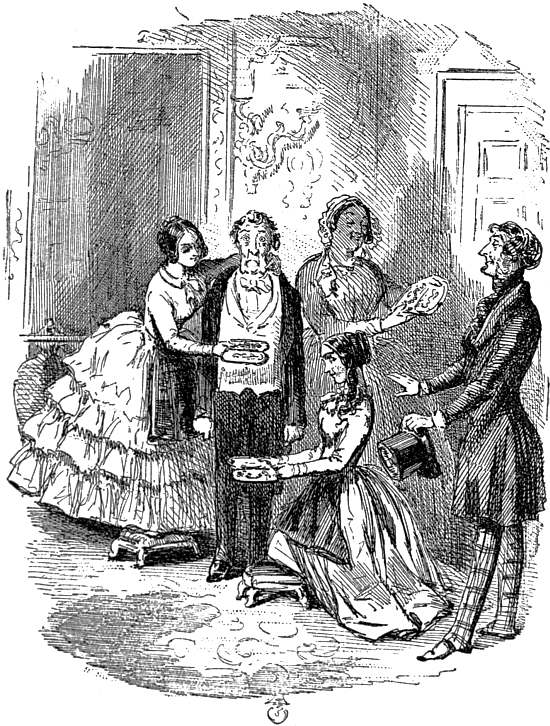
A Family Picture.
Mr. Candytuft is right. The graceful figures of the girls, the attenuated figure of papa, in whose hopeless expression one sees the dread of further attenuation, together with his own perfect presentment, would make—indeed, does make—an admirable picture. The jewels cost one thousand pounds: ten calls have to be made upon the supernatural bank. They are made, and the jeweller is paid. And the result! For some minutes after the departure of the tradesman Jericho sat motionless—all but breathless. He would, however, know his fate. He took out the silk lace with which an hour ago he had measured his chest. Again he passed it round his body. He had drawn upon the bank, and he had shrunk an inch.
Truly he was a man made of money—money was the principle of his being, for with every note he paid away a portion of his life.
Poor Mr. Carraway was ruined through no fault of his own. Jogtrot Hall was sold, and Jericho bought it. Thirty thousand pounds’ worth of flesh had he sacrificed to buy to himself a country mansion. He had become a member of Parliament, and at the same time become so thin that his tailor declared, “It’s like measuring a penknife for a sheath.” “Why,” said the tailor to his wife, “he isn’t a man at all, but a cotton-pod. He can’t have no more stomach than a ’bacco-pipe.” In fact, it was the growing belief of a large circle that Jericho was no flesh, no man, at all. “He was made up of coats,” ran the rumour, “like an onion.”
The insolence that is sometimes the accompaniment of great riches took full possession of Mr. Jericho, and he found an occasion to treat Colonel Bones to a specimen of it. Almost without provocation the Colonel was called “a toad-eater! a bone-picking pauper!” etc. For this insult the Colonel declared he would have Mr. Jericho’s blood, and in pursuance of that object he sent the millionaire a challenge. Jericho fought very hard to avoid fighting, but his second, Mr. Candytuft, prevailed, and the belligerents met in Battersea Fields. Mr. Commissioner Thrush waited upon the angry Colonel, and the celebrated Dr. Dodo was there to attend to the wounded. The seconds confer; the men are placed. Candytuft looked at them with an eye of admiration. The signal was given.
“Colonel Bones fires, and his ball goes clear through Jericho’s bosom, knocking off a button in its passage, and striking itself flat against a pile of bricks.”
“‘A dead man!’ cried the doctor, running to Jericho.
“‘My friend,’ exclaimed Candytuft, ‘have you made your will?’
“‘Eh? What’s the matter?’ said Jericho.
“‘Matter!’ exclaimed Dr. Dodo, and he pointed his cane to the hole in the front of Jericho’s coat, immediately over the region of his heart. ‘Matter! It’s the first time I ever heard a man with a bullet clean through his breast ask—What’s the matter!’”
The Colonel’s ball had passed through Jericho’s bank-note-paper breast, and Jericho lived and moved and was none the worse for it. Jericho fired in the air.
An ugly atmosphere was collecting about Mr. Jericho, and he was aware of it. “His own family saw in him a man of mysterious attributes. Monica turned pale at the smallest courtesy of her parent, and Agatha, suddenly meeting him on the staircase, squealed and ran away as from a fiend.
“Mr. Jericho went on a rejoicing conqueror. His huge town mansion, burning with gold—massive, rich, and gorgeous; for the Man of Money was far the most substantial, the most potent development of his creed, whereby to awe and oppress his worshippers——”
Mrs. Jericho had made up her mind that it was time her daughters were “settled in life, and she said as much to her husband.”
“‘Your girls, my dear, have my free permission to settle when and where they like,’ said the husband.
“But in sounding Mr. Jericho as to his intentions in the matter of settlements, she could make no way whatever. At last she put the point-blank question:
“‘What do you propose to give the dear child?’ (alluding to Monica, for whose hand Candytuft was about to ask).
“‘Give! I’ll give a magnificent party on the occasion.’
“‘But the dowry; what dowry do you give?’
“‘Dowry! I thought, my dear, you observed marriage was no bargain? Why, you’re making it quite a ready-money transaction!’”
At this point the conversation was interrupted by Mr. Candytuft, who, before advocating his own case, warmly espoused that of his foolish friend, Sir Arthur Homadod, the accepted of Agatha.
“‘He’s as bashful as—as—upon my life I am at a loss for a simile. And as he and I are old friends, and as he knew that I should see you—in fact, he’s in the house at this moment, and came along with me—he desired me to inform you that Miss Agatha had consented to fix the—the—what d’ye call it—the happy day.’
“‘Wish them joy,’ said Jericho.
“‘As to the young lady’s dowry?’ hesitated Candytuft.
“‘I can’t give a farthing; can’t afford it, my dear Candytuft.’”
The ambassador then speaks for himself:
“‘You may have remarked my affection for Miss Monica? You must have remarked it?’
“‘I beg a thousand pardons,’ said the wag Jericho, ‘but it has quite escaped me.’
“Candytuft wanly smiled.
“‘In a word, my dear sir, we have come to the sweet conclusion that we were made for one another.’
“‘Dear me! Well, how lucky you should have met!’”
Mr. Candytuft beats about the bush for awhile, but at last comes abruptly to the point, saying:
“‘I must ask—you force me to be plain—what will you give with the young lady?’
“‘Not a farthing!’ cried Jericho. ‘Not one farthing!’ said the man of money with determined emphasis.
“‘What is the matter?’ said Mrs. Jericho, who entered the room at this juncture.
“‘Pooh! you know well enough,’ cried Jericho. ‘Mr. Candytuft wants to marry rich; but that’s not all—he wants to be handsomely paid for the trouble.’”
After awhile Jericho affects to agree to dower his step-daughter, and he says:
“‘Let us settle the sum, eh! Well, then, what sum would satisfy you?’”
It was a delicate question to put thus nakedly.
“‘Come, name a figure. Say five thousand pounds.’”
Candytuft looked blankly at Jericho, moving not a muscle.
“‘What do you say to seven?’
“Candytuft gently lifted his eyebrows, deprecating the amount.
“‘Come, then, we’ll advance to ten?’
“The lover’s face began to thaw, and he showed some signs of kindly animation.
“‘At a word, then,’ cried Jericho with affected heartiness, ‘will you take fifteen thousand?’
“‘From you—yes,’ cried Candytuft; and he seized Jericho’s hand.
“The man of money looked at Candytuft with a contemptuous sneer, and with a wrench twisted his hand away. He then dropped into a chair, and a strange, diabolical scowl possessed his countenance. The man of money looked like a devil.
“‘And where—where do you think this money is to come from? Where?’ asked Jericho, and he rose from his chair, and it seemed as though the demon possessing him would compel the wretch to talk—would compel him to make terrible revelations. Each word he uttered was born of agony. But there he stood, forced to give utterances that tortured him. ‘I will tell you,’ roared Jericho, ‘what this money is. Look about you! What do you see?—fine pictures, fine everything. Why, you see me—tortured, torn, worked up, changed. The walls are hung with my flesh—my flesh you walk upon. I am worn piecemeal by a hundred thieves, but I’ll be shared among them no longer.’”
By this time the girls and Sir Arthur Homadod, alarmed by the cries of Jericho, had entered the room.
“‘And you had a fine feast, had you not?’ cried the possessed man of money, writhing with misery and howling his confession. ‘And what did you eat?—my flesh. What did you drink?—my blood!’”
It would be impossible to imagine a more satisfactory realization of this powerful scene than Leech’s rendering of it. The shrinking figure of Candytuft as he retreats before the fury of the moneyed man; the awful passion of the shrivelled Jericho; above all, the vacuous expression of Sir Arthur, all are done to perfection and without exaggeration. Beyond the endeavour to make the meaning of the illustrations in the “Man made of Money” clear to my readers, I have little or nothing to do with the story. I may note, however, that young Basil Pennibacker falls in love with Bessy, the pretty daughter of the ruined merchant Carraway, and that bold bankrupt, who is about to seek a new fortune at the Antipodes, calls upon Jericho to ask his consent to his stepson’s marriage. How the announcement of the engagement was received may be imagined, or if my reader be not satisfied with his idea of what may have taken place, he can read in Mr. Jerrold’s book how Mr. Carraway was met by his old friend. He will also find an illustration of an interview between “The Pauper and the Man of Money,” but as I do not think it quite worthy of Leech, I do not reproduce it. I may as well add that Basil—who turns out to be a very good fellow—does marry Bessy, and the happy pair, with the parent pair of Carraways, depart for Australia in the good ship Halcyon.
Mr. Jericho’s explosion, and his unpleasant conduct generally—especially regarding Monica’s dowry—had altered Mr. Candytuft’s matrimonial intentions for the present: there were delays. “He had suddenly discovered some dormant right to some long-forgotten property, and he meant to secure that, and lay it as an offering at the feet of his bride.” How the foolish Sir Arthur agreed to marry Agatha without a dowry, to the intense delight of Jericho—how splendid preparations for the wedding were made—how the wedding-party, Jericho included, waited at the church for the bridegroom, who never came (he had overslept himself in consequence of an overdose of medicine taken to steady his nerves)—for these details my reader is again referred to Mr. Jerrold, who describes the whole most enjoyably. Leech draws the baronet awakened by his servant, but too late: the canonical hour has passed. A report was spread that Sir Arthur had taken poison to avoid the Jericho connection.
Just at this time Mr. Jericho was offered a most satisfactory mortgage—so any way there was land for his money—no less than five-and-forty thousand pounds, by his friend the Duke of St. George.
Jericho lent the money, in the hope of climbing into the House of Lords with the assistance of the Duke; but this last drain upon his resources, with its penalty of attenuation, had left very little of him to go anywhere.
“He had shrunk,” says the author. “How horribly he had dwindled, how wretchedly small he had become! Ay, how small! He would measure himself, he would know the exact waste. Whereupon Jericho took the silken cord and passed it round his breast. Why, it would twice encircle him—twice! and a piece to spare. With horror and loathing he flung the cord into the fire. He would never again take damning evidence against himself.”
It became evident to Jericho that, if he desired to retain enough of his person to enable his friends and relations to recognise him, the drain upon the chest notes must cease.
“He would, therefore, not draw another note—no, not another. He would live upon what he had. He would turn the foolish superfluities about him into hard, tangible money.”
Bent upon turning everything belonging not only to himself, but to his wife and daughters, into cash, he sent for Mrs. Jericho.
“The trembling wife had scarcely power to meet the eyes of her helpmate. In two days twenty years seemed to have gathered upon him. His face looked brown, thin, and withered as last year’s leaf. His whole body bent and swayed like a piece of paper moved by the air. As he held his hand aloof, the light shone through it. It was plain there was some horrid compact between her lord and the infernal powers, or—it was all as one—the tyranny of conscience had worn him to his present condition.
“‘Mrs. Jericho, madam, you will instantly bring me all your diamonds—jewellery—all. Give like orders to your daughters, the mincing harpies that eat me.’”
The terrified woman remonstrated, asked for an explanation, offered to send for the doctor.
“‘Away with you! do as I command. Bring me all your treasures—all. And your minxes! See that they obey me too, and instantly.’
“‘Yes, my love, to be sure,’ said Mrs. Jericho, for she was all but convinced that Solomon’s reason was gone or going. It was best to humour him. ‘And why, my love, do you wish for these things? Of course you shall have them, but why?’
“‘To turn them into money, madam,’ cried Jericho, rubbing his hands. ‘We have had enough of the tomfoolery of wealth—I now begin to hunger for the substance. I’ll do without fashion. I’ll have power, madam—power!’”
The conversation continued, and Mrs. Jericho became more and more convinced that her husband was mad.
“‘Oh that Dr. Stubbs would make a morning call!’ silently prayed the wife.”
The man of money, having determined to dismantle his house and send his wife and daughters adrift, retired with one servant, all the rest being discharged, into “one of his garrets, a den of a place,” where the scullion had slept. The servant was the pauper grandfather of one of his footmen, an old man of “congenial weakness with Jericho. Indeed, there looked between them a strange similitude, twin brethren damned to the like sordidness, the like rapacity.”
Jericho had nicknamed the old man Plutus. Jericho and Plutus were in face and expression as like as two snakes.
Mrs. Jericho, assured of her husband’s madness, took counsel with her friends. Drs. Stubbs and Mizzlemist, Colonel Bones, Commissioner Thrush, and Candytuft met in conclave and listened to Mrs. Jericho’s account of her husband’s ravings; but she failed to convince the doctors that what a jury would consider insanity, was apparent in anything that the man of money had said or done. As Dr. Mizzlemist delivered this opinion, a crash was heard in an adjoining room—another, and another, and then a loud triumphant laugh from the throat of Jericho.
Wife and daughters, with jury of friends, started to their feet. Candytuft, ere he was aware—for had he reflected “a moment, he would as soon have unbarred a lion’s cage—opened the doors. And there stood Jericho, laden with spoil.”
Though Mr. Jericho was voted sane by the doctors, his conduct displayed a brutality for which madness would be the only excuse. The Jews were coming, everything was to be sold.
“‘Why stay you here?’ cried the man of money to his wife. ‘Why will you not be warned? In a few hours there will not be a bed for your fine costly bones to lie upon. Now will you depart?’”
The Jews wandered about the rooms, appraising everything. Jericho was anxious to avoid a “public hubbub,” as he called a sale.
“‘I want,’ said he to the brokers, ‘at a thought, to melt all you see, and have seen, into ready money. Take counsel together, I say, and make me an offer, a lumping offer, for the whole—eh?’”
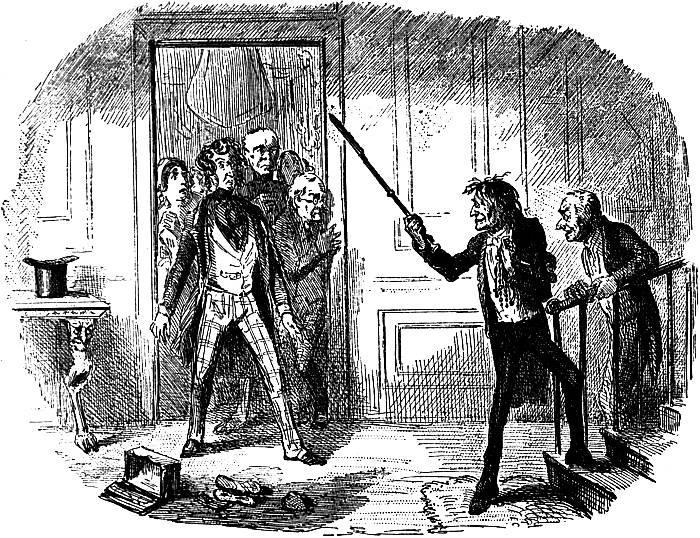
“And there stood Jericho.”
The man of money ascended to his garret and awaited the Jews’ offer, which was promised for the evening. He was alone, “evening closed in, and the moon rose and looked reproachfully at the miser.”
The garret door opened, and Plutus appeared.
“‘Well, has it come?’ cried the master.
“‘Here it is,’ answered the servant, as he laid a letter upon the table.
“‘Well, now for their conscience!’ exclaimed the man of money.”
Light was required; there was a candle upon the table, and paper prepared to light it.
“Most precious paper—the heart’s flesh and blood of the man of money! For the devilish serving-man had folded a note (how obtained can it matter?)—a note peeled from the breast of his master, a piece of money, a part of the damned Jericho sympathizing with him.
“The man of money took the paper—the devil, with his ear upturned, crept closer to the door—and thrust it amidst the dying coals. A moment, and the garret is rent as with a lightning flash.
“Yelling, and all on fire, the man of money falls prostrate with hell in his face. Then his lips move, but not a sound is heard. And the fire communicated by the sympathy of the living note—the flesh of his flesh—like a snake of flame glides up his limbs, devouring them. And so he is consumed: a minute, and the man of money is a thin black paper ash. Now the night wind stirs it, and now a sudden breeze carries the cinereous corpse away, fluttering it to dust impalpable.”

CHAPTER XI.
ALBERT SMITH AND LEECH.
In July, 1851, a new work appeared, under the name and title of the Month: “a View of Passing Subjects and Manners, Home and Foreign, Social and General, by Albert Smith and John Leech.” The publication was a serial one—monthly, in fact; and as it contained many amusing skits by Albert Smith, and much of Leech’s best work, notice of it is incumbent upon a writer of Leech’s life.
Eighteen fifty-one, as everybody knows, was the year of the Great Crystal Palace Exhibition in Hyde Park. I well remember visiting the huge glass building in February, 1851, in company with Dickens and Sir Joseph Paxton. Dickens was wrapped in furs, and we shivered through the place, which was only partially roofed; and seemed altogether so far from completion as to cause great doubts in our minds of the possibility of its being ready for its contents by the first of May.
I put the question to Paxton, and his reply was:
“I think it will; but, mind, I don’t say it will.”
Paxton’s thought was justified; for the Exhibition was opened by the Queen in great state at the date fixed, though many of its intended exhibits were still to come.
I confess I shared the foolish dread that the opening would be so crowded as to be very uncomfortable, if not dangerous, to sight-seers; and I therefore declined to accompany my brother, who was braver than I; and sorry enough I was when I found that the panic had been so universal as to enable the few courageous visitors to have the show, as my brother expressed it, “all to themselves.”
The first number of the Month appeared in July, 1851, and the last was issued towards the close of that year. It seems to have been the intention of the authors to have taken typical young ladies, and, under the heading of “Belles of the Month,” have used them as prefixes to each monthly part. Unfortunately, I think this idea was only partially carried out. True, we have Belles of the Park, and Belles of the Ball, and one or two Belles of the Month, so charmingly done by Leech as to make it a matter of surprise that such great attractions were not more frequently admitted to the paper.
The literary portion which begins the Month is very Albert Smithian indeed. In proof, I quote some of his description of “The Hyde Park Belle”:
“The charming young lady introduced to me,” says Mr. Smith, “was of middling stature, with oval face, chestnut hair, dark eyes, and very white and regular teeth. She had on a white transparent bonnet, and light muslin dress all en suite. In answer to my questions, she replied as follows:
“‘I shall be nineteen in August, and have been out two years and a half. Have I ever been engaged? Only once, and that was broken off because I went on a drag to Richmond with the officers of the —th. Lady Banner was inside—it was all perfectly proper. She is a very nice woman—always ready to chaperone anybody anywhere if her share is paid. Only sometimes she bores one dreadfully. Edmund went to India. I don’t know where he is now; I have not heard. I dare say he is somewhere. He bored me dreadfully at last. I work very hard—oh, very hard indeed!—that is, in the season. My maid always sits up to make tea for me when I come home. Her hours are very regular, considering. She goes to bed every morning about four; but, then, she doesn’t have to dance half the night. Yes; I like the Crystal Palace. Oh! I get so tired there—walking, and walking, and walking, you can’t think how far! I know the Crystal Palace fountain and Dent’s clock, and the stuffed animals and the envelope-machine. I don’t think I have seen anything else; I have never been out of the nave and the transept—nobody goes anywhere else. I did not know that there was anything to see upstairs, except large carpets. I am sure they would bore me dreadfully. We are engaged every night.... We had scarcely time to dress for the Grapnels’ dinner-party; and then we went to Mrs. Crutchley’s, to meet the Lapland Ambassador. We could not get into the room, and stood for two hours on the landing. Old Mr. Tawley was there, and would keep talking to me; he always bores me dreadfully. He is going to take mamma and me to see some pictures somewhere. I hate seeing pictures; they bore me dreadfully. After Lady Crutchley’s, we went to Mrs. Croley’s amateur concert, which was nearly over. She had only classical music. I don’t know what classical music is; I only know it bores me dreadfully. Ashton Howard says the same people who like classical music buy old china and wear false hair. I wish people would give up classical music. It never amuses anybody—that is, anybody worth amusing. I don’t know whether “The Huguenots” is classical music or not; I only know that when they give it at the Royal Italian Opera nobody seems bored then. I don’t know that I am exactly.’”
Whether in these boxes full of beauties one amongst them is intended by Leech to personate Mr. Smith’s “dreadfully bored” young lady, I cannot say. Certainly there is not one who seems in the condition described as not being “exactly bored.”
The Belle of Hyde Park continues:
“‘I go into the Park every day with mamma, but it bores me dreadfully. I see nothing but the same people, and I know all the trees and rails by heart. I ride sometimes; I like it better than the carriage. But papa don’t ride very often; and if he don’t I can’t, except with the Pevenseys and their brothers. John Pevensey is very stupid, and talks to me about farming. I get very tired; but I am obliged to go, because the Pevenseys know so many receivable people. But they bore me dreadfully; in fact, I don’t know who or what does not. I long for the season to be over; and when I go into the country, I long for it to begin again. I wish I could do as I pleased, like Marshall—that’s my maid—when she has a holiday. She is going to marry the man at the hairdresser’s; and last Sunday they went down all by themselves to Gravesend. I see mamma’s face if Ashton Howard was to propose to take me to Gravesend next Sunday, and without Lady Banner! I wish sometimes I was Marshall. Now and then I would give a good deal for a good cry. I can’t tell you why—I don’t know; only that everything is a trouble, and bores me dreadfully.’”
In reply to further inquiries from Mr. Smith, the young lady tells him what she pays for her satin shoes, which are worn out after two parties. Does she have her gloves cleaned?
“‘Certainly; but not for evening parties—the men’s coats blacken them in an instant. They do very well for the opera and evening concerts—nothing else. The Pevenseys wear cleaned gloves. Everybody knows it; and Ashton Howard always asks out loud if a camphine-lamp has gone out when they come into the room. You can get a nice bouquet for five or six shillings. Old Mr. Rigby, in the Regent’s Park, told me I might cut any flowers from his conservatory. But I don’t care for that—I would sooner buy them; he bores me dreadfully.’”
It cannot be denied that ugliness has reached its climax in men’s dress of the present day. It would be extremely difficult to find a garment more hideous than a dress-coat; and it is impossible for any head-covering to exceed the stove-pipe hat in ugliness, to say nothing of inconvenience and detestable uncomfortableness.
These sentiments were fully shared by one of the Month’s correspondents, a gentleman named Simmons, who “emerged from his residence at Islington” on the day of the opening of the Great Exhibition with the intention of showing to the multitudes who were expected to attend that ceremony the kind of hat that should depose, at once and for ever, the detestable chimney-pot.
“It was, in fact,” says the bold reformer, “merely a wide-brimmed, flat-crowned wideawake, to which I thought a feather—in these days of foreign immigration—would not be an out-of-the-way addition. I had contemplated my own features beneath it in as much variety of light and shadow as I could obtain from my shaving-glass for half an hour preceding my departure, and had arrived at such a satisfactory conclusion as to its effect, that I regarded myself as a sort of modern William Tell, about to release my country, by a bold example, from an oppressive and degrading subjection to a detested hat.”
A love of change is said to be inherent in human nature; but attacks upon custom—indeed, innovations of all kinds—are usually futile unless very special conditions attend the attempts. If the famous hat invented by a Royal Prince was received with overwhelming ridicule, as my older readers will remember that it was; a less melancholy fate could scarcely be expected for the wideawake and feather of the little gentleman from Islington.
“My appearance in the street certainly created a sensation,” says Mr. Simmons; “but it was one exceedingly mortifying to my feelings. Omnibus drivers winked at each other, and pointed at me with their whips. Occasionally a stray boy would indulge in personal observations, or a grown-up ragamuffin would sputter out an oath, and burst into a horse laugh, which to my mind appeared totally unwarranted by the circumstances of the case.”
The managers of the Month very wisely placed this etching in the front of their first number. In all respects Leech is here seen at his best. The figure of the poor little victim of reform, the street-boys and their surroundings, are all unsurpassable; while to an artist the composition of the figures and the arrangement of light and shadow are excellent.
After escaping from the attentions of Leech’s inimitable Arabs, Mr. Simmons reaches Hyde Park to find fresh troubles. The feathered wideawake creates a sensation, but not of the kind that its wearer expected; he was asked where “he bought it,” and “if he would sell it”; “if he made it himself”; and if he had “another at home like it to spare for a friend,” and so on. The “air of unconsciousness” that the reformer assumed irritated his assailants, whose “offensive remarks and insolent mirth” were soon exchanged for attentions more uncomfortable.
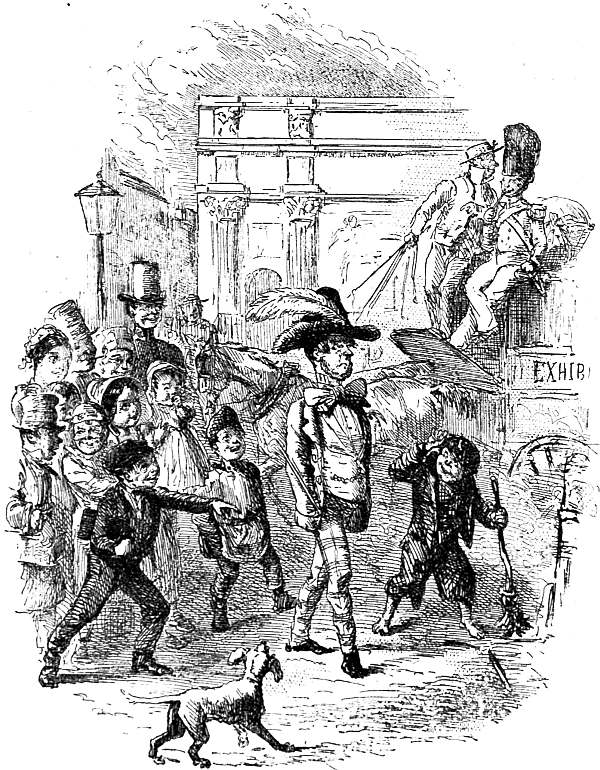
Mr. Simmons’s attempt at Reform.
Says Mr. Simmons: “A bright flash of practical jocularity suddenly illumined the mind of an original genius, who at once carried it into effect by casting at my decided article of costume a large tuft of grass, which struck me on the back of my neck, broke into dry dirt, and raised a perfect roar of delight at my expense.” Instead of patiently enduring this assault, as a prudent man would have done when surrounded by enemies, the valiant Simmons turned upon his assailant, “and struck the wit a severe blow in the face.” That was a death-blow to the picturesque hat, which “afforded some slight sport as a football for a few moments, and then vanished and was seen no more.”
It will be seen by the quotations that the literary portion of the Month is of the slight character—though sometimes clever and amusing—to which so much of Leech’s work has been allied. A sketch, entitled “Home from the Party,” gives occasion for the accompanying drawing by Leech of a young gentleman who has “danced all night till the broad daylight,” “and gone home” by himself “in the morning.” On his journey a brougham overtakes him, containing “the handsome dark girl with the clematis and fuchsia wreath, looking pale and pretty, with a pocket-handkerchief over her head cornerwise, held together at the chin. We think about that brougham-girl till she is out of sight, and wonder if we appeared to the best advantage as she passed. We don’t much think we did. One of the springs of our hat was out of order, and we were carrying our gloves in our hand, crumpled up to the size of a walnut, as though we were going to conjure with them; and we were blinking as we met the sun at the corner, and holding a seedy bouquet in our hand, which evidently she had not given us.”
The remarks, conversations, comments, and so forth, that generally accompany Leech’s drawings were invariably his own composition, and in their humorous aptness are almost as admirable as the drawings they explain. In illustration I note a design under the heading of “Moral Courage.”
“Scene—A Station of the Shoeblack Brigade.
“First Boy: ‘Here’s another swell, Bill, a-coming to be blacked.’
“Second Boy: ‘Ooray!’
“Third Boy: ‘Ain’t his boots thin neither?’
“Fourth Boy: ‘Wouldn’t they pinch my toes if I had ’em? Oh my!’
“Fifth Boy: ‘They don’t pinch his’n.’
“Sixth Boy: ‘Yes, they do.’
“First Boy: ‘Go easy, Blacky; mind his corns.’ (Swell winces.) ‘That was a nasty one.’
“(The comments are extended from the swell’s boots to his costume and appearance generally. And all this for a penny).”
Mr. Thackeray’s “Four Georges” are, no doubt, familiar to my readers, some of whom may also remember his delivery of them in the form of lectures to large audiences. In that great writer’s early time he wrote many essays, art-criticisms, etc., under the name of “Michael Angelo Titmarsh,” and it is under that title that he is represented in the drawing by his friend Leech, as he appeared at Willis’s Rooms “in his celebrated character of Mr. Thackeray.”
In the Month, Mr. Albert Smith makes Leech’s drawing a peg upon which he hangs some justly complimentary remarks on the Thackeray lectures which took the town by storm forty years ago.
Whether the “Belle of Hyde Park” or the “Belle of the Ball” is to be considered the belle of the Month’s July issue is left in doubt; but there is no doubt whatever about the claim of the pretty creature (who, accompanied by an extremely plain and dissolute-looking cavalier in the costume of Charles II.’s time, enters an imaginary ball-room) to a loveliness that it would be difficult to surpass, as the drawing amply proves.
This cut is accompanied by some verses which appear to me quite unreadable; I therefore spare my readers from the infliction of any of them.
The frontispiece to the Month for August is an etching by Leech of singular beauty, called “Charade Acting.” I have looked in vain through the letter-press for any explanation of this charade, so I suppose the meaning is purposely left for discovery to the intelligence of the observer. It represents the clever performance of Mr. Smiley and Miss Corgy.
Mr. Smiley evidently represents a valorous knight—else why that dish-cover shield, that saucepan helmet, that long surcoat of nightshirt in the place of mail? The knight has armed himself further with sword and lance (sword of any period, lance a roasting-spit). Those warlike preparations must have been made in defence of that delicious girl leaning over the back of the ancient chair. Is she supposed to be a distressed damsel leaning from her prison-window and listening to Mr. Smiley’s vows of liberating her or dying in the attempt? If so, where is the word that will express as much? Not in the brain of the stout old gentleman who is fast asleep amongst the audience, nor in that of the pretty little girl who sits in front of him apparently wondering why people should be “so silly.” The lady who tries to hide a yawn with her fan has evidently “given it up,” and the two lovely women near her are much in the same condition.
Now we come to the belle of the month of August, who is riding with her papa in Kensington Gardens. An attempt was made—later, I think, than the Exhibition year—to extend Rotten Row into Kensington Gardens, and thus deprive pedestrians—notably children and nursemaids—of their promenades amongst the trees. For some months the equestrian habitués of Rotten Row careered in the Gardens, to the terror and danger of children, and the disturbance of many groups of soldiers and nursemaids. This usurpation created very strong opposition.
I lived in the neighbourhood, and I accompanied a deputation to Sir Cornewall Lewis—then in power—with a view of impressing upon that Minister the desirability of rescinding the objectionable privilege which had been granted to the riders. We had some eloquent talkers, but their oratory seemed to me to make no impression upon Sir C. Lewis, who may have listened, but during the harangues he was always writing letters, and no sooner was one finished than he began another; and we left him without an intimation of our success or failure. But what is certain is, that within a week of our interview the equestrians disappeared—I hope for ever—from Kensington Gardens. Leech being a constant rider, both spoke and drew in favour of the new ride. Drawings may be found in the Punch series in which he laughs at the opponents of the horses in the Gardens, and I remember his indignation when I told him of our deputation and its successful issue.
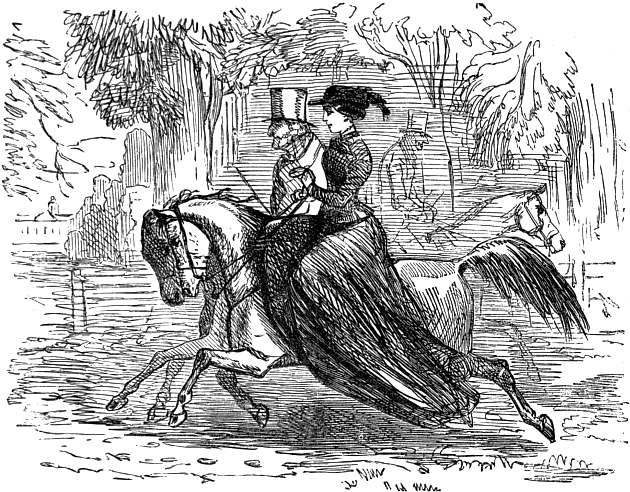
The Belle of the Month—August—taking a “Constitutional” in Kensington Gardens. Time, 8 A.M.
Leech was never happier than in the infinite variety of his pictures of life at the seaside; his invention was inexhaustible, as numberless groups of seaside visitors engaged in the search of health or pleasure—from the small digger on the sands to the valetudinarian at the Spa—sufficiently prove. Never was he more delightful than in dealing with the charming lady bathers, one of whom plays the part of the Month’s “Belle of September.”
I think this picture might have inspired the poet of the Month, but his lyre is silent.
“The Balcony Nuisance!” Without some explanation the drawing that follows this title would be perfectly incomprehensible. How, in the name of common-sense, of propriety, or of justice, can the word “nuisance” be applicable to the occupants of that balcony? Well, it is in this wise: A correspondent of the Month, who signs himself “Narcissus,” lives in a suburban square, from which he indites a remarkable letter. According to “Narcissus,” suburban squares are famous for the production of vast numbers of “single ladies.” He calls his square a “realm of girldom,” the proportion of the belles being very great over the marriageable young men, and therefore they watch with keen eyes for any new flirtations. “And now,” said he, “comes my complaint. I cannot call at any house where there are daughters but, the instant I knock, every balcony near me is filled with waves of rustling muslin, and a dozen pairs of bright eyes are on the qui vive for every movement or expression. I need not say how annoying this is.”
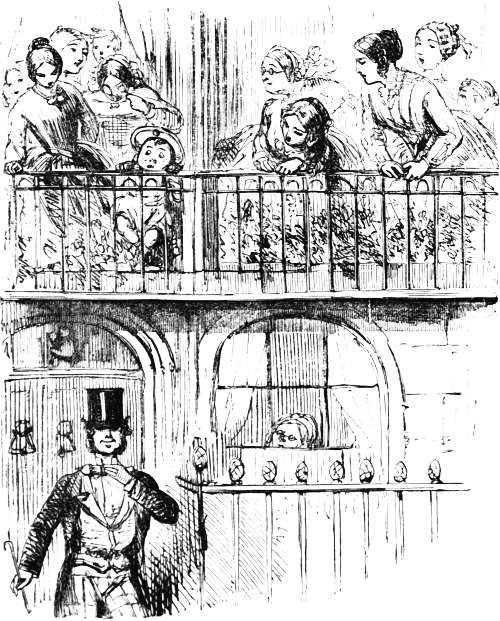
The Balcony Nuisance.
I see no trace of annoyance in the simpering buck who is the cynosure of all eyes in the drawing. Leech evidently saw through the affectation of annoyance, and depicted the Narcissus mind in its real condition of gratified conceit.
The Month’s October issue contains a good deal of Leech’s work. The number contains a “Belle of the Month,” but she is so inferior in attractiveness to her sisters that I am ungallant enough to pass her by. I find, however, a pretty musical group entitled “Pestal.” In 1851 Mr. Albert Smith says that Pestal, who was a Russian officer, was imprisoned for marrying without the consent of his Sovereign, and “cast for death.” Of course, though, according to Mr. Smith, this unfortunate man may have been a “Pestal-ent person,” we are not expected to believe the crime for which he was executed was only that of neglecting to ask the Czar’s consent to his marriage. “On the eve of his execution, as he lay ironed, awaiting the next morning’s mangling,” continues the inveterate punster, “in a happy moment of enthusiasm, he composed the waltz that bears his name.”
The pretty music seems to have sentimentalized the handsome youth, and drawn him closer to the performer, who is one of those sweet creatures with whom the artist has made us so familiar. I cannot refrain from presenting my readers with an example of the poetry that adorns the Month, so that they may be convinced of the propriety of giving them as little of it as possible. Forty-one verses, of which the two following are fair examples, accompany the drawing called Pestal:
“In London, as usual, last season I spent, To Pocklington Square my notes were addressed all, And wherever I rambled or wandered or went, I was pestered with that horrid pest of a ‘Pestal.’ “I thought this mysterious, moreover, and queer, ’Tis better at once that the truth be confest all— That all through the city one word should appear, And that word the incomprehensible ‘Pestal.’”
“The Great Dinner-Bell Nuisance” not only gives occasion for a capital drawing by Leech, but the title also heads a capital paper, in which the absurdity of the function, when there is not the least necessity for it, is well satirized. A retired lawyer named Watkins Brown lives in a village which contains at most 347 people, “in a comfortable sort of house in the Italian style, which he christened Somerford Villa.” He has no children, and his establishment consists of five persons, Mrs. W. B., Betsy, the cook, etc., including Buttons, the page. This boy, armed with a bell, is a nuisance to the neighbourhood; he performs upon it three times a day. “Now,” says the indignant writer, “why does Buttons do this? Is it to echo back the sound that comes at the same hours from Sir Marmaduke Hamilton’s, of Somerford Hall, and to impress people that Brown and Sir Marmaduke are the only gentlemen in the neighbourhood? It can’t be to let Brown and his wife know that luncheon or dinner is ready, for in nine cases out of ten they are in the room when the cloth is laid. Again I ask, why does Buttons do this? If he is of opinion that his master is unaware it is time to dress for dinner, why doesn’t he tell him so at once when he is in the room, instead of using such an absurd system of information? However, by six o’clock Brown and his wife are in the drawing-room, and Buttons seeing them there, and perceiving that they are just about to go to the dining-room, rushes out to the little court-yard, and then to the door of the miniature conservatory, and again commits the offence he had committed half an hour before. In the baby courtyard there are two dogs chained, and two other sporting dogs in a model of a kennel. Well, Buttons appears in the presence of the dogs with his great bell, and the sensible brutes, conscious of the pain they are about to endure, immediately set up a howl of quadruple agony, to which the bell tolls its awful accompaniment.”
Exactly fifty years ago I went on a portrait-painting tour into the country. Some sitters were promised to me, and I had hope, subsequently justified, that they would be the precursors of others. Amongst my patrons was a clergyman of aristocratic lineage; who, though he had inherited little in the shape of money, was possessed of certain tastes common to the upper ten, in which he could not afford to indulge; but amongst them was the dinner-bell, in which he did indulge, to the great annoyance of his neighbours. The Vicarage was an unpretending house with a small garden about it, in a small village; the inhabitants were chiefly Methodists, and the congregation at church was the smallest I ever saw.
The Vicar was not popular; the villagers disliked what they called “his airs and graces,” and they detested his dinner-bell. After sittings from the Vicar, he and I took occasional walks together, and one day, as we were passing a cobbler’s shop, the proprietor of it, “a detestable little Radical Methodist,” as the Vicar called him, appeared at his door with a huge bell in his hand; he stepped into the middle of the road, and, affecting not to see us, he rang it furiously.
“Man! man!” cried the Vicar, “stop that! What are you making that dreadful noise for?”
“Well, ye see,” replied the cobbler, in the language of the county, “it’s ma dinner-time, and aase joust ringin’ mysen in, to a bit of berry pudden.”
I was so vividly reminded by the Month’s “Dinner-Bell Nuisance” of my early experience, that I could not resist my inclination to introduce it into what purports to be the life of John Leech, in which it has no business whatever to appear. Once more I apologize, and hope I may not be tempted to “do it again.”
Of all the Belles of the Month, the belle of the month November is perhaps the most lovable. There she stands on Brighton Pier—stands, that is to say, as well as she can on those pretty feet of hers, against a wind that is so boisterously rude to her and to her mother, whose figure, blown out of shape, makes a striking contrast to her daughter’s. The little dog declines to face the gale, which seems likely to carry him away altogether, as well as the struggling child behind. The touches of cloud and sea, together with the screaming gulls, are indicated with the facile skill peculiar to Leech.
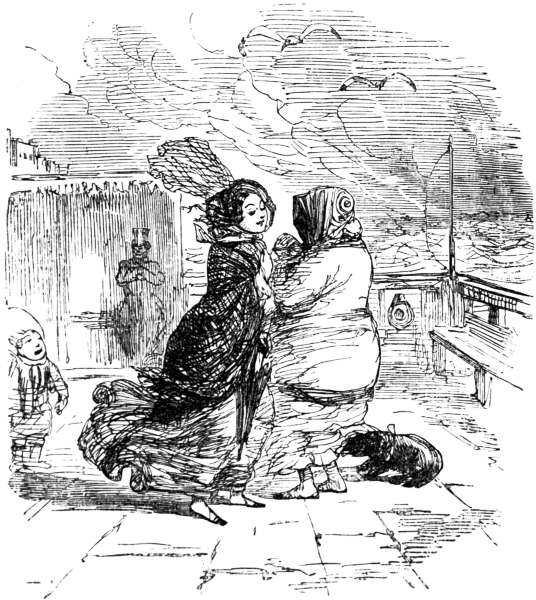
The Belle of the Month November “in Distress off a Lee-shore—Brighton Pier.”
In a paper headed “Hotels,” Mr. Smith expatiates somewhat tediously on the “old-established house” of the “old coaching days.” He says “the inmates of the coffee-room were mostly commercial travellers.” Those gentlemen may have been permitted to use the coffee-room; but my recollection of such places tells me that the commercials always had a room of their own, specially provided for them.
The writer goes on to tell us that “the commercial gents,” on the occasion of his discovery of them in the coffee-room, “pulled off their boots—not a very delicate performance—before everybody; and then, after sitting over the fire, and drinking hot brown brandy and water until they were nearly at red heat, ordered ‘a pan of coals,’ and went to bed.”
Yes; and provided an excellent subject for Leech, worthy of being reproduced here, or anywhere, if only for that inimitable old chambermaid, who has lighted commercial gents to bed any time these forty years.
Judging from the twist of the commercial’s necktie as he follows, or rather staggers, after the ancient maid, the brown brandy has done its work; and it is ten to one against his carrying that box of patterns safely upstairs.
One boot is successfully removed from commercial number two, and it will evidently not be the fault of the man who is struggling with the other if it does not follow suit.
Let the observer note the marked difference in character in all these figures, as well as the skill and truth with which the details in the room are rendered.
In 1851 Bloomerism was in full bloom, or rather the attempts of few foolish people to make it prevail amongst us were so persistent as to bring upon them attacks by pen and pencil.
As I have already drawn attention to the craze, and to some examples of the way Leech dealt with it, I should have made no further allusion to the subject had I not found in the pages of the Month drawings of such charm that, in justice to the magazine and my readers, I felt I must notice them.
First, then, we have a Bloomer whip “tooling” her friends down to the races. If Bloomerism prevailed, this is the sight that Epsom might have seen in the year 1851, to say nothing of equestrian bloomers of whose horsewomanship Leech shows us examples.
I think in my last selection from the Month I might claim for myself a position resembling that of the pyrotechnic artist whose display of fireworks culminates in a glorious blaze in the last scene of his entertainment, if I were permitted to introduce it.
My firework takes the form of a bouquet of young ladies at some “ancestral home” in the country, who have just received a box of books from London—perhaps from Mudie. What a bevy of beauties!—two of them already absorbed in the last new novel, while another makes off with an armful of treasures.
When I say that this drawing—whether we regard it as a composition of figures and of light and shade, or as an example of Leech’s supreme power over grace of action and beauty—is worthy of admiration for itself, and of our gratitude to the Month for the opportunity of reproducing it, I fear no contradiction.
CHAPTER XII.
MR. ADAMS AND LEECH.
In the pursuit of material for this memoir, I have had the good fortune to make the acquaintance of one of Leech’s earliest and most constant friends, Mr. Charles F. Adams, of Barkway, Hertfordshire. This gentleman is the beau-idéal of a country squire—handsome, hale and hearty, though far past middle age.
The letters I am privileged to publish show the terms on which the friends lived, and prove beyond a doubt that many of the hunting scenes which sparkle so brilliantly and so frequently in the pages of “Life and Character” owe their origin to the opportunities afforded to the artist by his friend.
This long-continued intimacy commenced when the men were both young; and the very first development of Leech’s taste for horses began with his acquaintance with Mr. Adams. It is told of that gentleman that, being the possessor of two horses, and being at that early time employed in business in London during the day, the night served him and Leech for a wild career, Adams driving his horses tandem-fashion far into the country, rousing sleepy toll-keepers and terrifying belated wayfarers, while Leech’s watchful eye noted incidents for future illustration.
That Leech could sing, and sing well, I know, for I have often heard him troll forth in a deep voice his favourite song of “King Death”; but that he had ever performed in public I was unaware till enlightened by Mr. Adams, who told me that it was a favourite and not infrequent prank of these two spirits to disguise themselves in imitation of street-musicians, and, with the assistance of a young fellow named Milburn, as wild as themselves, descend upon the London streets, and by singing glees make “a lot of money.”
“Leech used to go round with the hat,” said Adams; “but we never could make the fellow look common enough. Still, he collected a good deal, though he failed on one occasion; for, on presenting his hat to a bystander, who had been an attentive listener, the man claimed exemption as being in ‘the profession,’ in proof of which he produced a fiddle from behind him.”
Barkway is in the heart of a hunting country, and the meets of the “Puckeridge” frequently took place near Mr. Adams’ house, or at an easy distance from it. The house itself—a large mass of red brick, ivy, gables, and twisted chimneys—is one of those old places which have been enlarged to suit modern convenience without any sacrifice of the original design and quaint character.
“Ah,” said my host, as he showed me into his dining-room, “what happy times we have had in this room, when Leech, Millais, Lemon—editor of Punch, you know, long ago—Tenniel, and others, found themselves round that table!”
The following letters, with their too few characteristic sketches, prove the affectionate intimacy between Leech and his friend.
“To Charles F. Adams, Esq.
“August 9, 1847.
“My dear Charley,
“You will be glad to hear that I have got a little daughter, and that both mother and child are doing well. Mrs. Leech was taken ill, unfortunately, at the end of our trip to Liverpool—where, as perhaps you are aware, Dickens and some of us had been acting for Leigh Hunt’s benefit—and she was confined at the Victoria Hotel, Euston Square, where she is now. I thought you would like to hear the news, so send off these few lines. Give my kindest regards to Mrs. Adams, and believe me, old boy,
“Yours faithfully,
“John Leech.”
In a letter written to Mr. Adams a week later, Leech recommends a young gentleman to the care of his friend, in the hope that if Mr. Adams has “the opportunity, he will give the applicant something to do in his profession.” The letter closes by this announcement:
“You will be glad to hear, I am sure, that Mrs. Leech, and my daughter! are both ‘going on’ famously.
“Ever, my dear Charley,
“Yours faithfully,
“John Leech.
“Given up hunting? Not a bit of it.”
“January —, 1847.
“My dear Charley,
“Mark (Lemon) and I were talking only the other day about beating up your quarters towards the end of this month; and, with your permission, if the frost goes, we intend to do so. We thought of riding down—I on the old mare; and he on a ‘seven-and-sixpenny.’...
“Is there anything in the shape of a good cob that could hunt if wanted down in your parts? Possibly I could get rid of the mare in the way of a chop. I have been riding a nearly thoroughbred mare for the last week on trial. A very nice thing, but too much in this way.
“I want something more of this kind—a good one to go, and pleasant to ride.
“Yours ever faithfully,
“J. L.”
“April 17, 1848.
“My dear Charley,
“.... Old Mark and I were special constables on Monday last. You would have laughed to see us on duty, trying the area gates, etc., Mark continually finding excuses for taking a small glass of ale or brandy and water. Policeman’s duty is no joke. I had to patrol about from ten at night till one in the morning, and heartily sick of it I was. It was only my loyalty and extreme love of peace and order that made me stand it....
“Ever yours faithfully,
“John Leech.”
My elderly readers will bear in mind April 10, 1848, and the monster petition of the Chartists, which they were not allowed to present to Parliament in the threatening form they had arranged, with other alarming signs of that troubled time—the flight of Louis Philippe, Continental thrones tottering, and the rest of it.
In his correspondence with Mr. Adams, Leech constantly reminds his friend of his objection to high-spirited horses. Under date February 18, 1849, he asks Mr. Adams if he can hire “an ’unter from Ware.”
“I should prefer,” he adds, “something like the old brown horse Mark had last year. If he comes, of course he must have the same nag he had when he was at Barkway; but, mind, I won’t have a beast that pulls, or bolts, or any nonsense of the kind. I come out for pleasure, and not to be worried. Tell Mrs. Adams I shall not be half such an objectionable visitor as I have been heretofore, seeing that I have left off SMOKING!...
“My very kind regards to Mrs. Adams, your little ones, and my good friends in your neighbourhood.
“Believe me, old fellow,
“Yours ever faithfully,
“John Leech.”
“February 7, 1850.
“My dear Charley,
“I am longing to see you, and have a ride across country with you. Do you think I could have the horse Mark Lemon had when he was down at Barkway? Or if I couldn’t have that one, do you know of any other that would be equally TEMPERATE and WELL-BEHAVED? I have no horse at present. The last I had came down; and I am rather particular in consequence.
“Give me a line, old fellow, and let me know when the hounds meet near you....
“Yours faithfully,
“John Leech.”
One of Mr. Adams’ daughters, Charlotte, surnamed Chatty—then a small child, now a lady whose age is borne so well as to make it difficult to believe that she lived so long ago as 1850—whose acquaintance I had the pleasure of making the other day, told me of her frequent visits to the Leeches, and of the never-ceasing care and tenderness of Leech.
In a letter from Broadstairs, written in the autumn of 1850 to Mr. Adams, Leech says:
“You will be glad to hear that Chatty is as well as possible, and is now going to have a long day’s work (!) on the sands.”
Again, after a good deal of horsy talk:
“Mrs. Leech and Chatty with her will return for good to Notting Hill on Saturday, when we shall be glad to have her with us as long as you can spare her. Apropos of dear Chatty, I am sure her mamma will be glad to hear that she has been uninterruptedly cheerful and well, and has certainly proved herself one of the best-tempered, best-hearted little creatures possible. She desires me to send you all her best love and kisses....
“Ever faithfully,
“J. L.”
“31, Notting Hill Terrace, “February 18, 1852.
“My dear Charley,
“It will give me the greatest pleasure to come and see you. Mark (Lemon) says he will accompany me at the end of this month. Will that suit Mrs. Adams? I want much to SEE some hunting, as I want some materials for the work I am illustrating—indeed, I was going to propose a run down to you myself. Will you let us know when the hounds meet near you? Is the horse I had before still alive, I wonder? or could you, if I came, get me a horse ‘in every way suitable for a timid, elderly gentleman’?
*****
“I was very glad to hear from you, old boy. In great haste, but with our united best regards to Mrs. Adams and yourself.
“Believe me,
“Ever yours faithfully,
“John Leech.
“C. F. Adams, Esq.”
“Punch Office, 85, Fleet Street, “Saturday, February 28, 1852.
“My dear Charley,
“‘The change in the administration’ so upset our arrangements that I could not settle what day to come down to you. I propose now to come down to-morrow (Sunday) evening, so if you can get me a rocking-horse, or a clothes-horse, or any horse excessively quiet and accommodating, I will go out with you on Monday. Mark, having an appointment early on Monday with ‘her Majesty,’ or somebody, will come on Tuesday, to hunt on Wednesday, and back again on Thursday morning. All this, of course, if it suits your convenience. At any rate, I will come to-morrow, and then if there is any difficulty, we can send up to town. With kindest regards to Mrs. Adams,
“Believe me always,
“Yours faithfully,
“John Leech.”
“31, Notting Hill Terrace, “Wednesday, March 17, 1852.
“My dear Charley,
“I had almost made up my mind to come down on Friday evening to hunt on Saturday; but it would suit me infinitely better to come at the end of the week following, as I am just now in the agonies of my periodical work; so let me know when the meets are, and in the meantime I will peg away and get my business done so as to have a comfortable day with you. If I came on Friday, I should have to work day and night before I went, and come back directly to work day and night again, which is not a pleasant state of things; I hope, therefore, that we shall be able to see the hounds next week. I don’t think Lemon would be able to come, as he is busy moving; but I will ask him. I will make you the sketch of the house, or of anything else you like, when I come.
“Believe me,
“Ever yours faithfully,
“John Leech.
“C. F. Adams, Esq.
“Look in this week’s Punch for a sketch on the Royston Hills.”
“31, Notting Hill Terrace, “Wednesday, July 7, 1852.
“My dear Charley,
“I congratulate both of you most heartily and cordially. Mrs. Adams I hope is well, and will keep so, I trust. I will take upon myself to say that I don’t know any man more thoroughly capable of understanding and enjoying domestic happiness than yourself; and, moreover, I don’t know any man who more thoroughly deserves to have it. You wish it had been a boy, do you? Well, never mind; the son and heir will make his appearance in good time, I dare say. For my part, my unhappy experience makes me love little girls.
*****
“Pray give my kindest regards to Mrs. Adams, and my love to Chatty, who is to kiss the baby for me, and
“Believe me, my dear Charley,
“Always yours faithfully,
“John Leech.
“C. F. Adams, Esq.”
“Barlow, Derbyshire, “July 31, 1852.
“My dear Charley,
“You will see from the above address that I am still rusticating. I expect to be in rooms soon after the 12th of August, and then, after I have done my month’s work, I am your man. You say where ... Don’t make yourself uncomfortable about the quantity of sport; I shall be quite satisfied with what you offer me....
“Yours always faithfully,
“John Leech.”
Here follows an admirable sketch of Mr. Adams waking up Leech with, “Now, Jack, my boy! There’s no time to lose; we’ve ten miles to go to cover.”
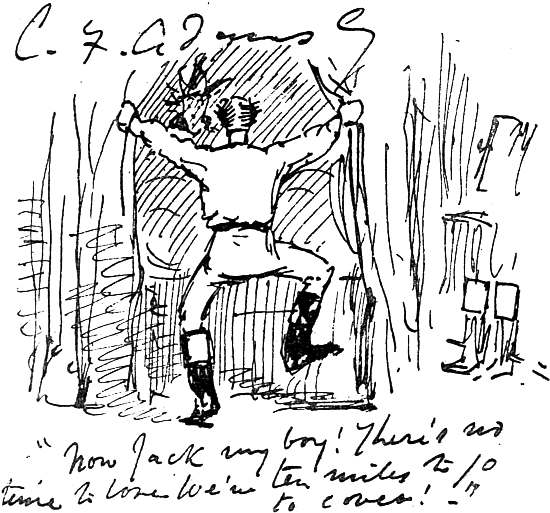
“Tuesday, December 14, 1852.
“My dear Charley Boy,
“Hip! hip! hurrah! The almanack is finished, and now for a day with the Puckeridge.
“I shall come down if you will take me in on Friday evening, to hunt on Saturday and Monday, I hope. Mark talked of coming. I wish he would. He says he should not ride, but that’s all nonsense. Do you think Pattison has got a horse that would carry him? Oh, I have had a rare benefit of work! I have been positively at it ever since I saw you. I want freshening up, I assure you.... Lots of fresh work, old fellow, so I think I may manage a real horse soon.
*****
“With kindest regards.
“Ever faithfully yours,
“John Leech.”
“Notting Hill Terrace, “January 26, 1853.
“My dear Charley,
“If you could ride my horse to-morrow (Thursday), pray do; it would save your own, and do her good. And the meet is close to you—Langley Green. I should have written before, but I have been harassed with work beyond measure. And as it is, the first number of ‘Handley Cross’ cannot come out until March. Mind you have the mare well worked, there’s a good fellow, as I don’t want, like our friend Briggs, to find her disagreeably fresh.
*****
“Believe me always yours faithfully,
“John Leech.
“C. F. Adams, Esq.”
“Saturday, February 26, 1853.
“My dear Charley,
“I suppose the frost has departed in the country, and that you have now what is called ‘open weather.’ It is very disagreeable here—wet, cold, and boisterous.
“However, if you can spare time (after riding your own, of course), I wish you would give the mare a benefit. I expect she will otherwise be a great deal too much for me.
*****
“I am, my dear Charley,
“Yours faithfully,
“John Leech.
“C. F. Adams, Esq.”
“32, Brunswick Square, “Saturday, January 21, 1854.
“My dear Charley,
“Thank you for your note. I can’t come down to-morrow, but I hope after next week to make up for lost time. I have got through some work that has been fidgeting me. I shall have a little more leisure. The meet on Monday is Dassett’s, I see, so pray give it the mare; I have been so queer myself that I shall want her particularly ‘tranquil.’ I have sacrificed the moustaches for fear of frightening the horses in the field. They were getting too tremendous.
“If, if I can get away next week at all, depend upon it I will, for I want fresh air and a little horse exercise.
“With kindest regards, old fellow,
“Believe me always yours faithfully,
“John Leech.
“C. F. Adams, Esq.”
“Saturday, December 22, 1855.
“My dear Charley,
“How is the country? I suppose no hunting as yet, for I have not received any card. The weather here to-day is mild and wet. I am working away in the hope of getting a day or two by-and-by comfortably. In the meantime, if there is anything going on, give my horse a turn across country, that’s a good fellow.
“With kindest regards, believe me,
“Yours faithfully,
“J. L.
“If you can’t spare time to hunt the mare, would it not be a good thing to send her to Patmore, and make him ride her? But do you attend to her if you can manage it.”
“8, St. Nicholas Cliff, Scarbro’, “August 30, 1858.
“My dear Charley,
“Your note was forwarded here, and I only found it on my return from Ireland, where I have been for the last three weeks. The consequence is that I am, of course, in rather a muddle with my work, and I am afraid I must forego the pleasure of shooting with you—at any rate, for the early part of the season; so pray do not deprive other friends of sport on my account. I shall hope to have a day or two with you before the season is over. I am not a very greedy sportsman, you know, and as long as I get a good walk am pretty well satisfied. I am sorry you have been so unwell—you should really give yourself a holiday. The bow should be unstrung sometimes. I know I find it must. I wish you could have seen me catch a salmon in Ireland—a regular salmon! When I say catch, I should say hook, rather, for he was too much for me, and after ten minutes’ struggle he bolted with my tackle. It was really a tremendous sensation....
“Believe me always,
“Yours faithfully,
“John Leech.
“C. F. Adams, Esq.”
“White Horse, Baldock, “Friday evening, ——, 1858.
“My dear Charley,
*****
“For the present I have arranged with Little to make this place my headquarters, it is so handy to the train, and I can come so much quicker and later to Hitchin. The slow railway journeys take it out of me, so that my pleasure is almost destroyed by the fatigue of travelling and bother to get off. I hope, nevertheless, that we shall have many evenings together to talk over the tremendous runs that we hope to have. I have bought a horse and brought it down here. I hope you will be out to-morrow to see it. I like it very much; it is a most excellent hackney, and sufficiently good-looking, although not perfect, I suppose; and it is represented to me as being a temperate hunter in addition to his other qualities. Well, we shall see. The black mare I shall send to Tattersall’s next week. She was as fresh as could be last Saturday, and I was quite glad I had not sold her; but, alas! she was as lame in the afternoon as possible, and next morning was a pretty spectacle! She would not do at all. So much for horseflesh.
“With kindest regards,
“Yours always,
“J. L.”
“32, Brunswick Square, W.C., “November 20, 1862.
“My dear Charley,
“If you ever have the time—which I never have—I should feel so glad if you would go some day and see how the ‘party’ at Kensington has done his work. I suppose ‘that little form’ of paying the bill must very soon be gone through, and I should like to know from a competent authority that the work has been well and properly done.
“How about the hunting? I am continually tormented here by noble sportsmen going by my window in full fig.
“Yours always,
“J. L.”
“6, The Terrace, Kensington, “November 27, 1862.
“My dear Charley,
“I am obliged to go to St. Leonards to-night, but I should be very glad if you would to-morrow, Friday (as you propose), look at my new house. In the corner of one of the new rooms I see it looks a little damp, although they considered it dry before they papered. I must say I am pleased with the new residence, and I think by degrees I shall be able to make it pretty comfortable. We shall hardly get in here, I expect, much before Christmas. There is yet so much to do. I shall be very glad of any hints about improvements that may occur to you.
“Kind regards, and believe me,
“Always yours,
“J. L.”
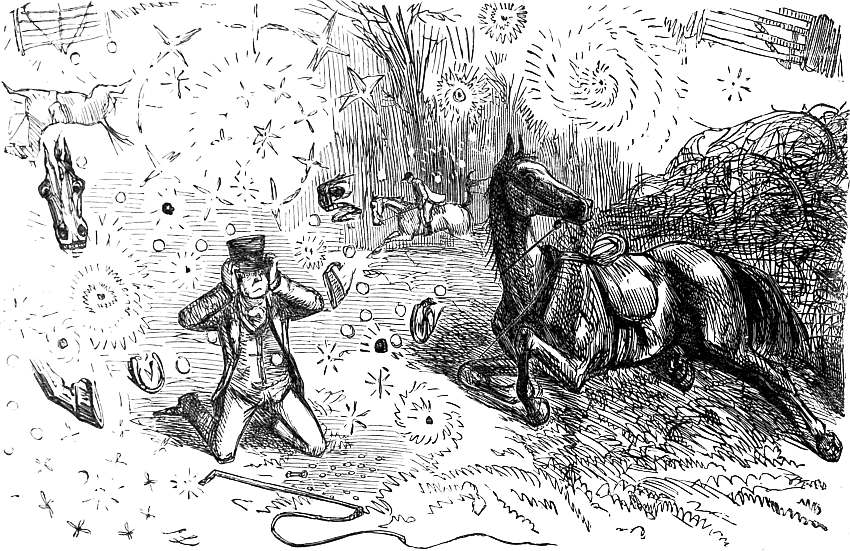
There is amongst the pictures of “Life and Character” a drawing of a sportsman who has been thrown from his horse. He has fallen upon his head, and as he raises it, stunned and bewildered, and but half conscious, the sensations that must have possessed him are realized for us in a manner so marvellous, so wonderful in its originality and truth, as to convince one that the accident must have happened to the man who drew the picture; and this was the case, for the fallen man was Leech himself, says Mr. Adams, who in charging a fence was thrown, his horse falling at the same time. If I had been told that the sensations inevitable under the circumstances were required to be reproduced by pencil and paper, I should have said such a feat was beyond the reach of art; but there they are! As the prostrate man looks up, he sees sparks of fire, horse’s head, legs, hoofs mingled together in a whirl of confusion round his prostrate figure.
No doubt the work he undertook for Bell’s Life in London, a long-established and long-discontinued paper, in which sport of all kinds was the most prominent feature—and which occupied much of Leech’s time in his youthful days—contributed to the creation of a taste and love for field sports that always distinguished him. Quite a band of comic artists, including Cruikshank, Kenny Meadows, “Phiz,” Seymour, and Leech, contributed sketches illustrative of a variety of subjects by a variety of authors; Leech’s work being easily distinguishable from that of his brethren of the pencil.
CHAPTER XIII.
“COMIC GRAMMAR” AND “COMIC HISTORY.”
The friendship, begun in their student-days at St. Bartholomew’s, between Leech and Percival Leigh flourished in renewed strength by the discovery of similarity of taste—Leigh unable to draw, but possessing a truly humorous pen; so the friends “laid their heads together,” the result being the production of the “Comic Latin Grammar,” letter-press by Leigh, illustrations by Leech. The first intention of the authors was that this should be a mere skit, a trifling brochure, consisting of a few pages; but, as so often happens, the work grew under their hands, and when published in 1840 it had assumed somewhat formidable proportions, and was followed by a work of similar character, with the title of “The Comic English Grammar.”
The “Comic English Grammar” was a work full of pleasant humour, charmingly illustrated by Leech “with upwards of fifty characteristic woodcuts.” It is curious to observe in these drawings the contrast that they afford to the artist’s later and more perfect work. There is a timidity, and what we call a hardness, from which the sketches in “Pictures of Life and Character” are entirely free; the general drawing, too, is faulty, but the humour and character are all there.
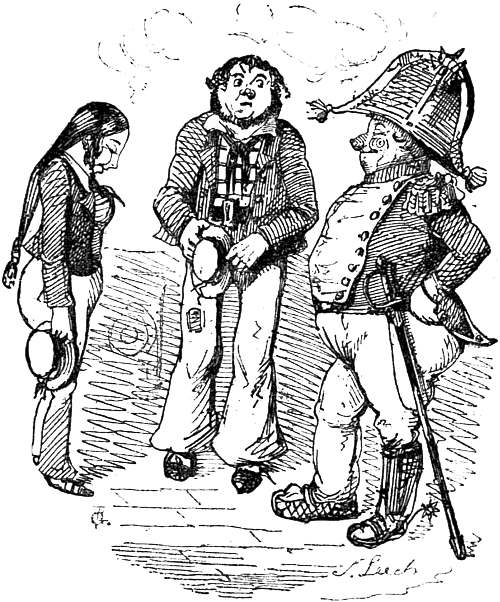
The first illustration, given above, is from a ballad called “Billy Taylor,” popular in my young days, in which Billy’s true love—with the reluctance to part from him common to persons suffering from that passion—disguises herself as a man before the mast, and shares the dangers of the sea with her sailor-lover:
“Ven as the Captain comed for to hear on’t, Wery much applauded vot she’d done.”
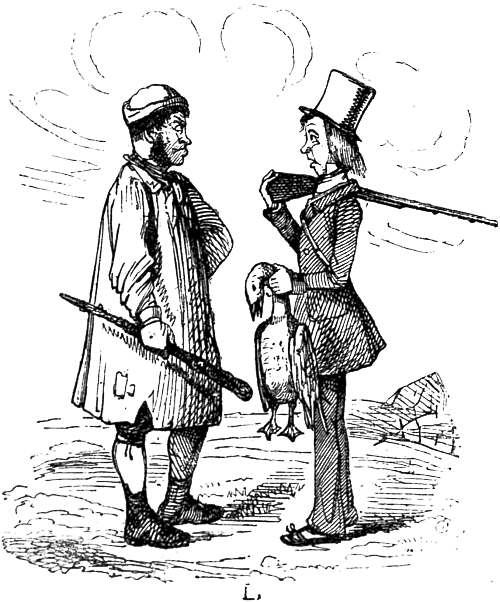
The verb “applauded” has here no nominative case, whereas it ought to have been governed by the pronoun “he.” “He very much applauded,” etc., says the writer of the “Comic Grammar” for our instruction. The second example, given above, seems to me capital fooling, and an excellent proof of the necessity for care in punctuation and accent.
“Imagine,” says the writer, “an actor commencing Hamlet’s famous soliloquy thus:
“‘To be or not to be; that is. The question,’ etc.
Or saying, in the person of Duncan in ‘Macbeth’:
“‘This castle hath a pleasant seat, the air.’
Or, as the usurper himself, exclaiming:
“‘The devil damn thee black, thou cream-faced loon! Where got’s thou that goose? Look!’”
Here we have the fault of hardness that I speak of, and something of feeble drawing, but the humour is perfect.
After the publication of the “Comic Grammar,” written by Gilbert à Beckett, one of the Punch staff, a somewhat similar experiment upon the public and on a larger scale was tried by the same author in the issue of a “Comic History of England.” This venture was warmly opposed at its inception by Jerrold, whose wrath at the idea of burlesquing historical personages was expressed with vehemence. Gilbert à Beckett persisted, however, and the history appeared, with over three hundred illustrations on wood and steel by John Leech. The book is, as might be expected, very light reading, containing many puns and much play upon words. Leech’s work seems to me to be slight, hurried, and even careless, compared with that of his later time; but the spirit of rollicking fun with which grave historical incidents are treated, and the humorous satire that the principal personages receive at the hands of the illustrator, make the “Comic History of England” amusing enough. The following extract, with the drawing that illustrates it, will show the truth of my estimate of both.
“A story is told of a certain Fair Rosamond, and, though there is no doubt of its being a story from beginning to end, it is impossible to pass it over in English history. Henry, it was alleged, was enamoured of a certain Miss Clifford—if she can be called a certain Miss Clifford, when she was really a very doubtful character. She was the daughter of a baron on the banks of the Wye, when, without a why or a wherefore, the King took her away, and transplanted the Flower of Hereford, as she well deserved to be called, to the Bower of Woodstock. In this bower he constructed a labyrinth something like the Maze at Rosherville, and as there was no man stationed on an elevation in the centre to direct the sovereign which way to go, nor exclaim, ‘Right, if you please!’ ‘Straight on!’ ‘You’re right now, sir!’ ‘Left!’ ‘Right again!’ etc., etc., his Majesty had adopted the plan of dragging one of Rosamond’s reels of silk along with him when he left the spot, so that it formed a guide for him on his way back again. This tale of silk is indeed a most precious piece of entanglement, but it was perhaps necessary for the winding up of the story. While we cannot receive it as part of the thread of history, we accept it as a means of accounting for Eleanor’s having got a clue to the retreat of Rosamond.
“The Queen, hearing of the silk, resolved naturally enough to unravel it. She accordingly started for Woodstock one afternoon, and, suspecting something wrong, took a large bowl of poison in one hand and a stout dagger in the other. Having found Fair Rosamond, she held the poniard to the heart and the bowl to the lips of that unfortunate young person, who, it is said, preferred the black draught to the steel medicine.”
Later on in the history we have another good example of Leech’s humour. King Edward, having subdued the Welsh, “endeavoured to propitiate his newly acquired subjects by becoming a resident in the conquered country. His wife Eleanor gave birth to a son in the castle of Caernarvon, and he availed himself of the circumstance to introduce the infant as a native production, giving him the title of Prince of Wales, which has ever since been held by the eldest son of the British sovereign.”
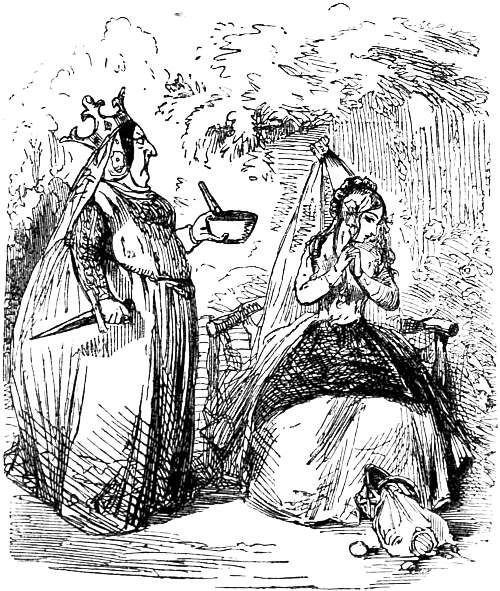
Queen Eleanor and Fair Rosamond.
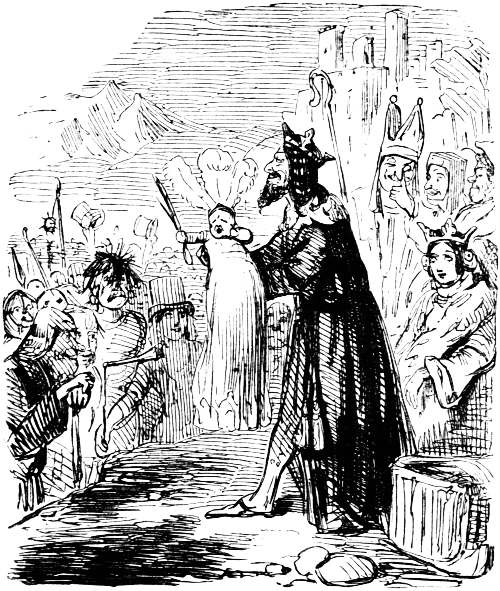
King Edward introducing his Son as Prince of Wales to his Newly-acquired Subjects.
A well-known historical scene is parodied as follows: Henry IV. being ill, “the Prince of Wales was sitting up with him in the temporary capacity of nurse,” says Mr. à Becket. “The son, however, seemed rather to be waiting for his father’s death than hoping for the prolongation of his life; and the King having gone off in a fit, the Prince, instead of calling for assistance or giving any aid himself, heartlessly took that opportunity to see how he should look in the crown, which always hung on a peg in the royal bedchamber. Young Henry was figuring away before a cheval glass with the regal bauble on his head, and was exclaiming, ‘Just the thing, upon my honour!’ when the elder Henry, happening to recover, sat up in bed and saw the conduct of his offspring.
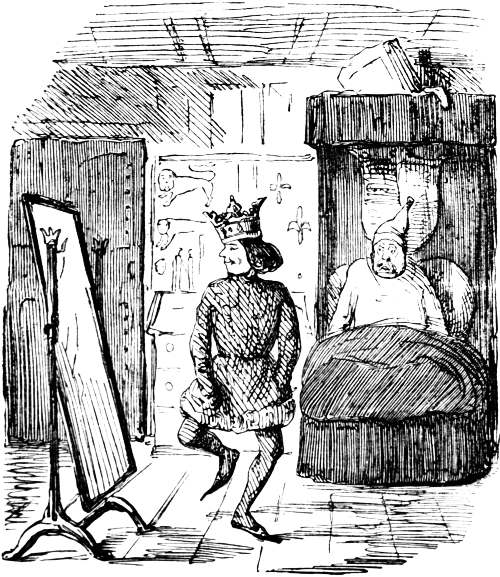
Unseemly Conduct of Henry, Prince of Wales.
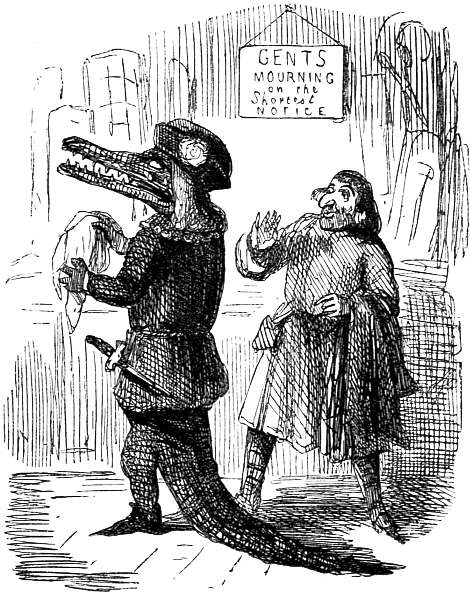
The Duke of Gloucester goes into Mourning for his Little Nephews.
“‘Hallo!’ cried the King, ‘who gave you leave to put that on? I think you might have left it alone till I’ve done with it.’”
The savage and hypocritical character of Richard III. afforded Leech an opportunity for satire in his design of that monarch, when still Duke of Gloucester, in the shape of a crocodile shedding tears for the death of the two Princes in the Tower.
“Richard,” says the chronicler, “by whom the outward decencies of life were very scrupulously observed, in order to make up for the inner deficiencies of his mind, determined to go into mourning for the young Princes, and repaired to the same maison de deuil which he had honoured with his presence on a former occasion when requiring the ‘trappings of woe’ for himself and his retainers on the death of his dear brother.”
With the escape of Mary, Queen of Scots, I must close the extracts from the “Comic History of England.”
“When the Queen was imprisoned at Lochleven, a certain George Douglas,” says the historian, “with the sentimentality peculiar to seventeen, fell sheepishly in love with the handsome Mary. She gave some encouragement to the gawky youth, but rather with a view of getting him to aid her in her escape than out of any regard to the over-sensitive stripling. Going to his brother’s bedroom in the night, the boy took the keys from the basket in which they were deposited, and, letting Mary out, he handed her to a skiff and took her for a row, without thinking of the row his conduct was leading to.”
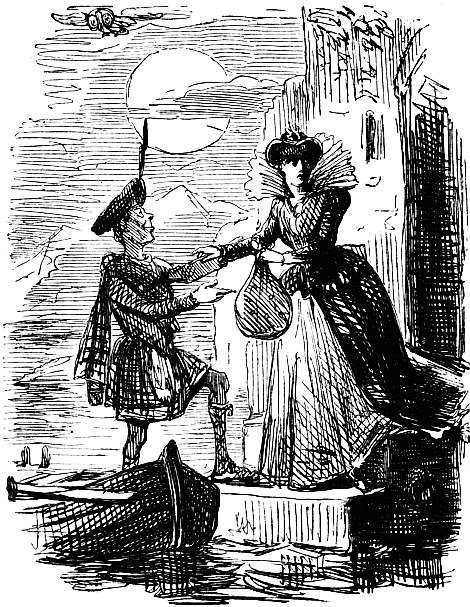
Mary’s Elopement.
A considerable interval of time elapsed between the publication of à Beckett’s “Comic English Grammar” and the same writer’s “Comic History of England,” the former being produced in 1840, and the latter seven years afterwards; but as there is little or no appreciable difference between the two works, either as regards the literary or artistic merit, I have thought it well to introduce them in this place.
These efforts show but one side of Leech’s many-sided power. It was in “The Children of the Mobility,” a satire on a production just then published, in which the children of the nobility were put before the world in all the splendour of their aristocratic surroundings, that Leech’s genius had full play, the little Duke affording an instructive contrast to the street arab, and the shivering, half-naked beggar-girl becoming infinitely pathetic in her rags. This work was executed in lithography, consisting of seven prints; and though, as works of art, they bear no comparison to the wood-drawings of a later time—they are not even so good as the “Fly-Leaves” published at the Punch Office later on—still, comparatively imperfectly as they are rendered, they show the artist’s intense sympathy with suffering childhood, as well as enjoyment in the games and “larks” by which the sufferings are for a time at least forgotten.
I now approach the period when the establishment of a comic newspaper was destined to afford Leech opportunities for the display of his powers, opportunities of which he availed himself with a prodigality almost as marvellous as the powers.
END OF VOL. I.
BILLING AND SONS, PRINTERS, GUILDFORD. J. D. & Co.