Front matter (continued 2)
Reading edition
I now return to the paper which Mr. Leigh wrote with a view to this memoir.
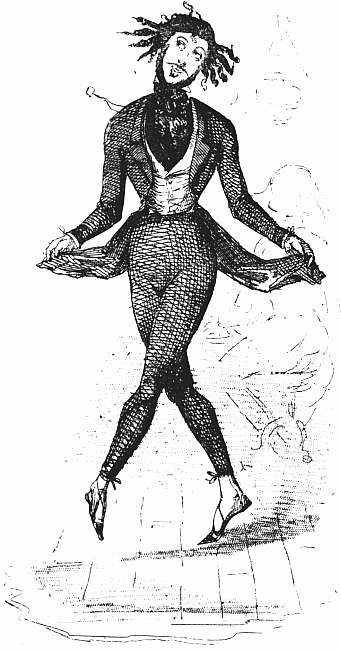
That Leigh and Leech first met as students at St. Bartholomew’s Hospital, I have noted elsewhere; and the details of his apprenticeship to the eccentric surgeon, which Mr. Leigh heard from Leech himself, I have also given, with the exception of one incident of which I was ignorant.
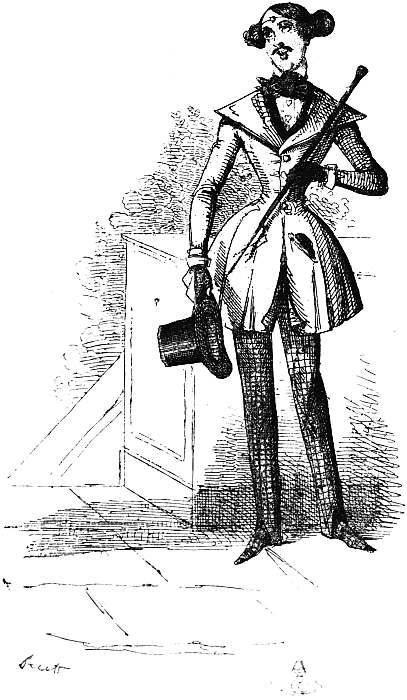
“In his dispensary,” says Mr. Leigh, “the doctor had one drawer amongst his boxes, in which there were pills of gentle efficacy, intended to be served out (they were made, I believe, of bread and soap) to the generality of his customers. This receptacle bore the label of ‘Pil. Hum.,’—abbreviation of humbug—or, as their concoctor used to call them, ‘Humbugeraneous Pills.’ The Dr. Cockle to whom, Mr. Leigh says, Leech went after he left Mr. Whittle, was the son of the inventor of Cockle’s Pills.
“No sooner had he become of age,” continues Mr. Leigh, “than he was induced, in order to meet difficulties for which he was not responsible, to accept an accommodation bill, which the drawer of, when it fell due, failed to supply the means of meeting. Leech was consequently arrested for debt at the suit of this discounter, and lodged in a sponging-house kept by a sheriff’s officer, a Jew, by name (I think) of Levi, in Newman Street. There he remained about a fortnight, supporting himself in the meanwhile by drawing cartoons and caricatures. He lithographed them on stone for Spooner, in the Strand, at a guinea each, a friend having negotiated their sale.
“At last, an advance of money on a projected publication sufficient to discharge the debt having been obtained, he was liberated. But not long after, a second scrape—a repetition of the first—cost him another temporary sojourn with another Jew in another sponging-house in Cursitor Street. This detention, however, lasted but a few days. From that period to the close of his life he remained subject to repeated demands for pecuniary assistance under continued pressure, which, as at the outset, he could not withstand. The deficits he had to defray were always heavy; the last of them, as I understand, a thousand pounds. It cost him very hard work to make it good. Excess of generosity was his greatest failing.”
I have no means of knowing, nor do I desire to know, who the borrowers were to whom Percival Leigh alludes; but his revelations make the fact of Leech having died a comparatively poor man comprehensible enough. If ever man was killed by overwork, Leech was that man, and this must be a painful reflection for those whose incessant demands upon him made it only possible for him to meet them by the incessant exertions which destroyed him.
Mr. Leigh’s paper concludes with the anecdote that follows:
“Leech and Albert Smith worked together very harmoniously as illustrator and writer in several books—‘Ledbury,’ ‘Brinvilliers,’ and many others—and one day when they were leaving Smith’s house together, a street-boy stepped up to them, and scoffing at the inscription on Smith’s large brass door-plate, cried:
“‘Oh yes! Mr. Albert Smith, M.R.C.S., Surgeon-Dentist.’
“‘Good boy!’ said Leech, putting a penny into the boy’s hand; ‘now go and insult somebody else.’”

CHAPTER IV.
MEETING OF MULREADY AND LEECH.
Mr. Mulready, R.A., was commissioned by the authorities to design a postal envelope for general use, a penny stamp affixed insuring free delivery of letters all over England. The design, which should have been of a simple character, was far too ornate and elaborate. At the top Britannia was represented in the act of despatching winged messengers with letters to all parts of the world, and down the sides of the envelope were the recipients of letters which had conveyed heart-breaking news to one side, and good tidings to the other. As a work of art the Mulready envelope has, in my opinion, great merit, but it was ludicrously inappropriate to the purposes for which it was intended. Leech saw and seized the opportunity, with the result appended.
The signature of the bottled leech, so familiar afterwards, is used here as Mulready’s signature, and “thereby hangs a tale,” which, though the burden of it deals with a future time, I venture to introduce in this place.
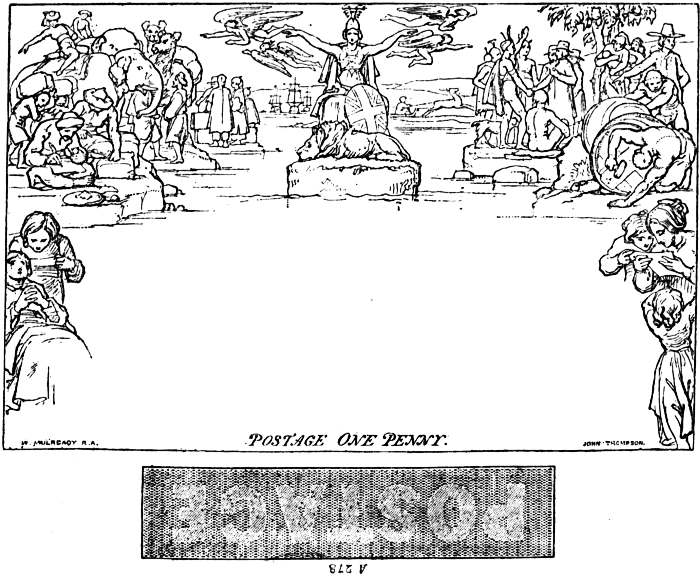
FORES’S COMIC ENVELOPES No. 1
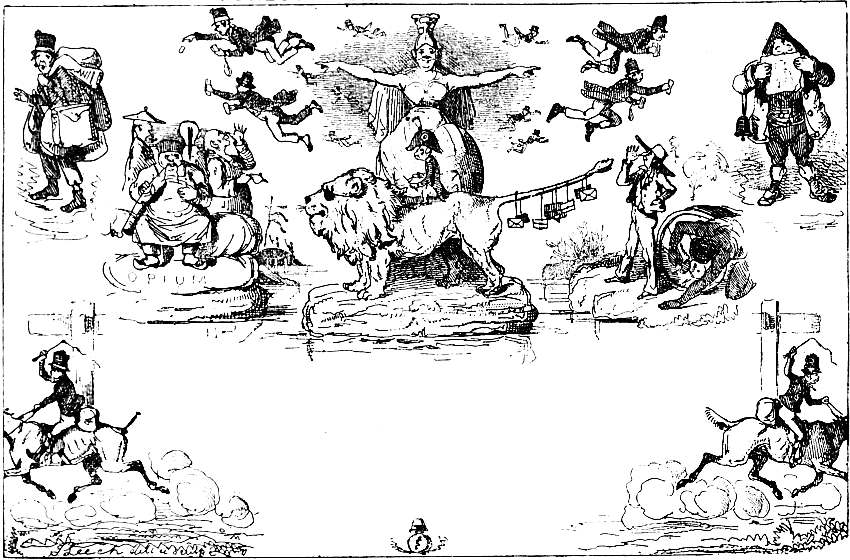
My friend Augustus Egg, R.A., who lived in a charming house in Queen’s Road, Bayswater, was not only well known as an excellent artist, but also as being the Amphitryon whose hospitality was famous, and whose dinners were still more famous by reason of the guests who were wont to surround his table. Where is the hungry man who would not have been enchanted to meet Dickens and Leech, Mark Lemon and John Forster (Dickens’s biographer), Hawkins, Q.C. (now the judge), Landseer, Mulready, Webster, and other artists less famous? Of these dinners I shall have something to say by-and-by; at present I confine myself to one special occasion.
It was on one day during the year 1847 that Egg said to me:
“You know Mulready better than I do; I wish you would go and get him to fix a day to dine here—any day next week will suit me. Leech wants to meet him; and, somehow or other, though both have dined here frequently, they have never met.”
“Good,” said I; “I will do your bidding.”
And on the following Sunday I called upon Mulready.
“Egg will be pleased if you will dine with him any day next week, sir, that you may be disengaged. He expects the usual set—Dickens, Landseer, Leech, and the rest. You have never met Leech, I think; he is very desirous to make your acquaintance.”
“Ah, is he? Well, I don’t care about knowing Leech.”
“Really, sir” (it was always the Johnsonian sir to the old gentleman), said I, when I had recovered from my surprise, “may I ask why you won’t meet Leech?”
“Yes, you may,” said the old painter, “and I will tell you. Of course you remember that unfortunate postal envelope that I designed? Well, Leech caricatured it. You needn’t look so surprised—you don’t think I am such a fool as to mind being caricatured; but I do mind being represented as a blood-sucker! What else can he mean by using that infernal little leech in a bottle in the front of his caricature as my signature? You know well enough, Frith, that I have never asked monstrous prices for my pictures. You fellows get better paid for your work than I ever did, and you wouldn’t like to be called blood-suckers, I expect.”
Mr. Mulready was an Irishman, and rather a peppery one; and I am happy to say that I overcame my disposition to laugh in his face mainly through a feeling of astonishment that my old friend could be ignorant of the ordinary way in which Leech signed his drawings.
“Do you happen to have a number of Punch by you, Mr. Mulready?” said I.
“No; as a languid swell said when he was asked that same question, ‘I am no bookworm; I never see Punch.’”
As I could not give my angry friend ocular proof of his mistake by producing the usual signature to Punch drawings, I set to work to explain how the little leech came into the bottle, and, without much difficulty, convinced my old friend that an insult to him was not intended.
The two artists met; and it was delightful to watch Leech’s handsome face as Mulready himself told of his misconception. First there was a serious, almost pained, expression, which, no doubt, arose in that tender heart from being the innocent cause of pain to another; the serious look passed off, to give place to a smile, which broadened into a roar of laughter. From that moment Leech and Mulready were fast friends.
With an apology for the interruption, I return to my narrative.
Alas! I can well remember the appearance of the “Sketches by Boz,” to be so quickly followed by the “Posthumous Papers of the Pickwick Club.” None but those who witnessed it can conceive the enthusiasm with which that immortal work was received by an eager public, who welcomed each number as it appeared, month after month, with hearty appreciation. Of course, there were carping critics, one of whom is reported to have said the author would “go up like a rocket and come down like a stick.” That prophet, a man of much literary ability, drank himself into a debtors’ prison, where, I was told, he died of delirium tremens.
There is, I think, a vein of melancholy unusually developed in the nature of almost all humorists. As an instance, I may give the actor Liston, whose humour on the stage was to me unparalleled; off it, he was gloom personified. Gillray, the caricaturist, died melancholy mad; and poor Seymour, the first illustrator of “Pickwick,” committed suicide. I may remark in this place the surprise with which I heard Leech say that he could see no fun in any of Seymour’s sketches.
In a walk that we took together, I tried to convert him by naming several examples of what appeared to me humorous work.
“No,” said Leech; “the only drawing I ever saw by Seymour that appeared funny to me was one in which two cockneys were represented out shooting. They are about to load their guns, when one says to the other:
“‘I say, which do you put in first—powder or shot?’
“‘Why, powder, to be sure,’ said his friend.
“‘Do you?’ was the reply. ‘Then I don’t!’”
I can vividly recall the shock occasioned by Seymour’s death. He was fairly prosperous, I believe. His engagement to illustrate “Pickwick” was a lucrative one, and he was much employed in other work. In spite of all these advantages, the humorist’s melancholy was fatal to him.
I was present at the banquet at the Royal Academy when Thackeray, in returning thanks for literature—Dickens being present—told us how, on finding there was a vacancy for an illustrator of “Pickwick,” he took a parcel of drawings to the author and applied for the place. From my own knowledge of Thackeray’s limited powers as an artist, I should have been sure of the failure of his application. Very different would have been the fate of Leech, who was also anxious to supply Seymour’s place; but he was too late, for Dickens had already chosen Hablot K. Browne, who, under the sobriquet of “Phiz,” worked in harmony with his author for very many years. There was no doubt a disposition on the part of “Phiz” to exaggeration in his illustration of Dickens’ characters (already fully charged, so to speak, by their author), sometimes to the verge of caricature, and even beyond it; this fault Leech would have avoided, as his exquisite etchings in Dickens’ Christmas books fully prove.
CHAPTER V.
“THE PHYSIOLOGY OF EVENING PARTIES,” BY ALBERT SMITH.
I have already spoken of the extreme difficulty of collecting material for this book, and to difficulty must be added the expense which is incurred by my publisher. I bear the latter affliction with the equanimity common to those who escape it; indeed, there is a kind of satisfaction in finding that books which are perfectly worthless as literary productions are so highly valued on account of the prints which illustrate them. I venture to give an instance in a very little book called “The Physiology of Evening Parties,” written by Albert Smith. My reader will be able to judge by the extracts given in explanation of the drawings, of the merits of Mr. Smith’s part in the “Physiology.” This work, published at 2s. 6d. when clean and new, costs 18s. 6d. when well “worn on the edge of time,” yellow, dirty, and unbound. The “Physiology” first saw the light in 1840. I plead again for forgiveness for chronological shortcomings, which my difficulties make unavoidable.
My first illustration represents a mamma and her two daughters in the serious business of selecting guests for an evening party.
“It is evening,” says Mr. Albert Smith; “mamma and her two daughters are seated at a table arranging the names of the visitors upon the back of an old letter, having turned out the dusty record of the card-basket before them in order that no one of importance may be forgotten.
“Ellen (loc.): ‘I am sure I don’t see why we should invite the Harveys, mamma. They have been here twice, and never asked us back again.’
“Fanny: ‘And we shall see those dreadful silver poplins again; they must be intimately acquainted with the cane-work of all the rout-seats in London.’
“Ellen: ‘And William Harvey is so exceedingly disagreeable; he always looks at the ciphers on the plate to see if it is borrowed or not.’
“Fanny: ‘And last year he declared the pine-apple ice was full of little square pieces of raw potato; and when Mr. Edwards broke a tumbler at supper he told him “not to mind, for they were only tenpence apiece in Tottenham Court Road.” The low wretch! he thought he had made a capital joke.’
“Mamma: ‘Well, my dears, I think your papa will be annoyed if they are left out; but never mind him—we won’t ask them.’”
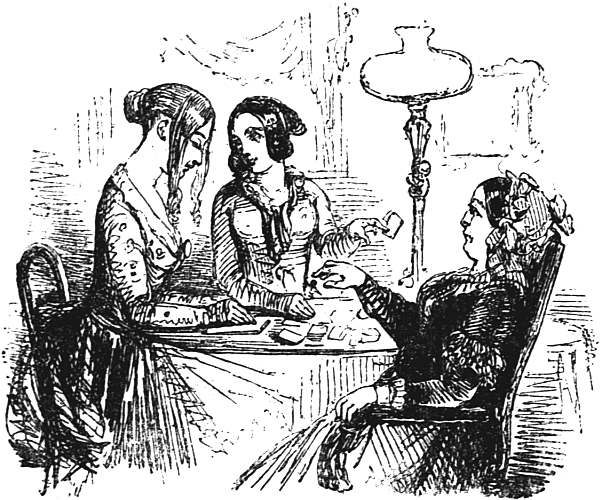
“Mamma and the Girls.”
The discussion respecting the guests goes on, opinion as to eligibility widely differing. Mamma proposes Mr. and Mrs. Howard and the four girls, to which Miss Ellen says:
“All dressed alike, and standing up in every quadrille. I declare I will get George Conway to put an ice in Harriet’s chair for her to sit down upon, in revenge for her waltzing last year, when she brushed down the Joan of Arc, and knocked its head off.”
This refined conversation continues till Miss Ellen speaks of her brother’s disposition to interfere with the invitation-list; she says:
“‘We must tell Tom not to overdo us so much with his own friends. I declare last year I did not know half the young men in the room; and it was so very awkward when you had to introduce them.’
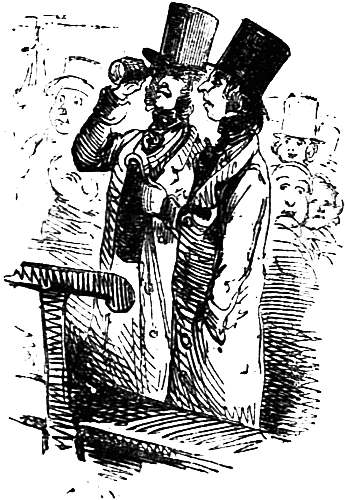
“Two Rude Young Men.”
“Fanny: ‘And they were not nice persons. Two of them were in the pit of the Lyceum the next night, and, seeing us in Mr. Arnold’s box, would stare us out of countenance. With a single glass, too!’”
“And in this style,” says our author, “the list is arranged, the hostess gradually becoming a prey to isinglass and acute mental inquietude, which gradually increases as the day draws nearer, until upon the morning of its arrival her very brain is almost turned to blancmange from the intensity of her anxiety!”
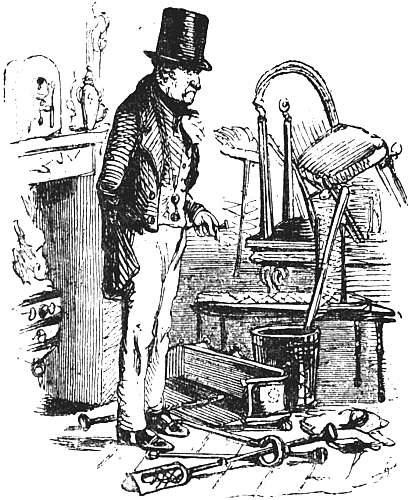
“The Head of the House.”
The whole house is, of course, turned topsy-turvy; and Leech gives us a picture of the master of the mansion surrounded by some of the consequences of giving an evening party.
“This state of things,” says the chronicler, “much delights the olive-branches of the family, who, left entirely alone, and quite overlooked in the general mêlée, divert themselves by poking their little puddy fingers into the creams, and scooping out the insides of divers patties with a doll’s leg,” etc., etc.
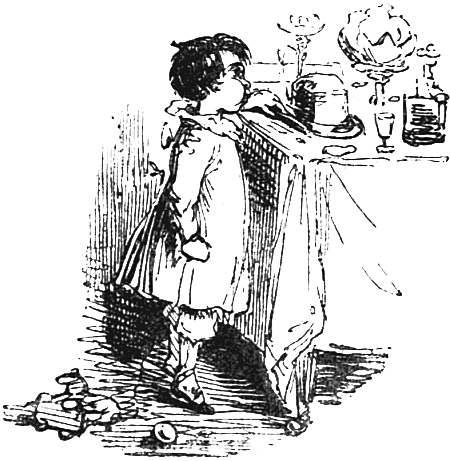
“An Olive-Branch.”
The ball begins under sundry difficulties. A most desirable person, “one for whom the party was almost given, sends a melancholy statement of the very acute attack of influenza under which they are labouring,” which they extremely regret will prevent their accepting, etc. Then one of the intended belles of the evening is obliged to go suddenly into the country, to see a sick aunt, but “she sends her two brothers—tall, gangling, awkward young men who wear pumps and long black stocks, and throw their legs about when they are dancing everywhere but over their shoulders,” etc., etc., says the author. Here is what Leech thinks of the two brothers.
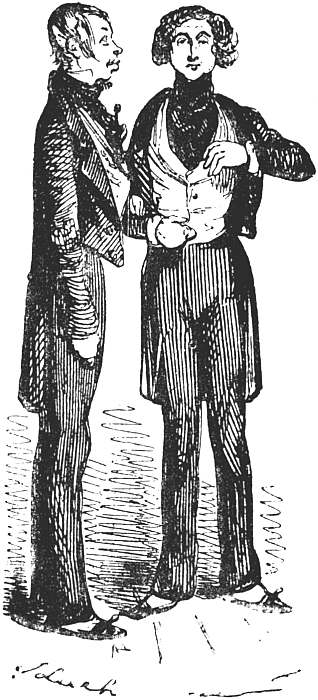
“Two ‘Gangling’ Young Men.”
I have never met with the word “gangling” before; is it an invention of Mr. Albert Smith’s? I can speak to the truth of the dress of these long brothers, for I who write have worn the long black stock and the peculiarly cut coat and waistcoats at many an evening party.
The numerous illustrations of “The Physiology” are such perfect examples of Leech’s earlier work, and in themselves so good, that I am induced to produce several more of them. I don’t know whether the fascinating person under the hands of the hair-dresser is Miss Ellen or Miss Fanny. I confess I can scarcely believe she would talk like either of them; happy barber! perfect you are as you ply your vocation; and in that vocation—insomuch as you have that sweet creature to contemplate—to be envied indeed!
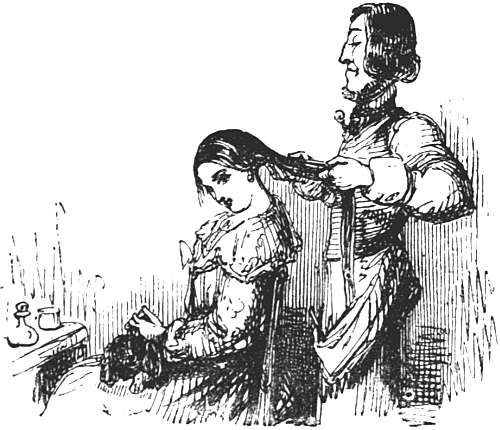
“Preparing for the Ball.”
Then we have the greengrocer, “who is to assist in waiting.... He wears white cotton gloves with very long fingers, and was never known to announce a name correctly, so the astonished visitor is ushered into the room under any other appellation than his own.”
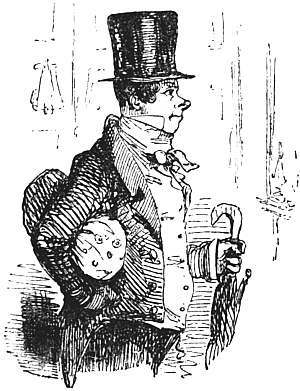
“The Assistant-Waiter.”
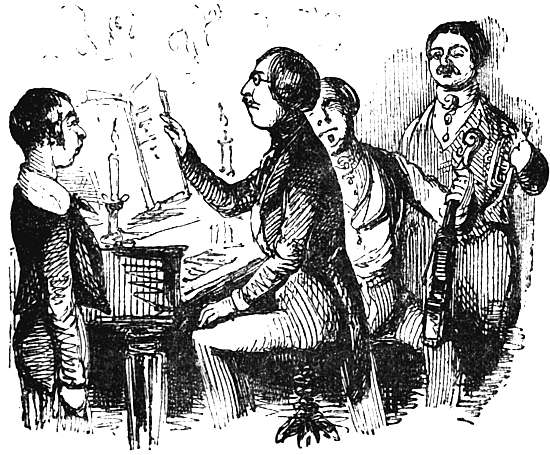
“The Band.”
The band must not be forgotten. “The music arrives,” says the writer, “sometimes in the shape of a single pianist of untiring fingers and unclosing eyes; sometimes as a harp, piano, and cornopean, who are immediately installed in a corner of the room with two chairs, a music-stool, and a bottle of marsala.”
I ask my reader to note the individuality in the four faces in this drawing—and in the figures no less than in the heads—each a strongly-marked personality precisely appropriate to the instrument upon which he performs. How admirable is the cornet-a-piston gentleman contrasted with the pianoforte player!
The mistress of the house is described as making “uphill attempts at conversation” pending the arrival of a sufficient number of guests to make up a quadrille. Two old ladies, however, have already put in an appearance, and have taken possession of the best seats to “see the dancing,” from which all attempts to move them to the card-room are successfully resisted. There they sit, poor old wallflowers! with all the advantage that “false hair and turbans” can give them. Though the execution of this drawing lacks the perfection of workmanship of Leech’s later manner, he never surpassed it in expression and character.
The music “strikes up,” the lady of the house throws a comprehensive coup d’œil over her assembled visitors, and at last pitches upon a tall young man—whom some of you may have met before—with short hair, spectacles, and turned-up wristbands, as if he was about to wash his hands with his coat on. His fate is sealed, and she advances towards him, blandly exclaiming:
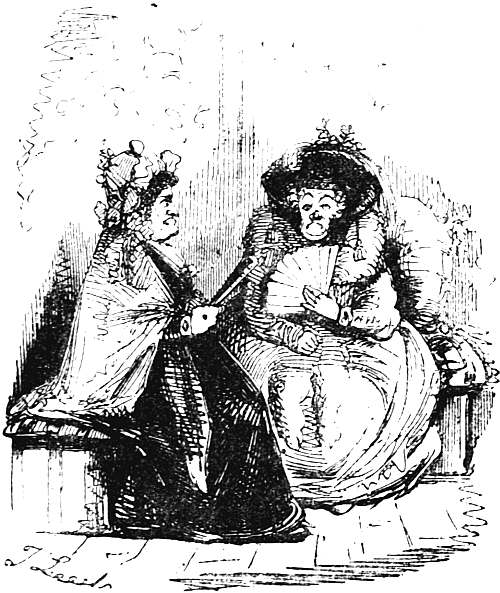
“Wallflowers.”
“Mr. Ledbury, allow me to introduce you to a partner.”
My own readers have heard of Mr. Ledbury; but as I think they are unacquainted with his personal appearance, I propose to introduce him to them, and here he is—
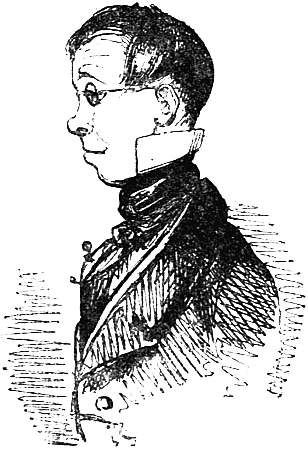
“Mr. Ledbury.”
Mr. Ledbury is “presented to a bouquet with a young lady attached to it”—a Miss Hamilton—who freezes him completely. A quadrille is formed. Mr. Ledbury cudgels his brains for five minutes. The young partner seems to be “searching after some imaginary object amongst the petals of her bouquet.” The mountainous Ledbury brain is in labour. Behold the production!
“Mr. L. ‘Have you been to many parties this season?’
“Miss H. ‘Not a great many.’
Miss Hamilton continues the bouquet investigation. The gentleman invents another sentence.
“Mr. L. ‘What do you think of Alfred Tennyson?’
“Miss H. ‘I am sorry to say I have not heard his poetry. Have you?’
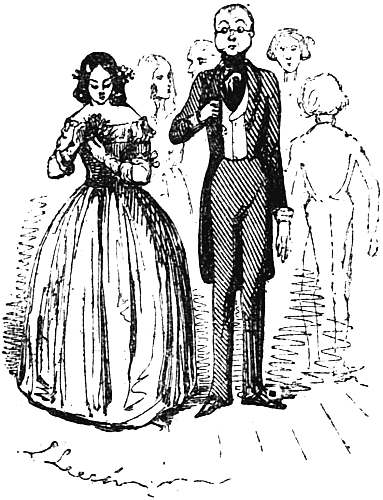
“Mr. Ledbury and Miss Hamilton.”
“Mr. L. ‘Oh yes! several times.”
Mr. Ledbury waits to be asked about “Mariana” and “Locksley Hall.” No inquiry, so he “rubs up an idea upon another tack”:
“Mr. L. ‘What do you think of our vis-à-vis?’
“Miss H. ‘Which one?’
“Mr. L. ‘The lady with that strange head-dress. Do you know her?’
“Miss H. ‘It is Miss Brown—my cousin.’”
Mr. Ledbury wishes he could fall through a trap in the floor.
The quadrille continues, with occasional attempts on the part of the brilliant couple to make conversation. The acme of imbecility seems to be reached when the lady asks if Mr. L. plays any instrument? He replies that he plays the flute a little. Does she admire it?
“Oh, so very much!” she says.
A waltz is proposed, but that form of dancing is, says our author, “never established without a prolonged desire on the part of everybody to relinquish the honour of commencing it. At last the example is set by one daring pair, timidly followed by another couple, and then by another, who get out of step at the end of the first round, and after treading severely upon the advanced toes of the old lady in a very flowery cap and plum-coloured satin (one of our faded wallflowers), who is sitting out at the top of the room, and who from that instant deprecates waltzing as an amusement not at all consistent with her ideas of feminine decorum.”
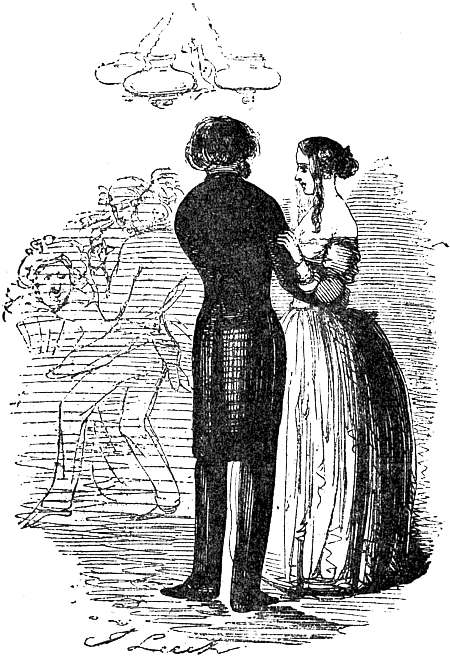
“The Waltz.”
The young lady in this drawing has much of Leech’s charm; but I should scarcely have selected it were it not for the figure of the gentleman, which exactly resembles that of Leech himself as I first knew him. If conservatories, or even staircases, could speak, what flirtations they could chronicle, what love-tales they could tell! Mr. Smith says “you will have to confess your inability to imagine what on earth the gentleman with the long hair, who is carefully balancing himself on one leg against the flowerpot-stand, and the pretty girl with the bouquet, can find to talk about so long, so earnestly.”
I for one beg Mr. Albert Smith’s pardon. I can easily imagine what they are talking about.
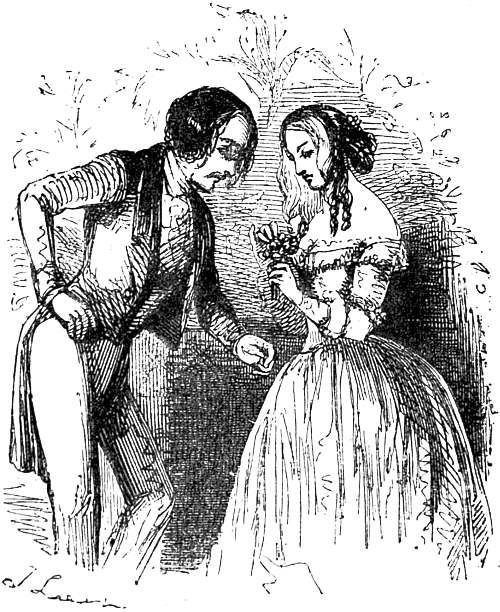
“In the Conservatory.”
It would be a grave omission if “The Belle of the Evening” were left out of these extracts from the “Physiology of Evening Parties.” Let me present her, then. Now listen to the flourish with which the author introduces her:
“Room for beauty! The belle of the evening claims our next attention, the lovely dark-eyed girl so plainly yet so elegantly dressed, who wears her hair in simple bands over her fair forehead, unencumbered by flower or ornament of any kind, and moves in the light of her own beauty as the presiding goddess of the room, imparting fragrance to the enamoured air that plays around her!”
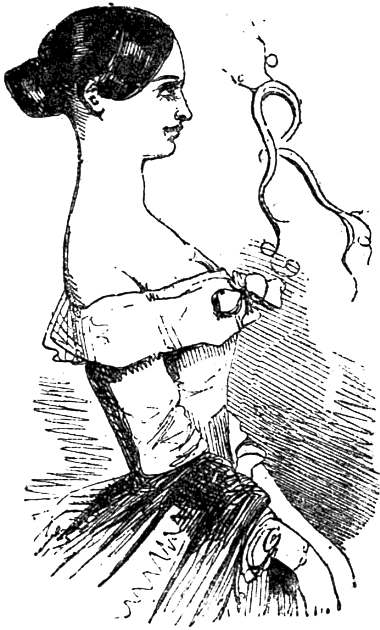
“The Belle of the Evening.”
Rather tall talk, this, but excusable, perhaps, as applied to the lovely creature Leech has drawn for us.
I feel I cannot close these extracts more appropriately than by allowing Mr. Ledbury to appear again at the moment of his departure from a scene in which he has so distinguished himself by his conversational, as well as by his terpsichorean, powers. He was destined to be guilty of one more folly—that of thinking he had but to ask for his hat to get it.
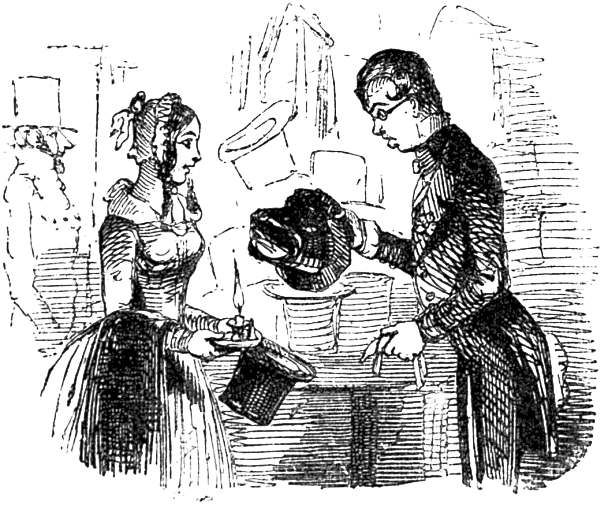
“Mr. Ledbury’s Hat.”
“He walks downstairs,” says Mr. Smith, “under the insane expectation of finding his own hat, or madly deeming that the ticket pinned upon it corresponds with the one in his waistcoat pocket.”
Here I take my leave of “The Physiology of Evening Parties” in presenting my reader with this charming little drawing, in which one scarcely knows which to admire most—the bewildered expression of Mr. Ledbury as he ruefully contemplates the rim of his hat, or the sympathetic, half-laughing face of the perfect little maid. The artistic qualities of this illustration are excellent. I say good-bye to “Evening Parties” only to meet Mr. Albert Smith again in a work by him called “Comic Tales and Pictures of Life,” published, I think, about the time of the “Evening Parties,” or perhaps earlier, for the illustrations are, on the whole, inferior to those in the latter production. The work under notice is composed of a series of short stories, in which love, comedy, and deep tragedy play alternate parts. Leech’s attention is mainly devoted to the comic scenes.
We are told of a Mr. Percival Jenks, whose frequent visits to the theatre have led to the loss of his heart to a beauteous ballet-girl. “The third ballet-girl from the left-hand stage-box, with the golden belt and green wreath, in the Pas des Guirlandes, or lyres, or umbrellas, or something of the kind, had enslaved his susceptible affections.”
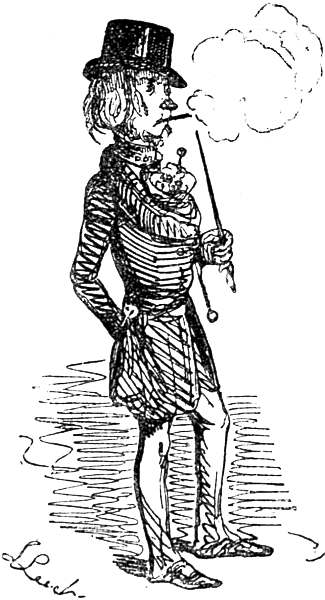
“Mr. Percival Jenks.”
No one knew who Mr. Jenks was, or what he was. Even his landlady’s information about him was confined to the idea that he was “something in a house in the City.” That idea proved to be well founded, for Mr. J. was discovered by the head-clerk at the house in the City, spoiling blotting-paper by drawing little opera-dancers all over it; thus neglecting his accounts, which he had to “stay two hours after time to make up. At half price, nevertheless, he was at the play again, his whole existence centred on an airy compound of clear muslin and white satin that was twirling about the stage.” Mr. Jenks burned to know his enslaver’s name with a view to an introduction; and for that purpose he haunted the stage-door, but utterly failed to recognise, amongst the faded cloaks, and drabby bonnets that issued from that portal, the angelic form of his charmer. He then took to haunting the places where minor actors and other employés of the theatre most do congregate for the purpose of social intercourse and refreshment; here at last he is rewarded.
“Do you know the young lady,” he says to a habitué, “who dances in the ballet with a green wreath round her head?”
“And a gilt belt round her waist?” asked the friend in turn. “Oh, it’s Miss—Miss—I shall forget my own name next.”
Percival was about to suggest Rosière, Céleste, Amadée, and other pretty cognomens, when his companion caught the name, and exclaimed:
“Miss Jukes; I thought I should recollect it.”
The name certainly was not what Percival had expected; still, what was in a name? Jenks was not poetical, and Jukes was something like it.
“Could you favour me with an introduction to her?” he asked.
“In a minute, if you wish it,” replied his companion.
“You know her intimately then?”
“Very; I buy all my green-grocery of her.”
The introduction takes place. Gracious powers! how a minute broke the enchantment of many weeks! “The nymph of the Danube was habited in a faded green cloak and straw bonnet, with limp and half-bleached pink ribbons clinging to its form. Her pallid and almost doughy face was deeply pitted with smallpox; her skin was rough from the constant layers of red and white paint it had to endure,” etc., etc. He fell back with a convulsive start.
From internal evidence I find the date of “Comic Tales,” etc., to be 1841, contemporary, therefore, with the establishment of Punch. There is a drawing of so pretty a conceit as to warrant my selecting it, though artistically it is inferior to Leech’s work even at that time. The drawing heads a paper entitled “Speculations on Marriage and Young Ladies,” and as it tells its own story, quotation from Mr. Smith is needless.
In one amusing paper in “Comic Tales,” the author treats us to “an Act for amending the representation of certain public sights, termed equestrian spectacles, in the habit of being represented at a favourite place of resort, termed the Royal Amphitheatre, Westminster Bridge.” The paper is framed in the form of an Act of Parliament, and the author forbids the use of ancient jokes or stereotyped phrases in a very humorous manner.
“Be it enacted,” he announces, after condemning a variety of objectionable practices, “that the clown shall not, after the first equestrian feat, exclaim: ‘Now I’ll have a turn to myself!’ previous to his toppling like a coach-wheel round the ring; nor shall he fall flat on his face, and then collecting some sawdust in his hand, drop it down from the level of his head, and say his nose bleeds; nor shall he attempt to make the rope-dancers’ balance-pole stand on its end by propping it up with the said sawdust; nor shall he, after chalking the performers’ shoes, conclude by chalking his own nose, to prevent his foot slipping when he treads upon it; nor shall he pick up a small piece of straw, for fear he should fall over it, and afterwards balance the said straw on his chin as he runs about; neither shall the master of the ring say to the clown, when they are leaving the circus: ‘I never follow the fool, sir!’ nor shall the fool reply: ‘Then I do!’ and walk out after him.”
I would draw attention to the figure of the clown in this cut, which is simply perfect in expression and character. The affected strut of the ring-master also is admirably caught.
A paper on Christmas pantomimes is illustrated by such a perfect clown that I cannot resist my inclination to present him to my readers.
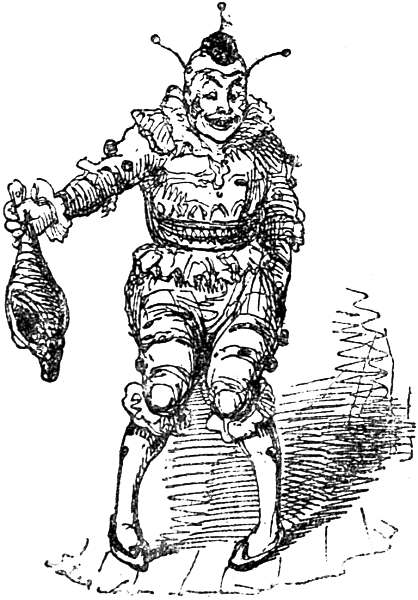
Clown: “Oh, see what I’ve found!”
“Comic Tales and Pictures of Life” contains, at least, one drawing that is equal to Leech at his best. The cut illustrates an article on “Delightful People,” a short essay, amusing enough.
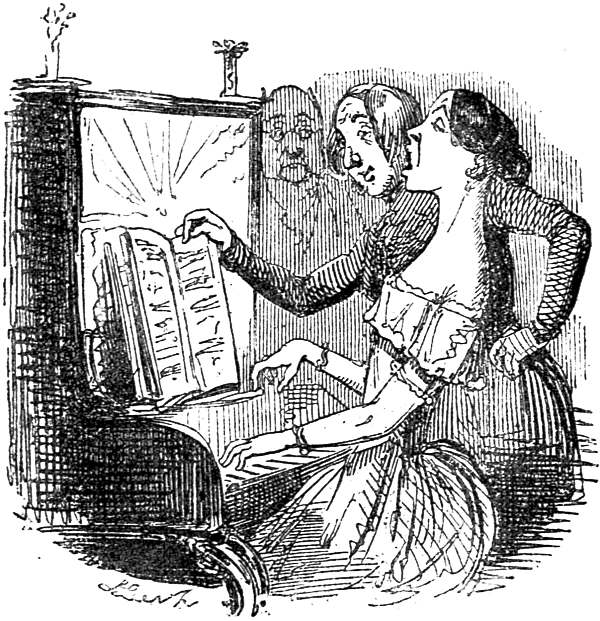
“Miss Cinthia Sings.”
Music, whether performed by the band or by musical guests, is an important factor in an evening party. Mr. Albert Smith tells us that “a lady of his acquaintance” had secured those “Delightful People, the Lawsons,” for a large evening party she was about to give; and after lauding the charming qualities of Mr. and Mrs. Lawson, she put a final touch to the Lawson attractions by informing her friend that their daughter, Miss Cinthia Lawson, was not only a delightful girl, but that “she sings better than anyone you ever heard in private.” In the interval of dancing Cinthia sings. “The young lady now dressed in plain white robes, with her hair smoothed very flat round her head à la Grisi, whom she thought she resembled both in style of singing and features, and consequently studied all her attitudes from the clever Italian’s impersonation of Norma.... At last the lady begun a bravura upon such a high note, and so powerful, that some impudent fellows in the square, who were passing at the moment, sang out ‘Vari-e-ty’ in reply. Presently, a young gentleman, who was standing at her side, chanced to turn over too soon, whereupon she gave him such a look, that, if he had entertained any thoughts of proposing, would effectually have stopped any such rash proceeding; but her equanimity was soon restored, and she went through the aria in most dashing style until she came to the last note, whose appearance she heralded with a roulade of wonderful execution.”
I remember Grisi, and I cannot share Miss Lawson’s conviction of her resemblance to that great singer—personal resemblance, I mean—and, in all probability, she had as feeble a claim to an equality of genius; but that she had a powerful voice, and that she gave it full effect, is evident by Leech’s perfect rendering of that wonderful mouth, from which one can almost hear the roulade. All the lines of the figure, with the movement of the hands, and the backward action of the singer, are true to Nature. The assistant at the music-book and the stolid old gentleman are also excellent.
With this, the best of the drawings in “Comic Tales,” I take my leave of the book.
CHAPTER VI.
JOHN LEECH AND THE ETON BOY.
I had been told that a friend whose acquaintance I made many years ago was in possession of some correspondence with Leech of considerable interest. I wrote to him on the subject, and received the following reply:
“Dear Mr. Frith,
“I had intended waiting till my return to town to see whether I could find John Leech’s letters before writing to you; but as you ask for the story, here it is, to the best of my recollection, and it is heartily at your service. When I was a boy at Eton I sent to Punch an incident which happened at a dance. Young Oxford complaining to his partner of the dearth of ‘female society’ at the University, she retorts, ‘What a pity you didn’t go to a girls’ school instead!’ Its appearance beneath an illustration of Leech’s caused great excitement in our house at Eton, and as great tales of Mr. Punch’s liberality were current—as, for example, that the sender of the advice ‘To persons about to marry—don’t,’ had received £100—I began to look anxiously for some tip for my contribution. An enterprising pal said, ‘It’s a beastly shame; and if you’ll go halves, I’ll write to Punch and wake ’em up.’ This speedily resulted in the receipt of a post-office order for two guineas from John Leech, accompanied by a rather dry note, to the effect that Mr. Punch considered that he had already done enough in providing an original illustration to my joke. I was indignant, and wrote back to Leech returning the money, but he would not hear of this. He told me I could buy gloves with the money for the young lady if I liked—which I am afraid I didn’t. Several kind letters from him followed, with an invitation, gladly accepted, to call and see him in the holidays, and a present, which I still treasure, of two volumes of his ‘Life and Character.’
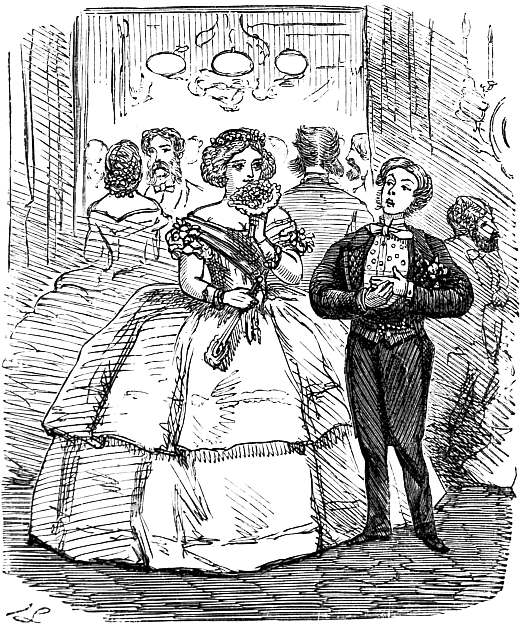
“Dreadful for Young Oxford.”
Lady: “Are you at Eton?”
Young Oxford: “Aw, no! I’m at Oxford.”
Lady: “Oxford! Rather a nice place, is it not?”
Young Oxford: “Hum!—haw! pretty well; but then I can’t get on without female society!”
Lady: “Dear! dear! pity you don’t go to a girls’ school, then!”
“At the time I remember my schoolfellows considered me a born caricaturist, an opinion I naturally shared. Leech was most indulgent to my early efforts—gave me some wood-blocks to work upon, and encouraged me to persevere, which, alas! I have not done, etc.
“Yours truly.”
Here follows Leech’s “dry note”:
“32, Brunswick Square, London, “June 6, 1859.
“Dear Sir,
“The editor of Punch is the person who should be addressed upon all money matters connected with that periodical. However, in the present instance, perhaps it will answer every purpose if I adopt the suggestion of your ‘great friend and confidant,’ and ‘do the handsome and send a tip direct,’ which I do in the shape of a post-office order for one guinea; or, as your ‘entirely disinterested’ young friend is to have half of what you get, it will be even better if I make the order for two guineas instead, as I do, only you must not look upon this as a precedent. I am afraid Mr. Punch would have considered that the trouble and expense he was at to have an original design made to your few lines would have been ample recompense. In future send to the editor your notion of what you expect for any contribution, and he will accept or reject accordingly, I dare say.
“Yours faithfully,
“John Leech.”
The Eton boy was “indignant, and wrote back to Leech returning the money,” to which Leech replied as follows:
“32, Brunswick Square, “November 8, 1859.
“Dear Sir,
“No, no; it must be as it is; besides, the order is made out in your name, and can be used by no one else. After all, your contribution was very amusing, and pray consider yourself as quite entitled to the sum offered. If you have any doubt as to how you should spend the money, why, then, buy some gloves for the young lady who said the smart thing to the Oxford man. As to my being offended, dismiss the notion from your mind at once. Your first note I consider perfectly good-natured, and your second as frank and gentleman-like. I hope you will do me the favour to accept two volumes of my sketches, in which I hope you will find some amusement.
“I will direct the volumes to be sent to you this afternoon.
“Believe me, dear sir,
“Yours faithfully,
“John Leech.”
Encouraged by Leech’s kindness, and being, as he says, “a born caricaturist in the opinion of his friends,” the Eton boy sent some sketches for Leech’s opinion. To this application he received the following reply:
“32, Brunswick Square, “June 11, 1859.
“My dear Sir,
“I am very busy, so you must excuse a rather short note. Your sketches I have looked at carefully, however, and I have no hesitation in saying that they show a great perception of humour on your part. They seem to me to be altogether very good; and I have no doubt that with practice you might make your talent available in Punch and elsewhere. I don’t know about your taking lessons, except from Nature, and learn from her as much as possible. Try your hand at some initial letters—if drawn on the wood clearly, so much the better—and I will, with great pleasure, hand them to the editor of Punch. ‘The Pleasures of Eton’ is capital; the style, I take it, founded a little upon Doyle’s works. I would not do that too much. You have quite cleverness enough to strike out a path of your own, and with my best wishes for your success,
“Believe me,
“Yours faithfully,
“John Leech.”
In sending these letters the Eton boy of old says he is “sure that nothing would more thoroughly exemplify Leech’s genial wit and courteous kindliness than these replies to an unknown schoolboy.” I suppose the letter in which my friend was invited to call upon Leech “in the holidays” is not to be found. But that he did call and received a present of “wood-blocks to work upon,” accompanied by “encouragement to persevere,” which, alas! he has not done, we have from himself.
This incident is especially delightful, as it reflects perfectly the quality of heart and mind so characteristic of Leech.
CHAPTER VII.
MR. SPONGE’S SPORTING TOUR.
Mr. Surtees, the writer of the sporting novels, possessed considerable powers of invention, which he indulged—amongst other vagaries—in giving names to most of the characters in his books, which served to enlighten his readers as to their physical and mental peculiarities, and never more happily than when he christened the hero of this sporting tour Mr. Soapy Sponge. “Mr. Sponge,” says our author, “wished to be a gentleman without knowing how;” but what Mr. Sponge did know was how to sponge upon everybody with whom he could force an acquaintance, and this he effected with surprising success. Hunting and good hunting quarters were the objects of Mr. Sponge’s machinations, and upon a half-hearted invitation from a Mr. Jawleyford, of Jawleyford Court, an invitation given without an idea that it would be accepted (as sometimes happens), Mr. Sponge found himself installed in the ancestral mansion of the Jawleyfords. Mr. Jawleyford was “one of the rather numerous race of paper-booted, pen-and-ink landowners,” says Mr. Surtees, “whose communications with his tenantry were chiefly confined to dining with them twice a year in the great entrance-hall after the steward, Mr. Screwemtight, had eased them of their rents.” Then Mr. Jawleyford would shine forth the very impersonification of what a landlord ought to be. Dressed in the height of fashion, he would declare that the only really happy moments of his life were those when he was surrounded by his tenantry.
In the background of this admirable drawing we see Mr. Jawleyford’s portrait, flanked by his ancestors, on canvas and in armour, hanging on the panelled walls of his gorgeous home. The variety of character in the “chawbacons,” each a marked individuality, contrasts effectually with his quasi fashionable landlord. For the first banquet at Jawleyford Court, “Mr. Sponge,” says the author, “made himself an uncommon swell.” His dress is minutely described, and faithfully depicted by Leech, in the etching in which we see the sponger conducting a very portly Mrs. Jawleyford, followed by her daughters, to the dining-room. The young ladies who have entered the drawing-room “in the full fervour of sisterly animosity,” according to the author, seem—in the lovely group that Leech makes of them—to have speedily made up their quarrel, as their entwined arms and pretty, happy faces prove. The solemn butler, who looks with awe at his aristocratic master, is in Leech’s truest vein, while Mr. Jawleyford himself is simply perfect. In the footmen and page the illustration is less successful; they seem to approach, if not to reach, caricature.
When Mr. Sponge found himself in good quarters, no hint however strong, no looks however cold, no manner however unpleasant, would move him, until he had provided himself with others to his liking. Under the impression that he was rich, the Misses Jawleyford set their caps at him. Amelia and Emily rivalled each other in tender attentions to the adventurer, who, after hesitating as to which of them he should throw the handkerchief to, fixed upon Miss Amelia, who found her sister “in the act of playing the agreeable” with Mr. Sponge as she “sailed” into the drawing-room before dinner; then, “with a haughty sort of sneer and toss of the head to her sister, as much as to say, ‘What are you doing with my man?’—a sneer that suddenly changed into a sweet smile as her eye encountered Sponge’s—she just motioned him off to a sofa, where she commenced a sotto-voce conversation in the engaged-couple style.”
During his stay at Jawleyford Court, Mr. Sponge’s time was passed in hunting, smoking all over the house—a habit the owner detested—and in making love to Miss Amelia; taking care, however, not to commit himself until he had discovered from papa what the settlements were to be. We who are behind the scenes know that Jawleyford Court is “mortgaged up to the chimney-pots,” and that Mr. J. is over head and ears in debt besides. We know also that Mr. Sponge is impecunious, his hunters are hired; he is, in fact, as his author describes him, “a vulgar humbug.” “Jawleyford began to suspect that Sponge might not be the great ‘catch’ he was represented,” says the author. No doubt in finding himself baffled in his attempts to sound his host upon the subject of settlements, Mr. Sponge also “began to suspect” that neither of the Misses Jawleyford would be the “catch” that he wanted. Still, he held on to his quarters in defiance of the attempts to get rid of him. He was removed from the best bedroom to one in which it was impossible to light a fire, or, rather, to endure it when it was alight, because of an incurable smoky chimney. He was given poor food and corked wine, still he stayed, until he had provided himself with a temporary home at the house of a hunting gentleman named Puffington.
Mr. Puffington, who made Sponge’s acquaintance at the covert-side where Lord Scamperdale’s hounds met, “got it into his head” that Mr. Sponge was a literary man, whose brilliant pen was about to be employed in the interest of fox-hunting in general, and of certain runs of Mr. Puffington’s hounds in particular. Mr. Puffington “was the son of a great starch-maker at Stepney.” Puffington, senior, made a large fortune, which enabled his son to become the owner of Hanby House, and of the “Mangeysterne—now Hanby-Hounds,” because he thought they would give him consequence. Our author says, Mr. Puffington “had no natural inclination for hunting,” but he seems to have become M.F.H. so that he might entertain some of the sporting friends he had made at college, such “dashing young sparks as Lord Firebrand, Lord Mudlark, Lord Deuceace, Sir Harry Blueun, Lord Legbail, now Earl of Loosefish,” and so on.
My space, or, rather, the want of it, prevents my telling how it was that Mr. Sponge “awoke and found himself famous” as an author. In conjunction with a friend, who steered him through the spelling and grammar, he concocted an article for the Swillingford Patriot—Grimes, editor—which “appeared in the middle of the third sheet, and was headed, ‘Splendid Run with Mr. Puffington’s Hounds.’” Mr. Grimes was ably assisted in his editorial duties by “his eldest daughter, Lucy—a young lady of a certain age, say liberal thirty—an ardent Bloomer, with a considerable taste for sentimental poetry, with which she generally filled the Poet’s Corner.”
As Mr. Puffington quite expected to be immortalized in some work of general circulation, his indignation knew no bounds when he found himself relegated to a corner of the county paper, and all his hopes of his doings being read by “the Lords Loosefish, the Sir Toms and Sir Harrys of former days” grievously disappointed. Never, surely, were disgust, disappointment, and rage more perfectly expressed than in the second portrait of Mr. Puffington: not only the face, but the whole figure—one can fancy how the hand in the pocket of the dressing-gown is clenched—denotes the surprise and exasperation of the miserable man.
Mr. Sponge’s literary effort has “done for him” with Mr. Puffington. He must go. Easier said than done.
“Couldn’t you manage to get him to go?” asked Mr. Puffington of his valet.
“Don’t know, sir. I could try, sir—believe he’s bad to move, sir,” said the valet.
Driven to despair, the host “scrawled a miserable-looking note, explaining how very ill he was, how he regretted being deprived of Mr. Sponge’s agreeable society—hoped he would come another time,” and so on. Even the “sponger” felt the difficulty of parrying such a palpable notice to quit. “He went to bed sorely perplexed,” and in his waking moments trying to remember “what sportsmen had held out the hand of good fellowship and hinted at hoping to have the pleasure of seeing him”; he could think of no one to whom he could volunteer a visit. But Fortune favours the brave sponger, as she often does unworthy people, and in Mr. Jogglebury Crowdey, an eccentric individual whose acquaintance Sponge had made in the hunting-field, he found another host. At the suggestion of Mrs. Jogglebury, who, without the slightest reason, had taken it into her head that Mr. Sponge was a wealthy man, and would make a satisfactory godfather to one of her children, Mr. Jogglebury called on Mr. Sponge at the Puffington mansion, and invited him to “pay us a visit.”
No sooner does our hero grasp the situation than he says:
“Well, you’re a devilish good fellow, and I’ll tell you what, as I am sure you mean what you say, I’ll take you at your word and go at once.”
And in this determination he persists, though Mr. J. pleads for some delay, as Mrs. Jogglebury Crowdey requires some little time for preparation in receiving so distinguished a guest.
The visit to Puddingpote Bower, as the Jogglebury dwelling was called, proved as unfortunate as the previous visits; the more people saw of Mr. Sponge the less they liked him, and this time the dislike was mutual. “Jog and Sponge,” says the author, “were soon most heartily sick of each other.” Mr. Sponge soon began to think that it was not worth while staying at Puddingpote Bower for the mere sake of his keep, “seeing there was no hunting to be had from it.”
Within twelve or thirteen miles from the Bower there lived Sir Harry Scattercash, a very fast young gentleman indeed. He kept “an ill-supported pack of hounds, that were not kept upon any fixed principles; their management was only of the scrimmaging order,” but Mr. Sponge, scenting an invitation, determined to make one amongst the field.
In his attempt to “go it,” my lord “was ably assisted by Lady Scattercash, late the lovely and elegant Miss Glitters, of the Theatre Royal, Sadler’s Wells. Lady Scattercash could ride—indeed, she used to do scenes in the circle (two horses and a flag), and she could drive, and smoke, and sing, and was possessed of many other accomplishments.”
What a winning creature Leech has made of her, and the scarcely less delightful little tiger behind her, may be seen in the illustration which the law of copyright prevents me from introducing, as it also prohibits the appearance here of Sir Harry, her husband, the happy possessor of the charming Lady Scattercash.
“Sometimes,” says the author of “Sponge,” “Sir Harry would drink straight on end for a week!” Mr. Sponge made desperate efforts to take up his abode at Nonsuch House, but Sir Harry was surrounded by congenial spirits, who, one and all, had taken prejudice against that worthy; so, beyond a hunting dinner, at which everybody, including the ladies, took more wine than was good for them, Mr. Sponge and Nonsuch House were strangers to each other for a time. But, as the hunting-field is open to all and sundry, Mr. Sponge, not easily daunted, put in a frequent appearance, in the sure and certain hope that admission to free quarters at Sir Harry’s was only delayed. Beyond what is elegantly called “peck and perch,” Nonsuch House contained a very powerful attraction in the form of Miss Lucy Glitters, sister to Lady Scattercash. Miss Lucy was a lovely person, and her charms were increased in Mr. Sponge’s eyes because he persuaded himself that the sister-in-law of a baronet must necessarily be a rich woman. Miss Lucy had also the conviction that Mr. Sponge was a rich man; how else could he spend his time in the sports of the field, with all their expensive accompaniments? Miss Glitters was a bold rider, and that accomplishment also endeared her to the gentleman in whom the passion of love burned suddenly, and with a very furious flame indeed; till on one fateful hunting day the amorous couple found themselves “in at the death”: they had distanced the field, they were alone. Mr. Sponge secured the brush, and said:
“We’ll put this in your hat, alongside the cock’s feathers.”
I now quote my author: “The fair lady leant towards him, and as he adjusted it becomingly in her hat, looking at her bewitching eyes, her lovely face, and feeling the sweet fragrance of her breath, a something shot through Mr. Sponge’s pull-devil pull-baker coat, his corduroy waistcoat, his Eureka shirt, angola vest, and penetrated to the very cockles of his heart. He gave her such a series of smacking kisses as startled her horse and astonished a poacher who happened to be hid in the adjoining hedge.”
On the return of the happy pair Lucy rushes to her sister with the good news. Lady Scattercash was delighted, because “Mr. Sponge was such a nice man, and so rich! She was sure he was rich—couldn’t hunt if he wasn’t. Would advise Lucy to have a good settlement, in case he broke his neck.” On further inquiry, however, her ladyship had good reason to suspect that a red coat and two or three hunters were not satisfactory proofs of wealth; and in reply to one who knew, she retorted, “Well, never mind, if he has nothing, she has nothing, and nothing can be nicer.” With the conviction that nothing could be nicer, “Lady Scattercash warmly espoused Mr. Sponge’s cause,” the consequence being his instalment in splendid quarters at Nonsuch House, where he made himself thoroughly at home. “It was very soon ‘my hounds,’ ‘my horses,’ and ‘my whips,’ etc., being untroubled by his total inability to keep the angel who had ridden herself into his affections, for he made no doubt that something would turn up.” If it were not for the introduction of a delightful drawing by Leech, I should take no note of a “Steeplechase,” in which Mr. Sponge comes before us for the last time. This function is not a favourite with Mr. Surtees, nor is it looked upon without much anxiety by Miss Lucy. “She has made Mr. Sponge a white silk jacket to ride in, and a cap of the same colour. Altogether, he is a great swell, and very like a bridegroom,” says the author.
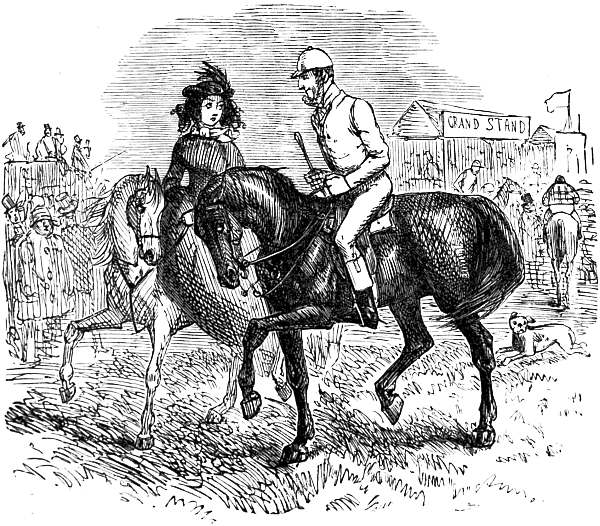
If this drawing suffered in the hands of the wood-engraver, it must have been beyond imagination beautiful, for, as it is, it shows us Leech in his full strength. Nothing, it seems to me, could surpass the figure of Lucy, whose expression of loving fear for the safety of the bold Sponge is shown to us in one of the prettiest faces conceivable. Sponge himself is no less successfully rendered as he smiles reassuringly at his beloved. The race—admirably described by the author—is run, and won by Mr. Sponge. “And now for the hero and heroine of our tale. The Sponges—for our friend married Lucy shortly after the steeplechase—stayed at Nonsuch House till the bailiffs walked in. Sir Harry then bolted to Boulogne, where he afterwards died. Being at length starved out of Nonsuch House,” says the historian, “he—Sponge—arrived at his old quarters, the Bantam, in Bond Street, where he turned his attention very seriously to providing for Lucy and the little Sponge, who had now issued its prospectus. He thought over all the ways and means of making money without capital.... Professional steeplechasing Lucy decried, declaring she would rather return to her flag exercises at Astley’s as soon as she was able than have her dear Sponge risking his neck that way. Our friend at length began to fear fortune-making was not so easy as he thought; indeed he was soon sure of it.” Something had to be done; “accordingly, after due consultation with Lucy, he invested his all in fitting up and decorating the splendid establishment in Jermyn Street, St. James’s, now known as the Sponge Cigar and Betting Rooms, where noblemen, gentlemen, and officers in the Household troops may be accommodated with loans on their personal security to any amount.” We see by Mr. Sponge’s last advertisement that he has £116,000 to lend at 3½ per cent.
CHAPTER VIII.
“THE MARCHIONESS OF BRINVILLIERS,” BY ALBERT SMITH.
“December 20, 1844.
“My dear Sir,
“Here we are at the 20th of the month, and I have only four pages of Smith’s new story—no incident. Really, it is too much to expect that I can throw myself at a moment’s notice into the seventeenth century, with all its difficulties of costume, etc., etc. What am I to do? There is a great want of system somewhere. I received a note from Mr. Marsh last night, stating for the first time that there would be two illustrations to ‘The Marchioness of Brinvilliers,’ and also urging me to be very early with the plates, it being Christmas and all that! But, as I said before, I have not the matter to illustrate. What am I to do? Added to all this, I must be engaged one day in the early part of next week on the melancholy occasion of the funeral of a poor little sister of mine. Pray, my dear sir, do what you can to expedite matters, and
“Believe me,
“Yours faithfully,
“John Leech.
“—— Morgan, Esq.”
The above is one of the many letters that might be quoted to show the aggravating delays and difficulties under which so much of Leech’s work was produced. I take Mr. Morgan to have been one of the officials of Mr. Richard Bentley’s establishment, whose patience must have been sorely tried again and again by the pranks of that genus irritabile, the writer. Judging from the humorous character of Albert Smith’s “Ledbury” and other works, one is hardly prepared for the horrors that make us shudder over the pages of “The Marchioness of Brinvilliers”—horrors in which the writer seems to revel with a zest as keen as that he takes in the fun and frolic of Ledbury.
The “shilling shocker” of the present day is a mild production indeed, in comparison with the history of the poisoner and adulteress, Brinvilliers, in which “on horror’s head horrors accumulate.” The authors of the modern productions are, for the most part, inventors of the blood-and-murder scenes that adorn their books. Not so Mr. Albert Smith, whose pages describe but too truly the career of the most notorious of the many criminals that flourished in the most profligate period of French history. Louis XIV. set an example in debauchery to his subjects which the highest of them eagerly followed; but the most fearful factor of this terrible time was poison, by which the possessors of estates who “lagged superfluous on the scene” were made to give place to greedy heirs; husbands, inconveniently in the way, were put out of it by their wives, whose affections had been disposed of elsewhere; state officers, whose positions were desired by aspirants unwilling to wait for them, were struck by sudden and mysterious illness, speedily followed by death, for which the faculty of the time could in no way account.
Marie, Marchioness of Brinvilliers, lived with her husband in the Rue des Cordeliers in Paris. The Marquis was a man of easy morals, and the Marchioness was a woman of still easier morals, for she had many lovers; she also amused her leisure hours by the study of the nature and properties of a great variety of deadly poisons; thinking, no doubt, as she was of a jealous disposition, that the time might arrive when her knowledge would be useful in depriving her lover of the temptation which had led him to forget his duty to her. The Marchioness was a very beautiful woman; she had eyes of a tender blue; her complexion was of dazzling whiteness, with cheeks of a delicate carnation; her expression was angelic, and she wore her hair of pale gold in bushy ringlets, in obedience to the fashion of the time. We first become acquainted with the Marchioness under painful circumstances, for she made—and kept—an appointment with one lover without being sufficiently careful to disguise her doings from another. That other was the Chevalier Gaudin de Sainte-Croix, who proceeded to the lodgings of his rival, M. Camille Theria.
“‘The Marchioness of Brinvilliers is here, I believe,’ said Gaudin to the grisette at the door. ‘Will you tell her she is wanted on pressing business?’
“The Marchioness appeared. A stifled scream of fear and surprise, yet sufficiently intense to show her emotion at the sight of Gaudin, broke from her lips as she recognised him. But she immediately recovered her impassibility of features—that wonderful calmness and innocent expression which afterwards was so severely put to the proof without being shaken—and she asked, with apparent unconcern:
“‘Well, monsieur, what do you want with me?’
“‘Marie!’ exclaimed Gaudin, ‘let me ask your business here at this hour’ (it was rather late) ‘unattended, and in the apartment of a scholar of the Hôtel Dieu?’
“‘You are mad, Sainte-Croix,’ said the Marchioness. ‘Am I to be accountable to you for all my actions? M. Theria is not here, and I came to see his wife on my own affairs.’
“‘Liar!’ cried Gaudin.”
The lady had not told the truth, for M. Theria had no wife, and he was so near by that he heard the angry voice of M. Sainte-Croix, who so convinced the Marchioness of her perfidy that “in an instant the accustomed firmness of the Marchioness deserted her, and she fell upon her knees at his feet on the cold, damp floor of the landing.”
In this powerful etching nothing could surpass the beauty of the face and figure of the Marchioness; she exactly realizes our ideal. But the Chevalier, though full of passion, is, to my mind, verging on the theatrical.
Finding that her entreaties to the Chevalier to “go away” have no effect, she threatens suicide.
“There is but one resource left,” she says, as she “springs up from her position of supplication.”
“Where are you going?” asked Sainte-Croix, as she rushed to the top of the flight of stairs.
“Hinder me not!” returned Marie. “To the river!”
But before she could reach the river—to which she would no doubt have given a very wide berth—she fainted, or pretended to faint, in the courtyard at the bottom of the staircase. Here the pair were overtaken by M. Theria.
“A few hot and hurried words passed on either side, and the next instant their swords were drawn and crossed. The fight was short, and ended in Sainte-Croix thrusting his rapier completely through the fleshy part of the sword-arm of the student, whose weapon fell to the ground.
“‘I have it!’ cried Camille. ‘A peace, monsieur! I have it!’ he continued, smiling, as he felt that his wound, though slight, was too serious to have been received in so unworthy a cause.
“As he was speaking, Marie opened her eyes and looked around. But the instant she saw the two rivals, she shuddered convulsively, and again relapsed into insensibility.
“‘She is a clever actress,’ continued Camille, smiling.
“‘We have each been duped,’ answered Gaudin.
“‘She will play me no longer. As far as I am concerned,’ said Theria, ‘you are welcome to all her affections, and I shall reckon you as one of my best friends for your visit this evening.’”
The visit was destined to have an unexpected end, however, for the attention of the Guet Royal, or night-guard, had been called to the clashing of swords.
“Some young men, who had come up with the guard as they were returning from their orgies, pressed forward with curiosity to ascertain the cause of the tumult. But from one of them a fearful cry of surprise was heard as he recognised the persons before him. Sainte-Croix raised his eyes, and found himself face to face with Antoine, Marquis of Brinvilliers!”
The late combatants threw dust in the eyes of the lady’s husband cleverly enough by pretending that Sainte-Croix had rescued her from the unwelcome attentions of Theria, who had mistaken her in the uncertain light for a lady with whom he had an appointment. The cloak which the Marchioness wore, together with the darkness of the night, had prevented his discovering that she was not the person he expected until her cries had brought in Sainte-Croix, who was passing, as he said himself, “to his lodgings in the Rue des Bernardins.”
The lady went home with her husband, and Sainte-Croix retired to his lodgings, there to meditate on the perfidy of his mistress. The Chevalier de Sainte-Croix was even more learned in poisons, and less scrupulous in the use of them, than his mistress; and in his first gusts of passion, on discovering her treachery, he was inclined—in the hate of her that took temporary possession of him—to subject her to their effect; but reflection produced demoniacal results. She should be spared to kill those who ought to be near and dear to her!
“‘I will be her bane—her curse!’ he exclaimed. ‘I will be her bad angel!... And I will triumph over that besotted fool, her husband,’ etc.
“He opened a small, iron-clamped box, and brought from it a small packet, carefully sealed, and a phial of clear, colourless fluid.
“‘I have it! It is here—the source, not of life, but of death!’
“Almost as he speaks, he is summoned by the femme de chambre of the Marchioness to an interview at her residence at her father’s house, the Hôtel d’Aubray. The Chevalier found the enchantress in studied disarray. She might have been made up after one of Guido’s Magdalens,” says the author, “so beautiful were her rounded shoulders, so dishevelled her light hair,” etc.
The lovers were speedily reconciled, but the lady had an important communication to make—no less than the discovery of their intimacy by her husband, whom she felt sure had revealed the fact to her father, M. d’Aubray. A long pause, broken by Sainte-Croix:
“‘Marie,’ he said, ‘they must die, or our happiness is impossible.’”
The Marchioness was not yet hardened enough to receive this announcement with equanimity; and the lovers were still discussing the pros and cons of it, when they were surprised by Monsieur d’Aubray, who, entering by a secret door, “stood looking on the scene before him.” Any doubts of guilty intimacy, if he had any, were dispelled; and, after ordering his daughter to her chamber, he turned to Sainte-Croix, and said:
“‘Monsieur de Sainte-Croix, I will provide you with a lodging where you will run no risk of compromising the honour of a noble family.’”
And so saying, he produced a lettre de cachet, armed with which the exempts, who were waiting for him, speedily deposited M. de Sainte-Croix at the Bastille. The Marchioness, separated from her children and her husband, was exiled to Offremont, a family place some distance from Paris. Here she lived with her father, who so entirely believed in her repentance and determination to lead a new life that he proposed a speedy return to Paris.
“‘I have no wish to go, mon père,’ replied the hypocrite; ‘I would sooner remain here with you—for ever!’”
After much talk and reiterated professions of sorrow for the past, the Marchioness says, in reply to her father’s order that “she shall never speak to Sainte-Croix—who had been released from the Bastille—or recognise him again:
“‘You shall be obeyed, monsieur—too willingly.’”
The words had not long left her lips when she placed a lamp in the window of the room, to guide her lover to a prearranged assignation.
The awful interview that followed is described in Mr. Smith’s book.
The greater villain ran the risk of interruption in his lengthened arguments in favour of parricide; but hearing approaching footsteps, Sainte-Croix hurried away.
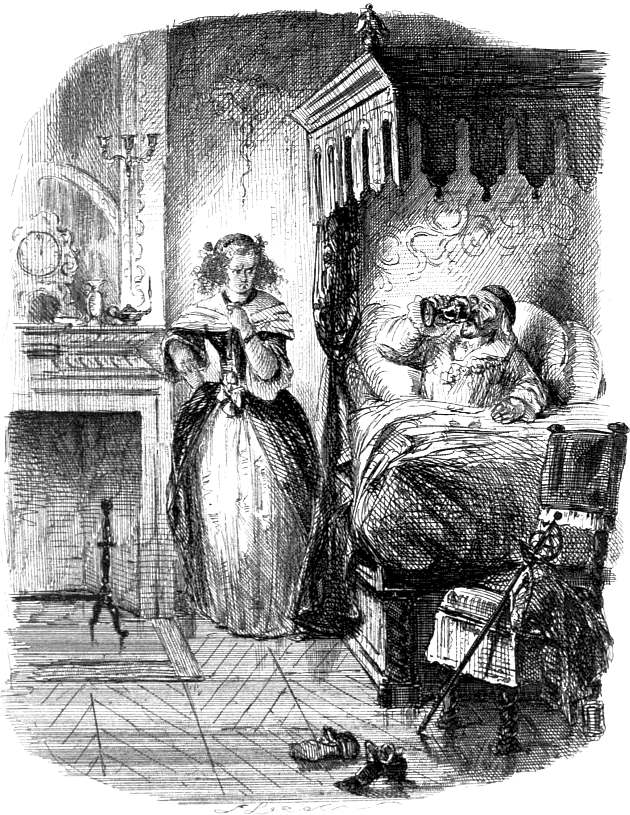
M. d’Aubray had gone to bed. A servant suggested the night-drink.
“‘I will give it to him myself, Jervais,’ said the Marchioness.”
Taking a jug from the man, she poured the contents into an old cup of thin silver; then, “with a hurried glance round the room, she broke the seals of the packet Sainte-Croix had left in her hands, and shook a few grains of its contents into the beverage. No change was visible; a few bubbles rose and broke upon the surface, but this was all.”
Sleep had surprised M. d’Aubray. His daughter touched him lightly, and he “awoke with the exclamation of surprise attendant upon being suddenly disturbed from sleep.
“‘I have brought your wine, mon père,’ said the murderess.
“‘Thanks, thanks, my good girl,’ said the old man, as he raised himself up in bed, and took the cup from the Marchioness. He drank off the contents, and then, once more bestowing a benediction upon his daughter, turned again to his pillow.”
Let those who desire to see how beauty can be retained, though disfigured by devilish passion, study the face of the Marchioness in this drawing. For skilful arrangement of light and shade, and of the objects that go to make up the mise en scène, and for natural action in the figures; this drawing takes the lead of all the admirable illustrations in the “Marchioness of Brinvilliers.”
CHAPTER IX.
“THE MARCHIONESS OF BRINVILLIERS” (continued).
A great reception was given at Versailles by the King. M. d’Aubray was “suffering from a sudden and fearful indisposition, but he insisted upon his daughter accepting an invitation, were it only to establish her entrée into society.”
There, amongst the trees in the gardens, the Marchioness encounters Sainte-Croix. “His face looked ghastly in the moonbeams, and his eyes gleamed with a light that conscience made demoniac in the eyes of the Marchioness.”
“‘You here!’ she exclaimed.
“‘Where should I be but in the place of rejoicing just now?’ replied Gaudin through his set teeth, and with a sardonic smile. ‘I am this moment from Paris. We are free!’
“‘My father?’ cried the Marchioness, as a terrible expression overspread her countenance.
“‘He is dead,’ returned Sainte-Croix, ‘and we are free!’”
There was a pause, and they looked at each other for nearly a minute.
“‘Come,’ at length said the Marchioness, ‘come to the ball.’”
A prominent and very interesting figure in Mr. Smith’s book is Louise Gauthier, a girl of comparatively humble birth, who had the misfortune to love Sainte-Croix with the intense self-sacrificing love that good women so often show for bad men, who return their affection with coldness and neglect. This girl, who had become the friend of Marotte Dupré, one of the actresses in the plays of Molière which were part of the attraction at the Versailles fête, accompanied the actress to Versailles, where she accidentally overheard a conversation between the Marchioness of Brinvilliers and M. de Sainte-Croix, which not only convinced her that the love for her that Sainte-Croix had once professed was given to another, but that some fearful tie existed between the two, caused by actions which had destroyed their happiness here and their hopes of it hereafter.
She came from her concealment, and was received with jealous fury by the Marchioness, who believed, or affected to believe, that the girl was at “the grotto” by appointment with Sainte-Croix. She bestowed what is commonly called “a piece of her mind” upon her lover, and concluded her rhapsody by informing him that from henceforth “we meet no more.” Louise, however, convinced the passionate Marchioness that she had made no appointment, but was at “the grotto” by, “perhaps, a dispensation of Providence,” in order that she might, having overheard their guilty conversation, so act upon their consciences as to “save them both.”
The first result of her good intentions is a declaration to the Marchioness by Sainte-Croix that, though there had been some love-passages between him and the girl, they were “madness, infatuation—call it what name you will; but you are the only one I ever loved.” Thus the ruffian speaks in the presence of the woman he had betrayed; but her love, though crushed, still urges her to become the man’s good angel, and, seizing his arm, she cries:
“‘Hear me, Gaudin. By the recollection of what we once were to each other—although you scorn me now, and the shadowy remembrance of old times—before these terrible circumstances, whatever they may be, had thus turned your heart from me and from your God, there is still time to make amends for all that has occurred. I do not speak for myself, for all those feelings have passed, but for you alone. Repent and be happy, for happy now you are not!’”
“Gaudin made no reply, but his bosom heaved rapidly, betraying his emotion.
“‘This is idle talk,’ said the Marchioness.... ‘Will you not come with me, Gaudin?’
“‘Marie!’ cried Gaudin faintly, ‘take me where you list. In life or after it, on earth or in hell, I am yours—yours only!’
“A flush of triumph passed over her face as she led Sainte-Croix from the grotto,” etc.
By the death of her father the Marchioness hoped, not only to have freed herself and her lover from an ever-recurring obstacle to their intercourse, but also to have inherited a much-needed sum of money—no less than “one hundred and fifty thousand livres were to have been the legacy to his daughter, Madame de Brinvilliers—and, what was more, her absolute freedom to act as she pleased. The money had passed to her brothers, in trust for her, and she was left entirely under their surveillance.
“‘This must be altered,’ said the Chevalier Sainte-Croix in an interview with the alter ego of an Italian vendor of poisons named Exili.’”
This man undertakes the “alteration,” or, in other words, the murder, of the two brothers for a “consideration” in the form of “one-fifth of whatever may fall to the Marchioness thereupon.
“‘Of course, there is a barrier between the brothers of Madame de Brinvilliers and myself,’ said Sainte-Croix to his accomplice, ‘that must for ever prevent our meeting. I will provide the means, and you their application.’”
Sainte-Croix had the right to claim the merit of this scheme for enriching the Marchioness, and at the same time relieving her from a guardianship that was impenetrable by her lover. The murder of her brothers seemed a trifling affair after the poisoning of her father, and she readily consented to assist in procuring a situation for the poisoner’s assistant—a man named Lechaussée—in the household of her brothers, who happened, very fortunately, to be in want of a servant at the moment. How this wretch administered the poison to the two brothers, who died instantly from its effect, the curious reader may ascertain—together with the other dramatic particulars—by consulting Mr. Albert Smith’s book, in which the incidents are told with great force and skill.
By eavesdropping in somewhat improbable places—notably at a grand fête at the Hôtel de Cluny, given by the Marquis de Lauzan, the Italian poisoner Exili becomes master of the guilty pair’s secrets. The Marchioness’s jealousy had been aroused during the evening by Sainte-Croix’s attention to an actress; and she left the great salon, and retired with her friend to a cabinet, in which, after the usual denial and reconciliation, secure, as they thought, from interruption, they discussed their demoniacal schemes. As they were about to pass from the room, “a portion of a large bookcase, masking a door, was thrown open, and Exili stood before them.”
The somewhat theatrical character that Leech gives to the figure of Sainte-Croix is much less apparent in this powerful drawing; and in the figures of Exili and the Marchioness there is not a trace of it. Though the Brinvilliers is masked according to a habit of the time, we feel that the mask conceals a beautiful face, distorted by fear, no doubt, but still lovely. The Italian is altogether excellent.
Exili loses no time in turning his information to account, and in reply to Sainte-Croix, who asks him what he wants, he replies that his trade as a sorcerer is failing, and as a poisoner he is in “a yet worse position, thanks to the Lieutenant of Police, M. de la Regnie.
“‘I must have money,’ he adds, ‘to enable me to retire and die elsewhere than on the Grève.’”
He ends by extorting from Sainte-Croix an undertaking to share with him the wealth obtained through the murder of the brothers. But if Exili relied upon the bond as a security of value, he displayed a degree of ignorance of the human nature of such individuals as Sainte-Croix that was surprising in so astute a person.
“To elude the payment of Exili’s bond,” says the author, “he had determined upon destroying him, running the risk of whatever might happen subsequently through the physician’s knowledge of the murders.” And he had, therefore, ordered a body of the “Guard Royal to attend, when they would receive sufficient proof of the trade Exili was driving in his capacity of alchemist.”
Sainte-Croix visited the Italian with excuses for the non-payment of the money early in the evening of the day on which the arrest was planned to take place later. To those excuses the poisoner listened angrily; he discovered some valuable jewels which Sainte-Croix wore. He had purposely brushed his hand against Sainte-Croix’s cloak, and in the pocket of it he felt some weighty substance. The chink assured him it was gold.
“‘You cannot have that,’ said Gaudin confusedly; ‘it is going with me to the gaming-table to-night.’
“‘You have rich jewels, too, about you,’ continued Exili, peering at him with a fearful expression. ‘The carcanet becomes you well. That diamond clasp is a fortune in itself.’
“‘Not one of them is mine,’ said Sainte-Croix. ‘They belong to the Marchioness of Brinvilliers.’”
The Italian affected to be satisfied with the assurance that the money should be paid next day, and Sainte-Croix’s doom was sealed. The alchemist “turned to the furnace to superintend the progress of some preparation that was evaporating over the fire.
“‘What have you there?’ asked Gaudin, who was anxious to prolong the interview till the guard could arrive.
“‘A venom more deadly than any we have yet known—that will kill like lightning, and leave no trace of its presence to the most subtle tests.’
“‘You will give me the secret?’ asked Gaudin.
“‘As soon as it is finished, and the time is coming on apace. You have arrived opportunely to assist me.’
“He took a mask with glass eyes, and tied it round his face.
“‘If you would see the preparation completed, you must wear one as well.’
“Exili took another visor, and, under pretence of rearranging the string, he broke it from the mask; and then, fixing it back with some resinous compound that would be melted by the heat of the furnace, he cautiously fixed it to Sainte-Croix’s face.
“‘I will mind the furnace whilst you go,’ said Gaudin, in reply to the alchemist, who said he must fetch some drugs required for further operations.
“At that moment Sainte-Croix heard an adjacent bell sound the hour at which he had appointed the guard to arrive.
“‘There is no danger in this mask, you say?’
“‘None,’ said Exili.
“Anxious to become acquainted with the new poison, and in the hope that as soon as he had acquired the secret of its manufacture the guard would arrive, Gaudin bent over the furnace. Exili had left the apartment, but as soon as his footfall was beyond Sainte-Croix’s hearing he returned, treading as stealthily as a tiger, and took up his place at the door to watch his prey. As Gaudin bent his head to watch the preparation more closely, the heat of the furnace melted the resin with which the string had been fastened. It gave way, and the mask fell on the floor, whilst the vapour of the poison rose full in his face almost before, in his eager attention, he was aware of the accident.
“One terrible scream—a cry which, once heard, could never be forgotten—not that of agony, or terror, or surprise, but a shrill and violent indrawing of the breath, resembling rather the screech of some huge, hoarse bird of prey irritated to madness, than the sound of a human voice—broke from Gaudin’s lips. Every muscle of his face was contorted into the most frightful form; he remained a second, and no more, wavering at the side of the furnace, and then fell heavily on the floor. He was dead.”
This terrible death-scene has found a perfect illustrator in John Leech. How admirable is the fiendish expression of the poisoner as he gloats over the body of his victim, which is drawn with a power and truthfulness altogether perfect! Every detail of the laboratory how skilfully introduced, how effectively rendered!
The alchemist behaved on the occasion as might be expected.
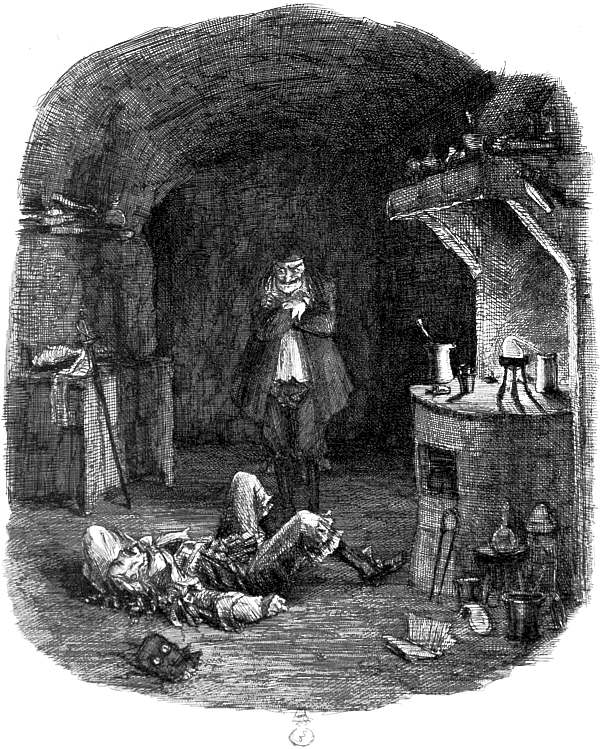
“He darted at the dead body like a beast of prey; and drew forth the bag of money, which he transferred to his own pouch. He next tore away every ornament of any value that adorned Gaudin’s costly dress....”
While at this congenial occupation, “the bristling halberts of the guard appeared.
“‘Back!’ screamed Exili. ‘Keep off, or I will slay you and myself, so that not one shall live to tell the tale! Your lives are in my hands,’ continued the physician, ‘and if you move one step forward they are forfeited.’
“He darted through a doorway at the end of the room as he spoke, and disappeared. The guard pressed forward; but, as Exili passed out at the arch, a mass of timber descended like a portcullis and opposed their further progress. A loud and fiendish laugh sounded in the souterrain, which grew fainter and fainter, till they heard it no more.”
The poisoner escaped—for a time. He was captured afterwards, tried, and, of course, condemned to death—a merciful death compared with that which befell him on his way to execution at the hands of the infuriated people, by whom his guards were overpowered, and after being almost torn to pieces, he was thrown into the Seine.
The toils were now closing round the miserable Marchioness de Brinvilliers. The wretched woman had reached the inconceivable condition of degradation said to be common to successful murderers when impunity has followed their first crimes—that of killing for killing’s sake. She put on the clothes of a religeuse, attended the hospitals, and poisoned the patients. Their dying cries were music to her, their agonies afforded her the keenest pleasure. To the student of French criminal history this is no news. I note it here so that the historian of the woman’s crimes should not be thought to have invented incidents that existed only in his imagination. Mr. Smith had the best authority for all the murders with which he charges Madame de Brinvilliers.
The death of Sainte-Croix was followed by the usual police regulation where foul play is suspected. Seals were affixed to his effects, amongst which poisons were discovered that were proved to be the property of the Marchioness of Brinvilliers. The murderess, terror-stricken, fled from Paris; and, though hotly pursued, she escaped into Belgium, and sought refuge in a religious house, where she took “sanctuary.” The pursuers were so near that, as she jumped from her carriage at the convent-door, she left her cloak in the hands of the exempt. She turned upon him, says the author, “with a smile of triumph that threw an expression of demoniac beauty over her features, and cried:
“‘You dare not touch me, or you are lost body and soul!’”
I must again refer my reader to Mr. Albert Smith’s book if he wishes to learn how the exempt, disguised as an abbé, beguiled the Marchioness from her sanctuary, and content myself with showing—or rather in letting Leech show—how she looked when the police-officer dropped his disguise and she found herself seized by his men.
The details given by Mr. Albert Smith of the last hours of Madame de Brinvilliers are, though painful reading, very remarkable. The Docteur Pirot, who passed nearly the whole of his time at the Conciergerie, has left records of which the author has availed himself, as well as from the letters of Madame de Sévigné. Those who wish to “sup full of horrors” can satisfy themselves by reading the account of the torture by water which was inflicted upon the miserable woman to induce her to betray her accomplices. But there were none to betray. Her only accomplice was dead. Her sufferings on the rack very nearly cheated the headsman, for, as they culminated “in a piercing cry of agony, after which all was still, the graffier, fearing that the punishment had been carried too far, gave orders that she should be unbound.” On her way to execution, she was attended by the constant Pirot. The tumbrel stopped before the door of Nôtre Dame, and a paper was put into her hands, from which she read, in a firm voice, a confession of her crimes. The tumbrel again advanced with difficulty through the dense crowds, portions of which, “slipping between the horses of the troops who surrounded it, launched some brutal remark at Marie with terrible distinctness and meaning; but she never gave the least sign of having heard them, only keeping her eyes intently fixed upon the crucifix which Pirot held up before her.”
In this drawing Leech’s power over individual character may be noted in the diversity of type amongst the hooting crowd round the tumbrel. The shrinking form of the prisoner is very beautiful.
When the Place de Grève was reached the execrations of the mob had ceased, and “a deep and awful silence” prevailed, “so perfect that the voices of the executioner and Pirot could be plainly heard,” says the chroniclers. I pass over harrowing details. The beautiful head of the poisoner was struck off by a single sword-stroke, and the executioner, turning to Pirot, said:
“‘It was well done, monsieur, and I hope madame has left me a trifle, for I deserve it.’”
He then “calmly took a bottle from his pocket and refreshed himself with its contents.”
If the short extracts from the history of this great criminal have enabled my readers more clearly to understand and enjoy Leech’s illustrations, my object in selecting them has been realized.
CHAPTER X.
“A MAN MADE OF MONEY.”—DOUGLAS JERROLD.
Knowing that this extraordinary book was illustrated by John Leech, and hearing that it contained some of his best work, it became my duty to make a sufficient acquaintance with the book to enable me to criticise and explain the drawings to my readers. I tried “skimming,” but the power of the book, and the brilliancy of the wit in it, so attracted me that I read the whole of it.
It is not my province, and it is certainly not in my power, to pose as a critic of literary work; and the hero—the man made of money, with a heart made of bank-notes instead of flesh and blood, containing within himself a bank that could be drawn upon to any amount—is so wonderful a being as to place him out of the category of human creatures, and altogether beyond criticism. This gentleman’s name was Jericho. He had waited till he was forty, and then he married a widow with three children; two of them were girls, the third a young gentleman of whom those who knew him best said, “He was born for billiards.” There was no love lost between Mr. Jericho and his step-children; in fact, they cordially hated him, and he returned the compliment. Their name was Pennibacker, inherited from their father, Captain Pennibacker, whose loving wife “was made a widow at two-and-twenty by an East Indian bullet.” Mr. Jericho was one of that large class which, though really needy, manœuvres successfully to be considered wealthy. His step-children considered him as “a rich plum-cake, to be sliced openly or by stealth among them.” The widow Pennibacker was first attracted to him by “a whispered announcement that he was a City gentleman. Hence Jericho appeared to the imagination of the widow with an indescribable glory of money about him.”
Mrs. Jericho desired to make a few purchases, and she approached her husband with a cry familiar to most of us:
“‘Mr. Jericho, when can you let me have some money?’”
The lady’s confidence in her husband’s wealth ought to have been shaken by what followed her application. Mr. Jericho turned a deaf ear to the appeal, which was repeated in every variety of tone and accent.
At length, “waving her right hand before her husband’s face with a significant and snaky motion,” she reiterated her demand with a terrible calmness:
“‘When can I have some money?’
“‘Woman!’ cried Jericho vehemently, as though at once and for ever he emptied his heart of the sex; and, rushing from the room, he felt himself in the flattering vivacity of the moment a single man. ‘I’m sure, after all, I do my best to love the woman,’ thought Jericho, ‘and yet she will ask me for money.’”
Disgusted with these unreasonable demands for money, Mr. Jericho determines to revenge himself by taking a day’s pleasure with three special friends, to be ended by “a quiet banquet at which the human heart would expand in good fellowship, and where the wine was above doubt.”
The dinner was a great success. It was very late—or rather somewhat early, as the sparrows were twittering from the eaves—when Mr. Jericho sought the marital couch, in which, too, his “wife Sabilla” was evidently “in a sound, deep, sweet sleep.”
“Untucking the bed-clothes, and making himself the thinnest slice of a man, Jericho slides between the sheets; and there he lies feloniously still, and he thinks to himself—Being asleep, she cannot tell how late I came to bed. At all events, it is open to dispute, and that is something.
“‘Mr. Jericho, when can you let me have some money?’
“With open eyes, and clearly ringing every word upon the morning air, did Mrs. Jericho repeat this primal question.
“And what said Jericho? With a sudden qualm at the heart, and with a stammering tongue, he answered:
“‘Why, my dear, I thought you were sound asleep.’”
Here follows a dialogue in the vein of the “Caudle Lectures,” in which Jerrold gives his wit and humour full play. To the perusal of the “give-and-take” passage of arms I cordially commend my readers. The dialogue closes with these words:
“‘I’m sure it’s painful enough to my feelings, and I feel degraded by the question, nevertheless I must and will ask you—When will you let me have some money?’”
This was the last straw, and Jericho groaned out:
“‘I wish to Heaven I was made of money!’”
To which Mrs. Jericho retorted, “in a low, deep, earnest voice:
“‘I wish to Heaven you were!’”
Silence came at last, and in the midst of it Jericho “subsided into muddled sleep; snoring heavily, contemptuously, at the loneliness of his spouse.”
And now two fleas—an elder and younger flea—come upon the scene, and proceed to dine, or sup, upon Mr. Jericho’s brow.
A long conversation ensues between these interesting creatures, in which the elder flea describes to his son how a man’s heart was changed into inexhaustible bank-notes.
“‘Miserable race!’ said the father flea, with his beautiful bright eye shining pitifully upon Jericho; ‘miserable, craving race, you hear, my son! Man in his greed never knows when he has wherewithal. He gorges to gluttony; he drinks to drunkenness; and you heard this wretched fool who prayed to Heaven to turn him—heart, brain, and all—into a lump of money.’”
How the operation was effected may be learnt from Mr. Jerrold’s book. One result of it was a most troubled and miserable night to the dreamer Jericho, whose complaints to his wife when he awoke met with no sympathy.
“‘If I were to live a thousand years, I shouldn’t forget last night!’ groaned Jericho.
“‘Very likely not,’ said Mrs. Jericho; ‘I’ve no doubt you deserve to remember it. I shouldn’t wonder——’”
Mrs. Jericho’s want of money is intensified by the wants of her son Basil, whose luck at billiards may have failed him just when his creditors were most pressing.
“‘Well, what does the old fellow say, the scaly old griffin? What’s he got to answer for himself?’” This was “the sudden question put to Mrs. Jericho on her return to the drawing-room, after the interview with her husband. ‘Come, what is it? Will he give me some money? In a word,’ asked young hopeful, ‘will he go into the melting-pot, like a man and a father?’
“‘My dear Basil, you mustn’t ask me,’ replied Mrs. Jericho.
“‘Oh, mustn’t I, though!’ cried Basil. ‘Ha, you don’t know the lot of people that’s asking me; bless you, they ask a hundred times to my once!’”
The Jerichos have some rich friends, the Carraways, who live in a mansion called Jogtrot Hall, “the one central grandeur, the boast and the comfort of the village of Marigolds.” To a fête at the Hall comes an invitation to the Jerichos. It had always been Mrs. Jericho’s ambition that her girls should—“in her own nervous words”—make a blow in marriage, and she felt that perhaps the time had come. But the girls’ dresses—the “war-paint,” as Mr. Basil put it—there was the difficulty, only to be surmounted by Mr. Jericho’s yielding to the repeated cry, “When will you let me have some money?”
With but faint hopes of success, Mrs. Jericho seeks her husband in his study. In a long colloquy, she urges the importance of her daughters’ appearance at this “grand party,” and the necessity for an advance to enable them to do so properly. Mr. Jericho turns a deaf ear to her appeal, till suddenly a wonderful change comes over him.
“Quite a new look of satisfaction gleamed from his eyes, and his mouth had such a strange smile of compliance! What could ail him?”
The charm was working, the marvellous change was in operation. Mrs. Jericho fears for her husband’s sanity. “‘He doesn’t look mad,’ thought Mrs. Jericho, a little anxious.
“‘I feel as if I had got new blood, new flesh, new bones, new brain! Wonderful!’ Jericho trod up and down the room and snapt his fingers. ‘Something’s going to happen,’ said he.”
And something did indeed happen. The transformation was complete; the hard heart had given place to illimitable money.
“‘You will let me have the money?’ repeated Mrs. Jericho.
“Jericho answered not a word, but withdrew his hand from his breast. Between his finger and his thumb he held in silver purity a virgin Bank of England note for a hundred pounds. Mrs. Jericho ran delightedly off with the money.
“And Jericho sat with his heart beating faster. Again he placed his hand to his breast, again drew forth another bank-note. He jumped to his feet, tore away his dress, and, running to a mirror, saw therein reflected, not human flesh, but over the region of the heart a loose skin of bank-paper, veined with marks of ink. He touched it, and still in his hand lay another note. His thoughtless wish had been wrought into reality. Solomon Jericho was in very truth a Man made of Money.”
The fête at Jogtrot Hall was a great success. The guests were many, and some of them distinguished. The Honourable Mr. Candytuft, Colonel Bones, Commissioner Thrush, and Dr. Mizzlemist, of Doctors’ Commons, must be noted, as they have to be dealt with pictorially by Leech hereafter. After a variety of entertainments, some twenty or thirty hungry guests graced a table under a long, wide tent, on which “there were the most delicious proofs of the earth’s goodness, with every kitchen mystery.” The host, Mr. Carraway, took the head of the table; Mr. Jericho, “dignified and taciturn, graced the board.” The orator on the occasion was Dr. Mizzlemist, who had been seized with a passion to drink everybody’s health. For the third time he rose to give “the health of Solomon Jericho, Esquire, an honour to his country.”
“In the course of his speech the Doctor delivered himself with so much energy that at the same time he stuck the fork, which had served him in emphasizing the Jericho virtues, between the bones of Mr. Jericho’s right hand, pinning it where it lay.
“‘It is nothing,’ said the philosophic Jericho.”
The change in Mr. Jericho’s appearance, from the full-faced, healthy-looking individual of Leech’s first drawing, to the spare, hollow-cheeked man at the banquet, is to be accounted for by the fact that, after each application to the strange bank established in Mr. Jericho’s breast, his whole form shrinks; he becomes thinner and thinner, to the alarm of his tailor, who “says, as he measures the changed man:
“‘Six inches less round the body, as I’m a sinner! Six inches less, Mr. Jericho, and I last took your measure six weeks ago.’”
At the Carraway fête the Misses Jericho made, and improved, the acquaintance of the Hon. Mr. Candytuft, and of an incredible idiot, Sir Arthur Homadod. The idiot was as beautiful as he was foolish; he was therefore handsome beyond the dreams of beauty. Whatever had taken the place of the mind in the baronet was impressed by Miss Agatha Pennibacker, and that virgin’s heart being free, she lost it to Sir Arthur. The Hon. Mr. Candytuft, having an eye to the enormous fortune supposed to be possessed by Mr. Jericho, and being desirous to secure the portion of it that would of course fall to his step-daughter, made love to Miss Monica with considerable success.
In the meantime the ladies wish to go to Court; in this they are encouraged by Candytuft; and, to enable them to make a proper figure there, costly jewels are required. To Candytuft and Jericho enter Mrs. J., “with a magnificent suite of jewels.
“‘Aren’t they beautiful, my dear Solomon?’ said she....
“‘You know, my dear,’ said Mrs. Jericho, in her sweetest, most convincing voice, ‘it would be impossible to go to Court without diamonds. One isn’t dressed without diamonds.’
“‘Court!’ Jericho opened his eyes, and a wan smile broke on his thin, blank cheek. ‘Are you going to Court?’