LECTURE I
Reading edition
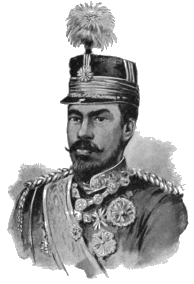
EMPEROR.
I
IT is now nearly four hundred years since the brave discoverer, Magellan, first sailed around the world. Yet, till comparatively recent times, three years were necessary to complete the circuit. To-day, some Phineas Fogg can put a girdle round the earth in less than eighty days, and messages are flashed to us from China and Ceylon in less than eighty seconds. The old-time spirit of adventure amid unknown scenes, which thrilled the traveler of former years, has, therefore, well-nigh disappeared. Of all the surface of our globe, the Polar Seas alone still bid defiance to the approach of man; though every year the ultimate capitulation of those ice-bound areas, lit by the aurora, becomes less remote.
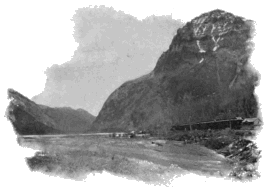
MOUNT STEPHEN.
The broad Atlantic has now dwindled to an ocean ferry. Europe is measured, not by weeks, but by hours. Constantinople, once so remotely Oriental, is but five days from London,—Cairo only six. Even the vast Pacific glides beneath our keel in thirteen days. Two centuries ago, the man who had achieved a journey around the globe would have been called a hero. One century since, he would have been remarkable. To-day the name he earns is merely—"Globe-trotter." In consequence of this, to certain minds our vanquished earth seems like a squeezed and juiceless orange. Material forces have deprived it of romance, as age has robbed the moon of atmosphere and life. And yet, the fact that we move rapidly from point to point need not lessen our interest in the places that we visit. The wondrous beauty of the Taj Mahal and the incomparable majesty of the Himalayas are not less enjoyed because we can make a pilgrimage to them with comparative comfort. Japan's awakened empire, China's four hundred millions, the toiling myriads of India, with history, customs and religions antedating those of Christendom, present the same stupendous problems, whether we visit them in an antique sailing-craft or in a modern steamer. Despite the speed with which we flit from continent to continent, the actual distance is still there. Let but the steamer's shaft become disabled in mid-ocean, and the fact will not be doubted. But of whatever size our earth may now appear to us, the time has never been when travel upon its surface offered such attractions. Its countries now are like a series of intensely interesting books—each the sequel of its predecessor—which science, commerce, and navigation have laid open for our scrutiny.
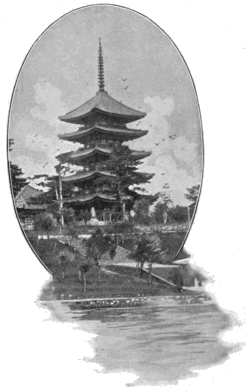
A JAPANESE PAGODA.
A tour around the world, therefore, is vastly more instructive than a journey through the principal European cities. Mere Occidental travel, though delightful, is but fragmentary and one-sided. The unbroken circle is alone the symbol of completeness; and only when the traveler has sailed away from our Pacific coast, and journeyed on and on toward the setting sun, until he sees the shores of our Republic (never before so beloved) rise from the waves of the Atlantic, can he in truth exclaim, with Monte Cristo, "The world is mine!"
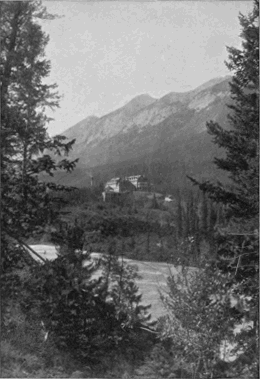
BANFF.
The route which we selected for our journey to Japan was the superbly built and admirably equipped highway to the Orient, the "Canadian Pacific." This magnificent transcontinental system comprises, first, the gleaming path of steel which crosses Canada from sea to sea; and, second, a fleet of steamers at the western terminus of the road—the largest, swiftest, and most modern boats that ply between the North American continent and the land of the Mikado. The various railway lines from the Atlantic to the centre of the continent are too well-known to require description; but since some starting-point is necessary, we may well choose, as the most appropriate one, the vast plains of Manitoba, midway between the Atlantic and Pacific, and only eighteen hours by rail from Minneapolis. Mile after mile, and hour after hour, we sped through these prairies as level as a tranquil sea. Sometimes, like wreckage floating on the waves, we saw great sun-bleached heaps of skulls and bones—pathetic relics of the herds of buffaloes which only thirty years ago existed here in millions, but which man's cruelty and recklessness have almost totally destroyed. At other times, the railroad cut its silvery furrow through a boundless area of golden rod and daisies,—apparently a shoreless ocean of red, green, and gold, upon the verge of which the sky seemed to rest like an azure dome. But presently we realized that the plains were being left behind us. In fact, between these prairies and the vast Pacific rise three great mountain-ranges almost parallel to one another. They are the Rocky, the Selkirk, and the Cascade mountains.
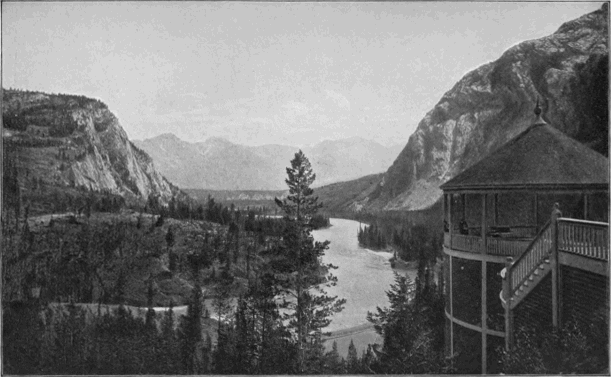
ON THE PORCH AT BANFF
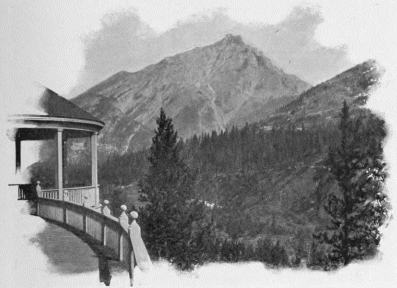
A VIEW FROM THE HOTEL.
It was already evening when we approached the "Rockies." We tried to catch their outline, but in vain. Behind a veil of impenetrable gloom, the morrow's splendid spectacle awaited us. Accordingly, at five o'clock in the morning, the subtle nervousness which usually heralds any long anticipated pleasure woke me with a start. I raised the curtain of my berth, and from my lips there came an exclamation of delight. There were the "Rockies," as I had so often pictured them; no longer vague creations of some other man's enthusiasm, but glorious realities awakening mine. A rugged wall of granite met my gaze, seamed here and there with silver, as the pure snow sparkled in its crevices; while all along its crest, five thousand feet above our heads, the dawn had traced a parapet of gold. I felt at once that thrill of satisfaction which every traveler prizes more and more as years roll on and fewer famous sights are left him to explore. It was the consciousness of one more conquest made, not merely for the excitement of a first possession, but for the calmer and more abiding pleasure of retrospection.
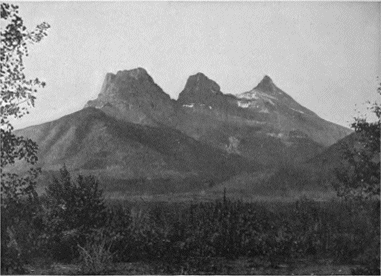
THE THREE SISTERS.
An hour later, we had left the train to spend two days at Banff,—a place unknown before the advent of the railroad, but forming now the centre of a charming region, four thousand five hundred feet above the sea, reserved by the Canadian Government as a national park. Above us, in the morning light, like some old Rhenish castle on a wooded cliff, appeared a picturesque hotel, within whose ample hall we found a huge log blazing in the fireplace; while modern luxuries, such as bath-rooms and electric-lights, assured us a delightful resting-place. Yet this is but one of several hotels built by the railroad company at points of special interest, so that the traveler by this route may halt and view its scenery amid comfortable surroundings.
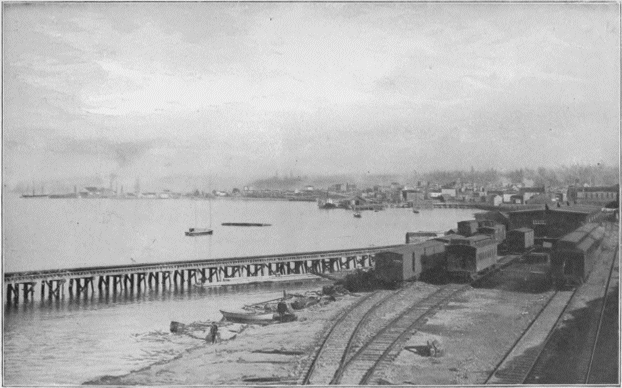
VANCOUVER.
Soon after our arrival, we started on a tour of exploration, and found the situation worthy of its fame. Over the best of roads Canadian ponies whirled us along the windings of the Bow river, green as emerald. The air was as pure as that of Norway. A breath of it was like a draught of wine. So transparent was the atmosphere, that mountains miles away seemed close at hand. Strange mountains these! Their color is an ashen gray, now darkened by a passing cloud, now almost white with vivid sunlight. They have no vegetation on their rugged slopes, save a few pine-trees, which suggest the "forlorn hope" of an army struggling toward a citadel.
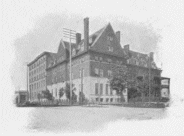
HOTEL VANCOUVER.
Had time permitted, we should have gladly lingered in this glorious region,—but with so much before us, we were compelled to take our leave of Banff and enter on the last great section of our journey toward the sea. In making this, we were for hours surfeited with grandeur. Our chief desire was to retard the train, and check the rapid shifting of imposing scenery. Our brains at last refused to receive additional impressions. One could spend weeks upon this portion of the route alone. Sometimes our train wound like a serpent around the mountain sides,—now on a narrow ledge three hundred feet above a foaming torrent, now gliding through a tunnel in the solid rock. Three million dollars' worth of snow-sheds guard this railway from the avalanche, and rivers even have been forced to turn aside and yield their immemorial pathways to the iron conqueror.
But now farewell to railroads and to mountains! We have reached the sea. Who that has ever crossed our mighty continent can quite forget the moment when, after all the plains and mountains he has traversed, he gains his first glimpse of the blue Pacific? It is at once a startling revelation of the distance he has come, and a reminder of those Orient lands whose misty shores still seem so fabulously tar away.
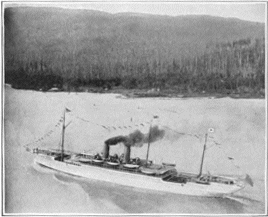
THE EMPRESS OF JAPAN.
Our ocean gateway, and place of embarkation for Japan, was Vancouver,—one of those marvels of the West, which, notwithstanding all our previous reading, astonish us when actually seen. Ten years ago Vancouver was a wilderness; a forest covered every portion of the present city. To-day it has good streets and sidewalks, electric-lights and trolley-cars, banks, churches, some extremely pretty houses, and a good hotel.
What an excitement marks the embarkation-day at this Hotel Vancouver! What searching glances pass from one strange group of travelers to another, as if to read the characters and dispositions of the men and women who are to be their fellow-passengers for fourteen days,—aye, more than that;—to be, perchance, their fellow-travelers for many months, meeting on other steamers, or in Chinese streets, or possibly in the palm-groves of Ceylon. No gaiety is yet discernible. It is the hour for farewells. The reading-room is filled with busy scribes, whose scratching pens and long-drawn sighs alone disturb the silence of the place.
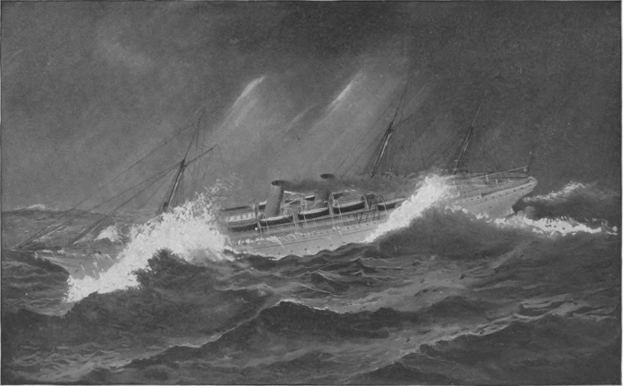
THE "EMPRESS" IN A STORM.
We saw, on the last day, at least a score of ladies, bent almost double on divans or arm-chairs, using alternately their writing-tablets and their handkerchiefs,—their tears apparently flowing much more freely than the ink from their fountain pens. Telegraph boys were meanwhile running to the various rooms with good-bye messages from eastern friends. "No use in sending them out," the blase operator told me; "they are all alike. Might just as well hoist a flag with the letters 'B. V.' on it; for every message ends with the same words: 'Bon Voyage!'"
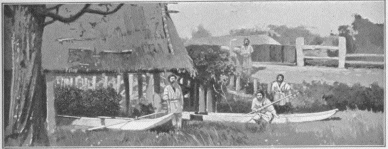
A JAPANESE VILLAGE.
But now the actual sailing-time has come; the last fond messages have been received; the gang-plank is thrown off; the huge propeller moves; and we have left our native land to make the circuit of the world. Of course some tears are shed; some cheeks grow paler at the thought of all that lies before us in the twenty-five thousand miles of land and water we must traverse; but these are soon forgotten in contemplation of the ship itself,—the Empress of Japan. This is one of the finest steamers in the world, and like her sister ships, the Empress of China and the Empress of India, is a vessel of six thousand tons and of ten thousand horse-power. Graceful and beautiful she looked,—her great hull snow-white to the water's edge, to shield it better from the tropic sun.
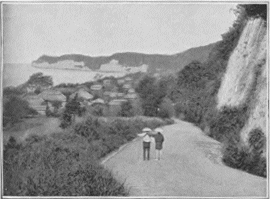
MISSISSIPPI BAY.
Aside, however, from the speed, strength, and comfort of the steamers, the voyage across the North Pacific does not call forth enthusiastic praise. It is a lonely, unfrequented route. We saw no sign of land or life for thirteen days. The cold, too, was excessive. Unless wrapped up with extra care, we could not sit on deck with any comfort, although protected from the wind by canvas screens. Moreover, in its sudden changes, this North Pacific rivals the Mediterranean in winter, and when aroused, its billows are colossal. During our voyage there were some hours, and even days, when all was reasonably calm; but there were others when tremendous winds tore into shreds the crests of white-capped waves and filled the air with blinding spray. Hours there were, when trunks not merely slid, but bounded, clear across the room, and landed with their casters in the air, like the hoofs of a rolling horse; hours when even the pantry stove revolted at such treatment and hurled its glowing coals about the floor. I recall an unusually stormy period when the diet of at least two wretched passengers for an entire day consisted of one grape,—and my companion ate the grape!
The day which passed most quickly on this voyage was that which we deliberately dropped from the calendar, on crossing the one hundred and eightieth meridian of longitude, just half-way around the world from London, and equidistant, east and west, from the observatory at Greenwich. Some wicked passengers ascribed our stormy weather to the missionaries on board, claiming that gales at sea are their invariable attendants. However that may be, there certainly were times when all the passengers (missionaries included) would have agreed with the old Japanese proverb—"A stormy sea-voyage is an inch of hell."
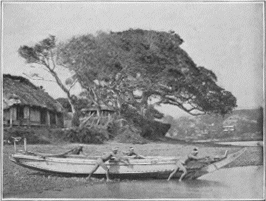
COMING TO MEET US.
Nothing stands out more clearly in my recollection of the Orient than the bright, long anticipated hour when, after thirteen days of dreary ocean travel, we suddenly beheld, emerging from the waves, that strange, unique, and fascinating land, which promised so much novelty and pleasure,—old Japan. Old, and yet new; for the fair sheet of water which first greeted us was Mississippi Bay, named from the flagship of Commodore Perry, which, with the remainder of his American fleet, dropped anchor here in 1854. The coming of this envoy to the East was not for the purpose of war or invasion, but to request that this important empire, our nearest neighbor westward, lying directly in the path of commerce between Asia and America, should, for the sake of mutual benefit, open its doors (till then resolutely closed to foreigners) and become, to some degree, accessible to the outer world.
Impatient to explore this land, we swept the shore with field-glasses, and saw, with much amusement, some natives hastening to launch their boats and row out to us. But were they really coming in just that economical style of dress? They were, and did; but in five minutes we forgot their costumes (or rather their want of them) in admiration of the men themselves. It was, however, not their faces, but their forms, which so attracted us. Never in marble or in bronze have I seen finer specimens of limbs and muscles than those displayed by the compactly built and copper-colored boatmen of Japan. Some of them looked like masterpieces of antiquity, suddenly endowed with life and motion.
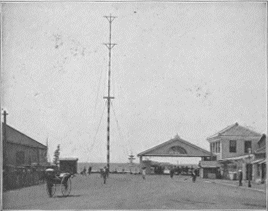
THE CUSTOM-HOUSE, YOKOHAMA.
Taking the hotel steam-launch, in preference to the native boats, we quickly reached the landing-pier of Yokohama. A slight examination of our trunks was made by officers polite enough to beg our pardon for the trifling delay. There is a duty in Japan on photographic cameras. One of our party was, therefore, called upon to pay the stipulated sum. "I have no Japanese money," he faltered; "I must leave my camera here, and call again."
"Not at all," replied the official courteously; "I will lend you the money; here it is." I thought my friend, accustomed only to the refinements of the New York Custom-house, would faint away. At last he gathered strength enough to ask: "But what security have you that I will repay you?"
"Ah!" replied the officer, smiling, "you are an American."
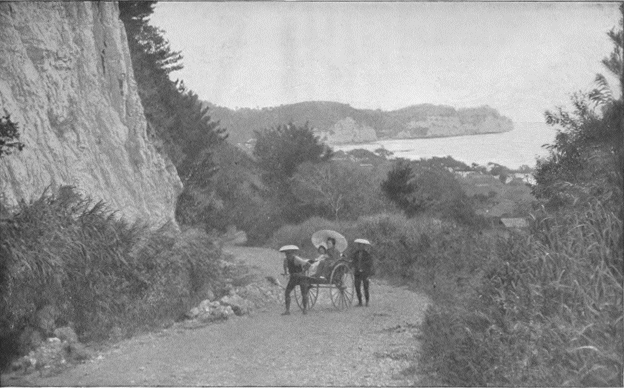
AS THE NATIVES TRAVEL.
"Truly," he exclaimed, as we walked away, "the Japanese are the French of Asia."
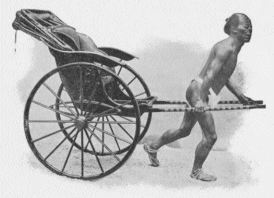
A JINRIKISHA.
On leaving the Custom-house I laughed aloud to see awaiting us the almost universal means of locomotion in Japan—the jinrikisha. Shades of our childhood!—what are these? Big-wheeled baby-carriages surely, and yet used altogether by adults. They looked as though a heavy man could crush them to earth, or a strong wind might blow them against the wall. When we stepped into ours, we did so cautiously, lest we should suddenly go over backward; and at the sight of some of our more stalwart passengers thus installed, the air was filled with peals of laughter. One portly traveler, weighing at least two hundred pounds, wagged his head feebly at an equally heavy comrade, and shook a "da-da" at him, as if they had both gone back to the state of babyhood. Yet, incredible as it would at first appear, the traveler soon comes to like these little vehicles. Their running-gear, though light, is strong. A breakdown in them is practically unknown. The steeds which draw them harness and unharness themselves, never shy nor kick, and are obedient to the slightest command. Jinrikishas are so cheap that one can hire them all day long and never feel the expense. Ten cents an hour is the usual price, or seventy-five cents for an entire day. One's packages and valises follow in another jinrikisha. The speed at which one travels in them is astonishing. Even with only one man in the shafts, the usual rate is at least five miles an hour. With one man pushing, and two pulling tandem, you actually seem to fly. On good roads with two men we sometimes made ten miles an hour. And what is most delightful to the traveler, the runners themselves seem to enjoy it thoroughly. Time and again in the country, when they had drawn us twenty or thirty miles with but occasional halts, they actually raced each other on the last half-mile, laughing and capering like boys at play.
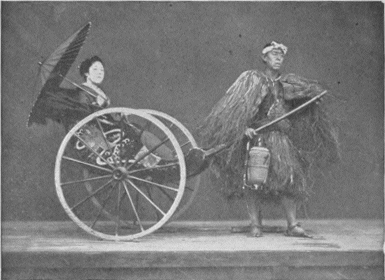
A JAPANESE MACKINTOSH.
In stormy weather these human horses wore blankets that excited both our laughter and amazement. They are a kind of Japanese mackintosh, composed of grass and straw, which, though they are quite effectual in shedding rain and snow, give to the wearer the appearance of a fretful porcupine.
A certain patriotic feeling draws Americans to the jinrikisha; for this convenient little chaise was the invention of a Yankee missionary. He ought to have made a fortune by it, for in Yokohama alone there are five thousand of these vehicles, and in Japan more than two hundred and fifty thousand; while they are also numerous now in China, India, and Singapore. But the missionary has had the usual fate of inventors, and is said to be, at present, an inmate of an Old Men's Home near Philadelphia.
PECULIAR TRAVELING.
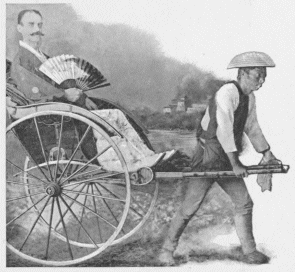
"A BIG-WHEELED BABY-CARRIAGE."
The Japanese word, jinrikisha, is worth explaining, "jin" means man, "riki" denotes power, and "sha" signifies wheel. A "man-power-carriage" is therefore the correct translation; but the wittiest and most appropriate title is the one given to it by an American tourist,—the "Pull-man-car." Delighted with our first experiences in these little vehicles, we left the Custom-house in Yokohama, and were quickly trundled to the Grand Hotel. This is one of the best hotels in the entire East. It fronts directly on the sea, and one can sit for hours on its long verandas and watch the animated scenes of street-life in the foreground; or else look off upon the lovely bay, where ships and steamers of all nations lie at anchor, among which glide the native boats, propelled by the bronzed athletes of Japan. My mind goes back with positive delight to some cool morning hours at my window here, but oftener still to moonlit evenings passed upon my balcony. At such a time, the scene recalled a painting in some cyclorama,—so difficult was it to discern where fancy ended and reality began; so smooth appeared the harbor's silvered breast; so motionless the mighty steamers stationed there like sentinels; so still their tapering masts, rising like minarets against the sky; while here and there a red or green light on a steamer's side flashed like a ruby or an emerald. Moreover, as the hours moved on, breaking the solemn stillness of the scene, the ship's bells followed one another through the watches of the night, and stole across the water like a silvery chime.
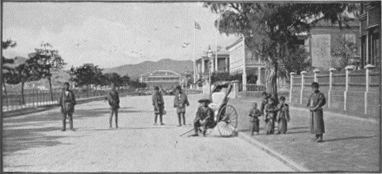
WAITING FOR A "FARE."
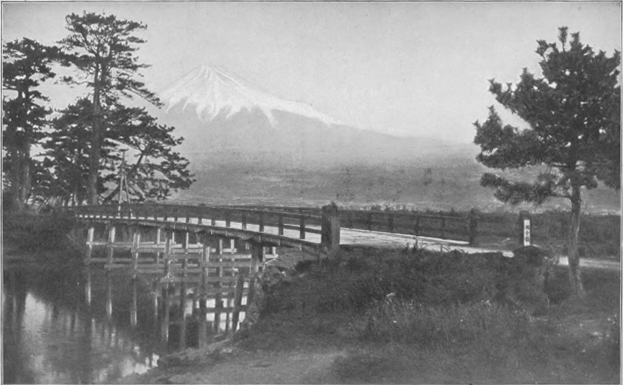
A DISTANT VIEW OF FUJI-YAMA.
IN YOKOHAMA BAY.
Yokohama is divided into three sections. The first is the original business settlement, where the hotels are located; the second is the strictly Japanese quarter; the third lies on an eminence called "The Bluff." The summit of this hill is reached, not merely by a winding road, but also by a stairway commonly known as the "Hundred Steps." Upon this height most of the foreigners reside; here also are the hospitals of different nations, the foreign cemetery, and several consulates. Wishing one day to make a call upon a resident on this hill, and being unable to make our human pony understand his name, we asked the aid of the hotel proprietor. To our astonishment, he said to us: "No name is necessary. I shall merely tell him to take you to gentleman No. 35." A moment's thought explained to us the reason for this custom; for "No. 35 gentleman" or "No. 76 lady" are terms which "'rikisha men" can much more easily understand than foreign names. Yet even this system has its difficulties; for all the houses on the Bluff are numbered, not in the sequence of location, but in the order of their erection. Thus, the first residence constructed there is No. 1, but the dwelling next to it, if recently erected, may be called No. 500.
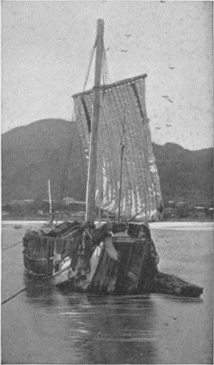
AN OLD-FASHIONED CRAFT.
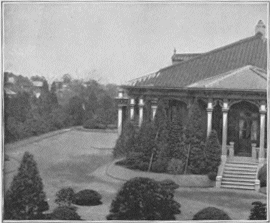
Some of the houses on the Bluff are quite attractive; and life in them must be in many respects delightful. We met here two American ladies, who, having taken a furnished house for several months, were actually housekeeping in Japan. They told us that they had never had so pleasant an experience, and that the markets of Yokohama abounded in meat, fish, fruit, and vegetables, all at reasonable prices, while their Japanese servants had been so devoted and respectful that they were spoiled for housekeeping with any others. The summer, they confessed, had been hot, and varied by an occasional earthquake; but on the Bluff the air was pure and cool, and they had at least been exempt from thunder-storms.
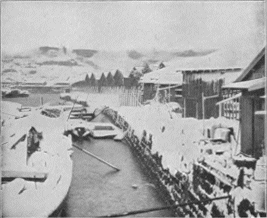
Yet Yokohama's climate is not always tropical, or even mild. Winter also can assert itself here, and boats and buildings sometimes wear a robe of snow. Such a wintry temperature makes, of course, little difference in the comfort of foreigners; but, to the Japanese themselves, one might suppose the winter months would be a season of protracted misery, since the vast majority of the natives have no fire in their houses save that in a charcoal brazier; the partitions in their dwellings are mere paper screens; and they themselves rarely wear woolen garments, much less flannel ones. Yet the people are hardy. Jinrikisha men, we were told, will run about the snow-covered streets with only cotton sandals on their feet.
"How can your people live thus thinly clad, and with so little fire?" we asked our guide.
"Oh, they become used to it," he answered. "You never cover up your face in winter. It is accustomed to the cold. So we subject our bodies to the same endurance."
A RESIDENCE ON THE BLUFF. YOKOHAMA IN WINTER.
One day, in strolling through a street in Yokohama, we came upon two little Japanese women doing laundry work and spreading garments out to dry upon a smooth, flat board. Following the pleasant custom of the country, they laughingly called out to us, "Ohaio—Ohaio,"—the Japanese expression for "Good Morning!" One of our party, a judge from Covington, Kentucky, did not understand the meaning of that word. Accordingly, when one of these Japanese maidens smiled sweetly in his face, and said, with a slightly rising inflection, "Ohaio!" he faltered, and replied, "Well, not exactly; I come from Covington, just across the river!"
ON THE WAY TO KAMAKURA.
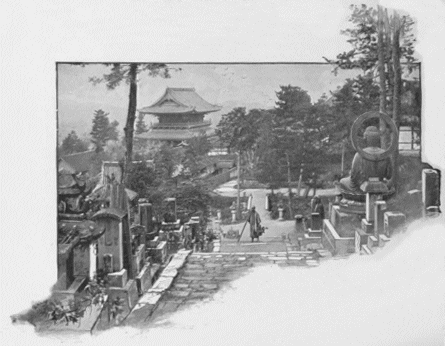
The foreign cemetery of Yokohama is beautifully situated on the Bluff, above the tumult of the town. It is well-kept, and many of its monuments are elaborate. Numerous epitaphs in English, French, German, and Italian attest the cosmopolitan character of the place. As we were walking there one Sunday afternoon, we met a lady deeply veiled, leaning upon her husband's arm, and giving way to uncontrollable grief. When they were gone we ventured to approach the grave which they had left. The tombstone bore a recent date, and on it were four lines that deeply moved us by their sad simplicity; for, stooping down to a low headstone wreathed in flowers, we read these words:
"A little grave, but oh, have care, For world-wide hopes are lying there; How much of light, how much of joy Are buried with a darling boy!"
A JAPANESE CEMETERY.
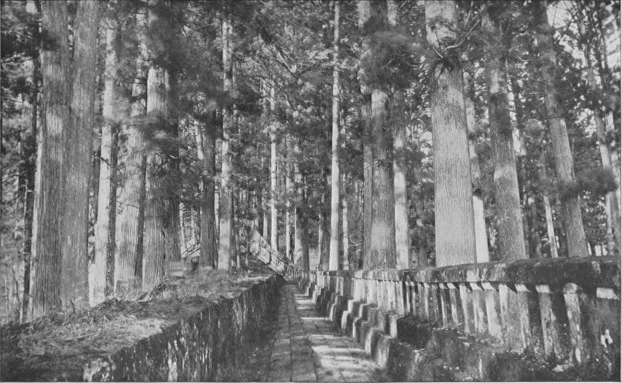
PATH TO THE SHOGUN'S HOUSE.
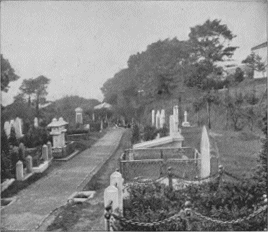
THE FOREIGN CEMETERY, YOKOHAMA.
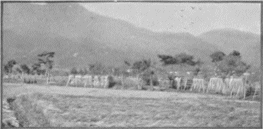
The day after our arrival in Yokohama, we drove out into the surrounding country. It was historically very interesting. Upon the plain where we saw laborers harvesting their crops, once stood the ancient capital of the empire,—Kamakura. It was then the residence of a million people, and was, no doubt, a scene of splendor, war, and intrigue; yet of the men and deeds which moved it centuries ago we know comparatively nothing. We sometimes think ourselves familiar with the history of our race; and so we are, along the lines of Egypt, Rome, and mediæval Europe. But when the traveler visits China, India, and Japan, he realizes the fact that he has come to the other side of the globe,—to lands whose histories are more remote than those of even Greece and Rome, and yet utterly distinct from all the streams of civilization which have flowed toward him. He begins to feel as men might who, having always thought the Rhine to be the only river of any magnitude on earth, should suddenly find themselves beside the Nile, whose mighty volume has been rolling onward for unnumbered ages, and over whose distant origin there hangs the halo of mystery.
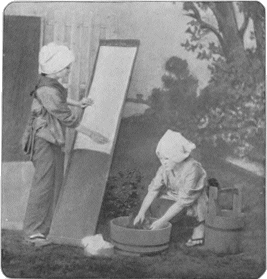
DOING LAUNDRY WORK.
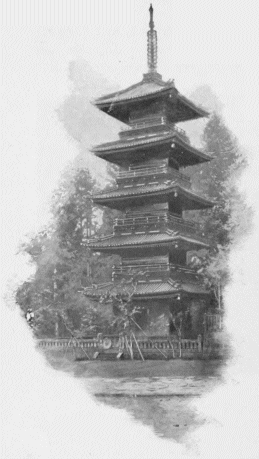
A BUDDHIST PAGODA.
One thing, however, still remains at Kamakura to tell us of its unrecorded past. It is the world-renowned statue of Buddha,—one of the largest works in bronze that man has ever made. Upon a huge stone pedestal, in the form of a lotus-flower, one hundred feet in circumference, this monstrous figure has been seated here in solemn contemplation for seven hundred years. It is a noble representation of the man before whose shrines more knees are bent in prayer to-day than before those of any other founder of religion whom this earth has known. Close by, beneath the trees, are pedestals of enormous columns, the relics of a splendid temple which once formed the canopy of the statue, but which was swept away by a huge tidal wave, four hundred years ago. The statue itself, however, was too immense and weighty to be thus destroyed; hence, as it sits here now in solitary grandeur on a plain, beneath which sleeps a vanished world, the only columns that surround it are majestic trees, the only roof that shelters it is the arch of the immeasurable sky, and the only tapers on its ruined altar are the unchanging stars.
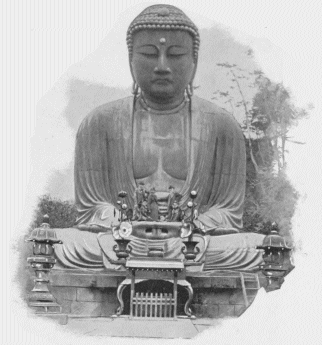
THE BRONZE BUDDHA AT KAMAKURA.
It is easy to enumerate statistics here; to call to mind the fact that this statue is fifty feet in height; that underneath its drooping lids are eyes of purest gold; that the face alone is eighteen feet in length; that the circumference of the thumb is three feet; and, finally, that within this statue is a chapel for a hundred worshipers. But these are not the things which most impress one here. We can find other statues for statistics. This has something better. It is the indescribable, passionless expression of the face, that grows upon the traveler as he studies it, and haunts his memory forever more—a look which in some way suggests the Sphinx, in its superiority to present evils, its dreamful contemplation of the infinite, its calm appeal from time to all eternity.
ENOSHIMA. JACOB'S LADDER, ENOSHIMA.
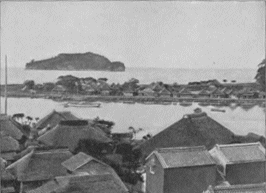
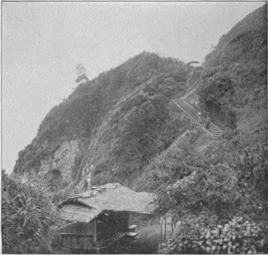
Leaving the great Buddha to his meditations, we continued our homeward journey by the sea,—that ocean which, although tranquil now, has more than once sent tidal waves upon this shore to wreck the temples and the homes of Kamakura, and in their swift retreat to leave a hideous trail of death and devastation. A little distance from the land, we saw the pretty island of Enoshima. It is a sacred island, said to have sprung, like Venus, from the ocean in a single night. It is regarded, therefore, as a gift from God. It may be that the legend has some truth in it, for almost every portion of Japan is of volcanic origin; and mountains have arisen, lakes have been produced, and landscapes wholly changed by earthquake shocks, even within historical times.
A FOREST MONARCH.
INTERIOR OF THE CAVERN TEMPLE. THE SACRED CAVE.
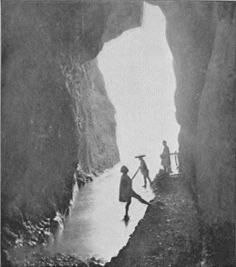
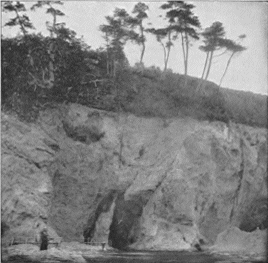
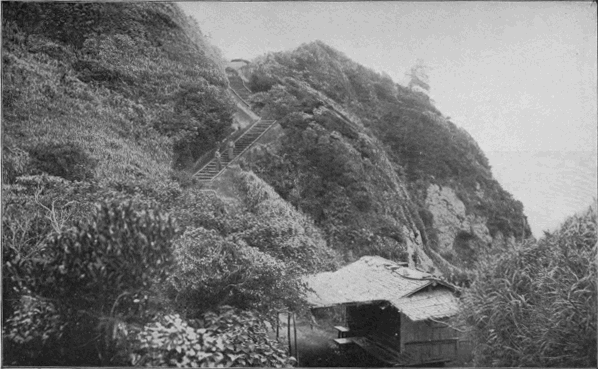
Desiring to see some features of this island, we crossed the narrow channel, and climbed to one of its numerous points of observation. It is a fascinating place. Delightful paths wind up the wooded hills, marked here and there by little stations, where one halts for tea. Beyond these are long flights of steps, on which, that afternoon, Japanese girls, in gaily-colored robes, were passing up and down, like angels upon Jacob's ladder. Some were at work, while others were at play; others, again, were returning from a place of prayer. They looked as curiously at us as we at them. We seemed to them, no doubt, like beings from another world; probably not a better one, for, when we had walked on, we heard them merrily discussing us with peals of child-like laughter. One part of Enoshima is deemed especially sacred. It is a natural cavern, somewhat resembling the Blue Grotto on the Island of Capri. In stormy weather it is inaccessible, for furious waves then thunder for admission here, and fill the entrance with a mass of foam. But on a pleasant day, like that which we enjoyed, it is not very difficult, on coming down the hill, to cross a wooden bridge and a few slippery rocks, and finally pass beneath a frowning arch to the interior.
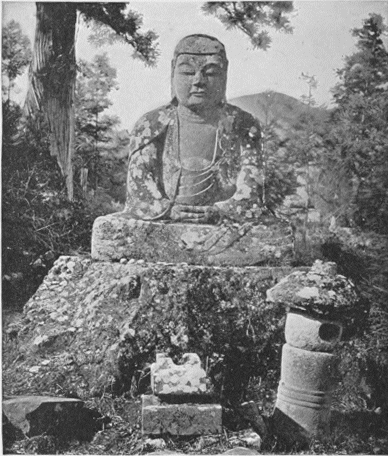
A RUSTIC BUDDHA.
It is a singular opening,—a crack in the volcanic cliff, three hundred feet in length and thirty in height. From its obscure recesses, we gained a charming telescopic vista of the broad Pacific. To our astonishment, we found within this cave an altar to the goddess of Good Fortune, a deity that from remotest ages has been worshiped here. It is a wonderful situation for an altar, this rock-hewn temple built by Nature's architect. A kind of mystery surrounds it, for mortals cannot always worship here. When the divinity allows them to approach, this inlet of the ocean lies in absolute tranquillity, extending inward to the shrine, like a long path of malachite. But there are times when she excludes all worshipers, bars the majestic portal with a watery wall, and hears, instead of humanity's feeble voice, the awe-inspiring anthem of the sea.
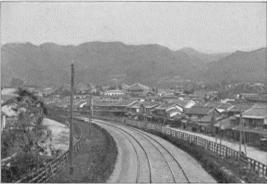
A JAPANESE RAILWAY.
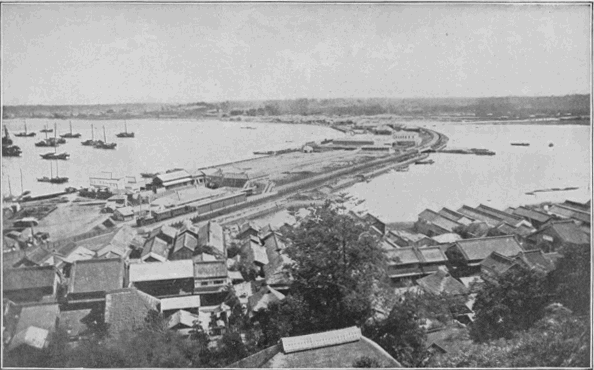
One beautiful October morning, leaving the Grand Hotel, we drove to the railway station to take a train for the Japanese capital, Tokio, eighteen miles distant. It seemed a wonderful transition to whirl through Yokohama streets in baby-carriages drawn by half-naked natives, and in a moment more to find ourselves in railroad cars, better arranged in some respects than most trains that run in Europe. Such sudden contrasts between the past and present are now found only in Japan. Twenty-five years ago there were no railways here, and hardly a jinrikisha. To-day, throughout this sea-girt empire is spread a network of two thousand miles of well-built paths of steel, which have stone ballast, massive bridges, fine rolling-stock, and well-appointed stations. And yet one travels first-class in Japan almost as cheaply as third-class in Europe. Nor is traveling in the Mikado's realm confined to foreigners. Never in any portion of the world have I seen trains so uniformly thronged as here, and ninety out of every hundred of the passengers were Japanese.
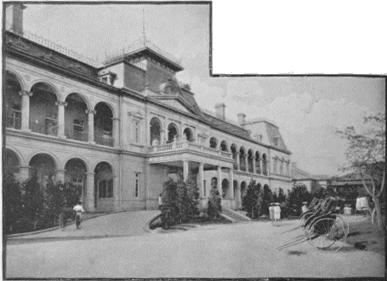
THE IMPERIAL HOTEL, TOKIO.
Tokio is the same old Yeddo that figured in our school-books—no matter how many years ago. The first thing to impress me in the place was its enormous size. It is, in truth, a city of magnificent distances, for its area surpasses that of London. Together with its suburbs, it has a population of one million eight hundred thousand. Save for its vast extent, however, the Japanese capital is not imposing. Seen from an elevation Tokio displays an almost limitless expanse of wooden roofs, whose trifling inequalities recall the undulating surface of a cold, gray sea. From this there rises, here and there, a solitary tower or pagoda, like a lighthouse from the waves.
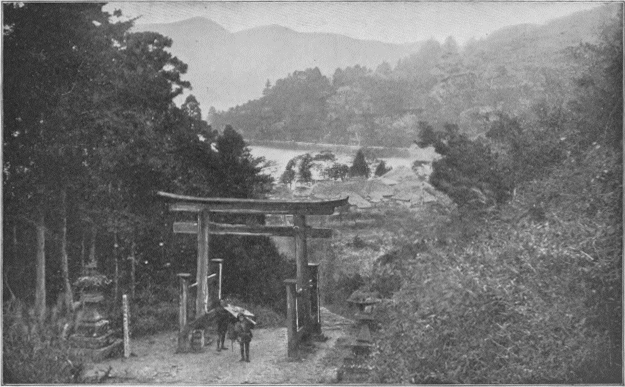
A TORII.
Four hundred years ago Tokio was a fishing hamlet. Not until 1603 did it become the military capital; and since that time it has been so frequently burned down and rebuilt, that it may be compared to the human body, the particles of which are said at certain intervals to be entirely renewed. In fact, statistics prove that, on an average, the city every thirty years has risen anew from its ashes. In 1895, at a single fire, four thousand houses were destroyed.
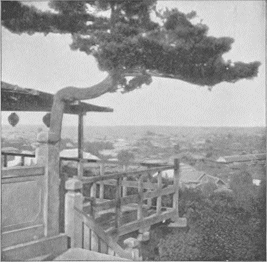
LOOKING DOWN UPON TOKIO.
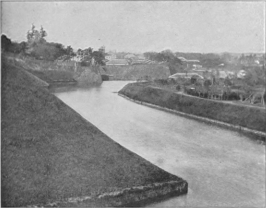
It is no easy task to explore thoroughly the Japanese labyrinth called Tokio, but one great central object forms, at least, a starting-point,—the imperial palace. Around it, like a warrior's belt, is drawn a moat so broad and deep that it might easily be deemed a river. The vast extent of this enclosure, its highly finished wall of stone, the silent, waveless stretch of water which surrounds it,—all these add mystery to one whose residence is so secluded from the eyes of men. Yet it is only recently that the Mikado has lived here. Thirty years ago the residence of Japanese sovereigns was a retired palace in the ancient city of Kioto. It may well be called "retired," for previous to the revolution of 1869 (which may be called the new birth of Japan) the Japanese for centuries had never seen the face of the Mikado. In giving audiences, even to his priests and nobles, he sat invisible behind a screen. When he walked out within his garden, carpets were spread before him to keep his sacred feet from contact with the earth. If he drove out, it was in a covered carriage, closed by screens, and as he passed along his subjects knelt in the attitude of prayer. Thus, century after century, these sovereigns lived,—each one in turn a monarch yet a captive, a god and yet a slave.
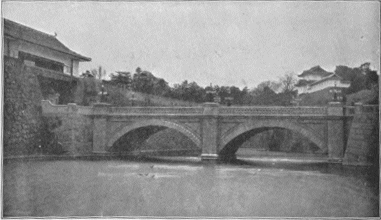
BRIDGE TO THE EMPEROR'S PALACE, TOKIO.
Meanwhile, in one of the stately castles of Japan there lived the Mikado's representative, or viceroy; for, of course, the Japanese emperors did not govern. How could they? They were imprisoned by their own divinity. A mediator between the monarch and his subjects had to be appointed, to act as overseer of the realm. Previous to 1869 therefore—for nearly seven hundred years—two rulers had existed in Japan. One was the theoretical sovereign, to whom all gave allegiance, but who accomplished nothing,—the Mikado; the other was the practical executive,—the military regent, called the Shogun.
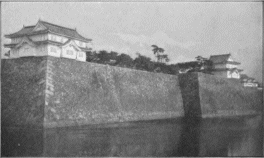
SHOGUN'S PALACE, OSAKA. THE MOAT AROUND THE PALACE, TOKIO.
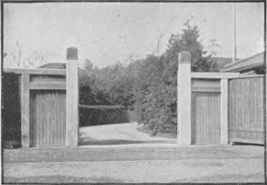
HOME OF THE RETIRED SHOGUN, SHIZUOKA.
In the small town of Shizuoka we saw the modest house where was still residing, like a country gentleman, the last of the once powerful Shoguns of Japan; for a change has taken place in the Mikado's empire. The Shoguns, who for centuries had been the actual sovereigns of the realm, and one of whom was in full power when the American fleet arrived in Yokohama, have now completely disappeared. Less than thirty years ago, from the secret precincts of his palace in Kioto, the lawful ruler, the present Mikado, was brought to light, like one who had been immured within a dungeon. In 1872, for the first time in a thousand years, a Japanese emperor freely appeared before his subjects. He was at that time a young man, twenty-two years of age, and was actually traveling by rail from Yokohama to Tokio, thenceforth to make that city his abode and capital. On that occasion, we are told, the loyalty and enthusiasm of his subjects knew no bounds. As the train moved off with the young emperor, restored to his ancestral power, there rang out on the air a melody which thrilled all hearts. It was the national anthem of Japan, the strains of which were first heard when savage tribes were hunting by the Thames and Rome was mistress of the world.
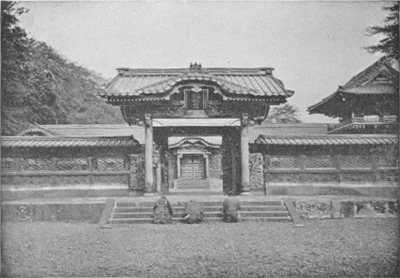
WHERE SOME OF THE SHOGUNS ARE BURIED.
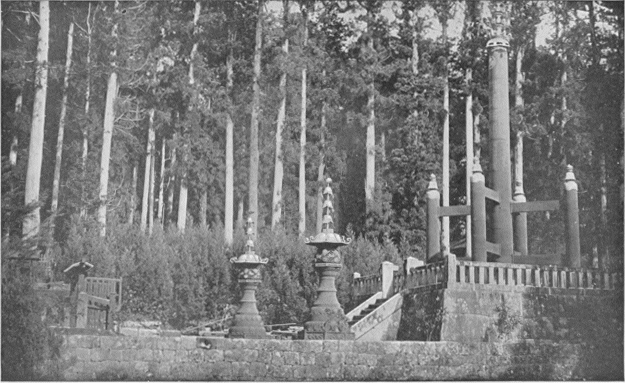
NEAR A HERO'S GRAVE.
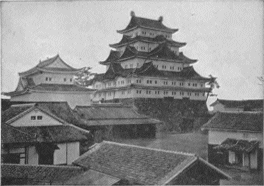
SHOGUN'S RESIDENCE, NAGOYA.
One might suppose that such a sudden rise in power, combined with the amazing changes in his empire, would have been ruinous to this young sovereign, for at the time of the restoration he was but sixteen years old. But he was evidently the man for the occasion, and has since proved himself an assiduous student and enlightened ruler. This man, who, as a youth, knew almost nothing of the existence of such foreign lands, now reads the literatures of England, France, and Germany.
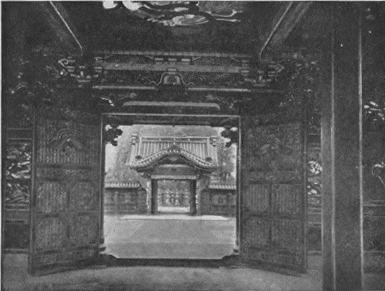
ENTRANCE TO THE SHOGUNS TEMPLE, TOKIO.
Moreover, this hundred and twenty-first Mikado of his line—the representative of the oldest dynasty on earth, whose founder reigned here five hundred years before the death of Julius Cæsar,—has not only adopted European dress and customs, but has favored the introduction of all the great inventions of the present age. Nevertheless, he had the wisdom to restrain his subjects in their first eagerness to adopt everything European, when they were even ready to destroy, as worthless, some of their ancient castles, shrines, and statues. And now that a reaction has set in, and the Japanese are once more proud to cherish the memorials of their ancestors, they are sincerely grateful to their emperor, because at the great national crisis he showed sufficient tact and independence to steer between the rocks of servile imitation on the one side and dull conservatism on the other, and, while the ship of state was trembling in the rapids of that flood of progress, he maintained a firm hand on the helm.
OLD FEUDAL RESIDENCE, TOKIO. A MODERN CASTLE.
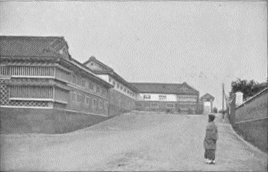
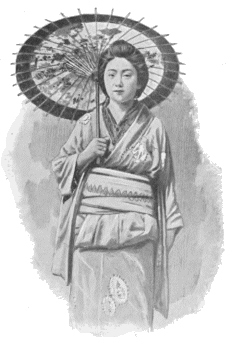
A LADY OF TOKIO.
The houses of the old Japanese nobles in Tokio recall many other striking contrasts between the past and the present. Until recently, for nearly a thousand years, Japan had many feudal lords, called Daimios. Most of them lived in Tokio for at least six months of every year, under the Shogun's watchful eye. But the great revolution of 1869 completely swept away the feudalism of centuries, and one by one, at the command of the Mikado, the Daimios gave up their swords, dismissed their armed retainers, renounced, to some extent, their vast estates and revenues, and, as a rule, retired to private life.
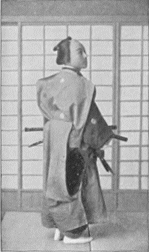
AN OLD-TIME SWORDSMAN.
Yet one must not suppose that the Japan of the present day has no nobility. Some years ago there was a grand revision of all ranks and titles. The old, distinguished families still form the nucleus of the aristocracy; but to their ranks have been added many men conspicuous for their talents, or for their loyalty to the new régime. We had the pleasure of meeting one who lives in close relations with the emperor. We found him a refined and courteous gentleman, dressed in a faultless suit of broadcloth, and speaking French and English fluently. As we conversed with him, however, our thoughts would stray from his appearance to that which his own father, doubtless, had presented, when Commodore Perry moored his fleet in Mississippi Bay. For his father had been one of those warriors of old Japan, called Samurai.
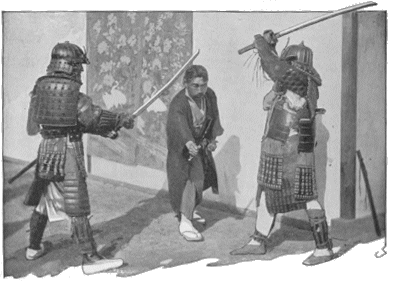
AN OLD-FASHIONED DUEL, AND UMPIRE.
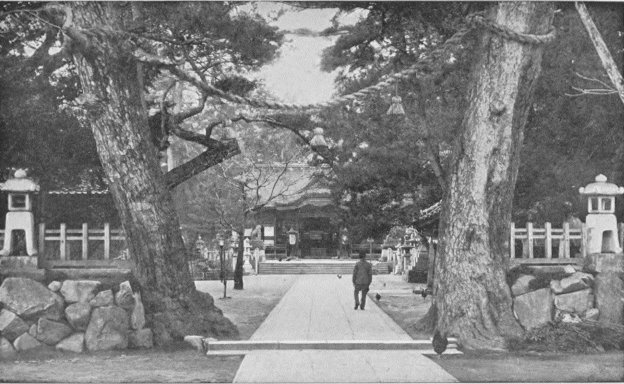
CENTENARIAN TREES.
A certain number of these men adhered to every Daimio, lived at his castle, fought his battles, and, not content with one sword, always carried two, as distinctive symbols of their rank. Yet now the old-time swordsman, if alive, has no doubt ceased to shave his head, has laid aside his singular costume, and has even put his swords away as relics of his youthful days, since no civilian is at present allowed to wear them. It is said that this class of Japanese suffered most from the revolution, for they suddenly found their occupation completely gone. Untrained for work and ill-adapted to the sudden change, their situation was at first deplorable. Hence it is little short of marvelous that such a radical transformation could have been effected in Japan without frequent insurrections. The sight of this great nation turning from feudalism to a constitutional monarchy, at the cost of rank, fame, wealth, and even livelihood, for tens of thousands of its foremost citizens, gives proof of a wide-spread, unselfish patriotism, perhaps unequaled in the world's history.
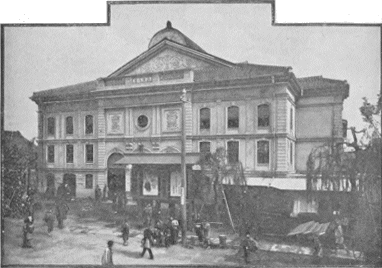
THE PRINCIPAL THEATRE IN TOKIO.
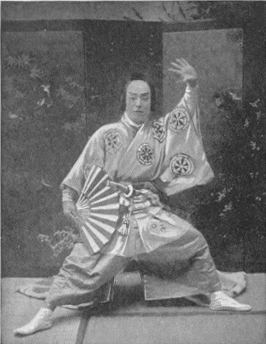
A JAPANESE ACTOR.
Not less remarkable is the recent progress of education in this "Land of the Rising Sun." The educational systems of all other nations have ripened slowly, and rest on centuries of experience. But twenty-five years ago, Japan had practically nothing of the kind. Accordingly, her brightest and most promising youths went forth to gather knowledge in the western world. She was eclectic in her method. Some were sent to England, some to Germany, others to France, and many to America. Accomplished foreign teachers also were induced to come and give instruction in Japanese schools; and how astonishing has been the result! In Tokio the buildings of the Imperial University cover fifteen acres of ground, and include admirable class-rooms, dormitories, laboratories, a hospital, and residences for the faculty. Here, in one department, are taught mathematics, astronomy, chemistry and geology; in another, civil and electrical engineering, naval architecture and metallurgy; in another, philosophy and the modern European languages; in still another, Japanese and Chinese history and literature. The University has also a Law School and a College of Medicine and Pharmacy, in each of which a four years' course is required. There are in all one hundred and twenty-three professors in the institution, fifteen of whom are foreigners, while more than fifty lecturers are also in the employ of the directors. Nor is this all, for in addition to this splendid University, there are in Tokio private colleges, commercial schools, military and naval academies, and a school of fine arts, besides an educational institution for the dumb and the blind; and not the least noteworthy is a common school system whereby the poorest child in Japan may obtain at least a rudimentary education.
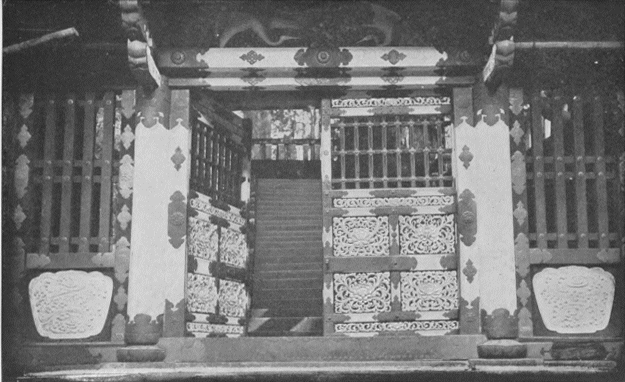
A SACRED GATE.
Let no one think, however, that all these changes, surprising though they are, have wholly done away with "old" Japan. The contrary is proved by countless characteristic sights, even in modernized Tokio. In their houses, theatres, shops, and festivals, and in their modes of bathing, eating, drinking, sleeping, and working, the vast majority of Japanese are to-day what they were centuries ago.
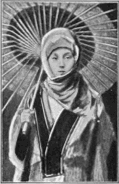
IN WINTER COSTUME.
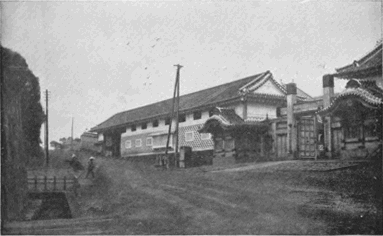
A DAIMIO'S HOME, TOKIO.
On our first day in Tokio, as we descended from the hill where we had gained a comprehensive view of the great city, we paused to note, at the foot of a long stone staircase, a singular gateway built of granite. The tourist may well observe such structures closely, for one of the most common architectural features of Japan is this peculiar style of portal, called a torii. In granite, wood, or bronze, such gateways usually mark the approach to a temple, shrine, or sacred statue. Nothing could be more simple. Two upright shafts are met and crossed by horizontal bars, the higher ones curving slightly upward at the ends. This is in one sense all, and the beholder at first sees little in them to admire; but, after a time, the foreigner in Japan expects them as essential features of every landscape, and welcomes them, like some sweet refrain, which, first heard in the overture, repeats itself in various disguises through the music of an opera.
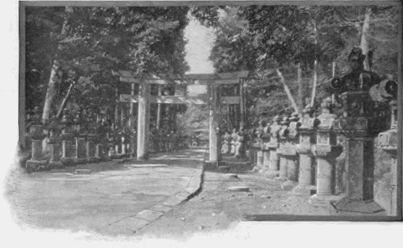
A TORII OR SACRED GATE.
There are two theories in regard to the origin of these sacred portals. The first maintains that they were intended originally for perches, upon which birds (which are occasionally liberated even now at Japanese temples) might pause before they took their heavenward flight to bear aloft the prayers of those who gave them freedom. The second theory affirms that these straight columns, with their curving cross-pieces, are derivative forms of the Chinese letter, or ideograph, which signifies Heaven.
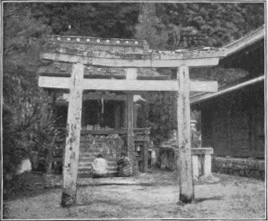
A RUSTIC TORII.
The latter explanation appears to be the more probable one; at all events, whatever may have been their origin, the architectural design of these peculiar structures is of immense antiquity. Such gateways, tradition hints, were extant twenty centuries ago; and it is worthy of remark that, despite the marvelous changes that have recently transformed Japan, no hand has ever been raised to mutilate these memorials of the past, or even to change a line of that mysterious hieroglyph which they so sharply outline against the sky.
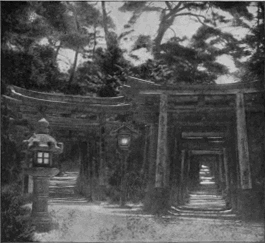
GROUP OF TORII.
In the immediate vicinity of these sacred arches, one usually sees a multitude of monuments, from five to seven feet in height. Sometimes these line, for a considerable distance, the avenues of approach to tombs and temples, and are compactly ranged in serried ranks, like soldiers at a dress parade, or people waiting for some grand procession. They are called lanterns, from the fact that, on special festivals, a lamp is placed in each of them, in honor of the hallowed dead. But the chief part they play is ornamental. Most of them are of stone; but some consist of beautifully decorated bronze,—real masterpieces of that art in which the Japanese excel. To many are attached bronze bells and circular medallions, bearing the crests of the imperial family or those of the military chieftains of Japan. With few exceptions, the finest ones have been presented by Japanese nobles, as proofs of their devotion to the shrine itself, or their esteem for those who are buried there.
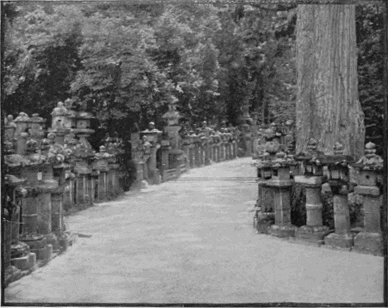
JAPANESE LANTERNS.
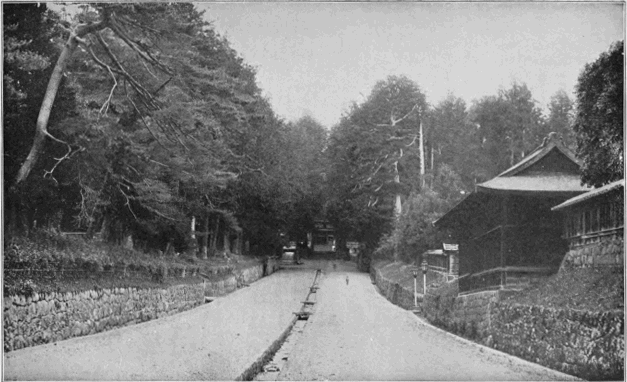
APPROACH TO THE TEMPLES, NIKKO.
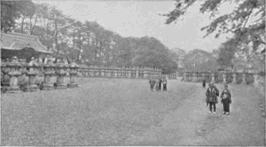
IN SERRIED RANKS.
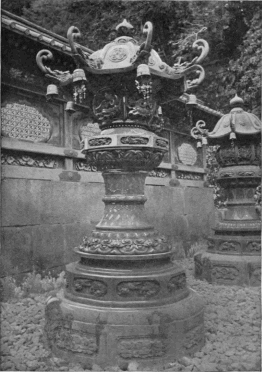
A BRONZE LANTERN.
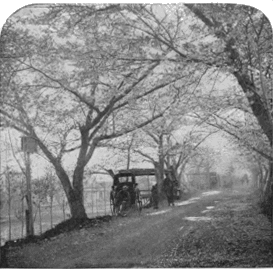
BLOSSOM-LADEN BANKS.
One of the principal pleasure-resorts of Tokio is Ueno Park. It is especially attractive in the month of April, when all its cherry-trees are radiant with blossoms. These lovely flowers are usually pink in color, and grow in clusters several inches wide. Poets have sung their praises here for centuries. They are to Japan what roses are to western nations. Their blooming-time is one of the national festivals. Some avenues in the Mikado's capital are lined with these resplendent trees, and are famous throughout the country for their wealth of coloring.
There is a little stream in Tokio which, every year, about the middle of April, flows for two miles between blossom-laden banks. Crowds gather then from miles around, to gaze upon its beauty. The newspapers announce each day the progress of the coloring, and maps of the city are sold, on which are indicated in pink the groves of cherry-trees. Old Mother Earth grows young again, and every heart, however sad, becomes rejuvenated too, at the sight of thousands of these huge bouquets, lifting their clouds of pale pink blossoms toward the light blue sky. Hundreds of pleasure-boats also then float along the stream, which mirrors the gorgeous spectacle above. A Japanese poet says: "I wish to cross the river, but fear to cut the brocade upon its surface." Meanwhile, along the banks are thousands of other admirers, on foot or in jinrikishas; and not infrequently a mischievous breeze plucks handfuls of the dainty petals and scatters them upon the upturned faces, like flakes of tinted snow.
A JAPANESE TEMPLE. A TEA-HOUSE ORNAMENTED WITH WISTARIA.
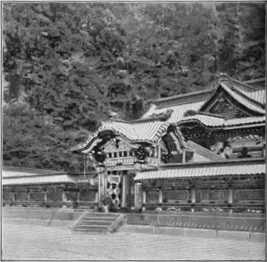
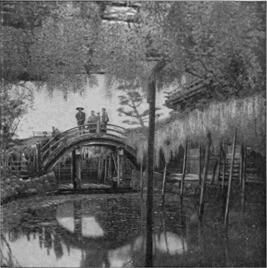
As we might expect from such a refined and artistic race, the Japanese are enthusiastic in their love of flowers. One of their favorite deities is called "The Goddess who causes the blossoms to open." With them, to make up parties for a floral exhibition is just as fashionable as for us to arrange box-parties for the theatre. Even in winter they will not allow themselves to be deprived of some enjoyment of this sort. Hence they call snow-crystals a kind of flower, and expeditions to see snow-displays form one of the regular amusements of the season.
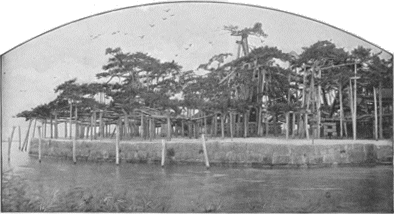
THE GREAT TREE NEAR LAKE BIWA.
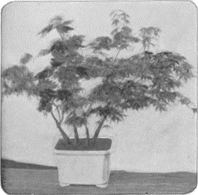
A DWARF MAPLE.
The land of the Mikado is with reason often called the Land of Flowers, for each month of the year has its special blossoms which the Japanese admire, and which together form an unbroken garland for the brow of Time. Particularly beautiful is the Japanese wistaria, which blooms in May, soon after the departure of the cherry-blossoms. This lovely vine is trained on trellises, and covers bridges, canopies, and arbors with magnificent purple clusters, two, and even three feet long. Japanese tea-houses find it extremely profitable to decorate their gardens thus, as thousands are attracted thither, who, as a matter of course, drink tea upon the premises. It is precisely of such exhibitions that this peculiar nation is most fond. With one or two exceptions, they do not seem to care for cultivated flowers, preferring flowering trees and vines, like the wistaria, plum, and cherry. In all the gardens that we visited in Japan, we never saw a flower-bed. In fact, Japanese gardens differ from our own as completely as a jinrikisha differs from a tally-ho coach. They are all essentially alike, whether they cover several acres or only a tiny court behind the house. If possible, an artificial lake is formed; large, if the space permits; if not, a little tank of water containing half-a-dozen goldfish must suffice. Rocks are heaped up to take the place of cliffs.
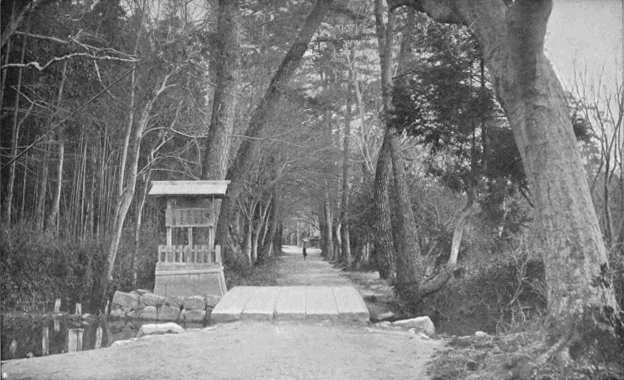
FOREST SOLITUDE.
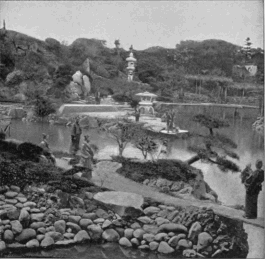
JAPANESE LANDSCAPE GARDENING.
A path of pebbles represents a river-bed. A tiny beach of smooth, white sand is made along the shore. Islands are also manufactured, with fantastic bridges; and here and there among the trees we see a quaint display of garden lanterns, miniature pagodas, fountains, grottoes, and occasional statues. But of smooth lawns and ornamental flowers, like our own, we find in Japanese gardens not a trace. What seems to take their place in the affections of the Japanese is the cultivation of dwarf trees. These are among the marvels of Japan. At first, we could hardly believe our eyes, when we saw maples, pines, and oaks, from sixty to one hundred years old, possessing crooked limbs and gnarled and twisted trunks, though they were scarcely more than two feet high, and had their roots confined within the limits of a flower-pot! Just what the secret is of limiting the growth of these old monarchs of the forest, while yet preserving their vitality, we did not learn. It is, however, an art of which the Japanese are passionately fond, and which an experience of centuries has brought to perfection. These hardy dwarfs are often looked upon as precious heirlooms, and are carefully watched and tended by the family from generation to generation. What a strange notion this,—of dwarfing landscapes to the limit of a courtyard, and stunting noble trees till they appear like a forest looked at through the large end of a telescope! Sometimes, however, the taste of the Japanese in arboriculture goes to the other extreme, and large trees are chosen as objects of regard. These are often trained and trimmed, till they resemble mammoth fans, pagodas, or stately boats with curving prows and lofty masts adorned with tiny sails. Although ingenious, this seemed to us like trifling with nature,—a parody of the sublime,—a burlesque of the beautiful.
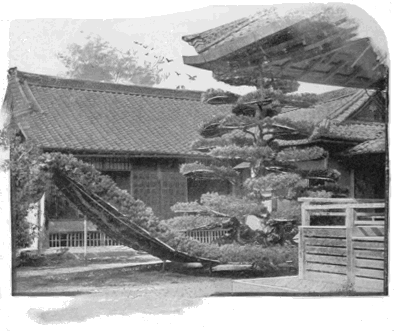
A TREE TRIMMED TO REPRESENT A SHIP.
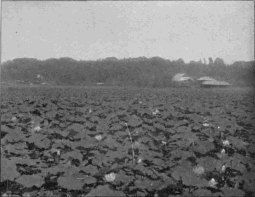
A LOTUS BED.
The glory of the month of August in Japan is the sacred lotus-flower, with whose broad leaves the moats in Tokio are filled. Growing from muddy, stagnant water, yet holding up to heaven its flowers always fresh and pure, the lotus is regarded as the symbol of the religious life,—aspiring from unfavorable conditions to a state of purity. The Buddhist writings say: "Though thou be born in a hovel, if thou hast virtue, thou art like the lotus growing from the slime." Accordingly the lotus is, par excellence, the flower of the Buddhist faith, associated with the mysteries of death and immortality. Bronze vases, filled with lotus-flowers made of metal, stand on all Buddhist altars, and statues of Buddha have usually, as an appropriate pedestal, a smooth lotus-leaf in stone or bronze.
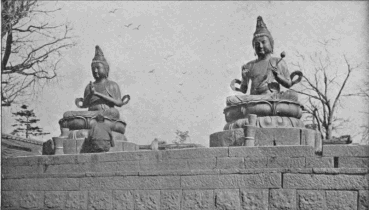
STATUES OF BUDDHA WITH LOTUS PEDESTALS.
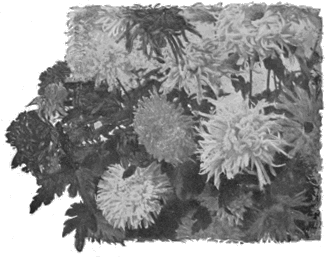
THE NATIONAL FLOWER.
Early November brings still another source of pleasure to the Japanese in the chrysanthemum. Opinions differ as to whether this, or the cherry-blossom, should be regarded as the Japanese national flower. To us it seemed that the chrysanthemum should have that proud distinction; for it is used as the crest of the imperial family; and the Mikado's birthday, the third of November, is usually made the opening day for all chrysanthemum exhibitions.
AUTUMNAL FOLIAGE.
In cultivating this flower, the Japanese have shown extraordinary skill. Some of their bushes are said to bear as many as four hundred perfect flowers at one time. Five or six varieties sometimes grow upon a single plant, and there are claimed to be, in all, two hundred and sixty-nine in the Mikado's empire. Moreover, since it blossoms longer than most other flowers, it is associated with the idea of longevity. One Japanese river, into whose limpid waters great showers of chrysanthemum petals fall, is thought to insure to a good old age the lives of those who drink from its invigorating flood.
THE MODERNIZING RAILWAY.
A WRESTLING MATCH.
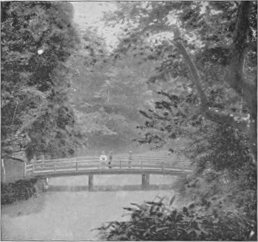
But perhaps the most gorgeous of the natural displays, which in Japan adorn with a continuous brilliancy the path of the revolving year, is its autumnal foliage. Then, as the Japanese poets say, the maple-trees put on their damask robes. This also is thought to be a floral exhibition, for bright-colored leaves are looked upon by the Japanese as flowers. The subjects of the Mikado have, like ourselves, that most delicious season of the year when the warm breath of summer still retards the frost. We call it Indian Summer: their name for it is Little Spring. It is a pretty—almost a pathetic—thought, to connect thus the deep, strong, passionate hues that mark the year's maturity with the faint blushes of the cherry-blossoms, which betoken youth. The year has lived through much since that pink blush adorned its cheeks. The autumnal colors may be richer and more effective, but that first bloom of hope and innocence will never come again.
A WRESTLER.
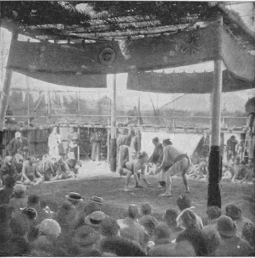
During our stay in Tokio, we one day visited a wrestling match. The scene of its occurrence, though in the heart of the city, resembled the enclosure of a country circus. On pushing through the crowd, we saw, in the centre, an elevated platform covered with sand. Above this was a highly decorated canopy, supported by tall bamboo poles, and gathered round it was the expectant populace. The second story of the structure consisted of a gallery made of bamboo rods, which, tied together, formed a floor resembling an enormous grid-iron. This gallery was divided into little areas, which served as private boxes for the entertainment.
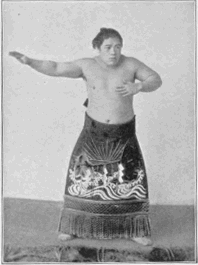
We climbed up into one of these by means of a ladder, and tea and cakes were subsequently brought to us; but we could not have eaten a mouthful, unless fed by our attendant, for we were fully occupied in clinging to the bamboo poles, like canary birds to their perches. There presently appeared upon the stage a human monster, who seemed to have a gorgeous lambrequin tied about his waist. This giant was a great surprise to us. The Japanese are usually small their women seem like girls; their children look like dolls their dwellings have the appearance of magnified bird-cages their vehicle of transportation is a baby-carriage. Their wrestlers, however, are enormous. Such mountainous displays of fat and muscle we had never seen. One after another, fifty such giants stood fronting us for a moment with uplifted arms, while an official read their names to the admiring spectators. Twenty-five wrestlers were then chosen to contend on one side and as many on the other. The prize was to be given to whichever side should win the greatest number of single combats.
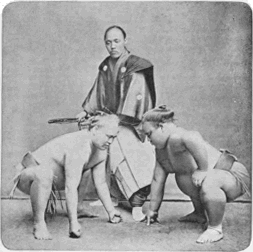
LIKE MAMMOTH BULL-FROGS.
A moment later, the "lambrequins" were laid aside. A couple of huge wrestlers squatted on the sand, like mammoth bull-frogs ready for a jump. They had already rubbed their hands in the sand to make them gritty and tenacious. Beside them stood the umpire, holding in his hand a fan. With this he gave his signal to the wrestlers, much as a musical director leads his orchestra. His word is law, and he decides whether the start is properly made and whether the rules have been observed. A few false springs were made at first, and the great crowd became impatient. At last, however, the wrestlers fairly caught each other, and began the struggle. For several minutes they tugged and strained, until it seemed that neither could possibly gain the advantage. Meantime the Japanese grew more and more excited, for all these wrestlers are well-known, and have their patrons and admirers. One whom we saw is famous for having thrown three rivals in succession. This is, of course, a proof of great endurance; for by the time the third encounter comes, the victor must necessarily be much exhausted.
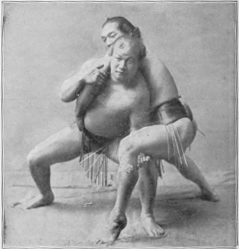
"THEY TUGGED AND STRAINED."
In the first match, however, the wrestlers whom we watched had no easy task; but, presently, one of them saw his opportunity, and caught his enemy under the left leg. The other instantly reached over his shoulder and clutched his opponent's belt. For a few seconds neither moved. Then, with a fearful lurch, the giant who had gained the advantage lifted his rival off the ground, and swung him headlong over his shoulder clear off the platform to the sand below. We felt our bamboo perch in the gallery shake when the body struck. The conqueror was, of course, hailed with shouts of triumph, and in five minutes all was ready for another contest.
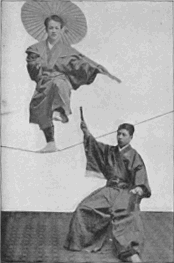
AN ACROBAT.
At the conclusion of the spectacle, as we were making our exit through the crowd, we stopped to watch some Japanese acrobats, one of whom danced upon a swinging rope with more agility and skill than we had ever seen. "By the way," said a friend at my side, "do you know that once in the history of this country the Japanese throne itself was wrestled for? It happened just a thousand years ago. The Mikado died and left two sons, each of whom claimed to be the rightful heir. Instead of plunging the nation into civil war, they submitted their rival claims to a couple of famous wrestlers, each agreeing to abide by the result! Who shall say that there are not worse methods than this old Japanese mode of arbitration?"
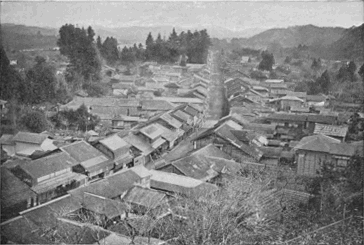
VILLAGE OF NIKKO.
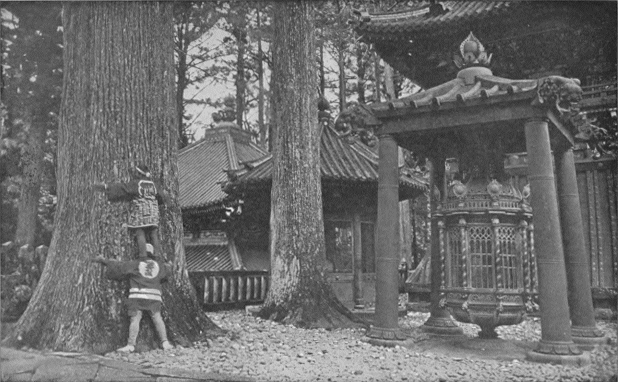
One of the most renowned and sacred places of resort, alike for pilgrims and for tourists in Japan, is Nikko. "Nikko!" How little that brief name suggests to those whose feet have never trod its hallowed paths; but, oh, how much to those whose recollections of it are a joy forever! The mere approach to it is astonishing. It is a sacred road, over twenty miles in length, and lined for the most part on both sides with the grand cedars of Japan. These trees, called cryptomerias, frequently attain a height of two hundred feet, and are probably unsurpassed in size save by the giants of our own Yosemite.
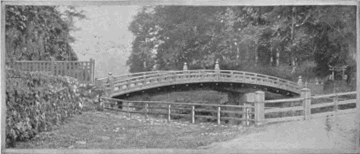
THE SACRED BRIDGE, NIKKO.
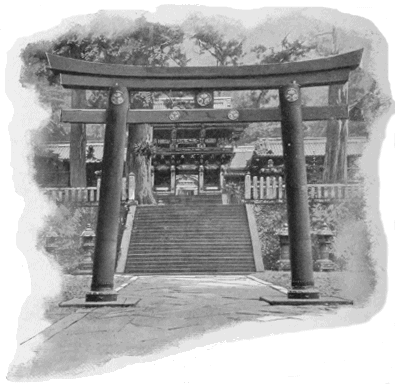
TIER UPON TIER AND TERRACE UPON TERRACE.
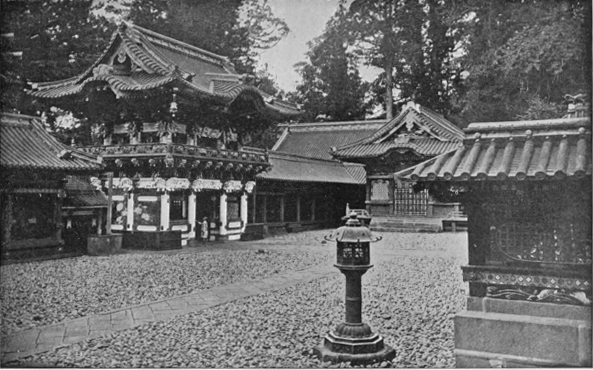
CHARACTERISTIC ARCHITECTURE.
It was late in the afternoon when we reached the terminus of this avenue. Before us rose a densely wooded mountain, around which swept a wild, impetuous stream. Spanning this foaming torrent is the sacred bridge of Nikko, whose floor and sides are covered with beautiful red lacquer, as smooth to the touch as polished mahogany, and which is ornamented here and there with tips of brass. In ancient times, none but the Shoguns ever stepped upon this bridge; none but the emperor may do so now. When General Grant, however, was traveling in Japan, the Mikado paid him the unusual compliment of ordering this bridge to be thrown open for his passage. But, from a delicate appreciation of the people's feelings, the General modestly declined the honor and took the regular, frequented path.
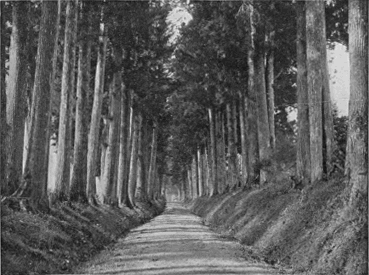
THE ROAD TO NIKKO.
Leaving behind us this ornate but untrodden bridge, we began to ascend the hill itself. From time to time we halted, astonished and bewildered. Imagine a mountain, covered with thousands of the most magnificent cedar-trees that the Creator ever caused to grow; then realize that upon this mountain and among these trees there is what may be called a sacred citadel, rising tier above tier, and terrace upon terrace, each covering several acres. Toward each plateau ascends a flight of broad stone steps. In front of each is placed the characteristic gateway of Japan,—the sharp-cut, mysterious torii, hewn out of massive stone or made of polished bronze. In one place there is a beautifully decorated fountain, at which all pilgrims wash their hands and mouths before approaching more closely to the temples of their gods.
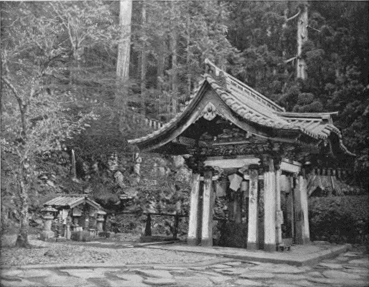
THE PILGRIMS' FOUNTAIN, NIKKO.
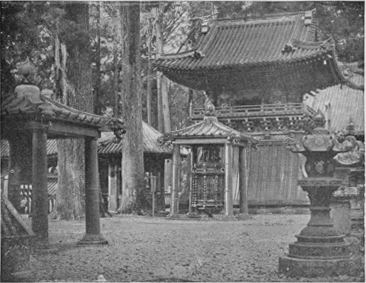
ON ONE OF THE TERRACES.
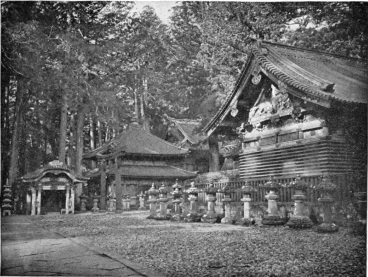
Ascending one of the staircases of stone, we stood in an extensive area, where structures met our gaze so unlike all that we had elsewhere seen that we were fain to believe our senses were deceiving us, and that it was all an illusion,—a cunning trick for stage effect, which, when the play was over, would completely vanish. Along the terraces, like jewels darkened by the forest gloom, were belfries which appeared encased with precious stones; fountains adorned with ornaments of gilded bronze; picturesque temples bright with every color of the rainbow; lacquered pagodas, rivaling the trees in height; and huge bronze bells, whose solemn tones, in rhythmic waves of sound, roll on in grand reverberations through these sacred avenues. But how powerless is language to portray a place like this! Words impotently creep before the grand impressiveness of Nikko, as insects crawl beneath its cryptomerias.
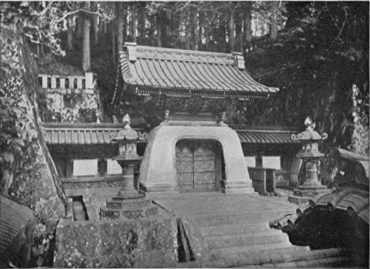
A GATEWAY AT NIKKO.
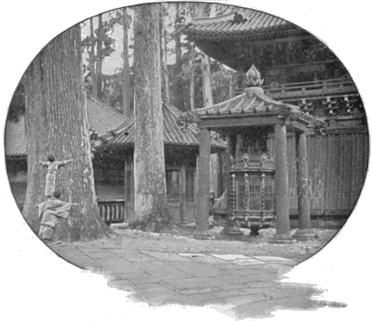
A QUIET CORNER.
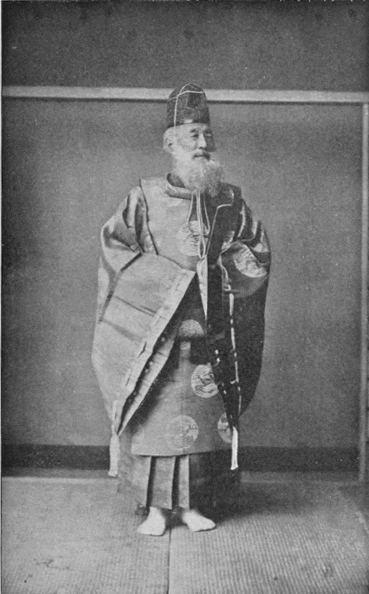
PRIESTLY VESTMENTS.
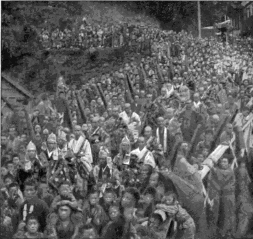
A PROCESSION AT NIKKO.
As we advanced still farther through these wonderful enclosures, it seemed like walking through a village whose buildings still remained in symmetry and beauty, yet whose inhabitants had disappeared. The silence of these courts was most impressive. Apparently, they have no guardians. Only the moss-grown lanterns stand about each shrine, like sentinels transformed to stone. Astonished and perplexed, we asked the meaning of these structures, and learned that some are treasure-houses, where are preserved the personal relics of the Shoguns and many of the gorgeous robes, embroidered banners, and superb insignia which still, on festal days, are borne in solemn state along these paths beneath a boundless canopy of shade, just as they have been borne for centuries. For the old trees of Nikko have looked down for nearly a thousand years on lines of richly decorated priests and pilgrims moving in solemn pageantry along these shadowy pathways consecrated to the gods. The individuals may come and go, but the processions never fail—much as the bright-tinted leaves fall here in autumn, to return no more, while the old trees live on.
AMONG THE SHRINES.
ENTRANCE TO TEMPLE, NIKKO.
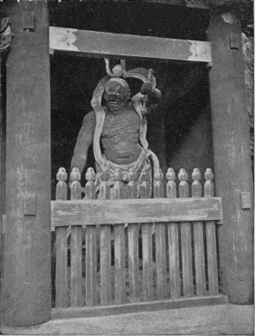
A TARGET FOR MASTICATED PRAYERS.
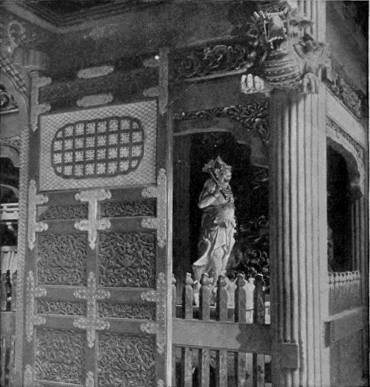
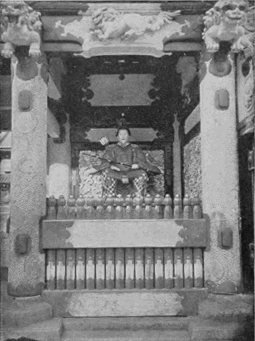
At last we stood before one of the many sacred gates which lead to Nikko's shrines or sepulchres. Each displays against the foliage beyond a mass of variegated color. In every case the roof curves slightly upward at the base, and has a covering of copper, marked with ornaments in brass. To the right and left of all such passageways are massive wooden columns, lacquered red, and in the alcoves thus constructed at this gate we saw, to our amazement, two grotesque statues of colossal size. They seemed a startling union of Hercules and Mephistopheles. Yet these repulsive figures represent gods, whose special duty is to scare demons from the temple gates. We have no certain information about the nervous temperament of demons, but one could well believe that these unearthly shapes, with blood-red bodies, gaping mouths, and bulging eyes, would throw most children into convulsions. Upon their forms and faces are visible small marks resembling scars. These are in reality dried paper-balls, which worshipers have first chewed into a pulp, and then hurled at the statues, though not by any means in contempt. The pilgrim, in the first place, writes his petition on a slip of paper; this he rolls into a wad, which he deposits in his mouth; and, finally, when it is softened by saliva, he throws it at the god. If it adheres to the idol's face, the omen is propitious. If it sticks to any part of the body, there is still some hope; but if it falls off on the ground, a favorable answer is impossible. This custom is peculiar to Japan. One sees, of course, numberless strange rites connected with religion in traveling about the world, but Japan is the only land I have ever visited where deities serve as targets for masticated prayers!
When, turning from these sculptured monsters, one looks with admiration on the exquisitely carved and beautifully furnished temples of this sacred citadel, one naturally exclaims: "How is it possible that the same race, which has produced such beautiful, artistic works as these, should also have created, and should still retain, such hideous, uncouth statues as we have just beheld?" But one asks many such questions in traveling through Japan. No race on earth is so astonishingly contradictory and so full of puzzling surprises as the Japanese. "The longer I live here," a resident of Tokio once said to me, "the less I understand these people. A superficial knowledge of them is easily acquired; but there is always at the last a mental gulf between the Orient and the Occident, across which I perceive that their past is not our past, and that their ideas on art, religion, government, the finite and the infinite, are radically different from our own."
A GUARDIAN OF THE GATE. THE BRONZE PORTAL.
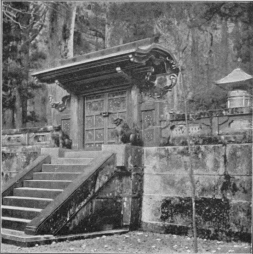
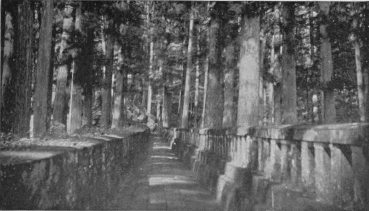
THE PATH TO THE SHOGUN'S GRAVE.
NATURE'S CATHEDRAL. THE SHOGUN'S TOMB.
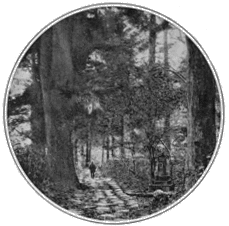
Leaving at length the shrines of Nikko, we climbed still farther up the sacred mountain, by one of its great staircases of stone. It led us to a place of which the temples are but antechambers and accessories. For this magnificent forest is a vast sepulchral grove, in which are buried some of the greatest statesmen of Japan.
NEAR ENOSHIMA.
NEGLECTED SHRINES.
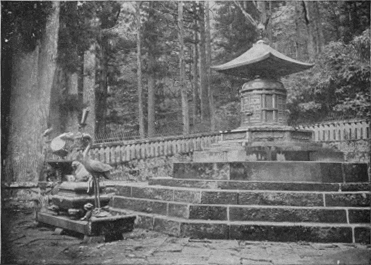
It has been stated that previous to 1869, Japan, for seven hundred years, had always had two sovereigns at the same time: one the ideal and secluded monarch,—the Mikado; the other, the actual regent, known as the Shogun. Bearing this fact in mind we reached the summit of the staircase. Before us was a portal of black bronze, inscribed with Sanskrit characters in gold. Behind it was a small enclosure, surrounded by a massive wall. Only two dragon-headed dogs were stationed here as guardians; but no one dares set foot within the sacred area,—none save a priest may pass beneath the low-browed arch. But, standing on the steps, we obtained at least a glimpse of what is here enshrined. It is the tomb of Ieyasu, the most powerful military ruler of Japan. It is a simple cylinder of bronze, six feet in height, the roof of which curves upward like a miniature pagoda. In front, upon a pedestal of stone, are the Japanese emblems of immortality. Here, then, the mightiest of the Shoguns rests, in death exalted, as in life, above his subjects. It is an awe-inspiring burial-place. Above him wave, like funeral plumes, majestic cryptomerias; beneath him are the temples where his spirit is adored; while, close beside him, in a deep ravine, the mountain torrent moans an endless requiem.
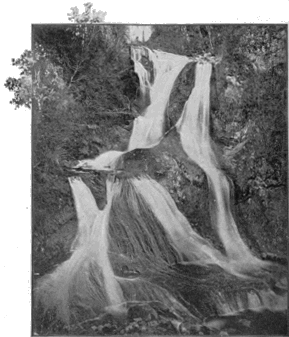
A MOUNTAIN TORRENT.
Yet it was when we left the Shogun's grave, and came down through the forest by that foaming stream, that we best appreciated the grandeur and sublimity of Nikko. Nowhere in the world, not even on the Alhambra hill, have I been so profoundly moved and thoroughly enchanted by a walk as by the one which winds about the sacred mountain of Japan. For miles above and around us stretched a cryptomerian cathedral, whose columns were the colossal trees, whose stained glass was the autumnal foliage, whose altar-covering was the green velvet of the forest, whose surpliced choristers were the white-robed and sweet-voiced rivers and cascades. One may well liken it to a cathedral , for its shadowy expanse is tenanted by countless rustic monuments and altars. Most of them looked abandoned both by gods and men; yet, here and there, we saw that worshipers had not forgotten them entirely, since fragrant flowers lay upon the thresholds of the few.
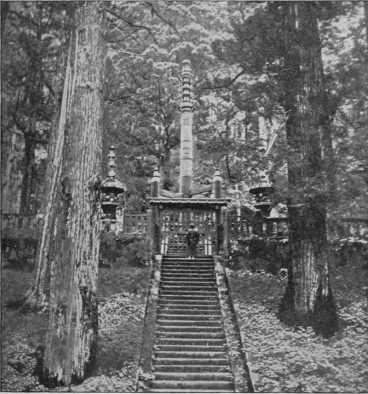
A CRYPTOMERIAN CATHEDRAL.
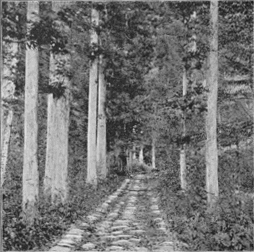
THE SACRED GROVE.
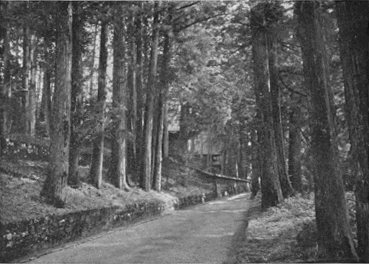
THE LAST STRONGHOLD OF ROMANTIC PAGANISM.
Lingering among these moss-grown emblems of an ancient faith, and treading pathways deepened by the feet of millions long since turned to dust, I shall never forget the impression made upon me. I felt that I was assisting at the last hours of a great religion. "Young Japan" has no more use for these ancestral shrines. It guards them merely as historic souvenirs: its faith in them is gone. In one sense, I was glad of this; but in another, I experienced here a feeling of regret. It seemed to me that this was earth's last strong-hold of romantic paganism, and that its life was ebbing fast.
Its sylvan gods, its nymphs and dryads of the hills, had left these immemorial shrines; and I could easily fancy that the drops of rain which fell that day from these old trees were in reality Nature's tears of grief that Pan was dying. Another generation, and he will be dead.
JAPAN
II
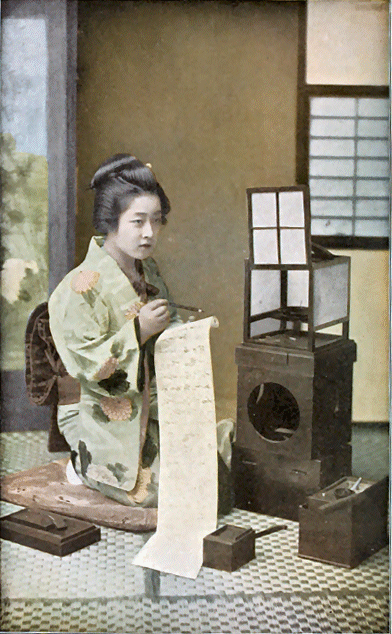
WRITING A LETTER.
LECTURE II
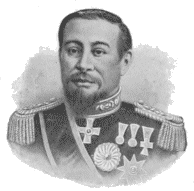
PRINCE ITO.
T
THE most important dramas of the coming century will probably be enacted on the shores of the Pacific. Neither the European coast, nor yet our own, can now materially change; but over the mightiest ocean on our globe new constellations have arisen. Another Oriental horoscope must now be cast. Dormant so long, the East is re-awakening from her sleep of ages. Russia, the grim Colossus of the North,—facing, Janus-like, both east and west,—is making there a depot for her navy. Meantime she pushes on by day and by night her trans-Siberian railway, whose bars of steel will soon unite the Baltic and Pacific and revolutionize the commerce of the world. In the Northern Pacific, England and France have interests which are steadily increasing. Southward, Australia, and New Zealand too, must be considered carefully in any forecast of the future. Last, but not least, our own Pacific coast, with its magnificent shore-front of California and Alaska, and the boundless possibilities of Puget Sound, will fifty years hence have enormous interests at stake. Meanwhile, Japan, central to all these various lands, keen, bold, and active, both in war and peace, has suddenly surpassed all records in her wonderful development, and even now can almost keep step with the great Western Powers.
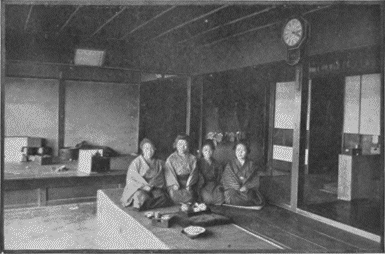
A DISTANT MARKET FOR CONNECTICUT CLOCKS.
In 1892, the writer visited the Mikado's empire, and on his return spoke enthusiastically of its people. But what he said of China was precisely the reverse. On this account, some thought that he exaggerated the virtues of the one and the vices of the other. But the events of 1895 verified his words. China has sunk still lower in the estimation of mankind, while Japan has risen far above the expectations of her warmest friends. In fact, Japan, in many ways, is now the most interesting country in the world. She is the pioneer of progress in the Orient. Consider her amazing growth in manufactures. By these she may ere long control the commerce of the entire East. Look at her admirable schools and universities. They can be favorably compared with not a few in Europe. Think of her government, which in less than twenty-five years has achieved what it took Europe centuries to accomplish,—to rid herself of feudalism and become a constitutional monarchy. Regard her army, which accomplished marvels in the recent war; and her navy, which elicited the admiration of the world.
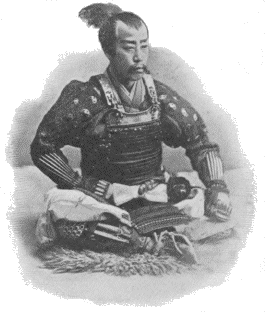
THE EDWIN BOOTH OF JAPAN.
In all these respects we find a national transformation, which in rapidity at least has had no parallel in history. It is, then, this extraordinary land, which has a long and brilliant past, and is apparently to have a still more brilliant future, that we are now to explore still farther.
However novel and attractive the cities of the Mikado's empire may be, it is from traveling through the country of Japan that one derives the greatest pleasure and instruction. For it is not what Japan has borrowed from the western world that most delights the foreign tourist. On the contrary, the more he sees of their artistic, happy, natural life, away from foreign contact, the better he likes it.
It was on a beautiful October morning, that, leaving cities and railways for a time behind us, we began our journey through a few of the Mikado's provinces. Seating ourselves in jinrikishas, we dashed across a little bridge and up a mountain gorge which led to Miyanóshita. There are few things more thoroughly delightful than traveling through a mountainous country in a carriage or on horseback. On a former trip I had thought that nothing could approach in pleasure this mode of traveling in Norway. But here it proved fully as enjoyable. It is true, the grandeur of Norwegian scenery is not met with in Japan; but, on the other hand, the charming novelty of everything one sees makes such excursions peerless in the traveler's memory.
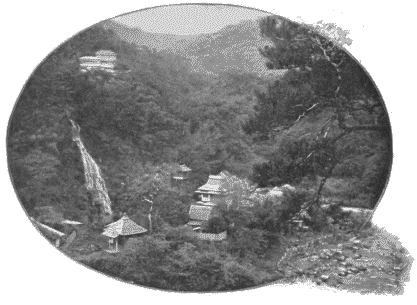
APPROACHING MIYANÓSHITA.
At first, our road was an embowered lane winding along a mountain-side, green to the summit with luxuriant foliage. There was no parapet along the edge, as on the mountain roads of Switzerland; but, as a reassuring compensation, we had no horses here to back or shy or roll us down the precipices. The steeds that drew us up the narrow path were copper-colored athletes, driven tandem, and without need of rein or whip. On, on they went with ceaseless energy, their splendid muscles working like machinery. Insensible to fatigue, they laughed and talked incessantly, asking only one favor of their drivers,—that of being allowed to reduce their clothing to the scantiest limits. Below us, as we rode along, was an impetuous stream, which lured from time to time adventurous water-falls to join its course. We halted to admire one of these at our leisure. Its special charm was not its height, though it descends several hundred feet: it was the wealth of colored foliage that made for it a frame of green and gold. A little to the left, an opening in the trees revealed a tiny shrine, and in the foreground stood an aged priest, who had stopped to gaze in wonder at such strange intruders.
A JAPANESE VILLAGE NEAR MIYANÓSHITA. A BIT OF JAPAN.
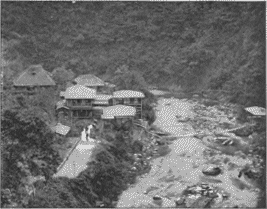
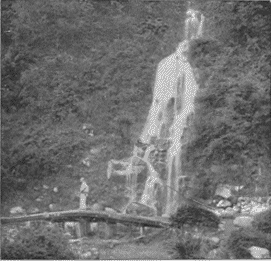
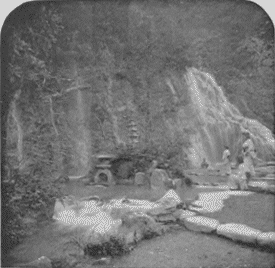
What pictures thus disclose themselves at every turn throughout this marvelous country! Anywhere else you would pronounce them stage effects—the cataracts which resemble tangled skeins of silken floss; the miniature pagodas interspersed among the trees; and, brightening all with life and color, the Japanese women with their brilliant sashes, as if the vanished nymphs and dryads of the place had now assumed material shapes, intending to be worshiped somehow, even by the skeptics.
RURAL SCENERY IN JAPAN. A MOUNTAIN STREAM.
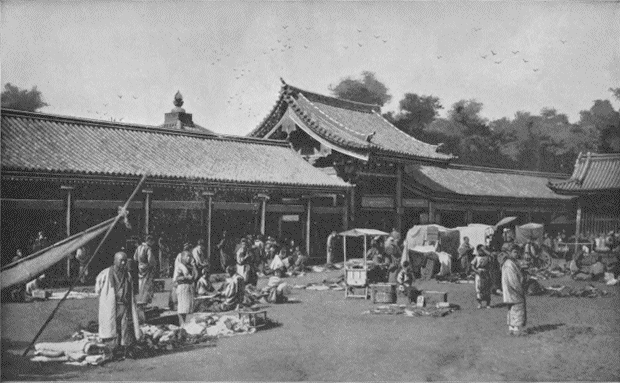
A JAPANESE FAIR.
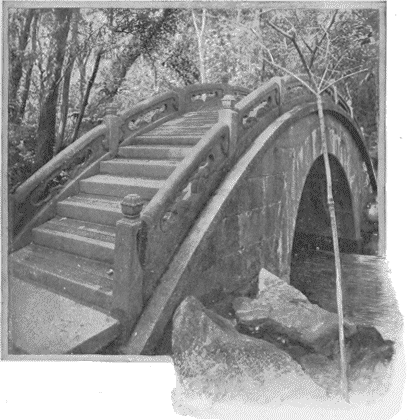
A JAPANESE BRIDGE.
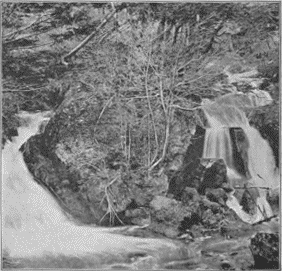
Yet this is what one sees continually in Japan. What would in other lands seem artificial, is here only natural. Accordingly, the charm of Japanese scenery is enhanced by the surroundings given it by man. Picturesque figures, clad in robes as multicolored as the trees themselves; bridges, temples, and pagodas, often as brilliant as the autumnal leaves around them—these make the landscapes irresistibly attractive, as if both man and Nature had agreed to wear at the same time their holiday attire. One feels that he is traveling through a land where Nature is adored, where animals are kindly treated, and where such pleasing and poetic myths as we associate only with ancient Greece and Rome are still believed by many faithful souls, and make each forest the abode of rural deities and every mountain rivulet a place of prayer.
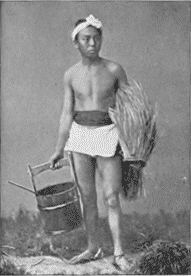
A FARMER IN HIS WORKING SUIT.
As we moved farther up the valley, we found at every turn some new source of enjoyment; first, in the vivid foliage, which made the mountains seem like huge bouquets of ferns; then, in the silvery stream whose voice would shout a welcome to us as it hurried on; and lastly, in the little Japanese inns, along whose carved-wood balconies were hung red paper lanterns, that glowed at night like monster rubies, and gave to the whole scene that charmingly unreal, or theatrical effect, so characteristic of Japan.
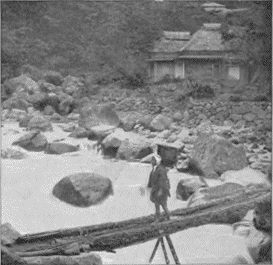
A RUSTIC BRIDGE.
Seeing some buildings on the opposite bank, we asked: "How do you cross here from shore to shore? Boats surely are not possible; nor are there any bridges, unless—but certainly those tiny structures yonder, stretched like a spider's web across the flood, cannot be bridges!" Yet closer scrutiny revealed the fact that they are really used as a means of transportation. Long poles of bamboo, bound about with reeds, and supported in the centre by a rough-hewn tripod,—such are the structures often spanning mountain-torrents in Japan! If swept away, they can easily be replaced; and, while they last, the peasants cross them fearlessly.
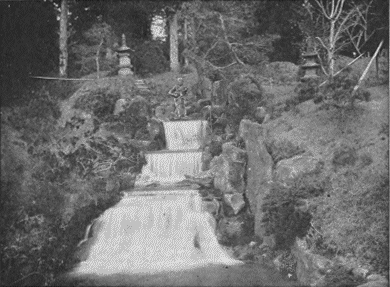
A CHARACTERISTIC VIEW.
"But how about wagons, carriages, and horses?" we inquired, only to be again reminded, with a laugh, that no provision need be made for them, for carriage-roads do not yet exist in these mountain regions, and horses are almost as rare as centaurs. In fact, one of the first things to impress us in these rural districts was the absence of animals. We saw no oxen, sheep, or donkeys, and only in rare instances a pony. Japanese farmers hardly know what meat, milk, and butter are, and when one recollects that they have never eaten bread, and have no word for it in their language, one naturally asks, "On what do they live?" Through our interpreter, we questioned a young laborer who was returning homeward from the fields in his everyday working-suit of clothes. He was well-formed and looked well-nourished, like most of his fellows, yet he assured us that only fish, rice, and vegetables formed his diet. When, therefore, one considers how much hard work the Japanese perform, and thinks of all the thousands here, who, in lieu of horses, haul heavy loads of wood and stone, it cannot be denied that they derive from their food quite as much strength as we do from ours. It is true, doctors declare that Japanese food, while good for peasants working in the open air, is bad for those who lead a sedentary life. But is anything good for those who lead a sedentary life?
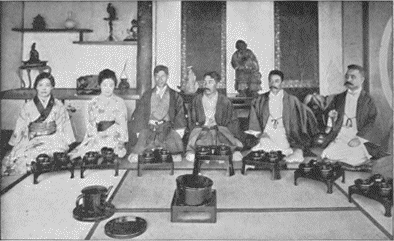
A JAPANESE MEAL.
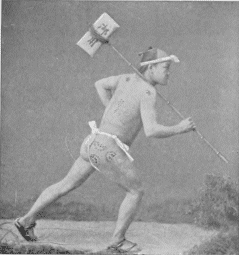
A POSTMAN.
"What," we inquired somewhat impatiently, "is the meaning of this dearth of animal life,—here, where a million acres on these verdant hills would give the best of pasturage for cattle?" The explanation given us was a religious one; for the Buddhist faith declares that to destroy any living creature is a sin. This doctrine, through successive centuries, has had a great effect upon the people. It practically forbids them to eat meat. If the United States, therefore, should ever become Buddhistic, a colossal industry of the West would disappear. No doubt, in time, stock-farms will be established in Japan, as foreigners create a large demand for beef, butter, milk, and cream; but agricultural customs are always slow to change.
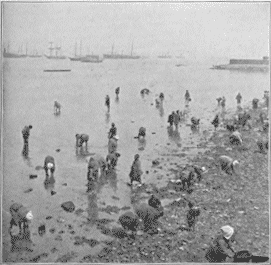
GATHERING SEA FOOD.
One might have supposed that catching fish would also have been prohibited by Buddhism, since that involves the sacrifice of life. But, as the waters around the Japanese islands fairly swarm with them, to have forbidden the people fish would have removed their staple article of diet, and caused a positive hatred for the new religion. It is probable, therefore, that the Buddhist priests knew (just as well as the Japanese fishermen) where to draw the line.
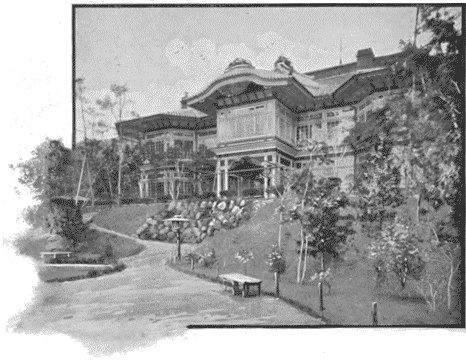
HOTEL AT MIYANÓSHITA.
One day, as we were rolling through the country in jinrikishas, we saw approaching us an extraordinary apparition.
"What is it," we exclaimed, "a winged Mercury, or a Coney Island bather rushing to the beach?"
"That is the letter-carrier," was the reply; "and the small waterproof paper bag at the end of his bamboo pole contains the mail."
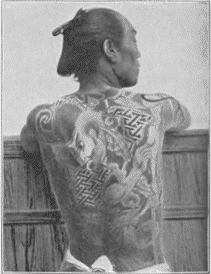
TATTOOED MAN.
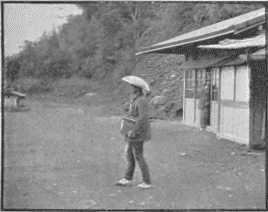
A POST-OFFICE.
In fact, where villages are not reached by a railroad, the old system of swift couriers still prevails. Let us not laugh, however, at Japan's postal service. It was only started in 1871; but it is already extended over the entire country, with more than five thousand post-offices and postal savings-banks. In 1881, after only ten years' growth, it carried ninety-five million letters and postal-cards, and its rate of postage is the cheapest in the world. A country postman, it is true, is rather oddly dressed. One thinks, at first, perhaps, that he is wearing a gaily-colored jersey. Not at all—his only garment is a cloth about the waist, with a kerchief around his head to keep the perspiration out of his eyes, and he has straw sandals on his feet. He is tattooed. It seems impossible, at a first glance, that such elaborate decoration is produced by sepia and vermilion alone, carefully pricked in with needles; nevertheless it is a fact. These brilliant hues are proof against the greatest amount of washing, tattooed man could no more change his colors than could an Ethiopian his skin or a leopard his spots. In feudal times this style of ornamentation was resorted to by the Japanese for the same reason that their hideous masks were worn in battle,—in order to inspire fear.
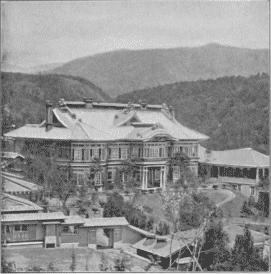
AT MIYANÓSHITA.
Even now, although the custom is prohibited, some wonderful specimens of tattooing can be seen; and from actual observation we were forced to believe the statement that artists in that line are able to prick into the skin a fairly faithful likeness of the man himself, or perchance of a friend. Such workmen now complain that they have little opportunity to practice their profession. Some patronage, however, still comes to them from youthful foreigners. Two sons of the Prince of Wales, for example, as well as Prince George of Greece, have on their bodies specimens of this ornamentation; and if some travelers whom we met here could be induced to raise their sleeves they would display to their astonished friends one or two very pretty Japanese views,—"colored,"—though not "dissolving."
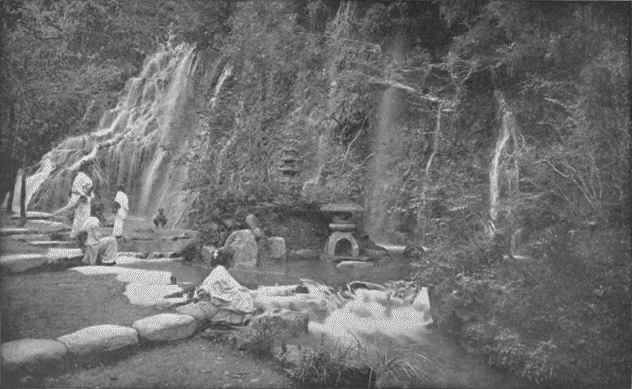
RURAL SCENERY.
One of the first and most delightful halting-places in our trip across Japan was the hotel at Miyanóshita. It is as dainty as a lacquered box, with floors, chairs, and balustrades as neat as wax and beautifully polished. The rooms are furnished simply, but in European style; the food is specially prepared for foreigners; and in cold weather the corridors can be enclosed in glass. What wonder, then, that tourists resort to Miyanóshita? For, in addition to its good hotel, it has the best of mountain air and delightful hot baths from a natural spring, and is a starting-point for many notable excursions. On most of these, however, jinrikishas cannot be used.
From this point on, the beaten roads are left, and only narrow paths ascend the hills. Hence, on the morning after our arrival, we found ourselves confronted by the most novel style of conveyance we had thus far seen. "What under heaven is this?" I cried, as I caught sight of it. "Must I get into this thing, and haven't you any blankets for these horses?"
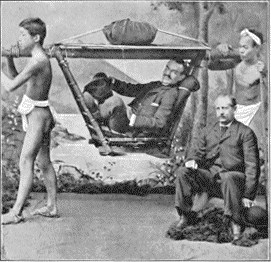
A KAGO.
My friend sat down upon a rock and vowed he would not go. "Give me a jinrikisha," he moaned; "I'd rather be once more a baby-jumper in my little carriage than a mere stone in a sling, as you will be in that!" He finally compromised on an armchair, hung on bamboo poles and carried by four men; but I resolved to give this vehicle a thorough trial. So crawling in, like a dog into its basket, I crossed my legs after the fashion of a Turk who had fallen over backward, and told my well-groomed steeds to go ahead. The unique and novel instrument of torture to which I thus subjected myself is called a "kago." It is a shallow basket, suspended from a bamboo pole, on which it swings irregularly like an erratic pendulum. Two men take this upon their shoulders, while a third follows as a substitute; for they change places usually every fifteen minutes.
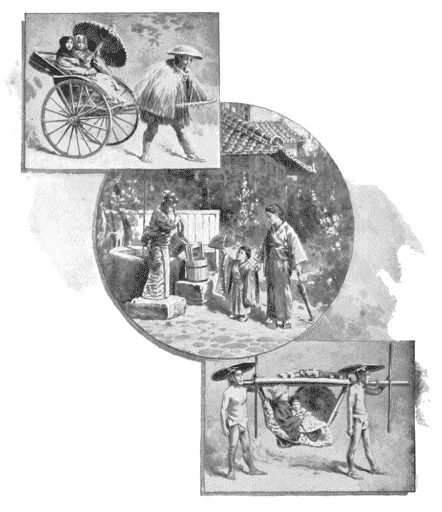
1. A RAIN-COAT. 2. AMONG THE FLOWERS. 3. A KAGO.
Mine changed every five. The man who invented the iron cage, within which the unhappy prisoner could neither stand up nor lie down, must have heard of a Japanese kago. The basket is too near the pole to let the occupant sit erect, and much too short for him to extend his feet without giving the bearer in front a violent prod in the small of the back. After many frantic experiments, I found that the easiest fashion of kago-riding was to lie upon my side, my head lolling about in one direction, and my feet in the other. Even then, the lower half of my body kept falling asleep, and I was frequently obliged to get out and walk, to avoid curvature of the spine. Yet, incredible though it seems, Japanese women often travel by these kagos. They certainly looked a thousand times more comfortable than I felt; but then, the Japanese are short, and, moreover, are used to bending up their limbs like knife-blades when they seat themselves.
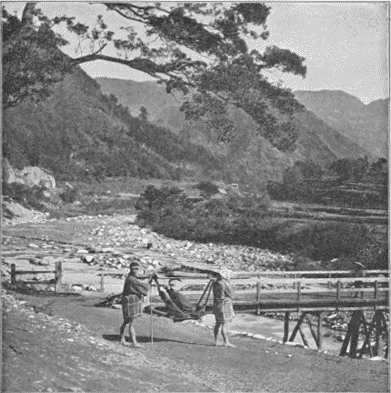
SWINGING LIKE A PENDULUM.
On a broad road, one experiences no sense of danger in these swinging cars; but, once in a while, when I was being carried thus along a path two feet in width,—a mountain grazing my right elbow, and a ravine one thousand feet in depth just under my left shoulder-blade, I used to wonder just what would happen if one of these men should stumble; or if, becoming weary of their load, they should suddenly shoot me outward into space like a stone from a catapult. I prudently kept on good terms with my kago-men, and never refused them when they asked the privilege of halting to take a smoke.
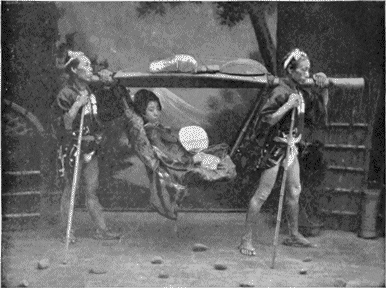
HUMAN PONIES.
Almost everything in Japan is small; nor is a Japanese pipe an exception to the rule. It is about as large as a lead-pencil with a child's thimble at the end. Three whiffs are all that any man can take from them, and the wad of tobacco thus consumed is just about the size of a two-grain quinine pill. Hence, the long inhalations of our smokers, the drooping backward of the head, the languid lifting of the eyes to watch the rings of perfumed smoke float lazily away,—all these are unknown to the Japanese. With them,—three little puffs, and all is over. This seems, however, to satisfy them completely, and with the air of one who has dined well, they knock the ashes from the tiny thimbles, and resume their march. After about four hours of this kago-riding we reached the summit of a mountain pass, called Otemetoge. From this point a glorious vista met our gaze.
STOPPING FOR A SMOKE. A JAPANESE LADY EN ROUTE.
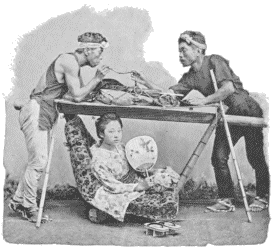
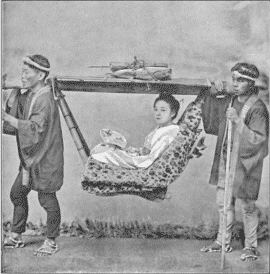
Behind us, in the distance, lay Miyanóshita and its neighboring villages, resembling a group of islands in an ocean of green foliage. Far off upon the heights a line of sunlit buildings gleamed like whitecaps on a bright-green sea. Nearer, and almost at our feet, some objects glittering in the noonday light attracted our attention, and these, examined through a field-glass, proved to be a foaming mountain stream and silvery cascade. At first we hardly dared to look on the other side of the pass, lest we should experience disappointment. But fortune favored us. The sky was clear; and gazing eagerly toward the west, we saw, directly opposite our point of observation, the grand old sacred mountain of Japan,—the world-renowned Fuji-yama.
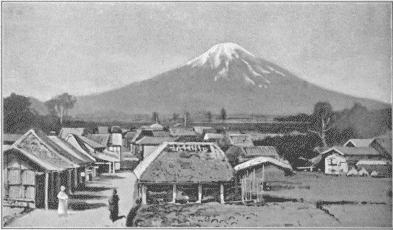
FUJI-YAMA.
It made me fairly catch my breath to look for the first time upon this noble peak, whose form had been portrayed on almost every specimen of Japanese art that I had seen from childhood. I felt as if I had been ushered into the presence of some mighty sovereign, whose name and deeds and splendid court had from my earliest years called forth my admiration. A score of interesting traits render a study of this mountain valuable. It is, in the first place, a volcano,—the tallest of those fiery furnaces whose devastations cast a lurid light along the path of Japanese history. Its last eruption was in 1707, when all the plain around its base was buried deep with cinders, and ashes fell fifty miles away. Yet even now, although no wreathe of smoke surrounds its brow, it sends forth steam through several apertures, much as a captive serpent hisses though its fangs are drawn. The little spur upon its southern slope is due to the last eruption. Before that, both of its curving sides were perfectly symmetrical.
The ascent of Fuji involves a long, hard climb for weary miles through lava-ashes, sometimes ankle-deep. The violence of the wind on certain portions of the mountain is proverbial, and by some travelers has been described as so appalling that they were fearful lest some furious blast might blow them into space and scatter their remains over a dozen provinces.
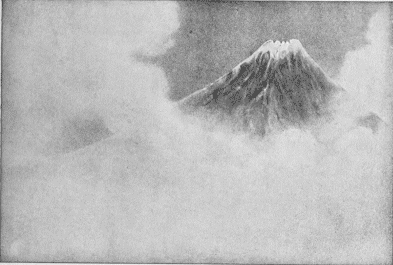
THE SACRED PEAK.
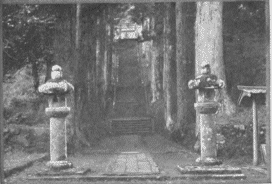
APPROACH TO A SHRINE.
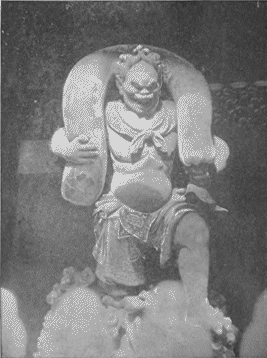
THE GOD OF WIND.
One cannot wonder that the Japanese have always deemed this mountain sacred. A perfect, silver-crested pyramid, over twelve thousand feet in height, rising in one majestic sweep from sea to sky; changing its color constantly from dawn to dusk, like some officiating priest, a mediator between God and man, assuming consecrated robes of purple, orange, violet, green, and gold,—how could man help regarding it as a glorious shrine inhabited by Deity itself? To its mighty base, as to some incense-burning altar, more than ten thousand reverent pilgrims annually come to make the arduous ascent; and to relieve their hardships, "rest-houses" have been built at intervals along the path, while, even on the summit, the three entrances to the volcano's crater, which is four hundred feet deep, are marked by sacred gateways.
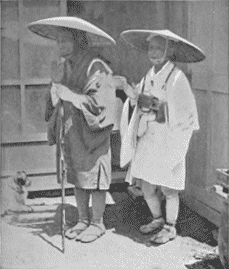
MENDICANT PILGRIMS.
Most of these pilgrims wear upon their shoulders the garments almost universally worn in stormy weather by the Japanese peasants,—a kind of water-proof, made of straw or grass, to shed the rain and snow. These vary from a finely-plaited matting to the cheaper, rougher grades, which make the wearer's back look like the roof of a thatched cottage. Upon their heads are hats of split bamboo or straw, that bear a comical resemblance to enormous mushrooms, and serve as sunshades or umbrellas, according to the condition of the weather. We met such pilgrims everywhere throughout Japan. At least a hundred thousand people thus become, in summer-time, religious tramps, and make their way to sacred islands, holy mountain-tops, and shrines whose names would fill a lengthy catalogue.
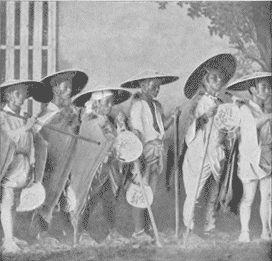
THE PILGRIM GARB.
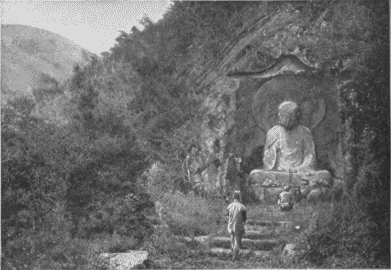
STATUE OF JIZO
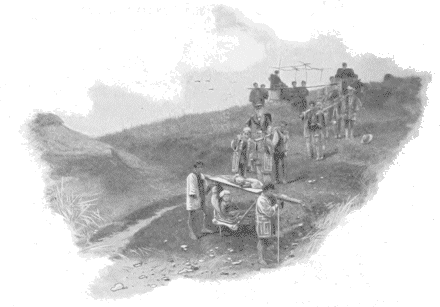
CROSSING THE TEN-PROVINCE PASS.
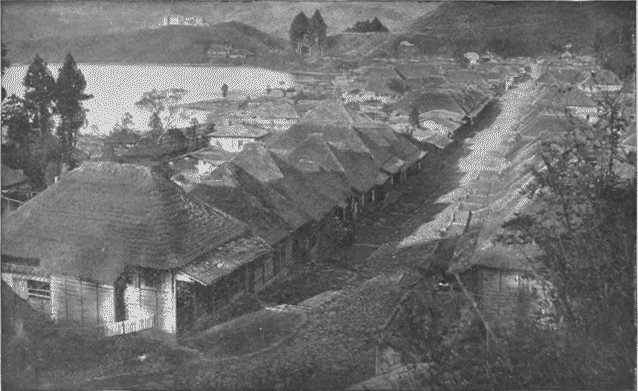
VILLAGE STREET.
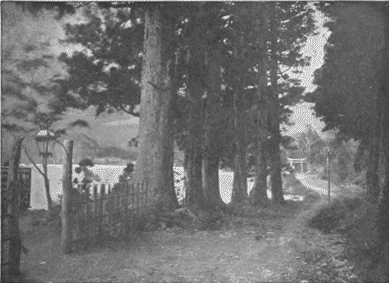
A LOVELY WALK NEAR HAKONE.
Many of these itinerant worshipers solicit alms to help them on their way; but there are also associations of these pilgrims, whose members pay one cent a month into a common treasury. From such a tax as that, however, the treasury never becomes congested, and hence the number of those who travel is necessarily limited. When, therefore, the pilgrim season opens, a certain number of the wanderers, chosen by lot, visit the shrines and represent those whose circumstances compel them to remain at home. These pilgrimages, it is said, are on the wane, but they are still popular. Only five years ago, at the festival of one famous shrine, twenty-one thousand people alighted in two days at a country railway station where the daily average is three hundred and fifty; and to another sacred shrine about two hundred and fifty thousand pilgrims annually come.
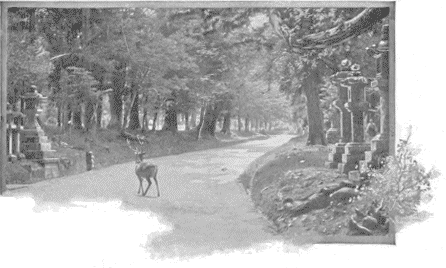
APPROACH TO THE TEMPLE AT NARA.
Another charming excursion in Japan led us across the "Ten-province pass" to Atami on the southern coast. Of course it had to be made in chairs or kagos; but such slight hardships sink to insignificance when one recalls delightful days spent in enjoying lovely scenery, inhaling pure, invigorating air, and riding over mountain-paths on which the sunlight, filtering through the trees, traced tremulous mosaics of alternate light and shade.
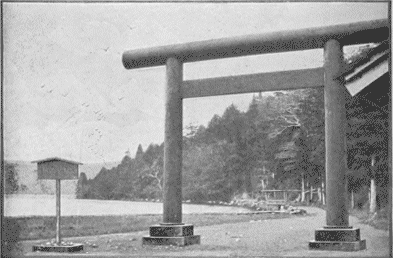
ON THE SHORE OF HAKONE LAKE.
Occasionally on this journey we came upon the sculptured effigy of some protecting deity. We were especially impressed by one that was colossal in dimensions, and had been carved laboriously from the natural cliff eleven hundred years before. It represents the Buddhist god, Jizo, who is the especial guardian of travelers and little children. Around the base of this extraordinary figure were heaps of pebbles which had been placed there, one by one, by wayfarers for centuries. This custom originated in one of the most singular myths which religion has ever produced, and is a striking proof of the fondness of the Japanese for children. Upon the banks of the river, in the lower world, is said to live a demon who catches little children as they try to cross, and makes them work for him at his eternal task of piling stones upon the shore. Every pebble laid at the statue's feet is thought to lighten the burden of some little one below! Smilingly yielding to the influence of this pathetic superstition, we ourselves left some pebbles, and then moved onward down the mountain-side, in the same path pursued by all the thousands who had here preceded us, like little boats upon the stream of Time.
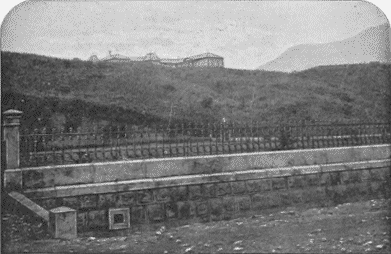
THE MIKADO'S PALACE, HAKONE.
ATAMI. THE GEYSER AT ATAMI.
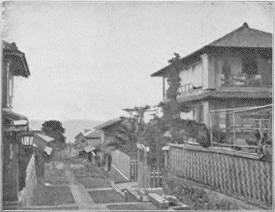
Presently a sudden turn revealed to us Hakone Lake,—a lovely sheet of water surrounded by densely wooded hills. This is a summer resort that rivals even Miyanóshita in popularity. The air is delightfully invigorating here, twenty-four hundred feet above the sea, and in the hot season, not only are all the Japanese tea-houses filled with guests, but families from Tokio and Yokohama rent all the available cottages around the lake. To some extent, indeed, this region has imperial patronage, for, on a pretty hill which overlooks the water, is a palace built for the Mikado. It must be said, however, that he has never occupied it, since he rarely leaves his residence in Tokio, but we were told that the Crown Prince, a lad of fourteen, had been here several times. In almost every other country in the world the public is now permitted to enter the abodes of royalty when their distinguished occupants are absent; but not so here. These palace doors are closed inexorably to all travelers. We were not allowed even to step within the grounds.
BY LAKE HAKONE.
At length, descending to the level of the sea, our faithful bearers brought us to Atami—a pretty town, famous for the manufacture of that Japanese paper which seemed to me one of the most astonishing products of the country. It is so fine and soft that it is used for handkerchiefs and napkins, and takes the place of lint in surgery; yet is so firm that it is manufactured into lantern-screens, brooms, air-cushions, and umbrellas. Torn into strips, it also takes the place of string, while all the inner walls of Japanese houses consist of screens of paper, divided into squares, like panes of glass.