LECTURE I (continued 2)
Reading edition
A MIXTURE OF STYLES.
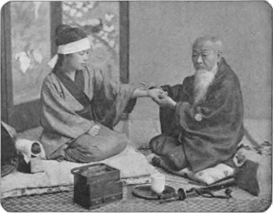
As we were one day walking through Atami, a sudden outburst of steam, on the other side of a fence, came very near stampeding our entire party. When we recovered sufficient breath to ask the cause of the explosion, we learned that it was occasioned by a small geyser, which has a species of convulsion every four hours, and each time pours out sulphurous vapor for a space of fifteen minutes. It would appear that the people of Atami are living on the lid of a volcanic tea-kettle, but evidently they have no fear. They have enclosed the geyser with a fence like a wild animal in a cage, and close beside it is a sanitarium, where patients with diseases of the throat and lungs inhale the steam. It may be an excellent place for sufferers from pulmonary troubles, but we concluded that nervous occupants of this retreat must feel like the traditional darky on the safety-valve of a Mississippi steamboat. The old-style doctors of Japan are still in vogue in certain rural districts, though they are being rapidly superseded by the young practitioners who have received a medical education, in Europe or America. With the old Japanese physicians a favorite mode of cure was sticking a long needle into the part of the body supposed to be diseased. Another universal panacea was branding the body with a burning weed called moxa. This was prescribed for troubles as unlike as rheumatism and toothache. Women, at certain critical moments in their lives, were thought to be relieved by having the little toe of their right foot burned three times. We often noticed scars upon the naked backs and limbs of our jinrikisha men, and learned that they had been produced by this strange medical treatment.
A JAPANESE DOCTOR OF THE OLD STYLE.
A JAPANESE LADY.
DRESS AND UNDRESS.
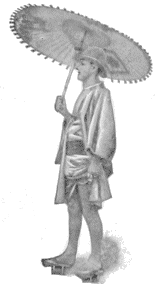
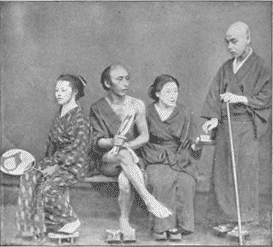
In traveling through the rural districts of Japan, the tourist soon becomes accustomed to the peasant's lack of clothing. It is not the exception here to be undressed—it is the rule. Even in the streets of Tokio one will behold, on rainy days, thousands of men wearing neither trousers nor stockings, walking about with tucked-up clothes and long white limbs, which gives them the appearance of storks upon a river-bank. Even those who have adopted the European dress will frequently, on a muddy day, practice economy by discarding their trousers, and, unconscious of any incongruity, will take their "constitutional" on wooden clogs, with bare legs and feet, though having the upper part of their bodies covered with a frock-coat and a Derby hat!
Among these scantily-clad people one often sees a somewhat better dressed but melancholy man, who, with his downcast eyes and shaven head, appears to have lost his friends together with his hair. He represents a useful class of people in Japan—the masseurs, or professional manipulators of the body. One should not hastily conclude that he is smoking. It is true, the article between his lips is usually a pipe, but it is not the kind that holds tobacco. It is a reed-like instrument, on which he blows two plaintive notes to advertise his presence. In every Japanese town we always heard at night the mournful call of the masseur. The laughter which their appearance at first provokes, gives place to pity when one learns that nearly all of these men are blind. It is a calling which, notwithstanding their infirmity, they can follow, and they are said to be adepts at it.
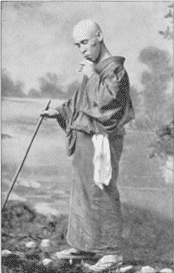
A MASSEUR.
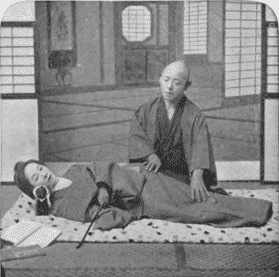
MASSAGE.
To appreciate a Japanese masseur, it is necessary to see one of them at work. This, it is true, is more than he himself can do, since he is blind; but our pity is soon diverted from him to the person he is treating, not so much because of the pinching to which he subjects his victim as on account of the pillow on which the patient's head reclines. It makes one think of Anne Boleyn or Mary Stuart, with their necks upon the fatal block; for a Japanese pillow is a wedge-shaped piece of wood, about a foot in length, on top of which is tied a wad of cloth, about the size of a Bologna sausage. To try to sleep with neck supported in this fashion would seem to most Americans as hopeless as to woo slumber with a fence-rail for a pillow. One shudders to consider the discomfort, under these conditions, of turning over in bed, and trying to locate the neck on such a diminutive support.
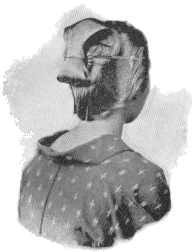
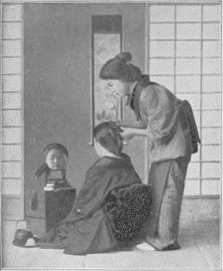
JAPANESE COIFFURE.
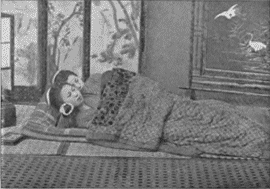
A JAPANESE PILLOW.
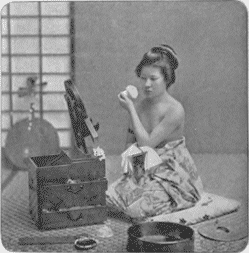
IN THE BOUDOIR.
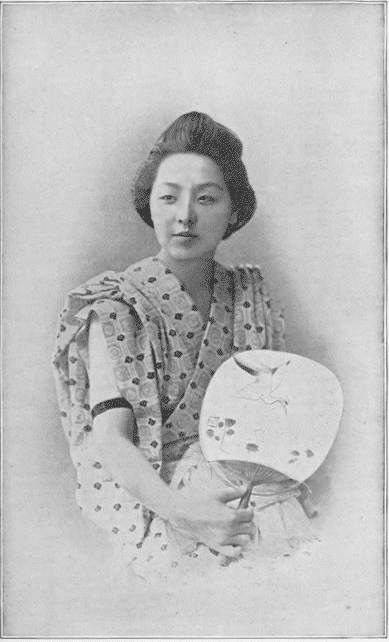
Yet, after all, we are creatures of habit, and forty million people in Japan use just such pillows every night, without suffering from insomnia. It is even claimed that Japanese women delight in them, since they do not disarrange the hair. Nor does this appear strange, when one scrutinizes their methods of coiffure. They are something marvelous. The hair of Japanese women is, with few exceptions, as black as ebony, and very abundant. Moreover, it is usually profusely oiled, and glistens like a raven's wing. Through these polished tresses are invariably drawn hairpins of gold, strings of coral, or ornaments of tortoise-shell. But as to how the ladies of Japan produce in their coiffures their black crescendos and diminuendos, their sharp staccato puffs and portamento water-falls, the writer dares not hazard a conjecture. Yet of one thing we may be sure: if we were to venture into a Japanese lady's boudoir, we should find that help is needed to produce them. The toilette-stand and looking-glass might seem to us a trifle low; but we must bear in mind that Japanese domestic life is regulated by a level three feet lower than our own: in other words, where we use chairs, they seat themselves on the floor. This furnished us a key to much that hitherto had seemed puzzling in their habits. Whether a thing be sensible or not depends upon the point of view,—in this case, the height at which we seat ourselves. Once regard an exquisitely clean floor of cushioned matting as an immense divan, and taking off our muddy boots becomes a matter of course; and tables and lamps and mirrors will be placed at a height adapted to our needs.
THE LAST TOUCHES.
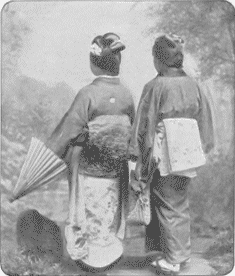
THE OBI.
When a foreigner beholds for the first time a Japanese lady seated on her heels, as is the custom, he fancies that she has the small of her back supported by an enormous cushion. But when he subsequently sees this lady walking down the street, attended by her maid, he perceives that what appeared to him a sofa-pillow is really a regular part of her costume. It is a heavy silken sash, extremely long and often very elegant, which keeps the robe itself in place. This obi, as it is called, is the most precious article of a Japanese lady's wardrobe. Its usual length is fourteen feet, and when its material is silk or gold brocade it will be seen that it has some value. These sashes exhibit, of course, a great variety of color, and one can scarcely find a prettier sight than that of several well-dressed Japanese ladies, grouped together in the vivid sunlight. They look as radiant and attractive as a bouquet of flowers.
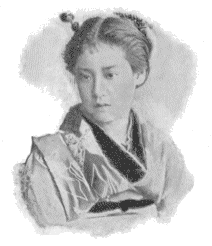
A JAPANESE BEAUTY.
American ladies who have tried the Japanese dress say that the tying of the obi is extremely difficult. But here, as in the art of hair-dressing, a lady's maid is almost indispensable. The bow, although arranged in different styles, is always worn behind, thus spoiling, in some measure, the outline of the form. When a Japanese lady becomes a widow, she makes no change in the position of the obi, unless she wishes publicly to announce that she will never marry again. In that case, it is said, she ties the bow in front. Whether this wards off all proposals may be doubted; but gossip relates that, once in a while, the widow comes to look at life a little differently, and then the bow works gradually round again to its original position.
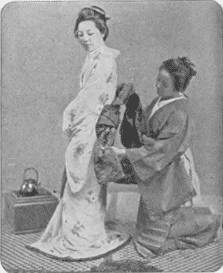
TYING THE OBI.
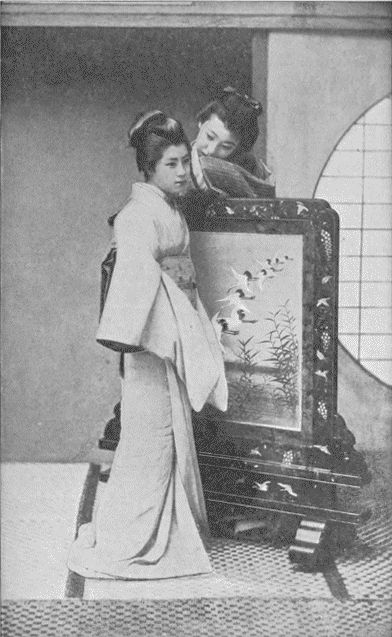
FRIENDS IN COUNCIL.
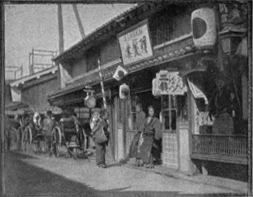
A JAPANESE SHOP.
Japanese ladies make a serious mistake when they exchange their national style of dress for that of foreigners, for, as a rule, their charm and beauty leave them when they appear in European garments. On two occasions we saw some thus arrayed, and the effect was painful. If most of them had put on each other's dresses by mistake, they would have looked about as well; and in the absence of corsets their little figures seemed as much out of place as children in their mother's wrappers.
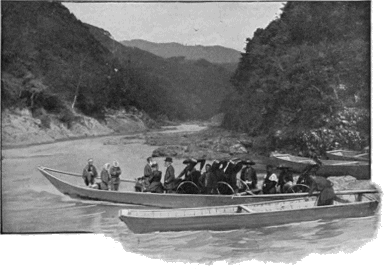
A BOAT-RIDE IN JAPAN.
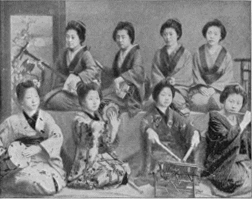
GEISHA GIRLS.
Some years ago a letter signed by Mrs. Cleveland and many other prominent women of America was addressed to their sisters in Japan, urging them not to risk their health and comfort by adopting European dress. It was of little avail. The die was cast. In 1885 the Japanese Empress and her suite appeared for the last time in public in the tasteful costumes of the past. Since then, the order has gone forth that all ladies who present themselves at court must do so in European dress; and it is to be feared that, ere a score of years have passed, the lovely and appropriate robes of old Japan will have disappeared forever. Until quite recently, the universal rule for Japanese women, when they married, was to shave their eyebrows, pull out their eye-lashes, and stain their teeth jet-black. Even the present empress did these things at her marriage. The idea seems to have been to make themselves look hideous, so as to have no more admirers, despite the fact that the average husband, as we all know, appreciates his wife better if he perceives that other men are aware of her attractions. But under the new régime this sad disfigurement is rapidly disappearing, and at present the younger ladies of Japan, at least, show rows of pearly teeth when laughter parts their lips.
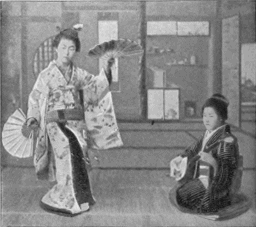
A DANCING-GIRL.
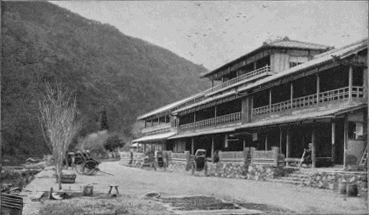
A TEA-HOUSE.
The richest toilettes that we saw in the land of the Mikado were worn by geisha girls, without whom Japanese festivals are incomplete. Some of these dainty creatures form an orchestra while others dance. Their instruments of sound (one can hardly call them instruments of music) consist usually of two kinds of drums and a long, three-stringed banjo, called the samisen. Sometimes a flute also is used. We frequently disputed as to which of these was the least excruciating, but on the whole we preferred the drums. When to this combination a human voice was added, our teeth were set on edge.
Young as they look, these geishas are professionals, and training-schools exist in Tokio and Kioto, where they are sometimes taught when only seven years of age. A Japanese dancing-girl forms a charming picture. Her long kimono of the richest silk is beautifully embroidered with such a wealth of lovely flowers, that she herself resembles a bouquet in motion. Her broad obi is of the heaviest crape, and falls upon a petticoat of gorgeous color.
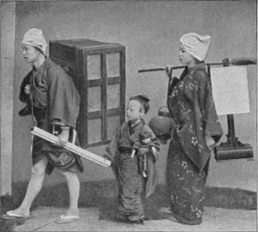
A JAPANESE FAMILY MOVING.
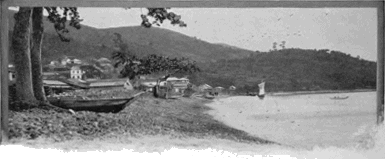
ON THE JAPANESE COAST.
Black lacquered sandals half conceal her tiny, white-socked feet, and in each hand she holds a decorated fan. Do not expect from her the slightest approach to Lottie Collins. The dance of "Ta-ra-ra-boom-de-ay," performed by a geisha girl, would make a subject of the Mikado, if he were unprepared for it, faint away. Nor will the spectator see the least exposure of her personal charms. For, strangely enough, the Japanese, who will at other times dispense with all the clothing possible, conceal a dancer's form with rigid severity. There is not much expression in these dancers' faces. One feels that they are not women, but girls to whom intense emotions are as yet unknown. They merely represent in graceful pantomime some song or story, flitting about like pretty butterflies, or swaying back and forth like flowers in a summer breeze. Leaving Atami, we had a charming ride of seven miles beside the ocean. The road (which may be called the Japanese Cornice) is passable for jinrikishas; and while on one side we looked off upon the Pacific, on the other we found that every valley had a background of well-rounded mountains, covered with verdure soft as velvet, from which at intervals a stream of crystal water rushed to meet the sea. The scenery of Japan may not be grand, but for a charming combination of the elements which make a country beautiful, enlivened constantly by natives in their novel occupations, the seven-mile drive from old Atami can hardly be surpassed.
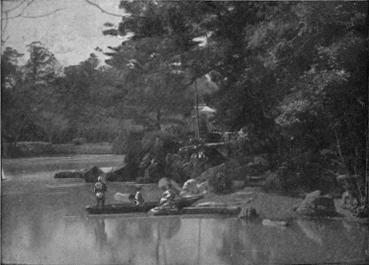
LOVERS OF NATURE AND ART.
Moreover, the people, as we met them on these journeys, pleased us greatly. They were invariably courteous and gentle in their manners, and no boorishness was visible, even among the lower classes. They always seemed to be good-natured. However stormy the weather, however heavy the load, however bad the roads, we never heard a Japanese complain, nor saw one in a bad humor. If the foreigner becomes angry with them, they laugh as if he were making himself ridiculous; and presently he feels that they are right, and that violent anger is in truth absurd.
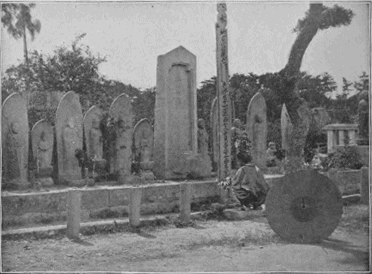
A JAPANESE AT PRAYER.
Yet, just as beneath the smiling landscapes of Japan still lurk the terrible volcanic forces of destruction, so underneath the sunny dispositions of the Japanese are all the characteristics of the warrior. Their history has thoroughly established that they are a manly, patriotic, martial race. Their gentleness, therefore, comes not from servility, but is the product of inborn courtesy and refinement.
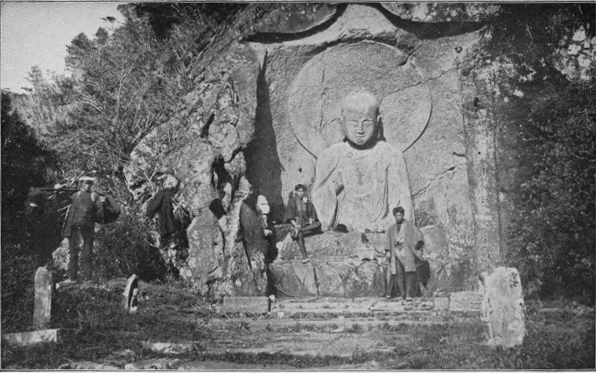
THE GUARDIANS OF TRAVELERS AND LITTLE CHILDREN.
The Japanese are naturally of a happy disposition. A smile illumines every face. Apparently their past has no regrets, their present no annoyances, their future no alarms. They love the beautiful in nature and in art. They live simply; and how much that means! Their wants are few. The houses of the wealthy do not differ much from those of the poor. Hence life for them is free from almost all those harrowing cares and worriments which sometimes make existence in the Occident a long, incessant struggle to keep up appearances. If they are sad, they seldom show their sadness in public. They evidently believe with the poet:
"Laugh, and the world laughs with you; Weep, and you weep alone."
In some provinces of Japan, when a new bridge is opened, not the richest, but the happiest, persons in the community are chosen to pass over it first, as a favorable omen.
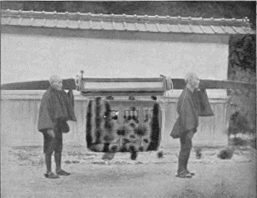
A JAPANESE HEARSE.
Strange as it may appear, however, these qualities of the Japanese have been regarded by some travelers as faults. A tourist once solemnly remarked to me: "The great trouble with the Japanese is that they are too happy."
"What!" I exclaimed, "can any one be too happy in this world?"
"Certainly," was the reply; "the Japanese are too light-hearted to learn with advantage the lessons of adversity. If a calamity befalls them, they often smile and say, 'Well, it can't be helped,' and then try to think no more about it. Worst of all," he continued, "they do not worry about the future, but actually meet death fearlessly and calmly."
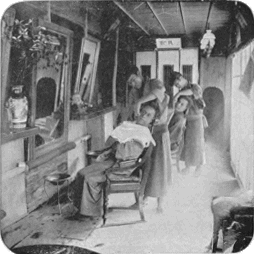
A BARBER SHOP.
"My friend," I answered, "if to enjoy as much as possible this world that God has given us, if to smile bravely in adversity, and if to die without fear, are faults, it would be well if many other people possessed them, too. You remind me of the old lady in New Hampshire, who exclaimed sadly, 'The Universalists tell us that all men are to be saved, but—we hope for better things!'"
In fact, a remarkable characteristic of the Japanese is the cheerful, almost jovial, way they have of announcing a calamity. An English resident of Japan called our attention to this fact soon after our arrival, and our experience confirmed his testimony. Whether the cause be nervousness or a dislike to give one pain, the fact remains that the Japanese will often preface a bit of dreadful news with laughter, or at least with a chuckle. Thus, whenever our guide called our attention to a funeral, his face would wreathe itself in smiles.
Still more extraordinary was the manner of a barber in the hotel at Yokohama. As he was shaving me one morning, after a moderate earthquake-shock the night before, he suddenly remarked, with what appeared to be a burst of unpremeditated merriment: "Oh, last night's shock was nothing. Why, a few years ago, in Tokio, my father and mother were killed outright by an earthquake (Ha! Ha!); the house fell right on top of them (He! He!), and crushed them both to death (Ha! Ha! Ha!)."
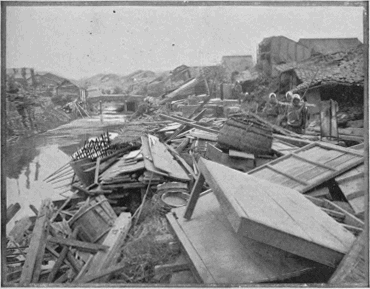
A RUINED VILLAGE.
It is difficult to explain this peculiarity otherwise than by supposing it to be a nervous mannerism; for, as a race, the Japanese are very affectionate, and filial reverence is a religious duty. In this instance I was so astonished at the man's hilarity, that I very nearly fell out of his chair. We thought of this incident again, when, some weeks later, we found ourselves in the Japanese province which had suffered most from the calamitous earthquake of October, 1891. Thousands of houses, we found, had been wrecked by that catastrophe, and in one place the railway tracks had been violently bent and twisted, like a chain irregularly thrown upon the ground. The motion lasted less than a minute; but what cannot an earthquake do in forty seconds? There came one mighty shock,—and over an extent of many miles the buildings fell like packs of cards. Great blocks of solid masonry were tossed about like dice. Trees lay around like jackstraws.
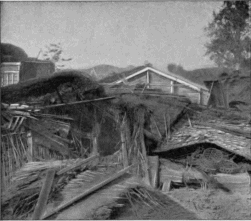
SCATTERED BY AN EARTHQUAKE.
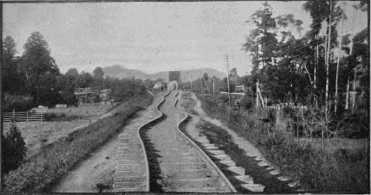
TWISTED BY AN EARTHQUAKE.
Large manufacturing towns were ruined. Thousands of husbands, wives, and children who, but an instant previous, had been happy at their work or play, were suddenly crushed by falling roofs, mangled by heavy timbers, buried alive in the debris, or burned to ashes by fires caused by overturned braziers. By chance we traveled through this region on the first anniversary of that great calamity, and many people, we were told, felt anxious till the day was over. But earthquakes in Japan, alas! are limited to no special dates. Their visits are extremely numerous and quite impartial as to months and days. Our earth is said to be quieting down in its subterranean disturbances; but poor Japan still has no less than fifty-one volcanoes labeled "active," and experiences every year, on an average, five hundred seismic shocks, besides numerous destructive typhoons or hurricanes. Most of them are, of course, mere tremors; but once in a while there comes a stroke that causes fearful devastation, as when in Tokio, in 1703, thirty-seven thousand lives were lost. Such terrible manifestations of volcanic power remind one of the more appalling scenes that must have been enacted here, when Nature brought these islands from the sea, pouring them from her fiery crucible.
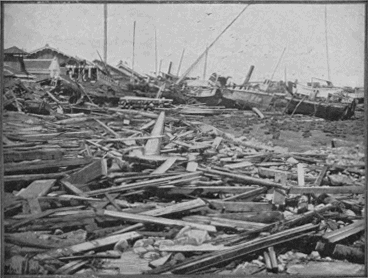
EFFECT OF A TYPHOON AT KOBE.
In planning a journey through the interior of Japan, the tourist naturally inquires where and with what accommodation he is to spend the nights upon the trip. He need not have the least anxiety. In the four prominent cities,—Tokio, Yokohama, Kobe, and Kioto,—there are first-class hotels, with rooms and food adapted to the tastes of foreigners. In many smaller places, too, like Miyanóshita and Atami, the hotels, although simpler, are both comfortable and well-managed. One suffers no discomfort in any of these localities. But in the country villages (which need not be included in the traveler's route unless he so desires), he must adopt the Japanese mode of sleeping in a tea-house—that is to say, in a regular Japanese hotel.
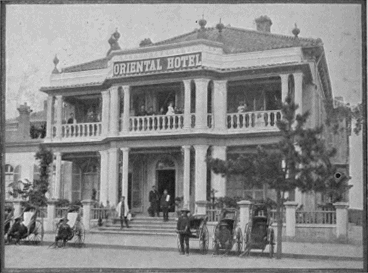
HOTEL AT KOBE.
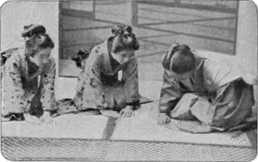
THREE OF A KIND.
As our jinrikishas drew up before one of these, we saw a pretty, modern building of two stories, adorned as usual with paper lanterns. At intervals, on the edge of every balcony, were tall, rectangular boxes reaching from floor to ceiling. These upright cases contain wooden shutters, about as large as the leaves of a dining-table, which are at night taken out, and pushed along in grooves, to make an outside wall for the entire house. When that is done, each balcony of course becomes an inside corridor. Thus every Japanese dwelling consists, as it were, of two houses, one within the other, enclosed in separate cases,—the inside one of paper, the outer one of wood. As we alighted here, the landlord and his servants hurried out to greet us, dropped on their knees, and, with their hands spread out, palms downward, and their foreheads almost touching the floor, they bowed repeatedly, like the "three little maids from school." What a contrast was here between the Orient and the Occident. Imagine a hotel clerk in America down upon his knees! In our hotels the traveler's first duty is to register his name. Here there is something even more important to attend to, namely, removing his shoes. Off they must come before he steps upon the delicate mattings and the glistening floor, just as with us a muddy overshoe would not be tolerated on a parlor carpet. In fact, on entering the hall, one sees what in America would be called a hat-rack, but which is here designed for holding shoes.
A TEA-HOUSE. A TEA-HOUSE VESTIBULE.
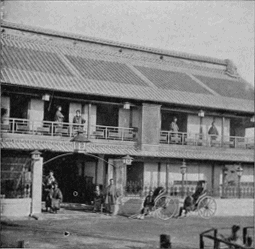
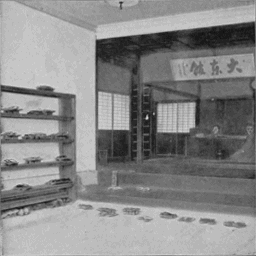
The tourist, therefore, should invariably carry with him in Japan a pair of soft, felt slippers, for otherwise he will be frequently obliged to walk about in hotels, shops, and temples, with merely stockings on his feet.
In nearly all Japanese dwellings one usually finds, hung in conspicuous places, some handsomely framed mottoes and proverbs, much as in many of our own country houses we read upon the walls such a comforting assurance as "The Lord will provide," or the melancholy conundrum "What is home without a mother?" To Occidental eyes, Japanese ideographs do not appear beautiful. They look like the meanderings of intoxicated flies that have been immersed in ink. As for their meaning, one motto was translated to us as signifying: "May Buddha bless this house!" Others were words of praise which princely visitors had left; while not a few were epigrams or proverbs, for which the Japanese are famous. Some of them ran as follows: "The absent get farther away every day;" "Clever preacher, short sermon;" "A woman's tongue three inches long can kill a man six feet high;" "Live under your own hat;" "Don't make a long call when the husband is not at home." And yet we send missionaries to Japan!
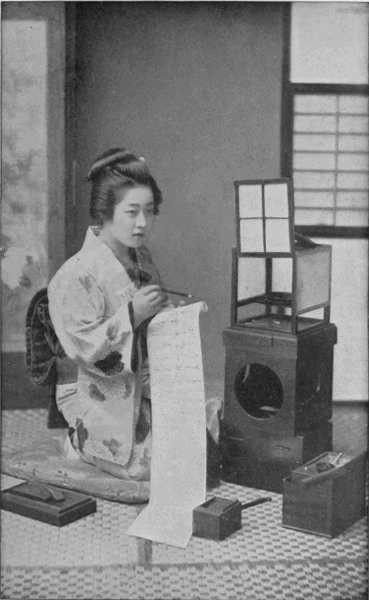
WRITING A LETTER.
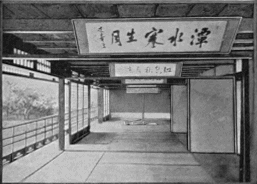
JAPANESE MOTTOES.
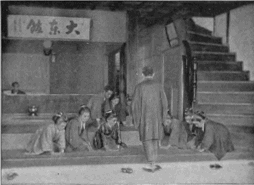
With many bows and smiles the landlord of the tea-house led the way up a flight of exquisitely polished stairs, and showed us our apartments. We looked around us with astonishment, for no furniture was visible. The floor, it is true, was covered with fine matting, but, with that one exception, the rooms, which opened into each other, were as bare as an unfurnished flat. Their number and extent depended largely on ourselves. Did we desire an entire story? We had but to push back the paper screens, and it was ours. Did we insist on having separate rooms? Close up the little screens again, and each could sleep in his own paper box, exactly twelve feet square. Unfortunately there are no locks upon these paper screens; hence, just as one is getting out of bed in the morning, the whole side of his room will sometimes disappear with the rapidity of a liberated Holland shade! Moreover, Japanese servants, urged by curiosity, will often poke a moistened finger through a square of paper, to study foreign toilettes at their leisure. During the daytime, in the summer, even the screens are removed, to give free access to the breeze, and the house then becomes the empty skeleton of its former self.
AT THE TEA-HOUSE DOOR. INTERIOR OF A TEA-HOUSE.
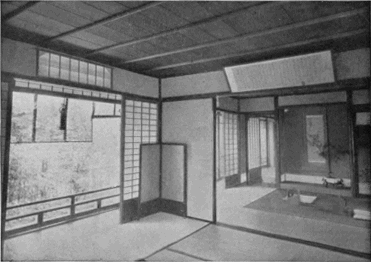
But what most puzzled us at first was where to hang our clothes. There were no hooks upon the walls, there was not even a table for our toilet articles. It seemed too bad to put our coats and hair-brushes on the floor. But one must recollect that Japanese floors are not like ours, since no boots ever touch them. For native guests a beautiful, square, lacquered box is usually provided, in which they lay the carefully folded robes which they remove before retiring. To us, however, no limited receptacle like that was given. We had the unrestricted floor.
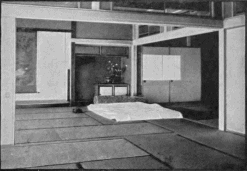
A JAPANESE BED.
The beds in which we slept afforded us the most amusement. When bedtime comes in Japanese homes, quilts are brought out from a closet and spread upon the floor. Within five minutes all is ready for the night, and with the morning light they disappear again. Occasionally, in the larger tea-houses, we, as foreigners, had special luxuries,—such as cotton sheets, a couch of seven comforters, instead of the usual two, and, for a bolster, an extra quilt rolled up as with a shawl-strap. Thus altogether, including what we used for coverings, our most luxurious couches in Japan consisted of from ten to a dozen comforters.
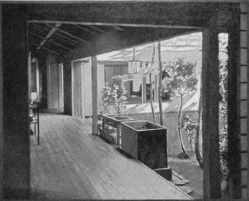
THE COMMON WASHSTAND IN A TEA-HOUSE.
We found some difficulty in getting sufficient sleep in Japanese tea-houses; not from the composition and arrangement of our beds, but from the noise about us, which seldom ceased before the hour of midnight, and always woke us with the dawn. Even our "summer hotels," with their distressingly thin partitions, are delightfully tranquil compared with the country inns of Japan. For sliding screens of paper are practically no barrier at all to sound, and, as if that were not sufficiently aggravating, these paper walls rarely reach the top of the room, but leave a ventilating space of a foot or two, through which the mingled snoring, prayers, and conversation of the guests, and the matutinal clatter of the servants, roll and reverberate like distant thunder.
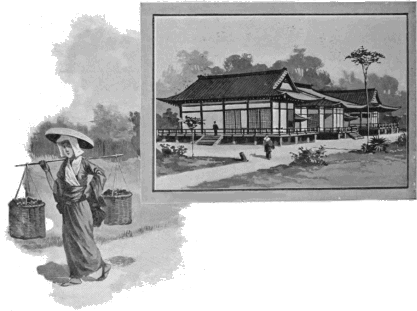
JAPANESE TEA-HOUSE. CARRYING TEA FROM THE FIELD.
The morning after my arrival, I pushed aside a screen with my forefinger, and lo! half of my room stood open to the rising sun. Descending to the courtyard, I beheld a Japanese servant hurrying toward me on her wooden clogs, to give me tea.
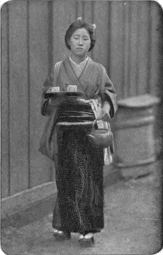
BRINGING TEA.
What shall be said of these attractive little waitresses, who make the dullest tea-house gay with laughter, brighten the darkest day with brilliant colors, and sweeten every tea-cup with a smile? They are not usually beautiful, or even womanly, in the sense of being dignified. They rather seem like well-developed school-girls, just sobered down enough to wear long dresses, but perfectly unable to refrain at times from screams of merriment. Yet search the world through, and where will you find servants such as these? From the first moment when they fall upon their knees and bow their foreheads to the floor, till the last instant, when they troop around the door to call to you their musical word for farewell,—"Sayonara,"—they seem to be the daintiest, happiest, and most obliging specimens of humanity that walk the earth.
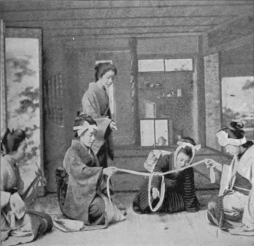
PLAYING GAMES.
We were particularly pleased with one agreeable trait of all these Japanese girls—their exquisitely clean and well-shaped hands. One would, of course, expect them to be small, for delicate frames are a characteristic of the race, but almost without exception the hands of all the waitresses who served us in Japan looked as if they had just emerged from a hot bath, and had been manicured besides. "A trifle," some would say, but, after all, such trifles help to make perfection. When one has traveled through a country for two months, and from one end of it to the other has seen pretty, well-kept hands extended to him fifty times a day, he feels respect and admiration for a race so neat and delicate to their finger-tips. The Japanese, according to our Occidental standard, may not have much godliness, but they possess what comes next to it—personal cleanliness. And I am sure that, at any time, I would rather associate with a nice, wholesome sinner than with an uncleanly saint!
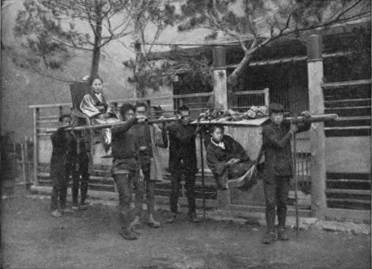
TWO MODES OF TRAVEL IN JAPAN.
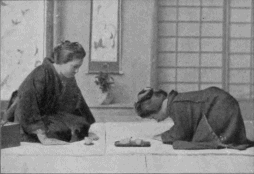
DOMESTIC ETIQUETTE.
It was while we were taking our breakfast here, that we beheld, in a neighboring room, a lady being served with tea by her domestic, who was approaching her mistress on her knees. Nothing amazed us more than this, for in the United States these positions are usually reversed. In free America it is the lady who, figuratively speaking, has to "go down on her knees" before her cook. When we consider the serious drawbacks to domestic happiness and comfort, occasioned by the insolence and inefficiency of servants in America, who, as a rule, are better lodged, clothed, and fed than any other class of laborers in the world, one questions if in this, and many other respects, Japan will be improved by contact with the Occident.
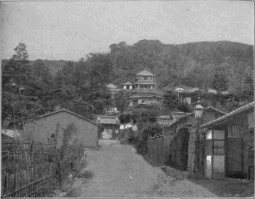
A STREET IN KIOTO.
What Moscow is to the Russians, Kioto is to the Japanese, their present capital, Tokio, corresponding rather to St. Petersburg. Kioto is the ancient capital,—the sacred city of the empire,—hallowed by countless shrines and endeared by centuries of classic memories. It was for a thousand years the home of the Mikado, and is still the centre of old Japanese art. Here also, till the revolution of 1869, lived many nobles of the highest rank, together with distinguished poets, priests, and artists. Its name, Kioto, denotes the City of Peace, and its best citizens were thought to be the most refined and polished of a race whose gentle manners are still unsurpassed.
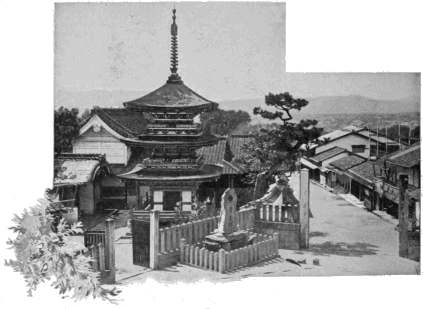
IN KIOTO.
Our hotel in Kioto was unlike the inns of other Japanese cities, being neither a European structure, like the hotels at Tokio and Yokohama, nor yet a tea-house, such as we had lately seen. It was a compromise between the two, with comfortable rooms and foreign furnishings. Its situation is far above the city, upon a wooded hill that has been sacred to Buddha for a thousand years. Around it are old temples, monasteries, and pagodas, among which one can walk in shaded paths the livelong day. Often, while seated on the spacious hotel balcony which overlooks the town, we heard a strangely fascinating sound rolling toward us through the sacred groves in solemn, silvery vibrations. We discovered after a short walk the cause of this. It was a huge bronze bell,—no less than seventy-four tons in weight,—whose sweet-voiced call to prayer has echoed over this hill for nearly three hundred years. There are few sounds more pleasing to the ear than the vibrations of a distant, deep-toned bell. Except in Russia I had never heard such notes as those that issue from the bells of old Japan. Their solemn strokes swell through the forest like the crescendo of an orchestra. These bells, however, are not rung, like ours, by wrenching them from side to side, until a pendant tongue falls sharply on their inner rim. Ah, no! the Japanese treat them far more cleverly. Suspended from the belfry roof is a large, rounded shaft of wood, attendant swings this to one side, and lets it fall, to strike the inverted bowl of bronze one mighty blow. The difference in sound produced by using wood instead of metal, is astonishing. There is no grating jar, no sharpness in the tone, but one stupendous boom of sound, as though a musical cannon were discharged. This instantly resolves itself into slow-moving, ever widening circles of reverberation, which fall upon the ear more and more faintly, till they die away like the last murmur of the surf upon the sand.
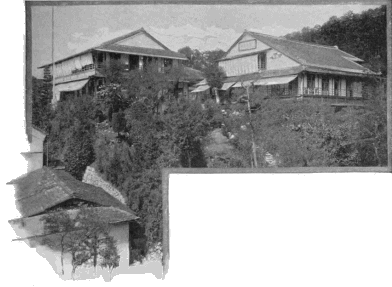
YAAMI'S HOTEL, KIOTO.
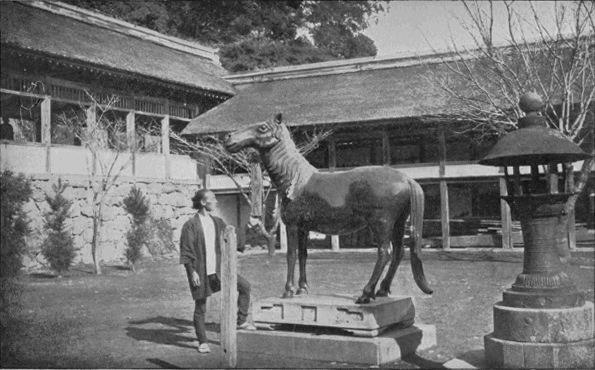
BRONZE HORSE.
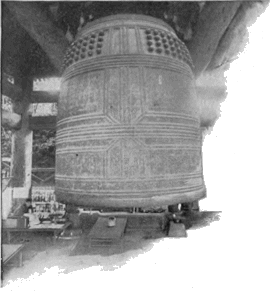
A MONSTER BELL, KIOTO.
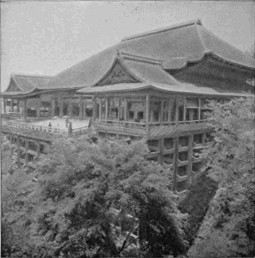
A TEMPLE IN KIOTO.
Accepting the invitation which that bell conveyed to us, we strolled toward one of Kioto's many temples. In the one we entered, five bells, with long white cords attached, were hanging in the lacquered porch. The worshiper pulls one of these, to call the attention of the god; then, having said a prayer, he drops a coin into a grated box and goes his way. On one occasion, we saw a pretty baby, three months old, brought hither in its mother's arms, and made to pull the bell-rope with its tiny hand. Then the great-grand-mother of the child, herself almost eighty-six years old, advanced with trembling limbs and rang it for the second time. It was a suggestive picture,—this vision of old age and infancy, like opposite poles of an electric battery, completing here a circuit of four generations; pathetic emblems of the past and future,—the smiling infant looking forward to anticipated blessings, the feeble matron thankful for the gifts received.
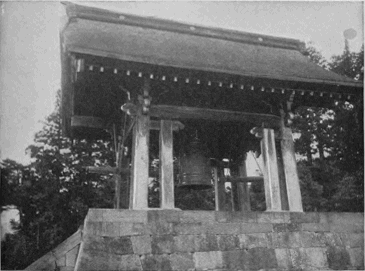
A JAPANESE BELFRY.
The Japanese have really two religions, in some respects rivals of each other. The elder, or original faith, is Shintoism; the younger, which has struggled to supplant it for twelve hundred years, is Buddhism.
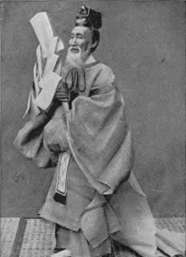
It is difficult to comprehend exactly what Shintoism is. The name means, literally, "The way of the gods," but it is the vaguest known religion. It has no bible, no dogmas, and not even a moral code. It dimly hints at immortality, but has no definite heaven or hell. Its gods, are either deified national heroes or else personifications of nature, such as the glorious sun, the all-surrounding ocean, and the innumerable deities of mountains, rivers, rocks, and trees. Its shrines for worship, with their gray stone lanterns and majestic torii, are severely plain, its services extremely simple, and all its priests appear like laymen in the streets, donning their clerical robes only when they officiate in the temples.
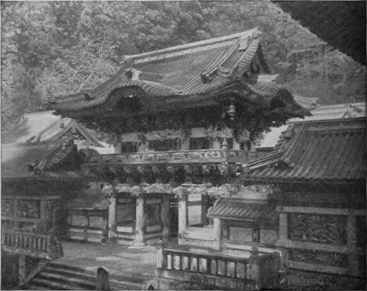
ENTRANCE TO A JAPANESE TEMPLE.
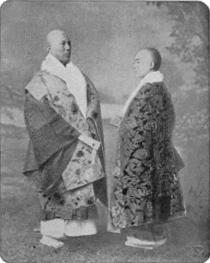
A SHINTO PRIEST. BUDDHIST PRIESTS.
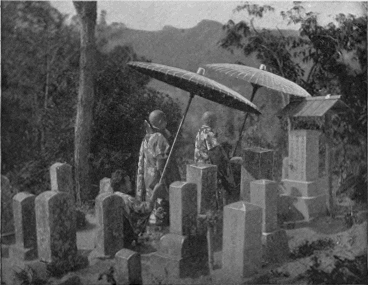
BUDDHIST PRIESTS IN A CEMETERY.
Not so the Buddhist priests. Their costume, like their ritual, is imposing. While Shinto priests may marry, the Buddhists take the vow of celibacy. In fact, though wholly different in its creed from the great Roman Catholic communion, some of the ceremonials of Buddhism remind us of it; such as their richly-mantled priests, their altars bright with candles and adorned with flowers, their clouds of incense, grand processionals, and statues of the gods and saints. What wonder, then, since it has such attractions, that this religion, when it came hither from India, about six centuries after Christ, achieved at once a remarkable success? The colder Shinto faith lost ground, and even the Mikados gave to Buddha's doctrines favor and support for centuries; but Shintoism has now once more become the state religion.
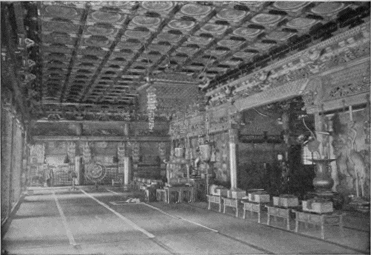
INTERIOR OF A JAPANESE TEMPLE.
The furnishings of the Buddhist temples in Japan are often marvels of artistic beauty, comprising tables, columns, doors, and even floors, composed of ruby red or jet-black lacquer, which is so thick and smooth as to produce the effect of rosewood or solid ebony. Here, too, are altars loaded down with ornaments of gold and bronze, silken screens inscribed with sacred characters, exquisite bronze lanterns, incense-burners, gilded gongs, tall lotus-flowers with leaves of gold, and beautiful lacquered boxes placed on stands about the floor, within which are the precious manuscripts of Buddhist scriptures. In a word, recall the richest specimens of Japanese art that you have ever seen, and know that with such adornment the finest temples in Japan are filled.
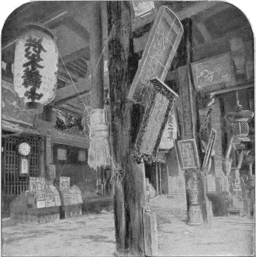
A BUDDHIST TEMPLE.
In some of the less important Buddhist shrines, however, "all that glitters is not gold." Some temples are repulsive from their shabby ornaments, hideous idols, and gaudy paper lanterns. Some of their deities are enthroned behind a wooden grating, and worshipers tie to the latter a bit of cloth on which has been inscribed a petition. One such deity, we were assured, has for his special function the assisting of women to obtain good husbands. He is immensely popular. We saw, in half an hour, at least a dozen women knock on the grating to rouse him and entreat his services. One old woman, who evidently knew from experience how rare good husbands are, led two of her daughters to the gate, and pounded on it savagely three times. Yet even in that temple we found a proof of how the western world has invaded the customs of Japan; for here, amid the grotesque deities, was hung an eight-day clock, which proved on examination to have come from Ansonia, Connecticut!
A singular feature of many of these Buddhist temples is a line of votive tablets, erected by pious souls, who wished either to show by means of pictures the dangers from which God had rescued them, or else to certify, in written words, to miraculous answers to their prayers. The Buddhist religion, however, despite its age and its indubitable hold upon the people, is not to-day, as we have said, the official religion of Japan. Since 1869 the Government has favored Shintoism, and many Buddhist temples have been stripped of their magnificent decorations and dedicated to the Shinto faith.
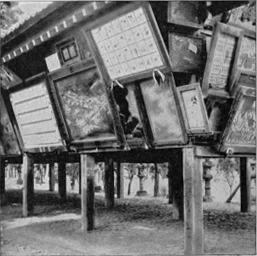
VOTIVE PICTURES.
Accordingly, the contributions that once came freely from the people are now falling off, and it is difficult to keep in good repair the costly lacquer-work and gilding of the temples. Some shrines already look shabby and neglected. However, an occasional exception to this rule shows how dangerous it is to make unqualified statements about Japan.
In Kioto, for example, we found a most astonishing proof of the vitality of Japanese Buddhism in the new and splendid temple of Higashi Hongwanji, which at the time of our visit was in process of construction. We saw it on the occasion of a special festival, when popular recognition and acclaim were manifested in profuse and elaborate decorations. But, the truth is, the temple is continually receiving the support of untold thousands of the Japanese. All the surrounding provinces have given it, not only money, but timber, metals, and stone, besides the transportation of materials free of cost. It seems as if conservative and faithful Buddhists, indignant at the prevalent idea that their religion is declining, were making this stupendous effort to show the world their strength and their devotion.
A PYRAMID WITH SILVER CREST.
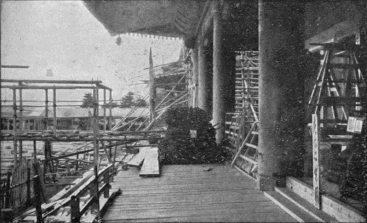
NEW BUDDHIST TEMPLE IN KIOTO.
One object in this shrine especially impressed us. This was a pile of rope,—each strand as long and large as a ship's cable,—made of women's hair, twisted and spliced with hemp! These ropes are the offerings of poor but devout women, thousands of whom, in nine Japanese provinces, having nothing else to give, contributed their hair, to be woven into cables for hoisting beams and tiles in the construction of the temple. One rope, two hundred and fifty feet in length, was the gift of three thousand five hundred women in one province alone. This seems at first, perhaps, a trifling thing; but when one recollects the pride which Japanese women take in their abundant hair, the care they show in its arrangement, and the entire absence in Japan of hats or bonnets to conceal the sacrifice, their action is remarkable. And when we perceived among the usual black strands occasional streaks of white and gray, proving that this enthusiasm extended from youth to age, it seemed to us the most touching proof of popular devotion to a sacred cause that we had ever seen.
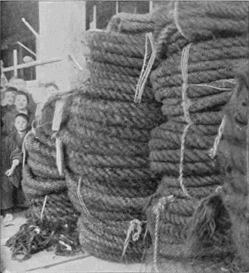
ROPES OF WOMEN'S HAIR.
We witnessed a number of matsuris, or religious festivals in Japan, when all the principal streets were thronged with people, and even the house-tops held their private box-parties. On every such occasion there would appear, in the centre of the thoroughfare, an object that never failed to fill us with amazement. Think of a hundred men pulling madly on two ropes, and drawing thus a kind of car, mounted on two enormous wooden wheels. Resting on this, and rising far above the neighboring roofs, imagine a portable shrine, resembling a pagoda, with roof of gold, and gorgeously decorated with silken tapestries, which are so richly embroidered and heavily gilded as to be valued at many thousands of dollars. This structure had two stories, on each of which were many life-size figures,—some being actual men and women, while others were mere painted statues, hideous and grotesque. Behind this came another car, shaped like a huge bird with crested head. Upon this second vehicle also stood an edifice, three stories high, resplendent 'with magnificent tapestries and gilded ornaments, and bearing statues of old Japanese deities, so laughably grotesque, that had not their surroundings been so rich the whole procession would have seemed a farce. Some of these statues, which were made to open their mouths and wag their heads like puppets, were especially applauded. Men, women, and children rode upon these cars, blowing horns and beating drums. If we had closed our eyes, we might have thought that we were listening to a Fourth of July parade of the "Antiques and Horribles." What most impressed us was the absence of what we should consider religious feeling. It was a show, a brilliant pageant—nothing more; though, as such, it was heartily enjoyed by thousands.
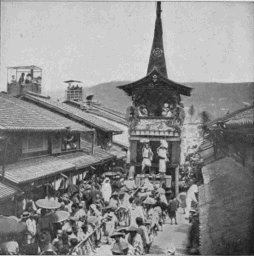
A RELIGIOUS FESTIVAL.
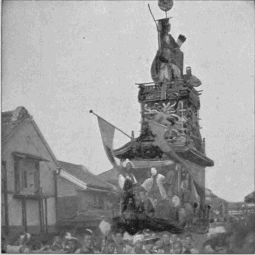
A MATSURI.
The streets in Kioto, like those of most Japanese cities, are usually much alike. No heavy teams disturb their rounded surfaces. Few vehicles, save light jinrikishas, pass over them. Almost no animals are ever seen in them. They are as clean as sidewalks are with us. In most of them we can perceive some groups or individuals, arrayed in varied colors, moving about like brilliant fragments in a long kaleidoscope. On either side extends a line of little houses, which, in point of architectural effect, appear monotonous, but since their lower stories are all open to the street, and from the fact that most of them are shops with all their goods on exhibition two feet from the thoroughfare, they really offer infinite variety.
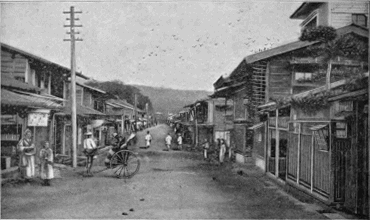
A CHARACTERISTIC STREET.
Approaching one of these shops, one first encounters a wooden platform, two feet from the ground. On this the Japanese purchaser usually seats himself, as he prepares to bargain. Most foreigners, however, being unable to fold comfortably their limbs beneath them for a cushion, assume a different attitude, and allow their feet to hang over the side. If they ascend the platform and really enter the shop, they are supposed to leave their shoes below, and walk in stocking feet; for the shops of the Japanese are, like their houses, paved with polished wood or covered with spotless matting. The goods displayed by no means constitute the merchant's entire stock. The choicest articles are often in a fire-proof store-house, close at hand, and can be sent for at a moment's notice. As for the contents of these street bazaars, they comprise every article of clothing, ornament, and furniture conceivable by the Japanese mind.
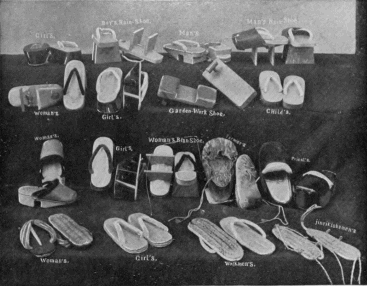
STYLES OF JAPANESE SANDALS.
The shoe shops in particular were, at first, a source of great surprise to us. "These surely are not shoes," we said, as we beheld their great variety of foot-coverings. And yet the Japanese are shod, though sandals is a better name than shoes, for what they wear. A Japanese gentleman, who has not yet adopted European dress, wears in the house a cotton sock, which has a separate compartment for the great toe, like the thumb of a mitten. When he walks out, he plants his foot on a straw sandal, or, if the streets be muddy, on a wooden clog that rises three inches from the ground. In doing so, he thrusts the apex of a V-shaped cord between his great toe and the smaller ones, and, holding on his sandals thus, he marches off.
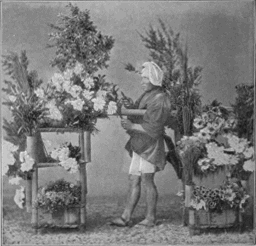
SHOPPING MADE EASY. A FLOWER MERCHANT.
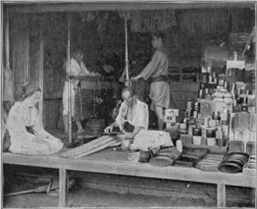
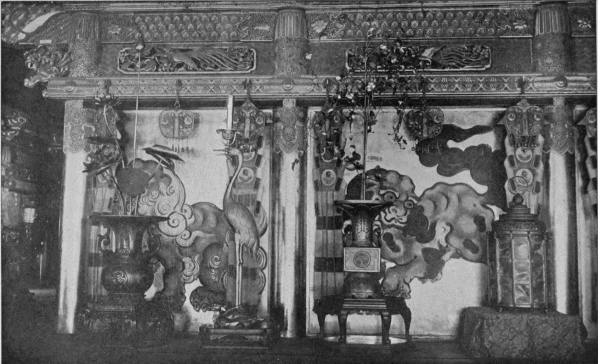
JAPANESE HANDIWORK.
But not all the merchants of Kioto are content to stay in shops; and, in this respect, human nature is much the same the world over. The gorgeous vehicles of American country peddlers, which we admired in our childhood days, are reproduced here on a smaller scale, though without wheels; and as the Japanese are sure to be artistic in everything, we were not surprised to find their brooms and dusters grouped in clusters like a huge bouquet. The peddlers themselves are pictures of human placidity. It is true, their eyes will open somewhat at the sight of foreigners, but most of the beardless faces that one sees beneath their mushroom hats of straw might easily serve an artist as models for a Japanese grandmother.
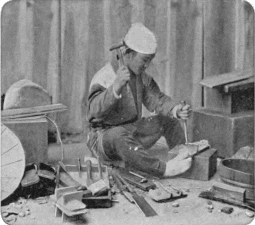
MAKING CLOGS.
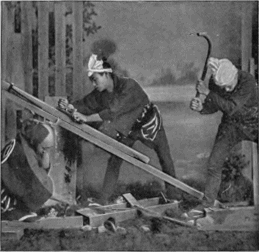
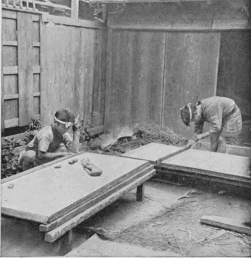
In strolling through the streets, we often paused to watch the natives at their work. If, for example, it chanced to be a cobbler making wooden clogs, we saw, to our astonishment, that his great toe could hold a block of wood as firmly as a thumb, and we began to ask ourselves if western workmen had gained much by covering up the feet and losing a third hand. The methods of Japanese laborers seem to us, at first, a little clumsy, because they are unlike our own. But one soon comes to marvel at their skill. No nation is superior to them in dexterity, fineness of touch, and delicacy of finish. In great things, as in small, one finds the same perfection. Japanese carpenters, for example, will use few nails in building a house, but they will make mortises so exact that water cannot penetrate between the joints; and they will decorate a fan or paint a photographic slide with touches so delicate that they will bear inspection with a magnifying-glass. To watch them is like watching our own motions in a mirror, for everything appears reversed. Our carpenters push the plane from them; the Japanese pull it toward them. The threads of our screws turn to the right; theirs turn to the left. Our keys turn outward; theirs turn inward. Nor is this difference true of handicraft alone. Their way of doing hundreds of familiar things is so directly opposite to ours, that one is almost tempted to believe the cause to be their relative position on the other side of the globe, and that they are really living upside down. The only question is: "Which side is up, and which is down?"
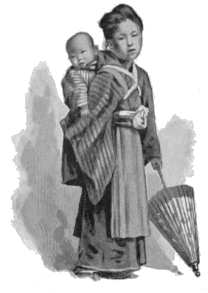
CHILD AND NURSE.
The Japanese think our ways just as strange as we do theirs. We, for example, carry our babies in our arms; in Japan, however, they are strapped on the backs of children not much larger than themselves, their little heads being left to flop about like flowers half-broken from the stem. Nor is this custom the exception. It is the universal rule, alike in city streets and country lanes. Whole pages could be filled in mentioning points of difference between Japanese and European customs. Thus, we stand erect before distinguished men, in token of respect; the Japanese, on the contrary, sit down. We take off our hats when we enter a house, while they remove their shoes. Our books begin at the left; theirs at the right; and if they have any "foot-notes," they are placed at the top of the page. We write across a sheet of paper horizontally; they write vertically down the page, like we make a column of figures. Our color for mourning is black; theirs is white. The best rooms in our houses are in front; theirs are in the rear. We mount our horses from the left; they from the right. We put a horse head foremost into a stall; they back him in and fasten him in the front. On seeing this, we laughingly recalled the showman's trick of getting people to "come and see a horse's head where his tail should be."
JAPANESE CARPENTERS. MAT-MAKERS.
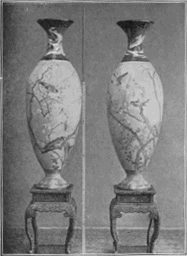
CLOISONNÉ VASES.
But if the Japanese are proficient in the ordinary industries of life, what shall be said of those finer proofs of their artistic skill which charm the world? At first, the foreigner hardly comprehends the value of their work or the amount of time and labor it has cost. Their articles of cloisonné are unsurpassed. In everything relating to handicraft in bronze the Japanese are unexcelled. Their flowered lacquer-work, also, with figures raised in gold, has been perfected for a thousand years; while in the realm of silk embroidery and gold brocade the Japanese have been said to paint with the needle as other artists do with the brush. In brief, they have produced among themselves and for themselves, for centuries, unnumbered masterpieces of artistic excellence, and this without a particle of outside help save that which came to them originally from China. Not, therefore, as uncultured mendicants have they appeared upon the threshold of the western world; but rather as people who, while accepting much that we have gained, have also not a little of value to impart. Hence they are a nation that elicits, not merely interest and astonishment, but also admiration and respect.
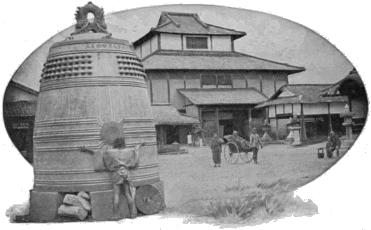
ONE OF JAPAN'S HUGE BELLS.
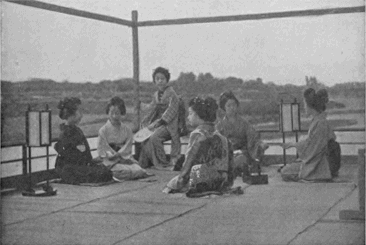
"IN THE GLOAMING."
There is a fascination in watching a Japanese artist engaged in cloisonné work. Taking a copper vase, he traces on its surface certain figures, such as flowers, birds, and trees. Then, from a roll of brass, one-sixteenth of an inch in breadth, he cuts off tiny pieces which, with consummate skill, and by eye-measurement alone, he twists into a mass of lines which correspond exactly to the figures he has drawn. Holding these bits of brass between the points of tweezers, he touches them with glue, and deftly locates them upon the rounded surface of the vase. At length, when all the figures are outlined, as it were, in skeleton, the flesh has to be applied. In other words, the thousands of interstices between the lines of brass are filled up with enamel of all shades and colors. When this is done the jar is put into a furnace, then touched with more enamel, then fired again, and so on, till it has been brought to the required degree of artistic finish. Then it is polished with great care, until the shining edges of the brass show through the enamel like the veins of a leaf. The colors also, by this time, are perfectly distinct and permanent, and the entire work stands forth,—a marvelous combination of delicacy, strength, and beauty.
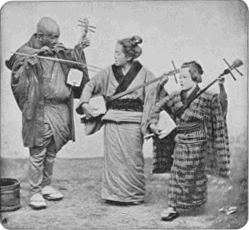
A SERENADE.
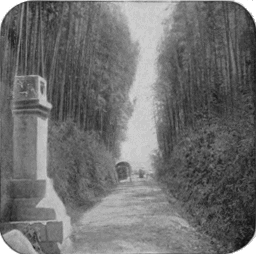
A WAYSIDE MONUMENT.
The scene, at evening, on the river-bank at Kioto is charming. Along the water' sedge are numerous little tea-houses, in front of which are many wooden piers. These are divided off into little squares, like private boxes in a theatre, and in them groups of Japanese are seated,—smoking, or taking supper in the open air. Meantime, a thousand colored lanterns gleam like fireflies on either shore and fleck the river with a dust of gold.
One cannot, however, praise the music which is here produced. It would be highly amusing, if one were deaf; but when one's hearing is acute, a little of such music goes a long way. None of the most enthusiastic admirers of the Japanese has dared, as yet, to praise their music. To Occidental ears the twanging of their banjo strings, and, above all, their caterwaulings, are positive torture. And yet, it must be said that to the Japanese our music seemed at first no less absurd than theirs to us. At the first opera given in Tokio by a European company, the Japanese audience was convulsed with laughter, and when the prima donna sang her highest notes, some men and women could no longer control themselves, and were seen stuffing their handkerchiefs into their mouths to avoid uttering shrieks of merriment.
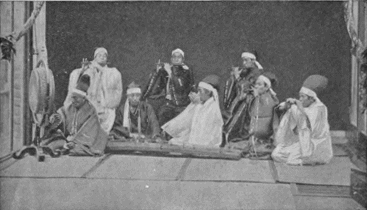
PRIESTLY MUSICIANS.
In the immediate vicinity of Kioto is a bamboo grove possessing an extent and beauty unusual even in Japan, where the plant grows luxuriantly. The various ways in which the Japanese use the bamboo stalk afforded us continual amusement and surprise, while it challenged admiration for their ingenuity. Bridges and scaffolding supports, water-pipes and fences, furniture, umbrellas, baskets, fans, hats, pipe-stems, sandals, screens, and walking-sticks,—are all constructed from that jointed, hollow stem, which looks so light and delicate, yet in reality is strong and durable. A thing of beauty and utility, the bamboo is certainly one of the greatest blessings that Nature has bestowed upon her children in the Land of the Rising Sun.
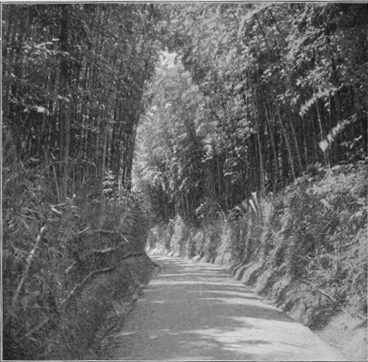
GROVE NEAR KIOTO.
A pretty sight in traveling through the province of Uji, near Kioto, are its tea-plantations, consisting of acres of evergreen bushes, two or three feet high. Among these move and sparkle in the sun odd bits of color, which prove to be the scanty robes of women and children crouching among the plants and picking their leaves. Most of these tea-plants are left unsheltered from the sun and storm, but the more valuable shrubs, producing tea worth six or seven dollars a pound, are covered by a trellis of bamboo, on which straw mats are placed. Sometimes the floor of an entire valley will be concealed beneath these mattings, which resemble a gigantic tent.
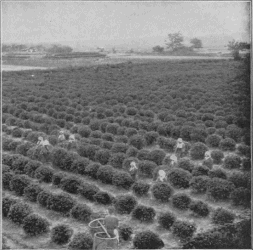
A TEA-PLANTATION.
It is a curious fact that, unlike teas from India and China, Japanese tea must not be made with boiling water, as that gives it a bitter flavor. Indeed, the finer the quality of the tea the cooler must be the water. Tea is the national beverage of Japan, and has been largely used there for nearly a thousand years. The Japanese hotels are known as "tea-houses," which correspond also to the cafés of Europe. The cha-no-yu, or fashionable ceremony of serving and drinking tea, has been for seven hundred years a national institution, governed by the minutest etiquette, each action and each gesture being regulated by a code of rules. It is said to have originated in a formal style of tea-drinking among the Buddhist priests, who found the beverage an easy means of keeping themselves awake during their nocturnal vigils. Japan may be said, therefore, not only to owe the introduction of the tea-plant to a celebrated Buddhist saint, who imported it from China, but for her elaborate ceremony of tea-drinking to be still further indebted to the priests of Buddhism.
While walking one day in Kioto, we met a fellow-passenger from Vancouver.
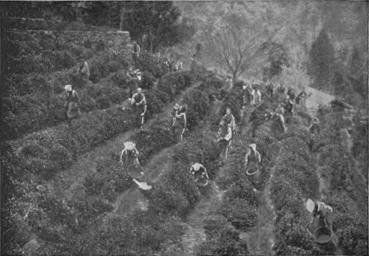
TEA-PICKERS.
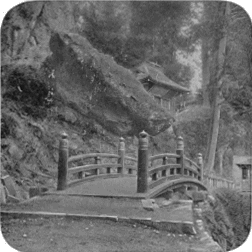
SACRED ROCKS AND TREES.
"What places have you visited?" he asked.
We told him.
"Have you not been to Haruna, beyond Ikao?" he inquired.
"No," we replied. "We thought of going there, but finally decided to omit it."
"You made a great mistake!" he cried. "Why not retrace your steps and go there now? It is not too late."
"That means," we said, "in all, six hundred miles of extra travel."
"No matter," he insisted. "You had better do it."
"Are you quite serious?"
"Not only serious, but enthusiastic. You will never regret it. Go!"
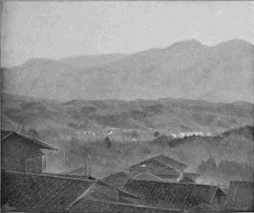
IKAO
We followed his advice, and a few days later, one afternoon in late October, we found ourselves almost the only guests in a well-kept tea-house in Ikao. Swift 'rikisha men had brought us hither from the railway station, sixteen miles away. The air was most exhilarating, for we were three thousand feet above the sea, which we had left eight hours before at Yokohama. Around us on all sides were lofty mountains, whose hidden treasures could not be explored in jinrikishas, for this was another point where all roads terminate, and only paths lead inward to the fabled homes of mountain deities.
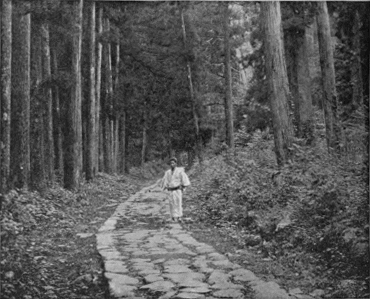
THE PATH THROUGH THE FOREST.
It was four o'clock the next morning when we started. It was still dark. The stars were glorious. We knew the coming day would be superb. It was as yet too cold for riding, so, followed by our kago-bearers, we set forth on foot. For some time we walked on in silence, enraptured with the splendor of the sky. Above us gleamed the Dipper's seven diamond points; Orion's belt hung radiant amid a galaxy of other suns; while, just above a lofty mountain range, flashed with unwonted brilliancy the herald of approaching day. At length the stellar light began to pale. The east became first white, then golden, as the sun advanced, and then there came an hour's scenery that can never be effaced from my memory.
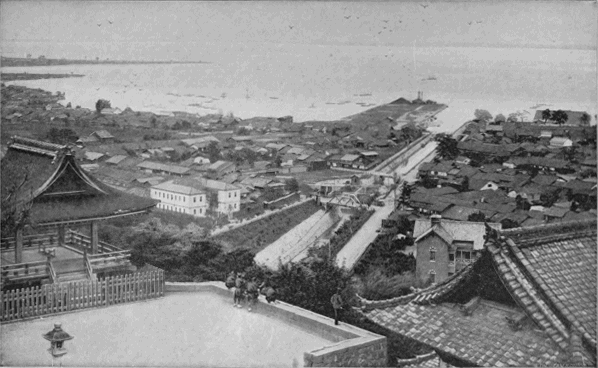
LAKE BIWA.
The colors on the mountains were magnificent. Autumnal foliage mantled them with glory. Thousands of oaks and maples lined the slopes with every shade of orange, red, vermilion, green, and purple. In any light these varied tints would have been beautiful; but to behold them changing into glory, tree by tree, as the first touch of dawn awakened them from sleep, was such a vision as we had never hoped to look upon. Some of this radiant foliage bedecked the ground, and sometimes we walked ankle-deep through multicolored leaves.
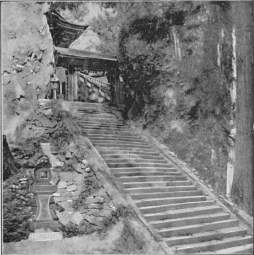
THE STAIRCASE AT HARUNA.
Moreover, the pathway was all white with frost, and stretched away in glittering perspective through the trees, like an avenue of silver between mountains of jewels. Intoxicated with such sights and with the crisp, aromatic air of that October dawn, we walked for miles without fatigue, unable to repress at times our exclamations of enthusiasm.
After a time, we found ourselves at the entrance to a deep ravine, shaded by giant trees, which at that early hour were still unburnished by the sun. In view of the reverence felt by the Japanese for massive rocks and time-gnarled trees, it is not strange that this wild gorge of Haruna has been for ages looked upon as sacred. A feeling of solemnity stole over us. Instinctively we spoke in softer tones. I felt as once before, when sailing into a Norwegian fjord. It was a place for Dante to describe and for Dore to illustrate.
At length we saw, wedged in between two mighty rocks, a flight of stone steps leading to a lacquered gate. Our Japanese attendant immediately bowed his head, removed his sandals, and knelt down to pray. Nor was this strange. Who could resist, in such a place, the impulse to revere that Power of which these forms of nature were imperfect symbols? At all events, whatever may have been the difference in our creeds, both traveler and native worshiped here that day,—one standing in the forest shade, the other kneeling on the moss-grown steps.
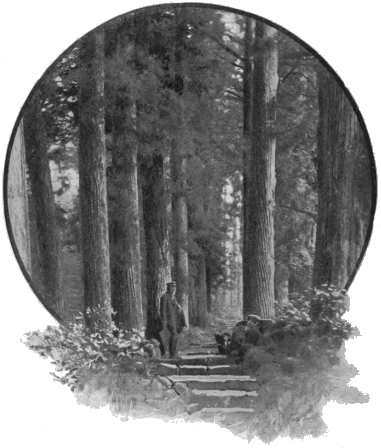
"HUGE CRYPTOMERIAS LIKE THOSE OF NIKKO."
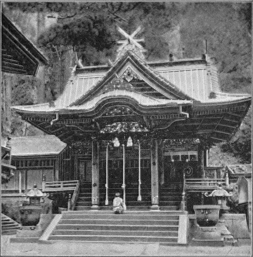
THE HEART OF OLD JAPAN.
After some moments' silence, our attendant arose and began the ascent. We followed him. On passing the first gateway, we perceived another smaller portal, which seemed to lead directly into the cliff. Above it was a rock, a hundred and fifty feet in height, and shaped like a gigantic obelisk. Around it rose huge cryptomerias, like those of Nikko, wrinkled with age, and solemn in their sanctity and shade. The mountain-side so overhung the place that it seemed kept from falling only by a caprice of nature. We almost feared to speak, lest, like some Alpine avalanche, the monstrous mass might fall and overwhelm us. Finally, however, we passed beneath the second arch; and, lo! before us, on a shelf of rock, completely isolated from the outer world, and guarded by these sentinels of stone, we saw a sacred shrine. Even at that early hour one pilgrim was already here, and, as the radiance of the rising sun stole through the twilight of the holy grove and turned the temple steps to gold, unconscious of the picture he produced, he knelt in prayer.
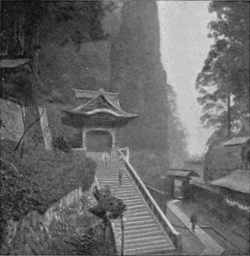
SACRED PORTAL.
That scene can never be forgotten. An interval of centuries seemed to separate us from the Japan of Yokohama. No whisper of approaching change had yet penetrated these peaceful solitudes. No earthquake-shock of doubt had sent a tremor through this mountain altar. The faith which chose this immemorial forest for its temple still reigned here supreme. And as we stood by this illumined portico, in which a ray of sunlight glittered like a sacred fire, we felt that we had reached the Heart of Old Japan.
CHINA
HONG-KONG.
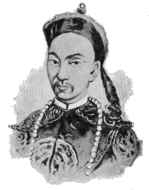
EMPEROR OF CHINA.
C
CHINA defies the world to equal her in three important respects: age, population, and industries. As for the first, she undoubtedly has the oldest Government on earth. Even the Papacy is young compared with it; and as for our republic, it is a thing of yesterday. A Chinaman once said to an American: "Wait till your Government has been tried before you boast of it. What is a hundred years? Ours has stood the test of forty centuries. When you did not exist, we were. When you shall have passed away, we still shall be."
In point of numbers, too, the Chinese empire leads the world. Its area is nearly twice as large as that of the United States, and it has six times as many people. The governor of one Chinese province rules over sixty million souls. Have we a definite conception of what four hundred million human beings are? Arrange the inhabitants of our globe in one long line, and every fourth man will be a Chinaman.
As for her industries, Musa, the Saracen conqueror of Spain, once aptly said that Wisdom, when she came from heaven to earth, was lodged in the head of the Greeks, the tongue of the Arabs, and the hands of the Chinese. China was once what the United States is now—the birthplace of inventions. Paper was manufactured there in the third century of our era. Tea was produced a century later. If Europe had enjoyed communication with China, it would have learned the art of printing many centuries before it did; and who can say what might have been the result? A thousand years ago the Chinese made designs on wood. Printing from stone was a still earlier industry among them. In China, also, gunpowder was first invented—a thought by which, alas! so many thoughts have been destroyed. This same astonishing race produced the mariner's compass in the fourth century, porcelain in the third, chess and playing-cards in the twelfth, and silk embroideries in almost prehistoric times. An empire, therefore, of such vast antiquity, overwhelming population, and great achievements must be, despite its faults, a country of absorbing interest.
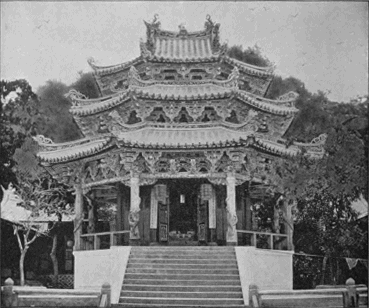
A CHINESE TEMPLE.
The most delightful portion of the voyage from Japan to China lies in the Japanese Mediterranean, known as the Inland Sea. It is a miniature ocean, practically land-locked for three hundred miles, with both shores constantly in sight, yet strewn with islands of all shapes and sizes, from small and uninhabited rocks to wave-encircled hills, terraced and cultivated to their very summits. It seems as if volcanic action here had caused the land to sink, until the ocean rushed in and submerged it, leaving only the highest peaks above the waves.
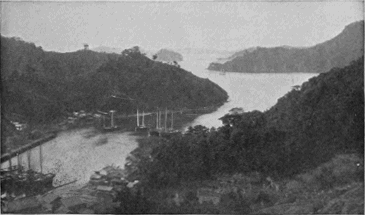
THE JAPANESE MEDITERRANEAN.
We lingered here all day upon the steamer's deck, like passengers on the Rhine, fearing to lose a single feature of the varied panorama gliding by on either side. By night it was more glorious even than by day; for then, from every dangerous cliff flashed forth a beacon light; the villages along the shore displayed a line of glittering points, like constellations rising from the sea; and, best of all, at a later hour, moonlight lent enchantment to the scene, drawing a crystal edge along each mountain crest, and making every island seem a jewel on a silver thread.
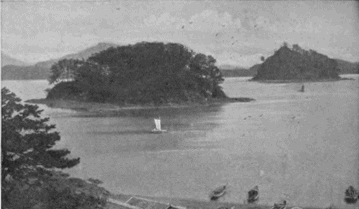
WAVE-ENCIRCLED HILLS.
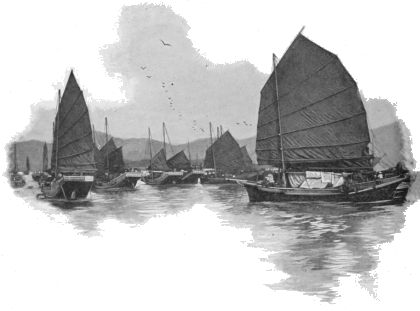
HUGE SAILS LIKE THE WINGS OF BATS.
When we emerged from these inland waters, we saw between us and the setting sun the stretch of ocean called the China Sea. At certain seasons of the year this is the favorite pathway of typhoons; and the Formosa Channel, in particular, has been a graveyard for countless vessels. Indeed, only three weeks before, a sister ship of ours—the "Bokhara,"—had gone down here in a terrific cyclone. Yet when we sailed its waters nothing could have been more beautiful. Day after day this sea of evil omen rested motionless, like a sleek tigress gorged with food and basking in the sun.
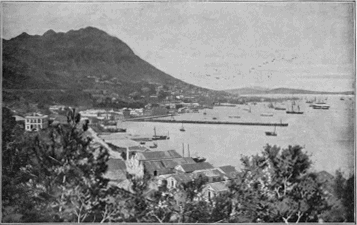
THE HARBOR OF HONG-KONG.
After a three-days' voyage from the Japanese coast, we began to meet, in constantly increasing numbers, large, pointed boats, propelled by huge sails ribbed with cross-bars, like the wings of bats. Upon the bow of each was painted an enormous eye; for of their sailing-craft the mariners of China, in elementary English, say: "If boat no have eye, how can boat see go?" We were assured that these were Chinese sailing-craft, and that our destination was not far away; but it was difficult to realize this, and I remember looking off beyond those ships and trying to convince myself that we were actually on the opposite side of the globe from home and friends, and in a few brief hours were to land in that vast Eastern empire so full of mystery in its exclusiveness, antiquity, and changeless calm.
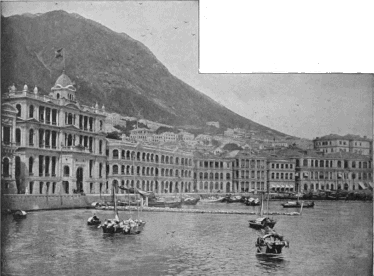
THE CITY OF VICTORIA.
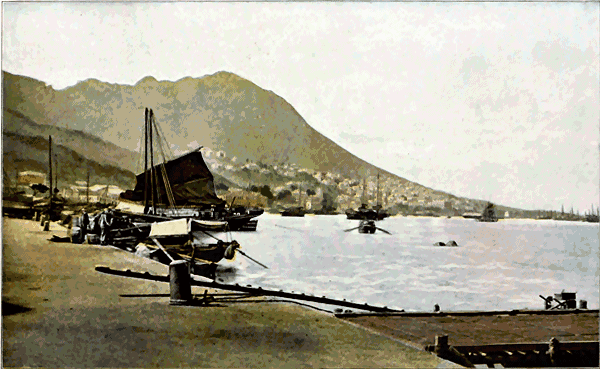
That night the agitation that precedes one's first arrival in a foreign land made sleep almost impossible. It seemed to me that I had not closed my eyes when suddenly the steamer stopped. To my astonishment, the morning light had already found its way into my state-room. We had arrived! Hurrying to the deck, therefore, I looked upon the glorious harbor of Hong-Kong. A hundred ships and steamers lay at anchor here, displaying flags of every country on the globe. Although the day had hardly dawned, these waters showed great animation. Steam-launches, covered with white awnings, were darting to and fro like flying-fish. Innumerable smaller boats, called sampans, propelled by Chinese men and women, surrounded each incoming steamer, like porpoises around a whale. On one side rose some barren-looking mountains, which were a part of the mainland of China; but for the moment they presented little to attract us. It was the other shore of this magnificent harbor that awoke our interest; for there we saw an island twenty-seven miles in circumference, covered with mountains rising boldly from the sea. Along the base of one of these elevations, and built in terraces far up on its precipitous slopes, was a handsome city.
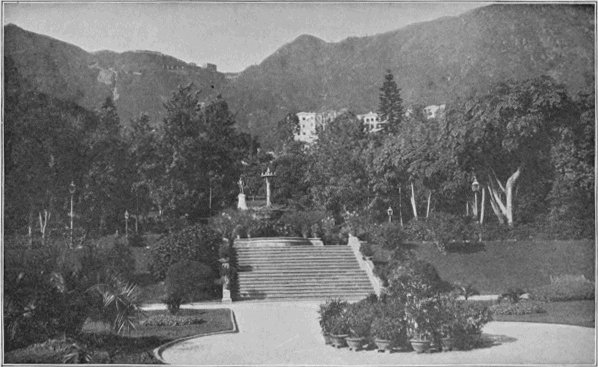
THE PUBLIC GARDENS.
"What is this?" we inquired eagerly.
"The town itself," was the reply, "is called Victoria, but this imposing island to whose flank it clings, is, as you may suppose, Hong-Kong."
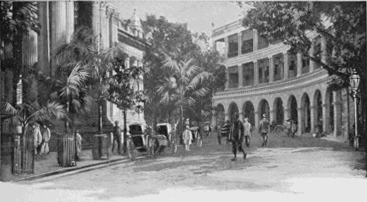
A STREET IN HONG-KONG.
The first impression made upon me here was that of mild astonishment at the architecture. Almost without exception, the prominent buildings of Victoria have on every story deep porticoes divided by columns into large, square spaces, which from a distance look like letter-boxes in a post-office. We soon discovered that such deep, shadowy verandas are essential here, for as late as November it was imprudent not to carry a white umbrella, and even before our boat had brought us from the steamer to the pier, we perceived that the solar rays were not to be trifled with.
As soon as possible after landing, we started to explore this British settlement. I was delighted with its streets and buildings. The former are broad, smooth and clean; the latter, three or four stories high, are built of granite, and even on a curve have sidewalks shielded from the sun or rain by the projection of the roof above. Truly, the touch of England has wrought astounding changes in the fifty-five years that she has held this island as her own. Before she came it was the resort of poverty-stricken fishermen and pirates. But now the city of Victoria alone contains two hundred thousand souls, while the grand aqueducts and roads which cross the mountains of Hong-Kong are worthy to be compared with some of the monumental works of ancient Rome.
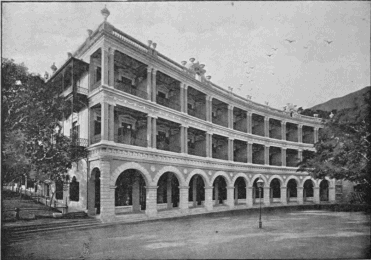
DEEP PORTICOES AND COLONNADES.
Along the principal thoroughfare in Victoria, the banks, shops, hotels, and club-houses, which succeed each other rapidly, are built of the fine gray granite of the adjacent mountains, and show handsome architectural designs. Everything looks as trim and spotless as the appointments of a man-of-war. Even the district of the town inhabited by Chinamen is kept by constant watchfulness immeasurably cleaner than a Chinese city; although if one desires to see the world-wide difference that exists between the British and Mongolian races, he merely needs to take a short walk through the Chinese quarter of Victoria. But such comparisons may well be deferred until one reaches Canton. There one beholds the genuine native article.
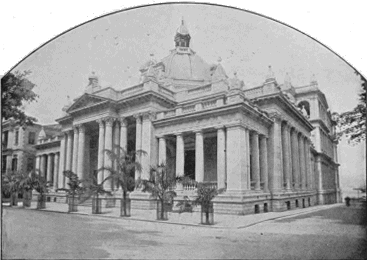
THE BANK, HONG-KONG.
The police who guard the lives and property of the residents of Hong-Kong, are for the most part picked men of English birth, and are considered as trustworthy as regular troops. But several hundred of these guardians of the peace are Sikhs—a race imported hither from India—renowned for bravery, loyal to the British government, and having no sympathy with the Chinese. These Sikhs have handsome faces, brilliant eyes, and dark complexions, the effect of which is wonderfully enhanced by their immense red turbans, conspicuous two or three blocks away, not only by their startling color, but because their wearers exceed in stature all other races in Hong-Kong.
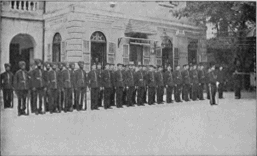
POLICEMEN.
Strolling one morning through the outskirts of the city, I came upon some troops engaged in military manœuvres, and attired in white from head to foot, to shield them from the sun. What traveler in the East can forget the ever-present soldiers of Great Britain, of whom there are nearly three thousand in the garrison of Hong-Kong? I know it is frequently the fashion to sneer at them and to question their efficiency in case of war. I know, too, that in certain ways the vast extent of England's empire constitutes her weakness.
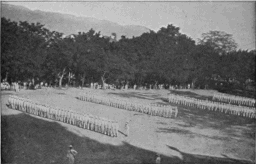
SOLDIERS DRILLING.
But I must say that in a tour around our planet I was impressed as never before with what the British had accomplished in the way of conquest, and with the number of strategic points they hold in every quarter of the globe. We had but recently left the western terminus of England's North American possessions, yet in a few days we discerned the flag of England flying at Hong-Kong. Next we beheld the Union Jack at Singapore, then at Penang, then at Ceylon, and after that throughout the length and breadth of the vast empire of India, as well as the enormous area of Burma. Leaving Rangoon, if we sail southward, we are reminded that the southernmost portion of Africa is entirely in English hands, as well as the huge continent of Australia.
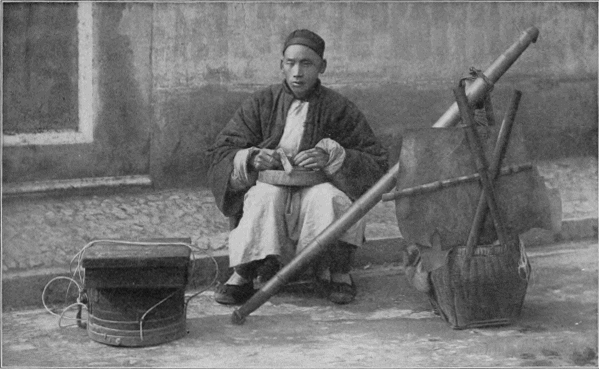
CHINESE COBBLER.
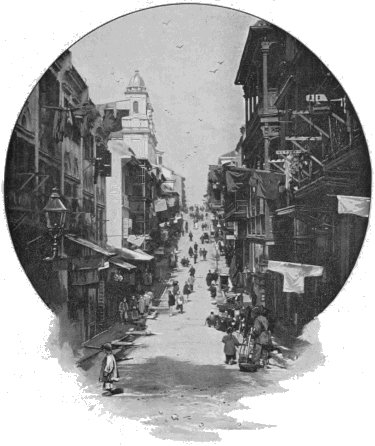
A BIT OF CHINATOWN IN HONG-KONG.
Returning northward, we find the same great colonizing power stationed at the mouth of the Red Sea, in the British citadel of Aden. Again a trifling journey, and we reach Egypt, via the Suez Canal, both virtually controlled to-day by England. Then, like the three stars in Orion's belt, across the Mediterranean lie Cyprus, Malta, and Gibraltar; in fact, we find one mighty girdle of imposing strongholds all the way, bristling with cannon, guarded by leviathans in armor, and garrisoned by thousands of such soldiers as were drilling at Hong-Kong.
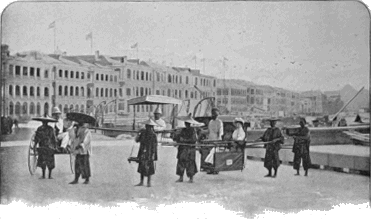
CHAIR-COOLIES AT HONG-KONG.
One of the first desires of the visitor to Hong-Kong is to explore the mountain which towers above the city of Victoria to a height of nearly two thousand feet. To do this with the least exertion, each of our party took a canvas-covered bamboo chair, supported by long poles, which Chinese coolies carry on their shoulders. On level ground, two of these bearers were enough, but on the mountain roads three or four men were usually needed. To my surprise, I found the motion of these chairs agreeable. The poles possess such elasticity that, leaning back, I was rocked lightly up and down without the least unpleasant jar. In fact, at times the rhythm of that oscillation gave me a sense of drowsiness difficult to resist.
But, alas! we had not here for carriers the cleanly natives of Japan. It may be, as some residents of Hong-Kong assert, that Chinamen are more trustworthy and honest than the Japanese, but certainly in point of personal attractiveness the contrast between these races is remarkable. The bodies of the lower classes of Chinese reveal no evidence of that care so characteristic of the natives of Japan. Their teeth are often yellow tusks; their nails resemble eagle's claws; and their unbecoming clothes seem glazed by perspiration. Nor is there usually anything in their manner to redeem all this. Where the light-hearted Japs enjoy their work, and laugh and talk, the Chinese coolies labor painfully, and rarely smile, regarding you meantime with a supercilious air, as if despising you for being what they call "a foreign devil."
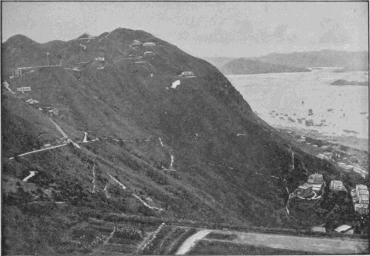
THE MOUNTAIN ABOVE VICTORIA.
Nevertheless, despite the repulsive appearance of our bearers, we thoroughly enjoyed our excursion up the mountain. At every step our admiration was increased for the magnificent roads which wind about the cliffs in massive terraces, arched over by majestic trees, bordered by parapets of stone, lighted with gas, and lined with broad, deep aqueducts, through which at times the copious rainfall rushes like a mountain stream. It will be seen that such a comparison is not an exaggeration, when I add that not many years ago, thirty-two inches of rain fell here in thirty hours. This mountain is the favorite abode of wealthy foreigners, and hence these curving avenues present on either side, almost to the summit, a series of attractive villas commanding lovely views. On account of their situation, the gardens of these hillside homes are necessarily small; but in the midst of them, about five hundred feet above the town, a charming botanical park has been laid out.
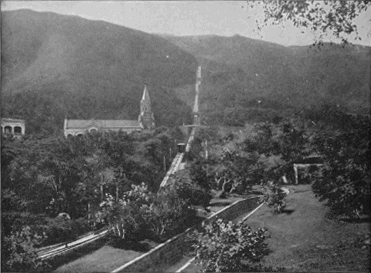
THE CABLE-ROAD TO VICTORIA PEAK.
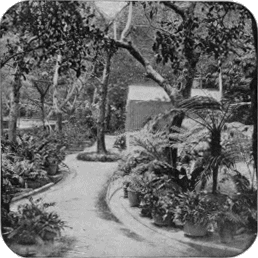
THE BOTANICAL PARK, HONG-KONG.
Forgetful of our coolies at the gate, we lingered in this garden for an hour or two, delighted with its fine display of semitropical foliage. It is marvelous what skillful gardeners have accomplished here, in transforming what was fifty years ago a barren rock into an open-air conservatory. Palms, banyans, india-rubber trees, mimosas with their tufts of gold, camellias with their snowy blossoms—all these are here, with roses, mignonette, and jessamine, surrounded with innumerable ferns. Occasionally we encountered in this fragrant area a Chinese gentleman, indulging leisurely his love of flowers; for this delightful park is open to all without regard to race or creed, although the population of the island is extremely cosmopolitan. Englishmen, Americans, Germans, Frenchmen, Spaniards, Portuguese, Italians, Parsees, Mohammedans, Jews, Hindus, and fully one hundred and fifty thousand Chinamen, are residents of the city of Victoria alone.
In this retired park one does not realize that Hong-Kong is such a rendezvous for different nationalities; but frequently, while we were walking here, the sharp report of a cannon forced a discordant echo from the neighboring hills and told us that some foreign man-of-war had just appeared within the bay; for here some ship or steamer is continually arriving or departing, and many times a day there comes a deafening interchange of salutes that sends a thrill through every window-pane upon the mountain.
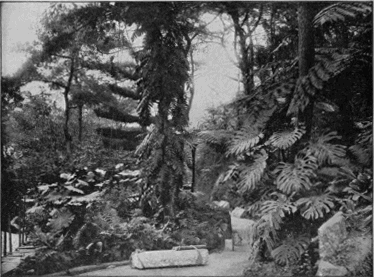
AN OPEN-AIR CONSERVATORY.
One can well understand, therefore, that with so mixed a population and in such close proximity to China, the officers sent out here by the British government must be men of courage, the garrison of the island strong, and its administration prompt and resolute. A single incident revealed to me the crimes which would undoubtedly creep forth, like vipers from a loathsome cave, were they not kept in check by vigorous justice and incessant vigilance. In one of the residences on the height above Victoria, I met one day at dinner the captain of a steamer anchored in the bay. He asked me to come out some evening and pay a visit to his ship. The following night, soon after dark, I walked down to the pier, intending to embark on one of the many boats along the shore. I was about to enter one, when a policeman rapidly approached. "Give me your name and number," he said roughly to the Chinese boatman. Then turning to me, he politely asked my name, address, and destination, and when I intended to return, "I am obliged to do this," he explained, "for your protection. There is a population of twenty thousand Chinese living in this harbor upon boats alone, besides the usual criminals who drift to such a place. Before we adopted this precaution, a foreigner would sometimes embark on one of these craft and never be seen again. In such a case search was useless. He had disappeared as quietly and thoroughly as a piece of silver dropped into the bay."
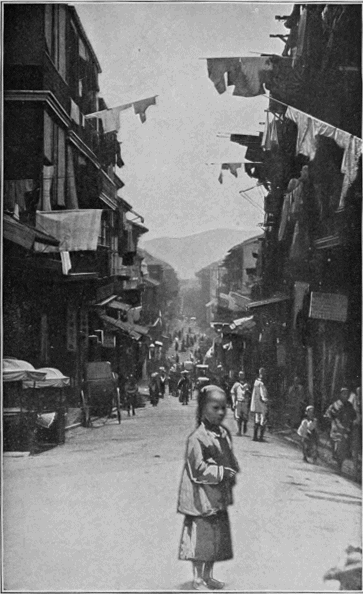
A HONG-KONG STREET—IN THE CHINESE QUARTER.
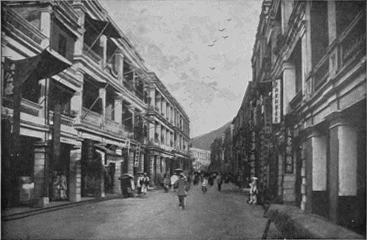
IN THE BUSINESS SECTION.
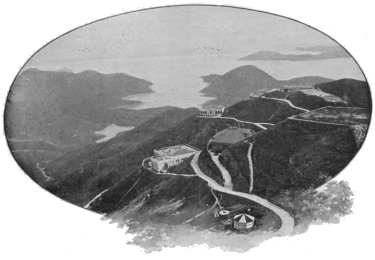
VIEW FROM VICTORIA PEAK
When I stood on the apex of Victoria Peak, I thought that I had never seen a finer prospect. Nearly two thousand feet below us lay the renowned metropolis of the East which bears the name of England's queen. From this great elevation, its miles of granite blocks resembled a stupendous landslide, which, sweeping downward from this rocky height, had forced its cracked and creviced mass far out into the bay. Between this and the mainland opposite, curved a portion of that ocean-girdle which surrounds the island, and on its surface countless boats and steamers seemed, in the long perspective, like ornaments of bead-work on a lady's belt.
Around the summit of the mountain are several handsome villas and hotels, whither the residents of Victoria come in summer to escape the heat; but, as a rule, in riding over the island I saw outside of the city very few houses, and little agriculture. The soil of Hong-Kong is not fertile; but politically and commercially the island is immensely valuable, for England has now made of it the great emporium of the Far East, and, garrisoned by British troops, it guards completely the approaches to that river, upon which, ninety-two miles inland from the ocean, lies the city of Canton.
One of the pleasantest excursions in Hong-Kong may be made in sedan-chairs, some six miles over the hills, to the great reservoir which supplies the city with water. The aqueduct which comes from it is solidly constructed, and on its summit is a granite path protected by iron railings. This winds along the cliffs for miles, and is in many places cut through solid rock. It is an illustration of the handsome, yet substantial character of everything accomplished here. One feels that such works are not only artistic, but enduring. Here are no wooden trestles, no hastily constructed bridges and no half-made roads to be destroyed by mountain-torrents, but everywhere the best of masonry, cyclopean in massiveness and perfect in detail.
THE RACE-TRACK, HONG-KONG. THE AQUEDUCT, HONG-KONG.
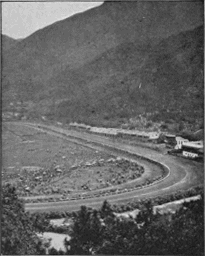
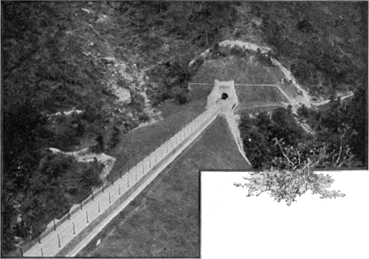
On reaching the terminus of this granite pathway we saw before us the principal reservoir of Hong-Kong. Though largely artificial, it looks precisely like a natural lake hidden away among the mountains. Before it was constructed the island's water-supply was lamentably insufficient, and the notorious "Hong-Kong fever" gave the place an evil name. But now, in spite of its large native population, Victoria has as low a death-rate as most European cities. The foreign residents are very proud of these magnificent water-works; yet, after ten days' sojourn here, when I took leave of several gentlemen by whom I had been entertained in private houses and at clubs, candor compelled me to confess that, so far as I had been able to observe, the foreign population makes very little use of this water for drinking purposes.
A MOUNTAIN ROAD, HONG-KONG. AN EASY DESCENT.
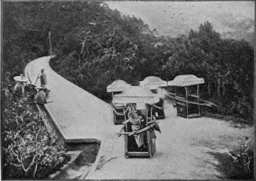
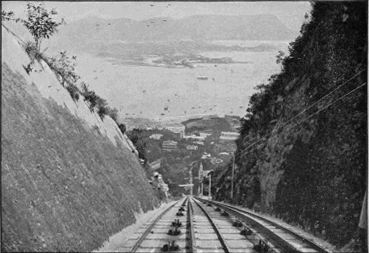
On starting to descend the mountain, we found a shorter route than the circuitous path by which we had come—an admirably managed cable-road. In viewing this, the question naturally arises how the Chinese can look on such conveniences as England has here introduced, and still remain content to have in their enormous empire scarcely a decent road, and only a few miles of railway, built to transport coal. Canals and rivers are still the usual arteries of travel through the most of China. In the northern provinces, where carts are used, the roads are often worn below the surface of the adjacent land, and hence become, in the rainy season, mere water-courses. Travelers are occasionally obliged to swim across them; and cases have been known of people drowning in a Chinese roadway. Moreover, the characteristic carts of China are of the most primitive description, having no seats except the floor, and no springs save the involuntary ones contributed by their luckless passengers. Yet, in many districts, even such vehicles can find no path, and people travel about in wheel-barrows propelled by coolies who are sometimes aided by a sail. The Bishop of North China, for example, makes many of his parochial visits in a wheelbarrow.
A CHINESE ROAD. A CHINESE VEHICLE.
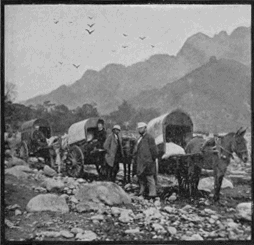
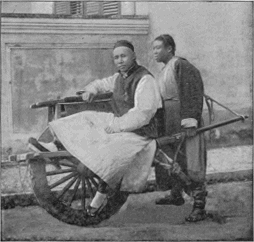
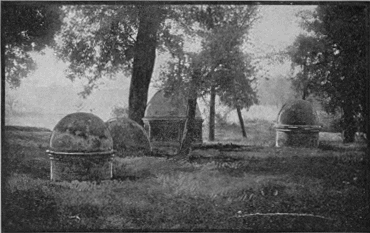
CHINESE GRAVES.
There is now in China a small progressive party which favors building railroads, as the Japanese have done, but the immense majority are against it. Some years ago a foreign company built a railroad near Shanghai, but the Chinese speedily bought it up at a great cost, transported the rails and locomotives to the sea, and left them to rust upon the beach. This opposition to railways is principally due to the belief that the use of them would deprive millions of people of their means of gaining a livelihood, and that they would, moreover, disturb the graveyards of the country. This latter objection seems at first incredible; but it must be remembered that Chinese cemeteries are strewn broadcast over the land,
"Thick as autumnal leaves that strow the brooks In Vallombrosa."
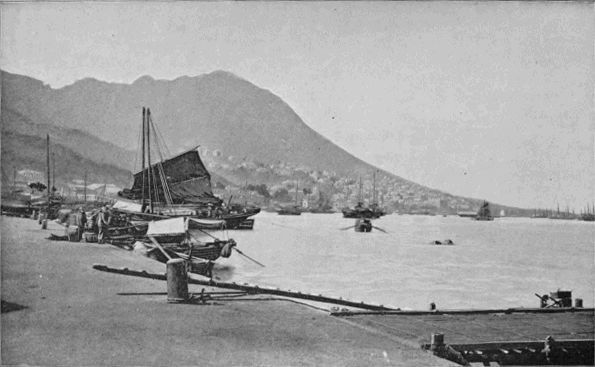
HONG-KONG.
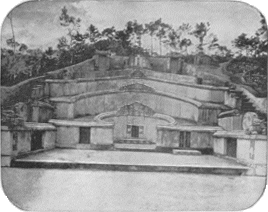
AN ELABORATE TOMB.
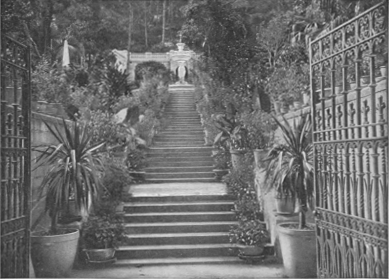
THE FOREIGN CEMETERY, HONG-KONG.
A FELLOW PASSENGER.
One sees them everywhere, usurping valuable tracts of territory needed for the living. Outside the city of Canton, for example, there is a graveyard thirty miles in length, in which are buried fully one hundred generations. Yet the Chinese insist that not one grave shall be disturbed, lest multitudes of avenging ghosts should be let loose upon them for such sacrilege. In fact, the permanence and inviolability of graves lie at the very foundation of Chinese life and customs, which is ancestor-worship. From childhood to old age the principal duty of all Chinamen is to propitiate the spirits of their ancestors, and to make offerings to them regularly at their tombs. This custom cripples the colossal empire of China as paralysis would a giant, and fear of doing violence to their dead holds China's millions in an iron grasp.
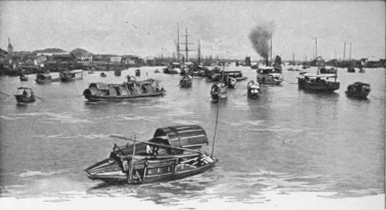
ON THE CANTON RIVER.
The discussion of this theme, as we were descending the mountain, suggested to us the idea of visiting the foreign cemetery in Hong-Kong. In this, as in the public garden, charming results have been obtained by care and irrigation. We were accompanied by a gentleman who had resided on the island nearly thirty years. "In spite of the beauty of this place," he said, "I dread to think that I shall probably be buried here—unable to escape from China even after death. For notwithstanding many pleasant friends, my life, like that of many here, has been at best a dreary banishment from all that makes your Occidental life so stimulating to the intellect and so rich in pleasures. The world at home," he added, "sometimes blames us for faults, the cause of which is often only an intense desire to counteract the loneliness of our existence; and foreigners in the East deserve some sympathy, if only from the fact that in these cemeteries, kept with so much care, the graves of those we love increase so rapidly." After a few days at Hong-Kong we embarked on one of the American steamers which ply between Victoria and Canton. These boats are modest imitations of the Fall River steamers on Long Island Sound. We found the one that we took clean and comfortable and its American captain cordial and communicative. During the trip he related to us many incidents of his life in China. This he could easily do, for there were only two other foreign passengers on board, and hence, so long as we remained upon the promenade deck, the spacious vessel seemed to be our private yacht.
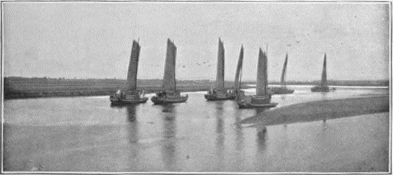
RIVER BOATS.
On passing, however, to the deck below, we found a number of Chinamen, likewise going to Canton. Most of them were smoking, lying on their backs, their heads supported by a bale of cloth. At first we thought these constituted all the passengers; but presently we learned, to our astonishment, that farther down, packed in the hold like sardines in a box, and barricaded from us by an iron grating, were more than a thousand Chinese coolies. A sentry, heavily armed, stood by the padlocked grating constantly; while in the wheel-house and saloon were stands of loaded muskets ready for emergencies. The danger is that Chinese pirates will come on board in the disguise of coolies, and at a favorable moment take possession of the ship. One naturally thinks this an impossible occurrence; but only a few years ago this actually took place on one of these boats. A well-armed band of desperadoes swarmed up from the hold, shot down the captain in cold blood, and also some of the passengers who tried to interfere. Then, taking command of the ship, they forced the engineer and crew to do their bidding, steered to a lonely point where their confederates awaited them, unloaded the valuable cargo into their boats, disabled the engine so that the survivors could not give the alarm, and finally made their escape. Such are the indisputable facts. Yet, sailing up this peaceful river, reclining in our easy chairs, and soothed by the soft, balmy air, the tragedy seemed so incredible that we were obliged to put our hands upon the guns, in order to realize that precautions were still needed.
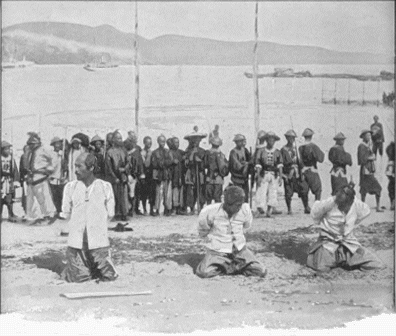
EXECUTION OF THE PIRATES.
As an additional proof, the captain showed us a photograph of the sequel to that act of piracy. For, as a matter of course, the British Government demanded satisfaction for this outrage, and in compliance nineteen criminals were beheaded. Whether they were the actual pirates, however, has been doubted. China always has scores of men awaiting execution—a dozen here, a dozen there. What matters it if those who merit death are said to have committed one crime or another? England had no way of identifying them. Accordingly she shut her eyes, accepted what the Chinese said of them, and took it for granted that the decapitated men were the real culprits. At all events, as an eye-witness told us, the deed itself was quickly done. In each case there was only one swing of the executioner's arm, and one flash of the two-edged sword; then, like a row of flowers clipped from their stems, the heads of all the kneeling criminals were lying in the sand, with staring eyes turned upward toward the sky.
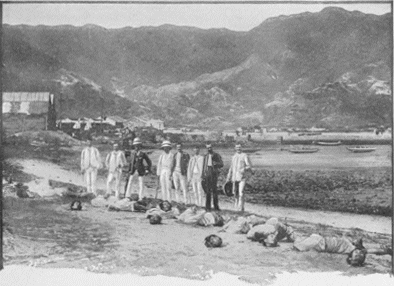
WITH STARING EYES TURNED UPWARD.
AN OLD CHINESE FORT, CANTON RIVER.
OPIUM-SMOKING.
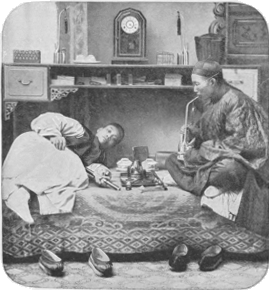
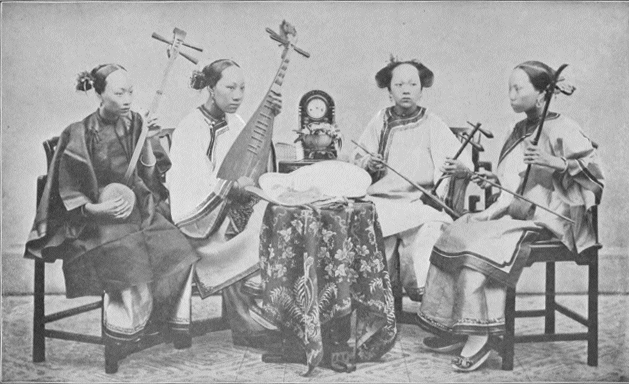
SINGING GIRLS.
On leaving this repulsive picture in the captain's cabin, we found that we were approaching the once important settlement of Whampoa. Its glory is gone now, but formerly it played a prominent part in Eastern politics and commerce; for previous to the Opium War of 1841 and the establishment of the Treaty Ports, this was as far as foreign ships were permitted to come, and Whampoa was then a kind of counter across which Cantonese and Europeans traded. We now began to observe along the shore strange-looking boats protected by a roof and filled with fruits and vegetables for the Canton market. Moreover, on both sides of the river for many miles we looked on countless little patches of rice, bananas, oranges, and sugar-cane. At one point our attention was called to an island on which are some old fortifications used by China fifty years ago in her attempt to exclude opium from her territory. I suppose that no intelligent student of the subject doubts that the real cause of the war of 1841 was the attempt of England to force upon the Chinese a drug which no one dares to sell in London, even now, unless it bears the label "poison." In 1840, the Commissioner of Canton thus addressed the Queen of England:
A CHINESE BRIDGE.
"How can your country seek to acquire wealth by selling us an article so injurious to mankind? I have heard that you have a generous heart; you must be willing, therefore, to obey the motto of Confucius, and refuse to do to others what you would not have others do to you."
In an address to foreign traders, issued in 1840, the Chinese also said: "Reflect that if you did not bring opium here, where could our people obtain it? Shall, then, our people die, and your lives not be required? You are destroying human life for the sake of gain. You should surrender your opium out of regard for the natural feelings of mankind. If not, it is right for us to drive every ship of your nation from our shores."
Finding that these appeals were of no avail, the Chinese finally compelled the British merchants in Canton to give up all the opium in their possession. It amounted to twenty-one thousand chests, or about three million pounds. This mass of poison the Chinese threw into the river, chest after chest, much as Americans treated English tea in Boston harbor. As it dissolved, it is said that a large number of fish died. England retaliated by broadsides from her men-of-war, and in 1842, after an unequal struggle, China was forced to pay her victorious enemy twenty-one million dollars—six millions for the opium destroyed, and fifteen millions as a war indemnity, besides giving to England as her property forever, the island of Hong-Kong, and opening five new ports to foreign trade.
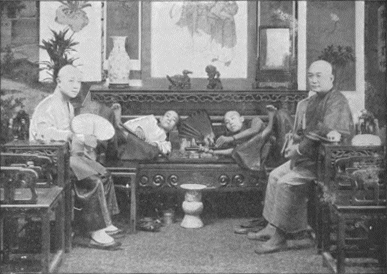
THE CURSE OF CHINA.
About a century ago opium was rarely used in China except as medicine. To-day it enters through the openings made by English cannon, at the rate of six thousand tons a year, and at an annual profit to the Indian treasury of from thirty to forty million dollars. But this is not the worst: the vice of opium-smoking has spread with such rapidity that in one Chinese city alone, where thirty years ago only five opium dens existed, there are now five thousand. In the minds of many Chinamen, therefore, Christianity is principally associated with the gift of opium and its attendant evils. China has now begun to cultivate the poppy for herself, and in some provinces six-tenths of the land is given over to producing opium, to the great detriment of agriculture. For the Chinese argue that if they must have it anyway, they may as well profit by it themselves, and let their own crop vie with that which England sends from India. It should be said that earnest protests have often been made by conscientious Englishmen against this conduct of their Government, but all remonstrances have failed to change its policy. Hence, when our British cousins sometimes humorously say that we Americans worship only the almighty dollar, it may be well to ask if any deity under the sun is more devoutly reverenced than the omnipotent pounds, shillings, and pence.
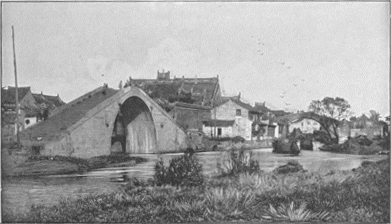
A VILLAGE SCENE.
When we had steamed about five hours from Hong-Kong, we came in sight of our first Chinese pagoda. It is a hollow tower of brick about three hundred feet in height, and resembles, on an enormous scale, one of those tapering sticks which jewelers use for sizing rings. At first, I thought that the nine circular terraces which mark its different stories were adorned with flags or tapestry, but closer scrutiny revealed the melancholy fact that weeds and bushes are now growing here. Indeed, like most of the sacred buildings that I saw in China, it looked both dirty and dilapidated.
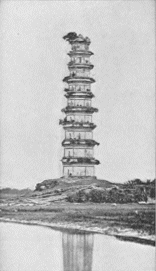
PAGODA, NEAR CANTON RIVER.
Soon after leaving this neglected edifice, we found ourselves amid a constantly increasing throng of Chinese boats, and I began to realize that these were specimens of that "floating population" of Canton of which we have all read, but of which nothing but a visit to it can give an adequate idea.
Hardly was our steamer anchored in the stream before the city, when hundreds of these boats closed in upon us on all sides, like cakes of floating ice around a vessel in the Arctic sea. Wedging and pushing frantically, the boatmen almost swamped themselves. They fought for places near the ship like men and women in a panic. The din of voices sounded like the barking of five hundred canines at a dog-show; and Chinese gutturals flew through the air like bullets from a mitrailleuse. It seemed impossible to disembark in such a mob.
But suddenly I felt a pressure on my arm. I turned and saw apparently three laundrymen from the United States. A glance assured me they were father and sons. "Good morning, sir," said one of them in excellent English, "do you know Carter Harrison, of Chicago?"
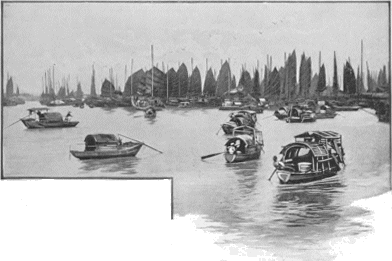
NEARING CANTON.
This question, coming in such a place and at such a time, rendered me speechless with astonishment.
"He mentioned us in his book, 'A Race With the Sun,'" continued the young Chinaman. "This is my father, the famous guide, Ah Cum. This is my brother, and I am Ah Cum, Jr. The others are engaged for to-morrow, but I can serve you. Will you take me?"
"So you are Ah Cum?" I rejoined; "I have heard much of you. Your reference book must be a valuable autograph album of distinguished travelers. Yes, we will take you; and, first of all, can you get us safely into one of those boats? And if so, who will guarantee that we shall not be murdered?"
"Ah Cum."
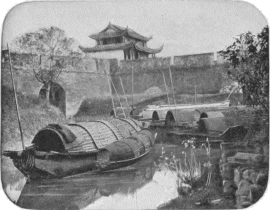
CHINESE BOATS, CANTON.
Accordingly we "came," and presently found ourselves in a boat. I cannot relate how we got there. I do not know, myself. I think of it now as one recalls the pulling of a tooth when under the influence of laughing-gas. I have a dim remembrance of jumping from one reeling skiff to another, of stumbling over slippery seats, of holding on to Ah Cum, Sr., and being pushed by Ah Cum, Jr., and now and then grabbing frantically at a Chinese queue, as a drowning man catches at a rope. The only reason that I did not fall into the water is that there was not space enough between the boats. At last, however, bruised and breathless, we reached a place of refuge, and watched our boatmen fight their way out through the crowd, until we landed on the neighboring island of Shameen. After the pandemonium around the steamer, this seemed a perfect paradise of beauty and repose. It is about a mile and a quarter in circumference, and is reserved exclusively for foreigners.
Shaded by drooping banyan trees, stand many handsome houses inhabited by Englishmen, Germans, and Americans whom the necessities of business keep in banishment here. Their social life is said to be very pleasant, and I should think, indeed, that in so small a settlement the members of this little colony (if they did not hate) would love each other cordially. This pretty place, before the capture of Canton, in 1857, was nothing but a hideous mud-bank. But foreigners have transformed it almost as completely as they have Hong-Kong, and have built around it broad embankments made of solid granite, which form an agreeable promenade.
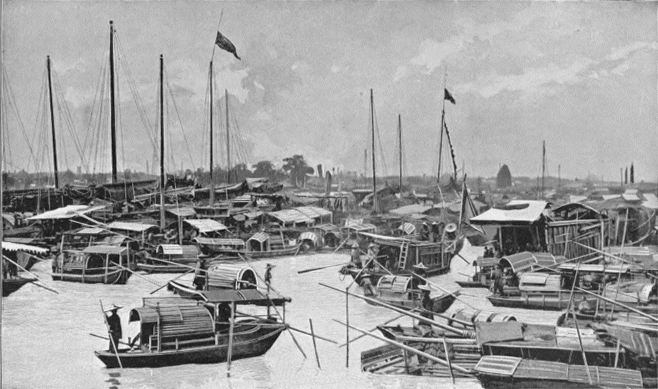
THE FLOATING HOMES OF THOUSANDS, CANTON.
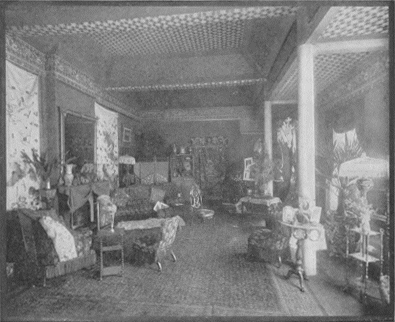
INTERIOR OF A EUROPEAN'S HOUSE.
Unfortunately, however, Shameen boasts of only one hotel, and of this such dismal stories had been told us that we had half made up our minds to eat and sleep on the American steamers, changing from one to another every morning as they came and went. This seemed, however, so difficult, that we resolved to try the accommodations here. We did so, and discovered that in this case "the devil is not so black as he is painted." At all events, clean, comfortable rooms made some amends for a meager bill of fare.