FRENCH AS SHE IS TRADUCED
Reading edition
BY THE AUTHOR OF "JOHN BULL AND HIS ISLAND," ETC.
WITH A PREFACE BY GEORGE C. EGGLESTON
CASSELL & COMPANY, Limited 104 & 106 Fourth Avenue, New York
Copyright, 1888, By O. M. DUNHAM.
All rights reserved.
PREFACE.
It must be that a too free association with American men of letters has moved the author of this book to add to his fine Gallic wit a touch of that preposterousness which is supposed to be characteristic of American humor.
For proof of this, I cite the fact that he has asked me to introduce him upon this occasion. Surely there could be no more grotesque idea than that any word of mine can serve to make Max O'Rell better known than he is to the great company of American readers.
Have not the pirate publishers already introduced him to all Americans who care for literature? Have not their translators done their best, not only to bring his writings to the attention of readers, but also to add to the sparkle and vivacity of his books by translating into them many things not to be found in the French originals? These generous folk, who have thus liberally supplemented his wit with flashes of their own stupidity, have treated his text after the manner of a celebrated Kentuckian of whom it was written that his love of truth was so great that he gave his entire time and attention to the task of ornamenting and adding to it.
But with all their eagerness to render interested service to a distinguished man of letters who was not then here to look after his own affairs, the pirates missed this, the best of his books; and finding that no surreptitious edition of it has appeared in this country, the author has felt himself privileged to re-write it and make such changes in it and additions to it as his own judgment has suggested without the prompting of voluntary assistants, and even to negotiate with a publisher for the issue of an edition on his own account.
I have called this work the best of Max O'Rell's books, and I think the reader will approve the judgment. Here, as in all that this author has written, there is a biting wit, which saturates the serious substance as good, sharp vinegar pervades a pickle; but here, as elsewhere, the main purpose is earnest, and the wit is but an aid to its accomplishment. A very wise and distinguished educator has declared that "the whole theory of education is to be extracted from these humorous sketches," and the story goes—whether Max O'Rell will vouch for its accuracy or not, I do not venture to say—that the head boy of St. Paul's School in London, after hearing the sketches read in public, said: "We boys enjoyed the lecture immensely, but that fellow knows too much about us."
With a tremor of apprehension, we reflect that Max O'Rell's period of observation among ourselves will presently end, and that when he comes to record the result in his peculiar fashion, we are likely to echo that school-boy's plaint. But at any rate we shall know our own features better after we have contemplated them in his mirror; and, meantime, those of us who have enjoyed his acquaintance are disposed earnestly to hope that a guest whom we have learned to esteem so warmly may not think quite so ill of the American character as the barbaric condition of our laws respecting literary property would warrant.
George Cary Eggleston.
New York, February, 1888.
INTRODUCTION.
A Word to the Reader and another to the Critic.
To write a book in a foreign tongue is risky, and I had better at once ask for indulgence.
The many scenes and reminiscences belong to England, and, if translated into French, the anecdotes and conversations would lose much of whatever flavour and interest there may be in them.
This is my reason for not having written this book in French. Let my reason be also my apology.

If any of my readers should feel inclined to think my review of British school-boys somewhat critical, let them take it for granted that when I was a boy I was everything that was good.
Now, gentle American Critic, whose magnanimity is proverbial, before thou abusest this little book, reflect how thou wouldst feel if thy Editor were to bid thee write thy criticism in French.
Max O'Rell.
Contents.

PAGE
Preface,
Introduction,
I am Born. — I am Deeply in Love. — I wish to be an Artist, but my Father uses strong Argument against it. — I produce a dramatic Chef-d'œuvre. — Parisian Managers fail to appreciate it. — I put on a beautiful Uniform. — The Consequence of it. — Two Episodes of the Franco-Prussian War. — The Commune explained by a Communist. — A "glorious" Career cut short. — I take a Resolution and a Ticket for London, 1
II. EXTRACTS FROM THE DIARY OF A FRENCHMAN IN SEARCH OF A SOCIAL POSITION IN ENGLAND.
Arrival at Charing Cross. — I have Nothing to declare to the Exciseman but Low Spirits. — Difficulty in finding a comfortable Residence. — Board and Lodging. — A House with Creepers. — Things look Bad. — Things look Worse. — Things look cheerful, 15
III.
I make the acquaintance of Public School Boys. — "When I was a little Boy." — An Awful Moment. — A Simple Theory. — I score a Success, 34
IV.
The genus Boy. — The only one I object to. — What Boys work for, 38
V.
Schoolboys I have met. — Promising Britons. — Sly Boots. — Too Good for this World. — "No, thanks, we makes it." — French Dictionaries. — A Naughty Boy. — Mothers' Pets. — Dirty, but Beautiful. — John Bully. — High Collars and Brains. — Dictation and its Trials. — Not to be taken in. — Unlucky Boys. — The Use of Two Ears. — A Boy with One Idea. — Master Whirligig. — The Influence of Athletics. — A Good Situation. — A Shrewd Boy of Business. — Master Algernon Cadwaladr Smyth and other Typical Schoolboys, 40
VI.
French as she is Traduced. — More Grumblings. — "La Critique" is not the Critic's Wife. — Bossuet's Prose, and how it reads in English. — Nothing improves by Translation except a Bishop. — A Few French "Howlers." — Valuable Hints on translating Unseen Passages, 72
VII.
English Boys on French Etymologies. — Why "Silence" is the only French Noun ending in "ence" that is of the Masculine Gender. — A Valuable Service rendered by the Author to his Land of Adoption. — Learned Etymologies. — Return to old Philological Methods. — Remarkable Questions. — Written and Oral Examinations. — A Kind Examiner. — How long would it take the Moon to Fall to the Earth? — How many Yards of Cloth it takes to cover an Ass, 80
VIII.
English Boys on French Composition. — "Go ahead" is not in French "Allez une Tête." — How Boys set about French Composition. — A Written Proof of their Guilt. — How Large Advertisements can help them. — A Stumbling-Block cleared away, 90
IX.
Suggestions and Hints for the Class Room. — Boys on History and Geography. — "Maxims" and "Wise Thoughts." — Advice to those about to Teach. — "Sir," and not "Mossoo." — "Frauleins" and "Mademoiselles." — Check your Love for Boys. — No Credit. — We are all liable to make Mistakes. — I get an insight into "Stocks," 95
X.
English Boys' Patriotism put to a Severe Test. — Their Opinion of French Victories. — King Louis VI. of France and the English Soldier at the Battle of Brenneville. — An English Boy on French Wrestling. — Young Tory Democrats. — "Imperium et Libertas." — A Patriotic Answer. — Duck and Drake, 110
XI.
Cricket. — I have an Unsuccessful Try at it. — Boys' Opinion of my Athletic Qualities. — French and English Athletes. — Feats of Skill and Strength versus Feats of Endurance and Brute Force. — A Case of Eviction by Force of Arms, 116
XII.
Old Pupils. — Acquaintances renewed. — Lively Recollections revived. — It is easier to Teach French than to Learn it. — A Testimonial refused to a French Master. — "How de do?" — "That's What-d'ye-call-him, the French Master," 121
XIII.
Debating Societies. — A Discussion on the Pernicious Use of Tobacco. — School Magazines in France and England. — A Business-like Little Briton. — An Important Resolution passed unanimously. — I perform an Englishman's Duty, 125
XIV.
Home, sweet Home! — Boys' Opinion of the Seaside. — French and English Beaches. — Who is he at Home? What was his Grandfather? — Remarks on Swaggering. — "I thought he was a Gentleman," 128
XV.
He can not speak French, but he can read it, you know. — He has a try at it in Paris. — Nasal Sounds and accented Syllables. — How I reduced English Words to single Syllables, and was successful in the Object I had in View. — A Remark on the Connection of Words, 133
XVI.
Public School Scholarships and Exhibitions. — Grateful Parents. — Inquiring Mothers. — A Dear Little Candidate. — Ladies' Testimonials. — A Science Master well recommended, 138
XVII.
The Origin of Anglomania and Anglophobia in England. — A Typical Frenchman. — Too much of an Englishman. — A remarkable French Master. — John Bull made to go to Church by a Frenchman. — A Noble and Thankless Career. — A Place of Learning. — Mons. and Esquire. — All Ladies and Gentlemen. — One Exception. — Wonderful Addresses, 148
XVIII.
The Way to Learn Modern Languages, 158
XIX.
English and French Schoolboys. — Their Characteristics. — The Qualities of the English Schoolboy. — What is required of a Master to Win, 165
Appendix, 169
John Bull, Jr.

I.
I am Born. — I am Deeply in Love. — I wish to be an Artiste, but my Father uses Strong Argument against it. — I Produce a Dramatic Chef-d'œuvre. — Parisian Managers Fail to Appreciate it. — I put on a Beautiful Uniform. — The Consequence of it. — Two Episodes of the Franco-Prussian War. — The Commune Explained by a Communist. — A "Glorious" Career Cut Short. — I take a Resolution, and a Ticket to London.
I was born on the ——
But this is scarcely a "recollection" of mine.
At twelve I was deeply in love with a little girl of my own age. Our servants were friends, and it was in occasional meetings of these girls in the public gardens of my little native town that my chief chance of making love to Marie lay. Looking back on this little episode in my life, I am inclined to think that it afforded much amusement to our attendants. My love was too deep for words; I never declared my flame aloud. But, oh, what a fluttering went on under my small waistcoat every time I had the ineffable pleasure of a nod from her, and what volumes of love I put into my bow as I lifted my cap and returned her salute! We made our first communion on the same day. I was a pupil of the organist, and it was arranged that I should play a short piece during the Offertory on that occasion. I had readily acquiesced in the proposal. Here was my chance of declaring myself; through the medium of the music I could tell her all my lips refused to utter. She must be moved, she surely would understand.
Whether she did or not, I never had the bliss of knowing. Shortly after that memorable day, my parents removed from the country to Paris. The thought of seeing her no more nearly broke my heart, and when the stage-coach reached the top of the last hill from which the town could be seen, my pent-up feelings gave way and a flood of tears came to my relief.
The last time I visited those haunts of my childhood, I heard that "little Marie" was the mamma of eight children. God bless that mamma and her dear little brood!
At fifteen I was passionately fond of music, and declared to my father that I had made up my mind to be an artiste.
My father was a man of great common sense and few words: he administered to me a sound thrashing, which had the desired effect of restoring my attentions to Cicero and Thucydides.
It did not, however, altogether cure me of a certain yearning after literary glory.
For many months I devoted the leisure, left me by Greek version and Latin verse, to the production of a drama in five acts and twelve tableaux.
For that matter I was no exception to the rule. Every French school-boy has written, is writing, or will write a play.
My drama was a highly moral one of the sensational class. Blood-curdling, horrible, terrible, savage, weird, human, fiendish, fascinating, irresistible—it was all that. I showed how, even in this world, crime, treachery, and falsehood, though triumphant for a time, must in the long run have their day of reckoning. Never did a modern Drury Lane audience see virtue more triumphant and vice more utterly confounded than the Parisians would have in my play, if only the theatrical directors had not been so stupid as to refuse my chef-d'œuvre.
For it was refused, inconceivable as it seemed to me at the time.
The directors of French theatres are accustomed to send criticisms of the plays which "they regret to be unable to accept."
The criticism I received from the director of the Ambigu Theatre was, I thought, highly encouraging.
"My play," it appeared, "showed no experience of the stage; but it was full of well-conceived scenes and happy mots, and was written in excellent French. Horrors, however, were too piled up, and I seemed to have forgotten that spectators should be allowed time to take breath and wipe away their tears."
I was finally advised not to kill all my dramatis personæ in my next dramatic production, as it was customary for one of them to come forward and announce the name of the author at the end of the first performance.
Although this little bit of advice appeared to me not altogether free from satire, there was in the letter more praise than I had expected, and I felt proud and happy. The letter was passed round in the class-room, commented upon in the playground, and I was so excited that I can perfectly well remember how I forgot to learn my repetition that day, and how I got forty lines of the Ars Poetica to write out five times.
What a take-down, this imposition upon a budding dramatic author!
Examinations to prepare compelled me for some time to postpone all idea of astonishing the Paris playgoers with a "new and original" drama.
I took my B.A. at the end of that year, and my B.Sc. at the end of the following one. Three years later I was leaving the military school with the rank of sub-lieutenant.
My uniform was lovely; and if I had only had as much gold in my pockets as on my shoulders, sleeves, and breast, I think I ought to have been the happiest being on earth.
The proudest day of a young French officer's life is the day on which he goes out in the street for the first time with all his ironmongery on, his moustache curled up, his cap on his right ear, his sabre in his left hand. The soldiers he meets salute him, the ladies seem to smile approvingly upon him; he feels like the conquering hero of the day; all is bright before him; battles only suggest to him victories and promotions.
On the first day, his mother generally asks to accompany him, and takes his arm. Which is the prouder of the two? the young warrior, full of confidence and hope, or the dear old lady who looks at the passers-by with an air that says: "This is my son, ladies and gentlemen. As for you, young ladies, he can't have all of you, you know."
Poor young officer! dear old mother! They little knew, in 1869, that in a few months one would be lying in a military hospital on a bed of torture, and the other would be wondering for five mortal months whether her dear and only child was dead, or prisoner in some German fortress.
On the 19th of July, 1870, my regiment left Versailles for the Eastern frontier.
As in these pages I simply intend to say how I came to make the acquaintance of English school-boys, it would be out of place, if not somewhat pretentious, to make use of my recollections of the Franco-Prussian War.
Yet I cannot pass over two episodes of those troublous times.
I was twelve years of age when I struck up a friendship with a young Pole, named Gajeski, who was in the same class with me. We became inseparable chums. Year after year we got promoted at the same time. We took our degrees on the same days, entered the military school in the same year, and received our commissions in the same regiment.
We took a small appartement de garçon at Versailles, and I shall never forget the delightful evenings we spent together while in garrison there. He was a splendid violinist, and I was a little of a pianist.
Short, fair, and almost beardless, Gajeski was called the "Petit Lieutenant" by the soldiers, who all idolized him.
At the battle of Wörth, after holding our ground from nine in the morning till five in the evening, against masses of Prussian troops six times as numerous as our own, we were ordered to charge the enemy, with some other cavalry regiments, in order to protect the retreat of the bulk of the army.
A glance at the hill opposite convinced us that we were ordered to go to certain death.
My dear friend grasped my hand, as he said with a sad smile: "We shall be lucky if we get our bones out of this, old fellow."
Down the hill we went like the wind, through a shower of bullets and mitraille. Two minutes later, about two-thirds of the regiment reached the opposite ascent. We were immediately engaged in a desperate hand-to-hand fight. A scene of hellish confusion it was. But there, amidst the awful din of battle, I heard Gajeski's death-cry, as he fell from his horse three or four yards from me, and I saw a horrible gash on his fair young head.
The poor boy had paid France for the hospitality she had extended to his father.
I fought like a madman, seeing nothing but that dear mutilated face before my eyes. I say "like a madman," for it was not through courage or bravery. In a mêlée you fight like a madman—like a savage.
I had no brother, but he had been more than a brother to me. I had had no other companion or friend, but he was a friend of a thousand.
Poor fellow!
I had been in captivity in a stronghold on the Rhine for five months, when the preliminaries of peace were signed between France and Germany in January, 1871, and the French prisoners were sent back to their country.
About five hundred of us were embarked at Hamburg on board one of the steamers of the Compagnie Transatlantique, and landed at Cherbourg.
Finding myself near home, I immediately asked the general in command of the district for a few days' leave, to go and see my mother.
Since the day I had been taken prisoner at Sedan (2d of September, 1870), I had not received a single letter from her, as communications were cut off between the east and the west of France; and I learned later on that she had not received any of the numerous letters I had written to her from Germany.
This part of Normandy had been fortunate enough to escape the horrors of war, but, for months, the inhabitants had had to lodge soldiers and militia-men.
At five o'clock on a cold February morning, clothed, or rather covered, in my dirty, half-ragged uniform, I rang the bell at my mother's house.
Our old servant appeared at the attic window, and inquired what I wanted.
"Open the door," I cried; "I am dying of cold."
"We can't lodge you here," she replied; "we have as many soldiers as we can accommodate—there is no room for you. Go to the Town Hall, they will tell you we are full."
"Sapristi, my good Fanchette," I shouted, "don't you know me? How is mother?"
"Ah! It is Monsieur!" she screamed. And she rushed down, filling the house with her cries: "Madame, madame, it is Monsieur; yes, I have seen him, he has spoken to me, it is Monsieur."
A minute after I was in my mother's arms.
Was it a dream?
She looked at me wildly, touching my head to make sure I was at her side, in reality, alive; when she realized the truth she burst into tears, and remained speechless for some time. Such scenes are more easily imagined than described, and I would rather leave it to the reader to supply all the exclamations and interrogations that followed.
I could only spend two days at home, as my regiment was being organized in Paris, and I had to join it.
On the 18th of March, 1871, the people of Paris, in possession of all the armament that had been placed in their hands to defend the French capital against the Prussians, proclaimed the Commune, and, probably out of a habit just lately got into by the French army, we retreated to Versailles, leaving Paris at the mercy of the Revolutionists.
This is not the place to account for this revolution.
An explanation of it, which always struck me as somewhat forcible, is the one given by a Communist prisoner to a captain, a friend of mine, who was at the time acting as juge d'instruction to one of the Versailles courts-martial.
"Why did you join the Commune?" he asked a young and intelligent-looking fellow who had been taken prisoner behind some barricade.
"Well, captain, I can hardly tell you. We were very excited in Paris; in fact, off our heads with rage at having been unable to save Paris. We had a considerable number of cannon and ammunition, which we were not allowed to use against the Prussians. We felt like a sportsman who, after a whole day's wandering through the country, has not had an opportunity of discharging his gun at any game, and who, out of spite, shoots his dog, just to be able to say on returning home that he had killed something."
On the 14th of April, 1871, my regiment received the order to attack the Neuilly bridge, a formidable position held by the Communists.
What the Prussians had not done some compatriot of mine succeeded in doing. I fell severely wounded.
After my spending five months in the Versailles military hospital, and three more at home in convalescence, the army surgeons declared that I should no longer be able to use my right arm for military purposes, and I was granted a lieutenant's pension, which would have been just sufficient to keep me in segars if I had been a smoker.
But of this I do not complain. Poor France! she had enough to pay!
At the end of the year of grace, 1871, my position was very much like that of my beloved country: all seemed lost, fors l'honneur.
Through my friends, however, I was soon offered a choice between two "social positions."
The first was a colonel's commission in the Egyptian army (it seemed that the state of my right arm was no objection).
I was to draw a very good salary. My friends in Cairo, however, warned me that salaries were not always paid very regularly, but sometimes allowed to run on till cash came into the Treasury. It was during the good times of Ismail Pacha. This made me a little suspicious that my salary might run on so fast that I should not be able to catch it.
The other post offered me was that of London correspondent to an important Parisian newspaper.
I had had enough of military "glory" by this time. Yet the prospect of an adventurous life is always more or less fascinating at twenty-three years of age.
Being the only child of a good widowed mother, I thought I would take her valuable advice on the subject.
I am fortunate in having a mother full of common sense. With her French provincial ideas, she was rather startled to hear that a disabled lieutenant could all at once become an active colonel. She thought that somehow the promotion was too rapid.
Alas! she, too, had had enough of military "glory."
Her advice was to be followed, for it was formulated thus: "You speak English pretty well; we have a good many friends in England; accept the humbler offer, and go to England to earn an honest living."
This is how I was not with Arabi Pacha on the wrong side at Tel-el-Kebir, and how it became my lot to make one day the acquaintance of the British school-boy of whom I shall have more to say by-and-by.
On the 8th of July, 1872, I took the London train at the Gare du Nord, Paris.
Many relations and friends came to the station to see me off. Some had been in England, some had read books on England, but all seemed to know a great deal about it. Advice, cautions, suggestions, were poured into my ears.
"Be sure you go and see Madame Tussaud's to-morrow," said one.
"Now," said another, "when you get to Charing Cross, don't fail to try and catch hold of a fellow-passenger's coat, and hold fast till you get to your hotel. The fog is so thick in the evening that the lamp-lights are of no use, you know."
All information is valuable when you start for a foreign country. But I could not listen to more. Time was up.
I shook hands with my friends and kissed my relations, including an uncle and two cousins of the sterner sex. This will sound strange to English or American ears. Well, it sounds just as strange to mine, now.
I do not know that a long residence in England has greatly improved me (though my English friends say it has), but what I do know is, that I could not now kiss a man, even if he were a bequeathing uncle ready to leave me all his money.
II.
EXTRACTS FROM THE DIARY OF A FRENCHMAN IN SEARCH OF A SOCIAL POSITION IN ENGLAND.
Arrival at Charing Cross. — I have Nothing to Declare to the Exciseman but Low Spirits. — Difficulty in Finding a Good Residence. — Board and Lodging. — A House with Creepers. — Things look Bad. — Things look Worse. — Things look Cheerful.
8th July, 1872.
8.30 P.M.—Landed at Folkestone. The London train is ready. The fog is very thick. I expected as much. My English traveling companions remark on it, and exclaim that "this is most unusual weather." This makes me smile.
10.15 P.M.—The train crosses the Thames. We are in London. This is not my station, however, I am told. The train restarts almost immediately, and crosses the river again. Perhaps it takes me back to Paris. Hallo! how strange! the train crosses another river.
"This is a town very much like Amsterdam," I say to my neighbor.
He explains to me the round taken by the South-Eastern trains from Cannon Street to Charing Cross.
10.25 P.M.—Charing Cross! At last, here I am. The luggage is on the platform. I recognize my trunk and portmanteau.
A tall official addresses me in a solemn tone:
"Have you any thing to declare?"
"Not any thing."
"No segars, tobacco, spirits?"
"No segars, no tobacco."
My spirits were so low that I thought it was useless to mention them.
In France, in spite of this declaration of mine, my luggage would have been turned inside out. The sturdy Briton takes my word [1] and dismisses my luggage with:
"All right. Take it away."
11 P.M.—I alight at an hotel near the Strand. A porter comes to take my belongings.
"I want a bedroom for the night," I say.
"Très bien, monsieur."
He speaks French. The hotel is French, too, I see.
After a wash and brush-up, I come down to the dining-room for a little supper.
I do not like the look of the company.
They may be French, and this is a testimonial in their favor, but I am afraid it is the only one.
Three facetious bagmen exercise their wit by puzzling the waiter with low French slang.
I think I will remove from here to-morrow.
I go to my bedroom, and try to open the window and have a look at the street. I discover the trick.
How like guillotines are these English windows!
I pull up the bottom part of mine, and look out. This threatening thing about my neck makes me uncomfortable. I withdraw.
English windows are useful, no doubt, but it is evident that the people of this country do not use them to look out in the street and have a quiet chat à la française.
Probably the climate would not allow it.
9th July, 1872.
A friend comes to see me. He shares my opinion of the French hotel, and will look for a comfortable apartment in an English house for me. We breakfast together, and I ask him a thousand questions.
He knows every thing, it seems, and I gather valuable information rapidly.
He prepares a programme of sight-seeing which it will take me a good many days to work through.
The weather is glorious.
My boxes are packed and ready to be removed—to-night, I hope.
Will pay my first visit to the British Museum.
I hail a cab in Regent Circus.
"Is the British Museum far from here?" I cry to the man seated on a box behind.
"No, sir; I will take you there for a shilling," he replies.
"Oh! thank you; I think I will walk then."
Cabby retires muttering a few sentences unintelligible to me. Only one word constantly occurring in his harangue can I remember.
I open my pocket-dictionary.
Good heavens! What have I said to the man? What has he taken me for? Have I used words conveying to his mind any intention of mine to take his precious life? Do I look ferocious? Why did he repeatedly call me sanguinaire? Must have this mystery cleared up.
10th July, 1872.
An English friend sets my mind at rest about the little event of yesterday. He informs me that the adjective in question carries no meaning. It is simply a word that the lower classes have to place before each substantive they use in order to be able to understand each other.
11th July, 1872.
Have taken apartments in the neighborhood of Baker Street. My landlady, qui frise ses cheveux et la cinquantaine, enjoys the name of Tribble. She is a plump, tidy, and active-looking little woman.
On the door there is a plate, with the inscription,
"J. Tribble, General Agent."
Mr. Tribble, it seems, is not very much engaged in business.
At home he makes himself useful.
It was this gentleman, more or less typical in London, whom I had in my mind's eye as I once wrote:
"The English social failure of the male sex not unfrequently entitles himself General Agent: this is the last straw he clutches at; if it should break, he sinks, and is heard of no more, unless his wife come to the rescue, by setting up a lodging-house or a boarding-school for young ladies. There, once more in smooth water, he wields the blacking-brush, makes acquaintance with the knife-board, or gets in the provisions. In allowing himself to be kept by his wife, he feels he loses some dignity; but if she should adopt any airs of superiority over him, he can always bring her to a sense of duty by beating her."
12th July, 1872.
Mr. Tribble helps take up my trunks. On my way to bed my landlady informs me that her room adjoins mine, and if I need any thing in the night I have only to ask for it.
This landlady will be a mother to me, I can see.
The bed reminds me of a night I passed in a cemetery, during the Commune, sleeping on a gravestone. I turn and toss, unable to get any rest.
Presently I had the misfortune to hit my elbow against the mattress.
A knock at the door.
"Who is there?" I cry.
"Can I get you any thing, sir? I hope you are not ill," says a voice which I recognize as that of my landlady.
"No, why?"
"I thought you knocked, sir."
"No. Oh! I knocked my elbow against the mattress."
"Ah! that's it. I beg your pardon."
I shall be well attended here, at all events.
13th July, 1872.
The table here is not recherché; but twelve months' campaigning have made me tolerably easy to please.
What would not the poor Parisians have given, during the Siege in 1870, for some of Mrs. Tribble's obdurate poultry and steaks!
19th July, 1872.
I ask Mrs. Tribble for my bill.
I received it immediately; it is a short and comprehensive one:
£ s. d.
Board and Lodging 5 5 0
Sundries 1 13 6
Total £6 18 6
I can understand "lodging"; but "board" is a new word to me. I like to know what it is I have to pay for, and I open my dictionary.
"Board (subst.), planche."
Planche! Why does the woman charge me for a planche? Oh! I have it—that's the bed, of course.
My dictionary does not enlighten me on the subject of "Sundries."
I make a few observations to Mrs. Tribble on the week's bill. This lady explains to me that she has had great misfortunes, that Tribble hardly does any work, and does not contribute a penny toward the household expenses. When he has done a little stroke of business, he takes a holiday, and only reappears when his purse is empty.
I really cannot undertake to keep Tribble in dolce far niente, and I give Mrs. Tribble notice to leave.
20th July, 1872.
9 A.M.—I read in this morning's paper the following advertisement:
"Residence, with or without board, for a gentleman, in a healthy suburb of London. Charming house, with creepers, large garden; cheerful home. Use of piano, etc."
"Without board" is what I want. Must go and see the place.
6 P.M.—I have seen the house with creepers, and engaged a bedroom and sitting-room. Will go there to-night. My bed is provided with a spring mattress. Won't I sleep to-night, that's all!
21st July, 1872.
I remove my goods and chattels from the charming house. I found the creepers were inside.
It will take me a long time to understand English, I am afraid.
8th August, 1872.
I examine my financial position. I came to England with fifty pounds; have been here thirty days, and have lived at the rate of a pound a day. My money will last me only twenty days longer. This seems to be a simple application of the rule of three.
The thought that most Lord-Mayors have come to London with only half-a-crown in their pockets comforts me. Still I grow reflective.
25th September, 1872.
I can see that the fee I receive for the weekly letter I send to my Parisian paper will not suffice to keep me. Good living is expensive in London. Why should I not reduce my expenses, and at the same time improve my English by teaching French in an English school as resident master? This would enable me to wait and see what turn events will take.
I have used my letters of recommendation as a means of obtaining introductions in society, and my pride will not let me make use of them again for business.
I will disappear for a time. When my English is more reliable, perhaps an examination will open the door of some good berth to me.
3rd October, 1872.
Received this morning an invitation to be present at a meeting of the Teachers' Association.
Came with a friend to the Society of Arts, where the meeting is held in a beautiful hall, and presided over by Canon Barry.
What a graceful and witty speaker!
He addresses to private school-masters a few words on their duty.
"Yours," he says, "is not only a profession, it is a vocation, I had almost said a ministry" (hear, hear), "and the last object of yours should be to make money."
This last sentence is received with rapturous applause. The chairman has evidently expressed the feeling of the audience.
The Canon seems to enjoy himself immensely.
Beautiful sentiments! I say to myself. Who will henceforth dare say before me, in France, that England is not a disinterested nation? Yes, I will be a school-master; it is a noble profession.
A discussion takes place on the merits of private schools. A good deal of abuse is indulged in at the expense of the public schools.
I inquire of my friend the reason why.
My friend is a sceptic. He says that the public schools are overflowing with boys, and that if they did not exist, many of these private school-masters would make their fortune.
I bid him hold his wicked tongue. He ought to be ashamed of himself.
The meeting is over. The orators, with their speeches in their hands, besiege the press reporters' table. I again apply to my friend for the explanation of this.
He tells me that these gentlemen are trying to persuade the reporters to insert their speeches in their notes, in the hope that they will be reproduced in to-morrow's papers, and thus advertise their names and schools.
My friend is incorrigible. I will ask him no more questions.
4th October, 1872.
There will be some people disappointed this morning, if I am to believe what my friend said yesterday. I have just read the papers. Under the heading "Meeting of the Teachers' Association," I see a long report of yesterday's proceedings at the Society of Arts. Canon Barry's speech alone is reproduced.
24th May, 1873.
For many months past, M. Thiers has carried the Government with his resignation already signed in his frockcoat pocket.
"Gentlemen," he has been wont to say in the Houses of Parliament, "such is my policy. If you do not approve it, you know that I do not cling to power; my resignation is here in my pocket, and I am quite ready to lay it on the table if you refuse me a vote of confidence."
I always thought that he would use this weapon once too often.
A letter, just received from Paris, brings me the news of his overthrow and the proclamation of Marshal MacMahon as President of the Republic.
28th May, 1873.
The editor of the French paper, of which I have been the London correspondent for a few months, sends me a check, with the sad intelligence that one of the first acts of the new Government has been to suppress our paper.
Things are taking a gloomy aspect, and no mistake.
12th June, 1873.
To return to France at once would be a retreat, a defeat. I will not leave England, at any rate, before I can speak English correctly and fluently. I could manage this when a child; it ought not to take me very long to be able to do the same now.
I pore over the Times educational advertisements every day.
Have left my name with two scholastic agents.
25th June, 1873.
I have put my project into execution, and engaged myself in a school in Somersetshire.
The post is not a brilliant one, but I am told that the country is pretty, my duties light, and that I shall have plenty of time for reading.
I buy a provision of English books, and mean to work hard.
In the mean time, I write to my friends in France that I am getting on swimmingly.
I have always been of the opinion that you should run the risk of exciting the envy rather than the pity of your friends, when you have made up your mind not to apply to them for a five-pound note.
(M——, Somerset.) 2d August, 1873.
Arrived here yesterday. Find I am the only master, and expected to make myself generally useful. My object is to practice my English, and I am prepared to overlook many annoyances.
Woke up this (Sunday) morning feeling pains all over. Compared to this, my bed at Mrs. Tribble's was one of roses. I look round. In the corner I see a small washstand. A chair, a looking-glass six inches square hung on the wall, and my trunk, make up the furniture.
I open the window. It is raining a thick, drizzling rain. Not a soul in the road. A most solemn, awful solitude. Horrible! I make haste to dress. From a little cottage, on the other side of the road, the plaintive sounds of a harmonium reach me. I sit on my bed and look at my watch. Half an hour to wait for my breakfast. The desolate room, this outlook from the window, the whole accompanied by the hymn on the harmonium, are enough to drive me mad. Upon my word, I believe I feel the corner of my eye wet. Cheer up, boy! No doubt this is awful, but better times will come. Good heavens! You are not banished from France. With what pleasure your friends will welcome you back in Paris! In nine hours, for a few shillings, you can be on the Boulevards.
Breakfast is ready. It consists of tea and bread and butter, the whole honored by the presence of Mr. and Mrs. R. I am told that I am to take the boys to church. I should have much preferred to go alone.
On the way to church we met three young ladies—the Squire's daughters, the boys tell me. They look at me with a kind of astonishment that seems to me mixed with scorn. This is probably my fancy. Every body I meet seems to be laughing at me.
20th August, 1873.
Am still at M., teaching a little French and learning a good deal of English.
Mrs. R. expresses her admiration for my fine linen, and my wardrobe is a wonder to her. From her remarks, I can see she has taken a peep inside my trunk.
Received this morning a letter from a friend in Paris. The dear fellow is very proud of his noble ancestors, and his notepaper and envelopes are ornamented with his crest and crown. The letter is handed to me by Mrs. R., who at the same time throws a significant glance at her husband. I am a mysterious person in her eyes, that is evident. She expresses her respect by discreetly placing a boiled egg on my plate at breakfast. This is an improvement, and I return thanks in petto to my noble friend in Paris.
22nd August, 1873.
Whatever may be Mr. R.'s shortcomings, he knows how to construct a well-filled time-table.
I rise at six.
From half-past six to eight I am in the class-room seeing that the boys prepare their lessons.
At eight I partake of a frugal breakfast.
From half-past eight till half-past nine I take the boys for a walk.
From half-past nine till one I teach more subjects than I feel competent to do, but I give satisfaction.
At one I dine.
At five minutes to two I take a bell, and go in the fields, ringing as hard as I can to call the boys in.
From two to four I teach more subjects than—(I said that before).
After tea I take the boys for a second walk.
My evenings are mine, and I devote them to study.
23rd August, 1873.
Mr. R. proposes that I should teach two or three new subjects. I am ready to comply with his wishes; but I sternly refuse to teach la valse à trois temps.
He advises me to cane the boys. This also I refuse to do.
15th September, 1873.
I cannot stand this life any longer. I will return to France if things do not take a brighter turn.
I leave Mr. R. and his "Dotheboys Hall."
At the station I meet the clergyman. He had more than once spoken to me a few kind words. He asks me where I am going.
"To London, and to Paris next, I hope," I reply.
"Are you in a hurry to go back?"
"Not particularly; but——"
"Well, will you do my wife and myself the pleasure of spending a few days with us at the Vicarage? We shall be delighted if you will."
"With all my heart."
25th September, 1873.
Have spent a charming week at the Vicarage—a lovely country-house, where for the first time I have seen what real English life is.
I have spoken to my English friend of my prospects, and he expresses his wonder that I do not make use of the letters of recommendation that I possess, as they would be sure to secure a good position for me.
"Are not important posts given by examination in this country?" I exclaimed.
But he informs me that such is not the case; that these posts are given, at elections, to the candidates who are bearers of the best testimonials.
The information is most valuable, and I will act upon my friend's advice.
My visit has been as pleasant as it has been useful.
12th January, 1874.
A vacancy occurred lately in one of the great public schools. I sent in my application, accompanied by my testimonials.
Have just received an official intimation that I am elected head-master of the French school at St. Paul's.
14th January, 1874.
One piece of good luck never comes alone.
I am again appointed London correspondent to one of the principal Paris papers.
Allons, me voilà sauvé!
[1] Things have changed in England since the dynamite scare.
III.
I Make the Acquaintance of Public School Boys. — "When I Was a Little Boy." — An Awful Moment. — A Simple Theory. — I Score a Success.
I am not quite sure that the best qualification for a school-master is to have been a very good boy.
I never had great admiration for very good boys. I always suspected, when they were too good, that there was something wrong.
When I was at school, and my master would go in for the recitation of the litany of all the qualities and virtues he possessed when a boy—how good, how dutiful, how obedient, how industrious he was—I would stare at him, and think to myself: How glad that man must be he is no longer a boy!
"No, my dear little fellows, your master was just like you when he was mamma's little boy. He shirked his work whenever he could; he used to romp and tear his clothes if he had a chance, and was far from being too good for this world; and if he was not all that, well, I am only sorry for him, that's all."
I believe that the man who thoroughly knows all the resources of the mischievous little army he has to fight and rule is better qualified and prepared for the struggle.
We have in French an old proverb that says: "It's no use trying to teach an old monkey how to make faces."
The best testimonial in favor of a school-master is that the boys should be able to say of him: "It's no use trying this or that with him; he always knows what we are up to."
How is he to know what his pupils are "up to" if he has not himself been "up to" the same tricks and games?
The base of all strategy is the perfect knowledge of all the roads of the country in which you wage war.
To be well up in all the ways and tricks of boys is to be aware of all the moves of the enemy.
It is an awful moment when, for the first time, you take your seat in front of forty pairs of bright eyes that are fixed upon you, and seem to say:
"Well, what shall it be? Do you think you can keep us in order, or are we going to let you have a lively time of it?"
All depends on this terrible moment. Your life will be one of comfort, and even happiness, or one of utter wretchedness.
Strike the first blow and win, or you will soon learn that if you do not get the better of the lively crew they will surely get the better of you.
I was prepared for the baptism of fire.
I even had a little theory that had once obtained for me the good graces of a head-master.
This gentleman informed me that the poor fellow I was going to replace had shot himself in despair of being ever able to keep his boys in order, and he asked me what I thought of it.
"Well," I unhesitatingly answered, "I would have shot the boys."
"Right!" he exclaimed; "you are my man."
If, as I strongly suspected from certain early reminiscences, to have been a mischievous boy was a qualification for being a good school-master, I thought I ought to make a splendid one.
The result of my first interview with British boys was that we understood each other perfectly. We were to make a happy family. That was settled in a minute by a few glances at each other.
IV.
The "Genus" Boy. — The Only One I Object To. — What Boys Work For.
Boys lose their charm when they get fifteen or sixteen years of age. The clever ones, no doubt, become more interesting to the teacher, but they no longer belong to the genus boy that you love for his very defects as much as for his good qualities.
I call "boys" that delightful, lovable race of young scamps from eleven to fourteen years old. At that age all have redeeming points, and all are lovable. I never objected to any, except perhaps to those who aimed at perfection, especially the ones who were successful in their efforts.
For my part, I like a boy with a redeeming fault or two.
By "boys" I mean little fellows who manage, after a game of football, to get their right arm out of order, that they may be excused writing their exercises for a week or so; who do not work because they have an examination to prepare, but because you offer them an inducement to do so, whether in the shape of rewards, or maybe something less pleasant you may keep in your cupboard.
V.
School Boys I have Met. — Promising Britons. — Sly-Boots. — Too Good for this World. — "No, Thanks, We Makes It." — French Dictionaries. — A Naughty Boy. — Mothers' Pets. — Dirty but Beautiful. — John Bully. — High Collars and Brains. — Dictation and its Trials. — Not to be Taken In. — Unlucky Boys. — The Use of Two Ears. — A Boy with One Idea. — Master Whirligig. — The Influence of Athletics. — A Good Situation. — A Shrewd Boy of Business. — Master Algernon Cadwaladr Smyth, and Other Typical Schoolboys.
Master Johnny Bull is a good little boy who sometimes makes slips in his exercises, but mistakes⏼never.
He occasionally forgets his lesson, but he always "knows" it.
"Do you know your lesson?" you will ask him.
"Yes, sir," he will reply.
"But you can't say it."
"Please, sir, I forget it now."
Memory is his weak point. He has done his best, whatever the result may be. Last night he knew his lesson perfectly; the proof is that he said it to his mother, and that the excellent lady told him he knew it very well. Again this morning, as he was in the train coming to school, he repeated it to himself, and he did not make one mistake. He knows he didn't.
If he has done but two sentences of his home work, "he is afraid" he has not quite finished his exercise.
"But, my dear boy, you have written but two sentences."
"Is that all?" he will inquire.
"That is all."
"Please, sir, I thought I had done more than that." And he looks at it on all sides, turns it to the right, to the left, upside down; he reads it forwards, he reads it backwards. No use; he can't make it out.
All at once, however, he will remember that he had a bad headache last night, or maybe a bilious attack.
The bilious attack is to the English schoolboy what the migraine is to the dear ladies of France: a good maid-of-all-work.
Sometimes my young hero brings no exercise at all. It has slipped, in the train, from the book in which he had carefully placed it, or there is a crack in his locker, and the paper slipped through. You order excavations to be made, and the exercise has vanished like magic. Johnny wonders.
"Perhaps the mice ate it!" you are wicked enough to suggest.
This makes him smile and blush. He generally collapses before a remark like this.
But if he has a good excuse, behold him!
"I could not do my exercise last night," said to me one day a young Briton. It was evident from his self-satisfied and confident assurance that he had a good answer ready for my inquiry.
"You couldn't," I said; "why?"
"Please, sir, grandmamma died last night!"
"Oh! did she? Well, well—I hope this won't happen again."
This put me in mind of the boy who, being reproached for his many mistakes in his translation, pleaded:
"Please, sir, it isn't my fault. Papa will help me."
An English schoolboy never tells stories—never.
A mother once brought her little son to the head-master of a great public school.
"I trust my son will do honor to the school," she said; "he is a good, industrious, clever, and trustworthy boy. He never told a story in his life."
"Oh! madam, boys never do," replied the head-master.
The lady left, somewhat indignant. Did the remark amount to her statement being disbelieved, or to an affirmation that her boy was no better than other boys?
Of course every mother is apt to think that her Johnny or Jenny is nature's highest utterance. But for blind, unreasoning adoration, commend me to a fond grandmamma.
The first time I took my child on a visit to my mother in dear old Brittany, grandmamma received compliments enough on the subject of the "lovely petite blonde" to turn her head. But it did not want much turning, I must say. One afternoon, my wife was sitting with Miss Baby on her lap, and grandmamma, after devouring the child with her eyes for a few moments, said to us:
"You are two very sensible parents. Some people are so absurd about their babies! Take Madame T., for instance. She was here this morning, and really, to hear her talk, one would think that child of hers was an angel of beauty—that there never was such another."
"Well, but, grandmamma," said my wife, "you know yourself that you are forever discoursing of the matchless charms of our baby to your friends."
"Ah!" cried the dear old lady, as serious as a judge; "but that's quite different; in our case it's all true."
If you ever hope to find the British schoolboy at fault, your life will be a series of disappointments. Judge for yourself.
I (once): "Well, Brown, you bring no exercise this morning. How is that?"
Promising Briton: "Please, sir, you said yesterday that we were to do the 17th exercise."
I (inquiringly): "Well?"
P. B. (looking sad): "Please, sir, Jones said to me, last night, that it was the 18th exercise we were to do."
I (surprised): "But, my dear boy, you do not bring me any exercise at all."
P. B. (looking good): "Please, sir, I was afraid to do the wrong one."
Dear, dear child! the thought of doing wrong but once was too much for him! I shall always have it heavy on my conscience to have rewarded this boy's love of what is right by calling upon him to write out each of those exercises five times.
That thick-necked boy, whom you see there on the front row aiming at looking very good, and whom his schoolfellows are wicked and disrespectful enough to surname "Potted Angel," is sad and sour. His eyes are half open, his tongue seems to fill his mouth, and to speak, or rather to jerk out the words, he has to let it hang out. His mouth moves sideways like that of a ruminant; you would imagine he was masticating a piece of tough steak. He blushes, and never looks at you, except on the sly, with an uncomfortable grin, when your head is turned away. It seems to give him pain to swallow, and you would think he was suffering from some internal complaint.
This, perhaps, can be explained. The conscience lies just over the stomach, if I am to trust boys when they say they put their hands on their conscience. Let this conscience be heavily loaded, and there you have the explanation of the grumbling ailment that disturbs the boy in the lower regions of his anatomy.
To be good is all right, but you must not over-do it. This boy is beyond competition, a standing reproach, an insult to the rest of the class.
You are sorry to hear, on asking him what he intends to be, that he means to be a missionary. His face alone will be worth £500 a year in the profession. Thinking that I have prepared this worthy for missionary work, I feel, when asked what I think of missionaries, like the jam-maker's little boy who is offered jam and declines, pleading:
"No, thanks—we makes it."
I have great respect for missionaries, but I have always strongly objected to boys who make up their minds to be missionaries before they are twelve years old.
Some good, straightforward boys are wholly destitute of humor. One of them had once to put into French the following sentence of Charles Dickens: "Mr. Squeers had but one eye, and the popular prejudice runs in favor of two." He said he could not put this phrase into French, because he did not know what it meant in English.
"Surely, sir," he said to me, "it is not a prejudice to prefer two eyes to one."
This boy was wonderfully good at facts, and his want of humor did not prevent him from coming out of Cambridge senior classic, after successfully taking his B.A. and M.A. in the University of London.
This young man, I hear, is also going to be a missionary. The news goes far to reconcile me to the noble army of John Bull's colonizing agents, but I doubt whether the heathen will ever get much entertainment out of him.
Some boys can grasp grammatical facts and succeed in writing a decent piece of French; but, through want of literary perception, they will give you a sentence that will make you feel proud of them until you reach the end, when, bang! the last word will have the effect of a terrible bump on your nose.
A boy of this category had to translate this other sentence of Dickens: [2] "She went back to her own room, and tried to prepare herself for bed. But who could sleep? Sleep!" [3]
His translation ran thus: "Elle se retira dans sa chambre, et fit ses préparatifs pour se coucher. Mais qui aurait pu dormir? Sommeil!"
I caught that boy napping one day.
"Vous dormez, mon ami?... Sommeil, eh?" I cried.
The remark was enjoyed. There is so much charity in the hearts of boys!
Another boy had to translate a piece of Carlyle's "French Revolution": "'Their heads shall fall within a fortnight,' croaks the people's friend (Marat), clutching his tablets to write——Charlotte Corday has drawn her knife from the sheath; plunges it, with one sure stroke, into the writer's heart."
The end of this powerful sentence ran thus in the translation: "Charlotte Corday a tiré son poignard de la gaîne, et d'une main sûre, elle le plonge dans le cœur de celui qui écrivait."
When I remonstrated with the dear fellow, he pulled his dictionary out of his desk, and triumphantly pointed out to me:
"Writer (substantive), celui qui écrit."
And all the time his look seemed to say:
"What do you think of that? You may be a very clever man; but surely you do not mean to say that you know better than a dictionary!"
Oh, the French dictionary, that treacherous friend of boys!
The lazy ones take the first word of the list, sometimes the figurative pronunciation given in the English-French part.
Result: "I have a key"—"J'ai un ki."
The shrewd ones take the last word, to make believe they went through the whole list.
Result: "A chest of drawers"—"Une poitrine de caleçons."
The careless ones do not take the right part of speech they want.
Result: "He felt"—"Il feutra"; "He left"—"Il gaucha."
With my experience of certain French dictionaries published in England, I do not wonder that English boys often trust in Providence for the choice of words, although I cannot help thinking that as a rule they are most unlucky.
Very few boys have good dictionaries at hand. I know that Smith and Hamilton's dictionary (in two volumes) costs twenty shillings. But what is twenty shillings to be helped all through one's coaching? About the price of a good lawn-tennis racket.
I have seen boys show me, with a radiant air, a French dictionary they had bought for six-pence.
They thought they had made a bargain.
Oh, free trade! Oh, the cheapest market!
Sixpence for that dictionary! That was not very expensive, I own—but it was terribly dear.
When an English boy is about to write out his French exercise, he invariably begins by heading the copy
"French,"
written with his best hand, on the first line.
This is to avoid any misunderstanding about the language he is going to use.
I have often felt grateful for that title.
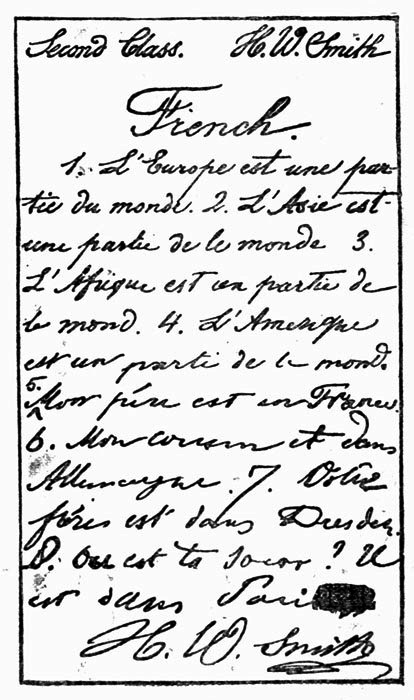
Children are very great at titles and inscriptions.
Give them a little penny pocket-book, and their keen sense of ownership will make them go straightway and write their name and address on the first page. When this is done, they will entitle the book, and write on the top of each page: "Memorandum Book."
When I was at school, we French boys used to draw, on the back of the cover of our books, a merry-Andrew and a gibbet, with the inscription:
"Aspice Pierrot pendu, Quod librum n'a pas rendu. Si librum redidisset, Pierrot pendu non fuisset."
I came across the following lines on some English boys' books:
"Don't steal this book for fear of shame, For here you see the owner's name; Or, when you die, the Lord will say: 'Where is that book you stole away?'"
Boys' minds are like a certain place not mentioned in geographies: they are paved with good intentions. Before they begin their work, they choose their best nib (which always takes some time). This done, they carefully write their name and the title of the exercise. French looks magnificent. They evidently mean to do well. The first sentence is generally right and well written. In the second you perceive signs of flagging; it then gets worse and worse till the end, which is not legible. Judge for yourself, here is a specimen. It collapses with a blot half licked off.
Master H. W. S.'s flourish after his signature is not, as you see, a masterpiece of calligraphy; but it is not intended to be so. It is simply an overflow of relief and happiness at the thought that his exercise is finished.
Translate the flourish by—
"Done!!!"
H. W. S. is not particularly lucky with his genders. Fortunately for him, the French language possesses no neuter nouns, so that sometimes he hits on the right gender. For this he asks no praise. Providence alone is to be thanked for it.
Once he had to translate: "His conduct was good." He first put sa conduite. After this effort in the right direction, his conscience was satisfied, and he added, était bon. Why? Because an adjective is longer in the feminine than in the masculine, and with him and his like the former gender stands very little chance.
I remember two very strange boys. They were not typical, I am happy to say.
When the first of them was on, his ears would flap and go on flapping like the gills of a fish, till he had either answered the question or given up trying, when they would lie at rest flat against his head. If I said to him sharply: "Well, my boy, speak up; I can't hear," his ears would start flapping more vigorously than ever. Sometimes he would turn his eyes right over, to see if he could not find the answer written somewhere inside his head. This boy could set the whole of his scalp in motion, bring his hair right down to his eyes, and send it back again without the least difficulty. These performances were simply wonderful. The boys used to watch him with an interest that never flagged, and more than once I was near losing my countenance.
One day this poor lad fell in the playground, and cut his head open. We were all anxious to ascertain what it was he had inside his head that he always wanted to get at. The doctor found nothing remarkable in it.
The other boy was a fearful stammerer. The manner in which he managed to get help for his speech is worth relating. Whenever he had to read a piece of French aloud, he would utter the letter "F" before each French word, and they would positively come out easily. The letter "F" being the most difficult letter for stammerers to pronounce, I always imagined that he thought he would be all right with any sound, if he could only say "F" first.
He was successful.
A boy with whom you find it somewhat difficult to get on is the diffident one who always believes that the question you ask him is a "catch." He is constantly on guard, and surrounds the easiest question with inextricable difficulties. It is his misfortune to know that rules have exceptions, and he never suspects that it would enter your head to ask him for the illustration of a general rule.
He knows, for instance, that nouns ending in al form their plural by changing al into aux; but if you ask him for the plural of général, he will hesitate a long while, and eventually answer you, générals.
"Do you mean to say, my boy, that you do not know how to form the plural of nouns in al?"
"Yes, sir, but I thought général was an exception."
I pass over the wit who, being asked for the plural of égal, answered, "two gals."
A diverting little boy in the class-room is the one who always thinks "he has got it." It matters little to him what the question is, he has not heard the end of it when he lifts his hand to let you know he is ready.
"What is the future of savoir?"
"Please, sir, I know: je savoirai."
"Sit down, you ignoramus."
And he resumes his seat to sulk until you give him another chance. He wonders how it is you don't like his answers. His manner is generally affable; you see at once in him a mother's pet who is much admired at home, and thinks he is not properly appreciated at school.
Mother's pets are to be recognized at a glance. They are always clean and tidy in face and person. Unfortunately they often part their hair in the middle.
Such is not the testimonial that can be given to young H. He spends an hour and a pint of ink over every exercise.
He writes very badly.
To obtain a firm hold of his pen, he grasps the nib with the ends of his five fingers. I sometimes think he must use his two hands at once. He plunges the whole into the inkstand every second or two, and withdraws it dripping. He is smeared with ink all over; he rubs his hands in it, he licks it, he loves it, he sniffs it, he revels in it. He wishes he could drink it, and the ink-stands were wide enough for him to get his fist right into it.
This boy is a most clever little fellow. When you can see his eyes, they are sparkling with mischief and intelligence. A beautiful, dirty face; a lovely boy, though an "unwashed."
A somewhat objectionable boy, although he is not responsible for his shortcomings, is the one who has been educated at home up to twelve or fourteen years of age.
Before you can garnish his brain, you have to sweep it. You have to replace the French of his nursery governess—who has acquired it on the Continong—by a serious knowledge of avoir and être.
He comes to school with a testimonial from his mother, who is a good French scholar, to the effect that he speaks French fluently.
You ask him for the French of
"It is twelve o'clock,"
and he answers with assurance:
"C'est douze heures."
You ask him next for the French of
"How do you do?"
and he tells you:
"Comment ça va-t-il?"
You call upon him to spell it, and he has no hesitation about it: "Comment savaty?"
You then test his knowledge of grammar by asking him the future of vouloir, and you immediately obtain: "Je voulerai."
You tell him that his French is very shaky, and you decide on putting him with the beginners.
The following day you find a letter awaiting you at school. It is from his indignant mother. She informs you that she fears her little boy will not learn much in the class you have put him in. He ought to be in one of the advanced classes. He has read Voltaire [4] and can speak French.
She knows he can, she heard him at Boulogne, and he got on very well. The natives there had no secrets for him; he could understand all they said.
You feel it to be your duty not to comply with the lady's wishes, and you have made a bitter enemy to yourself and the school.
This boy never takes for granted the truth of the statements you make in the class-room. What you say may be all right; but when he gets home he will ask his mamma if it is all true.
He is fond of arguing, and has no sympathy with his teacher. He tries to find him at fault.
A favorite remark of his is this:
"Please, sir, you said the other day that so-and-so was right. Why do you mark a mistake in my exercise to-day?"
You explain to him why he is wrong, and he goes back to his seat grumbling. He sees he is wrong; but he is not cured. He hopes to be more lucky next time.
When you meet his mother, she asks you what you think of the boy.
"A very nice boy indeed," you say; "only I sometimes wish he had more confidence in me; he is rather fond of arguing."
"Oh!" she exclaims, "I know that. Charley will never accept a statement before he has discussed it and thoroughly investigated it."
As a set-off for Charley, there is the boy who has a blind confidence in you. All you say is gospel to him, and if you were to tell him that the French word voisin is pronounced kramshaka, he would unhesitatingly say kramshaka.
Nothing astonishes him; he has taken for his motto the Nil admirari of Horace. He would see three circumflex accents on the top of a vowel without lifting his eyebrows. He is none of the inquiring and investigating sort.
Another specimen of the Charley type is the one who has been coached for the public school in a Preparatory School for the Sons of Gentlemen, kept by ladies.
This boy has always been well treated. He is fat, rubicund, and unruly. His linen is irreproachable. The ladies told him he was good-looking, and his hair, which he parts into two ailes de pigeon, is the subject of his incessant care.
He does not become "a man" until his comrades have bullied him into a good game of Rugby football.
On the last bench, right in the corner, you can see young Bully. He does not seek after light, he is not an ambitious boy, and the less notice you take of him the better he is pleased. His father says he is a backward boy. Bully is older and taller than the rest of the class. For form's sake you are obliged to request him to bring his work, but you have long ago given up all hope of ever teaching him any thing. He is quiet and unpretending in class, and too sleepy to be up to mischief. He trusts that if he does not disturb your peace you will not disturb his. When a little boy gives you a good answer, it arouses his scorn, and he not uncommonly throws at him a little smile of congratulation. If you were not a good disciplinarian, he would go and give him a pat on the back, but this he dares not do.
When you bid him stand up and answer a question, he begins by leaning on his desk. Then he gently lifts his hinder part, and by slow degrees succeeds in getting up the whole mass. He hopes that by this time you will have passed him and asked another boy to give you the answer. He is not jealous, and will bear no ill-will to the boy who gives you a satisfactory reply.
If you insist on his standing up and giving sign of life, he frowns, loosens his collar, which seems to choke him, looks at the floor, then at the ceiling, then at you. Being unable to utter a sound, he frowns more, to make you believe that he is very dissatisfied with himself.
"I know the answer," he seems to say; "how funny, I can't recollect it just now."
As you cannot waste any more time about him, you pass him; a ray of satisfaction flashes over his face, and he resumes his corner hoping for peace.
The little boys dare not laugh at him, for he is the terror of the playground, where he takes his revenge of the class-room.
His favorite pastime in the playground is to teach little boys how to play marbles. They bring the marbles, he brings his experience. When the bell rings to call the boys to the class-rooms, he has got many marbles, the boys a little experience.
One of my pet aversions is the young boy who arrays [5] himself in stand-up collars and white merino cravats.
George Eliot, I believe, says somewhere that there never was brain inside a red-haired head. I think she was mistaken. I have known very clever boys with red hair.
But what I am positive about is that there is no brain on the top of boys ornamented with stand-up collars.
Young Bully wears them. He comes to school with his stick, and whenever you want a match to light the gas with he can always supply you, and feels happy he is able for once to oblige you.
In some boys I have often deplored the presence of two ears. What you impart through one immediately escapes through the other. Explain to them a rule once a week, they will always enjoy hearing it again. It will always be new to them. Their lives will ever be a series of enchantments and surprises.
You must persevere, and repeat things to them a hundred times, if ninety-nine will not do. Who knows there is not a John Wesley among them?
"I remember," once said this celebrated divine, "hearing my father say to my mother: 'How could you have the patience to tell that blockhead the same thing twenty times over?' 'Why,' said she, 'if I had told him only nineteen times, I should have lost all my labor.'"
I am not sure that the boy with only one ear is not still more tiresome. He always turns his deaf ear to you, and makes his little infirmity pay. "He is afraid he did not quite hear you, when you set the work yesterday." For my part, I met the difficulty by having desks placed each side of my chair. On my left I had the boys who had good right ears; on my right, those who had good left ones.
I can not say I ever saw many signs of gratitude in boys for this solicitude of mine in their behalf.
At dictation time the two-eared boy is terrible, and you need all the self-control you have acquired on the English shores to keep your head cool.
Before beginning, you warn him that a mute e, or an s, placed at the end of a vowel, gives a long sound to that vowel, that ie is long in jolie, and i is short in joli; that ais is long in je serais, and ai is short in je serai.
Satisfied that he is well prepared, you start with your best voice:
"Je serais...."
The boy looks at you. Is he to write je serais or je serai?
To settle his undecided mind, you repeat:
"Je serais,"
and you may lay great emphasis on ais, bleating for thirty seconds like a sheep in distress.
He writes something down at last. You go and see the result of your efforts. He has written
"Je serai."
Drat the boy!
Next time you dictate a word ending in ais, he won't be caught again.
He leaves a blank or makes a blot.
You must never take it for granted that you have given this boy all the explanations he requires to get on with his work. You will always find that there is something you have omitted to tell him.
He is not hopelessly stupid, he personifies the vis inertiæ; he is indifferent, and takes but one step at a time.
He will tell you he did not know that there were notes at the end of his French text-books. When he knows that there are such notes, he will inform you next time that you did not tell him he was to look at them.
He sees things, but at first he does not know what they are for unless they are labelled, and he will ignore the use of a chair if you do not point out the flat part of this piece of furniture, or better still, touch it, saying, "Chair—to sit upon."
The following are bits of conversation you will have with him in the class-room:
"How is it you have no copy to give me?"
"I thought we only had to prepare the piece."
Of course you know what it means when a boy tells you he has "prepared" his work, but has not written it down. So you tell him he is to bring a copy next time. He does, for he is most anxious to do as he is told.
When you ask him to give you the translation of the piece viva voce, he tells you:
"Please, sir, you did not tell us we were to learn the piece."
"But, my boy, don't you understand that you are doing a piece of French twice a week in order to learn the language?"
He never thought of that. He had to write out the translation of a piece of French, and he has done it. He did not know he had to draw such bewildering conclusions as you have just mentioned.
He does as he is told, and he marvels you do not consider him a model of a boy.
If he were placed at the door of the reading-room of the British Museum, with orders to inform people that they must take their umbrellas or sticks to the cloak-room, he would carry out the intentions of the librarians with a vengeance.
"Take your stick or your umbrella to the cloak-room," he would say to the first person presenting himself at the door.
"But I have not got either," might reply the visitor.
"That's no business of mine; go and fetch them," he would naturally suggest.
He can grasp but one idea at a time, and this one idea does not lead to another in his mind. There it remains like the buried talent.
Master Whirligig is a light-headed boy. It requires very little to entertain him. The falling of a book, a cough, a sneeze, an organ in the street, will send him into fits of hilarity behind his pocket-handkerchief, and when the school breaks up for the Midsummer holidays, he will be able to tell you the exact number of flies that passed through the class-room during the term.
He is never still for a moment. Always on the look-out for fresh events, he is the nearest approach to perpetual motion yet discovered.
The cracks in this boy's cranium may be explained physiologically. Matter subjected to constant motion gets heated, as we all know. Now young Whirligig's skull is but scantily furnished with brain matter, and it would be wise of him to keep it still. This he seems to be incapable of doing. He is for ever jerking and shaking it, churning the contents in fact. The churn heated, hot vapors are generated; they expand, the pressure is too great, they must escape—they force an outlet—hence the cracks.—Q.E.D.
If you want to see the good average English schoolboy in all his glory, make him write out a rule of French grammar, and tell him to illustrate it with an example.
Nine times out of ten his example will illustrate the contrary to the rule.
He has heard over and over again, for instance, that a French past participle, conjugated with the auxiliary avoir, sometimes agrees with its direct object and sometimes does not. This he thinks very hard upon him. Funny temper these past participles have! You never know when they will agree. It is not fair, now, is it? By consulting his grammar, he would be enabled to satisfy his master. But he does not do that. He trusts to his luck, and has a shot. After all, his chance is 50 per cent. He generally fails to hit.
Is he not a most unlucky little creature?
Ask this boy to give you the French for "this woman is good," he will answer you: "Bonne est cette femme." He has heard that bon was one of those few adjectives that have to be placed before the noun, and that is very unfair to him, isn't it?
If you set an exercise to English boys, to be written out on the spot, they all set off quickly, the question being, as they look at one another:
"Who shall have finished first?"
This I hold to be due to the influence of athletics.
"Please, sir, I've done!" will exclaim the winner triumphantly, as he looks at the rest of the class still busy scratching their paper.
You generally like to know what boys intend to be, in order to direct your attention more specially to the subjects they will require to be grounded in for such or such an examination.
Most boys from twelve to fourteen years old will tell you "they do not know," when you ask them what they will be. Many of them are undecided, many indifferent; some are shy, and afraid you will think it conceited of them to believe they are fit to be one day doctors, officers, barristers, clergymen, etc.
A few answer "I don't know," on the tune of "What is that to you?"
As it is always impolitic to take more interest in people than they do themselves, you do not insist.
Once I asked a nice and clever little boy what he wanted to be.
This little boy's papa was at the time enjoying the well-salaried far niente of a chaplaincy attached to an old philanthropical institution that had not had any inmates for many years past.
"Please, sir, I want to be like papa," he answered, ingenuously.
My young friend T. had no taste for languages, except, perhaps, bad language, if I am to believe certain rumors of a punishment inflicted upon him by the head-master not long ago.
He prepares for the army, but I doubt whether he will succeed in entering it, unless he enlists. I regret it for her Majesty's sake, for he would make a capital soldier. He is a first-rate athlete, resolute, strong, and fearless. He would never aim at becoming a field-marshal, and I hold that his qualities ought to weigh in an examination for the army as much as a little Latin and Greek.
I never heard of great generals being particularly good at Latin, except Julius Cæsar, who wrote his Commentaries on the Gallic Wars in that language, and without a dictionary, they say.
My young friend is the kind of boy who, in the army, would be sure to render great service to his country; for, whether he killed England's enemy or England's enemy killed him, it would eventually be for the good of England.
Ah! now, who is that square-headed boy, sitting on the second form near the window? He looks dull; he does not join in the games, and seldom speaks to a school-fellow. He comes to school on business, to get as much as he can for his money.
He is not brilliant, but steady-going; he is improving slowly but surely. He goes on his jog-trot way, and always succeeds in being placed among the first twelve boys of the class. He is what is called a "respectable person."
He never smiles, and you would think he had on his shoulders the responsibility of the management of the London and Westminster Bank.
His books are carefully covered in brown paper or American cloth. He writes rough copies on the backs of old exercises, and wipes his pen when he has finished his work. He buys his books second-hand in Holywell Street, [6] and when he has finished with them they have the same market value as when he bought them.
He lends old nibs and half-sheets of paper, and requires the borrower to give him back new nibs and foolscap sheets.
He studies French with all the energy he is capable of, because his father has told him that, with a good knowledge of French, he will command a good salary in the City.
You ask him what he will be, and he answers you:
"In business."
This boy will be a successful man—a lord-mayor, perhaps.
I can not take leave of the class-room without mentioning the boy who is proud of his name.
"What is your name, my boy?"
"Algernon Cadwaladr Smyth."
"Oh! your name is Smith, is it?"
"No, sir; my name is Cadwaladr Smyth."
"You spell your name S-m-i-t-h, don't you?"
"No, sir; S-m-y-t-h," he answers, almost indignantly.
Dear boy! he is as proud of the y of his name as a Howard is of his ancestors—although I am not quite sure the Howards ought to be very proud of their name, seeing that it is but a corruption of Hog-ward.
I always thought it was somewhat hard on a boy to have to go through life labeled Cadwaladr; but, as I have remarked elsewhere, in England there is nothing to prevent parents from dubbing their offsprings Bayard, Bertrand du Guesclin—or, for that matter, Nebuchadnezzar.
[2] "The Old Curiosity Shop."
[3] Here I have to make a painful confession. I have actually acceded to a request from my American publishers, men wholly destitute of humor, to supply the reader with a translation of the few French sentences used in this little volume. This monument of my weakness will be found at the end.
[4] Poor little chap!
[5] Being a little bit of a philologist, I assume this verb comes from the common (very common) noun, 'Arry.
[6] A street in London where Jews sell second-hand books.
VI.
French as She is Traduced. — More Grumbling. — "La Critique" is Not the Critic's Wife. — Bossuet's Prose and how it Reads in English. — Nothing Improves by Translation except a Bishop. — A Few French "Howlers." — Valuable Hints on Translating Unseen Passages.
English boys have invented a special kind of English language for French translation.
It is not the English they use with their classical and other masters; it is not the English they use at home with their parents, or at school with their comrades; it is a special article kept for the sole benefit of their French masters.
The good genus boy will translate oui, mon père, by "yes, my father," as if it were possible for him to forget that he calls his papa father, and not my father, when he addresses him.
He very seldom reads over his translation to ascertain that it reads like English; but when he does, and is not perfectly satisfied with the result, he lays the blame on the French original. After all, it is not his fault if there is no sense in the French, and he brings a certain number of English dictionary words placed one after the other, the whole entitled French.
Of course he can not call it English, and he dares not call it Nonsense.
He calls it French, and relieves his conscience.
It will take boys long to understand that la trompette, la médecine, la marine, la statuaire, are not respectively the wives of le trompette, le médecin, le marin, le statuaire.
An honest little boy once translated "La critique doit être bonne fille" by "The critic's wife ought to be a good girl."
Poor little fellow! it is most probable that no dictionary within his reach would have explained to him that the expression bonne fille meant "good-humored."
O Bossuet, veil thy face!
The finest piece of French prose in existence is undoubtedly the following sentence, taken from Bossuet's funeral oration on the Great Condé:
"Restait cette redoutable infanterie de l'armée d'Espagne, dont les gros bataillons serrés, semblables à autant de tours, mais à des tours qui sauraient réparer leurs brèches, demeuraient inébranlables au milieu de tout le reste en déroute, et lançaient des feux de toutes parts."
This reads like a chant of Homer, does it not? It reads quite differently in boys' translations, I assure you, when you come to "towers that would be able to mend their breaches."
This confirms you in your belief that nothing improves by translation—except a bishop.
From my little collection of what is called in the scholastic profession "Howlers," I extract the following, with my apologies to their perpetrators.
La fille de feu ma bonne et estimée cousine est toujours la bienvenue, "My good and esteemed cousin, the daughter of fire, is always welcome."
Mon frère a tort et ma sœur a raison, "My brother has some tart and my sister has some raisins."
Elle partit dans la matinée du lendemain, "She took part in the morning performance of legerdemain."
This is a specimen of German geist perpetrated by a candidate to our scholarships, and a young subject of his Venerable Majesty Emperor William.
Honor to whom honor is due.
When I said that boys do not look at the notes given at the end of their text-books, it was nothing short of a libel, as two cases following will prove.
Diable! c'est qu'il est capricieux, le bonhomme!
A boy looked at a note on this phrase, and found: "capricieux, akin to Latin capra (a goat)." Next day, he brought his translation, which ran thus:
"The good man is devilishly like a goat."
The next two "howlers" were indulged in by my boys, as we were reading Jules Sandeau's Mademoiselle de la Seiglière.
The Baroness de Vaubert says to the Marquis de la Seiglière: "Calmez-vous."
A boy having translated this by "Calm yourself," I observed to him:
"Couldn't you give me something more colloquial?"
Boy, after a moment's reflection:
"Keep your hair on, old man."
Je laisse Renaud dans les jardins d'Armida, "I leave this fox in the gardens of Armida," and, between brackets, the following explanatory statement:
("Jerusalem delivered Tasso in the hands of an enchantress named Armida.") [7]
Chaque âge a ses plaisirs was translated by a nice little boy, "Every one grows old for his preserves."
(Evidently written after a surfeit of jam.)
The vagaries of my young friends are thrown into the shade by some achievements of professional translators which I have come across in America. A French master may occasionally enjoy the drolleries that a magnificent disdain for dictionary trammels and a violent yearning towards the playground will betray his pupil into; but I imagine that a publisher, who pays in hard cash for the faithful translation of a French book, can scarcely be pleased to find that the work has been interlarded with mirth-provoking blunders thrown in gratis.
I extract the two following examples of "French as she is traduced" from the translation of one of my books that the American pirates did me the honor to publish:
Les exploits d'Hercule sont de la Saint Jean auprès de..., "The exploits of Hercules are but of the St. John order compared to...."
Monsieur, ne vous retournez pas, "Sir, do not return yourself."
But to return to John Bull, junior.
I pass young worthies who translate "I have never read any thing by Molière" by "Je n'ai pas jamais lit quelque chose par Molière," on the ground that "it is so in English." This "French" sentence was, by-the-bye, the first essay on Molière I received at the hands of the English boys.
Some little fellows, trusting their sense of sight, have the objectionable habit of writing the translation of a text before looking at it, at all events before seeing it.