FRENCH AS SHE IS TRADUCED (continued 2)
Reading edition
Result: "Il raccommodait les vieux souliers"—"He recommended the old soldiers."
A clever boy, whilst reading a comedy at first sight, translated "Eglantine (baissant les yeux)" by "Eglantine (kissing his eyes)."
You naughty boy!

I once read the following sound advice given in the preface of a French Translation book:
"Hints on Translating Unseen Passages."
"1. Read the passage carefully through, at least twice."
"2. Keep as closely as possible to the original in sense, but use English idiom boldly."
"3. Never write down nonsense."
Now, and whilst I think of it, why unseen?
It may be that I do not perceive the niceties of the English language, but this commonly used word, "unseen," never conveyed any meaning to my mind. Would not "unforeseen" be a better word? I would timidly suggest.
If the book in question succeeded in making boys carry out the foregoing suggestions, it would be worth its weight in gold.
As far as my experience goes, the only hint which I have known them follow is the one that tells them to use English idiom boldly.
A drawback to these hints is that they are given in the preface. Now, dear colleagues and confrères, which of you has ever known a school-boy read the preface of his book?
[7] I reproduce the note which had "helped" the boy: ["Renaud dans les jardins d'Armida," the enchanted gardens of Armida ("Jerusalem Delivered," Tasso), figuratively, in the hands of an enchantress.]
VII.
English Boys on French Etymologies. — Why "Silence" is the only French Noun, ending in "ence," that is of the masculine gender. — A Valuable Service rendered by the Author to his Land of Adoption. — Learned Etymologies. — Return to Old Philological Methods. — Remarkable Questions. — Written and Oral Examinations. — A Kind Examiner. — How Long would it take the Moon to Fall to the Earth? — How Many Yards of Cloth it takes to Cover an Ass. — I Examine in German.
French boys, and only of late, are made to go through a course of French philology during their last two years at school; but English school-boys, who are seldom taught to speak French, and who would find it just as difficult to make themselves understood in Paris as they would in Pekin, are made to study the "rudiments" of French philology, that is to say, the origin of words they are unable to put together so as to make French sentences of them.
I might take this opportunity for discussing whether English school-boys should not leave alone all this nonsense, and devote the little spare time they have to learning how to put French words together with a decent pronunciation; but I have promised myself to discuss nothing in this little volume of personal recollections, and I will keep my word.
After all, what Englishmen want to be able to do is to write a letter in French, and to ask for a steak or a mutton-chop in a French restaurant, without having to low or bleat to make the waiter understand that it is beef or mutton they want.
I did not go to England to make reforms; I accept things as I see them, and I generally wait to give my advice until I am asked for it.
So French philology is taught. A hundred exercises, which I have under my eyes, show me the results of the philological teaching of French in England.
For once—now for once only, let me make a boast.
Small as I am, I have rendered a valuable service to the land of my adoption. Yes, a service to England, nothing short of that.
For over fifteen years, the French examiners in the University of London invariably every year asked the candidates for Matriculation the following question—I had almost said riddle:
"Which is the only French substantive ending in ence that is of the masculine gender, and why?"
You may picture to yourself the unhappy candidates, scratching their heads, and going, in their minds, through the forty and some thousand words which make up the French vocabulary.
Those only who were "in the know" could answer that the famous word was silence, as it came from the Latin neuter noun silentium, the other French nouns ending in ence (from Latin feminine nouns in entia) being feminine.
"Well," I said one day to the examiner, an eminent confrère and friend, "don't you think you make the candidates waste a good deal of their valuable time, and that it would be better to ask them the question (if you must ask it) in a straightforward manner?"
He thought I was right, and for two years more the question was asked again, but in the following improved manner:
"Explain why silence is the only French noun, ending in ence, that is of the masculine gender."
This was sensible, and I hoped the examiner would for a long time to come be in smooth water.
The gods willed it otherwise.
One morning he came to me in a great state of excitement.
"I am furious!" he said. "I believe one of the candidates has been laughing at me."
"You don't say so!" I remarked.
"I believe so," he continued, whilst untying a bundle of papers. "Now look at this," he cried, handing me a copy; "have you ever seen such impudence?"
I looked, but could make nothing out of it.
"What's the matter?" I inquired.
"Well, I asked the candidates the question about the gender of silence."
"I know, the famous question, eh?"
"Never mind that. See the answer one of them gives me," and he pointed it out to me. It ran thus:
"Silence is the only French noun, ending in ence, that is masculine, because it is the only thing women can not keep."
Tears of sympathy for the boy trickled down my cheeks; I thought it was lovely.
"Well," I said, when I had recovered, "it serves you right."
"I will plough that boy!" he ejaculated.
"No, you won't do that," I said. "How did he do the rest of the paper?"
"Very well, indeed; the impudent scamp is a clever fellow."
"And a wit," I added; "you must not plough him."
I never knew the fate of that boy, although I believe I saved him.
But what I do know is that never, never since, has the question found place in the Matriculation papers of the University of London.
A boy, having to give the etymology of the French word dimanche, and explain why "book" and "pound" are expressed by the same French word livre, perpetrated the following:
"Dimanche is a compound word, formed from di (twice), and manche (to eat), because you take two meals on that day (Sunday)." [8]
"Livre stands for 'book' as well as for 'pound,' because the accounts of 'pounds' are kept in 'books.'"
It was the same boy who, being asked for the meaning of cordon bleu, answered "a teetotaler."
A young Briton, having to derive the French word tropique, wrote:
"This word comes from trop (too much), and ique (from Latin hic which means here), with the word heat understood, that is to say: Tropique, it is too hot here."
Another boy, with a great deal of imagination and power of deduction, having to give the derivation of the French word cheval, wrote the following essay:
"Cheval comes from the Latin equus. The letter u was written v, which gave
equus = eqvus = quevus.
"This word became quevalus, which finally gave cheval."
We might exclaim with d'Aceilly:
"Cheval vient d'equus, sans doute; Mais il faut convenir aussi Qu'à venir de là jusqu'ici, Il a bien changé sur la route." [9]
This boy's method is, after all, a return to the old methods. If we consult Ménage's Etymological Dictionary, we see that he easily derives rat from mus, and haricot from faba, to take only two instances of the method.
"The Latin mus," he says, "became muratus, and then ratus, which gave us rat."
He deals no less successfully with haricot, viz:
"The Latin faba became by corruption fabaricus, which altered into fabaricotus, and finally into aricotus, which gave us haricot."
After this we may appreciate Voltaire's remark that "philologists take no account of vowels, and very little notice of consonants."
Nor do boys.
If the answers given by candidates at examinations are often remarkable, the questions asked by the examiners are often more wonderful still. Here are a few which have been seriously asked, and—proh pudor!—published:
"Define, with reference to passages in the Lettres Provinciales, 'grâce suffisante,' 'grâce efficace,' 'grâce actuelle,' 'casuisme,' 'pouvoir prochain,' 'probabilisme.' Also explain what is meant by 'casuistry.' What can be said in its defence?"
"Give some account of Escobar."
"What are the principal differences between the Latin and the French languages?"
Well might an eminent confrère exclaim one day:
"Is not all this printed and published to discourage the study of French?"
I once heard an examiner ask a dear little fellow, aged eleven, the following poser:
"Give me the derivations of all the words of the French sentence you have just read aloud."
Poor little boy! He took the examiner for a wonderful man.
So he was.
English examinations consist of so many papers to be taken up; the "viva voce" does not play an important part in England, as it does in France.
A "viva voce" examination very often gives the examiner a better idea of the candidate's abilities and knowledge than a written one, but it has many drawbacks. It favors babblers and the self-assured, and does not enable the timid to show themselves at their best.
The more learned the examiner, the more kind and indulgent is he to the candidates.
Sainte-Claire Deville, the famous French chemist, had to be declined by the authorities at the Sorbonne as an examiner, because he used to answer his questions himself to save the candidates trouble.
"How do you prepare oxygen?" he would ask. "By heating chlorate of potash, don't you?"
"Yes, sir."
"You place the chlorate of potash in a thin glass flask, don't you?"
"Yes, sir."
"Now a small quantity of manganese bi-oxide, mixed with the chlorate of potash, enables you to obtain the oxygen at a much lower temperature, does it not?"
"Yes, sir."
"Very good—now, another question."
And so forth.
On the other hand, there are examiners who make it a rule to bully the candidates, or, worse still, to snub them. They will ask preposterous questions with the mere object of disconcerting them.
"How long would it take the moon to fall to the earth?" I once heard an examiner ask a candidate to the baccalauréat ès-sciences.
A facetious examiner once got his due from a young Parisian candidate.
After asking him a few "catches," and obtaining no answers he suddenly said to him:
"Do you know how much cloth would be required to cover an ass?"
"I do not, sir," replied the lad, "but if you are anxious to know, I will ask your tailor."
The audience laughed heartily, and the examiner, seeing that this time the laughter was not on his side, congratulated the boy on his wit, and immediately asked him a few sensible questions, which were answered respectfully, and proved that the candidate had his subjects as ready as his wit.
I was once asked to examine the French and German classes of an important English school.
I wrote to "my lords and gentlemen," saying that my knowledge of German was not such as to enable me to find fault with other people's.
The governors answered that it did not matter, and I was directed to proceed to the Examination.
I got over the difficulty by sharing the work and the fees with an able German, who prepared the questions and corrected the copies.
[8] Dear boy! he probably was a weekly boarder, and the Sunday fare at home had left sweet recollections in his mind. This beats Swift's etymology of "cucumber," which he once gave at a dinner of the Philological Society: "King Jeremiah, Jeremiah King, Jerkin, Gherkin, Cucumber."
[9] "'Cheval' comes from 'equus' no doubt; but it must be confessed that, to come to us in that state, it has sadly altered on the way."
VIII.
English Boys on French Composition. — "Go Ahead" is not in French "Allez une Tete." — How Boys Set about French Composition. — A Written Proof of their Guilt. — How Large Advertisements can Help Them. — A Stumbling-block cleared away.
You have achieved a great success when you have succeeded in getting into young boys' heads that French is not English replaced by equivalent words to be found in a dictionary.
This is the way boys generally set about writing a piece of English into French.
They take the first English word, open their dictionary, and put down the French word they have found for it (the wrong one, as a rule, if more than one is given). Then they take the second English word, to which they apply the same process, until they come to a stop, which they carefully reproduce in the French (many don't). This done, they take their blotting-paper, apply it on the copy, rub it hard for a minute or two, and knock off to enjoy a well-deserved rest.
The amount of blotting-paper used by boys is prodigious. A word is no sooner written down than it is fixed on the paper by a good hearty rubbing down. They are afraid it will evaporate if not properly secured on the paper at once.
Suppose your young pupils have to put into French "I give you."
They will first write je, then donne. After the English word "you," they are referred to a note. They look at this note (many don't), and see that they must put the pronoun vous before the verb. They do so between the lines, and thus write down the proof of their iniquity:
vous "je ^ donne."
Although the boys use their eyes to look at things, there are few who use them to see.
Young S. was an exception.
Having to put into French, "No sovereign ever was more worthy," he brought me:
"Jamais souverain ne fut plus digne."
I congratulated him on his achievement, and as I was suspicious he had been helped at home I asked him how he came to write this. He then said to me that on his way home he had seen in the station a large advertisement of a tooth-paste maker. The advertisement consisted of a huge woman's head, showing two rows of beautiful teeth, with this inscription:
"Avec de belles dents jamais femme ne fut laide."
He had come to the conclusion that this French phrase could help him, and he took it down at the station.
This young Briton has a great future before him.
A boy having to translate "I have gone out," begins by writing "j'ai." That is understood. When afterwards he finds that the verb sortir is conjugated with the auxiliary être, he changes j'ai into je suis. Nine times out of ten he trusts his memory, or rather he leaves it to chance, and he keeps j'ai.
French books are loaded with facts, but few with explanations.
All the French grammars I know publish the list of the neuter verbs that are conjugated with the auxiliary être, but none give boys the reason why these verbs are conjugated with être and not with avoir. Boys learn this list of verbs and forget it, and you know little of boys' nature if you imagine that they will consult their grammar at every turn. Some do, to be sure, but how many?
I do not know of one French grammar that tells students that neuter verbs, which express a state as well as an action, or rather that neuter verbs which express that a state is enjoyed as soon as the action is over, are conjugated with être.
A boy will understand you, and remember what you say, if you tell him:
"As soon as you have died, you are dead. This is why the verb mourir, expressing the state of being dead, as soon as the action of dying is over, has to be conjugated with être."
"As soon as you have arrived, you are arrived."
"As soon as you have been born, you are born."
"Therefore all these verbs arriver, naître, venir, sortir, partir, etc., are conjugated with être."
"By this reasoning, with courir (to run) you get an absurdity. 'As soon as you have run you are run' is an absurdity. Therefore courir, expressing only an action, not a state, takes avoir."
Yes, boys will understand all that, and nothing gives them more pleasure than having their minds satisfied with a little explanatory food. I have seen rays of happy satisfaction flashing over scores of young faces as they got hold of these facts.
For the same reason, reflexive verbs are conjugated with être, because they also express that a state is enjoyed as soon as the action is over.
"As soon as you have washed yourself you are washed—if you have done it properly, of course."
Tell the boys so, and they will laugh, and they will understand you, and they will be grateful to you.
I could give hundreds of instances in which a few explanatory words would settle grammatical facts in boys' minds; but, although I am tempted at almost every page to turn this book into a class—book, I must bear in mind that my aim is not to instruct, and pass on.
IX.
How to be Happy though a school-master. — Suggestions and Hints for the Class-room. — Boys on History and Geography. — "Maxims" and "Wise Thoughts." — Advice to Those About to Teach. — "Sir," and not "Mossoo." — "Frauleins" and "Mademoiselles." — "Check" your Love for Boys. — No Credit. — We are all Liable to Make Mistakes. — I Get an Insight into "Stocks."
I know masters who spend their time looking at their books with their heads downwards, and who only occasionally lift them up to say to a boisterous class:
"Now then, now then!"
They might as well tell the boys: "Just take a minute's rest, my dears, will you? In a moment I shall be looking at my desk again, then you will be able to go on."
Face the boys, or you will be nowhere.
Always be lively. If you once let the boys go to sleep, you will never wake them up again.
Always look the same in face and person. Your moustache curtailed, your whiskers shaved, or the usual shape of your coat altered, will cause a revolution in your class.
Never show your temper if you have one, and keep the changes of your temperature for the benefit of your wife and family. If you once show your boys that they have enough power to disturb your equilibrium and interfere with your happiness, it is for them a victory, the results of which they will always make you feel.
If you are annoyed by a boy constantly chatting with his neighbors, see if he has a brother in the class. If he has, place them side by side, and peace will be restored. Brothers will sometimes quarrel in class, but have a quiet chat together, never.
Never overpraise clever boys, or they will never do another stroke of work. Never snub the dull ones; you don't know that it is not out of modesty that they will not shine over their schoolfellows.
Never ask young English public schoolboys any questions on history that may be suggested to you by the proper names you will come across in the text. Their knowledge of history [10] does not go much beyond the certainty that Shakespeare was not a great Roman warrior, although his connection with Julius Cæsar, Antony, and Coriolanus keep a good many still undecided as to the times he lived in.
Ask them under whose reign Ben Jonson flourished, and you will be presented by them with a general survey of English history from the Norman Conquest to the reign of Her Most Gracious Majesty Queen Victoria. A good many will also take the opportunity of making a show of their knowledge of literary history (the temptation is irresistible), and add that he was a great man who wrote a good dictionary, and was once kept waiting for a long time in Lord Chesterfield's antechamber, "which he did not like." Boys are generally good at historical anecdotes, a remnant of their early training.
We once had to put into French the following sentence:
"Frederick the Great of Prussia had the portrait of the young Emperor in every room of his Sans-Souci Palace, and being asked the reason why he thus honored the portrait of his greatest enemy, answered that the Emperor was a busy, enterprising young monarch, and that he found it necessary always to have an eye upon him."
I asked the class who this Emperor was that Frederick the Great seemed to fear so much, and I obtained many answers, including Alexander the Great and most well-known imperial rulers down to Napoleon the First; but not one named Joseph II. of Austria.
Another time we were translating a piece of Massillon, taken from his celebrated Petit Carême.
When we came to the following passage, in his sermon on Flattery: "The Lord," once said the holy King, "shall cut off all flattering lips, and the tongue that speaketh proud things," I asked the boys, who, by-the-bye, were referred in the notes to Psalm xii. 3, who was this holy King mentioned by Massillon?
The first answer was "Charles I." The second was "Saint Louis," and I should not probably have received the proper answer if I had not expressed my astonishment at finding that nobody in the class seemed to know who wrote the Psalms.
Even after this remark of mine, many boys remained silent; but at last one timidly suggested "David."
He did not seem to be quite sure.
"This," I thought to myself at the time, "is hardly an encouragement to make children read the Bible twice a day from the time they can spell."
The knowledge of geography is not more widespread than the knowledge of history among these same boys. So, if you have no time to waste don't ask them where places are.
They know where England is; they know more or less precisely the position of India, Canada, Australia, New Zealand, the Cape of Good Hope, and such other spots of the earth as are marked in red on the maps published in England.
France, Russia, Germany, Austria, Italy, Spain, Turkey, they could after a few hesitations find out on the map of Europe, but as they are not marked in red, their patriotism prevents them from taking any more interest in these countries.
France, however, is rather interesting to them as being a part of the globe in which the French irregular verbs come by nature.
Never expect any thanks for all the trouble you have taken over your pupils.
When boys succeed in their examinations, it is owing to their intelligence and industry; when they fail, it is owing to the bad teaching of their masters. Boys can do no wrong; get this well engraven on your minds.
When a boy laughs at a mistake made by a schoolfellow, do not believe that he does so out of contempt, and that he knows better. Ask him for the answer immediately, and he will be as quiet as you please.
If you observe him a little, you will see that he never begins to laugh before you have declared the answer of his schoolfellow to be wrong; he would never know himself.
I always carefully prepared the piece of French that my pupils had to translate, in order to be ready with all the questions suggested to me by the text; but I never prepared composition: I preferred working it in class with them, so as to show them that scores of French sentences properly rendered an English one. I think it is a mistake to impose one rendering of an English sentence. Anybody can do this—with a key.
Be not solemn in class, nor aim at astonishing the boys with your eloquence.
To look at their staring eyes and gaping mouths, you may perhaps imagine that they are lost in ecstatic admiration. Look again, they are all yawning.
When you have made the personal acquaintance of the boys who are to make up a class during the term, you can easily assign to them seats that will not perhaps please them, but which will insure peace. A quiet boy placed between two noisy chatterboxes, or a chatterbox placed between two solemn boys, will go a long way towards securing your comfort and happiness. The easiest class-room to manage is the one furnished with separate desks. Then you may easily carry the government on the old principle of Divide et regna.
If you see a boy put his hand before his mouth whilst he is talking, snub him hard for it. Tell him that, when you were a boy and wanted to have a quiet chat with a neighbor, you were not so silly as to thus draw the master's attention and get your little conversation disturbed.
We are none of us infallible, not even the youngest of us, as the late Master of Trinity College, Cambridge, once wittily remarked.
Never be tired of asking for advice; you will become a good school-master only on condition that you will take constant advice from the old stagers.
If, however, you should discover that, in the middle of your lesson, your pupils are all sound asleep, don't go and tell the head-master, and ask him how you should set about keeping them awake. This is beyond his advice.
The General commanding a French military school had once decided upon having a lecture on Hygiene given to the pupils on Monday afternoons. The day was badly chosen. A French Sunday always means for a French boy a little dissipation in the shape of a good dinner at home or with friends, and on Monday afternoons we generally felt ready for a little doze, if the lecture was in the least prosy.
The lecturer, tired of addressing sleeping audiences, lodged a complaint with the General, and asked that his lecture should henceforth take place on another day of the week.
This could not be arranged, but the General soon decided upon a plan to set matters to rights.
"I will place a basof [11] in the room," he said; "he will take down the names of all those who go to sleep, and I shall have them kept in on the following Sunday."
When the lecturer made his next appearance, followed by the basof, we thought it would be prudent to listen, and the lesson passed off without accident.
The following Monday, however, the poor lecturer had not proceeded very far, when he discovered that we were all asleep—and that so was the basof.
Of course the General inflicted a severe punishment upon us, and also upon the offending Cerberus.
Moral.—I believe that, if a lecturer or a master had gone to complain to an English head-master that all his pupils went to sleep whilst he lectured, the head-master would have answered him:
"My dear sir, if your lecture sends your audience to sleep, it is your fault, not mine, and I don't see how I can help you."
And the sooner the man sent in his resignation, the better for the comfort of all concerned.
If you are a Frenchman, never allow your boys to call you Mossoo, Myshoo, Mounzeer, or any other British adaptation of Monsieur. If you do, you may just as well allow them to pat you on the back and call you "Old chappie." They should call you "Sir," otherwise you will lose your footing and fail to be the colleague of the English masters. You will only be the Mossoo of the place, something, in the world, like the Mademoiselle (from Paris), or the Fraulein (from Hanover), of the Establishment for Young Ladies round the corner.
All the Frauleins come from Hanover, as all the Mademoiselles are Parisian and Protestants, if I am to believe the column of scholastic advertisements in the English newspapers.
This is wonderful, is it not?
If you set any value on your reputation and your time, never carry the interest which you naturally take in your pupils the length of inviting them to come to your house to receive extra teaching at your hands, unless it be as a means of improving your revenue.
I once determined to devote all my Saturday evenings to two young fellows whom I was anxious to pass through the Indian Civil Service examination. I thus worked with them five months. Their fathers were men of position. I never received so much as a post-card of thanks from them. If I had charged them a guinea for each visit, I should have received two checks with "many thanks for my valuable services," which would have benefited my banking account and given satisfaction to my professional vanity.
I have since "checked" my love for boys.
Shun interviews with parents, mothers especially, as you would the plague. Leave this privilege to the head-master, who is paid handsomely for these little drawbacks to his position. If they invite you to dinner, do not fall into the snare, but remember that a previous engagement prevents you from having the pleasure of accepting their kind invitation. Never enter into correspondence with them on the subject of "their dear boy." If, to inflict scruples on your conscience, they should enclose a stamped envelope, give a penny to the first beggar you meet on leaving school. Relieve the conscience, but, whatever you do, don't answer.
Always pretend you have not seen a breach of discipline when you are not quite sure about the offender, or, when sure, you can not bring a clear charge against him. You have no time for investigations.
Wait for another chance. A boy never rests upon an unpunished offence.
Offence and punishment should be exchanged like shots.
No credit: cash.
If you correct little boys' copies yourself, you will find that you have undertaken a long and wearisome task that brings no result. When you return these copies, they are received with thanks, folded up, carefully pocketed, and never looked at again. Make the boys reserve a good wide margin for the corrections. Underline all their mistakes, and, under your eyes, make them correct the mistakes themselves.
However well up you may be in your subjects, you are sure to find yourself occasionally tripping. The derivation of a certain word will escape you for a moment, or the right translation of another will not come to your mind quickly enough. With grown-up and intelligent young fellows in advanced classes, no need to apologise. But with little boys you must remember that you are an oracle. Never for a moment let them doubt your infallibility; call up all the resources of your ingenuity, and find a way out of the difficulty. So a good actor, whose memory fails him for the time, calls upon his imagination to supply its place. And must not any man, who would gain and keep the ear of a mixed audience, be a bit of an actor, let his theatre be the hustings, the church, or the class-room? Has not a master to appear perfectly cross when he is perfectly cool, or perfectly cool when he is perfectly cross? Is not this acting?
It once fell to my unhappy lot to be requested to take an arithmetic class twice a week, during the temporary absence of a mathematical master. In my youth I was a little of a mathematician, but figures I was always bad at. As for English sums, with their bewildering complications of pounds, shillings, pence, and farthings, which that practical people still fondly cling to, it has always been a subject of wonder to me how the English themselves do them. How I piloted those dear boys through Bills of Parcels I don't know; but it is a fact that we got on pretty well till we reached "Stocks." Here my path grew very thorny.
One morning the boys all came with the same sad story. None had been able to do one of the sums I had given them from the book. They had all tried; their brothers had tried; their fathers had tried; not one could do it.
A short look at it convinced me that I should have no more chance of success than all those Britons, young and old, but it would never do to let my pupils know this. They must suppose that those few moments had been sufficient for me to master the sum in. So, assuming my most solemn voice, I said:
"Why, boys, do you mean to tell me you can not do such a simple sum as this?"
"No, we can't, sir," was the general cry.
"Why, Robinson, not even you?" I said to the top boy. "I always considered you a sharp lad. Jones, you cannot? Nor Brown? Well, well; it's too bad."
And, putting on a look of pitying contempt—which must have been quite a success, to judge by the dejection written on the faces before me—I proceeded to give them a little lecture on their arithmetical shortcomings. I felt saved. It was near the time for dismissing the class.
"Boys," said I, to finish up, "I must have been sadly mistaken in you; the best thing we can do is to go back to addition and subtraction to-morrow."
Without being quite so hard as that upon them, I set them an easy task for the next lesson; the bell rang, and the boys dispersed.
I immediately went to the head mathematical master, and had the difficulty explained away in a few seconds.
How simple things are when they are explained, to be sure!
Armed with a new insight into Stocks, I was ready for my young friends the following Friday. After the ordinary work had been got through:
"Now," I said, "have you had another try at that sum, any of you?"
"Yes, sir; but we can't do it," was the reply.
"Well," I said, in a relenting tone, as I went to the blackboard, "I suppose we had better do it together."
I made the boys confess it was too stupid of them to have proved unequal to this simple sum; and thus they regained my good graces.
Later in the day I received the glad tidings that the master I replaced was better (goodness knows if I had prayed for the return of his health!). He was to have his boys next time.
Thus was I enabled to retire from the field with flying colors.
If you do not love boys, never be a school-master. If you love boys and wish to become a school-master, see that you are a good disciplinarian, or take Punch's advice to those about to marry:
"Don't."
[10] I mean "modern history," for although public school-boys know little or nothing of Marlborough and Wellington, they could write volumes about Pericles, Scipio, and Hannibal. Ask them something about the Reform Bill, the Repeal of the Corn Laws, or the causes which led to American Independence, and you will have little essays worth inserting in a comic paper.
[11] Abbreviation of "bas-officier" (non-commissioned officer).
X.
English Boys' Patriotism put to a Severe Test. — Their Opinion of French Victories. — King Louis VI. of France and the English Soldier at the Battle of Brenneville. — An English Boy on French Wrestling. — Young Tory Democrats. — 'Imperium et Libertas.' — A Patriotic Answer. — Duck and Drake.
I am afraid I often put the patriotism of English boys to a severe test.
I generally liked to place in their hands such books as would relate to them the glorious past of France, and teach them to respect her. Let those who do not love their country throw the first stone at me.
Bossuet's "Funeral Orations," Voltaire's "Siècle de Louis XIV.," D'Aubigné's "History of Bayard," Bonnechose's "Lazare Hoche," were among my favorite text-books.
I need not say that I always avoided recommending historical books which, like Bonnechose's "Bertrand du Guesclin," for instance, referred to struggles between France and England. For obvious reasons, I have always preferred reading the accounts of the battles of Cressy, Poictiers, and Agincourt in French histories to reading them in English ones; [12] and I imagined that Bertrand du Guesclin would not inspire in my pupils the same admiration as he did in us French boys.
But what fiery patriots these British lads are! Why, they would like to monopolize all the victories mentioned in history.
Bossuet's panegyric of Louis XIV. drove them frantic, half mad. Dear little fellows! they were wriggling with pain on their seats as we were reading: "This king, the terror of his enemies, who holds the destinies of Europe in the hollow of his hand and strikes with awe the whole astonished world."
"The whole world struck with awe!" that could not be. Surely Bossuet ought to have said "with the exception of England"—a sad omission on his part.
"Who is it Bossuet is speaking of?" once remarked a good little patriot, on hearing this sentence.
"Louis XIV."
"Louis XIV.?"
"Yes; never heard of him?"
I don't think he had.
Bayard they all liked. His personal deeds of valor appealed to their young imaginations. His athletic powers especially stirred their hearts with admiration.
Besides, his exploits took place such a long time ago that they felt ready to be lenient towards him.
We once came across the name of Louis VI. of France in some French text, and I was unfortunate enough to mention in class that, at the battle of Brenneville, an English soldier came up to the French king, and called upon him to surrender, when Louis VI. remarked: "Don't you know that, at chess, the king cannot be taken prisoner?" and immediately struck the English soldier dead on the spot.
The boys seemed displeased. They looked at one another; it was evident that they thought there was something wrong. The dose was too strong for them to swallow.
I inquired of a little lad, who appeared particularly distressed, what was the matter.
"Please, sir," he said, "did not the English soldier try to kill the French king?"
"Well, I suppose he did," I replied; "but King Louis VI. was very strong, you know."
"He must have been!" he remarked, no doubt feeling more comfortable after my explanation.
This historical anecdote of an Englishman allowing himself to be felled to the ground by a Frenchman puts me in mind of a little conversation I heard in my school-days.
Two young boys, one French, the other English, were talking athletics in the playground, and the English boy asked his young friend to explain to him the principles of French wrestling.
The little French lad proceeded, in a vivacious manner, to describe the successive moves of the sport.
He used the first person singular to make his description more forcible.
"First," he said, "I would get a good grasp of your waist with my right arm, whilst I would collar you with my left one; then, don't you see, I would twist my right leg round one of yours; then——"
"Ah! but wait a minute," exclaimed the English boy, with a smile. "What should I be doing all this time? Looking at you, I suppose?"
It was at the meetings of our French Debating Society that free play was given to youthful patriotism. Good heavens! what a tabula rasa of the map of the world! What fresh jewels added to the British crown! I don't think there is a single little corner of the globe worth mentioning that these boys did not lay their hands on. With what a crushing majority the "Peace, Retrenchment, and Reform" policy was defeated! Was it not an insult to this glorious country to suggest that a reform was needed?
"The Liberals," exclaimed a young member, with a movement of Homeric indignation, "may be appreciated in Russia, but they are not Englishmen."
French collégiens are red radicals, socialists, anarchists, revolutionists—until they leave school. As I have said elsewhere, leading the lives of prisoners, they dream wild dreams of liberty, they gasp for freedom.
Young Britons, enjoying liberty from tender years, are perfectly satisfied with their lot, and are mostly Conservatives. They identify Conservatism with patriotism; and if the Franchise were extended to them, the Liberal Party would have seen its best days.
The new political school inaugurated by Lord Randolph Churchill is greatly in favor with English boys; we had many Tory Democrats among us.
"Imperium et Libertas" are two words which sound pleasantly in young English ears: the possession of a mighty Empire, and the enjoyment of that "thrice sweet and gracious goddess," Liberty.
I once asked a little English lad why his compatriots ate roast goose on the 29th of September, the anniversary of the defeat of the Spanish Armada.
"Because," he answered proudly, "the King of Spain was such a goose as to come and attack our navy!"
A colleague of mine asked the same question in a different manner, and obtained an equally wonderful answer.
"What is it the English eat on the 29th of September to commemorate the defeat of the Spanish Armada?" he asked.
"Roast duck, sir, because it was Drake who beat the Spanish!"
[12] I have always been doubtful whether these battles are properly related in histories published in England.
XI.
Cricket. — I Have an Unsuccessful Try at it. — Boys' Opinion of my Athletic Qualities. — French and English Athletes. — Feats of Skill and Strength versus Feats of Endurance and Brute Force. — A Case of Eviction by Force of Arms.
I never tried my hand at cricket but once, and did not get on very well.
I was entrusted with the bat. It was a heavy responsibility. When I saw the ball come I hit hard at it, but missed it. The nasty thing struck me a woful blow on the jaw.
I did not see much in the game, and I withdrew.
Yet I confess that, as I began to understand the rules of cricket, I also began to conceive a certain amount of admiration for the game—at a respectful distance.
I always suspected the boys did not entertain any great opinion of my athletic powers. The following anecdote, related to me by some ladies, friends of mine, set my mind at rest on the subject.
These ladies, it appears, were traveling one day on the London District line. In the same compartment happened to be half-a-dozen boys, who were going to our annual school sports. The boys soon began to discuss the respective merits of the favorite runners, as well as their chances, and I am not quite sure that a little betting was not indulged in; but this the ladies did not tell me, and you must never run the risk of bringing unfounded charges against boys.
Presently a little fellow suggested that much fun would be added to the sport by the introduction of a master's race in the programme, and naturally this led the conversation to the athletic merits of the masters.
Said one of the merry company:
"What do you think of the French master?"
"Not much," said the chorus.
"Well, he is powerfully built," intimated one with a knowing look, who was, perhaps, bringing some personal recollection to bear on the subject.
"Yes," said another; "but he is too fat; he has no wind. He would be nowhere."
"What would you take him at?" asked the one with a knowing look.
"Sixty to one," was the reply.
Some discussion took place, and I "closed" at fifty to one.
Thus was my case settled.
As to the matter of athletics, to which English boys are such devotees, I cannot help thinking that they are overdone, made a hobby of, and, like most hobbies in England, ridden to excess. No doubt it is a fine thing for a boy to have plenty of outdoor amusements; it is good for him to be an adept at running, leaping, climbing, swimming; but what in the world does he learn at football, the great winter game of the English schoolboy? Why do the English so neglect pastimes that would develop dexterity of hand and limb, and devote themselves to a game which seems to me to teach nothing except respect of brute force?
"Oh! but it cultivates their powers of endurance," says somebody.
That is true, I believe; although, from what I have seen of the two, I never could discover that an Englishman was more patient under the toothache than a Frenchman.
Now, to get bruised ribs and dislocated shoulders in practicing flights out of second and third storey windows I should understand; an accomplishment of that kind might be useful in case of fire; but to what end does all the bruising of football tend?
The game of football itself seems to be the end, and "not a means to an end," as, I believe, Mr. Matthew Arnold has remarked.
Yet, behold John Bull, junior, on the football ground! The hero of a bad cause, but for all that a hero; a lusty little fellow, fearless, hardy, strong-knit, iron-muscled, and mule-headed, who, rather than let go a ball that he holds firmly in his arms, will perform feats of valor; who, simply to pass this ball between two goals, will grovel in the dust, reckless of lacerated shoulders, a broken rib or jaw-bone, and will die on a bed of suffering with a smile upon his lips if he can only hear, before closing his eyes, that his side has won the game.
Speaking from my experience, I should say that at gymnastic exercises, and all pastimes requiring a little skill, French boys are more than the equals of John Bull, junior. They are better at leaping, climbing, and wrestling. As for swimming, nine out of ten French boys are good swimmers. They do not want to emulate Captain Webb's feats when they grow up, because the object or beauty of such feats as his has never been revealed to them.
But that is the Englishman all through.
Can he swim well? Then he must straightway swim across the English Channel; he must outswim his fellow-creatures; he must be the champion of the world, and have the betting in his favor, until he turns his gift into a hobby, sets off on it, and, to the entertainment of a few Yankee excursionists, ends by being drowned in the Niagara Falls.
As for the savate, the canne, fencing, which all bring the wits into play as well as the muscles, they, even the last-named, are very little known or practiced in England. In these most young Frenchmen are well up, and as for gymnastic exercises they are more practiced in France than in England, although the English boy fondly imagines he is at the top of the ladder in all matters athletic.
The craze for athletics has inculcated in English boys the admiration for physical strength. This they like to find in their masters, as well as firmness of mind.
It is not necessary that masters should use the former. Not by any means; but there it is, and they might use it.
There is nothing to inspire people with peaceful dispositions like the sight of a good display of war material.
An ex-colleague of mine became very popular by the following occurrence, the tale of which spread through the school like wildfire.
This gentleman used to teach in a little class-room that led to the playground. One day a big boy of seventeen opened the door from the building, coolly crossed the room, and was about to open the door opposite to let himself out, when my friend caught hold of him by the collar, lifted him off the ground, and, to the stupefaction of the boys, carried him back through the room, as he would have a dog by the skin of his neck, and quietly dropped him outside the door he had entered by. Not a word was uttered, not an Oh! not an Ah! The performance, if I remember rightly, terminated somewhat comically. The boy had on a paper-collar, which remained as a trophy in the master's hands.
It was, as you see, a case of eviction vi et armis, by the force of arms.
XII.
Old Pupils. — Acquaintances Renewed. — Lively Recollections Revived. — It is Easier to Teach French than to Learn it. — Testimonial Refused to a French Master. — "How de do?" — "That's What-d'ye-call-Him, the French Master."
I like meeting old pupils, especially those who, I am vain enough to think, owe to me a little part of their success in life.
Others have greatly improved since they left school. I used to consider them hopelessly stupid, and now I see them able to speak on general topics with a great amount of common sense. Though they were not fit for school, they are fit for the world. They have good manners and are gentlemen.
Some you cannot recognize with their "chimney-pots"; some will take no notice of you.
Some will come and shake hands with you, and make a tardy acknowledgment of the debt they owe you; some will express their regret that they do not owe you more.
Some will approach you diffidently, and with a grin:
"How do you do, sir? Don't you know me? I am So-and-So."
"To be sure I do."
"Don't you remember I once threw a paper ball in the room, and it fell on your desk by accident?"
"To be sure. And don't you remember what you got for it?"
"Indeed I do. But that was an accident, you know, sir."
"I dare say it was. And how are you getting on?"
"Pretty well. I am in a bank."
"Adding pounds, shillings, and pence?"
"Yes—rather slow sport."
"Slow, yes, when the pounds, shillings, and pence don't belong to you."
"You are right, sir."
"Well, you might, perhaps, have done better for yourself; you were an able boy."
"I don't know about that, but I often regret I did not avail myself of the advantages that were offered to me."
A repentant boy is always a sad sight, and one to be shunned. You comfort him, wish him success, and shake hands.
The interest you have taken in boys at school is put to a severe test when you receive a letter like the following:
"Dear Sir:
"I have decided on doing a little teaching while my father is trying to obtain a situation for me. I know the interest you have always taken in me and my welfare, and I write to ask if you will kindly give me a testimonial as to my ability to teach French. I am aware that I always was, and am still, a very poor French scholar, so that I can ask for a testimonial from you only as a great personal favor; but I hope you will not refuse me."
After thanking me for past, present, and future kindnesses, he subscribes himself "My obedient and grateful pupil."
This boy, having heard me one day say in class that it was easier to be examiner than to be examined, had probably come to the conclusion that it was also easier to teach French than to learn it.
A testimonial from me could have but very little value; still, the poor boy had to add to his experiences that it was easier to ask for one than to obtain it.
Some old pupils approach you with a patronizing "How de do?"
When asked by a friend who it was they had spoken to, they replied:
"Oh! that's What-d'ye-call-him, the French master—a rather nice fellow, you know."
This was an excuse for condescending to speak to him.
They were under him for ten years only, and they could hardly be expected to remember his name.
XIII.
Debating Societies. — A Discussion On The Pernicious Use Of Tobacco. — School Magazines In France And England. — A Business-Like Little Briton. — An Important Resolution Passed Unanimously. — I Perform An Englishman's Duty.
Like their seniors in Great Britain, English boys have a little weakness for airing their virtuous sentiments in public, and the school debating societies offer them ample opportunity of giving them full play.
I was once present at a debate on "The Use of Tobacco." Forty young fellows from seventeen to nineteen years of age took part in it. I never was so edified in my life. The dear boys beat Alphonse Karr in their diatribes against the use of tobacco.
"Of course," remarked one member, "it is somewhat pretentious of me to speak of tobacco, as, I am happy to say, I have no experience of it. But I have read a great deal on the subject, and all our scientific men are unanimous in condemning the use of this baneful plant."
"The Use of Tobacco" was condemned by a show of hands, nem. con.
It would be wicked to suppose that any member had a little book of "Persian Rice" paper, and half an ounce of "Straight Cut" in his pocket, wouldn't it?
Our school magazine, edited by the boys, is a well-conducted and interesting record of school events. I can never look at it, printed as it is on beautiful paper, without going back to my school-days in France. We had a magazine of our own, too, but we had to write out two copies of each issue ourselves, and keep them locked in our desks. If we were caught reading them they were confiscated, and we were punished. In English public schools the masters subscribe, and not uncommonly write, for the magazine. The result is that, in England, the periodical is made up of wholesome literary essays, poetry, school news and anecdotes, reports of athletic and other meetings, etc., whereas, in France, it mainly consists of satires against the college and caricatures of the masters.
In a small private preparatory school where I attended for a short time, the little boys (fourteen in number) one day resolved to start a magazine. I was asked to preside at the meeting. Of course a printed paper was out of the question, and it was decided at the meeting that each of the boys would write it out in turn. Presently a true-born little Briton proposed that an annual dinner, in connection with the paper, should take place. As it was doubtful whether the magazine would enjoy life very long, an amendment, moved by another business-like member, was seized by the forelock, to the effect that the annual dinner should take place at once, and was passed unanimously. The discussion of the menu was then entered into, strong preference being manifested for tarts and cream and doughnuts. I most solemnly signed the minute of the previous meeting, and retired with the feeling that I had performed the work of a good British citizen.
XIV.
Home, Sweet Home! — Boys' Opinion of the Seaside. — French and English Beaches. — Who is He at Home? What was His Grandfather? — Remarks on Swaggering. — "I Thought He was a Gentleman."
I should like to echo the sentiments of many schoolboys on the subject of the place chosen by their parents for their Midsummer holidays.
As a rule, parents think themselves in duty-bound to take their boys to the seaside for these holidays.
In the case of people occupying "desirable" residences in London, this is sensible enough.
But boys who live in the country generally regret to hear that they will not be allowed to spend most of the holiday-time at home, in the midst of all their own belongings. They would prefer building houses for their rabbits, enjoying the favorite walks of their childhood; rowing on the neighboring river with their friends, even if they have to put up, in the evening, with the inconvenience of having to hear their sisters play the piano—a kind of inconvenience to which we are all subject nowadays.
But no; they are packed off to lodgings at the seaside; and they think that the sight of the sea and a few fishing-boats do not make up for rickety chairs, springless sofas, empty rooms, cheerless walls, beds stuffed with pebbles from the beach, and the loss of all home comforts and associations.
If, as is the case in France, these boys were allowed to mix with those they meet on the beach, and get up parties with them, life might be made supportable; but, obliged as they are to keep to themselves, or to the company of their brothers and sisters (some have none), they think it was not necessary to come so far in search of boredom.
French and English beaches illustrate best to my mind the way in which the two nations take their pleasures.
The French seem to set out for their holiday with a thorough determination to enjoy themselves. When they go to the seaside they go there on pleasure bound.
On French beaches every body makes acquaintance; the children play together under the eyes of happy papas and mammas, the grown-up ones go out in large parties bathing, boating, and fishing; and in the evening all meet at the Casino, where there are ball-rooms, concert-rooms, reading and smoking rooms, etc. No doubt many of the people you mix with there are not such as you would wish to invite to your house on a visit, but, the season over, these friends of a day are forgotten, and there remains the benefit to health and spirits from a thorough merry time.
In the English seaside resort, every bather looks askance at his fellow.
"Who is he at home?" or "What was his grandfather?" are questions that he must get satisfactorily answered before he associates with him; and rather than run the risk of frequenting the company of persons of inferior blood he is often bored to death with the monotony of the life, and is glad when it is time to take the children back to school or his own occupations call him away from the sea.
Dear British parents, if you have a garden and fields near your house, and you would like to make your boys happy, call them home for the holidays.
Apart from the aristocracy, it has always been a subject of wonder to me that caste should be so strong among the middle classes, in a country like England, who owes her greatness to her commercial and adventurous spirit.
In France, what is required of a gentleman is high education and refined manners. A peasant's son possessing these is received in any society.
In England, boys begin swaggering about their social position as soon as they leave the nursery, and if you would have some fun, you should follow groups of public school-boys in the playground or on their way home.
Of course, in public schools, the occupation of parents cannot be an objection to their sons' admission, and in your class-room you may have dukes' and saloon-keepers' sons sitting on the same form. These are treated on an equal footing; although I believe the head-master of a working public school would prefer the hangman's son, if a clever lad, to the son of a duke, if he were a fool.
Yes, those groups will afford you a great deal of amusement.
Here are the sons of professional men, of officers, clergymen, barristers. See them pointing out other boys passing: "Sons of merchants, don't you know!"
These are not without their revenge, as they look at a group close by: "Sons of clerks, you know!"
But you should see the contemptuous glance of the latter as they pass the sons of shopkeepers: "Tradespeople's sons, I believe!"
Here is a little sample conversation I caught as I passed two boys watching a game of cricket in the playground.
"Clever chap, So-and-So!" said one.
"And a nice fellow too, isn't he?" said the other.
"By-the-bye, did you know his father was a chemist?"
"A chemist! No!" exclaimed the dear boy in a subdued tone, as if the news had taken his breath away. "A chemist! you don't mean to say so. What mistakes we are liable to make, to be sure! I always thought he was a gentleman."
XV.
He can not Speak French, but he can Read it, you know. — He has a try at it in Paris. — Nasal Sounds and Accented Syllables. — How I Reduced English Words to Single Syllables, and was Successful in the Object i had in View. — A Remark on the Connection of Words.
When you ask an Englishman whether he can speak French, he generally answers:
"I can read it, you know."
"Aloud!" you inquire, with a significant smile.
"Well," he says, "I have never had much practice in reading French aloud. I mean to say that I can understand what I read. Of course, now and then I come across a word that I am not quite sure about, but I can get on, you know."
"I suppose you manage to make yourself understood in France."
"Oh! very little French is required for that; I always go to the English hotels."
He always does so on the Continent, because these hotels are the only ones that can provide him with English comfort.
When he starts for Paris he gets on capitally till he reaches Calais. There he assumes his insular stiffness, which we Continental people take for arrogance, but is, in reality, only dignified timidity.
Arrived at the Gare du Nord, he takes a cab and goes to one of the hotels in the Rue Saint Honoré or the Rue de Rivoli.
The first time he reached one of these establishments, he tripped on getting out of his cab, and fell on the pavement. The porter helped him up and asked him:
"Avez-vous du mal, monsieur?"
He thought the porter took him for a Frenchman, and he prepared to answer in French. Believing he was asked if "he had two trunks," he answers:
"No, only a portmanteau."
After this first success, he thought he would air his French.
"Garçon!" he calls; "j'ai faim."
He pronounces this quite perfectly, so perfectly that the waiter, understanding that he is married, informs him that he can have apartments ready for Madame.
"He is obstinate and will have another shot:
"Je suis fameux, garçon!"
The waiter bows respectfully.
This won't do, dear fellow; try again.
"Je suis femme!" he yells.
This staggers the waiter.
It is time to inquire of him if he speaks English.
"Can you speak English?"
"Oh yes, sir."
Our traveler is all right again, but he thinks that those confounded French people have a queer manner of pronouncing their own language.
With the exception of our nasal sounds, which I know are stumbling-blocks to Englishmen—who will always insist on calling our great music composer and pianist Saint-Saëns, "Sang Songs"—I never could understand that the difficulty of our pronunciation was insuperable. Our vowels are bold, well-marked, always sounded the same, and, except u, like the English vowels, or so nearly like them that they can not prevent an Englishman from understanding French and speaking it.
The greatest mistake he makes is in not bearing in mind that the accent should always be laid on the last syllable, or on the last but one if the word ends in e mute. How much easier this is to remember than the place of the English accented syllable, which varies constantly! In admirable, you have it on the first; in admire, on the second; in admiration, on the third. On the contrary, no difficulty about the pronunciation of the three French words, admirable, admirer, and admiration; the tonic accent falls on the last sound syllable in every case.
The less educated a man is the more stress he lays on the accented syllables; and you find the lower classes of a country lay such emphasis on these syllables that they almost pronounce nothing else. Being unable to make myself understood when pronouncing whole English words, I have often tried to use only the accented syllables when speaking to the lower class people of England; in every attempt I have been successful.
I obtained a basket of strawberries in Covent Garden Market by asking for a "bask of strawbs."
A lower class Yankee will understand few Frenchmen who speak to him of America; but he will understand them if they speak to him of Merk.
The greatest defect in an Englishman's pronunciation of French is generally in the wrong connection of words between which there is no pause.
The final consonant of a word, followed by another beginning with a vowel or h mute, should be pronounced as if it belonged to the latter word. An Englishman sounds ses amis as if it was seize amis. He should say: "se samis."
"Mon ami est à Paris" = "Mo nami è ta Paris."
Perhaps the following remark on the separation of syllables may fix the rule:
The English say: mag-nan-im-ity.
The French say: ma-gna-ni-mi-té.
You see, dear reader, how difficult it is to refrain from talking "shop," when one has been a school-master.
XVI.
Public School Scholarships and Exhibitions. — Grateful Parents. — Inquiring Mothers. — A Dear little Candidate. — Ladies' Testimonials. — A Science Master well Recommended.
It seems strange that in a democratic country, overburdened with school-rates, free education should be offered in the public schools to the children of the well-to-do and even wealthy people. To give opportunities to those who have clever children and cannot afford to pay for their education, such was the spirit which dictated the foundation of scholarships and exhibitions in the public schools, which schools are under the supervision of the Charity Commissioners.
The Charity Commissioners! The organizers of that well-ordered British charity which begins at home!
But all this again does not concern me. If it did, I should say to gentlemen enjoying revenues of £700, £800, and £1,000 a year: "My dear sirs, you can afford to pay school fees for your children; please to leave these scholarships to your less fortunate countrymen."
My diary contains a few recollections about foundation scholars and their parents which suggested the foregoing remarks to me. Pardon me for having given them a place here.
I have always noticed that the parents of foundation scholars are much more troublesome and exacting than those who pay their twenty or thirty pounds a year to the school for their sons' tuition fees.
The school is their property, the masters their servants, and when complaints are lodged with the authorities you may be sure they come from them.
They imagine, for instance, that the school ought to provide the boys with books, and think it very hard that they should be called upon to pay for them. When their sons are ordered to get a new book, they generally take a fortnight to obtain it.
"Where is your book?" you say to a scholar you see looking at his neighbor's.
"Please, sir, it has not come yet; I have ordered it at the stores."
Two weeks later the book makes its appearance.
When the boys raise subscriptions for their sports, which ought to be supported especially by those who owe a debt of gratitude to the school, or for a testimonial got up in favor of a retiring master, or in memory of a celebrated old pupil, the few recalcitrants are invariably to be found among the free scholars.
Our boys one day decided on founding a little literary society. As a few periodicals were to be bought and other little expenses incurred, their committee passed a resolution that an annual subscription of five shillings should be demanded of the members.
A father immediately wrote to the young president of the new society, asking if it was compulsory for his boy to join the society, as he did not see the force of paying five shillings for what, he thought, his boy was entitled to enjoy for nothing. The pater received his due by return of post. The president of the society answered:
"Dear Sir:
"Your son is not at all compelled to join our society. The subscription of five shillings was decided upon simply to keep our meetings select."
The Englishman has a supreme contempt for what is cheap. It is in his nature. He cannot understand that there is any value in what he has not to pay for.
I cannot forget the time when a young lunatic hanged himself at Christ's Hospital, and the plethora of letters that were sent to the papers by parents who seemed to be anxious to seize the opportunity of trying to bring discredit on that splendidly conducted school, one of the most interesting philanthropic institutions in England.
A father, sheltering himself behind a pseudonym, went the length of writing to the Daily News to say that he had had three sons educated at Christ's Hospital, but that he thanked God he had not any more to send there.
The Governors of Christ's Hospital spend £60 a year upon each blue-coat boy. The three sons of this "indignant" father therefore cost the Hospital something like £2,000.
What respect this man would have felt for the school if the money had been drawn out of his own pocket in the shape of capitation fees!
The following conversation once took place between a lady and the head master of a great public school:
"I have a little boy eleven years old," said the lady, "whom my husband is anxious to have educated here. He is a very clever little fellow. We have heard that, on leaving the school to go to one of the two great universities, some boys received exhibitions varying in value from £80 to £100 a year for four years. Do you think, sir, that our son would get one, for the probability of his obtaining such an exhibition would be a great inducement to us to trust the boy to your care?"
"Well," replied the head-master, with great command over his countenance, "I am afraid I cannot commit myself to any such promise."
The lady retired. Her promising son was probably sent to a more accommodating school.
The same head-master once received the visit of a man who asked him point-blank if the scholarship examinations were conducted honestly, or, in other words, if the scholarships were given according to merit.
From the answer he received he deemed it expedient to beat a speedy retreat.
When a school has to offer, say, six scholarships to the public, and there are a hundred candidates applying for them, you may easily imagine that it is difficult to persuade the parents of the ninety-four boys who fail that the scholarships are given according to merit.
In distributing six scholarships among a hundred candidates you make six ungrateful fathers and ninety-four discontented ones.
Whilst our school was being rebuilt in another part of the metropolis, a loving mother called on the head-master in the City to intimate her intention of placing her little boy in the school as soon as the new building would be finished, and also to ask if she would be allowed to see the room in which her dear child would be taught.
It was a great pity the building was not advanced enough at the time to permit of her securing a corner for "her darling pet."
The mother to be most dreaded is the one whose husband has left her for India, or some other warm climate. She is restless, inquisitive, and never satisfied. Each remark you make to her son brings her on the school premises for inquiries. She writes letter upon letter, pays visit upon visit.
Once a week her son brings you a little note in the following style:
"Mrs. X. presents her compliments to Mr. So-and-so, and begs that her son may be excused for not having prepared his lesson, as he had a bad headache last night."
A husband may be a nuisance in a house, but when I was a school-master I always thought he was a great improvement to it.
(In the Examination Room.)
Sometimes parents send up their sons for scholarship examinations with very little luggage.
I remember a dear little boy, between ten and eleven, who was a candidate for one of our vacant scholarships.
On reaching the seat that was assigned to him, he was provided with the Latin paper by the school secretary, and presented with half a ream of beautiful writing paper for his answers.
We thought he did not appear very busy, and presently, as I came up to him, I spoke a few kind words and gave him a little pat on the back.
"Well, how are you getting on?" I said.
"Please, sir, I can't do this paper. I don't know what it is about," he said, looking at me as if for help.
"Don't you know any Latin?" I inquired.
"Yes, sir; I know my first two declensions."
"Is that all the Latin you know?"
"Yes, sir."
"I suppose you won't take up Greek, will you?"
"I expect I had better not, sir, as I have never learned any," he replied, with his eyes half out of their sockets. "Is it difficult, sir?" he suggested, thinking I was not looking satisfied with his answer.
"Not very," I replied; "but if I were you I would not have my first try at it to-day."
"Thank you, sir," said my little friend.
"Do you know any French?" I then asked.
"Please, sir, mamma taught me a few sentences."
"Well, let me hear."
"Please, sir, I know Quelle heure est-il? and Comment vous portez-vous?"
"Any grammar?"
"No, sir."
"Don't you know the French for I shall have?"
"No, sir, I don't think I do."
"Do you know any mathematics?"
"Do you mean arithmetic, sir?"
"Yes, I do."
"Please, sir, I can do addition, subtraction, multiplication, and short division."
"I suppose you will try the English subjects. Do you know any English?"
"Yes, sir, I can speak English," he said, looking at me with surprise.
"Of course you can," I replied; "but you know some history, I suppose. Have you ever read any English history?"
"Yes, sir, I have read 'Robinson Crusoe.'"
"Well, well, my poor boy, I am afraid you have not much chance of getting a scholarship."
"Haven't I?" said the dear child, and he burst into tears. Then he handed me a letter, which was addressed to the head-master.
It was a supplication from his mother. Her little boy was very clever, she said, and she hoped he would not be judged by what he actually knew, but by what she was sure he would be able to learn if admitted into the school.
Poor child! we comforted him as well as we could, and sent him back to his mamma. He was very miserable.
Ladies are sometimes great at testimonials, and they must think it very ungentlemanly of men not to favor their candidates.
When our head science mastership was vacant, over a hundred applications were lodged with the head-master for his consideration. I remember that among the candidates there was one who was only provided with a single testimonial, and this from a lady (an old lady, I imagine). The testimonial was to the effect that "she had known Mr. P. for many years. He was a good and steady young man, and she knew he was very fond of science."
This testimonial failed to secure the appointment for its owner.
XVII.
The Origin of Anglomania and Anglophobia in England. — A Typical Frenchman. — Too Much of an Englishman. — A Remarkable French Master. — John Bull made to go to Church by a Frenchman. — A Noble and Thankless Career. — A Place of Learning. — Mons. and Esquire. — All Ladies and Gentlemen. — One Exception. — Wonderful Addresses.
The French in England are of two sorts, those who, by their intelligence, industry, and perseverance, have succeeded in building up an honorable position for themselves, and those who, by the lack of these qualities, vegetate there as they would be pretty sure to do anywhere.
The former do not all love the land of their adoption, but they all respect it. The latter, unwilling to lay their poverty at their own door, throw the blame upon England for not having understood them, and they have not a good word to say for her. It never occurred to them that it was theirs to study and understand England, and that England is not to be blamed for not having studied them and changed her ways to accommodate them.
They never part with a shilling without remarking that for a penny they would be able to obtain the same value in France. You often wonder how it is they stick to this country instead of honoring their own with their presence.
I have always been an admirer of that worthy Frenchman who carries his patriotism to the extent of buying all his clothing in France. He declares it impossible to wear English garments, and almost impossible to wear out French ones. Besides, he does not see why he should not give his country the benefit of some of the guineas he has picked up over here. Like every child of France, he has the love of good linen, and according to him the article is only to be found in Paris.
So he goes about in his narrow-brimmed hat, and turned-down collar fastened low in the neck, and finished off with a tiny black tie, a large expanse of shirt-front, and boots with high heels and pointed toes. As he goes along the street, he hears people whisper: "There's a Frenchman!" But, far from objecting to that, he rather likes it, and he is right.
He speaks bad English, and assures you that you require very few words to make yourself understood of the people. He does not go so far as Figaro, but his English vocabulary is of the most limited.
Without making any noise about it, he sends his guinea to all the French Benevolent Societies in England, and wherever the tricolor floats he is of the party.
He likes the English, and recognizes their solid qualities; but as he possesses many of his own, he keeps to his native stock.
How this good Frenchman does shine by the side of another type, a type which, I am happy to say, is rare—the one who drops his country.
The latter, when he speaks of England, says: "We do this, we do that, in England," not "The English do this, the English do that." He would like to say, "We English," but he hardly dares go that length.
He dresses à l'anglaise with a vengeance, makes it a point to frequent only English houses, and spends a good deal of his time in running down his compatriots.
He does not belong to any of the French societies or clubs in England. These establishments, however, do not miss him much more than his own country.
I once knew one of this category. His name ended with an e mute preceded by a double consonant. The e mute was a real sore to him, the grief of his life. Without it he might have passed for English. It was too provoking to be thus balked, and, as he signed his name, he would dissimulate the poor offending little vowel, so that his name should appear to end at the double consonant.
He was not a genius.
Acting under the theory of Figaro, "Qu'il n'est pas nécessaire de tenir les choses pour en raisonner," I have heard an Englishman, engaged in teaching French, maintain that it was not necessary to be able to speak the French language to teach it.
On the other hand, I once heard an eminent Frenchman hold that the less English a French master knew the more fit he was to teach French.
Both gentlemen begged their audience to understand that they made their statements on their own sole responsibility.
I never met a French master who had made his fortune, nor have you, I imagine.
I once met in England a French master who had not written a French grammar.
I was one day introduced to a Frenchman who keeps a successful school in the Midland counties. He makes it a rule to sternly refuse to let his boys go home in the neighboring town before one o'clock on Sundays. When parents ask him as a special favor to allow their sons to come to their house on Saturday night or early on Sunday morning, he answers: "I am sorry I cannot comply with your request. It has come to my knowledge that there are parents who do not insist on their children going to church, and I cannot allow any of my pupils to go home before they have attended divine service."
John Bull made to go to church by a Frenchman! The idea was novel, and I thought extremely funny.
To teach "the art of speaking and writing the French language correctly" is a noble but thankless career in England.
In France, the Government grants a pension to, and even confers the Legion of Honor upon, an English master [13] after he has taught his language in a lycée for a certain number of years.
The Frenchman who has taught French in England all his lifetime is allowed, when he is done for, to apply at the French Benevolent Society for a free passage to France, where he may go and die quietly out of sight.
If you look at the advertisements published daily in the "educational" columns of the papers, you may see that compatriots of mine give private lessons in French at a shilling an hour, and teach the whole language in 24 or 26 lessons. Why not 25? I always thought there must be something cabalistic about the number 26. These gentlemen have to wear black coats and chimney-pots. How can they do it if their wives do not take in mangling?
Mystery.
In a southern suburb of London, I remember seeing a little house covered, like a booth at a fair, with boards and announcements that spoke to the passer-by of all the wonders to be found within.
On the front-door there was a plate with the inscription:
"Mons. D., of the University of France."
Now Englishmen who address Frenchmen as "Mons." [14] should be forgiven. They unsuccessfully aim at doing a correct thing. But a Frenchman dubbing himself "Mons." publishes a certificate of his ignorance.
The house was a double-fronted one.
On the right window there was the inscription:
"French Classes for Ladies."
On the left one:
"French Classes for Gentlemen."
The sexes were separated as at the Turkish Baths.
On a huge board, placed over the front door, I read the following:
"French Classes for Ladies and Gentlemen. Greek, Latin, and Mathematical Classes. Art and Science Department. Music, Singing, and Dancing taught. Private Lessons given, Families waited upon. Schools attended. For Terms and Curriculum, apply within."
What a saving of trouble and expense it would have been to this living encyclopædia if he had only mentioned what he did not teach!
Since I have called your attention to the expression Mons., and reminded you of its proper meaning, never send a letter to a Frenchman with the envelope addressed as Mons.
I know, dear American reader, that you never do. But you have friends. Well, tell them to write Monsieur in full; or, as cobblers in their back parlors are now addressed as Esquires, rather confer the same honor upon a Frenchman. He will take it as a compliment.
Democracy is making progress in England. Where is the time when only land-owners, barristers, graduates of the Universities, were addressed as Esquires?
All ladies and gentlemen in England now.
Not all, though.
A young lady friend, who visits the poor in her district, called one day at a humble dwelling.
She knocked at the door, and on a woman opening it, asked to see Mrs. ——.
"Oh! very well," said the woman, and, leaving the young lady in the street, she went inside, and called out at the top of her voice:
"Ada, tell the lady on the second floor that a young person from the district wants to see her."
Apropos of "Esquire" I should like to take the opportunity of paying a well-deserved compliment to the Postal Authorities in England.
Some eight years ago, I lived in the Herbert Road, Shooter's Hill, near London.
After three weeks of wonderful peregrinations, a letter, addressed in the following manner, duly reached me from France:
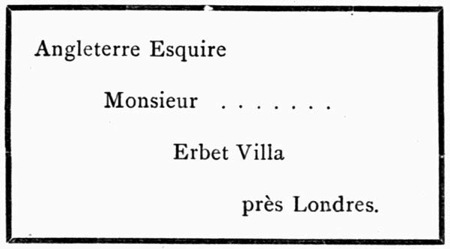
My dear compatriot had heard that "Esquire" had to be put somewhere, or else the letter would not reach me.
This is not the only letter addressed to me calculated to puzzle the postman.
A letter was once brought to me with the following high-flown inscription:
"Al gentilissimo cavaliere professore Signor...."
But what is even this, compared to the one I received from a worthy Bulgarian, and which was addressed to
"Monsieur.... Métropolitain de Saint Paul."
I was at the time teaching under the shadow of London's great cathedral.
[13] Among the nominations in the Legion of Honor, published on the 14th of July, 1884, I noticed the name of the English master (an Englishman) in the lycée of Bordeaux.
[14] "Mons., a familiar and contemptuous abbreviation of Monsieur."—Littré, "Dictionnaire de la Langue Française."
XVIII.
The Way to Learn Modern Languages.
I have always felt a great deal of sympathy, and even respect, for that good, honest, straight-forward young British boy who does not easily understand that in French "a musical friend" is not necessarily un ami à musique, nor "to sit on the committee," s'asseoir sur le comité, unless the context indicates that it is the painful operation which is meant. Poor boy! For him a foreign language is only his own, with another vocabulary; and so, when he does a piece of translation, he carefully replaces on his paper each word of his English text by one of the equivalents that he finds for it in his dictionary, rarely failing to choose the wrong one, as I have already said. Now comes que. Shall he put the subjunctive or the indicative? He has learnt his grammar: he could, if occasion required, recite the rules that apply to the employment of the terrible subjunctive mood. He has even, once or twice in his life, written an exercise on the subject, and as it was headed "Exercise on the Subjunctive Mood," he went through it with calm confidence, putting all the verbs in the subjunctive, including those that it would have been advisable to put in the indicative. This done, he was not supposed to commit any more mistakes on this important point of grammar. He might as well be expected to be an experienced swimmer after once reading Captain Webb's "Art of Swimming," and going through the various evolutions indicated in the pamphlet, à sec on the floor of his papa's parlor.
I admit that the French teacher of a public school ought to be a good philologist to make his lessons attractive to the students of the upper forms, and insure their success under examination; I admit that he should know English thoroughly, to be able to explain to them the delicacies of the French language, and maintain good discipline in his classes; I admit that he should be able to teach grammar, philology, history, literature; but I maintain that he ought never to lose sight of the most important object of the study of a living language,—the putting of it into practice; he should, above all things, and by all means, aim at making his pupils speak French. It is not enough that he should speak to them in French, even in the upper forms, where he would be perfectly understood: understanding a language and speaking it are two very different things. Neither will he attain his end by means of dull manuals of imaginary conversations with the butcher, the baker, and the candlestick-maker; these will, at most, be useful in helping a foreigner to ask for what he wants at a table d'hôte. You will not get grown-up, intelligent, and well-educated boys to come out of their shells, unless you make it worth their while. Now, Englishmen, like Americans, love argument, very often for argument's sake, and every school-boy, in England as in America, is a member of some society or committee, and at its meetings tries his wings, discusses, harangues, and prepares himself for that great parliamentary life, which is the strength of the nation.
Then, I ask, why not turn this love of discussion to account?
Start a French debating society in every school, and you will teach your generation to speak French. Such a proposition may sound bold, but it has been tried in several public schools, and has proved a complete success.
What cannot a teacher do that has succeeded in winning the esteem and affection of his pupils? First, make them respect you, then gain their hearts, and you will lead the young by a thread.
Take twenty or thirty boys, old enough to appreciate the interest you feel in them, and say to them, "My young friends, let us arrange to meet once a week, and see if we cannot speak French together. We will chat about any thing you like: politics even. Do not be afraid to open your lips, it is only la première phrase qui coûte. I am neither a Pecksniff nor a pedant, a dotard nor a wet blanket; in your company, I feel as young as the youngest among you. Do not imagine that I shall bring you up for the slightest error of pronunciation you make. I remember the time when I murdered your language, and I should be sorry to cast the first stone at you. At first I shall only correct your glaring mistakes; by degrees, you will make fewer and fewer, although, alas! you will very likely always make some. What does it matter? I guarantee that in a few months you will be able to understand all that is said to you in French, and express intelligibly in the same language any idea that may pass through your brain."
These little French parliaments work admirably; the earliest were started in two or three English schools four or five years ago. Each has its president—the head French teacher of the school, its honorary and assistant secretaries, and, if you please, its treasurer, who supplies the members with two or three good French papers, and, when the finances of the society permit, provides the means of giving a soirée littéraire. I have seen the minute-book of one of these interesting associations. Since its formation, this particular debating society has altered the whole map of Europe, greatly to the advantage of the United Kingdom. The young debaters have upset any number of governments, at home and abroad, done away with women's rights, and declared, by a crushing majority, that ladies who can make good puddings are far more useful members of society than those who can make good speeches. Young British boys have very strong sentiments against women's rights. In literature, the respective merits of the Classicists and the Romanticists have been discussed, and the "three unities" declared absurd and tyrannical by these young champions of freedom.
The speakers are not allowed to read their speeches, but may use notes for reference, and I notice that speakers, who at first only ventured short remarks, soon grew bold enough to hold forth for ten minutes at a time. In many instances, the president has had to adjourn a debate to the next meeting, on account of the number of orators wishing to take part in it. These minutes, written in very good French indeed, do great credit to the young secretary who enters them. I have myself been present at meetings of these societies, and I assure you that if you could see these young fellows rise from their seats, and, bowing respectfully to the president, say to him: "Monsieur le Président, je demande la parole," you would agree with me that, so far as good order, perfect courtesy, and unlimited respect for opposite views are concerned, these small gatherings would compare favorably with the meetings of honorables and even right-honorables that are held at the Capitol, the Westminster Palace, and the Palais Bourbon.
It is clear to my mind that, by such means, English boys can be made to speak French in the most interesting manner, and the one best suited to their taste. I firmly believe that if the great schools, public or private, were to start similar societies, that if all the young men knowing a little French were to form in their districts, such associations under the leadership of able and cheerful Frenchmen, England, or America for that matter, would in a few years, have a generation of French-speaking men.
I have always been at a loss to understand how boys who have been studying a language for nine or ten years should leave school perfectly unable to converse intelligibly in that language for five minutes together. It seems nothing short of scandalous.
Yet the reason is not far to be found. In England, at any rate, modern languages are taught like dead languages: they are taught through the eyes, whereas they should be taught through the ears and mouth.
The French debating society seems to me the best mode of solving the difficulty. I have often given this piece of advice to John Bull, and I myself founded a successful French debating society in England. Let Jonathan forgive my presumption if I avail myself of his kind and generous hospitality to give him the same advice.
XIX.
English and French Schoolboys. — Their Characteristics. — The Qualities of the English School-boy. — What is Required of a Master to Win.
I have often been asked the question, "Are English boys better or worse than French ones?"
Well, I believe the genus boy to be pretty much the same all the world over. Their characteristics do not show in the same way, because educational systems are different.
Both English and French boys are particularly keen in finding out the peculiarities of a master, and taking his measure.
They are both inclined to bestow their affection and respect on the man who is possessed of moral and intellectual power; it is in their nature to love and respect what is powerful, lofty, and good.