"John Ames, Native Commissioner" (continued 4)
Reading edition
Chapter Eighteen.
Haven between Storm.
“Do you know, this place reminds me a little of our resting ground that day down among the rocks at Camp’s Bay,” Nidia said, gazing up at the gigantic boulder, which, piled obliquely against two more, formed a natural penthouse on a very large scale. A blackened patch against the rock in the entrance of the cave, showed a fireplace surrounded by stones, and the very scanty baggage of the fugitives was disposed around.
John Ames, who was engaged in his normal occupation, viz. mounting guard, turned.
“Yes,” he said; “it’s the same sort of day, and grander scenery, because wilder. Peaceful, too. Yet here we are, you and I, obliged to hide among rocks and holes in peril of our lives.”
“Strange, isn’t it, how adaptable one can become?” went on Nidia. “That day, do you remember, when you were so sceptical as to our ever meeting again, who could have thought how we would meet and what experiences should have been ours between then and now?
“Do you know,” she went on gravely, after a thoughtful pause, “at times I think I must be frightfully hard-hearted and unfeeling—I mean, to have looked upon what I did—” and she shuddered.
“I liked the Hollingworths so much, too. And yet somehow it all seems to have happened so long ago. Why is it that I do not feel it more, think of it more? Tell me your opinion.”
“One word explains it,” he answered. “That is, ‘Action’.”
“Action?”
“Yes. You have been kept continually on the move ever since. First of all, you had your own safety to secure; consequently you had no time to think of anything but that—of anybody but yourself.”
“That sounds horribly selfish, somehow, but true.”
“Well, selfishness in its etymological sense is only another word for self-preservation, or, at any rate, an extension of that principle. Were you to sit down and weep over the loss of your friends until some obliging barbarian should come up and put an end to you? I think the pluck you showed throughout was wonderful, and not less so the soundness of judgment. When you found poor Hollingworth’s youngster so badly hurt, didn’t you sit there and look after him at momentary risk of your life until he died, poor little chap? Selfish? I call it by another name, and so will other people when we get safely out of this.”
Nidia smiled, rather sadly, and shook her head.
“Leave you alone for trying to flatter me,” she said softly. “You have been doing nothing else ever since we have been together. But—you don’t really think me unfeeling and hard-hearted, Mr Ames?”
He turned quickly, for he had been looking out over the surrounding waste.
“That isn’t what you called me the first time in Shiminya’s kraal,” he said.
“What? Unfeeling and hard-hearted. No. Why should I?” she rejoined demurely, but brimming with mischief. Then, as he looked hurt, “Don’t be angry. I’m only teasing, as usual. Really, though, I ought to apologise for that slip. But the name came out without my knowing it. You see, Susie and I used always to call you by it between ourselves. We saw it in the book at Cogill’s the day we arrived, written in a hand that seemed somehow to stand out differently from among all the others. At first, when we were trying to locate the people there, we used to wonder which was ‘John Ames,’ and so we got into the habit of calling you that way by ourselves. And in my mingled scare and surprise the other day, out it came.”
“We have been through a good deal together during the last four days,” he said, “including one of the narrowest shaves for our lives we can ever possibly again experience. Heaven knows how long we are destined to roam the wilds together, but why not keep the conventional until our return to conventionality?”
“Very well,” she answered.
It was even as he had said. This was the afternoon of the fourth day after leaving Shiminya’s den, and now they were well in among the Matopo range. Here, if anywhere, amid this vast sea of jumbled boulders and granite cones and wide rocky hollows, they would be comparatively safe, if only they kept a constant and careful look out, John Ames declared. The open country would be swarming with rebels, and it was not improbable that Bulawayo itself was in a state of siege. Here, where almost every stone represented a hiding-place, they could lie perdu for any time; and such was far the safer course, at any rate until able to gain some inkling of what had really transpired, as to which they were so far in complete ignorance. If the Matabele had risen upon Bulawayo with the same secrecy and suddenness wherewith they had surprised outlying stations, why, the capital would be absolutely at their mercy, in which case the only whites left alive in the land would be stray fugitives like themselves. Indeed, to John Ames it seemed too much to hope that any other state of things could be the prevalent one, wherefore for the present these rugged and seldom trodden fastnesses afforded the securest of all refuges. This plan he had put to Nidia, and she had agreed at once.
“Do not even go to the trouble of consulting me,” she had said. “Always act exactly as you think best. What do I know about things here, and where would I have been now but for you?”
“You showed yourself full of resource before I came on the scene, anyway. You might have pulled through just as well.”
“No; I should never have been able to keep it up. Heavens! where would I have been?”—looking round upon the wilderness and realising its sombre vastness. “But with you I feel almost as safe as I did—well, this day last week.”
As he had said, they had indeed been a great deal together during the past four days, really a great deal more so than during the three weeks and upwards that they had known each other down-country. Hiding away in sluit and river-bed and thorn thicket, every step of their flight had been attended with peril. Discovery meant death—certain death. Even were any trace of them lighted upon so as to arouse suspicion of their presence in the minds of their ruthless enemies, detection would not long follow. They could be tracked and hunted down with dogs, whatever start they might have gained; and as for hoping to distance their pursuers, why, a chain is no stronger than its weakest link, and Nidia, for all the fine healthy training she was most fortunately in, was hardly a match, either in fleetness or staying power, for a pack of hardy muscular barbarians. No; in superlative caution alone lay their only chance of safety.
And, throughout all this most trying experience—trying alike in the terrible strain upon the nerves, and the physical strain of forced marches in the enervating heat of a sub-tropical climate, over rough and fatiguing ground—how many times had Nidia noted with confidence and admiration the consummate judgment of her fellow-fugitive; the unflagging vigilance, the readiness of resource, and the tranquil hopefulness which he threw into the situation. Never a moment did he relax observation even in the most trivial matters, and his knowledge of the country, too, was wonderful. The part they had to traverse was the most dangerous part, indeed, through which their line of flight could possibly take them, bearing, as it did, a considerable population. More than once they would have to pass so near a kraal that the barking of dogs almost made them think they were discovered; but the narrow escape to which we heard him allude had occurred at about noon of the second day after leaving Shiminya’s.
The line of country they were traversing was rough and difficult—undulating flats covered with long grass, and plentifully studded with trees, but there was no avoiding it, and, indeed, every step, even here, was fraught with the gravest peril, for they were in the neighbourhood of quite a cluster of kraals. Poor Nidia felt as though she must give up in despair and exhaustion. The flags of the coarse grass cut her ankles like saws, and she felt as though she could hardly drag one foot after another, and even the words of cheer whispered by her companion seemed to fall on deaf ears. Suddenly the latter halted, listened a moment, then Nidia felt herself seized, and, with a whisper of caution, dragged down as though into the very earth itself. As a matter of fact this was nearly the case. The place she found herself in was a shallow donga, almost concealed by long grass and brambles, and these her companion was quickly but noiselessly dragging over her and himself. Then had come the sound of footsteps, the hum of voices. She could see out through the grass that was over her, and that without moving a muscle. An impi was approaching, and that in a line which should bring it right over their hiding-place; an impi of considerable size, and which might have numbered some hundreds. The warriors were marching in no particular order, and she could make out every detail of their equipment—the great tufted shields and gleaming assegais; rifles, too, many of them carried, and knobkerries and battle-axes. Some were crested with great ostrich skin war-bonnets covering the head and shoulders, others wore the isiqoba, or ball of feathers, fixed to the forelock; a long wing feather of the kite or crane stuck through this, and rising horn-like above the head; and catskin mútyas and anklets of flowing cowhair. At any other time she would have admired the spectacle exceedingly; now, however, in the grim dark faces and rolling eyeballs she could see nothing but the countenances of bloodthirsty and pitiless fiends. Oh, Heaven! would they never pass? The throb of her heart-beats seemed loud enough to attract their attention and cause them to stop. But no sooner had one squad glided by than another appeared; and with the advent of each, to those who lay there, it seemed that the bitterness of death had to be gone through again. Several passed so near to their hiding-place that the effluvium of their heated bodies reached the fugitives, musky and strong, but their attention was fixed upon the conversation of their fellows on the other side, and that peril was over. But not until nearly an hour had passed since the last of the savages had disappeared, and the lingering drawl of their deep-toned voices had died away, would John Ames suffer his companion even so much as to whisper, let alone move.
Well, that peril had passed over their beads, and now, in the well-nigh uninhabited fastnesses of the Matopo, they felt comparatively safe. And Nidia, remembering, and observing her fellow-fugitive and protector, would find herself twenty times a day making comparisons between him and all the other men she had ever known in a sense which was sadly unflattering to the latter; and an unconscious softness would come into her voice in conversing with him which was not a little trying to John Ames.
For if there was one point upon which the latter had made up his mind, it was that while Nidia was alone with him, and entirely under his care, he must never for a moment allow his feelings to get the better of him. To do so under the circumstances was, rightly or wrongly, to take an advantage of the position, against which his principles rose up in revolt. Yet there were times when his guard would insensibly slacken, and his tone, too, would take on an unconscious softening.
They were fugitives, those two, hiding for their lives in the heart of a savage and hostile land, wherein well-nigh every one of their own colour had almost certainly been massacred, yet to one of them, at any rate, the days that followed, that saw them hiding in and wandering through this grim rock wilderness, were days of sheer unadulterated delight. Life in the open entailed upon him no privation—he was used to it; to rough it on coarse and scanty fare he never felt, and as a price to pay for the happiness that was now his, why, it did not come in at all. To awaken in the morning to the consciousness that the whole day should be spent in the society and presence of this girl; that she was as absolutely dependent upon him—upon his care and protection—as she was upon the very air she breathed; that throughout the livelong day he would have in his ears the music of her voice, under his gaze the sunny witchery of that bright face, the blue eyes lighting up in rallying mockery, or growing soft and dewy and serious according to the thoughts discussed between them—all this was to John Ames rapture unutterable. He looked back on his many communings in his solitary comings and goings, and how the thought of her alone had possessed his whole being, how he would sit for hours recalling every incident of their acquaintanceship, even—so vivid was memory—going over all that was said and done on each day of the same, and yet, running through all, the hope of meeting again, somehow, somewhere. And now they had met—not as he had all along pictured, under conventional circumstances and surrounded by others, but as the survivors of savage massacre, who had been wonderfully thrown together, having passed through an ordeal of tragedy and blood. Her very life was in his hands, and by a sure and certain instinct he knew that it was in his hands to save once more, even as he had done more than once already.
And that his cup of joy might be full, the way in which his charge accepted the position was perfect. Under the circumstances other women might well have given way. The very precariousness of their situation, recollection of the horrors and perils so lately passed through, apprehensions as to the future, the necessary roughness of their life, the deprivation of a thousand and one of the many conveniences and comforts—great and small—of ordinary civilisation, the society of but one companion day after day—all might have conduced to low spirits and constraint and irritation, but nothing of the kind was manifest in Nidia Commerell. A day of complete rest in their snug hiding-place amid the rocks had completely set her up. The outdoor life and plain rough living, and sense of temporary security, had brought a healthy glow into her face, and the excitement and novelty of the position a brightness and sparkle into her eyes, that rendered her in the sight of her companion more entrancing to look upon than ever. Nor did she show the least tendency to become weary of him, any more than in that time, which now seemed so long back, when they were so much together amid surroundings of civilisation and peace. Her spirits were unflagging, her appreciation of his efforts and care for her comfort never wanting. She, too, seemed to have made up her mind to put the past, with its grievous and terrible recollections, the future, with its apprehensive uncertainty, far from her, and to live in the present.
And at night, when the grim mountain solitudes would be awakened by strange eerie sounds—the weird bay of the jackal, the harsh truculent bark of the baboon, the howling of tiger wolves, and other mysterious and uncanny noises, exaggerated by echo, rolling and reverberating among the grim rocks—she would lie and listen, her eyes upon the patch of gushing stars framed in the black portal of their rocky retreat, alive to the ghostly gloom and vastness of the wilderness around; then, rejoicing in the sense of proximity, even the care, of one whose slumber was light unto wakefulness in the reliability of his guard over her, she would fall asleep once more in the restful security afforded by the contrast.
Chapter Nineteen.
A Footprint in the Sand.
Reduced to existence in its most primitive state, it followed that the means of sustaining such existence were perforce primitive, and, foreseeing this, John Ames had managed, during their progress through the inhabited districts, to levy upon the grain fields. But although the supply was not yet exhausted, it had to be supplemented. There was no grain in the mountains, wherefore it became necessary to go out and hunt.
This primitive method of obtaining food was, however, handicapped by two important considerations. First, there was very little game indeed, most of that little consisted of birds—wild guinea-fowl, francolin, and a few partridges—and the hunter, though well set up in rifle ammunition, had no shot-gun. Much hard climbing sometimes produced a klip-springer; but this comes under the second of the two considerations, the inexpediency of discharging a firearm lest the report should reach undesirable ears. Fortunately John Ames, having been raised among natives, was an adept at throwing a kerrie, and with this primitive weapon was able to keep the larder supplied.
It meant hard work, though. Just as he would be congratulating himself upon having successfully stalked a troop of guinea-fowl, yet wanting a little shorter throwing-range, the abominable birds would raise their grating cackle of alarm, and, running like spiders through the grass, eventually wing their way to a lofty pile of boulders. Then the stalk had to be begun over again, involving unwearied patience and a well-nigh superhuman display of activity; involving, too, a more or less prolonged absence from camp.
Nidia, left alone during such absences, was obliged to summon all her courage, all her self-command. For she felt so thoroughly alone. The consciousness that no human being was within reach, that she stood solitary as she looked forth upon the tossing sea of granite crags and feathery foliage and frowning piles of rocks towering to the sky like giants’ castles, would get upon her nerves to such an extent that when her companion was absent longer than usual she would become half frantic with uneasiness and fear. What if he should not come back? What if he should meet with an accident, a fall, perhaps, and perish miserably in those grim solitudes, alone, unaided, or, what was much more likely, allow himself to be surprised by the savage enemy? What would become of her? And then she would take herself to task. Was it only of herself she could think at such a time? Had she no thought for him and his safety? Ah! had she not? She could hardly disguise the truth from herself. It was of no use to reason that being thrown together she must perforce make the best of the companionship into which she was thrown. She was face to face with the fact that John Ames was becoming very dear to her indeed.
More and more did each enforced absence emphasise this consciousness. It did not lessen her uneasiness; indeed, if any thing, very much the reverse. But it changed the quality thereof. She thought less and less of what a mishap involving him would entail upon her, more and more of what it would mean on his account.
And yet this growing consciousness did not give rise to any alteration in their daily relations. Nidia Commerell’s character was stamped with a very strong individuality. Prudery was utterly foreign to it, and she could not for the life of her see any necessity for affecting a reserve she did not feel, because she had for the first time in her life discovered a man possessed of every quality to which she could look up—merely because she and that man happened to be alone together in a wilderness, in hiding for their lives. She smiled a little to herself as she thought of her people in England, and what they would say if they could see her now. Then she thought of their anxiety on hearing of the outbreak in Rhodesia, but they would not have time to be anxious before hearing of her safety. She wondered, too, whether Susie Bateman was becoming alarmed about her, and from that she got to thinking, not for the first time that afternoon, that John Ames was later than usual; and, thus thinking, she rose to look forth.
The sun was dipping to the serrated sky-line, bathing the granite-piles in a lurid flush. The light had gone off the wide hollow beneath, leaving its broken-up stormy billows cold and grey, and the hush of evening was in the air. Then a sound fell upon her ear, the sound as of a stone dislodged by a light footfall. Her pulse beat quicker. It was her companion returning at last.
But the glad smile, which she had prepared to welcome him faded from her lips, and her face grew pale. Down yonder, on the fringe of the acacia growth, a figure was standing; but it was not his.
Had the savage enemy found them out at last? Nidia’s heart-strings tightened and her blood froze. A further glance served to reassure her, but only partially. The figure was not that of a native, of a savage. But—was it human?
It had vanished—silently, imperceptibly; had vanished as suddenly as it had appeared, but in that brief moment she had taken in every detail. The figure was that of a European, clad in brown, weather-beaten garments, tall, and wearing a long white beard. But the face. She had seen it for that moment, turned towards the setting sun, the light full upon it—full in the eyes—and never before had she beheld so awful an expression of fiendish hate stamped upon the human countenance. Was it human? The face was that of a devil! Nidia felt her flesh creep, and her hair rise, as she called to mind its expression, and all sorts of weird ideas, begotten of solitude amid vastness, circled through her brain. Was this frowning wilderness truly a demon-haunted spot, or had she seen the spectre of one of her murdered countrymen, who could not rest in his blood-stained grave? But that it could be a human figure she felt it impossible to believe.
Then another idea struck her. Was it indeed human—one who had escaped, like themselves, only to discover, or perhaps to witness the slaughter of those dear to him, whose brain had been turned thereby, and who, in a state of maniacal fury, was wandering at large? This solution, however, was hardly more palatable than the first. Had it seen her? She thought not; for she had remained perfectly still, true to an oft repeated injunction of her companion’s, as to the fatal attraction exercised towards oneself by any sudden movement, however slight. The sun had sunk altogether now, and already the very brief twilight was descending upon the surrounding waste. Would he never return? Nidia’s heart was well-nigh bursting with mingled terror and anxiety. Then it leapt for joy. A low whistle, a bar or two of a favourite song, a home-coming signal agreed upon between them, was borne to her ears. She could have laughed aloud in her delight. She composed both her face and manner to hide from him her terrors, for she had been careful never to let him suspect the half of what she went through during these protracted absences. Then his figure appeared striding out from the darkness.
“I’ve been in luck to-day, Miss Commerell!” he exclaimed gaily, flinging down a brace of full grown guinea-fowl, “Got them both at one throw, too.”
Nidia did not for a moment reply. She was looking up at him with a very soft and entrancing flush upon her face, and a light in her wide-opened eyes which he never quite remembered ever having seen there before. Then she said slowly, and with the air of one repeating a lesson—
“We have been through a good deal together during the last four days, including one of the narrowest shaves for our lives we can ever possibly again experience, and Heaven knows how long we are destined to roam the wilds together; but why not keep the conventional until our return to conventionality? Have I got a good memory, John?”
“Excellent,” he answered. “I must try to imitate it.”
His tone was even; but Nidia was not deceived. She was as well aware as he of the thrill that went through his heart on hearing his own words so exactly repeated, and all that they involved, and being so, she admired his self-restraint, and appreciated it in proportion to its rarity. If he had begun “to hang out the signals” at one time, he was careful to avoid doing so now. Yet—she knew.
“I’m afraid I’m late,” he went on. “I hope you did not begin to get frightened. The fact is, I had a very long hard scramble after those wretched birds.”
“Yes. Oblige me by putting down that bundle of sticks, and going and sitting over there. I am going to build this fire, not you. Don’t you hear? Do as you’re told,” she went on, with a little stamp of her foot, as he made no movement towards obeying. “You do the outdoor work, I the in. That’s fair division of labour.”
“I won’t hear of any ‘division of labour,’ falling to you,” he objected.
“Now, how often have we fought over this already? The only thing we ever do fight about, isn’t it? Go and sit over there, you poor tired thing, and—and talk to me.”
The while she took the sticks from his hands, looking up into his face, with a merry, defiant expression of command mingled with softness upon hers, that again John Ames came near losing his head. However, he obeyed. It was sheer delight to him to sit there watching her, as she broke up the sticks and deftly kindled a blaze in the fireplace, securely sheltered by rocks from outside gaze, chatting away the while. The fire was wanted rather for light and cheerfulness than for cooking purposes, for it was late, and there was sufficient remaining from the last cooking to make a supper of. While they were discussing this he told her about his afternoon’s doings, and the long and hard scramble he had been obliged to undertake over two high granite kopjes before obtaining his birds. There was smoke visible, far away to the south-west, but what it meant was impossible to say. Then she, for her part, told him what she had seen. He looked surprised, even startled, and the next moment strove to conceal it.
“Are you dead sure your imagination wasn’t playing tricks with you, Nidia? When one is alone in a place like this for hours at a time one’s imagination will turn anything into shape. I have more than once blazed at a stump in the dusk, when my mind has been running upon bucks.”
“But my mind wasn’t running upon bucks, nor yet upon tall old men with long white beards,” returned Nidia, sweetly. “But the face! oh, it was too awful in its expression. I don’t believe the thing was of this earth.”
“I expect it’s some one in the same boat as ourselves.” And John Ames lighted his pipe—for he had obtained a stock of tobacco from Shiminya’s store-hut as well as matches—and sat silent. The prospect of falling in with another fugitive was anything but welcome. It would not even add to their safety, rather the reverse, for it was sure to mean two skippers in one ship. Such a fugitive too, as Nidia had described this one to look like, would prove anything but an acquisition. But—was that all?
No, not quite. He was forced to own to himself that he had no desire to hurry the end of this idyllic and primitive state of existence, certainly not at any price less than Nidia’s entire safety. He would have welcomed a strong patrol, though with mingled feelings. He certainly would not welcome at all the appearance of a fellow refugee, which would end the idyll, without the compensating element of rescue.
“He had no gun, you say?” he went on.
“No. At least, I don’t think so, or I should have seen it. What can it have been?”
“As I say, some one in the same boat as ourselves. He’ll be walking up to our camp directly. And—I would rather he didn’t.”
“Would you?”
“Wouldn’t you?”
Nidia laughed.
“I believe I would. But what if it is some poor wretch who is lost? Oughtn’t we to try to help him?”
“At our own risk? Your description of this individual does not make one precisely yearn for his society, Nidia. Indeed, I gather from it that we should not be at all likely to get on, and I never heard that two skippers in one ship tended to enhance the safety of that craft. On the whole, I think we will leave the interesting stranger to his own devices. If, as you surmise, he really is off his chump, why, for that very reason the Matabele won’t hurt him, and for the same reason he will be the reverse of an acquisition to us.”
Then they talked on about other things—the times of their first meeting, and the Hollingworths, and Bulawayo, and presently Nidia grew sleepy. But, as she lay down, her last thought was a drowsy, half amused recollection that the apparition of the mysterious stranger seemed to have much the same effect upon her companion as the footprint in the sand had upon Robinson Crusoe.
He, for his part, sat thinking hard, and gradually growing drowsy. Suddenly an idea struck him, an idea that started him wide awake with a smothered whistle, expressive of mingled surprise and dismay. Rising, he took off the blanket which had been wrapped round him, and going over to the sleeping girl spread it softly over her, for there was a chill edge in the atmosphere. Then, taking his rifle and cartridges, he went to the entrance of the cave, and with his back against the rock, prepared to spend a wakeful and a watchful night.
Now, a seated posture, with one’s back against a hard and uneven surface of rock, in the open air, and that air with a particularly keen edge upon it, is not conducive to sleep unless the sitter is there with the object of being on the watch; which paradoxical deduction may for present purposes be sufficient to account for the fact that, as the night hours followed each other one by one, John Ames began to grow very drowsy indeed. Still, by reason of his enforced attitude, he could not yield; at least, so he would have said but for the fact that in that dead dark hour which just precedes dawn he was awakened—yes, awakened—by the weird instinct which warns of a presence, although neither by sight nor sound is that presence suggested. Something brushed past him as he sat there, and with it his ear caught a sound as of a stealthy human footfall. He started to his feet. Yes, his gaze was true. It was a figure—a tall figure disappearing in the darkness.
“Stand, or I fire!” he called.
But there came no reply.
He stood thus for a moment. There was nothing to be gained by discharging his piece at a venture in darkness like this. It might be heard anywhere, and furthermore would startle Nidia out of her wits. No, he would not fire.
“Who is it?” he called again, clear but low, so as not to be heard by the sleeper within.
For answer there came a far away, mocking laugh, harsh and long-drawn. Then silence.
With every drop of blood tingling in his veins, John Ames sprang within the cave again, for an awful idea had seized him. This thing must have been, right inside their hiding-place. His hand shook so that he could hardly get out a match and strike it. He bent down over the sleeping girl. She still slumbered—breathing softly, peacefully, but with brow slightly ruffled as though by dreams. He gazed upon her unconscious face until the match burned out, then turned away, filled with unutterable relief. No harm had happened to her, at any rate.
Then the first grey of dawn lightened upon the mountains.
Chapter Twenty.
Alone.
“I think we’ll move on a little further to-day, if you feel equal to it, Nidia.”
She looked up in surprise.
“Certainly, if you think it advisable,” she answered.
“Well, to tell the truth, I do. It’s not a good plan to remain too long in the same place. My notion is to work our way gradually to the northern edge of the range, where we can reconnoitre the open country between it and Bulawayo. It’ll be that way we shall be most likely to strike a patrol.”
John Ames was occupied in plucking the guinea-fowls he had brought in yesterday. Nidia had just lighted the fire and was engaged in making it burn. The sun had just risen upon a glorious day of cloudlessness, of coolness too, judging from the keen edge which still ran through the atmosphere.
“John,” she said, looking up suddenly, “is it because of what I told you yesterday?”
“The proposed move? N-no. Yet, perhaps a little of that too. You would never feel easy if left alone here again. But I have other reasons—that smoke, for instance, I saw yesterday. It may mean natives. There may have been fighting down Sikumbutana way or on the Umgwane, and they may be taking to the mountains. We had better get further on.”
“Do you know, I am glad you have come to that conclusion. What I told you yesterday has rather got upon my nerves, and, now we are going to move, I’ll tell you something more. I dreamt of it—dreamt that awful face was bending over me looking into mine. You know—one of those dreams that is horribly real, one that remains with you after you wake, and, in fact, that you remember as though it had actually happened. Are those birds ready?”
“Yes. Never mind. I’ll fix them,” he replied; and in a moment, fixed on a deft arrangement of sticks, they were hissing and sputtering over the fire. His mind was full of Nidia’s dream. But was it a dream? That shape, brushing past him in the darkness—the hollow, demoniacal laugh? Had the being, whatever it was, actually entered the cave, passing him seated there on guard? Was it a dream, indeed, or was it the actual face which she had seen? The latter seemed far more like it. Then he remembered that even if such were the case, it was too dark for features to be distinguishable. He was fairly puzzled. And by way of finding some solution to the mystery he went down to the spot which Nidia pointed out to him as the scene of the first apparition, and examined the ground long and carefully. There was not a trace of a human footmark—not a stone displaced. He felt more puzzled than ever.
But not to Nidia was he going to impart his misgivings. With a change of camping-place she would forget this rather unpleasant mystery, if only it did not take to following them, that is—and indeed they would be fortunate if they met with no more material cause for alarm.
“On the whole it’s rather lucky we struck old Shiminya’s place,” he remarked, as they were seated at their primitive breakfast. “Blankets, matches, everything we have—and that’s not much—we owe to him, even the rifle and cartridges. When I cleared from Sikumbutana, with nothing on earth but a pipe, a sword-bayonet, and a bunch of keys, I felt pretty helpless, I can tell you. What must you have felt, when you first found yourself adrift?”
“It was awful. That night—shall I ever forget it? And how strange we should have met like that. The very next day I was going to send over to let you know I was at the Hollingworths’. I only heard from Mr Moseley that you were so near. Would you have come to see me?”
“Have you forgotten that last long day of ours, down by the sea, that you can ask such a question?” he said gravely, his full, straight glance meeting hers. Nidia was conscious of ever so slight a flush stealing over her face. “How ingenious you are,” intently examining one of the wooden forks which he had roughly carved for her as they went along. “You must let me keep these as a memento of this wandering of ours.”
“How many are there?” he answered. “Three—may not I keep one of them? I want a memento, too.”
“Am I getting irremediably freckled and tanned?” she said. “And tattered? Yet one would be in absolute rags, but for that thorn-and-fibre needle and thread of yours.”
“I never saw you look better in my life. There are no freckles, and the brown will soon wear off, if you want it to. Though really it’s becoming—makes the eyes larger. So make your mind easy on that score. As for tatters”—looking at his own attire—“I’m afraid we are rather a ragged pair. By the way, I wonder what your people in England would say if they could see you now.”
“I know what they’d say to you for the care you’ve taken of me,” she answered seriously, “what they will say, I hope, one of these days.”
He turned away suddenly, and bending down, began busying himself over the rolling up of their scanty kit.
“Oh, as to that,” he rejoined, speaking in a tone of studied carelessness, “where should I have been all this time without you? Nice cheerful work it would have been romping about the mountains alone, wouldn’t it?”
“You would have been in safety long ago without myself as a drag upon you.”
“Possibly; possibly not. But, speaking selfishly, I prefer things as they are. But it’s rough on you, that’s what I’m thinking about. By the way, old Shiminya isn’t quite such a rip as I thought. I was more than half afraid he’d have given us away when they cut him loose. But he doesn’t seem to have done so, or we’d have heard about it before now.”
This apparently careless change of subject did not impose upon Nidia. She saw through and appreciated it—and a thrill of pride and admiration went through her. Whimsically enough, her own words, spoken to her friend on the day of that first meeting, came into her mind. “I think we’ll get to know him, he looks nice.” And now—he had impressed her as no man had ever before done. Full of resource, strong, tactful, and eminently companionable as he had shown himself, she was intensely proud of the chivalrous adoration with which she knew he regarded her, and all manifestation of which he was ever striving to repress. What would she do when they returned to safety, and their ways would lie apart? For somehow in Nidia’s mind the certainty that they would return to safety had firmly taken root.
“Perhaps they haven’t cut him loose yet,” she suggested.
Her companion gave a whistle, and looked scared. Only for a moment, though.
“Bad for him in that case. It would have been better for him and safer for us—to have given him a tap on the head. I couldn’t prove anything against him, though I’ve had my eye on him for some time—besides, he seems to have taken some care of you. But he’s sure to have been found. He’s one of these Abantwana ’Mlimo, and too much in request just now.”
“Is there anything in that Umlimo superstition, do you think, John?”
“There is, to this extent. From what I can get out of the natives it is of Makalaka origin, and manifests itself in a voice speaking from a cave. Now I believe that to be effected by ventriloquy. There is a close ‘ring’ of hierarchs of the Abstraction, probably most of them ventriloquists, and they retain their power by the very simple but seldom practised expedient of keeping their eyes and ears open and their mouths shut. That is about the secret of all necromancy, I suspect, from its very beginning.”
“Then you don’t believe in a particular prophet who talks out of a cave?”
“No; if only for the reason that the cave the Umlimo is supposed to speak from is one that no man could get into or out of—at least, so the Matabele say. No; the thing is a mere abstraction; an idea cleverly fostered by Messrs Shiminya and Co. They shout up questions to the cave, and ventriloquise the answers back.”
What was it? Did the speaker actually hear at that moment a shadowy echo of the mocking laugh which had been hurled at him from the darkness, or did he imagine it? The latter, of course. But here, in the very home of the superstition they had been discussing, could there, after all, be more in it—more than met the eye? He could not but feel vaguely uneasy. He glanced at his companion. She had altered neither attitude nor expression. He felt relieved.
Over less forbidding looking ground their way now lay. The grey chaotic billowings and craters of granite blocks gave way to table-land covered with long grass and abundant foliage. Here they advanced ever with caution, conversing but little, and then only in whispers. Indeed, after the rest and comparative safety of their late refuge, it was like entering into all the anxiety and apprehensions of peril renewed. Not very fast, however, could they travel, for Nidia, though a good walker, felt the heat, and John Ames, although, as he declared, he had “humped” a heavier “swag” than that comprised by their load, yet it demoralised him too.
A fireless camp amid the rocks, then on again in the cool of the morning. And as their way lay over high ground, the sun rose upon such a sea of vast and unrivalled wildness—castellated peaks and needle-like granite shafts, here a huge grey rock-dome, smooth, and banded round by a beautiful formation of delicate pink; there, and all around, cone-like kopjes of tumbled angular boulders, as though the fire whirlpool beneath earth’s surface had swept round and round, throwing on high its rocky billows, leaving in the centre this great dome, smooth and unriven. Doves cooed among the greenness of the acacias, whose feathery sprays gleamed bright against the background of grim rock in sombre masses.
“Yes, it is about as wild a bit of scene as you could find anywhere,” said John Ames, in reply to his companion’s cry of amazement and delight. “You will have something to talk about after this; for you can safely say you have been where very very few whites have ever set foot. Even now there are parts of the Matopos which have never been explored. The old-time hunters avoided them because there was no game—as we, by the way, know to our cost; the traders because there were no natives—as we know to our advantage; and the prospectors because granite and gold don’t go together.”
The foliage grew more abundant as they advanced; the “marula” and wild fig, and omnipresent acacia. Winding around the spurs of the great hills every turn of their way would reveal some fresh view of exquisite wildness and beauty.
“Look over there, Nidia. That might be the cave of the Umlimo himself,” said John Ames, pointing to a great granite cone which rose up from the valley bottom some little distance off. It was apparently about two hundred feet in height, and in the centre of its face yawned a great square hole, black and darksome.
“I wonder is it?” she said, gazing with interest at what was in fact a sufficiently remarkable object, “If it isn’t, it ought to be.”
“Look,” he went on. “Imagine it a bright moonlight night, and that valley bottom crowded with about half the Matabele fighting-men, all ranged in crescent formation, looking up at the cave there. Then imagine the oracle booming forth its answers from the blackness of yonder hole. Wouldn’t that make a scene—eh?”
“Yes, indeed it would. But—how could anybody get up there? It looks quite inaccessible.”
“So it probably is. But there would be no necessity for anybody to get up there. Messrs Shiminya and Co. would take care of that part of the entertainment, as I was telling you the other day. Well, we won’t camp near it on the off chance that it may be the real place.”
The spot they did select for a camp-ground was some little way further on, and a wild and secluded one it was, right in among rocks and trees, and well up on the hillside. This elevated position was of further advantage in that a reedy swamp wound through the valley bottom; two water-holes of oval formation, gleaming like a pair of great eyes from its midst.
“I’m afraid ‘skoff’ is running low, Nidia,” remarked John Ames, surveying gravely a pair of turtle-doves and a swempi, the latter a small variety of partridge, which he had knocked over with stones during their journeying. “A brace of record pedestrians can’t afford to let themselves run down in condition. The English of which is that I must go out and kill something—or try to.”
“Mayn’t I go with you?” she asked, rather wistfully. He looked doubtful.
“I wish you could,” he answered slowly. “But—you have walked enough the last couple of days; and apart from the discomfort to you, it is essential you should not overtire yourself. In fact, it might become a matter of life or death. No. Be good now, and remain perfectly quiet here, and rest. I’ll be back before dark. Good-bye.”
What impulse moved her to put out both her bands to him? He took them.
“Good-bye,” he said again. One second more of their eyes thus meeting and his resolution would be shattered. With a farewell pressure he dropped her hands and was gone.
It was early in the afternoon, and warm withal. Left alone Nidia grew drowsy and fell into a doze. When she awoke the sun was just going off the valley beneath, and she was still alone. She sat up congratulating herself upon having got through those lonely hours in sleep. He would be back now at any moment. Rising, she went over to the runnel of water which trickled down the rocks just behind their resting-place, and bathed her face in one of its clear basins. Then she returned. Still no John Ames.
The sun was off the valley now—off the world. In the brief twilight the stars began to rush forth. A terrible loneliness came over her. Oh, why was he so late? The two water-holes in the valley glared up at her with a lack-lustre stare, as of a pair of gigantic eyes, watching her loneliness. Still he came not.
Was he uncertain of the place? They had but just arrived there, and he might well be. Fool that she was not to have thought of it, and now her hands trembled with eagerness as she collected some dry grass and sticks together, and caring nothing what other eyes might see it if only his would, kindled them into a bright blaze.
How her hearing was strained to its uttermost tension! Every rustle of a leaf, every snapping of a twig, sent a thrill of anticipatory joy through her being, only to give way to sickening disappointment. An hour went by, then two. Faint and exhausted, she had not even the energy to prepare food. The one consciousness of her appalling loneliness here in this scarcely trodden waste seemed to sap and paralyse all her facilities. The weird voices of the night held a different meaning now that she was lying out alone on the hillside. Below, in the swamp, the trailing gleam of will-o’-the-wisps played fitfully, and the croaking of frogs was never stilled.
Had anything befallen him? It must be so. Nothing short of that could have kept him from returning to her. And she? She could do nothing to aid him. She was so absolutely helpless.
“Oh, darling! why did I ever allow you to leave me, my own, my true chivalrous love?” she murmured to herself amid a rain of tears, confiding to herself the secret of her heart in the agony of her distress and terror. And still the dark hours wore on, one upon another, and he—the companion, protector—lover—did not return.
The night she had spent hiding in the river-bank after the slaughter of the Hollingworths could hardly be surpassed for horror and apprehension, Nidia had thought at the time. Now she recognised that it had been as nothing to this one. Then she had hardly known the secret of her heart—now she had discovered it. But—too late.
Yet, was it too late? Harm might not have befallen him, after all. He might have missed his way in the darkness. In the very earliest dawn he would return, and then the joy of it! This hope acted like a sedative to poor Nidia’s overwrought brain. The night air was soft and balmy. At last she slept.
It was grey dawn when she awoke, but her awakening was startling, for it was brought about by a loud harsh shout—almost in her ear. Nidia sprang to her feet, trembling with terror. Several great dark shapes fled to the rocks just overhanging her resting-place, and, gaining them, faced round again, uttering their harsh, angry shout. Baboons? Could they be? Nidia had seen here and there a dejected looking baboon or two chained to a post; but such had nothing in common with these great fierce brutes up there, barely twenty yards distant, which skipped hither and thither, champing their great tusks and barking savagely. One old male of enormous size, outlined against the sky, on the apex of a cone, looked as large as a lion. Others came swarming down the rocks; evil-looking horrors, repulsive as so many gigantic spiders.
Wild-eyed with fear, Nidia snatched up a blanket, and ran towards them, waving it, and shouting. They retreated helter-skelter, but only to skip forward again, mowing and gibbering. Three of the foremost, indeed, great males, would hardly move at all. They squatted almost within springing distance, gnashing their tusks, hideously threatening.
Then, as by magic, the whole gnome-like troop wildly fled; but the cause of this change of front was hard and material. “Whizz—Bang—Whack!” came a succession of stones, forcibly hurled, splintering off a rock like a bullet, thudding hard upon simian ribs. Yelling and jabbering, the whole crew skipped and shoggled up the rocks, and Nidia, with a very wan and scared smile upon her pallid face, turned to welcome her companion and protector—turned, to behold—not John Ames at all, but a burly savage—a tall Matabele warrior, barbarously picturesque in the weird panoply of his martial adornments.
Chapter Twenty One.
Trapped.
His mind aglow with the recollection of that farewell, his one thought how soon he should be able to return, John Ames strode forth upon his quest, and as he did so it is probable that the whole world could not have produced another human being filled with such a rapturous exaltation as this refugee from a fiendish massacre, hiding for his life in the grim fastnesses of the Matopo Hills.
That last look he had discerned in Nidia’s eyes, that last pressure of her hands, could mean but one thing, and that the one thing to obtain which he would have laid down his life again and again. She was beginning to care for him. Other little spontaneous acts of cordiality during their enforced exile, had more than once stirred within him this wild hope, yet he had not encouraged himself to entertain it. Such he had of course deemed to be the outcome of their position. Now, however, the scales seemed to fall from his eyes, and he could read into them a very different meaning.
These last few days! Why, they seemed a lifetime. And when they should be over—what then? Was not his resolution a quixotic one; now, indeed, an impossible one? He almost made up his mind to abandon it, and on his return to ascertain once and for all how matters stood. As against that, what if he were mistaken, or partially so? There was such a thing as being too precipitate. Would it not be better to wait until he had brought Nidia safely and triumphantly through the multifold perils which still overhung their way?
How casual had been their meeting in the first instance, how marvellous and providential in the second. If anything seemed to point a significant augury, this did. But what of the more practical side? What would Nidia’s own people have to say in the matter? From things let drop he had gleaned incidentally that they were people of very considerable wealth, whereas he himself had little beyond the by no means princely salary wherewith the Chartered Company saw fit to remunerate his valuable services. Well, he would not think of that just then. Time enough to do so when they were safely back in prosaic civilisation once more. Let him revel in his happiness while it was his.
And it was happiness. Here he was—enjoying advantages such as rarely fall to the lot of the ardent lover. The daily intercourse, for all present purposes, each representing all the world to the other, beyond the reach of officious or intrusive outsider; she dependent upon him for everything—protection, companionship, even the very means of subsistence—what a labour of love was all this.
A slight rattle, as of stones, above his head, brought his mind back to the object of his quest; and lo! there stood the aforesaid means of subsistence personified, in the shape of a klip-springer, which from its boulder pedestal was regarding him with round-eyed amazement and distrust. Dare he use his rifle? There was no other way of securing the little buck. It was out of throwing-range, and in any case would be nimble enough to dodge a kerrie. He thought he would risk it. Game was alarmingly scarce.
But the question was decided for him. The animal suddenly sprang from the boulder, and in a couple of bounds had disappeared among the rocks. What—who—had scared it? The answer came—and a startling one it was. A score of Matabele warriors rose from among the long grass, and, uttering their fierce vibrating war-shout, flung themselves upon him. So intent had he been upon his thoughts, and on watching the klip-springer, that, crawling like snakes in the grass, they had been able to surround him unperceived. So sudden was the onslaught, that not a moment was given him for defence. His rifle was knocked from his grasp by a blow with a kerrie which he thought had shattered his wrist. Assegais flashed in front of his eyes, battle-axes were flourished in his face, his ears were deafened with the hubbub of voices. Then arose a great shout.
“Au! U’Jonémi!”
They had recognised him. Did that account for the fact that he was still alive? He had expected instant death, and even in that brief flash of time had crossed his mind a vision of Nidia left alone, of her agony of fear, of her utter helplessness. Oh, fool that he was, to have been lulled into this false security!
As though satisfied with having disarmed him, they had so far refrained from offering him further violence. No, he dared not hope. Others came swarming up, crowding around to look at him, many of them recognising him with jeers.
“Au! Jonémi! Thou art a long way from home!” they would cry. “Where are thy people—the other Amakiwa—and thy horses?”
“No people have I, nor horses, amadoda. I am alone. Have I not always wished well and acted well towards you? Return me, therefore, my rifle, and let me go my way in peace.”
It was putting a bold face on things; but, in his miserable extremity, as he thought of Nidia it seemed to John Ames that he was capable of any expedient, however insane. The proposal was greeted with shouts of derisive laughter by some. Others scowled.
“Wished well and acted well towards us?” echoed one of these. “Au! And our cattle—whose hand was it that destroyed them daily?”
This was applying the match with a vengeance.
“Yea—whose?” they shouted. “That of Jonémi.”
Their mood was rapidly growing more ugly, their demeanour threatening. Those who had been inclined to good humour before, now looked black. Several, darting out from the rest, began to go through the performance of “gwaza,” throwing themselves into every conceivable contortion of attack or defence, then, rushing at their prisoner, would make a lightning-like stab at him, just arresting the assegai blade within a foot of his body, or the same sort of performance would be gone through with a battle-axe. It was horribly trying to the nerves, dangerous, too, and John Ames was very sick of it.
“Keep the gun, then, if you will,” he said. “But now I must go on my way again. Hlalani-gahle ’madoda.” And he made as if he would depart. But they barred his way.
“Now, nay, Jonémi. Now, nay,” they cried, “Madúla, our father, would fain see his father again, and he is at hand. Come now with us, Jonemi, for it will be good for him to look upon thy face again.”
The words were spoken jeeringly, and he knew it. But he pretended not to. Boldness alone would serve his course. Yet his heart was like water within him at the thought of Nidia, how she would be waiting his coming, hour after hour—but no—he must not think of it, if he wanted to keep his mind. Madúla, too, owed him a bitter grudge as the actual instrument for carrying out the cattle destroying edict, and was sure to order him to be put to death. Such an opportunity of revenge was not likely to be foregone by a savage, who, moreover, was already responsible for more than one wholesale and treacherous murder.
“Yes,” he answered, “Madúla was my friend. I would fain see him again—also Samvu.”
“Hau! Samvu? There is no Samvu,” said one, with a constrained air. “The whites have shot him.”
“In battle?” said John Ames, quickly.
“Not so. They found him and another man sitting still at home. They declared that he had helped kill ‘Ingerfiel,’ and they shot them both.”
“I am sorry,” John Ames said. “Samvu was also my friend. I will never believe he did this.”
A hum, which might have been expressive of anything, rose from the listeners. But this news had filled John Ames with the gravest forebodings. If the chief’s brother had been slain in battle, it would have been bad enough; but the fact that he had been shot down in cold blood out of sheer revenge by a band of whites, with or without the figment of a trial, would probably exasperate Madúla and his clan to a most perilous extent, and seemed to aggravate the situation as regarded himself, well-nigh to the point of hopelessness.
They had been travelling all this while, and John Ames noticed they were taking very much the direction by which he had come. If only it would grow dark he might manage to give them the slip. But it was some way before sundown yet.
Turning into a lateral valley, numerous smokes were rising up above the rocks and trees. Fires? Yes, and men came crowding around the newcomers. Why, the place was swarming with rebels; and again bitterly did John Ames curse his fancied and foolish security.
He glanced at the eager, chattering faces which crowded up to stare at him, and recognised several. Might not there be among these some who would befriend him, even as Pukele had done before? He looked for Pukele, but looked in vain.
He strode up to Madúla’s camp to all outward appearance as unconcernedly as when he used to visit the chief’s kraal before the outbreak. His line was to seem to ignore the fact of there being an outbreak, or at any rate that these here present had anything to do with it.
He found Madúla seated against a rock smoking a pipe, and tricked out in war-gear. With him sat Zazwe, and another induna named Mayisela. And then, as if his position were not already critical enough, a new idea came to John Ames. These men had been seen by him under arms, in overt rebellion. Was it likely they would suffer him to depart, in order hereafter to bear testimony against them? Indeed, their method of returning his greeting augured the worst Madúla was gruff even to rudeness, Mayisela sneeringly polite, while Zazwe condescended not to reply at all. Of this behaviour, however, he took no notice, and sitting down opposite them, began to talk. Why were they all under arms in this way? He was glad to have found Madúla. He had wanted to find Madúla to induce him to return to his former location. The police officer and his wife had been murdered, but that had been done by policemen. It was impossible that Madúla could have countenanced that. Why then had he fled? Why not return?
A scornful murmur from the three chiefs greeted these remarks. Madúla with great deliberation knocked his pipe empty on a stone, and stretched out his hand for tobacco, which John Ames promptly gave him. Then he replied that they had not “fled.” He knew nothing of Inglefield, and did not care. If his Amapolise were tired of him they were quite right to get rid of him. They had not fled. The time had come for them to take their own land again. There were no whites left by this time, except a few who were shut up in Bulawayo, and even for these a road was left open out of the country. If they failed to take it they would soon be starved out.
This was news. Bulawayo, at any rate, had not been surprised. It was probably strongly laagered. But they would give no detail. All the whites in the country had been killed, save only these few, they declared. Yet he did not believe this statement in its entirety.
John Ames, as he sat there, talking, to all outward appearance as though no rebellion had taken place, knew that his life hung upon a hair. There was a shifty sullenness about the manner of the indunas that was not lost upon him. And groups of their followers would continually saunter up to observe him, some swaggering and talking loud, though in deference to the chiefs, not coming very near, others quiet, but all scowling and hostile. Nothing escaped him. He read the general demeanour of the savages like an open book. Short of a miracle he was destined not to leave this place alive.
The day was wearing on, and now the sun was already behind the crags which rose above the camp. It would soon be dusk. Every faculty on the alert, always bearing in view the precious life which depended upon his, he was calculating to a minute how soon he could carry into effect the last and desperate plan, the while he was conversing in the most even of tones, striving to impress upon his hearers the futility, in the long run, of thinking to drive the white man out. They had done nothing overt as yet. Let them return, and all would be well.
What of their cattle which had all been killed? they asked. It was evident Makiwa was anxious to destroy the people, since cattle were the life of the people. So John Ames was obliged to go all over the same ground again; but, after all, it was a safe topic. He knew, as well as they did, that the murder of the Hollingworths, of the Inglefields, and every other massacre which had surprised and startled the scattered white population, was instigated and approved by these very men, but this was not the time to say so. Wherefore he temporised.
The first shadow of dusk was deepening over the halting-place. Already fires were beginning to gleam out redly.
“Fare ye well, Izinduma” he said, rising. “I must now go on my way. May it be soon that we meet again as we met before. Fare ye well!”
They grunted out a gruff acknowledgment, and he walked away. Now was the critical moment. The warriors, standing in groups, or squatted around the fires, eyed him as he passed through. Some gave him greeting, others uttered a jeering half laugh, but a sudden stillness had fallen upon the hitherto buzzing and restless crowd. It was a moment to remain in a man’s mind for life—the dark forms and savage, hostile faces, the great tufted shields and shining assegai blades, and gun-barrels, and this one man pacing through their midst, unarmed now, and absolutely at the mercy of any one of them.
He had passed the last of them, uttering a pleasant farewell greeting. In a moment more the friendly gloom would shut him from their view. His heart swelled with an intense and earnest thankfulness, when—What was that long stealthy movement, away on his right? One glance was sufficient. A line of armed savages was stealing up to cut him off.
On that side the boulders rose, broken and tumbled, with many a network of gnarled bough or knotty root. On the other, brushwood, then a wide dwala, or flat, bare, rock surface sloping away well-nigh precipitously to another gorge below. One more glance and his plans were laid. He started to run.
With a wild yell the warriors dashed in pursuit, bounding, leaping, like demon figures in the dusk. Down the slope fled the fugitive, crashing through long grass and thorns. Now the dwala is gained, and he races across it. The pursuers pause to fire a volley at the fleeing figure in the open, but without effect, then on again; but they have lost ground.
They soon regain it, however. In this terrible race for life—for two lives—John Ames becomes conscious that he is no match for these human bloodhounds. Thorns stretch forth hooked claws, and lacerate and delay him, but they spring through unscathed, unchecked. They are almost upon him. The hissed forth “I—jjí! I—jjí!” is vibrating almost in his ears, and assegais hurtle by in the gathering gloom. His heart is bursting, and a starry mist is before his eyes. The cover ends. Here all is open again. They are upon him—in the open. Yet stay—what is this? Blank! Void! Space! In the flash of a moment he takes in the full horror of the plunge before him, for he cannot stop if he would, then a sickening whirr through empty air, and a starry crash. Blank—void—unconsciousness!
And a score of Matabele warriors, left upon the brink of the height, are firing off excited comments and ejaculations, while striving to peer into the dark and silent depths beneath.
“Au! He has again escaped us,” ejaculated Nanzicele. “He is tagati.”
Chapter Twenty Two.
“Accidents will happen.”
Nidia stared at the savage, her eyes dilated with the wildest dismay. The savage, for his part, stared at her, with a countenance which expressed but little less astonishment than her own. Bringing his hand to his mouth, he ejaculated—
“Whau! Umfanekiso!” (The picture.)
Her glance fell upon the naked sword-bayonet which lay on the ground between them. She made a movement to seize it, with a desperate idea of defending herself. The savage, however, was too quick for her. He promptly set his foot on the weapon, saying in English—
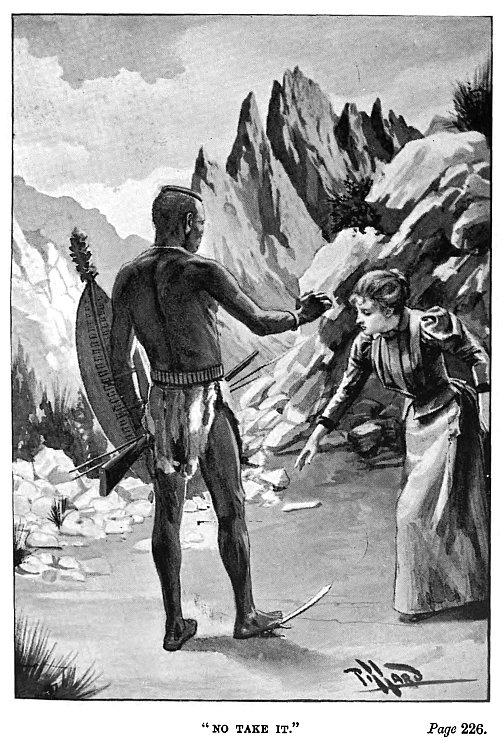
“No take it.”
By now Nidia’s first fear had begun to calm down. She had been in the power of some of these people before, and they had not harmed her; wherefore she tried to put on a bold front towards this one.
“Who are you?” she said, speaking slowly to facilitate the man understanding her. “You frightened me at first; not now.”
“Ikonde, (baboon) he flighten much more,” was the answer made with a half laugh. Then Nidia noticed that this Matabele had by no means an unpleasant face; indeed, she could hardly believe that he belonged to the same race as the fiends who had slaughtered the Hollingworths.
“No be flighten,” he went on. “I see you before—one, two, tlee—much many time.”
“Seen me before?” echoed Nidia in astonishment. “Where?”
“Kwa Jonémi.”
“Jonémi?” she repeated, with a start. “You know him?”
The warrior laughed.
“Oh, yes, missis. I know him. I Pukele. Jonémi his boy.”
“Ah; now I see. You were his servant? You are the man who saved his life, when the others were all murdered?” For Nidia had, of course, heard the whole story of the tragedy in Inglefield’s quarters.
“I dat man, missie,” said the other, with a grin that showed a magnificent set of teeth. “Umlimo he say kill all Amakiwa—white people. Pukele say, No kill Jonémi. Amapolise dey kill Ingerfiel, and missis, and strange white man. I not help. I go wit amapolise. I save Jonémi. See,” lifting his foot off the sword-bayonet, “I give him dis.”
“And for that you will never be sorry, I promise you,” said Nidia. “Listen, Pukele. For that, and that alone, you shall have what will buy twenty cows. I will give it you when we are safe again. Only—you must never tell Jonémi.”
The man broke into extravagant expressions of delight, in his own tongue, once he had begun to grasp the burden of this promise, declaring that Jonémi had always been his “father,” and he was not going to let his “father” be killed, even at the bidding of ten Umlimos—looking round rather furtively however, as he gave utterance to this sacrilegious sentiment.
“You said you had seen me at Jonémi’s,” went on Nidia; “but I have never been there. It must have been somewhere else.”
“No somewhere else. I see missie on bit of paper, hang on de wall. Jonémi he have it in hut where he sleep. He often stand, look at it for long time.”
A soft flush came into Nidia’s face, accompanied by a pleased smile.
“And you knew me from that?” she said. Then all her anxiety coming back upon her—for she had momentarily lost sight of it in the feeling of safety engendered by this man’s appearance and identity—she exclaimed—
“But where is Jonémi? He went out yesterday—not much after midday—and should have been back by sundown. You must find him, Pukele.”
The man uttered some words to himself in his own tongue, which from the tone were expressive of like anxiety. Then, to her—
“Which way he go?”
She pointed out, as best she could, the way John Ames had proposed to take. Pukele shook his head.
“No good dat way. Much Matabele dere. ’Spose he fire gun, den Matabele hear him for sure.”
Nidia’s face blanched, and she clasped her hands together wildly.
“You don’t think they have—killed him?” she said slowly.
In his heart of hearts Pukele thought that nothing was more likely; but he was not going to say so.
“I tink not,” he answered, “Jonémi nkos’nkulu. Great master. He aflaid o’ nuffin. Matabele much like him.”
“Listen, Pukele,” said Nidia, impressively. “You must go and find him.”
“But what you do, missis? You be flighten, all alone. Suppose Uconde—bobyaan—he come again, you much flighten? I be away till sun, him so,” pointing to the western horizon.
“I’ll be frightened of nothing,” she answered emphatically. “Leave me one of your long assegais, and go. Even if you have to be away all night, don’t come back. I’ll get through it somehow. But—find Jonémi.”
With many injunctions to her not to wander far from this spot, where to hide in the event of any Matabele chancing to pass that way, and promising to be back by sundown, Pukele took his departure. Once more Nidia was alone. This time, however, loneliness in itself no longer oppressed her. Intense anxiety on behalf of another precluded all thought of self.
True to his promise Pukele returned at sundown, and he had learned something. Jonémi had fallen in with the Matabele, even as he had expected. He had talked with the indunas, and having bidden farewell had walked away. That was about the same time last evening. But Pukele said nothing of the subsequent and stealthy pursuit, and the plunge from the height, for the simple reason that these were among the things he had not learned. The agents concerned in that last tragedy had their own motives for not advertising it abroad.
“Who were the indunas he was talking with?” asked Nidia, suddenly.
“Dey izinduna from Sikumbutana,” replied the warrior, as she thought, evasively; and in truth this was so, for although he would do anything to assist his former master, or one in whom his former master took an interest, Pukele’s native instincts were against revealing too much. There was always in the background a possibility of the whites regaining the upper hand, in which case it was just as well that the prime movers in the rising should not be known to too many by name.
“But if they were his own people they would not harm him?”
“Not harm him, missie. He walk away.”
“Then why is he not here, long before now?” Then, excitedly, “Pukele, you don’t think—they—followed him up in the dark—and—and killed him?”
This again Pukele thought was far from unlikely. But he dissembled. It was more probable, he declared, that Jonemi had taken a longer way to come back in order to throw off his track any who might be following. Or he might have discovered another impi and be forced to travel in the opposite direction to avoid it. He might be back any time.
This for her benefit. But in his heart of hearts the Matabele warrior thought that the chances of his former master being still in the land of the living were so small as to be not worth reckoning with. So he made up the fire, and cooked birds for Nidia and prepared to watch over her safety.
That night weird sounds came floating up to their resting-place, a rhythmical distant roaring, now subsiding into silence, then bursting forth again, till it gathered volume like the rolling of thunder. Fires twinkled forth, too, like eyes in the darkness, among the far windings of the hills.
“What is that, Pukele?” cried Nidia, starting up.
“Matabele make dance, missie. Big dance. Umlimo dance Matabele call him,” replied the savage, who was listening intently.
“Umlimo dance. Ah! I remember. Is there an Umlimo cave down there, where they are?” For she was thinking of the place John Ames had pointed out to her the day before, and his remark that if it wasn’t a real Umlimo cave, it ought to be. And these strange wild sounds seemed to proceed from about that very spot.
“An! Umlimo cave, what dat, missie?” inquired Pukele.
“A cave—a hole—where Umlimo speaks from,” she tried to explain. But the other became suddenly and unaccountably dense.
“Gave? Hole? Oh yes, missie. Plenty hole here. Plenty hole in Matopo. Oh yes. Big mountain, plenty hole.”
The great volume of savage sound came rolling up almost unintermittently till midnight. Then there was silence once more.
The next day, John Ames did not appear, nor the next. Then, in utter despair, Nidia agreed to Pukele’s repeated proposal to guide her out of the hills, and if possible to bring her into Bulawayo itself.
And right well and faithfully did this barbarian fulfil his undertaking. The rebels were coming into the hills now, and every step of the way was fraught with danger. He made her lie hidden during the day, always choosing some apparently inaccessible and least suspicious looking retreat, while he himself would wander forth in search of the means of subsistence. At night they would do their travelling, and here the eyes of the savage were as the eyes of a cat, and actually the eyes of both of them. And throughout, he watched over her safety with the fidelity of a dog.
One great argument which had availed to induce Nidia to yield to her guide’s representations, was that once she was safe in Bulawayo, he would be left free to pursue his search for the missing man. As to which, let him but succeed, she assured him, and he would be a rich man—as his people counted riches—for life.
Thus journeying they had reached the outskirts of the hills, and could now and then obtain glimpses of the open country. Twice had Pukele fallen in with his countrymen, from whom he had gleaned that it was so far open around Bulawayo, but would not be long, for the Umlimo had pronounced in favour of shutting it in, and the impis were massing with that object.
Pukele was returning from a solitary hunt, bringing with him the carcase of a klip-springer. He was under no restriction as to who heard the report of his rifle, and being a fair shot, and as stealthy and active as the game itself, he seldom returned from such empty handed. Moreover, he knew where to find grain when it was wanted, wherefore his charge suffered no disadvantage by reason of short commons. He was returning along the base of a large granite kopje. The ground was open immediately in front, but on his left was a straggling line of trees and undergrowth. Singing softly to himself he was striding along when—
Just the faintest suspicion of a tinkling sound. His quick ears caught it. At any other time he would have swerved and with the rapidity of a snake would have glided and disappeared among the granite boulders. Now, however, he stood his ground.
Three mounted men—white men—dashed from the cover, with revolvers drawn. Pukele dropped his weapons and held forth his arms.
“Fire not, Amakiwa!” he said, in his own tongue. “I was seeking for such as ye.”
But the mounted volunteers, for such they were, understood next to nothing of that tongue. They only saw before them, a native, a savage, a rebel, fully armed, with rifle and assegais, and in war-gear.
Pukele being a native, and having such an important communication to make as that a refugee white woman was under his charge whom he desired to place under theirs, it was not in him to make it in three words, nor would these have understood him if he had. He, however, stood waiting for their answer. A fourth trooper dashed from the bush.
“What are you waiting for, you blanked idiots?” he yelled. “Here’s a bloody nigger, ain’t there? Well, then—Remember Hollingworth’s!”
With the words he discharged his revolver almost point-blank into Pukele’s chest. Another echoing the vengeful shout, “Remember Hollingworth’s!” fired his into the body of the faithful protector of the only survivor of Hollingworth’s, which slowly sank to the earth, then toppled forward on its face.
The troopers looked upon the slain man with hate and execration. They, be it remembered, had looked upon the bodies of their own countrymen and women and children, lying stark under all the circumstances of a hideous and bloody death. Then the first man who had fired, dismounted and seized the dead warrior’s weapons, administering a savage kick to the now motionless corpse. So Pukele met with his reward.
“Get into cover again. There may be more of ’em!” he enjoined. And scarcely had they done so than the rest of the troop—for which these had been acting as flying scouts—having heard the firing, came hurrying up.
The affair was reported. Those in command jocosely remarking that it seemed a devil of a waste of ammunition to fire two shots into one nigger, who was neither fighting nor running away. Orders were given to keep a sharp look-out ahead, in case the slain man should be one of the scouts of an impi, and the troop moved on. It was, in fact, a relief troop which had been formed to search for and rescue such whites in the disturbed districts who had not already been massacred, and of such it had found and rescued some. Now it was returning.
Soon it was reported that the scouts had descried something or somebody, moving among the granite boulders of an adjacent kopje. Field-glasses were got out.
“By George, it’s a woman. A white woman!” cried the officer in command, nearly dropping his glass from his hand. “She looks the worse for wear too, poor thing. Another of these awful experiences, I’ll bet a dollar. She’s seen us. She’s coming down off the kopje. But we don’t want to scare her with all our ugly faces, though. Looks like a lady too, in spite of her tatters, poor thing,” he went on, with his glass still at his eyes. “Moseley, Tarrant—you might step forward and meet her, eh? We don’t need all to mob her in a body.”
“We’ve met her before, I think, colonel,” said the latter, who had also been looking through his field-glasses. “And that was at Hollingworth’s.”
“No!”
“Fact. When we got there she had disappeared, leaving no trace. Great Heaven, where can she have been all this while? Come along, Moseley.”
Great sensation spread through the troop, as it got abroad that this was the girl whose unknown fate had moved them all so profoundly. Several were there, too, who had been present at the discovery of the murdered family, and whose cherished thoughts of vengeance had been deepened tenfold by the thought of this helpless English girl in the power of the very fiends who had perpetrated that atrocity.
Under the circumstances, it was little to be wondered at if the voices of Moseley and Tarrant were a little unsteady as they welcomed the fugitive, and if indeed—as those worthies afterwards admitted to each other—they felt like qualified idiots, when they remembered the bright, sweet, sunny-faced girl, with the stamp of daintiness and refinement from the sole of her little shoe to the uppermost wave of her golden-brown hair. And now they saw a sad-faced woman, wistful-eyed, sun-tanned, in attire bordering on tattered dishevelment. Truly a lump gathered in their throats, as they stood uncovered before her and thought of all she must have gone through.
“Welcome, Miss Commerell. A hearty, happy welcome,” was all that Moseley could jerk out, as he put out his hand. “Thanks. Oh yes. We have met before,” with a tired smile, in answer to Tarrant’s rather incoherent greeting. “But—where are the rest of you? Ah—I see—over there.”
Soon the officer in command was welcoming her, and the troopers gradually edged in nearer, for curiosity was great and discipline by no means rigid.
“And I am among friends at last, and safe?” looking from one to the other, in a half vacant way, “But where is Pukele?”
“Who is ‘Pukele,’ Miss Commerell?” said Moseley.
“A Matabele. He has guided and taken care of me for the last week. Where is he? Isn’t he here? Didn’t he bring you to me? He went out to find game. I thought I heard him fire two shots, just lately, and came out to see. Then I saw you all. Where can he be?”
Where indeed? A strange, startled look was now on the faces of several of her listeners, including those in command. “Went out to find game.” And the native just shot was in possession of a klip-springer.
Dreamily Nidia continued—
“I feel so tired. Where am I, did you say?” Then passing her hands over her eyes, “How dark it seems” (it was mid forenoon). “I think—I’ll—rest.” And she sank down in a deathly swoon.
“Jee-hoshaphat, Jack!” a trooper in the background was saying. “That was her nigger you chaps bowled over. And now she’s asking for him.”
“What did the fool run up against our guns for, in that cast-iron hurry?” sullenly grumbled the other, who was really sorry for the mistake. “It wasn’t our faults, was it?”
“Of course not, old man,” rejoined the other. “It was nobody’s fault—only the nigger’s misfortune. Accidents will happen.”
Such the epitaph on the faithful, loyal savage, who having watched over the helpless refugee for days and nights that he might restore her to friends and safety, had found his reward. Shot on sight, by those very friends, when in the act of consummating his loyalty, such was his epitaph. “Accidents will happen!”
Chapter Twenty Three.
Entombed.
When John Ames at last returned to consciousness, the first thought to take definite shape was that he was dead. There was a rock ceiling overhead. He had been dragged into a cave, he decided, a favourite place of sepulture for natives of rank. His enemies had accorded him that distinction. He could not move his limbs. They had been bound round him.
Then there returned in dim confused fashion the events of the day; the surprise; the visit to Madúla’s camp; the crafty pursuit; the sudden ending of the ground beneath his feet; the plunge through empty air; then—starry void; and remembering it all, the supposed funeral ligatures took the form of a blanket, which, wrapped tightly round him, impeded the use of his limbs. He was not dead, only dreaming, suffering from a bad nightmare. The blanket—the rock overhead! What a blessed relief! All the events, terrible and tragic, he had just gone through, were parts of a dream. Nidia was not left alone in that savage wilderness, but here, within a few yards of him. He was lying across the entrance of her retreat, as usual, that none might imperil her save by passing over him. Filled with an intense thankfulness, he lay and revelled in the realisation that it had all been a dream. Still it should act as a warning one. Never would he be so confiding in their security again.
The light grew and spread. The grey rock above him became less shadowy, more distinct. Whence the languor that seemed to attend his waking hours, the drowsy disinclination to move? Yet there it was. Well, he must combat it; and with this idea he suddenly sat up, only to fall back with a cry of acute anguish. His head was splitting.
For some time he lay, unable to move, thinking the while whether his cry had disturbed Nidia. No; she had not moved. At last an idea took hold of his confused brain. Their camping-ground this time was not a cave. It was in the open. Whence, then, this rock—this rock which somehow seemed to weigh upon him like a tombstone? And—Heavens! What was that over there? A table?
A table! Why, a railway engine would have been no more phenomenal at that moment. A table! Was he dreaming? No. There it stood; a sturdy, if unpretentious four-legged table, right up against a tolerably perpendicular rock-wall.
He stared at it—stared wildly. Surely no such homely and commonplace object had ever been the motive power for such consternation, such despairing, sickening disappointment before. For it conveyed to him that the events of the previous day had been no dream, but dire reality. Where he now was he had no idea, but wherever it might be, it was certainly not in the place where he had parted from Nidia and she would still be undergoing all the horrors of utter solitude. Again he tried to leap up; but this time an invisible hand seemed to press him down, an unseen force to calm and hypnotise him, and in the result everything faded into far-away dimness. Nothing seemed to matter. Once more he dropped off into a soothing, dreamless slumber.
How long this lasted he could not have told. On awakening, the frightful brain agony had left him. He could now raise his head without falling back again sick with pain. The first thing he noticed was that the place was a rock-chamber of irregular shape; the further wall nearly perpendicular, the ceiling slanting to the side on which he lay. A strange roseate light filled the place, proceeding from whence he knew not. But now he became conscious of a second presence. Standing within this light was a human figure. What—who could it be? It was not that of a native. So much he could see, although the back was towards him. Then it turned. Heavens! though he had not seen it before, the recognition was instantaneous. This was the apparition at their former camp. The tall figure, the weather-worn clothing, the long white beard, and—the face! Turned full upon him, in all its horror, John Ames felt his flesh creep. The blasting, mesmeric power of the eyes, surcharged with hate, seemed to freeze the very marrow of his bones. This, then, was petrifying him. This, with its baleful, basilisk stare, was turning his heart to water. What was it? Man or devil?
There was a spell in the stare. That glance John Ames felt that his own could not leave. It held him enthralled. At all risks he must break the spell. “Where am I?” he exclaimed, astonished at the feebleness of his own voice.
“In luck’s way this time. Perhaps not,” came the reply, in full, deep tones. “What do you think of that, John Ames?”
“You appear to know me; but, I am sorry to say, the advantage is all on your side. Where have we met before?”
The other’s set face relaxed. A ghastly, mirthless laugh proceeded from a scarcely opened mouth. There was that in it which made the listener start, such an echo was it of the mocking laugh thrown back at him out of the darkness when challenging that shadowy figure at their former camp.
“Where have we not met?” came the reply, after a pause. “That would be an easier question to answer.”
“Well, at any rate, it is awfully good of you to have taken care of me like this,” said John Ames, thinking it advisable to waive the question of identity for the present. “Did I fall far?”
“So far that, but for a timely tree breaking your fall, you would hardly have an unbroken bone within you now.”
“But how did I get here? Did you get me here alone?”
“A moment ago you were deciding that curiosity might sometimes be out of place. You are quick at changing your mind, John Ames.”
The latter felt guilty. This was indeed “thought-reading” with a vengeance.
“Yes; but pardon me if it seems to you inquisitive—it is not meant that way,” he said. “The fact is, I am not alone. I have a friend who will be terribly anxious—in fact, terribly frightened at my absence. I suppose you are in hiding, like ourselves?” Again that mirthless laugh.
“In hiding? Yes; in hiding. But not like yourselves.”
“But will you not join us? I know my way about this sort of country fairly well, and it is only a question of a little extra care, and we are bound to come through all right.”
“Such ‘little extra care’ as you displayed only yesterday, John Ames? Yet an evening or so back you thought my presence hardly likely to prove an acquisition.”
The cold, sneering tone scarcely tended to allay the confusion felt by the other at this reminder. This, then, was the apparition seen by Nidia, and he had been able to draw near enough to overhear their conversation with reference to his appearance. The thought was sufficiently uncomfortable. Who could the man be? That he was an eccentricity was self-evident. He went on—
“You were right in saying that your ‘friend’ would be terribly frightened. She has gone through such a night as she hopes never to spend again, and her fears are not over, but this time they are very material, and are for herself. There are shapes stealing upon her down the rocks—dark shapes. Natives? No. Human? No. What then? Beasts. She screams; tries to drive them off. They grow bolder and bolder—and—”
“Heavens alive, man, don’t drive me mad!” roared John Ames, whirling up from his couch, forgetful alike of aching bones and bruised and shaken frame. “What, is it you see—or know? Are you the devil himself?”
But the face of the seer remained perfectly impassible. Not so much as a finger of his moved. His eyes seemed to open wider, then to close; then to open again, as one awakening from a trance. Their expression was that of slight, unperturbed surprise.
“Look here, now,” said John Ames, quickly and decidedly. “You have taken care of me when I was in a bad fix, and most likely saved my life. I am deeply grateful, and hope we shall get to know each: other properly. But just now I must not lose a moment in going back to my friend, and if you won’t go with me, I’ll ask you to put me into my bearings.”
The stranger did not move in his attitude, or relax a muscle.
“You can’t go from here now,” he said; “nor, in fact, until I allow you.”
“Can’t? But I must!” shouted John Ames. “Heavens! I don’t see how you can know all you have been saying; but the bare suggestion that she may be in danger—all alone and helpless—oh, good God, but it’ll drive me mad!”
“How I can know? Well, perhaps I can’t—perhaps I can. Anyway, there’s one thing you can’t do, and that is leave this place without my aid. If you don’t believe me, just take a look round and try.”
He waved his hand with a throw-everything-open sort of gesture. In feverish strides, like those of a newly caged tiger, John Ames quickly explored the apartment, likewise another which opened out of it. His mind fired with Nidia’s helplessness and danger, he gave no thought to the curious nature of this subterranean dwelling; all he thought about was means of egress.
At the further end of the apartment in which he had been lying yawned a deep shaft like that of a disused mine. Air floated up this; clearly, therefore, it gave egress. But the means of descent? He looked around and above. No apparatus rewarded his view—not even a single rope. He explored the further chamber, which, like the first, was lighted by a curious eye-shaped lamp fixed in a hole in the rock-partition wall. Here too were several smaller oubliette-like shafts. But no means of exit.
The while, his host—or gaoler—had been standing immovable, as though these investigations and their results had not the faintest interest for him. John Ames, utterly baffled, gave up the search, and the terrible conviction forced itself upon him that he was shut up in the very heart of the earth with a malevolent lunatic. Yet there was that about the other’s whole personality which was not compatible with the lunatic theory; a strong, mesmeric, compelling force, as far removed from insanity in any known phase as it could possibly be. Power was proclaimed large in every look, in every utterance.
“Was I right?” he said. “But patience, John Ames; you must be pitifully wrapped up in this—‘friend’ of yours, to lose your head in that unwonted fashion. Unwonted—yes. I know you, you see, better than you do me. Well, I won’t try your patience any longer. Had you not interrupted me it would have been better for you; I was going on to say that while I saw danger I saw, also, succour—rescue—safety.”