"John Ames, Native Commissioner" (continued 3)
Reading edition
How still it all was! Had their mother taken those earthquakes of children for a walk? she wondered. Even then it was strange to be out of earshot of their voices, if only in the distance. Well, the youthful hunter should be in, anyhow.
“Jimmie!” she called. “Jim-mie!”
No answer.
The front door was closed. She noticed that the trail went round as though to the back of the house, yet in front of the closed door the blood-patches lay thicker than ever. Jimmy would catch it when his mother came back, she thought to herself, for bringing his quarry in at the front door and making that horrid mess. Lifting her skirt to avoid the latter, and making a little grimace of disgust, she turned the handle.
There was a window opposite, but the blind was down. To Nidia, coming in from the full glow of the sunlight, the room was almost dark. Only for a moment though, and then she saw—
She saw that which might have turned many a stronger brain than hers—she saw that which made her cover her eyes with her hands, and stagger back against the doorpost with a low wailing cry of such unutterable horror as can rarely have proceeded from human throat. Oh Heaven! must she look again and go mad? was the thought which flashed through her mind as with hands pressed to her eyes she leaned against the doorpost as rigid as though turned to stone.
On the couch beneath the window aforesaid lay the form of Hollingworth—the form, for little else about the wretched man was distinguishable but his clothing. His skull had been battered in, and his features smashed to a pulp. There he lay, and on the floor beside him a periodical which he had been reading before overtaken by the sleep from which he was destined never to awaken. In one corner lay the corpse of his wife—and, in a row, four children, all with their skulls smashed, and nailed to the ground with assegais—the whole having undergone more or less nameless horrors of mutilation. This is what she saw—this girl—who had never looked upon a scene of violence or of bloodshed in her life. This is what she saw, returning in serene security to the peaceful home that sheltered her. No wonder she stood against the doorpost, her hands pressed tightly to her eyes, her brain on fire. Was it a dream—an awful nightmare? The very magnitude of the horror saved her.
Out into the air again. Not another glance dare she venture into that scene of hideous butchery. Out into the air again. The same golden sun was shining, the same fair earth, the same feathery foliage peaceful in the afternoon light. But within? The world began to go round with her. She staggered as though to sink into a swoon, when—
What was that? A cry? A moan? From the back of the house it seemed to come, and it was distinctly that of a human being in pain. Thither Nidia flew. The sound had created a diversion, and had certainly saved her brain from giving way from shock and fright.
A form was lying on the ground covered with blood and dust. Nidia recognised it in a moment for that of Hollingworth’s eldest boy—the youthful hunter whose prowess she had been about to congratulate.
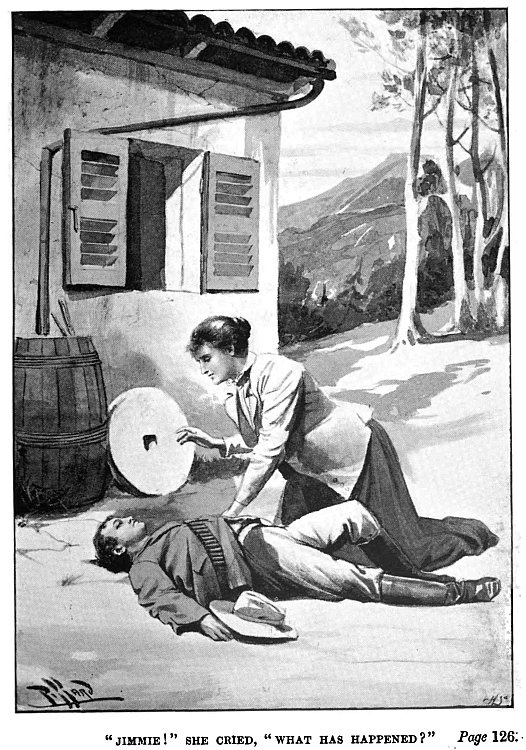
“Jimmie!” she cried, bending over him. “Jimmie, my poor child, what has happened? What have they done to you—to—to everybody?”
Her voice broke down, and she could only sob piteously. She tried to raise the boy’s head, but he screamed.
“Oh, don’t—don’t! Oh, it hurts!”
To her horror, Nidia saw something of the extent of the terrible injuries the poor little fellow had received. Besides a huge bump on the side of the head he was covered with assegai-stabs. Yet he was still alive. Amid his moans, he looked up suddenly.
“Oh, it’s you, Miss Commerell!” he gasped.
“Yes—yes. Oh, my dear little boy, what does it all mean?” she wailed, her voice thrilling with horrified pity.
A gleam came into the boy’s eyes, and for the moment he seemed to forget his agony.
“I—plugged two of the devils,” he said—“two of them. One was Qota, our boy. He got the charge of buckshot, the other the bullet. Then they hit me on the head with a kerrie. Oh-h!”
He sank back groaning under a renewed spasm of pain. This, then, was the double shot Nidia had heard. She saw now the meaning of the bloody trail which she had imagined was that made by the youthful hunter dragging home his quarry. The miscreants had dragged away the bodies of their own dead. Two of them had been sent to their account, red-handed, and that by this mere child, either in defence of those who were all to him, or revengeful in his rage and grief. Bit by bit she got at the truth.
He was returning from an unsuccessful stalk, and had gained the outside of the bush behind the house, when he heard a low prolonged scream proceeding from within. In this he recognised the voice of his mother. Cocking his gun, he ran hurriedly forward, but before he could gain the front door he was met by several savages armed with axes and knobkerries. Two of these he immediately shot—shot them dead, too, he declared—and then, before he could slip in fresh cartridges, they were upon him. The gun was wrenched from his hand, then something seemed to fall upon his head, for after that he knew no more.
All this was told spasmodically between lengthened pauses, and the effort had quite exhausted the poor little fellow. And now some inkling of the situation seemed to rush through Nidia’s reeling brain, though even then the idea that this wholesale murder was but one instance of several at that very moment throughout the land, did not occur to her. She supposed it to be a mere sporadic outbreak of savagery, or lust of plunder. It was clear, too, that this poor child was ignorant of all that had actually happened within, and she felt a sort of miserable consolation in realising that physical agony had so confused his mind that he showed no curiosity on the subject. Nor would he allow her to examine the extent of his hurts. If she so much as touched him he screamed aloud; but she knew, as confidently as though assured by the whole faculty, that his hours were numbered.
“I feel sleepy. How dark it is!” he murmured at length.
Dark! Why, the surroundings were in a very bath of lustre—of golden sunlight glow.
“So sleepy. Don’t leave me. Promise you won’t leave me!”
“Of course I won’t leave you, Jimmie darling,” sobbed Nidia, bending down and kissing his forehead; for well she knew what this deepening coma portended. Soon again he spoke, but in the feeblest of murmurs. “You must go. They’ll come back and find you; then they’ll kill you, the devils. You must go. Hide in the bush, down below the river-bank. They won’t look there. Go—go quick. They’ll come back. Hark! I hear them.”
“But I won’t go, Jimmie; I won’t leave you, whether they kill me or not,” she sobbed, moved to the heart by the unselfishness of this child-hero, who had first slain with his own hand two of the murderers of his parents, and now was urging her to leave him to the solitude he dreaded, lest she should meet with the same fate. But this heroic injunction was his last utterance. A few minutes, and the head fell back, the eyes opening wide in a glassy stare. Little Jimmie had joined his murdered kindred.
The sun sank beneath the rim of the world, and the purple shades of the brief twilight deepened over this once peaceful homestead, now a mausoleum for its butchered inmates lying in their blood. And still Nidia sat there holding the head of the dead boy in her lap.
Chapter Thirteen.
What happened at Jekyll’s Store.
Jekyll’s Store, near Malengwa, was an institution of considerable importance in its way, for there not only did prospectors and travellers and settlers replenish their supplies, but it served as a place of general “roll up,” when the monotony of life in camp or on lonely farms began to weigh upon those destined to lead the same.
Its situation was an open slope, fronting a rolling country, more or less thickly grown with wild fig and mahobo-hobo, mimosa and feathery acacia. Behind, some three or four hundred yards, rose a low ridge of rocks, whose dull greyness was relieved by the vivid green of sugar-bush. Strategically its position was bad, but this was a side to which those who planted it there had not given a thought. The Maxims of the Company’s forces had done for the natives for ever and a day. There was not a kick left in them.
The building was a fair-sized oblong one, constructed of the usual wattle and “dagga” as to the walls, and with a high-pitched roof of thatch. Internally it was divided into three compartments—a sleeping-room, a living-room, and the store itself, the latter as large as the two first put together. From end to end of this was a long counter, about a third of which was partitioned off as a public bar. Rows of shelves lined the walls, and every conceivable article seemed represented—blankets and rugs; tinned food and candles; soap and cheese; frying-pans and camp-kettles; cooking-pots and high boots; straps and halters; Boer tobacco and Manila cheroots; all jostling each other, down even to accordions and concertinas, seemed only to begin the list of general “notions” which, either stacked on shelves or hanging from the beam which ran along the building parallel with the spring of the roof, filled every available space. Bags of mealies, too, and flour stood against the further wall; and the shelves backing the bar department were lined with a plentiful and varied assortment of bottles.
Not much less varied was the type of customer who was prone to sample their contents. Miners working for a wage, independent prospectors, transport riders, now and then a company promoter or a mining engineer or surveyor, settlers on farms, an occasional brace of troopers of the Matabeleland Mounted Police—would all roll up at Jekyll’s in turn; but by reason of the wide distances over which the sparse population was scattered, there were seldom more than a dozen gathered together there at once—usually less. But even there the characteristics of the gathering were much akin to those pervading similar groups as seen in older civilisation—the bore simple and the bore reiterative, the local Ananias, usually triplicated; the assumptive bore; the literary critic—the last especially in full bloom after a few rounds of “squareface” or John Dewar—and other varieties. Such characteristics, however, were well known to the sound residue of the assemblage, who would delight to “draw” the individual owners thereof—after the few rounds aforesaid.
Within the store and canteen part of the building about a dozen men were gathered when Moseley and Tarrant rode up. All were attired in the usual light marching order of the country—shirt and trousers, high boots and wide-brimmed hat. Some were lounging against the counter, others squatting on sacks or packing-cases, and all were smoking. Jekyll, himself, a tall man with a grizzled beard, and who had been a good many years in the country before the entry of the first Pioneer force, was dispensing drinks, with the help of his assistant, a young Englishman who had been ploughed for his degree at Oxford. To several of these the new arrivals were known, and forthwith there was a fresh call on the resources of the bar department.
“News?” said Jekyll, in reply to a question from Moseley. “Thought maybe you’d have brought some. There’s talk of a rising among the niggers down beyond Sikumbutana. Heard anything of it?”
“Not a word.”
“Gah on. There won’t be no bloomin’ rahsin’,” cut in a prospector, a Cockney ex-ship-steward. “Nothink but a lot o’ gas. The wy to treat niggers is my wy.”
“And what might that be?” said another prospector, a tall, bronzed, fine-looking man, who had taken his degree at Oxford.
“Why, one o’ my boys cheeked me yesterday, so I ups with a bloomin’ pick-’andle and jes lets ’im ’ave it over the bloomin’ boko. That’s my wy with ’em.”
And the speaker cocked his head and looked around with the defiant bounce of a cad with a couple of drinks too many on board.
“H’m!” rejoined the other man, drily.
“By-the-by,” said Tarrant, “I wonder what Mafuta did with my rifle and cartridges.”
Jekyll pricked up his ears.
“Is that one of your boys?” he said.
“Yes. He was carrying my gun and cartridges.”
“Well, there was no gun and cartridges with your donkeys when they turned up.”
“The devil there wasn’t!” said Tarrant. “Let’s go and look into it.”
They went outside, Jekyll and two or three others accompanying them. The three boys in charge of the donkeys were there. They had off-loaded the packs and taken them inside. Where was Mafuta? They did not know. They had last seen him about half way; after that no more. They thought perhaps he had been ordered to try and shoot some game on the way. Tarrant looked blue.
“Oh, he’ll turn up,” he said, in a tone which conveyed the idea that such a contingency was remote.
“Pity you trusted him with a gun in these times,” said Jekyll. “I’m afraid he’ll clear with it.”
“Wot’ll yer tike for the chawnce?” said the Cockney, who was one of those who had accompanied them outside.
“Oh, he’ll roll up directly,” said Tarrant, ignoring this specimen; “Mafuta’s a reliable boy. I’ve had him a long while.”
Returning from the huts, they became aware of a certain amount of excitement in front of the store. A trooper of the Matabeleland Mounted Police had just ridden up. The rising was a fact, and he had been sent round to warn everybody to come in to Bulawayo if possible; if not, to collect together and form laagers. Several prospectors and miners had been murdered in the Sikumbutana district, but how far the outbreak had spread could not as yet be determined. He was on his way to warn Hollingworth; after that, if he could manage it, he must get through to John Ames’.
The excitement produced by this news was mingled with consternation. Half of those there collected were unarmed. Those who had weapons had left them behind at their camps; while some, with the habitual British carelessness which passes for intrepidity, had not even got any there.
The police trooper’s horse was offsaddled and put into one of the huts which did duty for stable for a feed and a brief rest, and then the whole party re-entered the store to discuss the situation and a fresh round of drinks. While this was in progress some one reported a party of natives approaching from the open side in front of the house. Quickly Jekyll got out a powerful binocular.
“There are about thirty of them,” he said, “but they’ve got no guns—only knobkerries and some axes. On the face of the latest news I believe they mean mischief. Now, chaps, we’ll startle ’em some. They won’t know there’s a whole crowd of you here. They’ll think there’s only me and Selwyn to deal with. Who’ve got guns?”
Seven answered in the affirmative.
“All right. Now then. You, Carbutt and Harris, get to that front window in t’other room—don’t let ’em see you, though. I’ll go out in front and indaba them. Selwyn ’ll stand in the doorway lighting his pipe—and when I sing out, ‘Let go,’ blaze away into the foremost of them. I shall want some men to go outside at the back of the house, though.”
All volunteered.
“No. You three’ll do”—indicating the policeman and two others. “Directly you hear the first shot fired, whip round to the front and blaze into them for all you’re worth. See the plan?”
“Rather, and an A1 plan it is,” said Moseley, who was one of the rearguard, slipping a couple of heavy buckshot cartridges into his shot-gun.
Those for behind scrambled through the back windows—the other two were already in position, one armed with a Winchester, the other with a Lee-Metford. Hardly had they done so than the natives emerged from the sparse bush in front.
There was nothing warlike in their aspect; indeed, to all appearance, they might have been a gang of boys travelling round to look for work in the mines. They halted about fifty yards from the house, and Jekyll, in pursuance of his plan, strolled about a dozen to meet them. Then he called for a couple of them to come up.
Who were they, he asked, and where going? They were looking for work, the spokesman answered. Could the ’Nkose take any of them on? Jekyll observed that perhaps he could do with two or three. Selwyn, the English assistant, was standing in the doorway, carelessly lighting his pipe. Others now began stealing up towards the two spokesmen. The savages little knew into what a trap their treachery was leading them. Then a shout arose from among them:—
“Tyay’ Amakíwa!” (Strike down the whites.)
But, simultaneously with the rush made upon Jekyll, and for which the words were the signal, the rifles of the two men at the window crashed forth in one report. The two foremost Matabele dropped dead, while the three men stationed behind the house were in position at once, and simply raked the whole crowd. Again and again the magazine rifles spoke, and between them and Moseley’s buckshot the result was that a little more than half the treacherous assailants were running for dear life and for the nearest bush; while Jekyll, who had not stirred throughout, stood re-lighting his pipe as if nothing had happened.
“Sharp work, chaps,” he said, as they all came out to see the result. “We’ve taught them how to fight the devil with fire—eh?”
The transformation was marvellous in its rapidity. The place which, five minutes before, had been the scene of a peaceful gathering, was now one of slaughter. More than one there present, who had never witnessed death by violence, gazing upon the stark, bleeding corpses, looked uncomfortable.
“Here’s one who isn’t dead,” said Jekyll. “Let’s see if he’ll give away anything.” And, bending down, Jekyll began to talk fluently in Sindabele. But the wounded man, a big, evil-looking savage, answered never a word. He had a bullet through him, and a couple of grains of heavy buckshot, and was bleeding profusely. The wonder was he was still alive. To all of Jekyll’s questions he answered nothing.
“I sy. ’E’s a bloomin’ impident black beggar, I don’t think,” said the Cockney, giving the prostrate native a push with his foot that was more than half a kick. “Wish I ’ad my bloomin’ pick-’andle ’ere.”
“Oh, shut up, Higgins, and leave the nigger alone,” said the man who had first taken exception to the swaggering cad’s bounce. “We don’t do things that way here.”
“’Ere, I sy, I’d like to know what I’ve done. Cawn’t a chep mike a bloomin’ blanked nigger awnswer a question when a gentleman arsts ’im one—hy?”
But whether this feat was practicable or not was destined to remain unrecorded, for at that moment came the crash of a volley poured from the line of bush wherein the discomfited barbarians had disappeared, and the vicious hum of missiles overhead and around, knocking chips of plaster from the walls of the house. Two men staggered, only wounded though, among them the police trooper, who was shot in the leg.
“Get inside, sharp,” sang out Jekyll, himself hauling in one of the wounded. “Stand ready. They’ll charge directly.”
Hurriedly, yet without panic, the men regained the shelter of the house. At the same time a cloud of savages, who had wormed their way up through the long grass, rose on the edge of the bush, and again poured in their fire. Again the bullets whizzed overhead, some penetrating the plaster wail, but no one was hit. Those within had already flown to the windows, and were returning the fire with a will. Several were seen to fall. The rest dropped down into cover again. Clearly they had no stomach for charging that determined few under cover.
“That’s all right,” said Jekyll. “This is all part of the scheme. These jokers have got on their war-gear. The first lot were an advance guard. I say, Selwyn, where would you and I have been now but for our friend here giving us the office? We’d have been quietly knocked on the head—eh?”
“We’d have had no show at all,” replied the assistant, who was brimful of pluck and beginning to enjoy the fight. But Jekyll, and two or three others, who were alive to the gravity of the situation, failed to discover an enjoyable side thereto.
The Matabele were evidently in sufficient force to render them over-confident, and, indeed, they were hardly careful to remain under shelter. Squads of twenty and thirty could be seen pouring in to swell the already formidable number, glancing through the bush and long grass, all in war-gear, with flowing tufts of red or white cowtail, and wearing the isiqoba, or ball of feathers, on the forehead. Warriors, defying fate, would spring up, and go through the performance known as “gwaza” making a series of quick leaps in the air, shouting the most bloodcurdling promises with regard to their enemies, and darting stabs, lightning-like, this way and that, as though in hand-to-hand conflict with an imaginary foe. At these the besieged whites, acting on the advice of the more experienced, forebore to fire. The mark was a very uncertain one, and there was not much to be gained by picking off two or three of these boasters. Ammunition was not plentiful. In fact, there was every chance of it giving out.
Chapter Fourteen.
The Long Night Through.
“Stand by, now. Here they come,” warned Jekyll. “Not too soon, and fire low.”
For the line of bush was alive with gleaming forms, as fully a hundred warriors darted out, making straight for the store; not in a compact body, but in a scattered line; not erect and in bounds and leaps, but bent low and crouching behind their shields. The while those in the background now opened a tremendous fire upon the building. Fortunately, however, most of the missiles flew high.
Those within, crouching too, with their heads just above the sills of the windows, waited a moment, then, partly rising, fired upon the advancing shields at a hundred yards’ distance. Several were seen to go down. Crash! a second volley, then a third. The magazine rifles were doing their duty right nobly. At the fourth volley the charging warriors, dividing into two sections, sheered off at a tangent, and, dropping down in the grass, crawled away with the silence and rapidity of snakes, offering no mark to draw the defenders’ fire.
“Quick! To the back!” cried Jekyll. “Not all, though.”
With instinctive unanimity the little garrison divided itself. Those told off to the back of the store arrived there in time to see their enemies swarming up among the low rocky ridge which overlooked their position from the rear.
“By George! that was real strategy, covering the advance of the storming party,” said one man, who was an ex-soldier. “Looks as if there were whites among them. Dutch perhaps.”
“No fear,” returned Jekyll. “The most English-hating Dutchman this country ever produced wouldn’t turn niggers on to white men. We’d be much more likely to do it ourselves. Hallo, Selwyn! Not hurt?”
This anxiously, as the young fellow, who had been peering forth watching his chance of a shot, staggered back from the window holding his hands to his head. Then it was seen that his face was streaming with blood.
“N-no; I don’t think so,” was the answer. “A splinter, I think it is.”
“Let’s see,” said Jekyll. “Ah yes. Here you are”—exhibiting an ugly splinter of wood, which he had simultaneously extracted from the other’s forehead. “Only a skin-wound. You’re in luck.”
“There’s some fellow who can shoot, at any rate,” remarked Tarrant, as another bullet pinged in through the window. “Oh, I say! Here, quick, some one! Lend me a rifle, for God’s sake”—almost snatching one from the hand of his neighbour, who yielded, too astonished to demur—and blazed at the point from which the last shot had come, just missing. A shout of laughter was the reply, together with a puff of smoke, and a bullet so near as to make Tarrant duck—of course, after it had passed. He again returned this, again missing, but narrowly.
“Here, try, one of you chaps; I’m no shot. For Heaven’s sake drop the young beast! It’s my infernal boy—Mafuta.”
A roar from his auditors greeted this intelligence, once its tenor was grasped.
“Your boy! But you said he was a reliable boy?” cried Jekyll.
“So he is, damn him. You may rely upon him doing for one of us yet,” answered Tarrant. “He can shoot, can Mafuta. And the infernal young scoundrel’s practising at me with my own gun and cartridges.” And they all roared louder than ever, the besieging Matabele the while deciding that Makíwa was a madder beast than even they had reckoned him.
“Now’s your chance, Dibs!” cried Moseley.
For Mafuta it was, sure enough; and now he had sprung up, and whirling and zigzagging to dodge his former master’s aim, the young rascal, brandishing the stolen rifle over his head in derision, bounded away to better cover, and gained it too.
“Drinks all round to ‘the reliable boy’s’ health!” shouted some one.
“Right. Help yourselves,” answered Jekyll. “Free drinks now, and everything else any one wants. This garrison’s in a state of siege. Only, don’t overdo it, for we’ll need plenty of straight shooting before we get out of this.”
“Good owld Jekyll!” sung out the Cockney prospector, who, to do him justice, was not deficient in pluck. “I always said ’e was one of the raht sort. ’E’s a reel owld corf-drop, ’e is—now mistike abart it.”
There had been a lull in the firing so far, but now the Matabele on the rock ridge began to open on the house from that side. The besieged were between two fires. Chary of throwing away even one shot, they forbore to reply, carefully watching their chance, however. Then it was amusing to see them stealing by twos and threes to the bar, avoiding the line of fire—laughing, as one would dodge to avoid an imaginary bullet. But as the sublime and the ridiculous invariably go hand in hand, so it was in this case. One man, incautiously exposing himself, fell. The heavy, log-like fall told its own tale even before they could spring to his aid. He was stone dead.
An awed silence fell upon the witnesses, broken at length by fierce aspirations for vengeance upon the barbarous foe; not so easy of fulfilment, though, for the latter was not in the least eager to take any of the open chances of war. His game was a waiting one, and he knew it. By keeping up a continuous fire upon the exposed points of the defence, he forced the besieged to remain ever on the alert.
The sun went down, and now the savages began to shout tauntingly.
“Look at it, Amakiwa! You will never see another. Look at it well. Look your last on it. You will not see it rise. There are no whites left in the land.”
“There are enough left to make jackal meat of you all,” shouted back Jekyll in Sindabele. “Au! We shall see many more suns rise, and many shadows against them—the shadows of hung Amandabele.” But a great jeering laugh was all the answer vouchsafed.
With the darkness the firing ceased, but those watching at the windows redoubled their vigilance, every sense on the alert lest the enemy should steal up under its cover and rush the position. Enraged and gloomy at so little opportunity being given them of avenging their comrade’s death, those within almost wished they would. One of the wounded men—the police trooper, to wit—was groaning piteously. Both had been made as comfortable as was practicable, but it was painful to listen to the poor fellow’s pleadings in the darkness, for, of course, they dared not strike a light. Would they not shoot him at once and put him out of his agony, he begged.
“Poor old chap! We’ll see you through all right. You’ll live to talk over all this again and again,” was the pitying reply of a comrade.
“I don’t want to; I want to be dead. Oh, it’s awful—awful!”
His kneebone had been shattered by a bullet, and he was enduring terrible agony. To listen to his pitiful writhings and groans was enough to take the heart out of the most daredevil glutton for fighting.
“Here, have a drink, old man. It’ll buck you up a bit,” said another, groping towards him with a whisky bottle.
“Yes. Give it here. Where is it?” And the sufferer’s groans were silenced in a gasping gurgle.
“Worst thing possible for him, I believe,” whispered Moseley.
“Shouldn’t wonder,” replied Tarrant also in a whisper. “Doesn’t much matter, though, the poor devil! He’s a ‘goner’ anyhow. A knock like that means mortification, and there’s no doctor here to take his leg off, nor could it be done under the circumstances if there was.”
“By the Lord, Moseley,” he resumed, a moment later, “I wonder if there’s anything in what Jekyll said the niggers were saying just now—that there are no whites left in the land. If this is a general outbreak, what of Hollingworth and his crowd?”
An exclamation of dismay escaped the other. Their own position was so essentially one of action that they had had little or no time to take thought for any but themselves. Now it came home to them. But for the timely warning brought by the police trooper, they themselves would have been treacherously set upon and massacred; how, then, should those who had not been so warned escape?
“Heavens! it won’t bear thinking about,” he replied. “Formerly, in the Cape wars; the Kafirs didn’t kill women; at least, so I’ve often heard. Perhaps these don’t either. Dibs, it’s too awful. Let’s put it to Jekyll.”
But the opinion of that worthy, and of two others with experience, was not cheering either. It was impossible to say what these might do. Most of the younger men of the Matabele nation were a mongrel lot, and a ruffianly withal One resolve, however, was arrived at—that if they succeeded in beating off their present assailants, they would hurry over to the aid of the Hollingworths.
The night wore on, and still the enemy gave no sign of his presence. Had he cleared out, they speculated? No, that was not likely, either. The odds were too great in his favour. It was far more likely that he was waiting his chance, either that they might strive to break through his cordon and get away in the darkness—and there were some who but for the fact of having wounded men to look after would have favoured this course—or that he would make a determined rush on the position with the first glimmer of dawn.
In the small hours of the morning the man with the shattered kneebone sank and died. He knew he was doomed, and declared that he welcomed a speedy release. Had he any message? asked the others, awed, now the time for action was in abeyance, at this pitiful passing away in their midst. If so, they pledged themselves solemnly to attend to his wishes. No, not he, was the answer. Anybody belonging to him would be only too glad to be rid of him, and to such the news of his death would be nothing but good news. He had never done any good for himself or anybody else, or he supposed he wouldn’t be where he was.
“Don’t say that, old chap,” said Jekyll. “Every man Jack of us who gets away from here without having his throat cut owes it to you. If that isn’t doing any good for anybody else I’d like to know what is.”
“Hear, hear!” came in emphatic chorus.
“Oh well, then perhaps a fellow has done something,” was the feeble rejoinder. And so the poor fellow passed away.
But they were not to be suffered to give way to the sad impressiveness of the moment, for a quick whisper from those at the back window warned that something was taking place. At the same time those watching the front of the house gave the alarm. Straining their sight in the dimness of the approaching dawn, the besiegers made out a number of dark forms crawling up from all sides. The Matabele were renewing the attack.
Those within had already laid their plans. There were two windows in front and one behindhand at each of these two men were on guard. Carefully aiming so as to rake the dark mass, they let go simultaneously, then dived below the level of the sill, and not a fraction of a moment too soon. A roar of red flame poured from the darkness, both front and rear, and several bullets came humming in, burying themselves in the opposite plaster, and filling the interior with dust. The former tactics had been repeated—the storming party advancing under cover of the fire of their supports. And immediately upon the cessation of that fire, a mass of savages rose from the earth, and, quick as lightning, hurled themselves upon the store.
Then those within had their hands full. The magazine rifles, playing upon the advancing crowd, wrought fearful havoc at point-blank quarters, and bodies, in the struggles of death or wounds, lay heaped up under the windows. But the assailants paused not, pressing on with greater intrepidity than ever, seeming to laugh at death. Now their hands were on the window-sills, but before they could effect an entrance there was the same crash, the same wild spring, the same fall backward without, and mingling with the din of firearms, the unearthly vibration of the Matabele battle-hum, uttered from the chest through the closed teeth outward, “Jjí-jjí!” rendered the scene as one of the strivings of fiends. Then the set, awful faces of those within—visible in the glare and smoke of the rifles—battling for their lives against tremendous odds!
It could not last. Very few minutes would decide one way or the other. Carbutt, helping defend one of the front windows, found the magazine of his rifle exhausted. Dropping back to fill it, he found his ammunition in like state—exhausted too; and at the same time the man who stepped forward to take his place received a blow with a heavy knobkerrie that sent him down like a bullock. A big Matabele warrior was half in the room; another, quick as thought, drove his assegai clean through the Cockney prospector. The entrance was forced. The besiegers held possession of the interior.
Not quite, though. The last man left alive, viz. Carbutt himself, stepped back through the compartment door and slammed it in their faces. But what avail? They would soon batter it in. It was only staving off the evil day.
The firing without was now renewed—renewed with a fury not hitherto manifested. Yet none of the missiles seemed to take effect. But a perfect uproar was taking place, wild cries, and rushings to and fro. Then the warriors who had entered the further compartment seemed to be crowding out as fast as ever they could. The dawn now was fairly broken. The space around the house had cleared as if by magic, save for the dead and disabled. Those within the bush were retreating, turning to fire as they did so. But—not at the store.
Then came a low rumbling sound, which the besieged ones, hearing, looked at each other for a moment, and then broke into a mighty hurrah, for in it they recognised the sound of hoofs, and of many hoofs.
Some two score horsemen rode up to the door, their uniforms and trappings those of the Matabeleland Mounted Police. That this did not constitute the whole of the force which had so effectually and in the nick of time come to their relief, a sound of brisk firing from the rock ridge at the back of the store served to show. A squad, having taken possession of the said ridge, was hastening the departure of the retreating Matabele.
As the besieged stepped forth they presented a not unimpressive spectacle. Haggard, unshorn; hands blackened and burnt from contact with the quick-firing magazine rifles; the anxious look telling of many hours of strained vigilance; the hard set of determined faces; and the light of battle not yet gone out of their eyes—they were in keeping with the background of bullet-battered wall and the foreground of dark corpses, grim and gory, lying stark and in every variety of contorted shape, at which the Police horses were snorting and shying.
“Just in time, Overton!” said Jekyll, hailing the officer in command, who was a friend of his. “Only just in the nick of time. They had already got inside the further room. Five minutes more would have done for us.”
“You stood them off well,” returned the other, dismounting. “I never thought we’d have been any good at all; thought you’d have been knocked on the head long ago.” Then gravely, “Any—er—losses?”
“Four. One of your men. The one who warned us.”
“Robinson, wasn’t it?”—turning to a trooper, who answered in the affirmative.
“Poor chap! Hallo, Carbutt. You in it, eh?”
“Glad to be out of it, too. Have a drink, Overton. I think we all deserve one.”
Now the residue of the relieving force arrived. These were all dismounted men, prospectors mostly, who had either been warned in time or had fallen in with the Police during their flight. Nearly all were known to some one or other of the defenders of the store, and there was a great interchange of greeting, and more than one story of hairbreadth escapes, told by some, who, like these, had been succoured only in the nick of time.
“There’s going to be the devil to pay,” the police captain was saying. “The rebellion’s a general one, or precious nearly so; at any rate, in this part of the country. Zazwe’s people and Umlugula’s have risen, and Bulawayo was being laagered up for all it was worth when we left. We can’t get any news from Sikumbutana, but Madúla’s a very shaky customer, and if he joins in, then I’m afraid Inglefield and Ames will be in a bad way.”
“Roll up, boys! Roll up!” sang out Jekyll, who had gone outside. “There’s free drinks all round this morning. ‘Skoff,’ too. Help get down some of these tins.”
There was no lack of response to this appeal, and the sun rose upon a busy scene. Glasses and beakers clinked, and men sat or stood around, devouring “bully” beef or canned tongues and other provisions, some of the rougher sort now and then shying the empty tins in scornful hate at the dead bodies of the fallen savages—for, after all, the corpses of four of their countrymen still lay unburied within.
“You’ve done for thirty-one all told, Jekyll,” presently remarked Overton, who had set some of his men to count the dead immediately around the place. “Not a bad bag for seven guns. What?”
“No; but we’ve lost four,” was the grave reply.
Then, having taken in a great deal of much needed refreshment, and effected the burial of their slain comrades—the latter, by the exigencies of the circumstances, somewhat hurriedly performed—the force divided, the Police moving on to warn Hollingworth. With them went Moseley and Tarrant, while the remainder elected to stay at Jekyll’s until they saw how things were likely to turn.
“I don’t know that you’re altogether wise, all of you,” were the Police captain’s parting words. “You’ve held your own against tremendous odds so far; but when it’s a case of the whole country being up against you, I’m afraid you’ll have no show.”
But to this the reply was there were plenty of them now, and they could hold their own against every carmine-tinted nigger in Matabeleland.
It was late in the afternoon when the mounted force arrived at Hollingworth’s farm. There was a silence about the place, an absence of life that struck upon them at once.
“I expect they’ve cleared,” said Moseley. “In fact, they must have, or we’d have heard the kids’ voices in some shape or form.”
“Let’s hope so,” replied the Police captain. Then a startled gasp escaped him. For exactly what had attracted Nidia’s glance on her return attracted his—the broad trail in the dust and the blood-patches, now dry and black.
With sinking hearts they dismounted at the door, and Overton knocked. No answer.
Somehow several of the faces of those who stood looking at each other had gone white. A moment of silence, then, turning the handle, the Police captain entered. He was followed by Moseley and Tarrant.
Almost instinctively they made a movement as though to back out again, then with set faces advanced into the room. Those horrible remains—battered, mutilated—told their own tale. They were too late—too late by twenty-four hours.
Then Tarrant’s behaviour astonished the other two. Pushing past them he entered the other rooms, casting quick searching glances into every corner or recess. When he returned there was a look almost of relief upon his face.
“Miss Commerell is not here,” he said.
“Miss who?” asked Overton, quickly.
“Miss Commerell. A visitor. Moseley, can she have escaped?”
“I hope to Heaven she has,” was the reply. “Wait. We haven’t examined the huts or the stable.”
Quickly they went round to the back, and with sinking hearts began their search. In one of the huts the body of poor little Jimmie came to light; then the lock of the store-hut was battered off—the stable—everywhere. Still, no trace of the missing girl.
“She may have escaped into the bush,” suggested Tarrant, whose suppressed excitement, even at that moment, did not escape the others. “Quick, Overton! Send some of your men to scour it in every direction.”
“Not so fast,” said the Police captain. “Things can’t be done that way. We must go to work systematically.”
He called up two of his men who were born colonists and versed in the mysteries of spoor. They, however, did not look hopeful. The ground around the homestead was so tramped and withal so dry, it would be difficult to do anything in that line. But they immediately set to work.
Meanwhile Overton, with the aid of his sergeant, was drawing up an official report, and making general examination. It was clear that the whole family had been set upon and treacherously massacred.
And those who looked upon these pitiful remains—a black lust of vengeance was set up in their hearts which was destined to burn there for many a long day. Woe to the savage who should meet these men in battle, or who, vanquished, should expect mercy. Such mercy they might expect as they had shown; and what that mercy was let the mutilated remains of father, mother, and little children treacherously slaughtered beneath their own roof-tree speak for themselves. “Remember the Hollingworths,” would henceforth be a sufficient rallying cry to those who had stood here, when the savage foe should stand before them.
Chapter Fifteen.
In Savage Wilds.
In the morning, peace, tranquillity, security; in the evening, violence, bloodshed, death—such is the sort of contrast that life seems to enjoy affording, especially life in a barbarous land—and however it may appeal to those at a distance from its tragedy, to a refined English girl, brought up amid the comforts of an advanced civilisation, unused, alike, to scenes of violence or to the endurance of hardships, the matter is different. Which may be taken to mean that the position in which Nidia Commerell now found herself was simply appalling.
She was alone—alone in a strange wild land—surrounded by beings who were devils in human shape; at their mercy, in fact; and, we repeat, what that “mercy” would be likely to mean, let those fearful remains within the ill-fated dwelling testify. Whither could she turn—whither fly?
Night was falling fast. Where would she find shelter, let alone food? Not at the price of her life would she enter that awful room again. She dared not. She felt that her reason would go. That sight repeated would turn her into a maniac, and indeed that this had not already happened was due to the saving diversion effected by the finding of poor little Jimmie, and his partial revival. Action. This alone had saved her.
She could not remain where she was. The murderers might return. Little Jimmie’s last words came back to her—“Down below the river-bank. They won’t look for you there.” Yes; she would go.
But the dead boy? She could not leave him thus, in the open. Two huts which did duty for outhouses stood at the back of the house. One of these was locked. It was the store-room. The other was open. The poor little fellow was not heavy for his age, and Nidia was endowed with an average share of strength. She managed to get the body inside; then, shutting the door upon it, stood pondering as to what she should do next.
It was now quite dark, yet thanks to the myriad stars which had rushed forth in the heavens, not so blackly so but that outlines were discernible. Standing thus she thought she heard a sound—the sound of voices. Hope—relief—gave way to terror, as she recognised the clear, yet deep-toned, drawl of native voices. It is probable they were a great way off, for the sound of the human voice, especially the native voice, carries far in the stillness of night; but of this, wholly unnerved by the ghastly discoveries of the last hour, she did not pause to think. In wild panic she fled.
By the light of the stars she could see her way dimly. She knew the path leading to the river-bed, and down it she dashed. Something rustled in the bushes at her right. Her brain throbbed like a steam-hammer, and she pressed her hands to her breast to keep down the piercing, panic-stricken scream which rose to her lips. The grasp of murderous hands put forth to seize her, the crash or stab of savage weapon, were what she expected. Her limbs gave way beneath her, and she sank to the earth.
Only for a moment, though. The instinct of self-preservation rose strong within her. She must conquer her fears. The effort must be made. Rising, she continued her flight, and soon had gained the bed of the river, and the hiding-place for which she was making. There, like a hunted hare, she crouched, striving to still the beatings of her heart, which to her terrified imagination seemed audible enough to reach any ears within hearing of anything.
The place she was in she knew well. It had been a favourite spot for the Hollingworth children to use for their impromptu pic-nics, and more than once she had helped them light their fire and grill the birds they had shot with their catapults—playing at camping out having been one of their favourite amusements. It was a hollow in the river-bank—which here was of stiff clay and perpendicular—and the front being entirely hidden by brushwood, it formed a sort of cave. Here, if anywhere, she would be safe from discovery.
That a great and imminent peril has the effect of nullifying lesser or imaginary ones is a wise provision of Nature. Had it been suggested to Nidia Commerell, say that time the evening before, that she should pass the night all alone in a hole on the banks of the Umgwane River, her reply would have been as unhesitating as it was uncompromising. Not for a fortune—not for ten fortunes—would she have embarked on such an experience, and that with the house and its inhabitants within half a mile. Any one of the half-hundred ordinary terrors of the night, actual or shadowy, potential lions, snakes, leopards—even down to ghosts—would simply turn her into a lunatic before the hours of darkness were half through, she would have declared. Now, the house was there just the same, but turned into a tomb for the awful remains of those with whom last evening at that time she was in happy and social converse, yet she welcomed the darkness of this hole as a very haven of refuge.
But as the night wore on the terrors which came upon the unhappy girl grew more and more acute. Visions of the Hollingworth family, not as she remembered it in life, but as she had seen it in the mutilation and agony of savage butchery, rose before her in the darkness, seeming to point to and suggest her own fate, ghastly and revolting as that which had overtaken them. Each stealthy rustle in the brake—every weird cry of night bird or beast, near or for—carried with it a new terror. A tiger-wolf howled along the river-bank, and although she knew that this brute is the most skulking and cowardly of carnivora, yet it might be different where there was only a frightened and defenceless woman to deal with. Lions, too, were not unknown in that part of the country; but their movements were sporadic, and there had been no sign of them anywhere in the neighbourhood for some time. Still, the horrible bloodshed which had taken place might attract all manner of wild animals; and she shivered with renewed terror at every sound. Soft footfalls seemed to be stealing towards her under cover of the foliage, breathings as of some fierce carnivorum stalking its prey; and there she lay utterly helpless. And then, the appalling loneliness of those dark hours!
But she was destined to meet with a very real fright before they were over. A clinking of stones struck upon her ear, as though something were coming along the dry river-bed. With despair in her heart she peered forth. Dawn was at hand, and in its gathering light she made out a shape—long, stealthy, sinuous—that of a beast. A leopard was crossing obliquely to the side opposite her hiding-place, where under the further bank lay a small water-hole. Not fifty yards distant, she could make out the markings of its beautiful skin as the great cat crouched there, lapping. At length it rose, and, facing round upon her hiding-place, stood for a moment, the water dripping from its jaws, its yellow eyes blinking. Then it walked back to the other side, uttering a throaty see-saw noise, taking a line which would bring it within twenty yards of where the terrified girl lay. Would it discover her presence? Surely. With fascinated gaze she stared at the beast. She could mark its great fangs as it bared them, emitting its horrid plank-sawing growl, even each smooth and velvety footfall hardly rattling the loose stones as it passed—but—wholly unsuspicious of her proximity.
Then as the sun arose, and all the glad bird and insect life of the wilderness broke into voice, Nidia felt for the moment a gleam of hope. Whether it was that the strain of the last twelve hours had hardened her to peril, or that the shock had changed her, she seemed to herself hardly the same personality, and was surprised at the calmness with which she could now map out the situation. For the first time it began to strike her that the murder of the Hollingworths was part of a preconcerted rising. The latter eventuality she had heard now and again discussed during her brief stay in the country, but only to be dismissed with contempt, as something outside the bounds of possibility. The only one who had not so treated it was John Ames; but even he had not reckoned it as an imminent or even probable danger.
And with the thought of John Ames came an inspiration. If she could strike across-country, surely at his place, if anywhere, she would find refuge. As a Government official he would be provided with police; in fact, she remembered hearing him say there was a strong police force stationed at his headquarters. She had an idea of the direction in which lay Sikumbutana, and she was a good walker. Yet—twenty miles, Moseley had said it was. This was a long distance. If she had only her bicycle to help her over the half of it!
Their nearest neighbour on the other side, she remembered, was Jekyll, who kept a store, for the supplying of prospectors and others with necessaries and general “notions.” She had passed it on her way out to the Hollingworths. This was quite eighteen miles off, practically as far as the Sikumbutana. Besides, a store was the first thing to be attacked and looted were the rising a general one. No; the first was the best plan.
But, as she began to contemplate its immediate carrying out, her heart sank. The wild vastness of the country filled her with dread. She remembered how impressed she had been with it during their journey out from Bulawayo, how every mile covered, as they drove through the hot steamy atmosphere, seemed to be taking them further and further into remote and mysterious regions; and now here she found herself, alone and thrown upon her own resources to accomplish what a man under like circumstances might well recoil from.
Then she called to mind all the stories she had heard or read of what had been done by persons—women especially—situated as she was, more particularly during the Indian Mutiny. They had escaped, and so far so had she. And, she was determined, so would she.
But to travel a distance of twenty miles necessitates a food supply. The bare idea of returning to the homestead filled Nidia with a shuddering dread, and that quite apart from the possible peril of such a course. It seemed to bring back all the terrors of the previous night. Yet it must be done. The store-hut was outside; she need not enter the house at all. Yet—the knowledge of what lay within!
It must be done, however. Already the pangs of hunger were taking hold of her, for she had eaten nothing since the middle of the previous day. Cautiously she stepped forth from her hiding-place, and climbing the steep path down which she had dashed so panic-stricken in the darkness, was soon at the homestead.
How peaceful it looked in the morning sunlight—as though the whole pitiful tragedy had been but a dream—a nightmare. Her eyes filled as she thought of it all; but no, she would not think, except as to the methods of accomplishing her own escape. And the first of these was to obtain the food she had come to seek.
Check Number 1.—The door of the store-hut was padlocked.
She looked round for a stone of convenient shape and size for smashing out the staples that held the lock, and soon found one. Then an idea occurred to her. What if the sound of hammering should reach hostile ears? There was no help for it, however; and soon the pretty, tapering fingers were all sore and rubbed; but the abominable iron remained obdurate. In despair she desisted, and stood panting with the exertion.
The key? To obtain it she would have to enter the house: No, that was not to be thought of—not for a moment. Then another idea struck her. The kitchen door was at the back of the house. No gruesome spectacle of slaughter would meet her eyes if she entered that department, and it was just possible she might find something there, enough, at any rate, to sustain life for a day or two.
No sooner thought out than acted upon. With beating heart she stood within the room. It was as it had been left—crockery in a semi-washed state; utensils lying about; and—her pulses gave a throb of joy—there on a table stood a pie-dish, containing about half of a cold pie. Beside it, too, were three boiled mealie-cobs. The latter she placed in the empty half of the dish, and, laden with this most opportune spoil, she went outside, and having gently closed the door, took her way down the river-path again.
But ere she was half way again the sound of voices was borne to her ears. Standing still for a moment she listened intently. They were native voices, and—they were drawing nearer. Swiftly she fled down the river-path, and having regained her place of refuge, lay within it like a hunted animal, all inclination for food now gone.
No further sound arose to disturb her, and presently a drowsiness came upon her, and she fell fast asleep, slumbering peacefully and dreamlessly. Hour after hour went by, and the sun mounted high in the heavens. When at length she did awaken, lo! the day was half gone. But she felt greatly refreshed, and attacked the viands she had so opportunely discovered with good appetite.
And now Nidia made her first and great mistake. She should have remained where she was until the following day, starting with the very first glimmer of dawn upon her long and weary pilgrimage. This would have given her the advantage of several cool hours in which to travel. Instead, she decided to start at once.
She went over to one of the water-holes, of which there were several, and took a long deep drink. Then she made her way down the dry bed of the river. It was easier walking, for there was no bush or long grass to impede her way, and had the further advantage of screening her from observation. Two or three times, after peeping cautiously forth, she had stolen across a neck of ground so as to shorten the way where the river-bed made a long bend; but the coarse sawlike grass had cut her scantily protected ankles, and her skirt was ripped in several places by numerous thorns, and by the time she had travelled for three hours, she became sadly alive to the certainty that she had effected very little progress indeed.
Worse still. She was beginning to feel utterly exhausted. Even a fair amount of bicycle training, and that in an equable climate, was inadequate training for a twenty mile across-country walk through the burning enervating heat of sub-tropical Matabeleland, and, moreover, she was tormented by a raging thirst; for no water had she found since first starting, and now she had walked for three hours.
The river-bed here made a bend. Despairingly poor Nidia sent a glance at the sun, to discover that the amount of daylight left to her was diminishing to an alarming degree. Then she climbed up the bank to ascertain whether a short cut might not effect a considerable saving of time.
She discovered it would. The country was dangerously open, though, and there were cultivated lands she would have to pass. Summoning up all her strength and courage, she stole rapidly along, keeping within the shelter of a line of thorn-bushes. These came abruptly to an end, and away, about a quarter of a mile off, stood three or four huts.
Quickly she drew back. Too late. She had been seen. Two natives were crossing the patch of cultivated land—a big man and a small one—and both were armed with guns. She turned instinctively to flee, but in loud and threatening tones they called on her to stop. At the same time a rush of gaunt curs, from the neighbourhood of the huts, howling and yelping, decided the situation. Poor Nidia, panting with exhaustion and fear, turned again, and, trying to summon all her courage, stood awaiting the approach of the two barbarians, who were advancing towards her with rapid strides.
Chapter Sixteen.
Mephisto—in Black.
The aspect of the two natives into whose power she had fallen was not such as to inspire Nidia with any great degree of reassurance. They formed an evil-looking pair; the tall one, heavy, sullen, scowling; the short one, lithe, lean, very black, with hawk-like features and sunken cruel eyes. One circumstance, however, she did not fail to note, and it inspired her with a momentary gleam of hope. The big man was clad in the uniform of the Native Police, very much soiled and worn, and hardly looking identical with the smart get-up she had noticed in members of the same corps at Bulawayo, yet the uniform for all that. If he was a policeman she was safe. He would be bound to protect her, and guide her to some place of safety. To this end she addressed him.
“You are a policeman, are you not?”
“Where you go?” was the gruff reply.
“To Sikumbutana. You must show me the way, and I will give you something you will like—money.”
“Sikumbutana? Kwa Jonémi?” repeated the man.
“Jonémi?”—wonderingly. “John Ames! Yes; that is the name,” she exclaimed, eagerly recognising it. “How much you give me?”
“A pound. Twenty shillings.”
“Give me now”—stretching out his hand.
Could she trust him? She would willingly have given twenty—fifty—pounds to find herself in a place of safety, but the gruff offhand manner, so different to the smooth deferential way in which natives were wont to treat their white conquerors, inspired her with distrust and alarm. But she was in their power absolutely.
She took out her purse—a dainty, silver-rimmed, snake-skin affair—which contained some loose silver and a couple of sovereigns, and opened it. The big native snatched it roughly from her hand.
She started back, flushing with anger, less at the robbery than at the ruffianly manner of its perpetration, but her anger was dashed with a chill, sinking feeling of terror. She was so entirely within the power of these two savages. Then she remembered how John Ames had laid down, in the course of one of their numerous conversations, that in dealing with natives it never did to let them think you were afraid of them.
“Why did you do that?” she said, looking him straight in the face, her eyes showing more contempt than anger. “You—a policeman? I would have given you all that money if you had asked me, and more, too, when you had taken me where I wanted to go.”
Her utterance was purposely slow, clear and deliberate. The big native had sufficient knowledge of English to enable him to understand at any rate the gist of her rebuke. But he only scowled, and made no reply. Then the small man began to address her volubly in Sindabele, but to each of his remarks or questions Nidia could only shake her head. She understood not one word of them. Having satisfied himself to that extent, he left off talking to her, and, turning to the other, began a long and earnest discussion, of which it was just as well that Nidia could not understand a word.
“See, Nanzicele,” the short man was saying. “This woman has walked right into our hands. The whites are all killed. Now, kill her.”
But the other shook his head with a dissentient grunt.
“One blow of that heavy stick in thy belt, and that head will fly to pieces like a pumpkin rolling down a hill. Or why not cut that white throat and see the red blood flow? Au! The red blood, flowing over a white skin—a skin as white as milk—and the red of the blood—ah—ah! It will be acceptable to Umlimo, that blood. See, Nanzicele, thou hast a knife that is sharp. The red blood will flow as it did from the throat of the wife of thy captain in the hut but two nights ago.”
Again the tall barbarian grunted dissent.
“I like not this killing of women, Umtwana ’Mlimo,” he answered. “This woman has never harmed me. I will not kill her.”
“What about Nompiza?” said the small demon, with his head on one side. “Au! thou didst laugh when she splashed into the water-hole in the moonlight.”
“She did harm me, in that she scorned and mocked me. Yet, I liked not that deed either, Shiminya.”
“Yonder dogs, shall we call them and set them on to devour this white witch?” went on the sorcerer. “They are hungry, and she is defenceless. We shall laugh at her face of terror when they attack her on all sides, and then, when they rend her limb from limb—they shall eat white meat for once. Au! It will be a sacrifice pleasing to Umlimo.”
“I never heard of a sacrifice pleasing to Umlimo, or any other Great Great One, that was offered through a dog’s maw, Shiminya,” cried the other, with a great jeer; for too much association had somewhat sapped Nanzicele’s respect for the redoubted magician. The latter, conscious of having made a slip, went on.
“Nompiza scorned thee when thou wouldst take her to wife, Nanzicele. Thou art large and strong, but thou hast no cattle, son of Fondosi, therefore thou hast no wives. Here is one who comes straight to thee. She is white, it is true, yet take her.”
Of all these atrocious suggestions Nidia, standing there, was of course blissfully ignorant. The sun was declining, and she was inwardly growing somewhat impatient. Would they never have finished their indaba? Was it, perhaps, her look of absolute unconsciousness, her very helplessness, that appealed to some spark of manliness within the heart of that rough savage, as he replied?
“No, no. I want not such. They are tagati, these white women. The Amakiwa are the wisest people in the world, yet they treat such women as these as though they were gods. I have seen it—yes, I, myself. Look, too, at this woman. She is not afraid. There is a power behind her, and I will not offer her violence.”
Then the abominable wizard deemed it time to throw his trump card.
“Where is she going? To Sikumbutana,” he said, lapsing into a professional oracularism. “To whom is she going? To Jonémi. Nanzicele was a chief in the Amapolise, but he is not now. Why not? Ask Jonémi. This woman knows Jonémi—belongs to him, it may be; perhaps his sister—perhaps his wife. Jonémi was in our power, but he escaped from us. This woman is in our power; shall we let her go?”
This recapitulation of his wrongs and appeal to his vengeful feelings was not entirely without effect upon Nanzicele. He hated John Ames, whom he regarded, and rightly, as the main instrument of his own degradation. He had only spared him, in the massacre of Inglefield’s hut, for a worse fate, intending to convey him to Shiminya’s múti kraal, and put him to death in the most atrocious form that the fiendish brain of the wizard could devise. Then they had all become drunk, and John Ames had escaped, and for all the trace he had left behind him might just as well have disappeared into empty air. And now, here, ready to his hand, was a scheme of vengeance upon the man he hated. Turning his head, he looked intently at Nidia. But the aspect of her, standing there calm and fearless—fearless because entirely ignorant of what had happened at Sikumbutana, and still regarding this man, rough as he had shown himself, as her protector by reason of his Police uniform—appealed to the superstitious nature of the savage. He felt that it was even as he had said. There was a power behind her.
“I will not harm her, Shiminya,” he growled. “Au! I am sick of all this killing of women. It will bring ill chance upon us. They ought to have been shown a broad road out of the country.”
“To show a broader road to more whites to come into it by? Thy words are not words of sense, Nanzicele. Have it as thou wilt, however,” said the crafty wizard, who knew when to humour the savage and stubborn temperament of his confederate. “We will take care of her this night—ah—ah! in the only safe and secure place”—with a sinister chuckle.
“Be it so. I will not have her harmed, Shiminya,” declared the other. “It may be we shall yet obtain large reward for delivering her back to her own people in safety.”
“Will the reward be of lead or of raw-hide?” said the sorcerer, pleasantly. “And who will give it when there are no more whites in the land?”
“No more whites in the land? That will be never,” returned Nanzicele, with a great laugh. “That is a good tale for the people, Umtwana ’Mlimo. But for thee and for me—au! we know. When Makiwa sets his foot in any land, that foot is never taken up. It never has been, and never will be.”
Yes, decidedly in this case familiarity had bred contempt. The ex-police sergeant had “got behind” the mysterious cult, through his close association with one of its most influential exponents. Shiminya, for his part, was aware of this, and viewed the situation with some concern. Now he only said—
“Talk not so loudly, my son, lest ears grow on yonder bushes as well as thorns. Now we will go home.”
A look of relief came into Nidia’s face as she knew, by the rising of the two, that their conference was at an end. Then Nanzicele said—
“You go with we.”
“Can we get there to-night?” she asked eagerly.
“We try. Where you from?”
Then she told him, and about the murder of the Hollingworths; and her voice shook and her eyes filled. To her listener it was all a huge joke. He knew she was tinder the impression that she was talking to a loyal policeman. Then she began asking questions about John Ames. Was he at home? and so forth. But Nanzicele suddenly became afflicted by a strange density, an almost total ignorance of English.
For upwards of an hour they journeyed on, leaving the cultivated lands, and striking into wilder country. Once a great snake rose in their path, and went gliding away, hissing in wrath, and bright-plumaged birds darted overhead. Vast thickets of “wacht-een-bietje” thorns lined the river-bank, and these they skirted.
Nidia was becoming exhausted. So far excitement and nervous tension had kept her up. Now she felt she could hold out no longer. Just then they halted.
In front was the vast thicket. Shiminya, bending down, crawled into what was nothing more nor less than a tunnel piercing the dense thorns and just wide enough to admit the body of a man. There was something sinister in its very aspect. Nidia drew back.
“Go after him. Go after that man,” ordered Nanzicele, roughly.
“No. I don’t like it. I can’t get through there,” she answered. “This can’t be the way to Sikumbutana.”
Nanzicele snatched out the short-handled heavy knob kerrie stuck through his belt.
“Go after that man,” he roared, flourishing it over her head.
The aspect of the great savage was so terrific, the sudden change so startling, that Nidia put her hands over her eyes and shrank back with a faint cry, expecting every moment to feel the hard wood crash down upon her head. Trembling now in every limb, she obeyed without hesitation the command so startlingly emphasised, and crawled as best she could in the wake of Shiminya, Nanzicele bringing up the rear.
The tunnel did not last long, and soon they were able to proceed upright, but still between high walls of the same impenetrable thorn. Lateral passages branched out on either side in such labyrinthine tortuosity of confusion that Nidia’s first thought was how it would be possible for any one to find his way through here a second time.
Soon a low whining sound was heard in front; then the thorns seemed to meet in an arch overhead. Passing beneath this, the trio stood in a circular open space, at the upper end of which were three huts, “What place is this?” exclaimed Nidia, striving not to allow her alarm to show in her voice, for in her heart was a terrible sinking. There was that about this retreat which suggested the den of a wild beast rather than an abode of human beings, even though barbarians. How helpless, how completely at the mercy of these two she felt.
“You stay here,” replied Nanzicele. “Sikumbutana too far. Go there to-morrow. Plenty Matabele about make trouble. You stay here.”
There was plausibility about the explanation which went far to satisfy her. The situation was a nervous one for a solitary unprotected woman; but she had been through so much within the last twenty-four hours that her sensibilities were becoming blunted. They offered her some boiled corn, but she was too tired to eat. She asked for water, and they brought her some, greasy, uninviting, in a clay bowl, but her thirst was intense.
“You go in there—go to sleep,” said Nanzicele, opening one of the huts.
“But I would rather sleep outside.”
“You go in there,” he repeated, more threateningly. And Nidia, recollecting the knobstick argument, obeyed.
The hut was stuffy and close; suggestive, too, of creeping things both small and great; but, fortunately, she was too completely exhausted to allow room for nervous fears, and sleep overwhelmed her. Sleep! The ghosts of former victims done to death amid every circumstance of horror within that den arose not to appal her. She slept on in blissful ignorance; slept—within the scarce-known retreat of one of the most atrocious monsters of cruelty that ever flourished amid even a barbarous race—slept—within the web of the crafty blood-sucking human spider.
Nanzicele departed, and the sorcerer, having secured the entrances to his den with thick thorn branches, sat crouching over a small red fire, his plotting brain ever at work. He was in high good humour, for here was a new victim for him to practise some of his favourite barbarities upon. In this case they must be refined forms of barbarity, such as would torture the mind rather more acutely than the red-hot iron would the body, and a better subject for such he thought he had never seen. So he squatted there, and gleefully chuckled. Beside him crouched the wolf. “Ah, ah, Lupiswana!” he exclaimed, addressing his familiar spirit. “It may be that thou shalt sink thy fangs into white flesh—dainty delicate flesh, Lupiswana. White blood, too—white red blood—richer, more rare than that of Nompiza, and such. It is sleeping now. Come, Lupiswana; we will go forth and see.”
Taking one of the red faggots from the fire, he blew it into flame; then, rising, he went to the door of the hut wherein Nidia was asleep. Softly undoing the fastenings, he entered. The light flickered fitfully on the horrible trophies disposed around. The evil beast at his side was emitting a low, throaty growl; but neither that nor the proximity of this demon availed to awaken the sleeping girl. Calm, peaceful, she slumbered on amid her hideous surroundings. The wizard went forth again, “Ah, ah, Lupiswana! She knows not what is before her. To-morrow I think thou must have one taste of this white flesh—perhaps two.”
And the four-footed demon growled in response to the biped one.
Chapter Seventeen.
Of Peril and Fear.
Nidia’s sleep had been dreamless and profound, wherefore when she awoke the next morning she felt rested and refreshed. A shudder of repulsion ran: through her as her gaze made out the hideous adornments of her grisly sleeping apartment—the skulls and bones and stuffed snake-skins—but she felt no real fear. Even the human mask, looking sufficiently horrible in the semi-darkness of the hut, failed to inspire her with the wild panic terror which the wizard had confidently reckoned upon. Waking up amid such gruesome surroundings would, he calculated, produce such a shock upon her nerves as to render her frantic with terror, and this was one of the little refinements of cruelty he had promised himself. But she had gone through too much real peril, had looked on horrors too material to be scared by such mere bogeydom as a few skulls and bones.
She lay for a little while longer thinking out the position. Though naturally not a little anxious and a trifle uneasy, she was far from realising the desperate nature of her position, and that the very man she trusted in as protector and guide was an arch-rebel who had instigated and participated in more than one treacherous and wholesale murder. She supposed they had brought her here for the reason this man had given—for better security—and that to-day he would guide her safely to Sikumbutana.
To this end she rose. A snuffling noise outside the door of the hut attracted her attention, then a low growl. Some kraal cur, was all the thought she gave it. She opened the door and went outside. The sun was well up, and the birds were twittering in the thorn thicket, but of those who had brought her there she saw no sign. The ashes of the fire over which Shiminya had squatted lay white and dead, but of himself and the other there was no sign. But the animal she had heard was lying across the entrance of the kraal. She surveyed it with some curiosity. If this was a dog she had never seen one like it before. It was more like the pictures she had seen of a hyaena.
She went back into the hut to put on her straw hat, for the sun was hot. The fact of having the hat with her reminded her of the signal escape she herself had had from the massacre which had overwhelmed the Hollingworths. But that she had felt moved to take a stroll that afternoon she would have shared their fate. Then she upbraided herself. Was it not selfish to feel any sort of satisfaction under such circumstances? Ah, but—life was life, and death was ghastly and terrible—and she was alive.
As she came forth again the brute lying across the entrance opened its yellow eyes and snarled. She called to it in a soothing tone, which caused it to snarl louder. The sun waxed hotter and hotter, yet somehow she preferred the shadeless glare to the dour interior of the hut. What had become of the two natives? She felt instinctively that they were not in the other huts, therefore they must be absent. But on what errand? She began to feel more and more uneasy.
The sun mounted higher and higher, and still no sign of their return. Were they, after all, treacherous? Yet why had they not murdered her at first? They could so easily have done so. But perhaps they had gone to fetch some more of their countrymen to enjoy the spectacle of seeing her put to death.
With such fears did poor Nidia torment herself. Then suddenly she became alive to the fact that a little more of this sort of speculation would utterly unnerve her. So she resolved by an effort of will to put such imaginings far from her, and as an initiative in that direction she would try to find something to eat, for she was growing hungry.
Rising, she went to one of the huts. The recumbent beast snarled so threateningly that she half turned. Would it fly at her? She looked around for a stick or a stone. There was nothing of the sort in sight. Still looking over her shoulder she undid the fastenings of the door. The brute lay snarling, but made no move to attack her.
The interior of the hut was close and frowsy, but looked as if it were used more as a store-room than for purposes of habitation, for it was piled up with all manner of odds and ends—blankets, rolls of “limbo,” looking-glasses, boots, hats, shirts, and articles of native clothing and adornment, all jostled up together—even a camp wash-basin and jug. The latter looked inviting. If only she could find some water. Ah, here was some! A large calabash when shaken gave forth a gurgling sound, and in a moment Nidia was plunging her face into a most refreshing basinful.
Further investigation revealed some cold boiled mealies. They were insipid and uninviting fare, and the bowl containing them was not over clean; still, they were something to eat, and poor Nidia was becoming very hungry. So she devoured them before pursuing her investigations further.
Ha! what was this? Meat it seemed like, and it was wrapped in a damp rag. Well, a steak done over the coals would not come in badly just then, she thought, reflecting how fortunate it was she had once taken lessons in a cookery school. She even smiled to herself as she pictured her dusky entertainers returning to find her in the middle of the breakfast, which certainly they had been at no pains to provide.
She undid the damp cloth. Yes; it was meat, uncooked meat—and then—She dashed the whole to the ground, and stood, with distended eyeballs, gazing at what lay there, the very personification of staring horror.
For there lay upon the ground two human hands—arms, rather—for they were attached to the forearm, which had been disjointed at the elbow. They were clearly those of a native, albeit turned almost white, as though from the action of water. This was what the damp rag had contained, these two sodden maimed limbs of a human being.
But with the discovery an idea suddenly struck root in Nidia’s mind which seemed to turn her to stone, so appalling was it in its likelihood. Were these people cannibals—secret cannibals, perhaps? The smaller of the two men had, at any rate, a totally different look to any other native she had ever seen. This, then, was why she had been brought here, was being kept here. This, too, accounted for the absence of her custodians. They had gone to fetch others to share in their feast—that feast herself.
Utterly beside herself now with the horror of this dreadful thought, she dashed from the hut—one idea in her mind—to get away from this awful place at whatever cost. But there was another who entertained different ideas concerning the disposal of her movements, and that was the wolf.
For as she approached the gap in the circular fence which constituted the exit, the brute lay and snarled. She talked soothingly, then scoldingly, as to a dog. All to no purpose. It lifted its hideous head, and snarled louder and more threateningly. But it would not budge an inch, and she could only pass through that gap over its body.
Perfectly frantic with desperation, Nidia tore a thorn bough from the fence; and, advanced upon the beast. It crouched, snarling shrilly; then, as she thrust the spiky end sharply against its face, it sprang at her open-mouthed, uttering a fiendish yell. But for the bough she would have had her throat torn out; as it was the sharp spines served as a shield between her and the infuriated brute, which, with ears thrown back and fangs bared, squirmed hither and thither to get round this thorny buckler—its eyes flashing flame, its jaws spitting foam. The struggle could not last for ever. Her strength was fast leaving her, and in her extremity a wild shriek of the most awful terror and despair pealed forth from the lips of the unhappy girl. Then another and another.
What was this? Unheard by the combatants because drowned by the savage yells and snarls of the one and the terrified screams of the other, there was a tearing, crashing sound at the upper end of the enclosure. A man dashed through the thorny fence—a white man—hatless and with clothes well-nigh in tatters—pale as death, his right hand grasping a sword-bayonet. Without a moment’s hesitation he made straight at the infuriated beast, darting such a stab with his weapon that had it gone home the wizard’s “familiar spirit” would have needed a successor. The quick movements of the animal, however, turned the blade aside—result a deep ugly gash along the ribs. But seeing it had no longer to deal with a badly frightened woman, but a strong, determined man, the skulking nature of the beast came uppermost even in the midst of its fury. With a shrill yelp of pain and fear, it fell off, and, turning, fled through the entrance like a streak of lightning.
The girl dropped the thorny bough and faced her rescuer, with a burst of half hysterical laughter. One exclamation escaped her—
“John Ames!”
Wonder, delight, relief—all entered into the tone. In the extremity of her fear and exhaustion conventionality was lost sight of—formality forgotten. The name by which she had been accustomed to designate him alone with her friend, to think of him alone with herself would out. Not another, word, though, could she utter. She stood there breathless, panting, a mist before her eyes, after the violence of her exertions, the extremity of her fear.
“Don’t try and talk,” he said—“simply rest.”
She looked at him—still panting violently—shook her head, and smiled. She was physically incapable of speaking after her exertion. But even then a contrast rose vividly before her—this man now, and when she had last seen him. They had bidden him good-bye, she and her relative, in the front door of the hotel at Wynberg, cordially—and conventionally—mutually expressing the wish to meet again soon up-country. Now, here he stood, having dropped, as it were, from the clouds, to come to her aid in her moment of sore need. And his appearance—haggard, unshaven, hatless, his clothes in tatters; yet it seemed to her sufficient at this moment that he was here at all. For some little while they sat in silence. Then he said—
“If you are sufficiently rested, tell me how it is you are here—in this place.”
“Oh yes; I can talk now. But—oh, what would I have done with that horrible fiend of an animal but for you? I should have been torn to pieces.”
“Strange, too, how it got here. I know the sort of beast. It in a kind of mongrel hyaena—Lupiswana, the natives call it. Ah! Now I begin to see.”
This as if a sudden idea had struck him. But again he repeated his request that she should tell him her experiences. And this she did—from the murder of the Hollingworths right on.
“And so you were coming to me for refuge?” he said, for she had made no secret of that part of it either. “It was well indeed you did not, for I only escaped through the fidelity of my own servant. I will tell you all about it another time. I must take care of you until we fall in with a patrol. We shall have to keep closely in hiding, you know. I am only a fugitive like yourself. The whole country is up in arms, but it is only a question of time and—”
A bullet hummed over the speaker’s head, very near, simultaneously with the crash of a firearm, discharged from the entrance of the enclosure, where a small lean native stood already inserting another cartridge in the breach of his smoking rifle. But John Ames was upon him with a tiger spring, just in time to strike up the barrel and send the bullet humming into space.
“No, no! You don’t go like that,” he said in Sindabele, gripping the other’s wrists. The savage, small and thin, was no match for the tall muscular white man; yet even he was less puny than he appeared and was striving for an opportunity to slide, eel-like, from that grasp, and make good his escape. “Gahle, gahle! or I will break your wrists.”
Then the native gave in, whining that Jonémi was his father, and he shot at him in mistake, seeing him in his kraal. He had retired there in peace, in order to keep out of all the trouble that was being made.
“Yes; thou knowest me, and I know thee, Shiminya,” was the answer. “In the mean time I will take thy rifle—which belongs to the Government—and cartridges. That’s it. Now, go and sit over there, and if thou movest I will shoot thee dead, for I can shoot better than thou.”
The discomfited sorcerer, now the odds were against him, did as he was told, turning the while to Nidia and adjuring her to speak for him. His was the kraal that had taken her in. He had housed and fed her. This very day he had intended to take her to Sikumbutana. He had gone forth to see that the way was clear so that he might do so in safety, and, returning, had found Jonémi, whom, mistaking for some plunderer, he had fired at.
Nidia, of course, understood not a word of this, but John Ames had let the rascal’s tongue run on. He more than suspected Shiminya to be an instigator of the murder of the Inglefields, and was sure that he was aware of it. For the rest, it certainly seemed as he had said. Nidia’s own tale was in keeping. They had been somewhat rough in their manner to her, but had given her food and shelter, and had done her no serious harm. As for her ghastly find within the hut, John Ames had speedily quieted her fears on that head. This Shiminya was a wizard of note, and portions of the human anatomy were occasionally used by such in their disgusting and superstitious rites.
“We have need of many things which thou hast in thy huts, Shiminya,” he said, “for we are going to leave thee, and return to Sikumbutana”—this with design. “I, for instance, have no hat, and my clothes are torn. I need further thy rifle, or rather the rifle of Government, and all the cartridges thou hast. Rise, therefore, and show us where such may be found. But first I will bind thy hands.”
The countenance of the sorcerer, which had brightened up, fell at this. Nidia, at a word from John Ames, having searched in the huts for the necessary thongs, the binding was effected in the most masterly manner. Then, forcing the prisoner into the hut where Nidia had made her startling discovery, John Ames set to work to ransack the place. Luckily, it was a very store-house of European goods, which Shiminya, being of an avaricious turn, had exacted from his clients and dupes and kept hoarded up here. Most of the articles of wear, though of coarse and shoddy make, were new; and, best of all, there were four packets of Martini-Henry cartridges stowed away in the thatch; for here was one who knew where to look for that kind of contraband goods.
“I am now going to kill thee, Shiminya,” said John Ames, when he had selected, not all he wanted, but all he would be able to carry.
The wizard looked scared, for well he knew how richly he deserved death at the hand of every white man in the land, and this one he believed to be quite capable of carrying out his threat. But the cunning rogue shrewdly played upon his best stop, and kept reiterating all he had done for the inkosikazi when she had appealed to him for protection, frightened and exhausted and alone.
“Yet it is necessary that I should slay thee, Shiminya, for although thou hast done this for the inkosikazi, I know that thou lovest me not; and if I spare thee, how long will it be before thou art running in front of Madúla’s people, and crying, ‘This way hath Jonemi gone’?”
And turning to Nidia, he asked her to go outside, saying that he would join her in a moment. Then, being alone with his captive, he took up a heavy knobkerrie.
“Now, Shiminya. Thy death is near,” he said, raising the club.
But the wizard was another instance to the contrary of the cut-and-dried idea that cruelty and cowardice are bound to go hand in hand. No further appeal for mercy did he make. Not a word did he utter. With a last look of hate glowing in his snaky eyes, he put forth his skull, as though to meet the blow. But the other lowered his weapon.
“I give thee thy life, Shiminya,” he said. “Should the time ever come, remember that thy life lay within my hand and I gave it thee.”
The wizard murmured assent. Of a truth he felt that the jaws of Death had been opened very wide before him, and then closed.
“But I trust thee not, so I will leave thee here bound,” went on John Ames. “It will not be long ere thy people find thee out.”
He tied his prisoner fast by the feet to the pole of the hut, and was just leaving him, when Shiminya exclaimed—
“’Nkose, make, I pray thee, the door very fast. Do not only tie it. Thrust also a stout stick through the fastenings.”
“Why so?” said John Ames in amazement.
“Animals might get in. And I am helpless.”
“Lupiswana, for one?”
“Au! Jonémi knows everything,” replied the sorcerer, with a half smile.
“I see. Yes; I will see that the door is fast. Hlala-gahle, Shiminya.”
“Now we must leave,” he said, rejoining Nidia, and then setting to work to bar up the wizard in his own den. Then, as they stepped forth, he told her how he had designedly caused the latter to feel himself within the very portal of death, in order that he might the more thoroughly realise how entirely his life had been given him. If there was any good in the man he would appreciate this act of clemency, explained John Ames.
She looked at him in admiration.
“What an ingenious idea!” she said. “But there must be some good in him or he would have killed me when I was in his power.”
“There is that in his favour. Yet I wish I could think that he had no worse object in view in not killing you. He is one of the Abantwana ’Mlimo, and I have had my eye on him for some time. The other man wore a police uniform, you say? You were not able to catch his name?”
“No. You see, I don’t understand a word of the language.”
“H’m. That’s a pity, for your description of him almost tallies with that of the greatest rascal unhung, and whom I hope will not very long remain unhung.”
“This is not the way I came in by,” said Nidia. “Look. I don’t remember that water-hole.”
They had gained the river-bed, and before them lay a still deep pool. But the grisly remains which lay beneath its placid waters rose not up in judgment against the cruel murderer, who sat bound in his own den up above; and little did they who now passed it dream of the shrieking tragedy of which it had more than once been the scene in the dead of night. And the wizard? At that moment even he was beginning to taste of some of the terror which he had delighted in meting out to his helpless victims, for he himself was now helpless, and the evil beast having returned, and being by some mysterious instinct aware of the fact, was tearing and scratching and growling at the fastenings of the hut door in order to get at its more evil master, who, for his part, in spite of the extra precaution, was momentarily growing more and more anxious lest it should succeed. One taste of white flesh he had promised his “familiar”! The probability was that ere the day should close it would have gorged its fill of black.