L.T. Meade (continued 3)
Reading edition
“So I spent the night in the waggon, Silas, and in the morning the waggon set me down nigh upon four miles off, and I walked the rest of the way.
“That’s all,” continued Jill, heaving a sigh, and sinking down into the old straw chair which had remained empty in Silas’s house since his mother’s death.
“There you be,” said Silas, clasping his hands in ecstasy. “You mind me o’ the lavender, as well as t’other and gayer flowers. There’s something wondrous subtle and sweet about yer—mignonette, too, you take arter, and I shouldn’t be a bit surprised ef I found cherry-pie flavour in yer before long. Verbeny and sweet-briar you air, and no mistake. But there, I must see and get yer a cup o’ tea, for you’re sore spent, my poor little cuttin’, and you won’t strike into this yere honest breast, ef I don’t see arter the watering.”
The members of the Wesleyan chapel to which Silas belonged would scarcely have known him this morning. The fact that he was expected to lead their choir was absolutely obliterated from his mind. It is very much to be doubted if he even remembered that the day on which Jill came to him was Sunday.
Jonathan, his factotum, and one servant, appeared presently on the scene, and nearly jumped when he saw his rough, fierce-looking master tenderly offering tea, minus milk and sugar, to the prettiest picture of a girl Jonathan’s eyes had ever rested on.
“You there!” shouted the master, “make yerself useful. Go round to Farmer Ladd’s, and bring in a pint o’ cream and a slab o’ butter, and ask ef the missis has a plump spring chicken ready plucked for roasting. And go on to Dawson’s in the village, and get a loaf of white bread. Quick! D’ye hear! Wot are ye staring at?”
“But it’s the Sawbath,” said Jonathan, dropping his jaws.
“Ef it’s fifty Sawbaths, go and do my biddin’. D’ye hear!”
Jonathan flew off, and strange whispers soon after began to circulate in the village with regard to that soberest and soundest of men, Silas Lynn.
But all the time Silas himself was in the Garden of Eden, for surely no Sunday like this had ever dawned before in his austere life.
“Ain’t the flowers purtty?” he said to Jill. “Never did I see anythink like ’em. Seems as if they knowed. Do look at the perky airs o’ them pansies! Sauce is no name for ’em—staring up at us two in that unblushing fashion. Eh, Jill, did you speak, my gel?”
“The flowers are like picters, Silas. I never see flowers like this all a-growin’ before. It’s very soothin’ to look on. They seem to still the ’eart.”
“Well, my ’eart’s a-bobbing and a-banging,” said Silas. “There’s no stilling o’ it to-day, nor for many another day, I guess. My word, wen you speak of yer ’eart being stilled, sounds as ef you were in pain of some sort.”
“No, Silas, I’m werry ’appy. But there’s a deal of pain in the world, you knows; and it’s comfortin’ to think as the flowers is meant for them as suffers. I must be asking yer for the money now, Silas, for I ha’ got to take the next train back to Lunnon.”
“I’ll come with yer, my gel.”
“No, please don’t. It’s a bargain that I am to give the money back to the one what gi’ it to me to keep, and no questions arsked. That’s a bargain, ain’t it, Silas Lynn?”
“To be sure, Jill. You don’t suppose as I doubts yer, my pretty little cuttin’? You come along to the ’ouse, and I’ll get the money out. ’Ow’ll yer take it? In silver or gowld?”
“I’d like five sovereigns best, Silas, ef you had ’em.”
“Well, we’ll see. You set there in the porch, and I’ll go and look.”
Silas presently returned with five new sovereigns, which he placed in Jill’s open palm. It was delightful to him to give. He had no idea that this gold was the price of freedom and of a girl’s first love.
“My word, how still she sets,” he muttered. “Breeding through and through. Wot flower is she most like now? The lavender, I’m thinking—so primily and shut-up like in its ways. She’ll make a wife in a thousand. I’m ’bout the luckiest feller in Christendom.”
Chapter Twelve.
Quite early in the afternoon Jill returned to the humble little flat in Howard’s Buildings. She had felt nervous and excited until she got there. Nat might be waiting for her. Nat might have come and discovered her not there and gone away again, and the first suspicion of cold doubt might already have reached him. But when Jill discovered that Nat Carter had not yet arrived; when she questioned Mr Stanley, who assured her emphatically that that handsome young man, her sweet-heart, had not put in an appearance, she suddenly felt a strange quiet and almost apathy stealing over her.
She sat quietly in her mother’s chair and folded her hands on her lap.
She had got a task to perform, but the pain, the agony, which such work ought to cause her was not present at this moment. Nat should have his mate’s money back again, but Jill must tell him that she could never be his wife.
“There’s no help for it,” she muttered. “I must tell Nat as I can’t never wed him. I must make myself seem bad in his eyes. There ain’t nothing else for me to do. He’ll never know now, never to his dying day, that poor mother stole that ere money. The money part ’ull seem all right to him, but Jill—he’ll allers think o’ Jill as fickle and false. I must make him think that—there’s no help for me. I’ll wed Silas, and I’ll try to be good to him, and I must forget Nat wot I loves.”
Thoughts like these passed swiftly through the tired girl’s brain. She knew that she must soon speak cruel words. She must say good-bye to Nat.
“And I love him mor’n aught else in all the wide world,” she groaned. “I love mother—oh, I do love mother—but Nat—Nat comes first. If it were a case o’ choosing, perhaps I’d be mean enough to cling on to Nat, and let poor mother go, but it ain’t a case of choosing. Nat’s young and strong; he ha’ got a true, true heart, and an honest face, and he’s ’spectable—oh, he’s bitter ’spectable. There are lots of nice girls in the world, and Nat ’ull get his pick, and it’s best for him to have nothing to say to a girl what have a mother what drinks. Nat’s all right; he’ll comfort hisself soon; it’ll be easy for Nat to get another wife; but poor mother, she has no one but me, for the boys they don’t count. Mother suffers bad pain, and she’s nearly distraught with one sorrow and another. It ain’t a case o’ choice. I must cling to poor mother.”
When Jill came to this point in her reflections she rose and went into the inner room. Seeing her dishevelled and untidy appearance in the little square of looking-glass, her first instinct was to brush her black hair smooth, and wash her face, and bring her whole little person back to the absolute order and fresh neatness which was part of her beauty; but on second thoughts she refrained from doing this. Her object now was to put Nat against her.
“It’ll cut him much less to the ’art ef he sees for his own self that I ain’t the Jill he thought I were,” she murmured.
She threw off her shawl, therefore, and, with a sigh of physical discomfort, came back again to the kitchen.
She had scarcely done so before Nat’s knock was heard at the door. She went at once and opened it for him.
“Is that you?” she said. “You might ha’ come sooner. I were getting tired o’ waiting; it’s dull settin’ indoors on a fine Sunday. Come in ef you want to, though.”
Her tone was almost flippant. Nat opened his blue eyes in astonishment. He himself was in the most irreproachable Sunday go-to-meeting dress. He wore a button-hole of carnations. The sweet scent of that special flower gave Jill a sick, faint feeling for many a day afterwards. His hair was brushed from his broad white forehead. There was a fresh colour in his cheeks, and his happy eyes looked like a bit of the sky.
Jill’s untidy, almost slovenly, appearance distressed him nearly as much as her change of voice, but he determined to take no notice. He came in and sat down, therefore, and said after a very brief pause in a gentle voice:
“It wor Clara Williams wot kep’ me. The poor thing is nearly distraught with misery. It’s quite piteous to see her. And as to those four little orphans, wot is to come o’ them? I’m sorry I were late, Jill, but we can go out now and have a real jolly time. I can give you the rest of the day, sweet-heart. Ain’t yer mother home, Jill? Wor yer alone all the morning, my little love?”
“Indeed, no,” said Jill, “I had company, and fine company too, but it worn’t mother. Mother’s out. She ain’t very well, and she wants lots o’ air and exercise, but I hadn’t a dull time, so don’t you think it, Nat.”
“Well, I’m glad on it. You may be quite sure I were thinking on yer when I were doing things for Clara Williams. I’m right glad you worn’t dull. Shall we go out now, Jill?”
“No, thank yer, I’m dead beat. I have been out already for hours. I s’pose you has come for the money, Nat. Here it is back. You count it and see ef I ain’t stole none.”
Nat raised his eyes in astonishment. Jill, who was standing with her back slightly turned to him, held out the money in the identical brown-paper wrapper which he had given her the five sovereigns in.
“Here, take it, I’m well rid on it,” she said impatiently.
Nat held out his hand and took the little parcel.
“Open it,” she said; “count the sovereigns. You ’member as you give me five sovereigns. See for yerself that they are all there.”
“Why, what is come to you, Jill?” said Nat. “You speak queer. I don’t seem to know you to-day.”
Jill gave a short little laugh.
“I has many sides,” she said. “Sometimes I’m all honey, sometimes I’m all winegar. It’s best as the man what mates me should know me all round.”
“Yes,” said poor Nat, “and I thought I did know yer all round, Jill: I made sure on it. I allers said as I’d never marry in haste. It’s an orful thing, marriage. Once done it can’t be undone; and I said as the gel what I took for wife should be my friend for many and many a day first. You ’member when we wor at school together, Jill. How I took yer part, and how yer sat near me, and how straight you always wor, never skulking away from yer lessons and never shirking the truth. You wor a bit o’ tomboy, no doubt, but you wor true and sweet all round. You has growed up true and sweet, and more beautiful nor any picter. There’s no winegar in you, my own Jill, but there’s a cloud over yer. Come and tell me about it. Put yer head here on my breast and tell me all ’bout, it.”
“No, no, Nat,” said Jill; “I don’t say as there ain’t a cloud. I don’t want, even on this bitter day, to say words what ain’t true, but there’s no goin’ to you for comfort any more, for we must part.”
“Part!” said Nat, “part!” His lips fell apart, his blue eyes flashed an angry fire. Then he closed his mouth firmly, and a hard look settled down on his handsome face. “Do yer mean as you’re tired on me?” he said. “You ha’ spoke werry strange since I come in, and you ha’ looked werry strange. Do you repent o’ our bargain? Do you want not to be my mate? Why do you keep your back turned to me, Jill? Look into my face—look up into my face and tell me the truth.”
“It’s quite true as I can’t mate you, Nat.”
Jill turned swiftly as she spoke; out of her big beautiful eyes looked for a second an agonised soul; but Nat could not catch a glimpse of this frightened, steadfast, loving soul, in the cruel agony which her words gave him.
“You’re tired of our bargain?” he repeated.
“Yes, that’s it; I’m tired o’ it.”
“And you don’t want to wed me?”
“No.”
“Then I’d best be goin’,” said Nat.
He took up his hat and walked as far as the door. “Ha’ you counted the money—are you sure as it’s all right?” called Jill after him.
“’Course it’s all right; what matters the money? You go and break a chap’s ’eart, and you talk to him o’ money. You send a chap right away to the devil, and you talk to him o’ money. What’s money to me to-day! I say, curse all women, curse goodness. I say—oh, Jill, Jill, you don’t mean it. It’s a trick you’re playing on me. Jill, my little love, my little sweet-heart, come back to me—come back.”
Nat’s voice was broken. He flung his hat on the floor, and, rushing up to the young girl, clasped her tightly in a passionate embrace.
For just a quarter of a minute she yielded to it. She felt the strength of the arms she loved. She said to herself:
“I can’t go on. Even for mother’s sake, I can’t go on with this.”
But then the remembrance of Nat’s words of the night before, the remembrance of that cruel creed of his, which only believed in honesty, sobriety, and truth, came back like a cold wave to turn aside the warm impulses of nature.
“No, Nat,” she said, detaching herself from him, “you must believe wot I say. We ha’ got to part. I did think as I loved yer, and it did seem nice and beautiful to me, the thought of living with yer—but you’re too high—too high for the likes o’ Jill. Ef you wedded me, you’d turn bitter agen me, for I ain’t what you think; I must ha’ my fling. May be I don’t think them things wrong that you hold by. Wot’s a lie now and then, if it serves a good purpose, and wot’s jest not being too perticler ’bout change, and returning all the pennies you get, and selling withered flowers for fresh! There’s a lot of fuss made by some folks about that sort of thing—I know what you thinks; but I call that sort of thing soft. Poor folks has got to live, and they can’t be over perticler. And then, Nat—you holds a deal on to sobriety—mother, she has a horror even o’ a drop o’ beer; but me, when I’m werry tired, it’s comfortin’. I don’t go for to deny that it’s werry comfortin’. Wot’s the matter, Nat? How white you ha’ got. I’m up to the average gel, ain’t I, Nat? I’m not all white like an angel; but I ain’t black neither, am I, Nat?”
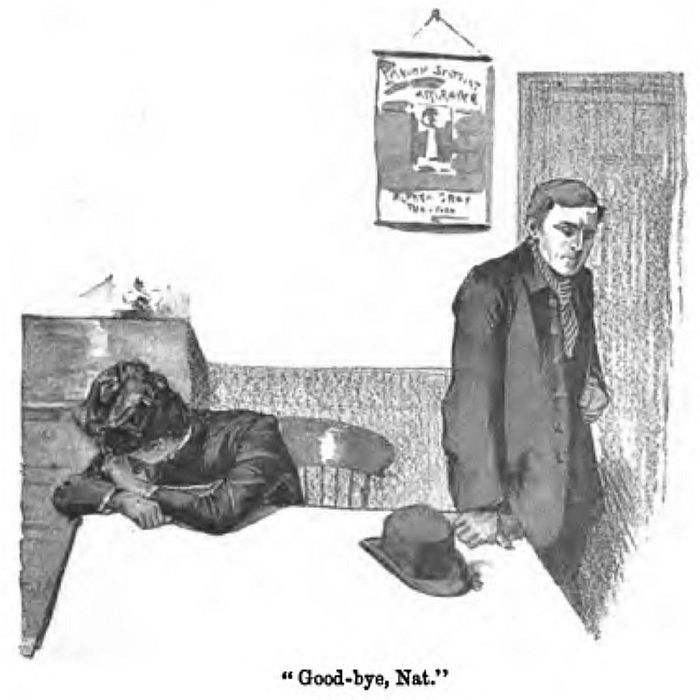
“I has got a blow,” said Nat Carter. “You’re right, Jill. I don’t know yer all round. I has promised to wed yer, and I’ll stick to it, if you’re o’ that mind. God forgive you, Jill, you’re not what I thought, but I’ll be a good husband to yer, if yer wishes it.”
“Do I wish it?” said Jill with sudden scorn and passion. “Let the righteous wed with the righteous, and the sinner with the sinner. I’m as God made me; I’m full of passion, and I’m full of weakness. You’re white, and I’m black; but, Nat, where I loves I don’t see the sin. Ef you were as black as a coal, Nat, and loved me, I’d love you back again. Oh me, me, my heart’s broke, but I can’t never, never be yer mate now, Nat Carter.”
“And yet it seemed all right last night,” said the young man.
“No. I had my doubts last night, and now they’re certainties. I doubted then as you was too high, and me too low for us to come together, now my doubts is turned to certainties. Good-bye, Nat, good-bye; choose a gel that never telled a lie, what would scorn to steal, and what wouldn’t touch a drop o’ beer to save her life; good-bye, Nat.”
“Good-bye,” said Nat. He took up his hat in earnest this time. Jill’s words had frozen him. There was a numbness all over him, which prevented his feeling the real agony of the parting; he turned the handle of the room door and went out. Jill listened to his footsteps going down the stairs, till they died away in the distance.
Chapter Thirteen.
Susy Carter was one of those self-reliant people who are not over-troubled with conscience. Her nerves were in excellent order. She did not consider herself vain, but she was thoroughly satisfied with her life, with her ways, with her ideas. She utterly scorned the flower girls who did not live up to the high standard which she had set herself. Had Susy been born in a different station of life, she would have gone in for the education craze, for the women’s suffrage question, and for all those extreme ideas of so-called emancipation which agitated the breasts of the sterner members of her sex.
Susy was not lovable, nor did she greatly love anyone but herself. She was ambitious and intended to rise in the world. Even a London flower girl can have ambition. As in all other callings, that of the flower girl has many grades. Between the poor, little, sloppy, ragged victim, who hawks miserable, withered flowers, reeking with stale vegetation and the infection of badly ventilated rooms, and such a flower girl as Susy Carter, there is a very vast gulf fixed.
Susy heard of the Flower Girls’ Guild, she was one of the first to join this admirable band, she delighted in the sanitary conditions imposed upon her. She paid her shilling a week regularly, and enjoyed all the advantages of the room where the flowers were kept at night, and the nice wash which she could give herself there in the morning.
Nature had made Susy fair and pretty, and the becoming uniform of the Guild suited her to perfection. Since she had joined it she had become more popular as a flower girl than ever. Her flowers were better in quality, and the ladies who bought from her, finding this fact out, were only too glad to come to her again; week after week she was steadily putting away money. If this state of things went on Susy hoped that in a few years she might have saved enough either to marry a respectable costermonger or to start a barrow, or even a shop for herself. Susy had not the least idea of marrying for love, she was thoroughly satisfied with her present life, which had a certain amount of excitement without undue hardship.
Nat and Susy Carter had neither father nor mother, they were somewhat alike in appearance, and had certain traits of character in common. They were both ambitious, hard-working, honest, respectable, but where Susy’s soul was small and crabbed, shrinking indeed from its normal size from want of any due care or attention, Nat’s was strong and brave, for Nat’s soul was saved by the intense love which he had felt for some years now for Jill. Nat and Susy shared the same rooms, and these rooms were by no means to their taste. They were in a low part of the town, not exactly in Drury Lane, but in that poor neighbourhood. The situation was most convenient, not far from the market and in the very thick of the life which they were obliged to lead, but the rooms occupied by the brother and sister, though fairly clean in themselves, were by no means to the taste of either. Nat would not have stayed there but for the hope that he and Jill would soon set up housekeeping together, and Susy quite made her mind to share Nat’s home whenever he made it. She was sitting on this particular Sunday afternoon in their little kitchen, leaning somewhat discontentedly out of the window, and wishing that the long dull Sabbath would come to an end, when to her surprise the door of the room was suddenly opened and Nat came in. Susy could not help giving a start of astonishment. Nat had left her some hours ago with a distinct understanding that he would not return until night. Susy had given him a slightly contemptuous look when he had told her what his day’s work would be.
“Yes, yes,” she muttered, “don’t tell me no more; you’ll be a good Samaritan all the morning, and a lover all the arternoon. Each one to their taste, don’t tell me no more.”
“It ’ud do you good, Susy, to have a lover of your own,” said Nat, in reply to these bitter words; “a right good ’ansome feller as ’ud draw the ’eart out of yer, and make yer feel.”
“’Ow?” said Susy, looking at him with mocking eyes.
Nat reddened. A vision of Jill as she had looked the night before with the moonlight shining all over her passionate, tender face flashed before him.
“I can’t say,” he replied. “You wait and see.”
“No, I’ll never see that sight,” said Susy; “there ain’t a man living as ’ud make a fool on me. Give me a tidy bit of money, and I don’t mind what the man is like.”
Nat closed the door behind him with a faint sigh. It was the first touch of that depression which was to seize him in such a mighty clutch later in the day. Susy, in spite of herself, felt dull after he had left her. She wondered if she should go to church, but decided against this effort, and seating herself in the window began to unpick the trimming off an old hat, and to put it on again in a fresher style. She then warmed some tea for her dinner, and boiled an egg to eat with her stale bread and butter. Afterwards she took up a penny novelette which she had borrowed from her landlady, and tried to interest herself in the impossible story which it contained. The hero of the tale was of course a duke, and the heroine was in a very slightly more exalted position than Susy herself. The duke loved the maiden, and the romance ended in a brilliant wedding, in a shower of rice, and old satin slippers. Susy threw down the novelette with an impatient sigh. With all her faults she had plenty of sense, and the mawkish, impossible tale sickened her.
“I call it stuff,” she said to herself. “Dooks don’t marry gels like me. I’d a sight rayther read about a costermonger. A costermonger’s flesh and blood to me, a dook ain’t nothing but a sort of a sperit. Oh, my word, is that you, Nat? ’Ow you did startle me!”
“I come in quietly enough,” said Nat. “I suppose I needn’t come into my own room on tiptoe, need I?”
Susy gave her brother a long attentive stare.
“My, how crusty you’ve turned!” she exclaimed in her mocking voice. “Wot’s up with yer? ’As Jill been giving yer a spice of her mind? I allers said that gel ’ad the ’eart of a tiger.”
“Look here, Susy,” said Nat, “you stop that!” He came over and took the slim girl by her shoulders, and whirled her suddenly out into the centre of the room. “You and me,” continued Nat, “are brother and sister, ain’t we?”
“Yes, Nat, yes. Oh, my word; ’ow you sets my ’eart a-thumping.”
“Stop talking, and listen to me. I want to say something.”
“Well, well.”
“Will yer stop talking? I’ll shake the breath out of yer if yer don’t. Now, then, you listen. Oh, you poor good-for-nothing, you poor small good-for-nothing bit of a thin soul, you belong to me, I s’pose, and I must stick to yer. I’m yer brother, and I must hold on to yer till you gets a husband of some sort. But look yere, Susy, ef yer mentions Jill Robinson’s name agen to me, whether you speaks for Jill, or agen Jill, it’s all the same, I’ll leave yer. I’ll leave Lunnon and I’ll go where you can’t find me. I’ll tell you a thing about Jill now, and then she’ll be atween us not as ef she were dead, for we can speak of our dead, but as if she had never lived, and never died. That’s how Jill is to be atween you and me, in all the days that are to come. There never wor a Jill. That’s how things are to be. Do you understand?”
“Yes, Nat; you—you frighten me, Nat.”
“Wot’s a little fright to you? I’m nigh to hell with torture. Jill’s broke with me. We’ll never be wed, never. But that ain’t the worst. The worst is there never wor a Jill, ’twas but a dream I ’ad. I dreamt it all the time I were a-growing up, and all the years sence I come to manhood. And to-day I woke. There’s no Jill. Do you hear me, Susy? Do you understand?”
“Yes, Nat, I try to. And there’ll be no wedding, and no nice little flat, and no room for me at ’arf a crown a week, and the run of the kitchen thrown in? My word, the ways of some gels is past bearing.”
“Not another word, Susy. You know our bargain. Ef you breathe Jill’s name even once again, we part, and you may take care on yourself for all I care.”
“No, I’ll not speak on her no more,” said Susy. “You needn’t pinch me so ’ard, Nat, and you needn’t glare at me. I can’t help it ef I don’t go into big passions like other folk. I’m made quiet, and with control of my feelin’s, and I don’t see as I’m to be spurned for it. I’m quite willin’ to drop that gel; she worn’t never a mate for you, ’cordin’ to my way of thinkin’. Oh, for mercy’s sake don’t shake me agen, I expect my shoulders are black and blue as it is, from your pinches. Wot I want to know now is this. Are we to stay on in these loathsome rooms, or are we to move somewhere else? You and me could take that flat in Howard’s Buildings, and live there by ourselves—why not? Oh, good gracious, wot is the matter now, Nat?”
“I’m goin’ out,” said Nat. “You may expect me back when you see me, not afore.”
“Ain’t you coming back to-night?”
“No!”
The door of the room was banged to with a loud report. Susy waited until Nat’s footsteps ceased to sound. Then she threw herself into the nearest chair, and gave vent to a gentle sigh.
“Talk of tigresses! Why, Nat’s turned into a tiger,” she moaned. “Oh, my poor shoulders, how they does ache!”
The next morning Susy arrived in good time at the neat room in Westbourne Grove, where the flower girls who belonged to the Guild had the privilege of keeping their unsold flowers.
The room was arranged on the plan of a dairy, and was so thoroughly ventilated that even the flowers which were over from Saturday night were many of them still fresh and fit for sale.
Susy had bought a small supply of quite fresh flowers at Covent Garden, and she was not long in trimming up her basket and giving it a very presentable and tidy appearance. She did not possess Jill’s eye for colour nor her delicate touch. Everything Susy did was commonplace, but nevertheless when she started forth on her day’s work, refreshed by her good wash in the nice lavatory which adjoined the room where the flowers were stored, there was not a more presentable or trimmer-looking flower girl in London. Her fair hair was plaited up smooth and tight; the front portion of it being of course curled into a tight fringe. She wore the neat and serviceable costume of the Guild, having left her own clothes behind her at the rooms of the Institution.
A flower girl’s profits largely depend on the position where she can place her stand. These positions vary immensely in excellence, and the good ones, in the neighbourhood of railway stations, and certain street corners where the thoroughfare is large, are much prized and eagerly sought after.
Susy’s stand now, close to the Marble Arch, was one of the best in London. She had her regular customers, and it was not long before her basket was cleared of its contents, and her pockets were filled with substantial coins. Having nothing further to do in the way of business, she strolled quietly home, intending to go back to Westbourne Grove later in the day to change her costume, and get possession of her clothes.
She had nearly reached the low street where she and Nat lived, when a woman sprang suddenly from the shelter of a doorway where she was leaning, and clutched her by the arm. The woman was Poll Robinson.
So marked was the change in Poll since Susy had last seen her; so strong were the marks of suffering on her face, so untidy her dress, so unkempt her black hair, that the girl did not at first recognise her.
When she did, a sensation of repulsion came over her, and she shook Poll’s big hand from her shoulder.
“Well,” she said, “wot is it? I ’as got my orders to have nought to do with you and yourn. Oh, Mrs Robinson, you ’as been drinking; I can smell the gin on your breath.”
“Only a little drop, honey; the least drop—not more than two penn’orth. I ’ad a bad bout of pain, and the gin makes it easier. Susy, don’t walk so fast, for the love of heaven. My breath’s bitter short lately, and I can’t keep up with you.”
“But I said I were to have nought to do with yer; them were Nat’s orders, and I s’pose I has got to obey ’em.”
“Nat said you were to have nought to do with me?” said Poll. “Did Jill say that? Did she? You tell me that true.”
“I can’t, Mrs Robinson. I has nothing to do with Jill, nor with you, neither. Do let me go. It’s disgusting to smell sperits on a woman at this hour of the day.”
“It’s the pain, my dear; you’d take to sperits yourself ef you had my pain. And so Nat has found out! Oh, my God, and I thought to hide it from him! Oh, my God, this is bitter, bitter—this is cruel—this is too much! Oh, to think that arter all Nat has found out!”
“It’s a good thing he has,” said Susy, speaking at random, for she had not the least idea what Mrs Robinson meant. She liked, however, to show that she was quite mistress of the situation. “It’s a right good thing as Nat has found out,” she continued, “and a fine pepper he’s in, I can tell yer. I never in all my days seed him in sech a taking. I shouldn’t be a bit surprised ef Nat turned wicked, and he such a pattern as he allers were! There now, Mrs Robinson, I can’t be seen talking to yer any more. It’s as much as my life is worth. Good arternoon to you.”
Susy walked quickly away, and Poll turned down a side alley. Her sufferings and the irregular life she was now leading had weakened her, and she felt a queer trembling sensation running all over her frame.
She was accustomed to gin now, and the twopenn’orth she had indulged in this morning had little or no effect in disturbing her equilibrium. The gin warmed her, and eased the ceaseless, gnawing pain. It was not from the effects of the gin that Mrs Robinson was now shaking from head to foot. It was from the awful knowledge that her great sacrifice had been in vain; that she had given up Jill, and in giving her up had parted with all the sunshine, and all the love which life could offer, and yet had done it in vain.
Poll had gone away from the girl in order to save her from disgrace. She felt certain that Jill would fret for a little, that she would mourn for her and long to have her back again; but by-and-by Nat’s love would comfort her. She would marry Nat, and they would settle down in their comfortable and respectable home together. No need to tell Nat, who was so particular and so strict in his notions, that he had married the daughter of a woman who drank. He need never know that, for Jill would not tell. The secret, the dark, terrible secret would be safely buried and Jill would have a happy life. Poll. had gone away quite sure that this would be the case.
The knowledge had stayed with her during the two or three miserable days which had passed since she had left Howard’s Buildings. Poll was a great deal more ill than she had any idea of. Her constant pain was caused by a terrible malady; her fine constitution was being secretly undermined, and she was not at all fit for the hard, roaming, comfortless life to which she had voluntarily sacrificed herself.
She was in the state when she needed the tenderest care and the most loving nursing. Jill had done everything that a daughter could do for her mother’s comfort; she had given her good and nourishing meals; she had seen that she clothed herself well and rested well; in short, she had surrounded her with a life of comparative refinement and comfort.
Even in that life Poll could scarcely endure her own sufferings; how much greater were they now, when she was going through all the hardships which a roaming existence to a woman in her class meant!
She slept in a common lodging-house at night; she ate when she was hungry; and whenever the terrible thirst seized her she gratified it without a moment’s thought of self-control.
Therefore the three days which had passed had made sad havoc in Poll; she looked years older, her dark face had lost all its comeliness, it was drawn and haggard, and there were many white streaks in her thick raven-black hair. She was going down the hill very fast, both physically and mentally. She knew it, poor soul, and yet until this moment she had never repented of the step she had taken. She had done it with her eyes open, and she said to herself morning, noon, and night:
“I ain’t sorry, for I’m giving my Jill, the best gel as ever breathed, a happy life.”
But now Poll’s head did reel, and Poll’s limbs almost refused to keep her suffering body upright. She had made her sacrifice in vain, for in some way, some extraordinary, unaccountable way, Nat had found out her secret.
Nat knew that Jill was the daughter of a woman who debased herself by drink. The knowledge had come to him, and it had all the worst effects which Poll had dreaded; he was very angry, he was reckless in his anger.
Susy said that Nat himself would now go to the bad. Notwithstanding, therefore, Poll’s sacrifice, Jill’s life would be wrecked.
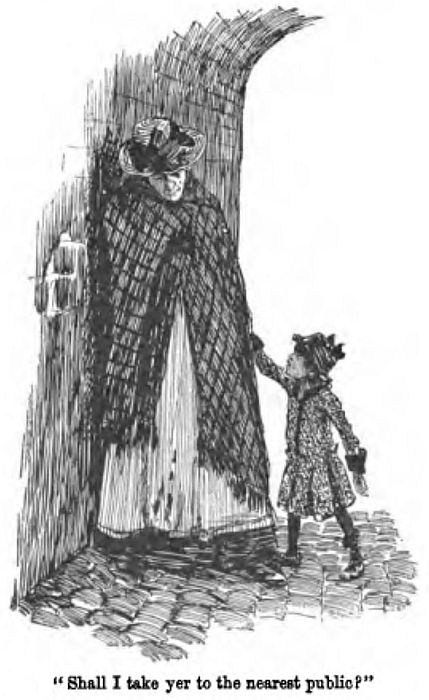
For some little time Mrs Robinson staggered down the ugly slum into which she had entered, then she ran against a wall, too dull and dazed to proceed another step. A child came up and touched her on the arm—a pinched gutter child, who looked up at her with big eyes partly of affright, partly of indifference.
“Shall I take yer to the nearest public?” she said; “do you want another drop? You’re half seas over now; mother’s orful when she’s only half seas over. You come along to the public and have another drop, and then you won’t know nothink; you’ll be all right then.”
“So you think I’m drunk?” said Poll; “no, I ain’t drunk, there’s a pain here,” panting to her breast, “and a swimming here,” clasping her hand to her forehead; “but I ain’t took enough to make me even half seas over. You seem a good-natured sort of a gel, and maybe ef you lend me your shoulder to lean on, I’d find a copper in my pocket for yer by-and-by.”
The child’s eyes glittered when Poll spoke of a copper.
“Yer may lean on me if yer, like, missis,” she said.
“I want yer to take me to a place called Howard’s Buildings, in Nettle Street,” said Poll. “I can’t see werry well for the giddiness in my head; and I can’t walk werry well, because I has a sort of a trembling all over me; but ef I may use your eyes, little gel, and ef you’ll be a crutch to me, why I’ll give yer thruppence, so there.”
“Howard’s Buildings,” said the child, “I never yered tell on ’em, nor of Nettle Street neither.”
“I can guide yer a bit, honey. Ef you’ll tell me the names of the streets as we pass, I’m most sure to know ’em, and I can tell yer ef we’re going right or wrong. You come close up to me, little gel, and let me lean on yer shoulder.”
The child came up as she was told, and Poll and she began a slow pilgrimage through the slums.
Poll’s head felt as giddy as ever; the pain which seemed to eat into her very life never ceased, the trembling in her legs grew greater, but still she struggled forward. As the sacrifice was in vain, and Jill was miserable without her, why she might at least go back to Howard’s Buildings. This was the only coherent thought she had. She would go back to Jill; she would kiss Jill once again.
Beyond this desire she was incapable of going. If she only kept on walking, putting one trembling foot before the other, she would at last reach the Buildings, and Jill and she would meet again. It seemed to Poll that a whole lifetime had already divided her from the girl; but now if only she could walk, the dreadful separation would come to an end.
“Can’t yer step out a bit faster, missis?” said the little gutter child. “You lean hard on me, and step out, missis; we won’t get to them Buildings—whatever you call ’em—to-night, ef you don’t step out.”
“I’ll try to, dearie,” said Poll; “I’m werry cold though. It’s late, ain’t it, honey? Seems as ef the place was werry dark.”
“Dark,” said the child, “it’s broad day; why, the sun’s shining all over us. Oh, my word, I’m melting up with the heat; and you’re no light weight, missis, I can tell yer.”
“Let me grip hold on yer ’and,” said Poll. “What street are we in now?”
“What street?” laughed the child; “why we’re in the street as we started in; we ain’t gone the length of Sulphur Row.”
“Oh, my God!” said Poll, “I thought as we were hours walking, and that the night had come; you must let me lean up against somethink, for I can’t see.”
“My thruppence first,” said the child.
Poll tried to fumble in her pocket; a waggon was heard lumbering down the street behind them. The driver shouted to the child and woman to get out of the way.
“Oh, missis, come, come!” screamed the little girl; “you’re standing in the road—you’ll be run over—let me pull yer on the path leastways.”
Poll with a great effort staggered forward. The waggon rushed by, almost grazing her feet.
The next instant the poor creature lay prone on the pavement, all consciousness having left her. The child uttered a cry and the usual crowd collected round the prostrate woman.
Two or three policemen came up and examined her.
“Drank,” said one of them impressively.
“No, she ain’t,” said the child; “I asked her that and she said no, she worn’t a bit drank; she had an orful pain and wor werry giddy, and werry trembling in the limbs, but it won’t drink, I tell yer. She spoke real sensible. I know ’em when they drinks, and thet worn’t what ailed her. She wanted me to take her to some Buildings or t’other, and she promised me thruppence. Do you think as I might take it out of her pocket?”
“No, no; get out of this, you little varmint,” said the police. They examined Poll more critically, and finally decided to take her on a shutter to the Bearcat hospital: this happened to be Saint Bartholomew’s.
Chapter Fourteen.
Notwithstanding the uses of adversity, it is astonishing how well prosperity agrees with some people. It has much the same sort of effect on them that the sun has on fruit and flowers. All the graces within them which have been invisible while the rough winds of adversity blew, now blossom, and show sweet bits of colour, and little tender, gracious perfumes, which no one would have supposed consistent with such hard, crabbed, in short disagreeable products of nature.
Silas Lynn had all through his life, up to the present day, been visited by the harsh winds of adversity.
It is true they had not come to him in the form of poverty. He was too prudent, too hard-working for poverty to have anything to do with him. But a man can suffer adversity without being poor, and Silas’s life from his cradle up to the present had been a hard one.
Pleasure and he had kept at a distance. The relaxations of existence had never been permitted to him. In short, his life had been all lessons and no play.
Silas was aware of this fact himself, but up to the present he had looked upon it as a good and healthy sign of his soul’s state. His mother had taught him that chastening is the lot of the Christian.
“Whom the Lord loveth, He chasteneth,” she had said to him so many times, that he whispered it to himself with white lips and a haggard look on his strong face as he bent over her in her coffin.
When his fruit crop failed, and his flowers yielded but poor blooms, he repeated the old text again under his breath, and took comfort from it.
It was a great surprise, therefore, to Silas, when suddenly the old aspect of things altered, and the Lord whom he sincerely loved ceased to chasten. Life was so completely changed to Silas that he scarcely knew himself.
He was going to be married. There was nothing remarkable in the fact in itself—more than one middle-aged woman of the Wesleyan community in his own village would gladly have come to keep house for him. She would, as the expression goes, “make him and mend him.” She would cook for him, and keep his place clean, and spend his money, and be the mother of his children, whom she would bring up in the fear of the Lord.
Silas could have married Eliza Sparkes, or Mary Ann Hatton, or Hannah Martin, and he would have received the congratulations of his friends, and the sincerest good wishes from all quarters, and yet not have been able consciously to say in his heart, “The Lord has ceased to chasten.”
But he was not going to marry a middle-aged woman from the village. He was middle-aged himself, no doubt, nearly forty, but the bride who was soon coming to gladden the old cottage, and vie with the flowers in her beauty, was scarcely more than a child in years.
This wilful, pretty, dainty blossom which he had culled out of the London streets was just the very last wife any one would have expected him to take. She would not be to the taste of the Wesleyans, and he felt that the congratulations and “God speed you” from his friends would be few.
But what mattered these things, when his own heart was singing a psalm of thanksgiving from morning till night, when the flowers in his garden were absolutely riotous in the profusion of their blossoms, when the sun smiled on him, and the dews came at night to refresh him? What did he care for the neighbours, whether they were pleased or not?
During the first fortnight of his engagement to Jill, his own nature took a sudden late blossoming. His gruff voice became a shade lower and more refined in tone, and even Jonathan, his hard-working factotum, ceased to fear Silas.
Master and man were very busy, putting the tiny cottage in order, for the wedding was to be in another week.
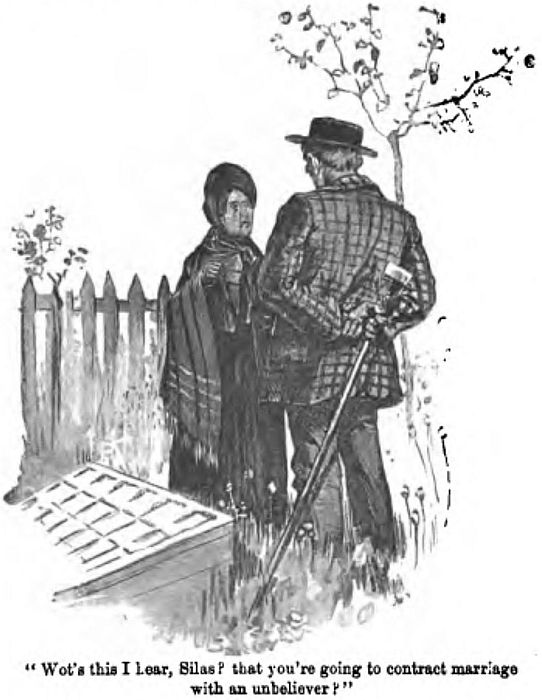
On a certain Saturday evening, as Silas was standing in the middle of his flower-beds, contemplating a late crop of enormous carnations, and considering how many boxes he could fill with cut blooms for his Monday’s market, he heard the click of the gate at the far end of the garden path, and saw an elderly woman in a poke bonnet and long cloak advancing to meet him.
“Giminy! ef it ain’t Aunt Hannah!” he muttered under his breath, “Now, whatever’s bringing her bothering round?”
He walked down the path as he spoke, and held out his big hand to his relation.
“Wot’s this I hear, Silas?” said his aunt; “that you’re going to, contract marriage with an unbeliever?”
The little woman had an anxious, wizened face. It was raised now with a world of commiseration in it to Silas.
The man felt so happy that he absolutely smiled down at the audacious little intruder.
“That’s all you know,” he began.
“Oh, don’t I know, Silas! Wot would yer pore mother say ef she were to come alive again, and see this bitter day? Oh, Silas! you that has been brought up on the Bible—han’t you read your Scripter to some purpose? ‘Favour is deceitful and beauty is vain.’ Oh, Silas! Silas! it’s Mary Ann Hatton, or one of them other sober women you ought to be taking to wife.”
“Yes,” said Silas, “and wouldn’t both on us have been as cross as two sticks? I’m taking a bonny bit of a gel to wed, wot’s sweet as a rose to look at, and with a perfume o’ the lavender and the cherry-pie about her. Good inside and out is Jill, and I guess ef Solomon were alive, he’d say as the price of a gel like Jill were above rubies.”
“I heerd tell,” said Aunt Hannah, in a slow voice, “that you was quite gone off yer head, Silas, my man, but I didn’t go to believe it, until I had clapped my own two eyes on yer. I’m mournful, thinkin’ on yer pore mother. But there’s no manner of use in wasting words on a man wot’s gone silly, so I’ll wish yer a werry good-evening.”
“You stay a bit,” said Silas. “Jonathan and me, we are doing up the cottage, and you had ever a cute eye for a good bit of furniture. Come and see what I am doing. I doubt ef you’d know the place.”
With many sighs and groans, Aunt Hannah was induced to enter the cottage. She behaved in a melancholy way when she got inside, for the sight of her sister’s vacant chair provoked a sudden flood of tears, which embarrassed and annoyed Silas.
“Eh dear, eh dear,” she sobbed, “to think of the last time I ha’ seen pore Maria a-bolstered up in that cheer. She had the asthmey awful, and she said to me, ‘Hannah, it ketches me most when I lies down.’ She said them words over and over, and I don’t think I ever heerd anything more mournful. Eh, and ef that ain’t the lavender I see’d her put in with her own hands into that identical muslin bag, my name ain’t Hannah Royal! Oh, Silas! it’s wonderful how you can go agin a mother like that!”
“I ain’t a-going agin her,” said Silas; “you shet up now, Aunt Hannah, you has said enough. Wot do you think of this table and chair as I has bought? And this rug to put in front of the stove? Come now, give us your opinion; it’s worth having.”
Thus appealed to Aunt Hannah immediately wiped her tears, and going down on her knees began to feel the texture of the rug, and to put it up to her nose, and to sniff at it, and then hold it between herself and the light.
“I misdoubt me that it ain’t made with three threads across,” she said, laying it down with some contempt. “And the colour’s too flashy for my taste. I like a drab ground, with a teeny sprig of purple on it. Let me look at that ’ere table. You don’t mean to tell me, Silas, as you has gone and bought a meehogany table? Don’t yer know as sech a table is sinful waste to a man in your station?”
“It were goin’ dirt cheap,” said Silas, in an apologetic tone.
“I misdoubt me that it’s worm-eat,” said Aunt Hannah. “And as to this cheer, its creak would turn a body silly. Well, is there anything else for me to see?”
“There’s a crate in that corner, full of cups and saucers, and plates and dishes.”
“Chaney?” said Aunt Hannah, “I’m a jedge of that. I’ll unpack the crate ef you wish, Silas.”
“Well, do,” said Silas, “I’ll be obleeged. I can manage flowers, but I ’ates touching chaney. It seems to slip out of yer fingers, however careful you air. You unpack the crate, missis, and we’ll have a cup of tea together.”
Silas proceeded to light the fire, and put the kettle on to boil, and Aunt Hannah unpacked the crate which contained the cups and saucers, and plates, and dishes, with which Jill was to help to furnish her new home.
If there were one thing more than another for which Mrs Royal had a truly worldly affection, it was for “chaney.” She was a good judge of all house furniture, but with regard to “chaney” she felt herself a specialist. She was as knowing on this point as Silas was with regard to the best blooms and the choicest cuttings. The task, therefore, to which she now set herself was quite to her mind.
Silas had not dared to choose the tea-service and the plates and dishes himself—he had asked a friend of his to buy them for him, and to have them sent down to the cottage. When Aunt Hannah, therefore, removed the paper wrapper from a delicate cup of white and gilt, with a blue convolvulus lying across the saucer, and sending its delicate tendrils round the cup, he came and gazed at the lovely specimens with a certain quickening of his pulses, and a queer inclination in his eyes to water.
“I say!” he exclaimed, “I never thought as chaney would look like that.”
“It’s most onsuitable,” said Aunt Hannah. “But I don’t deny as it’s neat. My word, I only hope as that gel will have deft fingers, or she’ll be crackin’ and splittin’ this yere fragile chaney. You don’t mean to say, Silas, as you’ll use it hevery day? You are sinnin a’most past knowin’ you, but I don’t s’pose as you’ll go the awful depths of using this yere chaney hevery day.”
“That must be as Jill pleases,” said Silas.
“Giminy! I never did know as chaney could look like this, it seems to add a fresh pleasure to life—why, it a’most beats the flowers.”
“I won’t deny that it ain’t a werry neat pattern,” said Aunt Hannah, “the twist of convolvuly is werry cunnin’, but chaney like that is meant to lock up in a cupboard; there ain’t no one as ’ud use it daily.”
“Look here,” said Silas, “there’s a power of cups and saucers ain’t there, Aunt Hannah?”
“My word, yes,” said Aunt Hannah, “a whole, dozen, and plates to match, and four fruit dishes, and a couple of cake plates, and a slop-bowl and a teapot, and a cream jug and sugar basin—it’s the most complete thing I iver seed.”
“Well, then, look yere,” said Silas, “s’pose as we has a tea-drinkin’ out o’ it.”
“Silas!” Aunt Hannah dropped her lower jaw and her small eyes grew beady bright in their glance.
“S’pose,” continued Silas, “we had a tea-drinkin’ out of it, and we asked Jill down, and one or two o’ the neighbours to meet her, and you come and spend the night here, Aunt Hannah, and you ondertake the tea-drinkin’—s’pose now you do that, eh?”
“Well,” said Aunt Hannah, “it seems like encouraging of you, Silas, in your mad folly.”
“Not a bit on it,” said Lynn, “for whether you come or whether you go, Jill and me we’ll be married at the church in the village come next Thursday. You can please yerself, Aunt Hannah, but I thought as we might have our tea-drinkin’ on Tuesday, and you’d see with your own eyes, and the neighbours ’ud see, what sort of a little gel were coming home to me to cheer up my life.”
“Well,” said Aunt Hannah, “I don’t go fer to deny that there’s something in your idee, Silas. I own as I’d like to say a word to that gel on the subject of chaney like this. Ef I found her teachable and humble in her notions, I don’t promise, mind, but I might give her three cracked delf cups of my own—white they was once, but they has turned yeller—she could use ’em for common and keep this chaney for best, for christenings, and sech-like, and the delf cups ’ud be a very suitable present from your aunt to her, Silas.”
“You can do that as you please,” said Silas. “Air we to have the tea-drinkin’, or air we not, Aunt Hannah?”
“I think, hall things considerin’, that it ’ud be right to have it,” said Aunt Hannah, in a solemn voice. “In a matter o’ this sort it’s right to consider the waluables, and this chaney is altogether out of the common. The first thing to be done is to scald it, and that I’ll manage for yer on Monday morning, Silas, for I’ll bring over my own wooden pail, and gradually heat each cup and each saucer in hot water, until it’ll bear the heat when it comes to the bile. It’s wonderful careless of gels in these days, they’ll crack the finest chaney for not knowing how properly to scald it afore usin’.”
“That’s settled then,” said Silas. “I’ll speak to Jill to-morrow, and we’ll ask Mr Hibberty Jones and his wife, and Mary Ann Hatton to come to tea, and ef Mr Peters ’ud honour us as well we’d be proud to see him. You’ll see to the victuals, won’t you, Aunt Hannah?”
“Yes, you leave that to me,” said Aunt Hannah. “That girl ’ull eat a cake worth eating for the first time in her life—and now I must be goin’ ’ome.”
Chapter Fifteen.
Jill was quite willing to accompany Silas home for the tea-drinking. He told her about it on Sunday when he went to see her in her little flat.
“Yer to come down looking as peart as you can. Jill,” he said to her. “The folks in Newbridge beats all folks livin’ for contrariness. They think that God Almighty did right when He made a lovely flower, and mortal wrong when He made a lovely woman. They think as sweetness and beauty can go together in flowers but not in gels, so I want you to look your werry beat, my dainty little cuttin’, and show ’em as they are all hout for once in their reckonin’s. I’m thinkin’ as maybe yer would like a new bit of a gownd; what do yer say to a yaller cotton now, made werry stylish? I don’t mind paying a real good dressmaker to put it together. Come, now, would you like it, ah?”
“No, thank you, Silas,” said Jill. “I’ll feel more at home like in my old black gownd, which has in a sort of a way growed to me. I’d like best to wear that with a bit of a posy that you’ll pick out of the garden fresh for me when I get down.”
“You’re to stay for the night, mind, when you do come,” said Silas. “An aunt o’ mine, a Mrs Royal, a werry decent body, can share my bed with yer, and I’ll go and have a shake-down at Peters’s. You’ll be sure to come in good time, and a-lookin’ yer best; Jill.”
“Yes, Silas,” she replied, with a meekness which would have puzzled him very much had he known her better. He was too happy and content, however, for even the faintest suspicion of anything not being quite right to enter his mind.
Jill Robinson was like the mignonette and the lavender and the cherry-pie for sweetness of character, while she resembled the crimson rose-bud in the richness of her beauty.
Yes, surely the Lord had given up chastening Silas when so great a prize as Jill was to be his.
The invited guests were only too eager to come to the tea-drinking. Notwithstanding the disapproval of the congregation at Silas’s choice, those of them who were favoured with an invitation to see his bride were by no means slow of availing themselves of it.
Mrs Hibberty Jones and Miss Mary Ann Hatton went, it is true, under a protest, but Hibberty Jones himself and Peters owned that they did not object to seeing beauty when they could do so in a good cause. It was distinctly to Silas’s advantage that the foremost members of the congregation should support him at this critical juncture, and if possible take early steps to convert Jill to her future husband’s faith. So, dressed in their best, the homely village folk walked across the fields, on this lovely summer’s evening, to Silas Lynn’s tea-drinking.
Silas had ordered a new suit of strong rough frieze for his wedding. The suit had been made in a great hurry by the village tailor, and was sombre both in its cut and its colour. But the gloomy effect of coat and trousers was much relieved by a gay waistcoat of white with a coloured sprig bedecking it all over. This waistcoat had belonged to Silas’s father, and was regarded in the family as a very precious heirloom. He wore in his button-hole three large crimson carnations, and altogether made an imposing spectacle as he stood in the porch of the little cottage to receive his visitors.
Aunt Hannah was busy inside the house. She wore a dark plum-coloured dress, and a little tight black net cap, tied under her chin with a bow of yellow ribbon.
Jill had not yet arrived, and Silas, while he held out his great hands in hearty greeting to his visitors, could not help letting his eyes wander anxiously up the path which led from the railway station direct to the cottage.
“How do you do, Mr Lynn?” said Miss Mary Ann Hatton in an acrid voice. “Allow me to congratulate you. Oh, pray don’t let us keep your hattention. Where the heyes stray is where the ’eart is to be found. Ain’t that so, Mrs Jones?”
“It ain’t modest to speak o’ them sort of things aloud,” said Mrs Jones, in a hushed voice to the spinster. “Don’t let yer feelin’s get the better of yer, Mary Ann—you’re disappointed, but keep it dark, for the sake of feminine modesty. Well, Mr Lynn, we’re proud to come and meet this young gel what is soon to be yer wife. Have she come yet? Or are you looking for ’er over the brow of the ’ill, that you keep your eye fixed on that one pint so constant?”
“She ain’t come, but I’m expectin’ of her every minute,” said Silas. “I’m real proud to welcome yer, neighbours. Come in, come in. My aunt, Mrs Royal, is in the house a-brewing the tea. Come in, neighbours, and make yerselves at home.”
Mr and Mrs Hibberty Jones and Miss Hatton stepped immediately across the threshold, but old Mr Peters stood still, and put one of his wrinkled hands, with marked solemnity, on Silas Lynn’s shoulder.
“Wanity of wanity, Silas,” he said in a mournful tone. “I didn’t think as you’d have been tuk in by a bit of a gel to the extent of wearin’ a flowered waistcoat. You has had a sudden fall, Silas.”
“Go right into the house, Mr Peters,” said Silas. “There Jill a-coming down the field. You look at her, and tell me arterwards ef you think she wor worthy of a sprigged waistcoat or not.”
When Jill and Silas entered the little cottage side by side, the rest of the visitors were seated in some impatience round the tea-table. The board was well supplied with a large brown cake in the centre, a freshly cooked ham at one end, and the tea equipage, containing the delicate white and gold tea-service, at the other. Bread in great junks, hot cake, butter in several fancy devices, and a large dish of honey completed the repast.
Hibberty Jones had placed himself as near that end of the table where the ham stood as possible. Miss Hatton sat pensively where she could keep control of the honey, and Mrs Hibberty Jones made up her mind that she would act as cutler of the cake.
When Silas and Jill entered the whole company arose, and each in turn offered a cold handshake to the London flower girl. Room was made for her to sit down beside Silas at the end of the board, and Aunt Hannah, with a loud “a-hem,” lifted the teapot to dispense the tea.
“May I ask, Mrs Jones,” she inquired, “’ow you like your tea sarved, or ef you has no wishes on the subjec’? Some folk ain’t particular, but it’s best to know.”
“I ain’t what’s called particular,” said Mrs Jones.
“No honey, I thank you, Miss Hatton—but I likes my tea to lay for a good eight or ten minutes arter it is made. I will own that I likes it bitter; flavoured with one spoonful of thick rich cream and three good lumps of castor sugar. Jones goes in for four lumps, but I say so much sugar is apt to lay heavy, so three’s my quantity. I’ll trouble you not to give me more than one teaspoonful of cream, Mrs Royal.”
“Sech strong tea is wonderful bad for the narves,” said Miss Hatton. “May I ask, miss,” turning to Jill, “’ow you takes it in the City? I’m told, but I don’t know ef it’s true, that you mostly uses our tea-leaves over agen.”
“I don’t think it’s true,” replied Jill, “though maybe there air some folks poor enough even for that.” She raised her great dark eyes as she spoke, and looked sadly at Miss Hatton.
The spinster turned away with a toss of her head. “Why, she’s foreign,” she muttered. “It’s worse even than I feared.”
“I have no doubt, miss, whatever, that you always drinks the best o’ tea,” said Hibberty Jones with a gallant bow. “So purty a bit of a young gel couldn’t but have the werry best.”
“Quite so—I agrees with you, Mr Jones,” said Mr Peters.
The women could not forbear snorting audibly, and Miss Hatton in her agitation dropped a spoonful of honey on the white cloth, and the next moment one of the delicate white saucers with the convolvulus lying across its smooth surface had been pushed by her awkward elbow on to the floor. It lay there in shivers. Aunt Hannah gave an unearthly groan, and Silas felt the purple colour of rage dyeing his face.
“Don’t say a word, Silas,” said Jill in a soft tone.
She sprang lightly to her feet, ran round to Miss Hatton’s side, picked up the broken crockery, which she put out of sight, placed another saucer beside Miss Hatton’s plate, and returned to her place by Silas.
Her little action was so swift and graceful, and the lovely colour which mantled her cheeks was so becoming, that the three men could not help expressing their approval by a low sort of underground cheer.
“You have a kind heart, I see, my lass,” said old Peters; “a kind heart as well as a purty face. I never knew ’em go together afore. I divided the world o’ women afore into two lots. There was the illigant faymales, with their fine faces, and their fine walk, and their fine bits o’ ways; and there was the plain, downright women, like my old missis, wot died, and like our good friend, Mrs Hibberty Jones” (Mrs Hibberty Jones turned white with suppressed anger at this marked allusion to her present appearance), “and like Miss Hatton,” continued Peters, “sterling bodies both o’ them, but awk’ard outside. We must own as plain women is awk’ard outside. Well, I thought as the plain ’uns were the good ’uns, and the purty ’uns the bad ’uns. Never thought as they’d get mixed; never did, never. But the ways of the Lord are wonderful, and I can’t but b’lieve that there’s a purty nature inside that bonny face o’ yourn, my gel.”
Jill received old Mr Peters’s rather embarrassing compliments with a calm indifference that greatly amazed the three other women present.
“I don’t think nobody ought to think o’ looks one way or t’other,” she said, after a pause. “We’re as we’re made—it’s the inside as is everything. I never know’d kind, rich, grand sort of folks like these here afore. I wor brought up rough, although I don’t like roughness; and some o’ the people I has met were real ugly in feature, but oh, the ’earts in ’em—the kindness o’ ’em—the beautiful look as love had put in their eyes. I don’t think the looks matters at all, it’s the ’earts as is everything.”
Jill looked so sweet when she said this that even the angry women were appeased, and Miss Hatton, suddenly moving her chair, made room for Jill to sit opposite the honey.
“You come nigh to me,” she said; “I own as I’m awk’ard, and I’m sorry I broke a bit of your chaney.”
“Go and set near her, Jill,” whispered Silas; “your winnin’ of ’em all, my little cuttin’; I knew as yer would.”
“Jill,” said Aunt Hannah, “I ’ope as you’re a gel as is willin’ to hact up to your own words. I will say as you looks well-meaning. It worn’t your fault as you were made handsome—it’s a trial, I will own; but you must try and take it patient. But what I wants to know is this—’ave you or ’ave you not got a light hand with chaney? Chaney is more delicate nor a woman; it has, so to speak, no constitootion. Any minute, by a rough knock or a push, or the awkardness jest now shown by Mary Ann Hatton, and there—it’ll go, shivered. The gel what can manage chaney has something to be proud on. When I was married I got a tea-sarvice of white chaney with a gold rim, and a scalloped edge round the saucer. It wor werry neat, but not a patch on this, for this blue convolvuly is too cunnin’ for anything. Well, when you come to see me, Jill, I’ll show you my chaney, every piece complete, not a crack in it, nor a chip; all the little cups, and the scalloped saucers and the plates, jest as I got ’em when I wor married. Why wor this? I’ll tell you why. I put ’em in a glass cupboard, and I never used ’em ’cept at christenings. Ef you keep this chaney for christenings why it’ll last, Jill, but ef you uses it every day, it stands to reason as the constitootions of these cups and saucers’ll give way. I ask yer now, in the presence of yer future husband, Mr Peters, Mr Hibberty Jones, the good wife of the latter, and Miss Mary Ann Hatton, what is yer intentions with regard to this beautiful chaney?”
“How can she tell jest now, Aunt Hannah?” said Silas.
“In the matter of wedding the gel I leave everything to you, Silas,” remarked his aunt, “but in the cause of the chaney I must speak my mind. Consider this question, my gel, and hanswer me true.”
There was a dead pause when Aunt Hannah came to the end of her oration. The other women, and even the men, looked at Jill with some small anxiety. She was quite silent for a moment, looking down at the delicate little cup and saucer which stood by her plate.
“I think,” she said, after a minute’s silence, “that we might have a little cupboard made for this yere chaney, Silas. The cupboard could face the door and the two windows, and when the sun come in it ’ud shine on the cups and saucers and make ’em look real fine, and when Aunt Hannah came to see us we could use the chaney. I has got some cups and saucers at home as ’ud do for you and me every day, Silas.”
“My gel,” said Aunt Hannah, “come here and kiss me. Silas, I withdraw all my hopposition to yer wedding this gel; the Lord has seen fit to give her a mind to match her face. She spoke now with rare wisdom, and my own three delf cups as I spoke on to yer last week, I’ll give to this gel as a wedding present.”
Chapter Sixteen.
The tea-drinking having turned out such a success, Silas went down to the village to spend the night with old Peters in a state of rare exultation.
“I wor right, yer see,” he said. “I know’d what I were about when I asked that yere little cutting to come and strike root in my garden.”
“She’s a werry purty creter,” said old Peters. “I don’t go for to deny it, Silas, she’s rare and purty. But what ails her, man? Do yer think as she has given yer her young affection; you ain’t so young, Silas, and you ain’t to say ’ansome; do yer think that gracious, purty girl gives back love for your love, Silas?”
Silas felt as if a dash of ice-cold water had been thrown over his warm, glowing, happy heart.
“What can a gel do more nor say ‘yes?’” he remarked after a pause.
“I’m not so sure on that,” replied Peters. “Gels say ‘yes’ for lots o’ motives—the wish for a home, maybe; oh, lots o’ motives. I’d have said that a young thing like Jill ’ud choose for her mate a lad with good looks hisself, and youth; that’s what I’d have said from my experience of the faymale ’eart; but there, Silas, don’t take on, man, I wor wrong about beauty and goodness goin’ together, so maybe I’m wrong ’bout the t’other also. I can see that the gel has a great kindness for yer, Silas; but love, that’s quite another matter. What ails her eyes for instance? what’s back o’ them looking out at us all so gloomy-like? My word, them eyes haunts me; seems as ef a sperit was looking through ’em, werry patient, werry sad. I could cry when I thinks on ’em. What’s the matter, Silas? What ails yer, man?”
“You don’t s’pose as talk like yourn is pleasant to listen to,” replied Silas; “and you’re all wrong ’bout Jill not wanting to have me. Why, I’ll prove it to yer now as yer wrong. I asked her to be my wife one morning at the market, and I suppose she felt skir’t like, for she looked at me with her face as rosy as the day, and her eyes like great, deep wells, with the wonder that filled ’em, and she said, ‘No, no, Mr Lynn, it can’t be’; and she up with her basket and away she runned. Well, of course I said to myself, there’s an end o’ this; but, what do yer think, neighbour? The next morning early, soon arter daybreak, who should come down all the way from Lunnon to see me but this same little gel; she knocked at my door and called out to me to open to her; and when I come it wor, ‘Yes, yes, Mr Lynn, I will marry yer ef you’ll have me.’ Worn’t that pretty good proof of her loving me, eh, Peters?”
“I don’t deny as it wor,” said Peters.
Silas and Peters entered the small cottage of the latter, and, as Silas had to go to town in a couple of hours, they immediately parted for the night, Silas declining to go to bed, but declaring he could take a good sleep in Peters’s deep arm-chair.
Just before they said good-night the old man made a request.
“Ef yer has time, Silas,” he said, “I’d be much obleeged to yer if yer could call round to Saint Bartholomy’s Hospital and leave this little parcel for my sister, Rachel Riggs. It’s a wool shawl of hers, as she allers sets store on, and I had a card from her to say as she wor better, and wanted her shawl. You’d obleege me greatly, Silas, ef you could leave it.”
“Put it on the table there,” said Silas, “and I won’t forget.”
The old man went off to his own room, and Silas sat in the deep arm-chair and looked out at the summer night. There was nothing really to trouble him in the words that Peters had said, nevertheless they kept coming back in a teasing and irritating fashion.
It was Peters’s opinion that Jill did not love him. What folly! If ever a girl had gone out of her way to show that she loved a man, it was Jill. As to her face being somewhat pale, and as to the fact that her dark eyes were sad in their expression, was not that always the case? Had not Silas, who knew her so much better than Peters, always noticed that latent sadness in her charming face. He loved her all the better for it.
“It’s jest her kind heart,” he murmured; “it’s jest as there is trouble in the world, and she can’t help noticin’ of it. Why, see her to-night, when Mary Ann Hatton dropped the chaney saucer. Even that were too much for my Jill. Oh, yes, Peters is quite mistook. Jill loves me, for sure, and I’m jest the werry happiest feller in the wide world.”
Silas, however, notwithstanding these soothing reflections, felt too excited to sleep. He was glad when the first faint brightness in the east told him that the time had come for him to rise and begin his long day’s work.
He softly left the cottage, and, going across the fields to his own small homestead, put the horses to the already carefully-packed waggon. Then going round to the cottage-door, he tapped with his knuckles at the window of the little bedroom where Aunt Hannah and Jill were sleeping. Jill was to accompany Silas back to town. She was dressed, and came out to him at once. Her face looked almost bright this morning; she had a faint colour in her cheeks, which was further deepened by the bright shawl which she wore round her head. When she came up to Silas and slipped her little brown hand into his, he instantly felt through his whole being that a glorious sun had arisen over the earth, and that old Timothy Peters must be fast approaching idiotcy.
“Come, Jill,” he exclaimed, “we’ll have a jolly ride into town. Why, yer ain’t cold, be yer my dear?”
“No, Silas.”
“Only I thought I see’d yer shiver. It’ll be werry hot by-and-by, but ef yer finds this hour of the morning chill, I’ll fetch out my sheep’s-skin rug to wrap yer up in.”
“No, no, Silas, I ain’t really cold. Let’s start at once, and maybe when we gets to the brow of the hill we’ll see the sun rise. I has been up early enough most days o’ my life, but I never seed the sun rise for all that.”
“It’s a sight to remember,” said Lynn. “Come along then, my choice little cuttin’, and we’ll get under weigh.”
As a rule, Silas was a very taciturn man; but on this particular morning it was he who did most of the talking.
“Eh, Jill,” he said once, as they approached London, “to think as you and me ’ull be husband and wife to-morrow. The delight o’ it is a’most past belief. When I thinks on you as keeping the cottage, bright, and cooking my meals for me, and watching as nobody comes and picks off the best blooms when I’m away at the market, I can scarce contain myself, I don’t believe in all the wide world there’ll be a happier pair nor you and me, Jill, for all that I am eight-and-thirty and you not seventeen yet.”
“I hope as I’ll make yer a good wife, Silas,” replied Jill.
“Oh, there ain’t no doubt on that, my little cuttin’. There’s that in you, Jill, that can’t help being good to folk. Lor’, I could shout with larfin’ when I think how you twisted all them crabbed folk round yer little finger last night. Jest a glint o’ your eyes and a soft word or two and ’twor done. Even Mary Ann Hatton couldn’t stan’ out agen yer. But, Jill, I’m a-thinking that yer mother and yer two brothers ought to be asked proper to our wedding. Yer mother is as fine a figure of a woman as I know; and, though I don’t know what yer brothers are like, and I make no doubt they’re mischeevous little varmints as is to be found in the world, yet still wot’s yours is mine, Jill, and I’ll make them all free and welcome to come to the wedding to-morrow. Wot’s the matter, my dear? Why don’t yer speak?”
“There ain’t nothing the matter, Silas. Seems to me lately as ef I had very few words of any sort to say. I’m obleeged to yer, Silas, for your kind thought about my folk, and I’d be right glad to have them with me when I’m wed; but I han’t seen the boys for nearly three weeks. I’m thinking maybe they has run off to sea. Tom were always minded that way.”
“Well,” said Silas, “they might do worse. The sea is not so bad a life ef a lad is strong, and ef he don’t take up with bad ways. But ’bout yer mother, Jill? It’s werry odd as I han’t laid eyes on her sence you and me made up our minds to get spliced.”
“Mother ain’t werry well,” said Jill, “and—” but here her voice failed her; she covered her face with her trembling hand, and burst into an agony of tears.
Silas, in his absolute amazement, pulled up the horses, and, looking round at the weeping girl, surveyed her from head to foot with a sudden shy terror, which gave a ludicrous expression to his plain face.
“Wot is it, Jill? Wot is it?” at last he gasped.
“Nothing, Silas, nothing,” she replied, checking her tears with a violent effort. “It were real wrong of me to give way, and you so good. But I’m troubled ’bout mother, orful, bitter troubled. She ain’t well, and I’m troubled ’bout her. Seems as ef I couldn’t speak on her lately. She won’t come to the weddin’, Silas, and you mustn’t ask me no questions ’bout the why and the wherefore. Maybe, arter we’re wed I’ll tell yer, but not now, dear Silas.”
“Well, it’s you I’m goin’ to wed,” said Silas, “and ef you’re there, no matter about t’other folks, say I. Only I’m sorry you’re in trouble ’bout anything, my own little gel, and I only wish I could, comfort you.”
“You do, Silas, you do.”
“Well, them’s good words to hear. We’re at the market now, Jill; but as you ain’t going to sell flowers to-day, maybe you’d like to be gwine home. Next time we meets it’ll be till death us do part.”
When Silas said these words Jill felt a sick agony creeping over her. They were the words she had longed to hear said over her and Nat. She turned her white face away, and, quickly leaving the market, ran home to Howard’s Buildings as fast as her feet could carry her. Silas, in excellent spirits, began to attend to his plants, flowers, and fruit. Any slight remaining uneasiness which might have lingered in his mind after old Peters’s words was now removed. Of course Jill loved him, but her pallor and the sad expression in her eyes were both accounted for by some secret sorrow in connection with her mother. Silas determined to get at this grief, and if possible to remove it after he and Jill were married. He was too busy to-day, however, to give it any further thought; he had not only to attend to his many customers, but he had to make arrangements for the two or three days’ holiday he meant to give himself after his wedding. He had to attend to a list of orders which Aunt Hannah had provided him with for the wedding-feast; and last, but not least, he must manage to call at Saint Bartholomew’s Hospital with the little shawl for old Peters’s sister, Rachel Riggs. Silas knew Mrs Riggs, and with all those new qualities which the sunshine of prosperity had awakened into being, it occurred to him that it would give her pleasure if a bunch of flowers accompanied the shawl. Silas would never have thought of giving Mrs Riggs flowers in the old days, but he did many things now which astonished himself.
When his business at Covent Garden was ended, he selected a large bunch of some of his commoner flowers, and started off to walk to the hospital. He had gone nearly half-way when it suddenly entered into his head that it would largely add to Peters’s happiness, if he, Silas, could contrive to see Mrs Riggs for a moment or two. He knew enough about hospitals to be aware that he would not be admitted until the afternoon, so, leaving his flowers at the shop of a friend, he got through his other work, and finally arrived at Saint Bartholomew’s on the stroke of two o’clock, the earliest hour when visitors are admitted.
Silas was taken at once to the women’s ward, where Mrs Riggs was sitting up in her clean bed with a “nightingale” round her shoulders. Her wizened old face was lit up with a curious mixture of surprise, pleasure, and alarm when she saw Silas coming gingerly on tiptoe down the long ward to see her. Her remembrance of Silas in the past was not a pleasant one—he was morose, intensely rough and disagreeable—a very upright man, of course, but the last to put himself out of the way to do a neighbour a kindness. It was astonishing, therefore, to see him with a little brown-paper parcel in one hand and an enormous bouquet of flowers in the other advancing to meet her. Silas’s rough face, too, was all aglow, his coarse mouth was wreathed in smiles, his little ferrity, deep-set eyes were the windows through which a happy soul looked.
Mrs Riggs said, “My sakes alive! wot’s come to the man?” under her breath. She stretched out her thin, old hand, which Silas clasped, and then, sitting down by her, he began to chat about the small doings of Newbridge and its inhabitants.
Peters’s cough was certainly better, the Hibberty Joneses were in good case, Mary Ann Hatton looked quite fine for her. In short, the village was enjoying a heyday of prosperity, and Silas felt sure that they would all give Mrs Riggs a hearty welcome when she returned. He knew that the old woman was regarding him with a sharp stare of curiosity; he was well aware that she was amazed at the change in him, but he did not feel inclined to betray his happy secret. There was a new sweet shyness about him when he thought of Jill and the great, tender love he bore her.
He had bid Mrs Riggs good-bye and was leaving the ward, when a full voice, rich in tone although somewhat weakened by recent illness, was heard pronouncing his name.
A woman who was lying stretched out flat in a bed at the far end of the ward was calling to him. Her voice had a piteous ring in it; her black eyes were fixed on him with a world of entreaty in their glance.
“Come yere, Mr Lynn, for the love o’ heaven, come yere,” said the voice.
Lynn looked up the ward and immediately recognised Poll Robinson. His heart gave a heavy thump; he was conscious of a sudden weight of apprehension on him, and then, still walking on tiptoe, he marched up the ward and stood by the sick woman’s side.
“Well, I’m blessed,” he exclaimed, looking down at her. “So you’re here, and that’s the secret wot’s troubling Jill.”
“Oh, Mr Lynn, ha’ you seen my gel?” exclaimed Poll. “Oh, you don’t know the awful ’eart hunger as is over me, never to see her or to hear of her. Oh, Mr Lynn, when I seed you a-coming in, I thought as you wor, may be, an angel fro’ heaven. I said to myself, maybe Jill has been a-buying flowers from Silas Lynn. Oh, my gel, my sweet, sweet gel. Ha’ you seen her, Mr Lynn?”
“Yes, yes, Mrs Robinson,” said Silas. “Make your mind heasy. Jill’s all right. Why I seen her this werry morning.”
“Oh, and is she well; do she look happy?”
“She ought to look well, and she ought to be happy. It’ll be her wedding-day to-morrow. Ef a gel don’t look happy on the eve of her wedding-day, why she never will, accordin’ to my thinkin’.”
“Oh, praise the Lord,” said Poll, “then I ain’t done the mischief I thought. I wor mortal feared as she had broke off with Nat Carter, but ef they’re to be married to-morrow why it’s all right, and I ain’t done the mischief I thought.”
“Who did yer say as she were to marry?” asked Silas in a queer, thick, husky voice. “Wot name did yer say, Nat—Nat Carter?”
“Yes, yes; you must know him for sure—that ’ansome young costermonger as allers goes in good time to the market. You must mind him, Mr Lynn, a tall, well-set-up lad, with blue eyes and as fair as Jill’s dark. Why they has loved each other, them two, ever since my Jill were a little dot at school. Never seen anything like the way they took on one for t’other. Wot’s the matter, Mr Lynn? You must know o’ this, surely.”
“Yes, of course,” said Lynn; he made a supreme effort to control himself and sat down on the chair by Poll’s bedside.
“You must know Nat Carter,” she continued, fixing her anxious eyes on him.
“Yes, yes, for sure.”
“It is an awful load off my mind, Silas Lynn, that they’ll be married to-morrow. Mayhap you’ll be at the weddin’.”
“Not likely,” growled Silas.
“Well, well; you look pinched somehow in the face, neighbour. I wouldn’t be surprised if Jill wor glad to see yer when she gives herself to Nat. She allers thought a sight on yer; she used to say to me, ‘Mother, his bark is worse nor his bite.’ Oh, Silas, you don’t know what a load you has lifted from my ’eart.”
“Look yere, missis,” said Silas, “I won’t go fer to deny that yer news has come to me sudden. Course, I know’d as Jill were to be married, but I never know’d as there were any hitch, so to speak. You might as well tell me what yer means, missis, for I takes a—a hinterest in the gel.”
“I don’t mind telling yer,” said Poll. “May be it’s best for yer to know. You see, it wor this way. I had an awful bad pain; I wor suffering from a sort of a tumour in my breast, and I can’t tell yer, Silas, what the suffering were like; it seemed to shrink me all up, and the only way I could get ease, day or night, was by taking a drop o’ gin. Sometimes I took perhaps mor’n I ought, and once or twice I know I forgot myself, and the sperits seemed to go into my ’ead; and what with the ease from pain, and the light, cheery sort of feeling in my ’ead, I used to sing songs in the street, and even dance, and folks collected round me, and I brought shame to my pretty, sweet gel. Oh, the goodness of her, and the tenderness of her, and the way she’d shield me and not let anybody point a finger at me; and the way she’d make s’cuses for me, and try to hush it up, and never let me even say to her as I had took a drop too much. Well, she engaged herself to Nat; it’s about a month ago now; and they two did look so ’appy; and Jill she says to me, ‘I’m his till death us do part;’ and oh, the look in her beautiful eyes, and the strength on her true, sweet face, and the way he looked at her, and he says, says he, ‘the only thing I want in a woman is to be honest, and sober, and true.’ He said the words bitter ’ard, and I said to myself, ‘I can’t keep sober, but I won’t bring disgrace on Jill; Nat Carter shan’t have it to say as he married the best gel in life only she had a drunkard for a mother.’ So I slipped away unbeknown to Jill, and I have never seen her since the day as she give herself to Nat. But three days arterwards I met Susy, Nat’s sister, and she said words to me what made me fear as Nat had found out ’bout me, and that he were taking it bitter ’ard, and that, maybe, he had broke off with Jill. Oh, you don’t know what I felt, Silas Lynn. To give the gel up, and yet not to save her arter all! Oh, I thought as my ’ead ’ud turn crazy. I tried to go back to her, and I s’pose I fainted in the street, for I don’t remember nothink more until I found myself yere. I had an awful dread of hospitals, but my word, Silas, I made a big mistake. Why, they has took that awful, fearful tumour right away, and I han’t a bit of pain now, and they say as I’ll get well again. There’s news for Jill on her wedding morning.”
“Yes, that’s good news,” replied Lynn, still speaking in that quiet, absent sort of voice. “Shall I tell her as you’ll soon be quite well and back with her again, neighbour?”
“Oh, ef you would,” said Poll; “and there’ll be no need for Nat to fear me now, for I won’t be tempted to take the awful drink. I wor a sober enough woman afore the pain troubled me, and now that the pain’s gone I’ll be sober enough again, never fear. Ef Jill has kept the secret ’bout me fro’ Nat Carter, she can always keep it fro’ him in the future. Wot’s the matter, Silas Lynn? Yer face has gone grey-like, and I thought how well you looked when you wor coming across the ward to see me.”
“So I am well,” retorted Silas; “I’m as right as rain. Now, good-bye, neighbour, I must be goin’. Ef I see Jill I’ll take her your message. Good-bye, neighbour, good-bye.”
He left the ward, still treading on tiptoe, but with a certain heaviness in his gait which was not observe able when he came in.
He went down-stairs, and out into the brilliant sunshine. The hospital ward was cool and fresh. Outside there was a glare over everything. For the first time in his life Silas felt as if he might have sunstroke, or as if the fierce heat might mount to his brain and give him fever. He had not yet realised in all its intensity the blow which had fallen on him; he was only dimly aware that the happiness which had come so late in life to take up its abode in his heart had found that dull room within him not large enough nor bright enough, and so had gone away. He was aware of this, still he went on making his preparations for to-morrow’s wedding. He ordered the necessary foods to be sent down to Kent for the wedding-feast; he bought a bonnet for old Aunt Hannah, and some cheap gimcracks to present to Mary Ann Hatton and Mrs Hibberty Jones.
At last he had finished his list of commissions, and he stood still for a minute to consider what he should do. He was not going to market to-morrow, so it was not necessary for him to return home early. It had been his intention to go back to the little cottage at Newbridge, in order to get it more completely ready for the sweet bride who was to enter it on the morrow. His flowers wanted extra watering and extra care in order to greet that one brilliant living blossom who was going to take root and settle down in their midst. Silas thought of encircling the porch of the cottage with a wreath of roses, of decking the table with which the wedding-feast would be spread with flowers in many strange and lovely devices; but the wish to do any of these things had now suddenly left him. He determined not to go home at present. He had a dim sort of consciousness that his pain would be much greater at home even than it was here.
Standing at the shady side of the street, leaning up against the door of a restaurant, he tried to bring his brain to think connectedly of Mrs Robinson’s words. He recalled them with an effort, and found that they amounted to the fact that Jill loved another man; that she had engaged herself to him before she engaged herself to Silas; that whereas Silas was old and ugly, Jill’s other lover was young, and comely to behold. There was no doubt whatever that something was troubling Jill. The facts were but too patent—she had some secret motive in consenting to wed Silas, but her heart was still with Nat.