L.T. Meade (continued 2)
Reading edition
Poll had always loved Jill with a curious, passionate, wayward affection. She had married a man whom she had not greatly cared for. He had been cruel to her in his time, and she had looked upon his death as a deliverance. She was the mother of three children, but two of them seemed to Poll to belong to her husband, and one to her. The boys were rough and commonplace; they were just like their father; Jill was beautiful both in mind and body, and Jill with her sweetness and love, her sympathy and tenderness, was Poll’s very own. She was built on her model—the same features, the same dark eyes, the same thick coils of raven-black hair; a trifle more of refinement in the girl than in the mother; a shade or two of greater beauty; added to this the glamour of early youth, but otherwise Jill was Poll over again.
Heart to heart these two had always understood each other; heart to heart their love was returned. Now Jill was giving herself to another. It was all in the course of nature, and Poll would not have wished it otherwise.
Had things been different, had that ache in her breast never been, and in consequence had that craving for strong drink never seized her, she might have been happy with Jill’s children on her knees.
Had everything been different she might have taken Nat into her heart, and loved him for her daughter’s sake.
But as things were, Poll felt that she could never love Nat; for although he little guessed it, he was the means of separating her from Jill.
Poll lay awake all night close to the girl; she could not possibly waste the precious hours in sleep, because she meant to go away from her for ever in the morning. Poll felt that it would be utterly impossible for her to keep sober always, and it was part of Nat’s creed that sobriety was godliness.
She had made up her mind what to do with the quick, fierce tenacity which was peculiar to her, when she heard the young man speak.
The chemist had told her only too plainly that she must go into a hospital or die. Poll preferred death to the hospital; but Jill should not witness her dying tortures, and Jill’s husband should never know that her mother had been one of those base, low women who get rid of their miseries in drink.
Jill did not want Poll any longer now, and because she loved her, the poor soul determined to go away and leave her.
“I’ll drink the stuff in the little bottle to-morrow night,” murmured Poll. “I’ll want it then, but I like to lie wide-awake and close to the child to-night. When the light comes in I’ll look well at all her features. I know ’em, of course—none better; but I’ll take a good filling look at ’em when the light comes in.”
She lay still herself, great pulses throbbing all over her body, the pain without becoming gradually less in intensity, by reason of the greater pain which surged and surged within.
There was one creature whom she loved with the fierce, hungry intensity of an untutored, a wild and yet in some ways a noble nature. The bond between her and her daughter was about to be severed. She herself, through her own deed, would cut the cord which bound them.
The light stole in at the window, at first faintly, then with more and more glad beams of sunshine and joy. Poll heard a neighbouring clock strike three. She said to herself:
“I’ll lie and look at the child until the half-hour sounds, then I’ll get up.”
The minutes dragged themselves away, too slowly in one sense, too quickly in another. The solemn boom of the half-hour rang out into the sleeping morning. Poll rose very softly, and dressed herself.
“I must have some money,” she murmured. “I’ll take a sovereign or two out of Jill’s stocking. She’d be glad to give it me, bless her! and I’ll write on a scrap of paper that I took it, and that I’m gone, and that she’ll never be troubled by me no more. Oh, poor Jill, it ’ud be cruel to write like that, for I never did trouble her. With all my sins, I never troubled my gel. We was knit too close, heart to heart, for either of us to trouble t’other.”
Poll stooped down as she spoke, drew away the bed-clothes, and putting her hand lightly and softly against Jill’s warm throat, revealed a narrow blue ribbon, to which a key was attached. Taking a pair of scissors out of her pocket, she cut the ribbon, and with the key in her hand went into the kitchen.
She opened the drawer of the bureau, and pulling out the old stocking, opened it, and spread the contents of a small gingham bag on the top of the dresser.
Jill, by care and management, had collected between four and five pounds. There were three sovereigns, a half-sovereign, some silver, and some coppers in the bag. Besides this there was a little parcel wrapped up carefully in tissue paper, and brown-paper over it. Poll opened this, and saw that it contained five bright-looking sovereigns.
“I didn’t know Jill was so rich,” she murmured. “It’s a good thing: she’ll have somewhat to furnish her house with. Now, how little can I do with? A sovereign and ten shillings’ worth of silver. That will be ’eaps. Oh, my gel, I wouldn’t rob you of a penny ef I could help it, but you are the last to grudge it to me.”
She returned the rest of the money to the old stocking, and shut the drawer. Then she considered what sort of note she should write to Jill. It must be brief, for time was passing. It must also be brief because poor Poll was a very bad scribe.
She found a sheet of thin paper, and dipping a rusty pen into a penny bottle of ink, scribbled a few words.
“Dear Jill,
“This is to say as I’ll come back again when I’m cured. I’ll ha’ no pain when I come back, my gel, so you make yourself ’appy. I ’as took one pound in gold, and ten shillings in silver out of the old stocking.
“Your Mother.
“Tell Nat as I ’as my eye on ’im, and according as he deals with you, according will I think on him.”
Poll left the letter open on the top of the bureau; then she went back for a moment into the inner room.
Jill was lying fast asleep. Poll bent over her with a long, hungry gaze. She stooped her head, and lightly, very lightly, kissed the young girl on her forehead.
“Mother,” murmured Jill in her sleep; “oh, poor mother! oh, poor mother!”
A look of pain came over her face; she turned away with a profound and even careworn sigh.
“My gel!” responded Poll. “Oh, yes, it’s best and right for me to go.”
Instead of dressing herself in her usual picturesque fashion, with a coloured apron and gay turban, Poll put on a grey shawl, and a dowdy, old-fashioned bonnet of rusty black lace. She tied up her other clothes in a big handkerchief, and without again glancing at her daughter left the room.
A moment later she was in the street. She had not troubled herself to give the boys a farewell look. In the intense pain of the other parting she had forgotten their very existence.
A few moments after she had left the house, the clock from the neighbouring church struck four. Jill often awoke at four o’clock, but this morning she slept on, quite oblivious of the passing of time.
Not so, however, one of the occupants of the press bed in the kitchen. This small person opened his ferrety blue eyes, wriggled his freckled face above the bed-clothes, and darted a quick, sly glance round the apartment.
“Oh, jiminy!” he murmured, “I ’ope as Bob won’t wake till I ’as done it. Oh, my eyes and stars! what a chance is here.”
He crept quietly out of bed, and with the light agile movements of a little cat went across the kitchen. He reached the bureau, and bending down pulled the drawer open, which contained Jill’s hard-earned savings.
Tom was a little person who possessed neither conscience nor fear. He soon emptied the contents of the stocking into his eager little palm. The brown-paper parcel which contained Nat’s five sovereigns was clutched in his other hand. He then ran across the room, slipped the coins into his trousers pockets, put his trousers on and returned to the bureau.
His mother’s letter, wide-open and exposed to the view of all who cared to read, attracted his attention. Thanks to the board-school which he attended, Tom could both read and write. He soon acquainted himself with the contents of the letter, and murmuring “jiminy!” once again under his breath, went up to the bed where Bob still slept.
Tom stood on one leg, and contemplated Bob’s sleeping face with its upturned nose, and its thick crop of freckles, for half a minute. Then taking up an old shoe, he flung it at the sleeper and awaited the result.
Bob started up with a howl.
“Hold your noise this minute,” said Tom, falling upon Bob, and half throttling him. “Hold your noise, and I’ll tell yer some’at. See here, Bob, I ha’ got some swag, and ef you make a row Jill ’ull hear us.”
The word “swag” had a magical effect on Bob. He stopped crying, wiped his dirty face, and looked at his brother with a world of wonder and desire lighting up each insignificant feature.
“Oh, my word, Tom!” he said, “is it gingerbread?”
“Gingerbread!” echoed Tom, in a voice of scorn. “You see yere. If you split I’ll split you. Yere, ain’t this prime?”
Tom thrust his hands deep into his pockets, and pulling out his store of gold and silver, spread his treasures on the bed. Bob’s eyes began to glitter, and his face turned white.
“Oh, Tom,” he gasped, “you’re a thief.”
“I ain’t,” said Tom. “It’s Jill’s, and what’s Jill’s is mine. Ain’t I her brother? Think on her saving it all up, and us being pinched and ’arf starved. Mean, I calls it, despert mean. Well, she can save some more. She ain’t never goin’ to see this swag agin.” Bob began slowly and cautiously to wriggle himself out of bed. He slipped on his trousers and his little jacket with trembling haste.
“Are we to be pals in it?” he said, looking at Tom. “Ef I don’t split, are we to go pals?”
“I don’t mind givin’ yer some on it,” said Tom. “But pals—that means ’arf and ’arf—no thank yer, young un.”
Bob edged himself between Tom and the door of the room.
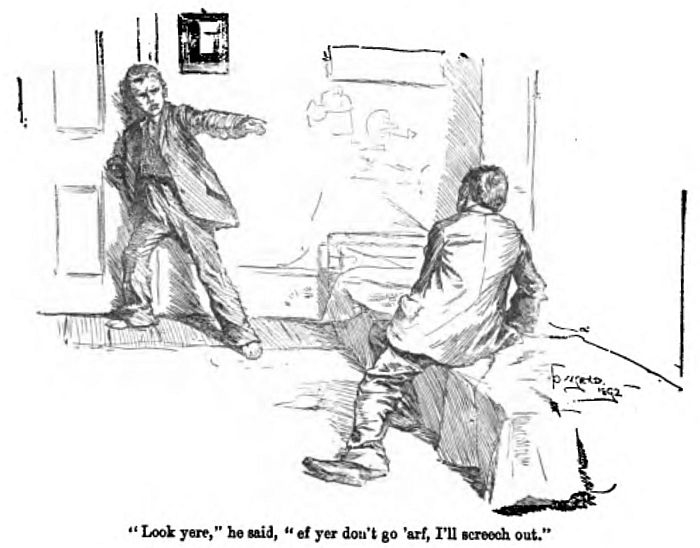
“Look yere,” he said, “ef yer don’t go arf, I’ll screech out, and Jill ’ull come. I’m atween you and the door, and I’ll screech orful loud, and Jill ’ull come afore you gits down-stairs, so now you knows. It’s ’arf the swag with me, or its none.”
Tom’s eyes shot forth little rays of wrath, but he knew that Bob had a queer obstinate tenacity of his own, and he thought it best to humour him.
“All right,” he said, “don’t screech. We’ll go pals. ’Spose as we runs away.”
“I ’ates that book-shop,” said Bob.
“And I’m run to death by the Boy Messenger Company,” said Tom in a gloomy voice. “’Spose we goes to sea, Bob.”
“’Spose we does,” said Bob, with a little yelp. ”‘A life on the rolling wave’—oh, my stars, won’t it be fine?”
“Mother has run away too,” said Tom. “There’s her letter on the top of the dresser. It was seeing her helping herself out of the stocking as put me up to it. She took some of the money, and she left the key in the drawer, that’s how I come by this jolly find. You read her letter, Bob.”
Bob did so, with his eyes glittering.
“I say,” he exclaimed, “yere is a jolly go. I ha’ got a stuff in my pocket, a kind of new sort of Indy-rubber wot rubs out writing. I say, Tom, let’s put the whole of it on mother.”
“The whole of wot? Wot do yer mean?”
“She says she has took thirty shillings. Let’s rub out them words, and put as she took all that wor in the stocking. Then the perlice won’t be a’ter us, and we can go off to sea without no one a-finding of us out.” Tom reflected over Bob’s words of wisdom, and finally decided that his plan was worth adopting. While Jill still slept, the wicked, clever little fingers erased a portion of Poll’s letter, and added the words instead, “I ’as took all the money you has hoarded away in the old stocking. I know you won’t grudge it.”
Chapter Eight.
Jill awoke presently, rubbed her eyes and sat up in bed. A sensation of gladness was all over her, but she could not at first understand what it meant. Her sleep had been so strong and dreamless that the remembrance of her engagement to Nat Carter did not in the first moment of waking return to her.
Then she remembered it. She gave a leap of pure joy and sprang lightly out of bed. Having dressed herself neatly she stood for a moment by the window of her little room. Thankfulness was filling her whole nature. She felt so young, so joyous, that it was a delight to her even to be alive. She looked up into the cloudless summer sky and said aloud:
“I don’t know nothink ’bout the ways o’ good folks, but they say that they b’lieve in Someone up there. They call Him God. Ef there is a God I thank Him with my whole heart this morning. God up in the sky, ef you’re there, do you hear me? Jill thanks yer with her whole heart to-day.”
A faint dimness came over the girl’s bright eyes; she put up her hand to wipe it away, and then went into the kitchen.
Poll, of course, had gone to buy some flowers in the early market. She might be back at any moment.
Jill bustled about to prepare breakfast. She did not go near the dresser, which stood in one corner of the little room and was never used to hold cups and saucers or any implements of cookery. Jill’s mind was so preoccupied that she did not even observe the boys’ absence.
At last, however, the breakfast was ready. The coarse cups and saucers were placed on the little table, the coffee stood on the hob of the bright little stove. The bread and a plate of dripping were placed also on the table.
It was almost time for Poll to have returned. Jill expected each moment to hear her footstep in the passage. She sat down to wait for her, and at last remembering her brothers, turned to the press bedstead to tell them to get up. The bedstead was empty. The bed was tossed and tumbled; no boys were to be seen there. Jill felt a passing wonder at their having gone away, without breakfast, but they were always erratic in their movements, and her mind was too preoccupied with other thoughts for her to trouble herself long about them.
After waiting a moment or so longer she ate her own breakfast, for she reflected that if for any reason her mother was detained in the market she would have to go out to buy flowers to replenish her basket herself.
Having eaten, she went into her bedroom to put on her apron and turban, and now neatly dressed she came back into the kitchen, and taking up her flower-basket, was preparing to leave the room, when she suddenly remembered that her pockets were destitute of money. She had really earned nothing the day before; she must therefore draw upon her little savings to replenish her basket this morning.
The thought gave her a faint passing annoyance, for she did not like to deduct even a penny from the money which would be so useful to Nat and herself when they started housekeeping.
There was no help for it, however, and she put her hand inside her dress to feel for the blue ribbon which held the precious little key of the bureau. The ribbon came out easily enough, but Jill started and felt herself turning pale when she saw that there was no key attached to it. Her eyes grew big with a sudden fear.
What had become of the key? The ribbon looked as if it had been cut. Who could possibly have done this? No one. The ribbon must have got thin and worn without Jill knowing it. The key must have dropped off. Where had she lost it? How very unpleasant if she was forced to burst open the drawer of the bureau!
Then she remembered that she had the key last night when she opened the drawer to put the five sovereigns Nat had given her to take care of for his pal into the old stocking. She certainly had the key then—it must therefore be somewhere in the house.
She went back into her bedroom and searched on the floor and in the bed; she could not find it and returned to the kitchen with a puzzled, anxious expression on her face.
Then she gave a cry of delight and made a leap forward—the key was in the lock of the drawer. How careless of her to have left it there! and yet she was glad now, for no harm could possibly have happened, as no one but herself and her mother knew that she kept money in the drawer.
She went on her knees, pulled it open, and taking up the old stocking, unrolled it. Her own savings, amounting to nearly five pounds, were kept in a tiny gingham bag—the money Nat had given her was in a neat paper roll. The bag was there flat and empty—the roll had also disappeared.
Jill felt herself turning queer, sick and faint; she could not possibly believe that the money was gone; she felt certain at first that in some way these carefully hoarded savings must have slipped out of the bag, that the roll of paper must be hiding in another part of the drawer.
It was a game of “Hide and Seek”—a cruel game between this money and a girl’s troubled, anxious heart. She searched the drawer from end to end; it contained some neatly-made aprons, some stockings, and a few other garments. The contents were quickly searched through, Jill rose to her feet—she was white and tottering, but she had not as yet reached the stage of believing that the money was gone.
She still thought that it was playing that hideous game of “Hide and Seek.” She placed her hand against her heart and leant against the bureau. There was nothing for her but to go on seeking for the treasure so securely hidden; but where now should she look?
She stood still, trying her best to think. Suddenly her eyes rested on the open sheet of thin poor letter-paper which contained her mother’s badly written words.
Jill started violently at the sight. She bent forward and tried to read the hand-writing. Her sight was excellent, but just for a moment she could not see the words in the letter; then she read them:
“Dear Jill,—This is to say as I’ll come back again when I’m cured.”
“What did that mean,”—Jill rubbed her eyes until they smarted—“Mother will come back again when she’s cured”? She read the next sentence; “I’ll ha’ no pain when I come back, my gel, so you make yerself ’appy.”
“Oh, poor mother, poor mother!” exclaimed Jill.
She looked again at the letter and read the last sentence:
“I ’as took all the money you has hoarded away in the old stocking. I know you won’t grudge it.”
Jill clasped her hands to her head; it reeled; she thought she should have fallen, but making a great effort, she tottered to a chair which stood near and sat down.
For several minutes she could not realise what had happened. Then the simple facts of the case came slowly home to her. The old stocking was empty. The money which Jill had taken nearly eighteen months to save—penny by penny and sixpence by sixpence—had vanished. But that was not the worst—that fact was bad, very bad, but it dwindled into insignificance beside the much more appalling fact that the five pounds which belonged to Nat’s pal had also disappeared. Nat, her lover, had trusted her with this money—he had feared to keep it himself—he had believed it possible that some one might steal it, and he had given it to Jill for absolute security. She remembered, as she sat numbed and still on that chair, into which she had thrown herself, the look in Nat’s eyes when he had spoken about giving her the money to keep safely for his pal.
The expression of trust, of confidence, of relief could not have been greater on Nat’s open, honest face had he taken that money to the Bank of England. Jill represented the Bank of England for trustworthiness, for security, to Nat.
“He trusted me,” she moaned; “he trusted me. Oh, mother, mother! what shall I do? Oh, mother, what have you done to the Jill whom you love?”
The poor girl felt that she could not keep still any longer.
By what possible means was she to get the money back? She must recover it—she must rescue it before her mother had spent it all. She rose and went hurriedly out. Her head was in a whirl, her usual dear judgment had, for the time, forsaken her. She, the upright, the respectable Jill, was penniless; but that was not the worst—she felt herself, in a measure, a thief, for through her Nat’s money had vanished.
Going down-stairs she met old Mrs Stanley, who stopped her to utter a pleasant “Good morning.”
“What is it, Jill?” said the old woman, startled by the queer, strange look on the girl’s face. “What’s the matter, dearie? You don’t look yourself.”
“I’m a bit anxious,” said Jill. “Mother’s not quite well, and I—I’m going out. Ef any one calls and arsks arter me, you say as I’ll may be—be out all day, Mrs Stanley.”
“Yes, my love, I’ll say.” The old woman looked at her longingly; words came to her lips which she felt a strange desire to utter. While she hesitated, however, Jill had run quickly down-stairs, and was lost to view.
Her empty basket hung on her arm. As she walked through the streets in the early summer morning a neighbouring clock struck six. She was still in very good time to get a supply of flowers for her basket. This was the height of the flower season. Flowers of all sorts were abundant and cheap. Jill was a regular customer too, and she knew more than one flower merchant who would give her a good selection of flowers even if she were a little late in going to buy them.
She passed through the ugly neighbourhood of Drury Lane, and taking a short cut for the Strand, found herself in Bedford Street.
She was close now to the market, and here she paused to consider what she should really do.
She had no money in her pocket, but this fact did not greatly trouble her, for she could easily go on tick for some flowers until the following morning. There was more than one flower merchant who would gladly fill the pretty girl’s basket for the sake of a smile, a shy “thank you,” and a look of gratitude in those lovely dark eyes. The fact that she was absolutely penniless was not, therefore, Jill’s trouble.
No! she had something far more important to think over.
Should she waste time at all to-day trying to sell flowers? Would it not be better for her to spend the long hours of this summer day looking for her mother? If she found her mother she could easily induce her to give back Nat’s five sovereigns. As for her own savings, they were of small consequence.
When she was about half-way up Bedford Street, Jill stood still to carefully consider her plans.
A heavy blow had been dealt at her, dealt at her, too, when the radiant sun of happiness was shining through all her being. She had been stunned for a little, but now her vigorous young brain was capable once more of taking in the whole situation.
She decided after a very brief pause that she would go to the market and buy enough flowers to stock her basket with; she would then go to her usual stand outside the Metropolitan Railway Station and sell the flowers as quickly as possible. Thus she would provide herself with a little ready money. She could pay back her debt for the flowers with part of this money, and spend the rest of it in looking for her mother.
To-day was Friday, and Nat had told her that he was scarcely likely to see her again before Saturday evening. She had, therefore, this much breathing time, either to recover the money, or to make up her mind what to say to Nat.
When this definite plan of action made itself plain to her, her brow cleared and she quickened her steps to reach the market. She soon found herself under the great glass dome where the flowers were sold, and in a moment was standing by a stall waiting for her turn to be served.
The extreme bustle and movement of the market was almost at its height when she arrived. An eager hum of busy voices pervaded the place. The merchants were busy, not only selling their flowers, but eating excellent breakfasts of coffee, poached eggs, bacon, and other delicacies, which were supplied to them by waiters from neighbouring restaurants.
The strong perfume of the flowers, and the heat, which, early as it was, was beginning to be felt through the glass roof, would have made the place almost intolerable to any one less acclimatised to this sort of thing than Jill.
Some of the flower girls looked already spent and tired. They were, for the most part, an unkempt-looking lot, their hair untidy, their dress exhibiting the extreme of dowdiness; the shabbiest hats adorned their rough heads; old shawls, greasy with wear, and dull from long exposure to weather, protected their ample shoulders. Their dresses were almost ragged, their feet slipshod and untidy.
Youth was a misnomer for most of them, and beauty was not to be found in their ranks. They knew good flowers, however, and chaffered eagerly, and conducted their marketing on the most approved business principles.
Jill was such a contrast to the other flower girls—her beauty was so remarkable, her dress so picturesque as she stood under one of the big palm-trees, that she resembled a tropical flower herself. She was looked at with envy by one or two of the girls, and with marked admiration by several young costermongers, who would have given a good deal for a nod or smile from so lovely a girl.
As a rule she had a pleasant, friendly way with her, never allowing familiarities, but taking good-natured badinage and jest in the spirit in which they were meant.
To-day, however, she saw none of the faces, heard none of the comments, returned none of the murmured greetings.
She waited for her turn to be served, as motionless almost as a statue, and it was not until a rather rough voice sounded in her ears that she awoke to the full difficulties of her present position.
“Can I sarve you, miss?” said a flower merchant. “I ’as got some beautiful rose-buds this morning, and a great supply of water-lilies. You come and see ’em, they’re just your style.”
This flower merchant’s name was Silas Lynn. He was a heavy-built man, with a powerful face, a rough shock of hair, and small, deeply set eyes. His mouth was coarse, his hands and feet enormous. He owned a cottage and a couple of acres of ground in Kent, and brought his flowers and fruit daily to the market, transacting all his business himself, and allowing no middleman to interfere with him.
Silas had a voice which exactly matched his appearance. It was so rough and harsh that it absolutely militated against his business; the more timid of the flower girls preferring to carry their pence and shillings to quarters where they would be sure of civil treatment.
One or two people who knew him very well indeed, made the queer remark, however, that Silas when bending over his favourite flowers had been heard to speak softly; that when he lifted the young leaves, and looked into the lovely blossoms, a mild sort of tender sunshine would suffuse his rough face.
These reports of him had been whispered by a few, but they were not generally believed. He was strictly honest, sober, industrious, but hard as a nail; a man who looked for no quarter, and gave none.
This he fully believed to be his own character, and his neighbours and friends supported him in the belief. It was from this man, however, that Jill had resolved to ask a favour.
When he desired her to come and look at his lilies, she went quietly with him to a back part of his stall, where the great, white waxy lilies were lying in a tank which he had provided for the purpose.
“I has had a good morning’s work,” said Silas, rubbing his hands, and turning aside for a moment to swallow down a great cupful of scalding coffee.
“Ah, there ain’t nothing like doing your business yourself, and trusting your affairs to no one else. That’s my way. I larnt it from my mother. Wot’s the matter, lass? You look peaky.”
“I’m a bit tired,” said Jill.
“And a bit late, too, I guess. Get out of this, this moment, you varmint, or I’ll break every bone in your body!” These last words were thundered at a small ragamuffin of ten, who had been loafing round, but now took to his heels as if pursued by demons. “You’re a bit late,” continued Silas, allowing his small eyes to rest upon Jill, with the sort of pleased satisfaction with which he regarded what he was fond of calling a “thorough-bred rose-bud.” “I don’t see you nor that mother of yourn often round as late as this; but now, how can I sarve ye?”
“Oh, Mr Silas Lynn,” exclaimed Jill, clasping her hands, and speaking in swift entreaty, “ef you would give me just a few flowers to put in my basket, and let me pay for ’em to-morrow morning.”
Lynn indulged in a loud laugh of astonishment, perplexity, and pleasure. He was as hard as a nail to be sure, but he did not object to lending Jill some flowers.
“I’ll lend ’em with pleasure,” he said; “but you s’prise me, Jill Robinson; I thought as you had a tidy lot of money put away.”
“So I had,” answered Jill, her lips beginning to quiver; “I had yesterday, but not this morning. When I looked for the money this morning it wor gone.”
“Stolen, does yer mean?”
“No, no; nothing o’ the sort—I can’t speak o’ it. Will yer lend me a few flowers, and let me go?”
“Gimme yer basket.”
Silas pulled it roughly out of the girl’s hand. He laid some wet grass in one corner, and arranged a pile of lilies on it; rose-buds, white, pink, cream-coloured followed; geraniums in every shade made up a brilliant bank in another corner. Masses of poppies filled the remaining space.
Silas had a knack of arranging flowers which could only be excelled by Jill herself. His great hands could touch the tiniest blossoms with a rare taste and a skill which produced surprising results.
“There!” he said suddenly. “I forgot the carnations! We’ll pop in a bunch here; they are wonderful for sweetness; they mind me o’ my mother. She had all their little ways. I’d like to tell you about her some day. Yere’s the baskit, and good luck to you! You’re a tidy lass—the only tidy one as comes to the market, and it’s a pleasure to see yer with the bits of flowers.”
“But,” said Jill, colouring and trembling, for sore as her heart was it could not help going out to such a basket of beauty, “I didn’t mean to have flowers like these. Why, there’s a sight more nor a guinea’s worth yere; and I only meant to have two or three shillings’ worth o’ the commoner sorts—poppies, and sich-like. I can make up field poppies and grasses to look wonderful, and I could sell ’em off quick, for the ladies like ’em for those new sort of heart drorin’-rooms as is all the go.”
“Heart drorin’-rooms?” queried Silas. “My word, what are they?”
“I don’t know, but they are all the rage. Heart drorin’-rooms and heart dresses. You hears of ’em iverywhere.”
“Well, there’s a heart baskit,” said Silas, with a harsh laugh, which was partly caused by a sudden embarrassment which came over him. “You take it, and go.”
“But I can’t, really. I could never pay it back.”
“You’re not meant to—it’s a gift.”
“A gift, Mr Lynn?”
Jill raised her eyes, looked him full in the face, read a meaning in his awkward glance, and pushed the basket of lovely flowers away.
“I can’t take it,” she said, “not as a gift; no, that worn’t my thought. Thank yer all the same.” She began, with hands that shook, to replace the masses of flowers on the flower merchant’s stall.
In a moment she found her two hands imprisoned. “Don’t do it,” said Silas, in a voice of low thunder. “Ef you touch ’em I’ll fling ’em on the refuse heap out there. Pay me, ef you will, but take the basket and go. And listen first: Jill Robinson! What do you think them flowers are worth to me? I’d give every flower on this stall for one kiss from your red lips. So now you know the mind of Silas Lynn. I’ve a rough voice, and a rough look, but my heart’s leal. Now you know my mind, so you can go, lass.”
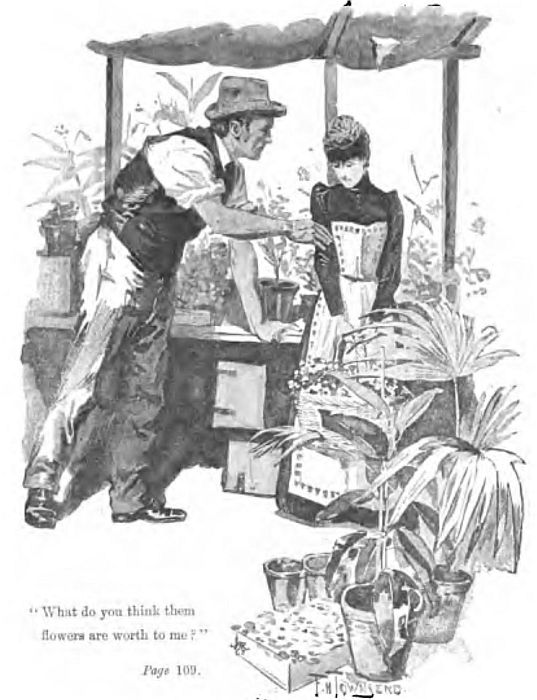
The man almost pushed her away, and the next moment his stentorian voice was heard, shouting savagely at some timid customers who had appeared on the scene.
Chapter Nine.
Jill had a very successful morning with her flowers; they were the envy and admiration of all the other flower women. Even Molly Maloney felt as if she must indulge in a fit of crossness when she saw those water-lilies, carnations and rose-buds. But there was something in Jill’s face which soon made the other women cease to feel unkindly towards her. Trouble was new to Jill, and the frightened, half-pathetic, half-despairing expression of her fall, velvety brows eyes gave the flower girls who came to talk to her and to admire her basket a queer sensation. They were curious, but their curiosity was not likely to be gratified by Jill. Even to Molly Maloney she scarcely vouchsafed a word of explanation.
“I’m in a bit of worry about mother,” she said once, in a low whisper; “Don’t speak on it, Molly; it’ll pass, no doubt. You ain’t seen mother this morning, ha’ you? She han’t chanced to call round to ask arter Kathleen?”
“No,” replied Molly; “and, ef she did, I wouldn’t dare to let her in. Kathleen’s down with faver, and no mistake. I’m at my best to keep it from the neighbours, for, ef they knew, one o’ them ’spectors would come round and carry the por chile off to the hospital. Oh! worra me, worra me! it’s a weary world, and no mistake.”
Jill said some words of sympathy. She was fond of pretty little Irish Kathleen, and, taking a choice rose-bud and carnation out of her basket, she gave them to Molly to take home to the child.
“Tell her they’re from Jill,” she said, “and I’ll look round to-morrow, may be, or may be Sunday.”
“You ain’t ’feared o’ the faver, then, honey?”
“No. Why should I be? It isn’t sickness as frights me.”
“You have a throuble, then, honey?”
“I’m fretted about mother, Mrs Maloney. She ain’t well, and it frets me. She’s more than anybody to me, mother is. I’ve sold most of my flowers now, so I’ll go. Good afternoon to yer, Molly.”
Jill took up her basket and walked away. She spent all the rest of the day going from one low haunt to another, looking in vain for Mrs Robinson. It did not occur to her to seek for her mother at Betsy Peters’s, but, on her way back to their own little flat, she ran up against Betsy, who stopped her at once to ask about Poll.
“She wor werry bad last night,” explained Betsy, and then she told of the incident which had occurred at the chemist’s shop.
“I thought I’d call round and ask arter her to-day,” said Betsy. “Her looks frightened me, and she’s real bad—real bad, Jill Robinson. The chemist knows, and so do I, what ails her.”
“It’s more nor I do,” said Jill, drawing herself up. For a brief instant she feared that Mrs Peters was referring to Poll’s unfortunate habit of taking more than was good for her. Jill’s black eyes flashed, and poor, meek, pale-faced Betsy started back a step in alarm.
“I don’t mean nothink bad, dearie,” she said. “It’s the heavy hand of the Lord that’s laid on your mother. She ought to go to a hospital. I don’t hold by ’em in most cases, but your mother ought to go.”
Jill felt herself turning very pale. “What do yer mean?” she said.
The woman stepped forward and whispered a word in her ear. The ugly sound caused her to reel for a moment, a faint dizziness came over her; she clutched Mrs Peters by the shoulder to keep herself from falling.
“Don’t take on, lovey,” said the woman. “It’s the will o’ the Lord. There’s no goin’ agen’ Him, Jill.”
”‘His purposes will ripen last, Unfolding every hour: The bud will have a bitter taste, But sweet will be the flower.’”
“Don’t talk cant,” said Jill. “Mother’s bad, ef what you say is true. She has got something orful the matter, and you tell me it’s the will of God, and you folks wot b’lieve in God talk o’ Him as good and kind. Ef God is good and kind, then it ain’t His will as mother should suffer orful things sech as you tell on. I b’lieve there’s a devil somewhere, and he does the bad things. It ain’t God. I’d scorn to think it o’ any one so beautiful as He.”
The girl’s indignant words rang out on the evening air. Mrs Peters thought them blasphemy, and clasped her thin hands in horror. Jill turned to leave her. She went back to the empty flat, and sat down in the old arm-chair where her mother had so often tried to rest.
It seemed to Jill that at last she had got at the meaning of her mother’s sudden departure. Poll had gone away because Jill must not see her pains. Jill must not see them—Jill, who loved her with that passion which comes now and then to a daughter for a mother, which now and then is almost the strongest passion of life!
In that moment of agony Jill thought far more of her mother than she did of Nat. She loved Nat intensely, but just then the aching emptiness within her was caused entirely by Poll’s absence.
She had never been angry with her mother for taking, as she supposed, all the savings out of the old stocking. Her one desire now was to shelter her mother. Jill had always stood between Poll and the censorious world. Jill had always understood why Poll must drink now and then; now it seemed to her that she also understood why the savings must go.
“I must find mother again,” she said to herself, after a pause. “I must, and I will; but, first of all, I ha’ got to give Nat back the five sovereigns as he gave me to take care on for his pal. There can be no marrying a’tween us until mother’s found, and the money given back to Nat.”
Jill spread her day’s earnings on her lap. She found that she had fifteen shillings, and had still a sufficient number of unsold flowers in her basket to give her, with a very few additions, sufficient material for to-morrow’s work. She had spent the greater part of an hour in the empty kitchen when there came a brisk knock at the door. She started at the sound, and went with some slight hesitation to open it. Nat might possibly be waiting outside. She longed to throw herself into his arms, and yet she dreaded seeing him. The knock was repeated. She opened the door, to see Susy Carter standing outside.
“It’s me,” she said, in her brisk way. “May I come in? My word, ain’t it hot!”
She entered the kitchen at once, and, taking a handkerchief out of her pocket, wiped her heated face.
“I thought maybe you’d be having tea,” she said. “I’d be glad of a cup. Ain’t your mother in yet?”
“No, Susy.” Jill filled the kettle as she spoke, and, turning on the gas, set it on the little stove to boil. “You shall have a cup of tea as soon as ever I can get it ready, Susy.”
“You don’t look spry,” said Susy. “Wot’s up with yer? Has you and Nat had a quarrel?”
“No. How dare you say it?” Jill’s eyes flashed with anger.
“Oh, highty-tighty! What a fly-away young madam it is!” said Susy, with her shrill laugh. “Well, Jill, I meant no offence. You look downhearted, somehow; and, of course, a gel don’t expect to see that on the face of another gel wot’s jest gone and engaged herself to her brother. It’s but natrel to see smiles on yer face, Jill, and to hear you joking and laughing. I joke orful when I’m happy, there’s nothing like a good joke for making time pass.”
“Well, I’m happy enough,” said Jill. “Who said I wasn’t? It ain’t my way to take my happiness all sparklin’ and fizzin’. I likes it quiet best.”
“You’re in great luck to have got Nat,” continued Susy. “Ef I was another sort, I’d be in a rage of jealousy, but that ain’t me. Nat’s safe to rise, and get on in the costering line; and he has saved a good little bit of money, too, and put it away in the Savings’ Bank, ef I am not much mistook. Nat’s close, when he likes, and so I tell him. I like him all the better for it. I ’ates people as wears their hearts on their sleeve, and tell all about their money matters, and so forth. I’m close myself, and inclined to be saving, and so will Nat be ef you’ll let him, Jill.”
“Who says I won’t let him?” retorted Jill. She spoke almost pettishly; her voice had completely lost its usual sweetness. Susy was never a congenial companion to Jill, and to-night she rubbed her the wrong way with each word she uttered.
“I’m not saying nothing,” replied Susy, nodding her pretty, fair head. “But deeds speak a sight louder nor words, and wot I want to know is this—why you and Nat has made up yer mind to take all them heaps of rooms down-stairs? It’s the height of folly, and that you know, Jill.”
“No, I don’t; but I know something else,” replied Jill.
“Wot? My word! you’ll spill that boiling water on the tablecloth ef you don’t look out. Wot do you know, Jill?”
“That Nat and me can manage our own affairs, ef we are let,” answered Jill.
“Oh, dearie me! now you’re turning sulky. I must let Nat know as the pretty little dear has got a temper of her own. But, speakin’ serious, Jill, hadn’t we better strike that bargain while we are about it?”
“Wot bargain?”
“Me to have the best bedroom, and the run of the kitchen, for ’arf-a-crown a week. Come now, it’s only common prudence to say yes.”
Jill sat down wearily, and dropped her hands to her sides. She had supplied Susy with tea, and bread and butter, and a substantial slice of cold pork-pie, but she could not touch any food herself.
“Nat must decide,” she said. “It’s Nat’s affair, it ain’t mine. It’s for him to decide.”
“He says t’other way,” said Susy, with a pout. “I bothered him this morning for a good while, and he said it was for you to say. Fact is, Jill, you can turn Nat round your little finger. He’ll do nothing agen you, ef it was ever so little.”
“Well, well, I’ll let you know presently,” said Jill. “I has a headache to-night, and I am tired.”
“But it won’t tire you any worse jest to say yes. I’m in a choky, nasty room now, and I want to give notice to quit. Ef you say ‘Yes’ to-night, I can give a week’s notice on Monday, and then I can move in yere Monday week. Nat’ll keep my bits of things in his room, and you’d give me a shake-down till you was married, wouldn’t you, Jill? Say yes, now do, dearie.”
“I can’t say nothing for certain, Susy. Nat and me we ain’t married yet. Ef we marry, I suppose you’re welcome to the room. I can’t say no more.”
“And you ’as said ’eaps, and I’m much obleeged,” said Susy, springing from her chair, running up to Jill and giving her a hearty embrace. “I’ll jest snap my fingers in my landlady’s face, come Monday. You’re a good sort, Jill, and a real out-and-out beauty. I don’t wonder Nat’s took with you. Now, I suppose, I had better go. Poor Nat! he were in a bit of trouble this morning for all he’s in such delight at your promising to wed him.”
“Nat in trouble!” said Jill, starting up, and speaking in a voice all animation and pain. “Wot do you mean, Susy? and why didn’t you tell me that afore?”
“I forgot it. My sakes, what a jumpy sort of wife you’ll make! I doubt if you and Nat will suit. He’s accustomed to me all his days and I never let my feelings get the upper hand in that style.”
“But wot is he in trouble about, Susy?”
“Oh, it’s that pal o’ his, Joe Williams.”
“Yes. Wot o’ he?” said Jill. She felt her heart beating quickly, for it was Williams’s money which Nat had placed in her keeping.
“He’s dead,” said Susy. “He died sudden this morning. Nat’s orful cut up, for the poor lad has left a wife and two or three children. By the way, Nat says that he has given you some money of Joe’s to keep safe for him.”
“So he has,” replied Jill.
“You look orful white, Jill. Are you going to faint?”
“I han’t the least notion of sech a thing.”
“Well, you do look queer! You’re all narves, I expect. I wish Nat luck on you, with yer starty ways, and yer changes of colour.”
“I’m very sorry about Williams,” said Jill, her eyes filling with tears. “I expect it has took Nat all on a heap. He set a deal of store on Williams.”
“He did. But, my sakes, you never knew him, Jill; it ain’t for you to be fretting. It’s a good thing you has got the money safe, for ’twill be wanted now for the funeral. Nat said as ’twere a load on his mind a-keeping of it, for our rooms ain’t safe. We was very onlucky in ’em, and I daren’t leave so much as a shilling behind me in the morning. I wish our Guild would provide rooms for us to sleep in, as well as a place for the flowers. Well, I must go now, Jill. I’m obleeged for the tea, and the promise of the rooms—the best bedroom, mind, when you and Nat is wed. How late yer mother is comin’ ’ome. Good-night, Jill.”
Susy took herself off at last, and Jill breathed a sigh of relief. She sat up for some little time longer, waiting for her brothers; but presently, finding they did not come home, locked the door of the little flat and went to bed. She slept scarcely at all that night, and awoke in the morning quite determined with regard to one thing—that she must either find her mother before the evening, or get the five pounds from some one else to return to Nat Carter.
As she was dressing she thought, for the first time almost since she had left him, of Silas Lynn. She remembered his generosity with regard to the flowers. That basket of flowers was really a splendid gift, and, although Jill meant to give him back at least ten shillings this morning, she could not but own that he had been more than kind to her. As to his outspoken words of admiration, she gave them very small consideration. She was accustomed to broad compliments from men of all sorts, and mere words made little or no impression on her. She thought now, however, with a certain little warm comforting thrill of hope, that perhaps Silas would be induced to lend her the princely sum of five pounds, to be paid back day by day in small instalments, until the whole debt was discharged.
Silas had been kind to Jill for a long time now, and several of the flower girls had joked her about the great, coarse, ugly-looking fellow. If she could induce Silas to help her in her present awful dilemma, she felt no service would be too great for her to render him. If Silas lent her five pounds, she might conceal the knowledge of what her mother had done from Nat, and they might be married some day, if not at once.
Jill hastened her toilet when this thought came to comfort her. She snatched up a piece of dry bread to eat, instead of breakfast, and, munching it as she went, hurried down-stairs. She reached the market quite an hour earlier than she had done on the previous day, and was rewarded at once by a broad stare from Silas. His stare was presently illuminated by a smile, which ended in a wink, and, stretching out one big hand, he beckoned to Jill to approach.
“I’m going to order breakfast for two,” he said, “and there’s a cosy seat here, under this rose-tree. I’ll fill yer basket, my gel, so you needn’t go no further. You set there, and take the world easy. My word! you mind me o’ my mother more nor ever this mornin’. There’s a waiter over there, I’ll call him. Hi, Sam! You come here this minute. Now then, I want a rare feed for me and this young ’ooman.—Wot have you got?”
“Kidneys, rashers and heggs, sorsiges, homlettes,” called the waiter off on his fingers.
“Wot’s yer mind?” asked Silas, turning to Jill. “Have a hegg done to a turn, and a little juicy slice of curled-up bacon on the top o’ it? And see yere, waiter, I’ll have a chump chop, and two heggs, and make the coffee strong, wotever you do. Now be quick, there’s a good chap.”
The waiter nodded, grinned, and disappeared. When Silas had given orders about his breakfast, he turned and looked at Jill with that slow, grave smile, which, nevertheless, was sweet enough to transform his rough face.
“I’m puzzled to know what flower to liken yer to,” he said. “Seems to me maybe as you most takes arter one o’ they dainty toolips afore they comes out into full bloom. Of all flowers under the sun, there seems to me to be more in a toolip than in any other. For one thing, it comes arter the dead, cold winter; then it’s so prim and yet so gay—so proper all round, and yet there’s sech a frolicsome look ’bout the little tips o’ the flowers jest where they half opens to let in the sunlight and the sunshine. Yes, you mind me o’ one o’ them dark red, rich-looking toolip-buds as comes in the spring.”
Jill scarcely replied to these words from Silas. She was thinking of the request she was about to make him, and wondering in what language she could best make known her sore want. She sat very still under the large rose-tree where he had placed her, her rich, dark head was slightly bent forward, her brown, yet shapely hands were folded over her many-coloured apron, her olive-tinted face was paler than its wont, the thick, heavy fringe of eyelashes caused a shadow on her cheek.
Silas gave her another quick, admiring glance.
“She’s a toolip, and a carnation, and a bit of a rose-bud all in one,” he murmured under his breath. “Never seen her like afore. See how quiet she sets, and how little she minds all I says to her. She’s hard to win, like one of them skittish colts at home. But why compare her to a colt? she’s a flower out and out. One o’ they cuttings werry precious and hard to strike in strange soil. I like her all the better for it. There’s breeding in every bit o’ her.”
“What shall I put in the basket to-day?” he continued. “How did the lilies go? and did the ladies wonder how you come by they choice rose-buds?”
These words roused Jill.
“You don’t know what that basket wor,” she said; “I sold off the flowers as fast as ever I could. They were lovely; there worn’t sech a basket to be seen with any other flower girl.”
Silas laughed. “Ha, ha.” He said, “We’ll do better’n that to-day; I ha’ thought the subjec’ of that basket o’ yourn out and out. I ha’ planned one most cunning for to-day. You leave it to me, Jill, I’ll fill it for yer. What do you say to a border all round o’ these delicate green ferns, and then a row o’ deep crimson carnations, and agen ’em something white, and then a mass o’ blue forget-me-nots, and the centre all roses—every sort, cream, white, pink, blush, crimson? Wot do yer say to that sort o’ basket, Jill Robinson?”
“It’d be more beautiful than a picter,” said Jill, her eyes smiling. “Oh, Mr Lynn, what lovely thoughts you has! I can most fancy I see that ere basket.”
“You leave it to me, and you’ll see it in real ’arnest,” said Silas. “Ah, here comes breakfast. Now then, Jill, you shall pour out the coffee.”
Jill stood up at once to perform her office. She did it without a scrap of self-consciousness. She was quite impervious to the glances of amusement which came from many pairs of eyes at the rough-looking flower merchant and the handsome girl. Her mind was too absorbed with something else to notice any of these outside matters; but Silas felt his heart swell within him as he took the large cup of coffee from Jill’s little hands. He noticed fast enough how the folks looked at them both. These glances, these significant nods gave him intense pride and pleasure.
“Seems to me,” he said under his breath, “as ef the little cuttin’ was a-beginning to strike.”
The meal was nearly over when Jill spoke again. “Yere’s ten shillin’s for the flowers you give me yesterday, Silas Lynn,” she said. “Ten shillin’s, and my werry best thanks; and ef you will fill my basket with five shillin’s worth more flowers of the common sort, I’ll be much obleeged.”
While she was speaking, Silas’s face, which had resembled a great beaming sun a moment ago, grew black.
“You keep that ten shillin’s, or you’ll anger me,” he growled. “Ef you must give it back, give it back another day, but not now. Tell yer what, ef yer give it to me now, I’ll put it in my mouth and swaller it; so there.”
There was something so ferocious in the man’s change of tone and change of face that Jill felt sick. She knew that she must humour him if there was the least chance of his acceding to her request.
“Mr Lynn,” she said suddenly, “I’ll keep that money, and give you ten shillin’s worth o’ thanks instead. I don’t mind saying as I come here to-day hoping as you’d do me a kindness.”
Silas’s brow cleared as if by magic.
“The little cuttin’s a-strikin’, not a doubt on it,” he muttered.
“Do you a kindness, Jill Robinson?” he said aloud. “Well, that’s quite arter my style. Let’s hear wot you wants, lass. Say the words as low as you like, my pretty, I’m all a-listenin’.” Silas bent down towards Jill as he spoke. “There,” he said, “speak up, don’t be afeared.”
“I’m in a good bit o’ trouble,” she said, her lips trembling. “I told yer yesterday that I had lost some money. It worn’t stole—don’t yer think that, but it wor lost. I want to pay that money back again to-night. Will yer lend it to me, Mr Lynn? Oh, there’s nought under the sun I wouldn’t do for yer ef you’d lend me that money what got lost.”
“There’s nought you wouldn’t do for me,” said Silas. “Them words is pleasant to hear—werry, werry pleasant. I has took a fancy to yer, and I like to hear yer say ‘there’s nought you wouldn’t do for me’; sech, for instance, as pouring out my coffee for me, eh? There, you’re blushin’, my gel; never mind never mind. How much is the money you want?”
“Maybe I ought not to ask,” said Jill, starting from her seat and speaking nervously; “it’s an orful lot—it’s five pounds.”
When Jill named the sum which she required, Silas could not help giving a start of astonishment. Flower girls like Jill had seldom anything to do with so large a sum of money. Silas was naturally a close man, and, much as he was taken with the pretty flower girl, he was obliged to think twice before deciding to lend her so much money. When she raised her dark eyes full of pleading to his face, however, and when their brilliance was veiled and softened behind tears, Silas could not help clapping his hand on his thigh and exclaiming, in a sudden burst of admiration:—
“’Tain’t a toolip you are, lass; it’s a bit of a moss-rose-bud. Jiminy! if you ain’t the very purtiest bit of a thing I ever clapped my eyes on—bar none.”
“You will lend me the money, will you not?” said Jill.
“Wait a while; it’s a big sum. There’s a power of work in getting a lot of money like that together, and ef I give it away jest for a gel’s whim—”
“No, no; not for a girl’s whim,” said Jill, “but for her sore need—for her werry sore need. Oh, Silas Lynn, I know as you has got a really kind heart.”
“Maybe I has, and maybe I han’t. I won’t lend the money unless you keep to your word. You said as you’d do anything for me. That means a deal. Do you abide by them words?”
“As far as I can, Mr Lynn.”
“You can abide by ’em ef you will. Now, for instance, ef I were to say there’s a nice little cottage in the country awaiting for a missis, and I wor to say: ‘Come, Jill, and be my own true love’—why, I declare I’m getting quite into the poetry vein. And ain’t the pretty dear turned red? Shall it be a bargain, Jill Robinson?—I give you the five pounds, and you give me your nice little purty bit of a self.”
“No, Mr Lynn. No,” said Jill. Little by little the colour had left her face; even her lips were white. “I didn’t understand it in that way,” she said. “It can’t be.”
She took up her empty basket and went away.
Chapter Ten.
Jill never remembered afterwards how she spent that long day. She had no flowers to sell, for she had taken her basket empty from the market, leaving those that were over from the day before in a pail of water at home.
She was too restless, miserable, and anxious to sit doing nothing in Howard’s Buildings. So she wandered the streets quite indifferent to the gaze of the many flower girls who knew her, and quite oblivious to the feet that her picturesque dress and beautiful face called for loud admiration from more than one passer-by.
Tired out at last, she went home. She was glad that the long day had come to an end. Nat would soon be with her now, and the worst would be over. She sat down in the empty kitchen and waited; then was nothing whatever else for her to do. She had thought about the lost money, and about what she should say to Nat so often, that at last her tired brain refused to think any more about it. She held on now only to one instinct. She must shield her mother at any cost. If necessary, she must even go to the length of telling Nat that she had given her mother the money.
She had come to this resolve when a quick step was heard on the stairs outside. A gay whistle accompanied the step, and then a hand knocked with gentle insistence on one of the panels of the door.
Jill went at once to open it. Nat was standing outside. He had dressed himself with some care, and when Jill threw open the door and looked at him, he presented as fine a picture of a young English lad of the people as heart could desire. His curly hair was damp with exercise, his face was tanned with much exposure to the weather; his honest, well-opened eyes were as blue as the sky. He was a tall young fellow, too, with broad shoulders and a well-knit frame.
“Eh, Jill!” he exclaimed, “I thought you’d be in, and awaiting for me. I had no time to send yer word; but I guessed somehow as a little bird might whisper to yer as I’d be looking round.”
“Shall we go for a walk, Nat?” said Jill in a hasty voice. “I ain’t quite well. Shall we go and take a walk on the Embankment? It’s a fine evenin’, ain’t it?”
“Why in course; it’s a beautiful evenin’, sweet-heart. We’ll go out, ef you wish. But you has never given me a kiss, Jill. Don’t you want to?”
“Yes, Nat,” replied the poor girl. She took a sudden step forward, flung her arms round his neck, and placed her soft cheek against his. “I’d like to go out with yer,” she said then. “We can talk about kissin’ presently. I’m craving for the air.”
She wrapped a bright shawl round her head. Nat took her hand and they went down-stairs.
“Ef there’s anything as I must tell, it ’ud be easier out in the air,” she murmured to herself.
For some time, however, Nat avoided all painful subjects. The two wandered down to the Embankment, and, going into the gardens, sat on one of the benches. They sat close together, and Nat’s brown hand held Jill’s under the gay apron which she still wore. A good many people passed them, and looked at them, and murmured to one another that this silly young pair were in a fool’s paradise, and that they’d wish themselves out of it fast enough one day. It seemed to Jill afterwards, however, that they were all alone that evening, that no one looked at them as they sat on the bench together, that they had the gardens to themselves.
The sunset passed, and the stars shone in the dark blue of the sky, and Jill looked up at them and thought that, after all, it must be very easy to be good. She had forgotten her pain and anxiety for the present; the influence of the summer night was surrounding her, and the still more potent influence of young love was sending all fears to sleep.
“Nat,” she said suddenly, “it seems as if the folks must be right.”
“Wot folks, Jill?”
“Them folks as says there’s a God, Nat, and that He lives up there. Seems to me that there must be a God, and that He’s beautiful. I don’t believe we could love each other as we do, but for God.”
“Maybe,” said Nat. “I han’t thought much about it. I were allers too busy. Ef He made you love me, Jill, I’ll go in for believing in Him; that’s sartin. But, oh! my word, my word, there’s a sight of misery in the world!”
“That’s the devil’s doing,” said Jill in a frightened whisper. “I allers put the misery to the devil. But don’t let us think on it to-night, Nat. Don’t let’s think on one miserable thing this beautiful night. Let’s put all the pain out of sight. It’s there for sure; but let’s put it out of sight. Do, Nat; do, dear, darling Nat!”
“Why, my little love, you’re all of a tremble. Take my ’and, and let’s walk about a bit. We won’t talk of miserable things, Jill—at least not yet awhile. Come out and look at the moon shining on the river. Ain’t it prime? And how the water ripples. Why, you’re shivering still, Jill. Ain’t yer well?”
“Oh, yes, Nat; I’m as well as a gel can be.”
“Let’s walk up and down then. I have everything planned for our wedding. I thought, maybe, we’d take a third-class fare down to Yarmouth or somewhere, and have a look at the real sea. I have an aunt at Yarmouth, a Mrs Potter, and she’d give us a shake-down for nothink, I make sure. Wot does yer say, Jill?”
“I never looked at the sea,” said Jill.
“Nor have I; folks say as there is nought like it. I believe we might give ourselves a week’s holiday. I has put by a few pounds. Wot’s the matter, Jill? You’re shivering again.”
“I wor thinking,” said Jill, “that maybe I were wrong about God. Maybe He ain’t up there.”
“Why, Jill, what do you mean? And I do declare you have tears in your eyes. What is the matter, my little gel?”
“Ef God was there,” said Jill, “ef the beautiful God I picter were there, He’d give us one perfect happy evening—oh, I know He would, I know He would!”
“And ain’t this evening perfect and happy, Jill?”
“I can’t keep the pain out,” said Jill in a low voice. “I ha’ tried, but it won’t stay away. I’m thinking of mother, for one thing; she ain’t very well.”
“But we’ll both take care on her when I’m your mate: and ef pain do come, we’ll bear it together. There ain’t a doubt as there’s a heap of suffering in the world, and it seems to me as if it worn’t right for us, however happy we wor, to shut our eyes to it. Why, look at me, I wor fit to burst my heart wid misery this morning, and yet when I were running up them stairs at Howard’s Buildings and thought that with each step I were getting nearer to you, it seemed as ef I could have shouted for joy. I take it that I wor in one sense selfish—in another, no.” Nat looked at Jill as he spoke. For a moment she was silent, then she said in a husky voice—
“Why were you miserable this morning, Nat?”
“It wor about my mate, Joe Williams. You know I telled you about him. Him and me we shared the same barrer, and the same cart of flowers. Joe was as good a feller as breathed; but he worn’t lucky. He had a sickly wife, for one thing, and four little bits of kids. He turned over a tidy bit of money; but he couldn’t save, not ef he was to try ever so. It seemed as ef saving and prudence worn’t in him. Do you think he’d pay a shilling a week to a buryin’ club or a sick club, or aught of them clubs as is the stay of working men? No, no, that worn’t Joe. It wor all spend, spend with him. To be sure his wife was sickly, and he couldn’t deny her nothink, and she wor more to blame than he. That woman had a perfect crank for smelling out money. Ef Joe brought ’ome as much as ’arf-a-crown, meaning to save it for a rainy day, she’d unearth it. It were no use his trying to save, for Clara were more for spending even than hisself.
“Well, one day an uncle of his died, and left him five sovereigns in an old teapot. Joe gave the teapot to Clara, and said nothing about the windfall inside. But he gave them five sovereigns to me jest a week ago, wrapped up in the identical brown-paper as I handed to you two nights back, Jill. And he says, says poor Joe, with a sort of a wink of a tear in his eye, ‘Ef the worst comes, Nat, that’ll bury me,’ says he, ‘and I won’t be on the parish,’ says he. I can tell you, Jill, that money wor like a millstone round me, I were so feart of losing it. And I were fine and glad when I handed it on to you, lass.
“Well, poor Joe, he dropped down dead yesterday morning, jest when he was coming to help me fill up the barrer. It were orful sudden, and poor Clara’s nearly off her head.”
Nat spoke huskily; the sorrowful feelings of the morning were moving him again.
“He’s dead,” he continued; “the best feller living, the kindest heart as breathed. I’ll never meet his like, he wor that trusting and that companionable. We wor mates for close on three year, and never was there a word atween us. I can’t get over his dying off so sharp; but it is a good thing as you has the money safe, Jill.”
“Yes; that’s a werry good thing,” replied Jill. She paused again.
The moon was now riding in majesty across the dark blue heavens; the lovers had turned their steps towards Howard’s Buildings. Jill was trembling no longer; every nerve was on tension, each beat of her heart was warning her to be careful, to betray nothing. She wondered at her own sudden calm, at the power of brain with which she seemed endowed. She felt so still now, so capable of acting prudently in this terrible emergency, that she was even inclined to test Nat, to see for herself what he would do and how he would look if he really knew that his dead pal’s money was gone.
“It is a good thing as I has them five sovereigns,” she continued; “but s’pose as they wor lost?”
“What do yer mean, Jill?” Nat’s honest, open face clouded over, his blue eyes flashed a steely light of anger. “You oughtn’t even to say sech a thing in jest,” he continued.
“No, no, in course I oughtn’t; but it is a way with me to look at every side o’ a picter. You giv’d the money two nights ago to a gel as could be trusted. You loved that gel, you thought a sight on her; she had a mother the soberest o’ women, and she herself were honest as the day. You’re a lucky feller, Nat Carter, to have found a gel that lives up to yer creed. You’re rare and lucky, though I say it as shouldn’t, to marry a gel with sober, quiet, and honest relations. You wouldn’t like it no other sort, would you?”
“I should think not,” said Nat, quickening his steps. “But why do you talk in that queer fashion, Jill?”
“It seems to ease my heart like; it’s so nice to know as I’m jest what you want. Now, s’pose, jest s’pose for two minutes, dear Nat, that things worn’t the way they are. S’pose I wor Jill still, with a heart all trembling with love to you, and my face the same as it is, and everything looking jest as it do now, but the inside, Nat, the inside o’ your Jill quite different. S’pose, jest for the sake o’ the thing, that my mother worn’t a sober woman, that she’d take a drop too much sometimes, and sometimes go the length o’ singing songs in the street, with a mob round her, and s’pose your Jill had to go and fetch her home and cossit her up and make purtense as she wor a very sober, ’spectable sort o’ woman, and s’pose, still more, that when you giv’d me yer mate’s money I didn’t keep it safe, but I giv’d it to my por mother what worn’t sober. You trusted Jill, and Jill worn’t worthy, and your dead pal’s money wor all gone, every stiver of it. You look at that picter, Nat, and say what you’d do with sech a Jill as I ha’ drawed out. Would you take her to your heart and say, ‘Never mind, poor Jill, you loves me, and that makes up for all. Your mother ain’t sober and you ain’t true; but your love is true, and I’ll take you to be my wife.’ That wouldn’t be your way, would it, Nat?”
“How wildly you talk, Jill. I think you must be a-going to have fever.”
“No; I ain’t goin’ to have any fever, and I ain’t talking wildly. Answer me. Would you take the Jill as I have pictured to be your wife?”
“Take the child of a drunken mother,” said Nat; “take a false gel, what wor the werry worst kind of a thief, to be my wife! No, thank yer. Don’t talk on it, Jill; it pains me; it seems sort o’ cruel to yourself even to speak on such matters.”
“But,” said Jill, “one moment, Nat. You wouldn’t have her—you’re sartin sure, even ef she had my face; the face you loves, the face you think werry lovely.” Jill threw off her many-coloured shawl as she spoke; her dark eyes gloomy in their great depths, were raised to Nat’s; her little brown well-shaped hands were placed on his shoulders, her lips were parted in a faint smile, the gleam of her pearly teeth just showed. There was a passion of love and longing in her gaze which stirred the young man to the very depths of his being. Nevertheless, what a horrible picture she had drawn! A false Jill, a thief, the daughter of a drunkard!
“No, no,” he said, almost pushing her clinging hands away; “sech a Jill ’ud be nought, and worse than nought to me. Ef she had ten times your beauty I’d spurn her. I’d push her from me. Don’t talk on her no more—don’t think on her. Put your hand inside my arm, my little love, and let’s walk fast, for you’re beginning to shiver again. Why did you talk so strangely, Jill?”
“A fancy I had,” said Jill in a light tone. “It’s over now; let’s talk o’ pleasant things again. When’ll you want your mate’s money, Nat? Shall I give it to yer to-night?”
“No, not to-night; I’ll come round and fetch it to-morrow some time.”
“About what time, Nat?”
“Let me see; I ha’ a deal to do for poor Clara Williams in the morning. I’ll come in the arternoon, as early as I can.”
“Well, we’re back at Howard’s Buildings now,” said Jill, with a little sigh, “and I must go up home. Kiss me, Nat; put your arms tight round me and kiss me.”
“My little love!” said Nat Carter.
“Hold me a bit tighter, Nat, dear. I want to kiss yer werry, werry hard for a minute. Good-night, Nat.”
“Good-night, Jill, my own little love.”
Jill kissed her hand twice to her lover, who stood and watched her as she vanished up the steep stone stairs of Howard’s Buildings.
Chapter Eleven.
Silas Lynn left Covent Garden at an early hour, and went home. He had a very neat little waggon for conveying his goods to town, and he sat in it now, in the pleasant sunshine and gave himself up to reverie.
He was very much startled and amazed at his own action that morning. He had not only made love to a very young and very pretty girl, but he had asked her to come down to the country god share his bit of a cottage with him.
He had asked her to take him for better, for worse. He had asked her to belong to him for ever and ever; it was really a tremendous thing to do, a rash, overwhelming sort of thing. Here was Silas, a grim, sour, gnarled old bachelor (he was not very far from forty years of age), asking a bit of a lass whom he knew little or nothing about to be his wife, Silas was known amongst the neighbours as a woman-hater—as a gruff, disagreeable, churlish sort of man, and yet now he was in love; absolutely in love with a pretty girl who possessed a pair of dark eyes for her dower, who was nothing whatever but a London flower girl, possessed of all the knowledge, and probably all the wickedness, that that name implied, and who owed somebody or other the large, the enormous sum of five pounds.
“It’s a good thing as she wouldn’t have me,” said Silas, as he sat in the front of the waggon, and “gee-upped” to his horses. “It’s a right good thing for me. She’d have been my undoing, sure as sure; a dainty bit of a thing with a purty way and a proud look; full of breedin’; and yet nothing but a London gel. Oncommon like the flowers all the same; painted up by the Almighty hisself—roses in her cheeks, fire in her eyes, and—my word! her lips, haven’t they a dash of colour in ’em! The Almighty made her very ’ticing—there’s no doubt on that pint. Worn’t she sweet just when she ’anded me that coffee; my word, it tasted like new honey. But all the same it’s well I’m rid on her. I’ll have forgotten her by Monday. There’s the new colt to be broken in, and that bed of dahlias wants thinnin’; I’ll say anything too that Jonathan’s coorting that wench Hepsibah, ’stead of looking arter the young sparrer-grass. Oh, my hand’s full, and I’m well quit of a bit o’ a girl like that ’un.”
Having reached home, Silas put up his tired horses, watered and groomed them, saw to their comforts in every particular, and then went into the little cottage which he had offered to share with Jill.
Silas was a very prosperous market-gardener. He had what might be called a certain knack with flowers and vegetables. Under his touch they throve. His blossoms were larger than those of any other market-gardener round. He did not go in so extensively for fruit, but even his fruit was better and more abundant than his neighbours’.
It was generally known that Silas was a man of substance. Every Monday he might have been seen trudging on foot to the nearest market town, entering the Bank, and going home again with a satisfied expression on his strong, rough face.
Everyone knew what Silas did in the Bank. He was storing his money there, putting away every week his hard-earned savings.
Notwithstanding his success, however, he was a very morose and churlish man. He never exchanged friendly words with his fellow creatures. He never invited his neighbours to partake of his hospitality. He was very good to his flowers, and scrupulously kind to his animals. But that he had any duties to perform to humanity at large, never entered into his calculations.
Although his small farm was so prosperous, and his horses so comfortably housed, the little cottage where he lived himself was of the most meagre description. It was very old, and in its best days was but a poor residence.
Silas said, however, that the two-roomed dwelling was good enough for him, and he would have been a brave man, and she a remarkable plucky woman, who had dared to suggest to Silas Lynn that he might with advantage enlarge his dwelling.
He entered his house now, put a match to some bits of sticks and some small lumps of coal, which had been left ready laid in the grate, and, sitting down on a hard wooden chair, which was much polished with age and service, glanced complacently around him.
When the fire blazed he would put the kettle on to boil, and make himself a dish of tea—he called it a dish because that had been his old mother’s way of expressing it. He would drink his tea strong and bitter, without the luxuries of milk and sugar, and take with it a slice from a quartern loaf which stood in the cupboard, and a thick cut from the cold bacon which he always kept in the house.
After this frugal meal he would be sufficiently rested to go out to thin the dahlias.
Silas had quite made up his mind to forget Jill; nevertheless, he found his thoughts running back to her in a way which both perplexed and irritated him. He said to himself:
“I has took too much notice of the gel. She’s nought but a common gel, when all’s said and done; and I has maybe turned my own head a comparing of her to the flowers made by the Lord God Almighty. It’s a good thing she wouldn’t have me; yes, it’s a right good thing. Praise the Lord for all His mercies, Silas Lynn. Drink yer tea and munch yer bacon, and forget the hussy.”
Lynn put the kettle on to boil as he spoke. Then he looked round the tiny kitchen.
“My certy, what a mess I wor near making of myself,” he muttered. “As ef she’d have been content with mother’s old room!”
The kitchen was very small; Lynn knew every inch and corner of it, but he found himself examining it now with new and critical eyes.
“A more comfortable room there can’t be,” he said to himself. “But it ain’t the place for a London gel. What ’ud she do with the old eight-day clock, and the bit of the dresser where mother kept the dishes? She’d come in with her fallals and her fashions, and afore a week wor out I wouldn’t know my own place. Mother’s arm-chair ’ud most like be moved from its corner, and the bunch of lavender that she sewed up herself in the muslin bag, and pinned over the mantelshelf, would be put behind the fire; and mother’s big Bible changed for a yeller-backed novel. Oh, lor, what an escape I has had! God be thanked again for all his mercies.”
The kettle boiled; Silas made his tea, ate his bread and bacon, and went out. He worked hard amongst his dahlias for two or three hours, scolded his servant Jonathan in round full terms, saw to the breaking in of the colt, and the comfort of his two patient waggon horses, and filially retired to his cottage when the stars were out and the moon shining. It was the very same moon that was looking down at this moment on Jill in her passion and anguish. But Silas knew nothing of this. He called the moon “My lady,” and bobbed his head to it after a fashion taught him by his mother. Then he went into his cottage, locked the door, lit a small paraffin lamp, and set himself to read his accustomed chapter out of the big Bible before going to bed.
Silas was a Wesleyan, and a very devout adherent of that religious body. He went twice every Sunday to the little Wesleyan chapel in the village close by, and on more than one occasion had himself been induced to deliver a prayer at the revival meetings.
Silas had a stentorian pair of lungs, and he could sing the old-fashioned Methodist hymns to the old tunes with immense effect. He was fond of giving way to his fancy on these occasions, and would supplement the tune with many additional twists and turns. He scorned to sing anything but a high and harsh treble, considering that the one and only quality necessary for rendering hearty praise to the Creator was noise.
Silas liked singing in the chapel, he liked praying aloud, he would not have at all objected to addressing his “fellow-worms,” as he called them, Sunday after Sunday. Above all things, he liked laboriously spelling out verse by verse a chapter of his mother’s Bible at night. He was not a fluent reader; perhaps because he only practised this art to the extent of that one chapter nightly. He liked to ponder over the words, and to move his big thumb slowly from word to word as he came to it. He never skipped a verse or a chapter, but read straight on, beginning the next night exactly where he had left off the night before. He was going through the Book of the Proverbs now, and he made shrewd comments as he read.
“Ha, ha,” he said to himself, “don’t never tell me as there’s a man living now wot beats the great King Solomon for wisdom. Take him on any subjec’, and he’s up on it, with all the newest lights too. Natrel history, for instance! hark to him on the conies and ants. Listen to him ’bout bees—why it’s quite wonderful. Then, again, take gardening—seems to me Solomon was a born gardener. Don’t Holy Writ say of him that he knew the names of all the flowers, and could he do that if he worn’t about among ’em—a-tying of ’em up, and digging at their roots, and watering ’em, and taking cuttin’s from the choicest of ’em? Folks tell of King Solomon in all his glory, but I seem to see him most often out among the flowers, a-petting and a-tending of ’em, and learning all those store of names by heart. But take Solomon all round, and his knowledge of the ways of women beats everything. Hark to the verse in this chapter: ‘Favour is deceitful, and beauty is vain, but a woman that feareth the Lord, she shall be praised.’ That were my mother’s sort—no beauty in her, and no favour—a downright woman, plain in her way, and a bit primity in her notions; but, oh, the goodness of her, and the fear o’ God that shone round about her, making a sort of savour all round her like a sweet-smelling flower! Jill minded me o’ her, but not in looks, for the poor gel has them things spoken so strongly agin by King Solomon. But for all that there was a sweetness in her that seemed to me this morning when I looked into her eyes to be more’n skin-deep. Most like I’m wrong. I’ve the Bible agin me, anyhow, and I ought to be thankin’ the Lord on my knees for having saved me from the enticing wiles of that poor gel.”
As a rule, Silas spent his short night without a dream, but the events of the past day had disturbed his somewhat slow nature. His brain had received an impression of a girl’s grace, freshness and beauty, which had penetrated straight from the brain to the heart.
Silas fully believed that by Monday morning he should have forgotten Jill; that her image would fade from his mental sight, her voice cease to sound on his mental ears. He did not know that he was never to forget her—that from henceforth to his dying day he would carry her image tenderly, sacredly in the inner shrine of his heart.
The little rosy god of love had come and touched Silas, and he could no more resist his influence than the flowers in his own garden could refrain from growing and expanding in the sunshine. So, quite contrary to his wont, Silas Lynn spent his night in dreams. Jill figured in each of these visions. Sometimes she was angry with him, sometimes appealing, sometimes indifferent. She was in danger, and he was the one to save her. She was surrounded by prosperity, and he was the benefactor who brought these good things to her feet.
All the time, however, through all the happenings of these queer distorted dreams, he and Jill were together. It did not surprise Silas, therefore, when early on that Sunday morning he awoke, to hear some one knocking at his door.
“Yes, I’m coming,” he said, still believing that he was in a dream.
“I want you very badly, Silas Lynn,” called Jill from the other side of the door.
Then he knew that he was awake, and that she had come to him. All the prudent thoughts of yesterday had flown to the winds. He found himself absolutely trembling with eagerness, joy, ecstasy.
“Yes, I’m a-coming; I’ll be with yer in a minute, Jill,” he called out. “For,” he said to himself as he tumbled into his clothes, “it’s too wonderful for anything. Who’d ha’ thought—who would have thought that a dainty bit of a cuttin’ like that ’ud go and take root in a rough soil like this here? It’s a fact nevertheless. Nothing less ’ud bring her here at this time o’ the morning. ‘Favour is deceitful and beauty is vain’—not a bit on it—you’re wrong for once, King Solomon.”
Having dressed himself, Silas quickly unlocked the cottage-door.
Jill was standing outside, leaning wearily against the post of the door. Her neat black dress was covered with dust, her apron was unpinned, her gay-coloured shawl had fallen back from her shapely head, and her black hair, in some disorder, was tumbled about her face. Jill’s face was very white. Silas felt himself absolutely colouring crimson as he came out to her, but not a tinge of shyness or embarrassment were in the wide-open eyes she raised to his.
“I ha’ come,” she said, speaking in a choking, husky voice, “for the loan of the money. I know wot it means, Silas, but I ha’ come all the same.”
“You know what it means?” said Silas Lynn, clasping both her small, cold hands in one enormous palm. “Do you mean to tell me that we are to wed each other, Jill Robinson? Are we to go afore the pa’son, and take each other for better and for worse?”
“Ef you like,” said Jill wearily. “I ha’ come for the money first. That’s the first thing. We can talk of t’other later on. The money’s the first thing.”
“Yes, yes. Why, you are all in a tremble! You must want that ere money bitter bad, Jill Robinson. Look me in the eyes, gel, and say as you’ll play me no tricks arter I have gived it to yer.”
“I’ll be quite true to you, Mr Lynn.”
“Now, don’t you speak in them stiff tones. Say ‘Silas,’ my pretty. Say ‘I’ll be quite true to you, Silas.’”
“I’ll be quite true to you, Silas,” repeated Jill.
“And you love me?”
“I—I’ll try.”
“Look you yere, Jill—” Silas was getting command of the situation now. His heart was opening out under these full beams of love and rapture. “Look you yere,” he said, “ef you’re true to me, Jill Robinson, and ef you love me even a little, and think nothink of no other feller—why, now I swear as there ain’t gel in the land as ’ull have a better husband. There’ll be love all round you, Jill; and what can’t that do? And ef I’m rough to outsiders you’ll never see nothink o’ it, my little gel; your wishes ’ull be mine, and your friends ’ull be mine, and your fancies will be my fancies. Day and night I’ll serve yer; and there ain’t any gel, no, not even if she’s a princess, ’ull have a truer mate. I wor a good son to my mother wots in ’eaven, and I’ll be a good husband to you, you pretty bit of a dainty flower—ef you’ll do your part. Faithful and true, that’s all I arsk. Is it a bargain, Jill? As to the money part, I could give yer ten times five pounds, ef yer wanted it—that’s neither here nor there; but the other part of the bond I must ha’ your promise on. Faithful and true—you’ll be that. D’ye hear me, Jill?”
“Yes,” said Jill, “I’ll do my part. I’ll think o’ none but you; I’ll be true to you in word and deed.”
“Then that’s right. I’ll ask no more questions. There’s a home for yer mother in my ’ouse, Jill, and full and plenty for you from this moment forward; and we’ll get spliced up as soon as may be, gel.”
“But the money,” said Jill. “It’s part of the bond between us, that I should ha’ the money and no questions asked.”
“You shall ha’ the money, and I’ll ask no questions, ef you don’t want to tell me.”
“I can’t tell you, Mr Lynn. The money were give to me in trust, and it got lost, although no one stole it. I must give it back to the one wot’s lent it to me this werry arternoon.”
“You shall have it, my gel. Now come into the house, and I’ll get yer a cup of tea. ’Ow did yer come to me, Jill? And how did you find my bit of a shanty?”
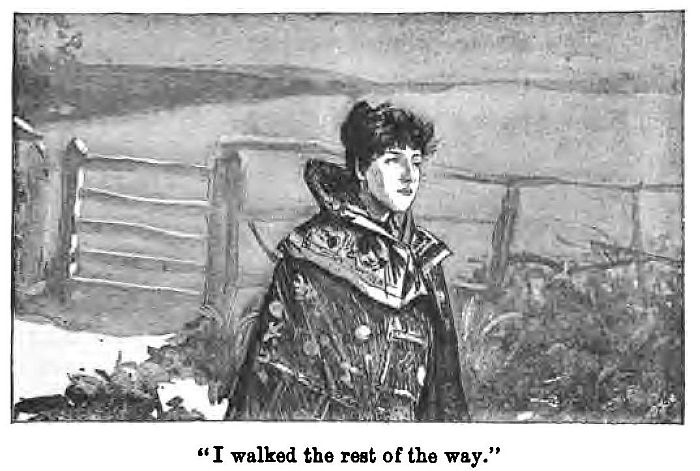
“It were this way,” said Jill. “I found last night, quite late last night, that the lost money must be gived back to—And I thought of you, and I ’membered how real kind you were. It worn’t that I loved you, Silas Lynn. I’ll try to in future, but it wornt with any thought of love that I ’membered you last night. But as I sat all in desolation, I see your face, kind and smiling, and tender-like, a-looking at me, and I said I’ll go to Silas, and he’ll save me fro’ my misery.”
“That wor right—that wor a good thought,” interposed the man.
“I went out then, and I came to a shop just close to the market, where I guessed as they’d know ’bout you. It wor a flower-shop; the man’s name is Thomson. And Thomson said, as good luck ’ud have it, he were just starting an empty waggon back into Kent, to be ready for a load of strawberries for Monday’s market. And ef I liked, he said, I could have a lift in it.