PART II. THE EASTERN QUESTION.
Reading edition
73
I. FOREIGN POLICY OF ENGLAND DURING THE SIXTEENTH, SEVENTEENTH, AND EIGHTEENTH CENTURIES.
The Spanish Empire, its power, and its decline—Commercial rivalry of England and Holland—The ascendency of France; threatened by the Grand Alliance—The Spanish succession and the Bourbon league—England’s connection with the war of the Austrian succession—The Seven Year’ War—Revival of the Anglo-Bourbon struggle in the American and Napoleonic wars.
Charles V. of Spain in the height of his power reigned over almost the whole of Western Europe. Besides being King of Spain he was Archduke of Austria, Duke of Burgundy, and Lord of Spanish-America. “The Emperor,” said Sir William Cecil, “is aiming at the sovereignty of Europe which cannot be obtained without the suppression 74of the reformed religion, and unless he crushes the English nation he cannot crush the Reformation.” Perceiving this important fact, Charles directed his attention to England, and offered the hand of his son Philip to Mary of England who was anxious to bring back the Catholic Faith into England.
Their marriage took place in 1554, and proved a great help towards re-establishing the Papal supremacy in England, besides making Spain and England strong political allies.
Charles V. abdicated in 1555 and spent the rest of his life in seclusion at San Yusti, and the great part of his dominions, viz., the Colonies, Italy, and the Netherlands descended to his son, Philip II., who was by his marriage with Mary nominal King of England.
On the childless death of Mary the English crown descended to Elizabeth in 1558. Philip thereupon offered marriage to her, but the virgin queen wisely declined. England was by this refusal emancipated from Papal interference and the tyrannies of Philip, and Elizabeth resolved to carry out her 75religious and political views independently. Her doctrinal[28] reform and foreign policy naturally made Spain her bitter enemy.
In the Netherlands Philip’s general conduct raised the inhabitants to revolt, and under the leadership of the Prince of Orange they soon obtained a strong position, and eventually, in 1648, after a long and protracted struggle, their independence was recognized.
Thus the two great sea powers of Philip’s age were both common enemies against the arrogance of Spain and were consequently united.
In France a similar religious struggle, fierce and bitter, was raging. Civil war was rampant and atrocities numerous, the massacre on St. Bartholomew’s Day being a notable example. In 1585 the Catholic party formed the “League,” whose main objects were the annihilation of the reformed party, and the 76elevation of the Guises to the French throne through an alliance with Philip II. of Spain. Its manifesto stated that French subjects were not bound to recognize a prince who was not a Catholic. The death of Henri III. made the situation worse, for two candidates for the French throne appeared,—Henry of Navarre, who was supported by the Huguenots and the Cardinal of Bourbon, whom the Leaguers followed, while Philip II. laid claim to the throne on behalf of his daughter by his third marriage with Elizabeth of Valois, sister of Henri III. Hence, after the accession of the House of Bourbon, a coalition of England, Holland, and France was formed against Philip II. of Spain, and from 1600 to 1660 the European coalition was England, Holland, and France, versus the Spanish Empire.
In the meantime Spain had acquired Portugal in 1580, by which both countries became one state, and Philip II. sovereign of the whole oceanic world. Portugal for sixty years remained a dependency of Spain, and then the Spanish Empire had attained to vast 77and unwieldy dimensions. She could no longer defend her colonies from foreign invasion and plunder. The Dutch established themselves wherever they pleased, and plundered and occupied most of the Portuguese possessions. It has been truly said that the Colonial Empire of Holland was founded at the expense first of Portugal, and ultimately of Spain.[29]
England at this time was rapidly rising into the front rank of European nations. In 1588 the “Invincible Armada” appeared in the English Channel and was annihilated and disgraced. This was the introduction to that English colonial greatness on which the sun never sets.
78Then came the beginning of the fall of the Spanish Empire. In 1640 Cardinal Richelieu, the ablest French statesman, provoked Portugal to rebel, his object being the aggrandizement of his own country abroad. The revolt proved successful under John of Braganza, and again Portugal posed as a nation. This proved a deadly blow to Spanish power, and Cromwell finally crushed her power by his invincible foreign policy. He seized Jamaica while Charles II. acquired Bombay.
This gradual decay of Spain had a corresponding inspiriting effect on England and Holland. Both became commercial and colonial rivals one with another. Ashley Cooper said, “Holland is our great rival in the ocean and in the New World. Let us destroy her though she be a Protestant Power; let us destroy her with the help of a Catholic Power.”[30]
79The great naval victories of England and the Navigation Acts, 1651, 1663, and 1672,[31] crushed the Dutch carrying trade and navy, and England now began to assume the supremacy of the whole oceanic world which has from that time never departed from her.
However, France gradually filled the breach left by Holland and Spain, and became a great naval rival of England. The strength of all the nations round her had been considerably weakened by the Thirty Years’ War, while her commercial and manufacturing progress soon made her one of the strongest European Powers.
From 1660 to 1672 may be regarded as the 80period of the great national rise of France. Louis XIV. laid claim to Belgium and Burgundy in 1665 on the death of Philip IV. of Spain, and in order to enforce his claim his army entered Flanders and Burgundy, but owing to the pressure of the Triple Alliance[32] the unfavourable Peace of Aix-la-Chapelle was concluded.
However, later on Louis broke the Triple Alliance and secured the valuable assistance of England and Spain, and with the assistance of the former nation he made a concerted attack upon Holland. France had now reached the topmost rung of the ladder between 1678 and 1688.
About this period the struggle against absolute monarchy was nearly concluded in England, and was further strengthened in 1689 by the Declaration of Rights. The English crown was offered to William of Orange and Mary and accepted by them. Already this personal union had caused an alliance to be formed between England and Holland, at that time the two great Protestant 81Powers of Europe, against France the great Roman Catholic upholder.
If France had remained quiet during the above-mentioned internal discord, England would have been unable to form the “Grand Alliance.” Thus Louis committed a great error in assuming an offensive attitude against the two Protestant Powers. This caused a coalition to be formed against him of England, Holland, Spain, and Austria.
This new system in Europe existed from 1688 to 1700. Then new complications arose, for Charles II., King of Spain, died childless, and the extinction of the Spanish House of Hapsburg seemed to be near at hand. The question of a Spanish successor now occupied the minds of the European cabinets after the Peace of Ryswick.
There were three claimants: Louis XIV., Leopold I., and the Electoral Prince of Bavaria. The dominions of the Spanish sovereign were still extensive, viz., Spain itself, the Milan territory, Italy, the Netherlands, and Spanish-America. To unite the Spanish monarchy with that of France or 82Austria, would destroy the European balance of power. Consequently a general council with regard to the succession took place, and the First Partition Treaty was drawn up. Charles II. of Spain, however, made a will, appointing Louis’ grandson, Philip of Anjou, as his successor, so Louis XIV. determined to uphold the will rather than the treaty.
In 1701 the Duke of Anjou was peacefully proclaimed king as Philip V. Louis XIV. on hearing this boasted that “Il n’y a plus de Pyrenees.” This Bourbon succession in Spain changed the European system, and henceforth we have England, Holland, and Austria, as opposed to France and Spain.
The Duke of Marlborough, who combined the qualities of a general, diplomatist, and minister skilfully together, was the leader of the Second Grand Alliance against the Houses of Bourbon.
The inability of France to defend the Spanish Empire, followed by the War of the Spanish Succession, paved the way for the Peace of Utrecht (1713). By this treaty the Bourbons lost Italy and the Low Countries, but 83retained the throne of Spain, thus still leaving that country open to the influence of France. Hence the permanent alliance of France and Spain was formed in the eighteenth century.
Meanwhile Holland had fallen into decay through internal exhaustion caused by her struggle against foreign enemies; thus England had taken her place as the great maritime and colonial power. Thus we see the struggle between England and France (supported by Spain) for the oceanic world in the eighteenth century.
By the Utrecht Treaty, France ceded to England Newfoundland, Arcadia, and Hudson’s Bay territory, while Spain also ceded Gibraltar, the Minorca Island, and the Asiento, the occupation of the two former making another bitter enemy to England.
Spain had already a hatred of English trade with her colonies in America, so that only a single English ship was conceded by the Treaty of Utrecht, giving thereby only a limited right of trade in South America to England. But this was evaded by a vast 84system of smuggling which arose and proved a constant source of dispute between England and Spanish revenue officers and rendered peace almost impossible.
In 1733 the first secret pacte de famille had been concluded between France and Spain for the ruin of English maritime trade. The American coast was keenly watched, and the result was “The Jenkins’ Ear War,” 1739.
Charles VI., having no son, established an order of succession by the Pragmatic Sanction, signed by nearly all the European Powers, by which his daughter, Maria Theresa, was to succeed to all the hereditary dominions of Hapsburg. But on his death two claimants appeared on the scene—the Elector of Bavaria and Philip V. of Spain.
Walpole did his best to form a Grand Alliance between Hanover and Prussia, also between England, Holland, and Austria. However, Frederick’s claim to Silesia being refused by Austria, the French and Prussian armies crossed the Rhine, 1741. Thus France began the War of the Austrian Succession. In 1743 the Battle of Dettingen 85was fought between England and France, the former fighting on behalf of Maria Theresa, and as yet feeling her way carefully before she was brought into direct conflict with the latter Power.
After the Treaty of Worms the question at issue was changed to that of naval supremacy, and the War of the Austrian Succession fell into the background.
In 1744, after an attempted invasion of England on behalf of the Pretender, France declared war against both England and Austria. This was bad policy, for if she had fought against one enemy at a time she would have stood a far better chance of crushing England’s power. Professor Seeley says, “If we compare together those seven wars between 1688 and 1815, we shall be struck with the fact that most of them were double wars, and that there is one aspect between France and England, another between France and Germany.... It is France,” says he, “that suffers by it.”[33]
England and Holland firmly allied with 86one another, and German troops were subsidized by England.
Against this alliance the second secret pacte de famille was founded.
Battles were fought on all sides, by land and sea, both in Europe and America. In spite of French successes at Fontenoy and Laufeldt, she was severely defeated both on the sea and in America. Louisburg fell, Cape Breton Island was captured, and many other losses sustained. At length the Treaty of Aix-la-Chapelle brought a nominal peace into the oceanic world, in 1748.
In 1756 this nominal peace came to an end, and the Seven Years’ War[34] was fought out, both in the Old and New Worlds; Pitt 87the elder then appeared as a great actor on England’s side, and used his great talents to crush down the French Colonial Empire, and to obtain for his country the sole mastery of the oceanic world.
He was essentially a war Minister: “The war was vigorously carried on throughout 1758 in every part of the globe where French could be found, and in 1759 Pitt’s energy and his tact in choosing men everywhere were rewarded by the extraordinary success by land and sea.”[35]
The glorious death of Wolfe on the Heights of Abraham was followed by the surrender of Montreal and the brilliant victory of Plassey in India by Clive over the French. Pitt assured his countrymen that “they should not be losers” (in giving pecuniary assistance to Frederick the Great) “and that he would conquer America for them in Germany.”
88This proved true. In 1762 the fall of the French Colonial Empire occurred, and England obtained Canada and India.
This wonderful statesman[36] undoubtedly made England the first country in the world.
Three Wars of Revenge.
“A height of prosperity and glory unknown to any former age,”[37] was reached in England during the administration of Chatham. Now the tide of fortune began to run against England.
The passing of the famous Stamp Act, and many other “repeated injuries and usurpations,”[38] made the relations between England 89and the American Colonies virtually hostile. At last the Colonies revolted, and it gave Spain and France the long-wished-for opportunity of taking revenge upon England. France and Spain formed the third pacte de famille, and assisted the insurgent Colonies, and the independence of the United States was acknowledged in 1783.
In 1789 the French Revolution broke out, and the first effect felt in England was the breaking-up of the Whig party.
In 1792 Austria and Prussia invaded France in order to put down the Republicans in that country. In retaliation France determined to declare war against all countries governed by kings, which principle she established by the “Decree of November 19th,” and in 1793 she declared war against England and Holland.
The younger Pitt had now come to the front. He was an economist and advocated a peace policy. In the spring of 1792 he reduced the navy and confidently looked forward to at least fifteen years of peace. There is no doubt that if France had 90remained quiet his hopes would have proved correct, and that the west bank of the Rhine would now be under French rule.
But France was eager to revenge past injuries put upon her by England; and, as if in answer to her desires, the second Alexander the Great appeared in Napoleon, and began “alarming the Old World with his dazzling schemes of aggrandizement.”
Against England his whole energies were directed. “Let us be masters,” said he, “of the Channel for six hours and we are masters of the world.”[39] In 1798, he captured Malta, occupied Egypt, and undertook a campaign in Syria, as a furtherance to his desires of obtaining India, at the same time retaining his ideas with regard to 91England. Malta to Egypt, Egypt to India, India to England.
In 1802 a momentary universal peace occurred. But Napoleon could not rest, his ambition spurred him on. His anger was again kindled by the English retention of Malta, after his defeat in Egypt, and he saw if Malta was wrested from him his lofty schemes would be undermined. In 1803 he again declared war against England and Holland. He arrested all the English residents in France between the ages of sixteen and sixty and kept them confined.
The younger Pitt was just the statesman fit to cope with him, and frustrate his aims. He aimed at a European coalition,[40] by which all threatening dangers from the overwhelming greatness of one nation might be averted.
92On October 21, 1805, the glorious victory at Trafalgar, the outcome and consummation of Nelson’s inspiring command, “England expects every man to do his duty,” broke the naval power of France. And yet this was followed by the capitulation of Ulm, the defeat at Austerlitz, and the subsequent Treaty of Presburg, which broke up the coalition of England, Russia, and Austria, and seriously affected Pitt’s health thereby. Truly, “Austerlitz killed Pitt.”[41]
At once Napoleon proceeded to turn the whole forces he had on the Continent against England, especially after the Peace of Tilsit, (1807). He first attacked England with the “Continental System,” i.e., he prohibited all direct and indirect European trade with the 93British Isles. This he confirmed by the Decrees of Berlin (1806) and Milan (1807).
In 1812 he invaded Russia and entered the famous city with the cry of “Moscow! Moscow!” Even at that moment, however, his real aim of attack was England, across the Channel.
England was ever uppermost in his thoughts. “He conquers Germany, but why? Because Austria and Russia, subsidized by England, march against him while he is brooding at Boulogne over the conquest of England. When Prussia was conquered, what was his first thought? That now he has a new weapon against England, since he can impose the Continental System upon all Europe. Why does he occupy Spain and Portugal? It is because they are maritime countries, with fleets and colonies that may be used against England.”[42]
Napoleon was driven out of Moscow by fire, and his return march turned literally into a defeat, while his plan of a direct attack in 94England, through Belgium, three years after, was frustrated at Waterloo.
Thus the scene of the great Napoleonic drama in English history closed on June 18, 1815.
95
II. FOREIGN POLICY OF RUSSIA DURING THE REIGNS OF PETER THE GREAT, CATHERINE II., AND ALEXANDER I.
Peter the Great, and establishment of Russian power on the Baltic—Consequent collision with the Northern States and the Maritime Powers—Catherine II. and Poland—First partition—Russia reaches the Black Sea—Russo-Austrian alliance against Turkey opposed by Pitt—Second and third partitions of Poland—Rise of Prussia—Alexander I. and the conquest of Turkey—Treaty of Tilsit—Peace of Bucharest—Congress of Vienna—French influence in the East destroyed.
Peter the Great (1689–1725).
The Russian territory now extends over one-seventh of the globe, and Alexander III. rules over more than 100,000,000 souls. Russia is a powerful political rival not only of England alone, but of all the European Powers.[43]
96However, on Peter the Great’s accession to the throne, his country covered an area of only 265,000 square miles, and no harbours were to be found either on the Baltic or the Black Sea. This was felt to be a serious obstacle for a rising Power. Peter himself said, in the preface to the “Maritime Regulations”: “For some years I had the fill of my desires on Lake Pereyaslavl, but finally it got too narrow for me. I then went to the Kubensky Lake, but that was too shallow. I then decided to see the open sea and began often to beg the permission of my mother to go to Archangel.”[44] His first and great object was to establish harbours on the Baltic or the Black Sea.
The Turks were the preliminary object of his attack. The first campaign against Azof (1695) proved a failure, but a new campaign was started again in 1696, and the Czar’s “bravery and his genius” were rewarded with a great victory over Azof. Here begins the modern history of Russia.
97
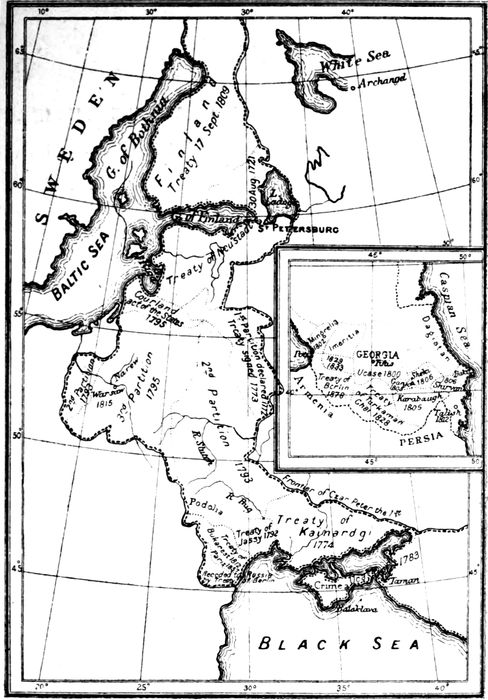
The Expansion of Russia in Europe.
99Immediately after the capture of Azof Peter determined to carry out his design of creating a large fleet on the Black Sea. For the purpose, “no sooner had the festivities in Moscow ended than, at a general council of the boyars, it was decided to send 3,000 families of peasants and 3,000 streltsi and soldiers to populate the empty town of Azof and firmly to establish the Russian power at the mouth of the Don. At a second council Peter stated the absolute necessity for a large fleet, and apparently with such convincing arguments, that the assembly decided that one should be built. Both civilians and clergy were called upon for sacrifices.”[45]
Peter also sent fifty men of the highest families in Russia to Italy, Holland, and England, to study the art of ship-building. Peter himself visited Holland and England that he might learn ship-building. “One thing, however, he could not learn there, and 100that was the construction of galleys and galliots, such as were used in the Mediterranean, and would be serviceable in the Bosphorus and on the coast of the Crimea. For this he desired to go to Venice.”[46] This clearly shows us that Peter had conceived the idea of establishing a strong navy on the Black Sea.
The revolt of the streltsi recalled him home; however, he found no difficulty in suppressing the insurrection.
After this, he sent an envoy to the Ottoman Empire to obtain permission for the Russian fleet to enter the Black Sea, to which the Porte replied: “The Black Sea and all its coasts are ruled by the Sultan alone. They have never been in the possession of any other Power, and since the Turks have gained sovereignty over this sea, from time immemorial no foreign ship has ever sailed its water, nor ever will sail them.”
Meanwhile Charles XII., King of Sweden, began to assume an attitude of hostility to Peter, and the Battle of Narva was fought, 101where Peter was miserably defeated. After this war, Charles made Russia the great object of his attack instead of Poland. He said, “I will treat with the Czar at Moscow.” Peter replied, “My brother Charles wishes to play the part of Alexander, but he will not find me Darius.” The Battle of Pultawa (1709) soon decided Peter’s superiority, and the Peace of Nystadt (1721) added the Baltic provinces and a number of islands in the Baltic to Russia.
In 1703 “a great window for Russia to look out at Europe”—so Count Algaratti called St. Petersburg—was made by Peter on the marshes of the Neva. This step firmly established Russian power on the Baltic.
But to establish Russian power on the Baltic at all was as great a mistake as ever has been committed by so shrewd a statesman as Peter the Great. The predominance of Russia in the Baltic with her strong navy threatened the interest of the commerce and carrying-trade of the English and Dutch. Hence it was natural enough that England and Holland, two great maritime powers, 102should have joined to protect their interest in the Baltic as well as the integrity of Sweden against Russian aggression. In the case of the Northern War, England had formed an alliance with Sweden and sent her fleet to the Baltic under command of Admiral Norris to prevent the Russian sway on those waters.
Had Peter thought less of the importance of the Baltic, and concentrated his energies on obtaining a sure foothold in the Crimea, Constantinople would now be a Russian southern capital.
Catherine II. (1762–1796).
The Seven Years’ War had been brought to a finish when Catherine II. ascended the Russian throne. The next great European complication was brought about by the affairs of Poland.
On the death of Augustus III., Stanislaus Poniatowski was elected King of Poland, and at the request of Prussia and Russia the dissenters, adherents of the Greek Church and the Protestants, received all civil rights.
103In opposition to this a Confederation of Bar was formed in 1768, with the object of dethroning the King. Catherine now began to interfere with Poland on behalf of the Greek Christians, and supported the King with her Russian army. This interference made her practically mistress of Poland. Turkey, an ally of the Confederacy, being alarmed at the growing Russian influence and being urged on by France, declared war upon Russia in order to resist the progress of Catherine in Poland; but this proved disastrous, as she was miserably defeated, both on land and sea, and brought to the verge of ruin. This Russian success alarmed Western Europe, and especially the two neighbouring Christian Powers, Prussia and Austria, each of whom had a special interest in the existence of Poland and Turkey. Catherine would not make peace without acquiring territory as a compensation for her exertions and outlay, while Prussia and Austria would not allow her to do this unless they acquired a certain amount of territory themselves. Hence the First Partition of 104Poland took place, by which the three Powers secured equal aggrandizement, Russia receiving the eastern part of Lithuania as her share.
In 1774 the Treaty of Kutschouk Kainardji was concluded with Turkey, by which the independence of the Mongol Tartars in the Crimea was acknowledged by the Sultan; Russia obtained the right of protection over all the Christian subjects of the Porte within a certain limit, and also the right of free navigation in all Turkish waters for trading vessels. This treaty firmly planted Russia on the northern coasts of the Black Sea.
In 1783 the Crimea was incorporated with Russia, and in 1787 Catherine visited the southern part of Russia as far as Kherson, on the Black Sea. Joseph II. of Austria, on hearing of her approach to his dominions, hastened to meet her, and together they journeyed through the Crimea, the Czarina unfolding to the Emperor both her own plans and those of Potemkin, her favourite, viz., to expel all the Turks from Europe, re-establish the old Empire of Greece, and 105place her younger grandson Constantine on the throne of Constantinople. Joseph fell in with her view, and it was hinted that something like a Western Empire should be also constituted and placed under the Austrian sway. In this way a division of the Ottoman Empire was contemplated between the two countries. This soon aroused the suspicions of Turkey, and war was again declared. But now it was two against one, and the fate of Turkey again seemed sealed.
William Pitt was the first statesman who directly opposed Russia and tendered assistance to Turkey against Russian encroaching power. His foreign policy of opposition to Russia has been followed more or less by generations of English Ministers. The Triple Alliance of England, Prussia, and Holland was formed by Pitt against the “Colossus of the North,” in order to preserve the balance of power in Europe, and the death of Joseph. II., saved Turkey again. Pitt, by means of this Alliance, demanded that a peace be made between Russia and Turkey on the status quo ante bellum, and threatened to 106maintain his demand by arms. The English people, however, cared very little about a Russian invasion of Turkey, while Catherine disregarded Pitt’s threats.
Soon after a peace between Russia and Turkey was concluded at Jassy, by which Turkey ceded Oczakow and the land between the Dnieper, Bug, and Dniester, containing several good harbours, and notably Odessa; the protectorate of Russia over Tiflis and Kartalinia was also recognized.
By the above-mentioned acquisitions she felt certain that very soon Constantinople would be in her hands. However, a nearer, and, in her opinion, a more important matter engaged her attention. In 1792 the new Constitution of Poland was drawn up by Ignaz Potocki, converting the Elective Monarchy into an hereditary one, the House of Saxony supplying a dynasty of kings. The Confederacy of Jargowitz, which was formed in opposition to this new Constitution, called in the help of Russia.
This now seemed to be a grand opportunity for Russia to finally annex Poland, 107because the deaths of Frederick the Great (1786) and Joseph (1790), and the French Revolution, which occupied the attention of all Western Europe, set the Czarina free from her most watchful rivals. A Russian army invaded Poland, and the new Constitution was repealed. Prussian troops also entered Poland under the pretence of suppressing Jacobinism, and Russia again found herself frustrated, and concluded a Second Partition (1793) with Prussia, by which she received Lithuania, Volhynin, and Podolia.
In 1795 the Polish nation rebelled, under the leadership of Xoscruscko, and this led to a Third Partition between Russia, Prussia, and Austria, and the former Power added 181,000 square miles, with 6,000,000 inhabitants, together with Curland, to her already vast dominions.
By this last Partition a road of aggression was open towards Sweden on the north-west, and towards Turkey on the south.
Many combined circumstances led Russia to assume an aggressive policy towards Turkey specially. Sweden, or rather Finland, 108was not of sufficient importance as a prey to the “northern bear”—a warmer climate was also wanted. Catherine had already discovered the mistaken policy of Peter the Great, who had spent all his energy in getting the strongholds of the Baltic in opposition to Charles XII. of Sweden. Russian sway on the Baltic meant a direct opposition from two great sea Powers, viz., England and Holland, whose interests would suffer thereby. A striking proof of the opposition was seen in the case of the Northern War.
The Partition of Poland produced another stray Power in the Baltic, to wit, Prussia.
Previous to the Partition of Poland, Prussia Proper and her dominions, Brandenberg and Silesia, were separated, Poland being between them. The First Partition joined the Prussian kingdom to the main body of the Monarchy; by the Second and Third Partitions Prussia obtained the then South Prussia and East Prussia, thereby uniting all into one compact body.
Thus unconsciously a powerful Russian 109enemy was being formed in the Baltic. Thus Russia had three great enemies—England, Holland, and Prussia, joined by Sweden and Denmark, on the Baltic.
Catherine had already obtained a firm footing on the Black Sea coast, and was confident of her ability to occupy Constantinople and make it a Russian southern capital; the French Revolution attracting the attention of Western Europe, the Ottoman Empire was left at the mercy of Russia. Again a Russian occupation would give a fine prospect of extending Russian authority into Danubian territory, Central Asia, and Asia Minor.
So we may conclude that Catherine’s annexation of Poland was only a step towards attaining her great aim, and gave her time to mature her plans.
At this juncture Catherine died, and was succeeded by Paul (1796). He reversed his mother’s policy by concluding an alliance with Turkey against Napoleon, seeing that the latter’s policy was to destroy the Turkish Empire for the benefit of France. He changed his policy later, however, after his 110unsuccessful campaign in Holland, and threw himself into Napoleon’s arms by establishing an armed neutrality in the north against England.
Alexander I. (1801–1825).
Catherine died (1796), but her plan did not perish with her. Alexander I. proved a faithful expounder of the late Czarina’s schemes.
His strong-handed policy was chiefly directed against Armenia and the Persian frontier, although the Danubian territory, Poland and Finland, did not escape his watchful eyes. Mingrelia and Imeretia were conquered in 1803, Shiroan in 1805–1806.
At last Alexander’s policy took a definite form at the Treaty of Tilsit (1807), for by the first provision “Russia was to take possession of Turkey in Europe, and push on her conquests in Asia as she thought proper.” This secret treaty, which was made with Napoleon I., caused great uneasiness in England, and a coolness sprang up between 111the two Powers (1807–1812), although England had adhered to an Anglo-Russian Alliance during Chatham’s administration, and Alexander joined the coalition of 1805.
In 1809 Russia gained Finland, with the whole of East Bothnia and part of West Bothnia, as far as the River Tornea, by the Treaty of Friedrichsham. The Peace of Bucharest (1812) was the result of England’s mediation, by which Russia added Bessarabia, and the Pruth was made the boundary between Russia and Turkey, while Russia gave up Moldavia and Wallachia, which at that time were occupied by her.
The quarrel between Russia and France concerning the “Continental System”[47] 112brought about a French invasion of Russia by 678,000 men (1812). But Russia coped successfully with her powerful foe.
The Congress of Vienna (1814–1815) met to restore the balance of power and regulate the European relations, and also established the “Pentarchy of the Great Powers.” Eight nations signed the Act of the Congress of Vienna, by which Russia was, generally speaking, the greatest gainer, for she received the greater part of the Grand Duchy of Warsaw.
At the Congress of Vienna, Castlereagh (the English representative) evidently had in view three aims—(1) to prevent any revival of the Continental System; (2) to protect English communication with India; and (3) to maintain her supremacy in the Mediterranean. For the first aim, England obtained Heligoland, and the kingdom of the Netherlands was formed, and “the surrender of Java was made to the Dutch by way of increasing the wealth and power of that kingdom, and so 113helping to re-establish the due counterpoise to French power which nature has given to the possession of the Low Countries”; for the second aim, England also obtained the possession of Cape Colony (from the Dutch) and the Mauritius (from France) to render safe the road to India; and for the third aim, England retained Malta, and also the seven Ionian islands were brought under English protection.
The Battle of Waterloo stamped out Napoleon’s[48] ambitious schemes. French power and influence in Eastern Europe vanished with Napoleon, and from that time France has not fully recovered, and is therefore unable to settle the Eastern Question for her benefit. The Napoleonic plan of occupying Constantinople has been stolen by Russia.
114
III. THE NEW EUROPEAN SYSTEM.
The concert of the Great Powers; its aims—It does not protect small states from its own members, e.g., Polish Revolution—How far can it solve the Turkish question?
Napoleon the Great fell at the Battle of Waterloo, 1815. The “concert of the Great Powers,” the primary object of which is to avoid the recurrence of universal war in Europe, was first established at the Congress of Vienna in the same year. This new European System is, however, only applicable to the case of a small Power or Powers, but not to the Great Powers themselves. For instance, in the Schleswig-Holstein, as well as the Franco-Prussian War, none of the other Great Powers could interfere, and matters were entirely left to themselves.
115
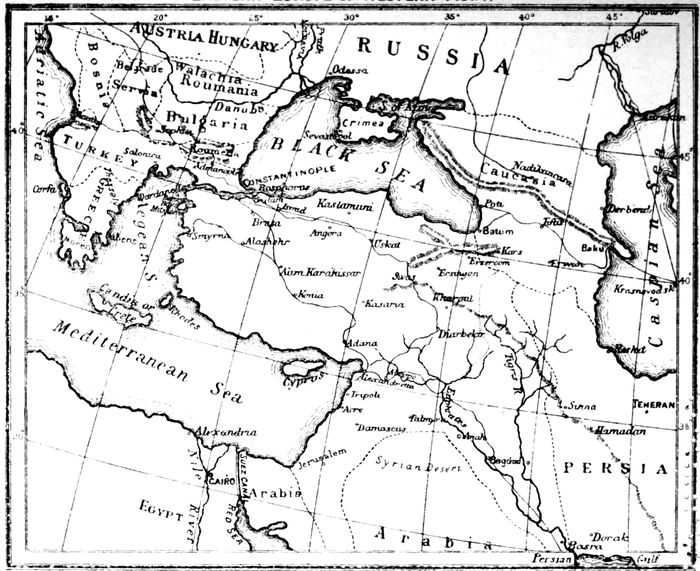
Eastern Europe & Western Asia.
117But in the case of a lesser state or states becoming breaker of the peace, the Great Powers have never hesitated to step in and settle the difference according to their mutual agreement. We see good instance of it in the Independence of Belgium.
The “concert of the Great Powers” is actually a second phase of the Holy Alliance, and the new system has usually its object the protection of a smaller state against the larger. Greek Independence was a singular example of the new system. The revolt of Greece was entirely suppressed by the Sultan, and there was no hope of freeing themselves from the Turkish yoke. Though hardly justifiable, the Great Powers at last interfered, and made Greece an independent state. The Independence of Italy was another example.
Thus we see that under the new system now prevalent in Europe, a smaller state at least attains her end.
Let us examine the Polish Revolution against Russia. The Poles said, Let us revolt. We shall undoubtedly be beaten by 118Russia; but we don’t mind that at all, because we shall at last attain our own end through the interference of the Great Powers. There was every reason for the event turning out as they had calculated. Louis Napoleon was the first European sovereign who interfered in the Polish Revolution, and he invited England to join him. England, however, declined, owing to the difficulties of the situation. France, from her isolation, failed in her desires, and Louis Napoleon lost his European confidence. Truly the fall of the French Empire began from that date.
This Polish Revolution disclosed another characteristic of the new European System. In the event of either country concerned being one of the Great Powers, the system is of no effect at all. The late dispute between England and Portugal comes under this heading.
One more interesting question needs investigation. How far this new European System is applicable to the question of Turkey, a country which may be placed among the first-class Powers, and where 119Christian inhabitants are in an inferior position to the Turkish Mahomedans. This is what I have to discuss in the following five chapters.
120
IV. GREEK INDEPENDENCE.
The Holy Alliance—The Greek insurrection—Interference of the Three Powers—Battle of Navarino—Treaty of Adrianople—The policy of Nicholas I.; Treaty of Unkiar Ikelessi—Turkey only saved by English and French aid—Palmerston succeeds to Canning’s policy.
Alexander I., Emperor of Russia; Francis, Emperor of Austria; and William I., King of Prussia, formed what was known as the Holy Alliance, the first-named being the chief instigator.
Its aim was to promote peace and goodwill among European nations, based upon Christianity, although it seemed quite liable to be abused for the benefit of absolute monarchy, as in the case of Spain. Nearly all the European Powers joined it, England[49] 121being the only one who declined. England’s argument was that “such interference is inconsistent with the fundamental laws of Great Britain. It must lead to a system of continual interference incompatible with European interests and the independence of nations.”[50] However, we are forced to admit and acknowledge that the present system of Europe is conducted on the same lines, slightly modified, as the Holy Alliance.
At the end of the eighteenth century the songs of the poet Rhegus and the revolutionary influence of France (1789) stirred up the Greeks to feelings of hatred against the Porte.
In 1821 the Danubian Provinces (Roumania), under the leadership of Hypisilands, rose in rebellion, trusting to receiving assistance from Alexander I., the instigator of the Holy Alliance. But their hopes were shattered, and Turkey soon crushed the revolt. This was the only case in which Russia did not interfere with Turkey in the Danubian question.
122A little reflection, however, will show the cause of the Russian non-interference in this case. Alexander’s power and influence were declining, and Russia was filled internally with discontent. Secret societies flourished everywhere, and the Czar dreaded a revolution in his own country if he gave help to the Danubian Provinces, which would be approving a rebellion against a legitimate sovereign.
The Greek rising in the Morea was answered by a counter Turkish massacre of Greeks in most of the principal cities of Turkey, and Gregory, the head of the Greek Church at Constantinople, was executed. This caused great indignation in the Russias and war appeared imminent, but owing to the mediation of England and Austria it was averted.
There is no doubt that Russia felt that it was to her advantage to assist a revolutionary movement, in order that she might secure as much influence in Turkey as possible. But Austrian interest in the Balkans was of vital importance. Her policy was naturally to 123oppose Russia in her desires, in order to keep the Turkish honour unstained and use her as a bulwark against Russia.
However, great enthusiasm was aroused, not only in England, but also in Germany and Switzerland.
Lord Byron died,[51] and Shelley wrote for the Greek cause. Lord Cochrane and Sir Richard Church fought, while the German poet, Müller, and the Swiss Eynard, warmly upheld the cause of the oppressed Greeks.
Notwithstanding this help, the Greeks were far from fortunate, and the Sultan, with the help of the Egyptians, captured Athens. But their brave defence of Missolonghi aroused the sympathies of the European Powers.
Nicholas I. (1825–1855).
On the death of Alexander I. the Holy Alliance vanished (1825), and Nicholas I. ascended the throne (1825–1855). Now the 124Greeks appealed to England for help, and Canning[52] saw that it was the best policy for England to assist Greece in order to control the ambitious plans of Russia. Accordingly he sent the Duke of Wellington as the English representative, and a protocol was signed at St. Petersburg by which Greece was to remain tributary to the Sultan, but to be independent as regards commercial relations. This protocol developed into the Treaty of London, between England, France, and Russia, by which the three Powers bound themselves to act as mediators in the Eastern question. The mediation of the Powers was rejected by the Porte, but accepted by the Greeks. The result was that the Turko-Egyptian fleet was totally destroyed at the Battle of Navarino by the 125allies, and the Sultan retreated from the Morea. Canning’s death in 1827 gave England an opportunity of retiring from active participation in the alliance, especially as she regarded the Battle of Navarino as an “untoward event,” so Russia and Turkey were left alone in conflict.
This, in my opinion, was a half-hearted policy on the part of England, although the Cabinet at that time could do no other, because their tenets would not allow them to help a revolutionary people against a country governed by a legitimate sovereignty.
Now had the long-wished-for opportunity arrived for Russia to carry into effect on Turkey her long-cherished designs. Diebitch, a Russian general, crossed the Balkans, and soon captured Adrianople; while Paskevitch took Kars and Erzeroom in Asia.
These successes resulted in the Treaty of Adrianople (1829), between Russia and Turkey. By the treaty[53] Russia gave back almost 126all her conquests to Turkey, only retaining the ports of Anapa and Poti, on the eastern coast of the Black Sea, and the Protectorate powers of the Czar over the Danubian Principalities were confirmed and extended. In return Turkey acquiesced in all the provisions of the London Conference.
This made Greece practically an independent state.
Nicholas pursued the policy of Alexander I. with regard to the Asiatic boundaries, and successfully carried on a war with Persia from 1826 to 1828 which was terminated by the Treaty of Turkmantchai (1828), Russia receiving the provinces of Erivan and Nakhitcheven. This was the period of the expansion of Russia, and the first appearance of Russia as a real rival of Great Britain.
Reviewing the general policy of Nicholas the reader cannot help being struck with the skilful manner and clever system by which the Czar carried out his plans.
Before his reign the Russian attacks were all made particularly in the south-west and south-east direction, viz., the Danubian 127territory, and Armenia; but on his accession he began to attack from a more southerly direction even than Turkey, viz., Greece, whom he assisted in rebellion against her Turkish oppressors. From 1826–1828 he attacked in a south-easterly quarter, viz., Armenia and Persia, at the same time occupying Adrianople and threatening Constantinople. Finally, to complete his plans, he struck a fatal blow at the heart of Turkey, viz., its capital, Constantinople, in 1833, with the Treaty of Unkiar Skelessi, by which Turkey was practically made a vassal of Russia.
This treaty exercised a great influence upon foreign powers. For Russia by it would have obtained actual possession not only of the Black Sea but also of its only entrance, the Dardanelles, which thus would have become a fortified Russian outpost.
Turkey now was in a very precarious state. She was almost past the aid of any earthly powers. But luckily two doctors stepped into the breach, namely, England and France, and, after a course of treatment, the following 128protocol was indited by the Pentarchy of Powers: “That ships of war have at all times been prohibited from entering the Channel of Constantinople, viz., by the Straits of the Dardanelles and of the Black Sea.”
Reshid Pacha had performed for Turkey great internal reforms, but, unfortunately, he was exiled through a Court intrigue. This proved a great blow to Turkish politics.
Thus Turkey began to decline again; and, as John Bright said in an able speech at Manchester (1854), “Turkey is a decaying nation;” and Cobden on the same occasion said, “Turkey is a decaying country, and the Turks cannot be permanently maintained as a ruling Power in Europe.” The Czar himself said that “a sick man is dying,” referring to Turkey, in his remarkable conversation with Sir Hamilton Seymour on January 28, 1853.
When Turkey appeared at her last gasp she had been saved by England and France. Now, for the second time, the same Powers rescued her from annihilation.
129England a short time previously had been in a feeble state owing to her severe war with Napoleon the Great. This had exhausted her financially to a great extent.[54]
However, Huskisson’s commercial policy (1823), Wellingtons Catholic Emancipation (1829), Russell’s great Reform Bill (1832), and the Repeal of the Corn Laws by Sir Robert Peel (1846), had exercised a refreshing influence upon her general prosperity.
Here Lord Palmerston, a disciple[55] of 130Canning, appeared on the scene to play his part in “the European concert.”
131
V. THE CRIMEAN WAR.
Nicholas I. alienates France from England by the Egyptian question—Mehemet Ali and Palmerston’s convention against him—Nicholas I. in England—The Protectorate of the Holy Land; breach between Russia and France—Proposed partition of Turkey—War of Russia and Turkey—The Vienna Note—Intervention of France and England to save Turkey—Treaty of Paris; Russia foiled—Correspondence between Palmerston and Aberdeen as to the declaration of war—National feeling of England secures the former’s triumph—French motives in joining in the war.
Although Turkey was unable to withstand Russia alone, yet, with the help of England and France, she was able to prevent the Russian inroad, on the south.
Nicholas, ever crafty, now turned his attention to fostering the minor disputes which still existed between England and France.
132Being envious of the English naval supremacy in the Mediterranean, France resumed her traditional policy of obtaining influence in Egypt, in order to be able to have a stronghold there against English power, and succeeded in making Egypt a faithful ally.
England, on the other hand, clung to the alliance with Turkey, and assisted the Sultan in quelling the rebellion of Mehemet Ali.
Thus we see there existed a difference between the two Powers, notwithstanding that Russia was a common rival of both.
Nicholas used this difference as a tool to weaken the allies against his own country.
In 1839 Mehemet Ali, with the silent approval of Russia, determined to become an independent monarch.
Thiers, a minister of Louis Phillipe, in helping Mehemet Ali, the viceroy of Egypt, had fallen into a Russian trap, although he believed and hoped that he was following the traditional policy of Napoleon the Great. This proved, however, a mistaken policy; for it was the general European feeling that 133if war resulted the Egyptians would be victorious, Constantinople would be in danger; the Treaty of Unkiar-Skelessi would come into force, the Russians would rush to help the Porte, while the Anglo-French fleets would be barred from the Dardanelles.
Lord Palmerston saw that the united action of the five Great Powers might settle the Eastern Question and destroy the influence of Russia, which seemed to be too arbitrarily strong. His idea was that a Conference should be held by the five Great Powers, and this was approved of by all.
There was no doubt that the Conference was not as unanimous as could be wished, and certainly England did not agree with France on several points.
At length Palmerston made a convention with three of the Powers for an armed interference in the Eastern Question. France was left alone. And Palmerston determined to pursue the above-mentioned policy.
Admiral Stopford captured Beyrout, and Sir Charles Napier bombarded Acre. The 134fall of the fortress of Acre—which was thought to be impregnable—before the English fleet, terminated the war, and Mehemet Ali became only an hereditary ruler over Egypt under the over-lord of the Porte.
The breach between England and France having become serious, Russia having obtained her desires stationed her fleet at Sebastopol, where it remained quiescent during the English bombardment of Acre.
Thus, although Lord Palmerston succeeded in crushing the French Minister’s scheme, yet he fell into the snare laid for him by Russia, viz., of bringing about a diplomatic disagreement between England and France.
But Russia did not gain by the transaction, for she in her turn lost her single-handed power over Turkey, which was given into the hands of the Five Powers.
Lord Palmerston offered the following condition to the Turkish Government. “England having, in conjunction with other Christian Powers, succeeded in restoring Syria to the Sultan, she is entitled to expect that the Sultan, in return for such assistance, 135should secure his Christian subjects from oppression.”[56]
At last the Syrian affairs were settled, but still England was always dreading a French attack both on Egypt and Syria.
In 1844 the Emperor Nicholas paid his famous visit to England. What was his object in coming to England at such a period? The only idea that I can put forward is, that he wanted to see to what extent the Anglo-French disagreement[57] with regard to Syrian 136affairs had reached; also to widen them as much as possible in order to make it impossible to form an Anglo-French alliance against him, and thus leave him a free hand in the settlement of the Eastern Question when the fall of Turkey should take place.
Nicholas was at once informed, after his arrival, by the British Prime Minister, “that no foreign influence in Egypt would be allowed by the British Government, who desired to keep the way open to India.” He at once perceived that the English were fearful of the French historic Napoleonic plans; and he at once used this fear to his advantage.
He first proposed a partition of Turkey, knowing that the English Government would not dare to agree to it, because it would hurt the national feeling of England. Soon after the Anti-Napoleonic Revolution was over the Holy Alliance was concluded between several European Courts, and the moral feelings in the western states of Europe were 137to defend the weak against the strong, and to resist unjust aggression. These feelings were clearly shown during the Russian oppression of Poland (1837), and in the Independence of Greece (1821–1829).
In England these feelings had manifested themselves, and any English Government which should venture to shock them would have been certainly upset. Therefore, a proposed partition of Turkey by Russia was received by the English Government with decided disfavour.
Then the Czar proposed that the guardianship of the Holy Land should be entrusted to Russia. This was his great aim, and was his principal object.
England found herself in a dilemma. What was she to do? She had already refused the Czar’s first proposal, and she felt obliged to accept the second. “The three representatives of the Conservative party, namely, the Duke of Wellington, Sir Robert Peel, and Lord Aberdeen, met the Czar and signed a secret memorandum, promising to exert their personal influence on behalf of the 138Greeks as opposed to the Latin Church at Jerusalem, and so practically to forward Russian claims to the guardianship of the Holy Places, as opposed to those of France, who was to be ignored in the matter. This memorandum, to a certain extent favouring Russia’s claim to a protectorate of the Greek Church, was never placed in the Foreign Office archives, but was forwarded in succession from one English Foreign Secretary to another, until, as we shall show, poor Lord Aberdeen (Wellington and Peel being dead) was called on for his pound of flesh in 1853.”[58]
Thus Nicholas attained the end he had in view, and left England, well pleased with the brilliant reception he had met with. “The Greek and the Catholic Church,” Lord Palmerston had written to Canning, 1849, “are merely other names for Russian and French influence.”
France at once perceived that the Czar’s visit to England was connected with some 139secret arrangement to the prejudice of French interests, and felt highly indignant.
France did not lose any time, and commenced plans to overturn Russian influence in the Holy Land. Russia resented this, thinking that France would be her only enemy. The Holy Land dispute soon became general.
The Turkish compromise did not please Russia and France. “Suddenly, the French ambassador at Constantinople, M. de Lavalette, was instructed to demand that the grants[59] to the Latin Church should be strictly executed in the Holy Land.”[60]
In 1852 Lord Aberdeen was made the British Prime Minister, and “the Emperor Nicholas heard the tidings of Lord Aberdeen’s elevation to a premiership with a delight he did not suppress.”[61]
Nicholas thought that now an alliance 140between England and France was impossible,[62] and at the same time, seeing that Prussia and Austria were neutral, determined to obtain “the key of the Black Sea.”[63]
However, he wanted to ascertain whether England would keep her secret engagement 141to come to a separate understanding with him. He again proposed a partition of Turkey, on January 28, 1853, at the same time making use of the curious expression to Sir Hamilton Seymour that “a sick man is dying,” and that his (the sick man’s) property should be divided according to agreement between England and Russia. Nicholas’ idea was (a) that Servia, Bosnia, Bulgaria, and the other principalities of the Danube, should become independent states under Russian protection, and (b) that he would “have no objection to offer,” to the occupation of Egypt and Candia by England “in the event of a distribution of the Ottoman Succession upon the fall of the Empire,” (c) that Constantinople should never be held by the English or French, or any other great nation, and Greece should not strengthen herself “so as to become a powerful state,” and (e) that Russia should occupy Constantinople provisionally, not “as a proprietor, of course, but as a trustee.”
“In answer to these overtures,” Kinglake says, “the Government of the Queen disclaimed 142all notion of aiming at the possession of either Constantinople or any other of the Sultan’s possessions, and accepted the assurances to the like effect which were given by the Czar. It combated the opinion that the extinction of the Ottoman Empire was near at hand, and deprecated the discussions based on that supposition as tending directly to produce the very result against which they were meant to provide.”[64]
Then the Czar sent Prince Menschikoff to Constantinople, and entrusted to him the two following missions: viz., (a) to set forth a Russian claim on the Holy Places, and (b) that all orthodox Christians, who were subjects of Turkey, should be placed under the immediate protectorate of Russia.
The above second mission was planned by Russia owing to her deep sympathy with the Sclavonic races, who had adhered to the same religion although they were still under Turkish rule. But this bond was rapidly getting weaker, and the Christian inhabitants 143were determined to throw off, if possible, the Mahomedan yoke.
But the second demand of Russia, to my mind, was an unjust claim, because it would have considerably affected the independence or dignity of the Sultan.[65]
The English Ambassador in Turkey, Lord Stratford de Redcliffe, a great opponent of Russia, advised the Porte to stand firm and resist to the utmost the second demand.[66] He and Lord Clarendon (the English Foreign Secretary), however, tried to persuade the Porte to agree to the first demand, but the Porte, with decided firmness, declined to accept this advice.
144This was followed, on May 21, 1853, by the departure of Prince Menschikoff from Constantinople, with the threat that “he had come in his great coat, but would return in his uniform.” Russia then crossed the Pruth on July 2nd, and occupied the Danubian Principalities as a preliminary to her demands. On the same day of the Russian invasion the representatives of the Great Powers assembled at Vienna. This Congress drew up what is known as the “Vienna Note.” Russia acceded to the terms contained in the Note, but the Porte refused, and offered certain amendments. The Powers after a time accepted them, and forwarded them to Russia, who, however, rejected them.[67] The Conference then dissolved.
In October, 1853, the Porte declared war on Russia; and the destruction of the 145Turkish fleet at Sinope sealed the Russian acquiescence to the declaration.
England and France allied themselves with Turkey against Russia, and declared war on March 28, 1854.
The siege of Sebastopol lasted for nearly a year, and its fall was followed by the Congress of Paris.[68] The plenipotentiaries of 146France, England, Russia, Turkey, Sardinia, Austria, and at last Prussia, assembled at Paris (February, 1856), and the “Treaty of Paris” was signed, by which the following matters were settled:—
1. The Great Powers “declare the Sublime Porte admitted to participate in the 147advantages of the public law and system (concert) of Europe. Their Majesties engage, each on his part, to respect the independence and the territorial integrity of the Ottoman Empire; guarantee in common the strict observance of that engagement; and will, in consequence, consider any act tending to its violation, as a question of general interest” (Art. VII.).
2. “The Black Sea is neutralized; its waters and its ports thrown open to the mercantile marine of every nation, are formally and in perpetuity interdicted to the flag of war, either of the Powers possessing its coasts, or of any other Power” (Art. XI.), and, “The Black Sea being neutralized according to the terms of Article XI., the maintenance or establishment upon its coast of military maritime arsenals becomes alike unnecessary and purposeless; in consequence, His Majesty the Emperor of all the Russias, and His Imperial Majesty the Sultan, engage not to establish or to maintain upon that coast any military maritime arsenal” (Art. XIII.).
148The docks and fortifications at Sebastopol were destroyed by the Western Powers; but it was allowed that Russia and the Porte should keep up “the number of light vessels necessary for the service of the coast” (Art. XIV.), and merchant ships of all kinds were allowed freely to enter it.
3. All control over the mouth of the Danube was taken from Russia and entrusted to the authority of the Riverain Commission (Art. XVII.). “A Commission shall be established, and shall be composed of delegates of Austria, Bavaria, the Sublime Porte, and Würtemburg (one for each of those Powers), to whom shall be added commissioners from the three Danubian Principalities, whose nomination shall have been approved by the Porte. This Commission, which shall be permanent: (1) Shall prepare regulations of navigation and river police; (2) Shall remove the impediments, of whatever nature they may be, which still prevent the application to the Danube of the arrangements of the Treaty of Vienna; (3) Shall order and cause to be executed the necessary 149works throughout the whole course of the river; (4) Shall, after the dissolution of the European Commission, see to maintaining the mouths of the Danube and the neighbouring parts of the sea in a navigable state” (Art. XVII.).
4. A portion of Bessarabia on the left bank of the Danube was ceded by Russia in order to make the Turkish defence against Russia more easy, and more fully to secure the freedom of the navigation of the Danube (Art. XX.).
There is no doubt Russia was beaten by the combined alliance against her. She had entirely overreached herself and miscalculated the temper of the other Powers. She had thought that an Anglo-French alliance was impossible, and that Prussia and Austria would have remained neutral. Prussia indeed did maintain a neutrality at the commencement of the war, and the King of Prussia himself said, “I am resolved to maintain a position of complete neutrality, and to this I add with proud elevation that my people 150and myself are of one mind. They require absolute neutrality from me.”
Austria, however, only maintained a conditional neutrality. The Austrian Emperor, in replying to the Russian Ambassador, Count Orloff, said, “Then must Austria be equally free to act as her interest and dignity may direct,” if Russia was to cross the Danube, or seek to occupy fresh territory, or not evacuate the Principalities when the war was over.
Later on both Prussia and Austria formed a defensive alliance against Russia, and with the consent of the Porte, the Principalities were provisionally occupied by Austria.
In England Lord Aberdeen did his utmost to bring about a peace between Russia and Turkey, but it was a hopeless task. Lord Palmerston, on the other hand, described the aggressive policy of Russia as follows:—
“The policy and practice of the Russian Government has always been to push forward its encroachments as fast and as far as the apathy or want of firmness of other Governments would allow it to go, but always to 151stop and retire when it was met with decided resistance, and then to wait for the next favourable opportunity to make another spring on its intended victim. In furtherance of this policy, the Russian Government has always had two strings to its bow—moderate language and disinterested professions at Petersburg and at London; active aggression by its agents on the scene of operations. If the aggressions succeed locally, the St. Petersburg Government adopts them as a fait accompli which it did not intend, but cannot, in honour, recede from. If the local agents fail, they are disavowed and recalled, and the language previously held is appealed to as a proof that the agents have overstepped their instructions. This was exemplified, in the treaty of Unkiar-Skelessi, and in the exploits of Simonivitch and Vikovitch in Persia.”[69] And Lord Palmerston wrote as follows to Lord Aberdeen (July 4, 1853), when the combined fleets of England and France were at Besika Bay:—“In the meantime, however, I hope you will 152allow the squadrons to be ordered to go up to the Bosphorus as soon as it is known at Constantinople that the Russians have entered the Principalities, and to be further at liberty to go into the Black Sea, if necessary or useful for the protection of Turkish territory. The advantages of such a course seem to be—
“First. That it would encourage and assist the Turks in those defensive arrangements and organizations which the present crisis may give the Turkish Government facilities for making, and the benefit of which, in strengthening Turkey against attack, will continue after the crisis is over.
“Secondly. It would essentially tend to prevent any further inroad on Turkish territory in Europe or in Asia, and it is manifest that any such further inroad would much increase the difficulties of a settlement.
“Thirdly. It would act as a wholesome check upon the Emperor and his advisers, and would stimulate Austria and Prussia to increased exertions to bring the Russian Government to reason.
153“Fourthly. It would relieve England and France from the disagreeable, and not very creditable, position of waiting without venturing to enter the back door as friends, while the Russians have taken forcible possession of the front hall as enemies.
“If these orders are to be given, I would suggest that it is very important that they should be given without delay, so that we may be able, when these matters are discussed this week in Parliament, to say that such orders have been sent off. Of course they would at the same time be communicated to the Russian Government.”
But the Premier did not agree with Palmerston’s views.
The combined fleets, at the request of the Sultan, passed up to Constantinople (October 7, 1853). Palmerston then made two propositions to the Cabinet:—
“First. That instructions should be sent to Constantinople that, in the event of war having been declared, the two squadrons should enter the Black Sea, and should send word to the Russian admiral at Sebastopol 154that, in the existing state of things, any Russian ship of war found cruising in the Black Sea would be detained, and be given over to the Turkish Government.
“Secondly. That England and France should propose to the Sultan to conclude a convention to the effect that, whereas war has unfortunately broken out between Russia and Turkey, in consequence of differences created by unjust demands made upon Turkey by Russia, and by unwarrantable invasion of the Turkish territory by a Russian army; and whereas it is deemed by England and France to be an object of general European interest, and of special importance to them that the political independence and the territorial integrity of the Ottoman Empire should be maintained inviolate against Russian aggression, the two Powers engage to furnish to the Sultan such naval assistance as may be necessary in existing circumstances for the defence of his empire; and they moreover engage to permit any of their respective subjects who may be willing to do so, to enter the military or naval service of the Sultan. 155In return, the Sultan is to engage that he will consult with England and France as to the terms and conditions of the new treaty which is to determine, on the conclusion of hostilities, the future relations of Russia and Turkey.”
But Lord Aberdeen in reply said:—
“I cannot say that I think the present state of the Russo-Turkish question would authorize such a proceeding on our part as that which you intend to propose.”
On November 1, 1853, Palmerston again said in concluding another letter to Lord Aberdeen:—
“It seems to me, then, that our course is plain, simple, and straight. That we must help Turkey out of her difficulties by negotiation, if possible; and that if negotiation fails, we must, by force of arms, carry her safely through her dangers.”
After the destruction of the Turkish fleet at Sinope, Palmerston wrote to Aberdeen as follows:—
“Will you allow me this opportunity of repeating in writing what I have more than 156once said verbally, on the state of things between Russia and Turkey? It appears to me that we have two objects in view: the one to put an end to the present war between these two Powers; the other to prevent, as far as diplomatic arrangements can do so, a recurrence of similar differences, and renewed dangers to the peace of Europe.
“Now it seems to me that, unless Turkey shall be laid prostrate at the feet of Russia by the disasters of the war—an event which England and France could not without dishonour permit—no peace can be concluded between the contending parties unless the Emperor consents to evacuate the Principalities, to abandon his demands, and to renounce some of the embarrassing stipulations of former treaties upon which he has founded the pretensions which have been the cause of existing difficulties.
“To bring the Emperor to agree to this, it is necessary to exert a considerable pressure upon him; and the quarter in which that pressure can at present be most easily brought to bear is the Black Sea and the 157countries bordering upon it. In the Black Sea, the combined English, French, and Turkish squadrons are indisputably superior to the Russian fleet, and are able to give the law to that fleet. What I would strongly recommend, therefore, is that which I proposed some months ago to the Cabinet, namely, that the Russian Government and the Russian admiral at Sebastopol should be informed that so long as Russian troops occupy the Principalities, or hold a position in any other part of the Turkish territory, no Russian ships of war can be allowed to show themselves out of port in the Black Sea.
“You will say that this would be an active hostility towards Russia; but so is the declaration already made, that no Russian ships shall be permitted to make any landing or attack on any part of the Turkish territory. The only difference between the two declarations is that the one already made is incomplete and insufficient for its purpose, and that the one which I propose would be complete and sufficient. If the Russian fleet were shut up in Sebastopol, it is probable that the 158Turks would be able to make in Asia an impression that would tend to facilitate the conclusion of peace.
“With regard to the conditions of peace, it seems to me that the only arrangement which could afford to Europe a fair security against future dangers arising out of the encroachments of Russia on Turkey, and the attempts of the Russian Government to interfere in the internal affairs of the Turkish Empire, would be that arrangement which I have often suggested, namely, that the treaty to be concluded between Russia and Turkey should be an ordinary treaty of peace and friendship, of boundaries, commerce, and mutual protection of the subjects of the one party within the territories of the other; and that all the stipulations which might be required for the privileges of the Principalities and of Servia, and for the protection of the Christian religion and its churches and the Ottoman dominions by the Sultan and the five Powers. By such a treaty, Russia would be prevented from dealing single-handed with Turkey in regard to those 159matters on which she has, from time to time, endeavoured to fasten a quarrel on the Sultan.”
Lord Aberdeen’s reply was:—
“I confess I am not prepared to adopt the mode which you think most likely to restore peace.”
Lord Palmerston tendered his resignation on receiving this reply, but withdrew it ten days after when the Cabinet adopted his views.
On June 16, 1854, Lord Palmerston wrote to the Duke of Newcastle, then Minister of War—“Our only chance of bringing Russia to terms is by offensive and not by defensive operations. We and the French ought to go to the Crimea and take Sebastopol. If this blow were accompanied by successful operations in Georgia and Circassia, we might have a Merry Christmas and a Happy New Year.”
Thus we see that the English policy during the Crimean crisis changed from peace tactics to defensive operations, and was subsequently turned into an offensive line of 160action which terminated in a brilliant triumph for England.
But how was Lord Palmerston able to carry out his war policy so vigorously? The answer is a very simple one. He was backed and urged on by the nation at large, who were incensed at the insolence of Russia. Thus he was able to pursue his plans, being encouraged and supported by a people who were well able to carry out what they resolved upon.
Kinglake said he (Lord Palmerston) “was gifted with the instinct which enables a man to read the heart of a nation.”
His judgment was rightly pronounced, for Palmerston saw the feelings of his national constituents and steered his course well and skilfully.[70]
161What, then, was the national feeling of England at that time?
“In the present instance,” said the Prince Consort, “their (the English) feeling is something of this sort: The Emperor of Russia is a tyrant, the enemy of all liberty on the Continent, and the oppressor of Poland.” From these royal remarks, I do not think I shall be far wrong in saying that the growing tendency of the English people towards liberalism since the Reform Bill of 1832, and the teaching of William Wilberforce, had led them to consider Russia not only as a national enemy but as a general opponent of the rights of humanity and civilization. No wonder that a war became a necessity after this public manifestation.
At the end of the last chapter I stated that England had rapidly increased, in wealth and prosperity since the Repeal of the Corn Laws. Gladstone, in the House of Commons, stated 162that such was the vigour and elasticity of the English trade, that even after the disadvantage of a bad harvest, and under the pressure of war, the imports from day to day, and almost from hour to hour, were increasing, and that the very last papers laid on the table showed within the last three months of the year that there was an increase of £250,000 in the national exports.[71] This, then, was one of the reasons which enabled England to carry on this war so successfully.
Let us turn our attention for a short time to France, which at this period was undergoing considerable internal agitation. Republicanism was now abolished and Monarchy reigned in its stead in the hands of Napoleon III. (1852). There seemed every prospect of the French Monarchy being firmly re-established.
The French Emperor was very desirous of starting a European War for the purpose of securing his seat on the throne, and also for the aggrandizement of his country abroad.[72] The 163interests of his country, both religious and political, were opposed to those of Russia with regard to the Holy Places, while both England and France had a common interest in keeping the Ottoman Empire from Russia. This latter interest acted as a means of union between the two Powers, both of whom were ready at any moment to attack Russia, and the publication of the Czar’s memorable conversation with Sir H. Seymour still further cemented that union.
The result we have already seen. Russia was humiliated.
164
VI. THE BLACK SEA CONFERENCE.
French influence destroyed by the Franco-Prussian War—Russia annuls the Black Sea clauses of the Treaty of Paris—Condition of Europe prevents their enforcement by the Powers—London Conference; Russia secures the Black Sea; England’s mistake—Alsace and Lorraine destroy the balance of power.
Russia had convinced herself that the separation of England from France was not a sufficient guarantee to hinder the possibility of the alliance of the two Powers against her, because a common interest would unite them immediately. Russia now determined to crush down one of the two Powers, independently of the other, and was only waiting for an opportunity to do so.
In 1870 the Franco-Prussian War broke out through the question of the Spanish Succession. England maintained a strict 165neutrality, and this now seemed a glorious opportunity for Russia to carry out her long-cherished designs. She supported Prussia morally, in this way hoping to crush France, and then only England would be left to attack. The result proved favourable; France was defeated by Prussia, and this was followed by the fall of the Monarchy, and the proclamation of the Republic (September 14, 1870).
Russia now looked around, and at a glance saw the favourable position she occupied, and her strength. Austria had been weakened by the war with Prussia in 1866, Spain and Italy were convulsed with revolutions, Turkey was naturally weak; Prussia had suffered somewhat in 1866 with Austria, and with France in 1870. France herself had undoubtedly received a crushing blow, while England was worried over the Alabama claims with America.
Thus we see the balance of power was considerably shaken by the Franco-Prussian War, while an alliance among the Western states seemed impossible.
166In 1870 Western Europe was startled by Prince Gortchakoff’s declaration that the Black Sea clauses of the Treaty of Paris, 1856, were null and void. “He declared it would no longer be submitted to by his Imperial master.”[73]
England naturally felt very indignant, but was practically helpless, as she was unable to get any ally from among the Western Powers, and she felt unable to cope singly with Russia. The Government were perplexed, and the Premier, Mr. W. E. Gladstone, sent Lord Odo Russell to the German Chancellor to ask his advice on the subject, and to inform him that “the question was of such a nature that England, with or without allies, would have to go to war with Russia.”
Prince Bismarck, who was afraid of a Franco-Russian alliance, and wished to conciliate the Russian Emperor, recommended that a conference should be held in St. Petersburg. The English Government objected to this, so a Conference was held in London 167where the following provisions were agreed to:—
“Article I. Articles XI., XIII., and XIV., of the Treaty of Paris, 1856, are abrogated.
“Article II. The principle of the closing of the Straits of the Dardanelles and the Bosphorus is maintained, with power to his Imperial Majesty the Sultan to open the said Straits in time of peace to the vessels of war of friendly and allied Powers, in case the Sublime Porte should judge it necessary in order to secure the execution of the stipulations of the Treaty of Paris.
“Article III. The Black Sea remains, as heretofore, open to the mercantile marine of all nations.
“Article IV. The Commission managing the navigation of the Danube “is maintained in its present composition” for a further period of twelve years.
“Article VIII. The high contracting parties renew and confirm all the stipulations of 1856, which are not annulled or modified by the present treaty.”
This treaty resulted in what Russia wished, 168viz., the opening of the Black Sea to Russian war ships—a right which she had held previous to the Crimean War.
Mr. Disraeli (afterwards Lord Beaconsfield) vigorously attacked the Gladstonian policy by saying that “the neutral character of the Black Sea is the essence of the Treaty of Paris, and that that, in fact, was the question for which we had struggled and made great sacrifice and endured these sufferings which never can be forgotten,” and the “point upon which the negotiations for peace (at Vienna, 1855) was broken off was the neutral character of the Black Sea.”[74]
169In answer to this attack Mr. Gladstone replied, “I do not speak from direct communication with Lord Clarendon, but I have been told since his death that he never attached a value to that neutralization. 170Again I do not speak from direct communication, but I have been told that Lord Palmerston always looked upon the neutralization as an arrangement which might be maintained and held together for a limited number of years, but which, from its character, it was impossible to maintain as a permanent condition for a great settlement of Europe.”
However, Russia had regained what she had lost at the close of the Crimean War by skilful diplomacy. She now was perfectly at liberty to keep her fleet in the Black Sea, and to refortify Sebastopol and Keotch to such an extent as to render them impregnable.
She felt gratified at the result of the Franco-Prussian War, and on hearing that Prussia had annexed Alsace and Lorraine. General Ignatieff, the Russian Ambassador at Constantinople, hastened to the German Ambassador, Count Karserling, and said, “Permit me to congratulate you, and thank you; for you it is a prodigious mistake, but on Russia you have conferred the greatest possible boon.” At the time of the annexation 171of the two French provinces, Germany thought that they would prove of the greatest value to the German Empire, but this idea proved a mistake, and since then Russia has used, and still uses them, as a pivot on which the Eastern Question turns.
Frederick III.’s idea of selling back Alsace and Lorraine would no doubt prove a great benefit, not only to the German nation, but also to the maintenance of the balance of power in Europe.
Yet, though Bismarck defeated Napoleon III. in a sanguinary war, Prince Gortschakoff had beaten all the signitary powers at the Treaty of Paris by one stroke of the pen, and the greatest gainer, in the Franco-Prussian War was not Germany but Russia. Verily, indeed, is it once more proved that the Pen is mightier than the Sword.
172
VII. THE RUSSO-TURKISH WAR OF 1878.
Bulgarian atrocities—The Andrassy Note; England destroys its effect—The Berlin Memorandum; England opposes it—Russia prepares for a Turkish war—Conference of Constantinople—New Turkish Constitution—Russo-Turkish War—Treaty of San Stefano—Intervention of the Powers—The Berlin Congress—Final treaty of peace.
The Slavs migrated to the Balkan Peninsula as early as 450 A.D., and Bosnia remained the only Slavonic part of the Turkish Empire where a native nobility owned the land and a peasantry tilled it for them.
Having been defeated by the Turks, the nobility became Mahommedans to save their patrimony, while the peasantry, having nothing to lose, remained Christians; but the tyranny of their nobility at length obliged the Turks to put an end to the Feudal System in Bosnia (1850–1851).
173In August, 1875, Herzegovina (the southwestern district of Bosnia) revolted against the Sultan, being aided by a strong natural position and receiving the assistance of both Servia and Montenegro.
While this revolt was going on the Bulgarians also rose in rebellion against the Sultan (1876), but were put down by the Turkish Government, although not without shameful cruelties and outrages being committed by the Turkish troops and militia, which caused great indignation throughout Europe,[75] and specially so in Russia. This, therefore, gave the latter country a good opportunity of claiming to be a general protector of the Christians in Turkey.
The Austro-Hungarian Minister, Count Andrassy, on behalf of Austria, Germany, and Russia, drew up a Note in which five[76] chief 174concessions were insisted upon from the Porte as necessary for the pacification of the revolted provinces.
Lord Derby, on behalf of the English Government, signed[77] it, but added that the 175integrity[78] of the Ottoman Empire was to be respected. Here the Czar caught a key-note of the English policy, and he played on it afterwards to his own advantage.
The Porte accepted the conditions of the Note, but the rebels did not trust the Turkish promises, so the insurrections continued.
The Czar then, with Gortschakoff, met Bismarck and Andrassy at Berlin, and, together, they drew up the “Berlin Memorandum,”[79] in which the three Powers asked 176the Sultan to grant an armistice for two months in order that the demands of the insurgents might receive a fair consideration. Italy and France added their voices, but England refused[80] to sign the Memorandum and sent a powerful squadron to Besika Bay, expecting that the Sultan would refuse the Memorandum because it would endanger the integrity of the Ottoman Empire. This 177“Berlin Memorandum” displays the skilful way in which Russia, under the clever guidance of the Czar and his Minister Gortschakoff, carried on negotiation. She was only seeking a pretence[81] for a single-handed war policy with Turkey, and in order to do this she proposed measures at Berlin which she knew would prove objectionable to England. Germany, who dreaded a special alliance between France and Russia, was obliged to agree to these measures, thus becoming a tool of Russia, who wanted to make England first deviate from the Treaties of Paris and London, and, if possible, to break down the balance of power in Europe which she herself had already done by her withdrawal from the Black Sea clauses in the Treaty of Paris. 178England fell into the snare together with the other Powers. She objected to the Berlin Memorandum, refused to sign, and sent a fleet to Besika Bay in support of her objection. This was just what Russia desired.
A new Sultan now ascended the throne, and Russian influence declined while that of England increased.
In July, 1876, Prince Milan of Servia, and Prince Mikita of Montenegro, declared war against Turkey, having open assistance from Russia. The rebels, however, were subjugated by the Turks.
In November, 1876, Alexander II. of Russia, made a public declaration that “if Turkey did not give due guarantees for the better government of her Christian subjects he would force them to do so, either in concert with his allies or by independent action.”
The European Powers, in consequence of this proclamation, proposed a Conference at Constantinople to settle the matter. The Czar, seeing that the Conference was inevitable, 179agreed to it. The representatives met, and, as was to be expected, asked nearly the same conditions as had been contained in the “Andrassy Note.”
The promulgation of a new Constitution for the Ottoman Empire was the result of the Conference, much to the disappointment of Russia, who did not expect that any such result would be arrived at. Thus, in order to stop any further reforms or concessions being made by Turkey, she succeeded in removing from power the author of the new Constitution, viz., Midhat Pasha, who was an important personage in Turkish politics.
The following little story shows the skilful way in which the Turkish Minister was removed from power by the agency of Russia:—
“During the Conference, the day after the Turks had proclaimed their new Constitution, General Ignatieff met Sir W. White.
“‘Have you read the Constitution?’ asked Ignatieff. ‘No,’ said the Englishman; ‘what does it matter? It is not serious.’ ‘But,’ said Ignatieff, ‘you must really read 180one Article;’ and so saying he pointed out the Article which set forth that all provisions to the contrary notwithstanding the Sultan was to retain an absolute right to banish from the capital any person whose presence might seem objectionable to him. ‘Mark my words,’ said Ignatieff, ‘the first man to be exiled under that clause will be Midhat Pasha, the author of the Constitution.’
“The prediction was fulfilled to the letter. Meeting Ignatieff some time after, Sir W. White recalled the prophecy and its fulfilment. ‘Oh! yes,’ said the general, carelessly; ‘I arranged that.’ ‘But you had left Constantinople before Midhat’s exile.’ ‘Certainly, but I arranged it just before I left.’ ‘How?’ ‘It was very simple; the weather was stormy in the Black Sea, and I could not leave for some days after the departure of my colleague. I went on board my steamer and anchored exactly opposite the Sultan’s palace. I did not go and bid him farewell, but waited. In a day or two, as I anticipated, there came an aide-de-camp from the Sultan to express his regret and surprise that I, 181whom he had known better than any of the Ambassadors, should be departing without paying him a farewell visit. I replied that, of course, I should have been delighted to have paid my respects to His Majesty, but that it was no longer necessary. I had paid my farewell visit to Midhat Pasha, as, under the Constitution, it was to him, not the Sultan, that such an act of respect was due. Almost immediately after arriving in Russia I heard of the exile of Midhat. My parting shot had secured his downfall.’”[82]
The Conference failed, and Russia declared war against Turkey, for now she had obtained what she had been striving for during the diplomatic transactions, viz., a pretence for a single-handed policy with regard to Turkey, and, secondly, she had obtained sufficient time for making all necessary war preparations. Now, although she had already got back what she had lost in the Crimean War (through the Franco-Prussian War), yet she was determined to obtain what she had 182intended to take at the Crimean War, viz., Constantinople.
A large Russian army crossed the Pruth (April, 1877), and encamped before Constantinople. In Asia Kars was captured. This led to the Treaty of San Stefano.
By this treaty the Ottoman Empire in Europe was completely abrogated. It recognized the independence of Servia, Montenegro, and Roumania; Bulgaria was created, and its boundaries now extended to the Black and Ægean Seas, embracing several valuable harbours. Although the latter country still remained tributary to Turkey, yet Russia had the appointment of a Christian prince in her hands. It has now to have a separate administration, to be supervised by Russian commissioners, and was also to be garrisoned by Russian troops.
In Bosnia, Crete, Thessaly, and Epirus a certain amount of reform was to be introduced by the Porte under the supervision of Russia. It was also enacted that the part of Bessarabia taken from Russia in 1856 should be ceded back to her, to which 183Lord Palmerston attached great value, “because,” he said, “it is not of local, but of European interest.” Kars, Batoum, and other adjoining districts in Asia were added to Russia, by which cession she undoubtedly held the strongholds of Armenia. Turkey had to pay Russia three hundred million roubles.
The results of this treaty may be described as follows: It was nothing less than (1) “To take all the European dominions of the Ottoman Empire from the Porte and put them under the administration of Russia;” (2) “to make the Black Sea as much a Russian lake as the Caspian;” (3) to give Russia a firm hold of the Mediterranean, and thereby imperil the naval supremacy of England in that quarter.
Naturally, England could not accept the Treaty of San Stefano without some alterations. Lord Derby resigned on the refusal of his demand that the treaty should be laid before Parliament, and Lord Salisbury sent out a vigorous circular which showed the injustice towards other races of a large 184Bulgaria establishing Slav supremacy in the Balkan Peninsula under Russian influence; also the loss of the ports of Bourgas and Batoum by the Turks would give Russia command of the Black Sea trade, while the cession of Kars to her would also influence Turkey’s Asiatic possessions. This would also affect the English interests in the Persian Gulf, the Levant, and the Suez Canal, which were in the Ottoman keeping, and therefore was a matter of extreme solicitude for England. She would be willing, however, to join in general stipulations made by the joint Powers, but would not submit to Prince Gortschakoffs commands. Again, an unpaid pecuniary debt owing to Russia by Turkey would give the former dangerous power.
The following words occur in the first despatch of the English Government to Russia:—
“The course on which the Russian Government has entered involves graver and more serious consideration. It is in contravention of the stipulation of the Treaty of Paris 185(March 30, 1856), by which Russia and the other signatory Powers engaged, each on its own part, to respect the independence and the territorial integrity of the Ottoman Empire. At the close of the Conference of London of 1871, the above plenipotentiary, in common with those of the other Powers, signed a declaration affirming it to be an essential principle of the law of nations that no Power can liberate itself from the engagement of a treaty, nor modify the stipulations thereof, unless with the consent of the contracting parties by means of an amicable arrangement. In taking action against Turkey on his own part, and having recourse to arms without further consultation with his allies, the Emperor of Russia has separated himself from the European concert hitherto maintained, and has at the same time departed from the rule to which he himself had solemnly recorded his consent.”[83]
The English Government addressed a second despatch to Russia, stating that the 186English Government is “of opinion that any treaty concluded by the Governments of Russia and the Porte affecting the treaties of 1856 and 1871 must be a European treaty, and would not be valid without the assent of the Powers who were parties to those treaties.”
The Russian Minister’s (Gortschakoff’s) reply was received at last: “We repeat the assurance that we do not intend to settle by ourselves European questions having reference to the peace which is to be made.”
Then the English Government sent another despatch to Russia and the other foreign Courts, and it was communicated through an English Ambassador at St. Petersburg that the Russian Emperor “stated categorically that questions bearing on European interests will be concerted with European Powers, and he had given Her Majesty’s Government clear and positive assurance to this effect.”
At length Austria, with the full appreciation of Russia, invited England to a Conference 187at Berlin for the object of establishing “an European agreement as to the modifications which it might become necessary to introduce in existing treaties in order to make them harmonize with the present situation.”
The English Government, however, stipulated beforehand “that it would be desirable to have it understood in the first place that all questions dealt with in the San Stefano Treaty between Russia and Turkey” should be fully considered in the Congress, and “that no alteration in the condition of things previously established by treaty should be acknowledged as valid until it has received the consent of the Powers.”
Russia replied that “the preliminary treaty of peace between Russia and Turkey will be textually committed to the Great Powers before the meeting of the Congress, and that in the Congress itself each Power will have full liberty of assent and of its free action” (“la pleine liberté de ses appréciations et de son action”).
This was a diplomatic triumph for England, 188and the treaty was formally submitted to the Congress. But there were certain facts which must not escape our notice, for just before the publication of the Treaty of San Stefano the excitement in England had attained its zenith. Russia, perceiving this, and hearing that England was quite ready to take up arms against her, took the utmost precautions not to injure English interests; so a Russian occupation of Constantinople, or any other circumstance which might excite the enmity of England, were omitted in the San Stefano Treaty.
When this became known in England the excitement abated somewhat; and, seeing this, Russia consented to submit the treaty to the Congress.
The Congress was opened at Berlin, under the presidency of the German Chancellor, Bismarck; and Beaconsfield firmly stood his ground at the Congress, previously calling out the reserve forces and summoning seven thousand Indian troops to Malta. Austria began to arm. Russia now could not be obstinate.
189The following conditions were fixed and drawn up by the Congress:—
Bulgaria.
Article I. Bulgaria is constituted an autonomous and tributary principality under the suzerainty of His Imperial Majesty the Sultan; it will have a Christian Government and a national militia.
Article III. The Prince of Bulgaria shall be freely elected by the population and confirmed by the Sublime Porte, with the assent of the Powers. No member of the reigning dynasties of the Great European Powers may be elected Prince of Bulgaria.
In case of a vacancy in the princely dignity, the election of the new prince shall take place under the same conditions and with the same forms.
Eastern Roumelia.
Article XIII. A province is formed south of the Balkans which will take the name of “Eastern Roumelia,” and will remain under the direct political and military authority of 190His Imperial Majesty the Sultan, under conditions of administrative autonomy. It shall have a Christian Governor-general.
Article XVII. The Governor-general of Eastern Roumelia shall be nominated by the Sublime Porte, with the assent of the Powers, for a term of five years.
Crete, &c.
Article XXIII. The Sublime Porte undertakes to scrupulously apply to the island of Crete the Organic Law of 1868, with such modifications as may be considered equitable.
Similar laws adapted to local requirements, excepting as regards the exemption from taxation granted to Crete, shall also be introduced into the other parts of Turkey in Europe for which no special organization has been provided by the present treaty.
Bosnia and Herzegovina.
Article XXV. The provinces of Bosnia and Herzegovina shall be occupied and administered by Austria-Hungary.
191
Montenegro, Servia, and Roumania.
Article XXVI. The independence of Montenegro, Servia, and Roumania is recognized by the Sublime Porte, and by all the high contracting parties, subject to the conditions set forth in the following:—
In Montenegro the difference of religious creeds and confessions shall not be alleged against any person as a ground for exclusion or incapacity in matters relating to the enjoyment of civil and political rights, admission to public employments, functions, and honours, or the exercise of the various professions and industries in any locality whatsoever.
The freedom and outward exercise of all forms of worship shall be assured to all persons belonging to Montenegro, as well as to foreigners; and no hindrance shall be offered either to the hierarchical organization of the different communions or to their relations with their spiritual chiefs.
Article XLV. The principality of Roumania restores to His Majesty the Emperor 192of Russia that portion of Bessarabian territory detached from Russia by the Treaty of Paris of 1856.
Cessions in Asia.
Article LVIII. The Sublime Porte cedes to the Russian Empire in Asia the territories of Ardahan, Kars, and Batoum, together with the latter port.
Article XIX. His Majesty the Emperor declares that it is his intention to constitute Batoum a free port, essentially commercial.