PART II. THE EASTERN QUESTION. (continued 2)
Reading edition
Article LX. The valley of Alaxhkerd and the town of Bayazid, ceded to Russia, are restored to Turkey.
The Sublime Porte cedes to Persia the town and territory of Khotou for its delimitation of the frontiers of Turkey and of Persia.[84]
193
The Anglo-Turkish Convention.
Article I. Batoum, Ardahan, Kars, or any of them, shall be retained by Russia, and if any attempt shall be made at any future time by Russia to take possession of any further territories of His Imperial Majesty the Sultan in Asia, as fixed by the Definitive Treaty of Peace, England engages to join His Imperial Majesty the Sultan in defending them by force of arms.
In order to enable England to make necessary 194provision for executing her engagement, His Imperial Majesty the Sultan further consents to assign the island of Cyprus to be occupied and administrated by England.
Beaconsfield having thus attained “peace with honour” for England, returned, and in a speech[85] in the House, said, “They are not movements of war, they are operations of peace and civilization; we have no reason to fear war. Her Majesty has fleets and armies which are second to none.”
195
VIII. REMARKS UPON THE TREATY OF BERLIN.
The position of affairs—The Salisbury-Schouvaloft Memorandum and its disastrous effect on the negotiations at Berlin—Russia’s gain—England and Austria the guardians of Turkey—Austria’s vigorous and straightforward Balkan policy—Thwarted in Servia but triumphant in Bulgaria—Relations of Greece to Austria—Solution of the Crete question—Neutrality of Belgium threatened—Importance of Constantinople to Russia; the Anglo-Turkish Convention—England’s feeble policy in Asia Minor—The question of Egypt—A new route to India by railway from the Mediterranean to Persian Gulf—England’s relation to Constantinople.
Let us now review and make a few remarks on the Treaty of Berlin.
Firstly, the whole treaty seems to me to be virtually a repetition[86] and revision of the conditions of the European concert in the Eastern question.
Prince Bismarck’s opinion was that the 196Treaty of San Stefano meant to alter “the state of things as fixed by former European Conventions,” consequently the Berlin Congress followed for “the free discussion of the Cabinets’ signatories of the treaties of 1856 and 1871.”
The Treaties of Paris and London being still in force, and owing to the rise of a new nationality and the redistribution of territory, these treaties were altered and amended by the Congress.
Before we criticize the Treaty of Berlin we ought to bear two things in our mind. (1) At the Conference of Paris, 1856, England, France, and Turkey were victorious, while Russia was conquered. (2) At the Berlin Congress, 1878, Russia was victorious over Turkey, while England and France were neutral.
In both meetings it was asserted and claimed that the Powers collectively had the right of settling the Eastern Question as against Russia’s single-handed interference, England leading the van with fair words but selfish interests.
197On Russia concluding the San Stefano Treaty with Turkey, England said that, according to the conditions of the Treaty of Paris, the Great Powers of Europe “engaged each on its own part to respect the independence and integrity of the Ottoman Empire,” and consequently Turkish affairs produced a general interest throughout Europe.
Russia had committed a serious breach of “the law of nations” by a treaty single-handed with Turkey. When the European Congress at Berlin was consented to by Russia, England said that the Treaty of San Stefano was not valid without the consent of the signatory Powers of the Treaties of Paris and London. She also demanded from Russia that, “in the Congress itself, each Power should have full liberty of assent and free action.” These demands seemed perfectly reasonable. However, England, before the Berlin meeting, contracted a secret agreement with Russia, in which the modifications asked for by England in the Treaty of San Stefano were 198specified. This agreement did not leave out the bringing in of other changes by mutual consent, but, if these failed, tended to be a mutual engagement by the ambassadors of Russia and Great Britain as to their general behaviour and conduct at the Congress. This secret agreement between the two Powers practically blocked the full liberty of the other Powers and the full amount of good they might otherwise have done. England had been one of the first to attack Russia for committing a breach of the Treaties of Paris and London; yet she overlooked the fact that she herself had morally broken the same treaties by her secret negotiation with Russia, the other Powers not being at the time cognizant of the fact.
Once more Russia, by the Black Sea Conference, had gained full freedom on the Black Sea, now she had regained the part of Bessarabia which she had lost during the Crimean War, the principal object of which was to drive Russia from the banks of the Danube. The above-mentioned territory was ceded to Russia through the influence 199of Lord Salisbury, who had secretly promised Schouvaloff, the Russian ambassador, that he would support the Russian demand with regard to that land.
By the Berlin Treaty England and Austria were invested with a special responsibility for protecting the integrity of the Ottoman Empire against Russian aggression—England in Asia Minor, and Austria in the Balkans.
If Russia attacked through Asia Minor the English interests would be imperilled; and by the disappearance of the Balkan States, then Austria would be open to Russian immediate attacks—a consummation which would be little desired by that Power.
This responsibility has undoubtedly from that time engrossed the attention of Austria and Hungary. She has had to encounter several difficulties. Bessarabia was no longer a Turkish province, and had been ceded to Russia by the Salisbury-Schouvaloff memorandum. Also there, was no possibility of the Balkan States being confederated 200owing to the different races, language, and feelings of the nationality.
In September, 1879, Bismarck visited Vienna and concluded an Austro-German defensive alliance against the alliance of France and Russia. Bismarck, however, described the German policy in the following terse manner: “Fight by all means, if you feel yourself strong enough to beat Russia single-handed. France and Germany will see all fair, and you can hardly expect anybody effectually to help you.”
Notwithstanding these rather unfavourable circumstances, and her financial difficulties as well, still the policy of Austria is at the present time carried on straightforwardly and vigorously, and the duty with which she charged herself at the Berlin Treaty is ably done, and is well backed up by the five million Magyars who inhabit Hungary and the adjoining provinces. This nation had been cruelly put under Austria by Russia (1848–49), and consequently their hatred against Russia was deeply rooted.
At present, therefore, Russia’s schemes 201with regard to Constantinople have been frustrated, and Austria holds the lead in the Balkan Peninsula race.
Austria was asked to occupy Bosnia and Herzegovina, in order to secure peace and order there. She did so, and, notwithstanding an armed resistance, entered and fulfilled her promise. She is now strengthening her hold on these states by stationary garrisons of soldiers in different parts, and also Jesuits, who exercise a moral influence over the people. The affairs of Servia have also deeply occupied the attention of the Austrian Government. She captured King Milan, and used him as a tool for her own purposes. Russia, however, desired to get hold of Servia through the ex-queen.
Intrigues at the Servian Court were numerous, and at last the miserable divorce of the king and queen leaked out. The present young king ascended the throne. This was a blow to the Austrian influence.
Bulgaria had been declared an independent country by the Berlin Treaty. On this state the question of supremacy between Russia 202and Austria in the Balkans hangs to a great degree. In 1855 Bulgaria and Eastern Roumelia were united into a single state. This revolution occasioned very great displeasure in Russia, and under her influence Prince Alexander was kidnapped and compelled to abdicate, and Prince Ferdinand of Coburg was elected as the ruling prince.
Although of German extraction, he is an Austrian by allegiance, and a Roman Catholic. He was originally an officer in the Hungarian army. There seems to me no doubt that his election was illegal, because, in the first place, by the Berlin Treaty the ruling prince must belong to the Greek Church.
Prince Ferdinand was quite ready to submit his claim for decision to the Great Powers, and abide by the result. All the Powers except England and Austria declared that he had no claim to the crown, but the two had their own way, and he ascended the Bulgarian throne—another repulse and blow to Russian influence. Prince Alexander meanwhile was given a post in the Austro-Hungarian 203army. Only recently, to show the friendly spirit that exists between Austria and Bulgaria, a loan has been concluded and advanced by the former to the latter.
Undoubtedly Austria committed a slight mistake in her policy with regard to Greece. She had arrogantly displayed her fleet and strength at Salonika, which no doubt was a source of irritation to Greece. Her best policy would have been kindness and consideration, not forcible means, for the prosperity of Austria was to a certain extent dependent on her treatment of neighbouring countries, and, together with the Great Powers she was to a certain extent dependent upon Greece’s action. The latter, therefore, was a necessary bulwark against Russian encroachments, and was thus of primary importance to England, France, and Italy. If, therefore, the Turks were driven from Europe, Greece would occupy the place of Turkey with regard to Russia, and would be the only obstacle to Russian Mediterranean advance. “I would never permit,” said the Czar Nicholas, “such an extension of Greece 204as would render her a powerful state.” Truly Greece might well be called the Belgium of the Mediterranean!
By the Berlin Treaty the Porte was advised to cede Thessaly and Epirus to Greece. This was done, and as the Greeks were noted for being good traders and sailors, great progress and improvement was made in their newly acquired territory.
It is difficult to see the reason why the Berlin Congress did not advise the Porte to cede Crete to Greece. If the island was left alone it would be harmless, and exercise no influence on the naval supremacy of the Mediterranean.
However, an occupation of Crete by a European Power would to a great extent change the balance of naval power in the Mediterranean, destroy European tranquillity and peace, the Levant would be in the hands of the Cretan occupiers. Again, its position would completely command the Ægean Sea, and if properly fortified might be rendered almost impregnable. Its natural wealth, population, and general productiveness 205afford ample resources both in times of war and peace; in fact, it might be very well termed the Second Gate to the Black Sea.
Therefore it seems to me the best policy to let this important island remain in a neutral state by an agreement between the Great Powers, and the sooner it is agreed to the better it would be for the peace of Europe generally.
In my opinion it would have been better to have placed it under Grecian rule for the following reasons:—
(1) Because Greece herself was a neutral nation. (2) They were a commercial people, and peaceful, which would have a beneficial effect upon the island. (3) More than half of the Cretan population are of Grecian extraction.
There is no doubt that if any one[87] of the Great Powers had proposed the cession of 206Crete to Greece it would have met with the general approbation of the Congress. This would not have met with Turkish opposition, particularly as England had before the Berlin Congress mentioned it in the Anglo-Turkish agreement; and to show that Turkey did not attach much importance to Crete, it is related in Turkish history that it was offered to Mehemet Ali as a reward for his help in the Greek insurrection; besides, the national force of Turkey was not large enough to utilize the strong natural position of the island.
Austria,[88] unless she had been influenced by her national vanity, would have agreed to such a proposal owing to the great value as a national defence that she received from the Balkan States. Again, Germany, France, 207and Italy could find no reasonable argument for opposing this plan.
The policy of England with regard to a neutral state has always been to strengthen its national power, and that to such a degree as to properly maintain its fixed neutrality.
In 1815 England ceded the Java Islands to the Dutch on the formation of the Netherlands at the Congress of Vienna. Why did she do this? For this reason: because by doing this the new States would be rendered neutral in case of a French or German invasion, and by this cession of Java the Dutch national power was increased in every way, and their power of maintaining a strict neutrality rendered stronger.
Another instance may strengthen my statement. Corfu, an important military and naval post, was put under English protection at the Vienna Congress, 1815. Lord Palmerston at one time saw that it would be impolitic to hand over Corfu to Austria, and declared that the islands ought never to be abandoned by England.
However, when the new kingdom of 208Greece was formed England cordially agreed to hand over Corfu and several other islands to Greece, on the condition that the Greeks should choose a king subject to the approval of England. The fortifications of Corfu were demolished, and the neutrality of the islands was declared by the Great Powers.
These circumstances, then, tend to show us that England was distinctly favourable[89] to the cession of Crete to Greece, and they were considerably strengthened by the fact that Greece was an ally of England, and the commercial relations between the two were very free.
There is no doubt that the marriage of the Crown Prince of Greece with a German Princess (1889) has morally strengthened the position and power of Greece. However, Greece still needs material strength for the maintenance of a strict neutrality.
209Turning to another country, we find that it is a matter of considerable doubt whether Belgium can maintain a firm neutrality in case of a Franco-German war. At the time of Lord Palmerston she might perhaps have been able to do so, but the recent discoveries in the world of science, and their application to military purposes, and the immense increase of the French and German armies, have changed the military world, and the neutrality of Belgium is a doubtful point. In 1887 an important discussion on this question took place, which resulted in the fortification of Namur and Liege. This was followed by the fortification of the Meuse, but it is said that the Belgians have not enough troops to garrison these newly-made defences. It has been publicly admitted in Belgium that their national force is not sufficient to defend a violation of neutrality against France and Germany, therefore Belgium must regard the first violator of her neutrality as her national enemy, and will be obliged to ally herself with a nation which is an enemy of the state which has violated neutrality. This 210is not the Belgium which Lord Palmerston meant it to be.
Another important fact is that since the Franco-German war German attention has been turned to the North Sea, and a new naval harbour and arsenal have been built at Wihelmshafen. Two other large harbours in the North Sea have also been improved lately, viz., Hamburg and Bremen. Kiel, the finest port on the Baltic, has been confiscated, and is now connected with the North Sea by a canal, through which ships of large tonnage may one day pass. Numerous ironclads and fleets of large merchant and emigrant steam vessels have been constructed which, in case of war, can be armed and turned into transports. Her land forces have been well organized and augmented, and military tactics scientifically developed. From these threatening facts it is certain that in the event of a Franco-German war both Holland and Belgium would occupy most dangerous positions. Having these events staring them in the face, only one expedient could present itself to the two states, viz., union. This 211would enable them to show a powerful front to the rival Powers, and would enable them both to maintain a united fixed neutrality, thus showing Lord Palmerston’s mistaken policy of the separation of the two states to be a weak one with regard to the present state of affairs, though perhaps it may have served its purpose at that time.
All these arguments go to prove that a cession of Crete to Greece would be beneficial to both European and Grecian interests.
Constantinople was hardly mentioned in the Berlin Treaty, although it is said that Lord Beaconsfield had suggested to General Ignatieff a Russian occupation of the Bosphorus with an English one of Mitylene. Ignatieff said, however, that “Mitylene was too near, as it was only two hours’ steam from the north of the Dardanelles.” Lord Beaconsfield did not, therefore, press the discussion. The importance of Constantinople can be explained in a few words.
By possession of the Straits Russia would be able to make the Black Sea a second Caspian, whose coasts are left undefended, 212and it would become a great Russian arsenal, for ten or fifteen thousand troops would be sufficient to shut out an English fleet from the Straits, and by this means quite two hundred thousand Russian troops could be withdrawn from the Black Sea and turned to the Balkans, Asia Minor, or Central Asia.
The Anglo-Turkish Convention.
Notwithstanding the fact that Austria has fulfilled her contract in preventing Russian aggression through the Balkans, yet Russia could find a way through Asia Minor, although her progress through Asia was stopped by England at the Anglo-Turkish Convention.
By this treaty, however, England committed a still more grave and serious breach of the Treaties of 1856 and 1871 than by this Berlin Treaty. Yet although England and Russia had made a secret agreement beforehand, still the Berlin Treaty was discussed and drawn up by the Congress. Therefore England was only morally to blame. But 213the Anglo-Turkish Convention was concluded between the two countries themselves, and was never submitted for the consideration of the Great Powers. Lord Beaconsfield sought to screen England by declaring that Russia had concluded the San Stefano Treaty with Turkey without the knowledge and consent of the Powers, and Russia herself, therefore, had broken the principles of the 1856 and 1871 Treaties. Yet this did not conceal the fact that England herself had not acted up to her tenets in the Anglo-Turkish Convention.
The Porte ceded Ardahan, Kars, and Batoum, together with its port, to Russia. England occupied Cyprus, and engaged to defend Asiatic Turkey, Syria, Palestine, Assyria, Arabia, and Armenia, against Russian invasion.
Has England performed her contract in Asiatic Turkey as Austria has done in the Balkans? We will see. Cyprus is left almost in the same condition as it was before our English occupation, and nothing has been done by England for the defence of 214Asiatic Turkey, while only a few hundred soldiers guard against a Russian invasion in Asia Minor. Surely this cannot be a sufficient number of men to withstand a Russian army. What, then, has become of the Anglo-Turkish Convention? Russia has taken advantage of this, and is doing her utmost to bring about war in that quarter.
By the Berlin Treaty the Russian Emperor declared that it was his intention to constitute Batoum a free port essentially commercial. Lord Salisbury interpreted this remark that the port of Batoum was to be only a commercial port. The Russian Emperor has, however, changed his intention, and Batoum is essentially a fortress, and is connected with Poti by a railway through Kutais.
Why cannot, therefore, Russia have an idea of breaking the Berlin Treaty with equal freedom as England did with regard to the Treaties of 1856 and 1871 by concluding the Anglo-Turkish Convention single-handed? It seems to me that Russia has a great opportunity of advancing to Erzeroum, and from there proceeding to Alexandretta; and 215from there to Constantinople. At any rate she has ample opportunities of reaching the Persian Gulf by piercing the northern frontiers and western part of Persia, and thus completing the far-seeing policies of Peter the Great, Nicholas, and Alexander.
How can England withstand this? When Cyprus was placed under English administration both France and Italy were opposed to this, France especially so, because she had a special interest with regard to Syria. However, she concluded a secret agreement with England, that the latter would consent to a French Protectorate over Tunis, which was done in 1881, a protectorate which is now extending to Tripoli. Many regard this action of France as an indirect third offer of Egypt to England, the first having been made by Nicholas I., and the second by Louis Philippe.
Whatever the French occupation of Tunis might be, England occupied Egypt in 1885, thus fulfilling Lord Palmerston’s prophecy of a quarter of a century before, when he said that “if a practicable waterway were created 216between the Gulf of Pelusium and the Red Sea England would be compelled sooner or later to annex Egypt, and that he opposed M. de Lessep’s scheme because he considered it undesirable that England should annex territory in that part of the world.”[90]
The Suez Canal was opened in 1869, and Lord Palmerston’s prophecy was fulfilled. In 1875 the English Government purchased the Khedive’s shares (£4,000,000) in the Suez Canal, and this was followed by the bombardment of Alexandria by the British fleet in 1885. The chief aim of the English occupation of Egypt was “to possess the inns on the north road.”[91]
217It will be impossible to avoid the conflict of English and French interests as long as there is only one route through the Suez Canal to India, and an Anglo-French alliance on the subject seems to be far distant, particularly as England has three-fourths of the traffic through the canal.
It is also a matter of great importance that England should keep Egypt orderly and peaceful. Lord Salisbury, in an excellent speech on Lord Mayor’s Day, 1889, said:
“We (English) have undertaken to sustain Egypt until she is competent to sustain herself against every enemy, foreign or domestic. We cannot see that that time has yet arrived. It may arrive quicker or later. Other Powers may help us by concurring in measures which will improve the position and increase the prosperity of Egypt, or they may defer that day by taking an opposite course. But whether the day comes sooner or later, our policy remains unaltered, and we will pursue our task to the end.”
We can easily get at the pith of Lord 218Salisbury’s speech. If France again became a co-partner of England in establishing peace and order in Egypt, then England would be quite willing to restore the dual control with regard to Egypt, and Lord Salisbury in 1878 had declared that England did not desire to annex Egypt.
The dual control of France and England with regard to Egypt might possibly settle affairs there temporarily, or neutralize that country on the same lines as Belgium; but still this is not a sufficient guarantee against an Anglo-French dispute on the Egyptian question.
The French Government of the present day is not noted for stability, always changing, never agreeing, and ready for foreign quarrels, and although now they are supporting the English Government in Egypt, it is not safe to depend upon them, for the feeling of rivalry is sure to arise, and great caution has to be exercised in order to prevent complications arising. No matter what happens, England must have free communication with India, and as long as there is 219only one road, ruptures will be inevitable, and there can be no firm alliance as in the case of the Crimean War.
It seems to me to be a favourable time to suggest to Turkey the construction of a railway from Constantinople or some other port on the Mediterranean to Bussorah on the Persian Gulf: why should not England undertake the construction herself? This route would certainly possess four great advantages:
(1) It would be a shorter route to India.
(2) It would be a valuable means of quick transportation of either Turkish or English troops for the defence of Asia Minor.
(3) It would avoid a clashing of English and French interests in Egypt to a certain extent, and a dual control would thereby be strengthened, and would produce two more results, viz:—
(a) A firmer alliance between England and France.
(b) England would be able to reduce her troops in Egypt, and devote them to the defence of Asia Minor, and by this means be 220more able to withstand Russian attacks in that quarter and in Persia.
(4) Lastly, Turkey would be strengthened financially owing to the prosperity of her commerce, and productions in Asia Minor, which is the usual effect of such a communication.
By this means England can fulfil her public duty to Turkey, which she had undertaken to do by the Anglo-Turkish Convention, and can maintain her national honour pledged when Lord Beaconsfield and Count Andrassy discussed the defence of Turkey from Russian invasion in Asia and Europe.
It is difficult to see why this railway scheme was not brought forward at the Anglo-Turkish Convention, because it appears to me to be of primary importance for the defence of both Asia Minor and India; and also how it escaped the mind of so clever a statesman as Lord Beaconsfield.
It has, however, been informally discussed both at political meetings and by pamphlet only recently: the financial difficulties seemed quite surmountable, but political opinions 221are decidedly at variance on the subject. But it is my opinion that England would be perfectly right in compelling Turkey to carry out this scheme, and if she was not able to execute it, then England could perform it herself, and she would be only fulfilling one of the duties which she has undertaken to perform with the Sultan at the Anglo-Turkish Convention.
The following articles strangely enough appeared in one of the English daily papers[92]:—
“The tradition, adhered to even by Lord Beaconsfield, of remaining allied with Turkey at all hazards, is no longer advocated even by Conservative occupants of the Foreign Office. Since the occupation by England of Cyprus, and still more of Egypt, Constantinople has lost much of its importance to England. The Russian fleet in the Black Sea would, in the event of war, pass through the Dardanelles, with or without the Sultan’s consent, and advance into the Mediterranean. The rule of the Sultan at Constantinople, 222therefore, no longer affords a guarantee against a Russian attack of the English possessions in the Mediterranean. Russia already possesses a road to India viâ Merv, and the possession of Constantinople could afford her no resistance in this direction.”
“England, on the other hand, in the event of Russia’s impeding the conveyance of English troops through the Suez Canal, has at her disposal another way to India, one which leads exclusively through British dominions—the new Canadian railway. One no longer thinks of defending India at Constantinople, but in Afghanistan and on the Anglo-Afghan frontier. England has as much interest as the other Powers in preventing Russia from advancing towards Constantinople, but this is no longer held to be a vital interest that would have to be protected even by force of arms.”
This is certainly a serious mistake in policy if backed up by the English Government, even more so than that of the Duke of Wellington, 1827–1830.
If Constantinople were once occupied by 223Russia, it is certain that Turkey would be a thing of the past, the Russian fleet on the Black Sea would at once sail into the Mediterranean and attack the English supremacy there. The Russian occupation would enable them to withdraw quite 200,000 troops from the Black Sea coasts which could be used for an attack on the Balkans, Armenia, or Central Asia; Cyprus would be lost to England, and Asia Minor to Turkey; Russia would have a largely increased power in the Mediterranean, and the Persian Gulf would be no longer open to English ships.
If the Franco-Russian alliance of to-day remained firm, and war was to be declared, then England would only have two long routes to India: (a) round the Cape of Good Hope, (b) the new Canadian railway. Lord Charles Beresford said, “With the Cape well fortified and held by a military force, England might laugh at the world.” But the Cape would be unsafe, owing to France having now firm hold of the Indian Ocean “Malta,” viz., Madagascar.
Notwithstanding that the new Canadian 224route passes exclusively through British dominions, yet it cannot be called a direct route, for it is certainly a seven days longer journey than the Gibraltar route to Calcutta. Russia, on the other hand, could send an immense number of troops in seven or ten days from Moscow to the Afghan frontiers, and in about another extra day from St. Petersburg, or the Caucasian Peninsula.
This would be all in favour of Russia gaining the first military move—a matter of extreme importance in the present advanced stage of military tactics.
This question may also be viewed from two other points:—
First, Cobden[93] and Bright were once under the idea that if Russia occupied Constantinople, she would change into a 225peaceful and civilized nation, and that England would be materially benefited commercially. This was merely an imaginary dream, for there is no doubt in my mind that a Russian occupation of the Turkish capital is a preliminary to shutting out English trade from the Black Sea by heavy protective duties. Second, England has engaged herself, together with the other European Powers, to respect the integrity and independence of the Ottoman Empire by the Treaties of Paris, London, and Berlin, and still more emphatically by the Anglo-Turkish Convention. If, therefore, she followed the policy of leaving Constantinople to its fate, and simply defended her interests on the Afghan frontiers, she would at once be branded with disgrace, and stigmatized as a breaker of the 1856, 1871, and 1878 Treaties, and a backslider from the Anglo-Turkish Convention.
At the present time, however, an indirect change of policy may be observed. Early in March, 1889, the First Lord of the Admiralty (Lord George Hamilton) introduced 226and passed the Naval Defences Bill, authorizing an expenditure of £21,500,000 on the Navy by constructing eight first and two second-class battle-ships, nine first-class and thirty-three smaller cruisers, and eighteen torpedo gunboats. This surely implies that England is determined to prevent Russian encroachments both at Constantinople and in the Mediterranean.
Reviewing the above, the following things seem plainly revealed, viz., that Russia has in the majority of cases assumed an offensive policy while England has maintained a defensive one with regard to Eastern Europe.
Pitt started a splendid scheme of resistance against Russia; Canning worked upon it, and developed the European Concert scheme with regard to Turkey; Palmerston improved, expanded, and eventually completed a perfectly harmonious unison; while Beaconsfield composed and worked variations upon the original strain of the Concert. Surely the example of such noble and great statesmen is worthy of veneration both in the present and the future.
227
IX. CENTRAL ASIA.
Rise of British power in India—Rivalry of France—Aims of Napoleon—Russian influence in Central Asia—Its great extension after the Crimean War—And after the Berlin Congress—Possible points of attack on India—Constantinople the real aim of Russia’s Asiatic policy—Recent Russian annexations and railways in Central Asia—Reaction of Asiatic movements on the Balkan question—Dangerous condition of Austria—Possible future Russian advances in Asia—England’s true policy the construction of a speedy route to India by railway from the Mediterranean to the Persian Gulf—Alliance of England, France, Turkey, Austria, and Italy would effectively thwart Russian schemes.
I do not mean to detain my readers for any length of time upon this tedious subject which has been so often discussed. I shall sketch the policy of England and Russia in the region in question. However, it must not be forgotten that the subject is important, as it leads up to the great Pacific Question which will occupy European attention for many years to come.
228The foundation of the British Empire in India dates from the Battle of Plassey, June 23, 1757, and Clive’s Second Governorship of the East India Company established the India administration on a firm basis.
Warren Hastings improved and properly organized the foundation laid by Clive, and Lord Cornwallis consolidated Bengal and the other chief states, and rendered them fairly secure.
Lord Wellesley was the first who felt fully convinced that England should be the permanent predominant Power in India, and he carried out this policy by extensive subsidiary alliances with native princes by which the states were placed under British protection.
It is said that this policy was suggested by “the great events that were taking place in Europe, where French ideas and French arms under the genius of Bonaparte were reducing kingdoms and states to provinces of an Empire.”[94]
Lord Minto first opened relations with the 229Punjaub, Afghanistan, and Persia. He was succeeded by Lord Moira, who saw that the British frontiers in India could never be secured till the natural barrier of the Himalayas and the sea were reached; while Lord Dalhousie proved a faithful follower and improver of this policy, and at last made India a completely organized state.
England’s Opponents in British India.
The Portuguese ascendency in India was of short duration. It was followed by a keen rivalry between the English and French, the former eventually obtaining the precedence. This was owing to the naval superiority of the English in Indian seas, under the wise guidance of Chatham, supported by the skilful military and civil administration of Clive and Hastings.
In 1797–1798 Napoleon threatened to invade India from the north; first he threatened an attack from the Deccan, then in the latter part of the year he concluded an alliance with several Asiatic princes preparatory 230to another attack from the same quarter.
The Marquis Wellesley was at once sent out and landed in Madras, April 26, 1798. Affairs seemed critical. Napoleon was preparing for a great invasion of Egypt prior to a descent on India. Tippoo Sultan, in India, was raising troops, disciplined under French management, and strengthened by French help, commanded by Raymond. Rao Sindia (the Mahratta ruler), the Peshawar (Governor of Poonah), the Ameer of Afghanistan, and Holkar were all hostile to English interests in India, and threatened to plunge everything into war with the assistance of the French.
Wellesley plainly saw that a defensive policy was the best. Accordingly he made an alliance with some of the Mahratta powers to frustrate a French invasion from the north. He also strongly urged the English Home Government to take possession of the Cape of Good Hope, and the Isles of France and Bourbon, in order to cut off the sea route to India from France. This 231advice was followed by the English Government, who retained Malta, Mauritius, the Cape of Good Hope, and the Ionian Islands by the provisions of the Congress of Vienna, 1815.
He then began to crush Tippoo Sultan and his allies, and by the brilliant victories of Assaye and Argaum brought them to his feet. Having conquered these Native states he now began to take measures to consolidate them. He allowed the princes to retain their titles, but subjected them to the English Power, which secured them from foreign aggression, and also let them have full liberty with regard to internal administration.
On his recall in 1805 a policy of non-interference was carried on by his successor, Lord Cornwallis.
During the Napoleonic European War, Lord Minto was Governor-General. Under his able administration the French Isles of Bourbon and Mauritius and the Dutch East Indian Islands were captured. He also sent political missions into Persia, Sindia, and Poonah to crush down the French influence and intrigue there.
232Napoleon fell in 1815, and the most formidable opponent to British Indian interests disappeared.
Yet the Marquis of Hastings and his successors still carried out the same policy of annexation as had been in existence during the alarms of Napoleon, and the Indian frontiers have ever since been keenly watched and guarded from foreign attack. The second Mahratta War (1817–1819) and the first Burmese War (1824–1826) are instances of British watchfulness over the frontiers.
As was to be expected, Russia appeared on the scene in the place of France, and the drama of the Anglo-Russian struggle in Afghanistan was enacted in 1837.
233
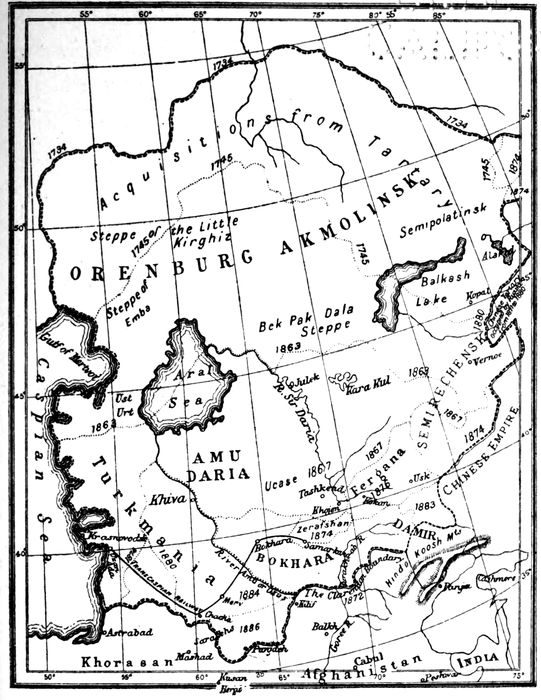
The Expansion of Russia in Asia.
235For some time previously Russia had been gradually advancing into Central Asia. This movement started with Peter the Great, while Alexander I. arranged with Napoleon by the Treaty of Tilsit (1807) to annex whatever he pleased in Central Asia. Hence the Russian boast of Nicholas that “Russia has no boundary in Central Asia.” For some time, however, Turkish affairs occupied the Russian minds, and Asia was left untouched, while for twenty or thirty years after the fall of Napoleon, all the great countries were endeavouring to restore the balance of power in Europe. Then in 1830 Russia began to show her hand, and seized Jaxartes, and in 1837 the siege of Herat by the Persians (no doubt incited by the Russians), which is sometimes called the north-western gate of India, and the failure of negotiations with Dost Mohammed, who was backed by Russian influence, urged the English to take strong measures in order to protect India from Russian invasion, especially through the two Afghan Passes, the Bolon and Khyber.
The first English move was the sending of an expedition to Cabul, and its occupation in 1839. Its intention was to place a ruler over Afghanistan who should be under English influence. This was considered defensive policy.
In 1847 Lord Palmerston wrote to Lord John Russell the following:—
“The roads through Persia are good, and 236the Caspian gives additional facilities. From Astrabad through Afghanistan are very practicable military roads. A Russian force in occupation of Afghanistan might convert Afghanistan into the advanced post of Russia.”
The annexation of Sind (1843), Punjaub (1849), Oudh (1856), and the second Burmese War (1852), are all policies on the same lines.
Just at this period Russia was warmly engaged with Turkish affairs, and in 1853–1856 was employed in the Crimean War against England, France, and Turkey. She was beaten, and by the Treaty of Paris was driven back from the Danube, and forbidden to put a Russian fleet of any description in the Black Sea, and the fortifications of Sebastopol were dismantled. Thus a Russian advance on the Balkans and Armenia seemed then almost hopeless. Therefore she turned her attention to Central Asia, and vigorously carried out her plans for several years.
In 1864 the Russian forces captured Tchenken, in Turkestan, and she had advanced as far as the river Syr Daria. In 2371865 she declared war with Bokhara, and captured Taskend, which was followed by the surrender of Khojind (1866).
In 1867 the province of Syr Adria was annexed, and in the same year Nicholas installed a Russian Government in Turkestan. In 1868 Samarcand was subjugated, and the Ameer of Bokhara was practically made a vassal of the Czar. In 1869 Krasnovodok, on the east coast of the Caspian, next fell a prey to Russian greed, and a fort was built there, and at present forms one of the Russian military outposts.
During and after the Franco-German War she was busily engaged in Central Asia, and still increased and extended her boundaries, until at length the Oxus was reached, and the Clarendon boundary in 1872 for a time stopped her roving footsteps. In 1873, however, the whole territory of the Khan of Khiva was drawn in, and the river Atrak was now the boundary with Persia. Zerafshan next fell before her, and now the Tian Shan mountains and the eastern part of Semipolatinsk formed the eastern boundary 238with China. Lastly, 1876 saw the annexation of Ferghana.
Let us now direct our attention to the English frontiers and territory, which she was trying to consolidate more firmly.
The Indian Mutiny of 1857 had led to the transferring of the Government of India from the East India Company to the Crown, and the reins of government from a Governor-General to a Viceroy (1858). The tour of the Prince of Wales through India, 1875–1876, had done a good deal of good in creating a friendly feeling with the natives, and he had met with a brilliant reception. This was the preliminary to Queen Victoria being proclaimed Empress of India in 1877.
The Russo-Turkish War (1878), the San Stefano Treaty, and the Congress of Berlin, produced a new phase in the Afghan question. The opposition of Austria to Russia at the Balkans, the defence of England in Asia Minor, both by the provisions of the Berlin Treaty, and the Anglo-Turkish Convention had frustrated the schemes of Russia in Europe; she therefore turned her 239undivided energies to her advance in Central Asia, with the object of dividing the attention and forces of the English between Asia Minor and the Afghan frontiers.
In 1880 the final conquest of the Turcomans along the northern frontier of Persia and the east coast of the Caspian facilitated her designs, and Askhabad was occupied. The dispute of the Kulja frontier with China was a winning move also in the eastern direction, also a part of Semipolatinsk was added, and fresh boundaries were made in the south-west of Ferghana towards the Chinese Empire, which measure caused England to adopt a defensive policy by the third Burmese War (1885).
In 1882 the Russo-Merv Convention was concluded, finally deciding the submission of the latter, while in 1884 “His Imperial Highness (of Russia) had determined to accept the allegiance of the Merv-Turcomans, and to send an officer to administer the government of that region.”[95] The annexation of Merv gave Russia possession of the 240river Murghab, giving her an opportunity of having a waterway to Herat if needed.
This action compelled England to appoint a Commission to define the North-West frontier of Afghanistan (1885). England at this time was worried also with Egyptian affairs. Russia, notwithstanding, advanced and occupied Sarakhs and various other posts on the North-West frontier, all being strategically important. This aroused the English Government, who at once asked for a vote of credit of £11,000,000, and began to show such a determined front that Russia was compelled to make certain concessions.
However, at the conclusion of the negotiations it was found that Russia had pushed herself a considerable distance towards Herat, and had reached Ak Robat, while the railway to Samarcand was nearly finished. Thus Russia certainly scored a winning point, and, if desirous, could attack the Anglo-Indian frontier by three ways:
(1) By advancing towards Cabul from Bokhara across the Oxus.
241(2) By marching towards Candahar viâ Herat by the Meshed line.
(3) By attacking the same place through the Attric Valley and Merv route.
The unsettled condition of the boundary between the Oxus and the Heri Rud, and particularly the Upper Oxus, will undoubtedly prove a source of discord between Russia and England for many years to come.
In spite of the strenuous efforts of Russia in advancing, and extending her power and boundaries in Central Asia, yet her great and absorbing thought was not revealed openly to the watchful eyes of European Powers, viz., to have full control of Constantinople, the key to the Black Sea, and by obtaining this to command the Mediterranean and be paramount in Western Europe.
A favourite manœuvre in military operations is to try and divert an opponent’s eyes from the true point of attack, and by so doing to weaken the opposition at that point.
As we have casually mentioned before, the elder Pitt “conquered America in Germany,” and afterwards when Charles III. of Spain 242concluded a secret Treaty known as the (third) “Family compact” with France, intending really to make war upon England, Chatham “determined to attack without delay the Havannah and Philippine Islands.”
Again, as another illustration of the above statement, we saw that Napoleon’s Egyptian expedition and his invasion of Russia were really underhand blows at England.
But why did he not attack America or Ireland? Surely if he had sailed directly from Brest, 1798, to either of the above places, instead of going to Egypt as he did, with the combined fleets of France, Spain, and Holland, he would have dealt a much deadlier blow at British power.
Let us examine the policy of Russia which has caused me to make the above statement.
Catherine II. had resolved to reach Constantinople through the Balkan Peninsula. Pitt withstood this resolution by supporting the Ottoman Empire, together with Austria, as conducive to the interests of both nations. Austria, therefore, became an enemy of Russia.
243Alexander I., therefore, seeing the united interests of England, France, Austria, and Turkey allied against him, changed his front and determined to reach Constantinople along the Caucasian route. He plainly saw that by this manœuvre he would compel England and France to defend the Caucasus.
At the beginning of his career the Czar Nicholas followed the same plans as his predecessor, but carried them out much more firmly; he increased his field of operations by invading Persia, 1826–1828, and occupied Armenia.
By this measure, no doubt, he expected to attract either England or France, perhaps both of them, to the Caucasian Question, thereby weakening the power of their alliance in the Balkans. France certainly would feel considerable uneasiness for the Holy Places which had a special charm for her Catholic followers. England would also have felt qualms, seeing that if Russia occupied Persia, and made it an outpost for attacking India through Afghanistan she would have considerable trouble in defending her possession. 244However, this scheme did not prove so effective as Nicholas wished, for it did not divide the attention of England and France in the Balkans.
Russia, therefore, perceiving this, followed the Napoleonic scheme of a direct attack on India with the help of several Asiatic states. In 1830 she first appeared in Central Asia and soon subjugated Persia and induced the Shah to occupy Herat, 1837. Alarmed at this, the whole energy of England was directed towards Afghanistan, and special preparations, which lasted for a quarter of a century, were made to defend an attack from that quarter. The home affairs of England, together with these alarming schemes of Russia with regard to India, determined the Wellington Ministry to advocate non-interference in Balkan affairs.
Russia also removed French opposition from the Balkans to Syria by stirring up quarrels between the Greek and Latin Churches in Jerusalem. In addition to this, as I have shown, Nicholas separated England and France by his diplomatic tact.
245Thus Turkey was left alone with Austria in the Balkans. Nicholas then, feeling confident of success, at once threatened Constantinople by taking the steps which led to the Crimean War. He, however, overreached himself, and was beaten, as we have seen, by the allied armies of England, France, and Turkey.
Immediately after the Crimean War Russia again stretched out her hands on Persia as she had done in 1837. Lord Palmerston, however, closed them by declaring war with the same country. “We are beginning,” wrote Lord Palmerston, “to repel the first openings of trenches against India by Russia, and whatever difficulties Ferokh may make about Afghanistan we may be sure that Russia is his prompt and secret backer.”[96]
In 1857 the peace of Paris was concluded by which the Shah renounced all claim over Herat and Afghanistan. This was a clever political stroke against a Russian attack on India.
246In 1849 Lord Palmerston wrote:—
“Persia must, I (Lord Palmerston) fear, now be looked on as an advanced post for Russia whenever she chooses to make use of it. She will command it either by overpowering force or by bribing the state by prospect of acquisition in Afghanistan.”
However, ultimately the same policy was again resorted to by the Czar to worry England in Central Asia. Again the Russians advanced into Central Asia towards the Indian frontier and extended their borders both south and east with great celerity.
But a fresh complication arose extremely favourable for Russian plots. The Franco-German War (1870) seemed to be an introduction to the accomplishment of her wishes. France was miserably defeated, while the hands of Germany were fully tied up with Alsace and Lorraine. Two formidable opponents to Russian arms were therefore placed hors de combat. England and Austria were thus the only powers left for the defence of Constantinople. Austria had previously been weakened by a war with 247Prussia. It therefore seemed that England was the only strong supporter of the Ottoman Empire, and Russia determined to conquer Turkey in Central Asia, so she conquered and annexed Central Asia as far as possible until her boundaries reached Afghanistan and the Chinese Empire in 1874. Being naturally alarmed at these encroachments, England again was obliged to devote all her energies to the Indian and Afghan frontiers, and engaged in the Afghan War.
Russia now saw that she was in a better position with regard to Turkey than she had been before the Crimean War, for although Turkey was still assisted by Austria, yet the latter had not fully recovered from the Prusso-Austrian War. Again France was in a convulsed state, while England was harassed with Afghan affairs. A general alliance of the Mediterranean Powers seemed therefore impossible.
Russia, therefore, boldly declared war in 1878, and marched to the gates of Constantinople, and eventually concluded the San 248Stefano Treaty. This aroused both England and Austria, and, owing to their warlike attitude, the Berlin Congress was convened, and Russia again found her hands withheld from the Turkish metropolis, although she succeeded in definitely dividing the attention of England and Austria in the Balkans by turning English eyes towards Asia Minor. Her success was still greater in obtaining the outlet of the Danube and the arsenal of Batoum in the Black Sea.
Glancing, then, at the situation generally, one can perceive that Russia saw that the English opposition in Asia Minor would prove formidable, but she did not think that the Austrian defence of the Balkans would turn out so dangerous to her hopes. Her reasons for thinking this were plain. England at this crisis was a nation of the first magnitude, both in strength and wealth, and if only she (England) had fortified and occupied Cyprus as she ought to have done, she would have proved a valuable ally to Turkey, and would also have commanded the Ægean Sea. Russia saw that the most 249advantageous policy would be to distract England’s attention both from Cyprus and Asia Minor. To accomplish this she for the third time started to conquer Turkey through Central Asia.
In 1878 she concluded a secret agreement with Persia by which the territory down to Sarakhs from the Russian frontier was ceded, to her. Her influence in Khorasan was increasing day by day, and especially so in Meshed, owing to the skill and tact of M. Vlassoff, the Russian Consul-General in that district. India was again threatened by her, and Herat approached. Her boundaries were extended into the Chinese dominions, and great uneasiness was caused in England concerning the boundary question of the Oxus.
The most effective and important step, however, taken by Russia for the accomplishment of her schemes, was the construction of the Caspian-Samarcand Railway. It was started in 1881 with the primary object of facilitating the war operations of General Skobeloff for the reduction of the Tekkes. 250Lord Hartington called General Annenkoff, the promoter of the railway, “a foolish fellow.” However, Samarcand was reached in 1885, during the time that an Anglo-Russian war was threatening about the Murghab question. Thus a general military[97] communication of Russia with Asia was established. She had three ways of sending troops and materials in the direction of the eastern shores of the Caspian:—
(1) From St. Petersburg to Saratoff on 251the Volga, viâ Moscow, by railway, from there to Astrakhan by steamboat on the river, and from the latter place to Krasnovodsk or Uzan Ada.
(2) From St. Petersburg to Voladis Caucase per railway, from thence to Tiflis by post road (an eighteen hours’ journey), from Tiflis to Baku by railway, and from there to Uzan Ada.
(3) From Odessa or the Crimea to Poti on the eastern Black Sea coast by steam, from Poti to Baku, and from there to Uzan Ada.
The water traffic across the Caspian, from its different ports is carried on by fifteen ships of the Caucasus and Mercury Company. They are in receipt of a large annual subsidy from the state for the conveyance of mails and troops, and also for the use of their boats for transport in case of war. One of these fifteen steamers sails from Baku to Uzan Ada twice a week.[98]
The Trans-Caucasian Railway starts from the latter place, running east and afterwards north-east to Merv. From there it proceeds 252in the same direction, crossing the Oxus, passing Bokhara, and eventually terminates at Samarcand—a distance altogether of about nine hundred miles.
The work of laying the rails was done by two battalions of Russian soldiers (five hundred each) and also by five thousand native labourers, whose wage was threepence a day. Wages have since been increased to sixpence a day. From the amount expended in labour we can see that the railway expense did not prove inordinately dear, viz., 30,000,000 roubles, including also the cost of the Siberian Railway, especially as the Russian estimate at first was 60,000,000 roubles. The average rate of laying the rails was exceedingly rapid, viz., four or five miles a day.
There are now one hundred and four locomotives and one thousand two hundred wagons, fifteen new locomotives have lately been ordered, six new passenger wagons, and eighty cistern cars. A commission has recently reported in favour of a further grant to General Annenkoff of 8,000,000 roubles.[99]
253This line has opened a wide field for trade with Central Asia. The traffic in 1888 alone was about £3,000,000, and General Annenkoff announced that the net profit of the railway in 1888 amounted to about £80,000, that 2,000,000 pods of cotton had been conveyed by it during the same year, and that in 1889 a total of 4,000,000 pods was anticipated.[100]
Viewing from a political and strategical point of view this railway has been an even more important factor. The northern frontier of Persia by its means has been placed completely at the mercy of Russia, and by it she was enabled to consolidate her new Asiatic territories which she had annexed and conquered, Russian troops were able to be transported to the Afghan frontier at a very short notice from all parts of Russia.
Without doubt the construction of the Trans-Caspian Railway and its threatening results have proved of immense value for the success of Russia. By its means England was induced to turn her attention 254from Asia Minor to Indian affairs. This resulted in embroiling England with the second Afghan War, compelled her to appoint a boundary commission, and plunged her into the third Burmese War. All these catastrophes compelled her to neglect her Anglo-Turkish Convention promises—a result aimed at by her Russian friends(?)
Even in Persia English influence is at a discount, and proportionately Russian influence is rising. The appointment of Sir H. D. Wolff, a clever diplomatist, to the Teheran Court, and the brilliant reception accorded to the Shah during his recent visit by the English, were too late to do any good. It may do good, and it may not.
Let us now see what effect upon Austria the Russo-Asiatic policy had.
Firstly, Austria had been left alone to cope with Russia in the Balkans, and she was practicably left to defend the Ottoman Empire. France and Germany were practicably disarmed, and were unable materially, to assist Turkey against Russia. England, as we have seen before, was occupied elsewhere, 255and had practically deserted Asia Minor, although this might be altered if only she would station troops at Cyprus or somewhere near at hand. Austria did not wish for a naval alliance only, which she considered practically useless in event of war, but she wanted a complete alliance. An alliance between the two Powers failed at the Berlin Congress, and also in October, 1886.
Thus Russia obtained her desires in dividing the two Powers in Europe and Asia, and prevented a general alliance by threatening Central Asia.
Certainly Austria had performed her Balkan duty well, although she was clearly overweighted, and the result was internal exhaustion, financial difficulties, social discontent, the result of pecuniary troubles.[101]
256Of all the great European cities, the socialists are at the present moment strongest in Vienna. An able political writer of the present day has said: “The Dualism of the Monarchy (Austria-Hungary) is very nearly dead, and if Austria is to exist at all she must rapidly become tripartite, and ultimately resolve herself into a somewhat loose confederation.”[102]
These domestic difficulties have caused her to gradually lose her influence in the Balkans, and the abdication of King Milan of Servia has proved a still more serious blow to her power in that quarter.
It seems to me impolitic for Russia to go to war with the five million Magyars. It would be better to influence Austria so as to increase her internal discords and foster them by skilful diplomacy if she wished to attain her objects. For instance, to demonstrate against the accession of Prince Ferdinand to 257the Bulgarian throne, to oppose the Bulgarian loans, and give pecuniary help herself to immigrants from Montenegro to Servia.
The consequence would be that Austria could not possibly remain peaceful when inhabited by bitter anti-Russian Magyars. She would have to make war preparations and spend money, and would thus increase her financial difficulties, and the result would be the breaking down of the Dual Monarchy, “the personal union of fifty-six states,” a mixture of races, religions, and tongues.
A strong and compact confederation can only be obtained by sound financial dealings. Austria once broken down by internal discord, then Constantinople and the Balkans would be Russian possessions.
If Russia is desirous of accomplishing her ends, her great aim must be to prevent any of the great Powers from making an alliance with Austria. Owing to the Franco-Russian alliance, Russia is quite powerful enough to hinder any effective alliance with Germany.
With regard to an alliance with England, there is one strong barrier which, if kept up, 258will always prevent such a coalition, viz., the Trans-Caspian Railway.
The following ideas would still further separate the two Powers:—
(1) The extension of the railway from Samarcand to Kokan, because from Kokan Russia can threaten to push on her border to Eastern Turkestan, and move southward to Tibet, and from there will be able to threaten the territory of Cashmere, which are the boundaries at present unsettled.
(2) An extension of railway from Samarcand to Tashkend, which is contemplated, and when completed will connect Siberia from a military point of view. It can be also taken north-west, along the north-eastern shore of the Aral Sea, and may be connected with the parent line at Orenburg, and connected with Russia and Central Asia for military purposes.
(3) To construct a line from Mertvi, or Dead Bay, on the Caspian, to the western shore of the Sea of Aral. This would prove another quick mode of transit, particularly from St. Petersburg and Moscow to Kilif, 259on the Oxus, and also to Samarcand. At present steamers ply on the Amu Daria from the Aral Sea southwards as far as Kilif on the northern boundary of Afghanistan.
These steamers are 20 feet broad, 150 feet long, and are of 500–horse power, travelling 16 miles an hour, and are capable of conveying 300 soldiers and 20 officers.
(4) To throw off a branch line from Bokhara to Kilif, and from there to Balkh.
(5) Two branch lines (a) from Merv to Herat, viâ Penjdeh; (b) from Merv to Sarakhs, viâ Chacha, and still further to Kuhsan, in the direction of Herat.
(6) By entering the Persian dominion from the present northern boundary to occupy Meshed, proceeding thence to Kuhsan to meet the line from Sarakhs.
In consequence of the approaching departure for Persia of M. de Buelzoff, the newly-appointed minister at Teheran, most of the Russian newspapers warmly advocated the immediate construction of a line from the northern part of Persia.
260(7) An extension of railway from Meshed through Khorasan and Serstan southwards as far as Nasirabad, and eventually to get a port on the Persian Gulf or Indian Ocean.
Once let Russia get the long-wished-for outlet in the southern seas, and then she will be still more able to strike another blow against English influence. There is not the least doubt that Persian affairs will occupy the attention of England for some years to come.
All these extensions will, if carried out, mean a Russian invasion all along the Hindostan frontier, and thus would further indirectly her European aspiration.
On the other hand, looking from an English point of view, we can suggest a scheme of frustration by means of sound and politic administration.
For instance, at present large railways start from Calcutta, Madras, and Bombay, traversing Delhi and Lahore, terminating at Peshawar; from Lahore the line runs to Kurrachee, on the Arabian Sea, and a branch line goes north-west from Sakkar 261to Pishin, viâ Quetta. Thus we see the English defence of her Indian frontier is fairly well looked after, although a “forward” policy of railway construction in India may, and no doubt will, be advantageous to English defence and commerce.
England is certainly heavily handicapped owing to the want of a short and safe communication with India. The Suez Canal is not safe enough, both the Canadian Railway and the Cape of Good Hope routes are long, therefore it is a matter of great moment that she should have a safe and quick route by which she might despatch troops and materials with celerity.
The following route, if carried out, would prove of the very greatest advantage to England. First, the occupation of the Karrack Island in the Persian Gulf, which is in every respect suitable for a military station, having good water and being healthy. It is with truth often termed the key of the Persian Gulf.
Secondly, a railway should be constructed from Scandarum, on the Mediterranean, to 262Bussorah, on the Persian Gulf, through the Euphrates Valley—a saving of from seven hundred to one thousand miles, and of nearly four days.
If an Afghan war arose, troops could be landed at Kurrachee instead of Bombay, and time would be gained and the monsoon also avoided. Troops could be forwarded at very short notice from Malta to Pishin and Peshawar, with almost equal speed to that with which Russia can collect troops in Central Asia.
If once opened, the trade of Central Asia, India, and China would find its way by this route, and open out Persian and Indian relations with Europe as much as the Suez Canal[103] did after its opening; Persia would 263be considerably strengthened. It would also, together with the military occupation of Karrack and Cyprus (if done properly), give a guarantee to both India and Persia against Russian attacks.
The distance from Scandarum to Bussorah is only seven hundred miles, and would be safe against attacks, being protected by the double rivers, the Euphrates and Tigris, for most of its course. Its cost would be estimated at £9,000,000, which might easily be raised in the London market. Also if the Mudinia Aksu line be extended to Scandarum, viâ Kiniah or the Scutari-Ismid line to Aleppo, through Angora, Kaisariyeh, and Abbiston, other beneficial effects may be produced. In the latter case it amounts, and is practically similar, to an extension of the Eastern Railway to the Persian Gulf, which starts from Paris, and passes Vienna, Belgrade, Sophia, Adrianople, terminating at Constantinople. So a direct land route could be obtained from Bussorah to Calais or Rotterdam if a bridge was constructed over the Bosphorus.
264As I have already shown in chapter VIII., the construction of the Euphrates Railway would avoid a Franco-English conflict of interests in Egypt to a certain extent, and a dual control would be established; thus a strong and effective alliance would ensue, caused by mutual interests, and England would be able thereby to withdraw her troops from Egypt, and devote them to the defence of Asia Minor. Thus a firm alliance between England and Turkey would follow, and would prevent a Mahommedhan rebellion in India against England, the Sultan being looked upon as the Mahommedhan Pope.
England will also be able to call Indian troops to her assistance in Asia Minor. It will follow that as a larger number of troops and a better communication is obtained in Asia Minor, Austria would be quite willing to ally herself with England, instead of refusing, as she had done twice before, the English power at sea being only of little use. England and Austria therefore can not only jointly support Turkey, but also England can “come to the assistance of 265Austria in Europe, and Austria make common cause with England in the event of Turkey being attacked in Asia Minor.”
Having a French, Austrian, and Turkish alliance, England can send her home troops both to India and Asia Minor by the Eastern Railway in a very short space of time, and can strengthen both countries and also help in the Balkans if required, and a firm and lasting alliance would be made.
Why cannot Italy join this alliance? It is a matter of necessity and advantage, both geographically and strategically, to do so, and if an alliance in Southern Europe could thus be made, the safety of the Balkans, Asia Minor, Persia, and Afghanistan might be assured, even if Germany joined Russia, and the lofty hopes of Russia would be dashed to the ground.
THE END.
The Gresham Press,
UNWIN BROTHERS,
CHILWORTH AND LONDON.
St. Nicholas Magazine
FOR YOUNG FOLKS.
Edited by Mrs. Mary Mapes Dodge.
Price 1s. Monthly.
With the beginning of the Seventeenth Volume (November, 1889) ST. NICHOLAS will be enlarged by the addition of eight or more pages to each number, and the Magazine will be printed in a new and clearer-faced type. During the year there will be four important Serial Stories by well-known authors, and also Notable Papers on Athletics and Outdoor Sports, as well as a multitude of Occasional Papers, Stories, Illustrated Articles of Character and Adventure, Suggestive of Talks on Natural History, Scientific Subjects, &c. The price will remain the same.
The Century
ILLUSTRATED MONTHLY MAGAZINE.
Price 1s. 4d. Monthly.
FOR 1889–90,
Will include among other features:—
The Autobiography of Joseph Jefferson (“Rip Van Winkle”); “Friend Olivia,” a Serial Story by Mrs. Barr, Author of “Jan Vedder’s Wife,” &c.; “The Merry Chanter,” in Four Parts, by Frank R. Stockton; Letters from Japan, by John La Farge; and The Gold Hunters of California, being Personal Narratives of most Romantic Interest.
Besides the above Special Features there will be valuable Contributions in Prose and Verse by Mark Twain, Edmund Gosse, H. H. Boyesen, Henry James, Edw. Eggleston, &c., &c.
The Century Dictionary.
In 24 Monthly Parts, Price 10s. 6d. each.
Part I. Now Ready.
When completed the work will form Six Volumes, price £2 2s. each.
A LIBRARY IN ONE BOOK.
Purchasers of this Dictionary will obtain a reference library which does away with a great number of other books. They will have—
1.
A COMPLETE DEFINING DICTIONARY OF ENGLISH WORDS.
2.
A DICTIONARY OF ETYMOLOGIES, UNEQUALLED BY ANY WORK YET PUBLISHED.
3.
A STANDARD DICTIONARY OF SPELLING AND PRONUNCIATION.
4.
AN ENCYCLOPÆDIA OF GENERAL INFORMATION, PARTICULARLY RICH IN HISTORICAL MATERIAL.
5.
A STANDARD DICTIONARY OF MECHANICAL TERMS.
6.
A COMPREHENSIVE DICTIONARY OF THE PRACTICAL ARTS AND TRADES, COMMERCE, FINANCE, ETC.
7.
A DICTIONARY OF SCIENTIFIC TERMS, GIVING THE RESULT OF THE VERY LATEST THOUGHT IN EVERY DEPARTMENT OF SCIENCE, AS BIOLOGY, BOTANY, ZOOLOGY, MINERALOGY, PHYSICS, ETC.
8.
A DICTIONARY OF MEDICINE, SURGERY, PHYSIOLOGY, ANATOMY, ETC.
9.
A DICTIONARY OF THEOLOGICAL TERMS.
10.
A DICTIONARY OF ART AND ARCHÆOLOGY, MYTHOLOGY, SCULPTURE, MUSIC, ETC., EXQUISITELY ILLUSTRATED.
11.
A LAW DICTIONARY.
12.
A STANDARD REFERENCE BOOK OF ENGLISH GRAMMAR AND PHILOLOGY.
13.
A DICTIONARY OF SYNONYMS.
14.
A TREASURY OF QUOTATIONS.
For Terms and Prospectuses apply to
T. FISHER UNWIN, 11, Paternoster Buildings, Paternoster Square, London, E.C.
Catalogue of Select Books in Belles Lettres, History, Biography, Theology, Travel, Miscellaneous, and Books for Children.
Belles Lettres
The Letters of Horace Walpole. Selected and Edited, with Introduction and Notes, by Charles Duke Yonge, M.A. Portraits and Illustrations. Limited Edition of 750 copies in Two Vols., medium 8vo., cloth, 32s.
The present selection comprises the more valuable portion of the famous letters to Thomas Gray the poet, Sir Horace Mann, and George Montagu, and is designed chiefly for those who, while lacking leisure to attack the bulk of the correspondence, may welcome the opportunity of becoming acquainted with “certainly the best letter-writer in the English language” (vide Sir Walter Scott).
The English Novel in the Time of Shakespeare. By J. J. Jusserand, Author of “English Wayfaring Life.” Illustrated. Demy 8vo., cloth. The work is divided into six chapters:—I. Before Shakespeare; II. Lyly and his Euphues; III. The School of Lyly; IV. Sir Philip Sydney and the Pastoral romance; V. Thomas Nash and the picturesque romance; VI. After Shakespeare.
Light and Shadow: A Novel. By Edward Garnett, Author of “The Paradox Club.” Crown 8vo., cloth, 6s.
In Thoughtland and in Dreamland. By Elsa d’Esterre-Keeling, Author of “Three Sisters,” “Bib and Tucker,” &c. Square imperial 16mo., cloth, 6s.; Presentation Edition (uniform with the above), in Box, 7s. 6d.
English Wayfaring Life in the Middle Ages (XIVth Century). By J. J. Jusserand. Translated from the French by Lucy A. Toulmin Smith. Illustrated. Second Edition. Demy 8vo., cloth, 12s.
“This is an extremely fascinating book, and it is surprising that several years should have elapsed before it was brought out in an English dress. However, we have lost nothing by waiting.”—Times.
Old Chelsea. A Summer-Day’s Stroll. By Dr. Benjamin Ellis Martin. Illustrated by Joseph Pennell. Second Edition. Crown 8vo., cloth, 7s. 6d.
“Dr. Martin has produced an interesting account of old Chelsea, and he has been well seconded by his coadjutor.”—Athenæum.
The Twilight of the Gods. By Richard Garnett, LL.D. Crown 8vo., cloth, 6s.
“If imagination and style constitute the true elixir of literary life, Dr. Garnett’s ‘Twilight of the Gods’ should live.”—British Weekly.
The Coming of the Friars, And other Mediæval Sketches. By the Rev. Augustus Jessopp, D.D., Author of “Arcady: For Better, For Worse,” &c. Third Edition. Crown 8vo., cloth, 7s. 6d.
Contents.—I. The Coming of the Friars.—II. Village Life in Norfolk Six Hundred Years ago.—III. Daily Life in a Mediæval Monastery.—IV. and V. The Black Death in East Anglia.—VI. The Building-up of a University.—VII. The Prophet of Walnut-tree Walk.
Arcady: For Better, For Worse. By Augustus Jessopp, D.D., Author of “One Generation of a Norfolk House.” Portrait. Popular Edition. Crown 8vo., cloth, 3s. 6d.
“A volume which is, to our minds, one of the most delightful ever published in English.”—Spectator.
The Romance of a Shop. By the late Amy Levy, Author of “Reuben Sachs,” “A London Plane Tree, and Other Poems,” &c. Crown 8vo., cloth, 6s.
“Miss Levy’s story is bright and fresh; there is a dash of originality in the idea and plenty of spirit in its execution.”—Athenæum.
The Paradox Club. By Edward Garnett. With Portrait of Nina Lindon. Second Edition. Crown 8vo., limp cloth, 3s. 6d.
“Mr. Garnett’s dialogue is often quite as good as his description, and in description he is singularly happy. The mystery of London streets by night is powerfully suggested, and the realistic force of his night-pieces is enhanced by the vague and Schumann-like sentiment that pervades them.”—Saturday Review.
Euphorion: Studies of the Antique and the Mediæval in the Renaissance. By Vernon Lee. Cheap Edition, in one volume. Demy 8vo., cloth, 7s. 6d.
“It is the fruit, as every page testifies, of singularly wide reading and independent thought, and the style combines with much picturesqueness a certain largeness of volume, that reminds us more of our earlier writers than those of our own time.”—Contemporary Review.
Studies of the Eighteenth Century in Italy. By Vernon Lee. Demy 8vo., cloth, 7s. 6d.
“These studies show a wide range of knowledge of the subject, precise investigation, abundant power of illustration, and hearty enthusiasm.... The style of writing is cultivated, neatly adjusted, and markedly clever.”—Saturday Review.
Belcaro: Being Essays on Sundry Æsthetical Questions. By Vernon Lee. Crown 8vo., cloth, 5s.
“This way of conveying ideas is very fascinating, and has an effect of creating activity in the reader’s mind which no other mode can equal. From first to last there is a continuous and delightful stimulation of thought.”—Academy.
Juvenilia: A Second Series of Essays on Sundry Æsthetical Questions. By Vernon Lee. Two vols. Small crown 8vo., cloth, 12s.
“To discuss it properly would require more space than a single number of ‘The Academy’ could afford.”—Academy.
“Est agréable à lire et fait penser.”—Revue des deux Mondes.
Baldwin: Dialogues on Views and Aspirations. By Vernon Lee. Demy 8vo., cloth, 12s.
“The dialogues are written with ... an intellectual courage which shrinks from no logical conclusion.”—Scotsman.
Ottilie: Eighteenth Century Idyl. By Vernon Lee. Square 8vo., cloth extra, 3s. 6d.
“A graceful little sketch.... Drawn with full insight into the period described.”—Spectator.
Introductory Studies in Greek Art. Delivered in the British Museum by Jane E. Harrison. With Illustrations. Square imperial 16mo., 7s. 6d.
“The best work of its kind in English.”—Oxford Magazine.
The Fleet: Its River, Prison, and Marriages. By John Ashton, Author of “Social Life in the Reign of Queen Anne,” &c. With 70 Drawings by the Author from Original Pictures. Second and Cheaper Edition, cloth, 7s. 6d.
Romances of Chivalry: Told and Illustrated in Fac-simile by John Ashton. Forty-six Illustrations. New and Cheaper Edition. Crown 8vo., cloth, 7s. 6d.
“The result (of the reproduction of the wood blocks) is as creditable to his artistic, as the text is to his literary, ability.”—Guardian.
The Dawn of the Nineteenth Century in England: A Social Sketch of the Times. By John Ashton. Cheaper Edition, in one vol. Illustrated. Large crown 8vo., 10s. 6d.
“The book is one continued source of pleasure and interest, and opens up a wide field for speculation and comment, and many of us will look upon it as an important contribution to contemporary history, not easily available to others than close students.”—Antiquary.
Legends and Popular Tales of the Basque People. By Mariana Monteiro. With Illustrations by Harold Copping. Popular Edition. Crown 8vo., cloth, gilt edges, 6s.
“In every respect this comely volume is a notable addition to the shelf devoted to folk-lore ... and the pictures in photogravure nobly interpret the text”—Critic.
Heroic Tales. Retold from Firdusi the Persian. By Helen Zimmern. With Etchings by L. Alma Tadema. Popular Edition. Crown 8vo., cloth extra, 5s.
“Charming from beginning to end.... Miss Zimmern deserves all credit for her courage in attempting the task, and for her marvellous success in carrying it out.”—Saturday Review.
Pilgrim Sorrow. By Carmen Sylva (The Queen of Roumania). Translated by Helen Zimmern. Portrait-etching by Lalauze. Square crown 8vo., cloth extra, 5s.
“A strain of sadness runs through the delicate thought and fancy of the Queen of Roumania. Her popularity as an author is already great in Germany, and this little work will win her a place in many English hearts.”—Standard.
Chopin, and Other Musical Essays. By Henry T. Finck, Author of “Romantic Love and Personal Beauty.” Crown 8vo., cloth, 6s.
“There are six essays in this compact and well-printed volume. They are all written with great thoroughness, and the interest of each one is admirably sustained throughout.”—Freeman’s Journal.
The Temple: Sacred Poems and Private Ejaculations. By Mr. George Herbert. New and fourth edition, with Introductory Essay by J. Henry Shorthouse. Small crown, sheep, 5s.
A fac-simile reprint of the Original Edition of 1633.
“This charming reprint has a fresh value added to it by the Introductory Essay of the Author of ‘John Inglesant.’”—Academy.
Songs, Ballads, and A Garden Play. By A. Mary F. Robinson, Author of “An Italian Garden.” With Frontispiece of Dürer’s “Melancolia.” Small crown 8vo., half-bound, vellum, 5s.
“The romantic ballads have grace, movement, passion and strength.”—Spectator.
“Marked by sweetness of melody and truth of colour.”—Academy.
Essays towards a Critical Method. Studies in English Literature. By John M. Robertson. Cr. 8vo., cloth, 7s. 6d.
“His essays are always shrewd and readable. His criticisms on the critics are enjoyable for the irony (conscious or unconscious) that is in them; and the book will not fail to please lovers of literature and literary history, and to prove suggestive to the critical.”—Scotsman.
The Lazy Minstrel. By J. Ashby-Sterry, Author of “Boudoir Ballads.” Fourth and Popular Edition. Frontispiece by E. A. Abbey. Fcap. 8vo., cloth, 2s. 6d.
“One of the lightest and brightest writers of vers de société.”—St. James’s Gazette.
Caroline Schlegel, and Her Friends. By Mrs. Alfred Sidgwick. With Steel Portrait. Crown 8vo., cloth, 7s. 6d.
“This is a singularly brilliant, delicate and fascinating sketch—one of the most skilful pieces of literary workmanship we have seen for a long time.... Mrs. Sidgwick is a writer of very unusual equipment, power and promise.”—British Weekly.
Amos Kilbright: His Adscititious Adventures. With other Stories. By Frank R. Stockton. 8vo., cloth, 3s. 6d.
“Mr. Stockton is the quaintest of living humorists.”—Academy.
History.
Battles and Leaders of the American Civil War. An Authoritative History, written by Distinguished Participants on both sides. Edited by Robert U. Johnson and Clarence C. Buel, of the Editorial Staff of “The Century Magazine.” Four Volumes, Royal 8vo., elegantly bound, £5 5s.
Lord Wolseley, in writing a series of articles in the North American Review on this work, says: “The Century Company has, in my judgment, done a great service to the soldiers of all armies by the publication of these records of the great War.”
Diary of the Parnell Commission. Revised with Additions, from The Daily News. By John Macdonald, M.A. Large crown 8vo.
The End of the Middle Ages: Essay and Questions in History. By A. Mary F. Robinson (Madame Darmesteter). Demy 8vo., cloth, 10s. 6d.
“We travel from convent to palace, find ourselves among all the goodness, the wisdom, the wildness, the wickedness, the worst and the best of that wonderful time. We meet with devoted saints and desperate sinners.... We seem to have made many new acquaintances whom before we only knew by name among the names of history.... We can heartily recommend this book to every one who cares for the study of history, especially in its most curious and fascinating period, the later middle age.”—Spectator.
The Federalist: A Commentary in the Form of Essays on the United States Constitution. By Alexander Hamilton, and others. Edited by Henry Cabot Lodge. Demy 8vo., Roxburgh binding, 10s. 6d.
“The importance of the Essays can hardly be exaggerated.”—Glasgow Mail.
The Story of the Nations. Crown 8vo., Illustrated, and furnished with Maps and Indexes, each 5s.
“L’interessante serie l’Histoire des Nations formera ... un cours d’histoire universelle d’une très grande valeur.”—Journal des Debats.
“The remarkable series.”—New York Critic.
“That useful series.”—The Times.
“An admirable series.”—Spectator.
“That excellent series.”—Guardian.
“The series is likely to be found indispensable in every school library.”—Pall Mall Gazette.
“This valuable series.”—Nonconformist.
“Admirable series of historical monographs.”—Echo.
Rome. By Arthur Gilman, M.A., Author of “A History of the American People,” &c. Third edition.
The Jews. In Ancient, Mediæval, and Modern Times. By Prof. J. K. Hosmer. Second edition.
Germany. By Rev. S. Baring-Gould, Author of “Curious Myths of the Middle Ages,” &c. Second edition.
Carthage. By Prof. Alfred J. Church, Author of “Stories from the Classics,” &c. Third edition.
Alexander’s Empire. By Prof. J. P. Mahaffy, Author of “Social Life in Greece.” Fourth edition.
The Moors in Spain. By Stanley Lane-Poole, Author of “Studies in a Mosque.” Third edition.
Ancient Egypt. By Canon Rawlinson, Author of “The Five Great Monarchies of the World.” Third edition.
Hungary. By Prof. Arminius Vambéry, Author of “Travels in Central Asia.” Second edition.
The Saracens: From the Earliest Times to the Fall of Bagdad. By Arthur Gilman, M.A., Author of “Rome,” &c.
Ireland. By the Hon. Emily Lawless, Author of “Hurrish.” Third edition.
Chaldea. By Z. A. Ragozin, Author of “Assyria,” &c. Second edition.
The Goths. By Henry Bradley. Second edition.
Assyria: By Zénaïde A. Ragozin, Author of “Chaldea,” &c.
Turkey. By Stanley Lane-Poole. Second edition.
Holland. By Professor Thorold Rogers. Second edition.
Mediæval France. By Gustave Masson. Second edition.
Persia. By S. G. W. Benjamin. Second edition.
Phœnicia. By Canon Rawlinson.
Media. By Z. A. Ragozin.
The Hansa Towns. By Helen Zimmern.
Early Britain. By Prof. A. J. Church, Author of “Carthage,” &c.
Russia. By W. R. Morfill, M.A., Author of a “A Grammar of the Russian Language.”
The Barbary Corsairs. By Stanley Lane-Poole, Author of “The Moors in Spain,” “Turkey,” &c.
The Jews under the Roman Empire. By W. Douglas Morrison, M.A.
Scotland. By John Macintosh, LL.D., Author of “The History of Civilisation in Scotland.”
(For further information, see “Nation Series” Catalogue. Sent to any address on application to the Publisher.)
Biography.
Sir John Hawkwood (l’Acuto). Story of a Condottiere. Translated from the Italian of John Temple-Leader and Guiseppe Marcotti, by Leader Scott. Illustrated. Royal 8vo., bound in buckram, gilt tops. Limited Edition.
Extract from Preface.—“He was for more than thirty years one of the most effective dominators of Italian affairs, and in her history—military, political, and social—he figures as a personage whose character and actions have an importance more than sufficient to justify the simple curiosity of biographical erudition.”
The Life & Times of William Lloyd Garrison. From 1840-1879. By His Children. Vols. III. and IV., completing the work. Portraits and Illustrations. Demy 8vo., cloth, 30s.
Compiled by Mr. Garrison’s two sons, Wendell Phillips Garrison, Literary Editor of the Nation, and his brother, F. J. Garrison, the above work is undoubtedly one of the most important contributions yet made to American history and biography. Among those with whom Mr. Garrison was at one time or another during his career associated, may be mentioned Mazzini, John Bright, J. S. Mill, Emerson, James Mott, William E. Channing, Whittier, Maria W. Chapman, Caleb Cushing, Lafayette, Wilberforce, Fowell Buxton, Daniel O’Connell, George Thompson, Zachary Macaulay, Clarkson, Harriett Martineau, Wendell Phillips, Mrs. Opie, Haydon, Lady Byron, Sir Jonn Bowring, the Duchess of Sutherland, and others.
Good Men and True: Biographies of Workers in the Fields of Beneficence and Benevolence. By Alexander H. Japp, LL.D. Illustrated. Crown 8vo., cloth, 6s.
Contents:—I. Norman MacLeod, D.D.—II. Edward Denison.—III. Arnold Toynbee.—IV. John Conington.—V. Charles Kingsley.—VI. Bishop Hannington.—VII. The Stanleys: Father and Son.—VIII. Thomas Guthrie, D.D.—IX. Sir Titus Salt.—X. Samuel Plimsoll.
Life & Times of Girolamo Savonarola. By Pasquale Villari. Translated by Linda Villari. Portraits and Illustrations. Two vols. Second Edition, with New Preface. Demy 8vo., cloth, 32s.
Anne Gilchrist: Her Life and Writings. Edited by Herbert Harlakenden Gilchrist. Prefatory Notice by William Michael Rossetti. Second edition. Twelve Illustrations. Demy 8vo., cloth, 16s.
Charles Dickens as I knew Him: The Story of the Reading Tours in Great Britain and America (1866-1870). By George Dolby. New and cheaper edition. Crown 8vo., 3s. 6d.
“It will be welcome to all lovers of Dickens for Dickens’ own sake.”—Athenæum.
Ole Bull: A Memoir. By Sara C. Bull. With Ole Bull’s “Violin Notes” and Dr. A. B. Crosby’s “Anatomy of the Violinist.” Portraits. Second edition. Crown 8vo., cloth, 7s. 6d.
Johannes Brahms: A Biographical Sketch. By Dr. Herman Deiters. Translated, with additions, by Rosa Newmarch. Edited, with a Preface, by J. A. Fuller Maitland. Portrait. Small crown 8vo., cloth, 6s.
The Lives of Robert and Mary Moffat. By their Son, John Smith Moffat. Sixth edition. Portraits, Illustrations, and Maps. Crown 8vo., cloth, 7s. 6d.; Popular Edition, crown 8vo., 3s. 6d.
“The biographer has done his work with reverent care, and in a straightforward unaffected style.”—Contemporary Review.
The German Emperor and Empress: The Late Frederick III. and Victoria. The Story of their Lives. By Dorothea Roberts. Portraits. Crown 8vo., cloth, 2s. 6d.
“A book sure to be popular in domestic circles.”—The Graphic.
Arminius Vambery: His Life and Adventures. Written by Himself. With Portrait and Fourteen Illustrations. Fifth and Popular Edition. Square Imperial 16mo., cloth extra, 6s.
“The work is written in a most captivating manner.”—Novoe Vremya, Moscow.
Francis Bacon (Lord Verulam): A Critical Review of his Life and Character, with Selections from his Writings. By B. G. Lovejoy, A.M., LL.B. Crown 8vo., half-bound cloth, gilt top, 6s.
Theology and Philosophy.
The Treasure Book of Consolation: For all in Sorrow or Suffering. By Benjamin Orme, M.A. Popular Edition. Crown 8vo., cloth extra, gilt edges, 3s. 6d.
The Questions of the Bible, Arranged in the Order of the Books of Scripture, with Connective Readings and Tables. By W. Carnelley. Demy 8vo., cloth, 7s. 6d.
“The book will be a useful one for theologians and students.”—Fireside News.
“A book of peculiar value to all who study the Bible.”—Christian.
The House and Its Builder, with Other Discourses: A Book for the Doubtful. By Dr. Samuel Cox. Third Edition. Small crown 8vo., paper, 2s. 6d.; cloth, 3s.
“Expositions.” By the same Author. In Four Volumes, demy 8vo., cloth, price 7s. 6d. each.
“We have said enough to show our high opinion of Dr. Cox’s volume. It is indeed full of suggestion.... A valuable volume.”—The Spectator.
“Here, too, we have the clear exegetical insight, the lucid expository style, the chastened but effective eloquence, the high ethical standpoint, which secured for the earlier series a well-nigh unanimous award of commendation.”—Academy.
“When we say that the volume possesses all the intellectual, moral, and spiritual characteristics which have won for its author so distinguished a place among the religious teachers of our time ... what further recommendation can be necessary?”—Nonconformist.
The Risen Christ: The King of Men. By the late Rev. J. Baldwin Brown, M.A. Second and Cheaper Edition. Crown 8vo., cloth, 3s. 6d.
“We have again felt in reading these nervous, spiritual, and eloquent sermons, how great a preacher has passed away.”—Nonconformist.
Christian Facts and Forces. By the Rev. Newman Smyth, Author of “The Reality of Faith.” New edition. Crown 8vo., cloth, 4s. 6d.
“An able and suggestive series of discourses.”—Nonconformist.
“These sermons abound in noble and beautiful teaching clearly and eloquently expressed.”—Christian.
Inspiration and the Bible: An Inquiry. By Robert Horton, M.A., formerly Fellow of New College, Oxford. Fourth and Cheaper Edition. Crown 8vo., cloth, 3s. 6d.
“The work displays much earnest thought, and a sincere belief in, and love of the Bible.”—Morning Post.
“It will be found to be a good summary, written in no iconoclastic spirit, but with perfect candour and fairness, of some of the more important results of recent Biblical criticism.”—Scotsman.
Faint, yet Pursuing. By the Rev. E. J. Hardy, Author of “How to be Happy though Married.” Sq. imp. 16mo., cloth, 6s. Cheaper Edition, 3s. 6d.
“One of the most practical and readable volumes of sermons ever published. They must have been eminently hearable.”—British Weekly.
The Meditations and Maxims of Koheleth. A Practical Exposition of the Book of Ecclesiastes. By Rev. T. Campbell Finlayson. Crown 8vo., 6s.
“A thoughtful and practical commentary on a book of Holy Scripture which needs much spiritual wisdom for its exposition.... Sound and judicious handling.”—Rock.
The Pharaohs of the Bondage and the Exodus. Lectures by Charles S. Robinson, D.D., LL.D. Second edition. Large crown 8vo., cloth, 5s.
“Both lectures are conceived in a very earnest spirit, and are developed with much dignity and force. We have the greatest satisfaction in commending it to the attention of Biblical students and Christian ministers.”—Literary World.
A Short Introduction to the History of Ancient Israel. By the Rev. A. W. Oxford, M.A., Vicar of St. Luke’s, Berwick Street, Soho, Editor of “The Berwick Hymnal,” &c. Crown 8vo., cloth, 3s. 6d.
“We can testify to the great amount of labour it represents.”—Literary World.
The Reality of Religion. By Henry J. VanDyke, Junr., D.D., of the Brick Church, N.Y. Second edition. Crown 8vo., cloth, 4s. 6d.
“An able and eloquent review of the considerations on which the writer rests his belief in Christianity, and an impassioned statement of the strength of this belief.”—Scotsman.
The Reality of Faith. By the Rev. Newman Smyth, D.D., Author of “Old Faiths in New Light.” Fourth and cheaper edition. Crown 8vo., cloth, 4s. 6d.
“They are fresh and beautiful expositions of those deep things, those foundation truths, which underlie Christian faith and spiritual life in their varied manifestations.”—Christian Age.
A Layman’s Study of the English Bible Considered in its Literary and Secular Aspects. By Francis Bowen, LL.D. Crown 8vo., cloth, 4s. 6d.
“Most heartily do we recommend this little volume to the careful study, not only of those whose faith is not yet fixed and settled, but of those whose love for it and reliance on it grows with their growing years.”—Nonconformist.
The Parousia. A Critical Inquiry into the New Testament Doctrine of Our Lord’s Second Coming. By the Rev. J. S. Russell, M.A. New and cheaper edition. Demy 8vo., cloth, 7s. 6d.
“Critical, in the best sense of the word. Unlike many treatises on the subject, this is a sober and reverent investigation, and abounds in a careful and instructive exegesis of every passage bearing upon it.”—Nonconformist.
The Ethic of Freethought: A Selection of Essays and Lectures. By Karl Pearson, M.A., formerly Fellow of King’s College, Cambridge. Demy 8vo., cloth, 12s.
“Are characterised by much learning, much keen and forcible thinking, and a fearlessness of denunciation and exposition.”—Scotsman.
Descartes and His School. By Kuno Fischer. Translated from the Third and Revised German Edition by J. P. Gordy, Ph.D. Edited by Noah Porter, D.D., LL.D. Demy 8vo., cloth, 16s.
“A valuable addition to the literature of Philosophy.”—Scotsman.
“No greater service could be done to English and American students than to give them a trustworthy rendering of Kuno Fischer’s brilliant expositions.”—Mind.
Socrates: A Translation of the Apology, Crito, and Parts of the Phædo of Plato. 12mo., cloth, 3s. 6d.
“The translation is clear and elegant.”—Morning Post.
A Day in Athens with Socrates: Translations from the Protagoras and the Republic of Plato. 12mo., cloth, 3s. 6d.
“We can commend these volumes to the English reader as giving him what he wants—the Socratic ... philosophy at first hand; with a sufficiency of explanatory and illustrative comment.”—Pall Mall Gazette.
Talks with Socrates about Life: Translations from the Gorgias and the Republic of Plato. 12mo., cloth, 3s. 6d.
“A real service is rendered to the general reader who has no Greek, and to whom the two ancient philosophers are only names, by the publication of these three inviting little volumes.... Every young man who is forming a library ought to add them to his collection.”—Christian Leader.
Natural Causation. An Essay in Four Parts. By C. E. Plumptre, Author of “General Sketch of the History of Pantheism,” &c. Demy 8vo., cloth, 7s. 6d.
“While many will find in this volume much from which they will dissent, there is in it a great deal that is deserving of careful consideration, and a great deal that is calculated to stimulate thought.”—Scotsman.
Travel.
Our Journey to the Hebrides. By Joseph Pennell and Elizabeth Robbins Pennell. 43 Illustrations by Joseph Pennell. Crown 8vo., cloth, 7s. 6d.
“It will be easily understood that we could not plan a route out of our ignorance and prejudice. It remained to choose a guide, and our choice, I hardly know why, fell upon Dr. Johnson.”
Studies in the South and West, with Comments on Canada. By Charles Dudley Warner, Author of “Their Pilgrimage.” Crown 8vo., 10s. 6d.
Studies of Kentucky, The Blue Grass Region, New Orleans, Chicago, etc., etc.
Ranch Life and the Hunting Trail. By Theodore Roosevelt, Author of “Hunting Trips of a Ranchman.” Profusely Illustrated. Small 4to., cloth elegant, 21s.
“It contains the highest excellence of letter-press and engraving.”—Saturday Review.
Rides and Studies in the Canary Isles. By Charles Edwardes. With many Illustrations and Maps. Crown 8vo., cloth, 10s. 6d.
“An honest piece of work done by a capable hand.”—Academy.
Guatemala: The Land of the Quetzal. By William T. Brigham. Twenty-six full-page and Seventy-nine smaller Illustrations. Five Maps. Demy 8vo., cloth, £1 1s.
“A book of laborious research, keen observation, and accurate information concerning a region about which previously scarcely anything was known.”—Leeds Mercury.
A Summer’s Cruise in the Waters of Greece, Turkey, and Russia. By Alfred Colbeck. Frontispiece. Crown 8vo., cloth, 10s. 6d.
The Decline of British Prestige in the East. By Selim Faris, Editor of the Arabic “El-Jawaïb” of Constantinople. Crown 8vo., cloth, 5s.
“A perusal of his book must do the English reader good.”—Asiatic Quarterly Review.
Daily Life in India. By the Rev. W. J. Wilkins. Illustrated. Crown 8vo., cloth, 5s.
“A very able book.”—Guardian.
Modern Hinduism: An Account of the Religion and Life of the Hindus in Northern India. By Rev. W. J. Wilkins. Demy 8vo., cloth, 16s.
“A valuable contribution to the study of a very difficult subject.”—Madras Mail.
Central Asian Questions: Essays on Afghanistan, China and Central Asia. By Demetrius C. Boulger. With Portrait and Three Maps. Demy 8vo., cloth, 18s.
“A mine of valuable information.”—Times.
The Balkan Peninsula. By Emile de Laveleye. Translated by Mrs. Thorpe. Edited and Revised for the English Public by the Author. Map. Demy 8vo., cloth, 16s.
“Likely to be very useful at the present time, as it is one of the best books on the subject.”—Saturday Review.
Tuscan Studies and Sketches. By Leader Scott, Author of “A Nook in the Apennines,” “Messer Agnolo’s Household,” &c. Many Full-page and smaller Illustrations. Sq. imp. 16mo., cloth, 10s. 6d.
“The sketches are of that happy kind which appeal to the learned through their style, and to the simple through their subjects.”—Truth.
Letters from Italy. By Emile de Laveleye. Translated by Mrs. Thorpe. Revised by the Author. Portrait of the Author. Crown 8vo., 6s.
“A most delightful volume.”—Nonconformist.
“Every page is pleasantly and brightly written.”—Times.
Miscellaneous.
The Letters of the Duke of Wellington to Miss J., 1834-1851. Edited with extracts from the Diary of the latter by Christine Terhune Herrick. Crown 8vo., paper boards, 6s.
How Men Propose. The Fateful Question and Its Answer. Love scenes from popular works of Fiction, collected by Agnes Stevens. Square Imp. 16mo., cloth, 6s.; Presentation Edition, cloth elegant, bevelled boards, gilt edges, in box, 7s. 6d. (Uniform with “How to be Happy Though Married.”)
This work presents a collection of extracts from the works of prominent novelists, showing the many and various ways in which they treat the marriage proposal. No effort has been spared to include the widest range of authors and varieties of treatment.
Sylvan Folk. Sketches of Bird and Animal Life in Britain. By John Watson, Author of “A Year in the Fields,” &c. Crown 8vo., cloth, 3s. 6d.
“His descriptions are so fresh that they will give genuine pleasure to everyone who reads them. The book will be especially interesting to young readers.”—Nature.
Industrial Rivers of the United Kingdom. By various well-known Experts. With numerous Illustrations. Crown 8vo., cloth, 7s. 6d.
These Chapters are not confined to the commerce and industries which characterise the great rivers: the history of each stream is traced from the earliest times. The foundation of the trade and manufactures which distinguish the several ports and districts are noticed; and the improvement of the rivers and harbours, and the development of the trade and commerce, up to the latest possible period, are dealt with at length.