ILLUSTRATIONS (continued 4)
Reading edition
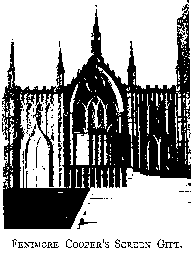
Mr. Keese's words, dating January, 1910, are: "And now comes in a rather singular discovery made by the writer a few days ago: In looking over a book in my library, published about ninety years ago, there is an article on Newstead Abbey, Nottinghamshire, England, with a steel engraving of the front of the Abbey, which is almost identical with the design of the original screen in Christ Church. Who was responsible for transplanting the same to this country appears to be unknown, but the fact is interesting in that Newstead Abbey was the home of the Byron family and that of Lord Byron."
In a letter of April 22, 1840, to H. Bleeker, Esq., Cooper wrote of this screen: "I have just been revolutionizing Christ's Church, Cooperstown, not turning out a vestry but converting its pine interior into oak—bona fide oak, and erecting a screen that I trust, though it may have no influence on my soul, will carry my name down to posterity. It is really a pretty thing—pure Gothic, and is the wonder of the country round."
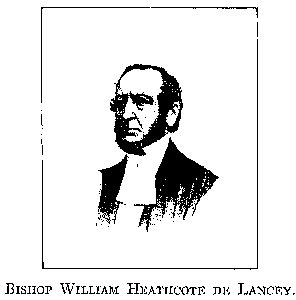
Of Cooper himself was said: "Thus step by step his feet were guided into the ways of peace." It was of the Protestant Episcopal church that his wife's brother, William Heathcote de Lancey—a genius of goodness—was bishop.
A beautiful, tender, and touching tribute to the love of his life was Fenimore Cooper's will. In part it reads: "I, James Fenimore Cooper, give and bequeath to my wife, Susan Augusta, all my property, whether personal or mixed, to be enjoyed by her and her heirs forever. I make my said wife the executrix of my will."
In a little over four months his wife followed him to the far country. Of his children, Elizabeth, the first-born, died in infancy; Susan Augusta, the author, was the second; the third, Caroline Martha, became Mrs. Henry Frederick Phinney; next came Anne Charlotte, then Maria Frances, who married Richard Cooper; Fenimore, the first son, they lost in babyhood, and Paul Fenimore, the youngest, became a member of the bar in Albany, New York.
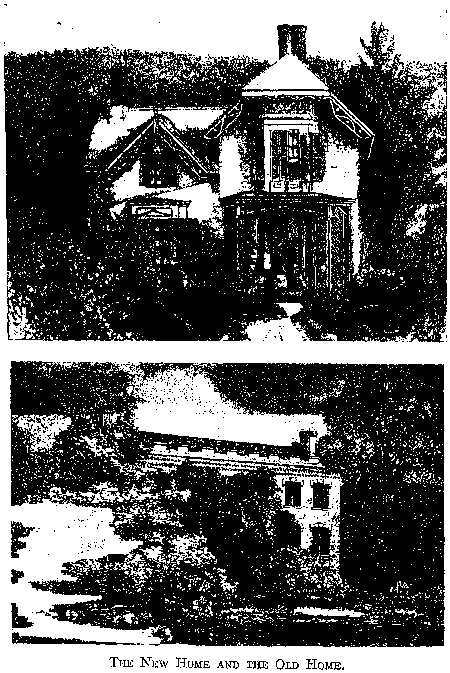
Cooper left his family a competency, but the Hall home soon passed into other hands; later it was burnt. From rescued brick an attractive house was built on the west bank of the Susquehanna for his daughters Susan Augusta and Anne Charlotte, both now resting near father and mother in Christ's Church yard. Their niece, Miss Susan Augusta Cooper, daughter of their sister, Maria Frances, Mrs. Richard Cooper, now lives in this picturesque house, and there she reverently treasures many personal belongings of her famous grandfather, and also those of her author-aunt, Susan Augusta Cooper, whose best memorial, however, is the noble orphanage on the river-bank some ways below. The oaken doors saved from the flames of the burning Hall served for this new home, which overlooked the grounds of their old home. The site of the latter is marked by Ward's "Indian Hunter." Aptly placed, peering through mists of green toward the author's church-yard grave, he is a most fitting guardian of the one-time garden of Fenimore Cooper.
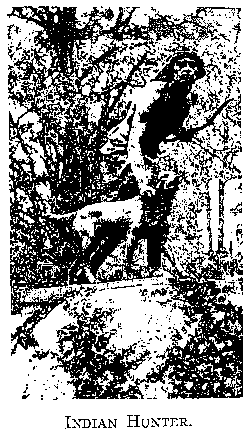
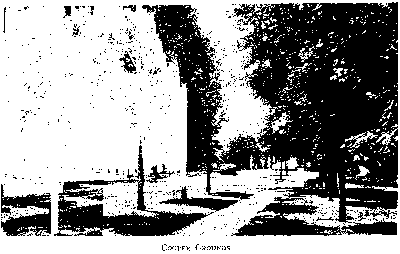
By the generosity of the late Mrs. Henry Codman Potter, this hunter's domain has been transformed into beautiful "Cooper Grounds"; and here the red-man of bronze keeps ward and watch over memories that enshrine the genius of a noble soul whose records of this vanishing race are for all time.
A gentleman just from continental Europe in 1851 said of people there: "They are all reading Cooper." A traveler, returned from Italy about that time, wrote: "I found all they knew of America—and that was not a little—they had learned from Cooper's novels." When an eminent physician who was called to attend some German immigrants asked how they knew so much of their new-home country, they replied: "We learned it all from Cooper. We have four translations of his works in German, and we all read them." February 22, 1852, Charles G. Leland of Philadelphia wrote of Cooper's works: "There were several translations issued at Frankfort, Germany, in 1824, in two hundred and fifty parts, a second large edition in 1834, and a third in 1851. All his works, more than Scott and Shakespeare, are household words to the German people." Library records of to-day show no waning of this early popularity of the "Leatherstocking Tales" and "Sea Stories" of Fenimore Cooper. In 1883 Victor Hugo told General Wilson that excepting the authors of France, "Cooper was the greatest novelist of the century." It was Balzac who said: "If Cooper had succeeded in the painting of character to the same extent that he did in the painting the phenomena of nature, he would have uttered the last word of our art."
From Hanau-on-Main, Germany, January, 1912, Herr Rudolf Drescher writes: "Within two years two new translations of Cooper's complete works have been issued. One at Berlin, the other at Leipsic. 180 pictures by the artist Max Slevogt held one edition at $192, the other with less pictures was $60, and both were sold. Cheaper editions without pictures also met with large sales. I possess an 1826, German copy of 'The Pioneers.'" Another record is, Cooper's works have been seen "in thirty different countries, in the languages of Finland, Turkey and Persia, in Constantinople, in Egypt, at Jerusalem, at Ispahan."
The author's literary cruise, dating back three years before the launching of "The Pilot" in 1823, was a long one. And no admiral of mortal fame ever led so sturdy and motley a fleet—from the proud man-of-war to the light felucca, gondola, and bark-canoe—over ocean and inland waters. With visions of forests, its moving spirit and skilful pilot still stands at the helm, the full light of the ages upon "eye, arm, sail, spar, and flag." Thus is Fenimore Cooper firmly anchored in the mind and heart of posterity as the creator of American romance.
August, 1907, "Historic Cooperstown" held her Memorial Celebration. Her founder, Judge William Cooper, his hardy pioneers, and the "memory of one whose genius had given her Glimmerglass country world-wide fame," were honored with world-wide tributes. Among these were addresses, heartfelt, and able, from the late Bishop Henry Codman Potter, on "The Religious Future"; Francis Whiting Halsey, on "The Headwaters of the Susquehanna"; George Pomeroy Keese, on "Early Days of Cooperstown," and James Fenimore Cooper of Albany, New York, on his great-grandfather "William Cooper."
From "The Cooperstown Centennial" one learns that at five o'clock on Wednesday afternoon of August 7 many people were reverently taking part in solemn services around the grave of James Fenimore Cooper and beneath the glinting tree-shadows of Christ's Church yard. The service began with a procession of young girls in white surrounding the author's last resting-place, where verses on Cooper were recited by Miss Wilkinson; then the little folk sang the lyric tribute of Mr. Saxton:
0, great magician, may the life We lead be such a one as thine— A simple life, transcending art, A spirit close to Nature's heart, A soul as strong and clear, and fine.
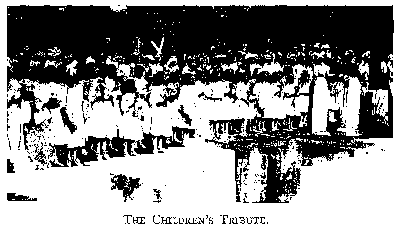
After singing, the children, gathering around, covered the marble slab with their tributes—the flowers of the season. Some poetic pictures in blank verse were given of Cooper's works, by the Reverend Dr. W.W. Battershall of St. Peter's Church in Albany, New York, the present rector, and successor of Doctor Ellison, Cooper's boyhood instructor. Then the Rev. Ralph Birdsall, rector of the author's "little parish church," spoke of Fenimore Cooper's church-yard home: "A marble slab that bears no praise for fame or virtue; only a simple cross, symbol of the faith in which he lived and died, and upon which he based his hopes of immortality." The soldier lying near, brought from the field of honor; the author's old neighbors, who exchanged with him in life the friendly nod; hands that were calloused with the axe and shovel, and Judge Temple's aged slave in narrow home—all sleeping beneath the same sward and glancing shadows are not less honored now than is the plain, unpolished slab of stone, bearing two dates,—of birth and entrance into the life eternal of James Fenimore Cooper.
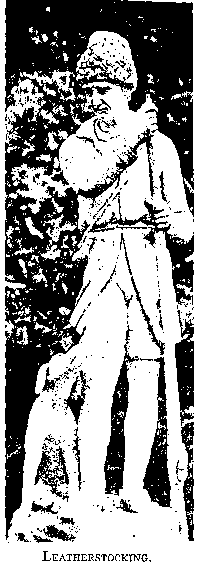
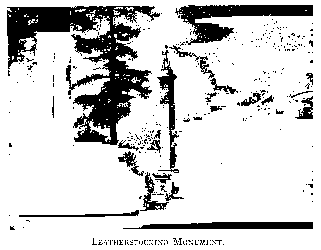
On his airy height of the "Cooper Memorial," gleaming white through the lakewood slope of Mt. Vision, wondrous Leatherstocking stands, a rare tribute to simple, uplifting goodness. Clad in his hunting-shirt, deerskin cap, and leggings, his powder-horn and bullet-pouch swung over his shoulder, his dog Hector at his feet, looking up with speaking expression into the fine, wise, honest face of his master, stands Natty, gazing over all the lake he loved so well.
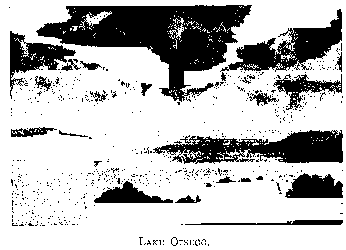
—— o'er no sweeter lake Shall morning break or noon-cloud sail; No fairer face than thine shall take The sunset's golden veil. J.G. WHITTIER.
" Cooper had no predecessor and no successor in his own field of fiction; he stood alone,—he was a creator, and his 'Natty' will stand forever as the most original of pioneer characters," wrote Henry M. Alden.
With Rev. Mr. Birdsall, many think the time has come when the fame of Fenimore Cooper demands a world-given memorial in Cooperstown. A lifelike statue from an artist's chisel should show the "'prose poet of the silent woods and stormy seas' seated, pen in hand, gazing dreamily for inspiration over the Glimmerglass, where the phantom creatures of his genius brood." Let it stand, a new-world literary shrine, in the square fronting the Old-Hall home site, which northward commands a sweeping view of his "little lake" and a side glimpse of lofty Leatherstocking of the tree-tops—not far away.
And strewn the flowers of memory here. For one whose fingers, years ago, Their work well finished, dropped the pen; Whose master mind from land to sea Drew forms heroic, long to be The living types of vanished men. A.B. SAXTON.
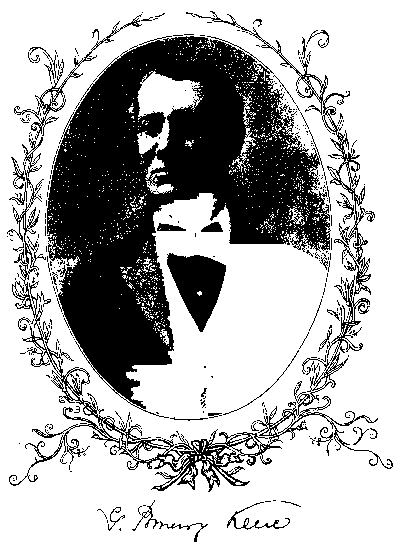
IN MEMORIAM
GEORGE POMEROY KEESE
On April 22, 1910, and at the home of his son, Theodore Keese, in New York City, came the Spirit-Land call to the late George Pomeroy Keese. It was also in New York City that he was born, on January 14, 1828. His parents were Theodore Keese and Georgiann Pomeroy, niece of James Fenimore Cooper. This grand-nephew of the author enjoyed four score and more of full, active years, mostly spent in Cooperstown, N.Y., and he gave of them generously in serving the welfare and interests of that village. There Edgewater, Mr. Keese's attractive home, overlooks, from the south, the entire length and beauty of Lake Otsego, whose waters and banks are haunted by Cooper's creations.
From Mr. Keese is quoted:
"George Pomeroy of Northampton, Mass., came to Cooperstown among the early settlers in 1801. He married the only living sister of Fenimore Cooper in 1803.
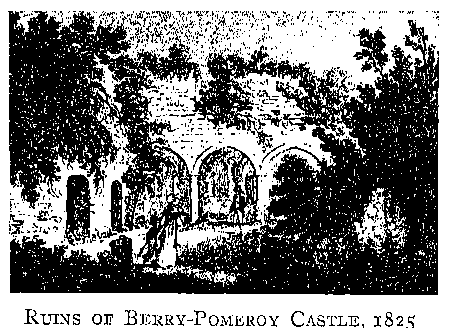
"His ancestry dates back to the coming of William the Conqueror from Normandy in 1066. At this time Ralph de Pomeroy accompanied the Norman duke to England and rendered him such valuable assistance that he received from him no fewer than fifty-eight lordships in Devonshire as a reward for his services. Selecting a favorable site, not far from the banks of the river Dart, Ralph de Pomeroy erected thereon the celebrated stronghold that now bears the family name of Berry-Pomeroy Castle, the stately ruins of which are still visited as one of the most picturesque objects of interest in the county of Devon.
"The descendants of the founder of Berry-Pomeroy retained the lands belonging to their ancestral home until the time of Edward VI, when at the period of the rebellion of that date they were seized by the crown and bestowed upon the haughty Lord Protector Somerset in whose family they still remain."
October 10, 1849, Mr. Keese married Caroline Adriance Foote, daughter of Surgeon Lyman Foote, U.S.A., who, with seven of their children, survives her husband. From childhood Mrs. Keese well knew Fenimore Cooper.
From his tender years to the age of twenty-four Mr. Keese lived in close touch with the author until his death in 1851. Afterwards such near association, affection and ability made Mr. Keese a veritable stronghold of authentic values concerning this grand-uncle. After his five years of patient, careful direction given to the preparation of this personal life of James Fenimore Cooper, the spirit of George Pomeroy Keese passed to the Land of Everlasting Light.
As a traveled, scholarly, wise, and gentle man, Mr. Keese kept in live pace with current events, and he possessed that strong, rare quality of character which "says little and does much," and compels esteem and devotion from all human kind.
Amongst Mr. Keese's various writings is "The Historic Records of Christ's Church, Cooperstown, N.Y." The rector, Reverend Ralph Birdsall, has written of its author: "At the altar of Christ's Church abides the secret that made Mr. Keese a man so widely honored and beloved."
MARY E. PHILLIPS.