ILLUSTRATIONS (continued 2)
Reading edition
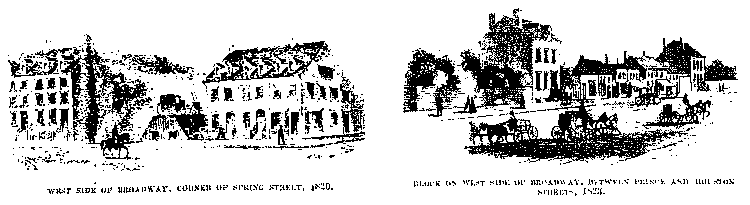
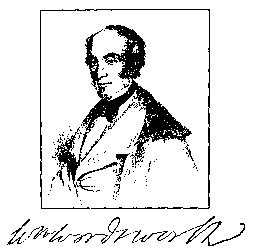
John Bartlett's Bookshop, too,—"a veritable treasury of literary secrets,"—in the new Astor House, became a haunt for the bookmen of its times. Cooper was fond of the society of literary men when he could meet them as men, and not as lions. He once said: "You learn nothing about a man when you meet him at a show dinner and he sits up to talk for you instead of talking with you. When I was in London Wordsworth came to town, and I was asked to meet him at one of those displays; but I would not go." Then Mrs. Cooper said: "But you met him afterwards, my dear, and was very much pleased with him." To this Cooper replied: "Yes, at Rogers', and was very much pleased with him; but it was because I met him in a place where he felt at home, and he let himself out freely."
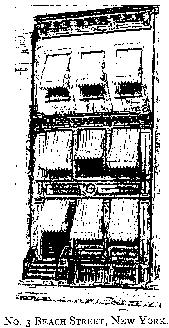
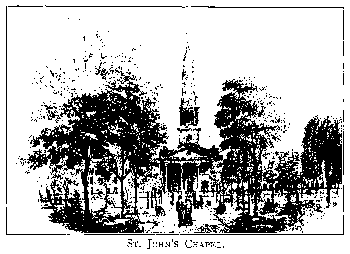
After some stay on Broadway, Cooper moved his family to their Beach Street abode. Some twenty paces from Hudson it stood,—a brick house of many attractions in the wrought iron railings, marble steps, arched doorway, high ceilings, with heavy, ornate mouldings, massive oaken doors, and Venetian blinds of the deep windows. Spacious and inviting was this city home during the 1820's, in the fashionable district of St. John's. In April, 1823, while living here, Cooper was made a member of the Philadelphia Philosophical Society. August of this year he lost his first son,—the youngest child,—Fenimore; and he himself went through a serious illness, brought on by an accident: "On returning from a New Bedford visit his carriage broke down, and always glad to be afloat, he took passage in a sloop for New York. Being anxious to reach home, when the wind began to fail, and to make the most of the tide, he took the helm and steered the little craft himself through Hell Gate. The day was very stormy, and the trying heat brought on a sudden sun-stroke-like fever." February 3, 1824, his second son, Paul, was born.
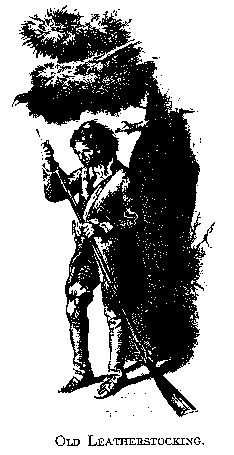
"The Spy" finished and the glow of success upon its author, he again resolved "to try one more book." For this work his thoughts turned in love to the home of his childhood, so closely associated with the little "Lake of the Fields." "Green-belted with great forest trees was this 'smile of God'—from Mount Vision dreaming at its feet, to the densely wooded 'sleeping lion' guarding its head, nine miles to the north." Of the new book Cooper frankly said: "'The Pioneers' is written exclusively to please myself." Herein Leatherstocking makes his first appearance, and for all time, as Natty Bumppo, "with his silent footfall stepped from beneath the shadows of the old pines into the winter sunlight."
An old hunter—Shipman by name—often came with his rifle and dogs during the early years of the new colony, to offer his game at William Cooper's door, and was a great attraction for the lads of Otsego Hall. A dim memory of Shipman served as an outline only for Cooper's creation, "Natty," as in strength and beauty of character he came from the writer's pen, to live through the five "Leatherstocking Tales," as "the ever familiar friend of boys." While Cooper placed no real character from life in this book, Judge Temple is accepted as a sketch of his father. The aim was to create a character from the class to which each belonged. Thus served brave old Indian John as "Chingachgook"; Mr. Grant, the missionary; and "Monsieur Le Quoi," the Frenchman. In "Chronicles of Cooperstown" it appears that a real "Mr. Le Quoy excited much interest in the place, in being superior to his occupation as a country grocer." One day a Mr. Renouard, a seaman, entered his shop for some tobacco, and returned in a few minutes agitated and pale, excitedly asking, "Who is the man that sold me this tobacco?" At the answer, "Mr. Le Quoy," he replied, "Yes, Mr. Le Quoy de Mesereau. When I went to Martinique to be port-captain of St. Pierre, this man was civil governor of the island, and refused to confirm my appointment." It was learned later that the French Revolution drove Mr. Le Quoy with little money to a New York friend,—a Mr. Murray,—who also knew well Judge Cooper, and they both advised this country store until peaceful France could and did invite its owner to return to his island home.
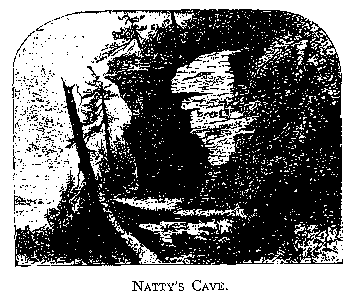
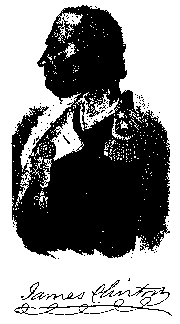
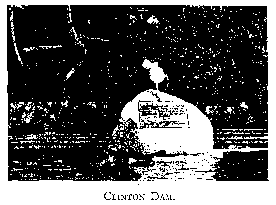
An Indian alarm of the early-village period of 1794 formed the opening chapter of the new book, but the incidents were mainly creations of Cooper's fancy. Yet the pigeon-flights, Natty's cave, which sheltered Elizabeth Temple from the forest fire, and each charming picture of the Glimmerglass country, are true to life. The academy, court-house, jail, inn; the "'Cricket'—that famous old cannon which sent its thunders thousands of times over the Otsego hills on days of rejoicing—are fairly given." The old gun was found when digging the cellar of Judge Cooper's first house, and was said to have been buried by troops under Gen. James Clinton, who marched from Albany against the Indians in 1779. They cut their way through forests, brought their boats to Lake Otsego, and their headquarters were in a log house built on the future site of the first Hall. The place where was the old Clinton Dam is now marked by the Daughters of the American Revolution as the one Cooperstown, connecting link with the War of Independence.
The outward appearance of the old Hall is fairly given by Cooper's pen, but once within, all is a faithful record, "even to the severed nose of Wolfe, and the urn that held the ashes of Queen Dido." The tale was of a great landlord living among his settlers on property bearing his name. The book was "The Pioneers, or, Sources of the Susquehanna," and "thirty-five hundred copies sold before noon of the day it was published."
It was of "The Pioneers" that Bryant wrote: "It dazzled the world by the splendor of its novelty."
An interesting incident of Cooper's kindness of heart is of this date and some ten years later came to light as follows: After his return from Europe in 1833 he one day gave to his eldest daughter "a small book bound in boards." It was entitled "Tales for Fifteen, or, Imagination and Heart" by Jane Morgan. He said to her: "Dearie, here is a little book that I wrote for Wiley," adding that he had bought it at a news stand on his way home. It appears "when Wiley failed a number of his patrons wrote stories and gave them to him." These two—one called "Heart" and the other "Imagination" were written by Cooper, but "curiously enough,"—were published under the pen-name of "Jane Morgan." The book is very rare; only two copies are known to be in existence.

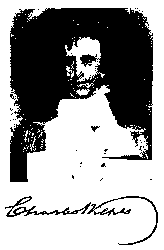
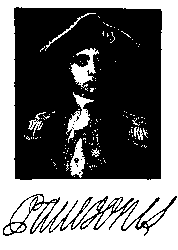
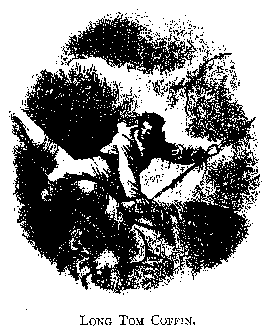
The thought of writing a romance of the sea first came to Mr. Cooper while dining at Mr. Charles Wilkes', where the table-talk turned on "The Pirate," just issued by the author of "Waverley." When his marine touches were highly praised for their accuracy, Cooper held they were not satisfactory to the nautical reader. His friends thought more accuracy might better please seamen but would prove dull reading for the general public. With his usual spirit, Cooper refused to be convinced, and on his way home that evening "the outlines of a nautical romance were vaguely sketched in his mind"; but he never dreamed it would become one of a series of sea-stories. "I must write one more book—a sea tale—" he said, "to show what can be done in this way by a sailor!" The stirring struggles of the American Revolution again enlisted the author's loyal pen-service in the character of that bold adventurer, John Paul Jones, and his cruise in The Ranger, when he made his daring descent upon Whitehaven and St. Mary's Isle, which suggested to Cooper his plot for "The Pilot." Two ships, a frigate and the schooner Ariel, were drawn for the tale. During its writing the author had many doubts of its success. Friends thought the sea tame when calm, and unpleasant in storms; and as to ladies—the reading of storms would surely make them seasick. His first encouragement came from an Englishman of taste, though a doubter of American talent. To Cooper's surprise, this authority pronounced his sea tale good. Then came the favorable opinion of Commodore Shubrick, of which the author wrote: "Anxious to know what the effect would be on the public, I read a chapter to S——, now captain, which contained an account of a ship working off-shore in a gale. My listener betrayed interest as we proceeded, until he could no longer keep his seat. He paced the room furiously until I got through, and just as I laid down the paper he exclaimed: 'It is all very well, but you have let your jib stand too long, my fine fellow!' I blew it out of the bolt-rope in pure spite!" And thus it was that when the author "came beating out of the 'Devil's Grip,'" this old messmate jumped from his seat and paced the floor with strides, not letting a detail escape him. Cooper was fully satisfied and accepted the criticism, and the tale, alive with spirited description of sea-action, won the day. It was written with all the author's power and accuracy of detail. In "Mr. Gray" appeared John Paul Jones, while "Long Tom Coffin" was said to be Mr. Irish, the mate of the Stirling, in which the lad "Cooper made his voyage before-the-mast." Of this mate and the Yankees the author wrote: "He too was from Nantucket, and was a prime fellow, and fit to command a ship." Prof. Brander Matthews calls this simple-hearted cockswain and Natty Bumppo "co-heirs of time." The famous fifth chapter of "The Pilot" was the first fiction to show that "a master of the sea tale had come into the world, and it has never been surpassed in literature of the sea." This, the third of Cooper's novels, won for him his greatest popularity. It was dedicated to William Branford Shubrick, United States Navy—the author's loyal friend since their days together on the Wasp, in 1809. Its inscription reads in part: "My Dear Shubrick—by your old Messmate, the Author." A few days after "The Pilot" was issued, January, 1824, Cooper wrote this friend: "I found Wiley had the book in the hands of his five printers—on my return—for reprint. So much for our joint efforts." Concerning "The Pilot" and its author, this appeared in the Edinburgh Review: "The empire of the sea is conceded to him by acclamation."
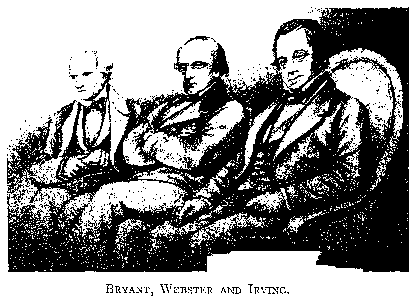
Meeting Cooper at dinner three months later, Bryant wrote his wife that "he seemed a little giddy with the great success his works have met." Another said: "What wonder that the hearty, breezy author of 'The Spy,' 'The Pioneers,' and 'The Pilot,' should, by a certain 'emphatic frankness of manner,' have somewhat startled the shy, retiring, country poet who had not yet found his place on The Evening Post!" Later, in 1824, to Richard Henry Dana's newsy letter about Cooper's foreign standing, Bryant replies: "What you tell me of the success of our countryman, Cooper, in England, is an omen of good things. I hope it is the breaking of a bright day for American literature." Bryant's memorial address after Cooper's death remains a splendid record of their unclouded friendship, based on mutual respect. It was delivered at Metropolitan Hall, in New York City, February 25, 1852. The occasion was honored by the presence of the most brilliant men of the time. Daniel Webster presided, assisted by William Cullen Bryant, and Washington Irving. At that time these three men were made the subjects of a pencil sketch by Daniel Huntington.
Mr. George Palmer Putnam thus describes a meeting between Irving and Cooper, after the latter's return from Europe: "One day Mr. Irving was sitting at my desk, with his back to the door, when Mr. Cooper came in (a little bustling as usual) and stood at the office entrance, talking. Mr. Irving did not turn (for obvious reasons), and Cooper did not see him. I had acquired caution as to introductions without mutual consent, but with brief thought—sort of instinct—I stoutly obeyed the impulse of the moment, and simply said, 'Mr. Cooper, here is Mr. Irving.' The latter turned, Cooper held out his hand cordially, dashed at once into an animated conversation, took a chair, and, to my surprise and delight, the two authors sat for an hour, chatting in their best manner about almost every topic of the day and former days; and Mr. Irving afterwards frequently alluded to the incident as being a very great gratification to him. Not many months afterwards, he sat on the platform and joined in Bryant's tribute to the genius of the departed novelist."
September 18, 1851, Irving wrote: "The death of Fenimore Cooper is an event of deep and public concern. To me it comes with a shock; for it seems but the other day that I saw him at Putnam's, in the full vigor of mind and body, 'a very castle of a man.' He left a space in our literature which will not be easily supplied. I shall not fail to attend the proposed meeting."
It is recorded that "Yale never, in later years, saw fit to honor herself by giving Cooper his degree, but Columbia, in this instance more intelligent than either Harvard or Yale, in 1824, conferred on the author the honorary degree of A.M."
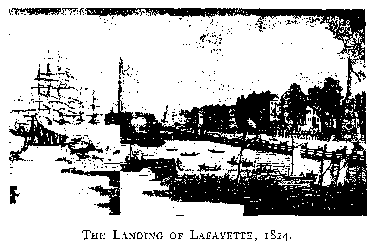
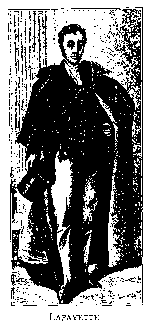
When, in 1824, General Lafayette, as the Nation's guest, landed from the Cadmus at Castle Garden, Mr. Cooper made one of the active committee of welcome and entertainment. Of his part in the Castle-Garden ball, and his enthusiasm, a friend wrote: "After working hard all day in preparations and all night in carrying them out, towards dawn he went to the office of his friend Charles King and wrote out a full and accurate report, which appeared in Mr. King's paper the next day." Concerning this famous Castle-Garden ball, Cooper himself wrote: "A tall spar was raised in the center, a vast awning of sail-cloth covered the whole, which was concealed by flags that gave a soft, airy finish—all flooded by lights. Music of the national air hailed Lafayette's arrival. The brilliant throngs and gay dancers over the floor fell into line like a charm, forming a lane, through which the old man passed, giving and receiving warm and affectionate salutations at every step to the small marquee in the midst, prepared for the 'Guest of the Nation.' He was like a father among his children." In various other ways Cooper paid tributes of courtesy to General Lafayette during this visit to America.
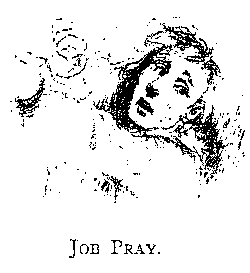
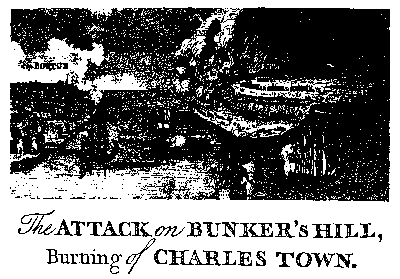
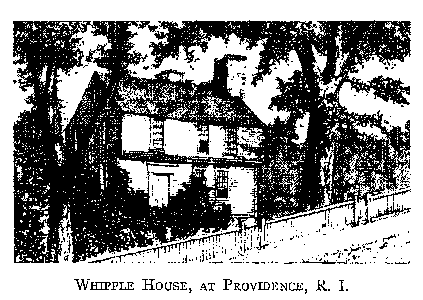
As the three successful books which the author had now written dealt with the strength and struggles of liberty-loving Americans for their new country, his wide sense of justice suggested writing on loyalty from the other point of view—the Mother Country's—as held by men of birth and honor. This loyalty to England Cooper made the subject of his next book. It was a dangerous venture, and a time too near the dearly-bought laurels of our young republic in its separation from England. But the author made every effort for accuracy on all points; he was tireless in his study of history, state papers, official reports, almanacs, and weather-records. A journey "to Yankee Land" familiarized him with every locality he so faithfully described in the pages of "Lionel Lincoln." "A Legend of the Thirteen Republics" was an added title to the first edition only (1825) of "Lionel Lincoln," for Cooper's intention to write a story of each of the thirteen states was given up later, and the title "A Narrative of 1775" took its place. The author himself was not satisfied with this work, nor with the character of "Lionel Lincoln," whose lack of commanding interest makes "Job," his poor half-witted brother and son of "Abigail,"—a tenant of the old warehouse,—the real hero of the book. Of its author, Bancroft the historian wrote: "He has described the battle of Bunker's Hill better than it has ever been described in any other work." Another high authority says: "'Lionel Lincoln' certainly gives spirited battlepieces—notably the battle of Bunker's Hill, which is a masterpiece." Rhode Island people may care to know that a part of this book was written in Providence, in the home of Mr. John Whipple, which stands on the verge of the old elm trees of College Street. Here, too, Cooper may have studied on the opening scenes of "The Red Rover."
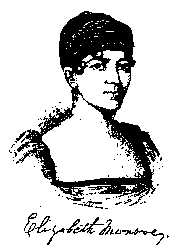
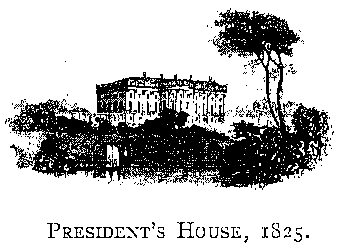
Early spring of 1825 found Fenimore Cooper in Washington, whence he wrote: "I have just witnessed one of the most imposing ceremonies of this government; I allude to the inauguration of the President of the United States." It was that of John Quincy Adams, who succeeded James Monroe. Elsewhere one learns that Cooper had dined at the White House; he gave a description of Mrs. Monroe as first lady of the land.
Up to this year the author had signed his name "James Cooper"; then, in remembrance of his mother's wish, he changed it, and by the April, 1826, act of Legislature the family name became Fenimore Cooper.
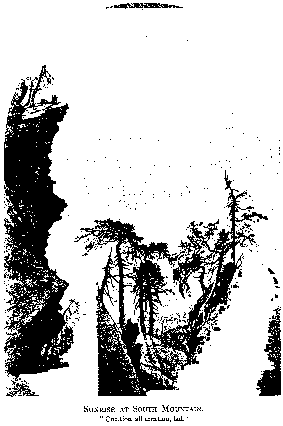
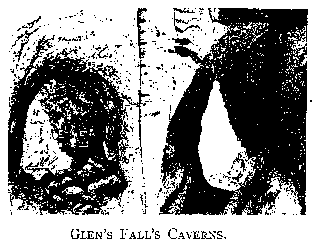
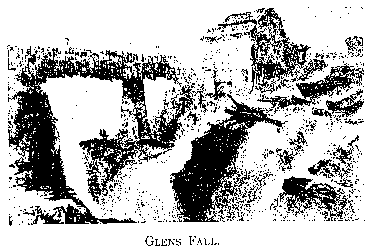
During the summer of 1825 Mr. Cooper made one of a party of young men,—which included also the Hon. Mr. Stanley, afterwards Lord Derby, Prime Minister of England, and the Hon. Wortley Montagu, later Lord Wharncliffe, in an excursion to Saratoga and the Lake George country. They went slowly up the Hudson, paid a brief visit to West Point, thence to Catskill, where, like Leatherstocking, they saw "Creation!"—as Natty said, dropping the end of his rod into the water, and sweeping one hand around him in a circle—"all creation, lad." In the hills they saw the two small ponds, and the merry stream crooking and winding through the valley to the rocks; and the "Leap" in its first plunge of two hundred feet: "It's a drop for the old Hudson," added Natty. The Shakers were called upon in their beautiful valley and neat village at Lebanon; good dinners were eaten at friendly tables in Albany; and gay were the times they had in Ballston and Saratoga. Thence to the Lake George region, its wooded heights, islands, crystal lakes, silent shores. For a while they lingered with delight, then turned back for the dark, still caverns in the heart of Glens Fall. These caverns were, Natty said, "Two little holes for us to hide in." He added, "Falls on two sides of us, and the river above and below!—it would be worth the trouble to step up on the height of this rock and look at the pervarcity of the water. It falls by no rule at all." Within the shadows and silence of these caverns Mr. Stanley suggested to Cooper that "here was the very scene for a romance," and the author promised his friend that a book should be written in which these caves would play an important part. A story of strong Indian make-up first came then to the author's mind. Before leaving, these caverns and the surrounding country were closely examined for future use.
Besides his youthful and Lake Ontario experiences with Indians, Cooper followed parties of them from Albany to New York, and several times to Washington, for the purpose of closely studying their natures and habits; all authorities in print were consulted. On his return home the book was begun and rapidly written. "Planned beneath the summer leaves, on the far shore of picturesque Hell Gate, above smiling fields and bowering orchards of his Angevine home, those leaves had scarcely fallen when the story was told—'the most uniformly exciting and powerful of his fictions'—'The Last of the Mohicans,' and Natty and Chingachgook were left in the wilderness beside the rude grave of Uncas." Again they came into the shadow of the unbroken forest, as called for by the one friend he now constantly consulted,—his faithful, loving life-mate. At the time of its writing Cooper had a serious illness, during which his mind was filled with ideas for this book. Suddenly rousing himself one of these autumn afternoons, he called for pen and paper, but too ill to use them, asked Mrs. Cooper, watching anxiously by his side, to write for him. Fearing delirium, she wrote, thinking it would relieve him. A page of notes was rapidly dictated, which seemed to his alarmed nurse but the wild fancies of a fevered brain. It proved to be a clear account of a lively struggle between "Magua" and "Chingachgook," and made the twelfth chapter of the book. Why the author called Lake George by another name is thus explained: "Looking over an ancient map, he found that a tribe of Indians the French called Les Honcans lived by this beautiful sheet of water, and thinking the English name too commonplace and the Indian name too hard to pronounce, he chose the 'Horican' as better suiting simple Natty." This book, "The Last of the Mohicans," proved, perhaps, to be the most popular of all his works up to 1826.
A present-day man-of-letters writes of Cooper: "He paints Indians and Indian scenes with a glow of our sunset skies and the crimson of our autumn maples, and makes them alive with brilliant color. Rifles crack, tomahawks gleam, and arrows dart like sunbeams through the air. Indians fleet of foot and full of graceful movement are these dusky Apollo's Uncas. Cooper's readers never yawn over these tales of the forest or the sea. He is the swan on the lake, the eagle in the air, the deer in the wood, and the wind on the sea." So writes Prof. Brander Matthews. That life-student of the American Indian, Francis Parkman, wrote: "It is easy to find fault with 'The Last of the Mohicans,' but it is far from easy to rival or even approach its excellence." It is said that "Magua," of this book, "is the best-drawn Indian in fiction; from scalp-lock to moccasin tingling with life" and the tension of the canoe-chase on the Horican.
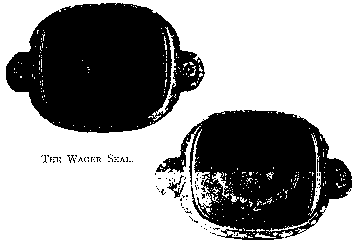
During this Lake George excursion a question came up between the Hon. Mr. Stanley, the Hon. Wortley Montagu, and Mr. Cooper as to who was the "Premier Baron of England." Cooper named Lord Henry William Fitzgerald (3rd son of James, 1st Duke of Leinster) 22nd Baron de Ros [b. 1761—d. 1829] as his man; whose title came from Henry I., to Peter, Lord of Holderness called Ros. Each of his two friends claimed another as the "Premier Baron of England." All were so confident that a wager was laid, and later inquiry proved Cooper right. In due time the debt was paid with a large gold, silver-filled seal. On its stone—a chrysoprase—appeared a baron's coronet and the old Scottish proverb: "He that will to Cupar maun to Cupar!" The incident serves to affirm Cooper's wide information and accurate memory.
This winter of 1825-26 Cooper and his family made their home at 345 Greenwich Street, not many steps from 92 Hudson Street, where lived the poet William Cullen Bryant, who often went around the corner for a walk with his friend.
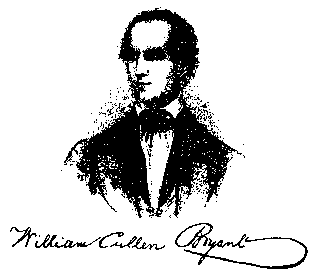
General Wilson wrote: "Soon after Bryant went to New York he met Cooper, who, a few days later, said: 'Come and dine with me tomorrow; I live at No. 345 Greenwich Street.' 'Please put that down for me,' said Bryant, 'or I shall forget the place.' 'Can't you remember three-four-five?' replied Cooper bluntly. Bryant did remember 'three-four-five,' not only for that day, but ever afterward."
During this spring Cooper followed a deputation of Pawnee and Sioux Indians from New York to Washington, in order to make a close study of them for future use. He was much interested in the chiefs' stories of their wild powers, dignity, endurance, grace, cunning wiles, and fierce passions. The great buffalo hunts across the prairies he had never seen; the fights of mounted tribes and the sweeping fires over those boundless plains all claimed his eager interest and sympathy, with the resulting desire to place "these mounted tribes" and their desert plains beyond the Mississippi in another Indian story. One of the chiefs of this party—a very fine specimen of a warrior, a remarkable man in every way—is credited with being the original of "Hard-Heart" of "The Prairie," which an authority gives as Cooper's favorite book. On a knoll, and within the glory of a western sunset, stood Natty, born of the author's mind and heart, as he first appeared in this book. "The aged trapper—a nobly pathetic figure contrasted with the squatter"—looms up, colossal, against the gleaming radiance of departing day; and full well he knows his own leaving for the long-home is not far off—for the remarkable life of wondrous Leatherstocking closes within these pages. Of other characters and the author Prof. Matthews says: "He was above all things a creator of character.—He can draw women.—The wife of Ishmael Bush, the squatter, mother of seven stalwart sons and sister of a murderous rascal, is an unforgotten portrait, solidly painted by a master." "The Prairie" was begun in the winter of 1826, in the New York, Greenwich-Street home, while Cooper was under the weather from the old fever effects. The closing of his father's estate, and debts contracted against him by those whom he had helped, emptied his purse and left him a poor man. To meet these calls of honor and his own needs, he wrote when not able to do so, and for a short and only time in his life called in the aid of coffee for his work. Wine he drank daily at dinner only, and he never smoked.
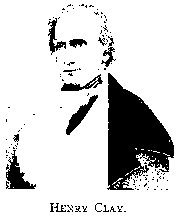
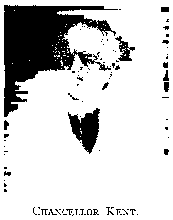
When Cooper followed the Sioux and Pawnee Indians to Washington, in 1826, Henry Clay, Secretary of State, offered him the appointment of United States Minister to Sweden. It was declined in favor of the consulship to Lyons, France, which latter would allow him more freedom and protect his family in case of foreign troubles. With this trip to Europe in view his family busily studied French and Spanish. Returning to New York, Cooper's club gave him a farewell dinner, at which the author said he intended to write a history of the United States Navy. At this dinner he was toasted by Chancellor Kent as "the genius which has rendered our native soil classic ground, and given to our early history the enchantment of fiction."
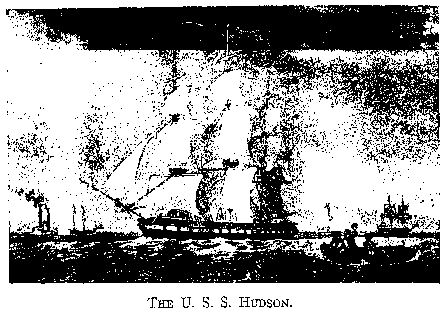
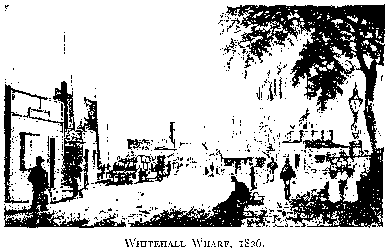
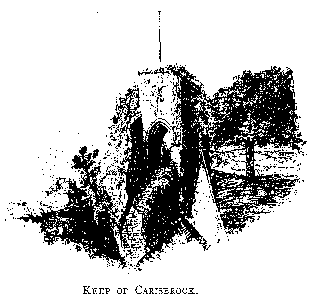
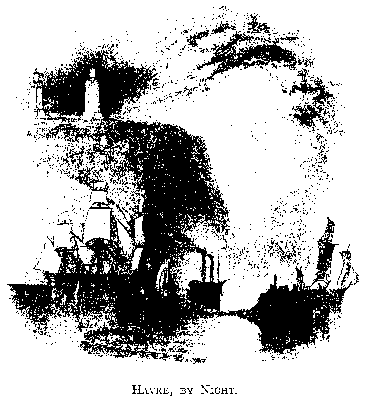
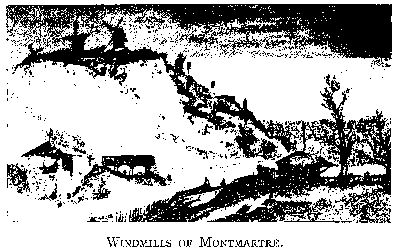
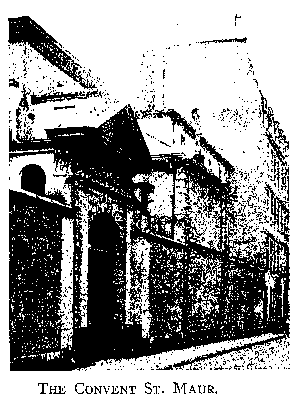
May 1 the town house was given up for a month of hotel life, and on June 1, at eleven o'clock, Mr. and Mrs. Cooper and their children boarded the Hudson at Whitehall Wharf for Europe. They left a land-squall—their maid Abigail—ashore and found some rough weather ahead before June 30. "A fine clear day brought in plain sight ninety-seven sail, which had come into the Channel, like ourselves, during the thick weather. The blue waters were glittering with canvas." A little later Cooper wrote: "There is a cry of 'Land!' and I must hasten on deck to revel in the cheerful sight." The Hudson brought up at Cowes, Isle of Wight, July 2, 1826; "after a passage of thirty-one days we first put foot in Europe," wrote Cooper. In this "toy-town" they found rooms at the "Fountain," where the windows gave them pretty vistas, and evening brought the first old-country meal, also the first taste of the famous Isle-of-Wight butter, which, however, without salt they thought "tasteless." As eager newcomers to strange lands, they made several sight-seeing ventures, among which was enjoyed the ivy-clad ruin of Carisbrook, the one-time prison of Charles I. A few days later they landed on the pier at Southampton, which town is recorded as being "noted for long passages, bow-windows, and old maids." Here they found pleasant lodgings, friends, and a sister of Mrs. Cooper's whereby time was pleasantly passed by the family while Cooper went up to London to see his publishers. On his return they were soon aboard the Camilla, "shorn of one wing" (one of her two boilers was out of order), and on their way to France. At midnight they were on deck for their first sight of France; "Land!—of ghostly hue in the bright moonlight, and other lights glittering from the two towers on the headlands near by." Landing at the small port of Havre, they had some weary hours of search before finding shelter in Hotel d'Angleterre. By a "skirted wonder" of the port their luggage soon passed the customs next morning and they were started for Paris. They were charmed with the dark old sombre, mysterious towers and fantastic roofs of Rouen, where Cooper bought a large traveling carriage, in which they safely passed the "ugly dragons" that "thrust out their grinning heads from the Normandy towns" on the way to the heart of France. From the windmills of Montmartre they took in the whole vast capital at a glance. A short stay was made at a small hotel, where soon after their arrival they engaged "a governess for the girls." She proved to be " a furious royalist," teaching the children that "Washington was a rebel, Lafayette a monster, and Louis XVI a martyr." Under the rule of returned royalists was attempted the exclusion of even the name of Bonaparte from French history. "My girls," Cooper wrote, "have shown me the history of France—officially prepared for schools, in which there is no sort of allusion to him." Their next venture was Hotel de Jumièges in a small garden, far from the Faubourg St. Germain, where they had an apartment of six rooms. Cooper wrote: "The two lower floors were occupied as a girls' boarding-school;—the reason for dwelling in it, our own daughters were in the school; on the second floor there was nothing but our own apartment." And here, next door to their nun-neighbors of the convent St. Maur, Cooper wrote the last pages of "The Prairie." It was published in the autumn of 1826, by Lea and Carey, of Philadelphia.

Cooper was very fond of walking, and to get a general idea of Paris he and Captain Chauncey—an old messmate and officer in the navy—made the circuit of the city walls, a distance of nineteen miles, in four hours. For two hours the captain had Cooper "a little on his quarter." "By this time," Cooper wrote, "I ranged up abeam,"—to find a pinching boot on his friend's foot. Near the finish the mate of this "pinching boot" became "too large," and the captain "fell fairly astern." But without stopping, eating, or drinking, they made the distance in four hours to a minute.
Washington Irving wrote from Madrid the following spring: "I left Paris before the arrival of Cooper, and regret extremely that I missed him. I have a great desire to make his acquaintance, for I am delighted with his novels. His naval scenes and characters in 'The Pilot' are admirable." Cooper soon became known in France by his presence at a dinner given by the U.S. Minister to Canning then in Paris.
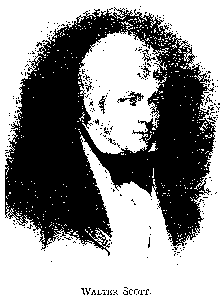
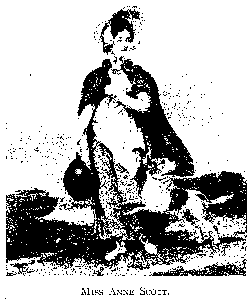
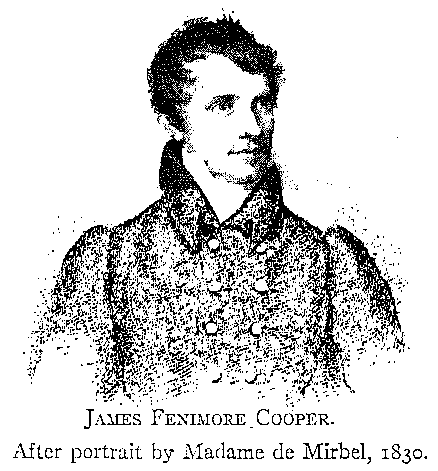
In "Bryant and His Friends" General James Grant Wilson says: "Scott and Cooper met at the Princess Galitzin's, in Paris, November, 1826; and, says Scott's diary, 'so the Scotch and American Lions took the field together.'" In Miss Cooper's "Pages and Pictures" appears her father's first interview with the author of "Waverley," of which Cooper wrote in part: "Ten days after the arrival of Sir Walter Scott I ordered a carriage one morning. I had got as far as the lower flight to the door when another carriage-steps rattled, and presently a large, heavy man appeared in the door of the hotel. He was gray, limped a little, walking with a cane. We passed on the stairs, bowing. I was about to enter the carriage when I fancied the face and form were known to me, and it flashed on my mind that the visit might be to myself. The stranger went up the large stone steps, with one hand on the railing and the other on his cane. He was on the first landing as I stopped, and, turning, our eyes met. He asked in French, 'Is it Mr. Cooper that I have the honor to see?' 'I am, sir.' 'Oh, well then, I am Walter Scott.' I ran up, shook the hand he stood holding out to me cordially, and expressed my sense of the honor he was conferring. He told me the Princess Galitzin had been as good as her word and given him my address,—and cutting short ceremony he had driven from his hotel to my lodgings." Realizing all at once that he was speaking French to Cooper's English, he said: "Well, I have been parlez-vousing in a way to surprise you. These Frenchmen have my tongue so set to their lingo I have half forgotten my own language,' he continued in English, and accepted my arm up the next flight of stairs." They had some copyright and other talk, and Sir Walter "spoke of his works with frankness and simplicity"; and as to proof-reading, he said he "would as soon see his dinner after a hearty meal" as to read one of his own tales—"when fairly rid of it." When he rose to go Cooper begged he might have the gratification of presenting his wife. Sir Walter good-naturedly assented. When Mrs. Cooper and their nephew William Cooper were introduced, he sat some little time relating in Scotch dialect some anecdotes. Then his hostess remarked that the chair he sat in had been twice honored that day, as General Lafayette had not left it more than an hour before. Sir Walter was surprised, thinking Lafayette had gone to America to live, and observed, "He is a great man." Two days later Sir Walter had Cooper to breakfast, where the Scotch bard appeared in a newly-bought silk gown, trying "as hard as he could to make a Frenchman of himself." Among others present was Miss Anne Scott, who was her father's traveling companion. "She was in half mourning, and with her black eyes and jet-black hair might very well have passed for a French woman." Of Scott Cooper wrote: "During the time the conversation was not led down to business, he manifested a strong propensity to humor." In naming their common publisher in Paris "he quaintly termed him, with a sort of malicious fun, 'our gosling' (his name was Goselin), adding that he hoped at least he 'laid golden eggs.'" Mr. Cooper was warmly interested in aiding Sir Walter's "Waverley" copyrights in America, and concerning their author he later wrote: "In Auld Reekie, and among the right set, warmed, perhaps, by a glass of 'mountain dew,' Sir Walter Scott, in his peculiar way, is one of the pleasantest companions the world holds." About 1830, when Cooper was sitting for his portrait by Madame de Mirbel, that artist—for its pose—asked him to look at the picture of a distinguished statesman. Cooper said: "No, if I must look at any, it shall be at my master," and lifting his eyes higher they rested on a portrait of Sir Walter Scott.
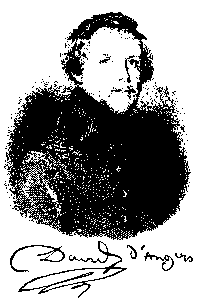
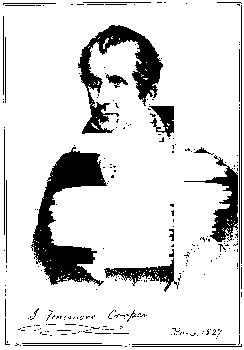
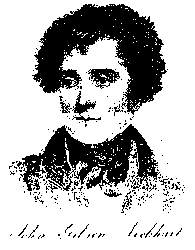
One of Cooper's steadfast friends exclaimed of him:—"What a love he cherished for superior talents in every ennobling pursuit in life!" This characteristic no doubt led him into that day life of Pierre Jean David d'Angers, whose brave soul had battled its way to artistic recognition. In M. Henry Jouin's "David d'Angers et ses Relations Littéraires," Paris, 1890, appear two letter records of this master-sculptor as to Cooper. In that of David to Victor Pavie, November, 1826, is: "Next week I am to dine with Cooper; I shall make his bust. If you have not yet read his works, read them, you will find the characters vigorously traced." A note adds that the sculptor kept his word, and this bust of Cooper appeared in the "Salon of 1827." Paris, March 30, 1828, David again writes of Cooper to Victor Pavie:—"Dear friend, in speaking of the sea, I think of 'The Red Rover' of my good friend Cooper. Have you read it? It interests me much." A note adds: "Without doubt the author had presented his new book to the sculptor," who gave to Cooper this bust, modeled in 1826. Mrs. Cooper thought the bust and the Jarvis portrait of her husband were "perfect likenesses." Later on David's genius again found expression in a bronze medallion of his "good friend Cooper." David has given the striking intellectual of Cooper's head of which an authority of that time wrote: "Nature moulded it in majesty, yet denied it not the gentler graces that should ever adorn greatness."

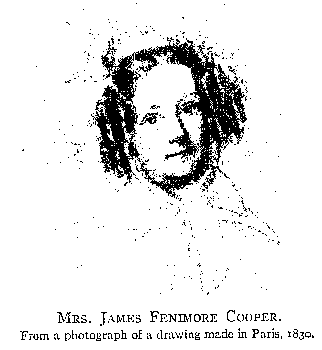
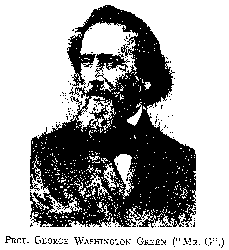
"In Paris Cooper's style of living gave his ideas of the duties and position of an American gentleman. In a part of the handsome Hotel de Jumièges he lived, keeping his carriage and service required by a modest establishment; and his doors were always open to every American who had claims on his society. Meanwhile nothing was allowed to break in upon his literary duties, for which a part of each day was set aside." So wrote one who became a friend staunch and true at this time in Paris. Of their meeting he wrote: "I shall never forget the first day I saw Cooper. He was at good old General Lafayette's, in the little apartment of the rue d'Anjou,—the scene of many hallowed memories." Lafayette's kind heart had granted an interview to some Indians by whom a reckless white man was filling his purse in parading through Europe. With winning smile the great, good man told these visitors to return to their home while yet they could. Mr. G. continued: "As I was gazing at this scene I saw a gentleman enter whose appearance called off the General's attention. He was in the prime of life (thirty-five), and of that vigor which air and manly exercise give. I had seen the heads of great men, and there were some close to me, but none with such a full, expansive forehead, such strong features, a mouth firm without harshness, and an eye whose clear gray seemed to read you at a glance while it fears not to let you read him in turn. 'Who is he?' I whispered to a grand-daughter of the General near me. 'Mr. Cooper; do you not know Mr. Cooper? Let me introduce you to him.' 'Cooper,' said I to myself; 'can it be that I am within five paces, and that there, too, are the feeble of the race around which his genius has shed a halo like that of Homer's own heros?' I was fresh from 'The Mohicans,' and my hand trembled as it met the cordial grasp of the man to whom I owed so many pleasing hours. I asked about the Indians. 'They are poor specimens,' said he; 'fourth-rate at best in their own woods, and ten-times worse for the lives they are leading here.'" Later, Mr. G. met the author in Lafayette's bed-room, and saw how warmly he was welcomed by the great poet Béranger. Still later Mr. G. and Cooper met in Florence, where they had much fine talking and walking "on calm summer evenings." Of the Bard-of-Avon it is noted that Cooper said: "Shakespeare is my traveling library. To a novel-writer he is invaluable. Publishers will have mottoes for every chapter; I never yet turned over Shakespeare without hitting upon just what I wanted I like to take them, whenever I can, from our own poets. It is a compliment they have a right to, and I am glad when I can pay it." Concerning the author's habits, this friend concludes: "When Cooper left his desk he left his pen on it. He came out into the world to hear and see what other men were doing. If they wanted to hear him, there he was, perfectly ready to express opinions of men or things. It was delightful to hear him talk about his own works, he did it with such a frank, fresh, manly feeling."
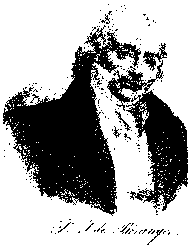
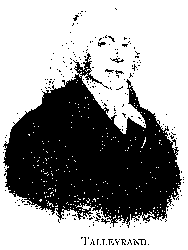
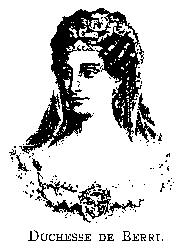
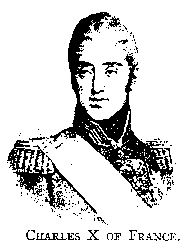
Among the great again was seen the ever-favored yet not "gai" Talleyrand. Of the incident Cooper noted: "It is etiquette for the kings of France to dine in public on January 14 and on the monarch's fête-day." Wishing to see this ceremony, Mr. and Mrs. Cooper were sent the better of the two permissions granted for the occasion. Cooper describes the ceremony—the entrée of Charles X: "Le Roi, tall, decidedly graceful; the Dauphin to his right, the Dauphine to his left, and to her right the Duchess of Berri." Passing Cooper, he continues: "Near a little gate was an old man in strictly court-dress. The long white hair that hung down his face, the cordon bleu, the lame foot, and the unearthly aspect made me suspect the truth, it was M. de Talleyrand as grand chamberlin, to officiate at the dinner of his master"; whereby proving his own words: "It is not enough to be some one,—it is needful to do something." A near Abbé whispered of Talleyrand to Cooper: "But, sir, he is a cat, that always falls on its feet." Yet of Talleyrand another's record is: "But if Charles Maurice was lame of leg—his wit was keener and more nimble than that of any man in Europe." Brushing past the gorgeous state-table to Mrs. Cooper, the author adds: "She laughed, and said 'it was all very magnificent and amusing,' but some one had stolen her shawl!"
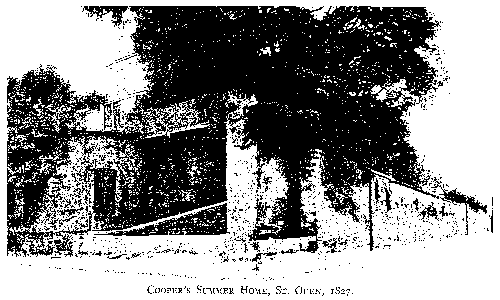
Cooper was ever a home-lover. Wherever he might be in foreign lands, he contrived to have his own roof-tree when possible. Therefore, the summer of 1827 sent them from rue St. Maur to the village of St. Ouen, on the banks of the Seine and a league from the gates of Paris. The village itself was not attractive, but pleasant was the home, next to a small château where Madame de Staël lived when her father, M. Necker, was in power. Some twenty-two spacious, well-furnished rooms this summer home had, in which once lived the Prince de Soubise when grand veneur of Louis XV, who went there at times to eat his dinner—"in what served us for a drawing-room," Cooper wrote. The beautiful garden of shade-trees, shrubbery, and flowers, within gray walls fourteen feet high, was a blooming paradise; and for it all—horses, cabriolet, grand associations—was paid two hundred dollars per month for the season of five.
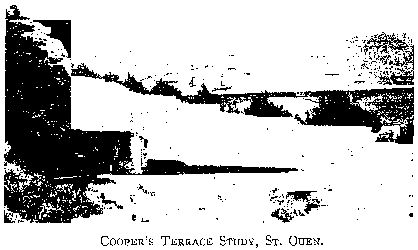
"The Red Rover" was written in these three or four summer months in St. Ouen on the Seine, whence the author's letters tell of watching the moving life on the river, the merry washerwomen as they chatter, joke, and splash beneath his terrace; how he tried punting, and left it to "honest Pierre," who never failed to charge him double fare, and of whom he tells a pretty story; how they all enjoyed the village fêtes, with whirligigs and flying-horses, whereby the French contrive to make and spend a few sous pleasantly. "I enjoy all this greatly," wrote Cooper. Excursions were made,—one to Montmorenci, in plain view of Paris; and the author explains that the Montmorenci claim to being "the first Christian baron" is of the Crusade War-Cry date and origin. His wife and he took all the pretty drives in their cabriolet, but later he took to the saddle for the out-of-field paths, where pleasant salutations were exchanged with kindly-hearted peasants. Of these rambles Cooper wrote: "One of my rides is ascending Montmartre by its rear, to the windmills that night and day are whirling their rugged arms over the capital of France." Montmartre, he said, gave him a view "like a glimpse into the pages of history." He often met royalty dashing to and from Paris. The king with his carriage-and-eight, attended by a dozen mounted men, made a royal progress truly magnificent.
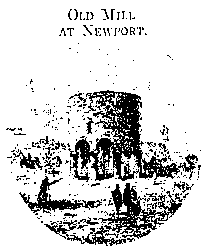
Overhanging the river at the garden side was a broad terrace which ended in a pleasant summer-house, and here many pages of the author's next book—"The Red Rover"—were written. After he left the navy, and while he was living in Angevine, Cooper became part owner in a whaling-ship,—The Union, of Sag Harbor. She made trips to different parts of the coast, and several times, for the pleasure of it, Cooper played skipper. Under his direction she once carried him to Newport, with which he was greatly pleased. He explored the old ruin there, but no fancy could ever persuade him to see more than a windmill in it; but the charm of Newport's situation, harbor, and shore lines lingered in his mind and served him for the opening and closing scenes of this work. After its publication he received from some Newport gentlemen the gift of a little box made from the keel of the Endeavor, Cook's famous exploring ship, which wound up its world-circling voyage in Newport harbor. On the lid of the box was a silver-plate engraving. In Cooper's story the "Red Rover" appears on this Newport scene in the height of his career,—an outlaw in spirit, a corsair in deed. In early life he was of quick mind, strong will, with culture and social position, but wildly passionate and wayward; and smarting under official injustice, in an evil hour he casts his lawlessness loose on the storm-tide of life. The voice of an elder sister, who had given something of a mother's deep love and tenderness to the wayward youth, falls upon his ear. Old memories are awakened; home feeling revives; conscience is aroused, and in the very hour of its greatest triumph the proud spirit bows in penitence,—the Rover surrenders his captives. A like change of heart came, through a mutual love of the birds of heaven, to a real pirate who chanced upon a cabin in the forest's solitude and here confessed his life to its inmate, Audubon, who left this "striking incident" a record in his works. However, "Dick Fid, that arrant old foretop man, and his comrade, Negro Sip, are the true lovers of the narrative;—the last, indeed, is a noble creature, a hero under the skin of Congo." "The Red Rover" is all a book of the sea. In Sir Walter Scott's journal, January, 1828, appears: "I have read Cooper's new novel, 'The Red Rover.' The current of it rolls entirely on the ocean. Something too much of nautical language. It is very clever, though." Its author "has often been idly compared to the author of 'Waverley,' but to no such heritage as Scott's was ever Cooper born. Alone he penetrated the literary wilderness, blazing paths for those who should come after him there";—and a Columbus of letters for others to follow on the sea's highway was he.

A misprint in Lockhart's "Life of Scott" made his comment on Cooper most unfortunate by an "s" added to the word manner. Sir Walter's journal reads: "This man who has shown so much genius has a good deal of manner, or want of manner, peculiar to his countrymen." Cooper, hurt to the quick for himself and his country at being rated "a rude boor from the bookless wilds," by one he had called his "sovereign" in past cordial relations, resented this expression in his review of Lockhart's work for the Knickerbocker Magazine, 1838, and for so doing he was harshly criticised in England. October, 1864, the literary editor of The Illustrated London News wrote: "I am almost inclined to agree with Thackeray in liking Hawkeye 'better than any of Scott's lot.' What noble stories those five are in which the hero is described from youth to age!" From "Thackeray in the United States," by General James Grant Wilson, comes: "At an American dinner table" (the talk was of Cooper and his writings) "Thackeray pronounced Leatherstocking the greatest character created in fiction since the Don Quixote of Cervantes"; and he thought the death scene in "The Prairie," where the old trapper said "Here!" surpassing anything he had "met in English literature."
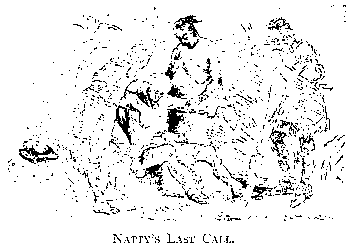
Of Natty's answer to the Spirit Land call Cooper's own words are: "The trapper was placed on a rude seat, which had been made, with studied care, to support his frame in an upright and easy attitude—so as to let the light of the setting sun fall full upon the solemn features. His head was bare, the long, thin locks of gray fluttering lightly in the evening breeze. The first glance of the eye told his former friends that the old man was at length called upon to pay the last tribute of nature. The trapper had remained nearly motionless for an hour. His eyes alone had occasionally opened and shut. When opened, his gaze seemed fastened on the clouds which hung around the western horizon, reflecting the bright colors, and giving form and loveliness to the glorious tints of an American sunset. The hour—the calm beauty of the season—the occasion, all conspired to fill the spectators with solemn awe. Suddenly, while musing on the remarkable position in which he was placed, Middleton felt the hand which he held grasp his own with incredible power, and the old man, supported on either side by his friends, rose upright to his feet. For a moment he looked about him, as if to invite all in presence to listen (the lingering remnant of human frailty), and then, with a fine military elevation of the head, and with a voice that might be heard in every part of that numerous assembly, he pronounced the word—'Here!'
"When Middleton and Hard Heart, each of whom had involuntarily extended a hand to support the form of the old man, turned to him again, they found that the subject of their interest was removed forever beyond the necessity of their care."
Concerning social life Cooper wrote: "Taking into consideration our tastes and my health, the question has been, not how to get into, but how to keep out of, the great world." But for the happy chance of inquiry at the gate of a friend, the author would "have dined with the French Lord-High-Chancellor, without the smallest suspicion of who he was!" Of French women Cooper adds: "The highest style of French beauty is classical. I cannot recall a more lovely picture than the Duchess de——[this title and blank are said to veil the identity of the Princess Galitzin] in full dress at a carnival ball, where she shone peerless among hundreds of the élite of Europe. And yet this woman was a grandmother!"
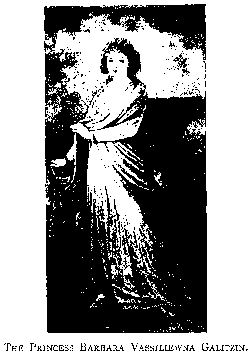
In a letter dated Paris, November 28, 1826, written by Mrs. Cooper to her sister, appears of Mr. Cooper:—"They make quite a Lion of him and Princesses write to him and he has invitations from Lords and Ladies. He has so many notes from the Princess Galitzin I should be absolutely jealous were it not that she is a Grandmother. We were at a Soirée there the other evening among Dutchesses, Princesses, Countesses, etc."
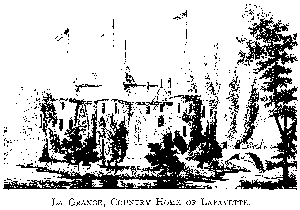
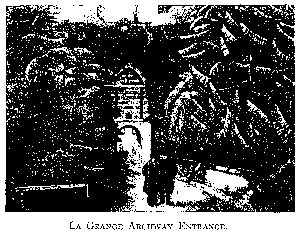
Once with and twice without Mrs. Cooper, the author visited La Grange, the country home of General Lafayette, some twenty-seven miles from Paris and near Rosay. He tells us that La Grange means barn, granary, or farm, and that the château came to Lafayette through his wife; that it had some five hundred acres of wood, pasture, meadow, and cultivated land; that the house is of hewn stone, good grayish color, with its five plain, round towers and their high, pyramidal slate roofs making a part of the walls; that the end towers are buried in ivy planted by Charles Fox. He tells how small, irregular windows open beautifully through the thick foliage for the blooming faces of children, in their home-part of La Grange. He gives rare pictures of the great stairway, the General's bed-room, cabinet, and library in the tower-angle overlooking the willow-shaded moat. Beneath this library was the author's own bed-room. Then came the array of drawing-rooms and innumerable other rooms, where hospitality seemed to know no limit. Lafayette's cabinet contained many portraits,—one of Madame de Staël, and one of his own father. Of this room, and the library, and his grand old host Cooper wrote: "I passed much of our visit alone with him in these two rooms. No one can be pleasanter in private, and he is full of historical anecdotes that he tells with great simplicity and frequently with great humor." The château stands on three sides of an irregular square, and is one of the most picturesque structures in the country. The winding road enters a thicket of evergreens, crosses a bridge, and passes beneath an arch to the paved court. Together, Cooper and his host had many walks and drives thereabouts, and, all in all, the author fell under the spell of Lafayette's personal charm and his simple integrity of character. Between Lafayette's richness of years and Talleyrand's old age there was a gulf,—one had attained nearly everything worth striving for; the other had lost the same.
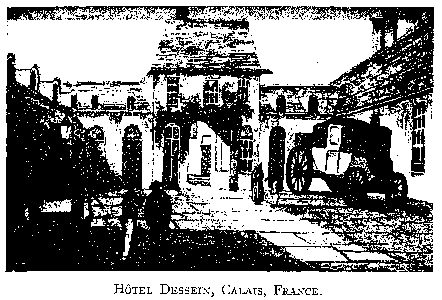
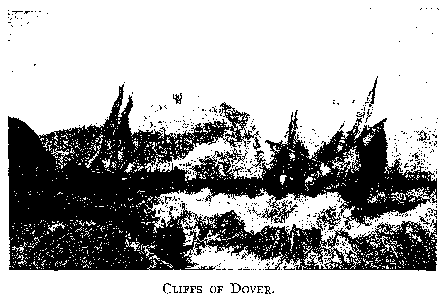
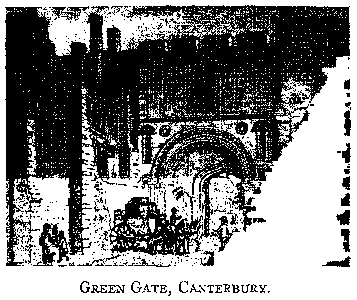
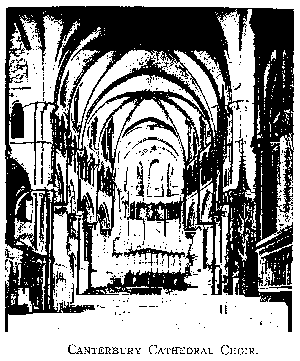
Cooper and his family entered France July, 1826, and February, 1828, they thought the time had come to change the scene, and proceeded to England. "I drove around to the rue d'Anjou to take my leave of General Lafayette," wrote Cooper. To Calais they had rain and chill and darkness most of the way. Passing through the gate, they drove to the inn immortalized by Lawrence Sterne and Beau Brummel, where they found English comfort with French cooking and French taste. One of February's fine days they left the Hotel Dessein to embark for England. After a two-hours' run the cliffs of Dover appeared on each side of that port,—the nearest to the continent,—making these chalk cliffs seem, Cooper says, "a magnificent gateway to a great nation." Leaving the fishing-boats of the French coast, "the lofty canvas of countless ships and several Indiamen rose from the sea," as they shot towards the English shore, many "bound to that focus of coal-smoke, London." Quietly landing at Dover-haven, they went to Wright's tavern, where they missed the French manner, mirrors, and table-service, but "got in their place a good deal of solid, unpretending comfort." In due time Mr. Wright put them and their luggage into a comfortable post-coach, and on the road he called "quite rotten, sir," to London. To Americans, at that date, the road proved good, and also the horses that made the sixteen miles to Canterbury in an hour and a half, where they drove to another Mr. Wright's; going to four of the name between Dover and London, Cooper concluded with an apology that "it was literally all Wright on this road." The visit to Canterbury cathedral was made during "morning vespers in the choir. It sounded odd to hear our own beautiful service in our own tongue, in such a place, after the Latin chants of canons; and we stood listening with reverence without the screen." London met them "several miles in the suburbs down the river," but they suddenly burst out onto Waterloo bridge, over which they were whirled into the Strand and set down at Wright's hotel, Adam Street, Adelphi; "and," wrote Cooper, "we were soon refreshing ourselves with some of worthy Mrs. Wright's excellent tea."
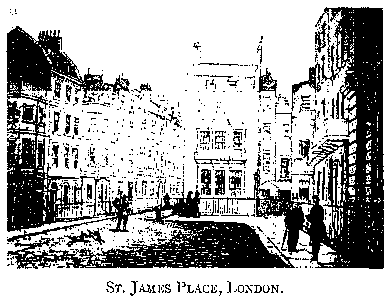
The second night in London Cooper, stretched out on a sofa, was reading, when some street musicians began to play beneath his window several tunes without success; "finally," he wrote, "the rogues contrived, after all, to abstract half a crown from my pocket by suddenly striking up 'Yankee Doodle!'" After some hunting they took a small house in St. James Place, which gave them "a tiny drawing-room, a dining-room, three bed-rooms, offices, and house-service for a guinea per day." A guinea more weekly was added for their three fires, and their own maid and man gave personal service during this London season. Of his man-servant Cooper wrote: "The English footman I engaged is a steady, little, old man, with a red face and a powdered poll, who appears in black breeches and coat, but who says himself that his size has marred his fortune. He is cockney born, about fifty; quality and splendor act forcibly on his imagination, and he is much condemned in the houses where I visit on account of his dwarfish stature"; and we are told that the English favor pretty faces for their maids and fine figures for their footmen.

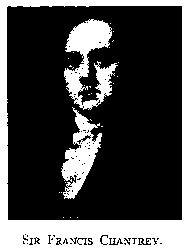
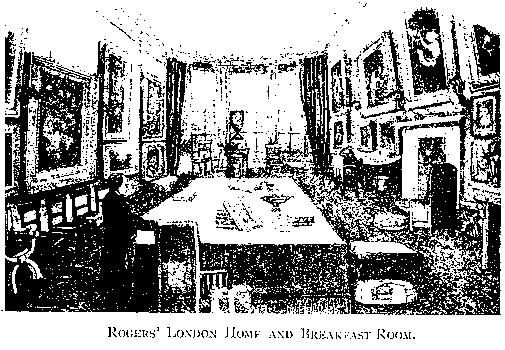
To a Mr. Spencer whom Cooper met in France was due the visit soon paid him by his near neighbor, the author of the "Pleasures of Memory." Of Samuel Rogers Cooper wrote: "He very kindly sought me out"; and, "few men have a more pleasant way of saying pleasant things." His visit was followed by an invitation to breakfast the next morning. Cooper continues: "It was but a step from my door, and you may be certain I was punctual." He found the poet's home perfection for a bachelor's needs; only eighteen feet front, but the drawing-room and dining-room were lined with old masters. And in the bow-window stood the "Chantrey Vase," placed by its maker when artist workman in the room where he later dined as Chantrey the sculptor and Rogers' honored guest. The library was filled with valuable books and curiosities in history, literature, and art. Of this poet's dream-home Cooper wrote: "Neither he nor any one else has a right to live in so exquisite a house and expect everybody to hold their tongues about it. Taking the house, the host, the mental treats he dispenses, the company, and the tone, it is not easy to conceive of anything better in their way. Commend me in every respect to the delicious breakfasts of St. James Place!" On one occasion, "Rogers, talking of Washington Irving's 'Columbus,' said, 'in his airy, significant way,' as Moore called it, 'It's rather long.' Cooper turned round on him and said sharply, 'That's a short criticism.'" This banker-poet could be severe on his English friends too, as it appears "Lady Holland was always lamenting that she had nothing to do. One day, complaining worse than ever that she did not know 'what to be at,'" said Rogers, "I could not resist recommending her to try a novelty—try and do a little good."

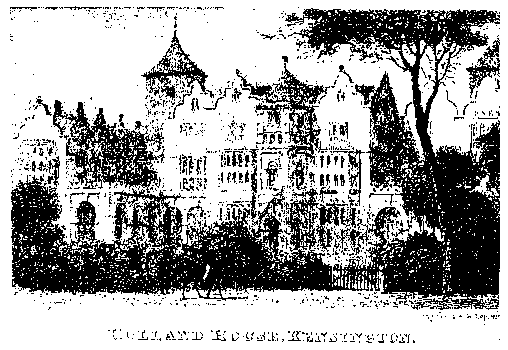
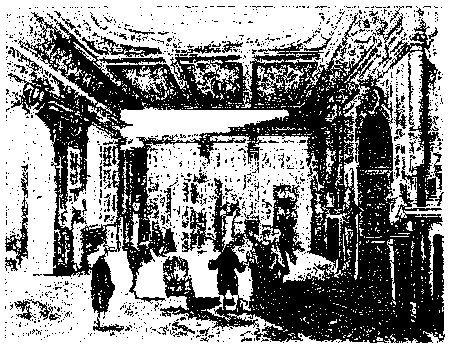
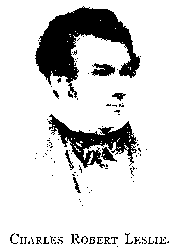
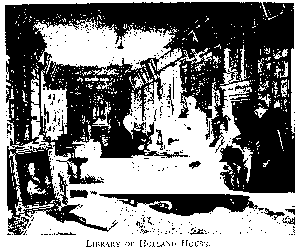
Through Samuel Rogers Cooper was soon dining at Holland House, in the much-carved and gilded room where Sully and embassy supped in 1603. By a word to the porter, Sir James Mackintosh had planned a pleasant half-hour for his American friend in the gardens, where was Rogers' seat, and then in the library on the second floor, where he saw its each-end tables. The generous space between is said to have been paced by "Addison when composing," and his inspiration quickened by kindly "bottles placed on them for that purpose." The artist Charles Robert Leslie caught a rare glimpse on canvas of this library, in which appear his friends Lord and Lady Holland, who were also the host and hostess of Fenimore Cooper. We are told by him that the dining-table was square; that the host had one corner and the hostess the centre; and the American author, "as the stranger, had the honor of a seat next to Lady Holland." When talking, he was offered by her a plate of herring, of which he frankly avowed he "ought to have eaten one, even to the fins and tail"; but little dreaming of their international worth just then, the herring were declined. With good humor his hostess said: "You do not know what you say; they are Dutch." With some vigor of look and tone Cooper repeated—"Dutch!" The reply was: "Yes, Dutch; we can only get them through an ambassador." Then Cooper rose to the occasion by replying: "There are too many good things of native production to require a voyage to Holland on my account." Of their host Rogers' record was: "Lord Holland always comes down to breakfast like a man upon whom sudden good fortune had just fallen—his was the smile that spoke the mind at ease." And after his death were found on Lord Holland's dressing-table, and in his handwriting, these lines on himself:

Nephew of Fox and friend of Gay, Enough my meed of fame If those who deighn'd to observe me say I injured neither name.
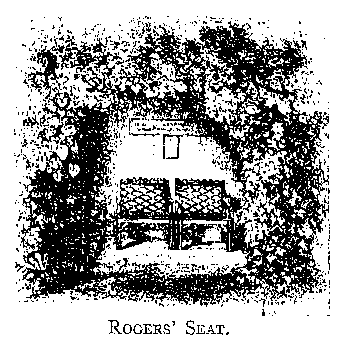
"Here Rogers sat, and here forever dwell With me, those Pleasures that he sang so well."
After dining at Lord Grey's Cooper wrote of him: "He on all occasions acted as if he never thought of national differences"; and the author thought him "the man of most character in his set." We are told that England is the country of the wealthy, and that the king is seldom seen, although the royal start from St. James for Windsor was seen and described as going off "at a slapping pace."

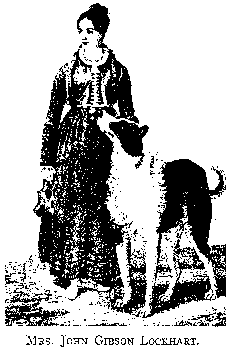
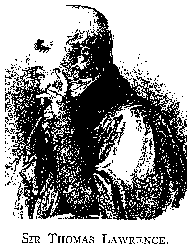
But it was in that dreamland of Rogers' that Cooper's heart found its greatest joy. There he met the artists,—Sir Thomas Lawrence, handsome and well-mannered; Leslie, mild, caring little for aught save his tastes and affections; and Newton, who "thinks himself" English. Here, dining, he meets again Sir Walter Scott, his son-in-law and later biographer, Mr. Lockhart, Sir Walter's daughters, Mrs. Lockhart and Miss Anne Scott. He says Mrs. Lockhart "is just the woman to have success in Paris, by her sweet, simple manners." He had a stately chat with Mrs. Siddons, and Sir James Mackintosh he called "the best talker I have ever seen; the only man I have yet met in England who appears to have any clear or definite notions of us." Rare indeed were these flash-lights of genius that Samuel Rogers charmed to his "feasts of reason and flow of soul."

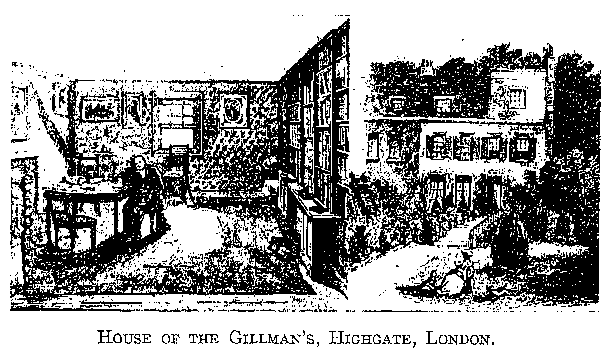
With Mr. Southby Cooper went to see Coleridge at Highgate, where, he says, "our reception was frank and friendly, the poet coming out to meet us in his morning-gown. I rose to take a nearer view of a little picture, when Mr. Coleridge told me it was by his friend Allston." From the bard of Highgate they went to see Miss Joanna Baillie at Hampstead, and found her "a little, quiet woman, a deeply-seated earnestness about her that bespoke the higher impulses within; no one would have thought her little person contained the elements of a tragedy."
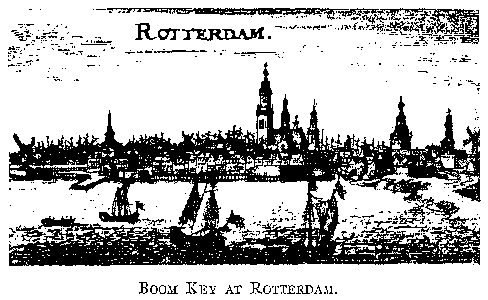
An Amsterdam engagement for early June called Cooper and his family from London before the end of the season, and prompted him to say, "The force of things has moved heavier bodies." Quitting England was by no means easy, but "the weather was fine and the North Sea smooth as a dish." They paddled the whole night long in their "solid good vessel, but slow of foot." With morning "a low spit of land hove in sight, and a tree or a church tower" rose out of the water,—this was Holland. At Rotterdam "the boat was soon alongside the Boom Key." With some fluttering about the dykes and windmills of Dutchland, a flight through Belgium soon brought them once more to Paris.
Cooper was a keen observer and a calm critic of both home and foreign folk. That he was stirred to strong words by unpleasing comments on his country appears in his "Notions of Americans: Picked up by a Traveling Bachelor." This book of facts, showing wide and accurate knowledge, was intended to enlighten and clear away mistakes. Instead of this, it drew upon its writer critical fire both at home and abroad, and was the first of the many shadows of his after life. His stories of our new country taught Europe more about America than Europe had ever learned before. His love for, and faith in, his own country were strong. Abroad he was a staunch defender of her free institutions, and foreigners deemed him more proud of his American birth than of his literary birthright of genius; and yet, at home he was voted "an enemy of all that the fathers of the Republic fought for." However, the opinion of those who knew Cooper best was given by his Bread and Cheese Club friend, Dr. John Wakefield Francis, as,—"He was an American inside and out—a thorough patriot." It was said that as an aristocratic American he never presented letters of introduction. Yet in foreign lands his society was sought by the most distinguished men of his time. However of this, the rare pleasure of these London days he ever held in warm remembrance.
Flying from the summer heat of Paris, the family soon left for Switzerland with a team of sturdy Norman horses, a postilion riding the near beast. It slipped and fell, rolled over and caught its rider's leg beneath, but was saved its breaking by the make of his old-fashioned boot, "so with a wry face and a few sacr-r-r-es, he limped back to his saddle."
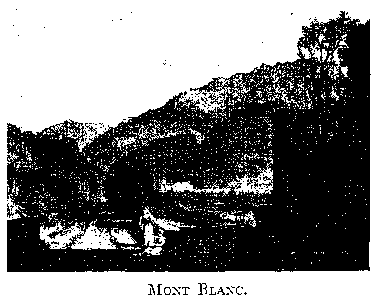
In their salon of the inn at Avallon were curious emblem pictures of different nationalities: one a belle of fair hair; another a belle of raven locks; a third a belle of brown ringlets;—all these for Europe; but for the United States was "a wench as black as coal!" So thought Switzerland of us in the days of 1828. One lovely day Cooper "persuaded A. to share" his seat on the carriage-box. Rounding a ruin height "she exclaimed, 'What a beautiful cloud!' In the direction of her finger I saw," wrote Cooper, "a mass that resembled the highest wreath of a cloud; its whiteness greatly surpassed the brilliancy of vapor. I called to the postilion and pointed out the object. 'Mont Blanc, Monsieur!' It was an inspiration when seventy miles by an air line from it. This first view of the hoary Alps always makes a thrilling moment."
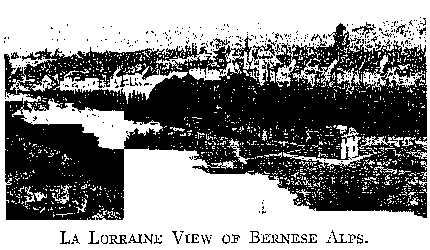
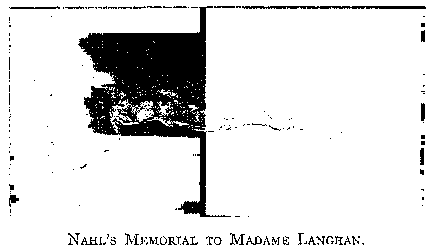
Later came morning rides and evening strolls. The modest stone country-house which they took for economy and the author's love of quiet home-life was La Lorraine, and belonged to the Count de Portales of Neufchâtel. There was a high field near, where, one day, when Mr. Cooper was teaching his little son Paul the "mysteries of flying a kite," they caught the rare fleeting glimpse of a glittering glacier. La Lorraine, only half a mile from Berne, is noted as "one of the pretty little retired villas that dot the landscape," with "the sinuous Aar glancing between" it and the town. The trim little garden and half-ruined fountain were well shaded by trees, and the adjoining farmhouse and barn-yard, all Swiss, made a fine playground for the children's summer holiday. The house and its furniture they found "faultlessly neat." There was a near-by common where hoops, rope-jumping, and kites could be enjoyed. From this point and the cottage windows "was a very beautiful view of the Alps—an unfailing source of delight, especially during the evening hours." Cooper has given some fine descriptions of their life in the glow of this Alpine country; of harvest-time and mountain gleaners. He tells of a visit to Hindelbank to see the sculptor Nahl's wondrous idealism in stone, which represents a young mother, the pastor's wife, and her babe. The infant lies in passive innocence on its mother's bosom, while her face is radiant with the light of a holy joy on the resurrection morn. Her hand is slightly raised in reverent greeting of her Redeemer. Of this work Cooper writes: "I take it to be the most sublime production of its kind in the world." And they found it in "one of the very smallest, humblest churches in Europe."
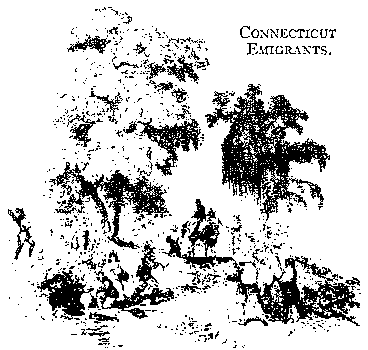
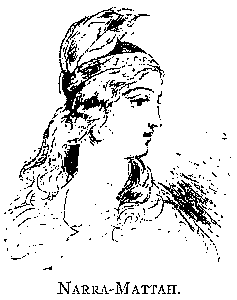
In the small, uncarpeted study of La Lorraine a new book was planned and begun. For the story's setting the author's mind turned to the far-away, new home-country, and early frontier life in Connecticut. There he brought the transatlantic Puritan and the North American Indian together—the strong, stern Puritan family affection in close contact with the red-man's savage cruelty, dignity, and his adoption of a white child. A fair-haired little girl is torn from her mother and cared for by a young Indian chief, once a captive in the white settlement. Years pass over the bereaved family, when an Indian outbreak restores the lost child to her parents' roof as "Narra-Mattah," the devoted wife of a Narraganset warrior-chief, and the young mother of his little son. This book draws a strong picture of pure family devotion; even the old grandfather's heart, beneath his stiff Puritan garb, beats an unforgettable part. Sorrow for the lost child gave the story its name—"The Wept of Wish-ton-Wish" (then thought to mean in the Indian language, "Place of the Whip-poor-will") and it has been said to describe the settlement of the Fenimore family in America.
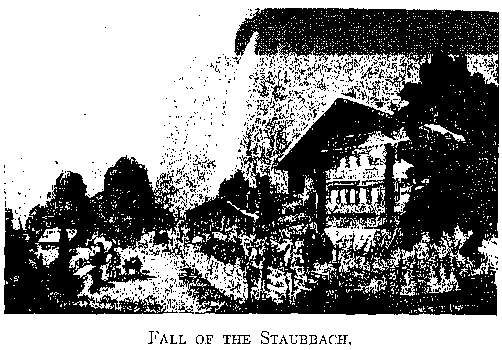
Many and interesting were their excursions. One was to Interlachen, with its glimpse of the Jungfrau, and the Lauterbrunnen valleys "full of wonder and delight." At Lauterbrunnen they walked to the famous Falls of Staubbach, which Cooper describes and explains as meaning "Torrents of Dust."
As the summer had fled autumn winds began to whistle through the lindens of La Lorraine, and the snow began to fall upon its pretty garden, warning the author to fly south with his fledglings and their mother before the Alpine passes were closed by real winter. Cooper resigned the consulate at Lyons, which was given him solely "to avoid the appearance of going over to the enemy" while abroad. A carriage and two servitors were engaged. One of these, Caspar, had his soldiering under the first Napoleon, and many were the camp tales he had to tell in a way to please his employers. At the old town of Alstetten, with painted wooden houses at the foot of the Am Stoss, they arrived, more than ready for breakfast, which was somewhat delayed because, said Cooper, "our German was by no means classical; and English, Italian, and French were all Hebrew to the good people of the inn." It was "easy to make the hostess understand that we wished to eat,—but what would we eat? In this crisis I bethought me of a long-neglected art, and crowed like a cock. The shrill strain hardly reached the ear of the good woman before it was answered by such laughter as none but village lungs could raise. William—an admirable mimic—began to cackle like a hen. In due time we had a broiled fowl, an omelette, and boiled eggs." At another place where they stopped for mid-day luncheon Cooper writes: "We asked for a fruit-tart, and—odors and nosegays!—they gave us one made of onions, which they thought very good fruit in its way, and we ate exactly as much as we wished."
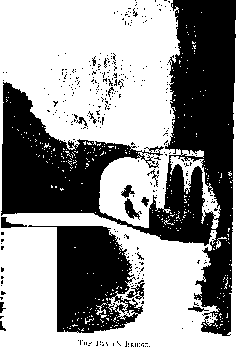
"The baths of Pfäffer," he wrote "in my own unworthy person have wrought a sudden and wondrous cure"; and of his visit to the Devil's Bridge over the Reuss: "We entered a gorge between frightful rocks, where the river was fretting and struggling to get in before us." From the yawning mouth of a gloomy cave came the tinkling bells of pack-horses to Italy by the St. Gothard. To the roar of the river and the rushing of winds without they plunged through this dark "Hole of Uri," which brought them to a rugged rock-rift pass with but a thread of heaven's blue far above them; and here "a slight, narrow bridge of a single arch spanned the gorge with a hardihood that caused one to shudder." Its slender, unrailed, fifteen feet of width was eighty of span, and one hundred above the boiling torrent that fell on broken rocks below, and over it; wrote Cooper: "The wind blew so furiously that I really wished for a rope to hold on by. This was the far-famed Devil's Bridge; other bridges may have been built by imps, but Beëlzebub himself had a hand in this."
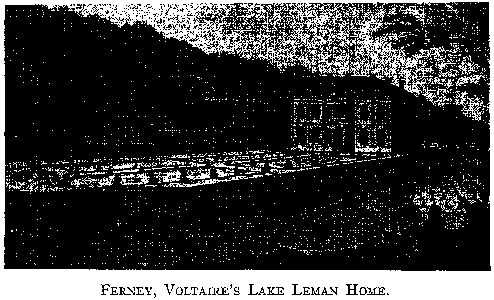
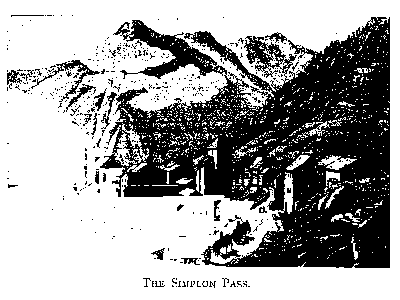
They enjoyed the beauty of Lake Geneva, and were charmed by the attractions of "Ferney," Voltaire's home on Leman's shore, and enjoyed the solemn gorge-valley of the Rhone, and through the Simplon passed into fair Italy. As they "drew near a small chapel in a rock Casper flourished his whip, calling out the word 'Italia!' I pulled off my hat in reverence," wrote the author. Down the steep mountains, over bridged torrents, past the hill-towns and valley-lands, they came to the City of the Lily,—fair Florence of the Arno. "As early as 1829," Cooper thought, "the unification of Italy was irresistible."
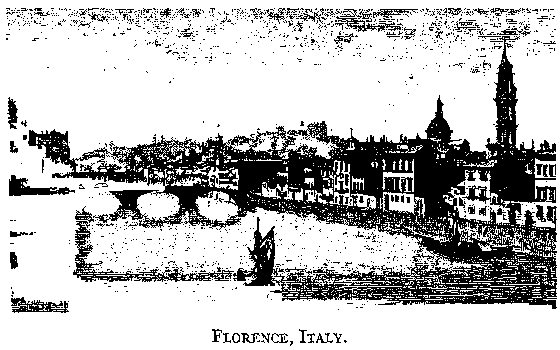
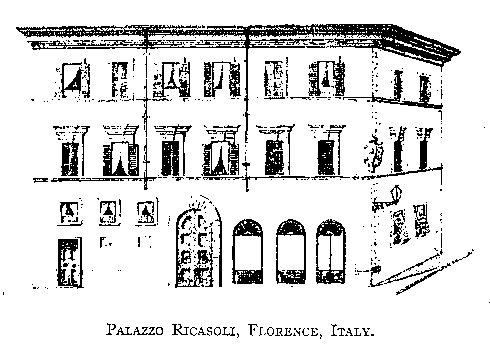
In Florence a home was soon found in the Palazzo Ricasoli, Via del Cocomero. Lofty of ceiling—twenty feet—was their apartment, in which they enjoyed "two noble bed-rooms, several smaller ones, a large drawing-room, dining-room, baths, a small court and garden within the iron gates, and all for the modest sum of sixty dollars per month." The oil burned in their lamps the home-folk "would be happy to use on their salads." Here, around the cheering glow of great wood-fires, the American author would gather his friends, old and new. From Otsego days a blazing hearth-stone ever rejoiced his cheery nature, and his way of laying the wood and nursing the flames horrified his Italian servants as waste of fuel. The chill of the tra montana brought into this circle of warmth and light many eminent foreigners; and of home-country folk, that true American, Horatio Greenough, often basked in the bright glow of the author's wood-fires at Florence.
Later Greenough wrote: "Fenimore Cooper saved me from despair after my return to Italy. He employed me as I wish to be employed; and up to this moment has been a father to me." Greenough's last work was a bust of his illustrious friend, the American novelist, which he proposed to cast in bronze, at his own expense, and place in the field where stands the Old Mill in Newport, and where the opening scene of "The Red Rover" is laid. He took counsel with Cooper's friends as to a monument to the author, and among his papers was found an elaborate design for the work.
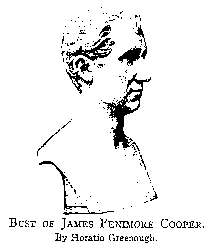
Cooper loved to encourage rising talent in young artists. He gave them orders, and also his cheering sympathy. One of these wrote that Cooper gave him a free letter-of-credit on his banker in Paris, and added: "I had occasion to use it more than once, and my drafts were always cheerfully accepted. Since then I have paid him, though he never would have asked for the money; nobody but he and I ever knew of the transaction." A Boston man writes of his visit to the Florence studio of Greenough: "My eye fell upon a bust which awakened sea and forest pictures,—the spars of an elegant craft, the lofty figure of a hunter, the dignified bearing of a mysterious pilot." It was the bust of Fenimore Cooper. Of the sculptor it was noted that "he always referred with emotion to the gleam of sunshine which encouraged him at this crisis, in the friendship of our late renowned novelist, Cooper."
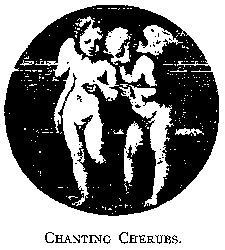
In the Pitti one day they passed before Raphael's Madonna del Trono, and the sculptor pointed out to his companion the fine drawing in the two little angel figures of the foreground, in the act of singing. Cooper asked if the subject would not lend itself to sculpture; afterwards one of his daughters copied the figures, and the result of the mutual interest in the design was an order from Cooper for a group which in a few months Greenough executed in marble. It was exhibited in America under the title of "The Chanting Cherubs." It was Cooper's "Chanting Cherubs"—the first group of its kind from an American chisel —that led to Greenough's order for the statue of Washington, and inspired the pen of Richard Henry Dana to write:
Whence came ye, cherubs? from the moon? Or from some shining star? Ye, sure, are sent a blessed boon, From kinder worlds afar; For while I look my heart is all delight: Earth hath no creatures half so pure and bright.
Later on Greenough came to them "all booted and bearded beyond recognition" save in "his walk and his talk."
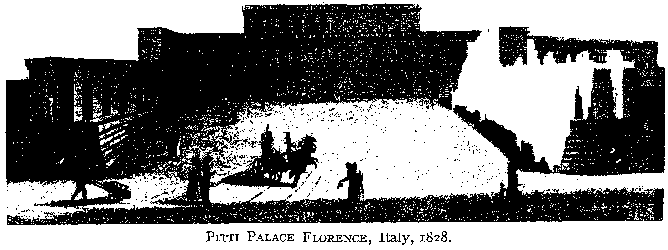
During Cooper's later American press troubles his close friend, Greenough, wrote him: "You lose your hold on the American public with rubbing down their skins with brick-bats." And yet, during Greenough's dark days, he said: "What is the use of blowing up bladders for posterity to jump upon for the mere pleasure of hearing them crack?" The author's keen delight in architecture, sculpture, and painting then gave him daily pleasure in the churches, palaces, and art-galleries of Bella Firenzi. Familiar from youth with his father's engravings of antique sculpture subjects, he writes of his first glimpses of the originals in the Pitti: "I stood, hat in hand, involuntarily bowing to the circle of marble figures that surrounded me."
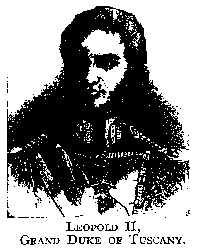
Attired in "a black coat, breeches, and vest with steel buttons, lace frills and ruff, a sword and a dress-hat," our author was presented at the brilliant Tuscan Court. Grand Duke Leopold II left on Cooper's mind a strong impression of integrity of character; his simplicity and justice were borne out in his greeting: "They tell me you are the author of many books, but as it has never been my good fortune to meet with them, I can say no more on this subject than that I have heard them well spoken of by those who have." Cooper was asked "a hundred questions as to America," and assured of the prince's pleasure in seeing him at court and his being in Tuscany. When leaving Florence Cooper paid his parting respects at the Pitti in an hour's pleasant converse, and then presented the Grand Duke with a copy of "The Wept of Wish-ton-Wish," printed in his city of the Arno. Here Cooper and his family had some gay carnival days with their various friends. Among them was the Count St. Leu, son of Queen Hortense and King Louis of Holland, and the author's sometimes host, and "one of the handsomest men of his age" that Cooper ever met. We are told of the Count: "He lived in good style, having a fine villa where I dined lately, and a palace in town." By those nearest him he was addressed "your Majesty," and held some "little show" of royalty. Princess Charlotte, his wife, and daughter of Joseph Bonaparte, the author also knew. He met Madame Mère, who is described as "a slight old lady, with little remains of beauty except fine black eyes." She was quiet, simple; in short, motherly, when seen by Cooper the winter of 1828-29.
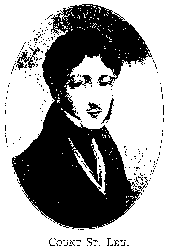
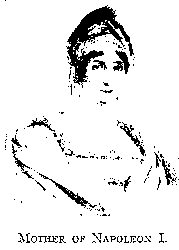
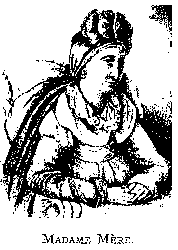
Longing for the open country came with the early Italian spring, and a hillside villa just outside the walls of Florence was secured. A narrow lane ran between this villa St. Illario and its rustic church of the same name. The villa had two projecting wings with belvederes and roofed terraces, one of which connected with the author's study. Herein he wrote of "the witchery of Italy"—the land he loved next to his own. His letters give glorious glimpses of the Arno, their strolls to Bellosguardo's heights, the churches, monasteries, costumes, and songs of the peasants—all attuned to poesy. Frequent were the exchanges of civility between the author's study and the good old curato across the lane. Cooper wrote of him: "The man has some excellent figs, and our cook, having discovered it, lays his trees under contribution." He continues: "One small, green-coated, fresh fig is the precise point of felicity. But the good curato, besides his figs, has a pair of uneasy bells in his church-tower that are exactly forty-three feet from my ears, which ring in pairs six or eight times daily. There are matins, noontide, vespers, to say nothing of christenings, weddings, and funerals."
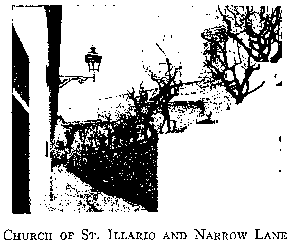
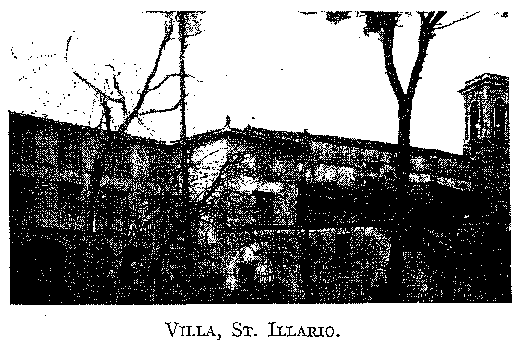
Then follows a rare account of a night funeral service ending beneath his study walls.
During the great Florentine fête of St. John, the patron saint of the city,—from the Count St. Leu's windows on the Arno,—the author and his family saw the display of gala-boats decked with thousands of colored-paper lanterns.
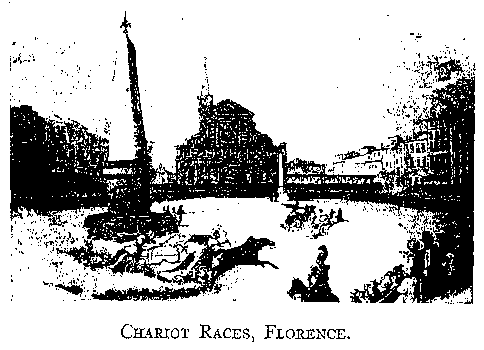
They enjoyed the chariot races in the wide Piazza Santa Maria Novella, where the small obelisks point the start and finish of the races. These were followed by the corso dei barberi—barbed horse-races without riders—down the longest street of the town. Then followed the French Minister's masked ball, amusing as well as splendid, readers of Cooper's "Italy" will find. But more than all, on their return to Villa St. Illario, were they charmed with the brilliant illumination of the noble cathedral dome, which against the dark skies "looked like a line engraving of fire." So closed this festa of Florence in the grand-ducal days, bright in gay gear and alive with everybody, from prince to contadini. Then he came in happy touch with the impulsive, laughing, singing, dark-haired Italians, and to the finer aspects of their nature he was partial. They were in sharp contrast to the Puritan band in the valley of the Connecticut, which his pen pictured in the finishing touches of "The Wept of Wish-ton-Wish," when in his study at Casa Ricasoli.
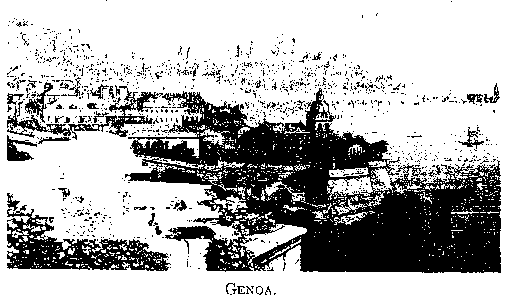
Press censorship and no English printing-house in Florence forced Cooper to leave his family and go to Marseilles. His letters give some pretty pictures which passed his carriage windows on the way. Of Genoa: "The seaward prospect was glorious." The islands "were borrowed by Leonardo," and a circuit of the city walls was made on horseback. Full of charm and interest was the road "on the margin of the sea"—from Genoa to Nice. In his "Excursions in Italy" appears of Genoa: "I looked back with longing-eyes at Genoa la Superba and thought it well deserved the title." "The whole of this coast," he wrote, "is as picturesque and glorious as the imagination can picture it." He tells of feluccas and other water-craft that claimed a sailor's eye; and the landward views of Mentone, Santa Monica, the heights, arches, and passes, and the wasp-like Villa Franca, perched on its ledge up two hundred feet—for fear of "the bears" said the guide. In Marseilles an English printer was secured and brought back to Florence. Besides being deaf and dumb his name—Richard Heavysides—bore out the burden of an unfortunate temper to the necessity of sending this printer back to Marseilles. Finally, by the kindness of the grand duke's librarian, a small edition of "The Wept of Wish-ton-Wish" was printed, and early sheets sent to publishers in Paris, London, and Philadelphia. In England the book was called "The Borderers," being based on the story of Eunice Williams of Deerfield, Mass., but it was more highly valued in England and France than in America.
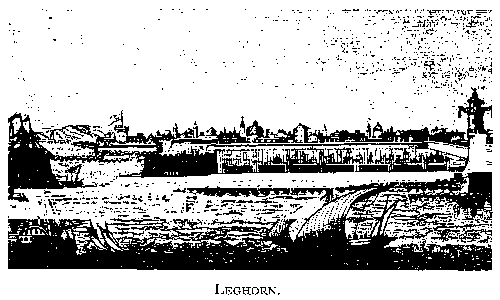
The Mediterranean blue on Cooper's journey to Marseilles allured him into conceiving another sea tale. Its writing, however, was delayed by a mild return of the old fever that was induced by the summer sun of Italy. Longing, therefore, for the water breezes, mid-summer found him within "sight and sound" of the sea waves. He writes "July 29 the whole family went to Leghorn, where the salt air was grateful, and I snuffed the odor of this delightful sea with a feeling that was 'redolent of joy and youth.' We feasted our eyes on the picturesque rigs and barks of those poetical waters, and met several men from the Levant,—an Algerian Rais calmly smoking his chibouque on the deck of his poleacre, many Sardinians, Tuscans, Jews, and three Russians. Rowing under the bows of a Yankee, I found one seated on the windlass playing on the flute,—as cool a piece of impudence as can well be imagined for a Massachusetts man to practice in Italy! The delicious odors of the seaport were inhaled with a delight no language can describe."
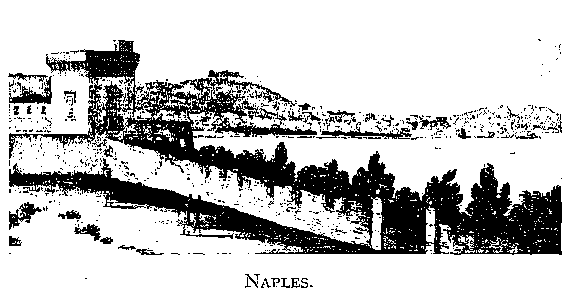
At Leghorn Cooper engaged a Genovese felucca, "La Bella Genovese,—a craft of thirty tons, beautiful mould, lateen-rigged, carrying two of that sail and a jib, and ten men for her crew." Aboard this small vessel the author and his family spent six days of pure pleasure, yet "somewhat bitten by fleas." They touched at Elba and other islands, and skirted the coasts of Tuscany, the Roman States, and so on to Naples, of which Cooper wrote: "Oh Napoli! glorious, sunny, balmy Napoli!" This cruising along the western coast of Italy in the Bella Genovese suggested to the author one of his favorite stories, "Wing-and-Wing," which was published twelve years later. In Naples several weeks were passed at a hotel; thence to a short-time home of their own on the cliffs of Sorrento. The very air of Italy was a delight to this sunny-hearted sailor, who so deeply felt the charm of all Italian nature. "The house we have taken," he wrote, "is said to be the one in which Tasso was born. It stands on the brow of the cliffs, within the walls of the town, and in plain sight of every object of interest on the bay. We occupy the principal floor only, though I have taken the entire house. There is a chapel beneath the grand sala, and kitchens and offices somewhere in those lower regions. We enter by a porte-cochère into a court which has a well with a handsome marble curb and a flight of broad, marble steps fit for a palace." Seaward several rooms led to the sala, fifty feet long, and facing the water. Cooper tells of its tiled floor, gilded couches, chairs, and marble busts. The great charm of the house was its terrace, fifty feet long by twenty-five wide, and protected by a stone balustrade, massive and carved, hanging over the blue Mediterranean, and giving to view Vesuvius, Ischia, and all the coast of glorious sea. Hearing an outcry from his son Paul one day, his father found the boy with his head fast between two of these great spindles—"in a way that frightened me as well as the youngster himself. It was like being imbedded in a rock. Below the terrace runs a narrow beach, where our children delight to play, picking up shells and more than shells,—ancient mosaics. There is a little room off from the terrace I use for writing," and where he could watch the beauty of the sea. Much of "The Water Witch" was rapidly written in this study on the inspiring terrace of Casa Tasso, Vesuvius in sight. Daily excursions were made. When four-of-the-clock threw the rock shadows far over the water, they went a-boating. On land they made "donkey" and "non-donkey" jaunts. Capo di Monti, overlooking the town landing-place, was also a favorite resting-place, and gave some bright pictures of native life. By an amusing practice of giving their king—a fine old mendicant with a lame leg—and his daily-growing train a grano a day at the gate, Cooper and his family on their excursions were freed from an army of beggars. All were grateful, and wished the American admiral "a thousand years,"—save one poor creature, who blundered into "a hundred," upon which his angered fellows cudgeled him with blows and words into shouting, "A thousand years, and long ones." Donkeys and boats were taken for Amalfi with her convent-crowned cliffs above the sea. Not until the chill tra montana and the snow-powdered mountain-tops reminded them that but one fire could be kindled in their vast Sorrento home did they leave it one morning, with ninety-six of their well-wisher beggars in the court to bid them good-speed on their way to the Eternal City.
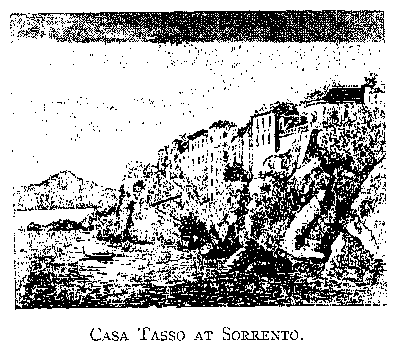
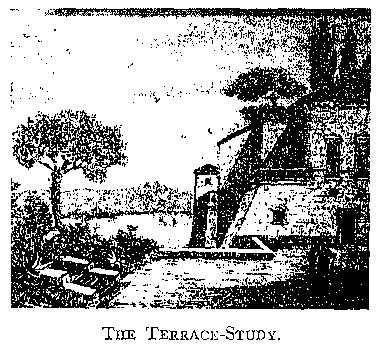
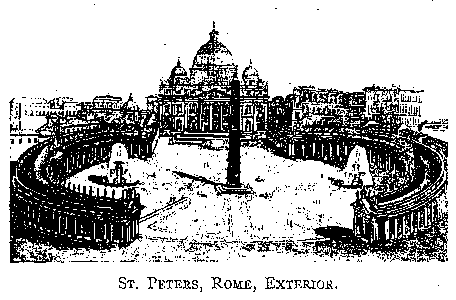
In the autumn of 1830 Cooper and his family entered Rome through the gate of St. John, and drove across the city to the Hotel de Paris, just below the Pincio and near the Porta del Popolo. After dinner, with still an hour of daylight, and eager to see what Rome was like, Cooper called a guide, and, holding Paul by the hand, sallied forth through the narrow, crooking streets over the bridge of the angels to St. Peters. "Pushing aside the door, I found myself in the nave of the noblest temple in which any religious rites were ever celebrated. To me there was no disappointment, and as I stood gazing at the glorious pile, the tears forced themselves from my eyes. Even little Paul was oppressed with the vastness of the place, for he clung close to my side and kept murmuring, 'What is this? What is this? Is this a church?' I turned away impressed with the truth that if ever the hand of man had raised a structure to the Deity in the least worthy of His Majesty, it was this!"
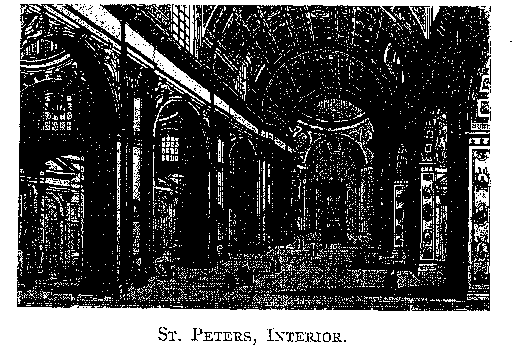
The usual roof-tree was soon found in the via Ripetta, where their back windows overlooked the tawny Tiber and gave them views of Castle St. Angelo and St. Peter's dome glorified by each day's setting sun, and here was passed their winter in old Rome. The Eternal City's ruins were most interesting to Cooper; it was his special delight to ride for hours with some friend over the Campagna, lingering among fragments of structures or statues of ancient days. Perhaps none who rode with him gave him more pleasure than the famous Polish poet, Adam Mickieowicz,—a man full of originality, genius, and sadness for the fate of his lost country. All of this won Cooper's sympathy and help in zealous writing and speaking for the suffering Poles; and one, Count Truskalaskie Wuskalaskia, later on found a welcome at Otsego Hall.
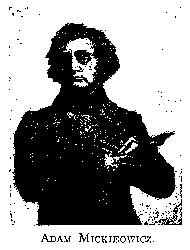
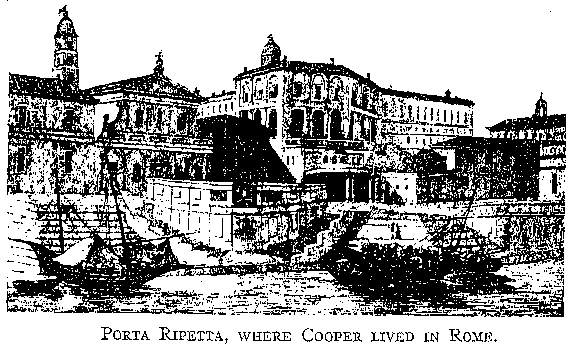
Our author also saw something of social Rome, as is noted: He "was at a grand ball—faultless as to taste and style"—given by a prince to a prince near to the royal family of England. Of compatriots he writes: "We have had a dinner, too, in honor of Washington, at which I had the honor to preside. You will be surprised to hear that we sat down near seventy Yankees in the Eternal City!"
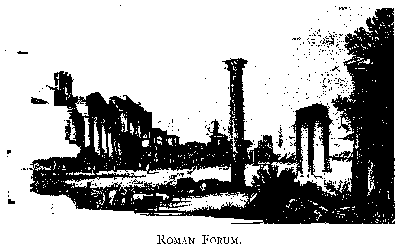
"The Water Witch," now nearly finished, required printing, which some kind Italian friends nearly brought about in Rome; but the book contained this sentence: "Rome itself is only to be traced by fallen temples and buried columns," which gave offense where none was intended and barred the work's issue there. The story was finished and laid aside until spring, when, after five delightful months in Rome and a few days at Tivoli, Cooper and his family reluctantly drove through the Porto del Popolo. In their own carriage, with four white horses, and their servitors in another with four brown ones, they passed up the Adriatic coast to Venice.
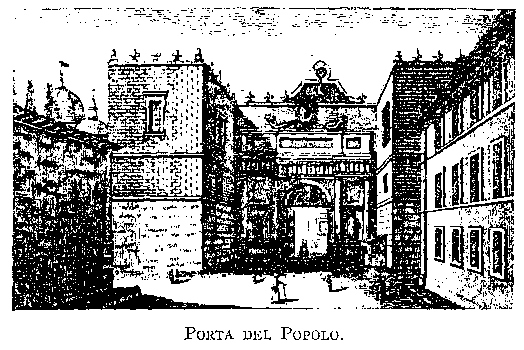
Miss Cooper's "Pages and Pictures" gives her father's graphic account of this interesting journey,—how, in a wild mountain-road they fell in with pilgrims neither way-worn nor solemn, but most willing to talk. They seemed moving pictures with their staffs, scrip, and scallop-shell capes, returning from Rome. Then came Terni and its famous waterfall—a mile away, they knew, for they walked there. Man-made were those falls, by the turning of a pretty stream many hundred years ago.
High bridges and hermit nooks were passed, and then a long aqueduct with Gothic arches, called Roman in the guide-books; an old temple turned into a church, and but a trifle larger than a Yankee corn-crib. Then over the fine road beyond Foligno, and the hill Fiorito, and they rolled easily down into the Ancona country, where they found the shrine of Loreto.

Ancona gave them their first sight of the Adriatic—less beautiful in hue than the Mediterranean blue, it seemed to our travelers. But with a sailor's joy in rope, pitch, and tar, Cooper hurried with his usual boyish eagerness to the port, and with a lively interest examined its several rusty-looking craft. The next day found them again on the way, of which he writes: "Walking ahead of the carriage this morning, we amused ourselves on the beach, the children gathering shells on the shores of the Adriatic." Short stops were made in Bologna and Ferrara, then northward to the coast. Afloat and a pull for an hour brought them to Venice. Through the Grand Canal and under the Rialto they glided to the opening port beyond. They left their craft at the Leone Bianco, or white lion. Entering, they found "a large paved hall" a few steps above the water. From their windows they could see the gliding gondolas; beyond the splashing of an oar no sound came from their movement. "Everything was strange," wrote Cooper. "Though a sailor and accustomed to water, I had never seen a city a-float. It was now evening; but a fine moon shedding its light on the scene rendered it fairy-like." That night a friend showed him the other ways than the water-ways of Venice. Through lane-like, shop-lined ways, over bridges, and through the Giant's Clock-tower he passed into the great square of St. Mark, with "much surprise and pleasure." By its glittering lamps, and over it all the moonlight, he felt as if "transported to a scene in the Arabian Nights."
Later he writes: "I have set up my own gondola and we have been looking at the sights." For weeks their easy gondola—which in form and lightness reminded him so much of the Indian bark-canoe—"went gliding along the noiseless canals," and Cooper studied his Venice for a purpose. He became interested in the details of its singular government and read many books about it. The heartless trifling with sacred personal rights in order to glorify the ruling powers of San Marco, as shown by the life of crime in its secret councils, seemed terrible to him. And so came about the thought of writing a book in which both views of the subject, as clear and just as his pen could draw them, should be given. And whoever has read "The Bravo" will know that it faithfully pictures Venetian life. The great Piazza, the splendid church, the towering belfry,—rebuilt,—the small Piazza and its columns; the Palace of the Doge, with its court, well, giant's stairway, lions' mouths, dungeons and roof prisons, and the Bridge-of-Sighs, leading to its neighbor, the Prison Building—all are here, with beautiful Venetia in the pride of her most glorious days near their waning. These and much more make up the fearful picture of Venice's cold cruelty, as revealed to the author of "The Bravo" in authentic historical records. Gelsomina, the jailer's daughter, a sweet and delicately-drawn character, got her name and general character from real life. Miss Cooper writes that when their "family was living on the cliffs of Sorrento a young peasant girl became one of the household,—half nurse, half playfellow to the children. She bore the sweet name of Gelsomina. Simple, innocent, and childlike, yet faithful to duty, Gelsomina was soon in high favor with great and small, and, in charge of the young flock, made one of every family party about the bay." At such times "she was always in gay costume,—light-blue silk jacket with gold lace; a flowing skirt; her dark hair well garnished with long golden pins and bodkins; a gold chain of manifold strands encircled her throat, and drops long and heavy hung from her ears. One afternoon, after playing with her young charges, Gelsomina went for water to that picturesque marble well in the court. While bending over the curbstone and drawing up the bucket, like Zara-of-Moriah fame, she dropped one of her long, heavy ear-rings into the water. Great was the lamentation of the simple creature! Warm was the sympathy of the household." But the old well was far too deep to give up this heirloom and family treasure, which was gone beyond Gelsomina's tears to recover. Gelsomina would have followed her American friends north, but a portly, stately, dignified aunt "would not trust her so far from the orange-groves of Sorrento." When the hour of parting came, pretty Gelsomina received from her mistress a fine pair of new ear-rings, and tears of gratitude fell upon the trinkets as she kissed the hand of the giver. Her name and something of her sweet innocence and fidelity were given to the jailer's daughter of "The Bravo."