Op. VIII
Reading edition
PLATE 20
THESE two sketches were taken from an 18th century (?) curtain done in solid crewel work, in somewhat bright colouring. The brown veining which occurs in I and in nearly all the leaves was most effective; in this plate is also shown a good example of basket stitch stem work. The acorn cup was worked in close French knots.
II The large leaf is a good example of solid work. The contour was in stem stitch, the serrated edges turned over on to the brown surface were in shading stitch, the red veinings in satin stitch.
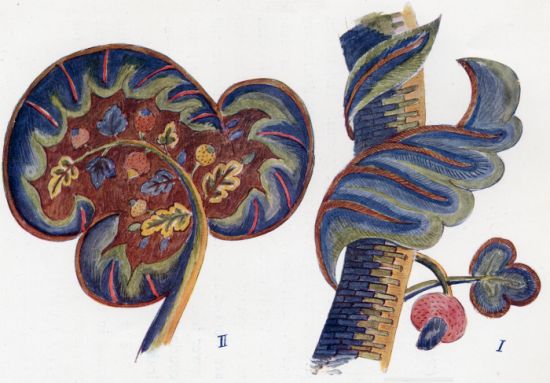
PLATE 21
THESE two leaves are of a bold, simple character that is easy to suggest, and proves a great relief in a design that is somewhat over-detailed. The large one is carried out in browns and greens. The turned over serrated edge is in satin stitch of graduating shade. The heavy veining is somewhat unusual in that it is carried out in laid stitch, dark green in the centre and light green outside. The stars are worked in dark green. The outline to the lower leaf is in two shades of green, the palest continuing to outline the remainder of the large leaf.
The small leaf is worked solid in shading stitch in blue with brown satin stitch edge, the veining is brown as is also the contour of the upper point.
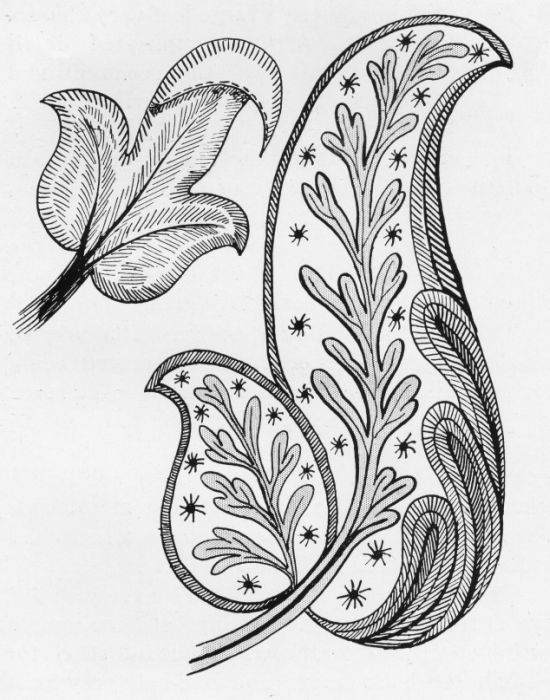
PLATE 22
WE have here a large leaf very characteristic of the complicated detail introduced by the conventional treatment of foliage in early English work.
The curved point of the leaf is outlined in rope stitch in a dark shade of soft bronze green, the heavy double cross lines are in crewel stitch and of a lighter shade of bronze in which the square lattice is also carried out, the French knots in the centres are of a dark olive green.
The round medallion is outlined similarly to the above but in darker shade, the centre being worked solid in slanting satin stitches set in rows, each row taken at the opposite angle to its neighbour; the next leaf is outlined inside, in two rows of chain, the turnover of the leaf being solid satin stitch in three shades of green. The stem is double back stitch, and the other leaves are worked solid in shading stitch in graduated shades of green.
The two small leaves, I & II example: 1st, rope stitch with alternate fillings of darning and outline stitch, and 2nd, rows of outline stitch for one-half the back leaves and one-half grey knot stitch and blue snail trail in alternative, the end leaf being in rows of outline of brown colour.
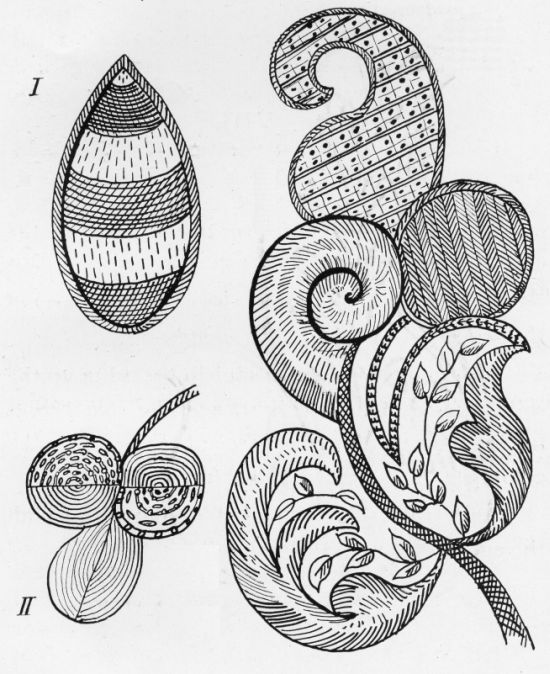
PLATE 23
A portion of the terra firma of the curtain.
The strawberries and clear parts of the ground are worked in French knots.
The plants are very useful in breaking up the solid masses of dark colour, and the stag serves to introduce into the base of the work the colouring of the acorns above (on plates 1 and 2).
As a rule this base of a design repeats all the colourings used throughout.
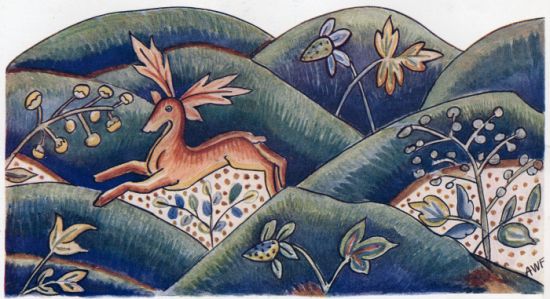
PLATE 24
EXAMPLE of a bird introduced into the late 17th century work.
It is executed in simple feather stitch for the tail feathers and satin stitch very evenly shaded. The dark centres of the short feathers are in crimson, the rest in shades of buff, the breast feathers also worked in satin stitch are in putty colour, legs and beak are brown and the crest in crimson.
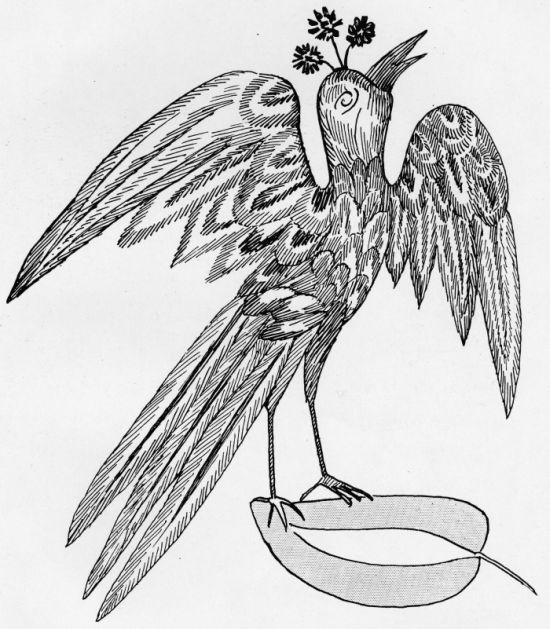
PLATE 25
QUAINT early example of a parrot, head in knot stitch, breast feathers block stitch, and wings in shaded single feather stitching.
The butterfly and grub are found in all early examples.
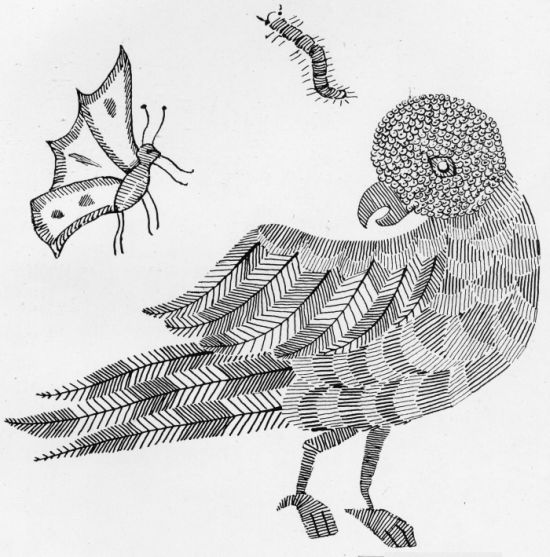
PLATE 26
GROUP of animals usually disporting on the terra-firma at base of large designs.
Worked always in long and short stitch.
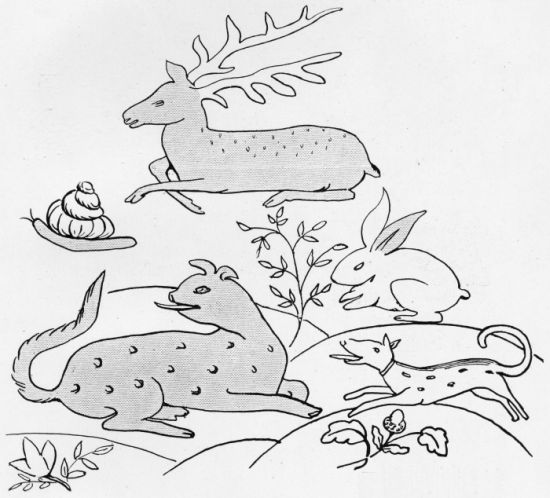
PLATE 27
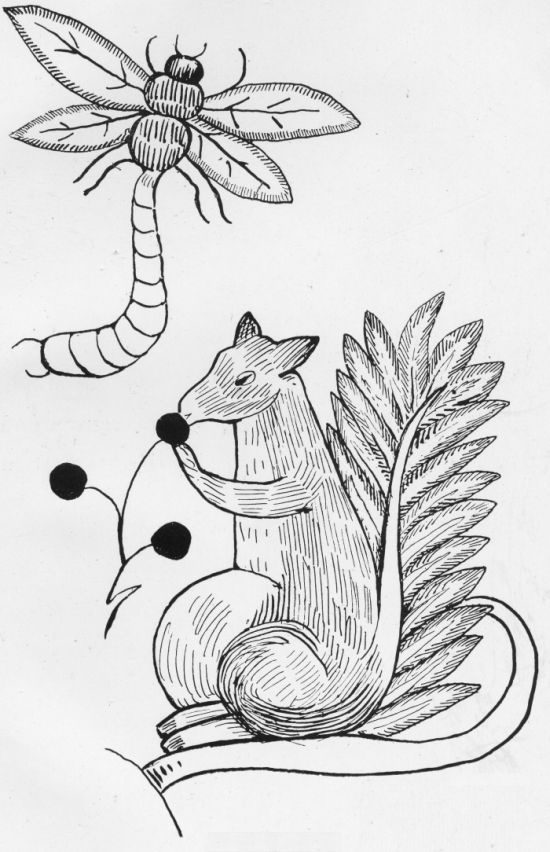
SQUIRREL in rich brown colour, with cream chest worked in shading stitch, tail in overcasting for the centre and furry part in single feather stitch with stem stitch outline.
PRINTED BY W. W. CURTIS LTD., CHEYLESMORE PRESS, COVENTRY