Op. VII
Reading edition
PLATE 16
THIS bold leaf is mainly carried out in block shading, but the colours are unusual. Indigo for the outside edge, soft brown the central block, and light green for the inner; in the second leaf the green is employed only for the line of veining; the two leaves or sections on the right-hand side are treated as follows—The upper one has outlines of brown, between which blocks of "buttonhole" in indigo are worked, the intervening spaces being simply decorated by a loop stitch in green wool. The sprays are in satin stitch, which is one of the best for small sprays to be worked solid.
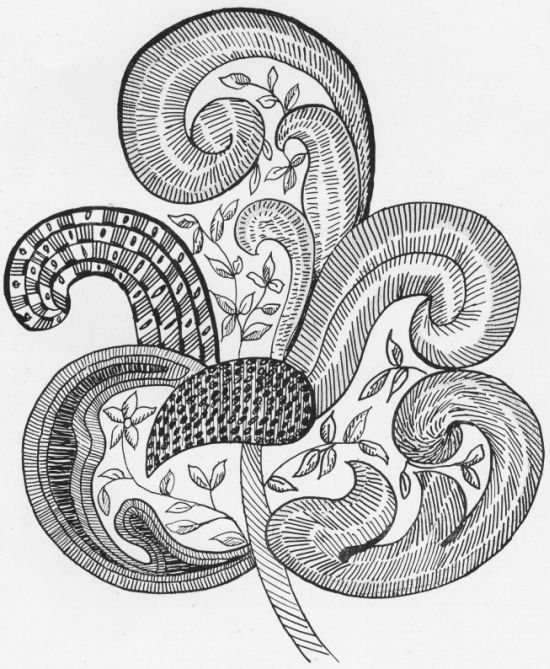
PLATE 17
A very handsome leaf, in the working of which many stitches are employed.
The curved scroll at the top is carried out in block shading in blue to pale green; the curved section on the right is marked out in squares filled alternately with satin stitches, with a simple French knot in each square, and by a square trellis secured in the centre by a cross stitch; the scroll below this is outlined in crewel stitch, and filled with laid work or strands of wool thrown across from edge to edge and couched by back stitches at the points of intersection.
The three leaves at the root of the stem are carried out in block shading in shades of grey green, the leaf above is outlined in crewel stitch and filled with fancy devices worked in buttonhole stitch with darning background; the centre motive is a solid mass of French knots, well raised and blue in colour. I have seen this same motive carried out in three shades, the lightest group at the point, the darkest at the back.
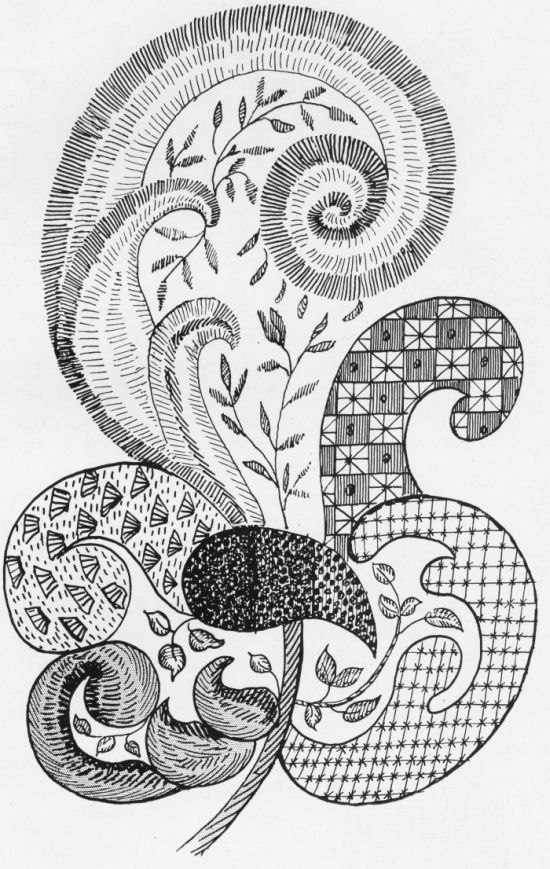
PLATE 18
MORE fillings taken from a piece of work executed in the late 17th century.
I Is one of the diverse methods of treating the large tree stems in a design. Within the fan-like outlines traced down on the linen is a solid filling of satin stitches, varying row by row from pale fawn at the foot to dark chestnut brown round the top, the direction of the stitches is shewn in the drawing.
II Here we have a fancy lattice of three strands of laid wool couched with small French knots at the intersecting points, the outline is in stem stitch and fanciful back stitches are used as fillings.
III Has first rows of long single threads thrown across, caught down with stars and groups of satin stitching crossed.
IV A light treatment for stems, the filling, shells in buttonhole stitches, with second outline in darning.
V One of the examples of the introduction of lace stitches that is to be noted in work of the late 17th century, the alternate blocks are in basket stitch, the others in double cross stitch in contrasting colours.
VI Quaint example of couched work.
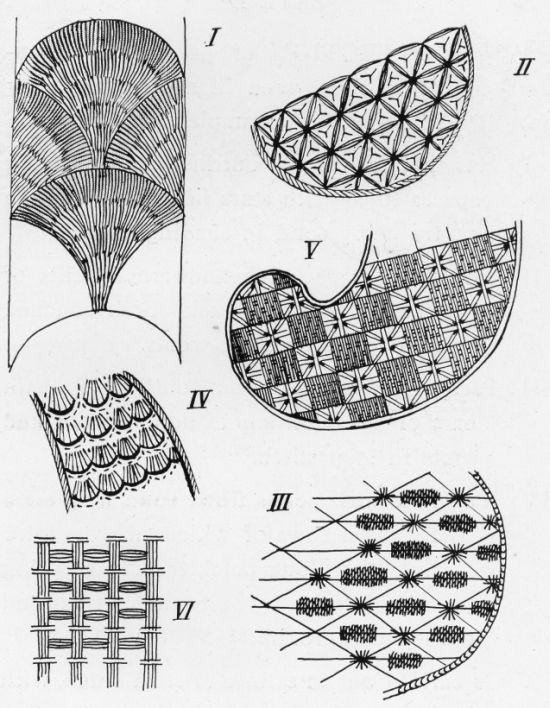
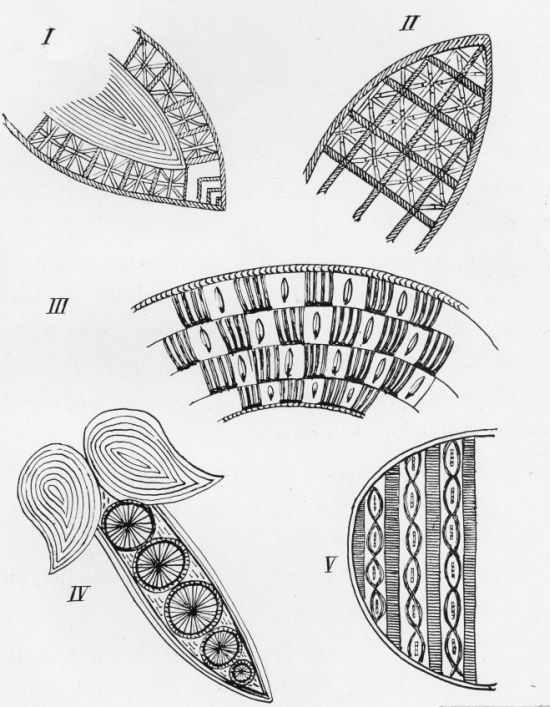
PLATE 19
A collection of particularly beautiful fillings seen in a Georgian copy of a very old example.
I Has double rows of outline stitch, framing spaces filled with stars in back stitch, the centre being solid in shading stitch.
II Outline of rope stitch and cross trellis of the same. Stars of back stitch couched down with contrasting wools.
III Part of a beautiful stem, outline of chain bars of button stitch in double wool and spots in loop stitch.
IV The two small petals filled solid with stem stitch, three rows of which are used for outlining the long petal, the centre being filled with rings in buttonhole stitch and darned background.
V Is carried out in satin and stem stitch, with back stitch bars couched with contrasting wool.