JACK HARDY (continued 4)
Reading edition
He heard some one enter the room by the trap-door, and immediately afterward saw a gleam of light. Peeping out, he recognized with a thrill that the intruder was De Fronsac, as he had expected, and that he was alone. He had lit the lamp, the glass of which was turned away from the window; the long roll of cardboard and a pistol lay beside it. Then he went to the window and looked out to sea. He was evidently waiting for a signal from the lugger.
"Peste!" he muttered, slapping his shoulders. "Comme il fait froid! Il est en retard. Quand viendra-t-il?"
Pistol in hand, Jack stepped quietly out of his hiding-place. De Fronsac started, swung round, and stared with amazement, for there, in the light of the lamp, stood the boy he had kidnapped, and a pistol was pointed full at his head.
"Yes, Monsieur de Fronsac, it is I. Stay where you are; if you make a movement I shall fire."
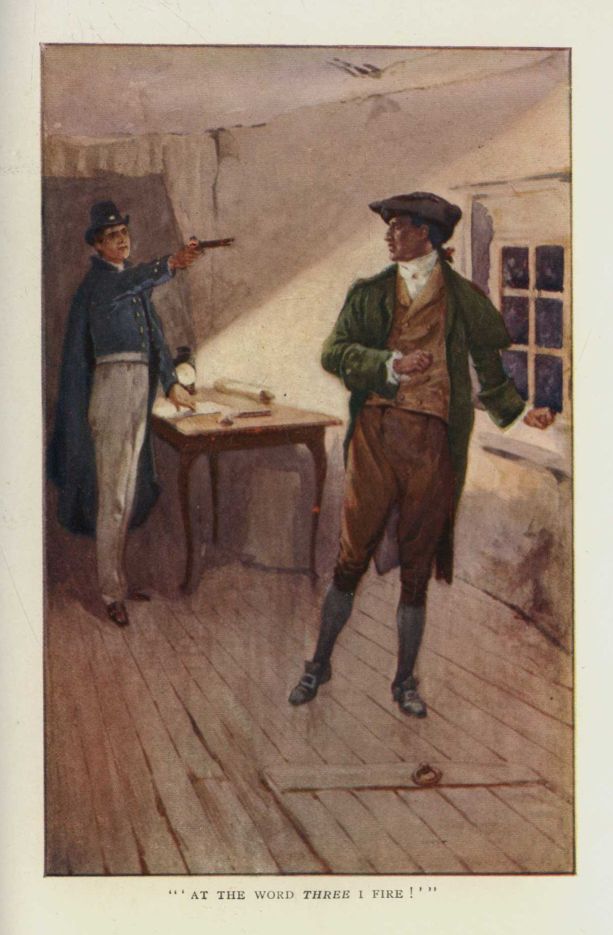
"If you make a movement, I shall fire"
The statement was so cool and matter-of-fact that it appeared to carry conviction, for De Fronsac arrested his first instinctive movement toward his own pistol. Still covering him with his weapon, Jack advanced to the table, turned the lamp so that the light fell on the Frenchman, and lifted the pistol. De Fronsac said not a word. There was no smile upon his face now, but his eyes gleamed, and Jack knew that he was watching for the slightest opening. De Fronsac felt the rope for a spy tightening relentlessly round his neck.
He glanced toward the lamp, within a few feet of him.
"No, Monsieur De Fronsac," said Jack, guessing his wish to knock it over: "it really is not possible. You would not live to reach the table. You will now go through the trap-door and descend the steps, as quickly and quietly as you can."
The man hesitated; Jack saw his fingers work nervously.
"I shall count three, Monsieur. At the word three I fire. One—"
De Fronsac moved sidewise toward the trap-door. At the opening he again paused, and appeared to be about to speak. But Jack gave him no opportunity.
"Again, Monsieur: one—two—"
De Fronsac pulled up the trap, and slowly lowered himself on to the topmost step.
"Remember, Monsieur," said Jack, before his head disappeared, "if you make the least unnecessary sound I shall send a bullet after you."
The gleaming eyes disappeared. Step by step the Frenchman descended. When he was a third of the way down Jack whistled gently. By the time De Fronsac reached the ground Gumley and Comely were one on each side of him.
"Evening, sir," said Gumley. "Orders are that you come along wi' me—and the dog. Watch him, Comely."
A deep growl caused De Fronsac to start.
"Harmless as a lamb, sir, while you goes steady. Bean't 'ee, Comely?"
The answer was another growl. They moved away, the dog keeping a few inches behind De Fronsac's heels, Gumley with a naked cutlass walking at his right hand.
Even before they were out of sight Jack had returned to the table. There he had noticed a sheet of paper. It was covered with figures—no doubt the message that De Fronsac was preparing to send.
"Wonder if there's time to make it out!" thought Jack. He looked out to sea; there was no signal light. With the aid of his key he scribbled below the figures the corresponding letters, and read:
NELSON A SUIVRE VILLENEUVE 9 NAVIRE 2 FREGATE SORTENT DE P MERCREDI BINSEY COVE LUNDI.
"A clever villain!" thought Jack. "Who would ever have imagined that a French spy would be mixed up with English smugglers! And I wonder how he gets his information about Nelson's doings, and the sailings of English convoys? Well, his friends will have rather a different message to-night."
He took from his pocket a piece of paper, and made some alterations in the figures he had written in the cabin of the Fury.
"If they like news of Nelson, they shall have some, invented on the spot!"
Every now and then while writing he glanced out to sea to make sure that he did not miss the expected signal. It was nearly an hour after he had completed his message that he caught the three successive flashes. Then he fixed the cardboard, pointed it through the round hole in the curtain, and signaled:
NELSON MOURANT A PALERMO NAVIRE BRISE PLAGE FOWEY CONVOI PETITE CHALOUPE BINSEY COVE LUNDI.
The message completed, he extinguished the light and descended, removing the steps as he went. The other set had apparently been taken by Gumley. Wrapping up the original dozen he started for his long walk back.
He had not gone many paces when he heard hurried footsteps behind. Turning round with a start, his hand on his pistol, he was amazed to hear his name called.
"Jack!"
The next instant a slight figure sprang toward him.
"Oh, Jack! I'm jolly glad, I am! I thought it was you, but couldn't be sure till you came down. Oh, I am glad!"
"Well, don't make a to-do, youngster. And what brings you out at this time of night?"
"Why, didn't you tell me months ago to keep an eye on Fronsac? Well, I've done it. I've followed him several nights—not often, 'cos mostly I'm sleepy; but I've never caught him. He always disappeared, and I never knew where he went till to-night. And I shouldn't have known now if I hadn't seen him climb down the Folly and go off with old Gumley. Oh, it was fine! My eye! wasn't he scared at the dog! But what's it all mean, Jack? I say, you'll come along home, won't you? They'll all be so jolly glad to see you."
"Not to-night, Arthur. I hope I shall come to see you all in a day or two. But not a soul in the village must know yet that I'm back, and the maids couldn't keep it in. Tell your father I'm here; and tell him that De Fronsac is a dangerous spy. We've got him safe now, but they mustn't suspect in the village. If any questions are asked you can say that he has gone away for a few days, and will be back on Monday night."
"Oh, I say, will they hang him?"
"Of course. Now cut and run; you'll catch your death of cold, and the squire will want to hang me."
"Not he. He likes you. So does—"
"Cut!" said Jack, putting an end to Arthur's confidences. The boy disappeared; Jack resumed his walk, and arrived dead tired at the inn at Middleton.
CHAPTER XVIII
THE BATTLE OF BINSEY COVE
"Ah! Patience is a monument, as brother Sol used to say. Tombstone I'd call it, 'cos this here waiting about in the cold'll be the death o' me."
"True, Mr. Babbage. It bean't Christian, let alone decent, to keep us poor fellers waiting here."
"Avast your jabber, Mudge. It bean't for the likes of you to grumble when 'tis a matter o' dooty, and love your neighbor as yourself. 'Tis a wonderful fine night, coldish, nat'ral for the time o' year. Mr. Hardy didn't make the weather, lads."
Ben Babbage, with a boat's crew from the Fury, lay off Totley Point, about a mile and a half west of Luscombe. It was about ten at night. They had been for two hours resting on their oars. A steady breeze blew from the west-sou'west, and a slight swell rocked the boat gently. Save for an occasional pull to keep her head to the wind the men had nothing to do except wait and watch; and Babbage, however he might grumble himself, was the last to permit grumbling in others.
But it was certainly a tax on their patience to wait hour after hour for a lugger which was slow to appear. Everybody was tired of inaction, and hoping for a signal of recall, when a shape loomed out of the blackness, passed on the starboard side of the boat, about two cable lengths away, and disappeared shoreward.
Babbage lifted a dark lantern from the bottom of the boat; Turley and Mudge stretched a sheet of tarpaulin between him and the shore. Then Babbage, facing out to sea, and keeping the lantern at such an elevation that its light should not fall on the water, rapidly opened and closed the shutter, sending one flash to windward.
"Things is a-going to happen, mates," he said, as he replaced the lantern. "The owdacious moment is at hand, as brother Sol used to say."
Again they waited, but now with keen expectation. In ten minutes, which seemed hours, a dark shape appeared in the offing. Babbage making a bell of his hands, sent a low whistle across the water; an order was given on the approaching vessel; the steersman put up the helm, and in a few seconds the other was alongside.
"All well, Babbage?" said Jack, in a low tone.
"Ay, ay, sir."
A rope was thrown from the cutter and made fast in the bows of the boat. Another brief command; the steersman put the helm down, and the cutter, with the boat in tow, followed in the wake of the lugger. At nightfall she had crept in to within two miles of the shore, and sending out the long-boat as a scout, had hove to, lest her mast should betray her.
In ten minutes the cliffs were dimly visible, and Jack recognized the jagged gap at the top that served as a landmark in steering for the cove. The cutter headed straight for the gap. There was a shout from far up the cliff; the Fury had been sighted by the lookout. His call was answered by cries from the beach. On the cutter all the men lay ready with musketoon, pistol, and cutlass, except the few who had been told off to run down the sail when the word was given, and make the cutter fast to the lugger when she came alongside.
Jack's heart beat more quickly than usual; he felt excited, and anxious, too, for he knew that the whole crew of the lugger, probably quite as strong as his own, would be ready to repel boarders. If they were joined by the Luscombe men who were receiving the smuggled goods he would be greatly outnumbered. Everything depended on the handling of the men, and knowing how desperately smugglers fought when brought to bay, Jack felt the seriousness of the position. What would the issue be?
While the boat's crew had been waiting in the cold, strange things had been happening at Gumley's cottage.
Gumley's method of guarding De Fronsac was to make a temporary kennel for the dog outside the window of the front room in which the prisoner was lodged, and a shakedown for himself by the door. He felt that he could not properly intrude upon De Fronsac, who was a person of quality. But he looked in at intervals to see that he was safe, on these occasions calling Comely into the room, to guard against any attempted surprise.
De Fronsac had recovered the use of his tongue after he reached the cottage.
"I protest, I say it is a scandal, an infamy, to shut me up as if I vere a t'ief. Vat right have you? Tell me dat—you—you—"
"Gumley, my name, sir. I've got my orders—in the king's name."
"Vell, I vill complain to de squire; I vill make to punish you—you—Gomley!"
"Orders is orders, sir. I can't say no more."
Gumley himself was somewhat anxious about his charge, for, not expecting such a drain on his larder, he had only his usual provisions for the week, and did not feel at liberty to leave the cottage and procure more. Thursday passed, Friday, Saturday, and still he had heard nothing from Jack. When Sunday came, there was only a half loaf of bread and a rind of cheese left, and these had to be shared among the two men and the dog.
On the second day De Fronsac began to beguile the tedium of confinement by writing poetry. When Gumley looked in at him on one of his periodical visits the Frenchman said:
"You have not a bad heart. You obey orders of—of—of a monstair. Vell, I read you vat I have now written about anoder Monstair—de great villain Monstair vat call himself Emperor of de French! Listen! You vill like it.
"'De sky vas blue, de sea vas green,
All beautiful for to be seen.
Vy den am I not gay and glad?
Alas! de Monstair make me sad.'
"Dat is good beginning, hein?"
"Reyther on the miserable side, don't 'ee think, sir? For myself, I like a rum-tum-tiddlum rollicum-rorum sort o' thing."
"Ver' vell, I write you someting of dat kind."
Gumley heard nothing more of this generous offer until Monday evening. Then, when he went into De Fronsac's room to explain with apologies that he had no more food, the Frenchman said:
"No matter not at all. Vizout doubt some vun vill come to-morrow. Be so good as give me a candle. I vish to write de poesy I speak of."
Gumley saw no reason for not humoring so harmless a hobby, and brought the lighted candle. But a couple of hours later he was awakened from his sleep at the locked door by a smell of burning. He soon satisfied himself that it came from the prisoner's room, and opened the door.
"Ha! I see you!" said De Fronsac. "I am almost burnt alive. I am writing my poesy ven—voilà! de candle overfalls and burns a hole in de table-carpet. See it! I put out de fire, easy; but it make much smoke. I fear it vake you; pardon, my good Gomley."
"Granted, sir, ready. If I was you I'd go to sleep now and do your writing stuff in the morning."
"So I vill," was the response. "Pardon! I vill not vake you again."
Gumley returned to his shakedown and was soon fast asleep.
Nearly two hours later he was wakened by a growl from the dog outside. He got up, opened the outer door, and found Comely trying to get up to the shuttered window of De Fronsac's room.
"Don't like his poetry any more than me, don't 'ee? Come in. We'll tell him 'tis time he was abed."
He closed the door when the dog had entered, and together they went into the prisoner's room. There was still a good deal of smoke in it—but no Frenchman.
"Ahoy!" cried Gumley.
But the dog made a dash back to the front door, and, when Gumley followed and opened it, rushed growling down the garden, where he was brought up by the high fence. Seizing his cutlass, Gumley stumped as fast as he could to the gate.
"Chok' it all!" he muttered. "This is what comes o' losing a leg in the king's name."
It took some little time to draw the bolts and unlock the gate, and when the old sailor got out into the road the fugitive was out of sight. But Gumley thought he heard a man running down the cliff path to the village. Without hesitation he started in pursuit, whistling Comely to his side. Never had that wooden leg moved so fast; but with all his exertion his pace did not exceed that of a quick walk. He was half-way down the path when he heard shots in the distance. Hurrying still more, he came to the village just in time to see a group of men rushing out at the other end, and caught the words "Sandy Cove!"
"Fire and brimstone!" he muttered. "This is a desperate go, Comely. Come on, my lad."
And he stumped on gamely through the deserted street.
Meanwhile there had been brisk doings at Sandy Cove. When Jack judged that he was only a couple of cable-lengths from the lugger, he cast off the long-boat with Babbage and his men. They, resting on their oars, allowed it to drift slowly in while the cutter disappeared into the darkness.
A few moments later Jack gave the word. The sail was run down. A round shot from the lugger whistled across the Fury's bows. Another few seconds; then, amid furious shouts, the cutter came against the larboard quarter of the lugger with a bump that caused the men on both craft to stagger. The Fury's bowsprit fouled the lugger's shrouds and hooked fast. Instantly half a dozen grapnels were out, and the two vessels were closely interlocked.
There was a deafening discharge of small arms from the deck of the lugger, but as most of the Fury's men were lying down awaiting the order to board, and the volley was fired at random in almost total darkness, hardly any damage was done. But the master of the lugger was clearly a man of action, for the echo of the shots had scarcely come back from the cliffs when he gave a loud order in French, and the smugglers swarmed over the bulwarks, intending to jump on to the deck of the cutter a foot or two below.
"Fire!"
The word rang out sharp and clear above the shouts of the Frenchmen. Their dark forms stood out clearly against the starlight; they were only a few feet from the muzzles of the Englishmen's muskets; and when at Jack's command the volley flashed, the front line of the smugglers disappeared as if struck by a thunderbolt.
With a loud cheer the English sailors, dropping their muskets, seized cutlass and pistol and dashed through the smoke, each man eager to be first on the enemy's deck. They needed no encouragement; most of them had a score to pay off for their defeat at the same spot in the previous autumn. While the Frenchmen were still half stunned by the scorching fire and the loss of so many of their comrades, Jack's men gained a footing on the deck.
But now the French skipper's voice could be heard rallying his crew, and the boarders were met by a serried mass armed with pistols and boarding pikes. And among the Frenchmen there was now a sprinkling of Englishmen, for the smugglers on shore had rushed over the gangway to their comrades thus hotly beset. Now a furious hand-to-hand fight raged about the lugger's stern. Great was the clamor as steel clashed on steel, pistols barked, hoarse voices roared encouragement or defiance, wounded men groaned. Again and again Jack and his men were flung back by sheer weight of numbers against the lugger's bulwarks; again and again they rallied and forced the enemy across the deck. No room here for fine weapon-play; men cut and thrust at random, met, grappled, flung away cutlass and pike to set to with nature's own weapons. Many a Frenchman fell under the sledge-hammer blows of British sailors' fists.
Jack had no clear recollection afterward of the details of the fight. At one moment he found himself leading a rush of his own men, pressing the enemy back foot by foot until only a last desperate effort seemed wanting to drive them overboard. Then would come a check; a hoarse shout from the skipper, whom Jack by and by distinguished in the mêlée—a huge fellow of reckless courage; the tide turned, the smugglers rallied gamely, and Jack and his men, stubbornly as they fought, were borne back and back, losing inch by inch the ground they had so hardly gained.
It was at one of these desperate moments that Jack heard at last the sound for which, throughout the struggle, he had been anxiously waiting. From the forefront of the lugger came a sudden rousing British cheer. There was a rush of feet in the rear of the smugglers, and in a second, as it seemed to Jack, the deck in front of him was clear. Ben Babbage had arrived. Carrying out orders given him previously, he had brought the long-boat unseen to the starboard side of the lugger, and, before the Frenchmen were aware of his presence, he was on deck, with Turley, Mudge, Folkard, and half a dozen other trusty shipmates.
Beset now in both front and rear, the Frenchmen lost heart. Suddenly they made a rush for the gangway connecting the lugger with the land, and swarmed helter-skelter across, not a few stumbling over the edge and falling souse into the water.
"Huzzay! huzzay!" shouted the panting Englishmen, as they saw the enemy in flight.
But they were answered by a loud and confident cheer from the beach, and in the momentary silence that ensued they heard the rapid tramp of a large body of men hurrying over the shingle. Immediately afterward they saw the fugitives halt, and rush back, largely reinforced, to the gangway, led by the indomitable captain. On they came, tumbling into the water three or four of the Englishmen who had started in pursuit and were making for the shore.
The gangway, consisting of four stout planks laid side by side, was wide, and gave foothold for a throng at once. Jack and Babbage collected their men at the lugger's bulwarks to meet this new attack. And the former, amazed at this sudden turning of the tables, was still more amazed to see beside the French skipper the slighter form of Monsieur de Fronsac. Even at the moment of recognition De Fronsac's pistol flashed; the bullet glanced off Jack's cutlass within an inch of his body, and embedded itself in the mast behind him.
The two forces came together with a shock. Babbage dropped his cutlass and flung his powerful arms around the skipper. They swayed for a moment, then fell together with a tremendous splash into the water. De Fronsac had dropped his pistol, and made for Jack with a cutlass. Jack parried his furious cut, and before he could recover replied with a rapid and dexterous thrust that found the Frenchman's forearm. With wonderful quickness De Fronsac shifted his weapon from the right to the left hand, and, shouting encouragement to the men beside and behind him, pressed forward indomitably.
At the same moment there was a rush of feet from the bows of the lugger. Her bowsprit came within easy reach of the rocky ledge, and a number of the smugglers had sprung on to it, scrambled along, and flung themselves on the flank of the defenders. Turley and others at Jack's right turned to meet this new danger; but the enemy had gained a firm foothold on the foredeck, and the fight once more became general.
Jack, fighting grimly with Mudge and Folkard at the head of the gangway, felt with a dreadful sinking at the heart that the tide of battle was turning overwhelmingly against him. It seemed only too likely that he must either take to the cutter and escape, or remain to be killed or captured. But at this moment there was a sudden uproar at the far end of the gangway; the cries he heard were unmistakably cries of dismay. The throng of men pressing from the shore to the lugger wavered; their rear was being attacked; the preventives must be upon them! So sudden and unexpected was the onslaught that they lost their heads; their confidence changed to panic, and as one man they made off, springing into the shallow water to right and left, and scurrying away into the darkness.
"Have at 'em, Comely! Have at 'em, my lad!"
The words rang clear above all the din; and ever and anon came a short yelping bark—the unmistakable war-cry of a bulldog. Jack felt a wonderful lightness of heart as the sounds came to him out of the dark. Then the press in front of him melted as by magic, and through the gap so quickly made stumped Gumley, wielding his cutlass like a flail, and shouting with the regularity of a minute-gun:
"Have at 'em, Comely! Have at 'em, my lad!"
Two men remained on the gangway, refusing to be intimidated by the tumult in their rear; nay more, adjuring the fugitives to stand fast. One was Monsieur de Fronsac, the other Kit Lamiger, the chief Luscombe smuggler, father of the lad whom Jack had fought.
The uproar, the flight, the appearance of Gumley and the dog, all happened in such rapid succession and amid such a clamor that to Jack the events seemed to take place in one crowded moment. As the last of the panic-stricken smugglers jumped sidewise from the gangway on to the rocks, De Fronsac, hearing Gumley's voice behind him, took a rapid step forward in a last desperate endeavor to dispose of Jack. But the middy marked his purpose. There was no time for deliberation. The Frenchman, wielding his cutlass as well with his left hand as with his right, made a fierce cut at Jack. The next moment he threw up his arms without a sound and fell backward across the gangway into the space between the lugger and the rocks. Jack's blade had pierced him through.
Meanwhile Kit Lamiger had found himself seized below in the vise-like grip of Comely's jaws. Struggling to free himself, he fell into the arms of Gumley, who, with a cry of "In the king's name, shipmate!" swung him round, threw him on to the shingle, and bade the bulldog watch him.
The fight was over.
"Ahoy, Gumley! Come aboard!" shouted Jack.
Gumley stumped across the gangway, and this was drawn on to the lugger's deck. Jack intended to work the vessels out for a little distance until there was no chance of being attacked except by boats, for he knew that he was still outnumbered. But just as he was preparing to cast off there came a loud hail from the beach, and immediately afterward Mr. Goodman rushed up at the head of a force of preventive men.
"Just in time, Mr. Hardy!" panted he.
"A little late, Mr. Goodman," replied Jack. "I expected you some time ago. The fight is over."
"Dash my buttons!" cried the mortified officer. "'Tis my confounded ill-luck. I should have been here, but I got another note a few hours ago that I had to attend to."
"Anonymous, Mr. Goodman?"
"Yes, anonymous as usual, hang it all! I came up when I heard the firing. I see you've got the lugger, sir. Our scheme worked out to the letter."
"To the anonymous note, eh, Mr. Goodman? Well, we've good news for the admiral to-morrow. And as you've a good number of your men here, I'll go ashore and step up to the Grange. I want to see my cousin. Turley, where's Babbage?"
"Never seed him, sir, since he went overboard with the French skipper."
"Well, I must leave you in charge, then. The poor fellow's drowned, I fear."
"No, sir," shouted a voice from the beach.
"Who's that?"
"Me, sir, Babbage as was."
"All sound?"
"And fury, as brother Sol used to say. Me and the French skipper fell overboard together, me on top. He drownded hisself, sir, 'cos he wouldn't let go. When I come up, some o' they fellers bowled me over like a ninepin, and my senses was fair knocked out o' me. Next thing I knowed I heard you a-saying I were drownded, sir. Not so, nor never even seasick."
"Well, I'm glad you're safe. Come aboard. We'll see what damage is done here, and then I'll go ashore, and we'll get a doctor from Wickham Ferrers to attend to the poor fellows who are wounded."
CHAPTER XIX
SOME APPOINTMENTS
Jack had but just reached the road above the cliff when he was somewhat startled to hear the regular clickety-click of a large number of horses trotting toward him. And surely, amid the clatter of their hoofs, there was the clash of steel!
He stood at the edge of the road, waiting. In a few moments, round the corner from the direction of Wickham, came two horsemen at a rapid trot, and behind them a troop, whose polished accoutrements gleamed in the light of the rising moon.
They rode on rapidly, and Jack had just recognized the uniform of the Dorsetshire yeomanry when the officer at their head caught sight of him, shouted "Halt!" and reined up his horse on its haunches.
"Where are they, my lad?" he asked in a tone of subdued excitement.
"Who, Cousin Humfrey?"
"Eh! Who are you? Why, bless me, 'tis Jack! Where are the ruffians?"
"Who, cousin?"
"Why, the French! Have they got a footing?"
"Most of 'em a wetting, cousin. But we've beat the whole crew and got the lugger."
"The lugger! Hang the lugger! What about the praams?"
"The praams!" Jack was puzzled; then a light dawned on him and he began to laugh.
"Come, come, 'tis no joke. Are they beaten back?"
"Oh, cousin, no joke! Did you really think it was Boney? Oh, I can't help it; excuse me, cousin."
It came out that Mr. Bastable had been awakened by one of his men, who declared that he heard cannons firing most horribly, and was sure 'twas Boney had come over at last. The squire got up, sent a rider post-haste to Wickham Ferrers for his troop of yeomen, and hurried into his uniform, which he kept always at hand by his bedside.
"And here we are, my lad, in an hour from the first alarm. There's quick work for you. But I'm glad 'tis no worse than a brush with smugglers. 'Twas a false alarm, my lads," he added, turning to his men. "Boney has thought better of it. Didn't care to tackle us Dorset men. You can get back and sleep sound. Now Jack, you'll come with me to the Grange. Arthur told me he'd seen you—the young rascal, stealing out at dead of night! But a good plucked 'un too, eh, Jack?"
"A chip of the old block, cousin. Just the sort of fellow we middies like."
"And that villain De Fronsac, now! What of him?"
"He's dead, cousin," said Jack gravely.
"Ha! He's got his deserts. The villain, playing his double game for eighteen months in my house! And his humbug about the Monster, too. It makes me red in the face when I think of it. But you must tell me all about it when we get home."
They found the Grange almost in a state of siege. The windows were close-shuttered, the doors were double locked, and when Mr. Bastable rapped, the voice of old William, the gardener, was heard, threatening in accents of unmistakable terror that he'd b-blow out the b-b-brains of any Frenchman with his b-b-blunderbuss. When admittance was obtained, shrieks were heard from the top of the house.
"The maids in hysterics!" growled the squire. "Here, Molly and Betty," he shouted, "don't be a couple of geese. 'Tis not Boney—'tis Master Jack!"
A door above flew open; Kate and Arthur came bounding down the stairs, with Mrs. Bastable a pace or two behind them.
"Lawk a mussy! Only to think o't, now!" giggled Molly above. "Measter Jack! Well, I never did!"
Kate impulsively threw her arms round Jack's neck and kissed him heartily. A middy is not easily taken by surprise, but Jack was only just in time to return the kiss before Mrs. Bastable came and encircled him.
"My dear boy, this is delightful."
"So it is, cousin—if it wasn't so smothery!"
"Mothery!" shouted the squire in high good humor. "Now, you'll come along to my den and tell me all about everything that's happened since you were kidnapped by those villains, confound them!"
"But my dear Humfrey, Jack looks dead-beat."
"We'll cure that by any by. The fire isn't out; we'll make it up; and I'm sure you women won't sleep a wink till you've heard the story."
"Hurray!" shouted Arthur, capering.
So they trooped into the snuggery, and there Jack, fortified with a glass of hot cordial brought by Molly, related his adventures from the time when he was carried to France against his will.
"There are two things I can't make out," he said in conclusion. "One is, how Gudgeon is mixed up in this. 'Twas his boat, I'm sure, that carried me in the tub to the lugger; and he drove to Gumley's the other night to hear what had been done. Where does he come in, cousin?"
Mr. Bastable laughed a little awkwardly.
"Go to bed, Arthur," he said.
"I know, father," said the boy, grinning.
"You do, do you, you young rascal! Well, Jack, I'll tell you. Gudgeon is a sly old dog. He's the smuggler hereabouts—but behind the scenes. His smoking chimney was the signal by day, as Fronsac's, it seems, was by night. But he's not a traitor; he knew nothing of Fronsac's double scheme, I warrant. He's a smuggler simply. Why, Jack, he has supplied me with smuggled brandy for years; so he does the parson at Wickham. The stuff you're drinking was smuggled; the lace your cousin Sylvia is wearing came from Valenciennes, and paid no duty. I'm afraid I must give it up now, my boy. There's not a squire on the seaboard but thinks it no harm; but with a cousin a gallant king's officer—yes, I must give it up." He sighed. "And I think I'd better go and see Gudgeon in the morning."
"He'll be transported, as sure as a gun," said Jack.
"Well, I don't think we'll go that length. You can't prove anything against him, you see. He's too sly for that—and—well, it might be awkward for more than one of us."
"All right, cousin," said Jack, laughing. "But there's another thing. That fellow who was wounded in the Hollow! De Fronsac shot him, I'm sure; I never told you that Arthur and I saw him bundled into a lugger that night we followed De Fronsac from the house."
"That's a mystery. I can't explain it. And it doesn't matter much, now that De Fronsac is gone. By George, Jack! I fancy you've killed smuggling at Luscombe—for some time, at any rate. Now to bed. We'll have another talk in the morning."
Jack was up early, in spite of the lateness of the hour when he went to bed. He was at breakfast alone with Mr. Bastable when Mr. Goodman was announced.
"Good morning, sir. Good morning, Mr. Hardy. I've come to you as a justice of the peace, Mr. Bastable. You've heard of our little exploit last night?"
"You were in at the death, I believe. Well, sir?"
"Well, sir, we went to the Hollow this morning to seize the goods we understood were hidden there. In the summer-house we found a man, sir; I have him outside now. He tried to run away; but we collared him, and as he wouldn't give an account of himself I've brought him along. Perhaps you'll commit him as a rogue and vagabond."
"Bring him in, Mr. Goodman."
The riding-officer returned with a heavy, undersized, beetle-browed fellow, in very tattered garb.
"Why, 'tis the very man!" cried Jack. "This is the man De Fronsac shot."
"De Fronsac!" growled the man, with gleaming eyes. "Where is he?"
"No longer in this world, my man," said Mr. Bastable. "Now, who are you? Give a good account of yourself, or I shall have to commit you."
The man showed no hesitation now. He explained that he had been employed in London by a French family through whom De Fronsac obtained much of the information he signaled to France. Having discovered this fact, he had come down to Luscombe to levy blackmail on the spy; the consequences were as Jack had related. He had returned to England—there were means of coming and going between the two countries even in that time of war—to wreak vengeance on De Fronsac, and was lying in wait at the summer-house when the preventives appeared on the scene.
"There's your mystery unraveled," said Mr. Bastable, turning to Jack. Then to the Frenchman he said: "We'll send you off to London, my man; 'tis for folk there to deal with you."
After breakfast, Jack walked over to Gumley's cottage. He wanted to know how De Fronsac had escaped, and was prepared to read Gumley a lecture for his lax guardianship. But he found the old sailor so desperately upset at the trick played upon him, that he had not the heart to add to his chagrin.
"Only to think of it, sir!" said Gumley, thumping the table. "Poetry! All my eye and Betty Martin! Why, when he got that there candle, he stood upon this here table"—another thump—"and burned away the ends o' the matchboards up aloft where they was nailed to the beams. No wonder I smelled smoke! And he showed me a hole in the tablecloth! Then he pried up the boards, got up into the attic, out by the trap-door on to the roof, and when Comely and me was a-nosing round here in the smoke, chok' it all! Mounseer was down the rain-pipe and under full sail for the road. Never have I bin so done afore, sir, and in the king's name, too."
"Never mind, Joe. You came after him like a Briton, and if you and Comely hadn't arrived on the scene when you did, I'm afraid there would have been a different story to tell the admiral to-day. I'm going to Portsmouth this afternoon. And I'll take care the admiral knows about your pluck and your stanchness as a king's man under persecution."
"Thank 'ee kindly, sir. And you won't forget to say a word for Comely, sir?"
"Not I. Comely and Gumley—a fine pair of warriors. Good-by."
When Jack got back to the Grange, he found that the squire had paid his promised visit to Mr. Gudgeon. Mr. Bastable laughed as he related the interview.
"He had the flutters very badly, Jack. I put it to him as delicately as I could. Said that recent events had given the neighborhood a bad name, especially as it had been found that some one had been selling information to the French. Suspicion might easily fall on the wrong person, I said; and I wound up by suggesting that when next winter comes he should see that his chimneys are swept regularly. The old rascal! 'Oh dear me!' says he, 'to think that a quiet law-abiding village like Luscombe should have harbored a French spy! It puts me in a terrible flutter, Cognac is the best cure I know, sir; maybe you'll do me the honor to take a sip with me?' and the rascal gave me a glass, Jack; contraband—capital stuff!"
"He'll be careful in future, I reckon, cousin. I must run over to Portsmouth after lunch and report to Admiral Horniman. I suppose I'd better keep Gudgeon's name out?"
"Certainly, my lad. You've snuffed out smuggling here—for the present; it is bound to begin again some day; but you may depend upon it that for a long time to come we're all king's men here, Gudgeon included."
It was a fortnight before Jack returned to the Grange. Then he came in a high state of excitement.
"Admiral Horniman is a jolly old brick!" he cried, after greeting his cousins. "What do you think he's done?"
"Resigned in your favor, Jack?"
"Pretty nearly!" returned Jack with a laugh. "No, he's written up a thumping report to the lords of the Admiralty, and got 'em to 'do a thing that's as rare as—as—"
"As Jack Hardys. Well!"
"Why, to let me off three years' service as a mid, and also the examination for lieutenant. Look here! here's my commission!" He flourished a paper, and cried for three cheers for Admiral Horniman. "And that's not all. I've got no end of prize-money for capturing the French brig, and retaking the Fury, and collaring the smugglers' stuff. My share alone comes to over a thousand pounds. And they've taken two French privateers and sunk another off Fowey. The signals worked splendidly; they were trying to cut out a disabled ship that wasn't there! The admiral's going to put in a claim to prize-money for me. He is a brick!"
"Oh, I say!" cried Arthur. "Don't I wish I was you!"
"I'm glad for dad's sake. He hasn't been over well off since he had to retire from the East India Company's service, owing to that wretched illness of his, and I'm afraid he had to pinch a bit for me. But now that's all changed. I shan't cost him another penny piece."
"Bravo! Arthur, you young dog, remember that, and hand over a thousand pounds to me when I'm bound for the poorhouse. Well, Jack, I congratulate you, my boy."
"But that's not all, cousin. I've kept the best for the last. Open your eyes! I'm appointed to the Victory, and sail to join Nelson in a week! Won't we pepper the French! Won't we win a glorious victory! Oh! cousin, isn't it the finest thing in the world to serve your king and country!"
"If you please, sir," said the butler, putting his head in at the door, "Joe Gumley is outside, asking for Mr. Hardy."
"Show him in," cried Mr. Bastable.
"Arternoon, sir," said Gumley, stumping in with the bulldog at his heels. He held his glazed hat clumsily, and looked not quite at ease. "I be come over for two things, Squire; number one, to say thank'ee to Mr. Hardy; number two, to axe a question."
"Never mind about number one, Gumley," said Jack. "Heave away at number two."
"Begging your pardon, sir, one always comes afore two, and ye can't alter nature. I take it kindly, sir, and I thank 'ee from the bottom of my heart, for your goodness to a' old mariner what has only one leg sound and rheumatiz in both. Here I've got, sir, a paper, and as near as I can make it out—'tis terrible writing for a admiral, to be sure—Admiral Horniman says he has great pleasure in app'inting Joseph Gumley watchman at the dockyard, ten shillings a week, cottage and rum free. I know who done that: Admiral Horniman would never ha' heard o' Joe Gumley but for Mr. Hardy. God bless 'ee, sir, for remembering of a poor wooden-legged old sailor what had to take to growing artichokes and other landlubbers' thingummies in the king's name."
"The admiral couldn't have found a better man," said Mr. Bastable, to cover Jack's confusion. "But what's number two?"
"Number two is this, sir. Do this here app'intment take in Comely? 'Cos if it don't with all respecks to Mr. Hardy and the admiral, I sticks to artichokes. Comely and Gumley—they sign on together."
"And nobody wants to split you, Gumley," said Jack. "Go and see the admiral, and take Comely with you—only hold him in, because the admiral's rather peppery, and Comely might made a mistake. He will know that with Comely and Gumley to watch it, the dockyard will be as safe as the rock of Gibraltar."
"Ay, ay, sir. Then we takes on that there app'intment. Comely and me—in the king's name."
THE END