JACK HARDY (continued 3)
Reading edition
After waiting a little to make sure that the cook and his assistants had not been disturbed, he prepared to go farther afield. Creeping to the door that stood ajar, he pushed it a little. It moved with a creak which must surely, Jack thought, be heard all over the house. He waited breathlessly; there was no sound. But he could not risk a continuous creaking. Taking his courage in both hands he pushed the door quickly, stopping it with a jerk. It made never a sound. Jack saw by the light of a small lamp that it opened into a narrow passage, with a door at the end. He crept along the wall. The farther door was not closed. He peeped in.
"The salle à manger!" he thought. There was the table at which the captain had entertained his guests.
To the left there was another passage at right angles to the first. A narrow staircase led, he supposed, to the servants' rooms. A few steps along the passage brought him to the entrance hall, from which sprang the main staircase. He looked up. He was at the bottom of a deep well, extending, it appeared, to the top of the mansion. He shrank back into the shade of the huge post at the foot of the stairs; for if the sentries outside the prisoners' room chanced to hear a movement below and looked over, they would certainly see him.
Then he cast back, and came to the back staircase. The steps were of stone; he might ascend without the danger of creaking; and he must see whither these stairs led. He went up the steps in pitch darkness, and found himself on a landing. Groping along the wall, he knew that he was in a stone-flagged corridor. Ah! at the end there was a streak of light. Tiptoeing along, he came to a door partly open. Dared he peep round it? He paused for a few seconds.
"Hang it!" he said to himself, "I wish my heart wouldn't thump so!" He listened: how these Frenchmen snored! Were they all asleep? He took a step forward; then felt a sudden unreasoning fear, and stole back for several yards. In a few seconds he had collected himself and returned to the door.
Now he ventured to put his head into the room. A dozen men—he would have said a score at the first moment—were asleep on rough settles against the wall. They had their clothes on, as if in bivouac, ready for action at a moment's notice. A smoky lamp hung from a bracket on the wall. In the corner of the fireplace, where there was a faint glow, were stacked the men's muskets. The key of the room was on the inside.
Having taken all this in at a glance, Jack carefully withdrew, returned along the passage and down the stairs, and arrived once more at the kitchen. Two sharp tugs at the rope brought Turley to his side; at short intervals the other three appeared.
"All safe!" whispered Jack. "You've taken the things to Babbage, Turley?"
"Ay, ay, sir."
"That's well. Now, Turley, that's the cook's room. You'll stay and watch the door. If any one tries to break out, you'll know what to do. You other men come with me."
He led them quietly along the passage and up the staircase. At the landing he halted.
"The guards are in that room at the end of the corridor," he whispered. "I'm going in to try and get their muskets. If I'm discovered, you three make a rush and get hold of the muskets. Never mind about me. You understand."
"Ay, ay, sir."
He crept stealthily into the room. The men's cartridge-belts lay in a heap on the table. Taking care to make no noise, Jack lifted two or three, one at a time, and handed them to his men. Then he approached the pile of arms. With the gentlest of movements he released two of the muskets, one with each hand, on opposite sides of the pile. Would the balance be disturbed? No, all was safe. He passed the weapons out of the room, and turned to remove a third and a fourth. But who had make that click? It was one of the men outside. Jack looked anxiously at the sleeping forms. Had any of them been awakened?
One of the Frenchmen turned, sat up, rubbed his eyes—and saw the English prisoner!
"Au voleur! au prisonnier! aux armes! Eveillez-vous, mes camarades!"
He was so sleepy that he scarcely knew what he was saying; but his shout roused his companions. As they turned, too heavy with sleep to have all their wits about them, Jack's three men sprang in, and in a twinkling seized the remaining muskets and rushed back into the passage. The first Frenchman was now on his feet. Jack with a straight right-hander sent him spinning over; then he dashed to the door, slipped the key out of one side of the lock and into the other, and just as two of the other men were lurching toward him, skipped outside, slammed the door, and turned the key.
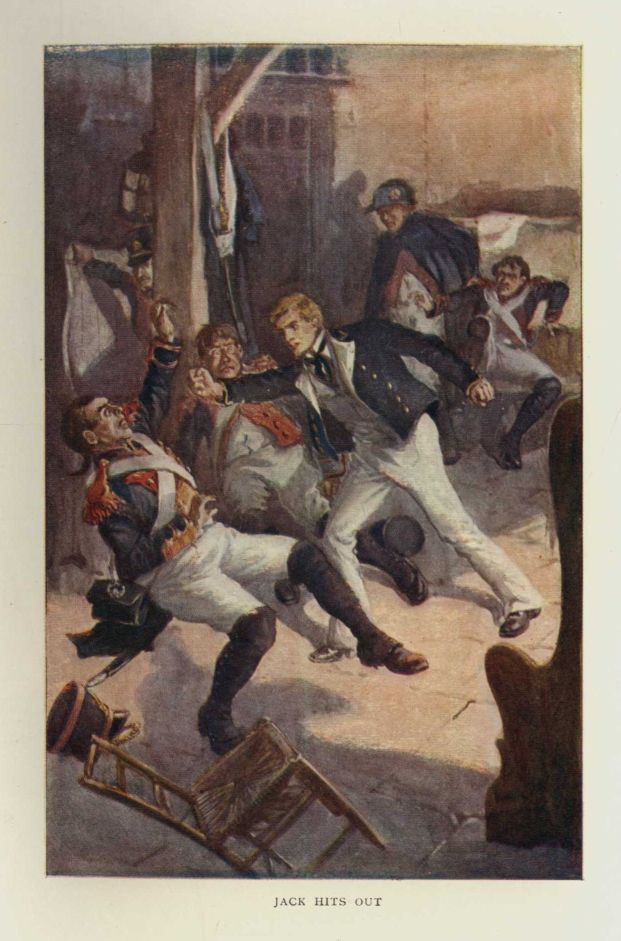
Jack, with a straight right-hander, sent him spinning over
"Now, men, after me!" he cried.
He raced along the corridor, conscious of a tremendous uproar in the guard-room—cries, oaths, violent thumps and kicks on the door. Up the stairs! There were the sentries at the top, startled out of their wits. What was happening? Hubbub below, hubbub in the prisoners' room! The prisoners were actually battering at the door! And with heavy implements: where had they got them? Crash! There was a panel half driven out. The amazed soldiers raised their muskets; they could at least fire into the room. But at this moment they caught sight of Jack and the sailors springing up the back staircase. Another crash on the door! O ciel! They waited for no more, but with a yell turned their backs and leaped down the main staircase, taking three stairs at a time.
"Ahoy there, Babbage; stand clear!" shouted Jack.
"Ay, ay, sir!" cried the bo'sun from within.
Putting to the lock the musket he carried, Jack fired. The lock was burst; with a touch the door gave way; and a second later the prisoners began to pour out.
"Steady, men!" cried Jack. "No crowding, or we'll get jammed and be clapped under hatches again. Armed men in front."
They followed Jack down the same staircase by which he had come. As they passed the locked door of the guard-room they heard the imprisoned men making a furious assault upon it. But it was a piece of good oak; they had no firearms to blow away the lock; and Jack knew that they might hammer it for an hour without making much impression.
Down they go! Here they are at the kitchen. And there is Turley, a saucepan in one hand, a huge dish-cover in the other, holding at bay the fat cook and his two assistants, who are vainly attempting, with ferocious cries, to get within his guard. When they see Jack enter the room, and behind him a swarm of seamen, they wheel round and scurry like hares into the farther apartment, the fat cook going last, squealing.
"No danger there!" said Jack. "There's no time to lose, men. Now for the back door."
He ran to it, drew back the bolts, and throwing it wide dashed out into the open. There was a blinding flash close by; the shot missed; and with Turley and others hard on his heels Jack dashed straight in the direction from which the shot had come. But the sentry who had fired was already scampering away. A companion had joined him; together they made for the wicket of the front gate; dashed through, and tried to close it. But Turley was just in time to slip his saucepan in and hold the gate open. The sentries waited no longer. They raced as fast as their legs would carry them toward the town.
To overtake them was impossible. In a few minutes the two companies of infantry would be on the track of the escaped prisoners. Was there time to reach the harbor before they came up? Had the shots already roused the officers of the vessels at anchor and caused them to despatch men ashore? Jack could not wait even to wonder. On he went, calling to his men to close up, straight along the road leading to the town. But to pass through the streets to the harbor would be fatal. Within half a mile of the town he halted.
"You, Mudge, and you, Folkard, cut off a quarter of a mile to port and fire your muskets. Then run as hard as you can in our wake. Quick, men!"
He hoped that the firing in that direction would mislead the enemy and give the fugitives the few minutes' grace they needed for the next move of his plan. When the two men had gone off to the left, he led the party rapidly to the right, hoping to strike the harbor at its eastern extremity.
As the fugitives, keeping perfect silence, stumbled in the darkness over fields and across ditches toward the harbor, they heard loud shouts to their left, followed by the roll of a drum. Clearly the alarm had been raised, the soldiers were turning out. All now depended on whether the direction of the escape was discovered within the next few minutes. If not, Jack thought that he might reach the harbor with his band in time to seize some boats before they were intercepted. He listened eagerly for shots behind; they seemed long in coming, and the outskirts of the village loomed up in the darkness ahead before the expected reports at last struck his ear. Fervently he hoped that the sound would draw the soldiers off in that direction.
He wished he could go faster, but many of the men were weak from the effects of imprisonment and meager fare, and he had to accommodate his pace to the slowest.
Making a fairly wide circuit, Jack steered for the extremity of the harbor, where only a few fishermen's cottages intervened between him and the waterside. Some fishers who had turned out of their dwellings on hearing the alarm scurried down the rutty road with loud shouts. The noise was bound to bring the soldiers to the spot within a few minutes. Jack's heart was pumping at a great rate, but he did not lose his coolness or his nerve. He must do something to check the soldiers, that was plain. Sending twenty men to search the shore for boats, he posted the nine armed with muskets under cover of the cottages with orders to delay the soldiers at all costs. The rest of his men, some armed with the spoil of the kitchen, others with bricks and stones snatched up on the way, he placed behind the nine to support them.
A minute or two—horribly long they seemed to Jack—of anxious waiting; then the two men who had fired the shots in the rear came panting up, and from the direction of the harbor a messenger brought the good news that six large boats had been found. Almost at the same moment the clump-clump of heavy boots and sabots on the road was distinctly heard, ever growing louder. If the runners proved to be soldiers it would be impossible to escape without a fight. Jack would rather have been allowed to embark in peace, but if there must be a fight—
"Well," he whispered to Babbage, "we'll show them what English Jack Tars are made of."
He at once sent the unarmed men down to the water under guidance of the messenger, bidding them get into the boats; then with the rest he prepared to fight a rear-guard action.
The Frenchmen came on helter-skelter. Not one of them imagined that they had any enemy more formidable than unarmed weaklings to deal with. Jack waited until they were within twenty yards; even in the dim starlight they could be seen distinctly enough. Then in a voice that rang clearly he gave the word "Fire!" The eleven rifles flashed; there were cries from the advancing Frenchmen; some of them, at any rate, must have been hit at this point-blank range. The head of the column was in confusion; men turned this way and that; they were apparently without leadership.
While they halted and wavered another word of command was heard above their cries and the sound of shuffling feet: "Charge!" The sailors responded with a cheer; some thirty strong, they dashed forward as one man; and in a few seconds the enemy were in full flight, struck by one of those sudden panics to which even the best troops are liable in night operations.
Jack also had his moment of alarm. Knowing the thoughtless impetuosity of the British sailor, he feared lest, with the enemy on the run, his men should forget everything else in the excitement of pursuit. But he had them soon in hand again.
"Now to the boats!" he said, "and as quickly as you can."
He had no difficulty in finding them. One of the sloops had already opened fire upon them; and the sound of oars in that direction showed that a boat, perhaps more than one, had been lowered, no doubt to pull in to the assistance of the soldiers. It was too dark for the fire of the sloop to be effective; Jack heard one or two shots strike the harbor wall.
Here were the boats, a few yards from the beach.
"Tumble in, men," said Jack.
In a few seconds all were aboard. Already Jack in the foremost boat was steering for a black shape almost exactly ahead, which he believed to be the Fury. Scarcely was his craft well under way before he heard oars in that direction; the cutter also, it appeared, was sending a boat.
"So much the better!" thought Jack. "There'll be fewer men on deck to repel boarders."
In less than a minute he saw the cutter's boat ahead; it was turning, as if to regain the vessel—he wondered why.
"Give way, men!" he cried, and from the boat behind came Babbage's voice urging his crew: "Pull, shipmates; pull, my hearties; Mr. Hardy ain't a-goin' to do it all by his lone self!" And Jack heard Turley, somewhere in his own boat, mutter: "Bust yourself, old Artichokes, but we'll be there first!"
It was a race between them. The other boats were some distance astern, for two, being without oars, were being towed by the remaining two. In the two foremost boats the men were straining every nerve. They knew that their lives depended on success, and scarcely needed the encouraging words of Jack and the old bo'sun. They gained on the Frenchman; the three boats dashed almost together under the cutter's counter; then there was a tussle. Rising in the boats the crews shouted and cheered and belabored their opponents, Jack's men plying rolling-pins, gridirons, soup-ladles, frying-pans, shovels, candlesticks, with a hearty vigor that made them more formidable weapons than the Frenchmen's cutlasses. In half a minute the Frenchmen, outnumbered and outfought, were hurled neck and crop out of their boats, and the English sailors were swarming up the side of the cutter. In the short fight the cutter's crew had been unable to help their comrades; it was such a rough and tumble that they would as likely have hit a friend as a foe. But they gathered for a desperate resistance when the Englishmen poured on to the deck. Jack and his party boarded aft; Babbage's men forward; but neither made easy progress, for the Frenchmen fought like tigers, rallying twice after momentary set-backs, and taking advantage of their superior numbers to press forward in the attempts to drive the boarders into the sea. The mêlée was at its fiercest when the arrival of the other boats turned the scale. Cheering British tars beset the gallant Frenchmen on all sides; man after man of the defenders fell, and in two minutes from the time when the last boat's crew boarded, the cutter was once more in English hands.
"Secure the Frenchmen!" shouted Jack, when the enemy surrendered and cried for quarter. He himself rushed aft and cut the cable; and while Turley and some others were collecting the Frenchmen's weapons and escorting their prisoners below, a score of willing hands had run up the mainsail, jib and foresail. Grazing the side of the fishing smack to leeward as she gathered way, the Fury moved out to sea. As she emerged from the shelter of the brig a round shot from one of the sloops struck her full amidships, and the other sloop was seen making sail in pursuit.
"Any damage done?" sang out Jack.
"Not a farden's worth, sir," replied Turley. "Well above water-line."
"Here's another! Look out!" shouted Babbage.
But the second shot whizzed harmlessly by; then the sloops and other vessels faded from sight; and the buoyant little cutter began to courtesy to the waves of the Channel, showing white-crested in the gloom.
CHAPTER XII
THE CAPTURE OF THE GLORIEUSE
For some time Jack was too busy in navigating the vessel, too anxiously looking out for pursuers, to take stock of the situation on board the Fury. But as soon as he felt that he was fairly safe, he went round the cutter to inquire. One of his men and five Frenchmen had been killed in the boarding operations. These were at once committed to the deep, for with a crew of nearly seventy, and twenty prisoners, there was already too little room on board. Many had been wounded on both sides; and Jack found that his men had the more serious, though not the most numerous, wounds; for while they had been pinked and slashed with cutlasses, the Frenchmen had received only bad bruises from the unusual weapons wielded by their opponents. Several of the men who had served in the sick bay on English warships had already done their best—it was but little in those days of ignorance and unskilful surgery—to attend to the wounded.
The French crew had apparently consisted of about forty men; arms for that number were discovered. Among the prisoners were the captain and lieutenant, whom Jack at once sought out and invited to share the cabin with himself. They were very crestfallen at their defeat; but when Jack, mustering his best French (which was not very good), made his best bow (which was charming), and said—"Je vous restore, Messieurs, vos épées, pour vous—vous—vous—(Hang it! What's the French for 'show'?)—pour vous displayer mon admiration de votre brave—. (Can't think of the French for 'fight.')—votre courage dans la bataille"—when Jack came to the end of this halting speech and smiled very unaffectedly, the Frenchmen returned his smile and his bow, and the captain, as he received his sword, said fervently:
"Monsieur, je vous rends grâce de votre noble conduite, qui est digne, assurément, d'un honnête homme."
Jack bowed and smiled again, wondering what he had done that was specially "honest." Like many another Jack since then, he was too apt to jump to conclusions.
He had never navigated the Channel, but he set the course of the cutter by the compass, intending to run as straight as he could for Wynport. Toward daybreak the wind shifted to the southeast and then to the southwest, and to Jack's disappointment dropped to a light breeze scarcely strong enough to disperse the thin fog that lay over the sea. There seemed little hope of a quick passage to the English coast. Jack was speculating on his chances of getting clear of the French shore when he was startled by the cry:
"Sail on the weather-bow, sir."
Diving into the cabin, he snatched up a spyglass and eagerly scanned the approaching vessel, which was coming up Channel, bringing a strong breeze with her. She was showing no colors, but there was something about her cut that made him feel a little uncomfortable. Turning to Babbage, who stood by, he handed him the spy-glass, saying:
"French?"
"French she be, sir, leastways furrin, and a spanking brig."
Jack looked a little blue.
It was difficult to estimate distances in the haze, but the stranger could scarcely be more than a mile away. Every now and again a gust of wind lifted the fog, and if Jack attempted to put about the movement would almost certainly be seen. Even if he could outsail the approaching vessel before the wind, which was at least doubtful, her bow-chasers would badly cripple him before he could run out of range.
"What chance have we of escaping, if she is French?" he said to Babbage, who was standing by his side.
"Not a brass farden's worth, sir. She carries thirty guns at the least; and if there is a man aboard that can shoot, she can hull us easy as winking without changing her course."
"That's bad, then."
"And worse to foller, sir, as brother Sol used to say."
Jack mentally anathematized brother Sol, who must have been a very Job's comforter. The outlook was black enough. Visions of a French prison again rose before him—if indeed prison should be his lot, for the French, if they captured him, might deal summarily with him in revenge for the men they had lost.
Babbage sat down on the deck and began to sharpen his cutlass.
"A nice little bit of arm-work coming, sir," he said cheerfully. "In course we'll fight 'em?"
Jack shook his head.
"That's the last thing I should think of doing—at present."
"Well, sir, she's coming on at a spanking rate, and if we're going to run, the sooner the better—meaning no offense, sir."
"We must either keep her closer to the wind, and hope to pass without notice, or put the helm up and run for it. We'd have a bare chance of outsailing her then."
"Yes, sir, and she'd give us her broadside fust and foller it up with her stern-chasers. She'd blow us out of the water, as sure as eggs is eggs, when they bean't pickles."
Jack stood for a few moments, gloomily pondering this desperate case. All at once his face brightened.
"I say, Babbage, we'll fight her."
"And God save the king, sir," replied the veteran, lifting his hat, and then vigorously whetting his blade.
The course which had suggested itself to Jack was one that he would scarcely have imagined in cold blood; but in the present crisis it seemed to him preferable to either of the two he had before mentioned. He had seventy men on board, thirty more than the cutter would have carried in the ordinary way. Most of them were well armed; and, well as British seamen always fought, they could be trusted in the present circumstances to outdo themselves, for defeat meant utter destruction. Could he lull the Frenchmen's suspicions for a few minutes? If he could!—well, the chance of success was small, but the smallest was better than none at all.
"Yes, by George! I'll do it!" he said to himself.
And he lost no time. He was astonished at the quickness with which his mind worked in forming his plan. Orders came to his lips in short, sharp sentences, and, thanks to the readiness of old Babbage and the fine discipline of the seamen, they were carried out as promptly as given.
A score of men went below, and in a few seconds returned to the deck, looking like Frenchmen. They had stripped the outer garments from the prisoners. Their weapons were completely concealed. Five men with loaded muskets stood guard over the real Frenchmen, four held themselves ready to board, with boat anchors as grapnels. The rest of the men, equipped with all the available armament, concealed themselves below, out of sight from the approaching vessel, but ready for action at a moment's notice.
These preparations were still being made when the French flag was run up on the brig. In response Jack hoisted the French colors found on board, and, bringing the cutter a point or two closer into the wind, made as if to hail the larger vessel. When only half a cable's length separated them he shouted:
"Ho! Hola!"
There was an answering shout from the brig. So far, at any rate, no suspicion had been aroused. Jack felt himself thrill with excitement and suspense; everything depended on the result of the next move. Turley was at the helm, his lips set, his eyes never leaving the midshipman's face. Two or three seconds after the hail Jack gave the word; Turley put the helm hard up, and the cutter, paying off from the wind, ran alongside the brig to the manifest amazement of the Frenchmen, the captain swearing with anger at what he supposed was rashness or utter stupidity on the part of the cutter's commander.
Barely two yards now separated the vessels, the side of the brig seeming to tower over the cutter. At a sign from Jack the men with the grapnels leaped up, and cast them in at the open ports of the brig. The ropes attached to them were instantly secured to stanchions on the cutter's deck, and with a slight movement of the tiller Turley brought the two hulls together.
Even before they touched, twenty men from the Fury's deck were clambering up the main chains of the brig, and forty more were swarming from below in support. By this time the French captain had realized that the commander of the cutter was neither stupid nor rash, but a dare-devil of an Englishman. Those were Englishmen's cries that he heard, mingling with the uproar made by his own men. Everything was in confusion. Only the marines were armed. What French captain would have dreamed of meeting a little English cutter so near his own coast? What audacity, what unjustifiable impertinence, for so small a vessel to engage a thirty-two gun brig, with a complement of probably two hundred men! It was ridiculous, thought the captain, even as he gathered his men for the fight.
He was taken by surprise, but what then? Snatching up any weapons that came handy, the Frenchmen came pouring out of the hatchways and from all quarters of the deck, and, forming a little knot, endeavored to stem the rush of the boarders. They fought, as Frenchmen always fight, gallantly and with fierce courage; but a boarding party of English seamen is not easily checked.
Jack at the head of a dozen men had already driven a group of the enemy from the fore deck into the foc's'le when, glancing aft, he saw that Babbage and a small band were in desperate straits. Sword in one hand, pistol in the other, the French captain was pressing them hard at the head of twenty well-armed marines and three of his officers. The remainder of Jack's party had scattered in pursuit of the enemy on the lower deck; and a hand-to-hand fight was raging near the armory, from which the watch below were hastily equipping themselves. It was impossible for Jack to collect his men; yet if Babbage and his gallant band were overcome all would be over.
"You four, watch the foc's'le!" he shouted. "Come on, you others! Babbage ahoy!"
With a shout he dashed aft, a dozen men bellowing as they sprang after him. Flash went a pistol; the clashing of cutlasses mingled with the various cries of the men; and Jack, cleaving his way through the press toward the old bo'sun's side, found himself face to face with the French captain. He had but just time to parry a shrewd thrust of the Frenchman's sword when a blow from a French sailor's pike, which must have killed him outright had it not been partly diverted by Babbage, fell obliquely upon his head with such force that he stumbled, staggered, and dropped senseless to the deck. His last conscious moment was filled with the din of fighting and the roar of his men.
"Mr. Babbage!"
"Wot?"
"I axe your pardon, true."
"Wot for?"
"For calling of you Artichokes, Sparrow-grass, Turnip-tops, and Cabbage. Wi' young Mr. Hardy a-lying here with all his senses knocked out of him, I couldn't abear to think as how I hurt your feelings, Mr. Babbage. I axe your pardon."
"Granted, Turley, granted, and more to foller," said Babbage, holding out a horny hand, which Turley grasped in one equally hard. Each man looked at the other, so long that they did not perceive that Jack's eyes were open, and that he was smiling.
"Oh, you solemn old donkeys!" he exclaimed. "You know you've been friends at heart all along."
They looked sheepish, like boys detected in something unboyish.
"Ah, sir," said Babbage, "brother Sol used to say 'tis not actions wot matter, 'tis feelings."
"Brother Sol was wrong, then. I shouldn't be feeling so dizzy but for the action of some Frenchman who got a cut at me. What's happened, Babbage?"
"The ship's ourn, sir, and we're making for Portsmouth."
"Hurray! Tell me about it!"
"Well, sir, arter you was down we got our monkeys up. 'Twas all over in half a minute. Turley and Mudge and a dozen more went at 'em 'longside o' me; we drove 'em back; Mudge tumbled the captain over, and the rest hauled down their colors and cried for quarter. Then me and some more jumped down the gangway and cleared the lower deck, where some mounseers was scrambling round the arm-chest. Bless you! it didn't last long. They did their best, to be sure, but we did better; and the end of it was they all flung down their pikes and cutlasses and gave in. Then we brought you down here into the captain's cabin; I put the ship about, and cast off the Fury with ten men in her; she's following in our wake now, sir."
"Capital! And what of the prisoners?"
"Tied up, sir. There's a hundred and forty, sir, all told, and being such a terrible lot more than us I couldn't leave 'em loose. They're sitting on the lower deck, side by side, twenty of them slung on to one rope, and for every twenty there's a man with a musket. They don't understand plain English, sir, but they understand a loaded musket, and every man of 'em knows that if he tries any tricks 'tis good-by."
"Well, I'm only sorry I was bowled over. You've done splendidly. How long have I been here?"
"Somewheres about half an hour, sir. We couldn't do much for you, not having no surgeon aboard; but we tied up your head as well as we could."
"Oh, I'm all right. Just a little dizzy. Help me on deck; the fresh air will do me good."
He had lost a good deal of blood, and could scarcely have reached the deck unassisted. The Englishmen gave a cheer when they saw their young officer—a somewhat muffled cheer, for their mouths were full of the food prepared for the Frenchmen's breakfast. It was so long since they had had a square meal that they were making the most of their opportunity, and the prisoners sat glum and hungry, watching the disappearance of the soup intended for themselves.
"Find the cook and cast him loose," said Jack. "He can get something ready for them. Let 'em eat, forty at a time. Where's the captain?"
"Getting over his temper for'ard, sir."
Jack found the captain, and learned from him that the vessel, named the Glorieuse, had been cruising off Ushant, and three days before had captured an English merchantman, which she had sent to Brest with a prize crew. The Glorieuse was bound for Boulogne, and the Fury had been taken for a French despatch-boat bringing orders.
By midday the Glorieuse came within sight of Selsey Bill, and beating up against a westerly breeze made a slow passage to Spithead. It was almost dark before she ran into Portsmouth Harbor. Her signals had already informed the port officers that she was a prize, and she had hardly hove-to when a boat came alongside to make inquiries.
"I'll have to go and see the admiral and report," said Jack to Babbage. "Probably I shall not be back to-night. We'll see about the prisoners in the morning."
CHAPTER XIII
OFF LUSCOMBE
During the latter part of the voyage Jack had devoted a good deal of thought to his future course of action. To report to the admiral would be his first duty; when that was done he wished to wipe off a personal score. He had been shipped off to France by the smugglers of Luscombe; they had unquestionably been assisted by Monsieur de Fronsac; and, remembering the name Goujon mentioned by the Frenchman, he felt pretty sure that the boat in which he had been conveyed from the shore belonged to the sufferer from the flutters, Mr. Nathaniel Gudgeon. It was not in human nature that he should let slip his chance of having his tit for tat.
And apart from his personal feelings, there were other reasons for this determination. To put down smuggling was part of his duty as a king's officer; it was no less his duty to suspect a Frenchman whom he found in league with them. There was something mysterious in their connection with De Fronsac, and something very unpleasant in the idea of De Fronsac's sailing under false colors in the house of Squire Bastable. It seemed to Jack that he would only be fulfilling a public duty, as well as getting even with private enemies, if he probed the mystery and laid the offenders by the heels.
But to do this it was very necessary that his return to England should be kept secret. The Luscombe smugglers would, no doubt, have friends spying for them in neighboring ports, and if he were seen they would be on their guard, and De Fronsac would have time to get away. He was glad, therefore, that it was dark when the Glorieuse came to her anchorage. It increased his chances of escaping notice in preparing to take the smugglers by surprise.
Smartening himself up as well as he could, and removing as far as possible the traces of his wound, he went ashore and made his way to Admiral Horniman's lodgings in the Hard. He was admitted at once on explaining his errand, and found himself in the presence of a big man with rugged, weather-beaten face, fierce white eyebrows, and a wooden arm. The admiral was alone, examining a chart with the aid of a tumbler of toddy and a long pipe.
"Mr. Midshipman Hardy, sir," said the servant.
"Come in and shut that door," roared the admiral in a quarter-deck bellow. "Dash my buttons! Do you want me to catch my death of cold! Now what's this?"
"Come to report a prize, sir."
The admiral looked Jack up and down.
"You have come to report a prize, have you, sir? And what's your superior officer about when he sends a youngster like you?"
"He's in a French prison, sir. I—"
"The deuce he is! How do you come to be in charge of a prize, eh? What's your vessel?"
"The Glorieuse, sir!"
"Don't trifle, sir! I didn't ask you for French crack-jaw. Your own vessel, sir?"
"The Fury, sir," Jack responded.
"What! Are there two Furies? The only Fury I know was the cutter that that fool Blake allowed to be captured. Didn't they tell me she was carried into Boulogne?"
"Yes, sir, but we retook her."
"By George! I'm glad of it; a smart cutter, the fastest on the station. And you took a craft called the Glorieuse too, did you? What's your vessel, and who's your captain, and why isn't he here?"
"If you please, sir—"
"Answer my question, sir—a plain question and a plain answer."
"My vessel's the Fury, sir," replied Jack, "and it was the Fury captured the Glorieuse, a thirty-gun brig."
"What! that cockle-shell take a thirty-gun brig?"
"Yes, sir, we took her by surprise, and—"
"And who retook the Fury?"
"Some threescore English seamen, sir; I was in command, and—"
"You in command! Bless my soul, what are you talking about? What's your name, sir?"
"Jack Hardy, sir."
"Why, why, didn't Lieutenant Blake report you as missing? Haven't I got his report—somewhere, hang me if I know where. Where's Lieutenant Blake? Why didn't he come and report all this himself?"
"I'm sorry to say he's a prisoner in France, sir. He was taken inland, and—"
"Am I standing on my head or on my feet?" cried the peppery admiral. "What's all this beating about the bush? Explain yourself, sir!"
"Why don't you give me a chance?" thought Jack; but Admiral Horniman's impetuous manner was well known on the Portsmouth station; no finer sailor ever served his Majesty; and those who knew him knew what a sterling character underlay his rough exterior. He raised his glass now and emptied it at a draft; and Jack took advantage of the action to begin his story, using as few words as possible, and hurrying on when he saw the admiral preparing to interrupt. Somewhat to his surprise, he reached the end without misadventure.
"Bless my soul! And you mean to tell me, Mr. Hardy, that you captured the Glorieuse yourself?"
"No, sir; I was bowled over; but the men fought splendidly, and Ben Babbage—"
"Turnip-tops! I know him! Brother Sol on the brain! but a good seaman. Well, Mr. Hardy, you'll write all that down—plain, mind you, so that I can read it, no finicking spidery scrawl for me, egad! Now run off and get a sawbones to look at that wound of yours, and take a few days' leave ashore. The sooner you're fit for duty the better. We'll take charge of your prize."
"Thank you, sir. But about the leave—if you don't mind, I'd rather not take it at present."
"What in thunder do you want to be at then?"
"You know what happened at Luscombe, sir—at Congleton's Folly?"
"Yes—no; hang me! I remember Blake reported something. He broke into a tower, or something of that sort, and found nothing—wasn't that it?—everything gone, lock, stock, and barrel."
"Yes, sir. I want to find out what is going on in Luscombe now. I can't do it if the smugglers learn that I've come back. Of course they're bound to know that the Fury has been retaken and the Glorieuse brought in a prize; but if my name's kept out of it they won't be on their guard; and if you would allow me a few days' absence, I'd—"
"So you shall, by the Lord Harry!" cried the admiral, without waiting to hear what. "And I'll tell you what I'll do. I'll keep the Glorieuse and the Fury in quarantine. Not a man from either of 'em shall come ashore till you've reported to me. They'd blab if they did. And there's blabbing enough. Egad! Several of our merchantmen have been scooped up lately, and I'll keel-haul the villain who betrays 'em to the French if I catch him. But what about your wound, eh? Won't that be troublesome?"
"'Tis just a flesh wound, sir," replied Jack; "I shall be all right in a couple of days. There's just one thing; may I have the Fury if I find I can use her?"
"Certainly, certainly, when you like; in fact, Blake being absent, you'll be in command till my lords make another appointment."
Jack took his leave, very well pleased with the result of the interview. He returned to the Glorieuse, waited until a lieutenant was sent by the admiral to take charge of her, and then, with twenty-five men, including Babbage and Turley, and stores hastily provided from the brig, he sailed out of the harbor in the Fury. The admiral, he suspected, would be somewhat amazed when he learned of the sudden departure; but, having permission, Jack had resolved on his way back to set off at once on his quest. The sooner the Fury was out of sight the better; and by sailing in the darkness she would be most likely to escape observation.
The wind was not very favorable. A fresh breeze was blowing from the southwest, and it was a somewhat tedious beat down Channel to the point, abreast of Luscombe, where he had seen the signal light from Congleton's Folly. Had the signalers sufficiently regained confidence, he wondered, to resume their midnight work?
"What do you think of it, Babbage?" he asked of the bo'sun, who was at the tiller.
"Well, sir, I think of a saying of brother Sol's: 'When the cat's away, the mice do play.' There be several cats in the case, sir. One, the Fury—a good name for cat or cutter; two, Mr. Blake; three, you yourself, sir; four, me and Turley, for, having made up our little difference, we two make one; I've got the claws, he've got the caterwaul. All these cats being away, those there mice will have a rare randy. Why, that there tower was as empty as a blown egg-shell when we drove in the door, and climbed to the top; and the smugglers will be a-hugging theirselves that all's clear, and thinking they can go on with their work without any danger of a visit from the preventives. Lor' bless you, I were a mouse myself once."
"I agree with you. 'Tis six months since I disappeared, and they'll have had all that time to recover from any fright we may have given them. I wish the wind would change. I want to get opposite the tower before morning."
"But you can't expect them to do the signaling every night, sir. No smugglers ever I knew or heard of could be so spry as that would mean. Belike we shan't see the light for a matter of days—nights, that is—or weeks. Like as not they'll have their regular times and seasons, same as the herrings."
"That's just why I'm so anxious to get there to-night. 'Tis Wednesday; 'twas on a Wednesday I first saw the light; for all we know Wednesday is their regular day."
"There may be summat in that."
"And as we don't want to be discovered I'll have the tackle blocks oiled, and tell the men to keep quiet."
"Specially Turley, sir; but there, I take that back, sir, or he'll be a-calling of me Spring Onions again."
That night was so dark that Jack had some doubts whether he could hit the exact spot from which the light was visible. But he ventured to creep in toward the shore sufficiently near to descry the landmarks, and having at length assured himself on that point, he ran out again, and cruised about, keeping a keen lookout for the light.
Two hours passed. It was near midnight, and he had almost given up hope of success when, to the southwest, he saw a gleam. At the moment the Fury was running up the Channel before the wind. The light evidently came from a vessel. But it had disappeared—no; there it was again; three times the same light was shown and extinguished.
"A signal, Babbage," said Jack. "Hope we shan't be seen."
"Better hold on our course, sir, then beat out. We've to get that there craft atween us and the shore."
Jack acted on the bo'sun's suggestion. In a few minutes the same signal was seen, this time full on the weather beam.
"They haven't answered her yet, sir," said Babbage, "and she won't sail in much closer, 'cos if she do, she won't see the light from the Folly, if so be 'tis that she's looking for."
"No. But I'm afraid she'll see us. She certainly will if we venture too close. Yet if we make too wide a sweep round her she may do whatever mischief she's about before we can make up on her. How far is she out, Babbage?"
"About five mile, I should say, sir."
"Well, I'm going to risk it. We'll run out beyond her, and hit the straight line between her and the Folly; we'll see then if any signaling is going on."
As soon as he thought he had made sufficient offing, Jack brought the Fury closer to the wind and crept toward the line he had mentioned. He no longer expected to see any signal from the vessel; the lantern would be turned away from him. But he looked anxiously toward the shore. Minute after minute passed, and yet he saw nothing. He began to fear that either he had lost his bearings and crossed the line while signaling had been going on between the tower and the vessel, or that there was no one at the Folly, after all, and both he and the commander of the other ship were to be disappointed.
Suddenly a light flashed out from shore, and remained gleaming brightly and steadily. So strong was it that Jack felt not a little anxiety lest it should show up the Fury to the vessel now between her and the land. But a moment's reflection reassured him. At this distance the light could have no illuminating power; and if he could not see the strange craft, it was not very likely that she could see him.
He was wondering what his next move had better be when the light disappeared. But only for a moment. Then it shone out again. Again it disappeared, and then for several seconds it alternately came and went, with regular intervals of very brief duration between the flashes. At last there was a longer interval; then the regular flashes began again.
"Heave to, Babbage!" cried Jack.
Springing down to the cabin, he returned in a few moments with a slip of paper, a pencil, and a shaded lantern. By the light of the last, Jack made a note. It would not have conveyed much or anything to an onlooker. It began— 17 — 3 — 18 — 2 —— 1 — 17 — 17 — 3 — 20 — 2 —— 16 —— 11 —— 15 — 1 — 20 — 3 — 17 — 2 ... and this succession of numbers and dashes grew until it completely filled the paper. After he had written for nearly half an hour the light disappeared altogether; he waited ten minutes on the chance of the flashes being resumed; then folded the paper, put it in his pocket, and ordered the men to crowd on all sail.
In a few seconds the Fury was running before the wind in the direction Jack thought the strange vessel might have taken. There was just a chance that he might overhaul and capture her, for he guessed that she was little if anything larger than the cutter, and in all likelihood the same lugger which had escaped Lieutenant Blake months before. But though he cruised about for a couple of hours he failed to find her.
"We'll give it up," he said at length to Babbage. "Now I want a little time to work out a puzzle. We mustn't be seen from Luscombe or the neighborhood, so we'll beat down Channel and make for Falmouth. That's far enough away to be out of reach of the Luscombe men or their spies; and I'll eat my boots if I haven't a pretty piece of news to report to Admiral Horniman to-morrow."
CHAPTER XIV
A DISCOVERY
About nine o'clock the next morning the Fury ran into Falmouth Harbor. Sending a boat's crew ashore to get fresh provisions, Jack closeted himself in the cabin, and, leaning his head on his hands, pored over the paper on which he had made the strange jottings the night before.
The numbers represented the flashes which had followed at intervals of a second; the short dashes represented intervals of five seconds, the long dashes intervals of twenty seconds. What was the explanation? It was clear that the signalers had a code; the flashes in some way spelt out words, and Jack guessed from the long time the message had taken that the words were spelt in full. How was he to set about finding out what they were? He had never in his life read a cipher, and for some minutes he was at a loss how to begin.
At last it struck him that the highest number he had written was 20. There were twenty-six letters in the alphabet, and some of the letters, such as Q, X, Z, were very seldom used. It was not unlikely that in a comparatively short message they would not be used at all. Each letter might be represented by a number. He wrote down the twenty-six letters of the alphabet, placing a number under each, from 1 to 26. Then he substituted the letters for the numbers on the paper, thus:
QCRB——AQQCTB——P——K——OATCQB
This was nonsense; the fact that most of the letters were consonants, and the one that most frequently occurred, Q, showed that he was on the wrong tack. He must try again. He was sure the long dashes represented the intervals between the words; what did the numbers stand for?
"I wonder what letter is most often used?" he thought. He wrote down the first thing that occurred to him, the first line of the song, Heart of Oak—
"Come, cheer up, my lads, 'tis to glory we steer."
"'Tis E!" he said to himself. "It occurs in four words out of ten. Now there are three words in the stuff that have 3 and 2 in them; depend upon it either 3 or 2 stands for E. Which is it? Why, E is the second vowel, and I is the third. Every word has one or two vowels in it, and two of these words have I in them. Perhaps the five vowels are numbered 1, 2, 3, 4, 5. Let's try that."
Recopying the alphabet, he found that on this system the message read—
PIQE——APPISE——N——H——MASIPE
"It looks a little more pronounceable, but hanged if I can make any sense of it. There's a French look about it. Why, what a dolt I am! If it's Fronsac who's signaling from the Folly, of course the message will be in French. Not that that helps matters!" he thought dolefully. "The French alphabet's the same as the English till you get to W, and W is number 23, which doesn't come in. Confound the thing!"
It was not until he had pondered and puzzled for more than an hour that Jack got any fresh light. Then it occurred to him that some of the less-used of the letters might have been dropped. After some thought, he left out K, Q, and all the letters after V, and renumbered those that were left. The first result of this change gave him a thrill. He spelt out the word "RISE."
"Now I'm on the scent!" he said to himself.
Next came the word "ARRIVE," then two initials—P, H, after them the word "NAVIRE."
"I can't make any sense of it at present. Let's go on."
At length the complete message was deciphered. It ran as follows—
RISE ARRIVE P H NAVIRE SOUS CONVOI E FREGATE PARTENT VENDREDI POUR JAMAIQUE SANDI COVE SAMEDI.
This was certainly clearer; it was decidedly French for the most part; but what did "RISE," "P," "H" and "E" mean? In a few minutes Jack jumped to the meaning of H and E; they were to be taken as numbers, not as letters; eleven merchant ships under convoy of two frigates were leaving on Friday for Jamaica. What about "RISE?" He remembered by and by that he had not begun to write until the signaling had been in progress for some time. "RISE" was probably the end of a word. What French word ended so? He put other letters in turn before the perplexing syllable: brise, crise, grise, prise. PRISE! Captured! He saw it at last. The signaler was informing the men of the lugger that a captured ship had arrived; P stood for Portsmouth; and Jack had no doubt that the ship meant was the Glorieuse.
All that was left of the message were the last three words: "SANDI COVE SAMEDI." These suggested that Sandy Cove was to be the scene of a cargo run on Saturday; but Jack had never heard of Sandy Cove. For the moment he gave no more thought to it; the first part of the message was of much greater importance than any smuggling business.
The mystery was becoming clear at last. No wonder the French showed a disconcerting knowledge of the movement of English ships! De Fronsac was a spy! So far from detesting the Monstair, he was actually in the Monstair's pay. His business was to supply the Monstair with information. And his cunning had found a means to avoid the perils that otherwise might have beset his task. He had made friends of the Luscombe smugglers, ostensibly cast in his lot with them, so that he might have opportunities of signaling information to the French. Jack saw through the scheme in a flash.
It was Wednesday. Obviously there was no time to be lost if the ships to sail on Friday were to be saved. The lugger would convey the message to one of the western ports of France, and the enemy's cruisers would come out in sufficiently large force to cut off the merchantmen and convoy. They could indeed afford to wait a few days, for even if the wind proved favorable for the sailing of the English vessels, they would make such slow progress that a French fleet in pursuit could overhaul them speedily, and, knowing their destination, would probably have little difficulty in finding them. Admiral Horniman must be at once informed of the discovery.
The men having by this time returned from their errand on shore, Jack at once hoisted sail and ran back to Portsmouth, keeping well out in the Channel off Luscombe to avoid recognition. The admiral spent five minutes in blowing off a considerable amount of warm language when he heard the story.
"The merchantmen shall sail if the wind favors," he said, when he had recovered. "But I'll increase their escort, and the French shall get an unpleasant surprise, I promise 'em, if they act on the information they've got. And that Frenchman at Luscombe, I'll string him up to the yard-arm. I'll stop his signaling. I'll give orders for the tower to be occupied, and every one found there put in irons and clapped under hatches."
"I don't think you'll find any one there, sir," Jack ventured to suggest. "Fronsac's hand in glove with the smugglers, that's the meaning of 'Sandy Cove Saturday.' If any of our men are seen making a move in Luscombe direction the news will be signaled along the coast. They'd all clear out. Couldn't we play their own game, sir?"
"What d'you mean?"
"I don't exactly see all the way, sir; but what occurred to me was that we might do a little signaling and catch 'em in their own net."
"A capital notion! By gad, we'll do it! We'll have to let 'em make their run on Saturday?"
"Yes, sir, and arrange to signal from the tower next Wednesday."
"Very well. I leave it to you. You seem to have got some brains. Come to me if you want any assistance."
Before he returned to the Fury Jack scribbled a note to his mother announcing his safe return, and begging her on no account to let the news travel to Bastable Grange. It was better that for the present his cousins should be ignorant of his whereabouts.
On reaching the cutter he started on a run up the coast. He wished to keep away from Luscombe until Saturday. Though he had no intention of interfering with the smugglers' run on that day, he was anxious to witness it. For one thing, it would prove whether he had read the intercepted message aright; moreover, he particularly desired to find out who was engaged in the business. Knowing what a close watch was kept by the smugglers, he recognized that it would not be easy to learn what he wished; but his successes in France had tended to dim the memory of certain less fortunate incidents at Luscombe.
He now took Babbage and Turley into his confidence. When he mentioned Sandy Cove he met with an unexpected check.
"There ain't no such place, sir—leastways, not on this coast," said Turley.
"Are you sure?" Jack insisted.
"Sartin, sir."
"That's strange. I don't think I read the word wrongly. I could be sure it was Sandi, the way a Frenchman would spell it. We'll have to go back to Portsmouth and get a chart of the coast; we may find something that looks like it."
But when he got a chart from the admiral he searched it in vain. There was no such name as Sandy Cove. He was convinced that he had not mistaken the signal; all that could be done now was to inquire in the neighborhood of Luscombe whether any of the inlets was locally known by that name. But with the exception of the Bastables he knew of no one whom he could trust, and he had a strong reason for avoiding the squire's house; nothing must be done that might put De Fronsac on his guard.
Then a thought of Gumley came to him—Joe Gumley, the one-legged sailor. He was Luscombe born; though he kept himself to himself, he would probably know the whereabouts of Sandy Cove. And he might safely be asked the question, for, never a friend to the smugglers, he had a distinct grudge against them since that day when his garden was ransacked, and he was the least likely of men to give them any information.
"Yes, I'll ask Gumley," thought Jack. "It can't do any harm."
It was afternoon when he steered the Fury into a sheltered cove some six miles west of Luscombe. He had chosen the spot because the coast there was rugged, and the shore uninhabited, and the cutter might lie safe from wind and wave, and from observation by too inquisitive people.
"Now, Babbage," said Jack as he stepped ashore, "I leave you in charge. Keep quiet, and be on your guard."
"Ay, ay, sir. And what if you don't come back, sir, like as 'twas six months ago t'other side of Luscombe?"
"Run back to Portsmouth and report to the admiral. But I'll be back, never fear."
He had exchanged his midshipman's hat for a wide-brimmed beaver, and wore a long cloak which made him look more like a magistrate's clerk than a sailor. Thus disguised, he walked over the beach, climbed the cliff, and struck into a path which would lead by a roundabout way into the Luscombe road. It was very unlikely that he would meet any of the Luscombe people in this direction; but Babbage's question reminded him of the unlucky end of a similar errand in the previous autumn, and he smiled somewhat grimly as he remembered his resolve to get even with his captors.
A white mist lay over the land, striking very cold against his face. But it favored his chances of escaping notice if any one should meet him, and he was indeed glad of the obscurity when, in the driver of a gig that passed him, he thought he recognized the bulky form of Mr. Gudgeon. Save for this solitary traveler, the road was quite deserted, and he arrived without adventure at Gumley's cottage.
He looked over the fence. No one was to be seen. Though it was already almost dark, owing to the mist, no light appeared in the cottage window.
"Ahoy O!" he called, without raising his voice, making a trumpet of his hands so that the sound would carry. There was no answer.
He rapped on the fence, calling "Ahoy O!" again. Still there was no reply.
"Here goes!" he said to himself. Stripping off his cloak he folded it and laid it on the nails, then clambered over and hastened to the door.
"I say, Gumley, let me in," he said, rapping.
"Who be 'ee? This bean't no inn."
"It's me, Gumley—Jack Hardy, you know."
"Tell that to the marines. Mr. Hardy's far away. Get along with 'ee."
"Don't be a jackass, Gumley. Open the door. Comely will know me if you don't."
"'Ware dog, then, and if his teeth jine in your legs 'tis your own doing, whoever ye be!"
There was a rattling of the bolts. The door was opened. The bulldog rushed out, and with a growl of pleasure began to rub his nose against Jack's trousers.
"There you are, you see," he said, stepping into the cottage, to find Gumley standing on guard with a blunderbuss.
"Well, sir, this is a rare surprise. I seemed to know your voice, but thought for sure it must be your ghost. Never did I expect to see you no more in this world, sir, and right glad I be."
"So am I, Gumley. But fasten up again, and light your lamp. I want to talk to you."
"But how did ye escape, sir?" asked Gumley, as he shot the bolt and led the way to his kitchen.
"'Tis too long a story to tell you now. Another time. But why, man, what's the matter with you? You look very down in the mouth."
"Ay, and so I feels, sir. What with worry and the rheumatics I feel I be not long for this world. I've bin twisted up with it all winter, sir. Since I sold they artichokes to Squire Bastable I've bin as useless as an old hulk. In course, some folks might think me lucky having only one leg to get the rheumatics in; but chok' it all, sir, the pain's just as bad in the wooden leg as 'tis in t'other; ay, and worse, 'cos I can doctor my natural leg, whereas not all the surgeons of King Jarge hisself could do this old stump any good."
"'Tis hard lines, indeed. But what's been worrying you?"
"Sit ye down, sir, and I'll tell 'ee about it."
CHAPTER XV
TAR AND FEATHERS
"Fust and foremost, sir," said Gumley, having lit his pipe, "my poor old moke is dead. Ah! he served me well for many a year, and carried tons and tons o' garden stuff into Wynport. But now he's gone, and if so be I can do any digging and planting this spring I'll have no one to carry my vegetables to market."
"'Twas old age, I suppose. He looked on his last legs when I saw him first on the Luscombe road six months ago."
"No, sir, 'twarn't old age. If he had been left alone he'd have lived to be as old as Methusalum. No, 'twarn't old age, nor overwork neither."
"What was it, then?"
Gumley hesitated. He looked at the locked door and the shuttered window, got up and went to the back door, bending his head forward as if listening. Then he returned to his chair, and, between two puffs, said, under his breath—
"'Twere p'ison, sir."
"Poison!"
"Ay, sir. Jerry—so I called him, sir—were sound as a ship's bell one night, sir; next morning he were dead as mutton."
"But how do you know 'twas poison?"
"'Cos that very same day Comely was took bad and well-nigh went to glory, too. Where Comely goes, Gumley follers; my rheumatiz were very bad that day."
"'Tis plain you've got enemies, Gumley. I'm sorry for you. Comely looks all right now, at any rate. We'll see what we can do to get you a new donkey. But I mustn't waste time. I'll tell you what I've come for. Do you know where Sandy Cove is?"
Gumley gave a start, and looked round the room again with that uneasy glance which had attracted Jack's attention before.
"Axing your pardon, sir, would ye say why and wherefore you want to know that?"
"I don't think I can—at all events, not yet. But I'll tell you one thing. I'm on the king's business, and that will be enough for an old king's man, eh, Gumley?"
"True, sir, God save the king! All the same, I'd rather ye axed your question of some one else."
"There is no one else. Come, Gumley, out with it. What is the mystery?"
Gumley still hesitated. He scratched his poll, rubbed the dog's head, stirred an imaginary fire with his wooden leg, and once more glanced uneasily at the window.
"This won't do," said Jack. "Joe Gumley, I call upon you, in the king's name, to answer this question at once. Where is Sandy Cove?"
"If you puts it like that, sir, as a king's man—leastways, I was afore I got this plaguy leg—I'm bound to make a clean breast of it. Sandy Cove is the name what the smugglers give to that there little chine just below Mr. Gudgeon's farm."
"Ah! And how came you to know that?"
"Well, sir, if truth must be told, in the king's name, I were a smuggler myself once, afore I became a king's man."
"I see! And the smugglers are down on you, are they, because you won't join 'em again?"
"How can I, sir? Once a king's man, always a king's man—to say nothing of the wooden leg. I served his Majesty for many a year, sir, and I bean't a-going to turn agen him. Not but what 'tis main hard, for smuggling's an uncommon fine trade—if so be I can make bold to speak free afore a king's officer."
"I won't peach," said Jack, laughing. "Speak freely? Of course you can. And you'd better tell me all about it now. You look as uneasy as if you were sitting on pins."
"So I be, sir, and that's the truth. No longer ago than last Wednesday, Mr. Goodman he chanced to come upon a string of carts carrying smuggled goods from Luscombe to Wickham Ferrers. He nabbed the whole lot, sir, horses and all. And my old mates got the notion into their noddles that 'twas me as blabbed—me, sir, what knowed no more about it than that there innocent dog. But they believe it; and there 'tis. They swore they'd make me smart for it, and I dursn't stir out o' my door for fear I get a good crack on the nob or something just as awk'ard."
"I don't understand why they're so down on you. You keep yourself to yourself, as you told me. Why should they think 'twas you split on them?"
"I make it out this way, sir. I'm a' old smuggler, and know all the secrets o' the trade. I'm a' old king's man, too. They don't square. I won't jine my old mates, and they, being a bit wooden-headed, thinks I'm agen 'em. I bean't agen 'em, only I bean't for 'em. I can't go agen the king, nor I can't go back on my old mates; but bless your soul, they don't see what I mean when I says I keep myself to myself."
"Well, you can't run with the hare and hunt with the hounds. But what's that?"
He sprang up from his chair and went toward the shuttered window. Comely went to the door, growling. From without, muffled by the distance, came the tramp of heavy feet along the road, mingled with the hum of voices.
"'Tis come, sir," sighed Gumley, leaning back in his chair resignedly. "Here they be at last. I knowed this would be the end of it. They said they'd tar and feather me, and they be come to do it."
"Two can play at that game, Gumley. I'd sooner not be recognized now, but I'll not leave you to deal with 'em single-handed."
"I take it very kind o' you, sir, but there's no call for you to be mixed up in it. If they mean to get in, in they'll get, sure enough; and ye'll only land yourself in a nasty rumpus, and do no good. Thank ye kindly. I'll let ye out by the back door afore they come, and me and Comely'll do what we can, for chok' it all, it bean't in human nature to be tarred and feathered without a bit of a scrimmage."
"No, no. If you're going to make a fight of it, I'll lend a hand. We're well armed. You've your blunderbuss and a cutlass; I've two pistols and a dirk; and our good friend Comely here has excellent teeth, I'll be bound."
At this moment a loud shout was heard from the road, followed by an insistent knocking on the gate. Gumley stumped up the rickety stairs to the floor above, threw open the windows looking on the garden, and shouted:
"Who be you, and what do 'ee want?"
"We want you, Joe Gumley," came the hoarse answer, "and we're gwine to have 'ee, too."
"I bean't deaf, Tom Berry, so ye needn't bust your fog-horn. What do 'ee want wi' me?"
"We'll show 'ee. You bin peaching, you dirty mean sneaker. Come down along, and we'll give 'ee a fair trial afore the men as used to be your mates."
"No, thank 'ee, Tom. Whoever says I bin peaching says a lie, and as for trial, why, I bean't a fool, I bean't. If I wants trying I'll go afore a justice o' the peace like Squire Bastable, or a judge and jury at the 'sizes, and not afore Tom Berry or Bill Widdicombe or any other mumble-chopped chaw-bacon. See then, I don't want to use hard words to old ship-mates o' mine, but—"
Jack heard no more, for Gumley's words were drowned by a volley of shouts and curses from the men below. He let down the window with a bang.
"They be coming over, sir," he called to Jack. "'Tis all hands to repel boarders. They're mounting on balks of wood to 'scape the nails. Now they're over. And they be split into two parties, half a dozen each; and one's coming straight for the front door; t'other's gone round to the back. I be coming, sir, I be coming."
By the time he reached Jack's side the men had begun to batter simultaneously at both the doors with the balks of wood which, knowing Gumley, they had brought with them, evidently anticipating resistance. The men at the front door were protected by a narrow porch; those at the back were fully exposed; and Jack saw that unless something were done at once to check them they would soon be able to break a way in, for the doors were not very substantial pieces of timber, and could not long stand the heavy battering to which they were now being subjected.
He stood with Gumley and the dog at the front door.
"What's your blunderbuss loaded with, Gumley?" he said.
"Small shot, sir."
"Then I tell you what we'll do. I'll fling the door open; you fire at their legs; then we'll all three charge 'em. We've only half a dozen to deal with; the men at the back will stop work when they hear the row. They'll come rushing round. Be ready to get back and haul the dog off. I'll keep my pistols in reserve; the less firing the better; we don't want all Luscombe here. Lend me a muffler, quick!"
He pulled the brim of his hat down over his face, turned up the collar of his cloak, and wrapped the muffler Gumley gave him closely round his chin. All the time the men were hammering at the door, and Comely was moving restlessly about, uttering deep growls.
"Standby, Gumley!"
Jack quickly slipped the bolts, threw the door open, and dodged back. There was a blinding flash, a roar, and yells of pain and rage from the smugglers, who, crouching in the porch around their battering-ram, received the crammed charge of the blunderbuss about their legs. They dropped the timber, and gave back a little. Before they had recovered from their surprise, the bulldog, snarling with fury, was among them, and behind him came Jack and Gumley, who laid about them doughtily with cutlass and dirk—using, however, the flat, for neither wished to do any serious hurt unless they were hard-pressed.
Amazement was now turned to confusion and fright. The intruders had no thought but to hobble out of the way of these furious combatants. But as they pushed one another toward the garden they were met by their comrades from the rear, whom the shout and the cries had interrupted, as Jack expected. Their arrival only doubled the confusion. Amid the babel of shouts they could hear nothing of what had happened. Some of the men were still yelling under the blows of the dirk and cutlass; and when one howled "Ho! Hi! Help! The dog's got me!" they were seized with uncontrollable panic; and with one consent bolted down the garden and scrambled over the fence, with no small damage to their nether garments from the nails, never pausing until they perceived that no pursuit was attempted.
One man, however, was left on the field. In the entrance to the porch lay a big fellow groaning. Comely held him fast by the leg. Gumley hastened to him and tried to release him from the dog's teeth, but, finding that impossible, he dragged dog and man bodily into the cottage, slammed the door, and bolted it. Jack was already inside.
"Let go, Comely, old boy," said his master, stooping to release the man, who, half dead with fright, lay groaning where Gumley had dropped him. "Why, what are ye bellowing like a sea-serpent for?" he added. "His teeth never went further than your leggings! Who be ye for a chicken-hearted—why, dash my buttons, 'tis Bill Gudgeon! Oh, Billy, what a' example to set your good feyther! Oh, my goodness, won't he be took bad with the flutters when he hears this! Ahoy, Mr.——! Avast there, Joe Gumley, blowed if you wasn't just a-going to put your foot in it. Billy, my son, you come along o' me."
He hauled the trembling youth into the kitchen, and pushed him into a chair, where he sat immovable, in mortal terror of the bulldog, which stood by, fixing him with his thirsty eyes.
Meanwhile Jack had gone to the upper window to see what had become of the enemy. They were out of sight, but when he opened the window he guessed by their voices that they were in conference just beyond the fence.
"Ay, and more'n Gumley!"
In the still air of the frosty March evening the hoarse whisper came clearly to Jack's ears:
"In course; there was his dog."
"I knows that. But I seed another man, all in black, with his hat over his eyes and his face all swaddled up: Goodman hisself, maybe."
"Well, I be gwine home along. I've got a score o' pellets somewhere about my legs, and they'll p'ison my blood less I pick 'em out soon."
"Ay true, and we'll go lame for a month or more. Chok' it all! Who'd ha' thowt old Joe would ha' bin so fierce!"
As they were moving away, a gig rattled up and stopped.
"'Tis Mr. Gudgeon, so 'tis," Jack heard a rough voice say.
"Not so loud!" was the hasty answer. "What luck, lads?"
"None at all, and be hanged to it. We've not got nowt but a trouncing, Mr. Gudgeon."
"Lower, speak lower, man. What happened?"
"Blunderbuss and cutlass and dog's teeth; that's what happened, Mr. Gudgeon, as your boy Bill could tell 'ee. Why, where be the lad?"
"Been and creeped home along, by the look o't," said another man. "He bean't here. There's blood for 'ee! There's spirit! What a bold-hearted first-born you have got, to be sure, Mr. Gudgeon!"
"Hush, man! Here, come along. I can take four or five of 'ee in the gig, and you can tell me the whole story as we go."
The gig rattled away; the men for whom there was not room shambled after; and Jack smiled as he returned to the kitchen.
"There, Comely, watch him!" Gumley was saying. "I be gwine to look around the garden, sir, to make sure none on 'em be left."
Jack made no reply, but stood at the door while Gumley stumped round the inclosure. He came back by and by grinning.
"They be all gone, sir, all but this." He held up a pail out of which the handle of a brush was sticking, and a bundle of feathers. "'Twas by the back door, sir."
"Ah! I've a notion. Shut the door and come along, Gumley."
Keeping his feathers well covered, and deepening his voice to the lowest pitch possible, Jack addressed the prisoner, who sat in shivering stillness, his eyes fixed on the vigilant dog.
"Now, Bill Gudgeon, you shall choose. Spend the night with the dog, and go before Squire Bastable to-morrow; or use this brush you came to use—on yourself. 'Twould be a pity to waste such excellent tar."
"And the feathers be uncommon soft," added Gumley.
The victim lifted his eyes for one moment, but said never a word.
"Come, come, make up your mind. The dog—or the tar brush."
Still the lad hesitated. Fright seemed to have tied his tongue.
"Very well, the dog, then. If he goes for you in the night you'd better sing out."
"Watch him, Comely!"
The dog acknowledged the order with a growl of satisfaction, and Jack and Gumley moved toward the door.
"Stop, measter! Stop, Joe Gumley!" cried the unhappy youth, finding his voice at last. "Not the dog! For gracious goodness' sake, not the dog."
"Off with your coat then," said Jack, finding some difficulty in keeping his voice at the proper profundity.
"Ay, or your good feyther'll have the flutters worse'n ever," said Gumley. "Such a good coat, too good to spoil."
Bill Gudgeon removed his coat, always eying the dog, which stood watching with intelligent appreciation. Then Gumley handed him the brush.
"A little on the nose to begin with," said Jack.
Forthwith Bill's nose was black.
"Now the cheeks; no—a little more, if you please—yes, that's right. Now a dab across the forehead: don't spare the tar, there's plenty more in the pail—yes, that's capital! Now a few feathers, Gumley."
The trembling lad stuck the feathers, as they were handed to him, on the glistening tar. He groaned once, but Comely's echoing growl silenced him and made him hurry.
"Now I think he'll do," said Jack at last.
"Beautiful, sir! Whoever seed a better job this side of the line?"
"Listen, Bill Gudgeon! You'll tell your father that if Mr. Gumley is molested again, you and your mates will be hauled up before Squire Bastable and sent to cool your heels in the lock-up. You can go!"
Bill took his coat, rose from the chair, and sidled to the door, his eyes never leaving the dog. He was gone!
Jack sat down and laughed quietly.
"I think he's had enough, Gumley. Now I must go. I'll see you again soon."
CHAPTER XVI
A RUN AT SANDY COVE
It took Jack much longer in the darkness to return to the Fury than it had taken to reach the cottage, and he found that Babbage was becoming uneasy.
"All safe, men?" he said.
"Ay, ay, sir. And you, sir?"
"Right as a trivet. Heave the anchor, boys; I want to be fifty miles away by the morning."
He required a little time for thinking out a plan for turning to account his discovery of the signaler's code, and meanwhile it was desirable to keep out of the smugglers' reach. Before dawn he dropped anchor at a little fishing village fifty miles west of Luscombe. It was a remote and secluded spot, and there was little chance of the Fury's presence coming to the ears of the Luscombe folk for some days.
"I'm going ashore again, Babbage. Lie quietly here. I may be away a couple of days."
Still disguised, he went into the village, hired a gig, and drove thirty miles in the Luscombe direction to the village of Middleton, about ten miles from the sea. He put up at the Pig and Whistle, scribbled a note to the riding-officer and despatched it by a horseman to Wynport.
"SIR" (he wrote),—
"Be good enough to meet me here this evening. Ask at the inn for Mr. Loveday. The matter is urgent, and the business the king's.
"Yours truly,
"JACK HARDY."
At six o'clock Mr. Goodman appeared.
"I am here, Mr. Hardy, but 'tis most inconvenient. I take it rather hard that a man of my age—"
"Exactly, Mr. Goodman. I'm not so old as you, and I should have come to you if I hadn't good reasons for keeping clear of the coast folk. I've information that the smugglers intend to make a run to-morrow."
"Is that all? Why, I often get such information, and nine times out of ten it is false. Besides, what's the good of knowing that a run is to be made if you don't know where?"
"I do know where."
"Oh, in that case leave it to me. I'll bag the whole gang. There's a score of rascals at Luscombe I'd like to hang—ay, and will, too. If your news is correct, 'twill be pretty soon, I promise you."
"Just so, Mr. Goodman. But meanwhile I've come to arrange that the run may be made without interference."
"What! Do I hear ye aright? A king's officer name such a thing to me! 'Pon my soul and body, Mr. Hardy, I'm surprised at you. 'Twill be my duty—a painful duty, Mr. Hardy—to report the matter. Never in the whole seventeen years of my service have—"
"Quite so, Mr. Goodman," Jack interrupted. "But Admiral Horniman thinks that in this case the king's service requires this little departure from the ordinary course. And 'twill only make the capture of your rascals more certain in the end. We have to meet them with their own weapons—match ruse with ruse; and that's why, with the admiral's approval, I want you and your land-guard to help me."
Jack smiled so pleasantly and spoke with such an air of deference that the riding-officer, taking what he said as a compliment to his own astuteness, thawed.
"A capital idea, Mr. Hardy! Exactly; play their own game. The admiral was always a man of sense. But what do you propose?"
Then followed a long conversation, in which Jack explained as much of his plan as he thought would suffice. Mr. Goodman was captivated with the notion, and left by and by in high good-humor with Jack, himself, and everybody.
Jack did not know the time of the intended run. It would certainly not be before dark, so when he left the inn on the following afternoon he timed his departure so as to arrive near Luscombe just after darkness had fallen. The distance was nearly twenty miles across country. He drove some ten miles directly toward Luscombe, then struck inland for another seven miles, alighted at a cottage recommended by the riding-officer, and left the gig in charge of the owner, a trusty man, saying that he would meet him at the same place at daybreak next morning.
From the cottage to Luscombe the distance was about five miles. He knew the lay of the land, and, following unfrequented paths, came to the edge of Congleton's Hollow in about an hour and a half. Skirting this cautiously, he made his way along the edge of the stream that had formed the chine he now knew as Sandy Cove.
It was a good mile to the sea. Every now and then he stopped and listened, to make sure that he was not being followed; hereabouts he had come unexpectedly upon Gudgeon and De Fronsac. As he came near Gudgeon's farm he went with redoubled caution. He heard a sand-piper whistling; a few gulls screeched above his head; save for these there was silence.
He remembered having noticed, in the course of his rambles with Arthur, a large evergreen bush growing on a shelf of rock some distance above the bed of the stream. That seemed to him the very place at which to post himself, for while he could get from it a good view of what was happening on the shore only a few yards below, it was so thick, and so situated in relation to its surroundings, that he would run little danger there of being observed.
With some difficulty he clambered up to the bush. Looking round to make sure that he was not espied, he forced his way into it, and waited. The time passed slowly. It was a black March evening, with a nipping wind, and in spite of his cloak Jack felt bitterly cold. Hour after hour drawled away, and there had been no sound. He wondered whether the run had been abandoned. Or had he, after all, made a mistake?
At last, when, feeling numbed and depressed, he had almost resolved to leave the spot, he heard voices from just above—on the zigzag path from Gudgeon's farm to the sea.
"Send round the word; she'll be in in ten minutes. There's no preventives on the prowl, or we'd have heard afore now from Totley Point or Laxted Cove. Aha! Goodman and his joes have never yet got past Peter Bunce and Jan Derriman. Bill, a' believe I've got some o' they pellets in my calf yet."
"More fool 'ee for meddling wi' old Joe."
One of the men hurried down the path, while the other returned to the top of the cliff. Listening intently, Jack heard the man's footsteps sounding ever more faintly as they receded in the direction of the village.
He was right, then! This was Sandy Cove, and here the run was to be made. He felt impatient for the work to begin. The sky was very dark, there was no moon—smugglers avoided moonlit nights—but the air was so clear that he hoped to see well enough for his purpose.
Ah! there were dark figures moving quietly about the beach below. The men had taken off their boots, it appeared, and there—yes! It was the black shape of a vessel slowly approaching the shore. The sails were run down with scarce a sound; the lugger hove to within a few yards of the cove; then, on a gangway invisible to Jack, the smugglers went to and fro, those coming shoreward bent under heavy burdens.
Jack watched eagerly. The carriers brought their loads up the chine, and disappeared along the same path that he himself had followed a few hours before. It seemed but a few minutes; then he heard a voice say "That's the last;" the lugger stood out to sea, and Sandy Cove was as quiet as though nothing had happened.
Slipping out of his hiding-place, Jack very cautiously followed the last man, who carried no load and seemed to be in some authority over the rest. Jack could never venture near enough to see his features, nor even to get a complete view of his form. He tracked him to Congleton's Hollow, and there was compelled to pause and dodge some of the carriers who, having finished their work, were making their way homeward across the fields. Waiting a little while until all seemed safe, he crept across the Hollow to the summer-house where he had found the iron steps. It was from this that the carriers had come. Clearly the smuggled goods had been deposited there. He searched as thoroughly as he could in the darkness, but could find no trace of them.
"'Tis a job for daylight," he said to himself. "Now for my tramp back."
He was dead tired when he reached the cottage where he had left his gig. The cottager awoke at his knock, put the horse in, and drove him at once to Middleton, where he slept heavily for three or four hours before Mr. Goodman arrived in the morning.
"Well, Mr. Hardy, I hope you spotted the rascals as we arranged."
"I saw the run," replied Jack, with an inward chuckle at the riding-officer's "we," "and a precious cold night it was. They've hidden the stuff somewhere in old Congleton's summer-house."
"Have they indeed? I'll seize it at once."
"No, no, Mr. Goodman, don't be in a hurry. You might send a few of your men to Luscombe, telling them nothing, of course. If they're seen about there for a day or two it will prevent the smugglers from removing their stuff until it is too late. And if you don't mind, send a messenger to Waddon for me, and tell Babbage to remain where he is till further orders."
"I will, Mr. Hardy. By George! I hope Admiral Horniman will be pleased with the way we are carrying out his plans."
Jack smiled as the riding-officer took his leave,—Mr. Goodman knew only half the plan; Admiral Horniman none of it.
The most important part of Jack's task was still before him. He had determined to be in the turret room of Congleton's Folly on Wednesday evening; how was he to get there? The removable steps were no doubt being used by the signaler; but it was not likely that they were still hidden in the same place. De Fronsac, of course, would believe Jack to be safe in a French prison; but the last hiding-place having been so easily discovered, he would certainly choose a new one. Yet, if the tower was to be entered, steps of some kind must be had.
Jack spent a quiet Sunday, and early on Monday morning drove a few miles inland to another village, where he entered the smithy and asked the smith if he could make him quickly a dozen iron loops with a tail to them.
"Well, maybe I might," said the smith, "if you showed me the pattern."
"Here you are," replied Jack, drawing a rough sketch of the article he wanted with a piece of charcoal on the side of the forge.
"And what might that be for, measter?" the smith inquired. "A cur'ous looking objeck."
"Yes, isn't it? 'Tis for a game I'm going to play—quite a new thing in these parts."
"Well, to be sure! And how thick do 'ee want 'em?"
Jack could only guess the dimensions. He tried to recall the size of the holes in the wall of the Folly, and gave the smith a thickness which he hoped would turn out within the mark. The steps were easily made when the man had grasped the idea. Getting them wrapped up, Jack drove back to Middleton, and thence to Waddon, where Babbage and the crew of the Fury were unfeignedly glad to see him once more.
"'Tis long waiting when you don't know, sir," said Babbage. "As brother Sol used to say: 'Wait not, want not,' and true it is, though so plain."
During the rest of Monday and all Tuesday the Fury cruised down Channel, merely to kill time. The men wondered why their young commander did not sail out to sea and do some scouting work, if nothing else, but Jack did not wish to run any risks; besides, he was busily occupied in drawing up a message in the cipher used by the signaler at the Folly.
On Wednesday morning the Fury put in once more at Waddon, and Jack left again. These mysterious absences were somewhat trying to Babbage's equanimity.
"But there," he said, talking the matter over with Turley, "to gentlemen of eddication, I s'pose, our heads—yourn an' mine, Turley—be only like so many turnips."
"Mr. Babbage?" Turley's tone was one of surprise and remonstrance.
"Wot?"
"Not Turnips."
"Why not?"
"Why, sir, 'cos they have Tops."
"Not when they're mashed, Turley, wi' butter, or dripping for cheapness."
CHAPTER XVII
DIAMOND CUT DIAMOND
Unconscious of the bo'sun's melancholy reflections, Jack was hurrying toward the village. There he again hired the gig, and drove once more over the same road, leaving Middleton so as to reach the neighborhood of Luscombe about dusk. With him he took the iron steps.
He made his way with great caution to Gumley's cottage. This time he did not hail the old sailor from the roadway, but got over the fence and tapped at the window. When he was admitted, he announced without preliminary the object of his visit.
"I want you to come and lend a hand, Gumley."
"Might I axe how and wherefore, sir?"
"I'll tell you that as we go along."
"'Tis not to go back on old messmates, sir?"
"Your old messmates have gone back on you. But 'tis not that, and, anyway, I call upon you, Joe Gumley, in the king's name—"
"Oh, if you put it like that, sir, I don't axe no questions. The king's name is enough for me."
"I know it. Come along, and bring Comely with you."
The three set out, Gumley curiously eying Jack's bundle.
"We're bound for Congleton's Hollow, Gumley."
"Ay, ay, sir."
"Any news since I saw you last?"
"Nary much, sir. Young Bill Gudgeon haven't bin seen since. And the preventives have bin paying surprise visits down in the village."
"That's well. The smugglers won't have dared to remove their cargo."
"Ah! I knowed as how they'd made another run."
"How did you know that? You keep yourself to yourself, you know."
"True, sir. But old Gudgeon's chimbleys do be uncommon foul, to be sure."
"What's that to do with it?"
"Why, sir, I were thinking that's the only thing I've seed to-day. But he'll soon be leaving off fires. Be you gwine to the Hollow by the lane, sir?"
"Yes. 'Tis a little longer way round, but I don't want to meet anybody."
"True, sir. Comely will give us good notice if any one is about."
They came at length to the Hollow. Jack led the way through the trees to within a hundred yards of the tower, and searched the neighborhood thoroughly to make sure that no one was on the watch.
"Now, Gumley, I'm going up to the room at the top. Not through the door, but up the outside with the help of these steps." He opened his bundle. "See, they fit into holes in the wall. Are you sailor enough still to come up after me and bring down the steps when I've got to the top?"
"Try me, sir. True, I've only one leg, but that's sound; and my arms—look at 'em, sir."
"That's all right. When you've got the steps, hide in the bushes with Comely until you hear me whistle. Then you'll come and take charge of a man I think you'll find here."
"Ay, ay, sir."
Jack mounted, Gumley after him. The latter removed the steps and disappeared into the thicket, while Jack closed the trap-door, and sat on the rickety chair, waiting.
Hours passed. It was very cold. Jack knew that De Fronsac would not leave the Grange until the family were asleep; he could only wait, wrapped up in his cloak, walking about quietly at intervals to keep himself awake.
At last he heard a slight click outside. Instantly he concealed himself in the hole behind the bedstead, leading to the staircase. To insure the full success of his plan it was necessary that the signaler should make his preparations undisturbed.