II SOCIAL LIFE IN THE ETERNAL CITY (continued 2)
Reading edition
At Grotto Ferrata is a vast monastery of monks of the Order of Basilio (Greek), a monastery so colossal as to be mistaken for a fortress. The chapel has frescoes by Domenichino. At Castel Gandolfo is the summer Papal palace, that has not been occupied by a Pope since the overthrowing of the temporal power in 1870. It has a beautiful and commanding view toward Rome. It was built by Urban VIII.
All the magic of Italy is in this picturesque excursion. In the vast grounds of the Villa Barberini are the ruins of the ancient palace and gardens of Domitian. On one hillside is a broken wall; a long avenue of ilex trees reveals here and there fragments of mosaic pavement. Crumbling niches hold fragments of statues. The hill itself is still pierced with the long tunnels driven through it by Domitian that he might pass unseen,—presumably safe from his enemies,—from the palace to the gardens. From the parapet, Rome is seen across the shining Campagna and the dome of Michael Angelo gleams against the blue Italian sky.
“The wreck is beautiful,” writes Mrs. Humphry Ward, in “Eleanor,” of this romantic spot; “for it is masked in the gloom of the overhanging trees; or hidden behind dropping veils of ivy; or lit up by straggling patches of broom and cytisus that thrust themselves through the gaps in the Roman brickwork and shine golden in the dark. At the foot of the wall, along its whole length, runs a low marble conduit that held the sweetest, liveliest water. Lilies of the valley grow beside it, breathing scent into the shadowed air; while on the outer or garden side of the path the grass is purple with long-stalked violets, or pink with the sharp heads of the cyclamen. And a little farther, from the same grass, there shoots up, in happy neglect, tall camellia trees, ragged and laden, strewing the ground red and white beneath them. And above the camellias again the famous stone-pines of the villa climb into the high air, overlooking the plain and the sea, peering at Rome and Soracte.”
One could wander all day in the strange ruins of the old Barberini grounds, and in the vast spaces of the gardens and through the Villa Doria.
The beauty of the avenue of ilex trees through which we flew from Castel Gandolfo to Lago di Nemi surpasses description. This lake, some four miles in circumference, lies in a crater hollow, with precipitous hills surrounding it, the water so clear that the ancients called it the “Mirror of Diana.” In it was constructed an artificial island in the design of a Roman state barge.
Over the long viaduct at Ariccia we flew; everywhere in the little town people, donkeys—an almost indistinguishable mass—filled the narrow streets; and thus on to Genzano and the Lago di Nemi, with its fabled fleet at the bottom.
The Chigi woods, that fill the deep ravine under the great viaduct at Ariccia, were in the most brilliant emerald green. Past these forests lay the vast stretch of the Pontine Marshes; and turning toward Rome again, the splendor of the sunset flamed in the sky. One could but recall Mrs. Humphry Ward’s vivid picture of a storm seen over this part of the Campagna:—
“The sunset was rushing to its height through every possible phase of violence and splendor. From the Mediterranean, storm clouds were rising fast to the assault and conquest of the upper sky, which still above the hills shone blue and tranquil. But the northwest wind and the sea were leagued against it. They sent out threatening fingers and long spinning veils of cloud across it—skirmishers that foretold the black and serried lines, the torn and monstrous masses behind. Below these wild tempest shapes again—in long spaces resting on the sea—the heaven was at peace, shining in delicate greens and yellows, infinitely translucent and serene, above the dazzling lines of water. Over Rome itself there was a strange massing and curving of the clouds. Between their blackness and the deep purple of the Campagna rose the city—pale phantom—upholding one great dome, and one only, to view of night and the world. Round and above and behind, beneath the long flat arch of the storm, glowed a furnace of scarlet light. The buildings of the city were faint specks within its fierce intensity, dimly visible through a sea of fire. St. Peter’s alone, without visible foundation or support, had consistence, form, identity; and between the city and the hills, waves of blue and purple shade, forerunners of the night, stole over the Campagna towards the higher ground. But the hills themselves were still shining, still clad in rose and amethyst, caught in gentler repetition from the wildness of the west. Pale rose even the olive gardens; rose the rich brown fallows, the emerging farms; while drawn across the Campagna from north to south, as though some mighty brush had just laid it there for sheer lust of color, sheer joy in the mating it with the rose,—one long strip of sharpest, purest green.”
The Villa Falconieri, in Frascati, which was built by Cardinal Ruffini, with the old ilex tree preserved in the portals, has recently been purchased by the Emperor of Germany, who proposes to transform it into an Academy for the accommodation of German students in Rome. These national academies draw their corresponding numbers of students from the nations thus represented, and contribute to the cosmopolitan aspects of Rome. The American Academy in Rome is now being transferred from the Ludovisi quarter to a large and convenient building outside Porta Pia.
Perhaps the eminently social quality of Roman life may be indirectly due to the lack of library privileges which is a conspicuous defect in Rome. The Biblioteca Vittorio Emanuele, under the courteous administration of Commendatore Conte Guili, has, it is true, a collection of over half a million volumes and thousands of very rare and valuable manuscripts. It has a large public reading room, and books are loaned on the signature of any embassy or consulate; yet this library, while offering peculiar advantages to theological and other special students and readers, does not afford any extended privileges to the general reader of modern English and American publications. It is located in a grim and forbidding old stone palace, approached by an obscure lane from the Corso, where, as there is no sidewalk, the pedestrian shares the narrow, dark, cold, stone-paved little street with carts, donkeys, peasants, and beggars.
The great monument to King Victor Emmanuel, of mingled architecture and sculpture, a colossal structure of white marble with arches and pillars forming beautiful colonnades, the capital of each column heavily carved, and the sculpture, which is being done by a number of artists, will be of the most artistic and beautiful order. This memorial will occupy an entire block, and it is located very near the Capitol. All the old buildings in the vicinity will be torn down to give a fine vista for this transcendently noble and sumptuous memorial.
The directors of this work aim to have it completed and ready to be unveiled in 1911, the jubilee year of Italy’s resurrection as a united country.
Encircled by the old Aurelian wall and near the great pyramid that marks the tomb of Caius Cestius, who died 12 B.C., lies the Protestant cemetery of Rome, full of bloom and fragrance and beauty, under the dark, solemn cypress trees that stand like ever-watchful sentinels. When Keats was buried here (in 1820), Shelley wrote of “the romantic and lovely cemetery . . . under the pyramid of Caius Cestius, and the mossy walls and towers now mouldering and desolate which formed the circuit of ancient Rome. The cemetery is an open space among the ruins, covered even in winter with violets and daisies. It might make one in love with death,” he added, “to think of being buried in so sweet a place.”
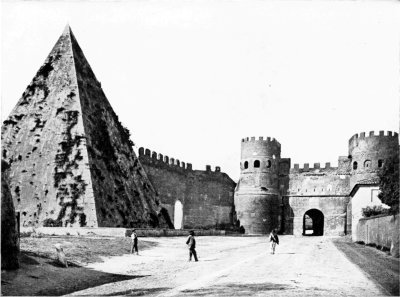
PORTA SAN PAOLA, PYRAMID OF CAIUS CESTIUS, ROME
In the old cemetery (immediately adjoining the pyramid and separated from the new one by a wall) is the grave of Keats (who died in 1821) with its unique inscription, “Here lies one whose name was writ in water.” Beside it is that of his friend, Joseph Severn, who died in 1829, and near these the grave of John Bell, the famous writer on surgery and anatomy. In the new or more modern cemetery the visitor lingers by the graves of Shelley and his friend, Trelawney; August Goethe (the son of the poet); of William and Mary Howitt, who died in 1879 and 1888. Not merely, however, do the names of Keats and Shelley allure the visitor to poetic meditations; but here lie the earthly forms of many a poet, painter, and sculptor of our own country, with their wives and children, who have sought in the Eternal City the atmosphere for art and who, enamoured by the loveliness of Rome, continued there for all their remaining years. These graves, these sculptured memorials, are eloquent with the joys, the sorrows, the achievements and the failures, the success and the defeat, of the artistic life in a foreign land. Many of these memorial sculptures are the work of the husband or the father, into which is inseparably joined the personal tenderness to the artist’s skill. Especially noticeable are the graves of the wives of three American sculptors,—William Wetmore Story, Richard S. Greenough, and Franklin Simmons. Each of these is marked by a memorial sculpture created by the husband, and the three different conceptions of these sculptors are interesting to contrast. That of Mr. Story is of an angel with outspread wings, kneeling, her head bowed in the utter despair and desolation of hopeless sorrow. The figure has the greatest delicacy of beauty and refinement and tenderness; but it is the grief that has no support of faith, the grief that has no vision of divine consolation. On the memorial monument is simply the name, Emelyn Story, born in Boston, 1820, died in Rome in 1898, and the note that it is the last work of W. W. Story, in memory of his beloved wife. Here, also, is Mr. Story buried, his name and dates of birth and death (1819-1901) alone being inscribed.
At the tomb of Sarah B. Greenough, the wife of Richard S. Greenough, the monument is designed to represent Psyche escaping from the bondage of mortality. This Psyche is emerging from her garments and she holds in her hand a lamp. On this is the inscription: “Her loss was that as of a keystone to an arch.”
Mrs. Greenough was a very accomplished musician, and she had the unique honor of having been made a member of the “Arcadians.”
The memorial sculpture over the grave of Mrs. Franklin Simmons is, as elsewhere noted, the work of her husband, a figure called “The Angel of the Resurrection.” The angel is represented as a male figure (Gabriel) holding in the left hand a golden trumpet while the right is outstretched. His wings are spread, his face partly turned to the right. The form is partially draped and in every detail is instinct with a complete harmony; every fold of the drapery, every curve of the body, and the lofty and triumphant expression of the face in its ineffable glory of achievement proclaim the triumph of immortality. It stands on a pedestal that gives it, from the base of the pedestal to the tip of the outstretched wings, a height of some twenty-one feet. This monument, seen against a background of dark cypress trees, speaks the word of positive and complete faith in the divine promise of eternal life.
“Then life is—to wake, not sleep, Rise and not rest, but press From earth’s level where blindly creep Things perfected, more or less, In the heaven’s height—far and steep.”
The visitor lingers over the grave of that interesting painter, J. Rollin Tilton, whose landscapes from Egypt and Italian scenes were so vivid and picturesque.
Richard Henry Dana, the elder, born in Boston in 1815, came to Rome to die in 1882.
Very near the tomb of William Wetmore and Emelyn Story is that of Constance Fenimore Woolson. Over the graves of William and Mary Howitt is the inscription: “Let not your heart be troubled; believe in God, believe also in me.”
On the wall just back of the new tomb erected over the ashes of Shelley by Onslow Ford in 1891 is a memorial tablet placed to Frederick W. H. Myers, bearing this inscription:—
“This tablet is placed to the memory of Frederick William Henry Myers, born at Keswick, Cumberland, Feb. 6, 1843; died in Rome, Jan. 17, 1901. ‘He asked life of Thee, and Thou gavest him long life ever and forever.’”
Over the grave of John Addington Symonds, whose best monument is in his admirable History of the Renaissance in Italy, is a Latin inscription written by Professor Jowett of Oxford, and a stanza from the Greek of Cleanthes, translated by Mr. Symonds as follows:—
“Lead thou, our God, law, reason, motion, life; All names for Thee alike are vain and hollow; Lead me, for I will follow without strife, Or, if I strive, still more I blindly follow.”
John Addington Symonds, who certainly ranks as the most gifted interpreter of Italy, in her art, her legends and associations, and her landscape loveliness, died in the Rome he so loved in 1893. His wife was ill in Venice, but his daughter, Margaret,—his inseparable companion and his helper in his work,—was with him. It is Miss Symonds who prefaced a memorial volume to her father with the exquisite lines:—
“O Love; we two shall go no longer To lands of summer beyond the sea.”
Near the graves of Keats and of his friend, Joseph Severn, are those of Augustus William Hare and John Gibson, the sculptor, who died in 1868. Some ten years before Hawthorne, meeting Gibson at a dinner given by T. Buchanan Read, wrote of him that it was whispered about the table that he had been in Rome for forty-two years and that he had a quiet, self-contained aspect as of one who had spent a calm life among his clay and marble.
Dwight Benton, an American painter and writer, who was for some time in the diplomatic service and whose home had been in Rome for more than a quarter of a century, lies buried here. For many years he was the editor of The Roman World, which still sustains the interesting character that marked it during his editorship. Of his work in art a friend wrote:—
“In painting, as in literature, Dwight Benton took his inspiration from nature. His paintings of Italian scenery are true and faithful representations of its character and atmospheric effects. His tramps on the Roman Campagna were long and often tiring, but he worked with all an artist’s enthusiasm, unmindful of cold, rain, and even hunger. He would delight, as all true artists, in an old convent, a tree, a tower, a cross, which he would reproduce with a peculiar and striking perfection of tone and color. In his paintings of Keats’s and Shelley’s tombs, not only are the slabs and marble there, but there, also, in all their naturalness, are the stately pines and cypresses above, with the sunshine and shadows alternating between them, and in the background the turreted top of St. Paul’s Gateway, the Pyramid of Caius Cestius, all lending effect and picturesqueness to the whole.”
The present King of Italy purchased one of Mr. Benton’s paintings, called “Giornata di tristezza.”
While art abounds in Rome, less can be said for literature. There is a large and admirable selected Italian library in connection with the Collegio Romano; but while these books circulate, under certain conditions, to visitors, and the courtesy of the librarian and his staff is generously kind, the location and the Italian methods render it a matter of some difficulty to avail one’s self of its resources. In the Piazza di Spagna there are two circulating libraries, but although one of these claims twenty-five thousand volumes, the majority are of mediocre fiction and almost none, if any, of the important modern works are to be found here. The visitor who is a subscriber to this library passes into a small, dark room, where one window looking on the street hardly does more than make the darkness visible, and he must take the catalogue to the window and stand in order to decipher the list, which is hardly, indeed, worth the trouble, as there are very few volumes of any pretension to importance in the collection, and of late years no additions, apparently, have ever been made. The other circulating library, while far preferable, is still in crowded rooms and the assortment is limited. The visitor in Rome who cares for reading matter looks forward with delight to Florence, with its noble circulating library, to which access is so easy and whose conduct in all ways is so convenient and grateful to the guest.
In Rome, however, one finds his romance embodied in life and his history written in the streets and in the marvellous structures. His poetry is in her art, her ruins, her magical loveliness of hillside vistas, her infinite views over the Campagna, her sapphire skies, and her luminous, golden atmosphere.
“Here Ischia smiles O’er liquid miles, And yonder, bluest of the isles, Calm Capri waits Her sapphire gates, Beguiling to her bright estates.” “Oh, Signor! thine the amber hand, And mine the distant sea Obedient to the least command Thine eyes impose on me.”