I THE PERIOD OF MODERN ART IN ROME (continued 2)
Reading edition
Art is progressive, and the present is always the “heir of all the ages” preceding; but it cannot be affirmed that it invariably makes the best use of its rich inheritance.
There are latter-day sculptors who excel in certain excellences that Story lacked; still, it would not be his loss, but our own, if we fail in a due recognition of that in his art which may appeal to the imagination; for, whatever the enthusiasms of other cults may be, there are qualities of beauty, strength, and profound significance in the art of Story that must insure their permanent recognition. Still, it remains true that Mr. Story owes his fame in an incalculable degree to the friendly pens of Hawthorne and others of his immediate circle,—Lowell, Motley, Charles Eliot Norton, Thackeray, Browning,—friends who, according to the latest standards of art criticism, were not unqualified nor absolute judges of art, but who were in sympathy with ideal expression and recognized this as embodied in the statues of Story.
Browning wrote to the London Times an article on Mr. Story’s work, in which he conjured up most of the superlative phrases of commendation that the limits of the English language allow to praise his work, none of whose marshalled force was too poor to do him reverence. The versatile gifts of Story’s personality drew around him friends whose influence was potent and, indeed, authoritative in their time.
Still, any analysis of these conditions brings the searcher back to the primary truth that without the gifts and grace to attract about him an eminent circle of choice spirits he could not have enjoyed this potent aid and inspiration; and thus, that
“Man is his own star,”
is an assertion that life, as well as poetry, justifies. In the full blaze of this fundamental truth, it is, not unfrequently, the mysterious spiritual tragedy of life that many an one as fine of fibre and with lofty ideals
“Leads a frustrate life and blind, For the lack of favoring gales Blowing blithe on other sails.”
Mr. Story was himself of too fine an order not to divine this truth. With what unrivalled power and pathos has he expressed it in his poem—one far too little known—the “Io Victis”:—
“I sing the song of the Conquered, who fell in the Battle of Life,— The hymn of the wounded, the beaten, who died overwhelmed in the strife; Not the jubilant song of the victors, for whom the resounding acclaim Of nations was lifted in chorus, whose brows wore the chaplet of fame, But the hymn of the low and the humble, the weary, the broken in heart, ***** Whose youth bore no flower on its branches, whose hopes burned in ashes away, From whose hands slipped the prize they had grasped at, who stood at the dying of day With the wreck of their life all around them. . . .”
In this poem Mr. Story touched the highest note of his life,—as poet, sculptor, painter, or writer of prose; in no other form of expression has he equalled the sublimity of sentiment in these lines:—
“. . . I stand on the field of defeat, In the shadow, with those who are fallen, and wounded, and dying, and there ***** Hold the hand that is helpless, and whisper, ‘They only the victory win Who have fought the good fight, and have vanquished the demon that tempts us within; Who have held to their faith unseduced by the prize that the world holds on high; Who have dared for a high cause to suffer, resist, fight,—if need be, to die.’”
Such a poem must have its own immortality in lyric literature.
For a period of forty years the home of the Storys in Palazzo Barberini was a noted centre of the most charming social life. Mr. Story’s literary work—in his contributions of essays and poems to the Atlantic Monthly; in his published works, the “Roba di Roma,” “Conversations in a Studio,” his collected “Poems,” and others—gave him a not transitory rank in literature which rivals, if it does not exceed, his rank in art.
Meantime other artists were to take up their permanent abode in the Seven-hilled City,—Elihu Vedder in 1866; Franklin Simmons two years later; Waldo and Julian Story, the two sons of William Wetmore Story, though claiming Rome as their home, are American by parentage and ancestry; and Mr. Waldo Story succeeds his father in pursuing the art of sculpture in the beautiful studios in the Via San Martino built by the elder Story. In 1902 Charles Walter Stetson, with his gifted wife, known to the contemporary literary world by her maiden name, Grace Ellery Channing, set up their household gods and lighted their altar fires in the city by the Tiber, ready, it may be, to exclaim with Ovid:—
“Four times happy is he, and times without number is happy, Who the city of Rome uninterdicted enjoys.”
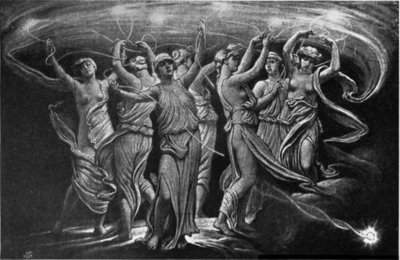
THE DANCE OF THE PLEIADES Elihu Vedder
If art is a corner of the universe seen through a temperament, the temperament of Mr. Vedder must offer an enthralling study, for it seems to be a lens whose power of refraction defies prophecy because it deals with the incalculable forces. His art concerns itself little with the æsthetic, but is chiefly the art of the intellect and the imagination. All manner of symbols and analogies; the laws of the universe that prevail beyond the stars; the celestial figures; the undreamed significance in prophecy or in destiny; omens, signs, and wonders; the world forces, advancing stealthily in the shadows of a dusky twilight; the Fates, under brilliant skies, gathering in the stars; oracles and supernatural coincidences that lurk in undreamed-of days; the Pleiades dancing in a light that never was on sea or land; unknown Shapes that meet outside space and time and question each other’s identity; the dead that come forth from their graves and glide, silent and spectral, through a crowd, unseen by any one; the prayer of the celestial powers poured forth in the utter solitude of the vast desert,—it is these that are the realm of Vedder’s art, and what has the normal world of portrait and landscape to do with such art as this? Can it only be relegated to a class, an order, of its own, and considered as being—Vedderesque? It seems to stand alone and unparalleled. In his work lies the transfiguration of all mystery. Vedder never paints nature, in the sense of landscapes, and yet one often feels that he has the key to the very creation of nature; that he has supped with gods and surprised the secrets of the stars. Do the winds whisper to him?—
“The Muse can knit What is past, what is done, With the web that’s just begun.”
How can he find the design to phrase his thought—this painter of ideas?
“Can blaze be done in cochineal, Or noon in mazarin?”
Whatever the Roman environment may have done for Allston, Page, and Story, there is no question but that to Vedder it has been as his soul’s native air. For him the sirens sing again on the coast; the sorceress works her spell; the Cumæan Sibyl again flies, wraithlike, over the plain, clasping her rejected leaves of destiny which Tarquin in his blindness has refused to buy. The Rome that lies buried under the ages rises for Vedder. His art cannot be catalogued under any known division of portrait, landscape, marine, or genre, but it is simply—the art of Vedder. It stands alone and absolutely unrivalled. The pictorial creations of Vedder are as wholly without precedent or comparison as if they were the sole pictorial treasures of the world. The visitor may care for them, or not care, according to his own ability to comprehend and to recognize the inscrutable genius there manifested; but in either case he will find nowhere else, in either ancient or contemporary art, any parallel to these works.
One could well fancy that to any interrogation of his conceptions the artist might reply:—
“I am seeker of the stone, Living gem of Solomon. But what is land, or what is wave, To me, who only jewels crave? ***** I’m all-knowing, yet unknowing; Stand not, pause not in my going.”
In the rich, weird realm of Omar Khayyam’s Persian poem, the Rubaiyat, Mr. Vedder found the opportunity of his life for translating its thought into strange, mystic symbolism. Never were artist and poet so blended in one as in Vedder’s wonderful illustrations for this poem. It has nothing in common with what we ordinarily call an illustrated work. It is a great treasure of art for all the ages. It is a very fount of inspiration for painter and poet. An exquisite sonnet suggested by “The Angel of the Darker Cup” is the following by Louise Chandler Moulton:—
“She bends her lovely head to taste thy draught, O thou stern Angel of the Darker Cup! With thee to-night in the dim shades to sup, Where all they be who from that cup have quaffed. She had been glad in her own loveliness, and laughed At Life’s strong enemies who lie in wait; Had kept with golden youth her queenly state, All unafraid of Sorrow’s threat’ning shaft. “Then human Grief found out her human heart, And she was fain to go where pain is dumb; So Thou wert welcome, Angel dread to see, And she fares onward with thee, willingly, To dwell where no man loves, no lovers part,— Thus Grief that is, makes welcome Death to come.”
The sonnet, the stanza, and the pictorial interpretation all form one beautiful trio in poetic and graphic art.
Writing of Mr. Vedder, Mr. W. C. Brownell speaks of the personal force in a picture and says that with Vedder this personal force is imagination,—“the imagination of a man whose natural expression is pictorial, but who is a man as well as a painter; who has lived as well as painted, who has speculated, pondered, and felt much. . . . It is this,” he continues, “that places Vedder in the front rank of the imaginative painters of the day.” Of Mr. Vedder’s painting called “The Enemy Sowing Tares,” Mr. Brownell writes:—
“. . . Here you note a dozen phases of significance. The theme is unconventional; the man has become the archenemy; the night is weird and awe-inspiring; the tares represent the foe of the church—money; they are sown at the foot of the cross—the symbol of the church. . . . Mr. Vedder has not passed his life in Rome for nothing. His attitude is in harmony with the spirit of the Sistine and the Stanze.”
One of the interesting and mystical works of Vedder is “The Soul between Doubt and Faith,”—three heads, that of the Soul hooded and draped, looking before her with eyes that seem to discern things not seen by mortals; the sinister face of Doubt at the left, the serene, inspiring countenance of Faith at the right. It is a magical picture to have before one with its profoundly significant message. The works of Mr. Vedder will grow more priceless as the years pass by. They are pictures for the ages.
In Mr. Ezekiel, another American artist whose almost lifelong home has been in Rome, is a sculptor whose touch and technique have won recognition. In a recumbent figure of Christ is seen one of the best examples of his art. It is pervaded by the classic influences in which he has lived. The studios of Mr. Ezekiel, in the ruins of the old Baths of Caracalla, are very picturesque and his salon, with its music, its wealth of books including many rare and beautiful copies, and its old pictures and bric-a-brac, is one of the fascinating interiors of the Eternal City.
The visitor who is privileged to see the Story studios in the Via San Martino finds Mr. Waldo Story occupying these spacious rooms where the flash of a fountain in the court, a view of the garden, green-walled by vines, with flowers and shrubs and broken statues, make the place alluring to dreamer and poet. In these rooms may be seen many of the elder Story’s finest statues in cast or marble, the “Libyan Sibyl,” “Nemesis,” “Sappho,” the “Christ,” “Into the Silent Land,” and others, with many portrait busts, among which are those of Browning, Shelley, Keats, Theodore Parker, Mrs. Browning, Marchesa Peruzzi de Medici (Edith Story), John Lothrop Motley, one of Story’s nearer friends, and Lord Houghton.
In the work of Mr. Waldo Story one admirable portrait bust is of Cecil Rhodes. A decorative work, a fountain for the Rothschild country estate in England, is charmingly designed as a Galatea (in bronze), standing in a marble shell that is drawn by Nereids and attended by Cupids. The happy blending of marble and bronze gives to this work a pleasing variety of color. Another decorative design is that of “Nymphs Drinking at the Fountain of Love.” These studios are among the most interesting in Rome.
It was in 1868 that Franklin Simmons, then a young artist from Maine, turned to Rome as his artistic Mecca. Since then the Eternal City has always been his home, but his frequent and prolonged sojourns in America have kept him closely in touch with its national life. Mr. Simmons is the idealist who translates his vision into the actuality of the hour and who also exalts this actuality of the hour to the universality of the vision. In the creation of portrait busts and of the statues and monumental memorials of great men he infuses into them the indefinable quality of extended relation which relegates his work to the realm of the universal and, therefore, to the immortality of art, rather than restricting it to the temporal locality. Louis Gorse observes that it is not the absence of faults that constitutes a masterpiece, but that it is flame, it is life, it is emotion, it is sincerity. Under the touch of Mr. Simmons the personal accent speaks; to his creative power flame and life respond, and to no sculptor is the truth so admirably stated by M. Gorse more applicable.
Mr. Simmons has been singularly fortunate in a wide American recognition, having received a liberal share of the more important commissions for great public works of sculpture. The splendid statue, al fresco, of the poet Longfellow for his native city, Portland, was appropriately the work of Mr. Simmons as a native of the same state; the portrait statues of General Grant, Gov. William King, Roger Williams, and Francis H. Pierrepont, all in Statuary Hall in the Capitol in Washington; the portrait busts of Grant, Sheridan, Porter, Hooker, Thomas, and other heroes of the Civil War; the colossal group of the Naval Monument at the head of Pennsylvania Avenue in Washington,—are all among the works of Mr. Simmons.
Like all artists who, like the poet, are born and not made, Mr. Simmons gave evidence of his artistic bent in his early childhood. After graduating from Bates College he modelled a bust of its president, and a little later, going to Washington (in the winter of 1865-66), many of the noted men of the time gave him sittings, and in a series of portrait busts his genius impressed itself by its dignity of conception and an unusual power of sympathetic interpretation. He modelled the bust of Grant while he was the General’s guest in camp, taking advantage of whatever spare minutes General Grant could give for sittings in the midst of his pressing responsibilities; and it is perhaps due to this unusually intimate intercourse with the great hero, and the rapport, not difficult of establishment, between two men whose natures were akin in a certain noble sincerity and lofty devotion to the purest ideals, that Mr. Simmons owes the power with which he has absolutely interpreted the essential characteristics of General Grant in that immortal portrait statue in the Capitol.
Washington is, indeed, the place to especially study the earlier work of Franklin Simmons. An important one is the Logan memorial,—an equestrian statue which is considered the finest work in sculpture in the capital, and which is the only statue in the United States in which both the group and the pedestal are of bronze. The visitor in Washington who should be ignorant of the relative rank of the great men commemorated by the equestrian memorial monuments of the city might be justified in believing that General Logan was the most important man of his time, if he judged from the relative greatness of his statue. When Congress decided upon this group, Mr. Simmons was requested to prepare a model. This proving eminently acceptable, Mr. Simmons found himself, quite to his own surprise, fairly launched on this arduous work, involving years of intense concentration and labor. For this monumental work was to be not merely that of the brave and gallant military leader,—a single idea embodied, as in those of Generals Scott, Sheridan, Thomas, and others,—but it was to be a permanent interpretation of the soldier-statesman, mounted on his battle-horse; it was to be, in the comprehensive grasp of Mr. Simmons, the vital representation of the complex life and individuality of General Logan and, even more, it must reflect and suggest the complex spirit of his age. In this martial figure was thus embodied a manifold and mysterious relation, as one of the potent leaders and directive powers in an age of tumultuous activities; an age of strife and carnage, whose goal was peace; of adverse conditions and reactions, whose manifest outcome was yet prosperity and national greatness and splendid moral triumph. All these must be suggested in the atmosphere, so to speak, of the artist’s work; and no sculptor who was not also an American—not merely by ancestry and activity, but one in mind and heart only; one who was an intense patriot and identified with national ideas—could ever have produced such a work as that of the Logan monument. So unrivalled does it stand, unique among all the equestrian art of this country, that it enchants the art student and lover with its indefinable spell. When this colossal work was cast in bronze, in Rome, the event was considered important. The king and the Royal family visited the studio of Mr. Simmons to see the great group, and so powerfully did its excellence appeal to King Umberto that he knighted Mr. Simmons, making him Cavaliere of the Crown of Italy. Nor was Mr. Simmons the prophet who was not without honor save in his own country, for his alma mater gave him the degree of M.A. in 1867; Colby College honored him with the Master’s degree in 1885, and in 1888 Bowdoin bestowed upon this eminent Maine artist the same degree. In 1892 Mr. Simmons married the Baroness von Jeinsen, a brilliant and beautiful woman who, though a lady of foreign title, was an American by birth. An accomplished musician, a critical lover of art, and the most delightful of hostesses and friends, Mrs. Simmons drew around her a remarkable circle of charming people and made their home in the Palazzo Tamagno a notable centre of social life. No woman in the American colony of the Seven-hilled City was ever more beloved; and it was frequently noted by guests at her weekly receptions that Mrs. Simmons was as solicitous for the enjoyment of the most unknown stranger as for those of rank and title who frequented her house. Her grace and loveliness were fully equalled by her graciousness and that charm of personality peculiarly her own. Her death in Rome, on Christmas of 1905, left a vacant place, indeed, in many a home which had been gladdened by her radiant presence. One of the most beautiful works of Mr. Simmons is a portrait of his wife in bas-relief, representing her standing just at the opening of parted curtains, as if she were about to step behind and vanish. It is a very poetic conception. A bust of Mrs. Simmons, also, in his studio, is fairly a speaking likeness of this beautiful and distinguished woman. It is over her grave in the Protestant cemetery that Mr. Simmons has placed one of his noblest ideal statues, “The Angel of the Resurrection,”—a memorial monument that is one of the art features of Rome to the visitor in the Eternal City.
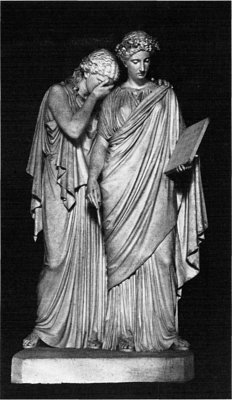
“GRIEF AND HISTORY,” DETAIL FROM NAVAL MONUMENT, WASHINGTON Franklin Simmons
The brilliant and impressive Naval Monument, or Monument of Peace, as it is known in Washington, placed at the foot of Capitol Hill on Pennsylvania Avenue, is eloquent with the power of heroic suggestion that Mr. Simmons has imparted to it. The work breathes that exaltation of final triumph that follows temporary defeat. Those who died that the nation might live, are seen in the perpetual illumination of immortality. Not only has Mr. Simmons here perpetuated the suffering, the sacrifices of the Civil War, but that sublime and eternal truth of victory after defeat, of peace and serene exaltation after conflict, and the triumph of life after death, are all immortally embodied in this group crowned with those impressive and haunting figures, “Grief” and “History,” which are considered as among the most classically beautiful and significant in the range of modern sculpture.
In the early winter of 1907 Mr. Simmons was invited by the American Ambassador to the Court of St. James, Hon. Whitelaw Reid, to send for Dorchester House, London, three busts of distinguished Americans,—those of Alexander Hamilton, Chief Justice Chase, and Hon. James G. Blaine, which Mr. Reid, in visiting the Roman studios of Mr. Simmons, had seen and greatly admired. The Ambassador observed that he “would like a few Americans, as well as so many Roman Emperors,” about him.
These portrait busts all reveal an amazing force and mastery of work. The fine sculptural effect of the Hamilton and the wonderful blending of subtle delicacy of touch and vigor of treatment with which the nobility of character is expressed, mark this bust as something exceptional in portrait art. It has a matchless dignity and serene poise. The bust of Chief Justice Chase is a faithful and speaking reproduction of the very presence of its subject, instinct with vitality; and the fire and force and brilliancy of the bust of Hon. James G. Blaine fairly sweeps the visitor off his feet. The modelling is done with an apparent instantaneousness of power that is the highest realization of creative art. It is the magnetic Blaine, the impassioned and eloquent statesman, that rises before the gazer.
Mr. Simmons has long been a commanding figure in plastic art. No American sculptor abroad has, perhaps, received so many important public commissions as have been given to him. He has created nearly a score of memorial groups; he has modelled over one hundred portrait busts and statues. His industry has kept step with his genius. The latest success of Mr. Simmons in the line of monumental art is the statue (in bronze) of Alexander Hamilton, which was unveiled at Paterson, N. J., in May of 1907. The splendidly poised figure, the dignity, the serene strength and yet the intense energy of the expression and of the entire pose are a revelation in the art of the portrait statue.
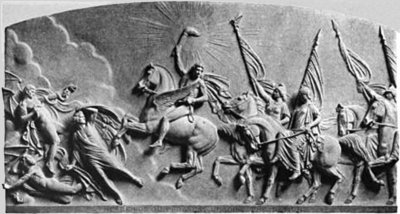
“THE GENIUS OF PROGRESS LEADING THE NATIONS” Franklin Simmons
It is not, however, true that Mr. Simmons has ever resigned himself to the necessity of producing portrait and memorial sculpture exclusively. In the realm of the purely ideal Mr. Simmons finds his most felicitous field for creative work. A bas-relief entitled “The Genius of Progress Leading the Nations,” with all its splendid fire and action, the motif being that of the spirits Life and Light beating down and driving out the spirits of darkness and evil; “The Angel of the Resurrection,” with its glad, triumphant assertion of the power of the immortal life; the poetry and sacredness of maternity as typified in the “Mother of Moses;” the statues of the “Galatea” and the “Medusa,” and other ideal creations, indicate “the vision and the faculty divine” of Mr. Simmons. To a very great degree his art is that which the French describe as the grand manner, and to this is added a spiritual quality, a power of radiating the intellectual purpose, the profounder thought and the aspiration of the subject represented.
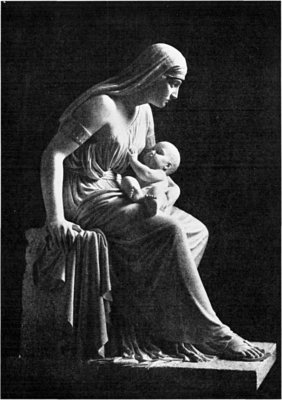
“MOTHER OF MOSES” Franklin Simmons
One of the most charming of these ideal works is a statue of “Penelope,” represented seated in the chair, her rich robe falling in graceful folds, and the little Greek fillet binding her hair. The face bears a meditative expression, into which has entered a hint of pathos and wistfulness in the dawning wonder as to whether, after all, Ulysses will return. The classic beauty of the pose; the exquisite modelling of the bust and arms and hands, every curve and contour so ideally lovely; the distinction of the figure in its noble and refined patrician elegance, are combined to render this work one that well deserves immortality in art, and to rank as a masterpiece in modern sculpture.
Another of his ideal figures, “The Promised Land,” is a work of great spiritual exaltation and beauty. An Israelite woman has just arrived at the point when before her vision gleams the “Promised Land”; the face tells its own story of all she has passed through,—the trials, the sadness, the obstacles to be overcome; but now she sees the fulfilment of her hopes and dreams. It is a most interesting creation, and one in which is portrayed the artist’s spiritual insight and susceptibility to poetic exaltation. To one visitor to Mr. Simmons’s studio this statue suggested the following lines:—
Fair on her sight it gleams,—the Promised Land! The rose of dawn sifts through the azure air, And all her weariness and toil and care Vanish, as if from her some tender hand Lifted the burden, and transformed the hour To this undreamed-of sense of joy and power! The rapture and the ecstasy divine Are deep realities that only wait Their hour to dawn, nor ever rise too late To draw the soul to its immortal shrine. O Sculptor! thy great gift has shaped this clay, To image the profoundest truth, and stand As witness of the spirit power that may Achieve the vision of the Promised Land!
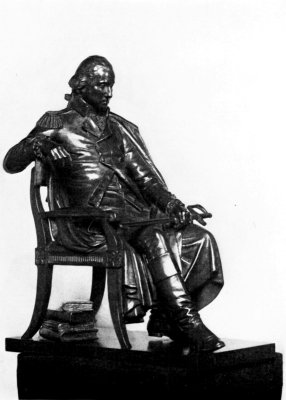
“VALLEY FORGE” Franklin Simmons
In a statuette in bronze called “Valley Forge,” Mr. Simmons has fairly incarnated the entire spirit of the Revolutionary period in that mysterious way recognized only in its result; all that unparalleled epoch of tragic intensity and sublime triumph lives again in this work. The fidelity to a lofty ideal which essentially characterizes Mr. Simmons is as unswerving as that of Merlin, who followed “The Gleam.”
“Great the Master And sweet the Magic When over the valley In early summers, Over the mountain, On human faces, And all around me Moving to melody, Floated the Gleam.”
This American sculptor who, in his early youth, sought the artistic atmosphere of Rome as the environment most stimulating to his dawning power, who accepted with unfailing courage the incidental privations of art life in a foreign land more renowned for beauty than for comfort, who
“. . . never turned his back, but marched breast forward, Never doubted clouds would break,”
has expressed his message in many purely ideal works,—the message that the true artist must always give to the world and that leads humanity to the crowning truth of life, that of the ceaseless progress of the soul in its immortality.
For the brief and significant assertion of the apostle condenses the most profound truth of life when he says:—
“To be carnally minded is death; but to be spiritually minded is life and peace.”
In these words are imaged the supreme purpose of all the experiences of the life on earth; and to the artist whose works bear this lofty message of the triumph of spirituality, his reward shall appear, not in the praise of men, but in the effect on character that his efforts have aided to exalt; in the train of nobler influences that his work shall perpetually inspire and create.
Mr. Simmons has always found Rome potent in fascination. One may not want to go to St. Peter’s every day, but one knows it is there, and there is some inexplicable satisfaction in being where it is possible to easily enter this impressive interior. One may not go near the Forum for a month, or even a season, but the knowledge that one may find it and the wonderful Palatine Hill any hour of any day is a perpetual delight. The Vatican galleries, with their great masterpieces; the Sistine Chapel, the stately, splendid impressiveness of San Giovanni Laterano; the wanderings in Villa Borghese, and the picturesque climbing of the Spanish steps, even all the inconveniences and deprivations, become a part of the story of Rome which the artist absorbs and loves.
The studios of Mr. Simmons in the Via San Nicolo da Tolentino are a centre of artistic resort, and his personal life is one of distinction amid the picturesque beauty and enchantment of the Eternal City.
For many years (until the death of Mrs. Simmons in 1905) the sculptor and his wife had their home in the beautiful Palazzo Tamagno in the Via Agostino Depretis, where one of those spacious apartments of twenty to thirty rooms, only to be found in a Roman palace, was made by them a brilliant centre of social life. Mrs. Simmons was herself a musical artist, with impassioned devotion to music; and her rare personal charm and distinction of presence drew around her a most interesting circle. Her receptions were for many years a noted feature of Roman society. The social life in Rome is very brilliant, interesting, and fascinating. The sight-seeing is a kind of attendant atmosphere,—the perpetual environment offering, but not intruding itself. People come to Rome for reasons quite disconnected with the Golden House of Nero or the latest archæological discoveries in the Forum. The present, rather than the past, calls to them, and the present, too, is resplendent and alluring.
Of the foreign painters in Rome, Charles Walter Stetson, whose work recalls the glory of the old Italian masters, is especially distinguished for his genius as a colorist. No visitor in Rome can afford to miss the studio of one of the most imaginative of modern artists. A wonderful picture still in process is a genre work with several figures, called “Music.” An idyllic scene of a festa amid the ilex trees—with the Italian sky and the golden sunshine pervading a luminous atmosphere, while the joyous abandon of the dancers appeals to all who love Italy—is one of the many beautiful pictorial scenes of Mr. Stetson which enchant the eye and haunt the imagination. Another picture is called “Beggars,”—a name that illy suggests its splendor. There is the façade of a church to which a long flight of steps leads up, a procession of cardinals and friars in their rich robes, while at one side the groups of beggars shrink into the darkness. It is an impressive commentary upon life.
For a long period, through the early and middle years of the nineteenth century, Rome held her place as the world centre of modern artistic activity. Great works of poetic and ideal sculpture elevated the general public taste to a high degree of appreciation. The standards were not ingeniously adjusted to mere spectacular methods whose sole appeal was to the crude fancy of possible patrons. Art held her absolute and inviolate ideals, and the spirit of her votaries might well have been interpreted in Mrs. Browning’s words:—
“I, who love my art, Would never wish it lower to suit my stature.”
The tone of public appreciation is raised to a high quality only when the artist refuses to sell his soul for a mess of pottage. He may, to be sure, need the pottage, but the price is too great. Rather will he find his attitude expressed in these wonderful lines:—
“I can live At least my soul’s life without alms from men. And if it be in heaven instead of earth, Let heaven look to it—I am not afraid.”
All art that has within itself true vitality must ever be the leader and the creator of the popular taste; only when it falls into decadence does it become the servile follower.
It is a serious question as to the degree in which the art of to-day keeps faith with the eternal ideals. The great expositions of the past quarter of a century, while they have contributed immeasurably to the popularization of art and to the familiarization of the public with the work of individual painters and sculptors, have yet, in many ways, been a demoralizing influence in their insidious temptation to produce pictures or plastic art calculated to arrest immediate attention, thus putting a premium on the spectacular, the sensational, on that which makes the most immediate and direct appeal to the senses. The work becomes fairly a personal document wrought with perhaps an almost amazing finesse, but utterly failing in power to inspire joyous sensibility to beauty or to impart to the gazer that glow of radiant energy which lofty art invariably communicates to all who respond to its infinite exaltation.
All great art is inspired by religious ideals. Painting and sculpture give to these a presence. Under their creative power are these ideals manifested. To embody them in living form becomes the absolute responsibility of the artist. In Greece all the fortunate conditions to produce great art were curiously combined and pre-eminently supported by the conjunction of events and by the prevailing sentiment of the time. The artist drew his inspiration from the most exalted conception of life embodied in gods rather than in men. Art, too, was an affair of the state. It was the supreme interest and held national importance. The temple was erected to form an inclosure for the statue, rather than that the statue was created as an adornment for the temple. The greatest gifts were consecrated to the service of art, and under these stimulating influences it is little wonder that artistic creation achieved that vital potency which has thrilled all succeeding centuries and has communicated to them something of the divine air of that remote period. With the Renaissance in Italy art culminated in the immortal work of Raphael and Michael Angelo. In the Sistine Chapel, where that sublime grouping of prophets and sibyls speaks of the very miracle of art in their impassioned fire and glow; where the figures, the pose, the draperies are so grandly noble and infused with dignity and presence,—the very atmosphere is vocal with the language of the spirit and the expressions of religious reverence. These marvellous shapes of grandeur and sublime intimations carry the soul into a conscious communion with the divine. In these stupendous works Michael Angelo has given to all the ages the message of the highest exaltation of art. In the technique, in the marvellous dignity of the sentiment, in the depth of the feeling involved, in the grace and power of the composition, these works embody the artistic possibilities of painting.
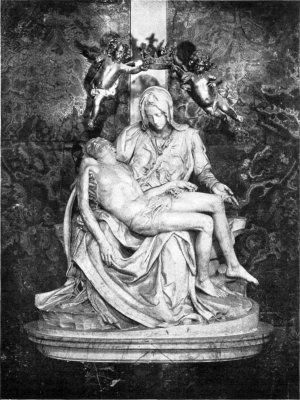
“LA PIETA,” ST. PETER’S, ROME Michael Angelo
Are such works as those of Canova and Thorwaldsen no longer created?
Can it be that art is no longer of national importance? In our own country vast appropriations are made for internal improvements of all kinds, while art that kindles and re-enforces life is almost ignored. Our government—the government of the richest country in the world—appropriated $200,000 for a memorial monument to General Grant to be placed in Washington, while Italy—whose resources are so slender in comparison—appropriates seven million dollars—thirty-five times the amount—for her great monument to Victor Emmanuel which is now being erected in Rome to stand near the Capitol and the Palace of the Quirinale. Great art has always been closely associated with great devotion to religious ideals. The artist was the servant of the Lord, and it was his supreme purpose to embody the aspirations of the age and render his works a full and complete symbol of those true realities of life which have their being in the spiritual universe rather than in the changing temporal world of the outer universe. The so-called realism of the day is based on a false interpretation. “The things that are seen are temporal, while the things that are not seen are eternal.” True realism is in spiritual qualities, not in physical attributes. True realism is found in such works as Canova’s sublime group, where the figures of Religion and of Death forever impress all who stand before this magnificent monument; it is found in Thorwaldsen’s “Christ;” in Franklin Simmons’s “Angel of the Resurrection,”—in such works as those that have a language for the soul, rather than in a “Saturnalia.”
Again, another fatal rock on which art must inevitably make shipwreck is the theory that it is good to perpetuate ugliness, in either painting or in sculpture. The permanent reality of life is beauty. So far as any person or object departs from this enduring reality, so far it is the result of distortion and deformity, and these, being the temporary, the accidental, the deficient, should not be perpetuated in ideal creation. It is an Apollo who embodies the permanent ideal of manhood—not a cripple or a hunchback. Still further: art should not only refuse to embody the defective, which is a mere negative; it should not only give form to the utmost perfection it beholds in nature or in humanity, but beyond this the responsibility is upon the artist to penetrate into loftier realms, to catch the vision not revealed to mortals. The artist is, by virtue of his high calling, a co-worker with God. An English wit has declared that life copies art rather than that art copies life. In this he expresses a truth rather than a merely clever epigram. It is the artist’s business to lead, not to follow. Only as he leads does he fulfil his divinely appointed destiny. “I maintain that life is not a form of energy,” writes Sir Oliver Lodge; “that it is not included in our present physical categories; that its explanation is still to be sought. And it appears to me to belong to a separate order of existence, which interacts with this material frame of things, and while here exerts guidance and control on the energy which already here exists; for although they alter the quantity of energy no whit, and though they merely utilize available energy like any other machine, live things are able to direct inorganic terrestrial energy along new and special paths, so as to achieve results without which such living agency could not have occurred.” Does it for an instant seem that a great scientist’s theoretical speculations of the laws of the universe and of organic life have no connection with the province of art? On the contrary. Truly does Balzac exclaim: “Is not God the whole of science, the all of love, the source of poetry?” The artist is he who enters into the divine realm; who discerns the divine creations as the true ideals of humanity, and who interprets to the world the sublime significance of the divine thought. Shall such an artist degrade his power by portraying ugliness—the mere defects of negations and distortions? Shall he degrade life by calling these the realities?
The painter or sculptor who holds that it is as truly art to represent distortion and repulsiveness as it is to represent beauty is as false to his high calling as would be the poet who should insist that doggerel and mere commonplace truisms expressed in rhyme are poetry. Compare, for example, two statues, Cecioni’s “La Madre,” in which a woman’s utter lack of personal attraction is so complete as to make her fairly repulsive to the gazer, and the “Mother of Moses,” by Franklin Simmons, in which the mystic beauty, the very ideal of maternity, is embodied. Which of these statues is calculated to uplift and to exalt all who come near? This marvellously beautiful creation of Mr. Simmons shows a woman of exquisite delicacy and loveliness sitting, slightly bending forward, holding her baby to her breast. The modelling of the draped figure with the bare arms and neck revealing the tender curves, the yielding delicacy of the flesh and that inscrutable light upon the beautiful countenance, whose expression suggests that she is looking far into the future of the infant whom she holds in her arms, are a wonderful portrayal of the mystery and the sacredness of motherhood. The one statue degrades maternity; the other ennobles and exalts. The one embodies a pernicious and a false ideal; the other embodies the ideal that must appeal to all that is noble and divine in human life, and it thus ministers to moral progress by its contribution to the elevation of the social tone. For indeed, life follows art. It is art that exerts this powerful influence upon life which it may lead to loftier heights or drag down to the moral abyss. The artist is not merely the portrayer of existing types; he is the inspirer of those ideal types which human life should recognize as its pattern, its model to be followed and ultimately achieved. The world needs ideal and poetic art to minister to the attainment of the true social life and to the full and complete expression of man himself.
Do not the visions of Fra Angelico and Botticelli still inspire the artist of to-day with the absolute realization of all the deep significance of the past?
“Is there never a retroscope mirror, In the realms and corners of space, That can give us a glimpse of the battle, And the soldiers face to face?”
Religion and art are inseparably united. In its true significance religion takes precedence of all else in that its influence is felt in every department and in every direction and expression of man’s activity. It is the inexhaustible fountain of that lofty energy which communicates itself to every channel that carries inspiration to life and to art. Religion is the influence that redeems the mere shallow, surface presentation,—the petty trick to capture popularity, and holds art true to its real purpose. The glory of the mediæval art of Italy owed its greatness to religion. Cimabue and Giotto were directly inspired by that spring of a diviner life given to Italy and later to the world of that “sweet saint,” Francis of Assisi. In an age of cruelty and terror he brought the new message that man is dear to God; that the soul is ceaselessly joyful; that man, created in the divine image, is a part of the divine life, and that only when he lives in this response and recognition does he truly live at all. In this restatement of the truth that Jesus came to proclaim, St. Francis opened the way for a revival of art, and opened the gates of that infinite and divine energy which has immortally recorded itself for all ages in the “Divina Comedia” of Dante. The irresistible wave of power which resulted from that liberating of thought, feeling, and emotion by the work of St. Francis expressed itself in the sublimest poem of all the ages, and in that glorious triumph of art that is still the treasure and the source of artistic inspiration.
It is only when the world is lifted out of the limitations of the material by a period of great art that humanity is brought into close and inspiring relation with the living Christ.
Men and women make the world, As head and heart make human life. Mrs. Browning.
Alas, our memories may retrace Each circumstance of time and place; Season and scene come back again, And outward things unchanged remain; The rest we cannot reinstate, Ourselves we cannot re-create, Nor set our souls to the same key Of the remembered harmony. Longfellow.
And as, after the lapse of a thousand years, you stand upon that hallowed spot, the yellow Tiber flowing sluggishly beneath you, the ruins of the Eternal City all around you speaking of fallen greatness, the mighty Basilica of St. Peter rising before you like some modern tower of Babel that would monopolize the road to heaven, the eye rests upon the figure of the Archangel sheathing his glittering sword upon the summit of the Castle of St. Angelo, and the heart asks, Why should that be a legend? Why should that be a projection of a morbid and devout imagination? Why should it not have been the clairvoyance of supernatural ecstasy opening the world of spirits? It was no unreality when the angel of God, with his sword drawn in his hand, withstood the prophet Balaam. It was no morbid imagination when the angel of God smote with the edge of the sword the first-born of the land of Egypt. It was no imposture when the shining hosts of the army of the Almighty smote the Assyrians. It was no deception when Gabriel, the King’s messenger from the court of heaven, was sent to comfort Daniel by the river Hiddekel; or when he announced to the maiden, whom all generations have called blessed, that she was to be the mother of the Divine Redeemer. . . . The written Word from first to last is full of the holy angels. It begins with angels, it ends with angels.
The Venerable Archdeacon Wilberforce, Westminster Abbey.