Volume 4 — ITALY AT WAR (continued 3)
Reading edition
The fighting before Verdun illustrated and emphasized the revolution in methods of attack and defense which has taken place in the French army. At the beginning of the war the French believed in depending largely on their light artillery both to prepare and to support an attack, and for this purpose their 75's were admirably adapted. This method worked well when carried out properly, and before the Germans had time to bring up their heavy guns; it was by resorting to it that the French won the victory of the Marne. But the Marne taught the Germans that the surest way to break up the French system of attack was to interpose obstacles, such as woods, wire entanglements, and particularly trenches. To destroy these obstacles the French then had to resort to heavy-calibered pieces, with which, as I have already remarked, they were at first very inadequately supplied. In the spring of 1915 in Artois, and in the autumn of the same year in Champagne, they attempted to break through the German lines, but these attacks were not supported by sufficient artillery and were each conducted in a single locality over a limited front. Then, at Verdun, the Germans tried opposite tactics, attempting to break through on a wide front extending on both sides of the Meuse. So appalling were their losses, however, that, as the attack progressed, they were compelled by lack of sufficient effectives to constantly narrow their front until finally the action was taking place along a line of only a few kilometres. This permitted the French to concentrate both their infantry and their artillery into dense formations, and before this concentrated and intensive fire the German attacking columns withered and were swept away like leaves before an autumn wind.
The French infantry—and the same is, I believe, true of the German—is now to all intents and purposes divided into two classes: holding troops and attacking, or "shock" troops, as the French call them. The latter consist of such picked elements as the Chasseur battalions, the Zouaves, the Colonials, the First, Twentieth, and Twenty-first Army Corps, and, of course, the Foreign Legion. All these are recruited from the youngest and most vigorous men, due regard being also paid to selecting recruits from those parts of France which have always produced the best fighting stock—and among these are the invaded districts. Shock troops are rarely sent into the trenches, but when not actively engaged in conducting or resisting an attack, are kept in cantonments well to the rear. Here they can get undisturbed rest at night, but by day they are worked as a negro teamster works his mule. As a result, they are always "on their toes," and in perfect fighting trim. In this way mobility, cohesion, and enthusiasm, all qualities which are seriously impaired by a long stay in the trenches, are preserved in the attacking troops, who, when they go into battle, are as keen and hard and well-trained as a prize-fighter who steps into the ring to battle for the championship belt.
The most striking feature of the new French system of attack is the team-work of the infantry, artillery, and airplanes. The former advance to the assault in successive waves, each made up of several lines, the men being deployed at five-yard intervals. The first wave advances at a slow walk behind a curtain of artillery fire, which moves forward at the rate of fifty yards a minute, the first line of the wave keeping a hundred to a hundred and fifty yards, or, in other words, at a safe distance, behind this protecting fire-curtain. The men in this first line carry no rifles, but consist exclusively of grenadiers, automatic riflemen, and their ammunition carriers, every eighth man being armed with the new Chauchat automatic rifle, a recently adopted weapon which weighs only nineteen pounds, and fires at the rate of five shots a second. Three men, carrying between them one thousand cartridges, are assigned to each of these guns, of which there are now more than fifty thousand in use on the French front. The automatic riflemen fire from the hip as they advance, keeping streams of bullets playing on the enemy just as firemen keep streams of water playing on a fire. In the second line the men are armed with rifles, some having bayonets and others rifle grenades, the latter being specially designed to break up counter-attacks against captured trenches. A third line follows, consisting of "trench cleaners," though it must not be inferred from their name that they use mops and brooms. The native African troops are generally used for this trench-cleaning business, and they do it very handily with grenades, pistols and knives.
When the first wave reaches a point within two hundred to three hundred yards of the enemy's trenches, a halt of five minutes is made to re-form for the final charge. In addition to the advancing curtain-fire immediately preceding the troops, a second screen of fire is dropped between the enemy's first and second lines, thus preventing the men in the first line from retreating and making it equally impossible for the men in the second line to get reinforcements or supplies to their comrades in the first. Still other batteries are engaged in keeping down the fire of the hostile artillery while the big guns, mounted on railway-trucks, shell the enemy's headquarters, his supports, and his lines of communication.
The attack is accompanied by and largely directed by airplanes, certain of which are assigned to regulating the artillery fire, while others devote themselves exclusively to giving information to the infantry, with whom they communicate by means of dropping from one to six fire-balls. As the aircraft used for infantry and artillery regulation are comparatively slow machines, they are protected from the attacks of enemy aviators by a screen of small, fast battle-planes—the destroyers of the air—which, in several cases, have swooped low enough to use their machine-guns on the German trenches. If it becomes necessary to give to the infantry some special information not provided for by the prearranged signals, the aviator will volplane down to within a hundred feet above the infantry and drop a written message. I was told that in one of the successful French attacks before Verdun such a message proved extremely useful as by means of it the troops advancing toward Douaumont, which was then held by the Germans, were informed that the enemy was in force on their right, but that there was practically no resistance on their left. Acting in response to this information from the skies, they swung forward on this flank, and took the Germans on their right in the rear. Just as a football team is coached from the side-lines, so a charge is nowadays directed from the clouds.
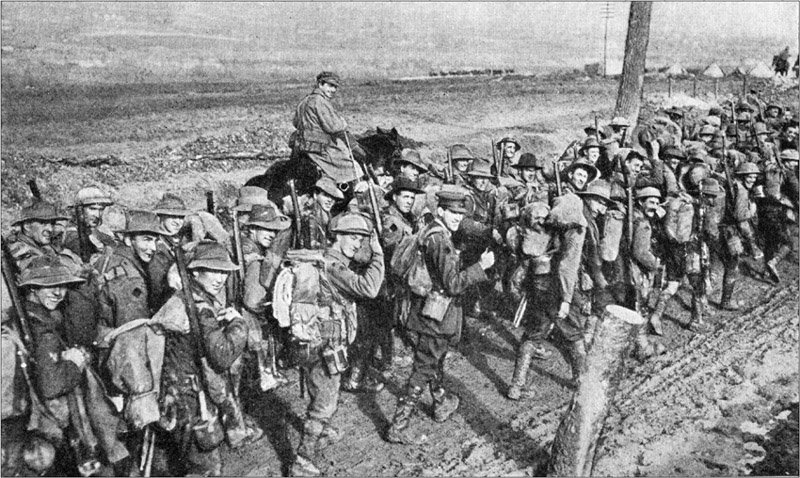
Australians on the Way to the Trenches.ToList
Despite gas, bullets, shells, rain, mud, and cold the British soldier remains incorrigibly cheerful. He is a born optimist.
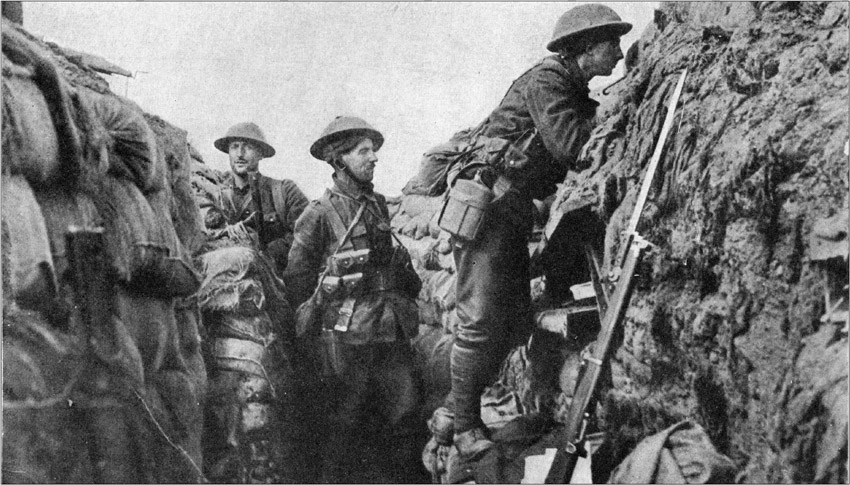
The Fire Trench.ToList
"Figures, looking strangely mediæval in their steel helmets, crouched motionless, peering out into No Man's Land."
One of the picturesque developments of the war is camouflage, as the French call their system of disguising or concealing batteries, airplane-sheds, ammunition stores, and the like, from observation and possible destruction by enemy aviators. This work is done in the main by a corps specially recruited for the purpose from the artists and scene painters of France. It is considered prudent, for example, to conceal the location of a certain "ammunition dump," as the British term the vast accumulations of shells, cartridges, and other supplies which are piled up at the railheads awaiting transportation to the front by motor-lorry. Over the great mound of shells and cartridge-boxes is spread an enormous piece of canvas, often larger by far than the "big top" of a four-ring circus. Then the scene painters get to work with their paints and brushes and transform that expanse of canvas into what, when viewed from the sky, appears to be, let us say, a group of innocent farm-buildings. The next day, perhaps, a German airman, circling high overhead, peers earthward through his glasses and descries, far beneath him, a cluster of red rectangles—the tiled roofs of cottages or stables, he supposes; a patch of green—evidently a bit of lawn; a square of gray—the cobble-paved barnyard—and pays it no further attention. How can he know that what he takes to be a farmstead is but a piece of painted canvas concealing a small mountain of potential death?
At a certain very important point on the French front there long stood, in an exposed and commanding position, a large and solitary tree, or rather the trunk of a tree, for it had been shorn of its branches by shell-fire. A landmark in that flat and devastated region, every detail of this gaunt sentinel had long since become familiar to the keen eyed observers in the German trenches, a few hundred yards away. Were a man to climb to its top—and live—he would be able to command a comprehensive view of the surrounding terrain. The German sharpshooters saw to it, however, that no one climbed it. But one day the resourceful French took the measurements of that tree and photographed it. These measurements and photographs were sent to Paris. A few weeks later there arrived at the French front by railway an imitation tree, made of steel, which was an exact duplicate in every respect, even to the splintered branches and the bark, of the original. Under cover of darkness the real tree was cut down and the fake tree erected in its place, so that, when daylight came, there was no change in the landscape to arouse the Germans' suspicions. The lone tree-trunk to which they had grown so accustomed still reared itself skyward. But the "tree" at which the Germans were now looking was of hollow steel, and concealed in its interior in a sort of conning-tower, forty feet above the ground, a French observing officer, field-glasses at his eyes and a telephone at his lips, was peering through a cleverly concealed peep-hole, spotting the bursts of the French shells and regulating the fire of the French batteries.
Nearly three years have passed since Germany tore up the Scrap of Paper. In that time the French army has been hammered and tempered and tested until it has become the most formidable weapon of offense and defense in existence. I am convinced that in organization and in efficiency it is now, after close on three years of experiments and object-lessons, as good, if not better, than the German—and I have marched with both and have seen both in action. Its light artillery is admittedly the finest in the world. Though without any heavy artillery to speak of at the beginning of the war, it has in this respect already equalled if not surpassed the Germans. It has created an air service which, in efficiency and in number of machines, is unequalled. And the men, themselves, in addition to their characteristic élan, possess that invaluable quality which the German soldier lacks—initiative.
It is worthy of note, in this connection, that the entire reorganization of the French army has been carried out virtually without any action on the part of the French Congress, and with merely the formal approval of the Minister of War. The politicians in Paris have, save in a few instances, wisely refrained from interference, and have left military problems to be decided by military men. But, when all is said and done, it will not be the generals who will decide this war; it will be the soldiers. And they are truly wonderful men, these French soldiers. It is their amazing calm, their total freedom from nervousness or apprehension, that impresses one the most, and the secret of this calm is confidence. They are as confident of eventual victory as they are that the sun will rise to-morrow morning. They are fanatics, and France is their Allah. You can't beat men like that, because they never know when they are beaten, and keep on fighting.
I like to think that sometimes, in that cold and dismal hour before the dawn, when hope and courage are at their lowest ebb, there appears among the worn and homesick soldiers in the trenches the spirit of the Great Emperor. Cheeringly he claps each man upon the shoulder.
"Courage, mon brave," he whispers. "On les aura!"
FOOTNOTES:
VIIToC
"THAT CONTEMPTIBLE LITTLE ARMY"
In watching the operations on the British front I have always had the feeling that I was witnessing a gigantic engineering undertaking. The amazing network of rails which the British have thrown over Northern France, the endless strings of lorries, the warehouses bulging with supplies, the cranes and derricks, the repair depots, the machine-shops, the tens of thousands of men whose only weapons are the shovel and the pick, all help to further this impression. And, when you stop to think about it, it is an engineering undertaking. These muddy men in khaki are engaged in checking and draining off an unclean flood which, were it not for them, would soon inundate all Europe. And so, because I love things that are clean and green and beautiful, I am very grateful to them for their work of sanitation.
Because most of the despatches from the British front have related to trenches and tanks and howitzers and flying men and raiding-parties, the attention of the American people has been diverted from the remarkable and tremendously important work which is being played by the army behind the army. Yet one of the most splendid achievements of the entire war is the creation of the great organization which links the British trenches with the British Isles. In failing to take into account the Anglo-Saxon's genius for rapid organization and improvization in emergencies, Germany made a fatal error. She had spent upward of forty years in perfecting her war machine; the British have built a better one in less than three. I said in "Vive la France!" if I remember rightly, that the British machine, though still somewhat wabbly and creaky in its joints, was, I believed, eventually going to do the business for which it was designed. That was a year ago. It has already shown in unmistakable fashion that it can do the business and do it well, and it is, moreover, just entering on the period of its greatest efficiency.
In order to understand the workings and the ramifications of this great machine in France (its work in England is another story) you must begin your study of it at the base camps which the British have established at Calais, Havre, Boulogne, and Rouen, and the training-schools at Etaples and elsewhere. Let us take, for example, "Cinder City," as the base camp outside Calais is called because the ground on which it stands was made by dumping ships' cinders into a marsh. It is in many respects one of the most remarkable cities in the world. Its population, which fluctuates with the tide of war, averages, I suppose, about one hundred thousand. It has many miles of macadamized streets (as sandy locations are chosen for these base camps, mud is almost unknown) lined with storehouses—one of them the largest in the world—with stores, with machine-shops, churches, restaurant, club-rooms, libraries, Y. M. C. A.'s—there are over a thousand of them in the war zone—Salvation Army barracks, schools, bathing establishments, theatres, motion-picture houses, hospitals for men and hospitals for horses, and thousands upon thousands of portable wooden huts. This city is lighted by electricity, it has highly efficient police, fire, and street-cleaning departments, and its water and sewage systems would make jealous many municipalities of twice its size. Among its novel features is a school for army bakers and another for army cooks, for good food has almost as much to do with winning battles as good ammunition. But most significant and important of all are the "economy shops" where are repaired or manufactured practically everything required by an army. War, as the British have found, is a staggeringly expensive business, and, in order that there may be a minimum of wastage, they have organized a Salvage Corps whose business it is to sort the litter of the battle-fields and to send everything that can by any possibility be re-utilized to the "economy shops" at the rear. In one of these shops I saw upward of a thousand French and Belgian women renovating clothing that had come back from the front, uniforms which arrived as bundles of muddy, bloody rags being fumigated and cleaned and mended and pressed until they were almost as good as new. Tens of thousands of boots are sent in to be repaired; those that can stand the operation are soled and heeled by American machines brought over for the purpose, and even the others are not wasted, for their tops are converted into boot-laces. In one shop the worn-out tubes and springs of guns are replaced with new ones. (Did you know that during an intense bombardment the springs of the guns will last only two days?) In another fragments of valuable metal sent in from the battle-field are melted and reused. (Perhaps you were not aware that a 5-inch shell carries a copper band weighing a pound and a quarter. The weight of copper shot off in this way during a single brief bombardment was four hundred tons.) The millions of empty shells which litter the ground behind the batteries are cleaned and classified and shipped over to England to be reloaded. Steel rails which the retreating Germans believed they had made quite useless are here straightened out and used over again. Shattered rifles, bits of harness, haversacks, machine-gun belts, trench helmets, sand-bags, barbed wire—nothing escapes the Salvage Corps. They even collect and send in old rags, which are sold for two hundred and fifty dollars a ton. Let us talk less hereafter of German efficiency.
Even more significant than the base camps of the efficiency and painstaking thoroughness of the British war-machine are the training camps scattered behind the lines. Typical of these is the great camp at Etaples, on the French coast, where 150,000 men can be trained at a time. These are not schools for raw recruits, mind you—that work is done in England—but "finishing schools," as it were, where men who are supposed to have already learned the business of war are given final examinations in the various subjects in which they have received instruction before being sent up to the front. And the soldier who is unable to pass these final tests does not go to the front until he can. The camp at Etaples, which is built on a stretch of rolling sand beside the sea, is five miles long and a mile wide, and on every acre of it there are squads of soldiers drilling, drilling, drilling. Here a gymnastic instructor from Sandhurst, lithe and active as a panther, is teaching a class of sergeants drawn from many regiments how to become instructors themselves. His language would have amazed and delighted Kipling's Ortheris and Mulvaney; I could have listened to him all day. Over there a platoon of Highlanders are practising the taking of German trenches. At the blast of a whistle they clamber out of a length of trench built for the purpose, and, with shrill Gaelic yells, go swarming across a stretch of broken ground, through a tangle of twisted wire, and over the top of the German parapet, whereupon a row of German soldiers, stuffed with straw and automatically controlled, spring up to meet them. If a man fails to bury his bayonet in the "German" who opposes him, he is sent back to the awkward squad and spends a few days lunging at a dummy swung from a beam.
Crater fighting is taught in an ingenious reproduction of a crater, by an officer who has had much experience with the real thing and who explains to his pupils, whose knowledge of craters has been gained from the pictures in the illustrated weeklies, how to capture, fortify, and hold such a position. In order to give the men confidence when the order "Put on gas-masks!" is passed down the line, they are sent into a real dugout filled with real gas and the entrances closed behind them. As soon as they find that the masks are a sure protection, their nervousness disappears. In order to accustom them to lachrymal shells, they are marched, this time without masks, through an underground chamber which reeks with the tear-producing gas—and they are a very weepy, red-eyed lot of men who emerge. They are instructed in trench-digging, in the construction of wire entanglements, "knife-rests," chevaux-de-frise, and every other form of obstruction, in revetting, in the making of fascines and gabions, in sapping and mining, in the most approved methods of dugout construction, in trench sanitation, in the location of listening-posts and how to conceal them; they are shown how to cut wire, they are drilled in trench raiding and in the most effective methods of "trench cleaning." The practical work is supplemented by lectures on innumerable subjects. As it is extremely difficult for an officer to make his explanations heard by a battalion of men assembled in the open, a series of small amphitheatres have been excavated from the sand-dunes, the tiers of seats being built up of petrol tins filled with sand. In one of these improvised amphitheatres I saw an officer illustrating the proper method of using the gas-mask to a class of 600 men.
On these imitation battle-fields, any one of which is larger than the field of Waterloo, the men are instructed in the gentle art of bombing, first with "dubs," which do not explode at all, then with toy-grenades which go off harmlessly with a noise like a small firecracker, and finally, when they have become sufficiently expert, with the real Mills bomb, which scatters destruction in a burst of noise and flame. To attain accuracy and distance in throwing these destructive little ovals is by no means as easy as it sounds. The bombing-school at Etaples will not soon forget the American baseball player who threw a bomb seventy yards. The hand-grenade is the unsafest and most treacherous of all weapons and even in practice accidents and near-accidents frequently occur. The Mills bomb, which has a scored surface to prevent slipping, is about the shape and size of a large lemon. Protruding from one end is the small metal ring of the firing-pin. Three seconds after this is pulled out the bomb explodes—and the farther the thrower can remove himself from the bomb in that time the better. Now, in line with the policy of strict economy which has been adopted by the British military authorities, the men receiving instruction at the bombing-schools were told not to throw away the firing-pins, but to put them in their pockets, to be turned in and used over again. The day after this order went into effect a company of newly arrived recruits were being put through their bomb-throwing tests. Man after man walked up to the protecting earthwork, jerked loose the firing-pin, hurled the bomb, and put the firing-pin in his pocket. At last it came the turn of a youngster who was obviously overcome with stage fright. To the horror of his comrades, he threw the firing-pin and put the live bomb in his pocket! In three seconds that bomb was due to explode, but the instructor, who had seen what had happened, made a flying leap to the befuddled man, thrust his hand into his pocket, drew out the bomb, and hurled it. It exploded in the air.
Near Etaples, at Paris Plage, is the largest of the British machine-gun schools. Here the men are taught the operation not only of all the models of machine-guns used by the Allies, but they are also shown how to handle any which they may capture from the Germans. Set up on the beach were a dozen different models, beginning with a wonderfully ingenious weapon, as beautifully constructed as a watch, which had just been brought in from a captured German airplane and of which the British officers were loud in their admiration, and ending with the little twenty-five-pound gun invented by Colonel Lewis, an American. Standing on the sands, a few hundred yards away, were half a dozen targets of the size and outline of German soldiers. "Try 'em out," suggested the officer in command of the school. So I seated myself behind the German gun, looked into a ground-glass finder like that on a newspaper photographer's camera, swung the barrel of the weapon until the intersection of the scarlet cross-hairs covered the mirrored reflection of the distant figures, and pressed together a pair of handles. There was a noise such as a small boy makes when he draws a stick along the palings of a picket fence, a series of flame-jets leaped from the muzzle of the gun, and the targets disappeared. "You'd have broken up that charge," commented the officer approvingly. "Try the others." So I tried them all—Maxim, Hotchkiss, Colt, St. Etienne, Lewis—in turn.
"Which do you consider the best gun?" I asked.
"That one," and he pointed to Colonel Lewis's invention. "It is the lightest, simplest, strongest, and most effective machine-gun made. It weighs only twenty-five and a half pounds and a clip of forty-seven rounds can be fired in four seconds. At present we have four to each company—though the number will probably be increased shortly—and they are so easy to handle that in an attack they go over with the second wave."
"But our Ordnance Department claims that they cannot fire two thousand rounds without heating and jamming," I remarked.
"Who ever heard of a machine-gun being called upon to fire two thousand rounds under actual service conditions?" he asked scornfully. "On the front we rarely exceed two hundred or three hundred rounds; five hundred never. Long before that number can be fired the attack is broken up or the gun is captured."
"In any event," said I, "the American War Department, to whom Colonel Lewis offered his patents, asserts that the gun did not make good on the proving-grounds of Flanders."
"Well," was the dry response, "it has made good on the proving-grounds of Flanders."
The pretty little casino at Paris Plage, where, in the days before the war, the members of the summer colony used to dance or play at petits chevaux, has been converted into a lecture-hall for machine-gunners. Covering the walls are charts and cleverly painted pictures which illustrate at a glance the important rôles played by machine-guns in certain actions. They reminded me of those charts which they use in Sunday-schools to explain the flight of the Israelites out of Egypt or their wanderings in the Wilderness. Seated on the wooden benches, which have been brought in from a school near by, are a score or more of sun-reddened young Englishmen in khaki.
"Here," says the alert young officer who is acting as instructor, unrolling a chart, "is a picture of an action in a little village south of Mons. A company of our fellows were holding the village. There are, you see, only two roads by which the Germans could advance, so the captain who was in command placed machine-guns so as to command each of them. About five o'clock in the morning the Germans appeared on this lower road. Now, the sergeant in charge of that machine-gun, instead of taking cover behind this hedge with this brook in front of him, had concealed his gun in this clump of trees, which, as you see, are out in the middle of a field. No sooner had he opened upon the Boches, therefore, than a detachment of Uhlans galloped around and cut him off from the town. Then it was all over but the shouting. The Germans got into the town and our fellows got it in the neck. And all because that fool sergeant didn't use common sense in choosing a position for his gun. They marked his grave with a nice little white cross. And that's what you boys will get if you don't profit by these things I'm telling you."
There you have an example of the thorough preparation which is necessary to wage modern war successfully. It is not merely a matter of a man being taught how to operate a machine-gun; if he is to be of the greatest value he must be taught how to place that gun where it is going to do the maximum damage to the enemy. And, by means of the graphic Sunday-school charts, and the still more graphic sentences of the officer-teacher, those lessons are so driven home that the men will never forget them.
Virtually everything between England and the fighting front is under the control of the L. C.—Lines of Communication. This vast organization, one of the most wide-spread and complex in the world, represents six per cent of all the British forces in France. Of the countless forms of activity which it comprises, the railways are by far the most important. Did you know that the British have laid and are operating more than a thousand miles of new railway in France? As the existing railways were wholly inadequate for the transportation of the millions of fighting men, with the stupendous quantities of food and equipment, new networks of steel had to be laid, single tracks had to be converted into double ones, mammoth railway-yards, sidings, and freight-houses had to be built, thousands of locomotives, carriages, and trucks provided. This work was done by the Railway Companies of the Royal Engineers, behind which was the Railway Reserve, whose members, before the war, were employed by the great English railway systems. Wearing the blue-and-white brassard of the L. C. are whole battalions of engineers and firemen, bridge-builders, signal-men, freight handlers, clerks, and navvies, all of them experts at their particular jobs. It is impossible to overrate the services which these railway men have performed. They build and staff the new lines which are constantly being constructed; they repair destroyed sections of track, restore blown-up bridges; in short, keep in order the arteries through which courses the life-blood of the army. They are the real organizers of victory. Without them the men in the trenches could not fight a day. You cannot travel for a mile along the British front without seeing an example of their rapid track-laying. They have had to forget all the old-fashioned British notions about track permanency, however, for their business is to get the trains over the rails with the least possible delay; nothing else matters. Engaged in this work are men who have learned the lessons of rough-and-ready construction on the Mexican Central, on the Egyptian State Railways, on the Beira and Mashonaland, and on the Canadian Pacific, and the rate at which they cause the twin lines of steel to grow before one's eyes would have aroused the admiration of such railroad pioneers as Stanford and Hill and Harriman.
The engines for use on these military railways are sent across the Channel with fires already built and banked, water in the boilers, and coal in the tenders. They come in ships specially constructed so that the whole top deck can be lifted off. Giant cranes reach down into the hold and pick the engines up and set them down on the tracks on the quays, the crews climb aboard and shake down the fires, a harassed-looking man, known as the M. L. O. (Military Landing Officer) turns them over to the Railway Transport Officer, who is a very important personage indeed, and he in turn hands the engineers their orders, and, half an hour after they have been landed on the soil of France, the engines go puffing off to take their places in the war machine.
It is not the numbers of men to be transported to the front, nor even the astounding quantities of supplies required to feed those men, which have been the primary cause for crisscrossing all Northern France with this latticework of steel. It is the unappeasable appetite of the guns. "This is a cannon war," Field-Marshal von Mackensen told an interviewer. "The side that burns up the most ammunition is bound to gain ground." And on that assumption the British are proceeding. England's response to the insistent cry of "Shells, shells, shells!" has been one of the wonders of the war. By January 1, 1917, the shell increase for howitzers was twenty-seven times greater than in 1914-15; in mid-caliber shells the increase was thirty-four times; and in all the "heavies" ninety-four times. And the shell output keeps a-growing and a-growing. Yet what avail the four thousand flaming forges which have made all this possible, what avails the British sea-power which has landed these amazing quantities of shells in France, and 2,000,000 of men along with them, if the shells cannot be delivered to the guns? And that is where the great new systems of railway have come in.
"Be lavish with your ammunition," Napoleon urged upon his battery commanders. "Fire incessantly." And it is that maxim which the artillerists of all the nations at war are following to-day. The expenditure of shells staggers the imagination. In a single day, near Arras, the French let loose upon the German lines $1,625,000 worth of projectiles, or almost as great a quantity as Germany used in the entire war of 1870-71. Five million shells of all calibers were fired by the British gunners during the first four weeks of the offensive on the Somme. In one week's attack north of Verdun the Germans fired 2,400,000 field-gun shells and 600,000 larger ones. To transport this mountain of potential destruction required 240 trains, each carrying 200 tons of projectiles.
During the "Big Push" on the Somme, there were frequently eighty guns on a front of two hundred yards. The batteries would fire a round per gun per minute for days on end, the gunners working in shifts, two hours on and two hours off. So thickly did the shells fall upon the German lines that the British observing officers were frequently unable to spot their own bursts. A field-battery of eighteen-pounders firing at this rate will blaze away anywhere from twelve to twenty tons of ammunition a day. As guns firing with such rapidity wear out their tubes and their springs in a few days, it is necessary to rush entire batteries to the repair-shops at the rear. And that provides another burden for the railways.
In addition to the railways of standard gauge, the British have laid down an astonishing trackage of narrow-gauge, Décauville, and monorail systems. These portable and easily laid field railways twist and turn and coil like snakes among the gun positions, the miniature engines, with their strings of toy cars, puffing their way into the heart of the artillery zone, where the ammunition is unloaded, sorted, and classified in calibers, and then artfully hidden from the prying eyes of enemy aviators and from their bombs. These great collections of gun-food the English inelegantly term "ammunition dumps." Nor do the trains that come up loaded go back empty, for upon the miniature trucks are loaded the combings of the battle-field to be shipped back to the "economy shops" in the rear. Where possible, wounded men are sent back to the hospitals in like fashion, some of the railways having trucks specially constructed for this purpose. Where the light railways stop the monorail systems begin, food, cartridges, and mail being sent right up into the forward trenches in small cars or baskets suspended from a single overhead rail and pushed by hand. They look not unlike the old-fashioned cash-and-parcel carriers which were used in American department stores before the present system of pneumatic tubes came in.
Comprising another branch of the L. C.'s multifarious activities are the field telephones, whose lines of black-and-white poles run out across the landscape in every direction. And it is no haphazard and hastily improvised system either, but as good in every respect as you will find in American cities. It has to be good. Too much depends upon it. An indistinct message might cost a thousand lives; a break-down in the system might mean a great military disaster. Every officer of importance in the British zone has a telephone at hand, and as the armies advance the telephones go with them, the wires and portable instruments being transported by the motor-cycle despatch riders of the Army Signal Corps, so that frequently within thirty minutes after a battalion has captured a German position its commander will be in telephonic communication with Advanced G. H. Q. The speed with which the connections are made would be remarkable even in New York. I have seen an officer at General Headquarters establish communication with the Provost Marshal's office in Paris in three minutes, and with the War Office in London in ten.
I might mention in passing that nowadays the General Headquarters of an army (G. H. Q. it is always called on the British front, Grand Quartier-Général on the French, and Comando Supremo on the Italian) is usually eight, ten, fifteen, sometimes twenty-five miles behind the firing-line. Most of the commanding generals have, however, advanced headquarters, considerably nearer the front, where they usually remain during important actions. It is said that at Waterloo Napoleon and Wellington watched each other through their telescopes. Compare this with the battle for Verdun, where the headquarters of the Crown Prince must have been at least thirty miles from those of General Nivelle at Souilly.
If one of the greatest triumphs of the war is the creation of the transport system, another is the maintenance, often under heavy shell-fire, of the highways on which that transport moves. No one can imagine what the traffic from the Channel up to the British front is like; one must see it to believe it. The roads are as crowded with traffic as is Fifth Avenue on a sunny afternoon. Every fifty yards or so are military police, mounted and afoot, who control the traffic with small red flags as do the New York bluecoats with their stop-and-go signs. So incredibly dense was the volume of traffic during the Somme offensive that it is little exaggeration to say that an active man could have started immediately back of the British front and could have made his way to Albert, twenty miles distant, if not, indeed, to the English Channel, by jumping from lorry to wagon, from wagon to ambulance, from ambulance to motor-bus. In going from Albert up to the front I passed hundreds, yes, thousands of lumbering motor-lorries bearing every kind of supply from barbed wire to marmalade. In order to avoid confusion, the lorries belonging to the ammunition-train have painted on their sides a shell, while those comprising the supply column are designated by a four-leaf clover. A whole series of other distinctive emblems, such as stars, crescents, pyramids, Maltese crosses, unicorns, make it possible to tell at a glance to what division or unit a vehicle belongs. I passed six-mule teams from Missouri and Mississippi hauling wagons made in South Bend, Indiana, which were piled high with sides of Australian beef and loaves of French-made bread. Converted motor-buses, which had once borne the signs Bank-Holborn-Marble Arch, rumbled past with their loads of boisterous men in khaki bound for the trenches or bringing back other loads of tired men clad apparently in nothing save mud. Endless strings of ambulances went rocking and rolling by and some of them were dripping crimson. Tractors, big as elephants, panted and grunted on their way, hauling long trains of wagons laden with tins of cocoa or condensed milk, with kegs of nails, with lumber, with fodder. Occasionally a gray staff-car like our own threaded its tortuous and halting way through the terrific press of traffic. We passed one that had broken down. The two officers who were its occupants were seated on the muddy bank beside the road smoking cigarettes while the driver was endeavoring to get his motor started again. One of them, on the shoulder-straps of whose "British warm" were the stars of a captain, was a slender, fair-haired, rather delicate-looking youngster in the early twenties. It was the Prince of Wales, but, so far as receiving any attention from the hurrying throng was concerned, he might as well have been an unknown subaltern. For it is an extremely democratic army, and royalty receives from it scant consideration; Lloyd George is of far more importance than King George to the man in khaki.
Almost since the beginning of the war this particular stretch of road on which I was travelling had been shelled persistently, as was shown by the splintered tree-stumps which lined the road and the shell-craters which pitted the fields on either side. To keep this road passable under such wear and tear as it had been subjected to for many months would have been a remarkable accomplishment under any circumstances; to keep it open under heavy shell-fire is a performance for which the labor battalions deserve the highest praise. Wearing their steel helmets, the road-making gangs have kept at work, night and day, along its entire length, exposed to much of the danger of the men in the trenches, and having none of their protection. There has been no time to obtain ordinary road metal, so they have filled up the holes with bricks taken from the ruined villages which dot the landscape, rolling them level when they get the chance. For nothing must be permitted to interfere with that flow of traffic; on it depends the food for the men and for the guns. An hour's blockade on that road would prove infinitely more serious than would a freight wreck which blocked all four tracks of the New York Central. No wonder that Lord Derby, in addressing his Pioneer Battalions in Lancashire, remarked: "In this war the pick and the shovel are as important as the rifle."
While I was standing on the summit of a little eminence beyond Fricourt, looking down on that amazing scene of industry, a big German shell burst squarely on the road. It wrecked a motor-lorry, it killed several horses and half a dozen men, but, most serious of all, it blew in the road a hole as large as a cottage cellar. The river of traffic may have halted for two or three minutes, certainly not more. In scarcely more time than it takes to tell it, the nearest military police were on the spot. The stream of vehicles bound for the front was swung out into the fields at the right, the stream headed for the rear was diverted into the fields at the left. Within five minutes a hundred men were at work with pick and shovel filling up the hole with material piled at frequent intervals along the road for just that purpose. Within twenty minutes a steam-roller had arrived—goodness knows where it had materialized from!—and was at work rolling the road into hardness. Within thirty minutes after the shell burst the hole which it made no longer existed and the lorries, the tractors, the wagons, the guns, the buses, the ambulances were rolling on their way. Then they bore away the six tarpaulin-covered forms beside the road and buried them.
The weather is a vital factor in war. The heavy rains of a French winter quickly transform the ground, already churned up by months of shell-fire, into a slimy, glutinous swamp, incredibly tenacious and unbelievably deep. Through this vast stretch of mud, pitted everywhere with shell-holes filled with stagnant water, the infantry has to make its way and the guns have to be moved forward to support the infantry. On one stretch of road, only a quarter of a mile long, on the Somme, twelve horses sank so deeply in the mud that it was impossible to extricate them and they had to be shot. No wonder that the soldiers, going up to the trenches, prefer to leave their overcoats and blankets behind and face the misery of wet and cold rather than be burdened with the additional weight while struggling through the molasses-like mire. The only thing that they take up to the trenches which could by any stretch of the imagination be described as a comfort is whale-oil, carried in great jars, with which they rub their feet several times daily in order to prevent "trench feet." If you want to get a real idea of what the British infantryman has to endure during at least six months of the year, I would suggest that you strap on a pack-basket with a load of forty-two pounds, which is the weight of the British field equipment, tramp for ten hours through a ploughed field after a heavy rain, jump in a canal, and, without removing your clothes or boots, spend the night on a manure-pile in a barnyard. Then you will understand why soldiers become so heedless of gas, bullets, and shells. But with it all the British soldier remains incorrigibly cheerful. He is a born optimist and he shows it in his songs. Away back in the early months of the war he went into action to the lilt of "Tipperary." The gloom and depression of that first terrible winter induced in him a more serious mood, to which he gave vent in "Onward, Christian Soldiers." But now he feels that victory, though still far off, is certain, and he puts his confidence into words: "Pack Up Your Troubles in Your Old Kit Bag and Smile, Smile, Smile," "Keep the Home Fires Burning," "When Irish Eyes Are Smiling," and "Hallelujah! I'm a Hobo!" The latter very popular. Then there was another, adapted by the Salvation Army from an old music-hall tune, which I heard a battalion chanting lustily as it went slush-slushing up to the firing-line. It ran something like this:
"The Bells of Hell go ting-a-ling-a-ling For you but not for me. For me the angels sing-a-ling-a-ling, They've got the goods for me. O Death, where is thy sting-a-ling-a-ling, O Grave thy victoree? The Bells of Hell go ting-a-ling-a-ling For you but not for me!"
It is almost impossible to make oneself believe that, less than two years ago, these iron-hard, sun-bronzed, determined-looking men were keeping books, tending shop, waiting on table, driving wagons, and doing all the other humdrum things which make up the working lives of most of us. Yet this citizen army is winning sensational successes against the best trained troops in the world, occupying positions of their own choosing, fortified and defended with every device that human ingenuity and years of experience have been able to suggest. These ex-shopkeepers, ex-tailors, ex-lawyers, ex-farmers, ex-cabmen are accomplishing what most military authorities asserted was impossible: they are driving German veterans out of trenches amply supported by artillery—and they are doing the job cheerfully and extremely well.
I believe that one of the reasons why the morale of the British is so high is because, instead of adopting the dugout life of the Germans, they have in the main kept to the open. Trench life is anything but pleasant, yet it is infinitely more conducive to confidence, courage, and enthusiasm than the rat-like existence of the Germans in foul-smelling, ill-lighted, unsanitary burrows far beneath the surface of the ground. Few men can remain for month after month in such a place and retain their optimism and their self-respect. One of the German dugouts which I saw on the Somme was so deep in the earth that it had two hundred steps. The Germans who were found in it admitted quite frankly that after enjoying for several weeks or months the safety which it afforded, they had no stomach for going back to the trenches. They were only too glad to crawl into their hole when the British barrage began and there they were trapped and surrendered.
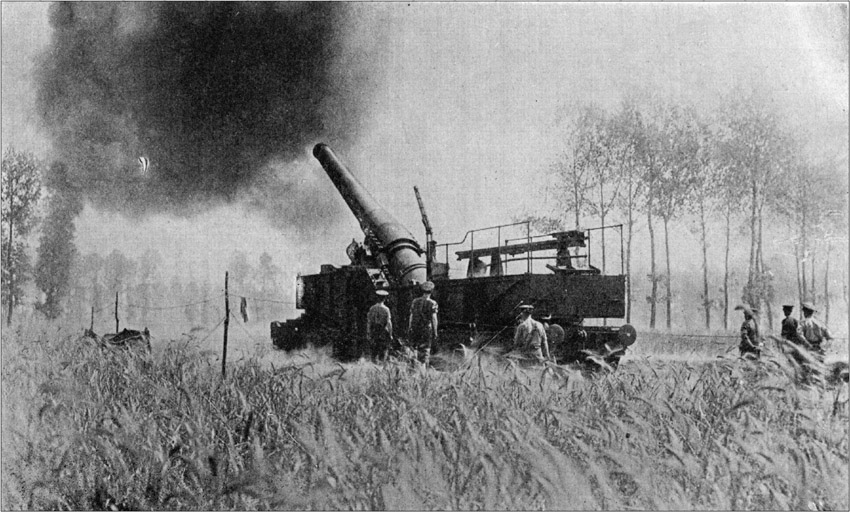
A British "Heavy" Mounted on a Railway-Truck Shelling the German Lines.ToList
During a big offensive the guns frequently fire a round a minute for days on end, the gunners working in shifts, two hours on and two hours off.
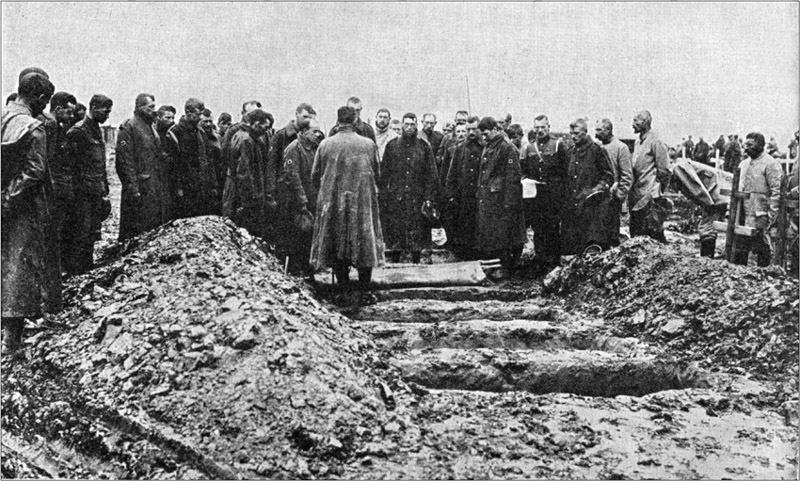
Buried on the Field of Honor.ToList
"Dust thou art and unto dust thou shalt return."
Germany largely based her confidence of victory on the belief that, under the strain of war, the far-flung British Empire, with its heterogeneous elements and racial jealousies, would promptly crumble. It was a vital error. Instead of crumbling it hardened into a unity which is adamantine. Canada has already contributed half a million men to the British armies, Australia three hundred thousand. South Africa, by undertaking her own defense, released the imperial regiments stationed there. She not only suppressed the German-fomented rebellion, but she conquered German Southwest Africa and German East Africa, thus adding nearly a sixth of the Dark Continent to the Empire, and has sent ten thousand men to the battle-fields of Europe. Indian troops are fighting in France, in Macedonia, in Mesopotamia, in Palestine, and in Egypt. From the West Indies have come twelve thousand men. The Malay States gave to the Empire a battleship and a battalion. A little island in the Mediterranean raised the King's Own Malta Regiment. Uganda and Nyassaland raised and supported the King's African Rifles—five thousand strong. The British colonies on the other seaboard of the continent increased the West African Field Force to seven thousand men. The fishermen and lumbermen from Newfoundland won imperishable glory on the Somme. From the coral atolls of the Fijis hastened six score volunteers. The Falkland Islands, south of South America, raised 140 men. From the Yukon, Sarawak, Wei-hai-wei, the Seychelles, Hong-Kong, Belize, Saskatchewan, Aden, Tasmania, British Guiana, Sierra Leone, St. Helena, the Gold Coast, poured Europeward, at the summons of the Motherland, an endless stream of fighting men.
Scattered in trenches and tents, in barracks and billets over the whole of Northern France are men hailing from the uttermost parts of the earth. Some there are who have spent their lives searching for gold by the light of the Aurora Borealis and others who have delved for diamonds on the South African veldt. Some have ridden range on the plains of Texas and others on the plains of Queensland. When, in the recreation huts, the phonograph plays "Home, Sweet Home" the thoughts of some drift to nipa-thatched huts on flaming tropic islands, some think of tin-roofed wooden cottages in the environs of Sydney or Melbourne, others of staid, old-fashioned, red-brick houses in Halifax or Quebec.
Serving as a connecting-link between the British and the French and Belgian armies is a corps of interpreters known as the liaison. As there are well over two million Englishmen in France, a very small percentage of whom have any knowledge of French, the liaison enjoys no sinecure. To assist in the billeting of British battalions in French villages, to conduct negotiations with the canny countryfolk for food and fodder, to mollify angry housewives whose ménages have been upset by boisterous Tommies billeted upon them, to translate messages of every description, to interrogate peasants suspected of espionage—these are only a few of the duties which the liaison officers are called upon to perform. The corps is recruited from Englishmen who have been engaged in business in Paris, habitués of the Riviera, students of the Latin Quarter, French hairdressers, head waiters, and ladies' tailors who have learned English "as she is spoke" in London's West End. The officers of the liaison can be readily distinguished by their caps, which resemble those worn by railroad brakemen, and by the gilt sphinx on the collars of their drab uniforms. This emblem was chosen by Napoleon as a badge for the corps of interpreters he organized during his Egyptian campaign, but the British unkindly assert it was selected for the liaison officers because nobody can understand them.
The more I see of the war the more I am impressed with its utter impersonality. It is a highly organized business, conducted by specialists, and into it personalities and picturesqueness seldom enter. One hears the noise and the clamor, of course; one sees the virility, the intense activity, the feverish haste, yet at the same time one realizes how little the human element counts; all is machinery and mathematics. I remember that one day I was lunching in his dugout with an officer commanding a battery of heavy howitzers. Just as my host was serving the tinned peaches the telephone-bell jangled. It was an observation officer, up near the firing-line, reporting that through his telescope he had spotted a German ammunition column passing through a certain ruined hamlet three or four miles away. On his map the battery commander showed me a small square, probably not more than three or four acres in extent, on which, in order to "get" that ammunition column, his shells must fall. Some rapid calculations on a pad of paper, and, calling in his subordinate, he handed him the "arithmetic." A minute or two later, from a clump of trees close by, there came in rapid succession four splitting crashes and four invisible express-trains went screeching toward the German lines to explode, with the roar that scatters death, on a spot as far away and as invisible from me as Washington Square is from Grant's Tomb. Before the echo of the guns had died away my host was back to his tinned peaches again. Neither he, nor any of his gunners, knew, or ever would know, or, indeed, very greatly cared, what destruction those shells had wrought. That's what I mean by the impersonality of modern war.
Our car stopped with startling abruptness in response to the upraised hand of a giant in khaki whose high-crowned sombrero and the brass letters on his shoulder-straps showed that he was a trooper of the Alberta Horse. On his arm was a red brassard bearing the magic letters M. P.—Military Police.
"Better not go any farther, sir," he said, addressing the staff-officer who was my companion. "The Boches are shelling the road just ahead pretty heavily this morning. They got a lorry a few minutes ago and I've had orders to stop traffic until things quiet down a bit."
"I'm afraid we'll have to take to the mud," said my cicerone resignedly. "And after last night's rain it will be beastly going.
"And don't forget your helmet and gas-mask," he called, as I stepped from the car into a foot of oozy mire.
"Will we need them?" I asked, for the inverted wash-basin which the British dignify by the name of helmet is the most uncomfortable form of headgear ever devised by man.
"It's orders," he answered. "No one is supposed to go into the trenches without mask and helmet. And there's never any telling when we may need them. No use in taking chances."
Taking off my leather coat, which was too heavy for walking, I attempted to toss it into the car, but the wind caught it and carried it into the mud, in which it disappeared as quickly and completely as though I had dropped it in a lake. Leaving the comparative hardness of the road, we started to make our way to the mouth of a communication trench through what had evidently once been a field of sugar-beets—and instantly sank to our knees in mire that seemed to be a mixture of molasses, glue, and porridge. It seemed as though some subterranean monster had seized my feet with its tentacles and was trying to drag me down. It was perhaps half a mile to the communication trench and it took us half an hour of the hardest walking I have ever had to reach it. It had walls of slippery clay and a corduroyed bottom, but the corduroy was hidden beneath the mud left by thousands of feet. Telephone-wires, differentiated by tags of colored tape, ran down the sides. Shortly we came upon a working party of Highlanders who were repairing the trench-wall. The wars of the Middle Ages could have seen no more strangely costumed fighting men. Above their half-puttees showed the brilliantly plaided tops of their stockings. Their kilts of green and blue tartan were protected by khaki aprons. Each man wore one of the recently issued jerkins, a sleeveless and shapeless coat of rough-tanned sheepskin such as was probably worn, in centuries past, by the English bowmen. On their heads were the "tin pot" helmets such as we were wearing, and in leather cases at their belts they carried broad-bladed and extremely vicious-looking knives.
For nearly an hour we slipped and stumbled through the endless cutting. At one spot the parapet, soaked by water, had caved in. In the breach thus made had been planted a neatly lettered sign. It was terse and to the point: "The Hun sees you here. Go away." And we did. The trench had gradually been growing narrower and shallower and more tortuous until we were walking half doubled over so as not to show our heads above the top. At last it came to an end in a sort of cellar, perhaps six feet square, which had been burrowed from the ridge of a hill. The entrance to the observatory, for that is what it was, had been carefully screened by a burlap curtain; within, a telescope, mounted on a tripod, applied its large and inquisitive eye to a small aperture, likewise curtained, cut in the opposite wall. We were in the advanced observation post on the slopes of Notre Dame de Lorette, less than a thousand yards from the enemy. At the foot of the spur on which we stood ran the British trenches and, a few hundred yards beyond them, the German. From our vantage-point we could see the two lines, looking like monstrous brown snakes, extending for miles across the plain. Perhaps a mile behind the German trenches was a patch of red-brown roofs. It was the town of Lieven, a straggling suburb of Lens, famous as the centre of the mine-fields of Northern France.
The only occupants of the observation post were a youthful Canadian lieutenant and a sergeant of the "Buzzers," as they call the Signal Corps. The officer was from Montreal and he instantly became my friend when I spoke of golf at Dixie and rides in the woods back of Mount Royal and a certain cocktail which they make with great perfection in a certain club that we both knew. He adjusted the telescope and I put my eye to it, whereupon the streets of the distant town sprang into life before me. In front of a cottage a woman was hanging out washing—I could even make out the colors of the garments; a gray motor whirled into a square, stopped, a man alighted, and it went on again; a group of men—German soldiers doubtless—strolled across my field of vision and one of them paused for a moment as though to light a pipe; along a street straggled a line of children, evidently coming from school, for it must be remembered that in most of these French towns occupied by the Germans, even those close behind the lines, the civilian life goes on much as usual. Though the Allies could blow these towns off the map if they wished, they do not bombard them save for some specific object, as to do so would be to kill many of their own people. Nor does it pay to waste ammunition on individual enemies. But if an observation officer sees enough Germans in a group to make the expenditure of ammunition worth while, he will telephone to one of the batteries and a well-placed shell tells the Germans that street gatherings are strictly verboten.
"Sorry that you weren't here yesterday," the lieutenant remarked. "We had a little entertainment of our own. Do you see that square?" and he swung the barrel of the telescope so that it commanded a cobble-paved place, with a small fountain in the centre, flanked on three sides by rows of red-brick dwellings.
"I see it plainly," I told him.
"The Boches are evidently billeting their men in those houses," he continued. "Yesterday morning an army baker's cart drove into the square and the soldiers came piling out of the houses to get their bread ration. There was quite a crowd of them around the cart, so I phoned back to the gunners and they dropped a shell bang into the square. The soldiers scattered, of course, and the horse hitched to the cart took fright and ran away. The cart tipped over and the bread spilled out. After a few minutes the men came out of their cellars and began to gather up the bread, so we shelled 'em again. The next time they sent out the women to pick up the loaves. We let them alone—French women, you understand—until I saw the Huns beating the women and taking the bread away from them. That made me mad and for ten minutes we strafed that section of the town good and plenty. It was very amusing while it lasted. And," he added wistfully, "we don't get much amusement here."
Darkness had fallen, when cold and tired, we climbed stiffly into the waiting car. As we tore down the long, straight road which led to General Headquarters the purple velvet of the eastern sky was stabbed by fiery flashes, many of them, and, borne on the night wind, came the sullen growling of the guns. As I stared out into the flame-pricked darkness there passed before me in imaginary review that endless stream of dauntless and determined men—mud-caked infantrymen, gunners, despatch riders, sappers, pioneers, motor-drivers, road-menders, mechanics, railway-builders—who form that wall of steel which Britain has thrown between Western Europe and the Hunnish hordes. Unyielding and undiscouraged they have stood, for close on three years, in winter and in summer, in heat and in cold, in snow and in rain, holding the frontier of civilization. And I knew that it was safe in their care.
VIIIToC
WITH THE BELGIANS ON THE YSER
I had left the Belgian army late in the autumn of 1914, just at the close of that series of heroic actions which began at Liége and ended on the Yser, so that my return, two years later, was in the nature of a home-coming. But it was a home-coming deeply tinged with sadness, for many, oh, so many of the gallant fellows with whom I had campaigned in those stirring days before the trench robbed war of its picturesqueness, were in German prisons or lay in unmarked and forgotten graves before Namur and Antwerp and Termonde. The Belgians that I had left were dirty, dog-tired, and disheartened. They were short of food, short of ammunition, short of everything save valor. The picturesque but impractical uniforms they wore—the green tunics and cherry-colored breeches of the Guides, the towering bearskins of the gendarmes, the shiny leather hats of the Carabinieri—were foul with blood and dirt.
As my car rolled across a canal bridge into that tiny triangle which is all that remains of free Belgium, a trim-looking trooper in khaki stepped from a sentry-box and, holding up an imperative hand, demanded to see my papers. Had it not been for the rosette of red-yellow-and-black enamel on his cap, and the colored regimental facings on his collar, I should have taken him for a British soldier.
"To what regiment do you belong?" I asked him.
"The First Guides, monsieur," he replied, returning my papers and saluting.
The First Guides! What memories the name brought back. How well I remembered the last time that I had seen those gallant riders, the pick and flower of the Belgian army, their comic-opera uniforms yellow with dust, crouching behind the hedgerows on the road to Alost, a pitifully thin screen of them, holding off the Germans while their weary comrades tramped northward into Flanders on the great retreat. It was not easy to make myself believe that this smart, khaki-clad trooper before me belonged to that homeless band of rear-guard fighters who had marked with their dead the line of retreat from the Meuse to the Yser.
It was my first glimpse of the reconstituted Belgian army. In the two years that it has been holding the line on the Yser it has been completely reuniformed, re-equipped, reorganized. The result is a small but complete and highly efficient organism. The Belgian army consists to-day of six infantry and two cavalry divisions—a total of about 120,000 men—with perhaps another 80,000 being drilled in the various training camps at the rear. It has, of course, no great reserves to fall back upon, for the greater part of the nation is imprisoned, but the King and his generals, by unremitting energy, have produced a force which is as well disciplined and as completely equipped as can be found anywhere on the front. When the day comes, as it surely will, when Berlin issues the orders for a general retirement, I shouldn't care to be the Germans who are assigned to the work of holding off the Belgians, for from the men who wear the red-yellow-and-black rosettes they need expect no pity.
Though the shortest of the lines held by the Allies, the Belgian front is, in proportion to the free Belgian population, much the longest. The northernmost sector of the Western Front, beginning at the sea and extending through Nieuport, a distance of only three or four miles, is held by the French; then come the twenty-three miles held by the Belgians, another two or three miles held by the French, and then the British. The Belgians occupy a difficult and extremely uncomfortable position, for these Flemish lowlands were inundated in order to check the German advance, and as a result they are in the midst of a vast swamp, which, in the rainy season, becomes a lake. They are, in fact, fighting under conditions not encountered on any other front save in the Mazurian marshes. During the rainy season the gunners of certain batteries frequently work in water up to their waists. So wet is the soil that dugouts are out of the question, for they instantly become cisterns, so the Belgian engineers have developed a type of above-ground shelter which has concrete walls and a roof of steel rails, on top of which are laid several layers of sand-bags. Though these shelters afford their occupants protection from the fire of small-caliber guns, they are not proof against the heavy projectiles which the Germans periodically rain upon the Belgian trenches. As the soil is so soft and slimy as to be useless for defensive purposes, the trench-walls are for the most part built of sand-bags, which are, however, usually filled with clay, for sand must be brought by incredible exertions from the seashore. I was shown a single short sector on the Yser, where six million bags were used. For the floors of these shelters, as well as for innumerable other purposes, millions of feet of lumber are required, which is taken up to the front over the network of light railways, some of which penetrate to the actual firing-line. If trench-building materials are scarce in Flanders, fuel is scarcer. Every stick of wood and every piece of coal burned on the front has to be brought from great distances and at great expense, so economy in fuel consumption is rigidly enforced. I remember walking through a trench with a Belgian officer one bitterly cold and rainy day last winter. In a corner of the trench a soldier in soaking clothes had piled together a tiny mound of twigs and roots and over the feeble flame was trying to warm his hands, which were blue with cold. To my surprise my companion stopped and spoke to the man quite sharply.
"We can't let one man have a fire all to himself," he explained as he rejoined me. "Wood is too scarce for that. The fire that fellow had would have warmed three or four men and I had to reprimand him for building it." A moment later he added: "The poor devil looked pretty cold, though, didn't he?"
I had been informed by telephone from the Belgian État-Major that a staff-officer would meet me at a certain little frontier town whose name I have forgotten how to spell. After many inquiries and wrong turnings, for in this corner of Belgium the Flemish peasantry understand but little French and no English, my driver succeeded in finding the town, but the officer who was to meet me had not arrived. It was too cold to sit in the car with comfort, so a lieutenant of gendarmerie, the chief of the local Sûrété, invited me to make myself comfortable in his little office. After a time the conversation languished, and, for want of something better to say, I inquired how far it was to Ostend. I was interested in knowing, because during the retreat of the Belgian army in October, 1914, I left two kit-bags filled with perfectly good clothes at the American Consulate in Ostend. They are there still, I suppose, provided the Consulate has not been shelled to pieces by the British monitors or the bags stolen by German soldiers.
"Ostend?" repeated the gendarme. "It isn't over thirty kilometres from here. From the roof of this building, if the weather was fine, you could almost see its church-spires."
He walked across to the window and, pressing his face against the pane, stared out across the fog-hung lowlands. He so stood for some minutes and when he turned I noticed that tears were glistening in his eyes.
"My wife and children are over there in Ostend," he explained, in a voice which he tried pathetically hard to control. "At least, they were there two years ago last August. They had gone there for the summer. I was in Brussels when the Germans crossed the frontier, and I at once joined the army. I have never heard from my family since. It is very hard, monsieur, to be so near them—they are only thirty kilometres away—and not be able to see them or to hear from them, or even be able to learn whether they are well or whether they have enough to eat."
It is a terrible thing, this prison wall within which the Germans have shut up the people of Belgium. How terrible it is one cannot realize until he has known those whose dear ones are confined incommunicado within that prison. I wish I might bring home to you, my friends, just what it means. How would you feel to stand on the banks of the Hudson and look across into New Jersey and know that, though over there, a few miles away, were your homes and those that you hold most dear, you could no more get word to them, or they to you, than if they were in Mars? And how would you feel if you knew that Englewood and Morristown and Plainfield and the Oranges, and a dozen other of the pretty Jersey towns, were but heaps of blackened ruins, that the larger cities were garrisoned by brutal German soldiery and ruled by heartless-German governors, and that thousands of women and girls—perhaps your wife, your daughters among them—had been dragged from their homes and taken God knows where? How would you feel then, Mr. American?
After an hour's wait my officer, profuse in his apologies, arrived in a beautifully appointed limousine, beside which the British staff-car in which I had come looked cheap and very shabby. At the very beginning of the war the Belgian military authorities commandeered every car they could lay their hands on, and though many have been worn out and hundreds were lost during the retreat, they are still rather better supplied with luxurious cars than any of the other armies.
"There will be a moon to-night," said my cicerone, "so before going to La Panne, where quarters have been reserved for you, I shall take you to Furnes. The Grande Place is pure Spanish—it was built in the Duke of Alva's time, you know—and it is very beautiful by moonlight."
The road to Furnes took us through what had been, a few years before, quaint Flemish villages, but German Kultur, aided by the products of Frau Bertha Krupp, had transformed the beautiful sixteenth-century architecture into heaps of brick and stone. And nowhere did I see a church left standing. Whether the Germans shelled the churches because they honestly believed that their towers were used for observation purposes, or from sheer lust for destruction, I do not know. In any event, the churches are gone. In one little shell-torn village my companion pointed out to me the ruins of a church, amid which a company of infantry, going up to the trenches, had camped for the night. Just as the men were falling in at daybreak a German shell of large caliber exploded among them. Sixty-four—I think that was the number—were killed outright or died of their wounds. But not even the dead are permitted to sleep in peace. I saw several churchyards on which German shells had rained so heavily that the corpses had been disinterred, and whitened bones and grinning skulls littered the ploughed-up ground.
Darkness had fallen when we came to Furnes. In passing through the outskirts, we stopped to call on two young women—an Irish girl and a Canadian—who, undismayed by the periodic shell-storms which visit it, have pluckily stayed in the town ever since the battle of the Yser, caring for the few hundred townspeople who remain, nursing the wounded, and even conducting a school for the children. They live in a small bungalow which the military authorities have erected for them on the edge of the town. A few yards from their front door is a bomb-proof, looking exactly like a Kansas cyclone-cellar, in which they find refuge when one of the frequent bombardments begins. We found that the young women were not at home. I was disappointed, because I wanted to tell them how much I admired them.
My companion was quite right in saying that the Grande Place of Furnes by moonlight is worth seeing. It certainly is. The exquisite fifteenth-century buildings which face upon the square have, by some miracle, remained almost undamaged. There were no lights, of course, and the only person in sight was a sentry, on whose bayonet and steel helmet the moonbeams played fitfully. The darkness, the silence, the suggestion of mystery, the ancient buildings with their leaded windows and their carved façades, the steel-capped soldier, all made me feel that I had stepped back five hundred years and was in the Furnes of Inquisition times.
Our visit to Furnes had delayed us, so it was well into the evening before we drew up before the hotel in La Panne, where a room had been reserved for me by the Belgian État-Major. A seaside resort in midwinter is always a peculiarly depressing place, and La Panne was no exception. Though every hotel and villa in the place was chock-a-block with staff-officers, with nurses, and with wounded, the street-lamps were extinguished, not a ray of light escaped from the heavily curtained windows, and, to add to the general sense of melancholy, a cold, raw wind was blowing down from the North Sea and a drizzling rain had set in. Though La Panne is within easy range of the German batteries, which could eliminate it with neatness and despatch, it has, singularly enough, never been bombarded, nor has it been subjected to any serious air raids. This is the more surprising as all the neighboring towns, as well as Dunkirk, a dozen miles beyond, have been repeatedly shelled and bombed. The only explanation of this phenomenon is that the Germans do not wish to kill the Queen of the Belgians—she was Princess Elisabeth of Bavaria, remember—who lives with the King at La Panne. It is possible that this may be the correct explanation. I remember that when I was in Brussels during the early days of the German occupation, there occurred a serious collision between Prussian and Bavarian troops, the latter asserting that the ill-mannered North German soldiery had shown some disrespect to a portrait of "unsere Bayerische Prinzessin." Why the Germans should have any consideration for the safety of the Queen after the fashion in which they have treated her country and her people, only a Teutonic intellect could understand. But the exemption which La Panne has thus far enjoyed has not induced its inhabitants to omit any precautions. An ample number of bomb-proofs and dugouts have been constructed, and at night over all the windows are tacked thick black curtains. For they know the Germans.
La Panne is the last town on the Belgian littoral before you reach the French frontier and the last villa in the town is occupied by the King and Queen. It stands amid the sand-dunes, looking out across the Channel toward England. It is just such a square, plastered, eight-room villa as might be rented for the summer months by a family with an income of five thousand a year. The sentries who are on duty at its gates and the mounted gendarmes who constantly patrol its immediate vicinity, are the only signs that it is the residence of royalty. Almost any morning you can see the King and Queen—he tall and soldierly, with all griefs and anxieties which the war has brought him showing in his face; she small and trim and girlishly slender—riding on the hard sands of the beach, or strolling, unaccompanied, amid the dunes. What must it mean to them to know that though over there to the eastward lies Belgium, their Belgium, they cannot ride five miles toward it before they are halted by the German bar; to know that beyond that little river where the trenches run their people are suffering and waiting for help, and that, after nearly three years, they are not a yard nearer to them?
How clearly I remembered the last time that I had seen the Queen. It was in the Hotel St. Antoine, in Antwerp, the night before the flight of the Government and the royal family to Ostend, and less than a week before the fall of the city itself. For days past the grumble of the guns had constantly been growing louder, the streams of wounded had steadily increased; every one knew that the end was almost at hand. It was just before the dinner-hour and the great lobby of the hotel was crowded with officers—Belgian, French, and British—with members of the fugitive Government and Diplomatic Corps, and a few unofficial foreigners like myself. Then, unannounced and unaccompanied, the Queen entered. She had come to say farewell to the invalid wife of the Russian Minister, who was unable to go to the palace. She remained in the Russians' apartments (during the bombardment, a few days later, they were completely wrecked by a German shell) half an hour perhaps. Then she came down the winding stairs, a pathetically girlish figure in the simplest of white suits, leaning on the arm of the gallant old diplomat. Quite automatically the throng in the lobby separated, so as to form an aisle down which she passed. To those of us who were nearest she put out her hand and, bending low, we kissed it. Then the great doors were opened and she passed out into the darkness and the rain—a Queen without a country.
No one comes away from La Panne, at least no one should, without having visited the great hospital founded by Dr. Léon du Page, the famous Belgian surgeon. It started in one of the big tourist hotels facing on the sea, but it has gradually expanded until it now occupies a whole congeries of buildings. It has upward of a thousand beds, but, as the fighting was comparatively light at the time I was there, only about two-thirds of them were occupied. Though the American Ambulance at Neuilly, and some of the hospitals at the British base-camps are larger, Dr. du Page's hospital is the most complete and self-contained that I have seen on any front. To mend the broken men who are brought there no device of medical science has been left untried. There are giant magnets which are used to draw minute steel fragments from the brains of men wounded by shrapnel; there are beds, heated by hundreds of electric lights, for soldiers whose vitality has been dangerously lowered by shock or exhaustion; there is a department of facial surgery where men who have lost their noses or their jaws or even their faces are given new ones. The hospital is, as I have said, self-contained. The operating-tables, the beds, all the furniture, in fact, is made on the premises. It is the only hospital I know of which provides those patients who have lost their legs with artificial limbs. And they are by far the best artificial limbs that I have seen anywhere. Each one is made to order to match the man's remaining limb. They are shaped over plaster casts, according to a system originated by Dr. du Page, in alternate layers of glue and ordinary shavings, and the articulation of the joints almost equals that of nature. As a result the soldiers are sent out into the world provided with legs which are symmetrical, almost unbreakable, amazingly light, and so admirably constructed that the owner rarely requires the assistance of a cane. Another detail for which Dr. du Page has made provision is the manufacture of his own instruments. Before the war the best surgical instruments were made in Germany. There were, so far as Dr. du Page knew, only five first-class instrument-makers in Belgium. Three of these were, he ascertained, in the army, so through the King he obtained their release from military duty. Now they work in a completely equipped shop in the rear of the hospital making the shiny, terrifying instruments which the white-clad surgeons wield with such magical effect.
Should you feel like giving up the theatre this evening, or taking a street-car instead of a taxi, or not opening that bottle of champagne, the money would be very welcome to Dr. du Page and his wounded. Should you feel that that is too much to give, it might be well for you to remember that he has given something, too. He gave his wife. She was returning from America, where she had gone to collect funds to carry on the work of the hospital. She sailed on the Lusitania....
To reach the Belgian firing-line is not easy because, the country being as flat as a ballroom floor, the Germans see and shoot at you. So one needs to be cautious. So dangerous is the terrain in this respect that the ambulances and motor-lorries and ammunition-trains could not get up to the trenches at all had not the Belgians, with great foresight, done wholesale tree-planting. Most people do not number nursery work among the duties of an army, but nowadays it is. From France and England the Belgians imported many saplings, thousands if not tens of thousands of them, and set them out along the roads exposed to German fire, and now their foliage forms a screen behind which troops and transport can move with comparative safety. In places where trees would not grow the roads have been masked for miles with screens made from branches. To have one of these screens between you and the Germans is very comforting.
On our way up to the front we made a détour in order that I might call on a friend, Mrs. A. D. Winterbottom, who, before her marriage to a British officer, was Miss Appleton of Boston. In "Fighting in Flanders" I told about a very brave deed which I saw performed by Mrs. Winterbottom. She was quite angry with me for mentioning it, but because she is an American of whom her countrypeople have every reason to be proud, I am going to tell about it again. It was during the last days of the siege of Antwerp. The Germans had methodically pounded to pieces with their great guns the chain of barrier forts encircling the city. Waelhem was one of the last to fall. When at length the remnant of the garrison evacuated the fort they brought back word that a score of their comrades, too badly wounded to walk, remained within the battered walls. So Mrs. Winterbottom, who had brought over from England her big touring-car and was driving it herself, said quietly that she was going to bring them out. The only way to reach the fort was by a straight and narrow road, a mile long, on which German shells were bursting with great accuracy and frequency. To me and to the Belgian officers who were with me, it looked like a short-cut to the cemetery. But that didn't deter Mrs. Winterbottom. She climbed into her car and threw in the clutch and jammed her foot down on the accelerator, and went tearing down that shell-spattered highway at top speed. She filled her car with wounded men and brought them safely back, and then returned and gathered up the others who were still alive. I have seen few braver deeds.
Mrs. Winterbottom remained with the Belgian army throughout the great retreat into Flanders, and when it settled down into the trench life on the Yser, she was officially attached to a division, with which she has remained ever since, moving when her division moves. She lives in a one-room shack which the soldiers have built her immediately in the rear of the trenches and within range of the enemy's guns. Her only companion is a dog, yet she is as safe as though she were on Beacon Hill, for she is the idol of the soldiers. She has a large recreation tent, like the side-show tent of a circus, but painted green to escape the attention of the German airmen, and in this tent she entertains the men during their brief periods of leave from the trenches. She gives them coffee, cocoa, milk, and biscuits; she provides them with writing materials—I forget how many thousand sheets of paper and envelopes she told me that they used each week; and she keeps them supplied with reading matter. Three times a week she gives "her boys" a phonograph concert in the first-line trenches. You must have experienced the misery and monotony of existence in the trenches to understand what these "concerts" mean to the tired and homesick men. I asked her if there was anything that the people at home could send her, and she replied rather hesitantly (for she is personally bearing the entire expense of this work) that she understood that some small metal phonographs were procurable which could easily be carried about and would not warp from dampness, for the trenches on the Yser are very wet. She also said that she would welcome phonograph records of any description and French books. The last I saw of her she was wading through a sea of mud, in rubber boots and a rubber coat and a sou'wester, to carry her "canned music" to the men on the firing-line. They ought to be very proud of Mrs. Winterbottom back in her own home town.
The Belgian trenches are very much like those on other sectors of the Western Front, except that they are made of sand-bags instead of earth, are muddier and are nearer the enemy, being separated from the German positions, for a considerable distance, only by the Yser, which in places is only forty yards across. In fact, a baseball player could easily sling a stone across the river into Dixmude, or what remains of it, for, like most of the other Flemish towns, it is now only a blackened skeleton. Many cities have been destroyed in the course of this war, but none of them, unless it be Ypres, so nearly approaches complete obliteration as Dixmude. Pompeii is a living, breathing city compared to it. Despite all that has been printed about the devastation in the war zone, I believe that when the war is over and the hordes of curious Americans flock Europeward, they will be stunned by the completeness of the desolation which the Germans have wrought in northeastern France and Belgium.
By far the most interesting day I spent on the Belgian front was not in the trenches but in a long, low, wooden building well to the rear. Over the door was a sign which read: "Section Photographique de l'Armée Belge." Here are brought to be developed and enlarged and scrutinized the hundreds of photographs which are taken daily by Belgian aviators flying over the German lines. In no department of war work has there been greater progress during recent months than in photography by airplane. Every morning at break of dawn scores of Belgian machines—and the same is true all down the Western Front—rise into the air, and for hour after hour swoop and circle over the enemy's lines, taking countless photographs of his positions by means of specially made cameras fitted with telescopic lenses. (The Allied fliers on the Somme took seventeen hundred photographs during a single day.) Most of these photographs are taken at a height of eight thousand to ten thousand feet,[F] though very much lower, of course, when an opportunity presents itself, and always with the camera as nearly vertical as possible. As soon as an aviator has secured a sufficient number of pictures of the locality or object which he has been ordered to photograph, he wings his way back to his own lines, the plates are immediately developed at the headquarters of the Section Photographique or in a dark room on wheels. If the first examination of the negative reveals anything of interest, it is at once enlarged, often to eight times the size of the original. As a result of this remarkable system of aerial espionage, there is nothing of importance which the Germans can long conceal from the Allies. They cannot extend their trench lines by so much as a yard, they cannot construct new positions, they cannot mount a machine-gun without the fact being registered by those eyes which, from dawn to dark, peer down at them from the clouds. At all of the divisional headquarters are large plans of the opposing enemy trenches, which are corrected daily by means of these airplane photographs and by the information collected through the elaborate system of espionage which the Allies maintain behind the German lines. To deceive the aerial observers, each side resorts to all manner of ingenious tricks. To suggest an impending retirement, columns of men are marched down the roads which lead to the rear; trenches which are not intended to be used are dug; and there are, of course, hundreds of dummy guns, some of which actually fire. The officer in command of the Belgian Photographic Section had heard that I was in Dunkirk in May, 1915, when it was shelled by a German naval gun, at a range of twenty-three and one-half miles.[G] So he gave me as a souvenir of the experience a photograph, taken from the air, of the gun emplacement after it had been discovered and bombed by the Allied aviators, and the gun removed to a place of safety. I reproduce the photograph herewith. The numerous white spots all about the emplacement are the craters caused by the bombs which were rained upon it.
Another of these monster guns was so ingeniously concealed in an imitation thicket that for a fortnight or more it defied the efforts of scores of airmen to locate it. Though hundreds of airplane photographs of the country behind the German trenches were brought in and minutely examined, there was nothing about them to suggest the hiding-place of a gun of so large a caliber until some one called attention to the deep ruts left by motor-trucks which had left the highway at a certain point and turned into the innocent-looking patch of woods. Why were the wheel-ruts shown on the plate so black? Because the vehicle must have sunk deep into the soft soil. Why did it sink so deeply? Because it was heavily laden. Laden with what? With large-caliber shells, perhaps. But still it was only a supposition. A few days later, however, it was noticed that at a certain point on the westward edge of that patch of woods there seemed to be a slight discoloration. This discoloration became more pronounced on later photographs which were brought in. Every one in the Section Photographique hazarded a guess as to its cause. At length some one suggested that it looked as though the leaves of the trees had been burned. But what burned them? There was only one answer. The fiery blast from a big gun hidden amid those trees, of course! Acting on that hypothesis, a score of aviators were sent out with orders to pour upon the wood a torrent of high explosive. The next few hours must have been very uncomfortable for the German gun-crew. In any event, the big piece was hauled out of danger under cover of darkness and the bombardments of the towns behind the Belgian lines abruptly ceased.
The Allied air service does not confine its observations to the trenches; it keeps an ever-wakeful eye on all that is in progress in the regions for many miles behind the front. To illustrate how little escapes the eye of the camera, the officer in charge of the Photographic Section showed me a series of photographs which had been taken of a village at the back of Dixmude, a few days previously, from a height of more than a mile. The first picture showed an ordinary Flemish village with its gridiron of streets and buildings. Cutting diagonally across the picture was a straight white streak which I knew to be a road leading into the country. At one point on this road were a number of tiny squares—evidently a row of workmen's cottages. The commandant handed me a powerful magnifying-glass. "Look very closely on that road," he said, "and you will see three specks." I saw them. They were about the size of pin-points.
"Those are three men," he continued. "The man at the right lives in the first of this row of cottages. The man in the middle lives in the fourth house in the row. But the man at the left is a farmer, and lives in this isolated farmhouse out here in the country."
"A very clever guess," I remarked, scepticism showing in my tone, I fear.
"We do not guess in this business," he replied reprovingly. "We know." And he handed me the next photograph, taken a few seconds later. There was no doubt about it; the pin-point of a man at the right had left his two companions and was turning in at the first of the row of cottages. Another photograph was produced. It showed the second man entering the gate of the fourth cottage. And the final picture of the series showed the remaining speck plodding on alone toward his home in the country.
"An officer of some importance is evidently making this house his headquarters," remarked the commandant, indicating another tiny rectangle. "If he wasn't of some importance he wouldn't have a telephone."