Volume 4 — ITALY AT WAR (continued 2)
Reading edition
With countless hair-pin, hair-raising turns, our road wound upward, bordered on one hand by the brinks of precipices, on the other by bare walls of rock. It was a smooth road, splendidly built, but steep and terrifyingly narrow—so narrow in places that it was nothing more than a shelf blasted from the sheer face of the cliff. Twice, meeting motor-lorries downward bound, we had to back along that narrow shelf, with our outer wheels on the brink of emptiness, until we came to a spot where there was room to pass. It was a ticklish business.
At one point a mountain torrent leaped from the cliff into the depths below. But the water-power was not permitted to go to waste; it had been skilfully harnessed and was being used to run a completely equipped machine-shop where were brought for repair everything from motor-trucks to machine-guns. That was one of the things that impressed me most—the mechanical ability of the Italians. The railways, cable-ways, machine-shops, bridges, roads, reservoirs, concrete works that they have built, more often than not in the face of what would appear to be unsurmountable difficulties, prove them to be a nation of engineers.
Up to the heights toward which we were climbing so comfortably and quickly in a motor-car there was before the war, so I was told, nothing but a mule-path. Now there is this fine military road, so ingeniously graded and zigzagged that two-ton motor-trucks can now go with ease where before a donkey had difficulty in finding a footing. When these small and handy motor-trucks come to a point where it is no longer possible for them to find traction, their loads are transferred to the remarkable wire-rope railways, or telefericas, as they are called, which have made possible this campaign in cloudland. Similar systems are in use, all over the world, for conveying goods up the sides of mountains and across chasms. A wire rope running over a drum at each side of the chasm which has to be crossed forms a double line of overhead railway. Suspended on grooved wheels from this overhead wire are "cars" consisting of shallow iron trays about the length and width of coffins, one car going up as the other comes down. The floors of the cars are perforated so as to permit the draining off of water or blood—for men wounded in the mountain fighting are frequently brought down to the hospitals in them—and the sides are of latticework, and, I might add, quite unnecessarily low. Nor is the prospective passenger reassured by being told that there have been several cases where soldiers, suddenly overcome by vertigo, have thrown themselves out while in mid-air. If the cars are properly loaded, and if there is not a high wind blowing, the teleferica is about as safe as most other modes of conveyance, but should the cars have been carelessly loaded, or should a strong wind be blowing, there is considerable danger of their coming into collision as they pass. In such an event there would be a very fair chance of the passenger spattering up the rocks a thousand feet or so below. There is still another, though a rather remote possibility: that of being shelled while in mid-air, for certain of the telefericas run within view of the Austrian positions. And sometimes the power which winds the drum gives out and the car and its passengers are temporarily marooned in space. Aviation, motor-racing, mountain-climbing, big-game hunting, all seem commonplace and tame compared with the sensation of swinging helplessly in a shallow bathtub over half a mile of emptiness while an Austrian battery endeavors to pot you with shrapnel, very much as a small boy throws stones at a scared cat clinging to a limb.
Yet over these slender wires has been transported an army, with its vast quantities of food, stores, and ammunition, and by the same method of transportation have been sent back the wounded. Without this ingenious device it is doubtful if the campaign in the High Alps could ever have been fought. But the cables, strong though they are, are yet too weak to bear the weight of the heavy guns, some of them weighing forty and fifty tons, which the Italians have put into action on the highest peaks. So, by the aid of ropes and levers and pulleys and hundreds of brawny backs and straining arms, these monster pieces have been hauled up slopes as steep as that of the Great Pyramid, have been hoisted up walls of rock as sheer and high as those of the Flatiron Building. You question this? Well, there they are, great eight and nine inch monsters, high above the highest of the wire roads, one of them that I know of at a height of ten thousand feet above the sea. There is no doubting it, incredible as it may seem, for they speak for themselves—as the Austrians have found to their cost.
The most advanced positions in the Carnia, as in the Trentino, are amid the eternal snows. Here the guns are emplaced in ice caverns which can be reached only through tunnels cut through the drifts; here the men spend their days wrapped in shaggy furs, their faces smeared with grease as a protection from the stinging blasts, and their nights in holes burrowed in the snow, like the igloos of Esquimaux. On no front, not on the sun-scorched plains of Mesopotamia, nor in the frozen Mazurian marshes, nor in the blood-soaked mud of Flanders, does the fighting man lead so arduous an existence as up here on the roof of the world. I remember standing with an Italian officer in an observatory in the lower mountains. The powerful telescope was trained on the snow-covered summit of one of the higher peaks.
"Do you see that little black speck on the snow at the very top?" the officer asked me.
I told him that I did.
"That is one of our positions," he continued. "It is held by a lieutenant and thirty Alpini. I have just received word that, as the result of yesterday's snow-storm, our communications with them have been cut off. We will not be able to relieve them, or get supplies to them, much before next April."
And it was then only the middle of December!
In the Carnia and on the Upper Isonzo one finds the anomaly of first-line trenches which are perfectly safe from attack. I visited such a position. Through a loophole I got a little framed picture of the Austrian trenches not five hundred yards away, and above them, cut in the mountainside, the square black openings within which lurked the Austrian guns. Yet we were as safe from anything save artillery fire as though we were in Mars, for between the Italian trenches and the Austrian intervened a chasm half a thousand feet deep and with walls as steep and smooth as the side of a house. The narrow strip of valley at the bottom of the chasm was a sort of no man's land, where forays, skirmishes, and all manner of desperate adventures took place nightly between patrols of Jaegers and Alpini.
As with my field-glasses I was sweeping the turmoil of trench-scarred mountains which lay spread, below me, like a map in bas-relief, an Austrian battery quite suddenly set up a deafening clamor, and on a hillside, miles away, I could see its shells bursting in clouds of smoke shot through with flame. They looked like gigantic white peonies breaking suddenly into bloom. The racket of the guns awoke the most extraordinary echoes in the mountains. It was difficult to believe that it was not thunder. Range after range caught up the echoes of that bombardment and passed them on until it seemed as though they must have reached Vienna. For half an hour, perhaps, the cannonade continued, and then, from an Italian position somewhere above and behind us, came a mighty bellow which drowned out all other sounds. It was the angry voice of Italy bidding the Austrians be still.
FOOTNOTES:
IVToC
THE ROAD TO TRIESTE
In order to appraise the Italian operations on the Carso at their true value, it is necessary to go back to May, 1916, when the Archduke Frederick launched his great offensive from the Trentino. Now it must be kept constantly in mind, as I have tried to emphasize in preceding chapters, that when the war opened, the Italians had always to go up while the Austrians needed only to come down. The latter, intrenched high on that tremendous natural rampart formed by the Rhaetian and Tyrolean Alps, the Dolomites, the Carnic, Julian, and Dinaric ranges, had an immense superiority over their enemy on the plains below. The Austrian offensive in the Trentino was dictated by four reasons: first, to divert the Italians from their main objective, Trieste; second, to lessen the pressure which General Cadorna was exerting against the Austrian lines on the Isonzo; third, to smash through to Vicenza and Verona, thus cutting off and compelling the capitulation of the Italian armies operating in Venetia; and fourth, to so thoroughly discourage the Italians that they would consent to a separate peace.
The story of how this ambitious plan was foiled is soon told. By the first week in May the Austrians had massed upon the Trentino front a force of very nearly 400,000 men with 2,000 guns. Included in this tremendous accumulation of artillery were 26 batteries of 12-inch guns and several of the German giants, the famous 42-centimetre pieces, which brought down the pride of Antwerp and Namur. By the middle of May everything was ready for the onset to begin, and this avalanche of soldiery came rolling down the Asiago plateau, between the Adige and the Brenta. Below them, basking in the sunshine, stretched the alluring plains of Venetia, with their wealth, their women, and their wine. Pounded by an immensely superior artillery, overwhelmed by wave upon wave of infantry, the Italians sullenly fell back, leaving the greater part of the Sette Communi plateau and the upper portion of the Brenta valley in the hands of the Austrians. At the beginning of June a cloud of despondency and gloom hung over Italy, and men went about with sober faces, for it seemed all but certain that the enemy would succeed in breaking through to Vicenza, and by cutting the main east-and-west line of railway, would force the armies operating on the Isonzo and in the Carnia to surrender. But the soldiers of the Army of the Trentino, though outnumbered in men and guns, determined that the Austrians should pay a staggering price for every yard of ground they gained. They fought as must have fought their ancestors of the Roman legions. And, thanks to their tenacity and pluck, they held their opponents on the five-yard line. Then, just in the nick of time, the whistle blew. The game was over. The Austrians had to hurry home. They had staked everything on a sudden and overwhelming onslaught by which they hoped to smash the Italian defense and demoralize the Italian armies in time to permit at least half their eighteen divisions and nearly all of their heavy guns being withdrawn in a few weeks and rushed across Austria to the Galician front, where they were desperately needed to stay the Russian advance.
By the beginning of the last week in June the Austrian General Staff, recognizing that its plan for the overwhelming of northern Italy had failed disastrously, issued orders for a general retreat. The Austrians had planned to fall back on the positions which had been prepared in advance in the mountains and to establish themselves, with greatly reduced numbers, on this practically impregnable line, while the transfer of the divisions intended for the Carpathians was effected. But General Cadorna had no intention of letting the Austrians escape so easily. In less than a week he had collected from the garrisons and training camps and reserve battalions an army of 500,000 men. It was one of the most remarkable achievements of the war. From all parts of Italy he rushed those half million men to the Trentino front by train—and despite the immense strain put upon the Italian railways by the rapid movement of so great a body of troops, the regular passenger service was suspended for only three days. (At that same time the American Government was attempting to concentrate a force of only 150,000 men on the Mexican border; a comparison of Italian and American efficiency is instructive.) He formed that army into brigades and divisions, each complete with staff and supply trains and ammunition columns. He organized fresh bases of supply, including water, of which there is none on the Asiago plateau. He provided the stupendous quantity of stores and ammunition and equipment and transport required by such an army. (It is related how Cadorna's Chief of Transport wired the Fiat Company of Turin that he must have 545 additional motor-trucks within a week, and how that great company responded by delivering in the time specified 546—one over for good measure.) Almost in a night he transformed the rude mule-paths leading up onto the plateau into splendid military roads, wide enough and hard enough to bear the tremendous traffic to which they were suddenly subjected. And finally he rushed his troops up those roads in motor-cars and motor-trucks, afoot and on horse-back and astride of donkeys and flung them against the Austrians. So sudden and savage was the Italian onset that the Austrians did not dare to spare a man or gun for their Eastern Front—and meanwhile the Muscovite armies were pressing on toward the Dniester. It is no exaggeration to assert that the success of Brussiloff's offensive in Galicia was due in no small measure to the Italian counter-offensive in the Trentino. That adventure cost Austria at least 100,000 dead and wounded men.
But not for a moment did the Italians permit the Austrian offensive in the Trentino to distract them from their real objectives: Gorizia, the Carso, and Trieste. The "military experts," who from desks in newspaper offices tell the public how campaigns ought to be conducted, had announced confidently that Italy had so taxed her strength by her efforts in the Trentino that, for many months at least, nothing need be expected from her. But Italy showed the public that the "military experts" didn't know what they were talking about, for in little more than a month after the Italian guns had ceased to growl amid the Tyrolean peaks and passes, they were raining a storm of steel upon the Austrian positions on the Carso.
Imagine a vast limestone plateau, varying in height from 700 to 2,500 feet, which is as treeless and waterless as the deserts of Chihuahua, as desolate and forbidding as the Dakota Bad Lands, with a surface as torn and twisted and jagged as the lava beds of Utah, and with a summer climate like that of Death Valley in July. That is the Carso. This great table-land of rock, which begins at Gorizia, approaches close to the shores of the Adriatic between Monfalcone and Trieste, and runs southeastward into Istria, links the Alpine system with the Balkan ranges. Its surface of naked, sun-flayed rock is broken here and there with gigantic heaps of piled stone, with caves and caverns, with sombre marshes which sometimes become gloomy and forbidding lakes, and with peculiar crater-like depressions called dolinas, formed by centuries of erosion. Such scanty vegetation as there is is confined to these dolinas, which form the only oases in this barren and thirsty land. The whole region is swept by the Bora, a wind which is the enemy alike of plant and man. Save for the lizards that bask upon its furnace-like floors, the Carso is as lifeless as it is treeless and waterless. No bird and scarcely an insect can find nourishment over vast spaces of this sun-scorched solitude; even the hardy mountain grass withers and dies of a broken heart. So powerful is the sun that eggs can be cooked without a fire. Metal objects, such as rifles and equipment, when left exposed, quickly become too hot to touch. The bodies of the soldiers who fall on the Carso are not infrequently found to have been baked hard and mummified after lying for a day or two on that oven-like floor of stone.
The Carso is probably the strongest natural fortress in the world. Anything in the shape of defensive works which Nature had overlooked, the Austrians provided. For years before the war began the Austrian engineers were at work strengthening a place that already possessed superlative strength. The whole face of the plateau was honeycombed with trenches and tunnels and dugouts and gun emplacements which were blasted and drilled out of the solid rock with machinery similar to that used in driving the Simplon and the St. Gothard tunnels. The posts for the snipers were armored with inch-thick plates of steel cemented into the rock. The dolinas were converted into machine-gun pits and bomb-proof shelters. In one of these curious craters I saw a dugout—it was really a subterranean barracks—electrically lighted and with neatly whitewashed walls which had sleeping accommodation for a thousand men. To supply these positions, water was pumped up by oil-engines, but the Austrians took care to destroy the pipe-lines as they retired.
At the northern end of the Carso, in an angle formed by the junction of the Wippach and the Isonzo, the snowy towers and red-brown roofs of Gorizia rise above the foliage of its famous gardens. The town, which resembles Homburg or Baden-Baden and was a popular Austrian resort before the war, lies in the valley of the Wippach (Vippacco, the Italians call it), which separates the Carso from the southernmost spurs of the Julian Alps. Down this valley runs the railway leading to Trieste, Laibach, and Vienna. It will be seen, therefore, that Gorizia is really the gateway to Trieste, and a place of immense strategic importance.
On the slopes of the Carso, four or five miles to the southwest of the town, rises the enormously strong position of Monte San Michele, and a few miles farther down the Isonzo, the fortified hill-town of Sagrado. On the other side of the river, almost opposite Gorizia, are the equally strong positions of Podgora and Monte Sabotino. Their steep slopes were slashed with Austrian trenches and abristle with guns which commanded the roads leading to the river, the bridge-heads, and the town. To take Gorizia until these positions had been captured was obviously out of the question. Here, as elsewhere, Austria held the upper ground. In a memorandum issued by the Austrian General Staff to its officers at the beginning of the operations before Gorizia, the tremendous advantage of the Austrian position was made quite clear: "We have to retain possession of a terrain fortified by Nature. In front of us a great watercourse; behind us a ridge from which we can shoot as from a ten-story building."
The difficulties which the Italians had to overcome in their advance were enormous. From their mountain nests the Austrian guns were able to maintain a murderous fire on the Italian lines of communication, thus preventing the bringing up of men and supplies. It therefore became necessary for the Italians to build new roads which would not be thus exposed to enemy fire, and in cases where this was impossible, the existing roads were masked for miles on end with artificial hedges and screens of grass matting. In many places it was found necessary to screen the roads overhead as well as on the sides, so that the Italians could move up their heavy guns without attracting the attention of the enemy's observers stationed on the highest mountain peaks, or of the Austrian airmen. But this was not all, or nearly all. An army is ever a hungry monster, so slaughter-houses and bakeries and field-kitchens, to say nothing of incredible quantities of food-stuffs, had to be provided. Fighting being a thirsty business, it was necessary to arrange for piping up water, for great tanks to hold that water, and for water-carts, hundreds and hundreds of them, to peddle it among the panting troops. A prize-fighter cannot sleep out in the open, on the bare ground, and keep in condition for the ring, and a soldier, who is likewise a fighting-man but from a different motive, must be made comfortable of nights if he is to keep in fighting-trim. So millions of feet of lumber had to be brought up, along roads already overcrowded with traffic, and that lumber had to be transformed into temporary huts and barrackments—a city of them. But the preparations did not end even there. To insure the co-ordination and co-operation of the various divisions of the army, an elaborate system of field telegraphs and telephones had to be installed, and, in order to provide against the lines being cut by shell-fire and the whole complex organism paralyzed, the wires were laid in groups of four. Then there had to be repair-stations for the broken machinery, and other repair-stations—with Red Cross flags flying over them—for the broken men. So in the rear of the sector where the Italians planned to give battle on a front of thirty miles, a series of great base hospitals were established, and, nearer the front, a series of clearing-hospitals, and, still closer up, field-hospitals, and in the immediate rear of the fighting-line, hundreds of dressing-stations and first-aid posts were located in dugouts and bomb-proof shelters. And along the roads stretched endless caravans of gray ambulances, for it promised to be a bloody business. In other words, it was necessary, before the battle could be fought with any hope of success, to build what was to all intents and purposes a great modern city, a city of half a million inhabitants, with many miles of macadamized thoroughfares, with water and telephone and telegraph systems, with a highly efficient sanitary service, with railways, with huge warehouses filled with food and clothing, with more hospitals than any city ever had before, with butcher-shops and bakeries and machine-shops and tailors and boot-menders—in fact, with everything necessary to meet the demands of 500,000 men. Yet Mr. Bryan and his fellow-members of the Order of the Dove and Olive-Branch would have us believe that all that is necessary in order to win a modern battle is to take the trusty target-rifle from the closet under the stairs, dump a box of cartridges into our pockets, and sally forth, whereupon the enemy, decimated by the deadliness of our fire, will be only too glad to surrender.
The most formidable task which confronted the Italians was that of constructing the vast system of trenches through which the troops could be moved forward in comparative safety to the positions from which would be launched the final assault. This presented no exceptional difficulties in the rich alluvial soil on the Isonzo's western bank, but once the Italians had crossed the river they found themselves on the Carso, through whose solid rock the trenches could be driven only with pneumatic drills and dynamite. All of the Italian trenches that I saw showed a very high skill in engineering. Instead of keeping the earthen walls from crumbling and caving by the use of the wicker-work revetments so general on the Western Front, the Italians use a sort of steel trellis which is easily put in place, and is not readily damaged by shell-fire. Other trenches which I saw (though not on the Carso, of course) were built of solid concrete with steel shields for the riflemen cemented into the parapets.
During these weeks of preparation the Italian aviators, observers, and spies had been busy collecting information concerning the strength of the Gorizia defenses and the disposition of the Austrian batteries and troops. By means of thousands of photographs taken from airplanes, enlarged, and then pieced together, the Italians had as accurate and detailed a map of the Austrian lines of defense as was possessed by the Austrian General Staff itself. Thanks to the data thus obtained, the Italian gunners were able to locate their targets and estimate their ranges with absolute precision. They knew which building in Gorizia was the headquarters of the Austrian commander; they had discovered where his telephone and telegraph stations were located; and they had spotted his observation posts. Indeed, so highly developed was the Italian intelligence service that the Austrians were not able to transfer a battalion or change the position of a battery without the knowledge of General Cadorna.
Now the Austrians, like the newspaper experts, were convinced that the Italians had their hands full in the Trentino without courting trouble on the Isonzo. And if there was to be an attack along the Isonzo front—which they doubted—they believed that it would almost certainly develop in the Monfalcone sector, next the sea. And of this belief the Italians took care not to disabuse them. Here again was exemplified the vital necessity of having control of the air. If, during the latter half of July, the Austrian fliers had been able to get over the Italian lines, they could not have failed to observe the enormous preparations which were in progress, and when the Italians advanced, the Austrians would have been ready for them. But the Italians kept control of the air (during my entire trip on the Italian front I can recall having seen only one Austrian airplane), the Austrians had no means of learning what was impending, and were, therefore, quite unprepared for the attack when it came—and Gorizia fell.
By the 4th of August, 1916, all was ready for the Big Push. On the morning of that day brisk fighting began on the Monfalcone sector. Convinced that this was the danger-point, the Austrian commander rushed his reserves southward to strengthen his threatened line. This was precisely what the Italians wanted. They had succeeded in distracting his attention from their real objective—Gorizia. Now the battle of Gorizia was really not fought at Gorizia at all. What happened was the brilliant and bloody storming of the Austrian positions on Podgora and Monte Sabotino, a simultaneous crossing of the Isonzo opposite Gorizia and at Sagrado, and a splendid rush up to and across the plateau of the Carso which culminated in the taking of Monte San Michele. Gorizia itself was not organized for defense, and so astounded was its garrison at the capture in rapid succession of the city's defending positions, which had been deemed impregnable, that no serious resistance was offered.
On the morning of August 6 a hurricane of steel suddenly broke upon Gorizia. But the Italian gunners had received careful instructions, and instead of blowing the city off the map, as they could easily have done, they confined their efforts to the destruction of the enemy's headquarters, observation posts, and telephone-stations, thus destroying his means of communication and effectually disrupting his entire organization. Other batteries turned their attention to the railway-station, the railway-yards, and the roads, dropping such a curtain of shell-fire behind the town that the Austrians were unable to bring up reinforcements. Care was taken, however, to do as little damage as possible to the city itself, as the Italians wanted it for themselves.
The most difficult, as it was the most spectacular, phase of the attack was the storming of the Sabotino, a mountain two thousand feet high, which, it was generally believed, could never be taken with the bayonet. The Italians, realizing that no troops in the world could hope to reach the summit of those steep slopes in the face of barbed wire, rifles, and machine-guns, had, unknown to the enemy, driven a tunnel, a mile and a quarter long, into the very heart of this position. When the assault was ordered, therefore, the first lines of Italian infantry suddenly appeared from out of the ground within a few yards of the Austrian trenches. Amid a storm of vivas the gray wave, with its crest of glistening steel, surged up the few remaining yards of glacis, topped the parapet, and overwhelmed the defenders. Monte Sabotino, the key to the bridge-head and the city, was in the hands of the Italians. But the Austrians intrenched on Hill 240, the highest summit of the Podgora range, still held out, and it took several hours of savage fighting to dislodge them. This last stronghold taken, the gray-clad infantry suddenly debouched from the sheltering ravines and went swarming down to the Isonzo. Almost simultaneously another division crossed the river several miles below, at Sagrado. Into the stream they went, their rifles held high above their heads, chanting the splendid hymn of Garibaldi. The Austrian shrapnel churned the river into foam, its waters turned from blue to crimson, but the insistent bugles pealed the charge, and the lines of gray swept on. Pausing on the eastern bank only long enough to re-form, the lines again rolled forward. White disks carried high above the heads of the men showed the Italian gunners how far the infantry had advanced and enabled them to gauge their protecting curtain of fire. Though smothered with shells, and swept by machine-guns, nothing could stop them. "Avanti Savoia!" they roared. "Viva! Eviva Italia!"
Meanwhile, under a heavy fire, the Italian engineers were repairing the iron bridge which carried the railway from Milan and Udine across the Isonzo to Gorizia and so to Trieste and Vienna. The great stone bridge over the river had been destroyed the day before beyond the possibility of immediate repair. In an amazingly short time the work was done and the Italian field-batteries went tearing over the bridge at a gallop to unlimber on the opposite bank and send a shower of shrapnel after the retreating Austrians. Close behind the guns poured Carabinieri, Alpini, Bersaglieri, infantry of the line and squadron after squadron of cavalry riding under thickets of lances. A strong force of Carabinieri were the first troops to enter the city, and not until they had taken complete possession and had assumed the reins of the local government, were the line troops permitted to come in.
The fighting continued for three days, the Austrians, though discouraged and to some extent demoralized, making a brave resistance. In one dolina which had been fortified, an officer and a handful of men fought so pluckily against overwhelming odds that, when at length the survivors came out and surrendered, the Italians presented arms to them as a mark of respect and admiration. By the evening of the 9th of August the attack, "one of the most important and violent onslaughts on fortified positions that the European War has yet seen," had been completely successful, and the city of Gorizia, together with the heights that guarded it, including the northern end of the Carso plateau, were in Italian hands. The cost to Italy was 20,000 dead men. It was a high price but, on the other hand, she captured 19,000 prisoners, 67 pieces of artillery, and scores of trench mortars and machine-guns. The moral and strategic results were of incalculable value. The first line of the Austrian defense, deemed one of the strongest on any front, had collapsed beneath the Italian assaults; though the crest of the Carso still remained in Austrian hands, the gateway to Trieste had been opened; and most important of all, the Italian people had gained the self-confidence which they had long lacked and which comes only from military achievement.
In order to reach Gorizia we had to motor for some miles along a road exposed to enemy fire, for the hills dominating the city to the south and east were still in Austrian hands. The danger was minimized as much as possible by screening the roads in the manner I have already described, so, as the officer who accompanied me took pains to explain, if we happened to be hit by a shell, it would be one fired at random. I could see no reason, however, why a random shell wouldn't end my career just as effectually as a shell intended specially for me. Although, thanks to the tunnels of matting, the Austrians cannot see the traffic on the roads, they know that it must cross the bridges, so on them they keep up a continuous rain of projectiles, and there you have to take your chance. The Gorizia bridge-head was not a place where I should have cared to loiter.
It is not a simple matter to obtain permission to visit Gorizia (it is much easier to visit Verdun), for the city is shelled with more or less regularity, and to have visitors about under such conditions is a nuisance. Hence, one cannot get into Gorizia unless bearing a special pass issued by the Comando Supremo. So rigid are the precautions against unauthorized visitors that, though accompanied by two officers of the Staff and travelling in a staff-car, we were halted by the Carabinieri and our papers examined seven times. To this famous force of constabulary has been given the work of policing the occupied regions, and indeed, the entire zone of the armies. With their huge cocked hats, which, since the war began, have been covered with gray linen, their rosy faces, so pink-and-white that they look as though they had been rouged and powdered, and their little upturned waxed mustaches, the Carabinieri always remind me of the gendarmes in comic operas. But the only thing comic about them is their hats. They are the sternest and most uncompromising guardians of the law that I know. You can expostulate with a London bobbie, you can argue with a Paris gendarme, you can on occasion reason mildly with a New York policeman, but not with an Italian carbineer. To give them back talk is to invite immediate and serious trouble. They are supreme in the war zone, for they take orders from no one save their own officers and have the authority to turn back or arrest any one, no matter what his rank. Our chauffeur, who, being attached to the Comando Supremo, had become so accustomed to driving generals and cabinet ministers that he blagued the military sentries, and quite openly sneered at the orders of the Udine police, would jam on his brakes so suddenly that we would almost go through the wind-shield if a carbineer held up his hand.
Gorizia is, or was before the war, a place of some 40,000 inhabitants. It has broad streets, lined by fine white buildings and lovely gardens, and outside the town are excellent medicinal baths. It will, I think, prove a very popular summer resort with the Italians. Though for many months prior to its capture it was within range of the Italian guns, which could have blown it to smithereens, they refrained from doing so because it was desired, if possible, to take the place intact. That, indeed, has been the Italian policy throughout the war: to do as little unnecessary damage as possible. Now the Austrians, who look down on their lost city from the heights to the eastward, refrain from destroying it, as they easily could do, because they cling to the hope that they may get it back again. So, though the bridge-heads are shelled constantly, and though considerable damage has been inflicted on the suburbs, no serious harm has been done to the city itself. By this I do not mean to imply that the Austrians never shell it, for they do, but only in a desultory, half-hearted fashion. During the day that I spent in Gorizia the deserted streets echoed about every five minutes to the screech-bang of an Austrian arrivé or the bang-screech of an Italian départ.
Finding that the big Hotel du Parc, which is the city's leading hostelry, was closed, we lunched at the more modest Hotel de la Poste. Our luncheon was served us in the kitchen, as, shortly before our arrival, the dining-room had been wrecked by an Austrian shell. Though this had naturally somewhat upset things, we had a really excellent meal: minestrone, which, so far as I could discover, is the only variety of soup known to the Italians, mutton, vegetables, a pudding, fruit, the best coffee I have had in Europe since the war began, and a bottle of fine old Austrian wine, which, like the German vintages, is no longer procurable in the restaurants of civilized Europe. While we ate, there was a brisk exchange of compliments between the Italian and Austrian batteries in progress above the roofs of the town. The table at which we sat was pushed close up against one of the thick masonry columns which supported the kitchen ceiling. It probably would not have been much of a protection had a shell chanced to drop in on us, but it was wonderfully comforting.
I was accompanied on my visit to Gorizia by Signor Ugo Ojetti, the noted Florentine connoisseur who has been charged with the preservation of all the historical monuments and works of art in the war zone. About this charming and cultured gentleman I was told a characteristic story. In the outskirts of Gorizia stands the château of an Austrian nobleman who was the possessor of a famous collection of paintings. Now it is Signor Ojetti's business to save from injury or destruction all works of art which are worth saving, and, after ticketing and cataloguing them, to ship them to a place of safety to be kept until the war is over, when they will be restored to their respective owners. Though the château in question was within the Italian lines, the windows of the ballroom, in which hung the best of the pictures, were within easy range of the Austrian snipers, who, whenever they saw any one moving about inside, would promptly open a brisk rifle fire. Scarcely had Ojetti and his assistant set foot within the room when ping came an Austrian bullet through the window, shattering the crystal chandelier over their heads. Then was presented the extraordinary spectacle of the greatest art critic in Italy crawling on hands and knees over a ballroom floor, taking care to keep as close to that floor as possible, and pausing now and then to make a careful scrutiny of the canvases that hung on the walls above him. "That's probably an Allori," he would call to his assistant. "Remember to take that down after it gets dark. The one next to it is good too—looks like a Bordone, though I can't be certain in this light. But don't bother about that picture over the fire-place—it's only a copy and not worth saving. Let the Austrians have it if they want it." And they told me that through it all he never once lost his dignity or his monocle.
Another interesting figure who joined our little party in Gorizia was a monk who had served as a regimental chaplain since the beginning of the war. He was a broad-shouldered, brown-bearded fellow and, had it not been for the scarlet cross on the breast of his uniform, I should have taken him for a fine type of the Italian fighting man. I rather suspect, though, that when the bugles pealed the signal for the attack, he quite forgot that the wearers of the Red Cross are supposed to be non-combatants. During the Austrian offensive in the Trentino, an Italian army chaplain was awarded the gold medal for valor, the highest military decoration, because he rallied the men of his regiment after all the officers had fallen and led them in the storming of an Austrian position held by a greatly superior force. Another chaplain who had likewise assumed command of officerless troops was awarded the silver medal for valor. As the duties of the army chaplains are supposed to be confined to giving the men spiritual advice, the doubt arose as to whether they were justified in actually fighting, thus risking the loss of their character as non-combatants. This puzzling question was, therefore, submitted to the Pope, who decided that chaplains assuming command of troops who had lost their officers in battle were merely discharging their duty, as they encouraged the men to resist in self-defense. In addition to the regimental chaplains there are, so I was told, thousands of priests and monks serving in the ranks of the Italian armies. Whether, after leading the exciting and adventurous life of a soldier, these men will be content to resume the sandals and the woollen robe, and to go back to the sheltered and monotonous existence of the monastic orders, I very strongly doubt. In any event, their sympathies will have been deepened and their outlook on life immensely broadened.
It rained in torrents during my stay in Gorizia, but, as we recrossed the Isonzo onto the Friulian plain, the sinking sun burst through a rift in the leaden clouds and turned into a huge block of rosy coral the red rampart of the Carso. Beyond that wall, scarce a dozen miles as the airplane flies, but many times that distance as the big gun travels, lies Trieste. It will be a long road, a hard road, a bloody road which the Italians must follow to attain their City of Desire, and before that journey is ended the red rocks of the Carso will be redder still. But they will finish the journey, I think. For these iron-hard, brown-faced men, remember, are the stuff from which was made those ever-victorious legions that built the Roman Empire—and it is the dream of founding another Empire which is beckoning them on.
VToC
WITH THE RUSSIANS IN CHAMPAGNE
When the French have been pestered for permission to visit the front by some foreigner—usually an American—until their patience has been exhausted, or when there comes to Paris a visitor to whom, for one reason or another, they wish to show attention, they send him to Rheims. Artists, architects, ex-ambassadors, ex-congressmen, lady journalists, manufacturers in quest of war orders, bankers engaged in floating loans, millionaires who have given or are likely to give money to war-charities, editors of obscure newspapers and monthly magazines, are packed off weekly, in personally conducted parties of a dozen or more, on a day's excursion to the City of the Desecrated Cathedral. They grow properly indignant over the cathedral's shattered beauties, they visit the famous wine-cellars, they hear the occasional crack of a rifle or the crash of a field-gun,[B] and, upon their return, they write articles for the magazines, and give lectures, and to their friends at home send long letters—usually copied in the local papers—describing their experiences "on the firing-line." "Visiting the front" has, indeed, become as popular a pastime among Americans in Paris as was racing at Longchamps and Auteuil before the war. Hence, no place in the entire theatre of war has had so much advertising as Rheims. No sector of the front has been visited by so many civilians. That is why I am not going to say anything about Rheims—at least about its cathedral. For there is nothing left to say.
Five minutes of brisk walking from the cathedral brings one to the entrance of the famous wine-cellars of Pommery et Cie, the property of the ancient family of de Polignac. The space in this underground city is about equally divided between champagne and civilians, for several hundred of the townspeople, who sought refuge here in the opening weeks of the war, still make these gloomy passages their home. As the caves have a mean temperature of fifty degrees Fahrenheit they are comfortable enough, and, as they are fifty feet below the surface of the earth, they are safe. So there the more timid citizens live, rent-free, and will continue to live, no doubt, until the end of the war. In normal times, there are shipped from these cellars each day thirty thousand bottles of champagne, and even now, despite the proximity of the Germans—their trenches are only a few hundred yards away—the work of packing and shipping goes on much as usual, though, of course, on a greatly reduced scale, averaging, so I was told, eight thousand bottles daily. By far the greater part of this goes to America, for nowadays Europeans do not buy champagne.
To the red-faced, white-waistcoated, prosperous-looking gentlemen who scan so carefully the hotel wine-lists, I feel sure that it will come as a relief to learn that, though there was no 1916 crop of champagne, the vintages of 1914 and 1915 were exceptionally fine—grands vins they will probably be labelled. (And they ought to be, for the vines were watered with the bravest blood of France.) I don't suppose it would particularly interest those same complacent gentlemen, though, were I to add that the price of one of those gilt-topped bottles would keep a French child from cold and hunger for a month.
A few hours before I visited the cellars, a workman, loading cases of champagne in front of the company's offices for export to the United States, was blown to pieces by a German shell. They showed me the shattered columns of the office-building, and on the cobbles of the little square pointed out an ugly stain. So, when I returned to America, and in a famous restaurant, where I was dining, saw white-shirted men and white-shouldered women sipping glasses abrim with the sparkling wine of Rheims, the picture of those blood-stained cobbles in that French city flashed before me, and I experienced a momentary sensation of disgust, for it seemed to me that in the amber depths I caught a stain of crimson. But of course it was only my imagination. Still, I was glad when it came time to leave, for the scene was too suggestive in its contrast to be pleasant: we, in America, eating and drinking and laughing; they, over there in Europe, fighting and suffering and hungering.
Leaving Rheims, we took a great gray car and drove south, ever south, until, as darkness was falling, we reached the headquarters of General Jilinsky, commanding the Russian forces fighting in Champagne. Here the Russians have two infantry brigades, with a total of 16,000 men; there is a third brigade at Salonika. The last time the Russians were in France was in 1814, and then they were there for a different purpose. Little could Napoleon have dreamed that they, who helped to dethrone him, would come back, a century later, as France's allies. Yet this war has produced stranger coincidences than that. The British armies, disembarking at Rouen, tramp through that very square where their ancestors burned the Maid of Orleans. And at Pont des Briques, outside Boulogne, where Napoleon waited impatiently for weeks in the hope of being able to invade England, is now situated the greatest of the British base camps.
General Jilinsky reminded me of a fighting-cock. He is a little man, much the height and build of the late General Funston, with hair cropped close to the skull, after the Russian fashion; through a buttonhole of his green service tunic was drawn the orange-and-black ribbon of the Order of St. George. He can best be described as "a live wire." His staff-officers impressed me as being as efficient and razor-keen as their chief. The general asked me if I would like to visit his trenches, and I assured him that it was the hope of being permitted to do so which had brought me there. Whereupon a staff-officer disappeared into the hall to return a moment later with a gas-mask in a tin case and a steel helmet covered with tan linen.
"You had better take these with you," he said. "There is nearly always something happening on our front, and there is no sense in taking unnecessary risks."
I soon found that the precaution was not an idle one, for, as our car drew up at the entrance to the boyau which led by devious windings into the first-line trenches, the group of officers and men assembled in front of brigade headquarters were hastily donning their masks: grotesque-looking contrivances of metal, cloth, and rubber, which in shape resembled a pig's snout.
"Gas," said my Russian companion briefly. "We will stay here until it is over."
Though we must have been nearly a mile behind the firing-line, the air was filled with a sweetish, sickish smell which suggested both the operating-room and the laboratory. So faint and elusive was the odor that I hesitated to follow the example of the others and don my mask, until I remembered having been told at Souchez, on the British front, that a horse had been killed by gas when seven miles behind the lines.
It is a logical development of this use of chemicals as weapons that the horses in use on the French front are now provided with gas-masks in precisely the same manner as the soldiers. These masks, which are kept attached to the harness, ready for instant use, do not cover the entire face, as do those worn by the men, but only the mouth and nostrils. In fact they resemble the feeding-bags which cartmen and cab-drivers put on their horses for the midday meal. Generally speaking, the masks are provided only for artillery horses and those employed in hauling ammunition, though it now seems likely that if the cavalry gets a chance to go into action, masks will be worn by the troopers and their horses alike. After a large gas attack the fumes sometimes settle down in the valleys far behind the lines, and hours may elapse before they are dissipated by the wind. As it not infrequently happens that one of these gas banks settles over a road on which it is imperative that the traffic be not interrupted, large signs are posted notifying all drivers to put the masks on their horses before entering the danger zone.
There are now three different kinds of gases in general use on the Western Front. The best known of these is a form of chlorine gas, which is liberated from cylinders or flasks, to be carried by the wind over the enemy's lines. Contrary to the popular impression, its use is not as general as the newspaper accounts have led the public to believe, for it requires elaborate preparation, can only be employed over comparatively flat ground, and then only when the wind is of exactly the right velocity, neither too light nor too strong. Another form of asphyxiating gas is held in shells in liquid form, usually in lead containers. Upon the bursting of the shell, which is fired from an ordinary field-gun, the liquid rapidly evaporates and liberates the gas, a few inhalations of which are sufficient to cause death. The third type consists of lachrymal, or tear-producing, gas, which is used in the same way as the asphyxiating, but its effects are not fatal, merely putting a man out of action for a few hours. It is really, however, the most efficacious of the three types, as it does not evaporate as readily as the asphyxiating gas. As a well distributed fire of lachrymal shells will form a screen of gas which will last for several hours, they are often used during an attack to prevent the enemy from bringing up reinforcements. Another use is against artillery positions, the clouds of gas from the lachrymal shells making it almost impossible for the men to serve the guns. I was also told of these shells having been used with great success to surround the headquarters of a divisional commander, disabling him and his entire staff during an attack.
Before a change in the wind dissipated the last odors of gas, darkness had fallen. "Now," said my cicerone, "we will resume our trip to the trenches." The last time that I had seen these trenches, which the Russians are now holding, was in October, 1915, during the great French offensive in Champagne, when I had visited them within a few hours after their capture by the French. On that occasion they had been so pounded by the French artillery that they were little more than giant furrows in the chalky soil, and thickly strewn along those furrows was all the horrid garbage of a battlefield: twisted and tangled barbed wire, splintered planks, shattered rifles, broken machine-guns, unexploded hand-grenades, knapsacks, water-bottles, pieces of uniforms, bits of leather, and, most horrible of all, the remains of what had once been human beings. But all this débris had long since been cleared away. Under the skilful hands of the Russians the rebuilt trenches had taken on a neat and orderly appearance. The earthen walls had been revetted with wire chicken-netting, and instead of tramping through ankle-deep mud, we had beneath our feet neat walks of corduroy. We tramped for what seemed interminable miles in the darkness, always zig-zagging. Now and then we would come upon little fires, discreetly screened, built at the entrances to dugouts burrowed from the trench-walls. Over these fires soldiers in flat caps and belted greatcoats were cooking their evening meal. I had expected to see unkempt men wearing sheepskin caps, men with flat noses and matted beards, but instead I found clean-shaven, splendidly set-up giants, with the pink skins that come from perfect cleanliness and perfect health. Following the direction of the arrows on signs printed in both French and Russian, we at last reached the fire-trench, where dim figures looking strangely mediæval in their steel helmets, crouched motionless, peering out along their rifle-barrels into the eerie darkness of No Man's Land. Here there was a sporadic illumination, for from the German trenches in front of us lights were rising and falling. They were very beautiful: slender stems of fire arching skyward to burst into blossoms of brilliant sparks, which illuminated the band of shell-pocked soil between the trenches as though it were day. Occasionally there would be a dozen of these star-shells in the air at the same time: they reminded me of the Fourth of July fireworks at Manhattan Beach. In the fire-trenches there is no talking save in whispers, but every now and then the almost uncanny silence would be punctuated by the sharp crack of a rifle, the tut-tut-tut of a mitrailleuse, or, from somewhere in the distance, the angry bark of a field-gun.
There was a whispered conversation between the officer in command of the trench and my guide. The latter turned to me.
"We have driven a sap to within thirty metres of the enemy," he said, "and have established a listening-post out there. Would you care to go out to it?"
I would, and said so.
"No talking, then, if you please," he warned me, "and as little noise as possible."
This time the boyau was very narrow, and writhed between its earthen walls like a dying snake. We advanced on tiptoe, as cautiously as though stalking big game—as, indeed, we were. Ten minutes of this slow and tortuous progress brought us to the poste d'écoute. In a space the size of a hall bedroom half a score of men stood in attitudes of strained expectancy, staring into the blackness through the loopholes in their steel shields. There being no loophole vacant, I took a chance and, standing on the firing step, raised my head above the level of the parapet and made a hurried survey of the few yards of No Man's Land which separated us from the enemy—a space so narrow that I could have thrown a stone across, yet more impassable than the deepest chasm. I was rewarded for the risk by getting a glimpse of a dim maze of wire entanglements, and, just beyond, a darker bulk which I knew for the German trench. And I knew that from that trench sharp eyes were peering out into the darkness toward us just as we were trying to discern them. As I stepped down from my somewhat exposed position a soldier standing a few feet farther along the line raised his head above the parapet, as though to relieve his cramped muscles. Just then a star-shell burst above us, turning the trench into day. Ping!!! There was a ringing metallic sound, as when a 22-caliber bullet strikes the target in a shooting-gallery, and the big soldier who had incautiously exposed himself crumpled up in the bottom of the trench with a bullet through his helmet and through his brain. The young officer in command of the listening-post cursed softly. "I'm forever warning the men not to expose themselves," he said irritatedly, "but they forget it the next minute. They're nothing but stupid children." He spoke in much the same tone of annoyance he might have used if the man had been a clumsy servant who had broken a valuable dish. Then he went into the tiny dugout where the telephone was, and rang up the trench commander, and asked him to send out a bearer, for the boyau communicating with the listening-post was too narrow to admit the passage of a stretcher. The bearer arrived just as we started to return. He was a regular dray-horse of a man, with shoulders as massive and competent as those of a Constantinople hamel. Strapped to his back by a sort of harness was a contrivance which looked like a rude armchair with the legs cut off. His comrades hoisted the dead man onto the back of the live man, and with a rope took a few turns about the bodies of both. As we made our slow way back to the fire-trench, and so to the rear, there stumbled at our heels the grunting porter with his ghastly burden. Now and then I would glance over my shoulder and, in the fleeting glare of the star-shells, would glimpse, above the porter's straining shoulders, the head of the dead soldier lolling inertly from side to side, as though very, very tired.... And I wondered if in some lonely cabin by the Volga a woman was praying for her boy.
FOOTNOTES:
VIToC
"THEY SHALL NOT PASS!"
General Gouraud, the one-armed hero of Gallipoli, who commands the forces in Champagne, is the most picturesque and gallant figure in all the armies of France. On my way south I stopped for a night in Chalons-sur-Marne to dine with him. He was living in a comfortable but modest house, evidently the residence of a prosperous tradesman. When I arrived I found the small and rather barely furnished salon filled with officers of the staff, in uniforms of the beautiful horizon blue which is the universal dress of the French army. They were clustered about the marble-topped centre-table, on which, I imagine, the family Bible used to rest, but which now held the steel base of a 380-centimetre shell, which had fallen in a near-by village that afternoon. This monster projectile, as large as the largest of those fired by our coast-defense guns, must have weighed considerably more than a thousand pounds and doubtless cost the Germans at least a thousand dollars, yet all the damage it had done was to destroy a tumble-down and uninhabited cottage, which proves that, save against permanent fortifications, there is a point where the usefulness of these abnormally large guns ceases. While we were discussing this specimen of Bertha Krupp's handicraft, the door opened and General Gouraud entered the room. Seldom have I seen a more striking figure: a tall, slender, graceful man, with a long, brown, spade-shaped beard which did not entirely conceal a mouth both sensitive and firm. But it was the eyes which attracted and held one's attention: great, lustrous eyes, as large and tender as a woman's, but which could on occasion, I fancy, become cold as steel, or angry as lightning. One sleeve of his tunic hung empty, and he leaned heavily on a cane, for during the landing at Gallipoli he was terribly wounded by a Turkish shell. Covering his breast were glittering stars and crosses, which showed how brilliant had been his services in this and other wars. He is a remarkable man, this soldier with the beard of a poilu and the eyes of a poet, and, unless I am greatly mistaken, he is destined to go a long, long way.
It was the sort of dinner that one marks with a white milestone on the road of memory. The soldier-servants wore white-cotton gloves and there were flowers on the table and menus with quaint little military sketches in the corners. General Gouraud talked in his deep, melodious voice of other wars in which he had fought, in Annam and Morocco and Madagascar, and the white-mustached old general of artillery at my left illustrated, with the aid of the knives and forks, a new system of artillery fire, which, he assured me very earnestly, would make pudding of the German trenches. While the salad was being served one of the staff-officers was called to the telephone. When he returned the general raised inquiring eyebrows. "N'importe, mon général," he answered. "Colonel —— telephoned that the Boches attacked in force south of ——" and he named a certain sector, "but that we have driven them back with heavy losses." Then he resumed his interrupted dinner as unconcernedly as though he had been called to the telephone to be told that the Braves had defeated the Pirates in the ninth inning.
While we were at breakfast the next morning the windows of the hotel dining-room suddenly began to reverberate to the bang-bang-bang of guns. Going to the door, we saw, high overhead, a great white bird, which turned to silver when touched by the rays of the morning sun. Though shrapnel bursts were all about it—I counted thirty of the fleecy puffs at one time—it sailed serenely on, a thing of delicate beauty against the cloudless blue. Though few airplanes are brought down by artillery fire, the improvement in anti-aircraft guns has forced the aviators to keep at a height of from 12,000 to 17,000 feet, instead of 2,000, as they did at the beginning of the war. The French gunners have now devised a system which, when it is successfully executed, makes things extremely uncomfortable for the enemy aviator. This system consists in so gauging the fire of the anti-aircraft guns that the airman finds himself in a "box" of shrapnel; that is, one shell is timed to burst directly in front of the machine, another behind it, one above, one below, and one on either side. The dimensions of this "box" of bursting shrapnel are gradually made smaller, so that, unless the aviator recognizes his danger in time, escape becomes impossible, and he is done for. Occasionally an aviator, finding himself caught in such a death-trap, pretends that he has been hit, and lets his machine flutter helplessly earthward, like a wounded bird, until the gunners, believing themselves certain of their prey, cease firing, whereupon the airman skilfully "catches" himself, and, straightening the planes of his machine, goes soaring off to safety. Navarre, one of the most daring of the French fliers, so perfected himself in the execution of this hazardous ruse that he would let go of the controls and permit his machine to literally fall, sometimes from a height of a mile or more, making no attempt at recovery until within sixty metres of the ground, when he would save himself by a hawk-like swoop in which his wheels would actually graze the earth.
The organization of the French air service, with its system of airplane and seaplane squadrons, dirigibles and observation balloons, schools, repair-shops, and manufactories, is entirely an outgrowth of the war. The airplanes are organized in escadrilles, usually composed of ten machines each, for three distinct purposes. The bombardment squadrons are made up of slow machines with great carrying capacity, such as the Voisin; the pursuit or battle squadrons—the escadrilles de chasse—are composed of small and very fast 'planes, such as the Spad and Nieuport; while the general utility squadrons, used for reconnoissance, artillery regulation, and photographing, usually consist of medium-speed, two-passenger machines like the Farman and the Caudron.
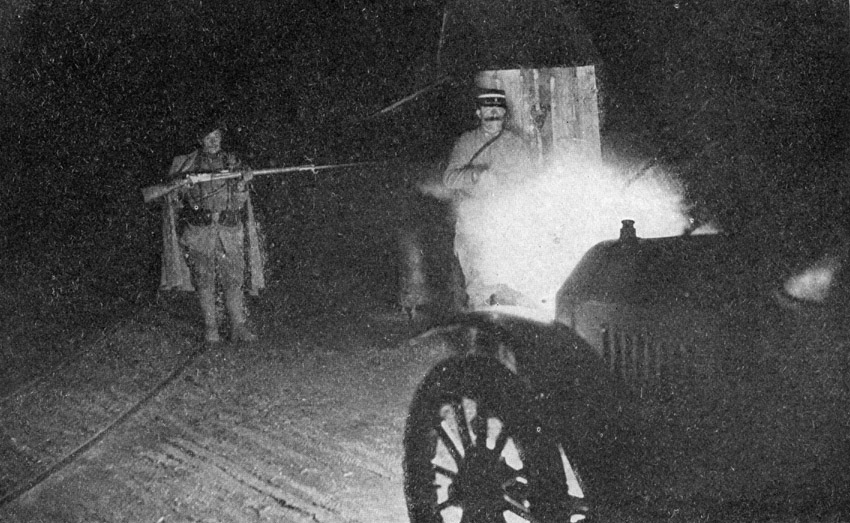
"Halt! Show Your Papers!"ToList
On the roads in the war zone there are sentries at frequent intervals and they are all suspicious.
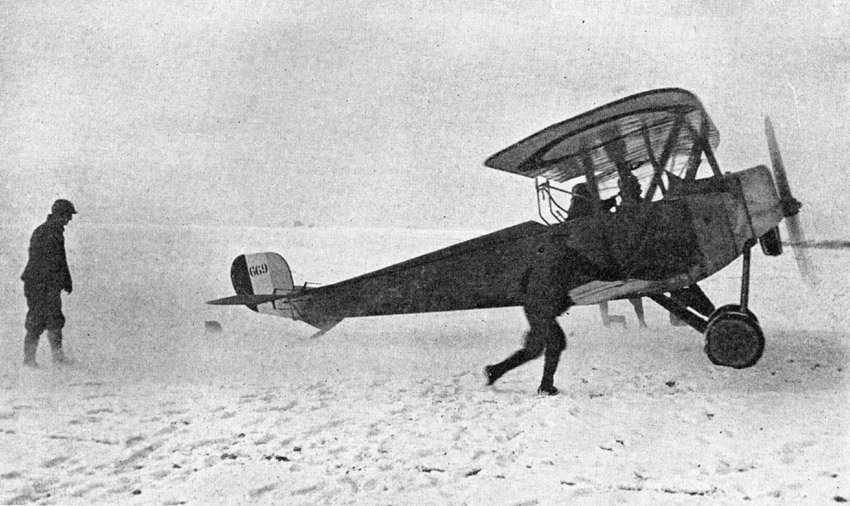
A Nieuport Biplane About to Take the Air.ToList
The pursuit or battle squadrons—the escadrilles de chasse—are composed of small and very fast planes, such as the Spad and Nieuport.
Until very recently the Nieuport biplane, which can attain a speed of one hundred and ten miles an hour, has been considered the fastest and most efficient, as it is the smallest, of the French battle-planes, but it is now out-speeded by the new Spad[C] machine, which has reached a speed of over one hundred and twenty miles an hour, and of which great hopes are entertained. The Spad, like the Nieuport, is a one-man apparatus, the machine-gun mounted on its upper plane being fired by the pilot with one hand, while with the other hand and his feet he operates his controls. On the "tractors," as the airplanes having the propellers in front are called, the machine-guns are synchronized so as to fire between the whirling blades. Garros, the famous French flier, was the first man to perfect a device for firing a machine-gun through a propeller. He armored the blades so that if struck by a bullet they would not be injured. This was greatly improved upon by the Germans in the Fokker type, the fire of the machine-guns being automatically regulated so that it is never discharged when a blade of the propeller is directly in front of the muzzle. Since then various forms of this device have been adapted by all the belligerents. Another novel development of aerial warfare is the miniature wireless-sending apparatus with which most of the observation and artillery regulation machines are now equipped, thus enabling the observers to keep in constant touch with the ground. In addition to developing the fastest possible battle-planes, the French are making efforts to build more formidable craft for bombing purposes. The latest of these is a Voisin triplane, which has a total lifting capacity of two tons, carries a crew of five men, and is driven by four propellers, each operated by a 210-horse-power Hispana-Suiza motor. These new motors weigh only about two hundred kilograms, or a little over two pounds per horse-power.
During the past year the French have made most of their raids by nights. One reason for this is that raiding craft, which are comparatively slow machines, are so heavily laden with bombs that they are only able to perform straight flying and hence are easily brought down by the fast and quick-turning battle-planes. Daylight raids, moreover, necessitate an escorting fleet of fighting craft in order to protect the bombing machines, just as a dreadnought has to be protected by a screen of destroyers. Though the dangers of flying are considerably increased by darkness, the French believe this is more than compensated for by the fact that, being comparatively safe from attack by enemy aircraft or from the fire of anti-aircraft guns, the raiders can fly at a much lower altitude and consequently have a much better chance of hitting their targets.
One of the extremely important uses to which airplanes are now put is the destruction of the enemy's observation balloons, on which he depends for the regulation of his artillery fire. An airplane which is to be used for this work is specially fitted with a number of rocket tubes which project in all directions, so that it looks like a pipe-organ gone on a spree. The rockets, which are fired by means of a keyboard not unlike that of a clavier, are loaded with a composition containing a large percentage of phosphorus and are fitted with gangs of barbed hooks. If the rocket hits the balloon these hooks catch in the envelope and hold it there, while the phosphorus bursts into a flame which it is impossible to extinguish. During the fighting before Verdun, eight French aviators, driving machines thus equipped, were ordered to attack eight German balloons. Six of the balloons were destroyed.
But the very last word in aeronautical development is what might be called, for want of a better term, an aerial submarine. I refer to seaplanes carrying in clips beneath the fuselage specially constructed 18-inch torpedoes. In the under side of this type of torpedo is an opening. When the torpedo is dropped into the sea the water, pouring into this opening, sets the propelling mechanism in motion and the projectile goes tearing away on its errand of destruction precisely as though fired from the torpedo-tube of a submarine. It may be recalled that some months ago the papers printed an account of a Turkish transport, loaded with soldiers, having been torpedoed in the Sea of Marmora, the accepted explanation being that a submarine had succeeded in making its way through the Dardanelles. As a matter of fact, that transport was sunk by a torpedo dropped from the air! The pilot of a Short seaplane had winged his way over the Gallipoli Peninsula, had sighted the troop-laden transport steaming across the Marmora Sea, and, volplaning down until he was only twenty-five feet above the water and a few hundred yards from the doomed vessel, had jerked the lever which released the torpedo. As it struck the water its machinery was automatically set going, something that looked like a giant cigar went streaking through the waves ... there was a shattering explosion, and when the smoke cleared away the transport had disappeared. Whereupon the airman, his mission accomplished, flew back to his base in the Ægean. There may be stranger developments of the war than that, but if so I have not heard of them.
France is now (April, 1917) turning out between eight hundred and a thousand completely equipped airplanes a month, but a considerable proportion of these are for the use of her allies. I have asked many persons who ought to know how many airplanes France has in commission, and, though the replies varied considerably, I should say that she has at present somewhere between five thousand and seven thousand machines in or ready to take the air.[D]
Leaving Chalons in the gray dawn of a winter's morn, we fled southward again, through Bar-le-Duc (the place, you know, where the jelly comes from) the words "Caves voutés" chalked on the doors of those buildings having vaulted cellars showing that air raids were of frequent occurrence, and so, through steadily increasing traffic, to Souilly, the obscure hamlet from which was directed the defense of Verdun. In the centre of the cobble-paved Grande Place stood the Mairie, a two-story building in the uncompromising style characteristic of most French provincial architecture. At the foot of the steps stood two sentries in mud-caked uniforms and dented helmets, and through the front door flowed an endless stream of staff-officers, orderlies, messengers, and mud-spattered despatch riders. In this village mairie, a score of miles behind the firing-line, were centred the nerve and vascular systems of an army of half a million men; here was planned and directed the greatest battle of all time. On the upper floor, in a large, light, scantily furnished room, a man with a great silver star on the breast of his light-blue tunic sat at a table, bent over a map. He had rather sparse gray hair and a gray mustache and a little tuft of gray below the lower lip. His eyes were sunken and tired-looking, as though from lack of sleep, and his face and forehead were deeply lined, but he gave the impression, nevertheless, of possessing immense vitality and energy. He was a broad-shouldered, solidly built, four-square sort of man, with cool, level eyes, and a quiet, almost taciturn manner. It was General Robert Nivelle, the man who held Verdun for France. He it was who, when the fortress was quivering beneath the Germans' sledge-hammer blows, had quietly remarked: "They shall not pass!" And they did not.
I did not remain long with General Nivelle; to have taken much of such a man's time would have been a rank impertinence. I would go to Verdun? he inquired. Yes, with his permission, I answered. Everything had been arranged, he assured me. An officer who knew America well—Commandant Bunau-Varilla, of Panama Canal fame—had been assigned to go with me.[E] As I was leaving I attempted to express to him the admiration which I felt for the fashion in which he had conducted the Great Defense. But with a gesture he waved the compliment aside. "It is the men out there in the trenches who should be thanked," he said. "They are the ones who are holding Verdun." I took away with me the impression of a man as stanch, as confident, as unconquerable as the city he had so heroically defended. A few weeks later he was to succeed Marshal Joffre to the highest field command in the gift of the French Government.
It is twenty miles from Souilly to Verdun, and the road has come to be known as La Voie Sacré—the Sacred Way—because on the uninterrupted flow of ammunition and supplies over that road depended the safety of the fortress. Three thousand men with picks and shovels, working day and night, kept the road in condition to bear up under the enormous volume of traffic. The railway to Verdun was so repeatedly cut by German shells that the French built a narrow-gauge line, which zig-zags over the hills. Beside the road, at frequent intervals, I noted cisterns and watering-troughs, and huge overhead water-tanks; for an army—men, horses, and motor-cars—is incredibly thirsty. This elaborate water system is the work of Major Bunau-Varilla, who, fittingly enough, is the head of the Service d'Eau des Armées.
Half a dozen miles out of Souilly we crossed the watershed between the Seine and the Rhine and were in the valley of the Meuse. On the other side of yonder hill, whence came a constant muttering of cannon, was, I knew, the Unconquerable City.
While yet Verdun itself was out of sight, we came, quite unexpectedly, upon one of its mightiest defenders: a 400-millimetre gun mounted on a railway-truck. So streaked and striped and splashed and mottled with many colors was it that, monster though it was, it escaped my notice until we were almost upon it. Suddenly a score or more of grimy men, its crew, came pelting down the track, as subway laborers run for shelter when a blast is about to be set off. A moment later came a mighty bellow; from the up-turned nose of the monster burst a puff of smoke pierced by a tongue of flame, and an invisible express-train went roaring eastward in the direction of the German lines. This was the mighty weapon of which I had heard rumors but had never seen: the great 16-inch howitzer with which the French had so pounded Fort Douaumont as to cause its evacuation by the Germans.
The French artillerists were such firm believers in the superiority of light over heavy artillery, and pinned such faith to their 75's, that they had paid scant attention to the question of heavy mobile guns. Hence when the German tidal wave rolled Parisward in 1914, the only heavy artillery possessed by the French consisted of a very few 4.2-inch Creusot guns of a model adopted just prior to the war, and a limited number of batteries of 4.8-inch and 6.1-inch guns and howitzers; all of them, save only the 6.1-inch Rimailho howitzer of 1904, being models twenty to forty years old. These pieces were, of course, vastly outclassed in range and smashing power by the heavy guns of the Central Powers, such as the German 420's (the famous "42's") and the Austrian 380's. Undismayed, however, the French set energetically to work to make up their deficiencies. As it takes time to manufacture guns, large numbers of naval pieces were pressed into service, most of them being mounted on railway-trucks, thus insuring extreme mobility. The German 42's, I might mention in passing, lack this very essential quality, as they can be fired only from specially built concrete bases, from which they cannot readily be moved. The two German 42's which pounded to pieces the barrier forts of Antwerp were mounted on concrete platforms behind a railway embankment near Malines, where they remained throughout the siege of the city.
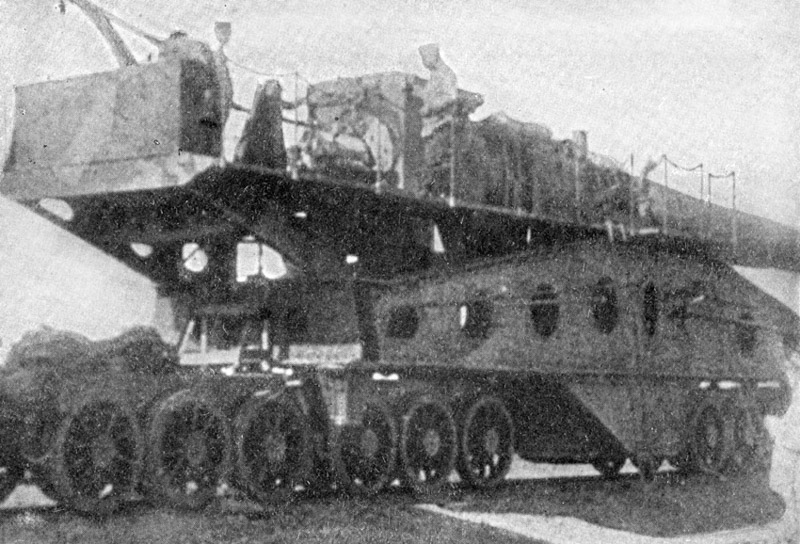
Verdun's Mightiest Defender: a 400-mm. Gun.ToList
This was the great 16-inch weapon with which the French so pounded Fort Douaumont as to cause its evacuation by the Germans.
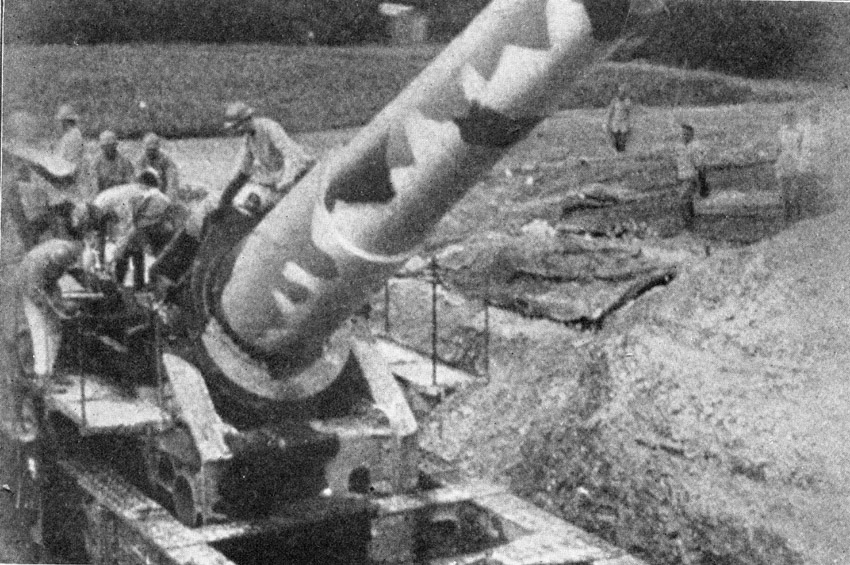
A Gun Painted to Escape the Observation of Enemy Airmen.ToList
"So streaked and striped and splashed and mottled with many colors was it that, monster though it was, it escaped my notice until we were almost upon it."
Some idea may be had of the variety of artillery in use on the French front when I mention that there are at least eleven calibers of guns, howitzers, and mortars, ranging in size from 9 inches to 20.8 inches, in action between Switzerland and the Somme. All of these, with a very few exceptions, are mounted on railway-trucks. In fact, the only large calibered piece not thus mounted is the Schneider mortar, a very efficient weapon, having a remarkably smooth recoil, which has a range of over six miles. It is transported, with its carriage and platform, in six loads, each weighing from four to five tons, about four hours being required to set up the piece ready for firing. Nearly all of these railway guns are, I understand, naval or coast-defense pieces, some of them being long-range weapons cut down to form howitzers or mortars, while others have been created by boring to a larger caliber a gun whose rifling had been worn out in use. For example, the 400-millimetre, already referred to as having proved so effective against Douaumont, was, I am told, made by cutting down and boring out a 13.6-inch naval gun. But the master gun, the very latest product of French brains and French foundries, is the huge 520-millimetre (20.8-inch) howitzer which has just been completed at the Schneider works at Creusot. This, the largest gun in existence, has a length of 16 calibers (that is, sixteen times its bore, or approximately 28 feet), and weighs 60 tons. It fires a shell 7 feet long, weighing nearly 3,000 pounds, and carrying a bursting charge of 660 pounds of high explosive. Its range is 18 kilometres, or a little over eleven miles, though this can probably be increased if desired. This is France's answer to the German 42's, and, just as the latter shattered the forts of Liége, Antwerp, and Namur, so these new French titans will, it is confidently believed, humble the pride of Metz and Strasbourg.
So insistent has been the demand from the front for big guns, and yet more big guns, that new batteries are being formed every day. Generally speaking, the French plan is to assign short-range howitzers and mortars to the division; the longer range, horse-drawn guns—hippomobile the French designate them—to the army corps; while the tractor-drawn pieces and those mounted on railway-carriages are placed directly under the orders of the chief of artillery of each army.
A new, and in many respects one of the most effective weapons produced by the war is the trench mortar. These light and mobile weapons, of which the French have at least four calibers, ranging from 58-millimetres to 340-millimetres, are under the direction of the artillery, and should not be confused with the various types of bomb-throwers, which are operated by the infantry. The latest development in trench weapons is the Van Deuren mortar, which takes its name from the Belgian officer who is its inventor. Its chief peculiarity lies in the fact that its barrel consists of a solid core instead of a hollow tube like all other guns. Attached to the base of the shell is a hollow winged shaft which fits over the core of the gun, the desired range being obtained by varying the length of the powder-chamber: that is, the distance between the end of the barrel and the base of the shell proper. The gun is fired at a fixed elevation, and is so small and light that it can readily be moved and set up by a couple of men in a few minutes. In no branch of the artillery has such advancement been made as in the trench mortars, which have now attained almost as great a degree of accuracy as the field-gun. Such great importance is attached to the trench mortars by the Italians that they have formed them into a distinct arm of the service, entirely independent of the artillery, the officers of the trench-mortar batteries, who are drawn from the cavalry, being trained at a special school.
The city of Verdun, or rather the blackened ruins which are all that remain of it, stands in the centre of a great valley which is shaped not unlike a platter. Down this valley, splitting the city in half, meanders the River Meuse. The houses of Verdun, like those of so many mediæval cities, are clustered about the foot of a great fortified rock. From this rock Vauban, at the order of Louis XIV, blasted ramparts and battlements. To meet the constantly changing conditions of warfare, later generations of engineers gradually honeycombed the rock with passages, tunnels, magazines, store-rooms, halls, and casemates, a veritable labyrinth of them, thus creating the present Citadel of Verdun. Then, because the city and its citadel lie in the middle of a valley dominated by hills—like a lump of sugar in the middle of a platter—upon those hills was built a chain of barrier forts: La Chaume, Tavannes, Thiaumont, Vaux, Douaumont, and others. But when, at Liége and Namur, at Antwerp and Maubeuge, the Germans proved conclusively that no forts could long withstand the battering of their heavy guns, the French took instant profit by the lesson. They promptly left the citadel and the forts nearest to it and established themselves in trenches on the surrounding hills, taking with them their artillery. This trench-line ran through certain of the small outlying forts, such as Tavannes, Thiaumont, Douaumont, and Vaux, and that is why you have read in the papers so much of the desperate fighting about them. Thus the much-talked-of fortress of Verdun was no longer a fortress at all, but merely a sector in that battle-line which extends from the Channel to the Alps. Barring its historic associations, and the moral effect which its fall might have in France and abroad, its capture by the Germans would have had no more strategic importance, if as much, than if the French line had been bent back for a few miles at Rheims, or Soissons, or Thann. The Vauban citadel in the city became merely an advanced headquarters, a telephone exchange, a supply station, a sort of central office, from the safety of whose subterranean casemates General Dubois, the commander of the city, directed the execution of the orders which he received from General Nivelle at Souilly, twenty miles away. Though the citadel's massive walls have resisted the terrific bombardments to which it has been subjected, it has neither guns nor garrison: they are far out on the trench-line beyond the encircling hills. It has, in fact, precisely the same relation to the defense of the Verdun sector that Governor's Island has to the defense of New York. This it is important that you should keep in mind. It should also be remembered that Verdun was held not for strategic but for political and sentimental reasons. The French military chiefs, as soon as they learned of the impending German offensive, favored the evacuation of the city, whose defense, they argued, would necessitate the sacrifice of thousands of lives without any corresponding strategic benefit. But the heads of the Government in Paris looked at things from a different point of view. They realized that, no matter how negligible was its military value, the people of other countries, and, indeed, the French people themselves, believed that Verdun was a great fortress; they knew that its capture by the Germans would be interpreted by the world as a French disaster and that the morale of the French people, and French prestige abroad, would suffer accordingly. So, at the eleventh hour and fifty-ninth minute, when the preparations for evacuating the city were all but complete, imperative word was flashed from Paris that it must be held. And it was. Costly though the defense has been, the result has justified it. The Crown Prince lost what little military reputation he possessed—if he had any to lose; his armies lost 600,000 men in dead and wounded; and the world was shown that German guns and German bayonets, no matter how overwhelming in number, cannot break down the steel walls of France.
It was my great good fortune, when the fate of Verdun still hung in the balance, to visit the city and to lunch with General Dubois and his staff in the citadel. Though the valor of the French infantry kept the Germans from entering Verdun, nothing could prevent the entrance of their shells. Seven hundred fell in one day. Not a single house in a city of 40,000 inhabitants remains intact. The place looks as though it had been visited simultaneously by the San Francisco earthquake, the Baltimore fire, and the Johnstown flood. But once in the shelter of the citadel and we were safe. Though German shells of large caliber were falling in the city at frequent intervals, the casemate in which we lunched was so far beneath the surface of the earth that the sound of the explosions did not reach us. It was as though we were lunching in a New York subway station: a great, vaulted, white-tiled room aglare with electric lights. We sat with General Dubois and the members of his immediate staff at a small table close to the huge range on which the cooking was being done, while down the middle of the room stretched one of the longest tables I have ever seen, at which upward of a hundred officers—and one civilian—were eating. This lone civilian was a commissaire of police, and the sole representative of the city's civil population. When the Tsar bestowed the Cross of St. George on the city in recognition of its heroic defense, it was to this policeman, the only civilian who remained, that the Russian representative handed the badge of the famous order.
The déjeuner, though simple, was as well cooked and well served as though we were seated in a Paris restaurant instead of in a besieged fortress. And the first course was fresh lobster! I told General Dubois that my friends at home would raise their eyebrows incredulously when I told them this, whereupon he took a menu—for they had menus—and across it wrote his name and "Citadel de Verdun," and the date. "Perhaps that will convince them," he said, passing it to me. By this I do not mean to imply that the French commanders live in luxury. Far from it! But, though their food is very simple, it is always well cooked (which is very far from being the case in our own army), and it is appetizingly served whenever circumstances permit.
After luncheon, under the guidance of the general, I made the rounds of the citadel. Here, so far beneath the earth as to be safe from even the largest shells, was the telephone-room, the nerve-centre of the whole complicated system of defense, with a switchboard larger than those in the "central office" of many an American city. By means of the thousands of wires focussed in that little underground room, General Dubois was enabled to learn in an instant what was transpiring at Douaumont or Tavannes or Vaux; he could pass on the information thus obtained to General Nivelle at Souilly; or he could talk direct to the Ministry of War, in Paris. I might add that one of the most difficult problems met with in this war has been the maintenance of communications during an attack. The telephone is the means most generally relied upon, but in spite of multiplying the number of lines, they are all usually put out of commission during the preliminary bombardment, the wires connecting the citadel with Fort Douaumont and Fort de Vaux, for example, being repeatedly destroyed. For this reason several alternative means of communication have always to be provided, among these being flares and light-balls, carrier-pigeons, of which the French make considerable use, and optical signalling apparatus, this last method having been found the most effective. Sometimes small wireless outfits are used when the conditions permit. On a few occasions trained dogs have been used to send back messages, but, the pictures in the illustrated papers to the contrary, they have not proven a success. In the final resort, the most ancient method of all—the despatch bearer or runner—has still very frequently to be employed, making his hazardous trips on a motor-cycle when he can, on foot when he must.
In the room next to the telephone bureau a dozen clerks were at work and typewriters were clicking busily; had it not been for the uniforms one might have taken the place for the office of a large and busy corporation, as, in a manner of speaking, it was. On another level were the bakeries which supplied the bread for the troops in the trenches; enormous storerooms filled with supplies of every description; an admirably equipped hospital with every cot occupied, usually by a "shrapnel case"; a flag-trimmed hall used by the officers as a club-room; and, on the upper levels, mess-halls and sleeping-quarters for the men. Despite the terrible strain of the long-continued bombardment, the soldiers seemed surprisingly cheerful, going about their work in the long, gloomy passages joking and whistling. They sleep when and where they can: on the bunks in the fetid air of the casemates; on the steps of the steep staircases that burrow deep into the ground; or on the concrete floors of the innumerable galleries. But sleeping is not easy in Verdun.
A short distance to the southwest of Verdun, on the bare face of a hill, is Fort de la Chaume. Like the other fortifications built to defend the city, it no longer has any military value save for purposes of observation. Peering through a narrow slit in one of its armored observatoires, I was able to view the whole field of the world's greatest battle—a battle which lasted a year and cost a million men—as from the gallery of a theatre one might look down upon the stage, the boxes, and the orchestra-stalls. Below me, rising from the meadows beside the Meuse, were the shattered roofs and fire-blackened walls of Verdun, dominated by the stately tower of the cathedral and by the great bulk of the citadel. The environs of the town and the hill slopes beyond the river were constantly pricked by sudden scarlet jets as the flame leaped from the mouths of the carefully concealed French guns, which seemed to be literally everywhere, while countless geyser-like irruptions of the earth, succeeded by drifting patches of white vapor, showed where the German shells were bursting. Sweeping the landscape with my field-glasses, a long column of motor-trucks laden with ammunition came within my field of vision. As I looked there suddenly appeared, squarely in the path of the foremost vehicle, a splotch of yellow smoke shot through with red. When the smoke and dust had cleared away, the motor-truck had disappeared. The artillery officer who accompanied me directed my gaze across the level valley to where, beyond the river, rose the great brown ridge known as the Heights of the Meuse.
"Do you appreciate," he asked, "that on three miles of that ridge a million men—400,000 French and 600,000 Germans—have already fallen?"
Beyond the ridge, but hidden by it, were Hill 304 and Le Mort Homme of bloody memory, while on the horizon, looking like low, round-topped hillocks, were Forts Douaumont and de Vaux (what a thrill those names must give to every Frenchman!) and farther down the slope and a little nearer me were Fleury and Tavannes. The fountains of earth and smoke which leaped upward from each of them at the rate of half a dozen to the minute, showed us that they were enduring a particularly vicious hammering by the Germans.
There are no words between the covers of the dictionary which can bring home to one who has not witnessed them the awful violence of the shell-storms which have desolated these hills about Verdun. In one week's attack to the north of the city the Germans threw five million shells, the total weight of which was forty-seven thousand tons. Eighty thousand shells rained upon one shallow sector of a thousand yards, and these were so marvellously placed that the crater of one cut into that of its neighbor, pulverizing everything that lived and turning the man-filled trenches into tombs. Hence there is no longer any such thing as a continuous line of trenches. Indeed, there are no longer any trenches at all, nor entanglements either, but only a series of craters. It is these craters which the French infantry has held with such unparalleled heroism. The men holding the craters are kept supplied with food and ammunition from the chain of little forts—Vaux, Douaumont, and the others—and the forts, themselves battered almost to pieces by the torrents of steel which have been poured upon them, have relied in turn on the citadel back in Verdun for their reinforcements, their ammunition, and their provisions, all of which have had to be sent out at night, the latter on the backs of men.
So violent and long-continued have been the hurricanes of steel which have swept these slopes, that the surface of the earth has been literally blasted away, leaving a treacherous and incredibly tenacious quagmire in which horses and even soldiers have lost their lives. General Dubois told me that, only a few days before my visit to Verdun, one of his staff-officers, returning alone and afoot from an errand to Vaux, had fallen into a shell-crater and had drowned in the mud. Indeed, the whole terrain is pitted with shell-holes as is pitted the face of a man who has had the small-pox. So terrible is the condition of the country that it often takes a soldier an hour to cover a mile. What was once a smiling and prosperous countryside has been rendered, by human agency, as barren and worthless as the slopes of Vesuvius.
Verdun, I repeat, was held not by gun-power but by man-power. It was not the monster guns on railway-trucks, or even the great numbers of quick-firing, hard-hitting 75's, but the magnificent courage and tenacity of the tired men in the mud-splashed uniforms, which held Verdun for France. Though their forts were crumbling under the violence of the German bombardment; though their trenches were pounded into pudding; though the unceasing barrage made it at times impossible to bring up food or water or reinforcements, the French hung stubbornly on, and against the granite wall of their defense the waves of men in gray flung themselves in vain. And when the fury of the German assaults had in a measure spent itself, General Nivelle retook in a few hours, on October 24, 1916, Forts Douaumont and de Vaux, which had cost the Germans seven months of incessant efforts and a sacrifice of human lives unparalleled in history.