Become acquainted with your sewing tools
Reading edition
Measuring tools
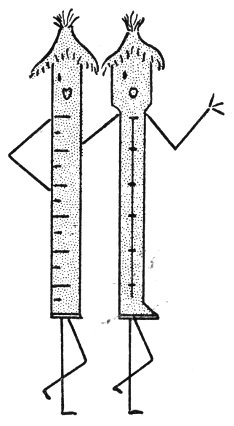
Measuring gauge (6 inches)
Ruler (12 inches)
Yardstick (36 inches or 1 yard)
Measuring Tape (60 inches)
Measuring tools are each marked with many short lines to help you measure fractions of an inch or inches.
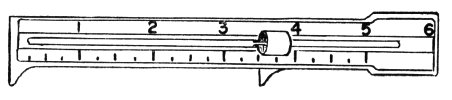
You will want to use the measuring gauge or the ruler for measuring short distances.
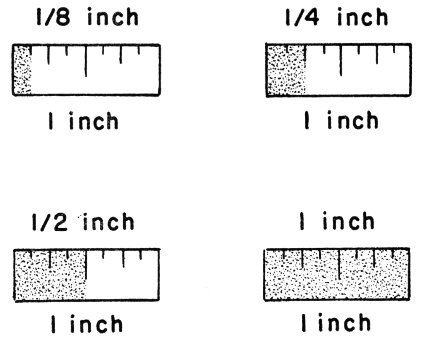
⅛ inch
¼ inch
½ inch
1 inch
If you want to measure anything longer than 12 inches, you will need to use either the measuring tape or the yardstick.
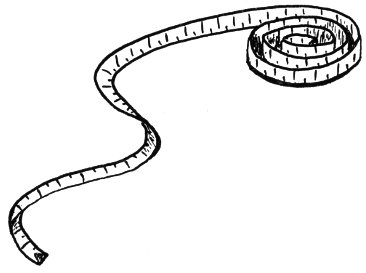
A measuring tape will help you measure inches or feet.
12 inches—1 foot
24 inches—2 feet
36 inches—3 feet
48 inches—4 feet
60 inches—5 feet
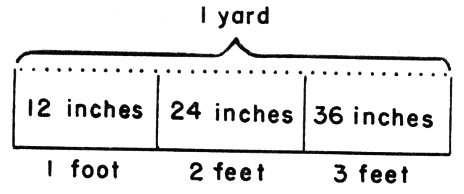
The yardstick will measure inches, feet, or yards for you.
1 yard
12 inches 24 inches 36 inches
1 foot 2 feet 3 feet
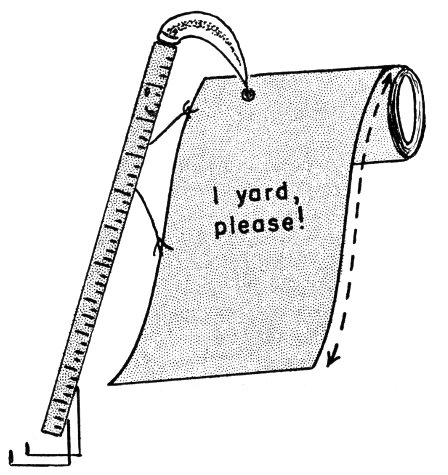
Material is sold by the yard or fraction of yard.
3
Cutting tools
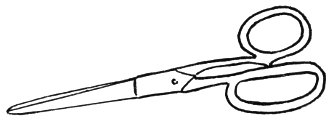
Pair of Shears
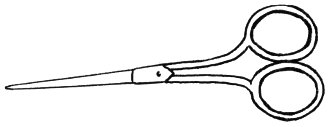
Pair of Scissors
If your mother has several types of cutting tools in her sewing box, you have already learned that shears and scissors will cut both fabric and thread, but one is easier to use for cutting thread than the other.
Little scissors like the small pair illustrated are meant to clip thread or cut narrow things like ribbon, elastic, etc. Scissors have very sharp and narrow points to make it possible to clip into tiny corners. Scissors have two handles the same size.
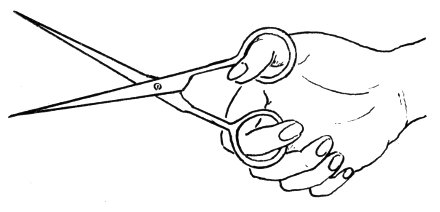
When you cut with scissors, put your thumb through one handle and a finger through the other. A pair of small scissors about 4 inches in length is easy to handle.
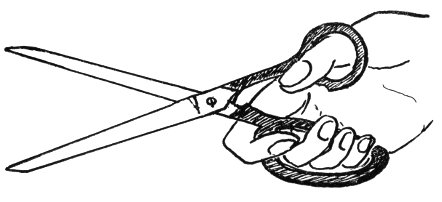
Shears are larger than scissors, and they are used for cutting a pattern out of material. Shears have one large handle and one small one. When you cut with shears, place your thumb through the small handle and two or three fingers through the larger handle. A pair of 7-inch shears is a good size for you.
Sewing tools
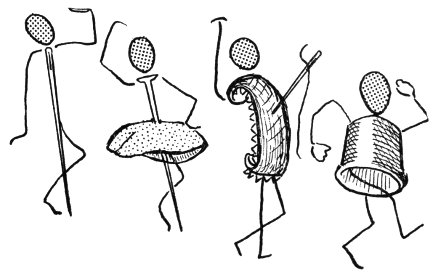
Needles and Pins and Pincushion and Thimble
Needles
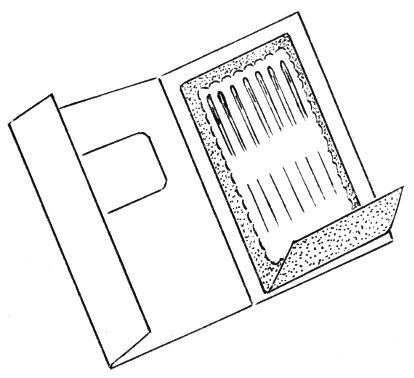
When you buy needles, search for slender ones with long eyes. If they are slender, they will slip in and out of the material without 4 much effort. The long eye will be easier for you to thread. Also notice the length of the needles. Will they be easy for you to handle?
Pins
Pins are used to hold the pattern and material together while you cut out a pattern, or to help you hold the pieces of material together when you are getting ready to sew.
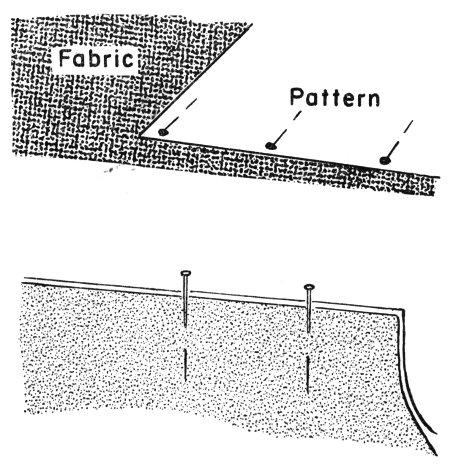
If you borrow some pins from your mother, you will be a smart little girl if you notice whether they slip into your material easily. Avoid using pins that are too large or have a blunt point. They are likely to snag or tear the material.
If you buy new pins, ask the saleslady for brass pins. These are strong pins, but fine in size.
Pincushion
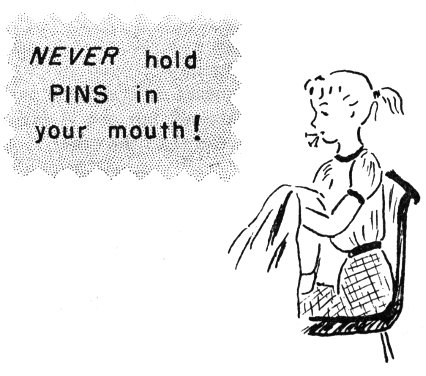
To help you develop the habit of putting pins and needles into a pincushion, always remember to wear your pincushion when you sew. If you drop pins or needles they are hard to find because they are small and will easily slip into a hiding place, where they may hurt someone later.
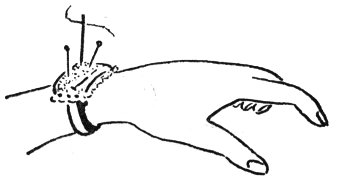
The wrist pincushion is the most convenient. If you are right-handed, wear the pincushion near your wrist on your left arm. If you are left-handed, wear the pincushion near your wrist on your right arm.
Thimble
People who sew usually wear thimbles for several reasons. They help to push the needle through the material, and they protect the finger from being pricked by the needle.
To push the needle through the material with the end of the thimble, hold the needle between the thumb and the first finger so that the eye end of the needle is resting against the end of the thimble.
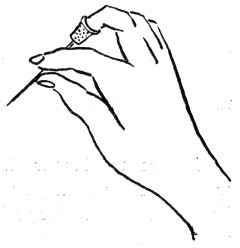
Buy the size that fits your middle finger snugly.
5
TRICK FOR NEATNESS
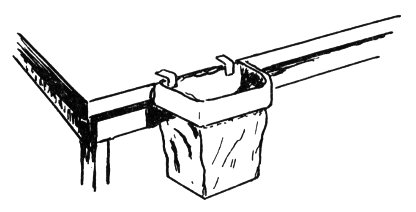
When you begin to use the sewing machine, you will be snipping many threads. Keep the area around your sewing table neat by using a paper bag for a wastebasket for scraps of material, paper, and thread. Fasten it to the edge of the table where you can reach it easily when you are sitting at the machine.