Chapter II · (continued 3)
Reading edition
They took us out on Monday morning and we were almost too weak to walk. The boys had a meal prepared for us, and we rested all that day. Next day they put us to work again, but instead of putting us all on the same shift they separated us. I was given night duty and the other boys were on day shift. I was feeling pretty blue the first day I went off to work alone, but was surprised and delighted to find an old pal of mine was on the same shift. This man was Macdonald, who had already made three attempts to escape, and when I met him he said, "Well, Jack, are you ready to try it again?" I said "Sure," and he said, "Well, I have everything ready and we will try and get away tonight." He had a good map and compass, so I told another prisoner to give mine to Sammie in case I got away. We knew the number of sentries and had them all located except one. It was very necessary that we should find out where he was.
Neither Mac nor I were allowed off the platform, so I asked another prisoner to let his hat blow off and then look round for a guard while he was down after it. He did this, but owing to the darkness under the platform he couldn't see anything, and he was just coming up when the gleam of a bayonet caught his eye; and here was our missing-link—with his back up against a pillar at the very spot where we had intended going over. That night at lunch hour one of the old prisoners came to us and told us to be careful, for he had heard two of the sentries planning to shoot the first one they found trying to escape. They figured that if they made an example of one, all the others would be afraid to make an attempt. We were not frightened, but they watched Mac and me so closely that we had no chance to get away. This was kept up for five nights, but on the fifth our opportunity came.
But first I must tell you what preparation we made in regard to clothes. It would not do for us to get away with only our prison garb, for it was grey, with wide red stripes down the centre of the coat, on the trouser legs, and on our caps. The only other clothes in our possession were those furnished by the Red Cross; namely, a brown sweater coat and black trousers. Now, each night before going to work, we were lined up and the officers looked us over to make sure no one had any Red Cross clothing on him. But this is how we fixed it. The black trousers had brown stripes, because the Germans insisted on our wearing stripes of some sort. When the Red Cross sent over the first parcels the Germans cut open the trouser legs and inserted red stripes. This work was so roughly done that the garments were spoiled, so the Red Cross put in brown stripes.
Now, in preparing for escape we cut this stripe out and sewed up the trousers so that they were all black. Then we cut the sweater coat up to the size and shape of our prison jacket and sewed it in. And when we lined up for examination, instead of throwing open our coats we thrust our hands in our pockets, and this opened our coats without turning back the corners. We had pulled on the prison overalls over our black trousers, so if we got away all we had to do was wear our prison jacket inside out, drop our overalls, and we were in civilian clothes. Still, each night as we lined up our hearts almost stopped beating lest they should discover our preparation. We couldn't lay in a supply of food, for just at this time there was a movement of troops at the border and the Germans were not bringing any parcels, so if we got away we must trust to what we could pick up in the fields.
But now to go back to the fifth night. As we went to lunch at twelve o'clock Mac said, "Now, Jack, we must make it tonight, for tomorrow we go on day shift." I said, "All right, Mac, I'm game; and we shall try for it just as soon as we go on duty again." We had an hour off for lunch, and as it didn't take long to eat a small piece of bread and sup a bowl of soup, we usually had a good sleep, but now we were too excited to either sleep or eat, and sat together and made our plans.
The platform on which we worked was situated in the centre of the railway yards and was as brightly lighted as the main street of a city. But this night we noticed two box-cars on a track about two hundred yards away, and Mac said, "If we can make them, we are safe." So when our hour was up and they marched us back, Mac and I were the first two up the ladder. We followed about three feet behind the first sentry until we got halfway down the platform, and while he went dreaming on his way to the end of the platform we dropped quietly to the ground. We were running when we struck, and we certainly beat the record in our two-hundred-yard dash to the box-cars, and from there to a small bush another two hundred yards away. Evidently no one noticed us, for there was not a shot fired. Once in the cover of the bush we felt safe, and we congratulated one another on having made at least a successful start. We carried our prison overalls with us, as we planned to make use of them later on.
Of course our first job was to get rid of our prison clothes, and while we were doing this we heard a great commotion in the camp. The prisoners were being lined up and counted, and we knew that we had been missed. The German rule was that if any prisoners escaped the officer in charge of the guard at that time was sent to the front lines, and this was the most dreaded of all punishments. This night a big bully was in charge, and he was hated by all the men. One of the prisoners had said early in the night, "Now, Jack, if you intend to get away, for goodness' sake go while this brute is in charge, for we want to get rid of him." We thought of this while we listened to him shouting out his orders in a voice that could be heard a mile. We knew the first thing they would do would be to put the bloodhounds on our track. They took them to our bunkhouse and let them get the scent from there. But we had a little plan to get rid of them; as soon as we heard them coming we scattered some pepper on our trail. We walked all that night, and although we heard the hounds occasionally we saw nothing of our pursuers. Morning found us on the edge of about two acres of scrub. The bushes were only about five feet high, but they were very thick and well-leaved, so we decided to lay up there for the day. Nothing happened until about four o'clock in the afternoon, when we were startled by hearing some one coming crashing through the bushes. We hugged the ground as closely as we could and hardly breathed, as the footsteps were coming nearer. The bushes were so thick that we couldn't see the person, but it sounded as though he was coming straight for us. We determined to sell our liberty dearly in case we were discovered, but to our intense relief he passed about two yards from us. We could see his feet and legs and could easily have reached out and tripped him. He was a German patrol, and he was looking for us. We watched him after he got past to make sure we wouldn't go the direction he had taken. We hadn't anything to eat that day except one piece of German black bread that each of us saved out of our rations the day before.
At 10 P.M. we started on the march again, and after about two hours' walking we came to the River Lippe. We lost no time looking for a boat, but made straight for our old bridge. It was easier getting through the wire this time, and we had no difficulty in getting across. Travelling on, we came to the little town of Haltern, but we didn't dare risk going through this time, in case some one was on the lookout for us. So we skirted around the edge, and on the way came across a few early gardens. It was early in June and nothing was very far advanced, but we found some young beets, which we ate, tops and all, also some seed potatoes. Of the latter we dug up almost the whole patch and we filled our pockets and big red handkerchiefs which each of us carried. I assure you these raw vegetables tasted as good to us then as any turkey dinner we would have at home. After our hasty lunch we started off across country. It was much rougher travelling, but we thought it was safer. Just at dawn we came to what we thought was a fair-sized bit of woods, and we decided to spend the day there. But when daylight had fully come, we found that our bush was a very small one and right at its edge was a German farmhouse. It was too late to go any farther, so we crawled along looking for a secluded spot in which to hide. Pretty soon we came to some low bushes over which a running vine had spread itself, so we crept in and lay down. Pretty soon we heard voices and the barking of a dog, and peeking out we saw an old farmer ploughing just at the edge of the bush. He was followed by two children and a dog, and as these played around we expected every minute they would land in on top of us. There was no sleep for us that day, so we lay there munching our potatoes and waiting for the darkness.
At 10 P.M. we started out, and soon we came in sight of Dulmen Camp. Once more we skirted around it, keeping as far away as possible. After a couple of hours we reached the swamp that came so near to being the death of us on our former trip. This time we went around, and though it took longer it was a vast deal more comfortable. It was too early in the night to make use of our old friend, the implement shed, but I passed it with real regret as I remembered the comfortable rest I had there. But we felt we must push on and run the risk of striking something good later in the night. We were now in the midst of a good farming district, and we decided we must lay in our rations for the following day. So, the next potato field we came to, we set to work and dug up about half of it. Potatoes were very scarce in Germany at this time. They were issued out to the farmers by the Government and could only be used for seed; and it tickled us to think how angry the old farmer would be when he discovered the damage done to his crop.
It was now getting on towards morning and we were very tired and weak, so the first bit of woods we came to looked good to us, and we decided to camp there for the day. On the way we picked up a tin pail and we decided to try boiling some potatoes if we got the chance. Everything seemed very quiet and it was still too early for any one to be around, so we gathered some wood and made a fire. I got some water from a nearby slough and we soon had the potatoes on; after they had been boiling for twenty minutes we tried them to see if they were nearly ready, but they seemed as hard as ever. So we waited another fifteen minutes, and still they were not soft. It was hard work waiting, for we were almost starved, but we let them boil for an hour, and Mac said we had better take them up before they got too tough to chew; so we started at them, but they were almost as tough as leather. We had nothing to eat with them but some pepper, and they had nothing to recommend them except that they were hot. After breakfast we crawled under some bushes and tried to sleep, but our nerves were too tightly strung to give us any rest.
However, we lay there all day, and nothing disturbed us. Towards evening a heavy thunderstorm came up, and it rained for two hours. Of course we were soaked to the skin, and we didn't look forward with much pleasure to our night's walk. Owing to the storm, darkness came on earlier than usual, so we got started in good time. We started out across country, and after travelling for two or three hours we came to a pasture field. We saw some cows in the distance, and Mac asked me if I could milk. I said, "It is a long time since I tried, but I would make a good stab at it for the sake of having a drink right now." Mac stayed on guard at the fence while I took our potato pail and went over to make the acquaintance of Bossy. There were three cows in the bunch, and choosing the one that looked most friendly I went up and introduced myself. I'm not sure she understood all the nice things I said to her, but her feminine vanity seemed to be pleased with the patting I gave her. At last I broached the subject of my visit, and taking "silence for consent," I took my pail and set to work; but the old lady showed her disapproval by walking away. Of course I followed, and once more resorted to flattery. When I thought I had her worked up sufficiently, I tried again for milk, but with the same result. This was repeated several times, and at last my patience was exhausted, so I hailed Mac, and when he came I urged him to continue the petting business while I tried for milk. He did this, and it worked splendidly; we got sufficient milk to give us both a good drink. It seemed to put new life into us. This was our fourth day out, and we were almost famished. After we finished our drink we thanked our old cow and started on the march again. This seemed to be our lucky night, for soon we came across a garden, and we laid in another supply of potatoes. Continuing on our way, we came to a fine road. It was bordered on each side by the most beautiful elm trees, and as it was leading in the right direction we determined to follow it. After walking about a mile we came to a farmhouse and right beside the road was a milk-stand. It held three cans of milk, and we couldn't make up our minds whether the farmer had intended them for the milkman or for us. We preferred to think the latter, so we proceeded to help ourselves.
We sat there and drank milk until we felt that we must look like "observation balloons." Then we filled our potato pail and went on. But we didn't feel much like walking and decided to lay up in the first likely-looking place that we came to. The whole country is beautifully wooded, so it was not long before we came to a nice bluff. It looked nice and quiet, and we settled ourselves for the day. We were very tired, and we both fell asleep, but I woke with a start, for I heard something coming through the bush. I wakened Mac, and we grasped our heavy walking sticks and lay still. The sound came nearer and nearer, and just when our nerves were at breaking point two bright eyes looked down at us over the edge of the little hollow we were in—it was a hedgehog. We couldn't keep from laughing at the scare it had given us. I wanted to take revenge, but Mac said, "No, let the little devil alone, it's a sign of good luck." Nothing else happened that day, and we chewed away at our raw potatoes and drank milk as we waited for darkness. When it came we started out again across country.
About 1 A.M. we came to a railroad track and after looking carefully in case there should be a sentry on guard, we crossed and came up on a carefully graded road. It was difficult travelling this night because, owing to the clouds, we had to depend entirely on our compass. We were not sure how the road ran, so while Mac got out his searchlight and endeavoured to read the compass I kept watch. If it was only getting a drink, one was always on guard. A moving figure in a field at the edge of the grade caught my attention, and at first I thought it was an animal. So it was, but of the two-legged German variety. He had seen our light, and suspecting that we were prisoners he determined to get a good shot at us. I suppose he could almost see the four hundred marks offered by the Government as a reward for a prisoner, dead or alive. He was coming in a stooping position, and the night was so dark that I wasn't sure it was a man until he raised his rifle and straightened up. Then I grabbed my chum and said, "A man, Mac," and we made a bolt for cover. The shot rang out, but he did not get us, and before our pursuer could climb the grade we were safely hidden in the bush. This was a warning that we were getting into the "danger-hole" district, for the man who shot at us was a police patrol.
Let me explain how the Holland border is guarded. It is well known that the border between Belgium and Holland is protected by a fence of live wires; but the Holland and German border is looked after by a wonderful system of patrols. This patrol system begins on a road two miles back from the border and running parallel with it. On this road there are three different kinds of patrols—men on horseback, on bicycles, and on foot—and instead of going singly, they were in parties of from three to ten. This is typical of the German at war and at home; he is much too cowardly to attempt anything single-handed. That's why their officers continue to send them over in massed formation; though sometimes it almost made our gunners sick the way they had to mow them down. Well, as I said, they patrolled their beats in parties; and this outside beat is well looked after. Crossing this first patrol, and leading into the border, there is a road every half-mile, and of course each road has its own special patrol—also another patrol has his beat in between these roads; while close to the border are two more lines of guards: one of these is stationary and the men are placed two hundred yards apart, and right in front of these guards, on each quarter-mile beat, walked a man, having two immense bloodhounds on leash.
Now, all this elaborate guard system was not put there for the sole purpose of catching a few escaping prisoners. But at this time the German soldiers were deserting in such large numbers, and getting over into Holland, that the Government took this method of stopping them. Now, this was what Mac and I were up against in attempting to cross the Holland border, and we realized the difficulties only too well, for Mac had learned it all by bitter experience. One stormy night, some weeks previous, he had crossed the border into Holland, only to lose his way, and stray back into Germany. He was captured by the guards and sent back to the mines. This was his third attempt as well as mine, and we knew it would go hard with us if we were caught again. So, after our brush with one of these game wardens who also acted as police patrol, we were doubly careful. We kept in the shadow of the trees and watched every step. When suddenly, right before us, shone out the whiteness of a graded road and we knew that we were in the line of the outside patrol. We crouched in the darkness at the edge of the wood and listened, but not a sound came to our ears, and in a moment or two Mac whispered "Now, Jack," and we made a dash across, when to our utter amazement three figures sprang up right in front of us and we found ourselves looking into three rifle barrels. A gruff German voice called, "Halt! Who goes there?" and we threw up our hands and grunted a reply. Immediately the guns were lowered and the men came toward us, but instead of finding two helpless prisoners, they were met by good hard blows delivered in true British fashion. We had taken them completely by surprise, and in a few minutes we were able to break through. We didn't wait to see what condition they were in, but made the best time possible to a place of safety. We heard one of them blow his whistle, just after we got away, and a couple of shots were fired, but if reinforcements came we did not see them. We kept on going until we thought we were safe from pursuit, and we began looking for a place in which to lay up for the day. This was our seventh day without food excepting raw vegetables, and our strength was almost exhausted.
This encounter with the patrols had used us up pretty badly owing to our weakened condition, and we knew that the supreme test was still ahead. Presently, right in the centre of the bush, we came to a place where the slough grass was very long and thick, and we decided to risk spending the day there. We were now in the centre of the patrol district, and there was no safe place; but we hoped to be fortunate enough not to be too close to the beat of the nearest patrol. We pulled a quantity of long grass and buried ourselves in it. Although very tired, sleep was out of the question, and we lay there planning how we could get through the last two lines of guards.
About 8 A.M. we were alarmed by the noise of some one crashing through the bushes, and our hearts beat like hammers as we listened to the sound growing nearer. Of course we were sure it was a patrol, and we began to fear our little game was up. We lay there scarcely breathing, and all at once voices reached us, and Mac whispered to me, "Gee! they must have women in this patrol." We peered through the grassy cover, and there, coming straight towards us, were two young German girls. The wooden shoes they wore accounted for the great racket they made, but I assure you we felt very much relieved, though our danger was still very great, for they could give the alarm, and we did not know who might be near.
A short distance from us they took off their coats, and we saw they had come to work. All through this part of the woods were scattered bundles of small sticks for firewood, and the girls' job was to collect these and carry them to a road some three hundred yards distant. The young ladies kept up a continual chatter, and perhaps it was this that kept them from discovering our hiding-place, for they came within two or three yards of us. At twelve o'clock they started home, and as soon as they were out of sight we got up and stretched ourselves. It was so good to move after lying still for four hours. However, we didn't dare stay up very long, and we were "tucked in" once more when the girls got back. This time there were three, and they worked away until about four o'clock. We had to lie like mice, and we were in constant terror lest one of us should sneeze or cough. Just about four we heard one girl say "Fertig" (or "finished"), and the three went out and sat on the side of the wood to continue their chat. We felt very much relieved and were congratulating ourselves on another escape when we heard a man's voice, and looking out of our hiding-place we saw an old man in conversation with the girls. He had evidently counted the bundles and was insisting that there were still some left in the bush. They argued for quite a while, and then to please the old man the girls came back. But it was evident they felt sore over having to come, for instead of searching for wood, they walked right through the bush and out to the road on the other side. There they sat down and after awhile moved on home, or at any rate out of sight. We were glad to be able to move again and to be relieved of our uninvited company. As soon as we were sure they were not coming back we got up and moved around to get the ache out of our bones. We also had some preparations to make for our final effort that night. As I mentioned before, we had carried our prison overalls with us, and now we were to put them to use. Our only chance of getting over the border lay in our being able to move so quietly that the sentry could not hear us. So we started to make moccasins out of our discarded overalls. We had neither scissors, needles, nor thread, but our experience had taught us that in all circumstances we must make what we did have serve our purpose. Our jackknife cut out our moccasins, and it also made a small stick into an implement that could punch holes, while some pieces of cord that we happened to have did fine in place of thread. It took quite a while to get our moccasins made, working with poor tools, and they were fancy-looking articles when we at last had them finished. The red trimming was very fetching, but we thought it quite appropriate, for there is always a lot of red tape necessary in getting out of a country that is At War. It was almost dark when we had our moccasins finished, so we put them on and made ready for our start. Our boots were securely fastened to our belts, and we took a final look at our map. We were almost famished, but two raw potatoes was all that remained in "the larder." However, we disposed of these, and just at 11 o'clock we started out.
The direction to the border was straight west, and we figured it must be a mile and a half to the nearest point. But we had to keep under cover as much as possible, so we couldn't tell just when we might be near it. We crossed the wood at the side of our bush, and a few minutes' walk brought us in sight of a small pasture field in which there were three or four cows. The sight of these brought to our minds the dandy drink of milk we had two nights before, and though we took an awful risk, going out into the open, we thought it worth while. Once more Mac stood on guard, and I crawled out to where the cows were grazing. I tried them, one after another, but not a drop of milk could I get. They had evidently been milked a short time previous. I made the trip back in safety, and we started out, not knowing what minute we might happen on a sentry's beat, which made our going exceedingly slow.
About 12.30 we came to the edge of a swamp, and here and there all through it we saw dark objects that looked like men. We lay in the long grass and watched to see if we could notice any movement. Sometimes we thought there was, and then again we were sure they were stationary. However, we had to pass them, so we crawled carefully forward, and made our way close to where one of these objects was standing, and when we thought we were near enough we raised up and took a look. It was a stack of peat piled to just about the size of a man. We had a good laugh, and I assure you we felt very much relieved. We made our way safely across the swamp and had just reached the other side when we heard the hounds. We listened, and noted that the sound came from across the swamp, just the direction we had come. Mac said, "Jack, they are on our track; we had better put out some pepper;" so we sprinkled it on our tracks and, crouching as low as possible, moved along. The sound was getting nearer, and suddenly, to our right, we heard a sentry call "Halt!" But instead of stopping we ran for all we were able. We heard the sentry call three times, and then a shot rang out. There was no attempt at concealment now, we were running for our lives, or what was dearer still—our liberty. There was a grove of trees just ahead, and we knew that we still had a chance if we could reach that. One more spurt and we were there, and had thrown ourselves down with our faces toward the open country we had just left. We were pretty well out of breath, but we dared not stay longer than was necessary to get our wind, so we pushed on, for we were anxious to get across the border in the darkest part of the night. We stole along like ghosts, for we did not know what moment we might run up against the border guards. We decided that the shot we had heard on our right had come from a passing patrol.
We kept on until 4 A.M., and as it was getting a little bit light we saw in the distance what looked like a small town. We were much astonished, because if we read our map aright the only town on our route should have been passed the night before. We lay up in a field and talked it over, but we couldn't locate ourselves. It wouldn't do for us to lay up for a day so near a town, so we must either turn back or hasten on. At last I said, "Let's flip a coin and see which we will do—heads, we go on; tails, we turn back." We did this, and it turned out "heads," so on we went. I forgot to say between us and the town was a canal, and we couldn't find a bridge. This canal was another puzzling feature. Well, we swam it, and came out very wet, cold, and tired. We passed within half a mile of the town and finally struck the main road on the other side. It was now daylight, and we had to be on the lookout for people every instant. Finally we saw a signpost just ahead, and we thought that would surely solve our problem. But when we came to it we found the lettering had become almost obliterated. One town that the hand pointed to we figured out as "Neda," but the one we had just passed could not be made out. Finally, with Mac's help, I climbed up to the top of the pole, and from there I made out a few of the letters. Comparing these with an address I had found on a piece of wrapping paper earlier in the morning, I made out the name as "Haakshergen." However, our map didn't show either of these towns, so we were just as much at sea as ever.
Then it occurred to us that the border troops must be stationed in either one of these towns, and there would surely be some of them passing on this road; so we determined to hide in the ditch close by and watch for them. We came to a place where there were some bushes growing at the side of the ditch and we hid in these. Finally we saw two mounted men coming, but they passed so quickly that we couldn't see much except that they wore grey uniforms. We waited a little longer, and along came two soldiers on foot. One of these was evidently sick or wounded, for just as they came opposite us he begged to be allowed to sit down. They talked for a minute or two and then moved on, but we had a good look at them. They wore exactly the same uniform as the German excepting that their hats were different. Instead of a "pill-box" they had a cap with a square top. All at once I remembered having seen some pictures of Holland soldiers in the Daily Mirror (an English paper), and I said, "By golly, I believe they are Hollanders," but Mac said, "No; if they were, they wouldn't be dressed like Germans." One thing we decided on, and that was that we must find a safer place than the one we were in; so when there was no one in sight we made our way to a nearby wheat field. We lay there discussing the situation, and just at 9 o'clock we heard the whistle of a train. We could hardly believe our ears, and we crawled to the edge of the field to see in which direction it was going. We found it running right into the town we had passed, and now we were more muddled than ever, for the German town that we thought was on the border hadn't a railroad nearer than fifteen kilometers. We made our way back into the field, took out our map, and tried to solve the problem.
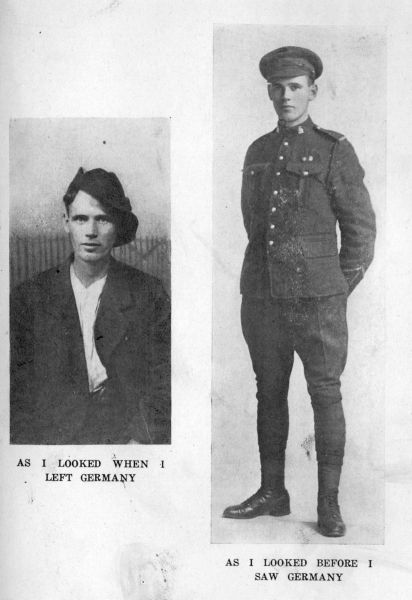
[Illustration: As I looked before I left Germany; as I looked before I saw Germany.]
At last we got desperate; we couldn't go on at night unless we found out where we were, so we thought we would take a chance on going farther down the road. We hadn't gone far when we saw a man in the distance, and we slipped into some bushes until he had passed. Going on farther we saw there was a man coming on a bicycle. We ducked and hid, and as he got nearer we could see that he had a gun strapped on his shoulders. We were afraid he had seen us and we were sure there would be some fun, but fortunately he too passed. When everything was quiet we started out again, and presently we spied an old man working on the road. He had only a wheelbarrow and shovel, so we decided to risk asking him what country we were in. When we came up we bid him the time of day, and, in the best German we could muster, asked, "Which is this, Germany or Holland?" The old man looked at us, smiled, and said "This is Holland." It sounded too good to be true, and for an instant we could only stare at him and each other, then the realization came that we were FREE and we laughed and hugged one another in our joy. The old man watched us with a sympathetic smile, for though he could not understand all that we were saying he knew that we were escaped prisoners. We must have been a rough-looking pair. We had travelled a hundred miles at night over all kinds of country, and had been eight days without any cooked food. Our faces were covered with hair, and our clothes were ragged and dirty. I weighed only 125 pounds, and the long period of anxiety and mental strain, had aged me at least ten years. Mac was just as bad, and we must have looked more like a couple of jail-birds than anything else.
Well, finally we sobered down sufficiently to ask the man how far it was to the nearest town. He told us it was about five miles to the little town of "Neda"; but before we started he asked us if we were hungry. We looked at each other and smiled—and the old man understood—he insisted on our taking all of his lunch, even the bottle of tea that he carried—and I assure you no food ever tasted better. We felt like new men after getting something to eat, and we shall not soon forget the old Hollander's kindness to us. It was with light hearts that we finally said "Good-bye" to our new friend and started on our way to "Neda."
The world looked very different to what it had a few hours before, and we were so busy talking about our experiences that we scarcely noticed a man passing by us on a bicycle. He must have heard a scrap of the conversation, for he turned and looked, and then jumped off his wheel and came toward us. He said, "Are you Englishmen?" We said, "No, not exactly; we are Canadians." "Oh," he said, "Canadians. I am a Hollander myself, but I was educated in England; you must be escaped prisoners." We replied, "Oh, we are not telling what we are." He said, "You needn't be afraid, for my sympathy is all with the Allies." So we told him everything, and he walked with us until we got almost to Neda. Then he mounted his wheel and rode into town, telling every one in sight that we were coming. So when we arrived the streets were lined with people; men, women, and children turned out to welcome us. They finally conducted us to a store where the proprietor spoke English. We sat and chatted for a few minutes, and then his wife came out with a lunch. She brought bread and butter, cake and tea, and I leave you to imagine how good it tasted.
But our friend on the wheel had left us at the store, and had reported our coming to the police headquarters. So while we were at our lunch the chief of police and an attendant arrived and asked us to go with them. This didn't look good to us—it seemed too much like what we had been getting for the past year. I said, "By golly!! Mac, I don't like this." He said, "Neither do I, but I guess we have to go," so we went along; but instead of landing in the police station, the chief took us to his own house. Here we were made to understand we were guests; and we were given water, soap, clean towels, and fresh shirts to replace the ones that were torn to pieces. After we got cleaned up we felt like new men, and our host took us out where a table was set under the trees and we had our first properly served meal since leaving England—a year and nine months.
Of course we were not given a regular dinner—our friends were too wise for that—heavy food would have killed us. All we had was bread and butter, cake, and strawberries with cream; but oh, they were scrummy. The next thing we needed was sleep, and our host wished to put us to bed in the house. But we felt much too dirty to get into his clean beds, and we made him understand we much preferred going into the hayloft. So he brought us some blankets, and we turned in. We slept for fourteen hours without waking; that's how badly we needed it. We wakened at 2 A.M., and at first we didn't know where we were. But after we got our bearings we went to sleep again and didn't wake until nine in the morning. Then we got up and had another light meal. We lay around and rested all that day, but as their English was as limited as our Dutch, conversation lagged. That night we had our first taste of meat since entering Germany—and maybe we didn't enjoy it!
Early next morning we took the train for Rotterdam, the chief sending an escort with us. Once there, we were taken to the British consul, and after proving our identity we were given clothes, money, and a passport for England. It was ten days before we got a boat out of Rotterdam, and during that time we received nothing but kindness from the people we met.
Finally we secured passage on a boat, and on the first day of July we landed in England.
"MY COMRADES, AND WHAT BECAME OF THEM, AS TOLD TO ME IN LETTERS, BY MY OLD CHUM BOB GODDARD."
DEAR JACK:
Well, you certainly had a pretty tough time in Germany, and I don't envy your experience. And now you want to hear what we did after you were taken prisoner, and what became of the bunch that you and I knew so well. It's not pleasant to recall the things that happened, Jack, but I'll do my best. Let me see; the Battle of St. Éloi was the last scrap you took part in. Well, after that things cooled down a bit, but we still took our turn in the trenches on that part of the line. No. 10 Platoon was still intact. We missed poor old Woodrow, and his chum Fred went around looking like a ghost. The latter had never gotten over his experience in No Man's Land, his eyes were sunken in his head, and he was nothing but a wreck. One night, when we were in reserves in Dickiebush, a few of us were talking and saying how lucky our little bunch had been, when at that minute an order came in sending us out on a working party. Fritz had gotten busy and blown down a section of our front lines, and the boys holding this spot had no protection, so we were being sent up to repair the damage. I guess Fritz was sore, for our Stokes light trench mortars and heavies had been pounding the German trenches all day long. Well, we were told off in small parties to carry up sandbags, corrugated iron, picks and shovels, to repair the line.
Our little bunch consisted of Tommy, Bink, Scottie, Bob Richardson, Newell, McMurchie, and one or two others whom you do not know. "Flare-pistol Bill" was in charge, of course; and just our luck, we had to carry the corrugated iron (and damned awkward stuff it is), it's too wide to carry through the trenches, so we had to go overland—and I tell you, the machine gun fire was wicked. The boys holding the trenches had a lot of casualties. Well, we got our loads and started off in and out of shell holes. Tommy fell into a hole that was full of water and got soaked; and Chappie, with his poor eyesight, if he fell once, he fell at least a dozen times. We went along cursing our hard luck, and making the best time we could, for the bullets were flying mighty thick. Flares were going up every few minutes, and every time one went up we would "freeze" till it went out again. At last we got quite close to the front line, and when Fritz sent up a flare it would fall right behind us. They couldn't help seeing us, for we made a lovely target with those big slabs of corrugated iron on our heads. The machine guns just ripped lead at us, and we were hurrying to get to the trench, when young Blair got it through the thigh. He started to yell at the top of his voice; and Scottie, who happened to be next in line, cussed him roundly for the noise he was making. We would likely have been all killed if he hadn't shut up. Well, they bound him up and carried him out, and the rest of us went on.
We hadn't gone fifty feet when Scottie went down with a crash, just in front of me. I crawled up to him, and he was badly hit—the blood was pouring from his mouth, and he mumbled "Stretcher bearer." Flare-pistol Bill went on to the trench to hunt up one, and I crawled back to see if I could find the one who had come up with us. Before I got back with Bob the stretcher bearer from the trench had fixed Scottie up as well as he could. Poor Scottie! his jaw was shattered. Bink insisted on carrying Scottie out on his shoulders, and they started. But before going halfway Bink played out, and when Scottie saw that Bink was all in he got down and walked to the dressing-station. Say, that boy was sure game. By the way, he's in Blighty now. Well, the rest of us got through safely, we fixed up our trench and managed to get back to our supports. A few nights later we made another trip to the front lines, and this was disastrous for No. 10. First of all, Tucker got shot in the face while on a wiring party; then Jack Branch was on a working party behind the trench when Fritzie started shelling, and he got a shrapnel bullet through his arm. We bound him up, and he was in great pain, but he smiled all the time. As he went out, he said, "I'll give your love to all the girls at Shorncliffe." I thought, "Well, isn't this a hell of a war, when a man can be pleased over getting a bloomin' big hole through his arm?"
Later that same night Tommy Gammon was on sentry go, and I was sleeping in the dugout behind him, when Corporal Banks came in and woke me. He said, "Do you want to see Tommy? He's hit." Gee, I jumped up in a hurry and ran down the trench to where Tommy was; but I breathed freely when I saw that it was only a hole through his arm—I was afraid he had got it bad. "How did you get it, Tommy?" I said. He said, "Oh, you know the sandbags we rolled out of the way to fire through last night?—well, I thought some one might be walking past and get a bullet through his bean, as a fellow had farther down the trench, so I put up my arm to roll the bag into place, and bingo! Fritzie was right on the job." I wrote to Tommy's mother that night and told her that I thought Tommy had a Blighty, and she came all the way out from Canada to see him. But he didn't get farther than our base hospital, and he was back to the trenches again in six months, so his mother did not see him after all.
Well, after Tommy left us, we were sent back to rest billets, and it was then that the Battle of Hooge started. We could hear the guns roaring and at night the whole sky on our left was lit up. The roads were jammed with machine guns, marching troops, cyclists, and cavalry—while coming from the scene of battle was a constant stream of ambulances. Tales of what was going on came leaking through and we fully expected to be sent up. But we couldn't move without orders, and we thought we might just as well enjoy ourselves, so we got up an open-air concert. It certainly was a dandy, and we had no end of a time. A lot of the old boys took part; and then some one got up and gave us a parody on "The Sunshine of Your Smile." It goes like this:
"Oh, Fritzie that hands those Blighties out so free, Just send a nice sweet cushy one to me-- One that will strike me just below the knee. Six months in Blighty--oh, how sweet 'twould be!
"Send me a shell with pellets nice and round; Scatter them, all but one, upon the ground; Send me that one, but let it come a mile, And I will give you the sunshine of my smile."
This met with great applause, and we sang it till we all learned the words. The concert was scarcely over when our officers told us that word had come for us to be ready to move at a moment's notice. After talking to some of our wounded boys that had come back from the fighting, we began to realize that something very serious was happening. They told us that whole battalions of Canadians had been wiped out by shell fire. Fritzie had just blown everything to pieces before he advanced, just the same as he did at St. Éloi. We realized that our time on rest was likely to be cut short; so we got busy and spent all our money—and sure enough, next day the order came for us to move, and away we went along the road to V—— just behind Ypres. We reached there safely and some of our officers and N. C. O.'s went on up to the lines to see what kind of a place we were going into. They found that we would be on the left flank of the attack, and although the Germans had blown most of the front line to pieces, they had not attempted to advance here. That night two companies, A and B, were sent on ahead of the rest of us, and they went as near the lines as they could in motor-buses, then they took over what was left of the front lines, consisting mostly of shell holes. The rest of us were marched through Ypres, and we found it a mass of ruins. It was here that we saw the affects of war—dirty, horrible, stinking war. Hundreds of people were buried when Ypres was bombarded, and the stench of the place was unbearable. We followed the railroad for a piece and we passed some shell holes made by the "Fat Berthas" used by the Germans at the beginning of the war. You could bury an ordinary-sized house in any one of these holes. Dead horses were lying everywhere, showing that the road we were on had been shelled earlier in the evening. We didn't know what minute they would open up again, so we hurried over every crossroad. Fritzie had a mania for shelling crossing roads, and those in the Ypres salient are all named appropriately. Here are a few: "Shrapnel Corner," "Hellfire Corner," "Hell Blast Corner." We were marching in single file by this time, and every man carried a sandbag, bomb, rifle and bayonet, rations and a bottle of water. Some load, eh? Judging from the flares going up all around us, we seemed to be going into a pocket. On our right, the machine guns were going all the time, and they sounded like a thousand riveting machines, only instead of construction their noise meant destruction. Pretty soon we came to a big barrier of sandbags known as "China Wall," and here dead men were lying everywhere, and we couldn't help stumbling over them on our way in. At last we came to the communicating trench, and just as we reached it Fritzie sent a salvo of shells across—one or two of the boys caught it—the rest of us kept on our way. We followed the trench, scrambling over parts that were blown in, and stumbling over the dead that were lying everywhere. Finally we came to the trench that we were going to take over, and we relieved what was left of the Royal Canadian Rifles. They were an awful sight, dirty and bloodstained—many were shaking as though with a palsy—their nerves literally torn to pieces by the shell fire. But they had no word of complaint. "All right, boys, it's quiet. All's over now," was their greeting, but what they said didn't sound exactly true, for we had not been in five minutes, when with a roar all of Fritzie's guns opened up once more. Bullets swept over us like hail; it was hell let loose. The officer in charge was killed almost at once, and Major Q—— took over the command. I sat in a bay with Sammy, Emerson, and Sergeant-Major Banks; the other boys were farther along the trench. I had never seen anything like what we were getting; machine guns were enfilading our trench—just at my feet was an old empty water can, and the bullets going in sounded as though some one was playing a drum. They couldn't hit me, because I was behind a traverse, or jog in the trench. After a while it quieted down a little, but it didn't entirely stop, and next morning, just at dawn, it started again, and I hope that I shall never be called on to go through what I did that day. But if I lived to be a hundred I could never forget it. Our trench was literally blown to pieces, and we couldn't do a thing but sit there and curse our gunners for not firing back—no doubt they were doing all they could, but the terrific noise of bursting shells all around us drowned the sound of our own artillery, and we fancied that we were not being supported. Wounded men were crawling along the trench looking for a spot that would offer comparative safety, and the rest of us were sitting in a daze. I was suffering for a drink, and I had no water. I had started to make some tea, but a shell knocked a big chunk of dirt into the trench and it upset my canteen. I wouldn't ask any of the boys for water, for every one needed all they had, and we are supposed to look after our own. Finally I got desperate, for the smoke and gas from the bursting shells parches the throat, and I made a search through a dead man's pack. It wasn't pleasant work, but I found a tin of milk, and it was worth a million dollars to me then. I had just gotten my drink, when, all at once, the earth under my feet began to heave and I was thrown on my face. I scrambled up again, but the earth was rocking like a ship at sea. Finally it stopped, and we looked over to the front lines which were held by A and B companies, but all we could see was smoke, black smoke right up to the sky, and then we realized what had happened. Our front lines had been blown up with mines, and now all the artillery that had been playing on our front lines was lifted on to us, and our hell became worse than ever. Then the Germans came and we had our hands full. A machine gun battery in a strong point just ahead held out, and a trench mortar on our left supported us, and our few lads did the rest. We were using the Ross rifle, and we fired it till it jammed; then we grabbed some Lee-Enfields that had been left behind by the E. C. R.'s. Fritzie seemed doped, and he came forward carrying full kit and trench mats. They were evidently surprised to find any one alive, for when we began to fire they stared around stupidly. Then our fire caught him, and as he attempted to get through the gap in our front lines the portion of line that had not been mined swept him with their machine guns. All the time our boys were just being wiped out with shell fire. Little Henry Wright was hit in the knee and started to crawl out over the back of the trench. I grabbed him and brought him back and stuck him into a hole out of the way of flying splinters. "You won't leave me, will you, if you have to go back?" he cried. "Not on your life," said I. "But don't be afraid—Fritzie is not going to chase us out of here." Just then somebody came along and said that the Germans had broken through on our right. I looked at Sammy and said, "This back to back stuff isn't all it's cracked up to be, is it?" Sammy grinned and we went on firing, and an officer that came along told us that the report we heard was not true—our line still held.
Just then poor old Baldy was blown to pieces by a shell; he had thrown up his bomb-proof job and had come back to the battalion. Chappie was struck by a piece of that same shell, and he got it right through the lung. Oh, how he did suffer! We couldn't take him back to the dressing-station on account of the terrific shell fire, and he lay in a sheltered part of the trench slowly bleeding to death. We took turns in going to see him. "Tell my little girl that I died fighting," he said to Bink. His chum, Marriot, came rushing along—"Oh, deah boy, I'm so sorry you are hit—cheer up, old chap." He, like the rest of us, didn't know what to say. But old Chappie didn't "go west" after all. He was ill for a long time, but was finally invalided home to Canada.
While we were worrying over old Chappie a call came for volunteers to dig out some men that had been buried. McLeod and I grabbed shovels, and away we went in the direction pointed out. There was smoke everywhere and shells were continually coming. We went down the trench for quite a distance, and, turning a corner, what a sight met our eyes! There, sitting around on the firing-step of a bay, were nine of our boys, dead. The shell must have burst just above them, for they were full of holes, and their clothes were on fire. I turned to Mac: "Nothing for us to do here, old boy," and we started back. Just then I stumbled over something, and looking down, I saw that it was a body almost entirely buried in the dirt and wire netting. I scraped away some of the dirt and found that the man still breathed, so I got busy and tried to get him out. He was covered with the wire that is used to keep our trenches from caving in, and it was an awful job getting the wire and dirt off. We dug with our shovels, and tore at the wire until finally we got him extricated. We couldn't see a wound, but we thought it might be concussion, but when we lifted him up there was a hole in his back that I could put my fist in. Poor fellow, I saw that it was no use, but I threw some water in his face, and he opened his eyes, and tried to speak, and then quietly "went west." I went back to the boys feeling mighty blue, and their only greeting was, "Where in hell have you been? Don't you know your place is here?" but I just cursed back, and explained.
The Germans had stopped coming over by this time, but they still held portions of our front line. Out of the five hundred men who took over our portion of the front trenches, only one or two came out, and this is what they told us. They had been shelled for hours and their casualties were very heavy, as their only protection was shell holes. Then Fritzie started to come over, but they gathered in a bunch and bombed him back, and then the mines went up and that finished them. When Fritzie came over the few that were left were half buried and dazed, and had lost their rifles, so they were taken prisoners.
In the second line there were about a hundred of us left. Spud Murphy, our officer, fought till his arm was disabled, but we continued to hold the trench. Bink and Sammy took a bunch of bombers and went up to the advance post; and that left our numbers still smaller. Just then Sergeant Faulkener came in from the strong point wounded in the shoulder. He had tried to keep it a secret, but loss of blood made him so weak that he had to give up. I spoke to him, and he said, "Ain't this hell? I get hit every little scrap I get into." He had been wounded down at Kemmil when Fritzie blew up the trenches there. "Honest John" we used to call him, and he was a good old scout.
The shell fire was still on just as bad as ever. Bob Richardson, our stretcher bearer, was working like a hero, the wounded lying all around him, and often the poor fellows were hit again before he got through binding them up. A boy went past me with a bandage on his head. I said, "Hello, Jack, got a Blighty?" He said, "No, I'm afraid it's not bad enough for that." Poor fellow, he was shot through the eyes, and he didn't know that he would never see again.
That afternoon, in response to an urgent request for help, a company of men from the 29th came in. Towards evening the shelling died down a bit, and the wounded that could walk went out. Carrying parties arrived, and took out those who were badly wounded. Chappie was one of the first to go. That night the Sergeant came along and said, "Goddard and Wilson, go out on listening-post." We looked at the spot where he wanted us to go. Fritzie was landing shells there about one a minute, and there was absolutely no protection. I said "Say, Sergeant, that's suicide!" "I know," said he, "but I have orders to put a post there." I said, "All right, but if I get killed I'll come back and haunt you." Well, over the top we went and we got to the place he had pointed out; we had barely lain down in a shell hole when whiz-bang! a shell landed just in front of us. It covered us with dirt, and we had hardly gotten the dust out of our eyes when whiz-bang! another landed just behind us. "Now," thinks I, "if one comes between those two, our name is mud." It wasn't more than a minute when we heard another coming, and this one landed in the part of the trench we had just left. Shrieks and groans went up, and Wilson and I lay there shaking like leaves. Just then, the Sergeant came out and told us to go back into the trench, and you bet we were glad to do it. We found that the last shell had killed three and wounded six, and no doubt we would have gotten one had we stayed. It's funny how things happen—our Sergeant-Major was badly wounded, and I helped to carry him to a place of comparative safety, but the poor fellow died after his wounds were dressed. We buried the dead as best we could, and then we hung on for two days more. We had no water and scarcely any food, and we suffered terribly, especially from thirst. Our ration parties were all killed trying to get food to us. Bink and some of the boys on the outpost were relieved first, and they brought us water. Poor lads, they had been sitting on an old culvert with water up to their waists. The only sleep we got all this time was during the day when we lay in the mud at the bottom of the trench. We were relieved on the third night, and oh, what joy when the 29th came in and took over the trench! We were "all in," and we staggered back to Ypres throwing away everything we carried except our rifles. When we got to Ypres, we found that we had to go back to where we had started from, so we struggled on. On the way we met a bunch of Lancashire men. "What do you belong to?" they asked us as they passed. "We are all that is left of a Canadian battalion," we replied. "Gorblimey, it's bleedin' orful," said they. Just as day was breaking we hit camp. The Quartermaster gave us a drink of rum, and the cooks had a feed ready, and we got our blankets and turned in. We slept till the afternoon, and then we had to answer a muster call. Two hundred and seventy-two was all that was left of what, three days before, had been a battalion one thousand strong. Tears rolled down our old Colonel's face as he looked at us. "My boys! my boys!" was all he could say. We were only out twenty-four hours, and during that time we read our mail, wrote a few letters, and opened our parcels. There were parcels everywhere, many of them belonging to boys who had been either killed or wounded, and these were distributed among those that remained. We were dead-tired and we were hoping for a good long rest, when in marched a big bunch of reinforcements, and shortly after we received orders to pack up and be ready to move that night. It was raining when we started out, and oh! we did feel rotten to have to go back to that hell-hole again. But the new fellows didn't know what it was like, and we laughed and joked with them. Bob Tait and I were carrying No. 10's rations; and we were "connecting file"—that is, we kept in sight of the platoon behind. It was raining so hard that we were soon soaked to the skin, and we were glad when they stopped at Ypres that night. Bob and I missed the platoon in front, they went into some dugout, so we went in with the rear platoon. We were billeted in what had been an old wine cellar. The house which had been there before the war was blown down, and from the outside it looked like nothing but a pile of bricks. Bob and I were in a little place by ourselves; we knew that it was useless to try and find our own platoon in the dark. We had nothing but a stone slab to sleep on, and it didn't look very inviting to stretch out there in our wet clothes. I was just preparing to lie down when Bob said, "Wait a minute, see what I found," and he held up a bottle of rum. Gee, I could have kissed him!—we had a good drink, and maybe we weren't glad that we carried the rations that night. We had a fine sleep in spite of the artillery thundering overhead. Every now and then a heavy German shell would land right on top of our sleeping-place, but it couldn't break through. The concussion would put out the candles, that was all. That night, the First Division of Canadians and some British troops made their big counter-attack; and took back all the ground that the Germans had taken in the previous nine or ten days.
Bob and I woke up next morning and had our breakfast, and after awhile we wandered out around town. Some German prisoners were coming down the road, and we stopped and spoke to them. One who could speak a little English said, "Too much shell." They were very hungry; one of them spotted a piece of biscuit beside the road. He grabbed it up and ate it like a dog. All at once we heard a shout, and turning we spied Bink and Charlie Pound. When they got up to us they said, "Where the devil have you fellows been? We want our rations." They seemed quite peeved and they hadn't worried a bit about losing us. It was not having their rations that bothered them.
Well, that night we went back to the same trenches that we had left just three nights before, only this time we marched on the Ypres-Menin road. This is the worst road in the salient; the Germans sweep it with their machine guns every night, and it sure is wicked. Of course Rust had been over it months before and knew all about it. He told us that the bullets come about a foot from the ground, and if a fellow gets one in the leg, he will get hit again before he can crawl away. We were nicely started down the road when all at once the machine guns started to crackle. I took one jump and landed, rifle and all, in a ditch full of water. Most of the boys came with me, but I couldn't help laughing at some of the reinforcements. They took refuge behind trees, just as if a little tree would stop a machine gun bullet. Of course we told them, but not till one or two of their number got hit did they realize their danger. The Germans were shelling the trenches that we were going into, and now and again they would send over some high-explosive shells and sweep our road with shrapnel, so we had a few more casualties.
Well, at last we reached the trenches, and McMurchie and I stopped to help a fellow that was hit. By the time we got in our boys had relieved the 29th, who had been holding it ever since we left. Well, just as Mac and I jumped into the trench, we heard some one say to our Sergeant, "The officer wants you to send a couple of men for the bombing-post on the road; the two that were holding it have just been killed." Donnslau turned around and spied us making tracks up the trench. "Goddard and McMurchie, you will take charge of the bombing-post at the end of the trench: Sergeant Oldershaw will show you where it is." Mac was ticked to death, and I followed him looking as happy as I could—but, say, I wasn't feeling a bit heroic. We went on the post and Fritzie shelled us there for two days, and it sure was a marvel that we didn't get hit. I remember, we were lying on the cobblestones in the middle of the road—the idea being to stop any Germans that might be sneaking down that way. Sometimes when things got too hot the Sergeant would call us into the trench and let us stay there for awhile. While in the trench we would go around whistling; and he was always cooking up tea or something. We always burned candles for this, and when our supply ran out he went and borrowed from the officers. Nothing seemed to bother him, and he would watch the shells bursting overhead—big black shrapnel and "woolly bears." When the latter burst they make a noise like a ton of bricks being dumped, and Mac would watch them with a smile—once when we were sitting in the mud, and I suppose I was looking about as cheerful as a dying duck in a thunderstorm, Mac remarked, "In spite of orl 'is trials and privations, the British Tommy remyns as cheerful as ever." He brought it out just like a Cockney, and I just had to smile. Shortly after this along came "Fat." He and Bink had been up at the culvert, and they were supposed to be on their way out, but poor old Fat was so stiff with the cold that he couldn't walk. We offered to fetch him a snort of rum, but he said he wouldn't take it. I suppose he had promised some darn girl back home, and he would die rather than break his word. Well, we gave him some hot tea, took off his socks and rubbed his feet; and I got him a pair of my dry socks. After awhile we coaxed him to eat a little, and we joked with him, till at last he gave a bit of a smile—and soon we heard his familiar "Tee he, tee he!"—he had the funniest laugh I ever heard. Well, he stayed with us till we were relieved.
A funny thing happened up the trench that same day. Marriot and some of the other boys were sitting in one of the bays of the trench cooking some Maconachie rations, when bang! right through the parapet came a shell. It went between Marriot and the next chap, and the shock must have been awful. Marriot rushed into the next bay, and meeting our Sergeant he spluttered, "Oh say, old chap, ain't I a lucky devil? All those fellows in the next bay are blown to hell, and I escaped." The Sergeant rushed around to find the bay empty except for the shell which hadn't exploded, but was reposing quietly in the bottom of the trench and Marriot had been too excited to notice. Maybe he didn't get chipped about it afterwards. That night we were relieved by the Coldstream Guards; and say, Jack, they are soldiers! They came in like clockwork, every man knew his place, and exactly where to go. They fixed bayonets on entering the trench and there was no confusion. They had taken over the trench almost before we knew it.
How glad we were to be relieved no one knows but those who were there. We were not sorry to see the last of Hooge. They gave us about a week's rest and then we went back to our old trenches at ——. It was quiet there, and for awhile we had it pretty easy. Just after taking over these trenches we were treated to a great sight. Our aeroplanes made a general attack all along the British front from the coast to the Somme, and they burned all the German observation balloons. We stood and watched them come down in flames, and it was great. Mind you it meant a lot to us; while they were watching us there couldn't be a stir behind our lines but we would be treated to a salvo of shells. In fact, we had orders not to move around in the daytime. But after the balloons were gone we could go about with comparative freedom. Even one man would attract the attention of these German eyes. Our old boy, Charlie Pound, was a runner or dispatch carrier between the front line and Headquarters, and he often came up to see us when we were in the line. One day he said, "There's a fat Fritzie in that balloon that I'd like to get my hands on; he must have a grudge against me, for he shells me every time I go down the communication trench." So Charlie was tickled to death when that particular balloon was brought down.
Well, Jack, our next trip in was at Hill 60, and it was a warm spot—not artillery fire this time, but trench mortars. Every morning Fritzie would send us "sausages" for breakfast; they came at the rate of one a minute. It wasn't that they caused so many casualties, but they made so much work. Every day Fritzie would blow up our front line and we would have to build it up again each night under machine gun fire. We took it in turns, half of us would be on working parties and the other half on outpost duty. One night several of us were down in a cutting on a bombing-post. The cutting had once been the Ypres Commines railway and it ran across the German lines as well as through ours. We had strong posts there to keep the Fritzies back in case they took a notion to come over. In the daytime it was exposed to rifle fire. We were sitting there this night when our Corporal came running in and said, "Hurry back to the trench, there's a show going to start." He had scarcely finished speaking when the trench mortar bombardment opened up, and we had barely hit the trench when a sausage landed on the very spot where we had been. The next few minutes were very exciting and we were kept busy dodging the sausages. We could easily see them coming through the darkness, for the fuse burned and left a trail of sparks. One would have thought they were rockets, if he hadn't seen them before. Then Fritzie opened up his artillery, and things got very warm indeed. We had several casualties, but once more our little bunch was lucky. We expected Fritzie would try to come over, so a bunch of us got out on the parapet and threw bombs and the others kept up a steady fire with their rifles. Our trench mortars were doing great work throwing over six bombs for every one Fritzie sent, and the Germans evidently thought we were too wide-awake, for they failed to show up.
Next day I missed fourteen days' leave, and gee! I did feel sore over it. I was on sentry duty with Ernie Rowe, and I was just in the act of changing my boots for a pair of rubber waders when along came an officer. I paid no special attention to him, as a sap ran underneath Hill 60 and there were always engineering officers around. This chap stopped and passed a few commonplace remarks about the wetness of the trench, etc., and then passed on. I thought no more about it and was taking my turn at looking through the periscope, when along came Captain Breedan and a bunch of scouts. "Did you see an officer go by here?" was their excited greeting. I answered, "He went past about fifteen minutes ago. What about him?" "He's a spy, that's all, and if you had caught him it would have meant fourteen days' leave for you," said Captain Breedan. Just my luck to miss a nice fat chance like that—the beggar was never caught, he seemed to vanish into thin air. After he left me the boys kept up the hunt for a long time and then gave up in disgust.
That day I left the battalion to take a course of instruction in the Stokes trench mortar. I always had a fancy for it, as it seemed to offer a chance at getting back at Fritzie. This sitting down and taking everything he had a mind to send over, and giving nothing in return, was not my idea of fighting. I hated to leave the boys, but I was "fed up" and I wanted a change. Bink took a machine gun course at the same time and we were at the same school. When we finished he went back to the platoon and I went to the Stokes gun. The first time I went in with the gun crew, they sent us to the old St. Éloi craters. There was always lots of trench mortar fighting here, and we had orders to send over six shells for every one that came across. They put me on lookout; that is, to watch for sausages and give the boys who were working the gun time to get away. We hadn't been firing more than five minutes, and the sausages were coming thick and fast, but most of them were landing about fifty yards away, when all at once something hit me in the face. I turned around with my fists clenched, for I thought that some one had hit me. One of the boys looked at me sharply and began getting out his bandage. He said, "You're hit," then I felt the blood trickling down my cheek, and after the boys fixed me up as well as they could I went to the dressing-station. One of the boys in the trench had been killed by the shell that I got a piece of; and I was out at the dressing-station for a day or two, and then had orders to report to my unit. On my way back I met Rust and Tommy Gammon, and we sat and chatted about old times. "Come with me and join the Stokes gun," said I; "it's lots better than the infantry." "Nothing doing," said Tommy, "you're a poor advertisement;" and I suppose I did look funny with a big bandage around my head. "No, we are not looking for a quick funeral yet awhile," said Rust. Well, I left the boys and went on to my new unit. Some time in the next day or so Harry Foster got hit through the shoulder; and he went off looking as pleased as a dog with two tails. My, how we envied him as he walked out smoking a cigarette! But, poor chap, he died in London, and we never heard what took him off.
Shortly after this we started off for the Somme, and before we went we exchanged our Ross rifles for Lee-Enfields. We had a great time going down, we rode in cattle cars part of the way and marched the rest. Most of the roads we passed over were lined with apple trees, and gee! they did look good. When we were getting near the lines we met a division of Australians coming out from the Somme battlefield, and what sights they were! They were covered with white chalk and most of them had their trousers cut off at the knee. We asked them what it was like and they said, "Oh, you won't want a rifle, all you need is a shovel to dig yourself a hole"—cheerful, wasn't it?
Well, we went into reserves and for a couple of days we did nothing but lounge around. We took a walk through Albert to see the statue of the Madonna and the infant Jesus. It hung right over the road, and it is marvellous how long it stayed there without being hit. The French people used to say that when it fell the war would end, but it has been down some time and the war is not over yet. They put us on fatigues and working parties for a few days and then we were moved up to the supports. We were told that we were going over the top early next morning assisted by tanks. Now, tanks had not been used up to this time and they were the surprise of the war. We hadn't heard one word about them and we were crazy to know what they were like, so our officer told us where we would find one, and away we went to see it. When we got there it was covered with a tarpaulin, but the officer in charge took the sheet off and let us have a good look: at it—and such a queer-looking monster as it was! It looked like a cross between an elephant (without his baggage) and a mud turtle. We bombarded the officer with questions, but he wouldn't answer many of them; only he said that nothing but a direct hit with a six-inch shell would penetrate its hide; and it could go through any hole or walk right over a house. It was some diabolical device all right, and we went back chuckling over the surprise that the Germans would get next day. That night we went in, marching in single file. It was pitch-dark and the Germans were shelling furiously, though before we left all our massed artillery had carried out what is known as half an hour's counter-battery work, the idea being to put as many German guns out of action as possible. Our gunners had most of the enemy positions covered, as our aeroplanes had been spotting them.
Well, we went in on the night of the 14th of September, 1916, and as I had been wounded in the knee the day before I was limping along with the other boys when, whiz-bang! a big shell burst right near us. It killed several of the boys that were just ahead. I hadn't been able to bend my leg a few minutes before, but believe me, I ducked when I saw that shell coming and I never thought about my knee. I was with the Stokes gun crew and was detailed off as a runner. This meant that I had to keep in touch with the various trench mortar crews, and report how things were going, to Headquarters. Tommy, Bink, and our other friends were with the battalion. Just before daybreak the Sergeant came around and gave us a snort of rum. We were lying in the trench that we had dug that night out in No Man's Land. It was called a "jumping off" trench. In front of us lay the German trench, and we were supposed to capture it and also a sugar refinery that was located a little further back. Altogether our advance was to cover about a thousand yards. Just at daybreak our barrage burst on the enemy trenches, and over we went; we got the front-line trenches without much opposition, but where the Fritzies did make a stand there was some dirty work. We were losing quite a lot of men with artillery fire. Rust was hit in the back with shrapnel, and as he half turned, a bullet caught him, smashing his jaw. Flare-pistol Bill was waving his arm to direct some of the boys when a bullet caught him in the head. But we were too busy to notice by this time, and leaving the wounded to the care of our stretcher bearers, we pushed on. We reached the second German trench and proceeded to lay out the Huns. Fat was bayoneting them as fast as he could, and "tee-hee-ing" all the time. Tommy had a big Hun in one corner, and with his bayonet under his chin was trying to make him put his hands up. At first Fritzie didn't understand, but when at last it dawned on him his hands went up in a hurry, and he cried "Kamerad!" in the approved fashion.
By this time all the Germans in sight had either been killed or taken prisoners, and a whole bunch were being herded back to our lines. The German guns were dropping heavies on the ground we had left, and as the prisoners went back they were caught in their own shell fire and a lot were killed.
From the start the tanks had been doing great work, walking over machine guns and killing hundreds with their own machine gun fire. The Germans were scared stiff and absolutely demoralized. One band, with more courage than the rest, gathered round a tank and tried to bomb it with hand grenades, but they met with no success, for the bombs either bounded off or exploded harmlessly against the steel sides. Finding their efforts useless they surrendered to the tank crew. While all this was going on, I was busy carrying messages between the gun crews and Headquarters. I was on the go all day and though the German shell fire was heavy, my luck was with me, and I didn't get hit once. Bink was dispatch runner for his company, and I passed him several times and he told me about the boys, as he was with them more than I. The last time I met him, he said, "Bob, Tommy's killed." "Tommy!" said I, almost too stunned to speak. "Yes," said he, "I was passing along the trench and had just jumped over a body when I thought the clothes looked familiar and I turned the body over, and there was poor Tommy; he had been shot through the chest by a sniper. I took charge of his things, and I'll send them to his people when I get out again." After Bink left me, I tried to realize that Tommy was gone, but I couldn't believe that my chum and bedfellow was really dead. It seemed so hard when he had only been back from hospital a few days. Well, I had no time to sit down and think, things were getting too warm.
At six o'clock that evening General Byng decided to throw in the third division, who had been held in reserve. I watched them as they came over, and it was a great sight. The 42nd Highlanders were in the lead, and they came in long lines with their bayonets fixed. The Germans spotted them as soon as they came over the ridge and immediately turned their guns on them, but they came on steadily in spite of their losses, over the top of us, and into the Hun lines. They cleaned up what was left of the Germans and established themselves firmly in Courcelette. The French Canadians had been holding Courcelette all day, but had lost heavily.
Well, that night we went back in reserve; we were all in, and we staggered along till we got to the brick fields at Albert. There we had our bivouacs and we turned in. Next morning I went over to see Bink, and we felt pretty blue. Tommy, Flare-pistol Bill, Barbed-wire Pete, and Lieutenant Oldershaw were all killed, and half a dozen others, including Rust, were wounded. Poor old 10th Platoon, they were going fast! Bink, Fat, McMurchie, Erne Rowe and I were the only ones left of my old pals, and the ones who were gone were the ones I had chummed with most. Bink and I had a lot of sad letters to write to the boys' relatives that day.
Shortly after this we were taken back of the line a few miles and reorganized, and in a few days we were back in the trenches again. The battalion went in at Courcelette a night or two before me, and such a place it was. The German artillery had made it a veritable hell-hole. What was once a pretty town was now a pile of bricks with a sunken road running through it, and leading down to a cemetery. When I went in with a Stokes gun, the 28th held the graveyard; such a time as we had getting in. We were shelled all the way, and the nearer we came to Courcelette the hotter it got. Finally we reached that sunken road and it was strewn with dead bodies, our lads and Germans. We started to set up our gun in the bank beside the road, and how we did dig. The shells were tearing up everything around us, and Tommy Lowe and I dug like demons. Our crew had three casualties almost immediately, two wounded and one killed. We got our gun set up, but as we were short of ammunition we had to wait for a counter-attack before we were allowed to fire. The 31st made an attack that morning, but got hung up on the German wire entanglements and lost heavily. When daylight came things were still hot. Sergeant Faulkner, who had just come back, after recovering from his second wound, for his final one that morning. "Carry on," he said; "I'm done." A little bunch of the 28th were holding the cemetery and expecting a counter-attack any moment. McMurchie was there in his glory. "Let the devils come," said he, "I'll chase them back with me entrinchin' tool handle." The wounded were lying around everywhere, and Tommy Lowe, Danny Dugan and I carried them up that road to the dressing-station. All forenoon the German snipers were on our track, and we had to hug the bank all the way up. The shell fire had died down, though our artillery was still giving the Germans a heavy shelling. When Tommy and I got tired we lay down in a shell hole, but the sun was hot and the odour from the dead bodies was so awful we had to move on.
That night the shelling was wicked, and we lost heavily. Our boys came along with a few prisoners, and as they couldn't get through the shell fire we allowed them to share our hole. They went out next morning, and the Huns wanted to shake hands with us for being so kind to them, but I gave one the toe of my boot and pointed the way out. Our artillery had made things unbearable for the Germans by this time, and they pulled out, leaving only a few snipers to harass us. McMurchie crawled over with a bomb and brought two of the snipers back with him. It was a funny sight to see them going up the road; those big six footers walking ahead of little Mac; the latter was barely five feet; but he marched proudly along, keeping his bayonet mighty close to them. The same day our cavalry went over, but they ran into a nest of machine guns and their little bunch was cut to pieces; it was dreadful to see the poor frightened horses running in all directions.
That night we were relieved and we went to a place called Sauage Valley. Here I said "Good-bye" to Bink; he was starting back to Blighty to get his commission. I went down the road with him and watched him till he was out of sight, and then I'm not ashamed to say that I went off into a shell hole by myself and cried like a kid. He was the last one of the old boys that had signed up with me, and now he was gone. It's hard enough to lose friends at home, but in the Army a fellow's pals are all that make life bearable. I never saw Bink again—he joined the flying corps and came down in Flanders with five bullets through his head. Well, after Binkie went, I didn't care a hang what happened. We put in another twenty-four hours in the trenches and then we started on our long march up north. We reached our destination and went into the trenches at S——. We relieved the English troops, and were there right up till Christmas. It was very quiet except for a few big raids that we pulled off; but the mud was awful. We waded through mud and water up past our waists going into the front lines, and once there we had to keep pumping all the time. Each day we would have a trench mortar scrap from two o'clock till five, and we would blow each other's trenches to pieces. I was in the trenches on Christmas day and I had two bottles of champagne that we had managed to smuggle in. I was in charge of the Stokes gun crew at that time, and I sent Tommy down to Headquarters for orders. As he left I said, "Now, Tommy, if you bring me my leave check, I'll give you five francs." After awhile Tommy came back and said, "Bob, hand out those five francs, here's your leave check." I threw him the money, and away I beat it along the trench as fast as my feet could carry me. It would have taken a "whiz-bang" to catch up to me that day. It was Xmas afternoon when I left the trenches, and the next day at 5 o'clock, still muddy and carrying my pack and rifle, I stumbled off the train at Victoria Station, and in twenty minutes I was at home, telling my old dad the tale that I have told you.