Chapter II · (continued 2)
Reading edition
Well, they evidently decided to take us prisoners, for we were searched, and then two of them were detailed to take us back—the only reason we were spared was because it is quite a feather in a German's cap to take a British officer prisoner—they are always rewarded for it. Well, they started us out at once over the same road we had come, and we went from shell hole to shell hole as before, but now that we were under German escort no one "potted" us, and in spite of the shell fire we reached what had been "No Man's Land." As we crossed this I noticed a funny thing. A company of German reinforcements were being brought up, perhaps a hundred in all; the officer in charge was bareheaded, and he carried a revolver and a stick of some kind. Instead of leading his men as our officers do, he walked behind and a little to one side, really on their flank. They couldn't hear his commands and he tried to show them where to go by pointing with his stick, but he kept his revolver levelled on the men all the time. As I watched them, a couple of our "Big Lizzie" shells burst right over them; when the smoke cleared away there wasn't one of the bunch to be seen. Well, we crossed "No Man's Land" and came to where the German trenches had been, but they were as level as our own. Finally we struck a communication trench and the going was a little safer. The trench was crowded with Germans, and they lined up in either side to let us pass. But here I had another narrow escape; the Boche's hatred of the British is such that they cannot resist giving vent to it when they have one in their power, and as we passed one big brute made a lunge at me with his bayonet. Fortunately, he missed his aim a little and the bayonet passed through the loose front of my shirt, but I felt the cold steel on my flesh—the guard said nothing to him. Another thing I noticed on my way out was the treatment a wounded German received from the comrade who was taking him out—the man was wounded through the head and he was evidently dizzy from pain and weakness, for he rolled from one side of the trench to the other like a drunken man—instead of carrying him as our men would do, or, at least, putting an arm round him to steady his steps, that brute walked behind, and when the wounded man would stop, wanting to sit down and rest, I saw the brute take that poor man by the collar, jerk him up, and land him a couple of kicks. This of course sent the man running and sprawling down the trench, and this is the way they made their way out.
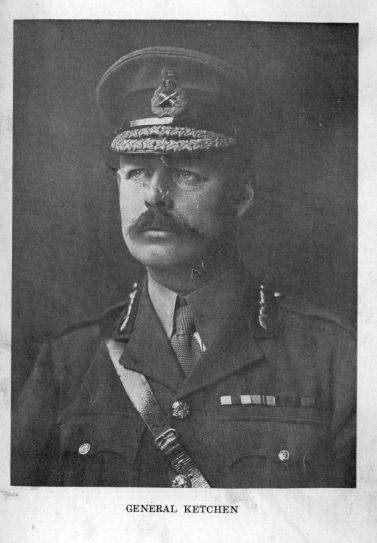
[Illustration: General Ketchen]
Well, we went on till we came to a German strong point, and here we found fifteen of our boys that had been captured earlier in the day; when we came on the scene they were being photographed by the Germans. The Germans allow their soldiers to carry cameras and almost every soldier has one; we had at least a dozen levelled at us that day—they were evidently taking pictures to send back to Germany—"Prisoners we have captured" would no doubt be the title.
They kept us hanging around here for half an hour, still under our own shell fire, and then we were marched back about three miles. Our first stop was beside an old Belgian church, and here we were taken over by an escort of Prussian Lancers, and for the first time I realized that I was really a German prisoner. We were herded together like a flock of sheep and driven ahead of our captors; we were made to go ten miles before they allowed us to stop, but to add variety to our otherwise tedious march, when our escort wanted a little fun they would put spurs to their horses and ride pellmell through our little bunch. It was great sport to see us dash in all directions tumbling over one another in our efforts to escape being trodden down by the horses; no wonder they laughed and shouted in their glee! And it was on a par with other things they did on that trip. We passed through several small Belgian villages, and when the Belgian women saw us coming, they ran out with jugs of water, chocolate, and cigarettes, but our escort met them and refused to allow them to give us anything. They were very plucky, and some of them dashed in past the guards, and these inhuman beasts known as Prussian Guards levelled their lances and made at the girls. Sometimes they missed; a water jug carried by one of the girls saved her, but I saw three women run through the body by these devils, and all because they wished to do an act of kindness to men who were wounded. The first thing we do with our prisoners is to feed them and dress their wounds, but these are the last things a German thinks of doing. Well, the same thing happened in all the villages, only we warned the girls away when we saw how they would be treated. I also noticed that the Belgians were not allowed on the sidewalk when a German was passing; if they did not get off, they were knocked off.
Finally we were halted in one of the villages and herded into a filthy horse stable. There were about thirty in the bunch and most of us were wounded; we had not even had a drink since we were captured, so we were pretty much "all in." We slept on the floor of the stable that night, and next morning some German guards came along and picked us up. For breakfast we were thrown four loaves of German bread and a pail of water was set inside the door. After breakfast we were lined up on the street, and a German officer who spoke a little English came along and asked us questions. He took our name and number and also the name of the unit to which we belonged. He said he was doing this so that he might report our capture to the military authorities in London, but he had another reason. After he got through he chose two from each unit, lined them up, and marched them off to a large building. I happened to be one of the number. The building where we were taken was occupied by a German general and his staff. We were put in a small room and two at a time marched out for an interview.
The first ones taken belonged to a machine gun crew; they were conducted into a long room at the far end of which sat the General and two interpreters. Along each side of the room was a line of Prussian Guards. The officer who had charge of the boys could speak English fairly well, and instead of taking them to where the General was, he sat down with them at a small table just inside the door. He appeared very friendly, and offered them cigars, cigarettes, and wine. The boys were cute enough to know why they were offered wine, and they "declined with thanks" but they took the smokes. The officer asked them questions about Canada and appeared very much interested in our country, he talked for half an hour and never mentioned war; then he asked them to go up to where the General was sitting. On the table in front of the General was a map of the front line trenches, and through the interpreter the General proceeded to pump the boys for information. This is a sample of the questions he asked them:
Interpreter: "Show me, on the map, the position your machine gun was holding on the Ypres salient."
Boy: "I am sorry, Sir, but I can't read a map."
He asked him several more questions of a similar nature and received unsatisfactory replies. Then he said, "Now, give me an idea of how many guns were holding the Ypres salient." The lad thought for a minute and then said, "Sir, as near as I could guess, it was about a million and a half." The General let a roar out of him like a mad lion, and two of the Prussian Guards grabbed the boys and, dragging them to the end of the room, threw them out of the door and down the short flight of steps at the entrance. I saw them pass the door of the room where I was sitting, and said, "Hully gee! what the Sam Hill are they doing with those chaps?" Sandy said, "Evidently they are not wanted in there." But the boys didn't seem to be at all displeased over the treatment they received, for they landed laughing, and as we went in I heard one say, "We slipped one over them that time, eh?"
A young Scotchman and myself were the next ones called, and we represented the sappers. The same officer brought us in and treated us as he did the first two; we helped ourselves to the cigars and cigarettes, but did not think it wise to touch the wine (Scotty said afterwards that it was the only time in his life he ever refused a drink). After having a smoke, we were taken up before the General. Scotty was a comical chap, very ready-witted, and we had arranged that he should do all the talking. The first question asked was, "Where was the sap you were working in?" Scotty looked up very stupidly, and said, "I don't understand you, Sir." The interpreter said, "Where was the mine you dug underground?"
Scotty: "Oh yes, I did that for a living before I joined the Army."
Interpreter: "Then show me on this map where the sap was."
Scotty: "I don't know of any sap in the front line."
Interpreter: "But you said you belonged to the miners!"
Scotty: "Yes, but I was not working on a mine in the front line."
Interpreter: "Then what were you doing?"
Scotty: "Well, it was like this; I was only in the trenches twice, the first time our Corporal put me on a fatigue party and I was carrying up sandbags and rations."
Interpreter: "Is that all you did?"
Scotty: "Yes, Sir."
Interpreter: "Then what were you working at the second time you were in the lines?—you were surely put in a sap this time."
I could see that both the General and the interpreter were getting quite peeved, but Scotty answered smilingly: "I will tell you what I did. The Sergeant in charge gave me a long stick with a nail in the end, and I had this stick in one hand and a sandbag in the other, and my work was to go through the trenches picking up all the paper, cigarette boxes, and tin cans." When this speech was interpreted to the General, the old boy was wild. I think he would gladly have put an end to us right there, but he only shouted an order to the guards, and we were hustled to the door and kicked out. When we picked ourselves up, we sat down on the steps and had a good laugh. Evidently the General was not satisfied with the information he received, for none of the others were taken in. We were all taken back to the stable and left there till the next morning, then we were marched off to the railway station and loaded on a train for Germany.
We travelled in cattle and box cars, and we did not sit up to see the sights because all of us were wounded or injured in some way. My back was badly strained when I was buried in the sap and I was bruised from head to foot. I had had nothing to eat all day excepting the small piece of black bread given to us in the morning. It was about 9 P.M. when we made our first stop in Germany, and this was at a large prison camp near Dulmen, Westphalia. Dulmen is a beautiful large city; and the camp is two miles out. At first sight a prison camp looks very much like a chicken ranch; the high wire fences around the whole enclosure and the little frame huts in the centre all carry out the idea. But when you get in, there is a vast difference, the outside fence is fourteen feet high, and of barb-wire with the barbs poisoned; three yards in, there is another fence, a low one this time, to prevent the "chickens" getting under, and this is made of live wire. In between these fences there is a line of German guards, each one having his own beat. The centre of the camp is divided into small blocks, each with its fourteen-foot fence of poisoned wire; there are six huts in each block and about fifty prisoners quartered in each hut. When I was there the camp contained about three thousand prisoners—French, Russian, English, and a few Canadians. But, to go back to my arrival. As we were marched into the camp we were a pretty sorry-looking lot. The old prisoners saw us coming, and rushed back to their huts and brought us out some food. The new prisoners were not allowed to mingle with the old ones until they had been two months in camp—I suppose this was to prevent any news getting in—so in order to do anything for us, the old prisoners had to catch us on our way through. Well, they brought us, from the contents of their Red Cross parcels, hardtack, biscuits, bully-beef, and jam, and when we reached our hut we had a pretty good meal. The boys had none too much for themselves and it meant a great deal to give up any of their precious food; but they knew, from experience, that we were starving, and we thought we were, for after good army rations, one small slice of black bread does not go far towards satisfying hunger. But, after existing on German fare for two months, we knew what it was to be really hungry; we were more like famished wolves than human beings.
This is a day's ration, served out to us the first day in camp, and in the two months I was there it never varied: for breakfast, a small bowl of coffee made from dried acorns, and served without milk or sugar. It was so bitter as to be almost undrinkable, and there was not one morsel of food given with it. For dinner we were allowed a bowl of stuff they called soup. It was made by boiling cabbage and turnips with a few dog bones; when I went there first I wouldn't believe the boys when they told me that our soup was made of dog bones, but one day I met one of the French prisoners who had been a doctor, and we went for a walk around the grounds, so I asked him what kind of an animal went into our soup and he told me it was just ordinary dog. We argued the question for several minutes, and I was still unconvinced, so he said, "Go into the cook house and see for yourself." I went, and the cook (who was a French prisoner) very obligingly lifted out some bones with his long spoon and showed me one of Fido's legs. That settled the question, and, naturally, I enjoyed the soup more than ever. As an extra treat, to give it a special flavour, sometimes they threw in the bark. The boys had taken their own way of finding out what they were eating—they saved all the bones for several days and then they put them together—the result was a German Dachshund. We had nothing but this soup for dinner, and for supper we were given a bowl of slop which the boys called "sand-storm," and a three-pound loaf of Deutschland black bread to be divided among ten of us. This bread was made from ground vegetables mixed with rye flour. If you read Gerard's "Four Years in Germany" you will see that samples of this food were examined by a specialist and declared to be almost devoid of food value. It was planned to reduce our numbers by a process of slow starvation.
We used to fight over the garbage cans for the peelings of potatoes, and cabbage, and when the old prisoners, who were getting their Red Cross boxes, brought us their German issue of soup, it was not safe for them to come inside our enclosure. They would place the can inside the gate and we fought over it like a pack of hungry wolves. If you think we are exaggerating, see Gerard's new picture film "My Four Years in Germany." It tells better than I can just how bad things were. Well, one day when our soup was handed in by the other prisoners a funny thing happened; we had seen the boys coming and had made a rush to the huts to get our bowls—a very short fellow reached the soup can first and before he could get his bowl filled, we had all crowded in on top of him—poor Shorty had his head and arm in the soup and was almost drowned before we got him out. He had soup everywhere except in the bowl. Every British prisoner had to put up with this kind of food for the first two months; after that, the Red Cross parcels would begin to arrive. The condition of the Russian prisoners was indeed pitiable. They received no help from home, and were depending solely on German food. A Russian can live on much less than a Britisher, but they literally starved to death on what the Germans gave them. They were made to work, and when they could go no longer and fell down from sheer weakness the Guard would beat them till they died. I have seen this happen again and again, and there was an average of fifteen deaths every day among the Russians alone. Our parcels came just in time to save the strongest of us, but scores of the weaker ones died. But just here let me explain the system used by the Red Cross for getting food to the boys in the prison camps. As soon as a new prisoner reaches the camp he is given a card which he fills in and sends to the Red Cross Headquarters in London. This card contains his name and number, and the number of the camp that he is in. It takes about two months to get the first parcel through; after that he received six food parcels and two of tobacco each month, and once in six months they send him a complete outfit of clothes, from overcoat to boots, also a parcel of toilet articles, such as toothbrush, shaving outfit, soap, etc. From the time these parcels reach the Dutch border, they are handled by a staff of our own prisoners, so there is no danger of their going astray. The Germans examine the parcels before they are given out to make sure that they do not contain maps or compasses for the prisoners; that is the only time they handle them.
These parcels mean life and a small degree of comfort to the boys, so you can imagine how they are looked forward to. The Red Cross saved my life and the lives of thousands of our boys; and they deserve honour and support from every person who calls himself a loyal citizen of any Allied country. I shall never forget when my first parcel came; I had been in camp two months and I had failed eighteen pounds. One of the boys came into my hut and told me there were two parcels for me. I told him to stop fooling, that his joke was stale. But he said, "No, it's straight goods this time, here are the tickets"—so I rushed off to where the parcel office was and got in line. Pretty soon my turn came and I handed in my tickets. A big German brought out the parcels, and while he was censoring them I was figuring on what I was going to have to eat, but imagine my disappointment when he pushed over the parcels and I found they contained nothing but clothing. There were two suits of underwear, two pairs of socks, two shirts and one pair of blankets, but no food. My clothing was in rags when I reached Germany, my tunic and cap were lost in the sap the day I was taken, and I needed socks and underwear very badly, also boots, so this supply was more than welcome, but I needed food more than anything else. I put all the stuff into the blankets and started back for the hut. When the boys saw me coming, they rushed out to meet me, for they were building on a feed, the same as myself. The unwritten rule of the prison camp is, whatever one gets the rest all share it, so they were disappointed too. However, three days later our food parcels arrived, having been delayed at the border, and we sure had a big feed. My first food parcel contained one tin of Welsh rarebit, one tin of jam, a large package of biscuits, three bars of chocolate, and two packages of cigarettes. I tell you it put new life into us, and we felt like licking all the Huns in sight.
After our Red Cross parcels came we were able to shave ourselves, and we had soap to wash with. When we first came to the camp the Germans asked if there were any barbers in our bunch. Now, there wasn't, but one of the boys, "Slim" Evans, volunteered for the job. They gave him an old razor, some soap and a strop, also a small brush, and he was ready for work. He had no chair of any kind, so he looked around till he found a bench in one of the huts; he swiped this and turned it upside down on his table. When the boys came for a shave, they climbed up on the table and sat in the upturned bench, using the leg of the bench for a head rest. It sure was some "barber's chair"; I'll bet there never was another like it. Well, Slim got lots of customers; the Germans didn't pay him for his work, but the prisoners tried to. Some had nothing at all, but he did their work just the same; others were working on farms, and for this they were given what was equal to 2d or 4d in English money. Slim never took anything from those who only received 2d, but those getting 4d were allowed to pay. Sometimes they gave him a box of German cigarettes so strong that if you smoked one on Monday you could taste it on Saturday. I remember my first visit to Slim; I climbed up into the chair and Slim asked me what I was getting; I said 4d, so he gave the razor an extra rub-up. Now, I hadn't had a shave for a month, so I was a pretty hairy-looking customer. Slim said, "How long since you've had a wash?" I said, "This morning, only I hadn't any soap." He said, "Never mind, I'll wash you with shaving soap." So he went to work, and really I didn't know whether he was shaving or skinning me. As a matter of fact he did a little of both, for he had six patches of skin off when he finished and the only remark he made was, "This razor is not quite as sharp as I could wish," but he told me to be sure and come again.
But I have spoken mostly of food, or rather the lack of it. Now I will try and give you an idea of how we put in our time. They didn't work us very hard in this camp; usually we were only taken out three times a week. When they wanted us, German guards would come in, line up about twenty of us, and take us out to work in the fields. The first job they put us at was planting potatoes and we worked faithfully the first day, but when we came in that night I said to "Snipe," the new pal I had made, "By golly! Snipe, I don't like the idea of producing food for these 'square-heads,' let's see if we can't put one over them." "All right," said Snipe, "I'm game, but how in hell are you going to do it?" I said, "Well, how would this do? Next time we are sent out, I'll take the hoe and you the bucket of potatoes; as soon as we get a little piece away from the guard, I'll keep on making holes, but you just go through the motions of dropping in potatoes, then when we reach the centre of the field I'll make an extra large hole and you can dump in all the potatoes except a few that must be saved for the other end of the row." "Gee, that sounds all right," said Snipe; "we'll have a try at it anyway, and I believe it will work." The field we had been working in was a long narrow strip containing about five acres, and there was an armed guard stationed at each end. Well, next day we were called out again and we tried our new plan. It worked splendidly; the other boys saw what we were doing and they all did the same, so the whole field was planted that way, and I wish you could have seen those potatoes when they came up.
The next thing we were given to do was putting out cabbage plants (of course they had not yet discovered the trick we had played with the potatoes). In planting cabbages the first man was given a small sharp stick instead of a hoe, and man number two had a box of young plants. A hole was made, but before the plant was put in the roots were nipped off. In three days the cabbages were all wilted or dead and the Germans could not make out what was wrong, so they sprinkled the ground with some kind of stuff thinking the damage was caused by worms in the soil. But some one happened to pull up a plant, and they realized then what had been done. Of course they were very angry, but no one would tell who did it, and they couldn't very well punish the whole camp. However, they didn't give us any more farm work to do.
Shortly after this, I was out on a working party with some of the old prisoners and one of them began telling me about a man who had made an escape from the camp some months before. He had gotten as far as the Holland Border, but was caught there. The word "escape" thrilled me as nothing else ever had, and from that time on the idea was never out of my head. I questioned the man and got all he knew about the distance to the border, direction, etc., and I could hardly wait till night to get telling the other boys about it. Finally we got back to the bunkhouse and I told Snipe and two or three other Canadians what I had heard. They were just as excited as I was, and we decided that if that fellow could get out of the camp, why we could too, and we made up our minds to keep working on it till we did find a way out.
One night when we were discussing the question, Snipe suggested that we cut a hole through the floor of the hut and tunnel our way out. We could make the hole under one of the bunks so it would not be easily seen by the guards. The plan seemed good to us and we began immediately to put it into operation. Snipe happened to be occupying one of the lower bunks, so we started there to cut the hole in the floor—we had only a couple of old jack-knives to work with—but after we got through the floor, we did the digging with our hands. While two of us worked the other lay on the top bunk where we had a small window, and kept watch. The floor of the shack in which we lived was two and a half feet from the ground, so there was plenty of room for the earth that we took out of the tunnel. We worked away for eight nights and by that time we had passed the inner fence, the guard and the electric wires, so we thought it was safe to come to the surface. When we got within a foot of the top we decided it was too late to attempt to get away that night, so planned to start at 11.30 the following night and that would give us time to get quite a distance away from the camp before daylight. So we went back to our bunks, and all that night we lay planning and dreaming of what we would do when we got out.
Next morning I was too excited to sleep, so very early I got up and took a walk around the fence. When I reached the place I thought our tunnel should be I took a look in that direction, and to my horror, I discovered a big hole between the two fences. I knew in an instant what had happened: when the Germans were changing guards, their weight had broken through the tunnel—I smile now as I think of the surprise it must have given them, but at the time it was a bitter disappointment. I hustled back to tell the boys, and Snipe moved into another bunk so that they couldn't fasten the blame on him. Of course we knew that the tunnel would be traced to our hut, and sure enough in about half an hour a bunch of guards came in, lined us up, and tried to make us tell what ones had attempted to escape. We all denied it, so after making a thorough search of the hut for maps and compasses they let us go. Thus ended my first attempt at escape.
Shortly after this the guard came in one morning, lined up about fifty of us, and said they were taking us away to work on farms. We were taken to the railway station, loaded on trains, and taken farther into Germany. When the train stopped and we got out, we found that we were in the centre of a coal mine district. With their usual regard for the truth they had taken us to work in the coal mines instead of on farms, and this mine where we were was well known among the prisoners of war as the "Black Hole of Germany" and it has maintained its evil reputation up to the present time.
The other camp we were in was a paradise in comparison with this. Owing to the fact that the train came up to the mines, there were no wire fences except just in the centre where the prisoners' huts were located. But there seemed to be guards everywhere. The first thing that struck us was the dirt of everything, the smoke of the coke ovens covered the whole place with a layer of soot.
It was five o'clock in the evening when we arrived, and we were this time turned loose with the other prisoners; there must have been five hundred at this camp—Russian, French, and English. We were the first Canadians to go there.
We found the barracks and every other place in a filthy condition, the beds were dirty and crawling with the largest fleas I have ever seen; these fleas are as large as ordinary mosquitos, they breed in the mine and are carried up on the men's clothes. Often these pests were so bad that the men lay out in the yard at night instead of going to bed—anyway, in the hot weather the stench from the beds is almost unbearable.
We walked out among the prisoners, and they were glad to get news of the war and of the outside world. Among other questions, they asked if London was still standing. The Germans had told them it had been levelled to the ground. Some of the men had been in the mines for two years and the stories they told were almost incredible. The Germans who guard this camp are always savage and cruel and they are urged on by the owners and operators of the mine. We talked with some of the first British prisoners who arrived there, and this is what they told us: At first they refused to work, knowing that it was contrary to international law to force prisoners of war to work in the mines. For refusing to work they were given a week of the most brutal abuse and torture possible. The weather was bitterly cold and there was a foot of snow. These men were stripped of everything but their shirt and pants and made to stand "at attention" out of doors. Any man moving hand or foot was knocked down with the butt of a rifle, and those who fainted from cold and exhaustion were dragged away and put back in their places as soon as they became conscious—while those whose strength enabled them to hold out the longest were stood in front of the cokery ovens until they were utterly exhausted by the terrific heat, and had to consent to work. The first shift that went down into the mines were driven into the cage with rifle butts and bayonets, and some of them went down unconscious. Oh, when this war is over, there will be a long day of reckoning with the German people.
After listening to such stories as these, and after seeing the poor wrecked bodies of the prisoners, you can imagine how we felt as we were marched off to work the next morning. When we were taken out, we were given our first suit of prison clothes—this consisted of overalls and smock and cap. The overalls had a four-inch stripe of red down each leg, the jacket had six inches of red down the centre of the back, and the cap had a wide red band across the top. After we got into these, we looked like a bunch of robins.
When we reached the pit-head we found a line of German civilians waiting to go down into the mines—as we waited for the cages to come up we overheard some of their conversation—of course we could not understand it, but one of the old prisoners translated it for me. The Germans had noticed that we were new men and they asked the guard what nationality we were. The guard told them we were Canadians, but the civilians said, "Oh nix! the Canadians are 'Swas'"—meaning black. They argued with the guard for fifteen minutes and then were not convinced. Finally the cage came, we were loaded in, and it started down. I shall never forget the feeling I had; I thought that we would never strike bottom. I asked an old prisoner how deep the mine was, and he said two thousand feet, and I believed him.
Well, at last the cage reached the bottom and I had my first view of a coal mine; even to my inexperienced eye things seemed to be in very bad shape. Owing to the great demand for coal, they did not take time to properly timber their mine, and the tunnels were caving in all the time—I am safe in saying that there was an average of three men killed there every week. There was never an inquiry made into these deaths.
Well, they started me to work and my job was to load up cars with the coal that the civilians hacked out. These cars held just a ton, and I had to push the loaded car onto the main tunnel or road; an engine took it the rest of the way. This was very heavy work, and often I thought my back would surely break, and it hurt me to think that the Germans were getting so much out of me. However, as the days went on we found little ways of getting back at them. For instance, the civilians were paid according to the number of tons they got out, and each man had tags with his number on them. When a car was loaded we were supposed to put one of these tags on the top, and when it reached the top of the shaft it was credited to the man whose number was on it. Well, sometimes, instead of putting the tag on the top of the load, we put it inside and piled the coal on it. At the top of the shaft, when no tag was found, the car was not credited to any one, and when pay day came and those old Germans found the paymaster did not give them credit for all the coal taken out, there surely was some fun; it did our hearts good to hear the row they made. Of course we would not have been able to play any tricks if there had been any guards around, but once we were down in the mine we were out from under military rule and working under the mine management, but the latter were just as cruel in their way as the military; they not only got every ounce of work possible out of each prisoner, but they inflicted the most terrible punishment for every slight offence. A few days after I went there, a splendid young Canadian boy from Toronto was found dead with the back of his head smashed in. He had been on night shift, and he had not been hurt in a cave-in, for our own boys found him. We asked for an investigation, but we were told to go to work and mind our own business; so we Canadians went on strike. A German who spoke a little English asked us what was the matter, and we said we wanted to find out what had killed our comrade. He laughed in our faces and said, "You are prisoners, you must do as you are told." We told him where he could go, and against the advice of all the old prisoners refused to go to work, and this was our punishment; we were stood "at attention" in fifteen-minute periods, with five minutes "at ease," until ready to go back to work. This was indeed torture—the five minutes' rest made it possible to prolong the agony. Men faint if made to stand "at attention" for many hours, but doing it this way we never lost consciousness. Guards marched up and down behind us; if we moved hand or foot we were knocked down and kicked; though they kicked us on the ankles whether we moved or not—my right ankle was so swollen I was not able to do up my boot for three weeks. Well, we stood this without food for two days and nights, and then we were so exhausted that we had to give in. The old prisoners had all been through this kind of thing, that was why they warned us not to go on strike. But no matter what the punishment was, we could not let the murder of one of our number go unnoticed.
Shortly after this we had another lesson of the same kind. An Englishman on night shift was found sleeping and the foreman who found him knocked him down a shaft and killed him. Another Britisher, who saw the murder, reported the foreman, and accused him of the murder, but when the trial came off the Britisher was given six months in prison for perjury.
But to go back to our work. We were supposed to be on eight-hour shifts—only sometimes they would make us do a double shift, or sixteen hours. When this was required they gave us an extra bread ration. The German in charge of the camp thought himself very smart because he could speak a few words of English and also write a little; so, instead of telling us that we were to come to his office for an extra ration of bread, he wrote the order on a piece of cardboard and hung it in our barracks. Seeing him hanging something up we all gathered round, and this is what we read: "You Englishmen, before going on shift, will draw your Breath at my office." Of course we all shouted and laughed at this; and the officer stood there looking as though he had been kicked and didn't know who had done it. He tumbled that there was something wrong with the notice, but all he said was "You Engländer, Schweinhunds," and went out.
It was while we were working on one of these long shifts that we thought of another way of getting even with our slave-drivers, for this is really what they were. They worked us to the last ounce of our strength; the food given us was not sufficient to keep body and soul together. We were living on our Red Cross parcels, and we ate none of the German food except the bread. It's the only time I ever worked for nothing and boarded myself. We were punished for every offence, real and imaginary, and when a man is driven harder than he can bear, and refuses to work any more, the methods used to force him to work would put any slave-driver to shame; and we were ready to do anything to try and even up the score. This is one plan that worked well.
There was a great deal of rock among the coal, and we were supposed to have two cars always on hand, and fill one with rock and the other with coal; but we thought as nature had mixed them in the mine that they should go up the same way, so we would half fill a car with stones, and then cover it over with coal. When this car reached the top it looked all right, so it was put into the dumping machine; once there it could not be stopped, and when those big rocks went rolling down into the machinery and over the sieves, there was one hell of a smash-up. Those old Germans would tear their hair with rage, but of course they couldn't tell who had done it. Finally, like everything else that went wrong, it was blamed on the "Engländers," as we were called, and the old German who spoke English took the case in hand. One night, after coming off shift, he lined us up and said, "I have been notified that you Englanders are putting stones in between the coal, and if I hear any more of this you shall be punished severely." Some one started to laugh and we all took it up, so he stood us "at attention." No matter what was done to us we never gave them the satisfaction of letting them know it hurt. I have seen our boys die under slow torture, and always they had that grin on their faces.
This was one thing the Germans never could understand, for, as a nation, they have no spirit at all; I have seen big men blubber like children over the slightest hurt. Working with civilians, we often had the satisfaction of a scrap. We dared not touch one of the military, no matter what they said or did, for it would mean instant death; but when the civilians were extra-brutal or insulting, as they often were, we got even if we did not happen to be too greatly out-numbered. The smallest Britisher that ever went into the mine could lick the biggest Hun in a fair fight. But that was just the trouble—the Germans know nothing about the first principles of fair play. At school, instead of being taught to defend themselves with their fists, they fight with sticks or anything they can lay their hands on, and once they get their opponent down, they kick him until he gives in. So when they ran up against English-speaking people and there was a scrap in sight, they were astounded to see the Englander lay down the shovel or whatever he happened to have in his hands. They would stand and stare with their weapon half raised as they saw their opponent laying aside his only means of defence. They did not know what to expect, and while they were in this uncertain condition the Englander got in his first blow. We became quite notorious for our methods of fighting, and when we would be put to work with any new men, their first question would be, "What did you do before joining the Army?" and we always said, "We were boxers." They would smile and say, "Ich nix boxer—nice Engländer, good Engländer"—this amused us immensely and their fear of us made them use us more decently.
After I had been in the mine about six months, Snipe and I planned out a scheme by which we hoped to escape doing any work for awhile. In going through the mine, we had come across many abandoned tunnels from which the coal had been taken—in many cases these tunnels were partially caved in and were considered unsafe, and for this reason they were avoided by the miners. The idea came to us this way;—one night when Snipe and I were coming off work, we passed these tunnels, and I said to Snipe, "Say, old boy, I'm fed up with this everlasting work for these brutal Huns; let's think up some scheme for getting out of it for awhile." Snipe said, "All right. But how can we get away from these blamed 'square-heads'?" Just then we noticed one of the tunnels, and I said, "Hully gee! Snipe, what's the matter with hiding in one of these tunnels? No one ever comes here." "Golly! I believe it would work," says Snipe, pounding me on the back. We were very much excited, and when we reached our bunkhouse we told some of the other boys. They asked to come in too, so six of us laid our plans. We went down on shift as usual and followed the other miners till we came to the tunnel in which we had planned to hide. When there was no one looking, we would dodge in, and when we were missed the miners thought we had gone to work in another part of the mine; each mine boss thought we were taken to work for some one else, so no one hunted us up; of course we were in constant danger of being buried alive, but we gladly took the risk for the sake of getting a rest.
We would lie round chatting and sleeping all day, and at night, blacken our faces and join the other miners on their way to the main shaft. We worked this game for eight weeks, not always staying in the same hole, but changing around whenever we saw a likely looking place. We had a splendid rest, and it put us in better condition for what was to follow. A funny thing happened after this had been going on a few weeks. One morning two of our boys, Barney and Raeside, did not come down in the same cage with us, and as we didn't dare wait, for fear of being set to work, we were out of sight before they arrived. So they hunted up a place for themselves, and the spot they chose was between the timbers and the roof of the main tunnel. It was a good place, and they would never have been discovered if they hadn't gone to sleep and snored. But they did, and a fire boss happened to be passing at the time, so he located their hiding-place. Of course he couldn't see who was there, but he tried to poke them out with his stick. They soon woke up, but Barney whispered, "To hell with him, Mac, we won't go," so they lay still. Finally the fire boss went for help, and as soon as he left the boys came out. But they had to come out one at a time. Barney got down first; and he beat it to locate another hole. When Raeside struck the tunnel, he saw a light not far away, and he thought it must be the returning boss, so off he went in the opposite direction. Barney had the light, and was looking for a place large enough to hold them, when he heard Raeside running. He at once jumped to the conclusion that Raeside had spotted a "square-head"—and he started off to his assistance—Raeside heard some one coming on the run, and he thought it must be the boss, so he went still faster. They chased each other like this for about a mile. Then Raeside gave out: and hiding his lamp, he hid in the first hole he came to. In a moment along came Barney, puffing and blowing like a whale, and as he passed Raeside saw who it was. Then the joke of it struck him, he called Barney back, and the two of them sat down in the tunnel and laughed till they were sore. The boss never found them, and I can imagine how angry he was when he went back with his reinforcements and found his prey gone. That night the boys told us the joke they had played on themselves.
But our good time ended abruptly one Saturday when a mine inspector, or "fire-stager" as he is called, came around on his tour of inspection, and he found us hiding in a hole about three hundred yards from the main road. We put out our pit lamps when we saw him passing, and he didn't let on having seen us, so we couldn't tell whether he had or not. He was too big a coward to tackle us alone, and we knew that if he had discovered us he would go for help. We didn't know whether to run or risk staying where we were, and while we were talking about it, we heard the tramping of a lot of feet in the tunnel leading to our hiding-place. It was too late to go now, we would have to face the music. There were six of us, and Snipe suggested that if no more than ten came we would stand and fight, but if there were more we had best make a running fight and escape to some other part of the mine. We decided to do this, and while we were waiting for them to come in we filled our pockets with stones.
But the foreman had no intention of bringing his men in—he lined them up, ten on a side, opposite the hole through which we must come out—they were armed with sticks, pieces of heavy rubber hose, and anything they could lay their hands on. After lining them up he made them hide their lamps under the jackets so that we wouldn't be able to see them when we came out. Then, when he got them fixed to his liking, he very bravely marched in where we were and said, "Alle Engländer?" We said, "Yes." He said, "You Schweinhunds!" At that one of our boys jumped and made a pass at him, crying, "You big square-headed German, I'll knock your head off, I wouldn't take that from your Kaiser Bill." The German backed up and avoided the blow, saying tauntingly, "Ah, nix, Engländer." Then he asked us why we were not working, and we said we had got tired and were taking a rest. He said "Komm' mit." We said, "Oh no." When he saw we had no intention of going he began to make promises. He said that if we would only go back to work he would not report us and we would not be punished in any way.
We did not believe him, and we trusted his promises about as long as it took him to make them; but, as Snipe said, we might as well take a chance on it, for we had to get out, and there was only one road to go. Of course he couldn't understand us, but we had picked up enough German to make out everything he said. Well, we pretended to believe him and we started out, walking in couples. When the first two reached the main road two lights flashed out, and the clubs commenced to whistle through the air. The boys shouted "duck!"—and, believe me, we did. We started down between those two lines of Germans, and seeing there were so many we thought it best just to make a run for it. In going through, three of our boys got knocked down, and the rest of us got some bad whacks over the head and back but we kept our feet. The last two Germans on the line got scared when they heard us coming and started to run. They were on the road just ahead of us, and we made a dash after them. They were a considerable distance from the main body when we overtook them, and I remember one of the boys saying, "We'll make these square-headed devils pay for what we've received"—and believe me, we did. Instead of going home to their supper that night, I'll bet they went to the doctor.
Well, when this scrap was all over and we got to the top of the shaft, the mine inspector that had caught us reported us to the military authorities, and their punishment was five hours "at attention." When we had put this in, they allowed us to go to our bunks. The next day was Sunday, and we were peacefully sleeping when a big German came in and called out our numbers. We asked him what he wanted, and he said we had to go on the Coke-o-roy. We certainly knew what this meant.
The coke ovens were attached to the mine, and most of the coal taken out was made into coke. Work on the ovens was so hard and so trying on account of the great heat, that they used this as a punishment for anything that was done wrong in the mines. This is what the German who could speak English told us. The morning we were put on, he lined us up and read this to us, "If you Engländers does not do your work right beneath the mine, we put you on coke ovens, and there, if you shall not work, you shall die." We all laughed at this, and he said, "You England Schweinhunds!" and went away.
But it was sure a punishment. The regular hours through the week was a twelve-hour shift, and each man was obliged to shovel thirty-two tons of coke, wheel it from ten to twenty yards along the platform, and dump it into railway cars. On Sunday the shift was twenty-four hours long, and each one had to handle sixty-four tons of coke. If you were not through when your time was up, you must keep at it till you did the required number of tons and then start back to work again with your shift.
It was on the twenty-four-hour shift that we started our work. We went on at 7 A.M. on Sunday, and we worked from that until 7 Monday morning. Almost as soon as I went on the ovens I met two of my old pals, Nickelson and Macdonald. They had been put here for attempting to escape from the mine, and had been at this job for a week before we arrived. We were mighty glad to see each other, for we all belonged to the same "school." But a "school" in a German prison camp does not mean the same as it does in America. We got the idea from the British Tommy, only he calls it "mucking it." It is made up of a bunch of boys who put all their parcels in together and go fifty-fifty on everything. Sharing with each other brought us a little closer together than we otherwise would have been.
Well, these were in our little "school" and had also shared in our rest-cure up to the time of their attempted escape. So when they saw us come on the ovens, they knew exactly what had happened. As I passed Nick, he said, "Which would you rather do, Jack, work on the coke oven or go to church?" I laughed and said, "Well, I guess, the church has it this time." After awhile I happened to be beside Mac, and I said, "Speaking of baseball, Mac, do they serve afternoon tea here?" He said, "Well, they used to, but you know tea has gone up, and as a substitute they serve out a little hell." And believe me, I hadn't been there long before I found that this was literally true.
I was feeling fairly fit after my two months' rest; and this rest was all that saved my life. But during that first day I didn't mind the work so much, I could stand it anyway, but when night came it was awful beyond description. The heat of the closed ovens was bad enough, but at night, when the coke in the ovens was sufficiently baked, they opened the huge doors and the burning mass was pushed out by machinery. It came out a solid lump just the shape of the oven, and the heat it threw off was terrific. Two or three big "square-heads" stood near with iron forks fourteen feet long, and with these they prodded the mass until it broke into pieces. When it first broke it burst into flames, but gradually it cooled, and finally they finished it by turning the water hose on it. But the Germans who attended to this looked like skeletons—the gas and heat seemed to have eaten the flesh from their bones and they seemed scarcely human. I was working near and the fumes of gas and the awful heat was almost more than a human being could stand. I looked around at the prisoners; and such a sight—they were toiling like galley slaves, their faces were streaked with soot and sweat till you couldn't tell whether they were black or white. I'll never forget the horror of that first night on the ovens, I was almost dead long before I had finished shovelling my sixty-four tons of coke, but the awfulness of the scene was harder to bear than the pain of my body. I said to Mac, "What does this remind you of, Mac?" He said, "Jack, it's more like hell than anything that was ever imagined or painted."
We were almost insensible when at last our work was finished; but we had to keep at it as long as our brains were strong enough to force our bodies to move. I saw what the weaker ones got, and that was enough for me. Those inhuman devils with their boasted German culture—a disgrace to everything that God has created—would drag these poor quivering, fainting creatures, pleading for mercy—right up to those red-hot ovens, and at the point of a bayonet force them to stand in that withering heat till they fell unconscious. Then the guard would drag them away and make two of the other prisoners carry them back to the barracks.
What I have described is a sample of what my days and nights were like on the coke ovens, till I made my final escape two months later. I played out several times, and each time I was roasted alive before the ovens. Once I backed away to escape the heat, and the guard knocked me unconscious with his rifle. The strongest men are being crippled and broken down in health in this work (of course the weak ones die very soon), but the treatment accorded our prisoners in other places is not much better. A young lad belonging to the Gordon Highlanders told me that he was wounded when he was taken prisoner, and he lay in the hospital for three days before they even looked at his leg. Then, when he finally got attention, everything was done in the roughest kind of way, and when the nurse had finished the dressing she spit in his face.
Another man who belonged to the Irish Fusiliers told me that when he was captured they kept him four days in the front lines doing fatigue duty under our shell fire, and in that time he had scarcely anything to eat. On the fourth night he and three other prisoners were quartered in a small room of a Belgian house, and they were taken down and lined up against the wall, while the German officers amused themselves by pelting them with green apples. One of the prisoners attempted to eat one of the apples and was beaten almost to death.
What we endured was the special torture that was reserved for Camp K 47; they had different methods at other camps. I remember an old prisoner telling me of the torture they had where he was before coming to the mines. It was an ammunition factory, and they had taken a bunch of English prisoners there and tried to make them work. Now, this is where our men drew the line, and though they knew it would mean punishment, and perhaps death, they absolutely refused to go to work. Of course the German officials were raging, and they resorted to their special line of torture to compel obedience. The boys were taken to where boxes were placed against large trees, they were forced to mount these and extend their arms full length about their heads. Then their wrists were strapped together and fastened to the tree—the box was kicked away and they hung by their arms often for hours. Every little while an officer would go around and ask them if they were ready to go to work. On their refusing he would give them a few kicks and pass on. This was kept up as long as the men could stand the agony, and the prisoner who told me this showed me the marks on his wrists, and said he knew at least six of their boys who died as a result of this torture.
The only thing that kept them from killing the prisoners outright was the fact that all the German prison camps were visited every few weeks by American Ambassador Gerard or some of his staff. He passed around among the boys, asked questions, and received complaints, and it is undoubtedly true that Ambassador Gerard saved hundreds of lives in the prison camps.
I had been working on the ovens for something like a month when a fresh bunch of prisoners were brought up from the mine. They had followed our example and were caught taking a rest. With this group was a young Canadian called Toby, and he was certainly "some boy." He was only eighteen at the time, really just a kid, but he had spirit enough for two ordinary men. They put him shovelling coke, and he got along all right till he finished the dump he was working on. Then, after the large chunks were gone, the dust and cleanings should have been put into wheelbarrows and taken over to a crusher. Toby had not been told this, and naturally he loaded it all into the cars. The boss caught him at it, and he stormed and shook his ugly fist in Toby's face. But Toby had learned to take a good deal, so he paid no attention. But the German manager had seen him too, so he came up when the boss had finished, and of course he could afford to be more insulting than his inferior. So after ranting for several minutes and wiggling his finger under Toby's nose he finished up by giving the lad a couple of brutal kicks with his iron-shod boots. This was more than Toby's spirit could stand, and Toby wheeled around and landed him a blow on the jaw; the man staggered back, and before he could recover Toby gave him another that sent him sprawling. The platform boss saw it all, and drawing his revolver he threatened to shoot, but Toby defied him and dared him to go ahead. The bully was afraid to do it, and he contented himself with reporting the case to the guard. Of course the guard came up, and with a great show of force dragged the youngster to the coke ovens and made him stand "at attention." But he hadn't been there long when lunch time came, and as they dared not leave him alone Toby was marched off to the platform with the other prisoners. During lunch he told me about the scrap he had gotten into, and I warned him to be on his guard—I knew the kind of brutes he was up against and I felt sure that they would try to get even if they could get him at a disadvantage. We were drinking pop at the time, and I made him hide the empty bottle under his jacket to use as a weapon in case he was attacked. Well, we went on duty again and Toby was put before the ovens to finish his punishment, but he had only been there a few minutes when the boss came along with a shovel on his shoulder and made Toby understand that he was to go to work under the long platform which held the ovens. So he marched Toby down the stairs and into the darkness under the platform. Suddenly Toby felt his arms gripped from behind and strong hands pinned them to his side, while out of the darkness in front loomed up the burly figure of the manager. He carried a short whip and this he proceeded to lay on to poor Toby, any place at all that he could hit. The lad wriggled with all his might, and finally succeeded in getting his arms free; then grabbing the whip in his left hand, he planted the manager one between the eyes with his right, and down he went. Then, quick as a cat, he wheeled on the other German, smashing at him with his pop bottle. The man tried to protect his face, but Toby's rage gave him the strength of madness, and the first blow broke the German's arm. Toby followed this up with another, and this time gave him a beauty just over the eye. He went down as if he was shot, and Toby started to walk away. By this time the manager had come to a little, and he called on Toby to "Halt!" but Toby paid no attention and the manager fired two shots after him. What he had been through possibly affected his aim; at any rate, he missed and Toby walked quietly back to his place and began work again. The Germans were too proud to let their comrades know how the lad had beaten them up, so they contented themselves with reporting him privately to the guard and giving him seven days' close confinement. Next day, as I passed the prison, I called and asked him how he was, and he said, "Fine! I could beat up half a dozen more 'square-heads' if I had them here; this is better than working on a coke oven, anyway." After Toby got out of jail the boys gave him a great ovation. They cheered him, carried him round on their arms, and fed him with everything they could lay their hands on. Nothing could keep down a boy with a spirit like his, and he made his escape about two months after I did. He was to have come with me, but had a sore foot, so we had to leave him behind. Poor kid, it's the only time I ever saw tears in his eyes.
The only redeeming feature of my work on the coke ovens was that I was out of doors and could get a glimpse of the surrounding country. Spring had come, and the fine weather made me long for freedom.
Three of us got together one night and figured out a way of escape; one chap known as Blackie, another called Sammy, and myself. Now, as I said before we worked in shifts, one week at night, the next during the day. It was during the night shift that we planned to get away; but there were two things we needed badly—namely, a map and a compass. We were talking this thing over one night when Sammy said, "I have a scheme." We told him to get it off his chest. "Well," he said, "I think I know where I can get a map and a compass; I work with a German civilian whom I think could be easily bribed." Blackie said, "What makes you think so?" Sammy answered, "I have worked with this fellow for three nights, and I have been treating him to some of my lunch, and he seems to be pretty hungry." Then he said, "We will all save food from our next parcel issue—chocolate, bully-beef, and biscuits—and I will take them and see what I can get for them." We all agreed, but we hadn't much hope of getting what we wanted. In two days along came a parcel issue and we saved out all we could spare and handed it over to Sammy. Next day Sammy took it with him, but brought it back when he came from work. When I saw him I said, "No luck, Sammy." He said, "Sure—come here and I'll tell you all about it." He said, "I got him going fine, and he'll bring the map and compass tomorrow." "Then, why did you bring back the food?" "Oh," he said, "I just showed it to him, and his eyes stuck out a mile," but I said, "No, Fritzie, this is for you when you bring the map and compass; so I think I have him." Sure enough, Sammy went off the next day with his little bag of rations. About two hours after we got started to work Sammy came along to where I was working and said, "Jack, I have it." We wanted to have a look at it right then, for it seemed too good to be true, but when we were looking at it we were nearly caught by one of our guards who happened to be passing. We curbed our curiosity, and did not bring out our treasures again until we were safe in our huts.
Every night we pored over our map and laid plans for our escape the following week when we would be put on night shift; but before the week was up I was put on a different job. Instead of shovelling coke I was set to filling small cars with coal. This took me away from the boys, and at first I was very much discouraged. But the new place where I worked was a large coal shed and quite dark; right at the back I found an unused door which was unlocked. Opening it, I discovered an iron ladder leading to the ground, and I said to myself, "This is just the chance we've been looking for." That night I told the boys of my find, and they said, "Yes, but how are we going to get there?" for between this coal house and the platform where the boys worked was a distance of one hundred yards. But I told them how I thought it could be managed, and we made our plans to try it that way.
We planned to make our "getaway" on the Tuesday of the following week, so we set about collecting provisions for our journey. All our pals were willing to contribute, and they gave us bully-beef and biscuits from their scanty stores. We could hardly wait for the time set for our starting, but at last the night came.
Every night at twelve o'clock the guards left their posts and marched the prisoners back to a hut for lunch. It was on our way back from this lunch that we hoped to get away. The guards always left us at the foot of the stairs leading up to the coke ovens, and they stayed at the foot of the ladder until the last prisoner was mounted. This night we had made up our minds that we should be the first ones up the ladder, for time meant everything to us. A guard was stationed at the foot of the ladder leading from the coal shed, and we had to make the distance before he did. Our path lay past the coke ovens, across a bridge to the coal house, through it and down the ladder. We didn't dare run, for we were surrounded by German civilians, but I assure you the time we made wasn't slow.
Blackie and Sammy came with me instead of stopping at their ovens, and we trusted to the friendly darkness to keep them from being detected. We won our race and reached the bottom of the ladder a full minute before the guard reached his post; so we were off on the run for a small wood which was about six hundred yards away. We reached it in safety and congratulated each other on our escape. We stayed there only long enough to get our wind, then we started off at a good brisk walk; as far as we knew we had not been missed, for there was no pursuit. We walked until 4 A.M. across the country, then we came to a large wood where we hid for the day.
Next night we started out about 9 P.M., and after a short walk we came to a large river. By consulting our map, we found it was the River Lippe, and we scouted along its banks in search of something to take us across. Unfortunately there was no boat in sight, and just when we had made up our minds to swim it I discovered an old bridge. It had been condemned and was no longer in use, but we were only too glad to try it; crawling carefully across in case there should be a guard at the other end. Just as we reached the centre we encountered a barbed wire entanglement. This made us feel quite at home, and we fancied we were back in the trenches. By the time we got through the wire, our clothes were in rags, but nothing could dampen our spirits, not even the rain that was falling, now that we were really getting away. We reached the end of the bridge in safety and found that it was not guarded, so we kept right on. The first thing we knew we came in sight of a village, and as it lay right in our way we decided to risk going through it. It was 2 A.M., and we marched through the main street of the town and not even a dog barked. We continued marching as long as it was dark, and just at daybreak we were fortunate enough to come to a small forest. It had been planted, and there were roads on every side; and although it was only three miles from a large military training camp, we decided to risk the day there.
We were very tired and two of us slept while the other kept watch. About 10 A.M. we were awakened by the sound of music, and on investigation found that a German battalion was coming our way. My heart was in my mouth as they came nearer and nearer, and I dreaded lest they might stop for a rest. They came within fifty yards of our hiding-place, and we could hear the officer's commands: "Right—left—right—left," but to our intense relief they passed us by. Just as they passed we heard the order given, "Alle singen," for the German troops do not sing because they feel like it but because they are commanded to. I had found this out from a German civilian who worked beside me in the mines.
All that day people passed up and down the roads, and we had some narrow escapes. One man came swinging along through the bush, and he passed within ten yards of us. We thought that day would never end, and longed for night and the friendly darkness. It was 10 P.M. before it was safe for us to leave our cover, but at last we were on the tramp again. About 2 A.M. we came in sight of the big prison camp at Dulmen. It was only about one and a half miles from us, and we could see the sentries making their rounds on the outskirts. We had all been there when we first entered Germany, so it looked quite familiar; but still I cannot say we had any desire to get back.
Travelling on, we came to a large swamp, and had either to wade through or go six miles round. We decided on the former plan, and soon were up to our waists in water. It was early in May and the nights were still very cold, and the water was like ice; but there was nothing to do but go through, now that we were wet, and as Blackie said, "It was bad luck to turn back." For two hours we waded, and at last, chilled to the bone, we reached the other side. Here we found ourselves in a farming district, and we looked eagerly for a safe warm place to hide in for the day. A deserted-looking building off by itself caught our eye, and it proved to be an implement shed with a small quantity of hay in the loft. This looked good to us, and taking off our wet clothes we buried ourselves in the hay. After a good sleep and our daily ration of one biscuit and a small piece of bully-beef, we felt better but still very hungry. All round us German farmers were working in their fields, but fortunately none of them came near us, and that day we had a good rest.
Night came on and we started out once more; this was our fourth night. About midnight we came to a farmhouse, and Blackie asked us how we would like a chicken. We said, "It would look good to us," and so we proceeded to hunt one up. Leaving Sammy on guard, Blackie and I made a tour of all the outbuildings, but there was no sign or sound of a chicken. We were about to give up when we noticed a small building at the end of the house. We went around one side, but failed to find an entrance; and coming to the end of the building, we turned the corner, when all at once a terrific howl arose, and our hair stood on end. Blackie had stepped on a big dog that was chained to the house. We did not wait to make the acquaintance of our newly found friend, but threw ourselves over fences, making the best time possible. The dog barked furiously and we ran half a mile before we felt safe to stop and get our breath. We kept to the roads for the remainder of the night and made good time. We struck some bush coming up to morning, and it looked so quiet that we decided to lay up there for the day. Nothing happened that day, and our greatest trouble was a growing hunger.
Night came, and we were all excited, for this was our fifth night and we judged that we were close to the Holland border. As soon as darkness fell we made our way cautiously out, and after a short walk, came in sight of a good-sized town. Our map showed two towns, one on either side of the border, but as the map was not scaled, we could not tell which one was on the border. As near as we could figure, the German town was a night's travelling from the border, and we decided we couldn't make the Holland town that night, so we took the first cover we came to and laid up for the day. Everything seemed very quiet, and the only disturbance came from some wild birds on a slough nearby.
We had come to the end of our rations. The day before we had only one biscuit among the three of us, and we were in a quandary to know how to divide it. It was hardtack and it would neither break nor cut; so finally we marked it off into thirds with a pencil and each one ate up to his line. We had nothing for a morning meal, and as we lay there, thinking how hungry we were, Blackie surprised us by taking from his pocket a small tin of cocoa. He had been keeping it for emergency rations, and we almost ate him in our joy at seeing anything eatable. The can was quickly opened, and the three of us proceeded to munch down dry cocoa. It stuck in our throats and we looked like greedy chickens that had taken pieces larger than they could swallow. We finished our tin of cocoa and everything seemed so quiet that we thought it might be safe to get up and try to warm our feet. So we each chose a large tree and, keeping behind it, we stamped around in our endeavour to work up a circulation. We had only been at this a few minutes, when to our great astonishment a voice behind us said "Guten Morgen!" We wheeled around and found ourselves covered by a double-barrelled shotgun. It was in the hands of a military policeman who was guarding the border. There was no use resisting, and our feelings are better imagined than described as we were marched back to the nearest town. It was two miles away, and in all that distance he kept us covered every second. I said to Blackie, "Gee, I wish this son of a gun would take his gun off us for a minute," and Blackie said, "No chance of his risking that, but I'm afraid that the crazy nut will pull those triggers, the way he is trembling," so we had to march along, not knowing what minute we would be shot in the back.
Reaching the town, which we found to be Stadtlohn, we were handed over to the military staff, and to our amazement the officer pulled a paper out of his desk and read out our names: Blacklock, Woods, and O'Brien. It was evident that word had been sent to the border towns warning them to be on the lookout for us. Even after we got into the room that fool M. P. kept us covered with his gun, and being in the presence of his superior officer made him more nervous, and his hand shook worse than ever. With six other men in the room, he wasn't in much danger of losing his six hundred marks. One of the boys said, "Isn't that fool ever going to put down his gun?" and the officer must have understood what he meant, for he gave a command in German, and the man not only put down his weapon, but he took out the shells. We breathed easier after that. The officer in charge asked the policeman where he caught us, and he answered, "Twenty minutes' walk from the Holland border." This was the hardest blow of all, for we could have made it easily had we only known. Well, they searched us, and yet they failed to find our map and compass. These were hidden in a knitted belt made for me by one of our prisoners. It contained a secret pocket, the entrance to which was carefully concealed. Not finding anything, we were lodged in the town jail, and there we stayed until the following day. We were almost starved, but all we had was a piece of bread and a bowl of soup.
Next morning two guards came to take us back to the mine—we went by train and arrived about 6 P.M. Of course they gave us a warm reception. As soon as we entered the gates we were met by German boots—with feet inside—and in this way were escorted to our quarters. Once there we were made to stand "at attention" for seven hours, with a guard behind ready with his boot in case you moved. At 1 A.M. they allowed us to go to our barracks, and we were staggering from hunger and weakness. Here a pleasant surprise awaited us. Our pals had collected all the food they could find and had put it in our bunks. I assure you it tasted good.
The next morning we were brought up for trial and closely questioned as to why we wanted to escape. Sammy told them we wanted a change, that was all. After this we were conducted by two officers and an interpreter back to our coke ovens, and from there we were taken, one at a time, to show them where we had gotten through their lines. Blackie was taken first and he led them down a ladder and past three sentries. Sammy and I took them over the same route; and they were quite convinced that we escaped that way. That night we laughed when we saw they had an extra sentry stationed there. Already we were planning to make another attempt at getting away, and we hoped to go the same road. But instead of night duty we were put on day shift, so we had to wait another week. Before the week was out I had a narrow escape. The prisoners working in the mines were under the supervision of the large prison camp at Münster, and once or twice a week they would send out an officer to look us over and see how we were behaving. The one chosen to look after our camp was a big burly brute, who showed his teeth and snarled like a cross dog. Even the guards were scared to death of him, and you could see them tremble and shake when he approached. No doubt they were afraid that they might lose their job if he could find any reason for reporting them. He seemed to hate the English even more than the other Germans did, and that wasn't necessary, but his chief aim in life seemed to be to catch an Englisher disobeying any of the camp rules, and as soon as he came inside our yard he would always make a bee-line for our hut. He paid no attention to the French and Russians. It was against the rules to smoke in the bunkhouse and half the time we were not allowed in the yard, so of course we broke the rule and smoked, only some one always stayed on guard and gave warning if they saw a "square-head" coming.
Well, this day I was on guard when I saw our friend coming on the run. I was standing just in the doorway, and I called out "Nix!" and the boys put their fags out of sight in a hurry. An instant later the old jay reached the door, and he stood sniffing like a dog. It didn't require any imagination to smell tobacco smoke, for the air was thick with it, but there wasn't a cigarette or pipe in sight. The old "square-head" knew that he was fooled, that some one had given them warning, and he snarled like a dog. I was standing beside the door because we were supposed to freeze whenever or wherever he appeared. He must have blamed me for warning the boys, for he whipped out his short sword, and wheeling quickly made a slash at me. That sword whizzed through the air like a bullet; and its point went an inch and a half into the frame of the door. I had ducked just in time or it would have been all off with me. I didn't wait to give him another chance, but made a bolt out of the door and over to Ruskie's hut. He went away raging, for he knew that I had slipped one over him.
While we were waiting two Russians were brought back; they had seen us go and made their escape the same way. They had neither map nor compass, and they were soon caught. The day they were brought back we saw them being conducted over to the coal shed; and I said, "I bet those dubs won't know any better than to show them how they escaped," and sure enough that is just what they did, so our chances in that direction were cut off, the door was securely locked and iron bars put across.
After we had been at work a little more than a week the Germans decided we needed further punishment for our attempted escape; so we were called up and the following sentences read to us by an officer who spoke a little English:
"You shall be put in a dungeon for ten days."
"You shall not see no daylight."
"You shall not have no blankets."
"You shall not take your coats."
"You shall live on bread and water."
"If you shall try to get away you shall have to die."
We couldn't keep from smiling at his attempt to write commandments. We were taken to the little prison that was in the centre of our yard. It was a tiny brick building containing only six cells; it had neither light nor ventilation, and the sanitary conditions were simply awful. It was worse than the filthiest pigpen you ever saw; and even pigs have straw to lie on, but we had nothing but the cold wet ground. The cells were more like coffins than anything else—they were just six feet by three and contained no furniture of any kind. Well, this was where we were put, and I assure you we didn't enjoy the prospect of spending ten days there. We tried to pass the time by calling to each other through the walls, but even this was forbidden, and our guard would stop it whenever he happened to overhear us. Old Blackie was very fond of good things to eat, and he always had the last of everything in sight; so Sammy and I amused ourselves by planning menus for him now that we had nothing but bread and water. We pretended that we were his servants and whenever we thought that it was getting near a mealtime we would read the menu to him. We suggested everything we had ever seen or heard of—roast turkey, frogs' legs, oysters, fruit of all kinds, etc., etc. Blackie would criticize our bill of fare, call us down for not getting something nicer, and usually ended up by ordering something entirely different. Often when we were in the midst of this nonsense, our old jailer would come knocking at our door and order us to stop talking. Blackie would say, "Boys, you could keep all your fine dinners if I could only get at that square-headed son of a gun out there. I'd make a meal out of him."
Of course none of the other prisoners were allowed to talk to us; but sometimes they would bring a book or paper and sit down with their backs against the prison wall. As long as the sentry was in sight they pretended to read, but when he was out of hearing they would tell us the camp news, and they took a special delight in telling us the good eats they had gotten in their last parcels. Of course we hadn't anything but one piece of black bread and a drink of water once a day, and we could only keep track of the days by the number of times our jailer had been in. Well, one day a chap slipped a knife blade under my door and I proceeded to make a hole in the wall. I carefully picked out the mortar until I had a hole large enough to peek through. The first one I made was too high; I didn't want to stand every time I looked out, so I plugged it up with a piece of my black bread and made another near the floor. Here I could lie down and see what was going on in the yard; and when Blackie had his imaginary breakfast he would call for the "Continental Times," and I would take the plug out of the wall and give him the morning news—what shifts were going out, who was on them, etc.
But we came near losing even this little bit of pleasure, and this is what happened: Some of the prisoners were planning an escape, and they dug a hole through the wall of their hut—the bricks were loose, ready to take out, and on the night they were to go my friend Macdonald, who was the ringleader, began to carefully remove the bricks—he took out two, and then it occurred to him that he had better take a peek out, and make sure that no one was watching, so he did; and there, only a few feet away, was a sentry, with his rifle pointed at the hole ready to blow the head off the first man who appeared. Needless to say, Mac did not go any farther; he warned the others, and they all crawled back to their bunks, and went to sleep. Next morning there was a big row made, and the guards tried to make the prisoners tell what ones were planning to escape, but no one squealed; and they were all stood "at attention" for two hours. Then a civilian was brought in with a pail of plaster, and he fixed up the hole that the prisoners had made, and with two of the officers he made the round of all the huts looking for more loose bricks. Finally he came to the prison, and one of the officers pushed the little stick he carried through the first hole I had made. This started them swearing at us, calling us English Schweinhunds and everything else they could think of. We lay there trying to keep from laughing, but at last Blackie exploded; and gee! they did rave. Finally they found the second hole, but I held my hand over it so the stick didn't come through—they could feel something soft, but had no idea what it was. Just then the officers were called away and the old civilian stopped up the top hole and moved on—no doubt the lower one is there still.