Carl Van Vechten
Reading edition
A new edition, revised, with sixteen illustrations and an epilogue

New York Alfred A Knopf MCMXX
COPYRIGHT, 1917, 1920, BY ALFRED A. KNOPF, Inc.
PRINTED IN THE UNITED STATES OF AMERICA
To the unforgettable interpreter of Ariel, Zelima, Louka, Wendla, and Columbine, Fania Marinoff, my wife
CONTENTS
Olive Fremstad11
Geraldine Farrar39
Mary Garden59
Feodor Chaliapine97
Mariette Mazarin 117
Yvette Guilbert135
Waslav Nijinsky149
Epilogue177
ILLUSTRATIONS
Click on the images to view them full-sized. (note of ebook transcriber.)
Mary Garden as ChérubinFrontispiece
FACING PAGE
Olive Fremstad as Elsa18
Olive Fremstad as Sieglinde20
Olive Fremstad as Kundry24
Geraldine Farrar as Elisabeth40
Geraldine Farrar as Violetta46
Geraldine Farrar as Louise in Julien 52
Mary Garden as Chrysis72
Mary Garden as Mélisande76
Mary Garden as Fanny Legrand90
Feodor Chaliapine as Mefistofele112
Mariette Mazarin as Elektra128
Yvette Guilbert140
Waslav Nijinsky in Debussy's Jeux168
Geraldine Farrar as Zaza190
Mary Garden as Cléopâtre196
Olive Fremstad
"C'est que le Beau est la seule chose qui soit immortelle, et qu'aussi longtemps qu'il reste un vestige de sa manifestation matérielle, son immortalité subsiste. Le Beau est répandu partout, il s'étend même jusque sur la mort. Mais il ne rayonne nulle part avec autant d'intensité que dans l'individualité humaine; c'est là qu'il parle le plus à l'intelligence, et c'est pour cela que, pour ma part, je préférerai toujours une grande puissance musicale servie par une voix défectueuse, à une voix belle et bête, une voix dont la beauté n'est que matérielle." Ivan Turgeniev to Mme. Viardot.
THE career of Olive Fremstad has entailed continuous struggle: a struggle in the beginning with poverty, a struggle with a refractory voice, and a struggle with her own overpowering and dominating temperament. Ambition has steered her course. After she had made a notable name for herself through her interpretations of contralto rôles, she determined to sing soprano parts, and did so, largely by an effort of will. She is always dissatisfied with her characterizations; she is always studying ways and means of improving them. It is not easy for her to mould a figure; it is, on the contrary, very difficult. One would suppose that her magnetism and force would carry her through an opera without any great amount of preparation. Such is not the case. There is no other singer before the public so little at her ease in any impromptu performance. Recently, when she returned to the New York stage with an itinerant opera company to sing in an ill-rehearsed performance of Tosca, she all but lost her grip. She was not herself and she did not convince. New costumes, which hindered her movements, and a Scarpia with whom she was unfamiliar, were responsible in a measure for her failure to assume her customary authority.
If you have seen and heard Olive Fremstad in the scene of the spear in Götterdämmerung, you will find it difficult to believe that what I say is true, that work and not plenary inspiration is responsible for the effect. To be sure, the inspiration has its place in the final result. Once she is certain of her ground, words, music, tone-colour, gesture, and action, she inflames the whole magnificently with her magnetism. This magnetism is instinctive, a part of herself; the rest is not. She brings about the detail with diligent drudgery, and without that her performances would go for nought. The singer pays for this intense concentration. In "Tower of Ivory" Mrs. Atherton says that all Wagnerian singers must pay heavily. Probably all good ones must. Charles Henry Melzer has related somewhere that he first saw Mme. Fremstad on the stage at Covent Garden, where between her scenes in some Wagner music drama, lost in her rôle, utterly oblivious of stage hands or fellow-artists, she paced up and down in the wings. At the moment he decided that she was a great interpretative artist, and he had never heard her sing. When she is singing a rôle she will not allow herself to be interrupted; she holds no receptions between scenes. "Come back after the opera," she says to her friends, and frequently then she is too tired to see any one. She often drives home alone, a prey to quivering nerves which keep her eyeballs rolling in ceaseless torture—sleepless.
Nothing about the preparation of an opera is easy for Olive Fremstad; the thought, the idea, does not register immediately in her brain. But once she has achieved complete understanding of a rôle and thoroughly mastered its music, the fire of her personality enables her easily to set a standard. Is there another singer who can stand on the same heights with Mme. Fremstad as Isolde, Venus, Elsa, Sieglinde, Kundry, Armide, Brünnhilde in Götterdämmerung, or Salome? And are not these the most difficult and trying rôles in the répertoire of the lyric stage to-day?
In one of her impatient moods—and they occur frequently—the singer once complained of this fact. "How easy it is," she said, "for those who make their successes as Marguerite and Mimi.... I should like to sing those rôles...." But the remark was made under a misconception of her own personality. Mme. Fremstad would find Mimi and Marguerite much more difficult to compass than Isolde and Kundry. She is by nature Northern and heroic, and her physique is suited to the goddesses and heroines of the Norse myths (it is a significant fact that she has never attempted to sing Eva or Senta). Occasionally, as in Salome, she has been able to exploit successfully another side of her talent, but in the rendering of the grand, the noble, and the heroic, she has no equal on our stage. Yet her Tosca always lacked nobility. There was something in the music which never brought the quality out.
In such a part as Selika she seemed lost (wasted, too, it may be added), although the entrance of the proud African girl was made with some effect, and the death scene was carried through with beauty of purpose. But has any one ever characterized Selika? Her Santuzza, one of the two rôles which she has sung in Paris, must be considered a failure when judged by the side of such a performance as that given by Emma Calvé—and who would judge Olive Fremstad by any but the highest standards? The Swedish singer's Santuzza was as elemental, in its way, as that of the Frenchwoman, but its implications were too tragic, too massive in their noble beauty, for the correct interpretation of a sordid melodrama. It was as though some one had engaged the Victory of Samothrace to enact the part. Munich adored the Fremstad Carmen (was it not her characterization of the Bizet heroine which caused Heinrich Conried to engage her for America?) and Franz von Stuck painted her twice in the rôle. Even in New York she was appreciated in the part. The critics awarded her fervent adulation, but she never stirred the public pulse. The principal fault of this very Northern Carmen was her lack of humour, a quality the singer herself is deficient in. For a season or two in America Mme. Fremstad appeared in the rôle, singing it, indeed, in San Francisco the night of the memorable earthquake, and then it disappeared from her répertoire. Maria Gay was the next Metropolitan Carmen, but it was Geraldine Farrar who made the opera again as popular as it had been in Emma Calvé's day.
Mme. Fremstad is one of those rare singers on the lyric stage who is able to suggest the meaning of the dramatic situation through the colour of her voice. This tone-colour she achieves stroke by stroke, devoting many days to the study of important phrases. To go over in detail the instances in which she has developed effects through the use of tone-colour would make it necessary to review, note by note, the operas in which she has appeared. I have no such intention. It may be sufficient to recall to the reader—who, in remembering, may recapture the thrill—the effect she produces with the poignant lines beginning Amour, puissant amour at the close of the third act of Armide, the dull, spent quality of the voice emitted over the words Ich habe deinen Mund geküsst from the final scene of Salome, and the subtle, dreamy rapture of the Liebestod in Tristan und Isolde. Has any one else achieved this effect? She once told me that Titian's Assumption of the Virgin was her inspiration for her conception of this scene.
Luscious in quality, Mme. Fremstad's voice is not altogether a tractable organ, but she has forced it to do her bidding. A critic long ago pointed out that another singer would not be likely to emerge with credit through the use of Mme. Fremstad's vocal method. It is full of expediences. Oftener than most singers, too, she has been in "bad voice." And her difficulties have been increased by her determination to become a soprano, difficulties she has surmounted brilliantly. In other periods we learn that singers did not limit their ranges by the quality of their voices. In our day singers have specialized in high or low rôles. Many contraltos, however, have chafed under the restrictions which composers have compelled them to accept. Almost all of them have attempted now and again to sing soprano rôles. Only in the case of Edyth Walker, however, do we find an analogy to the case of Olive Fremstad. Both of these singers have attained high artistic ideals in both ranges. Magnificent as Brangaene, Amneris, and Ortrud, the Swedish singer later presented unrivalled characterizations of Isolde, Armide, and Brünnhilde.
The high tessitura of the music allotted to the Siegfried Brünnhilde is a strain for most singers. Mme. Nordica once declared that this Brünnhilde was the most difficult of the three. Without having sung a note in the early evening, she must awake in the third act, about ten-thirty or eleven, to begin almost immediately the melismatic duet which concludes the music drama. Mme. Fremstad, by the use of many expediences, such as pronouncing Siegfried as if it were spelled Seigfried when the first syllable fell on a high note, was able to get through with this part without projecting a sense of effort, unless it was on the high C at the conclusion, a note of which she frequently allowed the tenor to remain in undisputed possession. But the fierce joy and spirited abandon she put into the acting of the rôle, the passion with which she infused her singing, carried her victoriously past the dangerous places, often more victoriously than some other singer, who could produce high notes more easily, but whose stage resources were more limited.
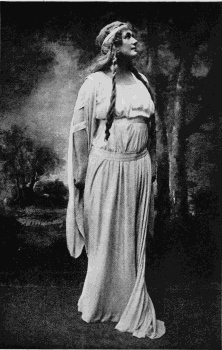
OLIVE FREMSTAD AS ELSA from a photograph by Mishkin (1913)
I do not think Mme. Fremstad has trained her voice to any high degree of agility. She can sing the drinking song from Lucrezia Borgia and Delibes's Les Filles de Cadix with irresistible effect, a good part of which, however, is produced by her personality and manner, qualities which carry her far on the concert stage, although for some esoteric reason they have never inveigled the general public into an enthusiastic surrender to her charm. I have often heard her sing Swedish songs in her native tongue (sometimes to her own accompaniment) so enchantingly, with such appeal in her manner, and such velvet tones in her voice, that those who heard her with me not only burst into applause but also into exclamations of surprise and delight. Nevertheless, in her concerts, or in opera, although her admirers are perhaps stronger in their loyalty than those of any other singer, she has never possessed the greatest drawing power. This is one of the secrets of the stage; it cannot be solved. It would seem that the art of Mme. Fremstad was more homely, more human in song, grander and more noble in opera, than that of Mme. Tetrazzini, but the public as a whole prefers to hear the latter, just as it has gone in larger numbers to see the acting of Miss Garden or Mme. Farrar. Why this is so I cannot pretend to explain.
Mme. Fremstad has appeared in pretty nearly all of the important, and many of the lesser, Wagner rôles. She has never sung Senta, and she once told me that she had no desire to do so, nor has she been heard as Freia or Eva. But she has sung Ortrud and Elsa, Venus and Elisabeth, Adriano in Rienzi, Kundry, Isolde and Brangaene, Fricka, Erda, Waltraute, Sieglinde, one of the Rhine maidens (perhaps two), and all three Brünnhildes. In most of these characterizations she has succeeded in making a deep impression. I have never seen her Ortrud, but I have been informed that it was a truly remarkable impersonation. Her Elsa was the finest I have ever seen. To Ternina's poetic interpretation she added her own greater grace and charm, and a lovelier quality of voice. If, on occasion, the music of the second act proved too high for her, who could sing the music of the dream with such poetic expression?—or the love music in the last act?—as beautiful an impersonation, and of the same kind, as Mary Garden's Mélisande.
Her Venus was another story. She yearned for years to sing Elisabeth, and when she had satisfied this ambition, she could be persuaded only with difficulty to appear as the goddess. She told me once that she would like to sing both rôles in a single evening—a possible feat, as the two characters never appear together; Rita Fornia, I believe, accomplished the dual impersonation on one occasion at the behest of Colonel Savage. She had in mind a heroine with a dual nature, sacred and profane love so to speak, and Tannhäuser at the mercy of this gemini-born wight. She never was permitted to try this experiment at the Metropolitan, but during her last season there she appeared as Elisabeth. Montreal, and perhaps Brooklyn, had seen this impersonation before it was vouchsafed New York. Mme. Fremstad never succeeded in being very convincing in this rôle. I do not exactly understand why, as its possibilities seem to lie within her limitations. Nor did she sing the music well. On the other hand, her abundantly beautiful and voluptuous Venus, a splendid, towering, blonde figure, shimmering in flesh-coloured garments, was one of her astoundingly accurate characterizations. At the opposite pole to her Sieglinde it was equally a masterpiece of interpretative art, like Duse's Camille "positively enthralling as an exhibition of the gymnastics of perfect suppleness and grace." In both these instances she was inspired perhaps to realize something a little more wonderful than the composer himself had dreamed of. The depth and subtlety and refinement of intense passion were in this Venus—there was no suggestion here of what Sidney Homer once referred to as Mme. Homer's platonic Venus!
OLIVE FREMSTAD AS SIEGLINDE from a photograph by Aimé Dupont
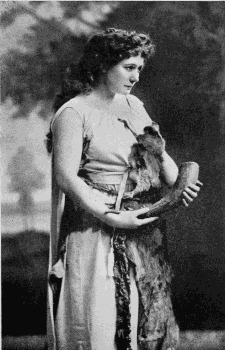
Her Sieglinde is firmly intrenched in many of our memories, the best loved of her Wagnerian women and enchantresses. Will there rise another singing actress in our generation to make us forget it? I do not think so. Her melting womanliness in the first act, ending with her complete surrender to Siegmund, her pathetic fatigue in the second act (do you not still see the harassed, shuddering figure stumbling into view and falling voiceless to sleep at the knees of her brother-lover?) remain in the memory like pictures in the great galleries. And how easily in the last act, in her single phrase, by her passionate suggestion of the realization of motherhood, did she wrest the scene from her fellow-artists, no matter who they might be, making such an effect before she fled into the forest depths, that what followed often seemed but anticlimax.
Mme. Fremstad never sang the three Brünnhildes in sequence at the Metropolitan Opera House (of late years no soprano has done so), but she was called upon at various times to sing them all separately. Undoubtedly it was as the Brünnhilde in Götterdämmerung that she made the most lasting impression. The scene of the oath on the spear she carried into the realms of Greek tragedy. Did Rachel touch greater heights? Was the French Jewess more electric? The whole performance displayed magnificent proportions, attaining a superb stature in the immolation scene. In scenes of this nature, scenes hovering between life and death, the eloquent grandeur of Mme. Fremstad's style might be observed in its complete flowering. Isolde over the body of Tristan, Brünnhilde over the body of Siegfried, exhibited no mincing pathos; the mood established was one of lofty calm. Great artists realize that this is the true expression of overwhelming emotion. In this connection it seems pertinent and interesting to recall a notable passage in a letter from Ivan Turgeniev to Pauline Viardot:—
"You speak to me also about Romeo, the third act; you have the goodness to ask me for some remarks on Romeo. What could I tell you that you have not already known and felt in advance? The more I reflect on the scene of the third act the more it seems to me that there is only one manner of interpreting it—yours. One can imagine nothing more horrible than finding oneself before the corpse of all that one loves; but the despair that seizes you then ought to be so terrible that, if it is not held and frozen by the resolution of suicide, or by another grand sentiment, art can no longer render it. Broken cries, sobs, fainting fits, these are nature, but they are not art. The spectator himself will not be moved by that poignant and profound emotion which you stir so easily. Whereas by the manner in which you wish to do Romeo (as I understand what you have written me) you will produce on your auditor an ineffaceable effect. I remember the fine and just observation that you once made on the agitated and restrained little gestures that Rachel made, at the same time maintaining an attitude of calm nobility; with her, perhaps, that was only technique; but in general it is the calm arising from a strong conviction or from a profound emotion, that is to say the calm which envelopes the desperate transports of passion from all sides, which communicates to them that purity of line, that ideal and real beauty, the true, the only beauty of art. And, what proves the truth of this remark, is that life itself—on rare occasions, it is true, at those times when it disengages itself from all that is accidental or commonplace—raises itself to the same kind of beauty. The greatest griefs, as you have said in your letter, are the calmest; and, one could add, the calmest are the most beautiful. But it is necessary to know how to unite the two extremes, unless one would appear cold. It is easier not to attain perfection, easier to rest in the middle of one's journey, the more so because the greater number of spectators demand nothing else, or rather are not accustomed to anything else, but you are what you are only because of this noble ambition to do your best...."
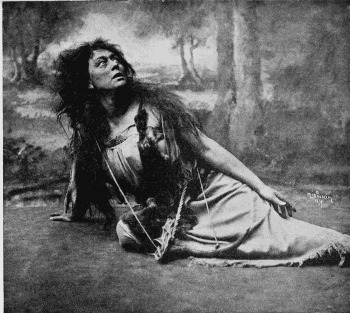
In the complex rôle of Kundry Mme. Fremstad has had no rival. The wild witch of the first act, the enchantress of the second, the repentant Magdalene of the third, all were imaginatively impersonated by this wonderful woman. Certain actors drop their characterizations as soon as the dialogue passes on to another; such as these fail in Parsifal, for Kundry, on the stage for the entire third act, has only one word to sing; in the first act she has but few more. Colossally alluring in the second act, in which she symbolized the essence of the "eternal feminine," Mme. Fremstad projected the first and third act Kundry into the minds and hearts of her audience.
OLIVE FREMSTAD AS KUNDRY, ACT I from a photograph by Mishkin (1913)
Well-trained in Bayreuth tradition, this singer was no believer in it; she saw no reason for clinging to outworn ideals simply because they prevailed at the Master's own theatre. However, she did not see how an individual could break with tradition in these works without destroying their effect. The break must come from the stage director.
"If Wagner were alive to-day," she once said to me, "I don't believe that he would sanction a lot of the silly 'business' that is insisted upon everywhere because it is the law at Bayreuth. Wagner was constantly changing everything. When he produced his music dramas they were so entirely new in conception and in staging that they demanded experimentation in many directions. Doubtless certain traditions were founded on the interpretations of certain singers—who probably could not have followed other lines of action, which Wagner might have preferred, so successfully.
"The two scenes which I have particularly in mind are those of the first act of Tannhäuser and the second act of Parsifal. Both of these scenes, it seems to me, should be arranged with the most undreamed of beauty in colour and effect. Venus should not pose for a long time in a stiff attitude on an uncomfortable couch. I don't object to the couch, but it should be made more alluring.
"The same objection holds in the second act of Parsifal, where Kundry is required to fascinate Parsifal, although she is not given an opportunity of moving from one position for nearly twenty minutes. When Klingsor calls Kundry from below in the first scene of that act, she comes against her will, and I think she should arise gasping and shuddering. I try to give that effect in my voice when I sing the music, but, following Bayreuth, I am standing, motionless, with a veil over my head, so that my face cannot be seen for some time before I sing.
"One singer can do nothing against the mass of tradition. If I changed and the others did not, the effect would be inartistic. But if some stage manager would have the daring to break away, to strive for something better in these matters, how I would love to work with that man!"
Departing from the Wagnerian répertoire, Mme. Fremstad has made notable successes in two rôles, Salome and Armide. That she should be able to do justice to the latter is more astonishing than that she should emerge triumphant from the Wilde-Strauss collaboration. Armide, almost the oldest opera to hold the stage to-day, is still the French classic model, and it demands in performance adherence to the French grand style, a style implying devotion to the highest artistic ideals. Mme. Fremstad's artistic ideals are perhaps on a higher plane than those of the Paris Conservatoire or the Comédie Française, but it does not follow that she would succeed in moulding them to fit a school of opera with which, to this point, she had been totally unfamiliar. So far as I know, the only other opera Mme. Fremstad had ever sung in French was Carmen, an experience which could not be considered as the training for a suitable delineation of the heroine of Gluck's beautiful lyric drama. Still Mme. Fremstad compassed the breach. How, I cannot pretend to say. No less an authority than Victor Maurel pronounced it a triumph of the French classic style.
The moods of Quinault's heroine, of course, suit this singing actress, and she brought to them all her most effectual enchantments, including a series of truly seducing costumes. The imperious unrest of the first act, the triumph of love over hate in the second, the invocation to La Haine in the third, and the final scene of despair in the fifth, all were depicted with poignant and moving power, and always with fidelity to the style of the piece. She set her own pace in the finale of the first act. The wounded warrior returns to tell how a single combatant has delivered all his prisoners. Armide's half-spoken guess, O ciel! c'est Renaud! which she would like to have denied, was uttered in a tone which definitely stimulated the spectator to prepare for the conflict which followed, the conflict in Armide's own breast, between her love for Renaud as a man, and her hatred of him as an enemy. I do not remember to have seen anything on the stage more profound in its implied psychology than her acting of the scene beginning Enfin il est en ma puissance, in which she stays her hand with dagger uplifted to kill the enemy-hero, and finally completely conquered by the darts of Love, transports him with her through the air to her own fair gardens.
The singer told me that she went to work on this opera with fear in her heart. "I don't know how I dared do it. I suppose it is because I had the simplicity to believe, with the Germans, that Kundry is the top of everything, and I had sung Kundry. As a matter of fact my leaning toward the classic school dates very far back. My father was a strange man, of evangelical tendencies. He wrote a hymn-book, which is still in use in Scandinavia, and he had a beautiful natural voice. People often came for miles—simple country people, understand—to hear him sing. My father knew the classic composers and he taught me their songs.
"This training came back to me when I took up the study of Armide. It was in May that Mr. Gatti-Casazza asked me if I would sing the work, which, till then, I had never heard. I took the book with me to the mountains and studied—not a note of the music at first, for music is very easy for me anyway; I can always learn that in a short time—but the text. For six weeks I read and re-read the text, always the difficult part for me in learning a new opera, without looking at the music. I found the text of Armide particularly difficult because it was in old French, and because it was in verse.
"I worked over it for six weeks, as I tell you, until I had mastered its beauties as well as I could, and then I opened the music score. Here I encountered a dreadful obstacle. Accustomed to Wagner's harmonies, I was puzzled by the French style. I did not see how the music could be sung to the text with dramatic effect. I attended several performances of the work at the Paris Opéra, but the interpretation there did not assist me in solving the problem. I tried every phrase in fifty different ways in an attempt to arrive at my end, and suddenly, and unexpectedly, I found myself in complete understanding; the exquisite refinement and nobility of the music, the repression, the classic line, all suggested to me the superb, eternal beauty of a Greek temple. Surely this is music that will outlive Wagner!
"Once I understood, it was easy to put my conception on the stage. There is no such thing as genius in singing; at least one cannot depend on genius alone to carry one through an opera. I must know exactly how I am going to sing each phrase before I go upon the stage. Nothing must be left to chance. In studying Armide I had sketches sent to me of every scene, and with these I worked until I knew every movement I should make, where I should stand, and when I should walk. Look at my score—at all these minute diagrams and directions...."
Armide was not a popular success in New York, and after one or two performances in its second season at the Metropolitan Opera House it was withdrawn. With the reasons for the failure of this opera to interest the general public Mme. Fremstad, it may well be imagined, had nothing to do. Her part in it, on the contrary, contributed to what success the work had. New York opera-goers have never manifested any particular regard for classic opera in any tongue; Fidelio or Don Giovanni have never been popular here. Then, although Caruso sang the music of Renaud with a style and beauty of phrasing unusual even for him, his appearance in the part was unfortunate. It was impossible to visualize the chevalier of the romantic story. The second tenor rôle, which is very important, was intrusted to an incompetent singer, and the charming rôle of the Naiad was very inadequately rendered; but the principal fault of the interpretation was due to a misconception regarding the relative importance of the ballet. There are dances in every act of Armide; there is no lovelier music of its kind extant than that which Gluck has devoted to his dancers in this opera. Appreciating this fact, Mr. Toscanini refused to part with a note of it, and his delivery of the delightful tunes would have made up a pleasant half-hour in a concert-room. Unfortunately the management did not supplement his efforts by providing a suitable group of dancers. This failure was all but incomprehensible considering the fact that Anna Pavlowa was a member of the Metropolitan company that season. Had she appeared in Armide, its fate in New York, where it was performed for the first time one hundred and thirty-three years after its original production in Paris, might have been far different. It may have been impossible for Mr. Gatti-Casazza to obtain the co-operation of the dancer. Times change. In 1833 Taglioni, then at the height of her powers, danced in London the comparatively insignificant parts of the Swiss peasant in Guillaume Tell and the ghostly abbess in Robert le Diable. This was the season in which she introduced La Sylphide to English theatre-goers.
The history of Richard Strauss's Salome in New York has been told so often that it seems quite unnecessary to repeat it here. There must be few indeed of those who will read these lines who do not know how the music drama received only one public performance at the Metropolitan Opera House before it was withdrawn at the request of certain directors. At that one performance Olive Fremstad sang the rôle of Salome. She was also heard at the private dress rehearsal—before an auditorium completely filled with invited guests—and she has sung the part three times in Paris. The singer threw herself into its preparation with her usual energy, and developed an extraordinary characterization. There was but one flaw, the substitution of a professional dancer for the Dance of the Seven Veils. At this time it had occurred to nobody that the singer who impersonated Salome could dance. How could any one sing the music of the tremendous finale after getting thoroughly out of breath in the terpsichorean exhibition before Herod? The expedient of a substitute was resorted to at the original performance in Dresden, and Olive Fremstad did not disturb this tradition. She allowed Bianca Froehlich to take off the seven veils, a feat which was accomplished much more delicately at the performance than it had been at the dress rehearsal. In Paris a farce resulted from the custom when Mme. Trouhanova not only insisted on wearing a different costume from the Salome whose image she was supposed to be, but also took curtain calls. I think it was Gemma Belincioni, the Italian, who first conceived the idea of Salome dancing her own dance. She was followed by Mary Garden, who discovered what every one should have noticed in the beginning, that the composer has given the singer a long rest after the pantomimic episode.
Aside from this disturbance to the symmetry of the performance, Olive Fremstad was magnificent. Her entrance was that of a splendid leopard, standing poised on velvet paws on the terrace, and then creeping slowly down the staircase. Her scene with Jochanaan was in truth like the storming of a fortress, and the scene with the Tetrarch was clearly realized. But it was in the closing scene of the drama that Mme. Fremstad, like the poet and the composer, achieved her most effective results. I cannot yet recall her as she crept from side to side of the well in which Jochanaan was confined, waiting for the slave to ascend with the severed head, without that shudder of fascination caused by the glimmering eyes of a monster serpent, or the sleek terribleness of a Bengal tiger. And at the end she suggested, as perhaps it has never before been suggested on the stage, the dregs of love, the refuse of gorged passion.
Singers who "create" parts in great lyric dramas have a great advantage over those who succeed them. Mary Shaw once pointed out to me the probability that Janet Achurch and Elizabeth Robins only won enthusiastic commendation from Bernard Shaw because they were appearing in the Ibsen plays which he was seeing for the first time. He attributed a good part of his pleasure to the interpretations of these ladies. However, he was never satisfied with their performances in plays with which he was more familiar and he never again found anyone entirely to suit him in the Ibsen dramas. Albert Niemann was one of the first tenors to sing Wagner rôles and there are those alive who will tell you that he was one of the great artists, but it is perhaps because they heard him first in lyric dramas of such vitality that they confused singer and rôle. Beatty-Kingston, who heard him in 1866, said (in "Music and Manners") that he had torn his voice "to tatters by persistent shoutings at the top of its upper register, and undermined it by excessive worship at the shrines of Bacchus and the Paphian goddess.... His 'production' was characterized by a huskiness and scratchiness infinitely distressing to listen to...." No allowances of this sort need be made for the deep impression made by Olive Fremstad. At the Metropolitan Opera House she followed a line of well-beloved and regal interpreters of the Wagner rôles. Both Lilli Lehmann and Milka Ternina had honoured this stage and Lillian Nordica preceded Mme. Fremstad as Kundry there. In her career at the Metropolitan, indeed, Mme. Fremstad sang only three operas at their first performances there, Salome, Les Contes d'Hoffmann, and Armide. In her other rôles she was forced to stand comparison with a number of great artists. That she won admiration in them under the circumstances is the more fine an achievement.
I like to think, sometimes, that Olive Fremstad is the reincarnation of Guiditta Pasta, that celebrated Italian singer of the early nineteenth century, who paced triumphantly through the humbler tragedies of Norma and Semiramide. She too worked hard to gain her ends, and she gained them for a time magnificently. Henry Fothergill Chorley celebrates her art with an enthusiasm that is rare in his pages, and I like to think that he would write similar lines of eulogy about Olive Fremstad could he be called from the grave to do so. There is something of the mystic in all great singers, something incomprehensible, inexplicable, but in the truly great, the Mme. Pastas and the Mme. Fremstads, this quality outstrips all others. It is predominant. And just in proportion as this mysticism triumphs, so too their art becomes triumphant, and flames on the ramparts, a living witness before mankind to the power of the unseen.
August 17, 1916.
Geraldine Farrar
Mme. Farrar's insigne.

THE autobiography of Geraldine Farrar is a most disappointing document; it explains nothing, it offers the reader no new insights. Given the brains of the writer and the inexhaustibility of the subject, the result is unaccountable. Any opera-goer who has followed the career of this singer with even indifferent attention will find it difficult to discover any revelation of personality or artistry in the book. Geraldine Farrar has always been a self-willed young woman with a plangent ambition and a belief in her own future which has been proved justifiable by the chronological unfolding of her stage career. These qualities are displayed over and over again in the book, together with a certain number of facts about her early life, teachers, and so on. Of that part of her personal experience which would really interest the public she gives a singularly glossed account. Very little attention is paid to composers; none at all to operas, if one may except such meagre descriptions as that accorded to Julien, "a hodge-podge of operatic efforts that brought little satisfaction to anybody concerned in it." There are few illuminating anecdotes; no space is devoted to an account of how Mme. Farrar composes her rôles. She likes this one; she is indifferent to that; she detests a third; but reasons for these prejudices are rarely given. There is little manifestation of that analytic mind with which Mme. Farrar credits herself. There are sketchy references to other singers, usually highly eulogistic, but where did Mme. Farrar hear that remarkable performance of Carmen in which both Saleza and Jean de Reszke appeared? For my part, the most interesting lines in the book are those which close the thirteenth chapter: "I cannot say that I am much in sympathy with the vague outlines of the modern French lyric heroines; Mélisande and Ariane, I think, can be better intrusted to artists of a less positive type."
Notwithstanding the fact that she has written a rather dull book, Geraldine Farrar is one of the few really vivid personalities of the contemporary lyric stage. To a great slice of the public she is an idol in the sense that Rachel and Jenny Lind were idols. She has frequently extracted warm praise even from the cold-water taps of discriminating and ordinarily unsympathetic critics. Acting in opera she considers of greater importance than singing. She once told me that she ruthlessly sacrificed tone whenever it seemed to interfere with dramatic effect. As an actress she has suffered from an excess of zeal, and an impatience of discipline. She composes her parts with some care, but frequently overlays her original conception with extravagant detail, added spontaneously at a performance, if her feelings so dictate.
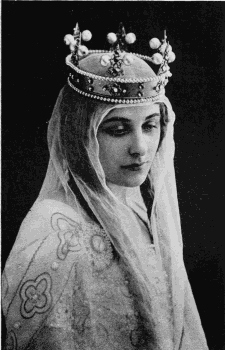
GERALDINE FARRAR AS ELISABETH from a photograph by Reutlinger
This lawlessness sometimes leads her astray. It is an unsafe method to follow. Actors who feel the most themselves, unless the feeling is expressed in support of carefully thought-out effects, often leave their auditors cold. It is interesting to recall that Mme. Malibran, who may have excelled Mme. Farrar as a singer, had a similar passion for impromptu stage "business." She refused to give her fellow-artists any idea of how she would carry a part through, and as she allowed her feelings full sway in the matter misunderstandings frequently arose. In acting Desdemona to the Otello of the tenor, Donzelli, for example, she would not determine beforehand the exact point at which he was to seize her. Frequently she gave him a long chase and on one occasion in his pursuit he stumbled and cut himself on his unsheathed dagger. Often it has seemed that Mme. Farrar deliberately chose certain stage "business" with an eye to astounding, and not with any particular care for the general roundness of her operatic performance. It must also be taken into consideration that no two of Mme. Farrar's impersonations of any one rôle are exactly similar, and that he who may have seen her give a magnificent performance is not too safe in recommending his meticulous neighbour to go to the next. Sometimes she is "modern" and "American" in the deprecatory sense of these words; in some of her parts she exudes no atmospheric suggestion. There are no overtones. The spectator sees exactly what is before his eyes on these occasions; there is no stimulation for the imagination to proceed further. At other times, as in her characterization of the Goosegirl in Königskinder, it would seem that she had extracted the last poetic meaning out of the words and music, and had succeeded in making her audience feel, not merely everything that the composer and librettist intended, but a great deal more.
At times she is a very good singer. Curiously enough, it is classic music that she usually sings best. I have heard her sing Zerlina in Don Giovanni in a manner almost worthy of her teacher, Lilli Lehmann. There is no mention of this rôle in her book; nor of another in which she was equally successful, Rosaura in Le Donne Curiose, beautifully sung from beginning to end. Mme. Farrar is musical (some singers are not; Mme. Nordica was not, for example), and I have witnessed two manifestations of this quality. On one occasion she played for me on the piano a good portion of the first act of Ariane et Barbe-Bleue, and played it brilliantly, no mean achievement. Another time I stood talking with her and her good friend, Josephine Jacoby, in the wings during the last act of a performance of Madama Butterfly at the Brooklyn Academy of Music. There was no air of preoccupation on her part, no sense on ours that she was following the orchestra. I became so interested in our conversation, for Mme. Farrar invariably talks well, that I did not even hear the orchestra. But her mind was quite capable of taking care of two things at once. She interrupted a sentence to sing her phrase off stage, and then smilingly continued the conversation. I shall never forget this moment. To me it signified in an instant what Mme. Farrar has taken the pains to explain in pages of her autobiography and which is all summed up in her own comment, written at the time on the programme of the concert of her Boston début, May 26, 1896: "This is what I made my début in, very calm and sedate, not the least nervous."
But Mme. Farrar's vocal method is not God-given, although her voice and her assurance may be, and she sometimes has trouble in producing her upper tones. Instead of opening like a fan, her high voice is frequently pinched, and she has difficulty in singing above the staff. I have never heard her sing Butterfly's entrance with correct intonation, although I have heard her in the part many times. Her Carmen, on the whole, is a most successful performance vocally, and so is (or was) her Elisabeth, especially in the second act. The tessitura of Butterfly is very high, and the rôle is a strain for her. She has frequently said that she finds it easier to sing any two other rôles in her répertoire, and refuses to appear for two days before or after a performance of this Puccini opera.
Mme. Farrar is a fine linguist. She speaks and sings French like a Frenchwoman (I have expert testimony on this point), German like a German, and Italian like an Italian; her enunciation of English is also very clear (she has never sung in opera in English, but has often sung English songs in concert). Her enunciation of Maeterlinck's text in Ariane et Barbe-Bleue was a joy, about the only one she contributed to this performance. And in Königskinder and Le Donne Curiose she was equally distinct. In fact there is never any difficulty about following the text of an opera when Geraldine Farrar is singing.
The rôles in which Mme. Farrar achieves her best results, according to my taste, are Manon, the Goosegirl, Margherita (in Mefistofele), Elisabeth, Rosaura, Suzanna, and Violetta. Cio-Cio-San, of course, is her most popular creation, and it deserves to some extent the applause of the populace, although I do not think it should be put in the above list. It is certainly not to be considered on the same plane vocally. Other rôles in which she is partially successful are Juliette and Marguerite (in Gounod's Faust). I think her Ariane is commonly adjudged a failure. In Madame Sans-Gêne she is often comic, but she does not suggest a bourgeoise Frenchwoman; in the court scenes she is more like a graceful woman trying to be awkward than an awkward woman trying to be graceful. Her Tosca is lacking in dignity; it is too petulant a performance, too small in conception. In failing to find adequate pleasure in her Carmen I am not echoing popular opinion.
I do not think Mme. Farrar has appeared in La Traviata more than two or three times at the Metropolitan Opera House, although she has probably sung Violetta often in Berlin. On the occasion of Mme. Sembrich's farewell to the American opera stage she appeared as Flora Bervoise as a compliment to the older singer. In her biography she says that Sarah Bernhardt gave her the inspiration for the composition of the heroine of Verdi's opera. It would be interesting to have more details on this point; they are not forthcoming. Of course there have been many Violettas who have sung the music of the first act more brilliantly than Mme. Farrar; in the later acts she often sang beautifully, and her acting was highly expressive and unconventional. She considered the rôle from the point of view of make-up. Has any one else done this? Violetta was a popular cocotte; consequently, she must have been beautiful. But she was a consumptive; consequently, she must have been pale. In the third act Mme. Farrar achieved a very fine dramatic effect with her costume and make-up. Her face was painted a ghastly white, a fact emphasized by her carmined lips and her black hair. She wore pale yellow and carried an enormous black fan, behind which she pathetically hid her face to cough. She introduced novelty into the part at the very beginning of the opera. Unlike most Violettas, she did not make an entrance, but sat with her back to the audience, receiving her guests, when the curtain rose.
GERALDINE FARRAR AS VIOLETTA from a photograph by Aimé Dupont (1907)
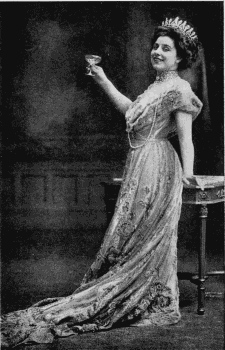
It has seemed strange to me that the professional reviewers should have attributed the added notes of realism in Mme. Farrar's second edition of Carmen to her appearances in the moving-picture drama. The tendencies displayed in her second year in the part were in no wise, to my mind, a result of her cinema experiences. In fact, the New York critics should have remembered that when Mme. Farrar made her début at the Metropolitan Opera House in the rôle of Juliette, they had rebuked her for these very qualities. She had indulged in a little extra realism in the bedroom and balcony scenes of Gounod's opera, of the sort with which Miss Nethersole created ten-minute furores in her performances of Carmen and Sapho. Again, as Marguerite in Faust (her Margherita in Mefistofele was a particularly repressed and dreamy representation of the German maiden, one instinct with the highest dramatic and vocal values in the prison scene), she devised "business" calculated to startle, dancing the jewel song, and singing the first stanza of the Roi de Thulé air from the cottage, whither she had repaired to fetch her spindle of flax—this last detail seemed to me a very good one. In early representations of Madama Butterfly and La Bohème her death scenes were fraught with an intense realism which fitted ill with the spirit of the music. I remember one occasion on which Cio-Cio-San knocked over the rocking-chair in her death struggles, which often embraced the range of the Metropolitan stage.
These points have all been urged against her at the proper times, and there seemed small occasion for attributing her extra activities in the first act of Bizet's opera, in which the cigarette girl engaged in a prolonged scuffle with her rival in the factory, or her more recent whistling of the seguidilla, to her moving-picture experiences. No, Mme. Farrar is overzealous with her public. She once told me that at every performance she cut herself open with a knife and gave herself to the audience. This intensity, taken together with her obviously unusual talent and her personal attractiveness, is what has made her a more than ordinary success on our stage. It is at once her greatest virtue and her greatest fault, artistically speaking. Properly manacled, this quality would make her one of the finest, instead of merely one of the most popular, artists now before the public. But I cannot see how the cinema can be blamed.
When I first saw the Carmen of Mme. Farrar, her second or third appearance in the part, I was perplexed to find an excuse for its almost unanimous acclamation, and I sought in my mind for extraneous reasons. There was, for example, the conducting of the score by Mr. Toscanini, but that, like Mme. Farrar's interpretation of the Spanish gypsy, never found exceptional favour in my ears. Mr. Caruso's appearance in the opera could not be taken into consideration, because he had frequently sung in it before at the Metropolitan Opera House without awakening any great amount of enthusiasm. In fact, except as Des Grieux, this Italian tenor has never been popularly accepted in French opera in New York. But Carmen had long been out of the répertoire, and Carmen is an opera people like to hear. The magic of the names of Caruso, Farrar, and Toscanini may have lured auditors and critics into imagining they had heard a more effective performance than was vouchsafed them. Personally I could not compare the revival favourably with the wonderful Manhattan Opera House Carmen, which at its best enlisted the services of Mme. Bressler-Gianoli, the best Carmen save one that I have ever heard, Charles Dalmores, Maurice Renaud, Pauline Donalda, Charles Gilibert, Emma Trentini, and Daddi; Cleofonte Campanini conducting.
At first, to be sure, there was no offensive over-laying of detail in Mme. Farrar's interpretation. It was not cautiously traditional, but there was no evidence that the singer was striving to stray from the sure paths. The music lies well in Mme. Farrar's voice, better than that of any other part I have heard her sing, unless it be Charlotte in Werther, and the music, all of it, went well, including the habanera, the seguidilla, the quintet, and the marvellous Oui, je t'aime, Escamillo of the last act. Her well-planned, lively dance after the gypsy song at the beginning of the second act drew a burst of applause for music usually permitted to go unrewarded. Her exit in the first act was effective, and her scene with Jose in the second act was excellently carried through. The card scene, as she acted it, meant very little. No strain was put upon the nerves. There was little suggestion here. The entrance of Escamillo and Carmen in an old victoria in the last act was a stroke of genius on somebody's part. I wonder if this was Mme. Farrar's idea.
But somehow, during this performance, one didn't feel there. It was no more the banks of the Guadalquivir than it was the banks of the Hudson. Carmen as transcribed by Bizet and Meilhac and Halévy becomes indisputably French in certain particulars; to say that the heroine should be Spanish is not to understand the truth; Maria Gay's interpretation has taught us that, if nothing else has. But atmosphere is demanded, and that Mme. Farrar did not give us, at least she did not give it to me. In the beginning the interpretation made on me the effect of routine,—the sort of performance one can see in any first-rate European opera house,—and later, when the realistic bits were added, the distortion offended me, for French opera always demands a certain elegance of its interpreters; a quality which Mme. Farrar has exposed to us in two other French rôles.
Her Manon is really an adorable creature. I have never seen Mary Garden in this part, but I have seen many French singers, and to me Mme. Farrar transcends them all. A very beautiful and moving performance she gives, quite in keeping with the atmosphere of the opera. Her adieu to the little table and her farewell to Des Grieux in the desert always start a lump in my throat.
Her Charlotte (a rôle, I believe, cordially detested by Mme. Farrar, and one which she refuses to sing) is to me an even more moving conception. This sentimental opera of Massenet's has never been appreciated in America at its true value, although it is one of the most frequently represented works at the Paris Opéra-Comique. When it was first introduced here by Emma Eames and Jean de Rezske, it found little favour, and later Mme. Farrar and Edmond Clément were unable to arouse interest in it (it was in Werther, at the New Theatre, that Alma Gluck made her operatic début, in the rôle of Sophie). But Geraldine Farrar as the hesitating heroine of the tragic and sentimental romance made the part very real, as real in its way as Henry James's "Portrait of a Lady," and as moving. The whole third act she carried through in an amazingly pathetic key, and she always sang Les Larmes as if her heart were really breaking.
What a charming figure she was in Wolf-Ferrari's pretty operas, Le Donne Curiose and Suzannen's Geheimness! And she sang the lovely measures with the Mozartean purity which at her best she had learned from Lilli Lehmann. Her Zerlina and her Cherubino were delightful impersonations, invested with vast roguery, although in both parts she was a trifle self-conscious, especially in her assumption of awkwardness. Her Elisabeth, sung in New York but seldom, though she has recently appeared in this rôle with the Chicago Opera Company, was noble in conception and execution, and her Goosegirl one of the most fascinating pictures in the operatic gallery of our generation. Her Mignon was successful in a measure, perhaps not an entirely credible figure. Her Nedda was very good.
GERALDINE FARRAR AS LOUISE IN JULIEN from a photograph by White (1914)
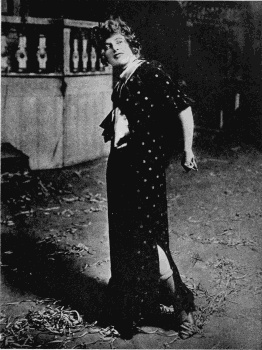
Her Louise in Julien was so fine dramatically, especially in the Montmartre episode, as to make one wish that she could sing the real Louise in the opera of that name. Once, however, at a performance of Charpentier's earlier work at the Manhattan Opera House, she told me that she would never, never do so. She has been known to change her mind. Her Ariane, I think, was her most complete failure. It is a part which requires plasticity and nobility of gesture and interpretation of a kind with which her style is utterly at variance. And yet I doubt if Mme. Farrar had ever sung a part to which she had given more consideration. It was for this opera, in fact, that she worked out a special method of vocal speech, half-sung, half-spoken, which enabled her to deliver the text more clearly.
Whether Mme. Farrar will undergo further artistic development I very much doubt. She tells us in her autobiography that she can study nothing in any systematic way, and it is only through very sincere study and submission to well-intended restraint that she might develop still further into the artist who might conceivably leave a more considerable imprint on the music drama of her time. It is to be doubted if Mme. Farrar cares for these supreme laurels; her success with her public—which is pretty much all the public—is so complete in its way that she may be entirely satisfied with that by no means to be despised triumph. Once (in 1910) she gave an indication to me that this might be so, in the following words:
"Emma Calvé was frequently harshly criticized, but when she sang the opera house was crowded. It was because she gave her personality to the public. Very frequently there are singers who give most excellent interpretations, who are highly praised, and whom nobody goes to see. Now in the last analysis there are two things which I do. I try to be true to myself and my own conception of the dramatic fitness of things on the stage, and I try to please my audiences. To do that you must mercilessly reveal your personality. There is no other way. In my humble way I am an actress who happens to be appearing in opera. I sacrifice tonal beauty to dramatic fitness every time I think it is necessary for an effect, and I shall continue to do it. I leave mere singing to the warblers. I am more interested in acting myself."
There is much that is sound sense in these remarks, but it is a pity that Mme. Farrar carries her theories out literally. To me, and to many another, there is something a little sad in the acceptance of easily won victory. If she would, Mme. Farrar might improve her singing and acting in certain rôles in which she has already appeared, and she might enlarge her répertoire to include more of the rôles which have a deeper significance in operatic and musical history. At present her activity is too consistent to allow time for much reflection. It would afford me the greatest pleasure to learn that this singer had decided to retire for a few months to devote herself to study and introspection, so that she might return to the stage with a new and brighter fire and a more lasting message.
Farrar fara—forse.
July 14, 1916.
Mary Garden
"Rose is a rose is a rose is a rose."
Gertrude Stein.
THE influence of Ibsen on our stage has been most subtle. The dramas of the sly Norwegian are infrequently performed, but almost all the plays of the epoch bear his mark. And he has done away with the actor, for nowadays emotions are considered rude on the stage. Our best playwrights have striven for an intellectual monotone. So it happens that for the Henry Irvings, the Sarah Bernhardts, and the Edwin Booths of a younger generation we must turn to the operatic stage, and there we find them: Maurice Renaud, Olive Fremstad—and Mary Garden.
There is nothing casual about the art of Mary Garden. Her achievements on the lyric stage are not the result of happy accident. Each detail of her impersonations, indeed, is a carefully studied and selected effect, chosen after a review of possible alternatives. Occasionally, after a trial, Miss Garden even rejects the instinctive. This does not mean that there is no feeling behind her performances. The deep burning flame of poetic imagination illuminates and warms into life the conception wrought in the study chamber. Nothing is left to chance, and it is seldom, and always for some good reason, that this artist permits herself to alter particulars of a characterization during the course of a representation.
I have watched her many times in the same rôle without detecting any great variance in the arrangement of details, and almost as many times I have been blinded by the force of her magnetic imaginative power, without which no interpreter can hope to become an artist. This, it seems to me, is the highest form of stage art; certainly it is the form which on the whole is the most successful in exposing the intention of author and composer, although occasionally a Geraldine Farrar or a Salvini will make it apparent that the inspiration of the moment also has its value. However, I cannot believe that the true artist often experiments in public. He conceives in seclusion and exposes his conception, completely realized, breathed into, so to speak, on the stage. When he first studies a character it is his duty to feel the emotions of that character, and later he must project these across the footlights into the hearts of his audience; but he cannot be expected to feel these emotions every night. He must remember how he felt them before. And sometimes even this ideal interpreter makes mistakes. Neither instinct nor intelligence—not even genius—can compass every range.
Miss Garden's career has been closely identified with the French lyric stage and, in at least two operas, she has been the principal interpreter—and a material factor in their success—of works which have left their mark on the epoch, stepping-stones in the musical brook. The rôles in which she has most nearly approached the ideal are perhaps Mélisande, Jean (Le Jongleur de Notre Dame), Sapho, Thais, Louise, Marguerite (in Gounod's Faust), Chrysis (in Aphrodite), and Monna Vanna. I cannot speak personally of her Tosca, her Orlanda, her Manon, her Violetta, or her Chérubin (in Massenet's opera of the same name). I do not care for her Carmen as a whole, and to my mind her interpretation of Salome lacks the inevitable quality which stamped Olive Fremstad's performance. In certain respects she realizes the characters and sings the music of Juliet and Ophélie, but this is vieux jeu for her, and I do not think she has effaced the memory of Emma Eames in the one and Emma Calvé in the other of these rôles. She was somewhat vague and not altogether satisfactory (this may be ascribed to the paltriness of the parts) as Prince Charmant in Cendrillon, la belle Dulcinée in Don Quichotte, and Grisélidis. On the other hand, in Natoma—her only appearance thus far in opera in English—she made a much more important contribution to the lyric stage than either author or composer.
Mary Garden was born in Scotland, but her family came to this country when she was very young, and she grew up in the vicinity of Chicago. She may therefore be adjudged at least as much an American singer as Olive Fremstad. She studied in France, however, and this fortuitous circumstance accounts for the fact that all her great rôles are French, and for the most part modern French. Her two Italian rôles, Violetta and Tosca, she sings in French, although I believe she has made attempts to sing Puccini's opera in the original tongue. Her other ventures afield have included Salome, sung in French, and Natoma, sung in English. Her pronunciation of French on the stage has always aroused comment, some of it jocular. Her accent is strongly American, a matter which her very clear enunciation does not leave in doubt. However, it is a question in my mind if Miss Garden did not weigh well the charm of this accent and its probable effect on French auditors. You will remember that Helena Modjeska spoke English with a decided accent, as do Fritzi Scheff, Alia Nazimova, and Mitzi Hajos in our own day; you may also realize that to the public, which includes yourself, this is no inconsiderable part of their charm. Parisians do not take pleasure in hearing their language spoken by a German, but they have never had any objection—quite the contrary—to an English or American accent on their stage, although I do not believe this general preference has ever been allowed to affect performances at the Comédie Française, except when l'Anglais tel qu'on le parle is on the affiches. At least it is certain that Miss Garden speaks French quite as easily as—perhaps more easily than—she does English, and many of the eccentricities of her stage speech are not noticeable in private life.
Many of the great artists of the theatre have owed their first opportunity to an accident; it was so with Mary Garden. She once told me the story herself and I may be allowed to repeat it in her own words, as I put them down shortly after:
"I became friends with Sybil Sanderson, who was singing in Paris then, and one day when I was at her house Albert Carré, the director of the Opéra-Comique, came to call. I was sitting by the window as he entered, and he said to Sybil, 'That woman has a profile; she would make a charming Louise.' Charpentier's opera, I should explain, had not yet been produced. 'She has a voice, too,' Sybil added. Well, M. Carré took me to the theatre and listened while I sang airs from Traviata and Manon. Then he gave me the partition of Louise and told me to go home and study it. I had the rôle in my head in fifteen days. This was in March, and M. Carré engaged me to sing at his theatre beginning in October.... One spring day, however, when I was feeling particularly depressed over the death of a dog that had been run over by an omnibus, M. Carré came to me in great excitement; Mme. Rioton, the singer cast for the part, was ill, and he asked me if I thought I could sing Louise. I said 'Certainly,' in the same tone with which I would have accepted an invitation to dinner. It was only bluff; I had never rehearsed the part with orchestra, but it was my chance, and I was determined to take advantage of it. Besides, I had studied the music so carefully that I could have sung it note for note if the orchestra had played The Star-Spangled Banner simultaneously.
"Evening came and found me in the theatre. Mme. Rioton had recovered sufficiently to sing; she appeared during the first two acts, and then succumbed immediately before the air, Depuis le Jour, which opens the third act. I was in my dressing-room when M. Carré sent for me. He told me that an announcement had been made before the curtain that I would be substituted for Mme. Rioton. I learned afterwards that André Messager, who was directing the orchestra, had strongly advised against taking this step; he thought the experiment was too dangerous, and urged that the people in the house should be given their money back. The audience, you may be sure, was none too pleased at the prospect of having to listen to a Mlle. Garden of whom they had never heard. Will you believe me when I tell you that I was never less nervous?... I must have succeeded, for I sang Louise over two hundred times at the Opéra-Comique after that. The year was 1900, and I had made my début on Friday, April 13!"
I have no contemporary criticisms of this event at hand, but one of my most valued souvenirs is a photograph of the charming interpreter as she appeared in the rôle of Louise at the beginning of her career. However, in one of Gauthier-Villars's compilations of his musical criticisms, which he signed "L'Ouvreuse" ("La Ronde des Blanches"), I discovered the following, dated February 21, 1901, a detail of a review of Gabriel Pierné's opera, La Fille de Tabarin: "Mlle. Garden a une aimable figure, une voix aimable, et un petit reste d'accent exotique, aimable aussi."
Of the composer of Louise Miss Garden had many interesting things to say in after years: "The opera is an expression of Charpentier's own life," she told me one day. "It is the opera of Montmartre, and he was the King of Montmartre, a real bohemian, to whom money and fame meant nothing. He was satisfied if he had enough to pay consommations for himself and his friends at the Rat Mort. He had won the Prix de Rome before Louise was produced, but he remained poor. He lived in a dirty little garret up on the butte, and while he was writing this realistic picture of his own life he was slowly starving to death. André Messager knew him and tried to give him money, but he wouldn't accept it. He was very proud. Messager was obliged to carry up milk in bottles, with a loaf of bread, and say that he wanted to lunch with him, in order to get Charpentier to take nourishment.
"Meanwhile, little by little, Louise was being slowly written.... Part of it he wrote in the Rat Mort, part in his own little room, and part of it in the Moulin de la Galette, one of the gayest of the Montmartre dance halls. High up on the butte the gaunt windmill sign waves its arms; from the garden you can see all Paris. It is the view that you get in the third act of Louise.... The production of his opera brought Charpentier nearly half a million francs, but he spent it all on the working-girls of Montmartre. He even established a conservatory, so that those with talent might study without paying. And his mother, whom he adored, had everything she wanted until she died.... He always wore the artist costume, corduroy trousers, blouse, and flowing tie, even when he came to the Opéra-Comique in the evening. Money did not change his habits. His kingdom extended over all Paris after the production of Louise, but he still preferred his old friends in Montmartre to the new ones his success had made for him, and he dissipated his strength and talent. He was an adorable man; he would give his last sou to any one who asked for it!
"To celebrate the fiftieth performance of Louise, M. Carré gave a dinner in July, 1900. Most appropriately he did not choose the Café Anglais or the Café de Paris for this occasion, but Charpentier's own beloved Moulin de la Galette. It was at this dinner that the composer gave the first sign of his physical decline. He had scarcely seated himself at the table, surrounded by the great men and women of Paris, before he fainted...."
The subsequent history of this composer of the lower world we all know too well; how he journeyed south and lived in obscurity for years, years which were embellished with sundry rumours relating to future works, rumours which were finally crowned by the production of Julien at the Opéra-Comique—and subsequently at the Metropolitan Opera House in New York. The failure of this opera was abysmal.
Louise is a rôle which Miss Garden has sung very frequently in America, and, as she may be said to have contributed to Charpentier's fame and popularity in Paris, she did as much for him here. This was the second part in which she appeared in New York. The dynamics of the rôle are finely wrought out, deeply felt; the characterization is extraordinarily keen, although after the first act it never touches the heart. The singing-actress conceives the character of the sewing-girl as hard and brittle, and she does not play it for sympathy. She acts the final scene with the father with the brilliant polish of a diamond cut in Amsterdam, and with heartless brutality. Stroke after stroke she devotes to a ruthless exposure of what she evidently considers to be the nature of this futile drab. It is the scene in the play which evidently interests her most, and it is the scene to which she has given her most careful attention. In the first act, to be sure, she is gamine and adorable in her scenes with her father, and touchingly poignant in the despairing cry which closes the act, Paris! In the next two acts she wisely submerges herself in the general effect. She allows the sewing-girls to make the most of their scene, and, after she has sung Depuis le Jour, she gives the third act wholly into the keeping of the ballet, and the interpreters of Julien and the mother.
There are other ways of singing and acting this rôle. Others have sung and acted it, others will sing and act it, effectively. The abandoned (almost aggressive) perversity of Miss Garden's performance has perhaps not been equalled, but this rôle does not belong to her as completely as do Thais and Mélisande; no other interpreters will satisfy any one who has seen her in these two parts.
Miss Garden made her American début in Massenet's opera, Thais, written, by the way, for Sybil Sanderson. The date was November 25, 1907. Previous to this time Miss Garden had never sung this opera in Paris, but she had appeared in it during a summer season at one of the French watering places. Since that night, nearly ten years ago, however, it has become the most stable feature of her répertoire. She has sung it frequently in Paris, and during the long tours undertaken by the Chicago Opera Company this sentimental tale of the Alexandrian courtesan and the hermit of the desert has startled the inhabitants of hamlets in Iowa and California. It is a very brilliant scenic show, and is utterly successful as a vehicle for the exploitation of the charms of a fragrant personality. Miss Garden has found the part grateful; her very lovely figure is particularly well suited to the allurements of Grecian drapery, and the unwinding of her charms at the close of the first act is an event calculated to stir the sluggish blood of a hardened theatre-goer, let alone that of a Nebraska farmer. The play becomes the more vivid as it is obvious that the retiary meshes with which she ensnares Athanaël are strong enough to entangle any of us. Thais-become-nun—Evelyn Innes should have sung this character before she became Sister Teresa—is in violent contrast to these opening scenes, but the acts in the desert, as the Alexandrian strumpet wilts before the aroused passion of the monk, are carried through with equal skill by this artist who is an adept in her means of expression and expressiveness.
The opera is sentimental, theatrical, and over its falsely constructed drama—a perversion of Anatole France's psychological tale—Massenet has overlaid as banal a coverlet of music as could well be devised by an eminent composer. "The bad fairies have given him [Massenet] only one gift," writes Pierre Lalo, "...the desire to please." It cannot be said that Miss Garden allows the music to affect her interpretation. She sings some of it, particularly her part in the duet in the desert, with considerable charm and warmth of tone. I have never cared very much for her singing of the mirror air, although she is dramatically admirable at this point; on the other hand, I have found her rendering of the farewell to Eros most pathetic in its tenderness. At times she has attacked the high notes, which fall in unison with the exposure of her attractions, with brilliancy; at other times she has avoided them altogether (it must be remembered that Miss Sanderson, for whom this opera was written, had a voice like the Tour Eiffel; she sang to G above the staff). But the general tone of her interpretation has not been weakened by the weakness of the music or by her inability to sing a good deal of it. Quite the contrary. I am sure she sings the part with more steadiness of tone than Milka Ternina ever commanded for Tosca, and her performance is equally unforgettable.
After the production of Louise, Miss Garden's name became almost legendary in Paris, and many are the histories of her subsequent career there. Parisians and foreign visitors alike flocked to the Opéra-Comique to see her in the series of delightful rôles which she assumed—Orlanda, Manon, Chrysis, Violetta ... and Mélisande. It was during the summer of 1907 that I first heard her there in two of the parts most closely identified with her name, Chrysis and Mélisande.
Camille Erlanger's Aphrodite, considered as a work of art, is fairly meretricious. As a theatrical entertainment it offers many elements of enjoyment. Based on the very popular novel of Pierre Louÿs—at one time forbidden circulation in America by Anthony Comstock—it winds its pernicious way through a tale of prostitution, murder, theft, sexual inversion, drunkenness, sacrilege, and crucifixion, and concludes, quite simply, in a cemetery. The music is appallingly banal, and has never succeeded in doing anything else but annoy me when I have thought of it at all. It never assists in creating an atmosphere; it bears no relation to stage picture, characters, or situation. Both gesture and colour are more important factors in the consideration of the pleasurable elements of this piece than the weak trickle of its sickly melodic flow.
MARY GARDEN AS CHRYSIS (1906)
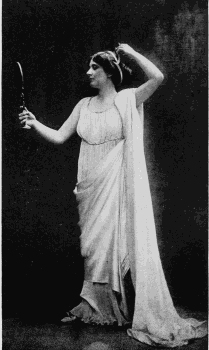
For the most part, at a performance, one does not listen to the music. Nevertheless, Aphrodite calls one again and again. Its success in Paris was simply phenomenal, and the opera is still in the répertoire of the Opéra-Comique. This success was due in a measure to the undoubted "punch" of the story, in a measure to the orgy which M. Carré had contrived to embellish the third act, culminating in the really imaginative dancing of the beautiful Regina Badet and the horrible scene of the crucifixion of the negro slave; but, more than anything else, it was due to the rarely compelling performance of Mary Garden as the courtesan who consented to exchange her body for the privilege of seeing her lover commit theft, sacrilege, and murder. In her bold entrance, flaunting her long lemon scarf, wound round her body like a Nautch girl's säri, which illy concealed her fine movements, she at once gave the picture, not alone of the cocotte of the period but of a whole life, a whole atmosphere, and this she maintained throughout the disclosure of the tableaux. In the prison scene she attained heights of tragic acting which I do not think even she has surpassed elsewhere. The pathos of her farewell to her two little Lesbian friends, and the gesture with which she drained the poison cup, linger in the memory, refusing to give up their places to less potent details.
I first heard Debussy's lyric drama, Pelléas et Mélisande, at the Opéra-Comique, with Miss Garden as the principal interpreter. It is generally considered the greatest achievement of her mimic art. Somehow by those means at the command of a fine artist, she subdued her very definite personality and moulded it into the vague and subtle personage created by Maurice Maeterlinck. Even great artists grasp at straws for assistance, and it is interesting to know that to Miss Garden a wig is the all important thing. "Once I have donned the wig of a character, I am that character," she told me once. "It would be difficult for me to go on the stage in my own hair." Nevertheless, I believe she has occasionally inconsistently done so as Louise.
In Miss Garden's score of Pelléas Debussy has written, "In the future, others may sing Mélisande, but you alone will remain the woman and the artist I had hardly dared hope for." It must be remembered, however, that composers are notoriously fickle; that they prefer having their operas given in any form rather than not at all; that ink is cheap and musicians prolific in sentiments. In how many Manon scores did Massenet write his tender eternal finalities? Perhaps little Maggie Teyte, who imitated Mary Garden's Mélisande as Elsie Janis imitates Sarah Bernhardt, cherishes a dedicated score now. Memory tells me I have seen such a score, but memory is sometimes a false jade.
In her faded mediæval gowns, with her long plaits of golden hair,—in the first scene she wore it loose,—Mary Garden became at once in the spectator's mind the princess of enchanted castles, the cymophanous heroine of a féerie, the dream of a poet's tale. In gesture and in musical speech, in tone-colour, she was faithful to the first wonderful impression of the eye. There has been in our day no more perfect example of characterization offered on the lyric stage than Mary Garden's lovely Mélisande.... Ne me touchez pas! became the cry of a terrified child, a real protestation of innocence. Je ne suis pas heureuse ici, was uttered with a pathos of expression which drove its helplessness into our hearts. The scene at the fountain with Pelléas, in which Mélisande loses her ring, was played with such delicate shading, such poetic imagination, that one could almost crown the interpreter as the creator, and the death scene was permeated with a fragile, simple beauty as compelling as that which Carpaccio put into his picture of Santa Ursula, a picture indeed which Miss Garden's performance brought to mind more than once. If she sought inspiration from the art of the painter for her delineation, it was not to Rossetti and Burne-Jones that she went. Rather did she gather some of the soft bloom from the paintings of Bellini, Carpaccio, Giotto, Cimabue ... especially Botticelli; had not the spirit and the mood of the two frescos from the Villa Lemmi in the Louvre come to life in this gentle representation?
Before she appeared as Mélisande in New York, Miss Garden was a little doubtful of the probable reception of the play here. She was surprised and delighted with the result, for the drama was presented in the late season of 1907-08 at the Manhattan Opera House no less than seven times to very large audiences. The singer talked to me before the event: "It took us four years to establish Pelléas et Mélisande in the répertoire of the Opéra-Comique. At first the public listened with disfavour or indecision, and performances could only be given once in two weeks. As a contrast I might mention the immediate success of Aphrodite, which I sang three or four times a week until fifty representations had been achieved, without appearing in another rôle. Pelléas was a different matter. The mystic beauty of the poet's mood and the revolutionary procedures of the musician were not calculated to touch the great public at once. Indeed, we had to teach our audiences to enjoy it. Americans who, I am told, are fond of Maeterlinck, may appreciate its very manifest beauty at first hearing, but they didn't in Paris. At the early representations, individuals whistled and made cat-calls. One night three young men in the first row of the orchestra whistled through an entire scene. I don't believe those young men will ever forget the way I looked at them.... But after each performance it was the same: the applause drowned out the hisses. The balconies and galleries were the first to catch the spirit of the piece, and gradually it grew in public favour, and became a success, that is, comparatively speaking. Pelléas et Mélisande, like many another work of true beauty, appeals to a special public and, consequently, the number of performances has always been limited, and perhaps always will be. I do not anticipate that it will crowd from popular favour such operas as Werther, La Vie de Bohème and Carmen, each of which is included in practically every week's répertoire at the Opéra-Comique.
MARY GARDEN AS MÉLISANDE from a photograph by Davis and Eickemeyer (1908)
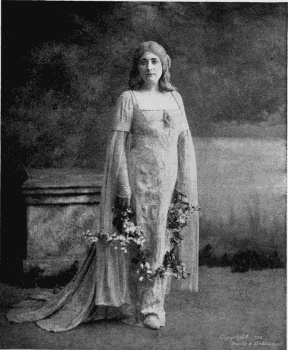
"We interpreters of Debussy's lyric drama were naturally very proud, because we felt that we were assisting in the making of musical history. Maeterlinck, by the way, has never seen the opera. He wished his wife, Georgette Leblanc, to 'create' the rôle of Mélisande, but Debussy and Carré had chosen me, and the poet did not have his way. He wrote an open letter to the newspapers of Paris in which he frankly expressed his hope that the work would fail. Later, when composers approached him in regard to setting his dramas to music, he made it a condition that his wife should sing them. She did appear as Ariane, you will remember, but Lucienne Bréval first sang Monna Vanna, and Maeterlinck's wrath again vented itself in pronunciamentos."
Miss Garden spoke of the settings. "The décor should be dark and sombre. Mrs. Campbell set the play in the Renaissance period, an epoch flooded with light and charm. I think she was wrong. Absolute latitude is permitted the stage director, as Maeterlinck has made no restrictions in the book. The director of the Opéra at Brussels followed Mrs. Campbell's example, and when I appeared in the work there I felt that I was singing a different drama."
One afternoon in the autumn of 1908, when I was Paris correspondent of the "New York Times," I received the following telegram from Miss Garden: "Venez ce soir à 5½ chez Mlle. Chasles 112 Boulevard Malesherbes me voir en Salome." It was late in the day when the message came to me, and I had made other plans, but you may be sure I put them all aside. A petit-bleu or two disposed of my engagements, and I took a fiacre in the blue twilight of the Paris afternoon for the salle de danse of Mlle. Chasles. On my way I recollected how some time previously Miss Garden had informed me of her intention of interpreting the Dance of the Seven Veils herself, and how she had attempted to gain the co-operation of Maraquita, the ballet mistress of the Opéra-Comique, a plan which she was forced to abandon, owing to some rapidly revolving wheels of operatic intrigue. So the new Salome went to Mlle. Chasles, who sixteen years ago was delighting the patrons of the Opéra-Comique with her charming dancing. She it was who, materially assisted by Miss Garden herself, arranged the dance, dramatically significant in gesture and step, which the singer performed at the climax of Richard Strauss's music drama.
Mlle. Chasles's salle de danse I discovered to be a large square room; the floor had a rake like that of the Opéra stage in Paris. There were footlights, and seats in front of them for spectators. The walls were hung with curious old prints and engravings of famous dancers, Mlle. Sallé, La Camargo, Taglioni, Carlotta Grisi, and Cerito.
This final rehearsal—before the rehearsals in New York which preceded her first appearance in the part anywhere at the Manhattan Opera House—was witnessed by André Messager, who intended to mount Salome at the Paris Opéra the following season, Mlle. Chasles, an accompanist, a maid, a hair-dresser, and myself. I noted that Miss Garden's costume differed in a marked degree from those her predecessors had worn. For the entrance of Salome she had provided a mantle of bright orange shimmering stuff, embroidered with startling azure and emerald flowers and sparkling with spangles. Under this she wore a close-fitting garment of netted gold, with designs in rubies and rhinestones, which fell from somewhere above the waistline to her ankles. This garment was also removed for the dance, and Miss Garden emerged in a narrow strip of flesh-coloured tulle. Her arms, shoulders, and legs were bare. She wore a red wig, the hair falling nearly to her waist (later she changed this detail and wore the cropped wig which became identified with her impersonation of the part). Two jewels, an emerald on one little finger, a ruby on the other, completed her decoration. The seven veils were of soft, clinging tulle.
Swathed in these veils, she began the dance at the back of the small stage. Only her eyes were visible. Terrible, slow ... she undulated forward, swaying gracefully, and dropped the first veil. What followed was supposed to be the undoing of the jaded Herod. I was moved by this spectacle at the time, and subsequently this pantomimic dance was generally referred to as the culminating moment in her impersonation of Salome. On this occasion, I remember, she proved to us that the exertion had not fatigued her, by singing the final scene of the music drama, while André Messager played the accompaniment on the piano.
I did not see Mary Garden's impetuous and highly curious interpretation of the strange eastern princess until a full year later, as I remained in Paris during the extent of the New York opera season. The following autumn, however, I heard Salome in its second season at the Manhattan Opera House—and I was disappointed. Nervous curiosity seemed to be the consistent note of this hectic interpretation. The singer was never still; her use of gesture was untiring. To any one who had not seen her in other parts, the actress must have seemed utterly lacking in repose. This was simply her means, however, of suggesting the intense nervous perversity of Salome. Mary Garden could not have seen Nijinsky in Scheherazade at this period, and yet the performances were astonishingly similar in intention. But the Strauss music and the Wilde drama demand a more voluptuous and sensual treatment, it would seem to me, than the suggestion of monkey-love which absolutely suited Nijinsky's part. However, the general opinion (as often happens) ran counter to mine, and, aside from the reservation that Miss Garden's voice was unable to cope with the music, the critics, on the whole, gave her credit for an interesting performance. Indeed, in this music drama she made one of the great popular successes of her career, a career which has been singularly full of appreciated achievements.
Chicago saw Mary Garden in Salome a year later, and Chicago gasped, as New York had gasped when the drama was performed at the Metropolitan Opera House. The police—no less an authority—put a ban on future performances at the Auditorium. Miss Garden was not pleased, and she expressed her displeasure in the frankest terms. I received at that time a series of characteristic telegrams. One of them read: "My art is going through the torture of slow death. Oh Paris, splendeur de mes desirs!"
It was with the (then) Philadelphia-Chicago Opera Company that Miss Garden made her first experiment with opera in English, earning thereby the everlasting gratitude and admiration—which she already possessed in no small measure—of Charles Henry Meltzer. She was not sanguine before the event. In January, 1911, she said to me: "No, malgré Tito Ricordi, NO! I don't believe in opera in English, I never have believed in it, and I don't think I ever shall believe in it. Of course I'm willing to be convinced. You see, in the first place, I think all music dramas should be sung in the languages in which they are written; well, that makes it impossible to sing anything in the current répertoire in English, doesn't it? The only hope for opera in English, so far as I can see it, lies in America or England producing a race of composers, and they haven't it in them. It isn't in the blood. Composition needs Latin blood, or something akin to it; the Anglo-Saxon or the American can't write music, great music, at least not yet.... I doubt if any of us alive to-day will live to hear a great work written to a libretto in our own language.
"Now I am going to sing Victor Herbert's Natoma, in spite of what I have just told you, because I don't want to have it said that I have done anything to hinder what is now generally known as 'the cause.' For the first time a work by a composer who may be regarded as American is to be given a chance with the best singers, with a great orchestra, and a great conductor, in the leading opera house in America—perhaps the leading opera house anywhere. It seems to me that every one who can should put his shoulder to this kind of wheel and set it moving. I shall be better pleased than anybody else if Natoma proves a success and paves the way for the successful production of other American lyric dramas. Of course Natoma cannot be regarded as 'grand opera.' It is not music, like Tristan, for instance. It is more in the style of the lighter operas which are given in Paris, but it possesses much melodic charm and it may please the public. I shall sing it and I shall try to do it just as well as I have tried to do Salome and Thais and Mélisande."
She kept her word, and out of the hodge-podge of an opera book which stands unrivalled for its stiltedness of speech, she succeeded in creating one of her most notable characters. She threw vanity aside in making up for the rôle, painting her face and body a dark brown; she wore two long straight braids of hair, depending on either side from the part in the middle of her forehead. Her garment was of buckskin, and moccasins covered her feet. She crept rather than walked. The story, as might be imagined, was one of love and self-sacrifice, touching here and there on the preserves of L'Africaine and Lakmé, the whole concluding with the voluntary immersion of Natoma in a convent. Fortunately, the writer of the book remembered that Miss Garden had danced in Salome and he introduced a similar pantomimic episode in Natoma, a dagger dance, which was one of the interesting points in the action. The music suited her voice; she delivered a good deal of it almost parlando, and the vapid speeches of Mr. Redding tripped so audibly off her tongue that their banality became painfully apparent.
The story has often been related how Massenet, piqued by the frequently repeated assertion that his muse was only at his command when he depicted female frailty, determined to write an opera in which only one woman was to appear, and she was to be both mute and a virgin! Le Jongleur de Notre Dame, perhaps the most poetically conceived of Massenet's lyric dramas, was the result of this decision. Until Mr. Hammerstein made up his mind to produce the opera, the rôle of Jean had invariably been sung by a man. Mr. Hammerstein thought that Americans would prefer a woman in the part. He easily enlisted the interest of Miss Garden in this scheme, and Massenet, it is said, consented to make certain changes in the score. The taste of the experiment was doubtful, but it was one for which there had been much precedent. Nor is it necessary to linger on Sarah Bernhardt's assumption of the rôles of Hamlet, Shylock, and the Duc de Reichstadt. In the "golden period of song," Orfeo was not the only man's part sung by a woman. Mme. Pasta frequently appeared as Romeo in Zingarelli's opera and as Tancredi, and she also sang Otello on one occasion when Henrietta Sontag was the Desdemona. The rôle of Orfeo, I believe, was written originally for a castrato, and later, when the work was refurbished for production at what was then the Paris Opéra, Gluck allotted the rôle to a tenor. Now it is sung by a woman as invariably as are Stephano in Roméo et Juliette and Siebel in Faust. There is really more excuse for the masquerade of sex in Massenet's opera. The timid, pathetic little juggler, ridiculous in his inefficiency, is a part for which tenors, as they exist to-day, seem manifestly unsuited. And certainly no tenor could hope to make the appeal in the part that Mary Garden did. In the second act she found it difficult to entirely conceal the suggestion of her sex under the monk's robe, but the sad little figure of the first act and the adorable juggler of the last, performing his imbecile tricks before Our Lady's altar, were triumphant details of an artistic impersonation; on the whole, one of Miss Garden's most moving performances.
Miss Garden has sung Faust many times. Are there many sopranos who have not, whatever the general nature of their répertoires? She is very lovely in the rôle of Marguerite. I have indicated elsewhere her skill in endowing the part with poetry and imaginative force without making ducks and drakes of the traditions. In the garden scene she gave an exhibition of her power to paint a fanciful fresco on a wall already surcharged with colour, a charming, wistful picture. I have never seen any one else so effective in the church and prison scenes; no one else, it seems to me, has so tenderly conceived the plight of the simple German girl. The opera of Roméo et Juliette does not admit of such serious dramatic treatment, and Thomas's Hamlet, as a play, is absolutely ridiculous. After the mad scene, for example, the stage directions read that the ballet "waltzes sadly away." I saw Mary Garden play Ophélie once at the Paris Opéra, and I must admit that I was amused; I think she was amused too! I was equally amused some years later when I heard Titta Ruffo sing the opera. I am afraid I cannot take Hamlet as a lyric drama seriously.