Carl Van Vechten (continued 2)
Reading edition
In Paris, Violetta is one of Miss Garden's popular rôles. When she came to America she fancied she might sing the part here. "Did you ever see a thin Violetta?" she asked the reporters. But so far she has not appeared in La Traviata on this side of the Atlantic, although Robert Hichens wrote me that he had recently heard her in this opera at the Paris Opéra-Comique. He added that her impersonation was most interesting.
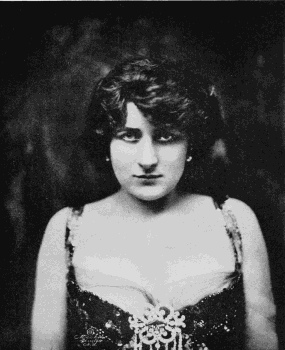
To me one of the most truly fascinating of Miss Garden's characterizations was her Fanny Legrand in Daudet's play, made into an opera by Massenet. Sapho, as a lyric drama, did not have a success in New York. I think only three performances were given at the Manhattan Opera House. The professional writers, with one exception, found nothing to praise in Miss Garden's remarkable impersonation of Fanny. And yet, as I have said, it seemed to me one of the most moving of her interpretations. In the opening scenes she was the trollop, no less, that Fanny was. The pregnant line of the first act: Artiste?.... Non ... Tant mieux. J'ai contre tout artiste une haine implacable! was spoken in a manner which bared the woman's heart to the sophisticated. The scene in which she sang the song of the Magali (the Provençal melody which Mistral immortalized in a poem, which Gounod introduced into Mireille, and which found its way, inexplicably, into the ballet of Berlioz's Les Troyens à Carthage), playing her own accompaniment, to Jean, was really too wonderful a caricature of the harlot. Abel Faivre and Paul Guillaume have done no better. The scene in which Fanny reviles her former associates for telling Jean the truth about her past life was revolting in its realism.
If Miss Garden spared no details in making us acquainted with Fanny's vulgarity, she was equally fair to her in other respects. She seemed to be continually guiding the spectator with comment something like this: "See how this woman can suffer, and she is a woman, like any other woman." How small the means, the effect considered, by which she produced the pathos of the last scene. At the one performance I saw half the people in the audience were in tears. There was a dismaying display of handkerchiefs. Sapho sat in the window, smoking a cigarette, surveying the room in which she had been happy with Jean, and preparing to say good-by. In the earlier scenes her cigarette had aided her in making vulgar gestures. Now she relied on it to tell the pitiful tale of the woman's loneliness. How she clung to that cigarette, how she sipped comfort from it, and how tiny it was! Mary Garden's Sapho, which may never be seen on the stage again (Massenet's music is perhaps his weakest effort), was an extraordinary piece of stage art. That alone would have proclaimed her an interpreter of genius.
MARY GARDEN AS FANNY LEGRAND from a photograph by Mishkin (1909)
George Moore, somewhere, evolves a fantastic theory that a writer's name may have determined his talent: "Dickens—a mean name, a name without atmosphere, a black out-of-elbows, back-stairs name, a name good enough for loud comedy and louder pathos. John Milton—a splendid name for a Puritan poet. Algernon Charles Swinburne—only a name for a reed through which every wind blows music.... Now it is a fact that we find no fine names among novelists. We find only colourless names, dry-as-dust names, or vulgar names, round names like pot-hats, those names like mackintoshes, names that are squashy as goloshes. We have charged Scott with a lack of personal passion, but could personal passion dwell in such a jog-trot name—a round-faced name, a snub-nosed, spectacled, pot-bellied name, a placid, beneficent, worthy old bachelor name, a name that evokes all conventional ideas and formulas, a Grub Street name, a nerveless name, an arm-chair name, an old oak and Abbotsford name? And Thackeray's name is a poor one—the syllables clatter like plates. 'We shall want the carriage at half-past two, Thackeray.' Dickens is surely a name for a page boy. George Eliot's real name, Marian Evans, is a chaw-bacon, thick-loined name." So far as I know Mr. Moore has not expanded his theory to include a discussion of acrobats, revivalists, necromancers, free versifiers, camel drivers, paying tellers, painters, pugilists, architects, and opera singers. Many of the latter have taken no chances with their own names. Both Pauline and Maria Garcia adopted the names of their husbands. Garcia possibly suggests a warrior, but do Malibran and Viardot make us think of music? Nellie Melba's name evokes an image of a cold marble slab but if she had retained her original name of Mitchell it would have been no better ... Marcella Sembrich, a name made famous by the genius and indefatigable labour of its bearer, surely not a good name for an operatic soprano. Her own name, Kochanska, sounds Polish and patriotic ... Luisa Tetrazzini, a silly, fussy name ... Emma Calvé.... Since Madame Bovary the name Emma suggests a solid bourgeois foundation, a country family.... Emma Eames, a chilly name ... a wind from the East! Was it Philip Hale who remarked that she sang Who is Sylvia? as if the woman were not on her calling list?... Lillian Nordica, an evasion. Lillian Norton is a sturdy work-a-day name, suggesting a premonition of a thousand piano rehearsals for Isolde ... Johanna Gadski, a coughing raucous name ... Geraldine Farrar, tomboyish and impertinent, Melrose with a French sauce ... Edyth Walker, a militant suffragette name.... Surely Lucrezia Bori and Maria Barrientos are ill-made names for singers ... Adelina Patti—a patty-cake, patty-cake, baker's man, sort of a name ... Alboni, strong-hearted ... Scalchi ... ugh! Further evidence could be brought forward to prove that singers succeed in spite of their names rather than because of them ... until we reach the name of Mary Garden.... The subtle fragrance of this name has found its way into many hearts. Since Nell Gwyn no such scented cognomen, redolent of cuckoo's boots, London pride, blood-red poppies, purple fox-gloves, lemon stocks, and vermillion zinnias, has blown its delicate odour across our scene.... Delightful and adorable Mary Garden, the fragile Thais, pathetic Jean ... unforgettable Mélisande....
October 10, 1916.
Feodor Chaliapine
"Do I contradict myself?
Very well, then, I contradict myself;"
Walt Whitman.
FEODOR CHALIAPINE, the Russian bass singer, appeared in New York at the Metropolitan Opera House, then under the direction of Heinrich Conried, during the season of 1907-08. He made his American début on Wednesday evening, November 20, 1907, when he impersonated the title part of Boito's opera, Mefistofele. He was heard here altogether seven times in this rôle; six times as Basilio in Il Barbiere di Siviglia; three times as Méphistophélès in Gounod's Faust; three times as Leporello in Don Giovanni; and at several Sunday night concerts. He also appeared with the Metropolitan Opera Company in Philadelphia, and possibly elsewhere.
I first met this remarkable artist in the dining-room of the Hotel Savoy on a rainy Sunday afternoon, soon after his arrival in America. His personality made a profound impression on me, as may be gathered from some lines from an article I wrote which appeared the next morning in the "New York Times": "The newest operatic acquisition to arrive in New York is neither a prima donna soprano, nor an Italian tenor with a high C, but a big, broad-shouldered boy, with a kindly smile and a deep bass voice, ... thirty-four years old.... 'I spik English,' were his first words. 'How do you do? et puis good-by, et puis I drrrink, you drrink, he drrrrinks, et puis I love you!' ... Mr. Chaliapine looked like a great big boy, a sophomore in college, who played football." (Pitts Sanborn soon afterwards felicitously referred to him as ce doux géant, a name often applied to Turgeniev.)
I have given the extent of the Russian's English vocabulary at this time, and I soon discovered that it was not accident which had caused him first to learn to conjugate the verb "to drink"; another English verb he learned very quickly was "to eat." Some time later, after his New York début, I sought him out again to urge him to give a synopsis of his original conception for a performance of Gounod's Faust. The interview which ensued was the longest I have ever had with any one. It began at eleven o'clock in the morning and lasted until a like hour in the evening,—it might have lasted much longer,—and during this whole time we sat at table in Mr. Chaliapine's own chamber at the Brevoort, whither he had repaired to escape steam heat, while he consumed vast quantities of food and drink. I remember a detail of six plates of onion soup. I have never seen any one else eat so much or so continuously, or with so little lethargic effect. Indeed, intemperance seemed only to make him more light-hearted, ebullient, and Brobdingnagian. Late in the afternoon he placed his own record of the Marseillaise in the victrola, and then amused himself (and me) by singing the song in unison with the record, in an attempt to drown out the mechanical sound. He succeeded. The effect in this moderately small hotel room can only be faintly conceived.
Exuberant is the word which best describes Chaliapine off the stage. I remember another occasion a year later when I met him, just returned from South America, on the Boulevard in Paris. He grasped my hand warmly and begged me to come to see his zoo. He had, in fact, transformed the salle de bain in his suite at the Grand Hotel into a menagerie. There were two monkeys, a cockatoo, and many other birds of brilliant plumage, while two large alligators dozed in the tub.
My second interview with this singer took place a day or so before he returned to Europe. He had been roughly handled by the New York critics, treatment, it is said, which met with the approval of Heinrich Conried, who had no desire to retain in his company a bass who demanded sixteen hundred dollars a night, a high salary for a soprano or a tenor. Stung by this defeat—entirely imaginary, by the way, as his audiences here were as large and enthusiastic as they are anywhere—the only one, in fact, which he has suffered in his career up to date, Chaliapine was extremely frank in his attitude. My interview, published on the first page of the "New York Times," created a small sensation in operatic circles. The meat of it follows. Chaliapine is speaking:
"Criticism in New York is not profound. It is the most difficult thing in the world to be a good critical writer. I am a singer, but the critic has no right to regard me merely as a singer. He must observe my acting, my make-up, everything. And he must understand and know about these things.
"Opera is not a fixed art. It is not like music, poetry, sculpture, painting, or architecture, but a combination of all of these. And the critic who goes to the opera should have studied all these arts. While a study of these arts is essential, there is something else that the critic cannot get by study, and that is the soul to understand. That he must be born with.
"I am not a professional critic, but I could be. I have associated with musicians, painters, and writers, and I know something of all these arts. As a consequence when I read a criticism, I see immediately what is true and what is false. Very often I think a man's tongue is his worst enemy. However, sometimes a man keeps quiet to conceal his mental weakness. We have a Russian proverb which says, 'Keep quiet; don't tease the geese.' You can't judge of a man's intelligence until he begins to talk or write.
"I have been sometimes adversely criticized during the course of my artistic life. The most profound of these criticisms have taught me to correct my faults. But I have learned nothing from the criticisms I have received in New York. After searching my inner consciousness, I find they are not based on a true understanding of my artistic purposes. For instance, the critics found my Don Basilio a dirty, repulsive creature. One man even said that I was offensive to another singer on the stage! Don Basilio is a Spanish priest; it is a type I know well. He is not like the modern American priest, clean and well-groomed; he is dirty and unkempt; he is a beast, and that is what I make him, a comic beast, but the critics would prefer a softer version.... It is unfair, indeed, to judge me at all on the parts I have sung here, outside of Mefistofele, for most of my best rôles are in Russian operas, which are not in the répertoire of the Metropolitan Opera House.
"The contemporary direction of this theatre believes in tradition. It is afraid of anything new. There is no movement. It has not the courage to produce novelties, and the artists are prevented from giving original conceptions of old rôles.
"New York is a vast seething inferno of business. Nothing but business! The men are so tired when they get through work that they want recreation and sleep. They don't want to study. They don't want to be thrilled or aroused. They are content to listen forever to Faust and Lucia.
"In Europe it is different. There you will find the desire for novelty in the theatre. There is a keen interest in the production of a new work. It is all right to enjoy the old things, but one should see life. The audience at the Metropolitan Opera House reminds me of a family that lives in the country and won't travel. It is satisfied with the same view of the same garden forever...."
Feodor Ivanovich Chaliapine was born February 13 (February 1, old style), 1873, in Kazan; he is of peasant descent. It is said that he is almost entirely self-educated, both musically and intellectually. He worked for a time in a shoemaker's shop, sang in the archbishop's choir and, at the age of seventeen, joined a local operetta company. He seems to have had difficulty in collecting a salary from this latter organization, and often worked as a railway porter in order to keep alive. Later he joined a travelling theatrical troupe, which visited the Caucasus. In 1892, Oussatov, a singer, heard Chaliapine in Tiflis, gave him some lessons, and got him an engagement.
He made his début in opera in Glinka's A Life for the Czar (according to Mrs. Newmarch; my notes tell me that it was Gounod's Faust). He sang at the Summer and Panaevsky theatres in Petrograd in 1894; and the following year he was engaged at the Maryinsky Theatre, but the directors did not seem to realize that they had captured one of the great figures of the contemporary lyric stage, and he was not permitted to sing very often. In 1896, Mamantov, lawyer and millionaire, paid the fine which released the bass from the Imperial Opera House, and invited him to join the Private Opera Company in Moscow, where Chaliapine immediately proved his worth. He became the idol of the public, and it was not unusual for those who admired striking impersonations on the stage to journey from Petrograd to see and hear him. In 1899 he was engaged to sing at the Imperial Opera in Moscow at sixty thousand roubles a year. Since then he has appeared in various European capitals, and in North and South America. He has sung in Milan, Paris, London, Monte Carlo, and Buenos Aires. During a visit to Milan he married, and at the time of his New York engagement his family included five children. The number may have increased.
Chaliapine's répertoire is extensive but, on the whole, it is a strange répertoire to western Europe and America, consisting, as it does, almost entirely of Russian operas. In Milan, New York, and Monte Carlo, where he has appeared with Italian and French companies, his most famous rôle is Mefistofele. Leporello he sang for the first time in New York. Basilio and Méphistophélès in Faust he has probably enacted as often in Russia as elsewhere. He "created" the title part of Massenet's Don Quichotte at Monte Carlo (Vanni Marcoux sang the rôle later in Paris). With the Russian Opera Company, organized in connection with the Russian Ballet by Serge de Diaghilew, Chaliapine has sung in London, Paris, and other European capitals in Moussorgsky's Boris Godunow and Khovanchina, Rimsky-Korsakow's Ivan the Terrible (originally called The Maid of Pskov), and Borodine's Prince Igor, in which he appeared both as Prince Galitzky and as the Tartar Chieftain. His répertoire further includes Rubinstein's Demon, Rimsky-Korsakow's Mozart and Salieri (the rôle of Salieri), Glinka's A Life for the Czar, Dargomijsky's The Roussalka, Rachmaninow's Aleko, and Gretchaninow's Dobrynia Nikitich. This list is by no means complete.
I first saw Chaliapine on the stage in New York, where his original ideas and tremendously vital personality ran counter to every tradition of the Metropolitan Opera House. The professional writers about the opera, as a whole, would have none of him. Even his magnificently pictorial Mefistofele was condemned, and I think Pitts Sanborn was the only man in a critic's chair—I was a reporter at this period and had no opportunity for expressing my opinions in print—who appreciated his Basilio at its true value, and Il Barbiere is Sanborn's favourite opera. His account of the proceedings makes good reading at this date. I quote from the "New York Globe," December 13, 1907:
"The performance that was in open defiance of traditions, that was glaringly and recklessly unorthodox, that set at naught the accepted canons of good taste, but which justified itself by its overwhelming and all-conquering good humour, was the Basilio of Mr. Chaliapine. With his great natural stature increased by art to Brobdingnagian proportions, a face that had gazed on the vodka at its blackest, and a cassock that may be seen but not described, he presented a figure that might have been imagined by the English Swift or the French Rabelais. It was no voice or singing that made the audience re-demand the 'Calumny Song.' It was the compelling drollery of those comedy hands. You may be assured, persuaded, convinced that you want your Rossini straight or not at all. But when you see the Chaliapine Basilio you'll do as the rest do—roar. It is as sensational in its way as the Chaliapine Mephisto."
It was hard to reconcile Chaliapine's conception of Méphistophélès with the Gounod music, and I do not think the Russian himself had any illusions about his performance of Leporello. It was not his type of part, and he was as good in it, probably, as Olive Fremstad would be as Nedda. Even great artists have their limitations, perhaps more of them than the lesser people. But his Mefistofele, to my way of thinking,—and the anxious reader who has not seen this impersonation may be assured that I am far from being alone in it,—was and is a masterpiece of stage-craft. However, opinions differ. Under the alluring title, "Devils Polite and Rude," W. J. Henderson, in the "New York Sun," Sunday, November 24, 1907, after Chaliapine's first appearance here in Boito's opera, took his fling at the Russian bass (was it Mr. Henderson or another who later referred to Chaliapine as "a cossack with a cold"?): "He makes of the fiend a demoniac personage, a seething cauldron of rabid passions. He is continually snarling and barking. He poses in writhing attitudes of agonized impotence. He strides and gestures, grimaces and roars. All this appears to superficial observers to be tremendously dramatic. And it is, as noted, not without its significance. Perhaps it may be only a personal fancy, yet the present writer much prefers a devil who is a gentleman.... But one thing more remains to be said about the first display of Mr. Chaliapine's powers. How long did he study the art of singing? Surely not many years. Such an uneven and uncertain emission of tone is seldom heard even on the Metropolitan Opera House stage, where there is a wondrous quantity of poorly grounded singing. The splendid song, Son lo Spirito Che Nega, was not sung at all in the strict interpretation of the word. It was delivered, to be sure, but in a rough and barbaric style. Some of the tones disappeared somewhere in the rear spaces of the basso's capacious throat, while others were projected into the auditorium like stones from a catapult. There was much strenuosity and little art in the performance. And it was much the same with the rest of the singing of the rôle."
Chaliapine calls himself "the enemy of tradition." When he was singing at the Opera in Petrograd in 1896 he found that every detail of every characterization was prescribed. He was directed to make his entrances in a certain way; he was ordered to stand in a certain place on the stage. Whenever he attempted an innovation the stage director said, "Don't do that." Young singer though he was, he rebelled and asked, "Why not?" And the reply always came, "You must follow the tradition of the part. Monsieur Chose and Signor Cosi have always done thus and so, and you must do likewise." "But I feel differently about the rôle," protested the bass. However, it was not until he went to Moscow that he was permitted to break with tradition. From that time on he began to elaborate his characterizations, assisted, he admits, by Russian painters who gave him his first ideas about costumes and make-up. He once told me that his interpretation of a part was never twice the same. He does not study his rôles in solitude, poring over a score, as many artists do. Rather, ideas come to him when he eats or drinks, or even when he is on the stage. He depends to an unsafe degree—unsafe for other singers who may be misled by his success—on inspiration to carry him through, once he begins to sing. "When I sing a character I am that character; I am no longer Chaliapine. So whatever I do must be in keeping with what the character would do." This is true to so great an extent that you may take it for granted, when you see Chaliapine in a new rôle, that he will envelop the character with atmosphere from his first entrance, perhaps even without the aid of a single gesture. His entrance on horseback in Ivan the Terrible is a case in point. Before he has sung a note he has projected the personality of the cruel czar into the auditorium.
"As an actor," writes Mrs. Newmarch in "The Russian Opera," "his greatest quality appears to me to be his extraordinary gift of identification with the character he is representing. Shaliapin (so does Mrs. Newmarch phonetically transpose his name into Roman letters) does not merely throw himself into the part, to use a phrase commonly applied to the histrionic art. He seems to disappear, to empty himself of all personality, that Boris Godunov or Ivan the Terrible may be reincarnated for us. While working out his own conception of a part, unmoved by convention or opinion, Shaliapin neglects no accessory study that can heighten the realism of his interpretation. It is impossible to see him as Ivan the Terrible, or Boris, without realizing that he is steeped in the history of those periods, which live again at his will. In the same way he has studied the masterpieces of Russian art to good purpose, as all must agree who have compared the scene of Ivan's frenzied grief over the corpse of Olga, in the last scene of Rimsky-Korsakow's opera, with Repin's terrible picture of the Tsar, clasping in his arms the body of the son whom he has just killed in a fit of insane anger. The agonizing remorse and piteous senile grief have been transformed from Repin's canvas to Shaliapin's living picture, without the revolting suggestion of the shambles which mars the painter's work. Sometimes, too, Shaliapin will take a hint from the living model. His dignified make-up as the Old Believer Dositheus, in Moussorgsky's Khovanstchina, owes not a little to the personality of Vladimir Stassov."
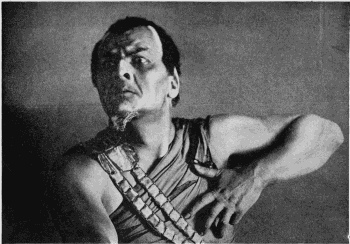
Chaliapine, it seems to me, has realized more completely than any other contemporary singer the opportunities afforded for the presentation of character on the lyric stage. In costume, make-up, gesture, the simulation of emotion, he is a consummate and painstaking artist. As I have suggested, he has limitations. Who, indeed, has not? Grandeur, nobility, impressiveness, and, by inversion, sordidness, bestiality, and awkward ugliness fall easily within his ken. The murder-haunted Boris Godunow is perhaps his most overpowering creation. From first to last it is a masterpiece of scenic art; those who have seen him in this part will not be satisfied with substitutes. His Ivan is almost equally great. His Dositheus, head of the Old Believers in Khovanchina, is a sincere and effective characterization along entirely different lines. Although this character, in a sense, dominates Moussorgsky's great opera, there is little opportunity for the display of histrionism which Boris presents to the singing actor. By almost insignificant details of make-up and gesture the bass creates before your eyes a living, breathing man, a man of fire and faith. No one would recognize in this kind old creature, terrible, to be sure, in his stern piety, the nude Mefistofele surveying the pranks of the motley rabble in the Brocken scene of Boito's opera, a flamboyant exposure of personality to be compared with Mary Garden's Thais, Act I.
As the Tartar chieftain in Prince Igor, he has but few lines to sing, but his gestures during the performance of the ballet, which he has arranged for his guest, in fact his actions throughout the single act in which this character appears, are stamped on the memory as definitely as a figure in a Persian miniature. And the noble scorn with which, as Prince Galitzky, he bows to the stirrup of Prince Igor at the close of the prologue to this opera, still remains a fixed picture in my mind. There is also the pathetic Don Quichotte of Massenet's poorest opera. All great portraits these, to which I must add the funny, dirty, expectorating Spanish priest of Il Barbiere.
FEODOR CHALIAPINE AS MEFISTOFELE
Chaliapine is the possessor of a noble voice which sometimes he uses by main strength. He has never learned to sing, in the conventional meaning of the phrase. He must have been singing for some time before he studied at all, and at Tiflis he does not seem to have spent many months on his voice. In the circumstances it is an extremely tractable organ, at least always capable of doing his bidding, dramatically speaking. Indeed, there are many who consider him a great artist in his manipulation of it. Mrs. Newmarch quotes Herbert Heyner on this point:
"His diction floats on a beautiful cantilena, particularly in his mezzo-voce singing, which—though one would hardly expect it from a singer endowed with such a noble bass voice—is one of the most telling features of his performance. There is never any striving after vocal effects, and his voice is always subservient to the words.... The atmosphere and tone-colour which Shaliapin imparts to his singing are of such remarkable quality that one feels his interpretation of Schubert's Doppelgänger must of necessity be a thing of genius, unapproachable by other contemporary singers ... his method is based upon a thoroughly sound breath control, which produces such splendid cantabile results. Every student should listen to this great singer, and profit by his art."
My intention in placing before the eyes of my readers such contradictory accounts as may be found in this article has not been altogether ingenuous. The fact of the matter is that opinions differ on every matter of art, and on no point are they so various as on that which refers to interpretation. It may further be urged that the personality of Chaliapine is so marked and his method so direct that the variations of opinion are naturally expressed in somewhat violent language.
For those, accustomed to the occidental operatic répertoire, who find it hard to understand how a bass could acquire such prominence, it may be explained that deep voices are both common and very popular in Russia. They may be heard in any Greek church, sustaining organ points a full octave below the notes to which our basses descend with trepidation. As a consequence, many of the Russian operas contain bass rôles of the first importance. In both of Moussorgsky's familiar operas, for example, the leading part is destined for a bass voice.
July 18, 1916.
Mariette Mazarin
SOMETIMES the cause of an intense impression in the theatre apparently disappears, leaving "not a rack behind," beyond the trenchant memory of a few precious moments, inclining one to the belief that the whole adventure has been a dream, a particularly vivid dream, and that the characters therein have returned to such places in space as are assigned to dream personages by the makers of men. This reflection comes to me as, sitting before my typewriter, I attempt to recapture the spirit of the performances of Richard Strauss's music drama Elektra at Oscar Hammerstein's Manhattan Opera House in New York. The work remains, if not in the répertoire of any opera house in my vicinity, at least deeply imbedded in my eardrum and, if need be, at any time I can pore again over the score, which is always near at hand. But of the whereabouts of Mariette Mazarin, the remarkable artist who contributed her genius to the interpretation of the crazed Greek princess, I know nothing. As she came to us unheralded, so she went away, after we who had seen her had enshrined her, tardily to be sure, in that small, slow-growing circle of those who have achieved eminence on the lyric stage.
Before the beginning of the opera season of 1909-10, Marietta Mazarin was not even a name in New York. Even during a good part of that season she was recognized only as an able routine singer. She made her début here in Aida and she sang Carmen and Louise without creating a furore, almost, indeed, without arousing attention of any kind, good or bad criticism. Had there been no production of Elektra she would have passed into that long list of forgotten singers who appear here in leading rôles for a few months or a few years and who, when their time is up, vanish, never to be regretted, extolled, or recalled in the memory again. For the disclosure of Mme. Mazarin's true powers an unusual vehicle was required. Elektra gave her her opportunity, and proved her one of the exceptional artists of the stage.
I do not know many of the facts of Mariette Mazarin's career. She studied at the Paris Conservatoire; Leloir, of the Comédie Française, was her professor of acting. She made her début at the Paris Opéra as Aida; later she sang Louise and Carmen at the Opéra-Comique. After that she seems to have been a leading figure at the Théâtre de la Monnaie in Brussels, where she appeared in Alceste, Armide, Iphigénie en Tauride and Iphigénie en Aulide, even Orphée, the great Gluck répertoire. She has also sung Salome, the three Brünnhildes, Elsa in Lohengrin, Elisabeth in Tannhäuser, in Berlioz's Prise de Troie, La Damnation de Faust, Les Huguenots, Grisélidis, Thais, Il Trovatore, Tosca, Manon Lescaut, Cavalleria Rusticana, Hérodiade, Le Cid, and Salammbô. She has been heard at Nice, and probably on many another provincial French stage. At one time she was the wife of Léon Rothier, the French bass, who has been a member of the Metropolitan Opera Company for several seasons.
Away from the theatre I remember her as a tall woman, rather awkward, but quick in gesture. Her hair was dark, and her eyes were dark and piercing. Her face was all angles; her features were sharp, and when conversing with her one could not but be struck with a certain eerie quality which seemed to give mystic colour to her expression. She was badly dressed, both from an æsthetic and a fashionable point of view. In a group of women you would pick her out to be a doctor, a lawyer, an intellectuelle. When I talked with her, impression followed impression—always I felt her intelligence, the play of her intellect upon the surfaces of her art, but always, too, I felt how narrow a chance had cast her lot upon the stage, how she easily might have been something else than a singing actress, how magnificently accidental her career was!
She was, it would seem, an unusually gifted musician—at least for a singer,—with a physique and a nervous energy which enabled her to perform miracles. For instance, on one occasion she astonished even Oscar Hammerstein by replacing Lina Cavalieri as Salomé in Hérodiade, a rôle she had not previously sung for five years, at an hour's notice on the evening of an afternoon on which she had appeared as Elektra. On another occasion, when Mary Garden was ill she sang Louise with only a short forewarning. She told me that she had learned the music of Elektra between January 1, 1910, and the night of the first performance, January 31. She also told me that without any special effort on her part she had assimilated the music of the other two important feminine rôles in the opera, Chrysothemis and Klytæmnestra, and was quite prepared to sing them. Mme. Mazarin's vocal organ, it must be admitted, was not of a very pleasant quality at all times, although she employed it with variety and usually with taste. There was a good deal of subtle charm in her middle voice, but her upper voice was shrill and sometimes, when emitted forcefully, became in effect a shriek. Faulty intonation often played havoc with her musical interpretation, but do we not read that the great Mme. Pasta seldom sang an opera through without many similar slips from the pitch? Aida, of course, displayed the worst side of her talents. Her Carmen, it seemed to me, was in some ways a very remarkable performance; she appeared, in this rôle, to be possessed by a certain diablerie, a power of evil, which distinguished her from other Carmens, but this characterization created little comment or interest in New York. In Louise, especially in the third act, she betrayed an enmity for the pitch, but in the last act she was magnificent as an actress. In Santuzza she exploited her capacity for unreined intensity of expression. I have never seen her as Salome (in Richard Strauss's opera; her Massenetic Salomé was disclosed to us in New York), but I have a photograph of her in the rôle which might serve as an illustration for the "Méphistophéla" of Catulle Mendès. I can imagine no more sinister and depraved an expression, combined with such potent sexual attraction. It is a remarkable photograph, evoking as it does a succession of lustful ladies, and it is quite unpublishable. If she carried these qualities into her performance of the work, and there is every reason to believe that she did, the evenings on which she sang Salome must have been very terrible for her auditors, hours in which the Aristotle theory of Katharsis must have been amply proven.
Elektra was well advertised in New York. Oscar Hammerstein is as able a showman as the late P. T. Barnum, and he has devoted his talents to higher aims. Without his co-operation, I think it is likely that America would now be a trifle above Australia in its operatic experience. It is from Oscar Hammerstein that New York learned that all the great singers of the world were not singing at the Metropolitan Opera House, a matter which had been considered axiomatic before the redoubtable Oscar introduced us to Alessandro Bonci, Maurice Renaud, Charles Dalmores, Mary Garden, Luisa Tetrazzini, and others. With his productions of Pelléas et Mélisande, Louise, Thais, and other works new to us, he spurred the rival house to an activity which has been maintained ever since to a greater or less degree. New operas are now the order of the day—even with the Chicago and the Boston companies—rather than the exception. And without this impresario's courage and determination I do not think New York would have heard Elektra, at least not before its uncorked essence had quite disappeared. Lover of opera that he indubitably is, Oscar Hammerstein is by nature a showman, and he understands the psychology of the mob. Looking about for a sensation to stir the slow pulse of the New York opera-goer, he saw nothing on the horizon more likely to effect his purpose than Elektra. Salome, spurned by the Metropolitan Opera Company, had been taken to his heart the year before and, with Mary Garden's valuable assistance, he had found the biblical jade extremely efficacious in drawing shekels to his doors. He hoped to accomplish similar results with Elektra....
One of the penalties an inventor of harmonies pays is that his inventions become shopworn. A certain terrible atmosphere, a suggestion of vague dread, of horror, of rank incest, of vile murder, of sordid shame, was conveyed in Elektra by Richard Strauss through the adroit use of what we call discords, for want of a better name. Discord at one time was defined as a combination of sounds that would eternally affront the musical ear. We know better now. Discord is simply the word to describe a never-before or seldom-used chord. Such a juxtaposition of notes naturally startles when it is first heard, but it is a mistake to presume that the effect is unpleasant, even in the beginning.
Now it was by the use of sounds cunningly contrived to displease the ear that Strauss built up his atmosphere of ugliness in Elektra. When it was first performed, the scenes in which the half-mad Greek girl stalked the palace courtyard, and the queen with the blood-stained hands related her dreams, literally reeked with musical frightfulness. I have never seen or heard another music drama which so completely bowled over its first audiences, whether they were street-car conductors or musical pedants. These scenes even inspired a famous passage in "Jean-Christophe" (I quote from the translation of Gilbert Cannon): "Agamemnon was neurasthenic and Achilles impotent; they lamented their condition at length and, naturally, their outcries produced no change. The energy of the drama was concentrated in the rôle of Iphigenia—a nervous, hysterical, and pedantic Iphigenia, who lectured the hero, declaimed furiously, laid bare for the audience her Nietzschian pessimism and, glutted with death, cut her throat, shrieking with laughter."
But will Elektra have the same effect on future audiences? I do not think so. Its terror has, in a measure, been dissipated. Schoenberg, Strawinsky, and Ornstein have employed its discords—and many newer ones—for pleasanter purposes, and our ears are becoming accustomed to these assaults on the casual harmony of our forefathers. Elektra will retain its place as a forerunner, and inevitably it will eventually be considered the most important of Strauss's operatic works, but it can never be listened to again in that same spirit of horror and repentance, with that feeling of utter repugnance, which it found easy to awaken in 1910. Perhaps all of us were a little better for the experience.
An attendant at the opening ceremonies in New York can scarcely forget them. Cast under the spell by the early entrance of Elektra, wild-eyed and menacing, across the terrace of the courtyard of Agamemnon's palace, he must have remained with staring eyes and wide-flung ears, straining for the remainder of the evening to catch the message of this tale of triumphant and utterly holy revenge. The key of von Hofmannsthal's fine play was lost to some reviewers, as it was to Romain Rolland in the passage quoted above, who only saw in the drama a perversion of the Greek idea of Nemesis. That there was something very much finer in the theme, it was left for Bernard Shaw to discover. To him Elektra expressed the regeneration of a race, the destruction of vice, ignorance, and poverty. The play was replete in his mind with sociological and political implications, and, as his views in the matter exactly coincide with my own, I cannot do better than to quote a few lines from them, including, as they do, his interesting prophecies regarding the possibility of war between England and Germany, unfortunately unfulfilled. Strauss could not quite prevent the war with his Elektra. Here is the passage:
"What Hofmannsthal and Strauss have done is to take Klytæmnestra and Ægisthus, and by identifying them with everything evil and cruel, with all that needs must hate the highest when it sees it, with hideous domination and coercion of the higher by the baser, with the murderous rage in which the lust for a lifetime of orgiastic pleasure turns on its slaves in the torture of its disappointment, and the sleepless horror and misery of its neurasthenia, to so rouse in us an overwhelming flood of wrath against it and a ruthless resolution to destroy it that Elektra's vengeance becomes holy to us, and we come to understand how even the gentlest of us could wield the ax of Orestes or twist our firm fingers in the black hair of Klytæmnestra to drag back her head and leave her throat open to the stroke.
"This was a task hardly possible to an ancient Greek, and not easy even for us, who are face to face with the America of the Thaw case and the European plutocracy of which that case was only a trifling symptom, and that is the task that Hofmannsthal and Strauss have achieved. Not even in the third scene of Das Rheingold or in the Klingsor scene in Parsifal is there such an atmosphere of malignant, cancerous evil as we get here and that the power with which it is done is not the power of the evil itself, but of the passion that detests and must and finally can destroy that evil is what makes the work great and makes us rejoice in its horror.
"Whoever understands this, however vaguely, will understand Strauss's music. I have often said, when asked to state the case against the fools and the money changers who are trying to drive us into a war with Germany, that the case consists of the single word 'Beethoven.' To-day I should say with equal confidence 'Strauss.' In this music drama Strauss has done for us with utterly satisfying force what all the noblest powers of life within us are clamouring to have said in protest against and defiance of the omnipresent villainies of our civilization, and this is the highest achievement of the highest art."
Mme. Mazarin was the torch-bearer in New York of this magnificent creation. She is, indeed, the only singer who has ever appeared in the rôle in America, and I have never heard Elektra in Europe. However, those who have seen other interpreters of the rôle assure me that Mme. Mazarin so far outdistanced them as to make comparison impossible. This, in spite of the fact that Elektra in French necessarily lost something of its crude force, and through its mild-mannered conductor at the Manhattan Opera House, who seemed afraid to make a noise, a great deal more. I did not make any notes about this performance at the time, but now, seven years later, it is very vivid to me, an unforgettable impression. Of how many nights in the theatre can I say as much?
Diabolical ecstasy was the keynote of Mme. Mazarin's interpretation, gradually developing into utter frenzy. She afterwards assured me that a visit to a madhouse had given her the inspiration for the gestures and steps of Elektra in the terrible dance in which she celebrates Orestes's bloody but righteous deed. The plane of hysteria upon which this singer carried her heroine by her pure nervous force, indeed reduced many of us in the audience to a similar state. The conventional operatic mode was abandoned; even the grand manner of the theatre was flung aside; with a wide sweep of the imagination, the singer cast the memory of all such baggage from her, and proceeded along vividly direct lines to make her impression.
MARIETTE MAZARIN AS ELEKTRA From a photograph by Mishkin (1910)
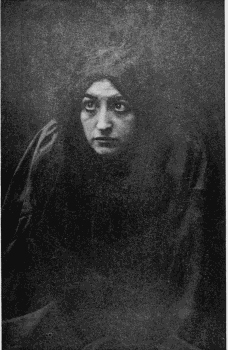
The first glimpse of the half-mad princess, creeping dirty and ragged, to the accompaniment of cracking whips, across the terraced courtyard of the palace, was indeed not calculated to stir tears in the eyes. The picture was vile and repugnant; so perhaps was the appeal to the sister whose only wish was to bear a child, but Mme. Mazarin had her design; her measurements were well taken. In the wild cry to Agamemnon, the dignity and pathos of the character were established, and these qualities were later emphasized in the scene of her meeting with Orestes, beautiful pages in von Hofmannsthal's play and Strauss's score. And in the dance of the poor demented creature at the close the full beauty and power and meaning of the drama were disclosed in a few incisive strokes. Elektra's mind had indeed given way under the strain of her sufferings, brought about by her long waiting for vengeance, but it had given way under the light of holy triumph. Such indeed were the fundamentals of this tremendously moving characterization, a characterization which one must place, perforce, in that great memory gallery where hang the Mélisande of Mary Garden, the Isolde of Olive Fremstad, and the Boris Godunow of Feodor Chaliapine.
It was not alone in her acting that Mme. Mazarin walked on the heights. I know of no other singer with the force or vocal equipment for this difficult rôle. At the time this music drama was produced its intervals were considered in the guise of unrelated notes. It was the cry that the voice parts were written without reference to the orchestral score, and that these wandered up and down without regard for the limitations of a singer. Since Elektra was first performed we have travelled far, and now that we have heard The Nightingale of Strawinsky, for instance, perusal of Strauss's score shows us a perfectly ordered and understandable series of notes. Even now, however, there are few of our singers who could cope with the music of Elektra without devoting a good many months to its study, and more time to the physical exercise needful to equip one with the force necessary to carry through the undertaking. Mme. Mazarin never faltered. She sang the notes with astonishing accuracy; nay, more, with potent vocal colour. Never did the orchestral flood o'er-top her flow of sound. With consummate skill she realized the composer's intentions as completely as she had those of the poet.
Those who were present at the first American performance of this work will long bear the occasion in mind. The outburst of applause which followed the close of the play was almost hysterical in quality, and after a number of recalls Mme. Mazarin fainted before the curtain. Many in the audience remained long enough to receive the reassuring news that she had recovered. As a reporter of musical doings on the "New York Times," I sought information as to her condition at the dressing-room of the artist. Somewhere between the auditorium and the stage, in a passageway, I encountered Mrs. Patrick Campbell, who, a short time before, had appeared at the Garden Theatre in Arthur Symons's translation of von Hofmannsthal's drama. Although we had never met before, in the excitement of the moment we became engaged in conversation, and I volunteered to escort her to Mme. Mazarin's room, where she attempted to express her enthusiasm. Then I asked her if she would like to meet Mr. Hammerstein, and she replied that it was her great desire at this moment to meet the impresario and to thank him for the indelible impression this evening in the theatre had given her. I led her to the corner of the stage where he sat, in his high hat, smoking his cigar, and I presented her to him. "But Mrs. Campbell was introduced to me only three minutes ago," he said. She stammered her acknowledgment of the fact. "It's true," she said. "I have been so completely carried out of myself that I had forgotten!"
August 22, 1916.
Yvette Guilbert
"She sings of life, and mirth and all that moves
Man's fancy in the carnival of loves;
And a chill shiver takes me as she sings
The pity of unpitied human things."
Arthur Symons.
THE natural evolution of Gordon Craig's theory of the stage finally brought him to the point where he would dispense altogether with the play and the actor. The artist-producer would stand alone. Yvette Guilbert has accomplished this very feat, and accomplished it without the aid of super-marionettes. She still uses songs as her medium, but she has very largely discarded the authors and composers of these songs, recreating them with her own charm and wit and personality and brain. A song as Yvette Guilbert sings it exists only for a brief moment. It does not exist on paper, as you will discover if you seek out the printed version, and it certainly does not exist in the performance of any one else. Not that most of her songs are not worthy material, chosen as they are from the store-houses of a nation's treasures, but that her interpretations are so individual, so charged with deep personal feeling, so emended, so added to, so embellished with grunts, shrieks, squeaks, trills, spoken words, extra bars, or even added lines to the text; so performed that their performance itself constitutes a veritable (and, unfortunately, an extremely perishable) work of art. Sometimes, indeed, it has seemed to me that the genius of this remarkable Frenchwoman could express itself directly, without depending upon songs.
She could have given no more complete demonstration of the inimitability of this genius than by her recent determination to lecture on the art of interpreting songs. Never has Yvette been more fascinating, never more authoritative than during those three afternoons at Maxine Elliott's Theatre, devoted ostensibly to the dissection of her method, but before she had unpacked a single instrument it must have been perfectly obvious to every auditor in the hall that she was taking great pains to explain just how impossible it would be for any one to follow in her footsteps, for any one to imitate her astonishing career. With evident candour and a multiplicity of detail she told the story of how she had built up her art. She told how she studied the words of her songs, how she planned them, what a large part the plasticity of her body played in their interpretation, and when she was done all she had said only went to prove that there is but one Yvette Guilbert.
She stripped all pretence from her vocal method, explained how she sang now in her throat, now falsetto. "When I wish to make a certain sound for a certain effect I practise by myself until I succeed in making it. That is my vocal method. I never had a teacher. I would not trust my voice to a teacher!" Her method of learning to breathe was a practical one. She took the refrain of a little French song to work upon. She made herself learn to sing the separate phrases of this song without breathing; then two phrases together, etc., until she could sing the refrain straight through without taking a breath. Ratan Devi has told me that Indian singers, who never study vocalization in the sense that we do, are adepts in the art of breathing. "They breathe naturally and with no difficulty because it never occurs to them to distort a phrase by interrupting it for breath. They have respect for the phrase and sing it through. When you study with an occidental music teacher you will find that he will mark little Vs on the page indicating where the pupil may take breath until he can capture the length of the phrase. This method would be incomprehensible to a Hindu or to any other oriental." The wonderful breath control of Hebrew cantors who sing long and florid phrases without interruption is another case of the same kind.
Mme. Guilbert finds her effects everywhere, in nature, in art, in literature. When she was composing her interpretation of La Soularde she searched in vain for the cry of the thoughtless children as they stone the poor drunken hag, until she discovered it, quite by accident one evening at the Comédie Française, in the shriek of Mounet-Sully in Oedipe-Roi. In studying the Voyage à Bethléem, one of the most popular songs of her répertoire, she felt the need of breaking the monotony of the stanzas. It was her own idea to interpolate the watchman's cry of the hours, and to add the jubilant coda, Il est né, le divin enfant, extracted from another song of the same period. With Guilbert nothing is left to chance. Do you remember one of her most celebrated chansons, Notre Petite Compagne of Jules Laforgue, which she sings so strikingly to a Waldteufel waltz,
Je suis la femme,
On me connaît.
Her interpretation belies the lines. She has contrived to put all the mystery of the sphinx into her rendering of them. How has she done this? By means of the cigarette which she smokes throughout the song. She has confessed as much. Always on the lookout for material which will assist her in perfecting her art she has observed that when a woman smokes a cigarette her expression becomes inscrutable. Her effects are cumulative, built up out of an inexhaustible fund of detail. In those songs in which she professes to do the least she is really doing the most. Have you heard her sing Le Lien Serré and witnessed the impression she produces by sewing, a piece of action not indicated in the text of the song? Have you heard her sing L'Hotel Numero 3, one of the répertoire of the gants noirs and the old days of the Divan Japonais? In this song she does not move her body; she scarcely makes a gesture, and yet her crisp manner of utterance, her subtle emphasis, her angular pose, are all that are needed to expose the humour of the ditty. Much the same comment could be made in regard to her interpretation of Le Jeune Homme Triste. The apache songs, on the contrary, are replete with gesture. Do you remember the splendid apache saluting his head before he goes to the guillotine? Again Yvette has given away her secret: "Naturally I have deep feelings. To be an artist one must feel intensely, but I find that it is sometimes well to give these feelings a spur. In this instance I have sewn weights into the lining of the cap of the apache. When I drop the cap it falls with a thud and I am reminded instinctively of the fall of the knife of the guillotine. This trick always furnishes me with the thrill I need and I can never sing the last lines without tears in my eyes and voice."
It seems ungracious to speak of Yvette Guilbert as a great artist. She is so much less than that and so much more. She has dedicated her autobiography to God and it is certain that she believes her genius to be a holy thing. No one else on the stage to-day has worked so faithfully, or so long, no one else has so completely fulfilled her obligations to her art, and certainly no one else is so nearly human. She compasses the chasm between the artist and the public with ease. She is even able to do this in America, speaking a foreign tongue, for it has only been recently that she has learned to speak English freely and she rarely sings in our language. Her versatility, it seems to me, is limitless; she expresses the whole world in terms of her own personality. She never lacks for a method of expression for the effect she desires to give, and she gives all, heart and brains alike. Now she is raucous, now tender; have you ever seen so sweet a smile; have you ever observed so coarse a mien? She can run the gamut from a sleek priest to a child (as in C'est le Mai), from a jealous husband to a guilty wife (Le Jaloux et la Menteuse), from an apache (Ma Tête) to a charming old lady (Lisette).
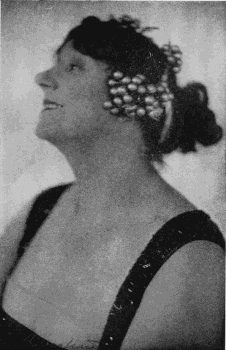
YVETTE GUILBERT from a photograph by Alice Boughton
It is easy to liken the art of this marvellous woman to something concrete, to the drawings of Toulouse-Lautrec or Steinlen, the posters of Chéret ... and there is indeed a suggestion of these men in the work of Yvette Guilbert. The same broad lines are there, the same ample style, the same complete effect, but there is more. In certain phases of her talent, the gamine, the apache, the gavroche, she reflects the spirit of the inspiration which kindled these painters into creation, but in other phases, of which Lisette, Les Cloches de Nantes, La Passion, or Le Cycle du Vin are the expression, you may more readily compare her style with that of Watteau, Eugene Carrière, Félicien Rops, or Boucher.... She takes us by the hand through the centuries, offering us the results of a vast amount of study, a vast amount of erudition, and a vast amount of work. In so many fine strokes she evokes an epoch. She has studied the distinction between a curtsey which precedes the recital of a fable of La Fontaine and a poem of Francis Jammes. She has closely scrutinized pictures in neglected corridors of the Louvre to learn the manner in which a cavalier lifts his hat in various periods. There are those who complain that she emphasizes the dramatic side of the old French songs, which possibly survive more clearly under more naïve treatment. Her justification in this instance is the complete success of her method. The songs serve her purpose, even supposing she does not serve theirs. But a more valid cause for grievance can be urged against her. Unfortunately and ill-advisedly she has occasionally carried something of the scientific into an otherwise delightful matinée, importing a lecturer, like Jean Beck of Bryn Mawr, to analyze and describe the music of the middle ages, or even becoming pedantic and professorial herself; sometimes Yvette preaches or, still worse, permits some one else, dancer, violinist, or singer to usurp her place on the platform. These interruptions are sorry moments indeed but such lapses are forgiven with an almost divine graciousness when Yvette interprets another song. Then the dull or scholarly interpolations are forgotten.
I cannot, indeed, know where to begin to praise her or where to stop. My feelings for her performances (which I have seen and heard whenever I have been able during the past twelve years in Chicago, New York, London, and Paris) are unequivocal. There are moments when I am certain that her rendering of La Passion is her supreme achievement and there are moments when I prefer to see her as the unrestrained purveyor of the art of the chansonniers of Montmartre—unrestrained, I say, and yet it is evident to me that she has refined her interpretations of these songs, revived twenty-five years after she first sang them, bestowed on them a spirit which originally she could not give them. From the beginning Ma Tête, La Soularde, La Glu, La Pierreuse, and the others were drawn as graphically as the pictures of Steinlen, but age has softened her interpretation of them. What formerly was striking has now become beautiful, what was always astonishing has become a masterpiece of artistic expression. Once, indeed, these pictures were sharply etched, but latterly they have been lithographed, drawn softly on stone.... I have said that I do not know in what song, in what mood, I prefer Yvette Guilbert. I can never be certain but if I were asked to choose a programme I think I should include in it C'est le Mai, La Légende de St. Nicolas, Le Roi a Fait Battre Tambour, Les Cloches de Nantes, Le Cycle du Vin, Le Lien Serré, La Glu, Lisette, La Femme, Que l'Amour Cause de Peine, and Oh, how many others!
All art must be beautiful, says Mme. Guilbert, and she has realized the meaning of what might have been merely a phrase; no matter how sordid or trivial her subject she has contrived to make of it something beautiful. She is not, therefore, a realist in any literal signification of the word (although I doubt if any actress on the stage can evoke more sense of character than she) because she always smiles and laughs and weeps with the women she represents; she sympathizes with them, she humanizes them, where another interpreter would coldly present them for an audience to take or to leave, exposing them to cruel inspection. Even in her interpretation of heartless women it is always to our sense of humour that she appeals, while in her rendering of Ma Tête and La Pierreuse she strikes directly at our hearts. Zola once told Mme. Guilbert that the apaches were the logical descendants of the old chevaliers of France. "They are the only men we have now who will fight over a woman!" he said. When you hear Mme. Guilbert call "Pi-ouit!" you will readily perceive that she understands what Zola meant.
Wonderful Yvette, who has embodied so many pleasant images in the theatre, who has expressed to the world so much of the soul of France, so much of the soul of art itself, but, above all, so much of the soul of humanity. It is not alone General Booth who has made friends of "drabs from the alley-ways and drug fiends pale—Minds still passion-ridden, soul-powers frail! Vermin-eaten saints with mouldy breath, unwashed legions with the ways of death": these are all friends of Yvette Guilbert too. And when Balzac wrote the concluding paragraph of "Massimila Doni" he may have foreseen the later application of the lines.... Surely "the peris, nymphs, fairies, sylphs of the olden time, the muses of Greece, the marble Virgins of the Certosa of Pavia, the Day and Night of Michael Angelo, the little angels that Bellini first drew at the foot of church paintings, and to whom Raphael gave such divine form at the foot of the Vierge au donataire, and of the Madonna freezing at Dresden; Orcagna's captivating maidens in the Church of Or San Michele at Florence, the heavenly choirs on the tombs of St. Sebald at Nuremberg, several Virgins in the Duomo at Milan, the hordes of a hundred Gothic cathedrals, the whole nation of figures who break their forms to come to you, O all-embracing artists—" surely, surely, all these hover over Yvette Guilbert.
April 16, 1917.
Waslav Nijinsky
"A thing of beauty is a boy forever."
Allen Norton.
SERGE DE DIAGHILEW brought the dregs of the Russian Ballet to New York and, after a first greedy gulp, inspired by curiosity to get a taste of this highly advertised beverage, the public drank none too greedily. The scenery and the costumes, designed by Bakst, Roerich, Benois, and Larionow, and the music of Rimsky-Korsakow, Tcherepnine, Schumann, Borodine, Balakirew, and Strawinsky—especially Strawinsky—arrived. It was to be deplored, however, that Bakst had seen fit to replace the original décor of Scheherazade by a new setting in rawer colours, in which the flaming orange fairly burned into the ultramarine and green (readers of "A Rebours" will remember that des Esseintes designed a room something like this). A few of the dancers came, but of the best not a single one. Nor was Fokine, the dancer-producer, who devised the choregraphy for The Firebird, Cléopâtre, and Petrouchka, among the number, although his presence had been announced and expected. To those enthusiasts, and they included practically every one who had seen the Ballet in its greater glory, who had prepared their friends for an overwhelmingly brilliant spectacle, over-using the phrase, "a perfect union of the arts," the early performances in January, 1916, at the Century Theatre were a great disappointment. Often had we urged that the individual played but a small part in this new and gorgeous entertainment, but now we were forced to admit that the ultimate glamour was lacking in the ensemble, which was obviously no longer the glad, gay entity it once had been.
The picture was still there, the music (not always too well played) but the interpretation was mediocre. The agile Miassine could scarcely be called either a great dancer or a great mime. He had been chosen by Diaghilew for the rôle of Joseph in Richard Strauss's version of the Potiphar legend but, during the course of a London season carried through without the co-operation of Nijinsky, this was the only part allotted to him. In New York he interpreted, not without humour and with some technical skill, the incidental divertissement from Rimsky-Korsakow's opera, The Snow-Maiden, against a vivid background by Larionow. The uninspired choregraphy of this ballet was also ascribed to Miassine by the programme, although probably in no comminatory spirit. In the small rôle of Eusebius in Carneval and in the negligible part of the Prince in The Firebird he was entirely satisfactory, but it was impertinent of the direction to assume that he would prove an adequate substitute for Nijinsky in rôles to which that dancer had formerly applied his extremely finished art.
Adolf Bolm contributed his portraits of the Moor in Petrouchka, of Pierrot in Carneval, and of the Chief Warrior in the dances from Prince Igor. These three rôles completely express the possibilities of Bolm as a dancer or an actor, and sharply define his limitations. His other parts, Dakon in Daphnis et Chloë—Sadko, the Prince in Thamar, Amoun in Cléopâtre, the Slave in Scheherazade, and Pierrot in Papillons, are only variations on the three afore-mentioned themes. His friends often confuse his vitality and abundant energy with a sense of characterization and a skill as a dancer which he does not possess. For the most part he is content to express himself by stamping his heels and gnashing his teeth, and when, as in Cléopâtre, he attempts to convey a more subtle meaning to his general gesture, he is not very successful. Bolm is an interesting and useful member of the organization, but he could not make or unmake a season; nor could Gavrilow, who is really a fine dancer in his limited way, although he is unfortunately lacking in magnetism and any power of characterization.
But it was on the distaff side of the cast that the Ballet seemed pitifully undistinguished, even to those who did not remember the early Paris seasons when the roster included the names of Anna Pavlowa, Tamara Karsavina, Caterina Gheltzer, and Ida Rubinstein. The leading feminine dancer of the troupe when it gave its first exhibitions in New York was Xenia Maclezova, who had not, so far as my memory serves, danced in any London or Paris season of the Ballet (except for one gala performance at the Paris Opéra which preceded the American tour), unless in some very menial capacity. This dancer, like so many others, had the technique of her art at her toes' ends. Sarah Bernhardt once told a reporter that the acquirement of technique never did any harm to an artist, and if one were not an artist it was not a bad thing to have. I have forgotten how many times Mlle. Maclezova could pirouette without touching the toe in the air to the floor, but it was some prodigious number. She was past-mistress of the entrechat and other mysteries of the ballet academy. Here, however, her knowledge of her art seemed to end, in the subjugation of its very mechanism. She was very nearly lacking in those qualities of grace, poetry, and imagination with which great artists are freely endowed, and although she could not actually have been a woman of more than average weight, she often conveyed to the spectator an impression of heaviness. In such a work as The Firebird she really offended the eye. Far from interpreting the ballet, she gave you an idea of how it should not be done.
Her season with the Russians was terminated in very short order, and Lydia Lopoukova, who happened to be in America, and who, indeed, had already been engaged for certain rôles, was rushed into her vacant slippers. Now Mme. Lopoukova had charm as a dancer, whatever her deficiencies in technique. In certain parts, notably as Colombine in Carneval, she assumed a roguish demeanor which was very fetching. As La Ballerine in Petrouchka, too, she met all the requirements of the action. But in Le Spectre de la Rose, Les Sylphides, The Firebird, and La Princesse Enchantée, she floundered hopelessly out of her element.
Tchernicheva, one of the lesser but more steadfast luminaries of the Ballet, in the rôles for which she was cast, the principal Nymph in L'Après-midi d'un Faune, Echo in Narcisse, and the Princess in The Firebird, more than fulfilled her obligations to the ensemble, but her opportunities in these mimic plays were not of sufficient importance to enable her to carry the brunt of the performances on her lovely shoulders. Flore Revalles was drafted, I understand, from a French opera company. I have been told that she sings—Tosca is one of her rôles—as well as she dances. That may very well be. To impressionable spectators she seemed a real femme fatale. Her Cléopâtre suggested to me a Parisian cocotte much more than an Egyptian queen. It would be blasphemy to compare her with Ida Rubinstein in this rôle—Ida Rubinstein, who was true Aubrey Beardsley! In Thamar and Zobeide, both to a great extent dancing rôles, Mlle. Revalles, both as dancer and actress, was but a frail substitute for Karsavina.
The remainder of the company was adequate, but not large, and the ensemble was by no means as brilliant as those who had seen the Ballet in London or Paris might have expected. Nor in the absence of Fokine, that master of detail, were performances sufficiently rehearsed. There was, of course, explanation in plenty for this disintegration. Gradually, indeed, the Ballet as it had existed in Europe had suffered a change. Only a miracle and a fortune combined would have sufficed to hold the original company intact. It was not held intact, and the war made further inroads on its integrity. Then, for the trip to America many of the dancers probably were inclined to demand double pay. Undoubtedly, Serge de Diaghilew had many more troubles than those which were celebrated in the public prints, and it must be admitted that, even with his weaker company, he gave us finer exhibitions of stage art than had previously been even the exception here.
In the circumstances, however, certain pieces, which were originally produced when the company was in the flush of its first glory, should never have been presented here at all. It was not the part of reason, for example, to pitchfork on the Century stage an indifferent performance of Le Pavilion d'Armide, in which Nijinsky once disported himself as the favourite slave, and which, as a matter of fact, requires a company of virtuosi to make it a passable diversion. Cléopâtre, in its original form with Nijinsky, Fokine, Pavlowa, Ida Rubinstein, and others, hit all who saw it square between the eyes. The absurdly expurgated edition, with its inadequate cast, offered to New York, was but the palest shadow of the sensuous entertainment that had aroused all Paris, from the Batignolles to the Bastille. The music, the setting, the costumes—what else was left to celebrate? The altered choregraphy, the deplorable interpretation, drew tears of rage from at least one pair of eyes. It was quite incomprehensible also why The Firebird, which depends on the grace and poetical imagination of the filmiest and most fairy-like actress-dancer, should have found a place in the répertoire. It is the dancing equivalent of a coloratura soprano rôle in opera. Thankful, however, for the great joy of having re-heard Strawinsky's wonderful score, I am willing to overlook this tactical error.
All things considered, it is small wonder that a large slice of the paying population of New York tired of the Ballet in short order. One reason for this cessation of interest was the constant repetition of ballets. In London and Paris the seasons as a rule have been shorter, and on certain evenings of the week opera has taken the place of the dance. It has been rare indeed that a single work has been repeated more than three or four times during an engagement. I have not found it stupid to listen to and look at perhaps fifteen performances of varying degrees of merit of Petrouchka, Scheherazade, Carneval, and the dances from Prince Igor; I would rather see the Russian Ballet repeatedly, even as it existed in America, than four thousand five hundred and six Broadway plays or seventy-three operas at the Metropolitan once, but I dare say I may look upon myself as an exception.
At any rate, when the company entered upon a four weeks' engagement at the Metropolitan Opera House, included in the regular subscription season of opera, the subscribers groaned; many of them groaned aloud, and wrote letters to the management and to the newspapers. To be sure, during the tour which had followed the engagement at the Century the répertoire had been increased, but the company remained the same—until the coming of Waslav Nijinsky.
When America was first notified of the impending visit of the Russian Ballet it was also promised that Waslav Nijinsky and Tamara Karsavina would head the organization. It was no fault of the American direction or of Serge de Diaghilew that they did not do so. Various excuses were advanced for the failure of Karsavina to forsake her family in Russia and to undertake the journey to the United States but, whatever the cause, there seems to remain no doubt that she refused to come. As for Nijinsky, he, with his wife, had been a prisoner in an Austrian detention camp since the beginning of the war. Wheels were set grinding but wheels grind slowly in an epoch of international bloodshed, and it was not until March, 1916, that the Austrian ambassador at Washington was able to announce that Nijinsky had been set free.
I do not believe the coming to this country of any other celebrated person had been more widely advertised, although P. T. Barnum may have gone further in describing the charitable and vocal qualities of Jenny Lind. Nijinsky had been extravagantly praised, not only by the official press representatives but also by eminent critics and private persons, in adjectives which seemed to preclude any possibility of his living up to them. I myself had been among the pæan singers. I had thrust "half-man, half-god" into print. "A flame!" cried some one. Another, "A jet of water from a fountain!" Such men in the street as had taken the trouble to consider the subject at all very likely expected the arrival of some stupendous and immortal monstrosity, a gravity-defying being with sixteen feet (at least), who bounded like a rubber ball, never touching the solid stage except at the beginning and end of the evening's performance.
Nijinsky arrived in April. Almost immediately he gave vent to one of those expressions of temperament often associated with interpretative genius, the kind of thing I have described at some length in "Music and Bad Manners." He was not at all pleased with the Ballet as he found it. Interviewed, he expressed his displeasure in the newspapers. The managers of the organization wisely remained silent, and a controversy was avoided, but the public had received a suggestion of petulance which could not contribute to the popularity of the new dancer.
Nijinsky danced for the first time in New York on the afternoon of April 12, at the Metropolitan Opera House. The pieces in which he appeared on that day were Le Spectre de la Rose and Petrouchka. Some of us feared that eighteen months in a detention camp would have stamped their mark on the dancer. As a matter of fact his connection with the Russian Ballet had been severed in 1913, a year before the war began. I can say for myself that I was probably a good deal more nervous than Nijinsky on the occasion of his first appearance in America. It would have been a cruel disappointment to me to have discovered that his art had perished during the intervening three years since I had last seen him. My fears were soon dissipated. A few seconds after he as the Rose Ghost had bounded through the window, it was evident that he was in possession of all his powers; nay, more, that he had added to the refinement and polish of his style. I had called Nijinsky's dancing perfection in years gone by, because it so far surpassed that of his nearest rival; now he had surpassed himself. True artists, indeed, have a habit of accomplishing this feat. I may call to your attention the careers of Olive Fremstad, Yvette Guilbert, and Marie Tempest. Later I learned that this first impression might be relied on. Nijinsky, in sooth, has now no rivals upon the stage. One can only compare him with himself!
The Weber-Gautier dance-poem, from the very beginning until the end, when he leaps out of the window of the girl's chamber into the night, affords this great actor-dancer one of his most grateful opportunities. It is in this very part, perhaps, which requires almost unceasing exertion for nearly twelve minutes, that Nijinsky's powers of co-ordination, mental, imaginative, muscular, are best displayed. His dancing is accomplished in that flowing line, without a break between poses and gestures, which is the despair of all novices and almost all other virtuosi. After a particularly difficult leap or toss of the legs or arms, it is a marvel to observe how, without an instant's pause to regain his poise, he rhythmically glides into the succeeding gesture. His dancing has the unbroken quality of music, the balance of great painting, the meaning of fine literature, and the emotion inherent in all these arts. There is something of transmutation in his performances; he becomes an alembic, transforming movement into a finely wrought and beautiful work of art. The dancing of Nijinsky is first an imaginative triumph, and the spectator, perhaps, should not be interested in further dissection of it, but a more intimate observer must realize that behind this the effect produced depends on his supreme command of his muscles. It is not alone the final informing and magnetized imaginative quality that most other dancers lack; it is also just this muscular co-ordination. Observe Gavrilow in the piece under discussion, in which he gives a good imitation of Nijinsky's general style, and you will see that he is unable to maintain this rhythmic continuity.
Nijinsky's achievements become all the more remarkable when one remembers that he is working with an imperfect physical medium. Away from the scene he is an insignificant figure, short and ineffective in appearance. Aside from the pert expression of his eyes, he is like a dozen other young Russians. Put him unintroduced into a drawing-room with Jacques Copeau, Orchidée, Doris Keane, Bill Haywood, Edna Kenton, the Baroness de Meyer, Paulet Thevenaz, the Marchesa Casati, Marcel Duchamp, Cathleen Nesbitt, H. G. Wells, Anna Pavlowa, Rudyard Chennevière, Vladimir Rebikow, Henrie Waste, and Isadora Duncan, and he probably would pass entirely unnoticed. On the stage it may be observed that the muscles of his legs are overdeveloped and his ankles are too large; that is, if you are in the mood for picking flaws, which most of us are not in the presence of Nijinsky in action. Here, however, stricture halts confounded; his head is set on his shoulders in a manner to give satisfaction to a great sculptor, and his torso, with its slender waist line, is quite beautiful. On the stage, Nijinsky makes of himself what he will. He can look tall or short, magnificent or ugly, fascinating or repulsive. Like so many interpretative artists, he remoulds himself for his public appearances. It is under the electric light in front of the painted canvas that he becomes a personality, and that personality is governed only by the scenario of the ballet he is representing.
From the day of Nijinsky's arrival, the ensemble of the Ballet improved; somewhat of the spontaneity of the European performances was regained; a good deal of the glamour was recaptured; the loose lines were gathered taut, and the choregraphy of Fokine (Nijinsky is a director as well as a dancer) was restored to some of its former power. He has appeared in nine rôles in New York during the two short seasons in which he has been seen with the Russian Ballet here: the Slave in Scheherazade, Petrouchka, the Rose Ghost, the Faun, the Harlequin in Carneval, Narcisse, Till Eulenspiegel, and the principal male rôles of La Princesse Enchantée and Les Sylphides. To enjoy the art of Nijinsky completely, to fully appreciate his genius, it is necessary not only to see him in a variety of parts, but also to see him in the same rôle many times.
Study the detail of his performance in Scheherazade, for example. Its precision alone is noteworthy. Indeed, precision is a quality we see exposed so seldom in the theatre that when we find it we are almost inclined to hail it as genius. The rôle of the Slave in this ballet is perhaps Nijinsky's scenic masterpiece—exotic eroticism expressed in so high a key that its very existence seems incredible on our puritanic stage, and yet with such great art (the artist always expresses himself with beauty) that the intention is softened by the execution. Before the arrival of this dancer, Scheherazade had become a police court scandal. There had been talk of a "Jim Crow" performance in which the blacks were to be separated from the whites in the harem, and I am told that our provincial police magistrates even wanted to replace the "mattresses"—so were the divans of the sultanas described in court—by rocking chairs! But to the considerably more vivid Scheherazade of Nijinsky no exception was taken. This strange, curious, head-wagging, simian creature, scarce human, wriggled through the play, leaving a long streak of lust and terror in his wake. Never did Nijinsky as the Negro Slave touch the Sultana, but his subtle and sensuous fingers fluttered close to her flesh, clinging once or twice questioningly to a depending tassel. Pierced by the javelins of the Sultan's men, the Slave's death struggle might have been revolting and gruesome. Instead, Nijinsky carried the eye rapidly upward with his tapering feet as they balanced for the briefest part of a second straight high in the air, only to fall inert with so brilliantly quick a movement that the æsthetic effect grappled successfully with the feeling of disgust which might have been aroused. This was acting, this was characterization, so completely merged in rhythm that the result became a perfect whole, and not a combination of several intentions, as so often results from the work of an actor-dancer.
The heart-breaking Petrouchka, the roguish Harlequin, the Chopiniac of Les Sylphides,—all were offered to our view; and Narcisse, in which Nijinsky not only did some very beautiful dancing, but posed (as the Greek youth admired himself in the mirror of the pool) with such utter and arresting grace that even here he awakened a definite thrill. In La Princesse Enchantée he merely danced, but how he danced! Do you who saw him still remember those flickering fingers and toes? "He winketh with his eyes, he speaketh with his feet, he teacheth with his fingers," is written in the Book of Proverbs, and the writer might have had in mind Nijinsky in La Princesse Enchantée. All these parts were differentiated, all completely realized, in the threefold intricacy of this baffling art, which perhaps is not an art at all until it is so realized, when its plastic, rhythmic, and histrionic elements become an entity.
After a summer in Spain and Switzerland, without Nijinsky, the Russian Ballet returned to America for a second season, opening at the Manhattan Opera House October 16, 1916. It is always a delight to hear and see performances in this theatre, and it was found that the brilliance of the Ballet was much enhanced by its new frame. The season, however, opened with a disappointment. It had been announced that Nijinsky would dance on the first night his choregraphic version of Richard Strauss's tone-poem, Till Eulenspiegel. It is not the first time that a press agent has made a false prophecy. While rehearsing the new work, Nijinsky twisted his ankle, and during the first week of the engagement he did not appear at all. This was doubly unfortunate, because the company was weaker than it had been the previous season, lacking both Miassine and Tchernicheva. The only novelty (for America) produced during the first week was an arrangement of the divertissement from Rimsky-Korsakow's opera, Sadko, which had already been given a few times in Paris and London by the Ballet, never with conspicuous success. The second week of the season, Nijinsky returned to appear in three rôles, the Faun, Till Eulenspiegel, and the Slave in Scheherazade. Of his performance to Debussy's lovely music I have written elsewhere; nor did this new vision cause me to revise my opinions.
Till Eulenspiegel is the only new ballet the Russians have produced in America. (Soleil de Nuit was prepared in Europe, and performed once at the Paris Opéra before it was seen in New York. Besides, it was an arrangement of dances from an opera which is frequently given in Russia and which has been presented at the Opéra-Comique in Paris.) The chef d'orchestre, Pierre Monteux, refused to direct performances of this work, on the ground that the composer was not only a German, but a very much alive and active German patriot. On the occasions, therefore, that Till was performed in New York, the orchestra struggled along under the baton of Dr. Anselm Goetzl. In selecting this work and in his arrangement of the action Nijinsky was moved, no doubt, by consideration for the limitations of the company as it existed,—from which he was able to secure the effects he desired. The scenery and costumes by Robert E. Jones, of New York, were decidedly diverting—the best work this talented young man has done, I think. Over a deep, spreading background of ultramarine, the crazy turrets of mediæval castles leaned dizzily to and fro. The costumes were exaggerations of the exaggerated fashions of the Middle Ages. Mr. Jones added feet of stature to the already elongated peaked headdresses of the period. The trains of the velvet robes, which might have extended three yards, were allowed to trail the full depth of the Manhattan Opera House stage. The colours were oranges, reds, greens, and blues, those indeed of Bakst's Scheherazade, but so differently disposed that they made an entirely dissimilar impression. The effect reminded one spectator of a Spanish omelet.
WASLAV NIJINSKY IN DEBUSSY'S JEUX (1913)
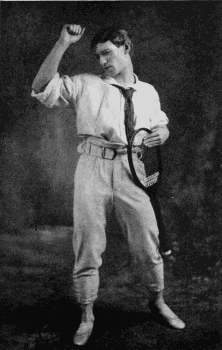
In arranging the scenario, Nijinsky followed in almost every detail Wilhelm Klatte's description of the meaning of the music, which is printed in programme books whenever the tone-poem is performed, without Strauss's authority, but sometimes with his sanction. Nijinsky was quite justified in altering the end of the work, which hangs the rogue-hero, into another practical joke. His version of this episode fits the music and, in the original Till Eulenspiegel stories, Till is not hanged, but dies in bed. The keynote of Nijinsky's interpretation was gaiety. He was as utterly picaresque as the work itself; he reincarnated the spirit of Gil Blas; indeed, a new quality crept into stage expression through this characterization. Margaret Wycherly, one of the most active admirers of the dancer, told me after the first performance that she felt that he had for the first time leaped into the hearts of the great American public, whose appreciation of his subtler art as expressed in Narcisse, Petrouchka, and even Scheherazade, had been more moderate. There were those who protested that this was not the Till of the German legends, but any actor who attempts to give form to a folk or historical character, or even a character derived from fiction, is forced to run counter to many an observer's preconceived ideas.
"It is an error to believe that pantomime is merely a way of doing without words," writes Arthur Symons," that it is merely the equivalent of words. Pantomime is thinking overheard. It begins and ends before words have formed themselves, in a deeper consciousness than that of speech. And it addresses itself, by the artful limitations of its craft, to universal human experience, knowing that the moment it departs from those broad lines it will become unintelligible. It risks existence on its own perfection, as the rope-dancer does, to whom a false step means a down-fall. And it appeals democratically to people of all nations.... And pantomime has that mystery which is one of the requirements of true art. To watch it is like dreaming. How silently, in dreams, one gathers the unheard sounds of words from the lips that do but make pretence of saying them! And does not every one know that terrifying impossibility of speaking which fastens one to the ground for the eternity of a second, in what is the new, perhaps truer, computation of time in dreams? Something like that sense of suspense seems to hang over the silent actors in pantomime, giving them a nervous exaltation, which has its subtle, immediate effect upon us, in tragic and comic situation. The silence becomes an atmosphere, and with a very curious power of giving distinction to form and motion. I do not see why people should ever break silence on the stage except to speak poetry. Here, in pantomime, you have a gracious, expressive silence, beauty of gesture, a perfectly discreet appeal to the emotions, a transposition of the world into an elegant accepted convention."
Arthur Symons wrote these words before he had seen the Russian Ballet, before the Russian Ballet, as we know it, existed, indeed, before Nijinsky had begun to dance in public, and he felt that the addition of poetry and music to pantomime—the Wagner music-drama in other words—brought about a perfect combination of the arts. Nevertheless, there is an obvious application of his remarks to the present instance. There is, indeed, the quality of a dream about the characters Nijinsky presents to us. I remember once, at a performance of the Russian Ballet, I sat in a box next to a most intelligent man, a writer himself; I was meeting him for the first time, and he was seeing the Ballet for the first time. Before the curtain rose he had told me that dancing and pantomime were very pretty to look at, but that he found no stimulation in watching them, no mental and spiritual exaltation, such as might follow a performance of Hamlet. Having seen Nijinsky, I could not agree with him—and this indifferent observer became that evening himself a fervent disciple of the Ballet. For Nijinsky gave him, he found, just what his ideal performance of Shakespeare's play might have given him, a basis for dreams, for thinking, for poetry. The ennobling effect of all great and perfect art, after the primary emotion, seems to be to set our minds wandering in a thousand channels, to suggest new outlets. Pater's experience before the Monna Lisa is only unique in its intense and direct expression.
No writer, no musician, no painter, can feel deep emotion before a work of art without expressing it in some way, although the expression may be a thousand leagues removed from the inspiration. And how few of us can view the art of Nijinsky without emotion! To the painter he gives a new sense of proportion, to the musician a new sense of rhythm, while to the writer he must perforce immediately suggest new words; better still, new meanings for old words. Dance, pantomime, acting, harmony, all these divest themselves of their worn-out accoutrements and appear, as if clothed by magic, in garments of unheard-of novelty; hue, texture, cut, and workmanship are all a surprise to us. We look enraptured, we go away enthralled, and perhaps even unconsciously a new quality creeps into our own work. It is the same glamour cast over us by contemplation of the Campo Santo at Pisa, or the Roman Theatre at Orange, or the Cathedral at Chartres,—the inspiration for one of the most word-jewelled books in any language—or the New York sky line at twilight as one sails away into the harbour, or a great iron crane which lifts tons of alien matter in its gaping jaw. Great music can give us this feeling, the symphonies of Beethoven, Mozart's Don Giovanni, Schubert's C Major Symphony, or César Franck's D Minor, The Sacrifice to the Spring of Strawinsky, L'Après-midi d'un Faune of Debussy, Chabrier's Rhapsody, España; great interpretative musicians can give it to us, Ysaye at his best, Paderewski, Marcella Sembrich in song recital; but how few artists on the stage suggest even as much as the often paltry lines of the author, the often banal music of the composer! There is an au delà to all great interpretative art, something that remains after story, words, picture, and gesture have faded vaguely into that storeroom in our memories where are concealed these lovely ghosts of ephemeral beauty, and the artist who is able to give us this is blessed even beyond his knowledge, for to him has been vouchsafed the sacred kiss of the gods. This quality cannot be acquired, it cannot even be described, but it can be felt. With its beneficent aid the interpreter not only contributes to our pleasure, he broadens our horizon, adds to our knowledge and capacity for feeling.
As I read over these notes I realize that I have not been able to discover flaws in the art of this young man. It seems to me that in his chosen medium he approaches perfection. What he attempts to do, he always does perfectly. Can one say as much for any other interpreter? But it is a difficult matter to give the spirit of Nijinsky, to describe his art on paper, to capture the abundant grace, the measureless poetry, the infinite illusion of his captivating motion in ink. Who can hope to do it? Future generations must take our word for his greatness. We can do little more than call it that. I shall have served my purpose if I have succeeded in this humble article in bringing back to those who have seen him a flashing glimpse of the imaginative actuality.
January 16, 1917.
Epilogue
as a substitute for a preface to the new edition.