FRENCH CARTOONS
Reading edition
XXIX.
Poulbot is the interpreter of French childhood, and in that capacity his pencil, before August 1914, had given infinite pleasure. But pleasure ceased to be a very important pre-occupation in August, 1914, and even Poulbot's sympathetic pencil lent itself to horror as easily as to mirth.
This drawing appeared in l'Anti-Boche, of Paris.
"Don't be frightened, kill her—I've got hold of her," runs the legend.
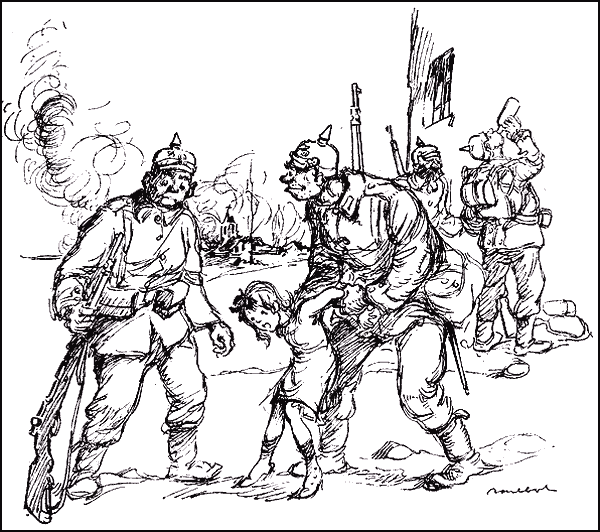
—N'aie pas peur, tue-la, j'la tiens.
XXIX.
XXX.
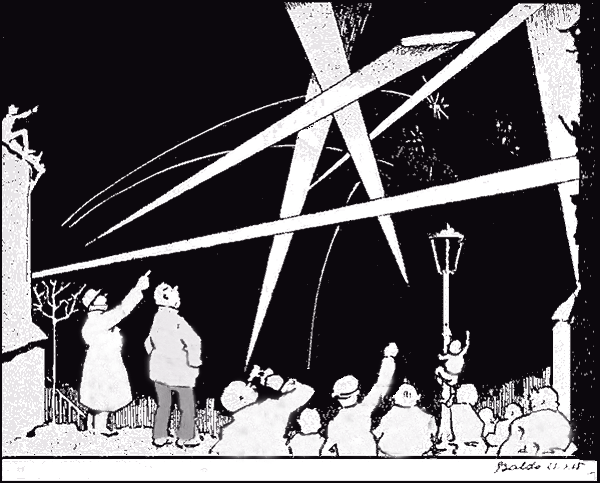
When the Zeppelins first came to Paris, public interest was immense, and children were wakened that they might not miss the sight. This drawing by Baldo from l'Anti-Boche, is not at all exaggerated.
"It looks like a sausage!"
"Oh, no!" cries the child, "if it had been a sausage the Boches would have eaten it long ago."
XXX.
XXXI.
THE GERMAN ATROCITIES.
This was one of the earliest coloured prints published in Paris during the war, and formed part of a cheap series, issued at a few sous each, and printed in colours the most brilliant and most naïve. The little boy of seven who was shot for levelling his wooden gun in play at the German invaders was a very favourite theme with all French artists, from Véber downwards. The incident is alleged to have taken place in the village of Magny, Alsace.
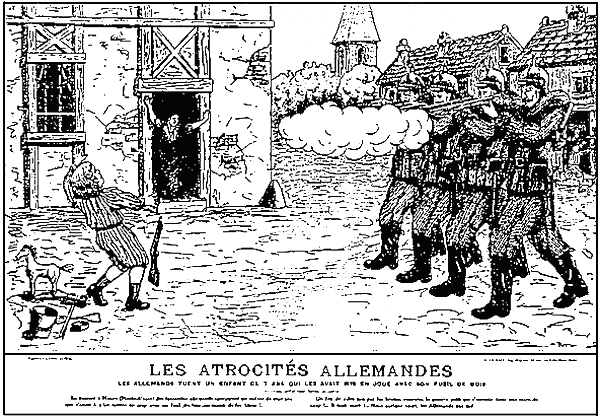
LES ATROCITÉS ALLEMANDES LES ALLEMANDS TUENT UN ENFANT DE 7 ANS QUI LES AVAIT MIS EN JOUE AVEC SON FUSIL DE BOIS
En passant à Magny (Haute-Alsace) des fantassins allemands aperçorvent un enfant de sept ans qui s'amusait à les mettre en joue avec un fusil de bois, au canon de fer blanc!... Un feu de salve tiré par les brutes renversa le pauvre petit qui s'escroula dans une mare de sang!... Il était mort!... Nous autions souri, les Allemands ont tué.
XXXI.
XXXII.
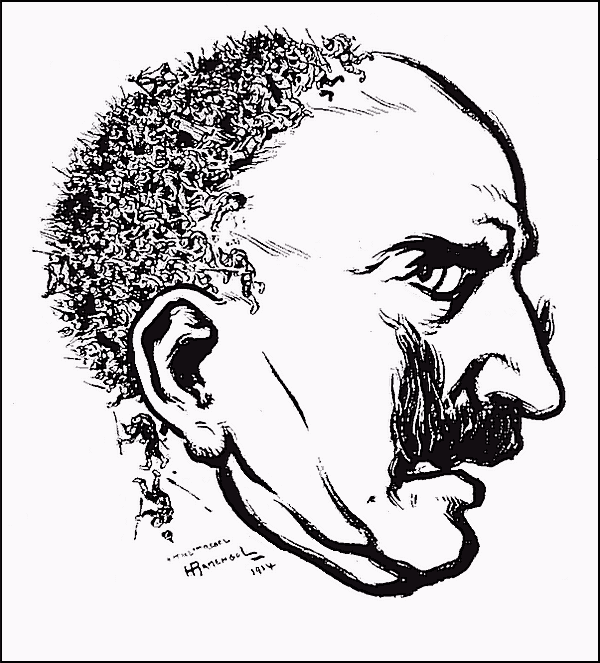
A drawing by Armengol, from Le Rire Rouge, Paris. "Retreat from the Front" (Le Front se Degarnit).
XXXII.
XXXIII.
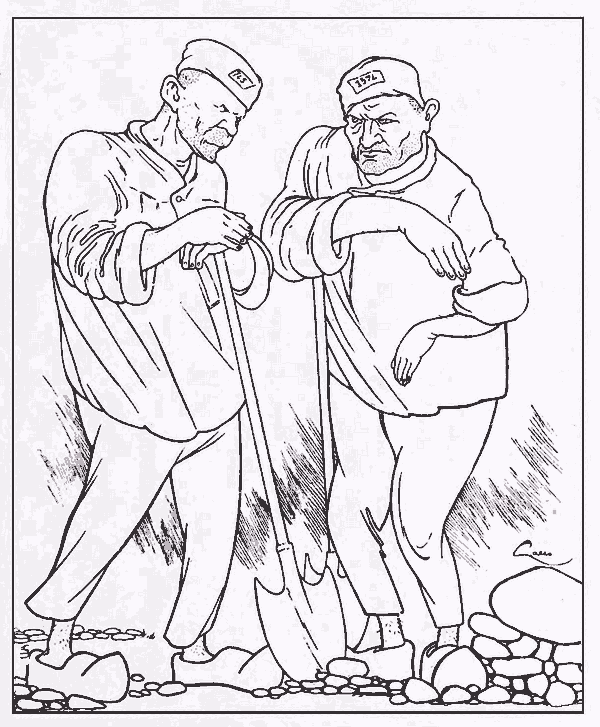
IN THE BAGNIO.
By Gallo.
"What did you do?"
"I killed my mother. And you?"
"I was Emperor of Germany."
(Reproduction of a drawing in A la Baïonnette, Paris.)
XXXIII.
XXXIV.
THE CONSULTATION ON THE KAISER.
Dr. George: It is astonishing how effective are the "75" pills of Dr. Poincaré.
Dr. Albert: Yes, I agree with you; the treatment should be continued.
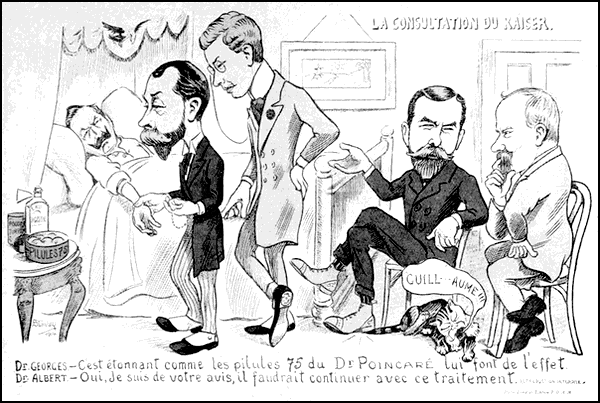
Dr. GEORGE—C'est etonnant comme les pilules 75 du Dr. Poincaré lui font de l'effect. Dr. ALBERT—Oui, je suis de votre avis, il faudrait continuer avec ce traitment.
XXXIV.
XXXV.
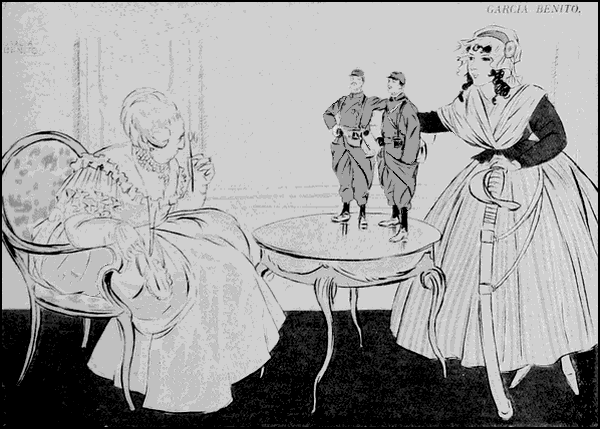
"THE SACRED UNION."
By Garcia Benito.
The Marchioness: "Dear me—in uniform one can't tell mine from yours!"
XXXV.
XXXVI.
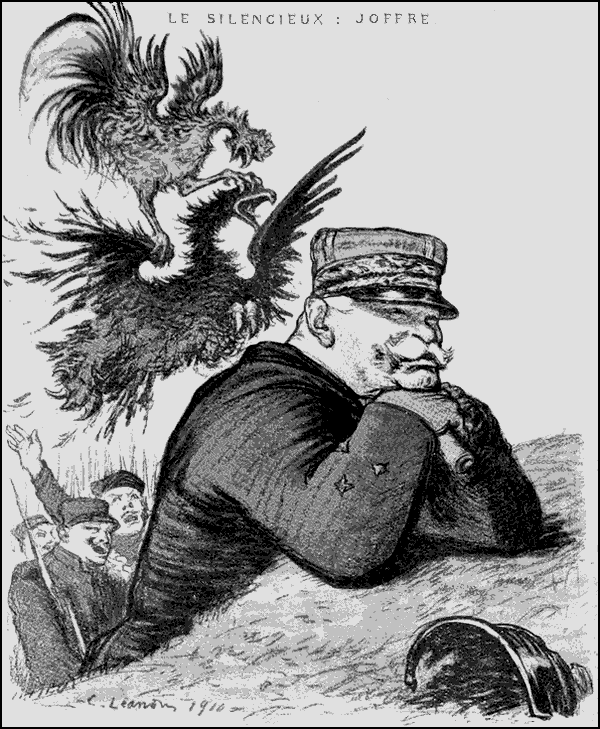
"THE SILENT ONE"—JOFFRE.
By Leandre, the allegorical cartoonist, in Le Rire Rouge, Paris.
The reputation for silence enjoyed by General Joffre is better-founded than is always the case with the reputed characteristics of great men. In the course of being shaved at a Paris barber's recently, an English client was told that General Joffre had for fifteen years been a regular customer at the shop. "And what sort of person is he really?" "I don't know, sir—he never said anything!"
XXXVI.
XXXVII.
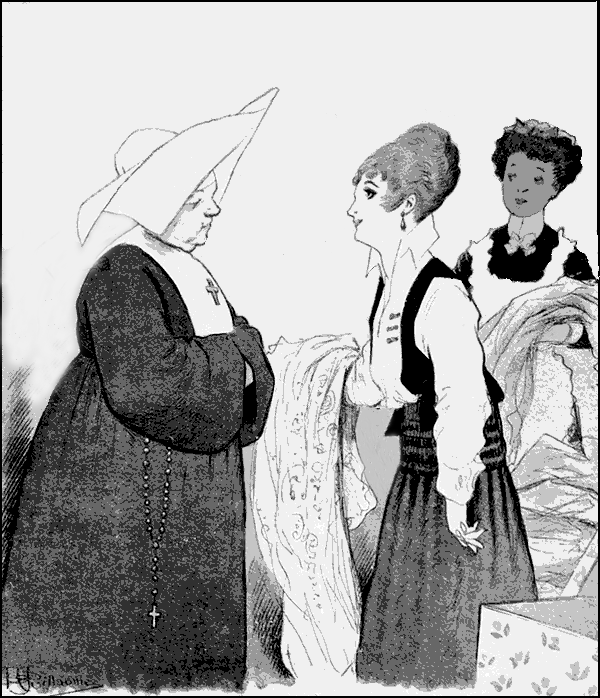
French satire has not devoted itself entirely to our enemies, but has been frequently turned on France. There are comedy and irony, perhaps even pathos, in Albert Guillaume's cartoon in Le Rire Rouge of the fair and probably frail lady who replies to the Sister of Mercy's request for clothes for the refugees: "Certainly, Sister. Françoise, bring me my pink dress with silver sequins. Do you mind it's being slit up at one side, Sister? It does rather date it."
XXXVII.
XXXVIII.
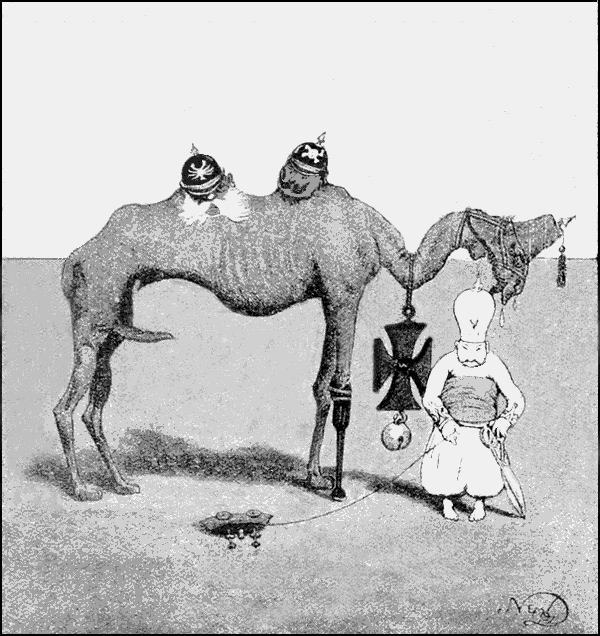
THE SICK MAN'S BURDEN.
The Two-Hunned Camel [Le Chameau à Deux Boches].
From Le Rire Rouge.
XXXVIII.
XXXIX.
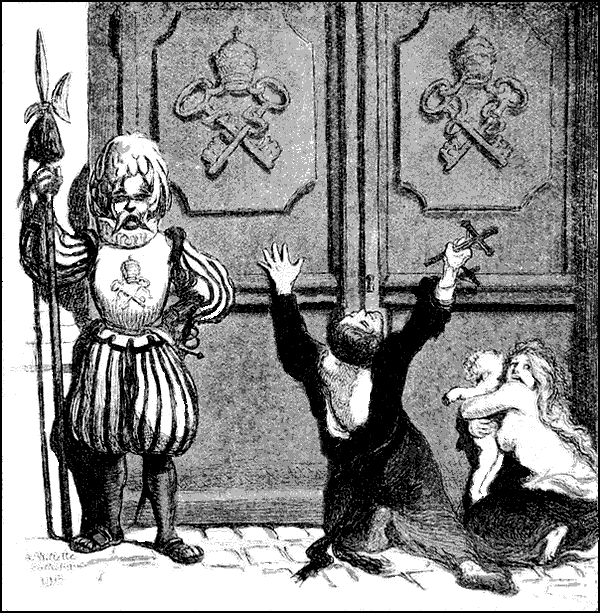
AT THE GATES OF THE VATICAN.
"Open! Open! It is unhappy Belgium!"
The Pope's neutrality was not popular in France, even before he refused to pronounce an opinion on the violation of Belgium, as "that had happened in his predecessor's time." Many people consider that by this attitude the Vatican lost a priceless opportunity of re-capturing France. It is significant that this moving cartoon, from Le Rire Rouge, is signed: "A. Willette, Catholique."
XXXIX.
XL.
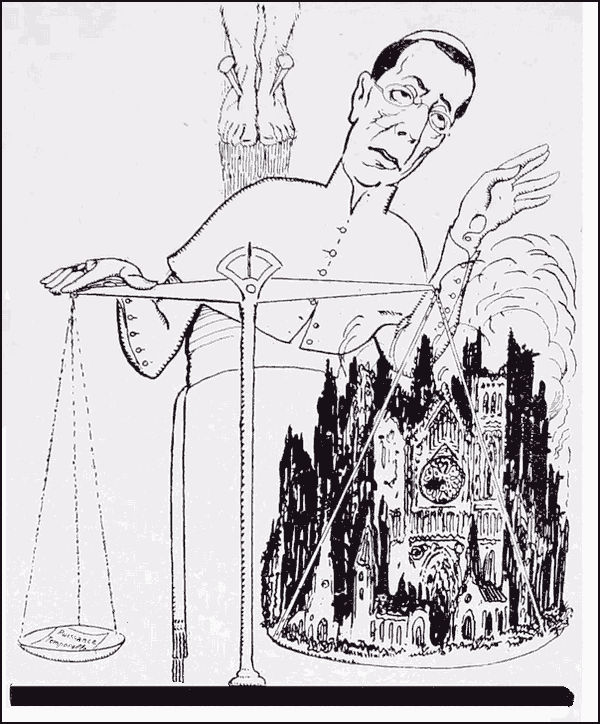
"The Pope says...."
By Grandjouan (Le Rire Rouge).
XL.
XLI.
GOTT MIT UNS.
"What would they have left Him if He had not been with them?"
Le Rire Rouge.
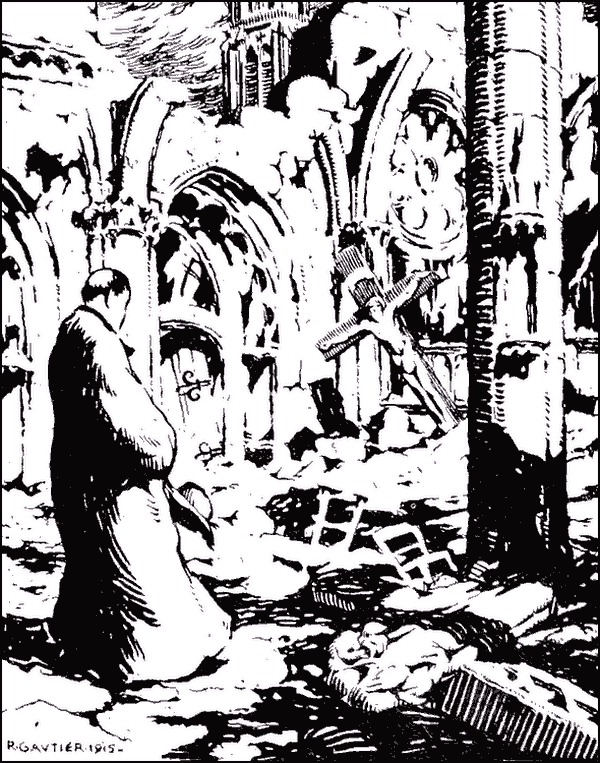
XLII. & XLIII.
Steinlen was once known best for his black cats—thin, rather wicked cats, prowling and hungry, and with inscrutable thoughts of their own. His fame grew, his scope widened and deepened, but never had he probed so deep nor risen so high as he has done since the war took him from his observation of social traits and concentrated him on the nobler aspects of mankind—and especially womankind. These two drawings are from a series which they worthily represent: "National Aid" and "Glory."
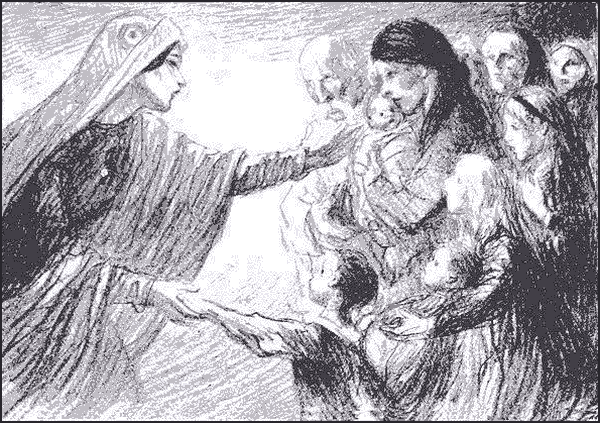
XLII.
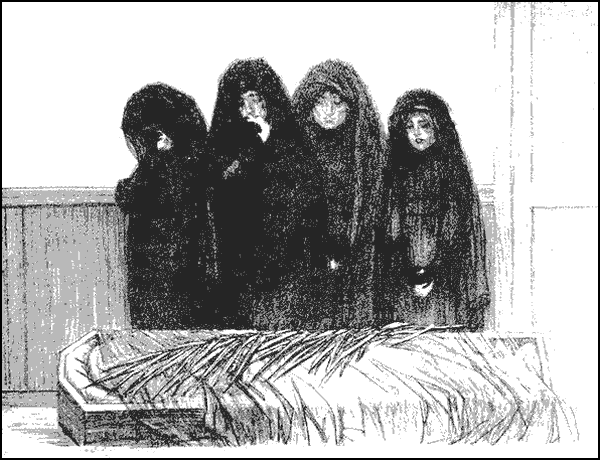
XLIII.
XLIV.
KAISER BONNOT, by H. A. Ibels.
The war has not obliterated so completely the life that went before it, that we have forgotten the Motor Bandits, headed by Bonnot, who terrorised Paris by their audacity for many weeks. Had this drawing not been a likeness of the Kaiser it would still have been a wonderful delineation of the apache, his reckless soul showing through every inch of his stealthy body.
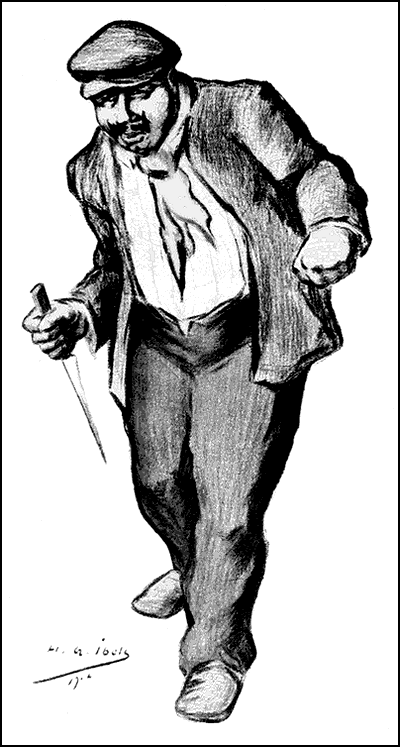
Kaiser - Bonnot
XLIV.
XLV.
DAVID AND GOLIATH, by Paul Iribe.
This drawing formed the cover of the first number of Le Mot, a short-lived but most interesting penny paper published in Paris during the war.
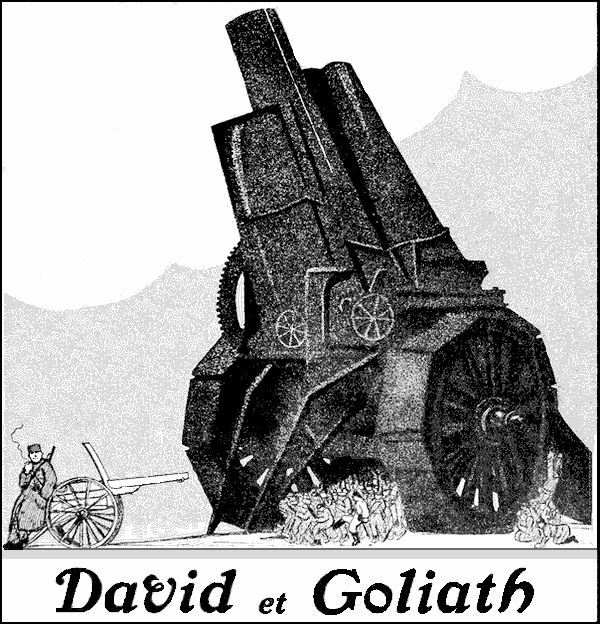
David et Goliath
XLV.
XLVI.
THE FAILURE, by Sem.
"After the Battle of the Marne, more than 50,000 German corpses were counted"—(The Papers).
Le Mot.
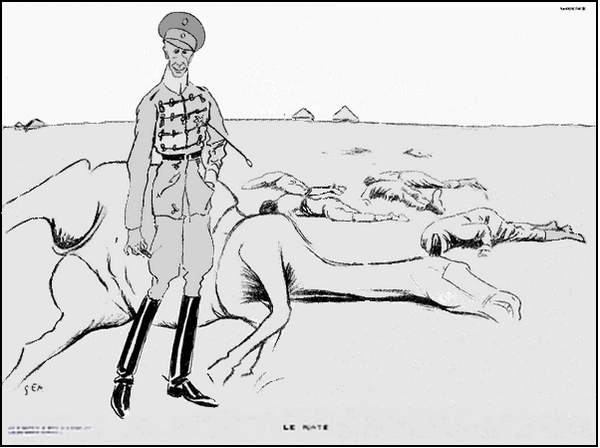
LE RATÉ.
après la bataille de la Marne on a compté plus de
80.000 cadavres allemands...
(LES JOURNAUX).
XLVI.
(A Franco-Russian Drawing.)
XLVII.
This drawing by Bakst, which appeared in Le Mot, bears the following legend:
"Leon Bakst, the great Russian painter, promises very soon, he says: From the Carpathians to Berlin a bound in the style of the Russian ballets, to the great stupefaction of those hounds of Germans and Austrians."
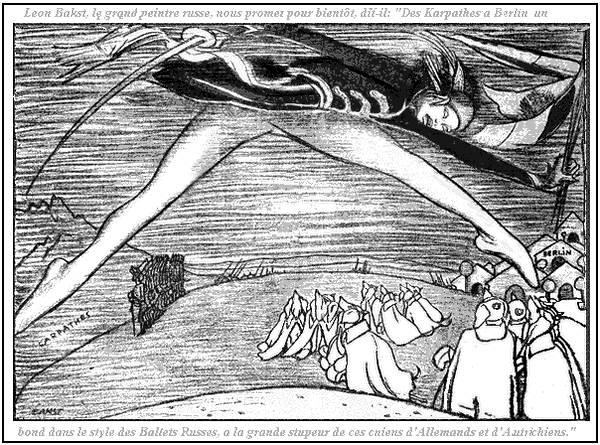
Leon Bakst, le grand peintre russe, nous promet pour bientôt, dit-il: "Des Karpathes a Berlin, un bond dans le style des Ballets Russes, a la grande stupeur de ces chiens d'Allemands et d'Autrichiens."
XLVII.
XLVIII.
The Empress Eugènie has turned her house into a military hospital.
"Do you know where we are, Jimmy?" "The nurse told me that it's the house of a lady who has lost her son in the war."
From Le Mot.
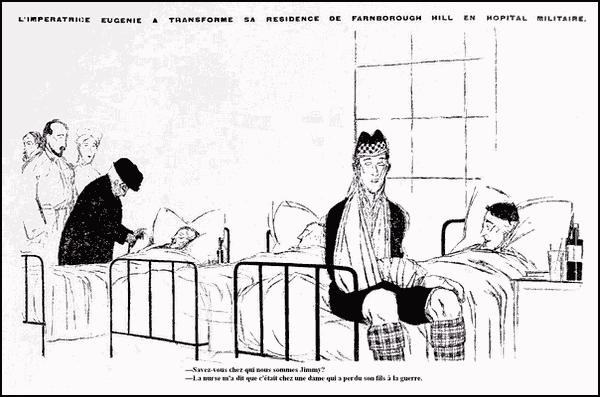
L'IMPERATRICE EUGENIE A TRANSFORME SA RESIDENCE DE FARNBOROUGH HILL EN HOPITAL MILITAIRE. —Savez-vous chez qui nous sommes Jimmy? —La nurse m'a dit que c'était chez une dame qui a perdu son fils à la guerre.
XLVIII.
XLIX.
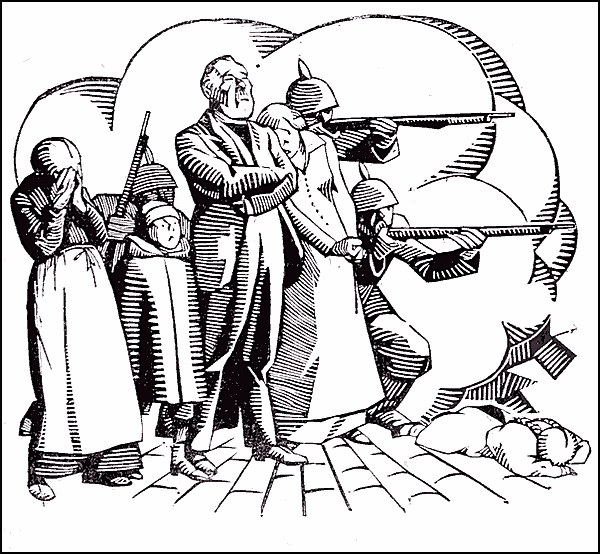
THE HOSTAGES, by A. Hermann-Paul.
From a woodcut published by the Librarie de l'Estampe, 68 Chaussée d'Antin, Paris.
XLIX.