Part 2 — GENESIS, OR, THE FIRST BOOK IN THE BIBLE (continued 2)
Reading edition
Justinopolis is identified as Capodistria; what matters is Divus' text. We find for the "Nekuia" (Odys. xi):
"At postquam ad navem descendimus, et mare, Nauem quidem primum deduximus in mare diuum, Et malum posuimus et vela in navi nigra: Intro autem oues accipientes ire fecimus, intro et ipsi Iuimus dolentes, huberes lachrymas fundentes: Nobis autem a tergo navis nigræ proræ Prosperum ventum imisit pandentem velum bonum amicum Circe benecomata gravis Dea altiloqua. Nos autem arma singula expedientes in navi Sedebamus: hanc autem ventusque gubernatorque dirigebat: Huius at per totum diem extensa sunt vela pontum transientis: Occidit tunc Sol, ombratæ sunt omnes viæ: Hæc autem in fines pervenit profundi Oceani: Illic autem Cimmeriorum virorum populusque civitasque, Caligine et nebula cooperti, neque unquam ipsos Sol lucidus aspicit radiis, Neque quando tendit ad cœlum stellatum, Neque quando retro in terram a cœlo vertitur: Sed nox pernitiosa extenditur miseris hominibus: Navem quidem illuc venientes traximus, extra autem oves Accepimus: ipsi autem rursus apud fluxum Oceani Iuimus, ut in locum perveniremus quem dixit Circe: Hic sacra quidem Perimedes Eurylochusque Faciebant: ego autem ensem acutum trahens a foemore, Foveam fodi quantum cubiti mensura hinc et inde: Circum ipsam autem libamina fundimus omnibus mortuis; Primum mulso, postea autem dulci vino: Tertio rursus aqua, et farinas albas miscui: Multum autem oravi mortuorum infirma capita: Profectus in Ithicam, sterilem bovem, quæ optima esset, Sacrificare in domibus, pyramque implere bonis: Tiresiæ autem seorsum ovem sacrificare vovi Totam nigram, quæ ovibus antecellat nostris: Has autem postquam votis precationibusque gentes mortuorum Precatus sum, oves autem accipiens obtruncavi: In fossam fluebat autem sanguis niger, congregatasque sunt Animæ ex Erebo cadaverum mortuorum, Nymphæque iuvenesque et multa passi senes, Virginesque teneræ, nuper flebilem animum habentes, Multi autem vulnerati æreis lanceis Viri in bello necati, cruenta arma habentes, Qui multi circum foveam veniebant aliunde alius Magno clamore, me autem pallidus timor cepit. Iam postea socios hortans iussi Pecora, quæ iam iacebant iugulata sævo ære, Excoriantes combuere: supplicare autem Diis, Fortique Plutoni, et laudatæ Proserpinæ. At ego ensem acutum trahens a foemore, Sedi, neque permisi mortuorum impotentia capita Sanguinem prope ire, antequam Tiresiam audirem: Prima autem anima Elpenoris venit socii: Nondum enim sepultus erat sub terra lata, Corpus enim in domo Circes reliquimus nos Infletum et insepultum, quoniam labor alius urgebat: Hunc quidem ego lachrymatus sum videns, misertusque sum aio, Et ipsum clamando verba velocia allocutus sum: Elpenor, quomodo venisti sub caliginem obscuram: Prævenisti pedes existens quam ego in navi nigra? Sic dixi: hic autem mini lugens respondit verbo: Nobilis Laertiade, prudens Ulysse, Nocuit mihi dei fatum malum, et multum vinum: Circes autem in domo dormiens, non animadverti Me retrogradum descendere eundo per scalam longam, Sed contra murum cecidi ast autem mihi cervix Nervorum fracta est, anima autem in infernum descendit: Nunc autem his qui venturi sunt postea precor non præsentibus Per uxorem et patrem, qui educavit parvum existentem, Telemachumque quem solum in domibus reliquisti. Scio enim quod hinc iens domo ex inferni Insulam in Æaeam impellens benefabricatam navim: Tunc te postea Rex iubeo recordari mei Ne me infletum, insepultum, abiens retro, relinquas Separatus, ne deorum ira fiam Sed me combure con armis quæcunque mihi sunt, Sepulchramque mihi accumula cani in litore maris, Viri infelicis, et cuius apud posteras fama sit: Hæcque mihi perfice, figeque in sepulchro remum, Quo et vivus remigabam existens cum meis sociis. Sic dixit: at ego ipsum, respondens, allocutus sum: Hæc tibi infelix perficiamque et faciam: Nos quidem sic verbis respondentes molestis Sedebamus: ego quidem seperatim supra sanguinem ensem tenebam: Idolum autem ex altera parte socii multa loquebatur: Venit autem insuper anima matris mortuæ Autolyci filia magnanimi Anticlea, Quam vivam dereliqui iens ad Ilium sacrum, Hac quidem ego lachrymatus sum videns miseratusque sum aio: Sed neque sic sivi priorem licet valde dolens Sanguinem prope ire, antequam Tiresiam audirem: Venit autem insuper anima Thebani Tiresiæ, Aureum sceptrum tenens, me autem novit et allocuta est: Cur iterum o infelix linquens lumen Solis Venisti, ut videas mortuos, et iniucundam regionem? Sed recede a fossa, remove autem ensem acutum, Sanguinem ut bibam, et tibi vera dicam. Sic dixi: ego autem retrocedens, ensem argenteum Vagina inclusi: hic autem postquam bibit sanguinem nigrum, Et tunc iam me verbis allocutus est vates verus: Reditum quæris dulcem illustris Ulysse: Hanc autem tibi difficilem faciet Deus, non enim puto Latere Neptunum, quam iram imposuit animo Iratus, quem ei filium dilectum excæcasti: Sed tamen et sic mala licet passi pervenientis, Si volveris tuum animum continere et sociorum."
The meaning of the passage is, with a few abbreviations, as I have interpolated it in my Third Canto.
"And then went down to the ship, set keel to breakers, Forth on the godly sea, We set up mast and sail on the swart ship, Sheep bore we aboard her, and our bodies also, Heavy with weeping; and winds from sternward Bore us out onward with bellying canvas, Circe's this craft, the trim-coifed goddess. Then sat we amidships—wind jamming the tiller— Thus with stretched sail we went over sea till day's end. Sun to his slumber, shadows o'er all the ocean, Came we then to the bounds of deepest water, To the Kimmerian lands and peopled cities Covered with close-webbed mist, unpierced ever With glitter of sun-rays, Nor with stars stretched, nor looking back from heaven, Swartest night stretched over wretched men there, The ocean flowing backward, came we then to the place Aforesaid by Circe. Here did they rites, Perimedes and Eurylochus, And drawing sword from my hip I dug the ell-square pitkin, Poured we libations unto each the dead, First mead and then sweet wine, water mixed with white flour, Then prayed I many a prayer to the sickly death's-heads, As set in Ithaca, sterile bulls of the best For sacrifice, heaping the pyre with goods. Sheep, to Tiresias only; black and a bell sheep. Dark blood flowed in the fosse, Souls out of Erebus, cadaverous dead, Of brides, of youths, and of much-bearing old; Virgins tender, souls stained with recent tears, Many men mauled with bronze lance-heads, Battle spoil, bearing yet dreary arms, These many crowded about me, With shouting, pallor upon me, cried to my men for more beasts. Slaughtered the herds, sheep slain of bronze, Poured ointment, cried to the gods, To Pluto the strong, and praised Proserpine, Unsheathed the narrow sword, I sat to keep off the impetuous, impotent dead Till I should hear Tiresias. But first Elpenor came, our friend Elpenor, Unburied, cast on the wide earth, Limbs that we left in the house of Circe, Unwept, unwrapped in sepulchre, since toils urged other. Pitiful spirit, and I cried in hurried speech: 'Elpenor, how art thou come to this dark coast? Cam'st thou a-foot, outstripping seamen?' And he in heavy speech: 'Ill fate and abundant wine! I slept in Circe's ingle, Going down the long ladder unguarded, I fell against the buttress, Shattered the nape-nerve, the soul sought Avernus. But thou, O King, I bid remember me, unwept, unburied, Heap up mine arms, be tomb by sea-board, and inscribed: "A man of no fortune and with a name to come." And set my oar up, that I swung mid fellows.' Came then another ghost, whom I beat off, Anticlea, And then Tiresias, Theban, Holding his golden wand, knew me and spoke first: 'Man of ill hour, why come a second time, Leaving the sunlight, facing the sunless dead, and this joyless region? Stand from the fosse, move back, leave me my bloody bever, And I will speak you true speeches.' And I stepped back, Sheathing the yellow sword. Dark blood he drank then, And spoke: 'Lustrous Odysseus Shalt return through spiteful Neptune, over dark seas, Lose all companions.' Foretold me the ways and the signs. Came then Anticlea, to whom I answered: 'Fate drives me on through these deeps. I sought Tiresias,' Told her the news of Troy. And thrice her shadow Faded in my embrace."
It takes no more Latin than I have to know that Divus' Latin is not the Latin of Catullus and Ovid; that it is illepidus to chuck Latin nominative participles about in such profusion; that Romans did not use habentes as the Greeks used ἔχοντες, etc. And nos in line 53 is unnecessary. Divus' Latin has, despite these wems, its quality; it is even singable, there are constant suggestions of the poetic motion; it is very simple Latin, after all, and a crib of this sort may make just the difference of permitting a man to read fast enough to get the swing and mood of the subject, instead of losing both in a dictionary.
Even habentes when one has made up one's mind to it, together with less obvious exoticisms, does not upset one as
"the steep of Delphos leaving."
One is, of necessity, more sensitive to botches in one's own tongue than to botches in another, however carefully learned.
For all the fuss about Divus' errors of elegance Samuelis Clarkius and Jo. Augustus Ernestus do not seem to have gone him much better—-with two hundred years extra Hellenic scholarship at their disposal.
The first Aldine Greek Iliads appeared I think in 1504, Odyssey possibly later.[4] My edition of Divus is of 1538, and as it contains Aldus' own translation of the Frog-fight, it may indicate that Divus was in touch with Aldus in Italy, or quite possibly the French edition is pirated from an earlier Italian printing. A Latin Odyssey in some sort of verse was at that time infinitely worth doing.
Raphael of Volterra had done a prose Odyssey with the opening lines of several books and a few other brief passages in verse. This was printed with Laurenzo Valla's prose Iliads as early as 1502. He begins:
"Dic mihi musa virum captæ post tempora Troiae Qui mores hominum multorum vidit et urbes Multa quoque et ponto passus dum naufragus errat Ut sibi tum sotiis (sociis) vitam servaret in alto Non tamen hos cupiens fato deprompsit acerbo."
Probably the source of "Master Watson's" English quantitative couplet, but obviously not copied by Divus:
"Virum mihi dic musa multiscium qui valde multum Erravit ex quo Troiae sacram urbem depopulatus est: Multorum autem virorum vidit urbes et mentem cognovit: Multos autem hic in mare passus est dolores, suo in animo, Liberans suamque animam et reditum sociorum."
On the other hand, it is nearly impossible to believe that Clark and Ernestus were unfamiliar with Divus. Clark calls his Latin crib a composite "non elegantem utique et venustam, sed ita Romanam, ut verbis verba." A good deal of Divus' venustas has departed. Clark's hyphenated compounds are, I think, no more Roman than are some of Divus' coinage; they may be a trifle more explanatory, but if we read a shade more of color into αθέσφατος οἶνος than we can into multum vinum, it is not restored to us in Clark's copiosum vinum, nor does terra spatiosa improve upon terra lata, εὐρυδείης being (if anything more than lata): "with wide ways or streets," the wide ways of the world, traversable, open to wanderers. The participles remain in Clark-Ernestus, many of the coined words remain unchanged. Georgius Dartona gives, in the opening of the second hymn to Aphrodite:
"Venerandam auream coronam habentem pulchram Venerem Canam, quae totius Cypri munimenta sortita est Maritimae ubi illam zephyri vis molliter spirantis Suscitavit per undam multisoni maris, Spuma in molli: hanc autem auricurae Horae Susceperunt hilariter, immortales autem vestes induere: Capite vero super immortali coronam bene constructam posuere Pulchram, auream: tribus autem ansis Donum orichalchi aurique honorabilis: Collum autem molle, ac pectora argentea Monilibus aureis ornabant...." etc.
Ernestus, adding by himself the appendices to the Epics, gives us:
"Venerandam auream coronam habentem pulchram Venerem Canam, quae totius Cypri munimenta sortita est Maritimae, ubi illam zephyri vis molliter spirantis Tulit per undam multisoni maris Spuma in molli: hanc autem auro comam religatae Horae Susceperunt hilariter, immortales autem vestes induere: Caput autem super immortale coronam bene constructam posuere Pulchram, auream, perforatis autem auriculis Donum orichalci preciosi: Collum autem molle ac pectora Candida[5] Monilibus aureis ornabant...." etc.
"Which things since they are so" lead us to feel that we would have had no less respect for Messrs. Clarkius and Ernestus if they had deigned to mention the names of their predecessors. They have not done this in their prefaces, and if any mention is made of the sixteenth-century scholars, it is very effectually buried somewhere in the voluminous Latin notes, which I have not gone through in toto. Their edition (Glasgow, 1814) is, however, most serviceable.
TRANSLATION OF AESCHYLUS
A search for Aeschylus in English is deadly, accursed, mind-rending. Browning has "done" the Agamemnon, or "done the Agamemnon in the eye" as the critic may choose to consider. He has written a modest and an apparently intelligent preface:
"I should hardly look for an impossible transmission of the reputed magniloquence and sonority of the Greek; and this with the less regret, inasmuch as there is abundant musicality elsewhere, but nowhere else than in his poem the ideas of the poet."
He quotes Matthew Arnold on the Greeks: "their expression is so excellent, because it is so simple and so well subordinated, because it draws its force directly from the pregnancy of the matter which it conveys ... not a word wasted, not a sentiment capriciously thrown in, stroke on stroke."
He is reasonable about the Greek spelling. He points out that γόνον ἰδὼν κάλλιστον ἀνδρῶν sounds very poorly as "Seeing her son the fairest of men" but is outshouted in "Remirando il figliuolo bellissimo degli uomini," and protests his fidelity to the meaning of Aeschylus.
His weakness in this work is where it essentially lay in all of his expression, it rests in the term "ideas"—"Thought" as Browning understood it—"ideas" as the term is current, are poor two dimensional stuff, a scant, scratch covering. "Damn ideas, anyhow." An idea is only an imperfect induction from fact.
The solid, the "last atom of force verging off into the first atom of matter" is the force, the emotion, the objective sight of the poet. In the Agamemnon it is the whole rush of the action, the whole wildness of Kassandra's continual shrieking, the flash of the beacon fires burning unstinted wood, the outburst of
Τροιάν Αχαιῶν οὖσαν,
or the later
Τροίαν Ἀχαιοὶ τήδ' ἔχουσ' ἐν ἡπέρα.
"Troy is the greeks'." Even Rossetti has it better than Browning: "Troy's down, tall Troy's on fire," anything, literally anything that can be shouted, that can be shouted uncontrolledly and hysterically. "Troy is the Greeks'" is an ambiguity for the ear. "Know that our men are in Ilion."
Anything but a stilted unsayable jargon. Yet with Browning we have
"Troia the Achaioi hold," and later,
"Troia do the Achaioi hold," followed by:
"this same day I think a noise—no mixture—reigns i' the city Sour wine and unguent pour thou in one vessel—"
And it does not end here. In fact it reaches the nadir of its bathos in a later speech of Klutaimnestra in the line
"The perfect man his home perambulating!"
We may add several exclamation points to the one which Mr. Browning has provided. But then all translation is a thankless, or is at least most apt to be a thankless and desolate undertaking.
What Browning had not got into his sometimes excellent top-knot was the patent, or what should be the patent fact that inversions of sentence order in an uninflected language like English are not, simply and utterly are not any sort of equivalent for inversions and perturbations of order in a language inflected as Greek and Latin are inflected. That is the chief source of his error. In these inflected languages order has other currents than simple sequence of subject, predicate, object; and all sorts of departures from this Franco-English natural position are in Greek and Latin neither confusing nor delaying; they may be both simple and emphatic, they do not obstruct one's apperception of the verbal relations.
Obscurities not inherent in the matter, obscurities due not to the thing but to the wording, are a botch, and are not worth preserving in a translation. The work lives not by them but despite them.
Rossetti is in this matter sounder than Browning, when he says that the only thing worth bringing over is the beauty of the original; and despite Rossetti's purple plush and molasses trimmings he meant by "beauty" something fairly near what we mean by the "emotional intensity" of his original.
Obscurities inherent in the thing occur when the author is piercing, or trying to pierce into, uncharted regions; when he is trying to express things not yet current, not yet worn into phrase; when he is ahead of the emotional, or philosophic sense (as a painter might be ahead of the color-sense) of his contemporaries.
As for the word-sense and phrase-sense, we still hear workmen and peasants and metropolitan bus-riders repeating the simplest sentences three and four times, back and forth between interlocutors: trying to get the sense "I sez to Bill, I'm goin' to 'Arrow" or some other such subtlety from one occiput into another.
"You sez to Bill, etc."
"Yus, I sez ... etc."
"O!"
The first day's search at the Museum reveals "Aeschylus" printed by Aldus in 1518; by Stephanus in 1557, no English translation before 1777, a couple in the 1820's, more in the middle of the century, since 1880 past counting, and no promising names in the list. Sophocles falls to Jebb and does not appear satisfactory.
From which welter one returns thankfully to the Thomas Stanley Greek and Latin edition, with Saml. Butler's notes, Cambridge, "typis ac sumptibus academicis." 1811—once a guinea or half a guinea per volume, half leather, but now mercifully, since people no longer read Latin, picked up at 2s. for the set (eight volumes in all), rather less than the price of their postage. Quartos in excellent type.
Browning shows himself poet in such phrases as "dust, mud's thirsty brother," which is easy, perhaps, but is English, even Browning's own particular English, as "dust, of mud brother thirsty," would not be English at all; and if I have been extremely harsh in dealing with the first passage quoted it is still undisputable that I have read Browning off and on for seventeen years with no small pleasure and admiration, and am one of the few people who know anything about his Sordello, and have never read his Agamemnon, have not even now when it falls into a special study been able to get through his Agamemnon.
Take another test passage:
Οὖτός ἐσιν Αγαμέμνων, ἐμὸς Πόσις, νεκρὸς δέ τῆσδε δεξιᾶς χερός Ἔργον δικαίνας τέκτονος. Τάδ' ὦδ ἔχει.1445
"Hicce est Agamemnon, maritus Meus, hac dextra mortuus, Facinus justae artificis. Haec ita se habent."
We turn to Browning and find:
"—this man is Agamemnon, My husband, dead, the work of this right hand here, Aye, of a just artificer: so things are."
To the infinite advantage of the Latin, and the complete explanation of why Browning's Aeschylus, to say nothing of forty other translations of Aeschylus, is unreadable.
Any bungling translation:
"This is Agamemnon, My husband, Dead by this hand, And a good job. These, gentlemen, are the facts."
No, that is extreme, but the point is that any natural wording, anything which keeps the mind off theatricals and on Klutaimnestra actual, dealing with an actual situation, and not pestering the reader with frills and festoons of language, is worth all the convoluted tushery that the Victorians can heap together.
I can conceive no improvement on the Latin, it saves by dextra for δεξιᾶς χερός, it loses a few letters in "se habent," but it has the same drive as the Greek.
The Latin can be a whole commentary on the Greek, or at least it can give one the whole parsing and order, and let one proceed at a comforable rate with but the most rudimentary knowledge of the original language. And I do not think this a trifle; it would be an ill day if men again let the classics go by the board; we should fall into something worse than, or as bad as, the counter-reformation: a welter of gum-shoes, and cocoa, and Y.M.C.A. and Webbs, and social theorizing committees, and the general hell of a groggy doctrinaire obfuscation; and the very disagreeablizing of the classics, every pedagogy which puts the masterwork further from us, either by obstructing the schoolboy, or breeding affectation in dilettante readers, works toward such a detestable end. I do not know that strict logic will cover all of the matter, or that I can formulate anything beyond a belief that we test a translation by the feel, and particularly by the feel of being in contact with the force of a great original, and it does not seem to me that one can open this Latin text of the Agamemnon without getting such sense of contact:
"Mox sciemus lampadum luciferarum498 Signorumque per faces et ignis vices, An vere sint, an somniorum instar, Gratum veniens illud lumen eluserit animum nostrum. Praeconem hunc a littore video obumbratum Ramis olivae: testatur autem haec mihi frater Luti socius aridus pulvis, Quod neque mutus, neque accendens facem Materiae montanae signa dabit per fumum ignis."
or
"Apollo, Apollo!1095 Agyieu Apollo mi! Ah! quo me tandem duxisti? ad qualem domum? * * * * * "Heu, heu, ecce, ecce, cohibe a vacca 1134 Taurum: vestibus involens Nigricornem machina Percutit; cadit vero in aquali vase. Insidiosi lebetis casum ut intelligas velim. * * * * * Heu, heu, argutae lusciniae fatum mihi tribuis: * * * * * "Heu nuptiae, nuptiae Paridis exitiales1165 Amicis! eheu Scamandri patria unda!"
All this howling of Kassandra comes at one from the page, and the grimness also of the Iambics:
"Ohime! lethali intus percussus sum vulnere."1352 "Tace: quis clamat vulnus lethaliter vulneratus?" "Ohime! iterum secundo ictu sauciatus." "Patrari facinus mihi videtur regis ex ejulatu.1355 "At tuta communicemus consilia." "Ego quidem vobis meam dico sententiam," etc.
Here or in the opening of the play, or where you like in this Latin, we are at once in contact with the action, something real is going on, we are keen and curious on the instant, but I cannot get any such impact from any part of the Browning.
"In bellum nuptam, Auctricem que contentionum, Helenam:695 Quippe quae congruenter Perditrix navium, perditrix virorum, perditrix urbium, E delicatis Thalami ornamentis navigavit Zephyri terrigenae aura. Et numerosi scutiferi, Venatores secundum vestigia, Remorum inapparentia Appulerunt ad Simoentis ripas Foliis abundantes Ob jurgium cruentum." "War-wed, author of strife, Fitly Helen, destroyer of ships, of men, Destroyer of cities, From delicate-curtained room Sped by land breezes. "Swift the shields on your track, Oars on the unseen traces, And leafy Simois Gone red with blood."[6]
Contested Helen, Ἀμφινεικῆ.
"War-wed, contested, (Fitly) Helen, destroyer of ships; of men; Destroyer of cities, "From the delicate-curtained room Sped by land breezes. "Swift on the shields on your track, Oars on the unseen traces. "Red leaves in Simois!" "Rank flower of love, for Troy." "Quippe leonem educavit....726 Mansuetum, pueris amabilem.... ... divinitus sacerdos Ates (i.e. Paris) In aedibus enutritus est. "Statim igitur venit746 Ad urbem Ilii, Ut ita dicam, animus Tranquillae serenitatis, placidum Divitiarum ornamentum Blandum oculourum telum, Animum pungens flos amoris (Helena) accubitura. Perfecit autem Nuptiarum acerbos exitus, Mala vicina, malaque socia, Irruens in Priamidas, Ductu Jovis Hospitalis, Erinnys luctuosa sponsis."
It seems to me that English translators have gone wide in two ways, first in trying to keep every adjective, when obviously many adjectives in the original have only melodic value, secondly they have been deaved with syntax; have wasted time, involved their English, trying first to evolve a definite logical structure for the Greek and secondly to preserve it, and all its grammatical relations, in English.
One might almost say that Aeschylus' Greek is agglutinative, that his general drive, especially in choruses, is merely to remind the audience of the events of the Trojan war; that syntax is subordinate, and duly subordinated, left out, that he is not austere, but often even verbose after a fashion (not Euripides' fashion).
A reading version might omit various things which would be of true service only if the English were actually to be sung on a stage, or chanted to the movements of the choric dance or procession.
Above suggestions should not be followed with intemperance. But certainly more sense and less syntax (good or bad) in translations of Aeschylus might be a relief.
Chor. Anapest: "O iniquam Helenam, una quae multas,1464 Multas admodum animas Perdidisti ad Trojam! Nunc vero nobilem memorabilem (Agam. animam), Deflorasti per caedem inexpiabilem. Talis erat tunc in aedibus Eris viri domitrix aerumna." Clytemnestra: "Nequaquam mortis sortem exopta1470 Hisce gravatus; Neque in Helenam iram convertas, Tanquam viriperdam, ac si una multorum Virorum animas Graecorum perdens, Intolerabilem dolorem effecerit." * * * * * Clytemnestra: "Mortem haud indignam arbitrar1530 Huic contigisse: Neque enim ille insidiosam cladem Aedibus intulit; sed meum ex ipso Germen sublatum, multum defletam Iphigeniam cum indigne affecerit, Digna passus est, nihil in inferno Glorietur, gladio inflicta Morte luens quae prior perpetravit."
"Death not unearned, nor yet a novelty in this house; Let him make talk in hell concerning Iphigenia."
(If we allow the last as ironic equivalent of the literal "let him not boast in hell.")
"He gets but a thrust once given (by him) Back-pay, for Iphigenia."
One can further condense the English but at the cost of obscurity.
Morshead is bearable in Clytemnestra's description the beacons.
"From Ida's top Hephaestos, Lord of fire, Sent forth his sign, and on, and ever on, Beacon to beacon sped tjie courier-flame From Ida to the crag, that Hermes loves On Lemnos; thence into the steep sublime Of Athos, throne of Zeus, the broad blaze flared. Thence, raised aloft to shoot across the sea The moving light, rejoicing in its strength Sped from the pyre of pine, and urged its way, In golden glory, like some strange new sun, Onward and reached Macistus' watching heights."
IX
THE CHINESE WRITTEN CHARACTER AS A MEDIUM FOR POETRY
BY ERNEST FENOLLOSA
[This essay was practically finished by the late Ernest Fenollosa; I have done little more than remove a few repetitions and shape a few sentences.
We have here not a bare philological discussion, but a study of the fundamentals of all æsthetics. In his search through unknown art Fenollosa, coming upon unknown motives and principles unrecognised in the West, was already led into many modes of thought since fruitful in "new" western painting and poetry. He was a forerunner without knowing it and without being known, as such.
He discerned principles of writing which he had scarcely time to put into practice. In Japan he restored, or greatly helped to restore, a respect for the native art. In America and Europe he cannot be looked upon as a mere searcher after exotics. His mind was constantly filled with parallels and comparisons between eastern and western art. To him the exotic was always a means of fructification. He looked to an American renaissance. The vitality of his outlook can be judged from the fact that although this essay was written some time before his death in 1908 have not had to change the allusions to western conditions. The later movements in art have corroborated his theories.—EZRA POUND.]
This twentieth century not only turns a new page in the book of the world, but opens another and a startling chapter. Vistas of strange futures unfold for man, of world-embracing cultures half weaned from Europe, of hitherto undreamed responsibilities for nations and races.
The Chinese problem alone is so vast that no nation can afford to ignore it. We in America, especially, must face it across the Pacific, and master it or it will master us. And the only way to master it is to strive with patient sympathy to understand the best, the most hopeful and the most human elements in it.
It is unfortunate that England and America have so long ignored or mistaken the deeper problems of Oriental culture. We have misconceived the Chinese for a materialistic people, for a debased and worn-out race. We have belittled the Japanese as a nation of copyists. We have stupidly assumed that Chinese history affords no glimpse of change in social evolution, no salient epoch of moral and spiritual crisis. We have denied the essential humanity of these peoples; and we have toyed with their ideals as if they were no better than comic songs in an "opera bouffe."
The duty that faces us is not to batter down their forts or to exploit their markets, but to study and to come to sympathize with their humanity and their generous aspirations. Their type of cultivation has been high. Their harvest of recorded experience doubles our own. The Chinese have been idealists, and experimenters in the making of great principles; their history opens a world of lofty aim and achievement, parallel to that of the ancient Mediterranean peoples. We need their best ideals to supplement our own—ideals enshrined in their art, in their literature and in the tragedies of their lives.
We have already seen proof of the vitality and practical value of oriental painting for ourselves and as a key to the eastern soul. It may be worth while to approach their literature, the intensest part of it, their poetry, even in an imperfect manner.
I feel that I should perhaps apologize[1] for presuming to follow that series of brilliant scholars, Davis, Legge, St. Denys and Giles, who have treated the subject of Chinese poetry with a wealth of erudition to which I can proffer no claim. It is not as a professional linguist nor as a sinologue that I humbly put forward what I have to say. As an enthusiastic student of beauty in Oriental culture, having spent a large portion of my years in close relation with Orientals, I could not but breathe in something of the poetry incarnated in their lives.
I have been for the most part moved to my temerity by personal considerations. An unfortunate belief has spread both in England and in America that Chinese and Japanese poetry are hardly more than an amusement, trivial, childish, and not to be reckoned in the world's serious literary performance. I have heard well-known sinologues state that, save for the purposes of professional linguistic scholarship, these branches of poetry are fields too barren to repay the toil necessary for their cultivation.
Now my own impression has been so radically and diametrically opposed to such a conclusion, that a sheer enthusiasm of generosity has driven me to wish to share with other Occidentals my newly discovered joy. Either I am pleasingly self-deceived in my positive delight, or else there must be some lack of æsthetic sympathy and of poetic feeling in the accepted methods of presenting the poetry of China. I submit my causes of joy.
Failure or success in presenting any alien poetry in English must depend largely upon poetic workmanship in the chosen medium. It was perhaps too much to expect that aged scholars who had spent their youth in gladiatorial combats with the refractory Chinese characters should succeed also as poets. Even Greek verse might have fared equally ill had its purveyors been perforce content with provincial standards of English rhyming. Sinologues should remember that the purpose of poetical translation is the poetry, not the verbal definitions in dictionaries.
One modest merit I may, perhaps, claim for my work: it represents for the first time a Japanese school of study in Chinese culture. Hitherto Europeans have been somewhat at the mercy of contemporary Chinese scholarship. Several centuries ago China lost much of her creative self, and of her insight into the causes of her own life, but her original spirit still lives, grows, interprets, transferred to Japan in all its original freshness. The Japanese to-day represent a stage of culture roughly corresponding to that of China under the Sung dynasty. I have been fortunate in studying for many years as a private pupil under Professor Kainan Mori, who is probably the greatest living authority on Chinese poetry. He has recently been called to a chair in the Imperial University of Tokio.
My subject is poetry, not language, yet the roots of poetry are in language. In the study of a language so alien in form to ours as is Chinese in its written character, it is necessary to inquire how those universal elements of form which constitute poetics can derive appropriate nutriment.
In what sense can verse, written in terms of visible hieroglyphics, be reckoned true poetry? It might seem that poetry, which like music is a time art, weaving its unities out of successive impressions of sound, could with difficulty assimilate a verbal medium consisting largely of semi-pictorial appeals to the eye.
Contrast, for example, Gray's line:
The curfew tolls the knell of parting day
with the Chinese line:
Moon rays like pure snow.

Unless the sound of the latter be given, what have they in common? It is not enough to adduce that each contains a certain body of prosaic meaning; for the question is, how can the Chinese line imply, as form, the very element that distinguishes poetry from prose?
On second glance, it is seen that the Chinese words, though visible, occur in just as necessary an order as the phonetic symbols of Gray. All that poetic form requires is a regular and flexible sequence, as plastic as thought itself. The characters may be seen and read, silently by the eye, one after the other:
Moon rays like pure snow.
Perhaps we do not always sufficiently consider that thought is successive, not through some accident or weakness of our subjective operations but because the operations of nature are successive. The transferences of force from agent to object which constitute natural phenomena, occupy time. Therefore, a reproduction of them in imagination requires the same temporal order.[2]
Suppose that we look out of a window and watch a man. Suddenly he turns his head and actively fixes his attention upon something. We look ourselves and see that his vision has been focussed upon a horse. We saw, first, the man before he acted; second, while he acted; third, the object toward which his action was directed. In speech we split up the rapid continuity of this action and of its picture into its three essential parts or joints in the right order, and say:
Man sees horse.
It is clear that these three joints, or words, are only three phonetic symbols, which stand for the three terms of a natural process. But we could quite as easily denote these three stages of our thought by symbols equally arbitrary, which had no basis in sound; for example, by three Chinese characters:
Man - Sees - Horse
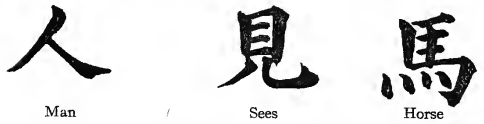
If we all knew what division of this mental horse-picture each of these signs stood for, we could communicate continuous thought to one another as easily by drawing them as by speaking words. We habitually employ the visible language of gesture in much this same manner.
But Chinese notation is something much more than arbitrary symbols. It is based upon a vivid shorthand picture of the operations of nature. In the algebraic figure and in the spoken word there is no natural connection between thing and sign: all depends upon sheer convention. But the Chinese method follows natural suggestion. First stands the man on his two legs. Second, his eye moves through space: a bold figure represented by running legs under an eye, a modified picture of an eye, a modified picture of running legs but unforgettable once you have seen it. Third stands the horse on his four legs.
The thought picture is not only called up by these signs as well as by words but far more vividly and concretely. Legs belong to all three characters: they are alive. The group holds something of the quality of a continuous moving picture.
The untruth of a painting or a photograph is that, in spite of its concreteness, it drops the element of natural succession.
Contrast the Laocoon statue with Browning's lines:
"I sprang to the saddle, and Jorris, and he * * * * * * And into the midnight we galloped abreast."
One superiority of verbal poetry as an art rests in its getting back to the fundamental reality of time. Chinese poetry has the unique advantage of combining both elements. It speaks at once with the vividness of painting, and with the mobility of sounds. It is, in some sense, more objective than either, more dramatic. In reading Chinese we do not seem to be juggling mental counters, but to be watching things work out their own fate.
Leaving for a moment the form of the sentence, let us look more closely at this quality of vividness in the structure of detached Chinese words. The earlier forms of these characters were pictorial, and their hold upon the imagination is little shaken, even in later conventional modifications. It is not so well known, perhaps, that the great number of these ideographic roots carry in them a verbal idea of action. It might be thought that a picture is naturally the picture of a thing, and that therefore the root ideas of Chinese are what grammar calls nouns.
But examination shows that a large number of the primitive Chinese characters, even the so-called radicals, are shorthand pictures of actions or processes.
For example, the ideograph meaning "to speak" is a mouth with two words and a flame coming out of it. The sign meaning "to grow up with difficulty" is grass with a twisted root. But this concrete verb quality, both in nature and in the Chinese signs, becomes far more striking and poetic when we pass from such simple, original pictures to compounds. In this process of compounding, two things added together do not produce a third thing but suggest some fundamental relation between them. For example, the ideograph for a "mess-mate" is a man and a fire.
A true noun, an isolated thing, does not exist in nature. Things are only the terminal points, or rather the meeting points of actions, cross-sections cut through actions, snap-shots. Neither can a pure verb, an abstract motion, be possible in nature. The eye sees noun and verb as one: things in motion, motion in things, and so the Chinese conception tends to represent them.
The sun underlying the bursting forth of plants = spring.
The sun sign tangled in the branches of the tree sign = east.
"Rice-field" plus "struggle" = male.
"Boat" plus "water," boat-water, a ripple.
Let us return to the form of the sentence and see what power it adds to the verbal units from which it builds. I wonder how many people have asked themselves why the sentence form exists at all, why it seems so universally necessary in all languages? Why must all possess it, and what is the normal type of it? If it be so universal it ought to correspond to some primary law of nature.
I fancy the professional grammarians have given but a lame response to this inquiry. Their definitions fall into two types: one, that a sentence expresses a "complete thought"; the other, that in it we bring about a union of subject and predicate.
The former has the advantage of trying for some natural objective standard, since it is evident that a thought can not be the test of its own completeness. But in nature there is no completeness. On the one hand, practical completeness may be expressed by a mere interjection, as "Hi! there!", or "Scat!", or even by shaking one's fist. No sentence is needed to make one's meaning more clear. On the other hand, no full sentence really completes a thought. The man who sees and the horse which is seen will not stand still. The man was planning a ride before he looked. The horse kicked when the man tried to catch him. The truth is that acts are successive, even continuous; one causes or passes into another. And though we may string never so many clauses into a single compound sentence, motion leaks everywhere, like electricity from an exposed wire. All processes in nature are inter-related; and thus there could be no complete sentence (according to this definition) save one which it would take all time to pronounce.
In the second definition of the sentence, as "uniting a subject and a predicate," the grammarian falls back on pure subjectivity. We do it all; it is a little private juggling between our right and left hands. The subject is that about which I am going to talk; the predicate is that which I am going to say about it. The sentence according to this definition is not an attribute of nature but an accident of man as a conversational animal.
If it were really so, then there could be no possible test of the truth of a sentence. Falsehood would be as specious as verity. Speech would carry no conviction.
Of course this view of the grammarians springs from the discredited, or rather the useless, logic of the middle ages. According to this logic, thought deals with abstractions, concepts drawn out of things by a sifting process. These logicians never inquired how the "qualities" which they pulled out of things came to be there. The truth of all their little checker-board juggling depended upon the natural order by which these powers or properties or qualities were folded in concrete things, yet they despised the "thing" as a mere "particular," or pawn. It was as if Botany should reason from the leaf-patterns woven into our table-cloths. Valid scientific thought consists in following as closely as may be the actual and entangled lines of forces as they pulse through things. Thought deals with no bloodless concepts but watches things move under its microscope.
The sentence form was forced upon primitive men by nature itself. It was not we who made it; it was a reflection of the temporal order in causation. All truth has to be expressed in sentences because all truth is the transference of power. The type of sentence in nature is a flash of lightning. It passes between two terms, a cloud and the earth. No unit of natural process can be less than this. All natural processes are, in their units, as much as this. Light, heat, gravity, chemical affinity, human will have this in common, that they redistribute force. Their unit of process can be represented as:
termtransferenceterm
fromofto
whichforcewhich
If we regard this transference as the conscious or unconscious act of an agent we can translate the diagram into:
agent act object
In this the act is the very substance of the fact denoted. The agent and the object are only limiting terms.
It seems to me that the normal and typical sentence in English as well as in Chinese expresses just this unit of natural process. It consists of three necessary words; the first denoting the agent or subject from which the act starts; the second embodying the very stroke of the act; the third pointing to the object, the receiver of the impact. Thus:
Farmer pounds rice.
The form of the Chinese transitive sentence, and of the English (omitting particles) exactly corresponds to this universal form of action in nature. This brings language close to things, and in its strong reliance upon verbs it erects all speech into a kind of dramatic poetry.
A different sentence order is frequent in inflected languages like Latin, German or Japanese. This is because they are inflected, i.e., they have little tags and word-endings, or labels to show which is the agent, the object, etc. In uninflected languages, like English and Chinese, there is nothing but the order of the words to distinguish their functions. And this order would be no sufficient indication, were it not the natural order—that is, the order of cause and effect.
It is true that there are, in language, intransitive and passive forms, sentences built out of the verb "to be," and, finally, negative forms. To grammarians and logicians these have seemed more primitive than the transitive, or at least exceptions to the transitive. I had long suspected that these apparently exceptional forms had grown from the transitive or worn away from it by alteration or modification. This view is confirmed by Chinese examples, wherein it is still possible to watch the transformation going on.
The intransitive form derives from the transitive by dropping a generalized, customary, reflexive or cognate object. "He runs (a race)." "The sky reddens (itself)." "We breathe (air)." Thus we get weak and incomplete sentences which suspend the picture and lead us to think of some verbs as denoting states rather than acts. Outside grammar the word "state" would hardly be recognized as scientific. Who can doubt that when we say, "The wall shines," we mean that it actively reflects light to our eye?
The beauty of Chinese verbs is that they are all transitive or intransitive at pleasure. There is no such thing as a naturally intransitive verb. The passive form is evidently a correlative sentence, which turns about and makes the object into a subject. That the object is not in itself passive, but contributes some positive force of its own to the action, is in harmony both with scientific law and with ordinary experience. The English passive voice with "is" seemed at first an obstacle to this hypothesis, but one suspected that the true form was a generalized transitive verb meaning something like "receive," which had degenerated into an auxiliary. It was a delight to find this the case in Chinese.
In nature there are no negations, no possible transfers of negative force. The presence of negative sentences in language would seem to corroborate the logicians' view that assertion is an arbitrary subjective act. We can assert a negation, though nature can not. But here again science comes to our aid against the logician: all apparently negative or disruptive movements bring into play other positive forces. It requires great effort to annihilate. Therefore we should suspect that, if we could follow back the history of all negative particles, we should find that they also are sprung from transitive verbs. It is too late to demonstrate such derivations in the Aryan languages, the clue has been lost, but in Chinese we can still watch positive verbal conceptions passing over into so-called negatives. Thus in Chinese the sign meaning "to be lost in the forest" relates to a State of non-existence. English "not" = the Sanskrit na, which may come from the root na, to be lost, to perish.
Lastly comes the infinitive which substitutes for a specific colored verb the universal copula "is," followed by a noun or an adjective. We do not say a tree "greens itself," but "the tree is green;" not that "monkeys bring forth live young," but that "the monkey is a mammal." This is an ultimate weakness of language. It has come from generalizing all intransitive words into one. As "live," "see," "walk," "breathe," are generalized into states by dropping their objects, so these weak verbs are in turn reduced to the abstractest state of all, namely, bare existence.
There is in reality no such verb as a pure copula, no such original conception, our very word exist means "to stand forth," to show oneself by a definite act. "Is" comes from the Aryan root as, to breathe. "Be" is from bhu, to grow.
In Chinese the chief verb for "is" not only means actively "to have," but shows by its derivation that it expresses something even more concrete, namely, "to snatch from the moon with the hand." Here the baldest symbol of prosaic analysis is transformed by magic into a splendid flash of concrete poetry.
I shall not have entered vainly into this long analysis of the sentence if I have succeeded in showing how poetical is the Chinese form and how close to nature. In translating Chinese, verse especially, we must hold as closely as possible to the concrete force of the original, eschewing adjectives, nouns and intransitive forms wherever we can, and seeking instead strong and individual verbs.
Lastly we notice that the likeness of form between Chinese and English sentences renders translation from one to the other exceptionally easy. The genius of the two is much the same. Frequently it is possible by omitting English particles to make a literal word-for-word translation which will be not only intelligible in English, but even the strongest and most poetical English. Here, however, one must follow closely what is said, not merely what is abstractly meant.
Let us go back from the Chinese sentence to the individual written word. How are such words to be classified? Are some of them nouns by nature, some verbs and some adjectives? Are there pronouns, and prepositions and conjunctions in Chinese as in good Christian languages?
One is led to suspect from an analysis of the Aryan languages that such differences are not natural, and that they have been unfortunately invented by grammarians to confuse the simple poetic outlook on life. All nations have written their strongest and most vivid literature before they invented a grammar. Moreover, all Aryan etymology points back to roots which are the equivalents of simple Sanskrit verbs, such as we find tabulated at the back of our Skeat. Nature herself has no grammar.[3] Fancy picking up a man and telling him that he is a noun, a dead thing rather than a bundle of functions! A "part of speech" is only what it does. Frequently our lines of cleavage fail, one part of speech acts for another. They act for one another because they were originally one and the same.
Few of us realize that in our own language these very differences once grew up in living articulation; that they still retain life. It is only when the difficulty of placing some odd term arises or when we are forced to translate into some very different language, that we attain for a moment the inner heat of thought, a heat which melts down the parts of speech to recast them at will.
One of the most interesting facts about the Chinese language is that in it we can see, not only the forms of sentences, but literally the parts of speech growing up, budding forth one from another. Like nature, the Chinese words are alive and plastic, because thing and action are not formally separated. The Chinese language naturally knows no grammar. It is only lately that foreigners, European and Japanese, have begun to torture this vital speech by forcing it to fit the bed of their definitions. We import into our reading of Chinese all the weakness of our own formalisms. This is especially sad in poetry, because the one necessity, even in our own poetry, is to keep words as flexible as possible, as full of the sap of nature.
Let us go further with our example. In English we call "to shine" a verb in the infinitive, because it gives the abstract meaning of the verb without conditions. If we want a corresponding adjective we take a different word, "bright." If we need a noun we say "luminosity," which is abstract, being derived from an adjective.[4] To get a tolerably concrete noun, we have to leave behind the verb and adjective roots, and light upon a thing arbitrarily cut off from its power of action, say "the sun" or "the moon." Of course there is nothing in nature so cut off, and therefore this nounizing is itself an abstraction. Even if we did have a common word underlying at once the verb "shine," the adjective "bright" and the noun "sun," we should probably call it an "infinitive of the infinitive." According to our ideas, it should be something extremely abstract, too intangible for use.
The Chinese have one word, ming or mei. Its ideograph is the sign of the sun together with the sign of the moon. It serves as verb, noun, adjective. Thus you write literally, "the sun and moon of the cup" for "the cup's brightness." Placed as a verb, you write "the cup sun-and-moons," actually "cup sun-and-moon," or in a weakened thought, "is like sun," i.e., shines. "Sun-and-moon cup" is naturally a bright cup. There is no possible confusion of the real meaning, though a stupid scholar may spend a week trying to decide what "part of speech" he should use in translating a very simple and direct thought from Chinese to English.
The fact is that almost every written Chinese word is properly just such an underlying word, and yet it is not abstract. It is not exclusive of parts of speech, but comprehensive; not something which is neither a noun, verb, or adjective, but something which is all of them at once and at all times. Usage may incline the full meaning now a little more to one side, now to another, according to the point of view, but through all cases the poet is free to deal with it richly and concretely, as does nature.
In the derivation of nouns from verbs, the Chinese language is forestalled by the Aryan. Almost all the Sanskrit roots, which seem to underlie European languages, are primitive verbs, which express characteristic actions of visible nature. The verb must be the primary fact of nature, since motion and change are all that we can recognize in her. In the primitive transitive sentence, such as "Farmer pounds rice," the agent and the object are nouns only in so far as they limit a unit of action. "Farmer" and "rice" are mere hard terms which define the extremes of the pounding. But in themselves, apart from this sentence-function, they are naturally verbs. The farmer is one who tills the ground, and the rice is a plant which grows in a special way. This is indicated in the Chinese characters. And this probably exemplifies the ordinary derivation of nouns from verbs. In all languages, Chinese included, a noun is originally "that which does something," that which performs the verbal action. Thus the moon comes from the root ma, and means "the measurer." The sun means that which begets.
The derivation of adjectives from the verb need hardly be exemplified. Even with us, to-day, we can still watch participles passing over into adjectives. In Japanese the adjective is frankly part of the inflection of the verb, a special mood, so that every verb is also an adjective. This brings us close to nature, because everywhere the quality is only a power of action regarded as having an abstract inherence. Green is only a certain rapidity of vibration, hardness a degree of tenseness in cohering. In Chinese the adjective always retains a substratum of verbal meaning. We should try to render this in translation, not be content with some bloodless adjectival abstraction plus "is."
Still more interesting are the Chinese "prepositions," they are often post-positions. Prepositions are so important, so pivotal in European speech only because we have weakly yielded up the force of our intransitive verbs. We have to add small supernumerary words to bring back the original power. We still say "I see a horse," but with the weak verb "look," we have to add the directive particle "at" before we can restore the natural transitiveness.[5]
Prepositions represent a few simple ways in which incomplete verbs complete themselves. Pointing toward nouns as a limit they bring force to bear upon them. That is to say, they are naturally verbs, of generalized or condensed use. In Aryan languages it is often difficult to trace the verbal origins of simple prepositions. Only in "off" do we see a fragment of the thought "to throw off." In Chinese the preposition is frankly a verb, specially used in a generalized sense. These verbs are often used in their specially verbal sense, and it greatly weakens an English translation if they are systematically rendered by colorless prepositions.
Thus in Chinese: By = to cause; to = to fall toward; in = to remain, to dwell; from = to follow; and so on.
Conjunctions are similarly derivative, they usually serve to mediate actions between verbs, and therefore they are necessarily themselves actions. Thus in Chinese: Because = to use; and = to be included under one; another form of "and" = to be parallel; or = to partake; if = to let one do, to permit. The same is true of a host of other particles, no longer traceable in the Aryan tongues.
Pronouns appear a thorn in our evolution theory, since they have been taken as unanalyzable expressions of personality. In Chinese even they yield up their striking secrets of verbal metaphor. They are a constant source of weakness if colorlessly translated. Take, for example, the five forms of "I." There is the sign of a "spear in the hand" = a very emphatic I; five and a mouth = a weak and defensive I, holding off a crowd by speaking; to conceal = a selfish and private I; self (the cocoon sign) and a mouth = an egoistic I, one who takes pleasure in his own speaking; the self presented is used only when one is speaking to one's self.
I trust that this digression concerning parts of speech may have justified itself. It proves, first, the enormous interest of the Chinese language in throwing light upon our forgotten mental processes, and thus furnishes a new chapter in the philosophy of language. Secondly, it is indispensable for understanding the poetical raw material which the Chinese language affords. Poetry differs from prose in the concrete colors of its diction. It is not enough for it to furnish a meaning to philosophers. It must appeal to emotions with the charm of direct impression, flashing through regions where the intellect can only grope.[6] Poetry must render what is said, not what is merely meant. Abstract meaning gives little vividness, and fullness of imagination gives all. Chinese poetry demands that we abandon our narrow grammatical categories, that we follow the original text with a wealth of concrete verbs.
But this is only the beginning of the matter. So far we have exhibited the Chinese characters and the Chinese sentence chiefly as vivid shorthand pictures of actions and processes in nature. These embody true poetry as far as they go. Such actions are seen, but Chinese would be a poor language and Chinese poetry but a narrow art, could they not go on to represent also what is unseen. The best poetry deals not only with natural images but with lofty thoughts, spiritual suggestions and obscure relations. The greater part of natural truth is hidden in processes too minute for vision and in harmonies too large, in vibrations, cohesions and in affinities. The Chinese compass these also, and with great power and beauty.
You will ask, how could the Chinese have built up a great intellectual fabric from mere picture writing? To the ordinary western mind, which believes that thought is concerned with logical categories and which rather condemns the faculty of direct imagination, this feat seems quite impossible. Yet the Chinese language with its peculiar materials has passed over from the seen to the unseen by exactly the same process which all ancient races employed. This process is metaphor, the use of material images to suggest immaterial relations.[7]
The whole delicate substance of speech is built upon substrata of metaphor. Abstract terms, pressed by etymology, reveal their ancient roots still embedded in direct action. But the primitive metaphors do not spring from arbitrary subjective processes. They are possible only because they follow objective lines of relations in nature herself. Relations are more real and more important than the things which they relate. The forces which produce the branch-angles of an oak lay potent in the acorn. Similar lines of resistance, half curbing the out-pressing vitalities, govern the branching of rivers and of nations. Thus a nerve, a wire, a roadway, and a clearing-house are only varying channels which communication forces for itself. This is more than analogy, it is identity of structure. Nature furnishes her own clues. Had the world not been full of homologies, sympathies, and identities, thought would have been starved and language chained to the obvious. There would have been no bridge whereby to cross from the minor truth of the seen to the major truth of the unseen. Not more than a few hundred roots out of our large vocabularies could have dealt directly with physical processes. These we can fairly well identify in primitive Sanskrit. They are, almost without exception, vivid verbs. The wealth of European speech grew, following slowly the intricate maze of nature's suggestions and affinities. Metaphor was piled upon metaphor in quasi-geological strata.
Metaphor, the revealer of nature, is the very substance of poetry. The known interprets the obscure, the universe is alive with myth. The beauty and freedom of the observed world furnish a model, and life is pregnant with art. It is a mistake to suppose, with some philosophers of æsthetics, that art and poetry aim to deal with the general and the abstract. This misconception has been foisted upon us by mediæval logic. Art and poetry deal with the concrete of nature, not with rows of separate "particulars," for such rows do not exist. Poetry is finer than prose because it gives us more concrete truth in the same compass of words. Metaphor, its chief device, is at once the substance of nature and of language. Poetry only does consciously[8] what the primitive races did unconsciously. The chief work of literary men in dealing with language, and of poets especially, lies in feeling back along the ancient lines of advance.[9] He must do this so that he may keep his words enriched by all their subtle undertones of meaning. The original metaphors stand as a kind of luminous background, giving color and vitality, forcing them closer to the concreteness of natural processes. Shakespeare everywhere teems with examples. For these reasons poetry was the earliest of the world arts; poetry, language and the care of myth grew up together.
I have alleged all this because it enables me to show clearly why I believe that the Chinese written language has not only absorbed the poetic substance of nature and built with it a second world of metaphor, but has, through its very pictorial visibility, been able to retain its original creative poetry with far more vigor and vividness than any phonetic tongue. Let us first see how near it is to the heart of nature in its metaphors. We can watch it passing from the seen to the unseen, as we saw it passing from verb to pronoun. It retains the primitive sap, it is not cut and dried like a walking-stick. We have been told that these people are cold, practical, mechanical, literal, and without a trace of imaginative genius. That is nonsense.
Our ancestors built the accumulations of metaphor into structures of language and into systems of thought. Languages to-day are thin and cold because we think less and less into them. We are forced, for the sake of quickness and sharpness, to file down each word to its narrowest edge of meaning. Nature would seem to have become less like a paradise and more and more like a factory. We are content to accept the vulgar misuse of the moment. A late stage of decay is arrested and embalmed in the dictionary. Only scholars and poets feel painfully back along the thread of our etymologies and piece together our diction, as best they may, from forgotten fragments. This anemia of modern speech is only too well encouraged by the feeble cohesive force of our phonetic symbols. There is little or nothing in a phonetic word to exhibit the embryonic stages of its growth. It does not bear its metaphor on its face. We forget that personality once meant, not the soul, but the soul's mask. This is the sort of thing one can not possibly forget in using the Chinese symbols.
In this Chinese shows its advantage. Its etymology is constantly visible. It retains the creative impulse and process, visible and at work. After thousands of years the lines of metaphoric advance are still shown, and in many cases actually retained in the meaning. Thus a word, instead of growing gradually poorer and poorer as with us, becomes richer and still more rich from age to age, almost consciously luminous. Its uses in national philosophy and history, in biography and in poetry, throw about it a nimbus of meanings. These centre about the graphic symbol. The memory can hold them and use them. The very soil of Chinese life seems entangled in the roots of its speech. The manifold illustrations which crowd its annals of personal experience, the lines of tendency which converge upon a tragic climax, moral character as the very core of the principle—all these are flashed at once on the mind as reinforcing values with an accumulation of meaning which a phonetic language can hardly hope to attain. Their ideographs are like blood-stained battle flags to an old campaigner. With us, the poet is the only one for whom the accumulated treasures of the race-words are real and active. Poetic language is always vibrant with fold on fold of overtones, and with natural affinities, but in Chinese the visibility of the metaphor tends to raise this quality to its intensest power.
I have mentioned the tyranny of mediæval logic. According to this European logic thought is a kind of brick-yard. It is baked into little hard units or concepts. These are piled in rows according to size and then labeled with words for future use. This use consists in picking out a few bricks, each by its convenient label, and sticking them together into a sort of wall called a sentence by the use either of white mortar for the positive copula "is," or of black mortar for the negative copula "is not." In this way we produce such admirable propositions as "A ring-tailed baboon is not a constitutional assembly."
Let us consider a row of cherry trees. From each of these in turn we proceed to take an "abstract," as the phrase is, a certain common lump of qualities which we may express together by the name cherry or cherry-ness. Next we place in a second table several such characteristic concepts: cherry, rose, sunset, iron-rust, flamingo. From these we abstract some further common quality, dilutation or mediocrity, and label it "red" or "redness." It is evident that this process of abstraction may be carried on indefinitely and with all sorts of material. We may go on forever building pyramids of attenuated concept until we reach the apex "being."
But we have done enough to illustrate the characteristic process. At the base of the pyramid lie things, but stunned, as it were. They can never know themselves for things until they pass up and down among the layers of the pyramids. The way of passing up and down the pyramid may be exemplified as follows: We take a concept of lower attenuation, such as "cherry"; we see that it is contained under one higher, such as "redness." Then we are permitted to say in sentence form, "Cherryness is contained under redness," or for short, "(the) cherry is red." If, on the other hand, we do not find our chosen subject under a given predicate we use the black copula and say, for example, "(The) cherry is not liquid."
From this point we might go on to the theory of the syllogism, but we refrain. It is enough to note that the practised logician finds it convenient to store his mind with long lists of nouns and adjectives, for these are naturally the names of classes. Most text-books on language begin with such lists. The study of verbs is meagre, for in such a system there is only one real working verb, to-wit, the quasi-verb "is." All other verbs can be transformed into participles and gerunds. For example, "to run" practically becomes a case of "running." Instead of thinking directly, "The man runs," our logician makes two subjective equations, namely: The individual in question is contained under the class "man"; and the class "man" is contained under the class of "running things."
The sheer loss and weakness of this method is apparent and flagrant. Even in its own sphere it can not think half of what it wants to think. It has no way of bringing together any two concepts which do not happen to stand one under the other and in the same pyramid. It is impossible to represent change in this system or any kind of growth. This is probably why the conception of evolution came so late in Europe. It could not make way until it was prepared to destroy the inveterate logic of classification.
Far worse than this, such logic can not deal with any kind of interaction or with any multiplicity of function. According to it, the function of my muscles is as isolated from the function of my nerves, as from an earthquake in the moon. For it the poor neglected things at the bases of the pyramids are only so many particulars or pawns.
Science fought till she got at the things. All her work has been done from the base of the pyramids, not from the apex. She has discovered how functions cohere in things. She expresses her results in grouped sentences which embody no nouns or adjectives but verbs of special character. The true formula for thought is: The cherry tree is all that it does. Its correlated verbs compose it. At bottom these verbs are transitive. Such verbs may be almost infinite in number.
In diction and in grammatical form science is utterly opposed to logic. Primitive men who created language agreed with science and not with logic. Logic has abused the language which they left to her mercy. Poetry agrees with science and not with logic.
The moment we use the copula, the moment we express subjective inclusions, poetry evaporates. The more concretely and vividly we express the interactions of things the better the poetry. We need in poetry thousands of active words, each doing its utmost to show forth the motive and vital forces. We can not exhibit the wealth of nature by mere summation, by the piling of sentences. Poetic thought works by suggestion, crowding maximum meaning into the single phrase pregnant, charged, and luminous from within.
In Chinese character each work accumulated this sort of energy in itself.
Should we pass formally to the study of Chinese poetry, we should warn ourselves against logicianized pitfalls. We should beware of modern narrow utilitarian meanings ascribed to the words in commercial dictionaries. We should try to preserve the metaphoric overtones. We should beware of English grammar, its hard parts of speech, and its lazy satisfaction with nouns and adjectives. We should seek and at least bear in mind the verbal undertone of each noun. We should avoid "is" and bring in a wealth of neglected English verbs. Most of the existing translations violate all of these rules.[10]
The development of the normal transitive sentence rests upon the fact that one action in nature promotes another; thus the agent and the object are secretly verbs. For example, our sentence, "Reading promotes writing," would be expressed in Chinese by three full verbs. Such a form is the equivalent of three expanded clauses and can be drawn out into adjectival, participial, infinitive, relative or conditional members. One of many possible examples is, "If one reads it teaches him how to write." Another is, "One who reads becomes one who writes." But in the first condensed form a Chinese would write, "Read promote write." The dominance of the verb and its power to obliterate all other parts of speech give us the model of terse fine style.
I have seldom seen our rhetoricians dwell on the fact that the great strength of our language lies in its splendid array of transitive verbs, drawn both from Anglo-Saxon and from Latin sources. These give us the most individual characterizations of force. Their power lies in their recognition of nature as a vast storehouse of forces. We do not say in English that things seem, or appear, or eventuate, or even that they are; but that they do. Will is the foundation of our speech.[11] We catch the Demiurge in the act. I had to discover for myself why Shakespeare's English was so immeasurably superior to all others. I found that it was his persistent, natural, and magnificent use of hundreds of transitive verbs. Rarely will you find an "is" in his sentences. "Is" weakly lends itself to the uses of our rhythm, in the unaccented syllables; yet he sternly discards it. A study of Shakespeare's verbs should underlie all exercises in style.
We find in poetical Chinese a wealth of transitive verbs, in some way greater even than in the English of Shakespeare. This springs from their power of combining several pictorial elements in a single character. We have in English no verb for what two things, say the sun and moon, both do together. Prefixes and affixes merely direct and qualify. In Chinese the verb can be more minutely qualified. We find a hundred variants clustering about a single idea. Thus "to sail a boat for purposes of pleasure" would be an entirely different verb from "to sail for purposes of commerce." Dozens of Chinese verbs express various shades of grieving, yet in English translations they are usually reduced to one mediocrity. Many of them can be expressed only by periphrasis, but what right has the translator to neglect the overtones? There are subtle shadings. We should strain our resources in English.
It is true that the pictorial clue of many Chinese ideographs can not now be traced, and even Chinese lexicographers admit that combinations frequently contribute only a phonetic value. But I find it incredible that any such minute subdivision of the idea could have ever existed alone as abstract sound without the concrete character. It contradicts the law of evolution. Complex ideas arise only gradually, as the power of holding them together arises. The paucity of Chinese sound could not so hold them. Neither is it conceivable that the whole list was made at once, as commercial codes of cipher are compiled. Therefore we must believe that the phonetic theory is in large part unsound. The metaphor once existed in many cases where we can not now trace it. Many of our own etymologies have been lost. It is futile to take the ignorance of the Han dynasty for omniscience.[12] It is not true, as Legge said, that the original picture characters could never have gone far in building up abstract thought. This is a vital mistake. We have seen that our own languages have all sprung from a few hundred vivid phonetic verbs by figurative derivation. A fabric more vast could have been built up in Chinese by metaphorical composition. No attenuated idea exists which it might not have reached more vividly and more permanently than we could have been expected to reach with phonetic roots. Such a pictorial method, whether the Chinese exemplified it or not, would be the ideal language of the world.
Still, is it not enough to show that Chinese poetry gets back near to the processes of nature by means of its vivid figure, its wealth of such figure? If we attempt to follow it in English we must use words highly charged, words whose vital suggestion shall interplay as nature interplays. Sentences must be like the mingling of the fringes of feathered banners, or as the colors of many flowers blended into the single sheen of a meadow.
The poet can never see too much or feel too much. His metaphors are only ways of getting rid of the dead white plaster of the copula. He resolves its indifference into a thousand tints of verb. His figures flood things with jets of various light, like the sudden upblaze of fountains. The prehistoric poets who created language discovered the whole harmonious framework of nature, they sang out her processes in their hymns. And this diffused poetry which they created, Shakespeare has condensed into a more tangible substance. Thus in all poetry a word is like a sun, with its corona and chromosphere; words crowd upon words, and enwrap each other in their luminous envelopes until sentences become clear, continuous light-bands.
Now we are in condition to appreciate the full splendor of certain lines of Chinese verse. Poetry surpasses prose especially in that the poet selects for juxtaposition those words whose overtones blend into a delicate and lucid harmony. All arts follow the same law; refined harmony lies in the delicate balance of overtones. In music the whole possibility and theory of harmony is based on the overtones. In this sense poetry seems a more difficult art.
How shall we determine the metaphorical overtones of neighboring words? We can avoid flagrant breaches like mixed metaphor. We can find the concord or harmonizing at its intensest, as in Romeo's speech over the dead Juliet.
Here also the Chinese ideography has its advantage, in even a simple line, for example, "The sun rises in the east."
The overtones vibrate against the eye. The wealth of composition in characters makes possible a choice of words in which a single dominant overtone colors every plane of meaning. That is perhaps the most conspicuous quality of Chinese poetry. Let us examine our line.
Sun Rises (in the) East.
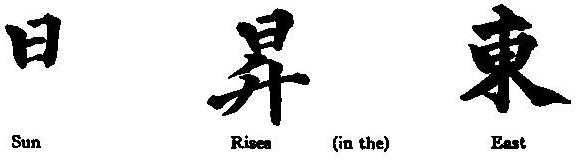
The sun, the shining, on one side, on the other the sign of the east, which is the sun entangled in the branches of a tree. And in the middle sign, the verb "rise," we have further homology; the sun is above the horizon, but beyond that the single upright line is like the growing trunk-line of the tree sign. This is but a beginning, but it points a way to the method, and to the method of intelligent reading.