SECTION II.
Reading edition
Influenza Epidemics Since 1893.
In this section of our report we will describe with as great accuracy as our sources of information will permit, and in as great detail as space will allow the events which have led up to the epidemics of 1918–20 and the various phases of the epidemics themselves. Points of similarity with previous epidemics will be made obvious; the differences, when of significance, will be described and studied in detail.
Occurrence Since 1893.
Attempts even today to determine when and where influenza has prevailed in the world since the great pandemic of the last century are met with great difficulties. There are several reasons for this, chief among which is the absence of definite characteristics by which the disease may be recognized. The isolated solitary case baffles positive diagnosis. Nearly every year there are reports in the literature of small outbreaks in institutions or communities in which the clinical picture is that of epidemic influenza. As a rule the conclusion has been in these cases that because the bacteriologic findings did not show a predominance of Pfeiffer’s bacillus the epidemic was not true influenza. This is particularly true in the outbreaks in which the streptococcus predominated. Today our views concerning the bacteriology have changed distinctly, and I believe it is safe to say that the predominance of a streptococcus in a local epidemic in no way rules out influenza, and that the only criteria by which we may judge are the clinical picture and the evidence of high infectivity, together with the epidemiologic characteristics of the local outbreak.
Period 1893–1918.—A review of the medical literature between 1889 and 1918 gives one a certain impression which may be summarized as follows: Between 1890 and 1900 the disease was in general more highly prevalent in most localities than at any time during the preceding thirty years. At no time during this decade did the annual death rate from influenza in England and Wales fall to anywhere near the figures that had prevailed consistently between 1860 and 1889. Between 1900 and 1915 there was a gradual diminution, but still not to the extent that had prevailed previous to 1889. Since 1915 there appears to have been a gradual increase. During the entire period there has been difficulty in distinguishing between the disease in 48question and other respiratory tract infections, particularly coryza, sore throat, tonsillitis, and bronchitis. Many of the local epidemics which appear probably to have been true influenza have had associated with them a high incidence of sore throats. We describe this as sore throat, rather than tonsillitis, because the clinician remarks that although the throat is sore there is little if any demonstrable inflammation of the tonsils.
Chart VIII published by Sir Arthur Newsholme, showing the death rate per million of population from influenza in England and Wales gives some idea of the prevalence of the disease in the first part of the interpandemic period in those countries. It should be remarked that the record is for deaths from influenza only.
For records in this country it is convenient to refer to the death rate in the State of Massachusetts; first, because the records in that State have been carefully kept for a long period; and second, because influenza has been carefully studied in this State during both epidemics by two most competent epidemiologists. For the period preceding 1889 we quote herewith from Abbott:
“For the past 45 years or more, or during the period of registration which began with the year 1842, no epidemic of influenza has prevailed within the State to such an extent as to have manifested itself in any serious manner in the annual lists of deaths. An examination of the registration reports for each year since 1842 shows that in no year were recorded more than 100 deaths from this cause; the highest number from influenza in a single year (92) occurred in 1857, and the least number (8) in 1884. The average annual number of deaths from this cause reported in the State for the period 1842 to 1888 was 38. The average number during the first half of this period was greater than that of the last half, especially when considered with reference to the increase of population. From these statistics of nonepidemic influenza between the years 1842 and 1888 it appears that its greatest prevalence, or rather the years in which the mortality from this cause was greatest, were also years of unusual mortality from pneumonia, and in some instances from bronchitis.”
Frost has charted the death rate per 100,000 from influenza and from all forms of pneumonia in Massachusetts by month, from 1887 to 1916. From it he concludes that the epidemic of 1889–1892 developed in three distinct phases, the first culminating in January, 1890, the second in April and May, 1891, and the third in January, 1892. The mortality was higher in 1891 than in 1890, and still higher in 1892, while in 1893, although there was no distinct epidemic, the pneumonia mortality for the year was even higher than that of 1892. Frost remarks that this corresponds to the experience in England, and that it apparently represents the general experience in other countries (see charts IX and X).
CHART VIII.
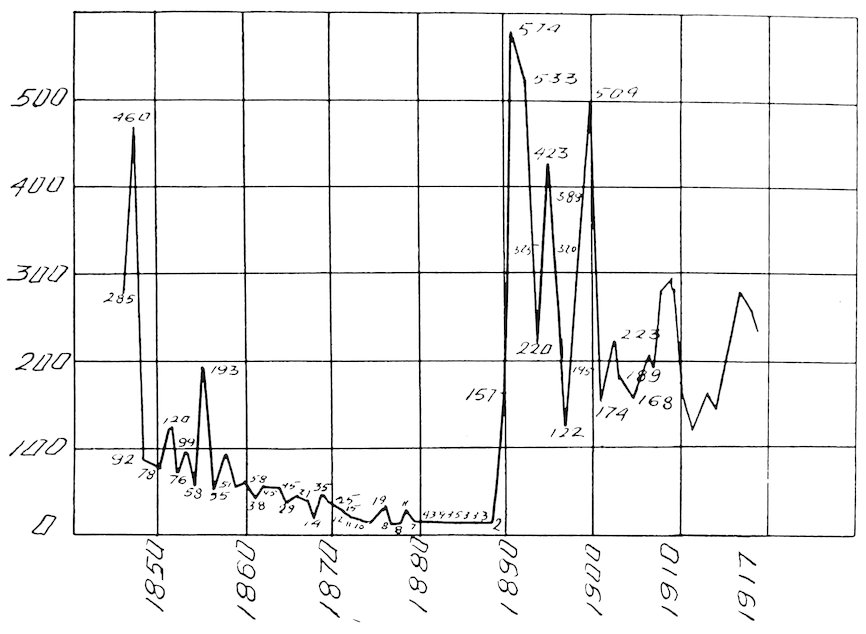
Death rates per million from influenza in England and Wales from 1845 to 1917. (Newsholme.)
CHART IX.
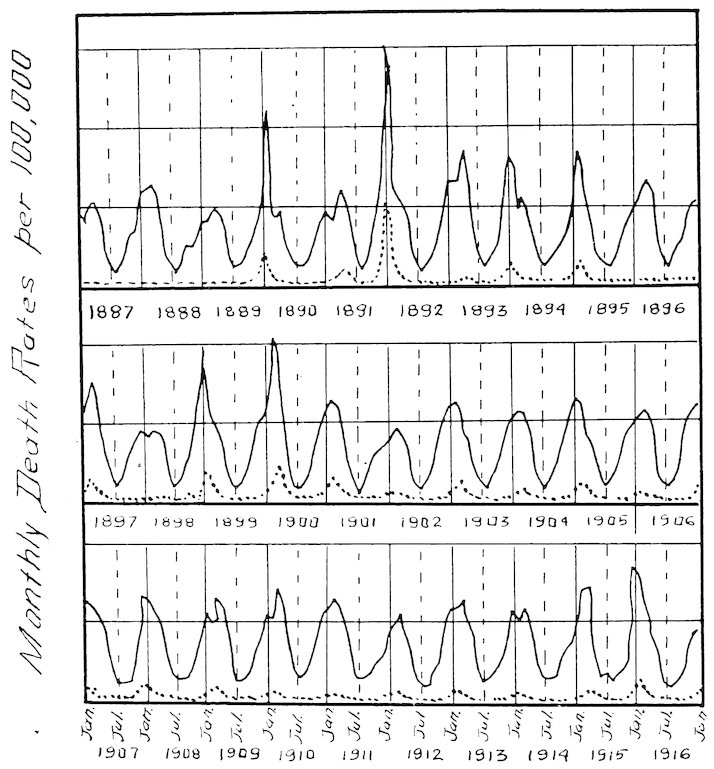
Monthly death rates per 100,000 from influenza and from pneumonia in Massachusetts from 1887 to 1916. (Frost.)
CHART X.
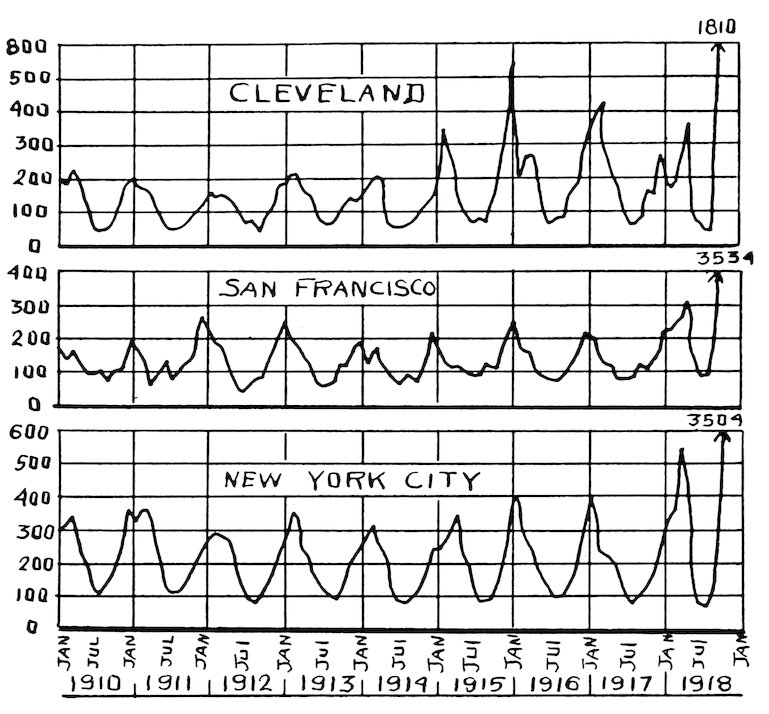
Monthly death rates per 100,000 from influenza and pneumonia in three cities of the United States from 1910 to 1918, inclusive. (Frost.)
49In the absence of comparable statistics for Massachusetts in 1917 and 1918, Frost has studied for those years certain other localities, particularly Cleveland, San Francisco and New York City. The mortality in all of these places, as well as in Massachusetts, was fairly regular from 1910 to 1915, but in December of the latter year and January of 1916 there occurred in New York and Cleveland a sudden sharp rise in mortality. This was not shown distinctly in the San Francisco curve, but it was a rise which was almost universal and synchronous over the entire registration area. It is of interest as indicating the operation of some definite and widespread factor, and suggesting in this group of diseases an epidemic tendency which is perhaps, as Frost remarks, not sufficiently appreciated. In January of 1916 he found that influenza was reported to be epidemic in twenty-two states, including all sections of the country. The epidemic was very mild. In the early spring of 1918 there was another sharp rise, which we shall discuss in greater detail later.
Increase in 1900–1901.—Reference to Frost’s chart for Massachusetts shows that there was also a rise in the curve around 1900. At this time influenza was quite widely disseminated. Early in 1901 the Marine Hospital Service made a canvass of all the states and several foreign countries to determine the epidemic prevalence of influenza. The results of the canvass were published in the Public Health Reports. The records lack the detail, particularly in the description of clinical symptoms, that is desirable in arriving at an identification, but the universal agreement from all individuals reporting, in the comparatively high morbidity and remarkably low mortality, together with the widespread distribution, and the duration of the local epidemic leaves little doubt as to the identity.
Influenza was reported present in October of 1900 in Los Angeles, Milwaukee and New Orleans. In November it became prevalent in Toledo and Cincinnati and in New York City. In December the disease was present in Chicago, Albany, Philadelphia, San Francisco, Denver, Baltimore, Grand Rapids, Columbus, O., Portland, Me., Detroit, Albuquerque and Omaha. In January it was reported in New Haven, Boston, Washington, D. C., Indianapolis, Louisville, Ky., Wilmington, Del., Portland, Ore., and Juneau, Alaska.
Although the disease was mild, in some localities a high proportion 50of the population was attacked. Thus in New Haven it was estimated that 10 per cent. developed the disease, and in Los Angeles 20 per cent., while in Wilmington, 40,000 were estimated to have become ill. In certain small towns in Texas the incidence was especially high. In Pittsburgh, Texas, ten per cent.; Laredo, 15 to 20 per cent.; Hearne, 50 per cent.; and El Paso, 50 per cent. were attacked. The duration of the epidemic in most localities was from four to six weeks.
Thus we see that in October, November and December of 1900 and January of 1901 there was a widespread epidemic affecting all parts of the United States. Many additional records in the Public Health Reports coming from small towns have not been included in this summary.
At the same time an attempt was made to determine the prevalence in foreign countries and letters were sent to the various United States Consulates. It was discovered that the disease was mildly epidemic in Denmark in October, in Berlin in November, in Cuba, British Columbia, Ontario, Egypt, Paris, Mexico and the West Indies in December; in Flanders, Porto Rico, Honolulu, in January of 1901; in Malta in February, 1901; and in London and Ireland in March of that year. The following countries reported that they had no influenza at the time: Windward Islands, Jamaica, Bahamas, Brazil, India, Colombia, Costa Rica, Ecuador, Honduras, Persia, Philippine Islands, Spain, Switzerland. The disease was reported as being not of epidemic prevalence in the following localities: Marseilles, Paris, Bremen, Hamburg, Mainz, Stuttgart, Bristol, London, Liverpool, England as a whole, Scotland, Amsterdam, Naples, Constantinople.
Reports from Switzerland and from Brazil stated that there had been no influenza since the pandemic period 1889–1893. The death rate per 100,000 in Glasgow from influenza for 1896 was recorded as six; for 1897, twelve; for 1898, fifteen; 1899, twenty-two and for 1900, twenty-seven.
The disease was present in Lima, Peru in March, 1900, and at Malta in the same month. In Prague it was stated that ten per cent. of the population had been attacked in the winter of 1901. In Sivas, Turkey, fifty per cent. of a population of 50,000 were estimated to have been taken ill within the winter months. It was reported from Valencia, Spain, that there had been four or five visitations of influenza since the preceding pandemic, each recurring invasion presenting a milder and less expansive form than its predecessor. Very few deaths had been recorded as directly due to influenza, but an increased mortality followed the epidemics. In normal times the average mortality was ninety deaths per week. After a visitation of influenza the number 51had increased to as much as 160 per week. The population numbered 204,000.
Period from 1901 to 1915.—Between 1900, with its wide distribution of a very mild influenza, and 1915, there is very little mention of epidemic prevalence of the disease. References which appeared in the Public Health Reports during the interval are characterized chiefly by their brevity, and by the absence of descriptive detail. They should nevertheless be included.
In October of 1901 there was some increase of the disease in the Hawaiian Islands, 110 cases being reported on the island of Kauai.
At the same time, C. Williams Bailey reported a mild form of influenza existing in Georgetown, S. C., which was first considered to be hay fever in consideration of the presence of the rice harvest season, but which was finally decided, after careful investigation, to be true influenza.
On July 21, 1902, the U. S. Consul at Canton, China, telegraphed that influenza “was almost epidemic, plague sporadic in Canton.”
In 1903 the disease was reported as apparently prevalent at New Laredo, Texas.
Surgeon Gassaway, of the Marine Hospital Service, reported from Missouri, December 14, 1903, as follows: “There is a very decided increase in the number of cases of influenza in this vicinity. Two have been admitted within the last few days to this hospital, and several cases have appeared among the patients under treatment. In these cases the onset is sudden and the disease appears principally, at least at first, to be confined to the nose and throat.”
Measles and influenza were reported prevalent in Barbados, West Indies, during the month of December, 1904.
Sturrock describes a quite typical local epidemic in a British institution in 1905.
Influenza was epidemic in Guayaquil and various other places in Ecuador during the months of June and July, 1906.
Selter speaks of a true local epidemic of a disease clinically resembling influenza which occurred in 1908 and extended over the territory from France to the Rhine.
Hudeshagen mentions having examined bacteriologically cases of influenza in the year 1914.
Ustvedt relates his experience at the Ullevaal Hospital up to September, 1918. Since 1890 there had been cases reported every year from the high marks of 10,461 cases in Christiania in 1890 and 5,728 in 1901 to the lowest figure, 138 in 1906. “The cases listed as influenza in the last few years may have been merely a catarrhal fever. 52This is the more probable as the cases were restricted to the winter months, while influenza usually occurs at other seasons.”
Jundell believes that influenza is endemic at Stockholm, Sweden, hundreds of cases being reported there each year. During the years 1912–1919 Pfeiffer’s bacillus has been found in ten per cent. of those cases in which the diagnosis seemed certain.
A current comment in the Journal of the American Medical Association in 1912 remarks that epidemics of coryza, sore throat, and bronchitis usually have been called influenza or grip because of the characteristic contagiousness and the infectivity, the persistence of the symptoms, and the tendency to prostration and mental depression. But this diagnosis has not been satisfactorily confirmed by bacteriologists. An epidemic according to the Journal, which occurred in Boston and which was called sore throat, was studied by Richardson and others. They traced the contagion to a streptococcus which apparently was spread by means of milk. Müller and Seligman had recently carried out a study of an influenza epidemic among children in Berlin and concluded that the causative organism was a streptococcus, differing so much from the ordinary germ that they used the term “grip streptococcus.” Davis and Rosenau, according to the comment, had made a bacteriologic study of a recent epidemic of sore throat in Chicago, and had demonstrated as the exciting agent a streptococcus of peculiar characteristics, which in many respects resembled the organism described by Müller and Seligman. The Journal noted that these three epidemics occurring during the years 1911 and 1912 in widely separated communities were all caused by the streptococcus, and cautioned against the proneness to call all such epidemics grip. Today the predominance of the streptococcus would not necessarily rule out influenza in our minds.
In the winter of 1913, C. L. Sherman had occasion to study carefully fourteen cases of so-called influenza in the vicinity of Luverne, Minnesota. Bacteriologic smears and cultures were made from the throat and sputum in all cases. Bacillus influenzae was found in two of the fourteen; pneumococcus in four and streptococcus in all. Tubercle bacilli were found in one case. The onset of the disease was invariably abrupt. The fever in all cases ranged between 101° and 104°; symptoms indicative of infection of the upper respiratory tract were always present. There was more or less sore throat in all. There was either cough at the onset or else it appeared within 48 hours. Headache was complained of by twelve of the fourteen; pains in the back and in the limbs by thirteen, and nervous symptoms by 53six. Prostration out of all proportion to the fever and other symptoms prevailed. Two developed an otitis media and the streptococcus was isolated from the purulent discharge in both cases. One patient had a complicating empyema, and one an acute arthritis. Sherman also concluded that we are prone to call too diverse diseases influenza.
Walb stated in 1913 that at Bonn during the preceding years there had been numbers of cases of a febrile affection which seemed to be typical influenza, but for which the pneumococcus appeared to be responsible. They were never able to isolate the influenza bacillus, and according to their statement the Hygienic Institute at Bonn, as well as that at Berlin, had not “encountered an influenza bacillus within the preceding ten years.”
C. T. Mayer described in 1913 a case of influenza in Buenos Ayres which is of particular interest in view of one of the symptoms, cyanosis, which was so prominent a feature in 1918. This appears to have been an isolated case. The diagnosis wavered between miliary tuberculosis and pneumonic plague, because of the high fever and intense cyanosis, with nothing to explain the cyanosis on the part of the heart. There were signs of severe congestion of both lungs, and notable enlargement of the spleen. Bacteriologic examination was negative except for the presence of Bacillus influenzae and Micrococcus catarrhalis. The patient subsequently improved rapidly, and the lungs were entirely normal after thirty days, thus ruling out the other two diseases.
A London letter to the Journal of the American Medical Association dated February 5, 1915, runs as follows:
“Since the outbreak of the war the public health has been remarkably good, but the record is now being threatened in the case of London, at any rate, by an epidemic of influenza.
“The gastric symptoms which distinguished last year’s epidemic are absent. The disease is most infectious. Whenever it has seized the individual it has usually run through the entire household.
“Whole offices have succumbed, and as the mildness of the attack lures the sufferer to continue his normal occupation, the disease has a full opportunity of extending. A large number have resulted in pleuro-pneumonia; otherwise the chief symptoms are headache, fever, tonsillitis.”
Telling and Hann describe another clinical diagnosis of influenza, the diagnosis being concurred in by Sir James Goodhart and Sir Clifford Allbutt. The onset was absolutely sudden at a supper party on November 10, 1912. The patient had a slight rigor, and was 54compelled to go to bed. In the night he had a longer and more severe rigor, with a temperature of 103°. On the following morning he dressed, but another chill sent him back to bed with a temperature still 103°, pulse 110, regular, and remarkably dicrotic. There was no cough and no sore throat. Another chill occurred in the evening. On November 12th the patient had two chills, the temperature remaining steadily at 103° to 104°. The patient complained much of nausea but did not vomit. On November 13th the temperature remained up, there was no chill on this day; the spleen was large and easily felt for the first time. On the 14th note was made that there was no headache. On the 15th, 16th and 17th the temperature began to fluctuate. On the 18th there were two severe rigors, and by the 19th the temperature suddenly fell to normal, with drenching sweat. Throughout there was nothing to suggest pneumonia, and typhoid fever appears to have been successfully ruled out.
An epidemic of influenza which prevailed in the city of Pittsburgh, Pennsylvania, from December to February of 1907 and 1908, has been described by J. A. Lichty. He says that the epidemic was as widespread, though probably not quite as severe, as the pandemic of 1889. Whole families, including servants and all associated with the household, were afflicted in rapid succession. The onset was sudden and severe, the usual symptoms of pain, all over, being most pronounced. The temperature did not go unusually high, nor did it seem to be in accord with the severity of the symptoms when the patient took to his bed. In typical cases the attack lasted from two to three or four days. Peculiar to this epidemic seemed to be the general complaint of sore throat. Upon examination the throat rarely showed any other evidence of an abnormal condition than a rather dark cyanotic blush, which was most intense over the tonsils and faded out over the roof of the mouth. This was rarely associated with any swelling or fever. Sinusitis and otitis media seem to have been the two most frequent complications. The disease appeared to be particularly fatal for chronic invalids. It was highly contagious. Many of those physicians who were frequently exposed to the disease fell victims.
At the same time C. H. Jones described an epidemic of the same disease in Baltimore. The symptoms were described as headache, backache, limb-ache, with a slight elevation of temperature, seldom more than 102°. Catarrhal symptoms developed secondarily and were not so prominent a feature as in former epidemics. There were some gastric symptoms, usually consisting of vomiting and nausea. 55Jones quotes no statistics, but feels sure that the infection was more extensive than at any period since 1895.
Coakley and Dench describe throat and ear complications as they saw them in New York. From this we may assume that the disease was present at the same time in New York City.
The following chart, derived from the U. S. Vital Statistics Report shows the increase in the death rates from influenza in 1900 and 1901; that of 1907 and 1908, and finally an increase to 26.4 per 100,000 in 1916, which reflects the epidemic beginning in the latter part of 1915:
Influenza and Pneumonia Mortality in the United States Registration Area for Each Year Since 1900.
Year. Annual death rates per 100,000.
Pneumonia. Influenza. Combined diseases.
1900 158.6 22.8 181.4
1901 133.5 32.2 167.7
1902 124.7 10.1 134.8
1903 122.6 18.5 141.1
1904 136.3 20.2 156.5
1905 115.7 18.8 134.5
1906 110.8 10.3 121.1
1907 120.8 23.3 144.1
1908 98.8 21.3 120.1
1909 96.3 13.0 109.3
1910 147.7 14.4 162.1
1911 133.7 15.7 149.4
1912 132.3 10.3 142.6
1913 132.4 12.2 144.6
1914 127.0 9.1 136.1
1915 132.7 16.0 148.7
1916 137.3 26.4 163.7
At best our information for these years is unsatisfactory. It is greatly to be desired that individuals who have access not only to the current medical literature, but also to the vital statistics and other records for all countries possessing reliable records, and who are versed in the newer mathematical methods of demography, establish definitely the influenza prevalence and distribution during these interpandemic years. The difficulty in this work is that mortality statistics are unreliable and morbidity statistics are lacking.
Influenza in 1915–1916.—Until the end of 1915 there was no widespread distribution in the United States similar to that of 1900 and 1901, but at that time there developed a widespread epidemic in this 56country of similar or possibly slightly greater severity than that of fifteen years previously. Reference to the last table will show that during 1916 the annual death rate from influenza as reported in the United States Vital Statistics reached the rate of 26.4 per 100,000. According to V. C. Vaughan the literature of that time shows that this epidemic originated in the West, first attracting attention at Denver, and gradually spread over the country.
Dr. Dublin of the Metropolitan Life Insurance Company gives the following table in which the deaths from influenza and pneumonia during the months of December, 1914, and January, 1915, are compared with deaths from the same cause during the months of December, 1915, and January, 1916:
Name of city Deaths reported as due to influenza. Deaths reported as due to pneumonia.
In 1915–16. In 1914–15. In 1915–16. In 1914–15.
Baltimore 57 12 219 101
Cincinnati 81 2 105 84
New Orleans 97 44 35 29
New York 494 62 2,067 1,207
Philadelphia 324 62 564 272
Providence 38 3 31 31
Total 1,091 185 3,021 1,724
Dublin states that the Industrial Department of the Metropolitan Life Insurance Company, covering the entire country and embracing ten millions of people, had deaths in the periods above mentioned, as follows:
In December, 1914, and January, 1915, the number of deaths attributed to influenza was 165
While in the corresponding months of 1915–1916 the deaths attributed to influenza were 957
The deaths attributed to pneumonia in December, 1914, and January, 1915, were 1,468
While the number of deaths attributed to the same cause in December, 1915, and January, 1916, were 2,563
Coffey and others have reported an epidemic of influenza at Worcester, Mass. during the first three weeks of January, 1916. During the first three weeks of January, 1915, there were reported in that city twenty-two deaths from respiratory diseases, making a total of 14.9 per cent. of the total deaths. In the same period of 1916 there were reported ninety-three deaths from acute respiratory diseases in the same population.
57Two of the more complete descriptions of the epidemic of the year 1915–16 are those by Mathers, and by Capps and Moody. Mathers reports that: “During the winter of 1915–1916 the United States was visited by a severe epidemic of acute respiratory infections which resembled in every detail the great epidemic of 1890. This outbreak was apparently first noticed in the Middle Western States, and it spread rapidly over the entire country, taking a heavy toll of human life. December and January were the months in which these infections were most prevalent, and the epidemic had almost completely lost its impetus by March, 1916. During the height of this epidemic in Chicago, sixty-one cases of the disease were studied bacteriologically, and the results form the basis of this paper.”
Mathers found hemolytic streptococci in forty-six instances, in all of which they predominated. Green producing streptococci were found thirty times, with one pure culture, and pneumococci thirty times with four pure cultures. Staphylococci were isolated in fifty cases; Micrococcus catarrhalis in six, and Friedländer’s bacillus in one case. The influenza bacillus was found in only one instance, and then in small numbers. The majority of the patients were studied early in the course of the disease, and in the earliest, hemolytic streptococci were almost constantly found, especially in the throat. In the atypical pneumonia which followed many of the attacks of grip, hemolytic streptococci predominated. In none of these was the Bacillus influenza found.
Mathers reported that coincident with the epidemic among humans there was an epizootic of so-called influenza among horses. The symptoms are very similar to that of the disease among humans. He isolated a streptococcus as the predominating organism in the horses. The streptococci from human and equine sources, although similar in many characteristics, differed widely in pathogenicity, and seemed to be highly parasitic for the specific hosts.
Capps and Moody found that in man most cases began rather abruptly, with coryza, pharyngitis, laryngitis, or bronchitis.
“The chief complications were inflammation of the accessory sinuses of the head, and bronchopneumonia, the latter being responsible for most of the fatalities. None of these symptoms taken alone would justify the distinctive name of grip. But the widespread and almost simultaneous onset of this fairly uniform symptom group and the rapid cessation of the epidemic after a few weeks reminded physicians generally of the great grip pandemic of 1889–1890. This resemblance was further strengthened by the unusual prostration lasting days or 58weeks after even mild attacks. The older practitioners can recall no similar epidemic during the twenty-five years intervening between 1890 and this year. The numerous epidemics of septic sore throat have all been entirely different in their symptomatology, and all were restricted to certain localities. The term “grip,” therefore, seems justified from a clinical standpoint.
“The public health reports offer evidence of an unusual prevalence of pneumonia in the larger cities. Nicolas calls attention to the fact that the incidence of grip was greatest in those cities in which the mortality from pneumonia was most strikingly increased.”
Capps and Moody found that as a rule the white blood counts in the individuals sick with influenza were 10,000 or less. A number showed true leucopenia. Less frequently there was a leucocytosis up to 15,000 or higher.
Influenza between 1916 and 1918.—Zinsser cites Dr. George Draper, who believes that he observed at Fort Riley in the winter of 1917 epidemic cases of influenza. He believes that for Europe too there is evidence that influenza was endemic during the years preceding the great outbreak, and that a number of minor epidemic explosions had occurred in the years just preceding 1918:
“MacNeal who has investigated military reports particularly, states that small epidemics occurred in the British Army in 1916 and 1917. A chart constructed by him from the American Expeditionary Force reports shows that a considerable rise in reported influenza cases took place in November and December, 1917, and in January, 1918, gradually declining toward spring. MacNeal, compiling the data available in the office of the Chief Surgeon, A. E. F., states that the influenza morbidity reported per 100,000 for succeeding months in 1917, were as follows:
July 321
August 438
September 404
October 1,050
November 1,980
December 2,480
“Robertson, who studied many of the secondary pneumonias which came to autopsy at this time found an unusual type of lobular pneumonia in which Pfeiffer bacilli were frequently found. In many of these cases the organisms could be obtained from the nasal sinuses and antra. Similar findings were reported by British bacteriologists (Hammond, Rolland and Shore, and Abrahams, Hallows, Eyre and 59French), who studied the cases that occurred in the reports by Austrian physicians in reference to outbreaks of typical influenza on the Austro-Russian front early in 1917.
“There seems little doubt, therefore, that for some years before the pandemic of 1918 influenza was endemic in many parts both of Europe and of America. As early as 1915–1916 Frost finds evidences of limited epidemic outbreaks in the United States. During the winter immediately preceding the true beginning of the pandemic small outbreaks occurred among the allied troops in France, the British troops in England and probably among American troops gathered in home concentration camps as well. MacNeal in a summary of the conditions prevailing among American troops in France concludes that epidemic influenza in that country originated from the endemic foci there existing, and that the disease was probably carried from Europe to the United States by shipping. The former assumption; namely, that the epidemic occurrence of the disease may have been due to the fact that an enormous and concentrated newly introduced material of susceptibles may have been lighted into flame at the numerous endemic smoulders, may well be correct. The latter, however, concerning the transportation of the disease from Europe to America may justly be questioned. For, in the first place, Frost’s studies have shown that prepandemic outbreaks were quite as frequent in the United States as in Europe during 1915 and 1916, and, though we have no proof of this, there is reason to believe that influenza was prevalent in concentration camps during 1917.”
Carnwath, after remarking that the epidemic began in the British Army in France in April, 1918, says that according to the reports of the Influenza Committee of the Advisory Board this was not the first time that Pfeiffer’s bacillus had appeared in the armies. On the contrary, it had frequently been found in cases of bronchopneumonia, especially during the winter of 1916–1917. It is doubtful, however, whether much importance, from the epidemiologic point of view, attaches to these sporadic findings of the Pfeiffer bacillus.
Influenza was reported in the year 1917, but this year, as well as the epidemic of 1916, becomes involved in a determination of the date of onset of the great pandemic of 1918.
The Pandemic of 1918.
The date and site of onset of the great pandemic are subjects concerning which there is no conclusive information. There have been small outbreaks of clinical influenza with epidemic tendencies at one 60place or another during nearly all of the intervening years since 1889. In all of them the question is open as to whether they were true influenza, and also assuming that some were true influenza, how many of them should be so included. There are some who believe that the increase of morbidity following the measles epidemic in the United States Army camps in the winter of 1917–18 is genetically associated with the great pandemic. In short, there is no one point in the last few years at which we may say that influenza which had previously been non-existent started at a focus and spread throughout the world.
It follows from the experience of 1889 that we should at least attempt to find an endemic focus and to follow the progression of the disease. It is safe to say that once having become pandemic the disease spread as it did thirty years previously. Experience in this country, where the autumn spread began in the New England States and continued West and South; knowledge of the late spread to remote localities; the fact that the disease first appeared in England, etc. in sea coast towns; the introduction of the influenza into new countries at seaport towns, after the arrival of infected ships, all coincide well with the past history.
But which of the several local epidemics of the preceding years was the direct progenitor of the great pandemic? In order to follow more clearly the development of the facts we will record here the various hypotheses that will come up for consideration as to the site of origin of the disease.
1. Influenza is endemic in some one locality, such as Turkestan in Asia, from which place the disease spreads throughout the earth at intervals, after having acquired in some way greatly increased virulence. The local outbreaks of interepidemic times are not due to the virus which causes the great pandemics and should be called pseudo-influenza in contrast to influenza vera. Following the pandemic it is true, however, that for a succession of years local outbreaks occur, due to the pandemic virus which has been left deposited in small endemic foci. These disappear in the course of a few years.
2. The second hypothesis is similar to the first, except that in it is considered the possibility of there being more than one endemic focus, at least two, one in the old world and one in the new. Although Leichtenstern believed in the first hypothesis he did not deny the possibility of the second.
“There have been in the past several well described influenza epidemics limited to North America. Furthermore true pandemics have occurred at the same time in North America and in Europe. We 61can suggest the hypothesis that there is a permanent endemic focus, just as in central Asia and Russia, existing in the southern part of North America. The following facts concerning the last pandemic period favor this idea.
“As early as May, 1889, influenza began in Athabasca (British North America) and in the summer of 1889, in Greenland. It is especially interesting to hear of an extensive influenza epidemic which in the middle or toward the end of December, 1889, broke out in the Northwest Territory of British North America, in Manitoba, in the Island of Vancouver, similar to that in the east of Canada and Quebec. A spread of the epidemic, which attacked Boston and New York on December 17th, to the above territories, far away and connected by very poor transportation facilities, is certainly improbable, especially in consideration of the time at which the two epidemics occurred.
“We are told that the invasion and the outbreak of influenza in these vast territories occurred at practically the same time at such widely separated places as Fort MacLeod, Saskatchewan, Prince Albert and other military posts, and furthermore in isolated Indian camps and tribes between which there was little or no communication.
“These facts also indicate that we are considering primary endemic pandemics analogous to the one which broke out in July, 1889, in Central Asia.”
3. The virus of influenza is more or less uniformly distributed throughout the world. We may say that it is endemic in many localities, as is the case with the meningococcus. Quite frequently in one locality or another the virus acquires increased virulence and causes a small local epidemic which may even spread to adjoining territories. It is possible that the virus in two or more separated localities may become more invasive simultaneously, thus causing widely separated and unrelated outbreaks. As a rule the virulence does not become so great as to cause a true pandemic, but at rare intervals, usually of decades, or thereabouts, the epidemic virus becomes so greatly enhanced, perhaps from passage to new territory and through non-immune individuals, that it eventually commences on its wild career around the earth. Perhaps the pandemic variety usually comes from one particular locality among the many endemic spots. Perhaps always from the same locality or perhaps at times even simultaneously from many different ones. It is possible even that an increased virulence develops simultaneously in all localities. This third hypothesis develops into a discussion as to whether the small interpandemic epidemics are true influenza or some other disease.
62Again, Leichtenstern, although he does not favor it, recognizes the possibility of this theory:
“Whether the small local epidemics reported by Kormann in Coburg in 1878 and by O. Seifert in Würzburg in 1883 are the same as the true epidemic influenza is at present uncertain. Some of the complications, such as swelling of the neck glands, and especially frequently parotitis, purpura, scurvy, indicate that the epidemic in Russia, in 1856–1858, reported by Kasin, was not the true influenza.
“When W. Zülzer writes in 1886 of an epidemic in Berlin in which many thousands of individuals were attacked, the question might arise, is this the same influenza which three years later passed through the entire world and which in Berlin was believed by the same physicians to be a new disease?
“The evidence is better in the case of the epidemic reported by von den Velden in 1874–75. First, because of the complication with pneumonia and especially because at the same time the disease sprang up in several places in France, South Germany and the Rhine Provinces. It is very doubtful whether epidemics described in 1855 and 1862 in Iceland, in 1870 in Philadelphia, in 1875 in Scotland, in 1876 in the Fiji Islands, in 1887 in several places of England, in October, 1889 in Natal, in November, 1889 in Jamaica and Prince Edward Island, was the true influenza, even though the complications of pneumonia in the last named epidemics favor this assumption. As regards the influenza epidemic which attacked specially the school children of Pleshey and Great-Waltham and from which fifty per cent. became ill in November and December, 1889, whereas the pandemic was known to have begun there in January, 1890—the high percentage of school children that were attacked renders the conclusion that this was influenza very doubtful.
“It is an entirely different matter concerning the last epidemic in which the epidemiologic compilations, based on retrospective diagnoses suggest that in many places of Germany the ‘first case’ of even small epidemic outbreaks was observed as early as the summer and autumn of 1889; in other words, several months before the outbreak of the true pandemic in December.”
Leichtenstern believed that the so-called catarrhal fever and epidemics of “cold” which some have been accustomed to call grip or influenza are not the true disease, although he admits that there is no pathognomonic sign by which the diseases may be differentiated. He expected that search for the influenza bacillus which had recently been discovered would enable investigators to determine by its 63presence or absence whether or not these local epidemics are true influenza.
This, of course, would depend on the proof that the influenza bacillus is the cause of the disease. If the many local influenza outbreaks which Hirsch has collected in his exhaustive historical tables are the same disease as true influenza, then the picture of influenza must be considered as rather protean. Leichtenstern adds that this is a possibility which from present information we cannot deny. He writes: “If such is the case we must give the following epidemiological definition of influenza: Influenza is a specific, infectious disease usually occurring epidemically which, however, is endemic over the entire earth, as indicated by outbreaks of cases, and which, after years and decades have passed, breaks out in epidemic proportions. It is recognized nearly every year in one or another place on the earth where it becomes epidemic. From time to time from some point or center, or from several points, as for instance simultaneously in the old and new world, and for reasons unknown to us, an enormous increase in virulence of the specific virus occurs and with it a great increase in the contagiousness of the disease. Those are the times when influenza spreads in mighty epidemics over wide stretches of land and portions of the earth, or over the whole earth. Our common epidemic influenza or grip, occurring practically isolated or in very small outbreaks, belongs to the same type of disease as the pandemic variety, but is due to a mitigated form of the causative organism, one of decreased virulence and of shorter viability.
“Provisionally, however, we will hold until the proof has been obtained by bacteriological methods that influenza nostras and influenza pandemica are two entirely different diseases, just as are cholera nostras and asiatica. Accordingly, we will divide the diseases designated as influenza in the following way:
“1. Influenza vera, caused by the Pfeiffer bacillus.
“2. The endemic-epidemic influenza vera which arises from the germ remaining after the spread of the influenza pandemic and which is caused by the same germ, the bacillus of Pfeiffer. The duration of this endemic state of influenza vera may last years in single localities.
“3. The endemic influenza nostras, or pseudo-influenza or catarrhal fever, commonly called grip, a disease sui generis. The germs causing this disease are at present as little known as are those of cholera nostras.”
Parkes, in 1876, recognized these possibilities: “The exact spot has not been made out. Two opinions prevail. First, one focus; 64second, many foci. Each nation, in turn, attributes the disease to its neighbor and from the names so given one can follow the direction of the epidemic.” Noah Webster believed that in 1698, 1757, 1761 and 1781 it originated first in America. Hirsch believed that some of the epidemics had probably originated in North America.
We find then that after the pandemic of the last century the same epidemiologic questions had arisen that have come into such prominence during the present period. As a rule those who have quoted the epidemiologists of 1890 to 1900 have mentioned the first hypothesis and have failed to allude to the fact that the other two were considered. So we see that the subject was by no means settled even at that time, and that if we should discover that the 1918 pandemic cannot be traced to a single endemic focus our results will not be absolutely contradictory to those of the last century.
Returning to a consideration of the period 1916–1918, we observe from reference to Frost’s diagram that in the spring of 1918 there was a sharp and general rise in mortality from influenza and pneumonia. Frost reports that in the larger cities on the Atlantic seaboard this increase occurred generally during January, February and March, when pneumonia mortality normally reaches its maximum. The increase was not so evident in all these cities as it was in New York City. In the rest of the country, especially in the Central and Western States, the increase occurred in April, a month during which pneumonia mortality is generally on the decline, and was sufficient to constitute an unmistakable departure from the normal. The increased mortality rate extended quite generally into May and in some areas still longer. This is the first increase after 1916 that is pictured in the mortality statistics for the country at large.
There are some who believe that they saw influenza in mild form in the United States army in the year 1917. V. C. Vaughan has investigated this possibility and from a study of the sick and wounded charts decided that there was no relation between influenza and the pneumonia which was prevalent in 1917, and which usually was secondary to measles, being caused by the streptococcus in the majority of localities. The lack of association between influenza and pneumonia in 1917 and the direct association in 1918 is well brought out by a comparison of the figures in the two following charts, prepared by V. C. Vaughan:
65
Pneumonia as a Sequel to Respiratory Diseases.
(All troops in United States in 1917.)
Primary diseases. No. of cases. No. of cases followed by pneumonia. Per cent. of cases followed by pneumonia.
Measles 47,573 2,075 4.37
Scarlet Fever 1,966 54 2.75
German Measles 8,982 39 0.43
Bronchitis 41,233 20 0.049
Influenza 32,248 19 0.059
Meningitis 1,027 13 1.27
Tonsillitis 43,021 7 0.016
Pulmonary tuberculosis 6,799 6 0.088
Laryngitis 4,633 2 0.043
Diphtheria 1,163 1 0.086
Mumps 21,725 0 0.000
Pharyngitis 8,096 0 0.000
Influenza and Pneumonia in Last Four Months of 1918.
Number of cases of influenza 338,343
Number of cases of influenza followed by pneumonia 50,700
Number of deaths from influenza-pneumonia 17,700
Stallybrass, who has studied the influenza and pneumonia deaths in Liverpool, England, since the 1889 pandemic, states that in every year there had been reflected in the curves evidence of periodic increase in deaths from influenza and pneumonia, and he states that from 1914 onward there has been a progressive increase in the annual number of influenzal deaths with the single exception of 1917.
It becomes evident that we cannot with the information at hand find any one locality in which the disease was prevalent sufficiently ahead of the pandemic and to the exclusion of other localities, so that we might determine accurately the site of origin. The next step will be, then, to discover as accurately as possible the date at which various communities were first definitely attacked by the great pandemic, and to search out the locality first affected.
Date of First Increased Prevalence in Various Localities.
From table II which gives the earliest recorded dates of increased prevalence in different localities, we can gain a fairly accurate idea as to the direction and manner of spread of the disease during the pandemic. Influenza was first noticed in the United States early in March, 1918. By the end of the month it had become more disseminated in very mild form over many of the States east of the Mississippi and a few West of that line. The following month the disease appeared in France. In the American Expeditionary Forces in France it first appeared at the base ports which were receiving troops from the United States. During this month the disease had reached the allied Western front, the German front had become infected and probably the disease had started on its travel inward into enemy country. In May the disease was reported present in Scotland, Spain, Greece and Egypt. In June England became infected, as also Switzerland, Germany, Austria and Norway. In this month the disease had reached as far as South America and India. In China, on the 15th of June, there was reported an epidemic of a disease resembling dengue which affected fifty per cent. of the population in Chefoo and Shanghai. This disease may well have been influenza. During July the disease had spread through Germany, appearing according to German reports in the cities toward the West earlier than in Berlin and other more Eastern cities, including Vienna. In July the disease was present in other countries of Europe and was again reported in China and India.
66
TABLE II.
The spread of influenza in 1918.
Month. Date. Country. City. Authority quoted.
March China McNalty, Carnwath.
Japanese Navy McNalty, Carnwath.
Japan Jour. Am. Med. Assn.
France Civilian Population at Chaumont MacNeal.
5 United States
Kansas Camp Funston Opie.
Missouri Kansas City V. C. Vaughan.
Illinois Chicago Frost.
Ohio Columbus V. C. Vaughan.
Michigan Detroit V. C. Vaughan.
18 Georgia Camp Greenleaf V. C. Vaughan.
Atlanta V. C. Vaughan.
28 S. Carolina Camp Sevier W. T. Vaughan.
30 Kansas Haskell Public Health Reports.
April United States Various points from Norfolk to Louisiana Public Health Reports.
Mississippi Camp Shelby V. C. Vaughan.
Georgia Camp Hancock Forbes and Snyder.
30 California San Quentin Prison Stanley.
France Netter.
Chauffard.
Messary.
Longcope.
1 Brest (American Expeditionary Forces) V. C. Vaughan.
British Expeditionary Forces Carnwath.
Allied Western Front Public Health Reports.
1 German Western Front Gins.
May France Chaumont Zinsser.
Scotland Glasgow Dunlop, Carnwath.
Spain Madrid Office International d’Hygiène Publique.
Greece Athens Filtzos.
Macedonia French Army Teissoniere, Beguet and Jolly.
Egypt Egyptian Expeditionary Forces Benjafield.
Italian Navy MacNeal.
June England Portsmouth Carnwath.
15 Birmingham Public Health Reports.
1 Switzerland Zürich Office International
d’Hygiène Publique.
1 Germany Frankfurt, A. M. Deutsche. med. Wehnschr.
3 Strasbourg (Alsace) Rose.
25 Bonn Koepchen.
At the end of the month {Berlin {North & South Germany Deutsche. med. Wehnschr.
Late Austria Vienna Bohm.
15 Norway Christiania Public Health Reports.
15 China(?) Chefoo Public Health Reports.
16 Brazil Santos Public Health Reports.
22 India Bombay Public Health Reports.
Porto Rico Atiles.
Philippine Islands Hernando
67July 1 Germany Dresden Schmorl.
Italy Office International d’Hygiène Publique.
13 Sweden Malmo
Gothenburg Frost and Sydenstricker.
Late 27 Netherlands Flushing Public Health Reports.
China Chungking Public Health Reports.
India Calcutta Malone.
August India Punjab Jour. Am. Med. Assn.
3 West Indies Guadeloupe Public Health Reports.
United States Boston Second Spread.
September Denmark Frost and Sydenstricker.
11 Republic of Salvador Public Health Reports.
16 Honduras Frost and Sydenstricker.
25 Bermuda Frost and Sydenstricker.
30 Jamaica Frost and Sydenstricker.
Mexico Santa Cruz Frost and Sydenstricker.
21 Canada Victoriaville Frost and Sydenstricker.
Quebec
Hamilton
30 Portugal Lisbon Public Health Reports.
28 Morocco Tangier Frost and Sydenstricker.
14 South Africa Union Frost and Sydenstricker.
16 Senegal Dakar Public Health Reports.
16 Sierra Leone Freetown Public Health Reports.
Korea Schofield.
United States West and South from Boston
October Early Alaska Governor’s Annual Report.
1 Russia Archangel Frost and Sydenstricker.
Peru Lima Soldan.
Uruguay Montevideo Frost and Sydenstricker.
25 Venezuela Frost and Sydenstricker.
11 Guatemala Frost and Sydenstricker.
12 Costa Rica Limon Frost and Sydenstricker.
26 Colombia Begota, Barranguilla. Frost and Sydenstricker.
Cartagena, Peru. Frost and Sydenstricker.
9 Cuba Camagney, Nuevitas Frost and Sydenstricker.
22 Azores Public Health Reports.
18 Canary Islands
19 Madagascar Frost and Sydenstricker.
17 Australia Frost and Sydenstricker.
19 New Zealand Frost and Sydenstricker.
Hawaii Honolulu Frost and Sydenstricker.
November British Guiana Rose.
Dutch Guiana Paramaribo Frost and Sydenstricker.
22 Samoa Apia Frost and Sydenstricker.
Arabia Aden Frost and Sydenstricker.
Iceland Erlendsson.
December Paraguay Paraguay, Asuncion Frost and Sydenstricker.
19 Dominican Republic La Plata, Puerto Plata, Santo Domingo Frost and Sydenstricker.
Lapland Macklin.
8 Society Islands Frost and Sydenstricker.
3 Tonga Islands Frost and Sydenstricker.
Fiji Islands Frost and Sydenstricker.
68During its course through Europe influenza had developed a greatly heightened virulence and toward the end of August it again appeared in the United States apparently traveling in a reverse direction from that of its first spread and, entering the country at Boston, it spread to the West and South until the entire country was covered. The West Indies were invaded early in August and in the same month the disease had spread through India as far as the Punjab. In September the epidemic continued through the West Indies, attacked Mexico and Canada, and had attained such remote localities as the South Africa Union, Senegal and Korea. In October the spread was particularly distributed through South America, and in this month again remote localities such as Alaska, New Zealand, the Hawaiian Islands, Australia, and Madagascar were reached. Islands, which although not very remote, were isolated except for the arrival of occasional ships, such as Cuba, the Azores and the Canary Islands, were first reported attacked in October. In November the spread continued throughout the world, and among the more remote localities should be mentioned Samoa, Arabia, Iceland. In December, Lapland, the Society Islands and the Fiji Islands were invaded (see Chart XI).
CHART XI.
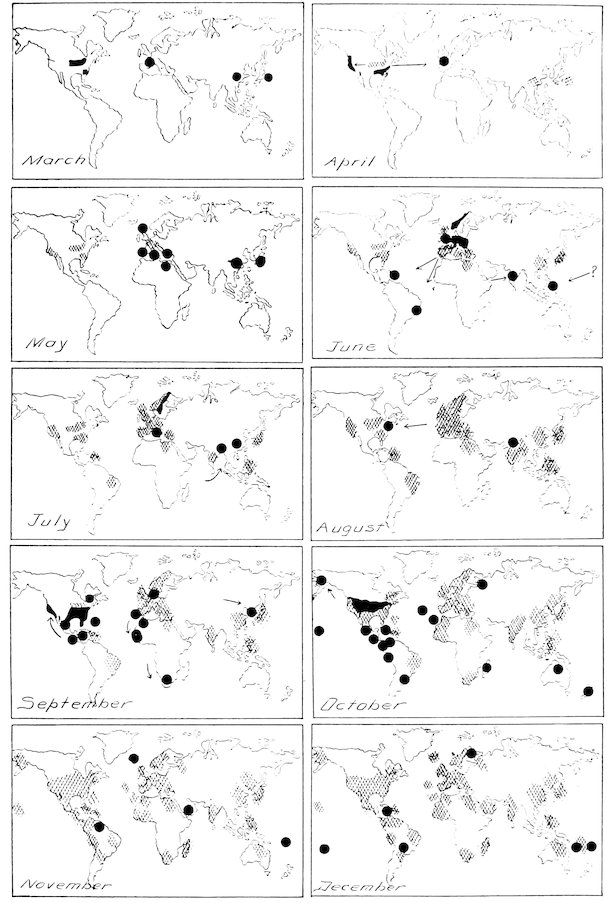
Cinematogram showing the spread of influenza in 1918 from a presumptive primary focus in the United States.
69It is particularly of interest to follow the spread of the disease in Europe. Perhaps the chief characteristic is the distribution equally to the north and south of France, a country which appears to have been invaded early. In May it spread to Scotland and to Spain, Greece and Egypt. In June the spread was in three directions, to England and Norway on the North, to Switzerland, Germany and Austria on the East, and again into Spain and Italy on the South.
The correctness of the foregoing description of the spread of influenza depends first, upon the accuracy of the authorities quoted, and particularly upon our having discovered the earliest report for each country. The author believes that the information as obtained for the United States represents nearly the true state of affairs, and that the error present is negligible. The information obtained for France is based upon the statements of excellent investigators, Netter, Chauffard and Massary, for the French population, and MacNeal, Zinsser and Longcope, for the American Expeditionary Forces. Here the statements agree both for the military and for the civil population that there was no widespread influenza in France much before April 1st. Also, the author feels that the information for England and Scotland is authoritative and will not later be changed. It is based particularly upon the excellent reports by Carnwath, who has investigated the subject in great detail. The excerpts from the German literature, although not abundant, are practically unanimous in agreeing as to the date of invasion in Germany. The reports from the remaining countries of Europe have been less abundant, and frequently the author has been forced to rely upon a report by only one individual; but while the date may be in error, yet the month of occurrence is probably correct.
For other continents, Asia, Africa and South America, the reports as far as they go appear reliable, but it is impossible to prove that at an earlier date there was not a very mild epidemic in some one of these localities, similar to the earlier epidemic in the United States, which escaped detection. It is particularly important, in view of the 1889 experience, that we obtain if possible fuller information on the earliest time of the appearance of the disease in China and other parts of Asia, and that we determine whether there was a spread from that continent to America previous to March, 1918.
Several factors have added considerably to the difficulty in tracing the site of origin of the 1918 epidemic and its direction of spread. The principal of these have been the speed of modern travel, the character of modern commerce, and the existence of a state of war. The channels of the commerce of today radiate nearly from all points to all other points of the civilized world. No longer are there a few preeminent lanes of travel, such as there were in 1580 when the epidemic 70spread clearly from Constantinople to Venice and on to Hungary and Germany, finally finding its way to Norway, Sweden, Denmark and Russia. The war has made it difficult to know accurately the date and direction of spread in enemy countries. We have practically no information, except that in the public press, from Russia and the Balkan States. By October of 1918 the severe form of the disease had become prevalent in every continent, and by December it had reached the farthest islands of the Southern Pacific ocean.
The apparent difference in the direction of spread between 1889 and 1918 makes comparison of rapidity difficult. But if we take as our starting point the time at which each epidemic became prevalent in commercial centers of Europe and the time at which it finally reached localities well off the usual paths of commerce we will see that there is some difference, the disease spreading more rapidly in the recent epidemic, but that the difference is no greater than could be accounted for by the more modern means of communication. From April, 1918, when the disease appeared in France, to October, when it was reported in Madagascar, is six months. From October, 1889, with the disease prevailing in Petrograd, to July, 1890, when it appeared in Madagascar, is nine months. It required seven months after the disease became epidemic in France this time for it to appear in Iceland, and nine months in 1889–90.
The earliest recorded epidemic of influenza in the United States in the spring of 1918 (but which was not recognized to be such until later) appears to have been that at Camp Funston, described by Opie and his associates as having appeared in that Camp March 5th. The epidemic swept quickly throughout the Camp and spent itself as rapidly. A second wave appeared in April and in May a third, both of which were almost entirely limited to newly drafted men brought into camp subsequent to the preceding outbreaks. Correlated with each of these three outbreaks was a period of increased incidence of pneumonia and bronchitis, frequently occurring in influenza cases. These complicating diseases were prevalent in the organizations attacked by the influenza and maintained the same relation to the length of service of the men affected.
The next report of influenza in the United States was from the Oglethorpe camps, beginning about March, 18, 1918. Within two weeks every organization in Camp Forrest and the Reserve Officers Training Camp was affected. After about three weeks the epidemic subsided rapidly. Fourteen hundred and sixty-eight cases were sent to the hospital out of a total strength of 28,586. It is estimated that 712,900 cases had occurred. The clinical symptomatology and the epidemic characteristics were described in detail.
On March 28th the author had occasion to observe a similar epidemic at Camp Sevier, South Carolina, which appears to have attacked a smaller proportion of the troops in camp, but which showed the same epidemiologic picture. A note in the Public Health Reports states that on March 30, 1918, the occurrence of eighteen cases of influenza, of severe type, from which three deaths resulted, was reported at Haskell, Kansas. This is the earliest report we have been able to find concerning the disease in civil communities. That for Chicago was practically contemporary. The Commissioner of Health of Chicago states in his special report on the autumn epidemic, that in March, 1918, distinct epidemics resembling influenza were observed in certain portions of that city.
According to Public Health Reports, fevers of an undetermined nature were reported during April and May at various points from Norfolk to Louisiana. “An examination of the records and reports of the physicians who had treated these cases leads to the belief that these fevers were mainly influenza of mild type.” It is possible, however, that all cases reported were not of the same disease, and in one locality in Louisiana dengue may have occurred.
Fleisher states that during the latter part of March and early part of April, 1918, there occurred at Camp Wadsworth an epidemic of measles and practically concomitant with it an epidemic form of bronchopneumonia associated with empyema. During this time there were some 200 cases of measles and twenty-one cases of bronchopneumonia or empyema in which a hemolytic streptococcus was the causative agent. He makes no mention of any epidemic of influenza either in mild or severe form, occurring at this period.
Forbes and Snyder reported that during the month of April, 1918, a highly contagious, but comparatively mild infection of the respiratory tract was epidemic in Camp Hancock. Several thousand men in the command were infected, but relatively few were ill enough to be sent to the hospital. The only fatal case occurred early in the epidemic, and it was the observations made in this case which prompted the study made by Forbes and Snyder.
The fatal case had the subjective symptoms familiar to influenza. The physical findings were similar to those occurring in influenza in the later epidemics. The leucocyte count was 4,300. A blood culture showed in twenty-four hours a heavy growth of small non-motile, gram-negative bacilli which the authors concluded to be Bacillus 72influenzae. The leucocyte counts made at five hour intervals on a later date were respectively, 3,400, 2,200 and 2,300. A second blood culture taken on April 10th, a day later, also showed a pure culture of the same organism. The leucocyte count had risen to 5,600. At necropsy a confluent bronchopneumonia was found. There was no pleural effusion and the other viscera showed nothing remarkable. Bacillus influenzae was recovered from cultures taken from the lung and spleen.
Throughout this epidemic the clinical picture of the disease was characteristic. Nearly every patient gave as the initial symptoms backache, headache, slight cough or sore throat. Conjunctivitis and a marked injection of the soft palate were noted in ninety per cent. of the cases. In addition, a slight or moderate general adenopathy was often observed. The face was flushed and in a few cases the skin of the thorax presented a mild erythema. In three cases a provisional diagnosis of scarlet fever was made until the blood count showed a leucopenia. Leucopenia was characteristic of all cases.
During the early April epidemic at this camp, nasopharyngeal cultures showed an organism resembling Bacillus influenzae in seventeen out of thirty-three cases, but the identity of the organism was not established by subcultures. In ten cases in which sputum examinations were made, Bacillus influenzae was found in only four; streptococci were present in six. Blood cultures on twenty consecutive non-fatal cases, only one of which was complicated by bronchopneumonia, were all negative.
V. C. Vaughan reports that at Camp Shelby, Hattiesburg, Miss., there was in April a division of troops numbering about 26,000. An epidemic of mild influenza struck this camp in April, 1918, and within ten days there were about 2,000 cases. This included not only those who were sent to the hospitals, but also those who were cared for in barracks. This was the only division that remained in this country without change of station from April until the fall of 1918. During the summer this camp received 20,000 recruits. In October, 1918, the virulent form of influenza reached this camp. It confined itself almost exclusively to the recruits of the summer, and scarcely touched the men who had lived through the epidemic of April. Not only the 2,000 who had the disease in April, but the 24,000 who apparently were not affected, escaped the fall epidemic.
Vaughan also remarks that in March and April of 1918 there was an unusually high death rate from pneumonia in Atlanta, Ga., Kansas City, Mo., Detroit, Mich., and Columbus, Ohio, while in the autumn 73epidemic these cities suffered rather less than the average. In view of the experience at Camp Shelby he reasons that there was probably mild influenza in these cities in March and April of 1918. It may be stated that in the mortality statistics for 1918, the abnormally high death rates for respiratory diseases during March and April were present throughout the registration area of the United States.
The first reports that we have been able to discover concerning influenza on the Pacific Coast are for the month of April. Stanley reports three successive waves of epidemic influenza at San Quentin Prison, Cal. The first began on April 30, 1918, with the entrance into the institution of a prisoner who was sick on admission.
Following the disease in its possible spread to the next continent we are inclined to conclude that it was carried to France with the great body of men traveling to that country from the United States. MacNeal and Longcope both report that in the first outbreak in the American Expeditionary Forces the earliest recorded epidemic appeared about April 1, 1918, in a rest camp near Bordeaux. It reached its height April 22d and ceased May 5th. According to V. C. Vaughan a mild epidemic of influenza and pneumonia prevailed at Brest and in that vicinity from April 1st to July 31st, 1918. During this time fifty cases of influenza, twenty-six of which developed pneumonia, with two deaths were admitted to the United States Naval Base Hospital at Brest. The disease was prevalent at the same time among the French civil, military and naval groups in the same locality. We see then that in the American Expeditionary Forces at any rate the disease first occurred in two base ports receiving troops from the United States. In May, 1918, a second outbreak was reported from Tours, which lasted from May 1st to May 24th and affected 117 persons. Zinsser reports an epidemic at Chaumont during May and from this time until July more or less extensive epidemics occurred throughout the entire American Expeditionary Forces.
Longcope remarks that the disease was likewise prevalent at this time among the French population and in parts of the British Army. The Influenza Committee of the British Advisory Board determined that in the first British Army the disease became prevalent around May 18th. Carnwath states that in the British Army in France the epidemic began by a few local outbreaks in the first and second Armies in April and May, 1918. Later it spread to the first, third and fourth Armies and affected a very large proportion of the troops.
Small describes two epidemics of influenza in one of the largest General Hospitals of the British Expeditionary Force in France. He says that the first wave began in April, 1918.
74The fact that MacNeal, as we have previously recorded, believed that there was influenza in France in 1917, must not be overlooked. Those earlier cases were scattered and did not so far as we know occur in the form of small epidemics. Even if these were true influenza it is reasonable to assume that they were sporadic cases and were not genetically associated with the epidemic spreading from America and daily increasing in virulence, which we are now following. MacNeal concludes that epidemic influenza in France originated from the endemic foci existing there, and that the disease was probably carried from Europe to the United States by shipping. The author’s opinion regarding the first direction of spread is that the reverse condition was the actual process. Zinsser likewise holds the latter view.
A most important observation made by MacNeal is that French physicians practicing among the civilian population were perfectly familiar with the disease when it appeared at Chaumont in April, 1918, that they designated it as La Grippe, and stated that it had been extensively prevalent in the civilian population of Chaumont from March 15th to May 15th, 1918. These observations of influenza occurring in France at almost the same date as the first outbreaks in the United States is a matter of great interest. It has also been stated by McNalty and by Carnwath, who quotes Kabeshima and Lee, that the disease was prevalent in epidemic form in China and Japan in March, 1918. We have here three foci from which the disease may have primarily originated. There are two possibilities; first, that it originated in all three foci (and perhaps others), and spread to all parts of the world from each; second, that the virus, distributed throughout the world, acquired high virulence in all three localities, causing small epidemic outbreaks, but that the virus from only one of these places finally became so exalted as to cause the pandemic. Did the pandemic disease originate simultaneously in France, in China and in the United States? One fact seems certain, that the influenza which attacked our troops in Europe was influenza imported from the United States. We have seen that it first appeared in the American Expeditionary forces at the base ports. Alberto Lutraria, Health Commissioner of Italy, has reported that the disease was brought to that country from America. A point of significance is the fact that during March and April there was an unusually large troop movement from the United States to the American Expeditionary Forces.
MacNeal says: “The suggestion that the epidemic was introduced from America is supported by the fact that it appeared at a time 75when large numbers of Americans were arriving in Europe, which is indeed an outstanding feature correlated in time with the onset of the epidemic.”
According to the report of the Influenza Committee, the disease was first seen in epidemic form in April and May in the British Armies in France, but that was not the first time that Pfeiffer’s bacillus had appeared within the armies. It had frequently been found in cases of bronchopneumonia, especially during the winter of 1916–17. Carnwath remarks that it is doubtful whether much importance from an epidemiologic point of view attaches to these sporadic findings of the influenza bacillus. In an outbreak of measles and rubella—complicated by purulent bronchitis—which attacked men belonging to the draft of troops from New Zealand between January 1st and March 8th, 1918, the bacillus influenzae was present in twenty-four of the forty sputa examined, and was grown in culture in twenty-one cases. Sellards made somewhat similar observations on measles patients at Camp Devens.
Concerning the French population, Chauffard, Messary and Netter, all remark that the first cases in France developed in April with possibly some cases before that time, and that there were undoubtedly cases in the German Army in April.
We see then that by April the disease has been transferred to France and is prevalent in the various armies. It is natural to assume that the battle front would present no great obstacle to the spread of the disease into the German Army. Gins remarks that the disease was present on the German West front among the troops as early as April, 1918, and that it spread from there more rapidly to the South than to the North.
During the month of May we observe the spread of the disease to Great Britain, where Carnwath, who has made an exhaustive study of the spread in Great Britain, believes that it was imported by the troops from France. Its first recorded appearance in Glasgow was in May. Dunlop, in reporting the successive epidemics in Scotland, observed that in addition to the three well marked epidemics there was a mild one recognizable in Glasgow in May, and that in that city the death rate rose from 14.1 to 20.1, and the weekly number of deaths from pneumonia and bronchitis from 36 to 107.
In England the disease first attracted attention in June, appearing first in the coast towns, chiefly at the beginning among the military and naval forces. The civilian population was severely affected only later. The ports which were earlier attacked were Portsmouth, 76Southampton and Liverpool. Inland towns suffered more severely later.
In the same month that the disease broke out in Scotland it appeared in Spain. The Inspector General of Health in that country reported that an epidemic of the disease began at Madrid in the last half of May, 1918, at a period when there was an unusually large gathering of people in the city. Within a short time it had spread rapidly through all the provinces. The increase in death rate became marked on the 27th of May and reached its peak on the 31st, at which time the rate was twice that of the average annual death rate for that period of the year. During the following week there was some oscillation around the peak and then the curve fell away. The epidemic was particularly severe at Madrid, Badajoz, and Seville. It was mild at Barcelona.
MacNeal remarks: “In Spain the disease appeared in epidemic form about the middle of May and this outbreak received great publicity, sufficient to lead to the popular appellation of Spanish influenza. The very rapid and extensive spread of the disease in Spain would indicate that it had been introduced from without rather than transformed from the endemic state in that country. This also appears to accord with the view of those who have studied the epidemic in Spain.”
Filtzos reports that influenza first appeared in Greece toward the end of May, 1918. The symptoms were slight and the people who were attacked suffered for three or four days with fever, accompanied by nervous symptoms. It was called at the time “Spanish Fever”. Beginning with September the epidemic became worse and caused a considerable rise in mortality. Complications with bronchopneumonia appeared. The decrease in incidence began toward the middle of December, 1918.
According to Benjafield, the pandemic first commenced in the Egyptian Expeditionary Force in May, 1918, but the maximum incidence was not reached until September and October. The cases during the earlier period of the epidemic were on the whole mild in type and of short duration, only a very small proportion being complicated by bronchopneumonia. The epidemic continued from November, through February, 1919, but the number of cases showed a marked decrease during the last two months.
The month of June saw the spread into England which we have already described, and the continuation from the German West front back into the enemy territory.
77Rose reports that on the 3d of June, 1918, in Strasbourg the first cases of influenza were reported in his hospital and that by the 15th of the month the disease was practically epidemic. Wachter in reporting cases from Frankfurt a. M. says that the cases of influenza in that city appeared from the beginning of June, 1918. Schmorl remarks that influenza became epidemic in Dresden in the beginning of July, 1918. According to Koepchen, the disease was epidemic in Bonn the 25th of June.
An editorial comment in the Deutsche medizinische Wochenschrift, July 4, 1918, remarks that the influenza pandemic “which probably has spread from Spain in the last few days” has appeared in several places in Germany in the South and the North, and in Berlin. According to the information received up to that time the disease was of short duration and without severe complications. The issue of July 11th reports that the influenza epidemic appears to have already passed its peak in Berlin and that in Süddeutschland the spread of the epidemic has become very wide.
The Office International d’Hygiène Publique records that the pandemic spread throughout Switzerland towards the end of June, 1918, after having invaded a certain number of European states, coming from various army fronts. It was at first of mild severity.
Böhm states that the deaths from pneumonia and influenza in Vienna began to show an increase in the week ending July 30th. In August they returned to the normal rate. The second wave occurred in Vienna in the middle of September.
From the information at our disposal we are unable to determine from what direction the pandemic entered either Switzerland or Austria. The point of entry into Switzerland is of relatively little importance in tracing the spread on the continent of Europe. Presumably it entered from the north or northwest. The disease appeared in Berne in June, reaching its height in that canton in the middle of July and dying out in August (Sobernheim and Novkaovie).
Information of the place of entrance into Spain is also rather indefinite. We are told that Barcelona was one of the cities attacked early. Barcelona is situated on the Mediterranean near the French border and is quite directly connected by commerce with Marseilles and other French ports on the Mediterranean.
In June the disease had also spread to Norway and outside of Europe to the West Indies, South America, India and China. A short notice in the Public Health Reports tells us that epidemic influenza with an estimated number of 1,500 cases began in Christiania, Norway, about June 15th.
78Atiles relates that influenza appeared in Porto Rico in June, soon after the arrival of a ship from Spain. It spread rapidly, and it is estimated that at one time fully eight per cent. of the entire population had the disease simultaneously, and that forty per cent. of the population were affected during the epidemic.
The Health Officer at Bombay made report in July, 1918, on an influenza-like disease then spreading throughout India. It was stated that the disease was introduced into Bombay from overseas by a transport which arrived May 31, 1918; that by June 22d the disease had become epidemic at Bombay, and that it was present in July, 1918, at Calcutta and Madras.
The rapid spread from Europe to distant India may be accounted for with the same mechanism as that by which the disease was spread from America to France and from France to England, viz. by army transports. The occurrence of the disease in Porto Rico appears to have been definitely connected with the arrival of a ship from Spain. A very short notice in the Public Health Reports tells us that influenza was reported present at Santos, Brazil, June 16, 1918. We are not informed as to how it reached that place.
We have discovered no mention of influenza in China in June. It was reported present in Chungking, China, July 27th. and at that time one-half of the population was stated to be affected. Dengue was reported prevalent at Chefoo, China, during the two weeks ended June 15, 1918, and a report from Shanghai of the same date describes the prevalence of a disease resembling dengue and affecting about 50 per cent. of the population. The disease in these two latter places may have been influenza.
The epidemic made its appearance in Korea in September, 1918. Schofield and Cynn, who report the epidemic, believe that the infection came from Europe via Siberia. The disease spread from North to South along the line of the Southern Manchurian Railway.
In August the disease was re-introduced into the United States and by the end of that month it had acquired a foothold in Boston and vicinity and rapidly spread to other parts of the country. The pandemic had crossed the Atlantic in both directions in six months’ time.
In 1918 as in 1889 there are excellent descriptions of the conveyance of the disease by vessels. The transfer from Spain to Porto Rico has been mentioned. Escomel says that the outbreak in Rio de Janeiro was ascribed to infection from a steamship from Spain, the same boat which later visited Buenos Ayres and started the epidemic in the latter city.
79According to a report to the Journal of the American Medical Association from Mexico the epidemic invaded that country from the North at Laredo and followed the course from North to South. From a similar source the same Journal reports that the influenza spread from Buenos Ayres as a primary focus to Paraguay and there acquired greater virulence.
Hernando reports from the Philippine Islands that influenza was estimated to have attacked forty per cent. of the total population of 7,000,000 the mortality being about 2.5 per cent. of those attacked. The epidemic really began in June, although it did not assume great severity until October. The group of ages that suffered most were those between ten and twenty-nine years. The disease did not seem to be imported, since cases were returned before any ships arrived from infected countries, although after the importation of cases it assumed a more severe form. The June epidemic seemed to confer a certain degree of immunity during the second outbreak of the disease in October.
Erlendsson reports that the influenza when it appeared in Iceland in November, 1918, corresponded in character with that in other portions of the world. Macklin gives an interesting description of the epidemic as it occurred in Lapland. The onset in that territory was probably in November. He found that many individuals recovered in two or three days and were about their work again feeling perfectly well. If, however, they contracted pneumonia, about fifty per cent. died.
“The Laplanders had a very thorough if unsympathetic way of dealing with their cases. The settlements were composed of wooden huts, small but generally well made and warm. A common type consisted of but one room, used by the family for all purposes. Better class Laps had better huts, with two or three rooms. In each settlement one of the single-room huts had been set apart, and into this each case of sickness as it arose was unceremoniously pushed; and none were permitted to return to their own huts until completely recovered. Whilst there they received practically no attention, and no healthy person ever entered to attend to their wants. Occasionally a bowl of water or reindeer milk was hastily passed in at the door, or a huge chunk of reindeer meat thrown in, uncooked and uncarved.
“We visited every settlement within our reach and entered these huts. The stench on opening the door met one like a poison blast and the rooms were nearly always ill lighted and dark. The patients lay littered about the floor in a crowded mass, fully dressed in clothes 80and boots (most of them had no socks), and with no other cover but an occasional greasy rug. Although the outside air was cold and the ground snow-covered, the temperature inside, maintained by the combined mass of bodies, was generally sufficiently high. The patients in these huts included both sexes and all ages; some, when we entered, sat up and with flushed faces and dull, uncomprehending eyes watched us listlessly. Others lay restlessly twisting about, quite incapable of taking any interest or of answering any questions.”
The epidemic struck Alaska in October, invading first the towns of the sea coast, being very evidently brought thither by steamer. Travel to the interior was stopped and so the latter escaped, to a great extent, the outbreak. At Kodiak and on Cook Inlet, the mortality was extremely high. Whole villages of esquimaux lost their entire adult population. Many infants were frozen in their dead mothers’ arms.
Influenza in China.—We have been able to follow the pandemic quite consecutively as it has spread around the world, from a first outbreak in the United States in March, 1918. We repeat that the disease was presumably present in Europe and elsewhere previous to that time, as it was in America, but the particular virus which ultimately acquired sufficient virulence to produce the pandemic may well be that which came from North America. Did this virus arise from an endemic focus in this continent, or was it transported to us at a somewhat earlier date from Asia?
McNalty states that influenza was present in China and in the Japanese Navy in March of 1918. He gives no reference. Carnwath makes the same statement and gives as reference the report of Kabeshima and Lee. The author has not been able to obtain this report.
The Health Officer of Shanghai made the following report for May, 1918: “Towards the end of the month, reports were received of outbreaks of ‘fever’ which rapidly affected a large proportion of the employees of various offices, shops, police stations, etc. As a result of clinical and laboratory observations of cases admitted to the Chinese Isolation Hospital the disease was recognized as epidemic influenza. The same disease was reported to have appeared in Peking before reaching Shanghai, but subsequent reports showed that most of the river ports were almost simultaneously infected; that is to say the rate of spread conformed to the rate of conveyance by railways and boats of infected persons;”
In November of 1918 an editorial note in the China Medical Journal reads as follows:
81“From nearly all parts of China reports are being sent to the newspapers of the occurrence of a severe epidemic of disease which seems to manifest itself in various forms. In Wusuch, where the disease is called ‘the five days’ plague’ the symptoms are said to be not unlike those of cholera, death in some cases ensuing in less than a day. In other cases it is complicated by severe and often fatal pneumonia. At Anking many cases have all the symptoms of typhoid fever, but the mortality is great and sudden. In one house four people died within a few hours of each other, and in another house eight persons out of eleven died. At Wuhu and other of the lower Yangtze ports it is said to resemble dengue fever and the mortality is so great that undertakers are finding it difficult to meet the demand for coffins. In Shansi, where the victims literally number thousands, the disease is regarded as influenza. In Peking fully fifty per cent. of the Chinese have been affected and the mortality has been heavy. Accurate reports from medical men in these cities would be very instructive.”
The author has the following personal communication from Doctor Arthur Stanley of the Health Department of the Shanghai Municipal Council. “Influenza fever appeared during the recent epidemic in Shanghai towards the end of May 1918. It swept over the whole country like a tidal wave. You may take it that it spread like most rapid extant means of transit. A primary source of origin was not made known.”
It is to be hoped that more definite and concurrent information will be forthcoming in the case of China. A thorough search of the literature as reviewed for China and Japan in the China Medical Journal reveals no description of the disease previous to April or May of 1918. Nevertheless we must assume that, until contradictory reports are made, the disease was present in those countries in March as stated by Carnwath.
Autumn Spread in the United States.
By the first of July, 1918, convalescent cases of influenza began to appear among members of the crews of transports and other vessels arriving in Boston from European ports. The number of such cases on each ship was usually not more than four or five, but Woodward records that in one or two instances between twenty and twenty-five individuals were sick on incoming vessels. None of these were seriously ill, none were sent to the hospital, and none died. The disease in this class of persons did not become severe until late August. Woodward has found on inquiry among practising physicians that 82typical cases of influenza were seen with notable frequency in private practice in the vicinity of Boston during the month of August, and that they had developed no serious complications, the only after effect being the marked prostration.
These mild preliminary cases failed to attract attention; first, because of their relative scarcity, and second because of their benign character. Public attention was first directed to the influenza in Boston by the apparently sudden appearance during the week ending August 28th of about fifty cases at the Naval Station at Commonwealth Pier. Within the next two weeks over 2,000 cases had occurred in the Naval forces of the First Naval District. One week later there was a similar sudden outbreak in the Aviation School and among the Naval Radio men at the Massachusetts Institute of Technology. The first death in Boston was reported on September 8th.
The peak of daily incidence in Boston occurred around the first of October. In the week ending October 5th a total of 1,214 deaths from influenza and pneumonia was reported, while by the third week of October this total had fallen to less than 600, and for the week ending November 9th was down to 47. Around November 15th the number of cases rather suddenly increased and this recurrent wave lasted for about ten days. By the 25th the rate was back to what it had been around the first of the same month. On or about December 1st the incidence again rose and continued increasing daily, to reach its peak in a severe recrudescence around December 31st.
There are conflicting reports concerning the date of first appearance of the epidemic at Camp Devens, Massachusetts. Woodward says that a sudden and very significant increase was reported during the third week in August in the number of cases of pneumonia occurring in the army cantonment at Camp Devens, seeming to justify the statement that an influenza epidemic may have started among the soldiers there even before it appeared in the naval forces. Soper, on the other hand, as well as Howard and Love in their official report, place the date of the first case at Devens as September 7th. Soper remarks: “The Devens epidemic is supposed to have commenced on September 7, 1918, in D Company, 42d Infantry. On that date a case of supposed meningitis was sent to the hospital from this company; on the following day twelve cases were sent for observation. These proved to be influenza. By the 16th thirty-seven cases had gone from the same company.” Howard and Love state, “The first authentic cases of virulent influenza of the great autumn pandemic among troops in the United States appeared on September 7, 1918, at Camp 83Devens, Mass.” These statements by Howard and Love do not eliminate the possibility of earlier and less virulent unrecognized cases. Wooley, who was camp epidemiologist, reports that influenza began at Camp Devens on the 8th of September, 1918. It reached its acme on the 16th, 17th and 18th of the month and then rapidly declined, almost completely vanishing about the middle of November. He makes no observation as to whether a mild form of the disease was or was not present in the camp in March and April preceding.
Influenza entered Massachusetts at Boston. Reeks reports that it entered Connecticut at New London, the cases coming primarily from the experimental station and from Fort Trumbull, where vessels from foreign ports had discharged patients. He believes that the disease was first introduced by ships arriving in New London from abroad and by men from the Boston Navy Yard, but numerous foci developed in a short period of time in various parts of the state. Many of these had appeared by the middle of September, and the source, according to Winslow and Rogers, was traced to military establishments, chiefly Camp Devens. In Wallingford, Willimantic, Hartland, Rockville and Danbury, all of which towns were attacked early in the epidemic, investigation showed that the disease developed in each case two or three days after visits of soldiers from Camp Devens. In Connecticut the epidemic spread, beginning at New London, chiefly from east to west, reaching its peak in the Eastern section around October 4th, in the central section October 15th, and in the Western part of the state around October 24th. Towns which had been infected early by visitors from military establishments reached the climax sooner than other towns nearby. In spreading from New London north and west the large cities of Connecticut were successively invaded, New Haven and Hartford reaching their crest about ten days later than New London, while Fairfield County did not reach its acme until later than New Haven.
In the cities along the New England coast we see then that the disease reached epidemic proportions early in September. By September 21st it had become epidemic in a wide area along the Atlantic coast extending from the Southern part of Maine to Virginia, as well as in a number of localities scattered over the entire country. By September 28th, areas adjacent to the centers in which the epidemic had already appeared were affected, suggesting radial movement from these centers. By that time the greater part of the New England States, the North Atlantic and Central States, and some of the Gulf and Pacific Coast States had become involved. By October 5th the pandemic had apparently reached all parts of the country with the 84exception of the more isolated rural districts and some areas in the Central States and Mountain States. Within an additional ten days even these areas, with the exception of the very remote rural districts, had been reached by the epidemic. Within four weeks the disease had become distributed to all sections of the country, and within six weeks from its first epidemic prevalence in Boston practically the entire country had been invaded.
Sydenstricker in a preliminary report remarks on the fact that the disease reached an epidemic stage in a number of localities in the central, northern, southern and western sections at about the same time as it did in the area along the northeastern coast. “The possibility is suggested, therefore, that sources of infection existed in at least some of the larger population centers, well distributed through the country, some time before the disease appeared as a nation-wide epidemic. The apparent radial spread of the epidemic from certain centers would seem to strengthen this hypothesis. It may also be noted that there is evidence, the collection of which has not yet been completed, pointing to the existence of cases of the disease in various centers, probably widely distributed, weeks before they were definitely recognized as influenza. The possibility that these foci themselves had a common focus is by no means excluded, of course, but there is as yet no conclusive evidence that would warrant the statement that the starting point of the epidemic was Boston or any specific locality.”
Dublin, from a study of the statistics of the Metropolitan Life Insurance Company, finds that the virulence of the influenza, as indicated by the mortality rate, was greatest along the Atlantic Coast and became progressively less as it progressed westward. There was one exception. The mortality was high in San Francisco, higher than in other western communities. Dublin believes that quite possibly there was a double infection in San Francisco in the fall of 1918, one coming from the East and of small caliber, while the other came either by way of the Panama Canal or perhaps from Asia. The evidence in favor of two ways is that Dublin finds that the peak of incidence in San Francisco and in some other places on the Pacific Coast occurred sometime in advance of the similar peak at points inland from the coast. This is not brought out in Pearl’s chart, and the latter finds when considering the peak of deaths that the peak for San Francisco was late. The peak in that city, in Oakland, California, and in Los Angeles, was reached on the week ending November 2d. Few cities had as late death peaks. Cleveland and Pittsburgh reached their peak in the same week, St. Paul, Minnesota in the week ending November 16th, and St. Louis, Milwaukee and Grand Rapids not until 85the week ending December 14th. In the case of Milwaukee and St. Louis these were the high peak dates but they were second peaks. In the former the first peak occurred October 26th and in the latter November 2d. In Grand Rapids the increase in mortality was clearcut by the middle of October, although the peak was not reached until the week ending December 14th. These statistics would indicate that San Francisco was attacked, as evidenced by increase in death reports, relatively late, and at about the time that would be necessary for the disease to be carried across the continent.
In an article by Ely, Lloyd, Hitchcock and Nickson it is said that influenza first appeared in the Puget Sound Navy Yard, near Seattle, on September 17, 1918, and that it was introduced by a draft of 987 sailors received from Philadelphia, a number of whom arrived ill, or came down within a few hours after reaching their destination. As a result, Seattle and the State of Washington were infected somewhat ahead of the other West Coast States. According to the record, influenza did not assume epidemic proportions in the State of Oregon for nearly a month after this Navy Yard epidemic.
With army camps and cantonments situated in nearly every section of the country it is difficult to follow the general direction of spread from camp to camp. During the period of the epidemic, troop movements were in general from West to East toward points of embarkation rather than in the reverse direction. This was in the opposite direction to that taken by the pandemic. Away from the coast there were, however, many movements of troops from camp to camp, in the redistribution of forces. That these troop movements were not discontinued during the epidemic is indicated by the report of Howard and Love: “The virulent type of influenza had spread rapidly from camp to camp, from the Atlantic seaboard to the South and West, due to the continual interchange of personnel from infected to non-infected camps. Such movements of troops at this time were recognized as dangerous and inadvisable, and prompt recommendations were made by the Medical Department that such movements be discontinued or greatly restricted, if compatible with military interests, which, of course, were at the time paramount. The War Department was unable to approve any marked restriction of movement of men from camp to camp at this time. One result of the free inter-communication of military personnel was that practically all military stations in the United States were in the throes of the epidemic at the same time.”