SECTION II. (continued 2)
Reading edition
In addition to this means of inter-communication we had the possibility of spread to the various camps by the ordinary course of civilian and commercial travel as in spread to different communities, and also 86the possibility of importing large amounts of virus at one time on the incoming trains with new draft troops.
Soper gives the following order for camps attacked:
Order. Camp. Location. Date.
1 Devens Massachusetts Sept. 12
2 Upton New York Sept. 13
3 Lee Virginia Sept. 17
4 Dix New Jersey Sept. 18
4 Jackson South Carolina Sept. 18
5 Hoboken New Jersey Sept. 19
5 Syracuse New York Sept. 19
5 Gordon Georgia Sept. 19
5 Humphreys Virginia Sept. 19
6 Logan Texas Sept. 20
6 Funston Kansas Sept. 20
6 Meade Maryland Sept. 20
7 Grant Illinois Sept. 22
7 Taylor Kentucky Sept. 22
8 Sevier South Carolina Sept. 23
8 Lewis Washington Sept. 23
8 Newport News Virginia Sept. 23
9 Pike Arkansas Sept. 24
10 Beauregard Louisiana Sept. 25
10 Eustis Virginia Sept. 25
11 Greene North Carolina Sept. 26
11 McClellan Alabama Sept. 26
12 Kearney California Sept. 27
12 Bowie Texas Sept. 27
13 Johnston Florida Sept. 28
13 Sheridan Alabama Sept. 28
14 Sherman Ohio Sept. 29
14 Dodge Iowa Sept. 29
14 Shelby Mississippi Sept. 29
15 Custer Michigan Sept. 30
16 Travis Texas Oct. 1
17 Cody New Mexico Oct. 3
18 Forrest Georgia Oct. 6
19 MacArthur Texas Oct. 7
20 Wadsworth South Carolina Oct. 11
20 Wheeler Georgia Oct. 11
20 Greenleaf Georgia Oct. 11
87Howard and Love have established definitely that the extension of the virulent influenza from Camp Devens to other camps south and west in September, 1918, can be traced in many instances directly to the interchange of military personnel from infected to non-infected camps. The height of the September outbreak in the United States Army extended over a period of about nine weeks, from Sept. 13th to November 15th, and during this period over 20,000 deaths occurred among troops in the United States alone in excess of the number that would have occurred, if the disease death rate for the corresponding period of the preceding year had prevailed.
It is interesting to note with respect to Camp Humphreys, Virginia, that there were possibly some sporadic cases previous to the autumn outbreak. Brewer in reporting on the epidemic in September and October records the first case as having occurred shortly after July 1st. He makes no mention of there having been any outbreak whatever prior to that date. Between July 1st and September 12th there were only sporadic cases diagnosed as influenza. The autumn outbreak began at Camp Humphreys September 13th and ended October 18th.
Recrudescences.
We have already seen from the work of Pearl that recrudescences following the original spread in any one locality were the rule rather than the exception in this country. He found that in sixty-five per cent. of the forty cities studied there were two distinct peaks in the mortality curve and in twenty per cent. there were three, while only fifteen per cent. had but one peak. The first peak was as a rule the highest. Although there was no absolute regularity in the time of occurrence of the recrudescences, Pearl established that the high peak cities had the second peaks on an average 7.1 weeks after the first, and the third peak on an average 13.1 weeks after the second. The two-peak cities are divided into two classes, the first comprising about a third of the total number, had the second mortality peak around eight weeks after the first, while the remaining two-thirds had the second peak about thirteen weeks after the first. The cycle in the epidemic wave appears to be nearly a multiple of seven weeks. He suggests that the smaller group of two-peak cities with early second peak may have been cities which at the time were presumably destined to show a third distinct wave and peak of mortality, but in which for some reason not now apparent the third wave did not eventuate. In contradistinction the larger group of two-peak cities with the second peak 88occurring around thirteen weeks after the first are presumably cities in which the complex of factors determining the form of the mortality curve was such as to lead definitely to a two and only two-peak curve. In three-peak cities the first interval was around seven weeks, the second around thirteen weeks. The two-peak cities with an interval around thirteen were probably not destined, according to Pearl, to have another repetition, but those with an interval of seven were presumably destined to have a second interval, the thirteen-week interval, which for some reason did not occur.
This raises the question of periodicity, a subject which we will discuss at a more appropriate place.
This experience of recrudescences was similar in the American Expeditionary Forces. The first outbreak lasted through April and May and into June. The second came in September and October. The spring epidemic had been characterized by mildness and was known as three-day fever, but in the autumn, complications of the respiratory tract predominated in the symptom complex. By August 18th a severe epidemic had occurred in an artillery camp at La Valdahon in the Jura Mountains, near Bezançon. Early in September a larger epidemic occurred in an artillery camp near Bordeaux. The epidemic in our troops in France, as well as in the French civil and military population, reached its height during October. The Service of Supply was more heavily affected than were the troops situated on the battle front. The morbidity rate appeared to have been almost the same as that in the United States. That it was not quite as high has been shown by Howard and Love. Longcope states that it prevailed particularly among the troops at the base ports where during a part of the epidemic transports laden with infected troops were being landed; in those organizations which contained the largest number of replacement troops; and in organizations being moved on troop trains, where the men were necessarily closely crowded.
The second outbreak subsided during the early part of November. A third occurred in January and February, very much as it had done in the United States. In the interval between the second and third recurrences there was no time at which the entire Expeditionary Forces were free from the disease. The author had occasion to study an outbreak occurring early in December in the 26th Division stationed in rest area at Montigny-le-Roi. In this outbreak the respiratory complications predominated, as in October, and the mortality was comparatively high. We had had occasion to study the same disease at Camp Sevier, South Carolina in September and early October, 1918, 89and in two different localities in France in December, 1918, and February, 1919, and found that the clinical characteristics were identical on both continents.
The more severe recurrence in England, in October, has been carefully studied. In fact this recurrence was almost universal in all countries. The autumn epidemic has been reported as being at its height in October, 1918, in such widely separated localities as the United States, England, France, Greece, Brazil, India, Japan and Korea.
In Europe at any rate the third wave occurring in the winter of 1919 was quite generally distributed. At about the same time the disease broke out in England, making a third wave in less than a year. Once again the third attack began less suddenly and less violently and resulted in a lower number of fatalities. During February there was reported to have been a great increase in the number of cases in Paris. It had terminated by March 27, 1919. In March the disease broke out anew, this time assuming grave proportions, not only in that city but in several of the Departments.
The second recrudescence has also been reported as being present in Spain.
On May 5, 1919, report was received from Buenos Ayres that in one of the concentration zones for naval troops located in the harbor there had been an epidemic of short duration, but with high morbidity, with two hundred cases being frequently reported each day.
Just as Pearl has observed a certain periodic recrudescence in the United States, there has been described a similar periodicity in England. The interval, however, is described as twelve weeks. The first wave began in July and died down about the end of August, running a two months course. Twelve weeks after the commencement of the first wave, at the beginning of October, the second appeared. It had disappeared around the middle of December. Again, twelve weeks from the beginning of the second wave, that is, in January, the third appeared.
Recurrences in Winter of 1919–1920.
We distinguish between the flareups following the autumn spread of 1918, and which lasted until the spring of 1919, and yet another widely distributed recurrence in the winter of 1920. We have called the former recrudescences to distinguish them in point of time from the latter, but do not imply thereby any difference in the character or origin of the secondary waves. Between them all there occurred 90almost continuously isolated or solitary cases of influenza which served to keep the fires smouldering. In our own work in the city of Boston we found record of scattered infrequent cases of clinical influenza of apparently low infectivity in every month from March, 1919, until the recurrence in January, 1920.
Moreover, in some localities there were during this interval small epidemic outbreaks. Thus a report from Lisbon, Portugal, on June 1, 1919, states that the deaths from influenza in that city during the preceding two weeks had been more than the total deaths from all causes during the preceding four months. A report from London, October 30, 1919, states that during the preceding few weeks there had been in the ninety-six great towns of England and Wales a slight but gradual increase in the number of deaths attributed to the disease, and a coincident rise in the number of notifications of acute primary and acute influenzal pneumonia. The feeling at that time was that the increase was associated with prevailing meteorological conditions, and did not apparently signify more than the usual variation in respiratory diseases which was to be expected at that season of the year. On November 3, 1919, the disease was reported prevailing at Chile and it was spreading throughout Bolivia. At the same time influenza had spread over the entire country surrounding Buenos Ayres and had even reached the neighboring city of Montevideo. In the latter part of November more than 2,000 cases had been reported at Lemaies, about fifteen miles northeast of Granada, Spain.
The winter of 1920.—In the United States the death rates from influenza and pneumonia in the large cities over the entire country were below the usual average from May, 1919, until January 1, 1920. In the week ending January 17th there was a sharp increase in the influenza-pneumonia rate, which occurred simultaneously in Kansas City and Chicago. In the latter city an excess over the average was not reached until some days later, but the maximum mortality occurred in the week ending January 31st, while in Kansas City the mortality did not reach its height until one week later. New York, Washington, San Francisco, Milwaukee and St. Paul soon followed with an increase in the week ending January 24th, and in the subsequent two weeks many other cities were added to the list. By February 14th thirty-two out of the thirty-six large cities reporting had an increase in the death rate from influenza and pneumonia as compared with the same period in 1917. The maximum was reached at this time, and according to the Bureau of the Census reports there were 7,059 deaths from influenza and pneumonia during the week ending February 14th. In 91the next week the number of deaths from these causes in the cities reporting had dropped to 5,088. The February weekly average for 1917 was 1,489. In the week ending February 14th, 267,643 cases of influenza were reported from forty-one states; the excess annual death rate as compared with the average for the period from 1910 to 1916 was 1,319.
In general the 1920 recurrence was decidedly milder than the autumn outbreak of 1918. Certain cities, however, suffered severely, particularly Detroit, Milwaukee, Kansas City, Minneapolis and St. Louis. In these the death rate, while the epidemic lasted, was higher than that of 1918. The duration of the epidemic was generally, however, shorter in these cities. Columbus, Ohio, and Indianapolis suffered severely, but to a less extent than the cities just mentioned. In Chicago the death rate was not as high as in the fall of 1918, but it did rise far above the point reached during the 1889–90 outbreak, and the influenza in the last two weeks of January brought the total mortality for that month up to 5,149, the highest mortality in the history of the city with the exception of October, 1918.
We have already discussed the recurrent epidemic as it was studied in Detroit. The salient characteristics were a rapid and fairly symmetrical evolution, a shorter duration than in 1918, a lower morbidity with a higher mortality rate, and finally, a smaller total number of deaths than in 1918.
The 1920 recurrence was widespread. It was not confined entirely to the large cities. Semi-official reports from small towns and villages show very much the same conditions as were observed in the larger cities. On the whole, however, most communities, both large and small, suffered less severely than in the first spread. The few exceptions to this were distributed over the continent without uniformity.
The first among the large cities to show an increase in death rate from the epidemic was Kansas City, in which the mortality first climbed in the week ending January 17th. The following week there was an increased rate in Chicago, New York and Milwaukee, and one week later, Boston, Detroit, San Francisco and Philadelphia were affected. New Orleans was one of the last large cities affected, not showing a definite increase until the week ending February 14th. In contrast to the 1918 pandemic, the influenza of 1920 showed no clearcut direction of spread, and was as in the years following 1889 due, without doubt, to firing up of the pandemic virus as it had been left scattered in many endemic foci throughout the earth. There probably 92were instances of spread from the larger centers to outlying districts, but there was no continuous spread over large areas. The accompanying table shows clearly that the disease this year commenced in the center of the continent, a fact which would seem to disconnect it entirely from the late epidemics of 1919, occurring in Europe:
Annual death rates from all causes by week in certain large cities of the United States from week ending January 3d to week ending February 21st.
City. Week Ending
January. February.
3 10 17 24 31 7 14 21
Kansas City 16.3 15.8 19.3 32.7 39.5 61.5 44.0 29.1
Chicago 14.4 13.8 15.1 23.5 41.3 39.1 24.6 17.7
New York 14.0 15.3 14.6 19.5 28.0 35.0 35.1 24.8
Milwaukee 11.6 12.5 9.0 15.6 29.4 34.5 27.1 16.9
Detroit 13.7 13.0 14.2 15.5 33.9 60.9 42.9 21.6
Boston 16.8 16.9 14.1 16.8 20.3 27.1 33.7 32.1
San Francisco 16.5 15.4 19.6 19.2 22.9 25.2 31.8 28.8
Philadelphia 15.6 16.7 16.2 16.8 18.3 22.1 34.3 37.2
New Orleans 18.8 19.6 22.6 18.8 20.9 20.1 25.0 32.3
The relative severity of the two epidemics in certain of the large cities has been compared by H. F. Vaughan, and he has found as is seen by the table that Kansas City and Detroit, two of the early cities affected, had the highest mortality in 1920. Philadelphia in 1918 lost nearly three times as many people as Detroit did in 1920. Detroit was higher than Chicago in 1920, but lower in 1918.
Per cent. of population killed by influenza.
1920. 1918–1919.
First seven weeks. First seven weeks. Twenty-one weeks.
Detroit 0.20 0.17 0.28
Chicago 0.12 0.34 0.41
Kansas City 0.24 0.30 0.63
Philadelphia 0.10 0.76 0.82
New Orleans 0.05 0.55 0.77
The following table taken from the “Final Influenza Bulletin,” by E. R. Kelley, Commissioner of Health in Massachusetts, shows distinctly the difference that must be always borne in mind between curves of influenza incidence and death curves. In his table the mortality climbed first on the week ending January 13th, as in the table 93above, but the increase in influenza cases began at least one week earlier. It is characteristic of influenza epidemics that the rise of mortality curves follows that of morbidity by about a week:
Influenza and pneumonia cases in Massachusetts in the first three months of 1920.
Influenza. Lobar pneumonia.
Cases. Deaths. Cases. Deaths.
Week ending January 3d 41 0 109 9
Week ending January 10th 46 2 142 50
Week ending January 17th 58 0 145 52
Week ending January 24th 489 4 201 56
Week ending January 31st 4,495 48 313 96
Week ending February 7th 9,627 272 382 212
Week ending February 14th 10,747 133 583 140
Week ending February 21st 5,601 181 510 147
Week ending February 28th 2,375 147 313 114
Week ending March 6th 1,144 54 206 34
Week ending March 13th 490 31 130 54
Week ending March 20th 254 20 105 44
Week ending March 27th 147 14 102 94
Week ending April 3d 218 6 97 12
In Massachusetts in the first three months of 1920 there were reported 35,633 cases of influenza and 3,158 of lobar pneumonia, with 906 deaths from the former disease and 1102 from the latter. The case rate per 100,000 from influenza was 883.4; from lobar pneumonia, 78.3; the death rate from influenza, 22.4; from lobar pneumonia, 27.4; and the fatality per cent. from the former disease was 2.5, and from the latter, 34.9.
The epidemics in Detroit and Boston both showed a symmetrical evolution and a single wave. This appears to have been the more frequent type of recurrence in this country. There are examples of the secondary curve. At the Great Lakes Naval Training Station the epidemic began during the week ending January 17th. On January 12th there were fifty-one cases. The peak was reached on the third day with the admission of 182 new cases during twenty-four hours. Although the peak came early the decline was less rapid and there were four secondary peaks, but the outbreak terminated on the twenty-fourth day. On the whole the epidemic was less severe than in 1918. Pneumonia was a complication in about ten per cent. of the reported cases of influenza at the training station.
On the European continent there were similar recurrences in the first three months of 1920. In the large towns of England the recorded 94deaths from influenza made an increase in a steady curve from sixty-six in the last week of January until the week ending March 27th. After that date there was a gradual falling off. That the situation was in no way as serious as it was at the same time in the American cities and in certain other parts of Europe is indicated by an annotation in the Lancet of March 6th. According to this annotation, the weekly totals of deaths attributed to influenza in London and the 96 great towns had on the whole tended to increase in the early part of 1920, but the absolute increment was so small and the necessary uncertainty of classification so great that no unfavorable inferences could be drawn from these fluctuations alone. On the other hand, the notifications of cases of pneumonia increased appreciably, too much to be set down as a mere chance fluctuation. But notification for this disease had not been in force long enough to enable accurate comparison. There were no indications of epidemic influenza in any of the large factories situated throughout the country. But on the other hand there was proof of the existence of epidemic influenza of an infectious, but relatively non-fatal type in certain large schools situated in the South and Southwest of England.
The annotation concludes that influenza was epidemic in a few localized English and Welsh communities, and that the type was similar to, but less severe than that of 1918–19.
In the city of Paris between the 11th and 31st of January there was a very definite increase in the death rate from inflammation of the respiratory tract above the average for other years.
Renon and Mignot studied 141 cases of influenza (71 men and 70 women) during January and February, 1920, at L’Hopital Necker. Fifteen of the 141 died. According to these observers the grip of 1920 attacked all ages in contradistinction to the 1918 epidemic which affected especially the young and vigorous. One-third of their group were over forty years of age, while some were seventy and eighty years old. In spite of this the disease remained relatively mild. Sixty-four were cases of simple grip. Forty-three had associated bronchitis and pulmonary congestion and edema. Twenty-seven had pneumonia. One had acute pulmonary edema. There were cases of influenza in tuberculosis individuals. One developed an acute serofibrinous pleurisy. One had purulent pleurisy, and one meningitis.
In Copenhagen there occurred between the 18th and 24th of January, 1920, 1,204 cases of influenza with four deaths; in the following week, from the 25th to the 31st of January, 7,445 cases with forty-two deaths; from the 1st to the 7th of February, 11,038 cases with 207 95deaths; from the 8th to the 14th of February, 8,308 cases and 327 deaths. This is to be contrasted with the month of December, 1919, in which there were 1,845 cases of influenza in Denmark, of which only 272 were at Copenhagen. In Christiania, Norway, during the week of January 25th to 31st, there occurred eleven deaths from influenza, whereas during the preceding two weeks there had not been a single death from this disease.
In December, 1919, there were reported in Switzerland only 511 cases of influenza. During the month of January, 1920, this increased to 13,162, and in February to 83,008, the estimated population being 4,000,000. From February the disease decreased in prevalence. In Zurich, with a population of 210,000, the epidemic resulted in 14,534 cases. The first increase began around January 4th. The total number of cases for January was 1,071. In February the records of the four weeks showed 2,721, 4,140, 3,341 and 1,899 cases, respectively; in March the decrease was rapid, 886, 442 and 45 cases being reported in the first three weeks. The total number of deaths, mostly due to pneumonia, was 229, a mortality of 1.5 per cent.
During 1920 epidemics were also observed in Valencia, Santander and other towns in Spain, and in Mexico City. In the latter city the number of deaths was reported as 1,649, as contrasted with 3,000 in 1918.
Incubation Period.
An accurate determination of the period of incubation in influenza presents great difficulties. The large number of cases with the consequent multiple opportunities for infection in the case of every individual add to the difficulty. Under any circumstances the period is very short. Parkes, many years before the 1889 epidemic, believed that an incubative period sometimes exists; that it was sometimes very short and sometimes of many days duration.
“In the Transactions of the College of Physicians it is stated that in the epidemic of 1782, seventeen persons came to London to an hotel, and on the following day three were attacked with influenza. Haygarth says that a gentleman came to Chester from London, on the 24th of May, 1782, ill of influenza; a lady, into whose family he came, was seized on the 26th, and was the first case in the town. Haygarth states, evidently with the view to point out the possibility of a direct contagion, that the gentleman was engaged to be, and was afterwards, married to this lady. In this case the longest possible incubative period was two days. In 1782 a family landed at Harwich, 96from Portugal, and came to London directly; the day after their arrival the lady, two servants and two children were all seized. Two men-of-war arrived at Gravesend from the West Indies; three Custom-house officers went on board; a few hours afterwards the crews of both vessels were attacked. Some other cases are on record where the incubative period, if it existed, could not have been more than a single day. On the other hand, some cases are on record in which the incubative period must have been two or three weeks.”
Leichtenstern believed that the usual incubation period is from one to three days although some cases have been reported in which it is without doubt no longer than twelve hours. Parsons in reporting for England also gives the incubation period as from one to three days as a rule.
It is reported in France in 1918 that in one institution thirty-one cases out of thirty-three individuals occurred within three days, all of them infected by one nurse.
MacDonald and Lyth report in the British Medical Journal for November, 1918, an interesting observation concerning the incubation period in influenza. These two individuals were traveling from London to York in the same compartment with an individual who was just convalescing from influenza. Exactly forty-one hours after being on the train with this individual, they both came down with the disease. One suffered lightly while the other was severely ill. The wife and two children of the latter contracted the disease in turn, and with them also the first symptoms appeared suddenly after a delay of about forty-eight hours.
Stanley, in studying the epidemics of influenza in San Quentin Prison, found that as a rule there was an increase in incidence following the Sunday picture shows. This usually occurred on Tuesdays and Wednesdays, giving an apparent incubation period of from thirty-six to sixty hours. He tabulated the records of twenty-nine individuals who had presumably become exposed at the show and found that the incubation period averaged about forty-eight hours.
The majority of observers give the incubation period as from twenty-four hours to four or five days, most often two or three days.
Predisposing Causes.
Not every individual acquires influenza. There are those who assume that the disease is so wide spread that every individual in each community attacked has been actually exposed to the disease. In that case there must be a certain amount of natural immunity which 97protects around sixty to eighty per cent. of most populations from the disease. The other extreme would be that every exposed individual falls victim to the disease and that only twenty to thirty or forty per cent. are actually exposed. The true state probably lies between these two extremes.
Nevertheless it is a fact that some individuals naturally insusceptible to the disease fall victim as a result of the action of some extraneous force, something which lowers their resistance. Raw recruits in the army camps in the fall of 1918 contracted the disease in much greater proportion than did the hardened soldiers. Fatigue, intercurrent illness, environmental changes and exposure to inclement weather may all predispose to infection in the individual. Greenwood found that the compulsory rationing of food in England during the war was probably not a predisposing cause of infection. The incidence of the disease in the South Africa Union where food was abundant was even higher than that for the British Isles. Hamer calls attention to the fact that the ages of highest incidence during the pandemic were those ages in which the diet was perhaps more restricted than in other ages. This, however, is but one factor and cannot be accepted as conclusive.
It had been suggested that in the army camps in the United States typhoid vaccination during the epidemic predisposed to the disease. The similarity of the symptoms in vaccine reaction and in influenza may have suggested this. V. C. Vaughan has investigated this possibility and finds that those organizations in which anti-typhoid vaccine was discontinued for a time after the appearance of the influenza suffered quite as severely as those which submitted to vaccination.
Other predisposing causes, such as the incidence of crowding in a household and the sanitary surroundings of the individual will be discussed later.
Periodicity.
The phenomenon of occurrence of epidemic influenza in many countries, even on different continents almost simultaneously and often without any clearcut progressive spread from one of these countries to another raises the question of periodicity in influenza. Is this simultaneous occurrence due to some mechanism in the life cycle of the influenza virus whereby it regularly acquires increased invasiveness, no matter what its geographical distribution, or is it merely a feature of the meteorologic conditions that makes the epidemic appear to be simultaneous in widely scattered communities?
Influenza characteristically returns. An influenza period usually 98comprises from three to five years, with one or two very mild epidemics at the beginning which may frequently be overlooked, then of wide pandemic spread, to be followed by endemic recurrences for as long as two or three years. During these influenza periods the intervals between waves are frequently so nearly equal or multiples of each other as to force the question of a periodic law. Not only thus, but even on a larger scale does the disease appear with a certain uniform regularity. The great epidemics are separated frequently by intervals approximating decades. Stallybrass calls attention to the epidemic years in England, which are 1789–90, 1802–03, 1830–32, 1840–41, 1848–49 and 1851, 1854, 1869–70, 1879, 1890–91, 1898, and 1918–19. With the exception of 1854 all of these dates are around the end of a decennium.
Yet, again, in the successive waves of an individual epidemic, as has been pointed out by Pearl, there is very roughly some periodicity.
Are these admittedly obvious phenomena fundamental features of the life cycle of the influenza virus, or are they incidental, due to extrinsic causes, changes in the pabulum, in the host as an individual, or in the host as a community, or changes in climatic conditions? Is it a basic feature upon which we must build our conception of the epidemiology of epidemic influenza, or is it more a feature of chance? The evidence to date is conflicting and incomplete. The answer lies in the future.
Periodicity in the acute infections is not a new subject. It has been discussed in various other diseases, particularly in measles. For many years epidemiologists in many parts of the world have reported the observation of a periodicity in epidemics of measles. It is generally regarded as an established fact that each locality suffers from epidemic waves of this disease and that the period is somewhere about two years. In certain relatively small localities in England where registration statistics have been kept for many years the Health Officers count on an epidemic every two years. In some places the epidemic is expected to fall during the even years, while in others it occurs in the odd years.
Brownlee has been one of the foremost investigators in the periodicity of influenza, but since his communication on that subject was very brief, we take occasion to quote first from his article on the periodicity of measles, thereby gaining a more comprehensive knowledge of his theory, and at the same time becoming able to compare the periodicity in the two diseases.
“The common explanation of the periodicity of epidemics of children’s 99diseases is that the susceptible children take the disease in sufficient numbers to limit the further spread. The epidemic thus dies out to recur when a further sufficient number of susceptible children have accumulated. This is quite a feasible theory and certainly explains the periodicity of epidemics. The forms of epidemic curve which arise on this hypothesis are not unlike those actually found, the differences being no more than might be expected between a mathematical form based on a hypothesis and the natural conditions to which the hypothesis is only an approximation. This explanation, however, must fail if epidemics of different periods can be shown to exist in the same town at the same time, and I think this has been shown. In London, which on account of its size might be assumed deserving of special treatment, the existence of periods of different length have been demonstrated. In Edinburgh, Glasgow, and Birmingham also it has been shown that epidemics with periods in the neighborhood of ninety-eight weeks and one hundred and ten weeks intermix. The same epidemicity even applies to districts in London. In the West end of London we have almost a replica of what occurs in Glasgow, Birmingham and Edinburgh. The main period there is 97 weeks, the secondary period 109.5 weeks. In the South of London one period is that of 97 weeks, but almost equally prominent is that of 87 weeks. The whole evidence, therefore, seems to point to some condition in the organism which produces the disease as the potent cause of the difference rather than to the number of susceptible children. Compare the Paramoecium which under natural conditions divides asexually for several hundred times and then dies out unless conjugation takes place. The resting stage following conjugation persists for some time.
“There is, however, one point of great importance which must be considered. If an epidemic begin in a definite locality and spread from that locality, and if there is no loss of infectivity on the part of the organism, it is demonstrable that a similar proportion of the population should be attacked in each zone as the epidemic spreads outward. On the other hand, if the organism lose the power of infecting with the lapse of time, in each additional zone invaded the proportion of susceptible persons infected should become smaller and smaller. Of course this might not be true for any one epidemic, as in many parts of the area invaded the population might be more or less susceptible because of recent attack of the disease, but when an average of twenty outbreaks has been taken this effect should be eliminated, the number of times the invading organism comes into contact with an 100insusceptible population being balanced by the number of times which it meets one more susceptible than the average. The method of spread of epidemics on the average should thus give some indication regarding the laws which determine the course of the phenomenon. Now with regard to London, the clearest facts refer to the 87-weeks, the 97-weeks and the 109.5-weeks period. The 97-weeks period starts at the same time all over the city and there is no evidence of any special center. The infection seems generalized. With regard to the 87-weeks epidemic, however, the case is different. This seems to start in St. Saviour’s Parish and to spread thence to Camberwell, Lambeth, etc. In this epidemic the rate of spread can be definitely measured. The maximum occurs later and later as the distance from the center is increased and the percentage of children infected is also easily observed to fall as the time increases. With regard to the 109.5 weeks’ period epidemic the facts are similar though not quite so definite. This seems to show that for at least two strains of organisms the epidemic ceases because the organism has lost its power of infecting. It may be inferred that an epidemic ceases because the organism varies in its potency to cause infection. A cycle of epidemics now coinciding and now differing in their maxima can thus be explained. Some kind of life cycle exists in the infecting organism. In this life cycle high powers of infecting are attained probably after a resting state: a period of activity follows and gives place to a period of rest; the average length of the cycle is determined by the strain of the organism.”
There are certain drawbacks to Brownlee’s work and conclusions. We quote from V. C. Vaughan, who has discussed Brownlee’s work, not only because of his good summary of the difficulties and disadvantages of the method, but particularly because the same disadvantages and possibility of inaccurate conclusions hold in the case of influenza.
“There is no reason for supposing that the virus of measles is controlled in any way by our calendar. In order to get anywhere in determining any law of periodicity in epidemics we must know the morbidity and mortality of the disease by days, or at least by weeks. In different parts of a large city there may be, and undoubtedly are, epidemic waves of measles on the flow or on the ebb at the same time. The best work that has been done along this line is that of Brownlee, who has figured out epidemic waves of measles, based on the weekly numbers of deaths in London between 1840 and 1912.
“The figures presented by Brownlee are of great value, and his 101theory is fascinating and has much in its favor, not only in a study of epidemics of measles, but of the other infectious diseases of infancy and childhood, especially scarlet fever, whooping cough, and chicken-pox. In order to solve the problem of periodicity in measles we must have more exact information than we now possess. Brownlee’s figures pertain to deaths only. There are, so far as we know, nowhere in the world satisfactory statistics concerning morbidity in this disease. Deaths from measles are so largely determined by the care bestowed upon the sick and upon the extent to which secondary infection is prevented that we are inclined to hesitate about the acceptance of a death rate or number of deaths from this disease as an index to the virulence of the organism causing the disease; in other words, we are not convinced that the death rate in a given outbreak of this disease is a measure of the virulence of the organism causing it. This involves the question whether measles per se is a disease of wide variation in malignancy or are the widely different death rates observed in different epidemics due to secondary infections. The streptococcus, a common invader of the body during the progress of a measles infection, is known to possess a most variable degree of malignancy. We are inclined to the opinion that if all cases of measles could be recognized before secondary infection occurs and could be cared for ideally the death rate from this disease in different epidemics would be much more uniform than is now shown and would be low. The greatest danger to life in an attack of measles lies in the fact that the virus lowers the resistance of the body cells and opens gateways to more deadly organisms, such as the streptococcus. We believe that there are demonstrated facts which support these ideas. Quite uniformly in measles there is a well marked leukopenia. As we now interpret it, this means a decrease in the number of the forces that naturally protect the body against the invasion of foreign cells. Again as we interpret it, the failure of the body cells to respond to the tuberculin test during a course of measles or soon thereafter is evidence that the resistance of the body is lowered. If our interpretation on these points be correct we fail to see how deaths from measles can be properly employed as a standard in the measurement of the virulence of the organism of the disease.”
Recognizing then the obvious disadvantages of the method, we will turn to the work done on periodicity in influenza. We should call attention at this point to the fact that the establishment of periodicity would carry with it the assumption that the third of our three hypotheses concerning the origin of influenza is the correct one. For 102example, the July and autumn epidemic in England, as well as all occurring subsequent to them, would be due to a virus or several viruses which have been endemic in England since 1889, in fact since man has been in England, and the epidemics and their recurrences would be due to increase in the virulence of this local virus. The virus is distributed over the earth and may become virulent periodically in many countries at the same time, or if the periodicity is different on two continents the epidemics would occur at different times.
Periodicity is not a new hypothesis. Hirsch denied any periodicity distinct enough to be revealed by the comparatively crude statistical methods of his time. Periodicity if present can only be revealed by detailed and complicated mathematical procedures. Brownlee has investigated the weekly number of deaths from influenza in London between 1889 and 1896, and also up to the present time. He has compared these with the weekly number of deaths from bronchitis and pneumonia in London, the records of which have been available since 1870. By the method of the periodogram he showed that there was a regular periodicity of 33 weeks in deaths from influenza between the years 1889 and 1896, but that in later years there was some considerable aberration. He concluded that for some reason influenza periods tend to recur at 33-week intervals after the primary epidemic, and that the favorable season for its recurrence is from January to the end of May. Should the 33d week fall in other than these winter months the epidemic may be mild or even missed, appearing after another 33-week interval. Epidemic influenza does not assume a form which causes any large number of deaths until a bronchitic or pneumonic constitution has been established. The fatal form is usually a disease of the winter or spring. He also found that in the absence of influenza, bronchitis and pneumonia did not show a 33-week periodicity, but when associated with influenza these conditions also became periodic (33 weeks), and he assumes that this change is definitely associated with the appearance of influenza.
Between 1876 and 1890 there was no tendency to the 33-week periodicity with regard to bronchitis and pneumonia, but it was very marked between 1889 and 1896. During this epidemic period the deaths from pneumonia precede those from influenza by one week and those of bronchitis precede those of influenza by two weeks. The number of deaths from bronchitis and pneumonia ascertained by this method of grouping is fully twice the number obtained from influenza alone.
103He believes that in these years, influenza appeared, on its epidemic onset, first with bronchitic symptoms, later with pneumonic symptoms, and lastly with those symptoms more definitely associated with influenza proper. When the several sets of deaths are added together in 33-week periods a very typical epidemic makes its appearance.
Brownlee finds that in the monthly statistics of Glasgow, Aberdeen, Massachusetts, etc., there has been nothing differing essentially from this phenomenon found in London.
Between 1876 and 1889 the annual curve for bronchitis and pneumonia shows two maxima, one at the end of January and the second in the middle of March. From March the decline in deaths from bronchitis is very rapid. The disease re-appears around the beginning of October. During the period 1889–96 the maximum number of deaths from bronchitis occurred in the second week of January and the last week of February. Both of these maxima are a fortnight before the maxima of the epidemics of influenza. This suggests that the advent of influenza has brought a change in the seasonal prevalence of bronchitis and supports the view that the earlier portion of the influenza epidemic is associated with bronchitic symptoms. The same phenomenon holds for pneumonia.
Brownlee was able to predict correctly the date of the recent 1920 epidemic. He did not attempt, however, to explain the short interval between the summer and autumn, 1918, epidemics in England. He speaks of the second as “aberrant.” In other words, it does not fall within his classification. October is not a high respiratory disease month. The epidemic should have been mild.
Stallybrass has confirmed Brownlee’s 33-week periodicity and suggests an explanation for the “aberrant” October epidemic. Using periodograms with a 33-week basis, and plotting deaths from influenza and respiratory diseases from January, 1890, through January, 1920, he finds that the most definite 33-week periodicity is shown during the years 1890–99. During this period there is one maximum, when all 33-week periods are superimposed, which occurs at the seventh week of the cycle. Beginning about 1899 a new maximum appears in the nineteenth week of the cycle, which continues to recur until the culminating point is reached in the week ending October 26, 1918. An additional 66 weeks carries the date forward to the first week in February, 1920. The maximum at the seventh week of the periodogram during the years 1899–1913 is greatly diminished from that in 1890–98. The periodogram for 1914–1919 shows clearly both maxima, that in the seventh and that in the nineteenth weeks.
104We quote Stallybrass in some detail (see Chart XII):
“Dr. John Brownlee pointed out that from July 13th to March 1st (the maxima of the summer wave of 1918 and of the spring wave of 1919) is 33 weeks, but that the wave having its crest in this country on November 2, 1918, does not fall into the sequence, leaving one to infer that there were two strains of the influenzal virus in operation.
“I supplement his investigation by the weekly deaths occurring in Liverpool during the period 1890–1919 that were ascribed to influenza and to all respiratory diseases. Prior to 1890 there were no deaths attributed to influenza for a number of years.
“Closely corresponding with Brownlee’s observations on London by far the most definite periodicity is shown during the years 1890–1899, during which period there is one well marked maximumly at the seventh week of the cycle. During the period 1899–1913 a new maximum in the nineteenth week of the cycle comes into play and continues to recur until the culminating point is reached in the week ending October 26, 1918, a week earlier than in most English towns (Wave III); a further 66 weeks carries one forward to the first week in February of this year, as Brownlee pointed out, and the outbreaks that are being reported in Japan, Paris, Chicago, New York, etc., would show that this strain has punctually reappeared.
“There is also evidence in the table of a small maximum at the twenty-seventh week of the cycle in the earlier sub-period, and at the twenty-ninth week in the later sub-period; slight movements of the maxima forwards or backwards in the cycle over a number of years may, perhaps, indicate a periodicity slightly greater or less than 33 weeks. The twenty-ninth week of the cycle fell on the weeks ending May 18, 1918, and January 10, 1919. An examination of the figures in Dr. Hope’s annual report for Liverpool for 1918 shows that there was a definite wave of influenza reaching its crest on May 18th (Wave I), and there is also a definite rise in the deaths from influenza, respiratory diseases, and from all causes, making a small peak in the week ending January 3, 1919, but it is hidden by the enormous waves of October and March, so that it only appears as an irregularity in the curve; but it was noted at the time that influenza had not declined in Liverpool in January in the way that it had in practically all other English towns. These two waves do not appear to have played a large part in this country, but the outbreaks in the Grand Fleet in May, 1918, and also in Spain, Glasgow, etc., may, perhaps, be attributed to it. In the United States in January, 1919, it would appear to have played a much larger part. In a large number of American cities two waves are experienced, the first being the October wave; the crest of the second wave sometimes fell in March, as did one of the crests in this country, but in a number of instances, e.g., Cambridge, Washington, San Francisco, New Orleans, etc., it fell in January, or to be exact, in the thirty-first and thirty-second weeks of the cycle. The close relationship of Liverpool and Glasgow with the United States through the incoming stream of American troops may perhaps account for the presence of this May wave in these two towns, and not the rest of England.
CHART XII.
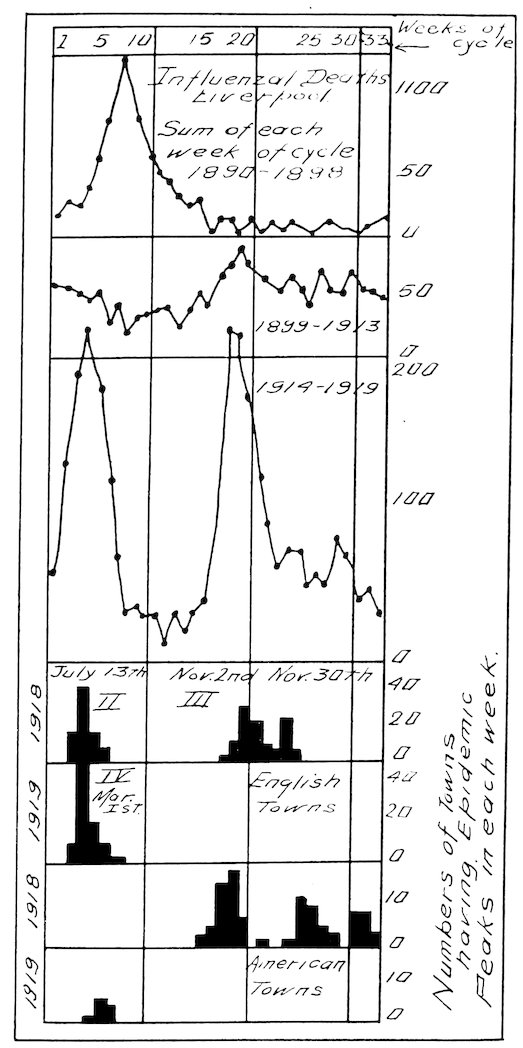
Periodogram based on the weekly influenza deaths in Liverpool between 1890 and 1919. The curves are based on a thirty-three week periodicity. (Stallybrass.)
105“The third maximum in the fourth week of the cycle is represented during the late outbreak by the waves culminating in Liverpool, and also the greater number of English towns on the weeks ending July 13 (Wave II) and March 1 (Wave IV). This is a 33-week interval. This wave recurred at an interval of 32–34 weeks in a large number of English towns.
“Of 65 towns which experienced all three waves 47 (72 per cent.) had their maxima in the summer and spring epidemics within an interval of 32–34 weeks; but comparing the week in which any given town had its epidemic peak in the summer and autumn, and autumn and spring epidemics only 27 (41 per cent.) and 31 (47 per cent.) respectively fell within the limit of a week on either side. The time relationships of the maxima in summer and spring were much closer to each other than they were to the autumn maxima.
“If it should prove correct that there were three strains of the influenzal virus, each with a periodicity of about 33 weeks, and that simultaneously all three strains became enhanced in both virulence and infectivity, then we are faced with a phenomenon without an exact parallel, although the behavior of the meningococcal viruses during the war presents some points of similarity. So far the weight of evidence leans to such an exaltation of a widespread endemic strain or strains rather than to dissemination from any particular focus in the world. In any case doubtless a good deal of spread of infection took place.”
Spear takes exception to the work of Brownlee and Stallybrass, and points out that the periodogram is not applicable to the study of recurrent epidemics unless the recurring waves are of approximately uniform “amplitude.” In that case nothing could be less appropriate for this study than the influenza waves which vary from very small to extremely high, as in 1918.
Spear describes two simple tests which he applied to demonstrate the existence or non-existence of periodicity.
106First he divided each of the last thirty years into 13 four-weekly periods, and tabulated the frequency with which the observed week of maximum mortality falls into one or other of the 13 groups. He discovered that the climax of an influenza prevalence falls more frequently in the second and third four-weekly period than in others—i.e., the months of February and March. Had there been a 33-week periodicity there would have been an equal number of these climaxes in each of the 13 divisions of the year.
Brownlee, according to Spear, was correct in his prediction that influenza would occur in February, 1920, for the reason that January or February is the most likely time for an influenza prevalence in any year.
Spear’s second test of periodicity consisted in plotting the interepidemic periods according to the number of weeks intervening. Were there a 33-week periodicity, he says, that nearly all interepidemic periods should fall in this group. As a matter of fact, more than twice as many periods fall in the 42–58 weeks interval than in any other interval. Fifteen fall within this period, six in the period 59–75 weeks, five in the period 8–24 weeks, and only four in the period 25–41 weeks. There was one in the period 76–92 and one 110 plus. Finally in the thirty years 1890–1919 there were thirty-two climaxes or peaks in the “influenza” mortality.
Spear concludes that if there is any periodicity it is around fifty weeks, or a year.
The fallacy in the work of Stallybrass and of Brownlee, according to him, is that the mortality in the third week of 1892, the twentieth week of 1891, and the tenth week of 1895, and in the big epidemic of 1918 so overshadowed all the other peaks that the smaller ones became lost in these larger waves.
Brownlee does not claim a 33-week periodicity during interepidemic periods. This part of Spear’s criticism is not valid.
Vaughan’s objections to the conclusions on measles hold equally well with regard to influenza. Finally, we must remember that in parts, at least, of the work of Brownlee and Stallybrass, they are not studying chiefly influenza deaths, but deaths reported as due to bronchitis and pneumonia.
After a study of the pros and cons of the question of periodicity the author submits by way of summary his conclusions:
1. Influenza does tend to recur at intervals. It has not been proven that these intervals are always of equal length.
2. At the present the opinions concerning the periods are divergent. 107We have the 33-week periodicity of Brownlee and Stallybrass, the one-year period of Spear, the seven-week intervals suggested by Pearl, and the apparent twelve-week recurrences in England in 1918 and 1919.
3. It is to be noted that particularly in the work of Stallybrass, in order to prove his periodicity, he finds it necessary at times to quote epidemics occurring, not in England, but in fairly remote parts of the world, as in the United States and Japan. We have shown that in the interval between 1918 and 1920 an epidemic could be discovered somewhere on the earth in many months, perhaps even in every month during this interval. It is to be regretted that following the criticism by Spear there has been no further report, so far as we know, by either Brownlee or Stallybrass.
4. It is quite possible, even probable, that influenza is endemic in mild form throughout the interpandemic years in England, as well as in many, or all other countries, but it is equally possible or probable that the particular virus which gave rise to the pandemic was not one which simultaneously increased in virulence in all countries, but was one which had its origin in one comparatively well localized focus.
5. Our own theory does not explain the autumn recurrence in 1918 in England, following that of May, June and July. We have traced the original spread to England and have left it at that point. We have again taken it up in the autumn when it became severe, and was returned to the United States. The interval of quiescence in England and elsewhere may need further explanation. Two alternative hypotheses suggest themselves: First, that the autumn recrudescence is entirely comparable to later ones, and is but a manifestation of the characteristic feature of recurrence in influenza. Had the autumn epidemic been mild and had it not so overshadowed all others, we would have classified it with those of early 1919 as being merely recrudescences of the summer spread. Evidence, particularly in favor of this, is the report of Greenwood previously mentioned which shows that in England the autumn spread partook of the nature of a secondary type of epidemic, as compared with the primary type in the summer.
The second hypothesis is that the occurrence in the summer in England of an epidemic due to a virus imported from America or France or China, with its consequent increase in morbidity, so enhanced the virulence of a local endemic British virus that the latter produced the autumn epidemic. We see no necessity for complicating the question by the assumption of this second hypothesis.
1086. Whether or not there is a regular periodicity of a definite number of weeks in the case of influenza, the fact remains beyond cavil that one of the dominant characteristics of epidemic influenza is its recurrence at intervals. The evidence is ample that the disease is distributed throughout many countries in interepidemic times and that intermittent outbreaks of large or small extent occur.
The most striking phenomenon is the fact that in March of 1918 influenza is reported as having been present in China, in the United States and in France. It is scarcely possible that the disease in its epidemic form could have been carried from any one of these three points to the other two in the remarkably short time between the onset of the three outbreaks. We are faced with the phenomenon of a simultaneous exaltation of the influenza virus in three remotely separated countries of the world. This one fact more than any other indicates that the fluctuation in virulence is dependent upon some factor intrinsic in the virus itself and not upon environmental factors.
It is impossible at the present time to decide whether the world epidemic spread simultaneously from these three foci or whether in only one of these three the virus became so exalted as to produce pandemic prevalence. All we can say is that we are able to trace consecutively the spread of the influenza from the focus in the United States throughout the world. The information upon which we base our findings is not statistical, and as we have previously said this latter type of demographic study should be brought into use to either corroborate or disprove our findings.
Virulence Enhancement.
Before attempting to study the mechanism of origin of the 1918 pandemic it is highly essential that we devote some attention to a consideration of the processes by which the germs of infection, particularly the virus of influenza, may develop an increase in virulence. Followers of the theory of periodicity would base virulence enhancement primarily on some intrinsic property of the virus itself. We know from past experience and particularly from animal experiments that this is not the only manner by which virulence may be increased.
As far as we know there is no new infectious disease. Individuals who delve into the history of the past inform us of more and more diseases which were well known to the ancients. We are frequently amazed at the variety of diseases now known to be infectious that were very correctly described by the Hippocratic writers. The infectious diseases are with us always and live nearly always in man, the host. 109There are few exceptions. Very few of the contagious viruses can live for any long period of time outside of the human body. A few, such as the plague bacillus, may live on other hosts, but these are the exception. The remarkable feature is that for long periods of time the virus exists in the host in a quiescent state and only at intervals does it become highly invasive and thereby produces epidemics of greater or less extent. Under what conditions does the metamorphosis of the microorganisms occur?
Topley, in the Goulstonian lectures, discusses this subject. He says: “The first difficulty with which we were faced in forming any theory of the spread of bacterial infection, which should conform to the known facts of epidemiology, was to find some explanation of the perpetuation of the virus during interepidemic periods. The bacteriologic data which have accumulated, especially during the last twenty years, have shown that the causative agents of specific diseases are to be found in apparently normal persons who give no history of having been in contact with the disease in question, as well as in contact with actual cases of the disease. Moreover, the organisms in question have been shown, in certain cases, to persist for long periods of time in or upon the tissues of their hosts, and we must always remember that the difficulty of bacteriologic technic is likely to lead to a serious under-estimate. Clinical and epidemiologic investigations have yielded confirmatory evidence, and we are thus left with a conception of the virus of a given disease being distributed fairly widely throughout the world as an apparently harmless parasite on the human host, but taking on during epidemic periods a new and sinister role, only to relapse again into comparative quiescence as the epidemic subsides.”
He explains the rise of the epidemic wave as follows: “There are at least three possible explanations—an increase in the power of the parasite to produce disease, a decrease in the resistance of the host, and some attraction in the surrounding circumstances which favor the transference of parasites from case to case without any alteration of the pathogenicity of the one or in the resistance of the other. The third of these hypotheses may, I think, be disregarded. That alterations in environment may be the determining cause in initiating an outbreak of bacterial disease is probable enough; but they will almost certainly act through the variations which they bring about in the other two factors. The whole of bacteriologic knowledge is clearly against the occurrence of a considerable epidemic in which the pathogenicity of the parasite and the resistance of the host remain constant. Again, while we may well believe a lowered resistance of a certain 110number of the host-species to be an important factor in the initiation of the process, yet we cannot believe that it is the whole story. The widespread ravages of many epidemics would seem altogether to preclude such an explanation. We seem forced therefore to the conclusion that an increase in the pathogenicity of the specific parasite is an essential factor in the rise of epidemics, excluding from this category small sporadic outbreaks which may be due to the introduction of a fully virulent parasite by a healthy carrier in some other way.”
If a disease like measles is quiescent in a given community it must be that in that locality the hosts and parasites are existing in a state of biological equilibrium. They are living in a state somewhat akin to symbiosis. Such a condition could be attained either by a diminution of the invasive powers of the parasite, or by an increase in resistance of the host. Probably both elements are active; as the relative immunity of the host rises the infectivity or virulence of the parasite must rise to an equal extent to maintain the equilibrium. If this were true we would find that in those localities in which the disease is endemic and where the population is relatively resistant there is a normally more virulent virus in existence. A stranger coming into such a community would, in view of his lower resistance to the virus, be more susceptible of becoming actively infected. There would, however, be little danger of an epidemic spread because the number of susceptibles would, roughly, be limited to the number of strangers in the community. If, however, an individual from the community carrying the more virulent virus were to travel to another community where the greater proportion of the population was relatively less immune the field would be fertile for the beginning of an epidemic. Furthermore, there is the possibility of an outbreak in the first community if there should occur gross changes in its constitution; another infectious disease, a redistribution of the population with greater crowding, anything to change the balance between host and parasite.
Theobald Smith has described this possibility very clearly:
“During the elimination of the more virulent races of microorganisms, there goes on as well a gradual weeding out of the most susceptible hosts. In a state of nature in which medical science plays no part, there must occur a slight rise in the resistance of individuals, due to selection and perhaps acquired immunity, which meets the decline of virulence on the part of microbes until a certain norm or equilibrium between the two has been established. The equilibrium is different for every different species of microorganism, and is disturbed by any changes affecting the condition of the host or the means of transmission 111of the parasite. One result of the operation of this law is the low mortality of endemic as compared with epidemic diseases. Certain animal diseases while confined to the enzootic territory, cause only occasional, sporadic disease, but as soon as they are carried beyond this territory epizootics of high mortality may result. Climate in some cases enters as an important factor, but the most important, perhaps, is the slight elevation in virulence brought about by a more highly resistant host. The most susceptible animals are weeded out and the rest strengthened by non-fatal attacks. The virulence of the microbe rises slightly to maintain the equilibrium. In passing into a hitherto unmolested territory, the disease rises to the level of an epizootic until an equilibrium has been established.
“The same is true of human diseases, among which smallpox is a conspicuous example. The great pandemics of influenza, which seem to travel from east to west every one or two decades, soon give away to sporadic cases, and the careful work of many bacteriologists would indicate that the influenza bacilli found at present have fallen to the level of secondary invaders, and are parasites of the respiratory tract in many affections.”
Smith describes his hypothesis that the tendency of microbes in perfecting the parasitic habit is to act solely on the defensive. The aim of microorganisms, if we may speak of such, is to become able to live unharmed on the host. If they kill the host they have lost their home. The biologic tendency would be in this case for diseases which were once acute to become more and more chronic and indolent.
The extremely virulent parasite, which kills its host, will die with the host unless it has effected a means of exit before its death and escapes into a new host. For this reason Pasteur failed to exterminate the rabbits of Australia. He believed that with races of the bacillus of rabbit septicemia, which were very virulent, and which destroyed life very quickly, all that would be necessary was to start the disease among the rabbits of Australia and that it would tend to spread and would kill off all of the rabbits. But the parasite killed the animals before it had perfected for itself a means of escape from the body and thereupon died.
“From the biologic standpoint which I have endeavored to present, we may conceive of all highly pathogenic bacteria as incompletely adapted parasites, or parasites which have escaped from their customary environment into another in which they are struggling to adapt themselves, and to establish some equilibrium between themselves and their host. The less complete the adaptation, the more virulent 112the disease produced. The final outcome is a harmless parasitism or some well-established disease of little or no fatality, unless other parasites complicate the invasion. The logical inference to be drawn from the theory of a slowly progressive parasitism would be that in the long run mortality from infectious diseases would be greatly reduced through the operation of natural causes. But morbidity would not be diminished, possibly greatly increased by the wider and wider diffusion of these parasites, or potential disease producers. The few still highly mortal plagues would eventually settle down to sporadic infections or else disappear wholly because of adverse conditions to which they cannot adapt themselves.
“In this mutual adaptation of microorganism to host, there is, however, nothing to hinder a rise in virulence in place of the gradual decline if proper conditions exist. In fact, it is not very difficult to furnish adequate explanations for the recrudescence and activities of many diseases today, though the natural tendencies are toward a decline in virulence. In the more or less rapid changes in our environment due to industrial and social movements the natural equilibrium between host and parasite established for a given climate, locality, and race or nationality is often seriously disturbed and epidemics of hitherto sporadic diseases result.
“These illustrations indicate that so-called natural law does not stand in the way of our having highly virulent types of disease, if we are ignorant enough to cultivate them. The microorganism is sufficiently plastic to shape itself for an upward as well as a downward movement. Among the most formidable of the obstacles toward a steady decline of mortality is the continual movement of individuals and masses from one part of the world to another, whereby the partly adapted parasites become planted as it were into new soil and the original equilibrium destroyed. These various races of disease germs become widely disseminated by so-called germ carriers, and epidemics here and there light up their unseen paths.”
An example of increasing virulence from changing environmental conditions, is the experience in the United States Army camps in 1917 and 1918 with the streptococcus. This microorganism, which at first was but a secondary invader, particularly to measles, became so exalted in virulence that it soon became the cause of primary disease. This is likewise true of the various secondary invaders of the influenza epidemics. They become so highly virulent that they dominate the picture in the later stages. The organisms included in this group are particularly the streptococcus, the various pneumococci, and the 113meningococcus. Probably the tubercle bacillus should be added to this list.
It requires a certain amount of time for such organisms to attain increased virulence. The earliest cases in any epidemic are comparatively very mild. Thus Major Billings, epidemiologist at Camp Custer, says that for the first five days of the autumn influenza epidemic in that camp the cases admitted to the hospital were very mild in character and were recorded as simple bronchitis and pharyngitis, of no great severity, the majority soon recovering. Five days after the first case was admitted, however, the entire symptom complex seemed to change, and the cases admitted to the hospital from then on were a very different and much more severe type. Major Billings, after going over the records, feels that both types of cases were the same disease, the second being a more severe form. Woolley reports essentially the same condition from Camp Devens.
The same phenomena were found in 1889. During the 1889 epidemic Prudden examined by current bacteriologic methods seven cases of influenza and six cases of influenza-pneumonia. In them he found staphylococcus pyogenes aureus, streptococcus pyogenes, diplococcus pneumoniae, and in other cases he found a streptococcus. He concludes that the use of culture methods and media commonly employed has brought to light no living germ which there is reason to believe has anything to do with causing the disease. He emphasizes the probable importance of streptococcus pyogenes in particular in inducing the various complications.
At this point we should include for the sake of completeness reference to a recent theory propounded by Sahli explaining influenza epidemics, a theory to which we do not subscribe. He believes that the pneumococcus, the streptococcus, the influenza bacillus, and possibly other organisms, form a complex group, an obligate complex, a symbiosis, a higher unit, which infects the organism as a unit. It is all of these organisms acting together which produce the influenza. After infection has occurred one or the other member of the group may develop preferentially. In favor of this he says that in one of his cases the sputum was swarming with influenza bacilli on one day, and that the next day the sputum was a thick pure culture of the pneumococcus. He says that if an ultramicroscopic germ should yet be discovered this would not invalidate the theory, but would merely add another member to the group forming the obligate complex virus unit.
Meteorologic conditions.—Formerly attempts were made to demonstrate etiologic relationships between the occurrence of influenza 114and unusual conditions of the atmosphere. In most cases no relationship has been discovered. Nevertheless it is conceivable that the changes in the atmosphere, particularly seasonal variations, might influence the virulence of the organism. It has been found that nearly all of the many epidemics apparently originating in Russia took their origin there either in the late autumn or in the winter months. The spread of influenza appears to be uninfluenced by atmospheric conditions, but the severity of the disease is definitely increased in the winter months, and Leichtenstern believes that the development of a primary spread from its point of origin is also influenced by the season. Hirsch found that out of 175 correlated pandemics or epidemics, 50 occurred in the winter between December and February, 85 in the spring from March to May, 16 in the summer from June to August and 24 in the autumn.
The soil plays no part in the spread of the disease. It prevails on every soil or geologic formation; on the mountain top, in the low malarial swamps, in the tropics and within the arctic circle. Volcanic eruptions, fogs, electrical conditions, ozone, direction of the wind, have all been considered in previous epidemics and successively eliminated as etiologic factors.
It must be stated, however, that Teissier, who investigated the influenza in Russia in 1890 and has compared his conclusions at that time with the results of investigation of the recent visitation, believes that some particular cosmic conditions suddenly enhanced the virulence of an endemic etiologic microorganism—probably some ordinary germ—and that this opened the portals to secondary infections.
Secondary invaders.—We have considered a possible manner in which the virulence of the organism causing influenza may become enhanced. Whatever this organism may be, another and equally important virulence enhancement occurs in the opportunist group of the germs, so-called secondary invaders of influenza. As we have previously remarked, it is a characteristic of influenza outbreaks in all communities that the earliest cases are very mild. Secondary infection has not as yet obtained a foothold. After about a week the character of the illness changes, becoming distinctly more severe. Billings reported that at Camp Custer in the autumn of 1918 cases admitted to the hospital during the first five days were very mild in character and were reported as simply bronchitis or pharyngitis of no great severity, the majority soon recovering. After this time the entire symptom complex seemed to change and the cases admitted to the hospital were of a very different and more severe type.
115Benjafield reports that in the Egyptian Expeditionary Force the epidemic commenced in May, 1918, and that the cases occurring during the earlier portion of the epidemic were mild in type and of short duration, only a very small proportion being complicated by bronchopneumonia. Wooley found at Camp Devens that the first cases were of a mild form and were usually diagnosed “naso-pharyngitis, acute catarrhal.” After a few days the disease became more severe and pneumonia cases developed.
Bezançon found that among the repatriated French soldiers from Switzerland those cases occurring in May and June had a much lower severity than in the later epidemic. Zinsser’s description of the mild, earlier epidemic in Chaumont has already been quoted.
The secondary invaders of pathogenic importance are the various forms of the streptococcus and pneumococcus, the meningococcus, the staphylococcus, and probably the tubercle bacillus and the influenza bacillus. In the last epidemic as in that of thirty years previously, the chief complications were bronchitis and pneumonia. Capps and Moody found these to be the chief complications in December, 1915. Also they found a high incidence of sinusitis. This has been a feature of the last epidemic. Wooley cites a good example of the damage done by these opportunist organisms when they are present. Among the troops stationed at Camp Devens in the fall of 1918 pneumonia following influenza was particularly prevalent in a battalion of negroes from the South. This battalion had, a short time previously, passed through an epidemic of pneumonia and Wooley believes that many of the blacks were harboring the pneumococci which were only awaiting a favorable opportunity to invade their hosts. The influenza furnished the required opportunity.
That the meningococcus should be classed in this group is certain. The author observed at Camp Sevier cases of epidemic meningitis occurring in various influenza wards scattered throughout the hospital, with no demonstrable relationship. Usually there was but one case in a ward and almost invariably meningitis occurred when convalescence was beginning. No epidemic occurred in any ward. Others have reported actual epidemics of meningitis following influenza. Moss found that a large proportion of his influenza cases had the meningococcus in the circulating blood, as demonstrated by culture. Fletcher cultivated meningococci from the lungs in all of eleven autopsies, and in all eleven cases the influenza bacillus was also present.
In considering the effect of influenza on the death rate in general, and in considering the relationship of influenza to other diseases in 116general, it is important to distinguish those diseases which are apparently unrelated and those diseases which occur as direct complications or sequelae. Bronchopneumonia, bronchitis, empyema, otitis media, frequently tonsillitis and sometimes erysipelas, occur as sequelae. Meningitis should frequently be included in this group.
Not only is there an increase in certain other diseases following influenza outbreaks, genetically related, as we have seen, but also some observers, particularly Crookshank, believe that previous to epidemic influenza prevalences there occurs an increase in the incidence of other entirely unrelated infectious diseases, such as poliomyelitis. This theory of simultaneous increase in invasiveness of many apparently unrelated germs is comparatively new and will probably receive deep consideration in the future. For the present the information on the subject is so limited that attempted conclusions would have no value.
Origin of the 1918 Pandemic.
In discussing the spread of the 1918 pandemic over the earth, the author has traced it from an apparent origin in the United States. Localized early epidemics are reported simultaneously in the United States, France, and China. From the literature at his disposal he has been unable to find convincing proof of an earlier origin in Asia, but he did emphasize at the time the necessity of a much more thorough study of influenza in all countries to be made by more competent statisticians. Nevertheless it is highly interesting to formulate an hypothesis which appears to meet all demands, on the assumption that the disease originated in America. In order to hold a theory with this basis we must assume that the third of our previously mentioned hypotheses of the origin of the disease is the more nearly correct.
Let us assume that in the interpandemic periods the influenza virus is widely distributed over the earth, existing in an avirulent form. The basis for this assumption is the previously described occurrence of localized epidemics in interpandemic periods. The occurrence of solitary cases, although of interest, could scarcely be considered as evidence of the widespread distribution of the virus, but in the case of the small outbreaks as in 1900, 1907 and 1915, and as in the numerous small outbreaks described by Hirsch, the character of the epidemic curve is characteristic. Let us, then, assume that the disease has been endemic in the United States, together with other localities. It requires no keen observation to discover in the years 1917 and 1918, Theobald Smith’s “movement of individuals and masses from one 117part of the world to another, whereby the partly adapted parasites become planted, as it were, into new soil, and the original equilibrium is disturbed.” Not only was there a tremendous redistribution and concentration of individuals in our camps in this country, but also there was a further disturbance of the equilibrium in the outbreak of other infectious diseases, particularly measles. The effect of the measles epidemic on the virulence of the streptococcus and allied organisms has been discussed; presumably the same occurred with respect to the influenza virus. Howard and Love report that approximately 40,512 cases of influenza were reported in the United States Army during 1917. They write:
“In 1917, the death rate for the acute respiratory diseases (influenza, pneumonias and the common types) increased to 1.71. During the fall of 1917, after the camps were filled with drafted men, acute epidemic diseases swept through a number of them. Measles was one of the most prevalent and one of the most fatal of the infectious diseases that occurred. It was noted during the fall and early winter that there were a number of cases of pneumonia which were unlike the pneumonia that ordinarily occurred. This was apparent both to the physicians in civil life and in the army camps. It was reported by all classes of practitioners that numerous cases of pneumonia were occurring which resembled the pneumonia following measles, but occurring among men who had not had measles recently. In a number of the camps, both in the north and in the south, rather extensive epidemics of pneumonia occurred and a number of deaths resulted. The same variety of pneumonia occurred in the late winter and spring of 1918. In many of the camps pneumonia was practically epidemic during March and April. In many camps a number of cases occurred later in the spring and summer. It was again reported by a number of medical men that these cases of pneumonia that were occurring were different from the types of pneumonia ordinarily encountered and very similar to pneumonia following measles, but, again, that the cases occurred among men who had not had measles recently.”
MacNeal has observed similar conditions in the American Expeditionary Forces in France in 1917:
“The American troops in France in 1917 began to show, as early as October, 1917, a very considerable rise in the influenza morbidity. The data available in the office of the Chief Surgeon, A. E. F., show an influenza morbidity per 100,000 of 321 in July, 438 in August, and 404 in September, rising to 1,050 in October, 1,980 in November, and 2,480 in December, 1917, in which month the total number of new 118cases of influenza reported was 3,520. That a considerable proportion of these cases were actual infections with the bacillus of Pfeiffer is proven by the necropsy findings in fatal cases of bronchitis and bronchopneumonia, especially those performed by Major H. E. Robertson at Army Laboratory No. 1, Neufchateau, in November and December, 1917, and January, 1918. In these cases the bacillus of Pfeiffer was found in the scattered patches of lung involved in the bronchopneumonia and also with great frequency in the cranial sinuses. These necropsy findings were, at the time, recognized as essentially new for young adult Americans, and, in a discussion at Army Laboratory No. 1, during December, 1917, they were considered as being of possible important significance for the future morbidity of American soldiers in France. In the British Army in France there is definite evidence of epidemics showing the same pathologic condition, during the winter of 1916–17, and at Aldershot in September, 1917. There can be little, if any doubt that this disease was essentially the same which attacked the American soldiers late in 1917.”
Schittenhelm and Schlecht have reported that a disease was studied among the German troops on the Eastern front which resembled greatly the influenza. It occurred from the beginning of August to the middle of October, 1917. It attacked simultaneously and in epidemic form units and divisions very widely separated over a large territory. It was characterized clinically by a very sudden onset, in the greater number of cases with chill, headache, pain in the extremities, sometimes thoracic pain and cough. The fever lasted seven to nine days. The spleen was enlarged in 11 per cent. of the individuals. There was diarrhea in 12 per cent., frequently conjunctivitis, and quite often a scarlatiniform rash. Bacteriologic examination of the blood was negative. There was usually leucopenia. No treatment seemed especially efficacious. Aspirin gave the best results. The authors call attention to the close similarity to influenza and also suggest that it might have been due to transmission by insects as in pappataci fever or in dengue.
Carnwath concluded that the finding of influenza bacilli in necropsies in British soldiers in 1917 was without epidemiologic significance in considering the origin of the 1918 pandemic. He had studied the disease among the British in detail and appeared to be of the opinion that the first influenza morbidity of significance among the British troops did not appear previous to April, 1918.
MacNeal further says: “The influenza rates per 100,000 of 1,050 in November and 2,480 in December, 1917, really indicate a greater 119relative prevalence of influenza at that time in the A. E. F. than occurred in the fall of 1918, when the respective morbidity rates were 826 in September, 2,176 in October, and 1,356 in November. The total number of American troops in France was relatively small during that winter—141,995 effective mean strength in December—so that the prevalence of influenza did not lead to the recognition of an actual epidemic. Furthermore, the overcrowding in quarters, which seems to have had a definite relation to many of the later explosive outbreaks, had not become such a distinct feature at that time. In addition, the cold, wet weather, exposure and unusual living conditions furnished explanations for the morbidity which were no longer adequate during the hot weather of May and June, 1918. Until May, 1918, therefore, the prevalence was that of an endemic disease, with perhaps an occasional outbreak suggesting epidemic character.”
We admit that MacNeal’s report furnishes excellent evidence of an independent origin in France. Two points should be borne in mind. First, that MacNeal’s figures are not for the French, but for the Americans who were transported to that country, and that we may consequently consider influenza among the American Expeditionary Forces as being possibly from the same source as influenza among the troops in our own country,—that the American Expeditionary Forces may be considered a subdivision of the American Army in the United States, equally well as a subdivision of the French population; second, that we have been unable to find detailed evidence of similar conditions occurring among the French troops or French population, where the conditions have been ripe in a way since 1914. MacNeal records that in March and April, 1918, there was a great increase in the number of troops brought over from the United States to France. Previous to that time there had been 287,000 in that country and during the two months 150,000 were added, with a consequent increase of more than fifty per cent.
We should insert a word of caution regarding the diagnosis of influenza among troops in the absence of any sign of an epidemic. Internists who served in base hospitals during the war will agree that a diagnosis of influenza is very frequently made on the admission card when the disease turns out to be some other malady. This was not equally true in all camps, but regimental surgeons could often be found who would transfer a patient to the hospital with the diagnosis of influenza used almost interchangeably with the diagnosis “Fever of unknown origin.” It would be interesting to see statistics from one or two of those base hospitals which were manned with especially 120competent internists, as to the frequency with which the admission diagnosis of influenza remained unchallenged in the hospital, during the year 1917.
There would be such cases in greater or smaller numbers. The magnitude of this number would not influence our hypothesis.
Aside from this discussion of the disease among our troops in France it is most important that we establish, if possible, the identity of the disease reported among British troops in Northern France during the winter of 1916–1917 and designated by the name “Purulent Bronchitis.” The disease first appeared in December, 1916. It reached its height during February and early March of 1917, and appears to have disappeared early in the spring. Hammond, Rolland and Shore report that during February and early March 45 per cent. of the necropsies under observation showed the presence of purulent bronchitis, and they remarked that the disease assumed such proportions as to constitute almost a small epidemic. They described the clinical aspects as follows:
“The cases which came under our notice can be divided broadly into two types: The first and more acute presents a clinical picture which closely simulates ordinary lobar pneumonia with a sustained temperature of about 103°, and expectoration at first blood-streaked—rather than rusty—which, however, rapidly becomes quite purulent. The pulse-rate in these cases is out of all proportion to the temperature in its rapidity. Dyspnoea and cyanosis are prominent features. The patient usually dies from ‘lung block,’ resulting in embarrassment of the right side of the heart on the fifth or sixth day. For the last day or two there is often incontinence of the feces, due, no doubt, to the condition of partial asphyxia. The mental state is one of torpor; delirium is the exception.
“The second and less acute type is marked by a more swinging temperature with a range of two or three degrees. The expectoration at first may be frothy and mucopurulent, but it very soon assumes the typically purulent character. This form may run a long course of from three to six weeks, during which time the patient wastes a great deal and has frequent and profuse sweats; indeed, at a certain stage the illness is most suggestive of acute tubercular infection, and it is only by repeated examination of the expectoration that the clinician can satisfy himself he is not really over-looking a case of acute pulmonary tuberculosis. The majority of our cases conforming to this type have ultimately recovered, but the convalescence is slow and tedious.
121“Onset.—Whilst a history of a previous catarrhal condition lasting for a few days is often obtained, the disease quickly assumes an acute character; we have been able to observe this in patients admitted into this hospital with purulent bronchitis; we find the temperature is between 102° and 103°, the pulse 120 or over, and the respiration about 35. The patient frequently complains of shivering and looks pathetically miserable, but we have not seen an actual rigor. Despite his obvious shortness of breath, the sisters have noticed that, at any rate at first, he prefers a lateral position low down in the bed, and resents any attempt to prop him up.
“Cough.—This for the first day or two may be irritable and distressing, with a little frothy expectoration, but as the latter becomes more purulent the cough is less troublesome, and soon the patient is expectorating easily and frequently, until the later stages are reached; when owing to increasing asphyxia the patient becomes more and more torpid, the cough subsides, and hardly any secretion is brought up. This failure becomes an added factor in bringing about a rapidly fatal termination.
“Expectoration.—The sputum, with its yellowish-green purulent masses, is very characteristic, and may be one of the first indications of the serious nature of the illness the patient is suffering from.
“Temperature.—The fever of this complaint does not follow any very constant type. In nearly all our cases the pyrexia was of sudden onset, and for the first few days was more or less sustained at about 103°. Later it conformed more to the swinging type with a range of several degrees. In a few cases a curious gradual ante mortem drop has been observed.
“Pulse.—Tachycardia is a very constant feature throughout the illness. The rate is frequently well over 120, though the volume may remain surprisingly good until immediately before death.
“Some degree of dyspnoea is always present, and is usually progressive, though towards the end in the fatal cases when the mental acuteness is dulled by the increasing asphyxia the patient is not distressed by its presence. In some cases there have been paroxysmal exacerbations of the breathlessness, accompanied by a state of panic, in which the patient struggles wildly and tries to get out of bed in order to gain relief. Cyanosis is another prominent feature throughout the illness. At first it may not be more than duskiness, but in the later stages it becomes very evident. It is only slightly relieved by oxygen; this, no doubt, is partly explained by the difficulty in giving the oxygen efficiently, owing to the patient’s objection to any mouthpiece 122that fits at all tightly, and partly by the blocked condition of the bronchioles interfering with the absorption of the oxygen.
“The condition usually begins with the presence of a moderate number of sharp crepitant râles, often first heard in the region of the root of the lung; these quickly become generalized. In the majority of the cases signs of bronchopneumonia patches can be made out; these are generally situated near the root of the lungs. In a certain number of cases these patches spread and become confluent, giving practically all of the physical signs of a lobar pneumonia. As the disease progresses the air entry is diminished; on listening one is often struck by the small volume of sound heard. The resonance of the lungs may also be lessened. A slight pleuritic rub was heard in a few of our cases, but this was soon masked by the bronchitis signs.”
Detailed sputum examination in twenty cases showed the presence of the influenza bacillus in eighteen, and in ten out of these eighteen the organism was isolated by culture. The next most frequent organism found was the pneumococcus, which was present in thirteen cases. The streptococcus was found in five.
Abrahams, Hallows, Eyre and French report the same epidemic:
“A typical case is as follows. The onset is usually acute; the early symptoms are those of a ‘cold in the head.’ The temperature may be 101 or 102°, but there are no features to distinguish the condition from acute ‘coryza’ or febricula, so that in the majority of cases the patient does not report sick for two or three days, by which time he is sent to the hospital. At this state two features attract particular attention. First, the character of the expectoration: this consists of thick pale yellow, almost pure pus, not the frothy expectoration familiar in ordinary bronchitis; it has no particular odor and it becomes increasingly abundant until in a day or two it may amount to several ounces in the twenty-four hours. Secondly, the rapidity of the patient’s breathing: this may be so evident that pneumonia suggests itself, yet on examining the chest the only physical signs consist of few or many rhonchi scattered widely, but most marked at the bases of the lungs behind, associated with a wheezy vesicular murmur; resonance everywhere is unimpaired and bronchial breathing is absent. A little later a third point attracts notice; a peculiar dusky heliotrope type of cyanosis of the face, lips, and ears, so characteristic as to hall-mark the nature of the patient’s malady even on superficial inspection. By this time dyspnoea is very pronounced; respiration consists of short, shallow movements, which in bad cases amount almost to gasps, reminiscent of the effects of gas poisoning. Recovery 123at this stage may occur, but by the time the cyanosis has become at all pronounced the prognosis is extremely bad, though the number of days the patient may still live, in spite of the severity of his distress, is often surprising. The character of the sputum remains the same throughout, though sometimes it is blood-tinged or actual blood may be expectorated instead of, or in addition to, the more typical pale yellow pus. In the later stages of the illness areas of impaired note or of actual dullness may be found, particularly over the posterior aspects of the lungs, associated with bronchial breathing and crepitant râles. These may be due to the progression of the purulent bronchitis into hypostatic pneumonia, or into actual bronchopneumonia at the bases; or, on the other hand, they may be due to massive collapse of the lungs secondary to the bronchitis and obstruction of the bronchioles by pus. In a few cases, not necessarily the most serious, a frank lobar pneumonia has developed later, and has been followed by an empyema from which 15–30 ounces of thin pneumococcal pus has been aspirated—in one case alone was resection of a rib unavoidable. The condition, however, is not primarily a lobar or a bronchopneumonia, but a bronchitis, and although a small amount of basal bronchopneumonia has been present in one or two of our post-mortem examinations, in other fatal cases there has been no bronchopneumonia at all, not even the smallest portions of either lung being found to sink in water.