Front matter (continued 4)
Reading edition
Phyllis hesitated, but at last the words came.
"On the cheap," she repeated. "Why don't you aim higher, Cyril? Why don't you try the real people--those who are worth while, especially now, when you're going to break away from Steinberger?"
His only reply was a shake of the head.
"You know you're too good for this sort of thing," she went on. "It isn't flattery to tell you that--you see it yourself every night--I saw it, and that's why I-- Oh, Cyril, let's try to get where you belong."
"You don't understand," he said moodily. "You don't understand a bit. I had all that once, and I kicked it over. The stage is an awfully small place--for anybody that amounts to anything, you know--though as big as an ocean for the others. There isn't anybody of importance--manager or star--who doesn't hate me." He perceived the doubt in her glance, and continued swiftly: "Oh, it's no conspiracy, or jealousy, or anything of that kind--a tip-top man can override all that if there's money in him for the box-office--but I've set them all against me. There isn't one I haven't punched or insulted somehow. I hold the record for being the best-detested man on Broadway. Why, Alfred Fielman once--that was six years ago, when I was by way of being a metropolitan favorite, and all that, ha, ha--he had me on a forty weeks' contract, and at the end of three he gave me a check for the rest and told me he had no more use for my services. Thirty-seven weeks' full salary--think of it--and the door!"
"But isn't it different now?" asked Phyllis, enfolding him with a pair of the whitest, softest, shapeliest arms in the world, and pressing her cheek against his face. "You've got good since then, and are now mama's little man!"
"Look at last night," protested mama's little man dismally. "Drinking, fighting, gambling, and my job out of the window! That's been me right along--two weeks' notice, and for God's sake, never come back!"
"Just a damned goat," rippled Phyllis, her teeth shining like pearls, and her cheeks dimpling mischievously.
"A silly ass," ejaculated Adair with much self-contempt.
"Now, I want to tell you my idea," cried Phyllis. "We're going to pack up, poor booful disgraced genius--and wife (as they add on hotel registers); and we're going to count our poor little pennies, and take a tourist sleeper to New York, and get a little flat of the sort they rent to dormice in reduced circumstances, and live on air and kisses and hope--while poor Booful will go round telling everybody he's a reformed character, and looking for an engagement. And if the top all hates him, and if the middle is all full, why Booful will begin at the bottom, while Mrs. Booful will wash, and cook, and darn his socks--oh, no, listen,--yes, and darn his socks, and pet him when he is discouraged and cross, and keep everything scrupulously clean (in books if you're awfully poor, you're always scrupulously clean, haven't you noticed it)? Yes, scrupulously clean, and oh, so economical of every nickel till everybody begins to see that Booful isn't a damned goat, but a man of splendid talent, and up, up, up he'll go like a balloon, till there won't be a garbage-can without his name on it, or a bill-board without somebody "presenting" him in letters six feet high, and fame and money will pour in like a Niagara, and, and--Cyril, why shouldn't we?"
His look of indulgence and amusement had gradually changed to downright eagerness.
"If you can stand it, I can," he said.
"Oh, Cyril, I'm not afraid--let's do it!"
"We'll be starvation poor."
"But in a home of our own--no more of these horrid hotels, no more traveling, and something big to live and hope for."
"Those dormice flats are awfully squeezy--and dark."
"So's a robin's nest, for that matter."
"And those pretty hands--it would be wicked to spoil them."
"Oh, I won't spoil them--besides, what would be the good of them if they couldn't work for the man I love."
"Scrubbing floors, and cleaning kettles and polishing the stove?"
"You can help a little."
"And suppose, instead of being easy, it's very hard? It takes courage to start again. You'll have to be brave enough for two, for I've none of that kind of grit or perseverance. Do you think you can bolster up a great big fellow like me, who'll come home like a baby and cry?"
"We'll bolster up each other."
"I--I wish I was more worthy of you, Phyllis."
"Stop kissing my toes--it tickles--and oh, Cyril, don't bite them!"
"I'm ashamed--you are so sweet and good and clever and brave--and the whole of me isn't worth that little pink one, and I don't think I've ever loved you so much as I do this minute, or respected you more. If you were married to a street-car conductor I believe you'd make him president of the United States--and if your husband mayn't bite you, who can?"
"You darling!"
"And I swear by that one that I love you better than anything in the world; and by that one I'll be true to you all my life; and by that one I'll cut my tongue out before I'll ever say an unkind word to you again; and by that one I'm going to do everything you say, just as though you were an angel from Heaven, which you are if ever there was one; and by that fat little big toe that I'm going to try to copy the tenderest, gentlest, most exquisite nature that God ever breathed into a human being; and by the whole chubby little white satin foot--"
"Do sit up--it's important."
"I thought it was all settled. We'll start for New York as soon as I am fired--officially."
"Cyril?"
"Yes, sweetheart?"
"I'm so infatuated with you that perhaps I don't see things as they are. It is not a dream, is it, that you really could get on in New York--I mean if you lived down all the ill will against you there? I try to detach myself, and criticize you dispassionately--but you always seem to me so tremendously good."
"I am good--in my own kind of work."
"You've no dread of failure?"
"In handing out the goods--? Not a particle, Phyllis. Why should I? Haven't I done it?"
"In your New York days?"
"Why, Phyllis, this isn't brag. I've got notices to show for it, corking notices. What you have seen me do is not my best. No one could do that with the support I get, and I have to carry the whole outfit single handed. A company ought to be a string orchestra--and they give me a brass band!"
"Have you got the notices?--I'd love to see them!"
"They're at the bottom of the trunk somewhere--three books of them."
"Do get them out, and let me read some."
After long rummaging the books were produced. Phyllis, who in the interval had put on a peignoir, and begun to comb her hair, seized on one of them enthusiastically. It was an unwieldy, shabby old volume, and so heavy it was hard to hold. The exertion, and perhaps the excitement had caused Adair's head to throb again, and he was glad to stretch his length on the bed while Phyllis, drawing up a rocking chair, seated herself as close as she could beside him.
The actor had not exaggerated his past successes. For three seasons he had been a notable figure on Broadway, and if his reputation had been more one of promise than achievement it was in dazzling contrast to what he had since become. He had himself almost forgotten the stir he had made--not the deafening curtain calls, the brimming box-offices, the deferential managers,--none could forget that--but the soberer, yet more valuable evidence of the critics. It was electrifying to listen to them again; to see across the mean, intervening years that other self of his lording it so high; to realize, with mingled bitterness, wonder and hope that he was still the same man, with the same if not richer powers, and a new-born resolution to regain what he had so lightly valued and so unconcernedly thrown away.
Phyllis, pink with excitement, and tripping occasionally over the longer words, read notice after notice with indefatigable zest, constantly substituting Booful and other endearing epithets for the more formal name in print, while her husband lay back, listening delightedly, and contributing exclamations, "By George, and it was William Winter who said that!"--"Say, that's Huneker, isn't it?" "A column in The World isn't handed out to everybody, not by a long sight."
BOOFUL OPENS AT WALLACK'S THE HONOR OF THE REGIMENT PLEASES, BUT NEEDS CUTTING. THE STAR SCORES AS MOODY HERO, AND EXCELS HIMSELF IN MAGNIFICENT PORTRAYAL OF EBHARDT.
"Those who went last night to see Booful were not disappointed, however they may have disagreed about the play itself. For that brilliant young darling it was hardly less than a personal triumph, and from the rise of the curtain--"
It was a very inconsiderate moment for a heavy rap at the door.
"Come in," cried Adair.
In the shadow stood a bulky figure--a blue figure--a figure with something shining on its swelling chest. Phyllis looked and quailed as the bravest of us do at the sight of the Law, intruding its hob-nailed boot into what is metaphorically termed our castle. In this case the castle was so small, and the Law so large and red and impressive that the former seemed but a trifling refuge against oppression. In the accents of a green and troubled island the new-comer asked: "Are you Misther Adair--Misther Surul Adair?"
"That's me, all right," said the actor.
"You're summonsed for assault and battery, and here's the payper, and it's before Judge Dunn ye're to come at two o'clock."
"Where do I go, officer?"
"The city hall, police court number one."
"Two o'clock, you say? Very good. Tell Judge Dunn I have much pleasure in accepting his kind invitation."
The functionary unbent genially.
"Tay will be served on the lawn," he said, "and the Marine Band will be in attendance, and some of our younger set will be there--in blue."
It seemed incredible to poor, trembling Phyllis that Adair could burst out laughing. But he did, and that with every indication of undiminished spirits.
"All right, officer, I'll be there."
"Good morning, sorr."
"Good morning, officer."
The tears were streaming down Phyllis' face as she ran to Adair, and threw her arms around his neck; but he caressed and comforted her, and gradually got her to smile again.
"I feel better," he said. "Be a dear, and make me some fresh coffee.--Oh, Phyllis, isn't it jolly!"
"Jolly? Oh, how can you--"
"Oh, I mean about going back to New York! A fellow who's hit them once can hit them again, and by George, with you to help me, I just know I'm bound to land!"
"But this awful police court!"
"Don't worry about that--they've never hanged a Free Mason yet.--Easy with the cream, sweetheart.--Where was it we left off? Oh, yes, here it is: 'Adair opens at Wallack's. Those who went last night to see Cyril Adair--'"
From the Leamington Courier of November 28th, 190-- AMUSING SCENE IN JUDGE DUNN'S COURT
From the Leamington Courier of November 28th, 190--.
AMUSING SCENE IN JUDGE DUNN'S COURT
Yesterday the proceedings in Judge Dunn's court were enlivened by the presence of Cyril Adair the actor, who, on the complaint of Jacob Steinberger, his manager, and Messrs. Willard Latimer and George Augustus Wright, brother players, was haled before the bar of justice for assault and battery. The three complainants showed unmistakable traces of a fistic encounter, and there was a subdued ripple of merriment at their bandaged appearance. The encounter was the outcome of a midnight game of poker, and there was a direct conflict of evidence as to who began the fray.
Judge Dunn finally summed up against the defendant, and in default of a fine, ordered him to find personal security to be of good behavior for three months. Much amusement was then caused by Mrs. Adair unexpectedly stepping forward, and pleading most charmingly with the judge to permit her to assume the obligation. The court was unable to resist so attractive a bit of femininity, and though remarking it was somewhat irregular, consented, amid general laughter, to grant her request.
The judge made up for it, however, by giving the defendant a stiff little lecture before dismissing the case, expressing his surprise that the husband of so young and pretty a wife should care to pass the early morning hours at poker and fisticuffs. Adair accepted the rebuke with great good nature and prompted by his wife thanked his honor for his forbearance, adding to the general hilarity by repeating aloud some of the advice that was being whispered in his ear. Apologies followed outside, and the whole party returned to their hotel in the same hack. All's well that ends well!
CHAPTER XX
Adair waited until Christmas before severing his connection with Steinberger. The holidays were bad for theatrical business, and the prospect of a temporarily reduced salary and several extra matinées seemed to make this period an auspicious one for departure. With two hundred and eighty dollars, their trunks, the clothes they stood in, and hearts beating high with eagerness and hope, the pair took the train for the City of Success.
Even on their way to it their respective positions began to change. The actor, for all his broad shoulders and big voice and commanding presence, betrayed from the first a helplessness and dependence that both pleased and surprised his little wife. He anxiously deferred to her in everything; fell in readily with every suggestion; listened with profound respect to her plans. He knew New York inside out; poverty was no stranger to him, nor the makeshifts and struggles of the poor; yet in the crisis of their fortunes it was the girl that took the lead--the girl who had never suffered a single privation in her life, who had been reared in luxury, to whom money and ease were as the air she breathed.
Left to his own unguided will Adair would have gravitated to a dingy bedroom in a dingy boarding-house. It was Phyllis who perceived the greater freedom, and the unspeakably greater comfort and charm of a tiny apartment. The nest-making instinct was strong in her, and also the bred-in-the-bone belief that it was the woman's place to guard her man's well-being, and to send him forth to work in the best of trim. She did not know how to cook; she had never swept out a room in her life, she had never even folded a table-cloth, yet her self-assurance and determination never wavered. All this could be learned--pooh, it only needed hard work and intelligence,--she would answer for its being the nicest little flat in New York, and would dismiss Adair every morning in his best clothes, smiling, well-fed, and happy, to look for an engagement.
Brave, confident little heart! Intent little head absorbed in calculations; magic the love that could cast effulgence over those soiled green notes, and the phantom gray city, and the man, none too good, or wise on whom such a treasure of devotion was lavished! But some conception of it pierced his thick skin, and what there was in him that was unselfish and noble felt disquieted at the contrast, and strangely stirred and humbled.
"Phyllis," he said huskily, "I--I didn't know what love meant until I met you. I guess lots of men go all their lives and never know. I've been sitting back here, thinking how nearly I might have missed it."
"And getting quite scared and worried?--The poor precious! If it wasn't for the conductor and that bald-headed man who's sure we're not married, because I put my feet on the seat, and wear red stockings--I'd kiss you right now, and give you a gurgle hug!"
"There are lots like me," Adair went on with unaffected seriousness, "but, Phyllis, there is only one of you. I suppose people are born like that sometimes--just one of them--and there aren't any more.--When we get round to it, we must have children; you mustn't be allowed to die and disappear; it wouldn't be right by the world."
Phyllis wrote down: "Pair tea-cups and saucers, thirty cents," and announced that in the meanwhile the world would have to wait, as one couldn't do everything at once. She added a duster to the list and a pie-pan, while a smile hovered at the corners of her lips. It impelled her to press her knee against Adair's, and whisper something so sparklingly improper that he blushed. Then she returned to housekeeping considerations with a pleased and saucy air, never so happy as when she had embarrassed him.
Accommodation for dormice, although plentiful, left much to be desired, except for dormice fond of grubbiness, gloom, and ill-smelling passages and halls. For dormice willing to live on One-hundred-and-jump-off-the-earth Street there was light and air, and reasonably sized rooms, and even skimpy glimpses of the Hudson. But Cyril wished to be near the theater district and the Thespian Club of which he was a member, and this restricted their choice to below Fifty-ninth Street. Heavens, what innumerable janitors they raised from the depths, what miles and miles of stairs they climbed, what desperate moments of indecision they endured, as, utterly spent, the precious deposit was nearly tempted from their pockets!
At last, however, at the tail of the most offensive little man in New York, whose questions included the likelihood or not of an increase in the family, and who had to be specifically assured that his new tenants meditated starting neither a bagnio nor a sweatshop, nor were going to teach music, or keep naphtha on the premises--at the tail of this personage, who at every step remembered some fresh prohibition, and some fresh possibility, the ideal was reached on the seventh floor of a house between Second and Third Avenue. It was a box of a place--sitting-room, bedroom, kitchen and bath--but shiny new, and with every window open to the sun, and Fifty-eighth Street to look out on instead of some dismal rear. It was taken at twenty-one dollars a month; their trunks followed them in; and they camped out their second night in New York on the bare boards of their new home.
With all our talk of the value of money very few of us have any conception of it. How many at least could believe that a small apartment in New York could be furnished, and prettily furnished, for a hundred and fifty dollars? On a doll-baby scale, of course, with pictures taken from the ten cent weeklies, and framed in blue creton and the same invaluable material accomplishing wonders over packing cases, improvised into wash-stands, bureaus and seats. Phyllis sent Adair off to the club, and set to work alone. She did not want him to see her dirty, tousled, and wearing an old dressing-gown of his in that chaos of disorder; though she presented a sweeter figure than she knew on her knees beside the pail, and scrubbing the floor like a little stage soubrette, or hammering creton with her mouth full of tacks and an inspired expression that would have befitted a Madonna. She was too girlish, too young, for anything to harm her beauty, and so gay and charming that all who came fell under her spell. Gawky messengers helped to move boxes, nail down matting, and elucidate the mysteries of setting up a bed. The janitor's wife, a faded German woman with gentle eyes and a soft voice, and all the European's respect for caste, insisted on joining in; and when, Phyllis, with difficulty and some shame, managed to explain she was unable to pay for such services, the creature kissed her hand, and redoubled her exertions. Beauty is a power everywhere, and if the poor can not pay its toll in compliments, they can wash windows, clean up litter, and carry an offering of frankfurters and sauerkraut up six flights of stairs; and with many an "Ach" and "lieber Gott" urge the little "high-born" to rest and eat.
And so amid kindliness and good will, the tiny apartment was got into shape, while the dark wild days without turned to snow, and the frosted panes showed nothing through but white and desolation. The dormice lay snug in their nest, and though their money ebbed, and the cupboard was next to bare, and the household work at times weighed hardly on unaccustomed, slender shoulders, perhaps they were too near Heaven to complain.
Adair had never been a very respectable nor popular member of the Thespian Club, that influential organization from which the New York stage is so largely recruited; and the return of the lost sheep was not accompanied by any particular enthusiasm. But Adair was too noticeable a man, and his talent too well remembered for his presence not to cause some stir, and soon there was comment on his extraordinary change for the better. He was certainly no longer the loud, swaggering, over-dressed Adair of the old days, with the dubious geniality, and the restless eyes. He did not drink; he seemed to have lost his surly streak; in many other ways more indefinite he had softened and improved. The Thespians, who were nothing if not good-natured and generous, very willingly let bygones be bygones, and some of the more important began to suggest his name to managers.
But the managers were made of sterner stuff than the actors and playwrights; they had longer memories, and skins that still smarted. They brightened at the name of Adair for the unexpected pleasure it gave them to say "No." Each had his special wrong to avenge, each his emphatic and passionate denunciation of a man they abominated. "I've only two rules in running my theaters," said Mr. Fielman. "The first is to give the public the best that money can buy; the second, never to engage Mr. Cyril Adair!"--Mr. Paw went further: "My poy, they say in our peeziness that the box-office talks, but if it said Adair all day and all night, I'd sooner get out and sell shoe-laces on the street than see his damn sneering face in any broduction of mine!" Niedringer was no more encouraging, and the Fordingham Brothers were curt and profane.
But the New York theatrical world is a big one; and these giants, while of enormous importance, do not rule all the roost. There are always new producers bobbing up; stars themselves make ventures into management and branch out; many others, independent on a smaller scale, choose the companies that support them. Then there are the second class houses, the vaudeville houses, the stock companies--all requiring an army of professional people. Then, too, hardly a season passes without several incoming actors from some woolly, wild, unheard-of region, arriving, full of eagerness to add Broadway laurels to brows already crowned in Teepee City or Nuggetville, Nevada. Add to these, imported English companies with the lesser parts often unfilled, and "angels," both male and female, with barrels of money for some stagestruck pet, who, desirous of a short cut to greatness, insists on beginning (and usually ending) at the top;--and you will have some small conception of what New York is--theatrically.
Adair did not despair. Not only was the atmosphere of the Thespian Club too redolent of success for that, but he was sustained besides by a couple of small offers which he received for the "road." Determined though he was to appear on Broadway, it was good for his courage and perseverence to have these engagements to refuse. They served to take the edge off the rebuffs he constantly experienced, and gave him something not altogether mournful to reflect on as he waited interminable hours in agents' and managers' anterooms. Not but what there were times when it was almost unendurable. Rejection, with an actor, carries with it a personal mortification; and his air of fashion, his nosegay, his smartly folded overcoat, his affected jauntiness--all intensify by their contrast the bitterness of his lot. He slinks off with pitiful bravado, and eyes suspiciously bright, to pull himself together for another attempt at another place, as dispirited a figure as any to be seen under heaven.
While Adair, with an effort as clumsy as it was touching, strove to hide his disappointment from his wife, and put by in their little home a steadily deepening sense of failure--she, on her side, was keeping him in ignorance of a matter that troubled her exceedingly. Her father had begun to write to her, but in such a way that a reconciliation, instead of becoming nearer, seemed more remote and impossible than ever. With all his tenderness and longing, and almost pathetic appeal "to be friends again," he was unable to resist taking flings at Adair. His hatred for the man came out in implications and covert allusions Phyllis could not forgive. Ostensibly holding out the olive branch, his letters served instead to heighten the estrangement, for behind everything was his conviction it was simply her pride that kept them apart; that having made a mess of her life, and committed an irreparable folly, she was defiantly accepting the misery she had brought down upon herself. That she was insanely happy--that she adored her husband--that neither poverty nor hardship counted a jot in her decision--all these to Mr. Ladd were incredibilities.--Yet the same story dressed up for him on the stage or in a book, would have won his sympathy, and reached his heart.--Of such inconsistencies are we made, and the poor puppets are cried over when flesh and blood is denied.
Of course, Phyllis was abnormally sensitive. Had her husband secured a good engagement, and some recognition she would have been in a more receptive mind to receive her father's advances. But Adair's unspoken anxiety, their diminishing money, their meager meals and the need that they had to take account of every penny--here were so many reasons to accentuate her critical faculties.--And this to be held as a proof that she had been "dragged down" was altogether too much. At first, full of eagerness and over many a closely-written page she had tried to explain matters to her father; but his disbelief was chilling, and from hopelessness her feelings gradually changed to anger. For a couple of weeks she had kept the thousand-dollar check he had sent her, hoping that he would so far relent toward Adair that she might accept it without disloyalty. Then, chagrined, she had returned it, though her extremity was bitter, and the tears dripped over the letter that bore it back. No reconciliation was possible that did not include her husband, or that was offered to him contemptuously and grudgingly. If this were impossible she begged her father to write no more, and spare her further suffering. His answer was as unreasonable as the others, and he contrived to wound even while he thought he was conceding everything.
His next letter she sent back unopened, and also the one after that. Then there were no more, and the postman's whistle presaged nothing after that but a post card from Tommy. These, with pictures of a local court house, or a new Masonic building, or some bald park, were almost daily visitors. But they spoke of affection and remembrance, and to a sad heart were not without their comfort.
Early one afternoon the sound of the key in the lock warned her that Adair had unexpectedly returned. His face announced his good news before he could so much as utter a word, and then the facts came out in a panting, breathless torrent. Shamus O'Dowd--she knew Shamus O'Dowd, the Irish comedian?--No?--What, never heard of Shamus O'Dowd?--Well, anyway, O'Dowd was at the Herald Square--big business--seats selling three weeks in advance--A Broth of a Boy, you know--and the fellow who was playing Captain Carleton had dropped out, and the understudy wasn't satisfactory--and--and--it was seventy-five dollars a week--and here were the lines--and you could have knocked him over with a feather when O'Dowd came right up to him at the club, and fixed it up in five minutes, and they had run through a rehearsal to give him a notion of the business, and it was a damned good character part, and--then, I wonder if that twenty-one dollar apartment had ever seen the like--with Phyllis sitting in Booful's lap, and her arms tight around his neck, and talking two to his one, all rapture and exclamations as though he had done something extraordinary instead of merely getting a job; and Booful, no less proud and foolish and excited felt, too, he had done something extraordinary, holding to the lines as though they were a patent of nobility, and crazy to begin the study of them; and describing the play with such humor and absurdity that his little wife thought she had never heard anything so funny in her life, her teeth shining as she laughed and laughed--especially at O'Dowd, who was described as fifty, with a bull-neck, and ever too much of him in front and behind, with a very short coat, and bounding fat legs, and such a Broth of a Boy that he was ready to fight or dance or sing or make love at the drop of a hat, and generally to caper from sheer exuberance of Irish youth.--Then Booful turned suddenly serious, and got up, and said that on no, no account was he to be disturbed, and began to pace like a lion up and down the doll-baby sitting-room, mumbling his part to himself with a far-away expression, and an occasional frown and swear as he missed a word; while Phyllis, pretending to sew, squeezed herself into a corner, and made as though she was not watching him, which she did in timid little peeps, thinking how handsome he was and noble and manly and splendid, with such returning recollections of his devotion, and gentleness, and simple, unrepining courage in the hard days now fast finishing, that she could have swooned from very tenderness.
A Broth of a Boy was a typical Irish drama. The central figure was a rollicking imbecile, with a tuneful voice and the customary shillelah, who foils the wicked mortgager, chucks colleens under the chin, does a hair-raising leap over a waterfall, and is altogether so Brothy and gay that no one can resist him. The usual British officer, condemned to carry out an unpalatable order, and falling under the spell of a pair of saucy Irish eyes, is found not to be half so bad a fellow as we had anticipated; and though a good deal of a booby, and the target for sarcasms that he is too obtusely English to perceive, gradually wins the toleration and even the affection of the gallery. In real life he would probably have been court-martialed for his arrant disregard of instructions, nor would a bare-legged milk-maid have been considered quite the prize the dramatist deemed her.--But one mustn't criticize this dreamy region too harshly. That great baby, the public, loves it,--and in the theater-world there is plenty of room for this grotesque Ireland, and always will be; and baby's patronage feeds many worthy and deserving people, who otherwise might have not a little trouble of it to live.
Yes, let us be lenient toward the Irish drama. It brought seventy-five dollars a week to that little apartment high up in East Fifty-eighth Street, and hope and courage to hearts that were beginning to falter.
CHAPTER XXI
In the whole house that night of Adair's return to Broadway there was probably but one person in front who was even aware that the bill had been changed. That rapt little spectator waited with her heart in her mouth for the actor's appearance, and thrilled herself with fairy tales while the play ponderously opened, and took its course. Adair would be recognized; there would be a wild demonstration of welcome; cheers, applause, yes, an ovation, with people standing up, and the gallery in an uproar!--It was a dream, of course, a phantasy, for her head was too squarely set on her shoulders to count on anything of the sort, but nevertheless it exhilarated her enough to make the reality doubly, trebly disappointing.
His entrance was unheralded by a single handclap, O'Dowd having just retired amid thunders, with part of the audience still insistently humming the refrain of Sweet Kitty O'Rourke, (words by Stevowsky; music by Cohen). Adair's first few lines were altogether lost in consequence, the scene beginning in vehement pantomime, and the house only gradually, and with extreme unwillingness, resigning itself to the exit of the star. It must be said they had some right to regret him. Adair was anxious and forced, and so desperately in earnest to be funny that he suggested a marionette. Phyllis' surprise turned to dismay, and dismay to an inexpressible pain. That he won many a boorish laugh only heightened her misery. It was worse than bad, it was common, and she could have bent down and cried in very shame. But in the throes of her despair she was watchful, and her pretty brows corrugated with the intensity of her attention. Poor though the part was, surely it could be done better, oh, so much better; and if only she dared--! An infinite compassion dimmed her eyes, an infinite pity, for was it not for her he had stooped to this vile clowning, debasing himself, blowing out his cheeks like a turkey-gobbler, feverishly catching at every trick to get a grin or a titter? All this sacrifice of dignity, manhood and self-respect to keep the poor little pot boiling on Fifty-eighth Street?
It was terrible to sit through the play, and to realize with more and more conviction that this sacrifice was unnecessary--that the rôle, straightforwardly acted, and the comic-policeman side of it ignored, might be made into something worth doing--not very much worth doing of course--but still redeemed from utter banality. But Phyllis knew how her husband bristled at the least touch of criticism. Ordinarily so loving and indulgent, a single word of disapprobation could set him off like an hysterical woman; before now she had inadvertently raised such storms, and looked back on them with terror. She asked herself what she was to do, and could find no answer. Everything in her revolted from lying to him, and yet she would be forced to. It was not cowardice, but the disinclination of seeing him suffer, and the dread of incurring the harshness and anger of the man she idolized. Enmity in his eyes seemed to strike her to the ground; her heart stopped beating; something seemed to die within her.--No, at any cost, she must lie, lie, lie.
She waited for him at the stage-door, a slight dejected figure under the gaslights, and conscious for the first time that her clothes were shabby, and that her gloves were old and worn. O'Dowd's carriage stood by, and she envied the coachman his warm fur collar, and with it came the thought of all she had given up to marry Adair. This put her in better spirits, for she was pleased with everything that enhanced her love, and gave it an unusual and romantic quality--so that for a moment she seemed less cold, less sad, and a delicious heroine-feeling enshrouded her. Had it not been for the fear of what was to come she would have been altogether happy. But a pang of apprehension shot through her, and all the pretty fancies engendered by the fur collar of a sudden disappeared.--She was again standing on the wintry street, tired, frightened, and disheartened.
Adair emerged in a jubilant humor, and squeezed her arm as he passed his own through hers, and moved in the direction of the cars. Boisterous and gay, he was in no mood to notice Phyllis' constraint, and took her approval for granted as he overflowed with talk. It was a great relief to her to remain silent, and nestle close to all that bigness and confidence, and be borne along by that strong arm. All her doubts and fears were lost in an unreasoning gladness, and what did anything matter but love?
Meanwhile the genial tide of Adair's discourse continued without intermission.--O'Dowd, who was a prince of good fellows, had patted him on the back. Eddie Phelps was up in the air, too, and said he had simply walked away from the other man--and oh, how good it was to be in a theater again! It was a piffling part, but after all it was something to have made the best of it, to have shown them what could be done in it by a first class man. That was the beauty of the stage--a real actor could take a janitor or an organ-grinder and create a lot out of nothing. Did she know that all that business in the second act was his?--Yes, positively--every bit of it his, and no wonder O'Dowd hugged him at the wings, and said it was great--yes, just like that--before everybody! You see, it had pulled up the whole thing where it had used to drag, giving it zip and go. Eddie Phelps said that the other fellow had never got a hand there. He had done better than that, hadn't he? And if it hadn't been such a damned feeder for the star--oh, well, success was success, if it were only an inch high!
In this strain of self-laudation, Adair boarded a car, and praised himself all the way home. Throughout he took Phyllis' concurrence for granted, and his exuberance was unclouded by the least suspicion of the truth. He had half finished his supper when with that instinct which was one of the most unexpected endowments of his character, he all at once perceived something to be amiss. It wasn't Phyllis' fault; she had given not a hint of dissatisfaction; nothing was further from her thoughts than to mar that night.
But when he laid down his knife and fork, and stared at her across the table she knew in an instant what was coming.
"My God, Phyllis," he exclaimed, "it is not possible you--you didn't like it?"
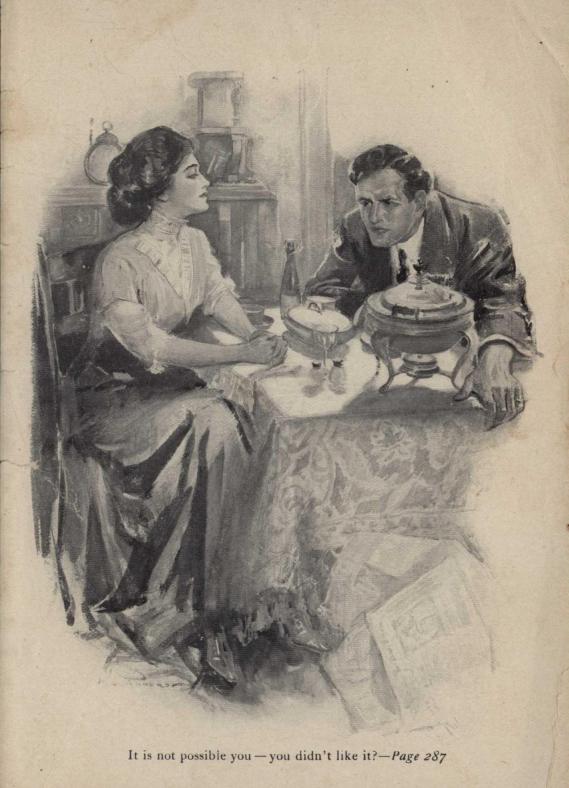
It is not possible you--you didn't like it?--Page 287
She would have given worlds for the lie that would not come; her eyes shrank from his; the sincerity and conviction of his tone made deceit impossible. It was almost in a whisper that she answered: "Oh, Cyril, Cyril,--I'm afraid I didn't."
He pushed away his plate and got up; he could not suffer such a mortification sitting; the flat itself seemed too small to hold his sudden shame, his agitation, the staggering shock of what seemed to him his wife's disloyalty.
"What was the matter with it?" he demanded passionately. "What was it you did not like?--No, no, you needn't try to wriggle out of it; you've said too much to stop now; you've as good as told me it was damned bad, and I want to know why.--The words don't matter; it isn't a question of how you put it, nor how much I mind being knocked by the one person on earth--! My God, Phyllis, what do you mean by saying I was bad?"
She was terrified. No culprit in the dock ever trembled more guiltily, or faced a brow-beating prosecutor with so stricken a look. Her husband's bitter and contemptuous tone cut her like a lash. But it was too late now to make excuses, to palliate the offense. There was nothing for it but to go on--to justify herself--and the better she could do it the more she would wound him! And all this on a night that surely ought to have been their happiest.
"You made the captain too--too common," she stammered. "He is supposed to be a high-bred, aristocratic man--stupid, of course--but a gentleman through and through. In real life--"
"Oh, real life!" he interrupted roughly, "that's where all you ignorant, criticizing people go wrong. He has nothing to do with real life--he's a preposterous stage figure, a convention. I have to take what I'm given; I'm not the dramatist; I can't write new lines for him, can I? My business is to hide the strings that pull his arms and legs, and make him possible--and by George, I did it!"
"But Cyril, dearest, listen--even when you first come on you're not polite enough, not chivalrous enough. You almost burst out laughing at--"
"That's to give contrast to him afterwards."
"But you can do that, and still keep him a gen--I mean nice, and--"
This was all she was allowed to say. Adair towered over her, convulsed, shaking, his voice hardly governable as he stormed and raged. It was the best thing he had ever done; it was perfect; there was fifteen years of stage experience in that one creation. It was awful that it should all go for nothing; it shook his nerve; it shook his confidence in himself; he hardly knew how he could go on playing the part. He wouldn't, he'd throw it up; he warned her to be more careful next time, or as an actor he would be done for. It wasn't that he was afraid of criticism--intelligent criticism--he welcomed intelligent criticism--the criticism of those who knew the stage--helpful criticism. But to club a man in this ignorant, crass way was simply to murder him. How could he ever bear to let her see him again in anything? He was sensitive; he was cruelly sensitive; it was because he had temperament; and if he couldn't please the person he liked he had no courage or heart left, even if he set the whole house crazy. Here was one of the best things he had ever done, killed for ever--and it was she who had killed it! It was the penalty of loving her that he could not go on without her approval; he knew she was wrong; in any one else he would have dismissed it with a shrug, and forgotten it the next minute; yet with her--! Perhaps this sounds more ignominious than it was. To Phyllis at least there was a great pathos in the exasperated outburst that was very far from being due to vanity alone. The revelation of her husband's weakness, of his utter dependence on her good opinion, atoned not a little for the violent things he said. It enlarged her understanding of the childishness that lies so close beneath the artist-nature--of its swift extremes of feeling--and showed her, too, the amazing intensity that Adair put even into a small rôle, and taught her afresh what a life and death matter the stage was to him. His frenzy, therefore, instead of rousing her resentment, and worse still her scorn and anger, rather quickened within her a tragic pity. His burning face, his dilating eyes, his quivering twitching mouth--all the evidences of an uncontrollable mortification--brought forth instead that womanly feeling, so rich in generosity and indulgence, that would sacrifice everything for the one it loved.
To prove that she was right seemed to her of much less importance just then than to smooth down that wild, distraught man-creature who belonged to her. With love in peril all other considerations were swept away. No pride stood between, no sense of injustice; love was too precious for such pettinesses to interfere.--Then with what piteous artifices she began to eat her words! How adroitly did she argue so that her surrender should not be too apparent, giving way by such fine gradations that Adair hardly suspected the imposture. How contritely she confessed herself in the wrong, her cringing little heart all submission, her whole young body eager to atone her fault.--The wild, distraught man-creature was by degrees coaxed back to tameness and sanity; the thunders subsided; with kisses and caresses he was even prevailed upon to resume his place at table, where, lecturing her masterfully as he ate, though with a steadily lessening severity, dormice peace was at length restored. By the time Phyllis had brought him his slippers, lit his cigar, and snuggled herself against his knees, like a sweet little Circassian who had disturbed her Bashaw, and had been graciously forgiven by that dearest and best of men, Adair mellowed sufficiently to feel some slight self-reproach. He apologized for having got so worked up; fondled her glossy hair; called her his darling little stupid whom he loved so well he couldn't endure her to find fault with him. Between whiffs, mellowing even more, he admitted that he might have been slightly unreasonable, even unkind, but put it all down to his disappointment at failing to please her. "I worked so hard," he said. "I just fell over myself to make them laugh. I--I had to think of the seventy-five, you know, and holding down the job; and as the others liked it, I--I thought you would. My sweetheart girl must try and make some allowances. I couldn't help feeling cross and nervous and all worked up--and, and, it's awful to fail, Phyllis."
She, at this, the naughty little hypocrite, would have eaten more humble pie; would have protested afresh that it was only one tiny-winy thing she had objected to--though even on that she wasn't half as sure as she had been. But Adair cut her short. In his softened humor he was prepared to concede something to her criticism; there was a speck of truth in what she had said, however much it had upset him; he was going to pull up the part a bit; he was--
Phyllis had sprung up, and darted into the bedroom, with so sparkling a smile, and with such an air of animation and mystery that Adair hardly knew what to make of it all. But he was accustomed to her girlish escapades, and lay back with his cigar, listening to bureau-drawers being hastily opened and shut, and awaiting developments with amused anticipation. She could be such a little devil when the fancy seized her, and rejoiced in the most shocking exhibitions for his private delectation. He was unprepared, however, for her to bound out in a suit of his own, the sleeves and trousers rolled up, and her hair half-hidden beneath a jaunty cap. She had made herself up for Captain Carleton, and the moment she opened her mouth Adair recognized the fine parody of himself in the rôle. The words she had pat, her retentive memory having caught and retained them during his laborious "study"; and while she was less sure of the imaginary milk-maid, she paraphrased the latter's lines with sufficient accuracy to keep her cues straight. She knew she was playing with fire; her face was a picture of mingled roguishness and terror, yet she was impelled by a headlong daring that was irresistible.
She flung herself into the scene with mad abandonment, mimicking his voice, his gestures, his laugh, the very way he leaned against the pasteboard gate--a whirlwind little figure, dancing crazily on the egg-shells of his vanity. It was the cleverest, wickedest, most unsparing travesty of his whole performance, carried through with inordinate zest and mischief, and heightened by a slim young beauty that had never seemed to him more alluring. Her little feet had never looked so small as with the coarse trousers flapping about her ankles; the audacious curves above intensified her sex; while the partly opened coat displayed the ribbons and lace of her night-dress beneath--the whole a vision of captivating girlhood.
Adair at first made no sign at all except to stare at her in a sort of stupefaction. His face grew so dark that she felt shivers running down her back, and for a moment she wondered if she had not mortally offended him. The first smile she wooed from him set her pulses dancing with relief. Yes, he was smiling, he was laughing, he was clapping his hands; and then, oh, the joy of it, he was bursting out with great, deep "Ha, ha's" of delight! Thus encouraged, she redoubled her exertions; she outdid herself; she was in the second scene now, and was tearing it to pieces like a puppy with a rag-doll, panting with excitement and success, and rapturous with victory. Adair jumped up, and in a paroxysm of admiration, passion, exultation and self-reproach, ran and crushed her in his arms. Phyllis felt the filmy lace-stuff rip asunder, and his lips seeking her flesh, while all incoherent he breathed out that he loved her, loved her, loved her, and that she was right; yes, he had been playing it all wrong; never would he go against her judgment again, and then and there took back every word he had said! He was just a vain, silly, conceited, swollen-up jackass, not even worth her finger-tip; and he couldn't forgive himself for the way he had treated her; and the only thing he could think of doing to show how badly he felt was to plump down and kiss her little slippers, which he forthwith did with a humility that would have been more impressive had there been a less frantic flurry of kicks and protests.
Thus the evening that had begun so ill ended in tenderness and profound accord. The very last thing Mr. Dormouse murmured as he lay locked in his wife's arms was that she was the cleverest little actress in the world, and pretty enough to eat, and a million times too good for him--which on the whole was the truest thing Dormouse had said for a long while, and showed that his ideas were improving. Little though he knew it he was improving in every way, and could he have set himself back six months he would have been astounded at the contrast. Women make men in other senses than the physical, and this robust lump of egoism, selfishness, ignorance and conceit was being slowly and unconsciously transformed. Something of Phyllis was passing into him, and in the magic of that soul-infiltration the grosser side of him had begun to crumble.
CHAPTER XXII
It is disappointing to chronicle that the altered and improved rendering of the English captain passed almost unnoticed. Mr. Kemmel, O'Dowd's right-hand man, indeed had objected to the change; and failing to bully Adair into submission had carried the affair up to the star. But that comedian, with a kindness that bordered on a sublime indifference, refused to interfere. "Hell, it don't matter how he plays it as long as he gets the words over," was his sage comment; and a wave of a large, fat hand dismissed the subject for ever. O'Dowd had his own private reasons for wishing to stay on good terms with Adair, which he was too regal, if not too cautious, to pass on at that moment to Mr. Kemmel. O'Dowd, being star, manager, and half-author of the piece was minting money under all three heads, and his concern for the box-office was proportionately great--so great that he could consider the choice of an understudy without irritation, and even accept a man who might "draw."
On first being commanded to understudy his principal, Adair had accepted the task much in the spirit of Mary Ann, when she is told: "Oh, I forgot to say you must do the washing, too!" It was a drudgery and a bore that he would have been well content to avoid, for one look at O'Dowd's red face and vigorous frame convinced him of the remoteness of the contingency for which he was to fit himself. He set no hopes in that direction, and it came to him as a real surprise, a couple of weeks after he was engaged, to be asked into the office and told of a new contract he was to sign.
"'The Guv'nor ain't satisfied with that fourth clause," said Mr. Kemmel. "He says it ain't plain--hey, there, don't let Phelps go, I want him and Klein for witnesses."
"Where isn't it plain?" demanded Adair, who remembered the document as one of unusual rigor, without even the usual two weeks' notice. "Do you wish to add penal servitude to my other fifty-seven penalties?"
Mr. Kemmel did not deign to smile. He was a pale, bald Jew of about thirty-six, with a peculiarly bleak way of addressing actors.
"No," he answered, "we want to clear up the understudy part of it."
"Understudy part of it? What do you mean?"
"Well, if you went on for five or six weeks, taking the Guv'nor's place every night and matinée--you might make out like it was a new engagement--and try to stick us."
Adair was too mystified to take offense.
"Stick you?" he repeated.
"Yes, sue us afterwards for three or four times the salary."--Mr. Kemmel sighed, and looked upward, as though reflecting on man's inhumanity to man. "In this business one has to be so careful," he added, as impersonally as though he were speaking to a stone pillar, "so careful--well, as I was saying, here we have iron-claded it, and you are to sign where it is penciled, and return the old contract to-morrow."
The typewritten words swam a little as Adair gazed at them; he was afraid of being tricked; he wanted to make sure that the precious seventy-five a week had not been tampered with. But there it was, all right, along with the new proviso. It was difficult to believe that this last amounted to anything, for O'Dowd's appearance precluded the least idea of illness. The man was as strong as a bull, with a voice that shook your ear-drums, and the shoulders of a negro coal-heaver. He was offensively healthy, and so limited in any interest but the theater that he moped visibly of a Sunday. One might as well understudy the Metropolitan Museum on the chance of its taking a night off. Adair laughed as he signed the new contract, and hardly thought of the matter for a day or two afterwards.
It was Kemmel who again brought it home to him.
"I'm keeping the orchestra for you to run over the Guv'nor's songs again with them," he said. "You sing them good enough, but the leader says you crowd the overture, and sometimes get ahead of him."
There are no people in the world so unmurmuring as actors; they will rehearse till their voices crack and their legs drop off, and all this, too often, under volleys of insults and reproaches. Adair had played two performances that day, and was worn out and hungry; yet it never occurred to him to make any objection to such an unexpected order. The poor, weary orchestra was there, as hungry and worn out as he, but as willing as every one connected with the stage seems always to be; they scraped and tootled and drummed and bassooned for two mortal hours, from a quarter past eleven till after one A.M., while Adair sang Irish melodies to the darkened house. O'Dowd himself, in a stage-box, was the solitary though far from silent spectator. Cigar in mouth, profane, morose and savagely critical, he bellowed furiously from his dark crimson cave.
"No, no, no, no! Hell's bells, do that again! At the second verse there now! For God's sake, Mr. Glauber, emphasize the key-note, boom it out on that first cornet so he can't miss it, and lam it in again on the minor. The minor! The minor, damn it! And, oh Lord, Adair, call that a brogue? Hell's bells, it's because you're in such a hurry--Glauber will wait for you--damn it, give it again, let it stick to your teeth--like this: 'Of owl the ma-a-a-a-ids of swate Kilda-a-a-a-rrr--'"
Adair had an unusually tuneful voice, and the middle register of his rather high baritone was full of warmth and charm. These catchy melodies appealed to him, and the sentiment was of a downright, popular kind. One rollicked the humor and quavered the pathos, and either put in brogue or didn't as one remembered or forgot it. As a matter of fact--except for the brogue--he did the songs more justice than the great O'Dowd himself, and sang them more sweetly and appealingly. He had no conception of it that night, however, as he was hectored and bullied without cessation until his eyes smarted, and his bewildered head was whirling. He had a whipped feeling as he went off, and a corroding sense of defeat and failure. It was idiotic to expect him to sing, and now that he had been tested and found wanting he hoped the silly goats would leave him alone.
He turned as he was putting on his overcoat in the wings, and saw that one of the silly goats had followed him. It was Mr. Kemmel, more bleared and bleak than ever, and evidently with something disagreeable to say.
"Oh, Adair," he exclaimed in a low voice, "hold on a minute, I want to talk to you. I've called a full rehearsal for to-morrow at nine o'clock, orchestra and all--for you'll have to go on in the Guv'nor's place to-morrow night!"
"I go on?--I?" Adair was thunderstruck. "What do you mean, Kemmel?"
"Just that."
"But he's as well as I am."
"The climate ain't agreeing with him, hee, hee!"--Kemmel's cackle was as cold as the draft off an iceberg.
"The climate?"
"New York state. He's got to get right out to-night, and that with us playing a run, and with eight weeks of our lease unexpired. If it weren't for the lease, and my Lord, the forfeit to Boaz and Gotlieb, he'd jump us out with him, run or no run. Ain't it awful, Mabel!"
"But Kemmel, what's the matter?"
"Well, it's like this, Adair. He and Julia Garrett were divorced here two years ago, and the dime museum freaks who tried it allowed her to marry again, and forbade him. They do things like that in New York, and if you kick it's contempt of court! The next day he married our Mrs. O----, Claudia Kirkwood at Chicago. See? There's nothing they can't forget here in two years, and so we came back, feeling pretty safe--and would have been, too, if number one hadn't got tired of the man who was keeping her in London, and rushed over here with her little hatchet. We've been trying to buy it, but it wasn't for sale--at least not at any figure we could pay--so we made a bluff offer of eight thousand, and reserved our Pullman!"
"Are you going to try to keep the run here?"
"You are!"
"And if I can't--if I don't draw?"
"Then we'll close."
"I wonder you didn't get Anderson Bailey or Henry Millard, or that man who has just left Blanche Mortimer--what's his name?"
"Costs too much--you're cheap."
Then to take the edge off this remark, he added:
"Say, that's not a knock; we wouldn't take them, anyway; I'm not throwing any bouquets, Adair, but you are damned good in it, really damned good--and are exactly what we want. And don't you feel sore about the money, either. We are paying you seventy-five salary, and four hundred and twenty-five worth of chance to make a big hit. You wish to get on, don't you? Well, you may be a made man in eight weeks. We're taking a gamble, and so must you. What if you are a holy frost? Don't go around belly-aching for money, but see if you can't win out. We believe you can; we are sure you can; go ahead!"
Praise, opportunity, the belief of others in you--how softening they are! Kemmel, the niggardly, the fault-finding, the lean, mean jackal of the Irish lion, suddenly took on a new hue. Adair found himself shaking his hand. What a good chap Kemmel was, after all! He shook his hand cordially, effusively, all former bitterness forgotten in an intoxication of joy. Kemmel melted too, under that irresistible spell; had a spasm of expansiveness and indiscretion; went so far as to say, in a darkling, confidential manner, that Adair had sung "all round" the boss.
"That's why I went for you like I did and balled you up now and then," he confided. "It wouldn't do to have him think that, you know. He's funny, like all of them, and while two-thirds of him is box-office, the other third is temperament--and my, it don't do to jar it!"
Phyllis had been sent home alone long before this, and Adair found her sound asleep in bed. A considerate husband would have let her lie undisturbed, and would have kept his great news till the morning. But Adair had no more compunction in waking her up than if she had been a pet puppy; and rolled her over, and tumbled her about almost as roughly, and with the same clenched-teeth zest in her drowsiness, beauty and helplessness. And she, woman-like, loved it, roughness and all--which goes to show how stupid consideration is at times, and how misplaced. Adair never gave it a thought, and his selfishness was rewarded by two bare, satiny arms reaching for his neck, and the eagerest little mouth in the world begging kisses and taking them.
And the news?
Don't blame him if it had grown a little. It was so truly-truly big that there could be no harm in making it a trifle bigger. Is it not permissible, with your adoring little wife nestling beside you in her nightie, and holding you fast lest you might suddenly be snatched away by some envious and ruthless agency--is it not permissible, I say, to add a stick and a cocked hat to some ordinary, very plainly-dressed facts? The whole rehearsal, thus gloriously reviewed in the retrospect, was brought up to the key of Kemmel's appreciation. The unexpired lease of the theater was seen to be a subterfuge, and no doubt O'Dowd had gone away to organize a number two company--the shrewd fellow; he and Kemmel mighty well knew they had made a "find"--they weren't in that business for nothing--and both were up in the air about it. The next thing would be a two years' contract, with a real salary and percentages! Cyril Adair, the Irish comedian, ha, ha! Well, why not? It would bring him back to Broadway in the right way, the big way! Bring him back to stay, by George, for with this as a stepping-stone they'd never get him off the grand old street again. And once solid--
With unloosened imagination they soared the sky, vying ecstatically with each other in that ethereal azure where everything is possible, two little children before the opening doors of paradise, and hardly less simple and naïve--big hand on little, voice outstripping voice, girl-heart and man-heart blended in an idyllic love. But alas, closer than paradise, oh, so much closer--on the next floor, in fact--was an honest motorman of the Metropolitan Street Railway, who lumbered out of bed, and hammered loudly on the floor for silence. On East Fifty-eighth Street this was a hint not to disturb a sleeping toiler. Bang, bang, bang, and the creaking springs and bedposts as the stalwart Brother of the Ox again sought repose. He got it all right; he often had to hammer, but never had to hammer twice; Phyllis had a great deal of humorous tenderness for her working-men neighbors--those decent, silent men who used to pass her so respectfully on the stairs; who played cheap phonographs on Sunday nights, raised families and canaries, owned dogs and took in boarders, till one wondered their apartments didn't bulge out and burst!--So McCarthy returned to the Land of Nod, and the dormice, reduced to whispers, soon kissed each other sleepily, and took their own road thither.
CHAPTER XXIII
One wonders sometimes why almost anybody can not be a successful Irish comedian? Given a good figure, a pleasing, sympathetic voice, and a face naturally inclined to smile--and the rest seems as easy as taking pennies from a blind man. Certainly Adair caught his house as surely as ever did O'Dowd, and moved through the piece amid the same thunders of applause. Younger, handsomer, and an incomparably better actor, and with that charm, so baffling to describe, which yet was ever-present and ever-compelling, he measured himself against his predecessor, and never for a moment had the least doubt of the outcome. It is not often that fairy tale came as bravely true; that the dream of overnight turned as quickly into the fact of to-day. Small wonder that Adair, standing there on the stage when all was done, his ears still ringing with the applause of that departing audience, was too exalted, and much too self-sure to fret at Kemmel's misgivings.
"Oh, you did fine," cried Kemmel. "You were splendid, splendid! But will they ever come back?" He jerked his head in the direction of the curtain.--"It was O'Dowd that brought them--not you; they already had their tickets; the pinch comes to-morrow, day after to-morrow. Can you draw them then, ah, that's the point?--No, no, don't misunderstand me, Adair. I'm all up in the air about you; you justified all we hoped; more than we hoped; you don't need to be told how you hit them to-night. But I'm scared--scared of your success--and I'm that nervous that I--!" Again he turned towards the curtain, and his voice was almost a wail. "Oh, my God, Adair, will they ever come back?"
The astonishing thing was that they did--crowded back, swarmed back, breaking all the records of the piece. Business rose by leaps and bounds till they were playing to capacity; till the thrilling words "sold out" were posted almost nightly on the box-office window; till a ravening horde of speculators took possession of the sidewalk in front, alternately delighting Kemmel with their advertising value, and wringing his soul with anguish at the money he saw going astray. Not that these were his only preoccupations; he was too loyal to his employer's interest, and too expert a theatrical man to let a success run along without a guiding hand. Adair's name went up in electric letters; pictures and paragraphs were scattered broadcast; an option was secured on another theater to continue the run, and, what seemed to him the best of all, he had Adair securely tied up by a new contract. Kemmel, in his own words, was "on to his job," and in his letters to O'Dowd he was already urging a number two company, and submitting estimates and names.
The new contract, of course, was a marvel of one-sidedness; on-to-his-job Kemmel naturally saw to that, and paid a legal iron-worker twenty-five dollars to make it of seamless steel. But on the running out of the existing contract at seventy-five dollars a week, it assured Adair two hundred and fifty as long as it pleased O'Dowd to employ him. Seamless steel could not accomplish everything, and a substantial increase of salary had to be accorded. Adair would have stood out for more; but Phyllis, with feminine caution, prevailed on him, to make no demur. Booful's day would come; stick to her and he would wear diamonds--not to speak of bells on his darling fingers and toes; but just now money was secondary to cementing his position till he was stuck up so high on Broadway that they'd have to feed him with a ladder.--Besides, two hundred and fifty dollars a week was an awful lot of money. Forty weeks at two hundred and--
"Forty weeks, you goose!" expostulated Adair. "I'd be the last person to object if it were forty weeks. But down there, on that smudgy blue place, they can cancel everything in forty seconds."
"People aren't cancelled who are playing to capacity."
"I know, but the utter damned meanness that--"
"Poor little Booful mustn't worry, and if he'll stop damning and rampaging, I'll take him down to his Uncle Macy's, and show him that lovely fur coat I want him to buy as soon as we have some money."
"I suppose you are right, Phyllis, but it galls me to--"
"My darling, sweetheart love," she broke in with pretty seriousness, "nothing is so important as your success, and once make that secure, money follows as a matter of course. Let Booful keep shinning up the pole, even if they do pick his pockets, and never think of anything but the gilt ball at the top, and--and me."
This was good advice and Booful acted on it. The two hundred and fifty, too, looked less despicable as every day drew it nearer; and as it became, not an abstraction to be argued over and theoretically scorned, but a tidy little bundle of greenbacks that would go far to ease life, both on the spending side of it and the saving. Oh, yes, half of it was to be laid by in the bank for a rainy day. Meanwhile, they lived up to the last cent of the seventy-five, which once so much, now suddenly grew meager by contrast, and by the greater inroads made upon it. Booful rolled home in cabs; there were little restaurant suppers with a fizzling pint of wine; Phyllis bought a coveted peignoir, made out of pale blue fluffy-nothingness, and with a hand-embroidered collar delicately touched with gold.--Well, why not? The nearing future was too bright not to discount it a little in the present.
We have said that Kemmel kept his press agent busy; and in the same thoroughgoing spirit that placarded every garbage-can from Twenty-sixth Street to Harlem, strove by a thousand means to get Adair's name prominently into the papers. If he succeeded beyond all expectations he ascribed it to his own astuteness, instead of to the fact that Adair, for the moment, was an extremely spectacular figure in the theatrical world. It was one of the remarkable things about this man that he impressed himself so indelibly in the recollection of every one who had ever known him. It was too often a disagreeable recollection; he had sown hatred with a royal hand; yet, in a queer, negative, altogether unprofitable way he had fascinated everybody. Others might make a disagreeable impression and be forgotten. But no one ever forgot Adair. Magnetism, personality, genius--whatever word one chose to call it--he had the peculiar faculty of arresting attention, of exciting interest, of making people talk and speculate about him.
It was indubitably at times a most unlucky gift. With his reappearance and success the flood-gates of his past were opened, and there gushed forth a Niagara of malignant chatter. His amours, his fights, his disreputable escapades, his divorce--all were revived. Every one seemed to have a story to his discredit, and to be in haste to get it into print. Nor was his marriage to Phyllis allowed to escape the same soiling publicity, and the tale was embellished with slanders and innuendoes that would have goaded a much more patient man to fury. Adair was with difficulty restrained from knocking editorial teeth down editorial throats; and it showed Phyllis' power over him, and the change generally in his disposition that the police courts were untroubled by his presence.
Lies about herself Phyllis could bear with some fortitude, but Adair's earlier life, as thus revealed by the sensation-mongers, cost her many a bitter pang.--The woman who had tried to shoot him at the Café Martin, and the whole revelation of that horrid affair--the Burt-Wauchope scandal, where rather than save himself by compromising an unknown girl, he had gone to prison for contempt; and that, not quietly and nobly, but with a vain-glorious satisfaction in his martyrdom--the discreditable spree on Tim Bartlett's yacht--how horrible, how unendurable it was--this graveyard resurrection of bygone years!
Adair never justified himself to her, never tried to palliate or explain away the incidents of his outrageous past. That instinct, which in all his relations with her invariably guided him aright, served him as well now as it had always before. He was more gentle, more tender, trusting to kisses rather than words. "Don't let this hurt you," he once said to her, the only time he had ever ventured to speak to her, "that wasn't me, Phyllis. There wasn't any me until you came. You know that, don't you? No me at all, but just a big brute, and if he didn't have a soul it was because it was in your bureau drawer along with your stockings and handkerchiefs, and I guess you thought it was a sachet bag or something, and never looked at it twice."
The most jealous, dismayed and heart-sick of women could not have resisted such pleading; not if she were in love, that is, and her lover's voice was as appealing, and his eyes as convincing and sincere.--In a divine commingling of wife-love and mother-love, so pure, so uplifting that it transcended all physical expression, save alone what the breast could give, she drew his head to her bosom, comforting him, comforting herself in an act emblematic of all that is most beautiful in humanity.
The more one studies the stage the more one is surprised by its disregard of principles that govern every-day, ordinary affairs. Perhaps it is because actors are all children, who have clung tenaciously to playing Indian in the hall, and shooting tigers under the parlor sofa long after the rest of us have grown up. It is a good thing for the world that "temperament" is so largely confined to the paste-board walls of the theater; or we might see our grocer sulking over his butter, or railway presidents impetuously ordering off trains because they had taken a sudden distaste to the landscape of some state. Self-interest, that sheet anchor of society, is but a kedge to the theatrical ship, and many plow the main without even that. Caprice often outweighs all money-making considerations; and though we are far from decrying those who sacrifice dollars to art (and there are many), may one not be a little peevish with the others, whose vanity and wilfulness often take such spiteful forms?
It certainly cost Shamus O'Dowd all of twelve thousand dollars, if not double or treble that amount to close the run at the Herald Square Theater and bring it to a peremptory conclusion. From his Rocky Mountain ranch he had watched, with a grinding and increasing anger, the success of the man to whom he had left his rôle. The swelling royalty returns exasperated him; the laudatory notices, sent in such profusion by Kemmel (who was innocent enough to think they would please)--were as tongues of flame leaping up the legs of a captive at the stake (such fat legs as they were, and with such an ample scorching surface), and all the talk of another theater and a second company clogged his eyes with blood, and seared his low, coarse face with the furrows of an intolerable indignation.
Nightly for twenty-five years he had been taking others' crimes on his brawny shoulders--murder, arson, embezzlement, forgery--he grabbed for them all, never so happy as when misjudged, with only the audience in the secret of his sacrifice; nobody on the stage could do anything wrong without his making a rush to take the blame--and the oaths he kept with an incredible fidelity; the superb impulses that started from him as freely as perspiration; his goodness, chivalry, and almost insensate honor--! Oh, the irony of reality as contrasted with those affecting fictions!
"Dear Kemmel," he wrote, in his ugly, sprawling, impatient hand. "Take the bloody show right off, and fire Adair, and keep the others on half-salary till you can fix me up a route outside of New York. In God's name, what do you think I'm made of, that I'm to play a number two company all around the clock while he's starring my hit on Broadway? And don't you put up any back-talk about it, either, for I mean every word of it if it takes my last red--though you must see that it don't. If we have to go forfeit on the theater, hell's bells, pay the bloody cormorants, and do you hear, Get Out!!! For I'm sick of the whole business. Fix it up with Mallory to send out something like this, even if you have to pay space rates for it, and I want it featured:--'The substitution of Mr. Cyril Adair for Mr. Shamus O'Dowd in the star-rôle of A Broth of a Boy has resulted so disastrously to the management that the Herald Square Theater will be dark on Monday night, and all outstanding tickets refunded at the box-office. The experiment was an unfortunate one for all parties, for Mr. O'Dowd, previous to his departure from New York, owing to his doctor's orders, was playing to enormous business, and bade fair to remain all the season. In Mr. O'Dowd's hands A Broth of a Boy has been a record money-maker, and friends of the genial star will be enthusiastic to learn of his early return to harness. The old adage of the lion's skin is thus verified again, and we are not disparaging Mr. Cyril Adair when we say he was unlucky to be cast for the Donkey.'
"I hope this is all clear, and that I have not overlooked anything. Perhaps when you are about it you had better fire Grace Farquar, too. Pretty girls are cheap, and I should like another more come-on, preferably a blonde this time. Received your check for $1,182.40. No more for the present. Cordially yours, Shamus O'Dowd."
CHAPTER XXIV
The right girl's cheek against his own is usually worth more to a man than all the philosophy to be found in books. Adair was stunned; he was too helpless, too hurt even to murmur. When one is struck by a thunderbolt, one lies where one falls. He expected Phyllis to fall also, and in a dull, heart-broken way was surprised by her intrepidity. She picked up the great, despairing creature; kissed him, petted him, crooned over him like a baby, smiling through her tears, and exerting all her pretty fancifulness to make him smile, too. Men may excel in marching up to cannon and saving people from burning buildings, and descending to the bottom of the sea in submarines; but in the forlorn hopes of life it is most often the women who lead.
After a while Adair was revived; on examination it seemed that he wasn't seriously damaged at all, only scared--oh, yes--just scared all out of his poor Booful wits; and a fairy potion called: "What does anything matter as long as we have each other?" was extraordinarily effective in pulling him together again. Then Phyllis jumbled up all the swear-words she had ever heard, and hurled them indiscriminately at Shamus O'Dowd, with such piquancy and humor, coming as they did from that sweet mouth, and with such a delicious lady-intonation that Adair was convulsed, and a tiny bit shocked--which was precisely what she had schemed for, the daring little wretch.
Thus began a new era of looking for an engagement; and it must be said it was a very sad, anxious, bitter era, for they were dreadfully poor--hungry-poor--and every time there was a knock at the door it was a dun who had to be coaxed and persuaded into going away. Adair's recent prominence had done little to incline managers towards him, and though they were more civil, and he generally got greater consideration at their hands, it was evident that their former hostility still persisted. But his professional reputation now stood pretty high; and occasionally one, bolder than the rest, would coquette with him, keeping him on tenter-hooks while a frantic search was made "for somebody that would do as well." This somebody was always found, and Adair would be told politely that "the vacancy had been filled."
Incidentally he learned that his parting from O'Dowd had been grossly misrepresented by that "genial star," who had spread it about broadcast that Adair was as impossible as ever, and so inflated and top-lofty that it had been cheaper to break the run of the piece than to stand his vagaries any longer. This was in such accord with Adair's former character that it found ready credence up and down Broadway; and the great Mr. Fielman himself enunciated the general sentiment when he said to Rolls Reece, the dramatist: "If that fellow Adair only had the manners and decency of a common hod-carrier, I'd give him a five years' contract, and make a fortune out of him; but the stage is on too high a level nowadays for men like that to get a second chance to disgrace it--at least from me!"
No one appreciates more than an actor the need for being well-dressed when seeking an engagement. His appearance is a considerable part of his capital, both on the boards and off; he may have had little breakfast, and less lunch, but his clothes must be good, and his linen immaculate, and in a "profession" judged so largely by superficialities, it behooves him, poor dog, to affect at any cost an air of fashion that but too often is the most pathetic of masquerades.
It was now that Phyllis rose to the occasion with an unexpected capacity that showed she was, indeed, her father's daughter. She got the janitress to teach her how to wash and iron white shirts; and in a short time could glaze a bosom better than her instructress, and almost as well as a French laundry-man. She learned how to press Adair's coats and trousers; she turned his ties; she ironed his collars; she cleaned his gloves with gasolene. No man was ever valeted with more assiduous care, or sent out every morning looking sprucer or better-groomed. When she kissed him good-by for the day it was always with a playful admonition, for Adair bore adversity none too well, and though he tried to hide his despondency he was beginning to break down under the long continued strain.
"And he knows he's a great, big, handsome, splendid Booful?"
"Oh, he's sure of it!"
"And he's going to step out like a Crown Prince going down to see his Emperor-Papa at the club?"
"You bet he is."
"And swing his cane as though he owned all Broadway--and throw back his head like a Greek statue, and swagger into their horrid old offices like a millionaire? For he is a millionaire, you know--not a money-one, but a Love-Millionaire--for don't I love him millions and millions?"
It took a kiss to answer that; and then the Love-Millionaire, laughing a little tremulously, would hurry away, whistling with much bravado as he went down the stairs, two at a time, as suited a great, big, handsome, splendid Booful; who, whatever his demerits in the past, was fast retrieving himself before the Great Judge.--And if, on his departure, Phyllis would lay her head on her arm and give way to uncontrollable tears, you would be wrong to feel too sorry for her. For the misfortune that draws a man and woman together, and extorts from each their noblest qualities is not really a misfortune at all, but a precious and beautiful thing that it would become us more to envy.
Thus the days passed in a deadening, cowing, unutterably depressing search for work. Adair was rebuffed, put off, told to call again; he abased himself to men he despised; he forced his presence with hungry persistence on dramatists and stars who were putting on new plays, affecting a good fellowship that was a transparent, dismal lie. He tried to buy them wine, cigars--inveigle them into promises, and his lunch often went in a tip to some greedy understrapper who guarded their portals.
It is strange the mile-wide demarcation that divides the real stage--the stage of Sothern, John Drew, Faversham, Maude Adams, etc., from that other to which Adair had so long associated himself. This other had no representative save Adair in the whole Thespian Club. It was a region apart, and a region that Adair was determined never to return to. It would have called him back willingly enough, and in his desperation he might have returned to it had it not been for Phyllis. It was she who kept his resolution alive; she was too confident of his talent to let him throw it back into that Dead Sea; it meant the abandonment of every serious ambition;--artistically speaking, suicide, death.--Booful belonged to the top, and it was his business and hers to get him there.
Brave words, but how about fulfilment? The end of the month would find them turned out of doors. Phyllis dreaded to see herself in the glass, she was becoming so pale and wan; in the unequal battle everything was going except her courage; sometimes, alone in the silent apartment, even that seemed to droop, and a daunting terror would overwhelm her--less for herself than for Adair. He was drinking again, and justified himself with a bitter vehemence. "They all say, 'Have a drink'!" he exclaimed. "Nobody ever says 'Have an eat'!"--His harsh, despairing humor recurred to her, as well as his sudden resentment at her pity. He had made atonement, but the sting remained--or rather a foreboding of something somber and evil that in spite of herself she could not shake off.
One day at the club a card was brought Adair, inscribed Mr. John H. Campbell; and the boy told him the gentleman was waiting to see him in the visitors' room. Adair knew no such person, but he went out to greet him with mingled curiosity and hope, for here perhaps was the long-sought engagement. An imposing, distinguished looking, very well-dressed man of fifty rose from the sofa, and asked him, with much suavity, whether he had the pleasure of addressing Mr. Cyril Adair. This question being quickly and politely settled, the imposing gentleman begged for a few words of conversation; and indicating a place for Adair beside him, he reseated himself with a bland, kind air which yet was not without an underlying seriousness, not to say solemnity.
"I have come on a very confidential matter," he said, fixing Adair with his shrewd, keen, heavy-lidded eyes. "A matter, Mr. Adair, so delicate that it is not easy to convey it except in a round-about form. May I explain I have sought you out at the request of--Mr. Ladd?"
There was a pause; the shrewd, heavy-lidded eyes slowly inventoried Adair and read beneath the tarnished air of fashion. Failure, need, hunger sap a man, and can not be hid, least of all from a professional observer. John Hampden Campbell was one of the leaders of the New York bar and was what they call a "court room lawyer" of high rank; which means that others hand up the guns, while he shoots them off. His knowledge of human nature was profound, and being profound was neither unsympathetic nor unkind. But he could shoot straight, nevertheless, and it was hardly a satisfaction to the victim to hear that murmur of "poor devil!" as the eminent counsel laid aside the smoking weapon.
"My father-in-law!" exclaimed Adair in amazement.
"He would be happier if he could cease to bear that name," said Mr. Campbell.
"He can hardly very well help himself," retorted Adair bluntly.
"No, but you could," put in the lawyer, with a vagueness that was intentional. "By this time you must realize that it is a union that is scarcely to your own best interests nor the young lady's."
"Haven't noticed it," said Adair, staring at him queerly.
"Mr. Ladd would be prepared to make very heavy sacrifices to put back things as they were before."
"What sort of sacrifices?"--Adair's tone was not unfriendly; it was rather questioning and perplexed.
"We would rather leave it to you to suggest them, though we are counting more on your concern for her welfare. Frankly, Mr. Adair, without meaning the least disrespect, and with a thorough knowledge of your honorable and straightforward conduct--do you consider you're acting rightly in holding this young lady to what most people would call a very bad bargain?"
"Being married to a starving actor?"
"Oh, that is putting it too--too--"
"Of course, she has thrown herself away--I know that."
There was a gleam in the heavy-lidded eyes.
"It could all be rectified," said Mr. Campbell soothingly. "Very easily, and very quickly rectified. It is just a question, it seems to me, of our getting together, and talking it over reasonably. In fact, some of the details might be omitted entirely. Mr. Ladd is a man of very large means, and is the soul of honor. He would see to it that your future was made easy."
"How easy?" asked Adair.
"I mean," returned Mr. Campbell, "that he would substantially recognize your honest desire to be guided by his wishes--wishes that you admit are just, and so much to the young lady's advantage that you are willing to withdraw entirely."
"Those are all words," exclaimed Adair; "let's get to figures."
Mr. Campbell looked pained. After having confined the interview so skilfully within the limits of irreproachable good taste, this brutality outraged his ear. He had not been unprepossessed by Adair, and felt sorry for him.--But here was the cloven hoof.--The fellow was just a low, mercenary adventurer after all.
"The figures are ten thousand dollars," he answered coldly.
"Why, I don't call that anything!"
"Cash," added Campbell, with a pursing of his lips.
"Of course, it's cash," cried Adair, "it's going to be that, whatever it is. Only it isn't enough. She's worth more than ten thousand dollars."
Campbell saw that his personal bias had made him err. Adair's vibrating tone had caught the note of his own; suavity and good humor were all-important, and he scurried back to them, like an incautious general flying for the batteries he has left behind. When he spoke again it was in his best lullaby manner.
"My dear fellow," he said, "the real point is that you concede the principle. That is so, is it not?"
"Hell, yes," returned Adair. "I'd concede a lot for fifty thousand dollars."
"But that is a very, very large sum of money."
Adair, with one hand in his trousers pocket, was restlessly turning over the two nickels that were there--all he had.
"I don't think so," he said. "Anyway, she's worth that, and more."
"I was hardly authorized to commit Mr. Ladd to such an amount," objected Mr. Campbell, "though I will not say right off that I might not entertain it. But you understand, Mr. Adair, that it implies you will not resist an action for divorce, and-- Well, you know we'd like to have the matter absolutely settled and done with."
"For fifty thousand dollars?"
The heavy-lidded eyes were obscured by a momentary glaze.
"We will meet you," said Mr. Campbell.
Adair rubbed the nickels together, and asked, with a slight catch of his breath, if he could have something on account.
"Certainly," assented the lawyer, producing his pocket-book. He removed a sheaf of bills, and Adair perceived that they were in denominations of a thousand dollars each. He had never seen a thousand-dollar bill before in his whole life, and here was a thick packet of twenty or more. No wonder that he was overawed. Campbell noticed his fascinated stare, and dilly-dallying with the notes, spread them out with an elaborate carelessness. To Adair, it was all a blur of $1,000, $1,000, $1,000, $1,000, a green mist of money, a crisp, crinkling, dizzying affluence.--Campbell was saying something to him. There was a paper to be signed. It was a temporary memorandum to be replaced later by a more formal document. Buzz, buzz, buzz! The paper was handed to him. Buzz, buzz, buzz, and the room going round and round. He was standing on his feet, shaking with the pent-up passion that he had been so long holding back. The actor in him had been waiting for that, but the actor was lost in the man.
"You're a damned hound!" he cried hoarsely, "And the man who sent you is a damned hound, and here is your damned paper, and may it choke you both! My wife isn't for sale, do you hear that! My wife isn't for sale, whether it's for fifty thousand or fifty million! Is that plain? Do you concede the principle, or shall I boot it into you? I thought I'd lead you on; I thought I'd just see how far you'd go--you with your sable overcoat, and fat pocket-book, and your stinking respectability. I had you sized up all right, and was only giving you rope to hang yourself. Get out of here, and get out quick, or I'll kick you from here to your cab. Get out!"
It was needless to say that John Hampden Campbell did not need to be pressed. Shadrach, Meshach and Abednego in the fiery furnace could have scarcely been in a bigger hurry. Cramming the notes and papers in his pockets, he sped from the visitors' room like a large, imposing projectile which had been fired from some monster cannon. A second later his flying coat-tails were deposited in his cab, and he was speeding away, considerably shaken in spirit and body, for the mountain quiet of his twenty-eight story office.
Lying on Phyllis' table, all ready for mailing, was a long letter to her father. Pride had crumbled and she had determined to seek his help. She had begun it with constraint, attempting, none too effectually, to conceal her sense of injury and injustice; but as page followed page the old tenderness returned with an irresistible force. That gray, handsome head was before her, that mellow voice was in her ears, and the wretchedness and folly of alienation came home to her with a new and piercing significance. The request for money; the cold, exact exposition of her need--was passed and forgotten in the impetuous rush of her pen. She loved her husband, she loved her father, and this estrangement was unbearable. Like many women under the stress of a deep emotion she wrote with a singular eloquence. She wept as she described Cyril--his unceasing goodness, his loyalty, his fortitude, his good humor and devotion. He was everything a woman loved best in a man; and instead of her marriage having been a mistake, a failure, it was more than she thought life could ever give her. Would not her father forget all that had passed, as she, too, would forget? Their love was too deep, too dear, to make reconciliation impossible. She would climb into his lap again, and put her arms about him--his sad, worn, desolate little girl--and they would whisper to each other what fools they had been, and kiss away the last shadow of misunderstanding.
So it ran, page after page, in her fine, delicate hand, an appeal that no father could have resisted. A beautiful letter, touched with the quality of tears; full of womanly longing; heart crying to heart, across an aching void. Alas, that it never went. It was torn to pieces, and thrown passionately on the floor. Campbell had intervened, and the news of his offer was thus received in the little flat on East Fifty-eighth Street. "That's the end of it," cried Phyllis, regarding the scraps of paper. "That's the end of everything between Papa and me!"
CHAPTER XXV
It is one of the peculiarities of looking for a theatrical engagement that hope is never quite extinguished. There is always some one who wants you to call next week; there is always a company just short of a part they are considering you for; there is always some friendly member of the Thespians who has "mentioned your name," and gives you a scribbled address or a telephone number. This is stated to explain the fact why Adair, instead of surrendering to circumstances, as any other man would have done in any other walk of life, still snatched at straw after straw with egregious determination. His circumstances were becoming absolutely desperate. Suspension from the club was staring him in the face; in eight days his sticks of furniture and his trunks would be dumped out on the street; it was only by the most rigid parsimony that body and soul could be kept together. Phyllis said the dormice were floating on a shingle, and with tearful laughter would expatiate on the pitiful, half-drowned things, so scared and hungry on a bobbing sea. What was to happen when they slid off?--Oh, but Booful wasn't to mind. She'd hold his poor, pretty, dormouse head up, and swim him off to a lovely island where there were peanuts on peanuts, and an alabaster mousery with all modern improvements.