Front matter (continued 3)
Reading edition
"Something very important."
"I'm sorry, but I can't do it."
"No, no, please. Mr. Adair will never forgive you if you don't." Then she had an inspiration. Where or how she had learned the name she hardly knew, but it flashed across her mind at this moment. "Is Mr. Merguelis there?"
"I am Mr. Merguelis."
"Mr. Tom Merguelis?"
"Yes."
"Then you might know who I am. Mr. Adair--"
"Oh, say, yes--you're not the little lady that he--"
"Yes, that's me."
"But, my dear, he's in his dressing-room, and that's on the level."
"I simply must talk to him for a second, and you must go and get him."
"Hello, hello--is that you? Hello--yes, my dear, I'm sending for him. Please hold the line."
What an age it seemed, standing there with the receiver to her ear, and her heart bursting with impatience. Meaningless scraps of talk strained her attention; when these stopped she was in terror lest she had been cut off; at last there was the peculiar jarring and disturbance that showed someone getting into touch at the other end, followed by Adair's strong clear challenge.
"Who wants Mr. Adair?"
"I do--it's Phyllis."
"Oh, my little girl, I'm in a frightful rush. Hurry up, tell me what's the matter?"
"I want to see you as soon as I can--something awful has happened."
"What?"
"I can't tell you here--but can't you guess?"
"Trouble at home?"
"Yes."
"Found out?"
"Yes."
"Your father?"
"Yes."
Adair paused. Events were moving faster than he had anticipated. He was both thrilled and bewildered at the suddenness of it all.
"It's risky," he said, in a voice that shook a little, "but you'll have to come up and see me here--there's nothing else for it."
"That's what I want to do," she answered.
"I'll fix it up with the door-keeper to take you to my dressing-room. Just say you have an appointment with me, and he'll understand. Wait there for me until the first act is over--will you?"
"Yes, Cyril."
"And you will excuse me if I run? They'll have to hold the curtain as it is."
"Yes, yes--and I'll be there."
"Au revoir, sweetheart!"
"Good-by--I won't be long."
The stage-door, like most stage-doors, was to be found in a cut-throat alley, so dark, dangerous, and forbidding in its aspect that it took all of Phyllis' courage to enter it. A ratty-looking individual, so compactly built into the entrance that he could open the door by a shove of his boot, exerted this labor-saving device in answer to her knock, and glowered at her from over the paper he was reading.
"What do you want?" demanded the ratty individual.
"I have an appointment with Mr. Adair."
He rose without a word; and leading her up some steps, guided her inside the theater. In the twilight of the wings were some stage-hands in overalls; an actor whom she recognized as the wicked prince, sitting on a soap-box, waiting listlessly for his cue; from the stage itself came the sound of voices raised to an unreal pitch, and strangely exciting and fantastic, in a cadence that was neither recitative nor speech. She could not help noticing, even in her agitation, the shabby, dilapidated, disorderly appearance of everything--the ropes, the dusty props, the frayed material of the scenes, the general air of comfortlessness--receiving the shock that comes to every one on first seeing the theater from the wrong side. But the ratty individual gave her no time to take more than a passing glance, leading the way with whispered warnings through a gorge of canvas, and down a twisting iron stair to the dressing-rooms below. He stopped at one of the little cabin-like doors, opened it, and ushered her in. Then he left her, and shuffled away with diminishing footfalls.
The dressing-room was bald, bare, uncarpeted, and painted a staring white. Below a mirror flanked by two flaring gas-jets there ran a sort of shelf on which were grease-paints, crayons, brushes, a pot of cold-cream, a pot of rouge, and other necessaries for "making up." From nails on the wall--common, every-day nails--there straggled an untidy line of men's clothes. On a box in the corner was a wash-basin, pitcher, soap, and a towel that was none too clean. Three empty chairs, and a wall decoration completed the picture. The wall decoration was a printed notice, in large and emphatic letters: "Smoking positively prohibited in this theater. Ladies must not use alcohol curling-irons."
Most young women, in a situation so equivocal and so unfamiliar, would have been ill at ease, frightened, apprehensive of many vague and dimly suspected dangers. But Phyllis' faith in Adair had none of this faltering quality. She loved, and loving she trusted. Her tremors had ended the moment the door had closed her in--the moment, in fact, when the others would have trembled most. To her, on the contrary, the little room breathed security for the very reason that it was Adair's. With adorable folly she pressed kisses on all his outstretched possessions; nuzzled her cheek against his coat; put her little foot beside one of his big man's shoes, delighting in the contrast--and altogether felt greatly comforted and refreshed.
After a while she heard a tremendous commotion overhead that swelled, sank and swelled again as the house broke into applause at the end of the act. There was a lumbering, scratchy, pattering sound as of a dozen pianos being moved at once by stalwart men in slippers--it was the new scene being set. The passageway outside, previously so still, resounded with a rush of feet--with exclamations and laughter as the company scudded to make their respective changes. The door was flung open, and there, brisk and smiling, on the threshold stood Corrèze!
Phyllis ran to his arms, and hiding her face against him began to cry. She was so happy, so wretched; the misery of that last hour had tried her more than she knew; her joy at seeing Adair seemed to exhaust the little strength she had left, and her conflicting emotions could find vent only in tears. How sweet it was to be petted, to be soothed--to feel so small, and weak, and helpless in that powerful clasp! Her tears flowed afresh. Flowed at the thought of her love for him, of his love for her, at the beauty, wonder, and solace of it all. Nothing could ever harm them as long as they had each other, nothing, nothing.
She made him take a chair, and seating herself at his feet crossed her arms on his knees and looked up at him. In this position it seemed easier to confide, easier to answer his persistent questions, easier at the same time to satisfy her craving to nestle close. As Adair heard of the letter he turned as black as a thunder-cloud and his hands clenched.
"I know whom I've to thank for that!" he exclaimed furiously. "The damned little treacherous hound, I could choke her for it! I've seen something working in her eyes all along, but I never dreamed she could be as low and contemptible as that! And so she was keeping tab on us, was she, with all her mean little eyes and ears, the dyed toad!"
"Cyril, you really know who it is?"
He made a hissing sound--a disgusted assent. "She isn't twenty feet from here," he exclaimed, "unless she is at the key-hole this moment." He rose; stepped to the door, and looked out. "Not here," he said.
"But tell me, is she one of the actresses in the company?"
"Never you mind," he returned roughly; and then, with a quick remorse at the look in Phyllis' face, he apologized in a roundabout fashion by denouncing the stage in general. "It's a low, dirty business," he cried, "and the people in it are a low, dirty lot; and I guess I'm not so damned much better myself; and if you had a spark of sense you'd clear out, and never see me again! Do you hear what I'm telling you, little chap? Do you hear, Phyllis girl?" He put down his hand, and caught her ear between his thumb and finger, giving it a shake. "Skin out, you darling baby. Your father's right. Go back with my compliments, and tell him I said so!"
His jeering tone hurt her; there was too much sincerity in his self-contempt, too genuine a ring to his proposed dismissal. The contradictory creature, stung to the quick by that letter, and indignantly conscious of much of its truth, was floundering towards righteousness, like a walrus after a floe. Hell, he didn't mean her any harm. Let her get out.
"You'd better hurry," he said, pinching her ear again. "I'm just a cheap actor, as common as the dirt in the road, and you're a beautiful young lady a million times too good for this kind of game. All that you can get out of it is dishonor and disgrace. Go away--let's drop it--love somebody who's worth loving."
He tried to push her from him, but she clung only the tighter, her face paling at his earnestness, and stubbornly looking up at his.
"You couldn't say that if you were--what you say you are."
"How do you know it isn't a trick!" he exclaimed, "just another move in the game--just to get you a little further out of your depth, and then drown you?" His hands closed round her neck with brutal pleasure in her youth, her softness, her delicacy, her powerlessness.
"It's strange," he said wonderingly, "but at this moment when you have never been more tempting to me, I am willing to let you go--want to let you go. It's the first good resolution in my life, yet you stick here like an infatuated little noodle, waiting for it to pass."
She snuggled closer against him.
"Am I tempting?"
"My God, yes."
"And you love me?"
"Oh, my darling, I do, I do!"
"And wouldn't it be nice for a poor little lonesome cheap actor, who's really a great big splendid noble person of genius, if he only knew it--to have me to pet him and love him and adore him, and kiss away his morbid, silly moods, and make such a darling baby of him that he'd burst out crying if I were out of his sight a minute?"
He looked at her sharply for an underlying meaning--a comprehension--an assent. But her candor and innocence were transparent; the purity beneath those limpid depths shone like a diamond in a pool. Her love took no thought of anything base or wrong, either in him or in her; all she sought was the assurance that he loved her, and wanted her; and this achieved she was content to leave the rest to him with unquestioning faith. She did not come of the class to whom marriage is vividly seen as a protection, a safe-guard, a coveted lien on a pocket-book and a man, enforceable by the police; to her it was more one of those inevitable formalities that attend all the big events of life, from being born to being buried, and which one accepts as a matter of course.
Adair, in a gust of passion, caught her up on his knees, and crushed her unresisting body in his arms. Everything was forgotten in the maddening rapture of the moment. The fragrance of her young beauty over-mastered him. His head reeled in the greatest of all intoxications--the woman-drunkenness that makes men crazy. Between his clenched teeth he whispered: "You are mine, and I am going to keep you--you shall never get away now. You had your chance, but it's gone, fool that I was ever to offer it. But now I'll kill you first; do you hear, Phyllis, I'll kill you first, for you're mine, body and soul, and you've gone too far ever to draw back." His voice sank lower; he was beside himself; all he knew was that she was shaking convulsively--that her face, her lips were burning--that love, shame, devouring fever all flamed in the eyes she tried to hide from him.
A knock at the door startled him to his feet. Rap, rap, rap!
"You're called, Mr. Adair," said the voice from without.
"All right, Williams!"
His quick, matter-of-fact tone was as much a shock to Phyllis as the interruption itself. To fall from the clouds, and then land so squarely and coolly on the earth below was a performance disturbing to witness. It seemed to cast suspicion on his sincerity up above. But the misgiving was a fleeting one, for as he turned to her, she perceived in his air of concern and resolution that she was still the dominant thought in his mind.
"See here, Phyllis," he said, speaking fast, "this means only one thing. The company leaves Saturday night after the show to jump to Ferrisburg. You must come with me--that's all there is to it.--Will you?"
She bowed her head, for somehow she could not answer in words.
"It won't do for us to see each other till then; but you ring me up on Saturday between twelve and one at the St. Charles Hotel, and we'll fix up the dates. Have you got that straight?"
She bowed her head again, more overcome than ever.
"Don't worry about a trunk, or any damned foolishness of that sort. Trunks have busted more elopements than six-shooters--just a nightie and a tooth-brush, and we'll manage the rest at Ferrisburg!" His glance sought for some evasion, some backwardness, but there was neither.
"It's the only thing to do," she said simply. "Only, only--" She was holding fast to his hand, swaying a little.
He waited for some objection; some silly, feminine obstacle--
"You do love me, don't you?" she asked as pleadingly as a child. "If you love me I could do anything. Tell me you love me, Cyril."
He kissed her hastily, saying "yes," and again "yes," and ran out of the dressing-room. A thin deferential man peeped in. "I'm Mr. Adair's dresser, Miss," he said. "He told me to show you the way out. If you would be so good as to follow me, Miss."
* * * * *
"Good-night, Miss!"
CHAPTER XV
In the meanwhile, Mr. Ladd, closely buttoned up and walking to keep himself warm, restlessly paced the drive-way, awaiting Phyllis' return. At every nearing footfall he would stiffen and stop, and his throat would contract with something very much like trepidation. His anger was all gone. In its place was not only contrition and self-reproach for having shown her that letter, but a very real alarm of the situation he had precipitated. He had been inconceivably stupid--inconceivably unkind and blundering. He had driven the girl straight into the fellow's arms, and had now doubled what he had to undo. Looking back on it he seemed to have said everything he ought not to have said; done everything he ought not to have done. It was a case for frankness, tenderness, and considerate understanding. Hurry, too, in such matters, was the root of all evil. Romance, like faith, grew with persecution. Gad, if she really thought herself in love with this egregious actor, he would put his pride in his pocket, invite him to the house, pretend to like him, and thus earn the right to stipulate for conventions and a long engagement. No cruel father here, but a cool man of the world, craftily leaving it to others to tittle-tattle, to disparage, and best of all to deride with a laughter infinitely more effective than the sternest and angriest of arguments. Yes, that was the program and he must put an iron hold upon himself to see that he did not swerve from it by a hair.
He ran forward in the dark as he heard some one coming, and recognized Phyllis dimly against the lighted street behind.
"Phyllis!" he cried, "Phyllis!" and he caught her hand and held it. Her touch, even more than her silence, told him how estranged they were. His agitation paralyzed his tongue; he hardly knew how to begin; he murmured under his breath, "Forgive me, forgive me"; and then, louder, with an uncontrollable resentment that flashed up in spite of all his self-warnings: "Don't deny it--you've been to him!"
"I wasn't going to deny it, Papa."
"Where? At the theater?"
"Yes."
"You went there alone--not even a maid with you? Have you parted with all sanity?"
His tone was overbearing, harsh, scornful. Alas, for his good and wise intentions! In the impact of two stubborn natures, each rousing in the other an invincible antagonism, there could be no tenderness, no consideration. Each was fighting with the flag nailed to the mast; she for Adair, he for his daughter.
"It was your doing, Papa. I had no alternative."
"Oh, what a lie! I'd sooner have gone with you myself, however bitter or humiliating it might have been for me."
The picture of such an escort to such a rendezvous made her laugh in spite of herself. It was not the kind of laughter to soften or turn away wrath. To Ladd it seemed heartlessness itself.
"It's unbelievable," he broke out, "my God, Phyllis, what am I to say to you? Isn't the man self-condemned on the face of it--with his closed cabs, and underhanded meetings, and now stripping you of every rag of reputation by letting you come to him at his theater? And what do you mean by the theater, anyhow?--His dressing-room, of course?"
"Yes."
Her answer wrung a groan from him.
"Phyllis, Phyllis!" he exclaimed. Then in an altered voice, full of irritated reasonableness, he went on: "Do you realize that we could have had the same--well, disagreement--over that Pastor fellow you were engaged to? Wouldn't you have been just as wilful in his case--just as sure? Wouldn't it have been the same with Baron von Piller if I had objected violently at the time you engaged yourself to him? Look back on both these affairs. You aren't altogether a fool. Mayn't this be a third mistake?"
She seized his hand in both her own, and squeezed it with all her strength.
"It's because I love him like that! Not the love that comes of compliments, of attentions and flowers, but that!--But of course you don't understand--you can't."
Mr. Ladd ignored this slight on his more limited knowledge, though his lip curled sardonically under his mustache.
"I am more concerned in how he loves you," he said. "He's acting like a cad, and you know it."
"Papa!"
His voice outrang hers. "Love," he cried, with piercing contempt, "that kind of love is the commonest thing there is. There isn't a drab on the streets who hasn't tasted it to the dregs. God help you when you wake up, and see this man as he is--schemer, scoundrel, blackguard. Do you think I don't know? Do you think I haven't run across hundreds? Do you think I'm going to let an adventurer like that get his hooks into you, and drag you down into his own filthy mire? You're the only thing I have in life; I live for you; there isn't an hour of the day when you're not in my mind. You can't dismiss all this at the nod of a stranger. It carries its obligations--for you, too; the obligation of more than twenty years; not for feeding and clothing you, I don't mean anything so banal--but the deeper one of a love that has kept you warm and happy--that has grown without your knowing it to be a very part of you, as it is all of me."
Had he stopped there the harm might still have been undone. But with a perversity inexplicable at that moment when the tide had turned, and responsive tears were streaming down those girlish cheeks, he had a sudden outburst of rancor that destroyed everything he had gained.
"To think that anybody named Cyril Adair--my God, Cyril Adair, with its suggestion of sticky sweetness, and tinsel, and footlights, and mock heroics--could come between two sane, grown-up people like you and me!--Cyril Adair!" he repeated, and laughed mirthlessly.
There was nothing he could have urged against Adair that could have hurt her more. A young and devoted woman can always find excuses for her lover's past. It belongs to a time before her little hand had been stretched out to save him, before she had brought hope and light to one who had never known either, and had consequently--and naturally--abandoned himself to despair. With a feeling surely divine, and often justified by results, she never doubts her ability to wash that black sheep to the fleecy whiteness of her own dainty wool. But poor Cyril's name was a very different matter; it was worse in its pinchbeck and aristocratic pretensions, and school-girl-novel picturesqueness than the most crimson of sins. It would still be stamped on the luckless sheep after he had been whitened as white as snow--the Scarlet Letter of vulgarity, so to speak--affronting good taste on every hill-side. Nothing more showed the degree of Phyllis' infatuation than that she had been able to tolerate this name; and now, to have it flung in her face, with an emphasis so sneering--the one taunt for which she had no answer--was more than she felt herself able to bear.
She drooped beside her father, realizing the futility of any further argument, and of a sudden so tired that the woes of the world seemed to be on her shoulders. Her voice, when at last she broke the silence, was weary, though with none of the weariness of surrender, but rather that of a settled and altogether sad determination.
"We seem to have said all there is to say--good night, Papa."
He would have detained her, but she moved away from him, and preceded him into the house. He followed, respecting her wish to terminate the scene. He was weary, too, and no less willing to be alone. He had to think and to act, and much had to be done that night.
They met at breakfast as usual. She kissed him dutifully, and poured out his coffee as though this Wednesday morning was no different from any other Wednesday morning. They talked on indifferent subjects until the servants had left them. Then the suspended battle was renewed.
"My dear," said Mr. Ladd, with an uncertain smile, "I am thinking of sending you on a visit to your Aunt Sarah's. It will be better for both of us to stay apart for a time, and see matters with a little more calmness and--consideration for each other. There's no sense in being over-hasty, and making momentous resolutions in this twinkling-of-an-eye sort of way. There's lots of time--oceans of time. You may change, I may change--for I don't set up to be inflexible, and neither do you. Yes, you'll go to your Aunt Sarah's, and then to Paris with her if you like, or Monte Carlo. I guess I can fix it up to the nines, even to a look-in at Paquin's, and one of those expensive strolls down the Rue de La Paix. Go ahead--why not?"
"I'd rather stay here, Papa."
"Phyllis, this is a request--a favor to me. I want you to."
"When?"
"Why not the noon train? I've taken a drawing-room for you, and a berth for your maid--and Sarah's expecting you."
"You told her?"
He made no attempt to avoid the implication of her eyes.
"No," he replied. "No, I don't believe in roaring out your troubles over the long distance 'phone. It was enough to call it an impulse. With you, my dear, that is always a sufficient reason."--They both laughed, and Mr. Ladd's anxious cordiality redoubled at so favorable a symptom. "If it's the real thing, Phyllis, time won't hurt it."
"It is the real thing, Papa."
"But you will go?"
"No."
"Phyllis, I insist."
"I'm sorry, but it's impossible."
"You have to. You must."
"I won't!"
It is the terrible part of stereotyped situations that people will make use of the stereotyped expressions that go with them. Mr. Ladd was the kindest and most devoted father on earth, yet the venerable formula rose to his lips: "You defy me under my own roof?"
It of course forced out the stereotyped reply: "I can leave it."
Mr. Ladd, in silence, looked at her long and steadily; then he bent his head. She saw nothing but the iron-gray hair; the stooping, dejected shoulders; the hand, lying as limp as dead, on the damask cloth.
"Papa?"
No answer.
"Papa?"
She ran to his side, all revolt gone, her only thought to comfort him. Her bare arms entwined themselves about his neck in a paroxysm of remorse; her bosom swelled; her voice was incoherent as she lavished her young tenderness upon him. It was a moment that would decide her life. Had her father left the initiative to her, had he been content to accept mutely these tokens of her surrender--he would have won, then and there, and nothing again would ever have come between them. But with blind stupidity he had to persevere with the intention their clash had interrupted.
"I will tell you my real reason for wanting you to get away," he said. "It wasn't what you thought at all--it was to spare you unnecessary pain. Last night I sent Reynolds, our best secret-service man, to New York with carte blanche to confer with the Pinkertons and ransack this fellow's record from top to bottom. From what Reynolds told me he already knew--I mean what's said down-town, I believe it will be a black one, so black that there won't be any question about your giving him up--just on the facts brought out--facts that can not be disproved or contested. Reynolds--"
"But, Papa, I don't understand. You are setting detectives to go back over his life, like a criminal? Detectives?"
"Yes."
"But how dishonorable, how infamous!"
"Oh, it's done every day; it's common, my dear; if the man's straight it can't hurt him--but if he has anything to hide, why, we turn on the search-light, and find out what's wrong.--It's all done secretly; he won't know; don't worry about that.--I expect a full report in a few days, and would rather not have you here when I get it."
"And do you think that's fair or right, or anything but--fiendish?"
"How do you know he isn't married, Phyllis?"--he shot this at her mercilessly. "How do you know anything except what he's told you? You may be willing to believe him, and all that--but I'm your father, and I want to know, and by God, I'm going to know!"
"Papa, don't!"
"Aha, you're not very confident, are you?"
"He's a man. I don't doubt he's been foolish, and bad, and fast, but to see it written down cold-bloodedly on sheets of paper is more than I can bear. I am willing to ignore that; I am willing to take him as he is now. Oh, Papa, a woman can forgive so much."
"Yes, my dear, and a great deal that a father never could."
"I beg you, Papa, I implore you to telegraph to them to stop."
"It's too late--besides it has to be done; I insist on it; I'm going to strip that man's past to the bone."
"Even if it costs you me? Even if this is the end of everything between us?"
"Fiddle-de-dee, these theatrics are unworthy of you! You're going to take the noon train to Sarah's, and behave yourself; and this business, however disagreeable to both of us, has got to go through."
Her lips tightened mutinously. She was not a young woman who could be driven.
"I'll stay here, or walk right out of your house--and you know where."
"Then stay," he cried, rising wrathfully, "and may God forgive you for the misery you are bringing down on me. I'm only trying to do what's best, and you treat me as though I was one of that fellow's cruel parents on the stage! It's no time to mince matters, and I tell you straight out, Phyllis, he's a blackguard and a scoundrel, and when you see the Pinkertons' report, I guess you'll go down on your knees and beg my pardon for your heartlessness and obstinacy."
He glared at her, expecting a retort that would add fresh fuel to his anger, but she was silent, downcast, trembling. The answer she made was to herself, inaudible save to her anguished soul: "Oh, that Saturday night were here!"
CHAPTER XVI
The four days that followed were almost unendurable in the strain they entailed. Phyllis was heavy with her secret; beset by emotions so conflicting that they seemed to rend her to pieces; forlorn and desolate under her father's studied coldness. The detectives' report did not come, or was withheld perhaps,--but the apprehension of it was always hanging horribly above her head. It was not the facts themselves she feared most, though she dreaded them, too; it was to hear them tauntingly on her father's lips; to be forced to stand, and listen, and cringe at what the human ferrets had unearthed.--Anxious days; leaden days; sad, introspective, interminable days, never to be recalled in after life without a peculiar depression.
On Saturday, at the stroke of noon, she was in a telephone booth, with shivers cascading down her back, and the eagerest heart in Carthage thumping under her breast. In the time she took to get her number, she had decided to go, not to go--then again to go, then again not to go. It was awful, and she couldn't; it was awful, and she would!
"Hello, is that the St. Charles Hotel?"
"Yes, Chincholchell, whodyerwant?"
"Mr. Cyril Adair?"
"Hold the line."
He must have been waiting there for his voice answered immediately, abrupt and deep: "Hello, is that you?"
"Yes,--you know who."
"Is it all right--you are coming?"
"If you want me to."
His only answer to that was a laugh that shook the wire. How manly and confident it sounded in contrast to her own quavering whisper!
"Now, listen, you darling baby, and get this right. We're to pick up the Alleghany local at ten minutes past midnight, and at half-past eleven I'll have Tom Merguelis waiting for you in a cab, across the Avenue on the southeastern corner. Can you manage to get out of the house, do you think?"
"Oh, yes."
"No trunk, you know--just the few things you need, and the fewer the better."
"I understand."
"Find Tom--that's all you have to do--and the rest is for him."
"Yes, Cyril."
"Say it as though you meant it! I'd rather have you back out now than fail me at the last moment. That's an awful faint 'yes.'"
"Don't blame me if I'm scared--you'd be scared too, in my place."
"Well, how scared are you going to be at half-past eleven--that's the real point of it?"
"Cyril, dearest?"
"Yes, my darling."
"I'm coming, I want to come, I'm crazy to come--and you mustn't think for a single moment that I won't."
"That's the way to talk!"
"And you'll be good to me, won't you?"
"My precious!"
"And love me, oh, so well?"
"Yes, yes!"
"And I'll try to be the best little wife that ever made a man warm, and comfortable, and happy--and I'm going to keep your heart-buttons sewed on as well as the others--and darn your beautiful big soul with girl-silk--and dress you every day in a lovely new suit of kisses, so that people will turn round on the street, and ask who's your tailor! And Cyril?"
"Yes, sweetheart?".
"I'm the happiest girl in the world, and the luckiest! And I'm not scared a bit, and I'll be there at half-past eleven, and I love you, and I'm going to run away with you; and I'm glad I'm going to run away with you, and I'm twenty-one, and my own mistress, and as bold as brass, and six policemen couldn't stop me, and I'm just a little slave panting for her master, and I've gnawed the ropes through with my teeth, and no one shall ever tie me up again, or keep me away from you, Amen!"
Again there was that manly, confident laugh.
"I think that little slave had better run home again and pretend to tie up," he said. "It would spoil everything if your father got wind of this--I know those rich old fellows--they can be a power for mischief whether the law is on their side or not. Good-by, my darling, take care of yourself, and look out for Tommy at eleven thirty. Good-by!"
"I hope we will never say that word to each other again," exclaimed Phyllis. "It's a horrid word and I hate it. Good-by, Cyril, and don't forget your little slave, counting the minutes at home!"
"Ta, ta, my lamb, I won't forget her. Couldn't if I would, ta, ta!"
There is no harder task than to fold one's hands and wait. Adair had his matinée and his evening performance to engross his thoughts, and allay to some degree his fever of anticipation. But Phyllis had no such resource. Restless, nervous, on edge with suspense--fits of joy alternating with craven terror--she wore out the longest afternoon of her life, and an evening that was more trying still. Her father, to make matters worse, attempted some advances; spoke to her with unexpected kindness; hovered on the brink of another appeal. What a little Judas she felt, sitting opposite him for perhaps the last time, and maintaining a constraint that was, indeed, her armor, for if she responded at all she knew she would never go that night. So she parried and fenced, and kept the conversation impersonal at any hazard, while his face grew steadily more overcast, and the lines of his forehead deepened. She excused herself early, pleading fatigue, and relaxed her attitude to kiss him tenderly good night.
"It'll all come right before long," she murmured softly. "Good night, my darling daddy, and remember I love you whatever happens."
She was off before he could take advantage of a mood so melting. But he felt much consoled, nevertheless.
"She's coming round," he said to himself. "I might have known she would. That's the comfort of her being such a good girl, and so intelligent!"
Up-stairs, the young lady thus complacently described was stripping off her dinner gown, and wondering what dress she would replace it with. She was the daintiest of soubrettes in her long dark-red silk stockings, and Watch, her Russian poodle, gazed at her with an approving, first-row-of-the-orchestra expression that made him look too wicked and dissipated for anything. She gave him a gentle kick on the nose to remind him that staring wasn't gentlemanly, and finally chose a blue tailor-made by Redfern. When this was on, the rest of her preparations were easy. She could not well take Watch, so she took his collar, and this was the first to go into the little hand-bag. A nightgown followed, a pair of stockings, tooth-brush, comb and brush, tooth-powder, some handkerchiefs, the photographs of her father and mother, still in their frames, and a pair of patent leather slippers with gilt buckles. Surely no little bride of her importance and social position had ever set forth with so slender a trousseau. There it all was, dog-collar below, slippers on top, in a bag no bigger than an exaggerated purse. She smiled a little tremulously as she looked at it, touched as only a woman could be by the magnitude of her sacrifice. Her clothes and her father--tears for both, thus equally abandoned, suffused her eyes.
The next thing was a note of farewell, to be found the following morning on her unused pillow. "I am going away with Mr. Adair," she wrote, "taking my own life in my own hands for better or worse. Whether we are to be friends--you and I--depends entirely upon yourself, although alienation from you will be very hard for me to bear. Forgive me if you can, and do not let your disappointment and chagrin embitter you against me; or what would hurt me almost as much--against him. To-night when I kissed you it was good-by, and if it is for ever it will be your own fault, and very, very cruel, for I love you, dearest father, I love you. Ever your devoted Phyllis."
By half-past nine everything was ready; and it was with a consuming impatience that she went into her boudoir with Watch, and ensconsed herself on the sofa to wait. A confidential Russian poodle can be of great help to a young lady in distress. Watch's sympathy; Watch's certainty of everything coming out right; Watch's implied determination to soften the blow to Mr. Ladd; Watch's willingness to whine over the general tragedy of things--all were whimsically comforting. Best of all, he could listen for ever and ever with one ear cocked up, and never lose for an instant his air of highly gratified interest. And what didn't he hear during that hour and three quarters on the sofa! What secrets of longing and tenderness, of girlish hopes, of girlish dreams, of delicious falterings and trepidations--all breathed into that woolly ear!
Then came the suffocating moment of departure--the quieting of an unruly friend--the peeping from the door; the tip-toeing down the stairs; the panicky stops to cower and listen; the stealthy passage of the great dim hall; the groping for bolts and chains; the heavy door swinging heavily back; the cold, dark, starry night beyond; the egress into it; the wild sense of escape and freedom; the sound of gravel under the eager little feet; the gate-way; the wide silent Avenue; the glimmering lights of the cab at the farther corner; and--
"Yes, I'm Tom Merguelis, Miss. Jump in--everything is ready."
She discovered herself sitting beside a very tall, very thin young man, who smiled down at her in a quizzical, friendly manner not unsuggestive of the Cheshire Cat. That vague, deprecatory grin was as much a part of Mr. Merguelis as his sandy hair, his retreating chin, and the whole amiable vacancy of his expression. His youth had been passed before the public as "assistant" to Professor Theophilus Blitz, the exhibiting hypnotist, who was accustomed nightly to run pins into him; make him drink kerosene under the impression it was beer; smack his lips over furniture-polish; eat potato peelings for sausages; bark like a dog, meow like a cat, make love to a bolster, and generally disport himself to the astonishment and horror of clodhopper audiences. Six years of this had left Tommy without a digestion, and that fixed and bewildered grin, which to Phyllis, under the unusual circumstances of their meeting, seemed to her not without a satiric quality.
But as they drove through the deserted streets she realized her mistake, and corrected so unjust a first impression. The artless, gawky creature idolized Adair, and was proud beyond measure to be serving him so romantically. It gave him an extraordinary fellow-feeling for Phyllis to have her also on her knees at the shrine of the demigod; and he overflowed with a hero-worship so naïve and sincere that she could not help liking him--grin and all. Indeed, it seemed a happy augury for her own future that Adair could excite so profound an admiration in those about him. Mr. Merguelis seemed as infatuated as she, and saw nothing strange in these midnight proceedings. There was approval in that everlasting grin. Would she please call him Tommy? Mr. Adair called him Tommy. They shook hands on it in the semi-darkness, and she knew she had found a friend.
Phyllis expected that Cyril would be waiting for her at the station, and was much cast down to learn that she was to remain alone with Tommy until the train arrived. "Then we'll all bustle on board together, and nobody will notice you," explained Tommy. The good sense of this was apparent, yet at the same time she could not help feeling a little forlorn and slighted. "Nobody will notice you," said Young Lochinvar's Tommy.--Now that the die was cast, why should she not be noticed? She was ready to avow herself Adair's before all the world, and why not on that dark, ill-lighted platform, when her courage was nearly spent and her slim young body drooping?
They sat on a bench, and waited in a corner of the vast cavern, she with her bag in her lap, Tommy with his unrelaxing grin fixed on space. Waited and waited, while stragglers passed, immigrants with babies and bundles, hurrying couples returning to the suburbs from a night in town. Above the noise there suddenly rose a louder thunder. It was the train bursting in with a roar, hissing steam and grinding its brakes as it slowed down, throbbing majestically. Tommy seized her by the arm and ran along the platform.
"Day car reserved for Steinberger's theatrical company?"
"Third car back."
"Day car reserved for Steinberger's theatrical company?"
"Jump in!"
Others were scrambling in, too. Phyllis had a fleeting glimpse of Miss de Vere, still with dabs of make-up on her sulky, handsome face; of the wicked Prince, loaded down with baggage, and excitedly taking the direction of everything on his shoulders; of a stout, authoritative Jew with a diamond pin, who was staring at her with a greedy curiosity, and that cattleman's look, as of one who could tell the shape, age, attractiveness, and market value of a human heifer at a single glance. They jostled into the empty car, a dozen or more, settling themselves anywhere, anyhow, like a big boisterous family. Tommy and Phyllis slipped into a seat at the farther end, and they had hardly done so before the latter felt a hand reach over and touch her cheek; and turning, saw Adair! Tommy sprang up, and made way for him, Adair taking the vacated place as though by right.
Whatever pique she might have held against him vanished in the magic of his presence. His hand, closing on hers, communicated peace and resolution. No longer was she afraid, or lonely, or sad, or uneasily conscious of those other prying and speculating occupants of the car. The goal was attained; stronger shoulders than her own now lifted her burden; she had run her race, and could now lie, all spent and weary, in that haven of heart's content. His musical voice flowed on in caressing cadences. Had Tommy carried out his instructions? Had Tommy explained the need of an unobtrusive departure, so that any chance reporter or busybody might be put off the scent?--Oh, the poor baby, how neglected she must have felt, on this the night of nights; how utterly ignored and forgotten!
He drew her head against his cheap fur coat, and stroked her cheek and tresses--his sweetheart, his darling, his little bride! It was sweet to be petted; sweeter still to enjoy the luxury of self-pity as he expatiated with smiling exaggeration on her sad, miserable, wretched waiting with Tommy, in the sad, miserable, wretched station! She closed her sleepy eyes, and nestled closer, awake only to catch every soft word of endearment. Of these she could not have enough. It was heavenly to doze away with: "I love you, I love you, I love you," falling in that insatiable little ear; heavenly to feel that big hand playing with her hair, and tempting kisses as it lingered against her mouth; heavenly to feel so weak, and small, and helpless, and tired against that muscular arm. Divine mystery of love! Divine the dependence of woman on man, of man on woman, neither complete without the other, and each so different... "My little bride" ... "I love you, ... I love you, ... I love you..."
The train rumbled through the darkness. The seats held the huddled figures of the company, all as limp as sacks, as oblivion stole upon them. Feet were cocked up; hats were pulled over brows; haggard women, pale men, sprawling in disorder, and through long familiarity as unrestrained as some low, coarse family--sloppy slippers and frank stockings to the garter; unbuttoned collars, unbuttoned vests; dirty cuffs on racks--the squalid evidences of a squalid intimacy.
Looking down at that pure profile, and inhaling with every breath the fragrance of an exquisite young womanhood which would be his so soon to take, and, if he wished, to fling away, shattered and destroyed beyond all mending, Adair felt, with dawning comprehension, and mingled elation and pain, all that had gone to put this creature so infinitely above him.
What care, what money, what anxious thought had been lavished to make her what she was. How incessant the effort; how jealous the guarding through all these years; how elaborate and costly the training to fit her for the proud, high position to which she had been born. It came over him with a strange new perception that the very innocence of her surrender was but another proof of that queenly rearing. She was not of a world where women suspected or bargained. They lived their gracious lives within triple walls, unaware of the sentinels and outposts for ever watching over them. And what were the sensations of the lucky thief, who had closed his fingers on the prize, and run? They were not altogether as joyful as one might have thought. The thief was very much bemused. That trusting head, snuggled against his breast, was causing a curious commotion in the heart beneath.
But he overcame the unmanly weakness. Hell, he would take what the gods had sent him. He hadn't raised a hand to get her; she had thrown herself at him; oh, she knew what she was doing, well enough, though she probably expected him to marry her. Perhaps he would, later on. He wasn't prepared right there to say he wouldn't. But there was plenty of time for that. He hoped she wouldn't turn out to be one of the crying, troublesome kind. Add a Laidlaw Wright father-in-law to that, and one might as well shoot oneself--what with writs, attachments, box-office seizures, injunctions, citations "to show cause," detectives going through your pockets, black eyes, fines, contempt-proceedings--all raining on a fellow in buckets! He smiled grimly at the recollection. No more of that for him.--Well, if she didn't like the other way, she would just have to make the best of it. Her innocence here again would be a great help. The poor little lamb believed every word he said. Besides, with women, kisses could always atone for everything.
The train rumbled on and on. Adair succumbed to a fitful and uneasy slumber, through which there ran a thread of tormenting dreams. He had lost her; they had become separated, and over the heads of a crowd he saw her disappearing in a vortex of hurrying people; he struggled unavailingly to follow, swearing, hitting out, shouldering and elbowing like a madman; the cruel reality of it awakened him to find her sleeping in his arms. He awakened her, too,--roughly,--to share his relief, his joy. He made her hold him round the neck; made her kiss him, all sleepy as she was; crushed and cuddled her in a transport of sudden passion. Then he nodded off again, his lips resting on her silken hair, blissfully content, and no longer afraid to close his heavy lids.
They were bundled off at Ferrisburg at three in the morning, all of them so sodden with sleep that they could scarcely keep their eyes open. A dilapidated bus, and a freckled boy received them, the former representing the Clarendon Hotel, the latter, Miss MacGlidden's theatrical boarding-house. The company divided accordingly, with some grumpy facetiousness, the lesser members trailing away on foot after the boy, the principals climbing into the bus,--the trunks of both stacked high on the platform to await the morning.
The hotel, in spite of its fine name, was a bare, dismal, ramshackle place; and the lowered lights, and uncarpeted floors gave it a peculiarly forbidding air as the doors were unlocked to admit them. Phyllis, clinging to her lover's arm, and overcome with weariness, took little heed of the arrangements being made for their accommodation. She had no idea of the Cyril Adair and wife that was being written almost under her nose. Even when she accompanied Cyril up-stairs at the heels of a yawning darky, she was equally unaware that her room was also to be his. No sleepy child at her father's side could have been more trusting.
The darky shuffled off, leaving them alone together in the big, cold bedroom. Adair took her in his arms, and kissed her, murmuring something that she only half heard and altogether failed to understand. All that she grasped was that he would return in a little while--that she was to undress, and go to bed, while he went down to get his dress-suit case. He opened her own little bag, and laughed as he arranged the contents on the chiffonier, she with blushes, struggling to restrain him. Then he was gone, and when she went to lock the door, she found that the key was gone, also.
She took off her hat, her cloak, her bodice, and with no light save a pair of wretched candles began to brush her unloosened hair. A terrible misgiving was stealing over her which she tried to allay by prolonging this familiar task. The missing key, the talk of coming back--what was she to think? A deadly fear struck at her heart. It was not all for her honor. There was more at stake than even that--the greater disaster of Adair's unworthiness. Could this be the love for which she had abandoned everything? Was it all a lie, a fraud, a trick? She suddenly seemed to lose the strength to stand, sinking into the nearest, chair, huddled and trembling.
No, no, he could not be so inconceivably base. She was wrong. His love was as real as hers. He was incapable of such coldblooded premeditation. Everything she had was his. It was not that. The thought of giving herself to him had filled her with an unreasoning joy. But to be cheated, to barter her life, her soul in exchange for his pretense--oh, she would have rather died! She would have starved for him, would have sold the clothes off her back for him, would have borne unflinchingly odium, contempt, disgrace, asking only that he love her well. But without that--! It was for him to choose; she had no resistance left; but if it were, indeed, all a lie she would kill herself the next day. One could outlive many things, but not that. There are some cheats that leave one with no redress save death.
She heard his step in the corridor; heard the door softly open; looked up with dilating eyes to learn her fate. The words Adair meant to say never were said. He stopped, staring down at her with a gaze as questioning as her own. It was one of those instants that decide eternities. All that she had thought, all that she had dreaded were articulate in the piteous face she raised to his. It was a look, which, mysteriously, for that perceptive instant was open for him to read.
"They have got me a room on the other side of the house," he said, "but I had to come back first to say good night." He ran over to her, kissed her lightly on her bared shoulder, pressed a great handful of her hair across his lips, and hurried away before temptation could overmaster him.
There was no one to be found anywhere, but he remembered the stove still burning in the bar-room, and the empty chairs gathered socially about it. Thither he made his way through the silent office and corridors, and drawing his cheap fur coat close about him, settled himself to pass what little remained of the night. There was sawdust on the floor, spittoons, scraps of sausage-rind; the air stank stalely of beer and spirits; the single gas-jet, turned very low, flickered over the nude women that decorated the mean, fly-blown walls, and flickered, too, over a man, half-slumbering in a chair, who, but glimmeringly to himself, had taken the turning road of his life.
CHAPTER XVII
The sensation of most runaway couples, after filling up a blank form, and having a marriage service gabbled over them by a shabby stranger in a frock-coat, is one of unmixed astonishment at the facility of the whole proceeding. A dog-license is no harder to obtain, and the formalities attending vaccination are even greater.
Phyllis emerged from the Reverend Josiah Lyell's with a ring on her finger, and a cardboard certificate on which the Almighty, angels, and forked lightning were depicted above her name and Adair's. The first discussion of their married life was what to do with this monstrosity. Phyllis was for tearing it up, but Adair, superstitiously afraid of bad luck, insisted stoutly on its being retained.
"I'll hide it at the bottom of my trunk," he said.
They returned to the carriage, which was awaiting them as composedly as though nothing in particular had happened in the ten-minute interval. Adair wished to take a drive before going back to the hotel, thinking that the air and repose would be soothing for their nerves,--but to his surprise Phyllis demurred.
"I've been married your way," she said, "now you must come and be married mine."
"Yours, Phyllis?"
"Yes, tell him to drive to a Catholic church."
He gave the order good-humoredly. "Aren't you satisfied?" he asked. "Do you want more angels and forked lightning?"
"You see, I've always been a sort of Catholic," she explained. "Not a good Catholic, but a poor little straggler, galloping on half a mile behind, like a baby sheep that's got left. I've never liked the confession part of it, but really, Cyril, there's a sort of whiff of Heaven about a Catholic church that I need occasionally. It's just as though you were awfully hungry, and went in to smell a beautiful dinner a long way off!"
"All right, Phyllis, if we are going to get married we might as well do it thoroughly," assented Adair. "If you think that beautiful dinner will help us any, let's go and smell it by all means."
As kind fate would have it, it was rather an attractive church, and better still it was altogether deserted. The autumn sunshine was streaming through stained-glass windows; a faint perfume of incense lingered in the air; the peace and solitude gave an added dignity to the altar, with its suffering pale Christ, its tall candles, its effulgent brasses gleaming in the rosy light. Phyllis made Adair kneel at her side, and holding his hand tightly in hers, prayed silently with downcast eyes, and the least quiver of a smile at the corner of her lips.
On their way out they stopped at the font. She crossed herself, touched her fingers to the water, and scattered some drops on Adair's face. "That's that you will always love me," she said, with captivating solemnity, "that's that you will always be true to me; and that's that--I may die first!"
Adair dabbled his own hand in the holy water, as though the act had a religious significance, "Oh, God," he said, looking up in all seriousness, "if there is a God--take care of this sweet wife of mine, and guard her from every harm; and if there isn't, I swear by this I am going to do it myself just as well as I know how!"
They kissed each other, and were about to go, when Phyllis noticed the poor-box. She slipped off her best ring, a little diamond such as girls are permitted to wear, and unhesitatingly dropped it in. Adair, caught by the picturesqueness of the offering, would have sacrificed his horseshoe pin had he not been prevented.
"No, that's too pretty," she cried jealously. "Haven't you something you don't like that God would?"
A little rummaging discovered a gold pencil-case which seemed to fulfill this demand--at least on Adair's side--and it forthwith followed the ring. Then they sought the open air.
"Now, at last I feel really married," said Phyllis gaily, as they climbed back into the carriage. "What a strange, dizzy, safe sort of feeling it gives one. And just think I could hug you right now before the driver, and that old lady with the basket, and that little boy blowing his baby brother's nose--and nobody could say Boo!"
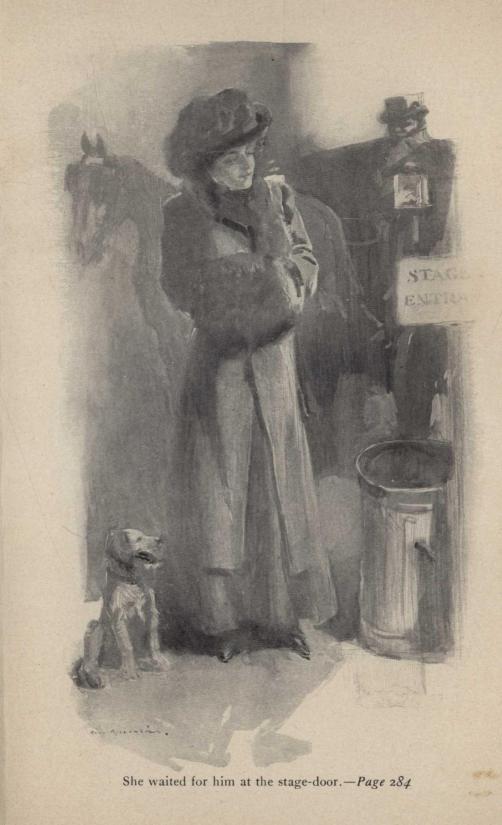
She waited for him at the stage-door.--Page 284
She alarmed Adair by pretending to carry the hugging into effect until he tried to push her away, and told her to behave. She replied with a delighted, bubbling outcry over her new freedom: "Oh, but I'm married now, and can do just what I like, and can have breakfast in bed with you every morning, and put my shoes out with yours to be blacked, and I'm Mrs. Adair, and have a wedding-ring, and a certificate with forked lightning on it!" She exultantly popped up her feet on the seat in front, showing a shocking amount of black silk stocking with a bravado that made him grab at her skirt to pull it down; and in the ensuing romp there was more silk stocking still, and so much happy laughter on her part, and scandalized protestation on his that the driver turned round, and they were all but disgraced.
The narrowness of the escape sobered her, and for the rest of the drive she was demureness itself. What a joy it was to recline with half-shut eyes, and let the air fan away all the troubled memories of the night before! Mind and body craved repose, and mind and body found it in the cradle-like movement of the carriage. Adair was very tired, too, and willing enough to share his pretty companion's mood. Deliciously conscious of each other, though more asleep than awake, they abandoned themselves to the fresh bright morning, and breathed in deep drafts of contentment.
On their return to the hotel, the carriage stopped and Tommy Merguelis jumped up on the step. His perennial grin, and withered, foolish face was not unclouded by a certain anxiety. He dropped a bunch of roses into Phyllis' lap, with an awkward compliment which got as far as she was a rose herself, and then ended midway with a terrified giggle.
"I'm awful sorry," he said, addressing Adair, "but you're wanted at the theater, Mr. Adair, and I've been chasing around after you for the last half-hour. They want you to rehearse right off with Miss Clarke, and coach her a bit in the business."
"Why, what's the matter with De Vere?" asked Adair, surprised.
A slight glaze seemed to spread itself over the grin.
"She won't be in the bill for a day or two," said Tommy. "She's been suddenly taken awful bad." He paused, seeking a decorous name for the attack in question, and finally veiled it in the obscurity of a foreign language: "A crisis de nerves," he added.
"Oh, tantrums?" said Adair in a plainer tongue. "What a confounded nuisance!"
"She kept yelling and yelling until we got the doctor," went on Tommy; "and then on top of that Miss Clarke had to get into a hair-pulling match with Miss Larkins--and so I think you had better hurry, Mr. Adair, if there's to be anything doing to-night."
"Great Lord, I think so, too!" cried the latter, to whom, like all stars, the evening performance was next to a religion. "You go on to the hotel," he went on, turning to Phyllis, "and make yourself as comfortable as you can." The vexation in his voice was even a better apology than the one in words. "I'm damned sorry," he said. "It's the most infernal shame. Forgive me, Phyllis, please do, and try not to mind."
Thus it was that she drove to the hotel alone, while Adair and Tommy strode off to quiet the tempest in the theater, and start a tedious and prolonged rehearsal with Miss de Vere's understudy.
Phyllis went to her room, and found one alleviation of its loneliness in examining that mysterious object, her wedding-ring. It was so strange, so unfamiliar, so charged with significance and finality. Just a trifling hoop of gold, and yet with what myriad meanings. Probably in days gone by, when of brass or iron it was riveted on the neck, little brides mirrored themselves in pools with a similar awe at their altered state, and a similar questioning of the unknown future.
For better or worse, for good or evil, her life was linked to Adair's beyond all recalling, and the emblem of their compact glittered on the hand she gazed at so long and earnestly.
But you can not hypnotize yourself for ever with a wedding-ring--even one not two hours old. There was another matter that called more insistently for her attention. Cyril had promised her two hundred and fifty dollars for her clothes, and it behooved her to get pen and ink, and begin making her calculations. This she did with much erasing, much crinkling of girlish brows--with a profound, wise-baby expression as though all the world were at stake. There was a delicious immodesty in spending Adair's money for such laced and ribboned femininities--nightgowns, stockings, chemises, and what she wrote down ambiguously as "those things," and colored as she wrote it. How thrilling it was, and how exquisitely shocking! Oh, dear, what nice ones they would have to be,--twenty-five dollars gone for six in the twinkling of an eye, for surely economy here would be a crime, men being notoriously fond of--
"Mrs. Adair?"
Her new name was so unfamiliar that she hesitated before answering: "Come in."
"A gentleman to see you, Mrs. Adair."
The door opened, and there on the threshold stood her father! His face was white, his eyes morose and sunken, his whole air so formidable that in the first shock of recognition Phyllis could do no more than stare at him in terror.
"May I enter?" he asked, in that deeper intonation of his which he never used except under some special stress. As he spoke he looked about sharply, and with a bristling hostility as though expecting to discover a second occupant of the room.
"Mr. Adair isn't here," she said, answering the silent question. "I am all alone, Papa."
She would have kissed him, but he brushed past her to a chair, and seated himself heavily, laying his silk hat and his gloves on the floor beside him. Thus stalwartly in possession of the chamber, he appeared more formidable than ever, and the deliberate gaze he bent on Phyllis was masterful and menacing.
"So you've gone and thrown away your life," he said at last. "Forgive me, my dear, if I am not able to congratulate you upon it."
"I married Mr. Adair this morning, if that's what you mean." She hardly knew how to say more without adding to her offense. Her father was bound to put her in the wrong whatever reply she made. A terrible hopelessness weighed her down, and crushed the unspoken appeal on her lips.
"Thrown away like that," he repeated, with a gesture. "You, who had everything; you, with beauty, position, money, brains--my God, the folly of it--the cruel, wicked, heartless folly of it!"
"Don't, Papa!" she pleaded. "It's done, and so what's the good of wounding me now?"
"Done!" he cried out bitterly. "That depends on what you mean by the word. I will call it done in six months when you will leave him for good, and he will name his price for a divorce. That's the way adventurers marry money nowadays. They enjoy the girl till they are tired of her, and then sell!"
Phyllis struggled to keep her composure under the affront. "You are very unjust," she returned in a low voice that trembled in spite of herself. "You are determined to think the worst of him, and make it impossible for us ever to be friends. But you are wrong, Papa. He's not an adventurer, nor anything like it. Surely I ought to know better than you, and if I have been willing to love him, and marry him--"
"Oh, I'm not going to argue with you about him," interrupted Mr. Ladd harshly. "You believe in him now, of course. One can't reason with lunatics, and I shan't try. I'll give you six months--perhaps even less--and then I want you to remember what I am saying to you now."
"That you were right?"--Her voice was scornful.--"Oh, Papa, this is unworthy of you."
"Phyllis," he retorted, "that's the last thing on earth I would ever say to you. If you should come back to me disillusioned, broken, utterly weary of the muddle you have made of it all, you will find everything unchanged between us and the whole matter as ignored as though it had never been. That's what you are to remember--that my heart and my purse will never be closed against you."
"Though both are dependent on my giving up my husband?"
"He will give you up, my dear, fast enough."
"How dare you say that, Papa--how dare you!" A mist of anger was in her eyes, and two spots of crimson glowed dangerously on her cheeks. Never in her life had she been more roused; up to that moment she had still hoped to save the day and win her father over, but now she perceived the irrevocable nature of what was being said. Yet outwardly, at least, she restrained herself, and hid within her quivering breast a tumult that seemed to rend her to pieces.
"If I seem to be misjudging Mr. Adair it is only because I know more about him that you do," continued Mr. Ladd in a tone not untinged with a grim satisfaction. Even as he spoke he drew out a thick packet, and unfolded it on his knee. It was a mass of typewriting, with here and there a notorial seal on paper of a different color, and an occasional newspaper cutting neatly pasted in the center of a little sea of comment. "Here we have him in black and white," he went on, "and frankly, Phyllis, he offers you a very poor promise of a happy married life."
"And you expect me on my wedding morning to sit down and read these things--these abominable slanders your detectives have scraped together?"
"Oh, no. But I demand to have Mr. Adair sit down and answer them."
"Would you believe him if he did?"
"Facts are facts. He can't deny them."
"And you called me unreasonable? Oh, Papa!"
Mr. Ladd ignored the taunt.
"When he appreciates that his whole disreputable past is known to me," he went on, with the same inflexible composure, "he may condescend to consider--an arrangement."
"An arrangement?--What do you mean?"
"I have brought a blank check with me," he explained. "He can name anything--and get it. I'd rather pay more now than less later."
His brutality overwhelmed her. It took her a few seconds to understand the incredible baseness he imputed to Adair. In the light of this her father's previous insults paled to insignificance. She was too stunned to make any reply, and for a while could do nothing but look at him in speechless wonder. Then she rose, and rang the bell.
"The marriage could be annulled," said Mr. Ladd, oblivious of everything except his one preoccupation. "The next thing is to keep the newspapers quiet, and that I can do. We'll go abroad--"
The darky came running up with a pitcher of ice water. No one ever rang for anything else in the Clarendon Hotel. He entered, jingling the ice.
"Show this gentleman out," said Phyllis, "and I want you to remember I shall not be home to him again."
"Phyllis!"
The entreaty in his voice moved her not a bit, nor the outstretched hand, veined, wrinkled and shaking.
"It's conceivable I may forgive you for this, Papa," she exclaimed, "though God knows it will be hard. But if you offer that check to Cyril I shall hate you till the day I die!"
"Have it your own way then," he returned dully, and with a curious break in his voice. "Take your own wilful road, and come back to me when your heart's broken. I'll be waiting for you, Phyllis, and ready to forget and forgive."
She disdained to make any reply. The darky officiously gathered up the silk hat and gloves from the floor, and presented them to Mr. Ladd. The latter, with a last look at his daughter's unrelenting face, turned in silence, and passed out.
"The stairs are to the left, sah," said the darky.
CHAPTER XVIII
Whether disillusion was finally destined to arrive or not, there was certainly not a hint of it during those succeeding weeks. There was no happier little bride in America, than Phyllis Adair, and intimate acquaintance with that extraordinary creature, man, only redoubled her delight in him. The bigness, directness, simplicity, intolerance, and dog-like devotion of her husband were an unfailing joy to her. No little girl who had been given a coveted St. Bernard could have taken more anxious, eager, excited care of him. She would feed Adair with the daintiest morsels from her own plate; she would exert every faculty she possessed to amuse and distract him when he fell into one of his despondent moods; she would mock him with such pretty archness when he grew irritable over trifles. "Damn it all, where did that fool Williams put my patent leather shoes?"--"Damn it all, you will find them in the bottom of the wardrobe neatly ranged with the others," she would answer. No matter how ill his humor she always found the means to make him smile; her quick wit, or her slim, audacious body each exultantly willing to tease and bewitch him.
Of all human gifts surely that of loving has received the least general recognition. A genius for music, a genius for mathematics or natural history, or sculpture, or mechanics, is at once admitted and acclaimed. But what of a genius for loving, which of all is infinitely the rarest? The trouble is that every one is conceited enough to think that he (or she) is a wonder at it. But frankly, do we really indeed see so many love-geniuses about us? Are we not rather struck instead by an almost universal love-poverty? If the husband stays drearily at home every night of his life, and if the wife is entirely absorbed in the baby, are we not asked enthusiastically to applaud a happy home? This is the national ideal, and tens of thousands are yawning heroically through it. But where's love in any but half-pint sizes? Everybody insists it is there in barrelfuls, much as they insisted in the fairy tale in the case of the man with the invisible clothes.--We are not defending hubby when he gets tangled up with the blonde lady, but emotionally speaking (only emotionally, be it understood), it may be an upward step. If you have a ten per cent. capacity to love, it is hard to be fobbed off with a four per cent. partner.
Phyllis was one of the chosen few in whom the capacity to love was inordinate. Her one thought was to make herself indispensable to the man to whom she had given herself. Adair was the last thing in her head at night, the first at dawn. Hardly was there an act of hers in which his personality was not a contributing factor. Her insatiable ambition was to please and delight him, and her brain was ever busy to find fresh ways, and improve on the old. Her finesse, her humor, her ardent and tender imagination--all were enlisted to a single end. Passion she had in plenty, for she was of a voluptuous nature, and the blood coursed hotly in her veins--but she had more than that to give him, and was possessed of a thousand captivating arts to ensnare this love that was said to be so elusive, and bind it tight with a myriad silken threads.
It will be asked was Adair worthy of so supreme a devotion? Is it not enough to answer that he was not altogether unworthy? There was a lot of human clay in the creature, and while Phyllis was exerting all her blithe young ardor to keep the altar-fires aflame, he was content to look on lazily, and man-like, take many things for granted. Had she been no better, their love would have run the ordinary course, and perished fast enough on the rocks of habit and satiety. Adair's spiritual side was all but dormant. He was encased in materialism as stoutly as some of us in fat; whatever gropings he had toward higher things were all in the direction of the stage. Feelings he could not initiate himself he took here ready made, and showed almost a genius in their comprehension. He presented a paradox of one who could admirably "get into" any written character, and yet who was wholly unable to "get into" his own.
Phyllis knew much more what laid beneath than he. To her the yearning, troubled, inarticulate soul of the man appealed as pathetically as the sight of some great, ashamed, bearded fellow who had never been taught to read. In the finer sense Adair had never been taught anything. His instincts alone had saved him from being a clod. In his fight up from the bottom he had arrived a good deal splashed with mud; and Phyllis, figuratively speaking, rolled back her sleeves, and set herself to tubbing him.
He was extraordinarily submissive in this respect, extraordinarily grateful and responsive. He made no pretense of hiding his ignorance, but questioned her like a child, and often as artlessly. At thirty-four he was having the universe reconstructed for him, and the process filled him with astonishment. Phyllis read aloud to him from such unheard-of authors as Thackeray, Carlyle, Hardy, Stevenson, and Meredith until these strange names became quite familiar. She could read French, too, translating as she went, while he sat back, profoundly respectful and impressed, his humility tinged with the zest of ownership. Yes, her youth, her beauty, her intelligence, her love, all were his; and as he gazed at her through the haze of his cigar, the words often fell heedlessly on his ear as he felt the mantling of a divine contentment.
Yet he could be very masterful on some matters. Phyllis was not allowed to receive the advances of the company, or to associate with any of its members, a prohibition not a little difficult to obey in the course of their constant traveling together. But if Phyllis shrank from being rude, Adair suffered from no similar delicacy, and was brutally direct in making his wishes plain to his stage companions. It was not only that he feared Lydia de Vere, whose yellowish eyes were full of enmity, and whose powers for mischief he well knew; but in contrast to his dainty wife these theater-people somehow began to strike him as tarnished and common, and he was jealously reluctant to expose her to their familiarities. Intercourse with Phyllis was sharpening his critical faculty; his view-point was insensibly changing; there were even times when he realized his own deficiencies.--Tommy Merguelis was the one exception he made. The lanky young man, when weighed in the new scales, was found to be less wanting than the others. There was something sensitive and refined about Tommy. Ill-health, pins, and years of furniture-polish had been as cleansing fires. He was a humble person who would accept his humble inch and grin gratefully, and not reach out for an ell. Yes, Phyllis might be friends with Tommy.
With them on their travels from town to town went a punching-bag, which Adair inflated and set up as soon as their trunks were unpacked. Every morning, stripped to the waist, Phyllis had to double up her little fists, and start a-pummelling for ten furious minutes. There could be no begging off from this daily rite; it was one of the iron rules of married life; pleadings, caresses, protests all were in vain. An icy bath had to follow, and if she hesitated too long on the brink, or showed too mutinous a row of toes, Adair would jump up, and tumble her in as mercilessly as a boy with a puppy. At night, too, he was no less rigid in regard to her prayers. His own religion was very nebulous. He never prayed himself nor went to church; but apparently that was no reason why Phyllis should be similarly backward. It gave him a peculiar pleasure to see her kneeling beside the bed, her night dress flowing about her slender, girlish body, and her hair drawn back, and held by a circlet of red ribbon. He knew no prettier picture, nor was it without a tender and uplifting value. For it was his name that moved on her lips, and who would not have been proud to send so enchanting a little deputy to plead for one before the Throne of Grace? Then it was that he seemed to love her best; and though all unaware of it, he, too, was praying in the deeper, unspoken language of the heart.
"You've forgotten your prayers!"
"Oh, it was so cold--I thought I wouldn't to-night."
"Jump up!"
"It's so cosy here with you--and you ought to have said it sooner--and anyhow, I won't."
"Jump up!"
"Oh, Cyril, that hurts!"
"Of course, it hurts."
"It's wicked to pinch as hard as that."
"It's wickeder not to say your prayers."
"Oh, Cyril, don't, don't!"
"Jump up, then."
"I'm not in the right frame of mind now--you have pinched it all away.--All right, all right, don't--I'll do it! Though I don't think a pinch-prayer would be as good as a real one. Do you?"
"This is the prayer-rush time--God won't notice it."
"Not even if I am black and blue? Why, the angels will be shocked."
"They are that already with the fuss you have made. Roll out, you bad little chap,--out with you!"
Sometimes Adair was sharp with her--impatient and fretful. He made very little effort to control his moods, which, as with most artists, were as changeable and capricious as those of a child. Nine women out of ten would have retorted in kind, and the honeymoon period would have insensibly passed, and with it much of the charm and rapture of their union. It was due to no help of Adair's that they did not descend to the ordinary plane of married life, with its deliquescence of nearly everything beautiful and romantic--occasional harshness on one side, tears and pin-prickings on the other, and departing illusions on both. People can still get along very tolerably in this manner, and remain fairly fond and faithful, but no one can contend it is the poet's ideal. It was certainly not Phyllis', and she was determined to avoid such a catastrophe.
In her ambitious little head the honeymoon was to be only the beginning of a sweeter intimacy beyond. She saw, lying latent in Adair, a capacity to love as great as her own (she was presumptuous enough to think that no one could love any better), and her one consuming endeavor was to draw it forth. Whether or not the prize was worth the winning never occurred to her. This big, splendid, untamed man-animal was hers, with all his weaknesses and defects, with all his fine qualities and bad, and she had accepted the responsibility of him with naïve self-confidence. To love was her vocation, and she set herself to it with delight.
Her unfailing gaiety, her pretty artifices to amuse and cajole him, her constant study of means to give him pleasure--all were as the drops that wear away the stone. High-spirited, quick-tempered, and with a sensitiveness that a glance could wound, she yet put such a rein upon herself that no provocation could draw from her an unkind word. She might grow suddenly silent, her mouth might quiver, her eyes glisten, but no sharp retort ever passed her lips. There are many men with whom this would not have answered. To some, indeed, an exquisite gentleness and forbearance almost tempts their harshness. Feeling themselves in the wrong their vanity is insulted, and with morbid perversity they go from bad to worse. But Adair was not of this sort. With all his faults he was a man of generous instincts, and capable of quick and headlong repentances. He could come in like a thunder-cloud, on edge with nerves, snappish, morose, ready to fly off the tangent at a trifle--and five minutes later would be sitting at Phyllis' feet, his face in her lap, conquered, contrite, declaiming hotly against himself, his ill-temper all striking inward.
These lapses of his helped his love much more than they hurt it, and through them he began to acquire some self-control, some degree of consideration--some shame. In him devotion brought out devotion. Instead of resenting Phyllis' strategems to keep him good-humored and happy, he was touched to the quick. It was a new idea, this of keeping love alight; of consecrating thought and care to it and guarding the precious flame from extinction. It dawned upon him as something entirely novel and unheard-of. Yet it was beautiful; he approved of it heartily. He innocently ascribed the invention to Phyllis, and as usual was tremendously impressed. It made him wonder whether she ever thought of anything else but love. As he grew to know her better he saw that it inspired all she did--that every impulse and every action sprang from it.
Had he been a king, and she the transient, pretty butterfly of the moment, she could not have striven harder to fascinate and hold him. Her saucy tongue, her fancifulness, her audacity, her often-declared determination to be as much sweetheart as wife--all were as spice to a love that might otherwise have cloyed. To adore a man is not enough--there is nothing the poor darling silly animal gets tired of so soon as being adored.--One had to keep him interested, captivated, filling in one's own little person all his complicated needs of passion, comradeship, entertainment, variety, and mental recreation. But how well one was repaid! If one gave a whole harem's worth of love, one received a whole harem's worth back, and sweetest of all one could watch the unfolding and ripening of a really fine nature. She was sure her infatuation had guided her truly in that respect; that her choice had fallen on a man with heart and soul big enough to repay her devotion. He might be rough, but she had never a moment's doubt as to the diamond, nor as to her ability to shape and polish it.
It was a process, unfortunately, that could not be hurried. Against her in the endeavor were the ingrained habits and wilfulness of twenty years. From his boyhood up Adair had lived in an atmosphere of unrestraint, a Bohemian of Bohemians, without ties, care-free, the whim of the moment his only guide. Some backslidings on his part were inevitable and Phyllis, with all her illusions, was sane and cool enough to foresee them. It was hardly a surprise to her, therefore, though frightening and dismaying, when late one night, after awaiting him in vain, Tommy Merguelis appeared unexpectedly in his stead. Any stranger to the young man would have judged him to be in high spirits; his shrill, nervous laugh was louder than usual; and he stammered and giggled as though bubbling over with an unextinguishable good nature. To Phyllis' practised eyes, however, these were ominous signs, and her breath came a little quickly, as she asked news of her husband.
"Oh, he's all right," said Tommy, standing with one hand on the door-knob, and showing no inclination to enter the room. "Oh, Mr. Adair is all right--and hee, hee, don't you worry about him. He's detained, that's all, and he sent me to say he might be late, and, and--"
"And what?"
"They've got him into a game down at Mr. Feld's--the owner of the theater, hee, hee--and he couldn't well refuse, or at least--"
"Oh, Tommy, please--I don't understand."
"Just a little game of draw."
"Cards?"
"Yes--poker."
This did not strike Phyllis as anything very terrible.
"And he sent you to tell me he would be late?" she inquired, much reassured.
Tommy lied manfully. As a matter of fact he had invented the message--and the errand--to shield Adair, who had forgotten everything in the absorption of the game. "Yes," he said, "he can't manage to be back to supper with you, and is awful sorry about it, and hopes you won't mind." Though Tommy could lie, he could not act. His anxiety was obvious; he wriggled uncomfortably; and his silly, convulsive smile presaged some disagreeable revelation. Phyllis, now thoroughly alarmed, and with characteristic directness went straight for the truth.
"Tommy, has he been drinking?"
"Oh, ah, well, hee, hee--yes, he has."
"And they are playing high?"
"A dollar limit."
"And you came here to warn me? Don't deny it,"
"Oh, ah, well, hee, hee--yes, I did, Mrs. Adair."--As Phyllis paused, troubled, uncertain, full of distress, Tommy added: "I don't know as it wouldn't be a good plan for you to come along with me and get him."
"Would he come?"
"Anybody would come for you, Mrs. Adair."
"Surely he doesn't often gamble, Tommy. He has never spoken to me of it?"
"Oh, there's nothing he don't do when the fit takes him. Hee, hee, he's that kind, you know--temperamental."
The word, and the woebegone indulgence with which it was uttered made Phyllis smile. Her humor was always close to the surface, even when there were tears between.
"You are a dear, good fellow," she said, "and I'll never forget your kindness to-night, though as for doing anything, I am going to stay here."
He was amazed at the gentleness of her tone.
"I am never going to be his taskmaster," she went on, as much to herself as to Tommy. "As far as I am concerned he shall always be as free as air. If I went after him at all, it would be to sit on his knee, and drink with him."
Tommy's scandalized face again made her laugh.
"Don't be afraid," she said with tremulous gaiety, "I won't do it this evening, anyhow. Now run away, Tommy, and tell them down-stairs we shan't need any supper after all."
She shut the door after him, and stood with her back to it, forlornly regarding the empty room. She was more than hurt, more than mortified. She had to ask herself if she had failed.
CHAPTER XIX
It was dawn when Adair staggered in, undressed and rolled in beside her. Her long vigil had been succeeded by an overpowering slumber, and she was not aware of his return until the streaming sunshine awakened her toward nine o'clock. She wondered at first why her heart was so heavy, and then, with reviving recollection, sat up, and gazed at her sleeping husband. Even a debauch could not impair his fine complexion, and the thick, black hair clustered against the ruddy skin softened Phyllis' expression as she studied his face long and earnestly. The charm of that vigorous manhood was irresistible, and whatever lurking grudge she still had against Adair was lost in a fresh access of tenderness. His uneasy breathing, his hot dry forehead, his parched and parted lips, all appealed as well to the woman in her--the mother, the nurse.
For once the routine of punching-bag and bath was forgone, and her first task on rising was to set about preparing breakfast. This, with the pair, was a trifling matter, consisting of rolls, cream and butter ordered over night and set outside their door on a tray every morning, and the coffee Phyllis made herself over a spirit lamp. She was thus busily engaged when she was conscious of a movement on the bed, and turned to see her husband lowering at her with bloodshot eyes. Awake, he looked disheveled, surly, ill and exasperated. His head was splitting, and he was in one of those vile humors when a man avenges his physical distress on those about him. He pushed Phyllis away as she ran over to him, and told her roughly to leave him alone. The offer of a cup of coffee outraged him. Groaning and swearing, he pulled himself into a sitting posture, and in a voice as intentionally disagreeable as he could make it demanded some hot water.
Holding the cup in both hands, he began to drink it in angry little sips, finding a malign satisfaction in the change that had come over Phyllis. Pale, silent, wounded and frightened, she was utterly at loss to know what to do. Every word was a stab, and she had a stupefying feeling that the end had come. Her only coherent thought, the only manifestation of resentment within her, was to contribute nothing to bring about the catastrophe. If Adair were determined to pull down their little paradise about their ears, and destroy for ever the filmy and poetic fabric of a perfect love, she, at least, would hold herself innocent of the sacrilege. But, oh, the pang of it, the heartrending misery, the disillusion!
"Now, go ahead," he said sullenly. "I'm ready--go ahead!"
She faltered and trembled in asking him what he meant.
He burst out with a scornful laugh.
"I was drunk last night," he said, "you know that as well as I do, and here I am ready to take my medicine--can't avoid it, I know that--and want to get it over with. You wouldn't be a woman if you didn't pay me out."
The vulgarity of the conception stung her.
"I--I don't pay people out," she said simply.
"Oh, no, you're the quiet kind," he went on with an ugly jeer, intent somehow on putting her in the wrong. "You don't say anything, but you sit there and freeze a fellow--and oh, my God, yes, cry! There you go, cry, cry, cry!"
She did break down for a moment under his deliberate cruelty, but quickly rallying, came over, and sat beside him on the bed.
"Don't, don't quarrel with me," she said pitifully, and then added with a gleam of humor, "after all, it wasn't I that was drunk, you know."
She put out her hand, and for a while he permitted it to lie against his aching forehead. All would have been well had he not unfortunately spilled his cup. At this his latent fury broke out anew.
"For God's sake, don't crowd all over me!" he cried. "Sit over there, where we can talk like sensible people. You have made me all wet with the damned stuff."
The fault was his own, and due to his unsteady hands, but he was wilfully pleased to put her in the wrong. He glowered at her with savage reproach as she moved a little farther away in obedience to his command. She was disconcertingly quiet, and it seemed to him an added injustice to be cheated of a scene. There was nothing but her anguished eyes, and her drooping and utterly dispiriting attitude to tell him how well he was succeeding.
"You're a little fool," he announced inconsequently.
He waited for her to answer, but she made no sign of having heard him, sitting there stricken, numb.
"To have tied up with such a damned goat," he added, with immense conviction.
Still no answer.
"The best thing you can do is to pack up and go," he went on.
At this she did find her voice, ghost of a one that it was.
"Is that what you really want me to do, Cyril?"
"It's what you ought to do," he returned, with a sternly paternal air.
"It's for you to decide."
His mumbling reply turned into a groan.
"I lost nearly four hundred dollars last night," he said, after a deadly pause. "Then I had to get into a scrap with Jake Steinberger, and Willie Latimer, and George Wright, and there was a hell of a shindy till somebody turned in a police-alarm, and I only dodged arrest by the skin of my teeth--not but what I'll be summonsed to-day, sure as sure. On top of that my engagement is gone, for I lammed Jake half to death, and I guess he had rather break up the tour all-standing than keep me in the bill another night. And--and--"
"You thought you'd make a clean sweep of everything, once you were at it, and alienate me, too?"
"Yes, like a damned goat," he repeated dully.
"Well, you have succeeded," she said in the same low, even tone, "I dare say you'll be sorry some day at having broken your toys. There isn't anything more to be said, is there, except good-by?"
She was about to rise when Adair flung himself out of the bed, and kneeling before her, pulled off her little slippers and began kissing her naked feet. His repentance was so sudden, so abject that it was almost as though he had gone crazy. It was indeed an hysterical revulsion, and his frame shook, and his hands clenched themselves on her flesh as he abased himself before her. He begged incoherently for forgiveness, for mercy; he would kill himself if she were to leave him; he loved her; he could die for her; the disgrace and despair of it all had driven him mad. At first she resisted, struggling to free herself, and too deeply affronted for any atoning words to touch her; but her powerlessness in his grasp, the warmth of his quick, tumultuous breath against her, even the physical pain he was unconsciously inflicting--all at last took her womanhood by storm, and she drew up his head, and allowed him to sob his heart out in her lap.
How little did either of them know, she sitting on the bed in her night-dress, he nestling close against her in an agony of shame and contrition, that a battle of the soul had been fought and won; that the finer nature had triumphed over the coarser; that an insensible but a most real step had been taken upward. Phyllis extorted no promises; Adair made no vows; rather they clung to each other like little children who had safely passed the edge of a precipice, and in security beyond were trembling at what they had risked.
The woman, always the more practical partner, was the first to descend from the clouds to mundane considerations.
"And what's the poor little damned goat going to do?" she asked, the quoted profanity on her pretty lips as piquant and tender as a lullaby; and accompanying it with a smile so arch that Adair's face, too, could not but light with it.
"Face the music and then get out," returned the D. G.
"Out where, dearest?"
Adair grew overcast.
"Mortimer Clark's on the road somewhere," he said reflectively, "and I'm sure he'd make room for me if he had to fire a whole company. Then there's Nan O'Farrell in the Diamond Diadem and Leo Foster in the Slaves of Circumstance. They are all on the cheap, and would jump at the chance of getting me at their prices. As soon as I get round to it, I'll telegraph."