THE OMAHA TRIBAL PRAYER.
Reading edition
According to the Omaha idea, a child during its infancy had no recognised existence as an individual or distinct member of the tribe, but remained as a part of its parents. When it could walk alone, at about three years of age, it was initiated into the tribal organisation through certain religious rites; but its responsible and individual life did not begin until its mind had "become white," as the Indians say. This expression referred to the dawn, to the passing of night into day, and represented the coming of the child out of the period where nothing was clearly apprehended into a time when he could readily recall past events with their distinctness of detail. This seeming mastery of the minutiæ of passing occurrences indicated that a stage of growth had been reached where the youth could be inducted into the religious mysteries through a distinct personal experience acquired in the rite, Non´-zhin-zhon,—a rite which brought him into what was believed to be direct communication with the supernatural powers.
In preparation for this rite the Omaha youth was taught the Tribal Prayer. He was to sing it during the four nights and days of his vigil in some lonely place. As he left his home, his parents put clay on his head; and, to teach him self-control, they placed a bow and arrows in his hand, with the injunction not to use them during his long fast, no matter how great the temptation might be. He was bidden to weep as he sang the prayer, and to wipe his tears with the palms of his hands, to lift his wet hands to heaven, and then lay them on the earth. With these instructions the youth departed, to enter upon the trial of his endurance. When at last he fell into a sleep or trance, and the vision came, of bird, or beast, or cloud, bringing with it a cadence, this song became ever after the medium of communication between the man and the mysterious power typified in his vision; and by it he summoned help and strength in the hour of his need.
In this manner all mystery songs originated,—the songs sung when healing plants were gathered and when the medicine was administered; when a man set his traps or hunted for game; when he desired to look into the future or sought supernatural guidance, or deliverance from impending danger.
The Tribal Prayer was called in the Omaha tongue Wa-kon´-da gi-kon: Wa-kon´-da, the power which could make or bring to pass; gi-kon, to weep from conscious insufficiency, or the longing for something that could bring happiness or prosperity. The words of the prayer, Wa-kon´-da dhe-dhu wah-pa´-dhin a-ton´-he, literally rendered, are, Wa-kon´-da, here needy he stands; and I am he.
This prayer is very old. Its supplicating cadences echoed through the forests of this land long before our race had touched its shores, voicing a cry recognised by every human heart.
THE OMAHA TRIBAL PRAYER.
Harmonized by Prof. J.C. Fillmore.
[Listen] [PDF] [MusicXML]
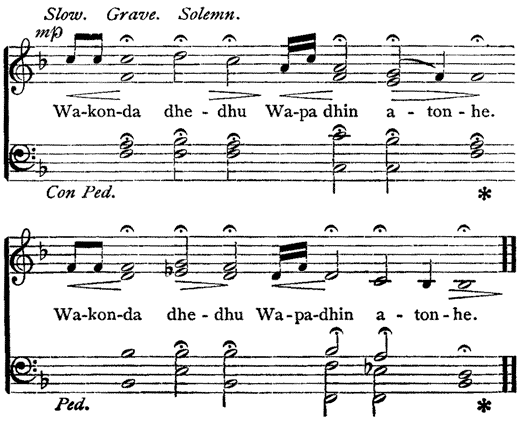
Wa-kon-da dhe-dhu Wa-pa-dhin a-ton-he. Wa-kon-da dhe-dhu Wa-pa-dhin a-ton-he.